The Essay That Is


Here you go, the answer I should have written for the prompt I gave my AP Lit students this week.

Maybe.

AP English Literature and Composition 2023 Free Response Question #3:

Many works of literature feature a rebel character who changes or disrupts the existing state of societal, familial, or political affairs in the text. They may break social norms, challenge long-held values, subvert expectations, or participate in other forms of resistance. The character’s motivation for this rebellious behavior is often complex. 

Either from your reading or from the list below, choose a work of fiction in which a character changes or disrupts the existing state of societal, familial, or political affairs. Then, in a well-written essay, analyze how the complex motivation of the rebel contributes to an interpretation of the work as a whole.

How does one become a rebel?

It seems like a simple question, but I don’t think it is. There is one obvious way that one could become a rebel: one could be made into a rebel by the sudden appearance or dominance of an authority that takes away the freedom or the lifestyle that one was familiar and comfortable with; if another country invaded this one and overthrew my government and imposed Draconian laws on me, I would rebel against that invader. But first, that seems uncommon; though there have certainly been such invasions and takeovers in the past, they are not the norm; and second, “rebel” implies that there is an established authority, an accepted norm, which the rebel then fights back against — if there is an invasion and a conqueror, then really one who fought that would be a freedom fighter, not a rebel. The invading conqueror would call you a rebel, sure, but only because they want to pretend their power grab was legitimate; and that’s just propaganda.

If you are not conquered by an outside force, then either you were born a rebel, and had to grow up under the established authority, which would make it hard to stay rebellious as they would pressure you, all the time, from all sides, to conform to what is accepted; or the oppressive regime had to grow slowly, over time, getting worse and worse — and then the question becomes, what would be the final straw? What would push you, at the last, from grumbling about the government, to fighting back against the government? Sometimes there may be a sudden shift, a surprise attack that would move the needle well beyond what was acceptable all of a sudden; but I think most authority doesn’t work that way — and surely social conventions do not. The American Revolution was motivated by a long serious of usurpations and abuses, according to the Declaration of Independence; though the American Civil War kicked off after Abraham Lincoln was elected president, there were a hundred smaller elements of the conflict before that. So why was one of the earlier actions of the authority not the one that set off the rebellion? Why was it not a later one? What makes the last straw the last straw?

Those, I think, are not easy questions to answer. But I surely would like to know, not least because I am an authority figure in a classroom full of naturally rebellious people; and not least because I live in a country that at times seems to be sliding slowly into tyranny, one which I will not accept — but where will I draw the line? What is the right place to draw the line?

In the novel Fahrenheit 451 by Ray Bradbury, the protagonist Guy Montag becomes a rebel. But he does not start that way. In fact, Montag lives his entire life, until 30 years of age, not only accepting the norms and authorities that control him, but actively participating, encouraging, defending those norms and that authority: Montag is a fireman in a society where firemen, formerly rescuers, are now tasked with eliminating the possibility of rebellion, by destroying free thought and free thinkers. In the novel, the society — an American society set some number of centuries in the future — uses the particular oppressive mechanism of ignorance: they have banned, and now routinely destroy, all books. Montag burns books. It is the first thing that happens in the story, and even more, we immediately know that Montag loves it: the first line of the book is “It was a pleasure to burn.” Even later, when he has changed and is working against the oppressive society that raised him, he still loves burning, he still loves destruction; he still turns to it as a solution to his problems, even though he knows it doesn’t work. But old habits die hard: and that’s my point about rebellion. If a rebel, like Montag, grew up in the oppressive regime, how would they maintain their will to fight back, for their whole lives? Montag has the seed of rebellion in him even before the events of the book bring it to fruition: he steals books that he is supposed to burn, and keeps them; he has been doing this for a year before the novel’s plot begins, and has twenty or so illicit books inside his house. He also fails to report a book reader he meets in a park, simply keeping his name and address in his own personal files, even though in the encounter he knew the old man had a book of poetry in his pocket. So even before the book starts, Montag is not entirely conformist, not completely comfortable with who he is and the world that has made him this way: but he does not at first rebel against it. He does end up subverting expectations, by turning on the very society he helps prop up; but before that, he had to conform to the expectations before he could subvert them. And which act is more significant? If I spend ten years kicking your ankles, and then one day get you an ice pack for your bruises — and I now the good guy? Is Montag?

Clarisse, on the other hand, has always been a rebel: we are told that this young woman, Montag’s neighbor, has always been different, has never fit in. And we can see the cost of that: she is being watched carefully, along with her whole family, by the government, Fire Captain Beatty reveals to us; Clarisse tells us that she has been often kept out of school and has to report to a psychiatrist to make her act “right.” She says that she doesn’t really have any friends among her peers, because children her age scare her: bereft of the empathy and broader perspective that reading books can provide, along with the other results of living under an oppressive tyranny, the young people in this world are savage and violent, killing people for fun. Clarisse is different, and her difference has an effect on Montag: when she speaks to him, in a way that is not any longer an accepted and conventional way of speaking to people, she inspires in him a curiosity that drives him to try to learn things he didn’t know before. This is certainly part of what makes Montag a rebel: but it is also probably part of what kills Clarisse, who vanishes early on in the book, never to return; we are told she was killed in a car accident, which is probable, considering how the people act and how they drive; but also, maybe the government removed a threat to their control over the people. 

So why isn’t that done to Montag? 

It makes sense that he would be driven to fight back once he realizes that Clarisse had shown him how terrible his world is; but why does he realize that? He responds more honestly and openly to Clarisse when she starts speaking to him; she comments on it. But wouldn’t that imply he was willing to speak to the “crazy” people like Clarisse before, and just never got caught at it? Why didn’t he get caught? Captain Beatty knows right away that Montag has been speaking to Clarisse. It’s one of the great things about this novel: the ruling power structure is not stupid, and are more than capable of discovering and eliminating threats to their hold on power. 1984 makes the same point, even more effectively, because in that book, Big Brother wins — which raises the question of just how rebellious is Winston Smith?

How rebellious is Montag? Are you rebellious if you fail?

Clarisse was rebellious in following her passions and her curiosity, exploring her world, speaking to people as she wanted to, rejecting the mind numbing activities and schooling that keeps all of her peers asleep in their own lives; in all of that, she rebels, and is successful at it. But she never even thinks about attacking the power structure: she just wants to stay alive. That makes sense to me. Faber, too, the old man in the park with a poetry book whom Montag did not turn in, is somewhat rebellious in mind and heart: he has considered ways that the power structure could be fought, mostly eliminating impossibilities — which shows how existing effective power structures become incredibly adept at preventing rebellion — but keeping a couple of tricks up his sleeve; when Montag comes to him looking for help and advice, Faber is able to give Montag at least a little bit. But he doesn’t actually help. He advises Montag against taking action. He refuses to do anything more than talk to Montag while Montag takes all the risks. I don’t know how rebellious that is, though Faber is rebel-adjacent, at least. 

But that only occurs because Montag refused, on a whim, to turn Faber in when he should have, and now Montag has a desire to rebel — and no idea how he should actually do it.

So what pushed Montag to rebellion?

He mentions a few experiences: Clarisse’s death, after her friendship with Montag, is certainly one. Another is that Mildred, his wife of ten years, overdoses on pills right at the beginning of the book; the clear depiction of this in the novel is that overdoses like hers are incredibly common — the hospital doesn’t admit her, instead sending technicians to her home to pump her stomach and filter her blood, and when Montag asks why there isn’t a doctor there to help her, they laugh and say that’s not necessary, all they need is the machines and two plumbers. And they do treat her like a broken toilet, for whom they don’t care one way or another: because Mildred is nothing special, just like all the other people who live or die in this world. So Montag recognizes the heartlessness of his society, separate from Clarisse’s example. But also, when the firemen talk about how they use the Mechanical Hound, a robot who tracks fugitives by smell and kills them with a massive overdose of opiates, to alleviate boredom by setting it to kill one of a small group of animals released in a closed space, betting on which one will get caught and killed, Montag mentions how he stopped participating in that practice some time ago. So did he have empathy before? How? If it was strong enough to affect him, how did he not get caught showing unseemly feelings for his fellow men, or even just for the cats the firemen set the Mechanical Hound to kill?

Did he hide his non-conforming attitudes and behaviors? How? He’s not really an actor: when he does try to pretend that everything is fine, he is in a constant state of near-panic, and Captain Beatty always knows it — though Beatty doesn’t always comment on it. Beatty knows how to keep secrets.

Want to know one secret Beatty kept? He has read books. Lots of books. The clear implication is that Beatty was once a reader and lover of reading, but then was convinced to join the forces of darkness and oppression, and he does it, gladly and whole-heartedly. It’s another question which could (and should) be explored: why do rebels sometimes stop rebelling, and swing all the other way to become enforcers of the status quo? 

One more influence that seems to help drive Montag to rebellion is the woman on Elm St. — my personal hero in this book — who, when the firemen show up at her house to burn her books, and threaten to burn her, beats them to the punch, setting her own house and her own self ablaze. Montag is strongly affected by it, which again shows that he may be different, that he may care more when people die horribly; but the other firemen are silent, as well, as they drive away. So they seem to be affected by this, just like Montag. So why does he resist, and the others do not? 

To return to the main question, then: what drives Montag to rebel? Because he does, finally, rebel: he reads the books he stole, and then when Mildred brings her vacuous friends over to watch TV with her, he reads a poem from a book at them — Matthew Arnold’s “Dover Beach,” about the slow loss of faith in the world and the terrible emptiness that remains when all hope and goodness are lost. And maybe that poem represents why Montag fights back against his society; but also, in the poem, Arnold doesn’t fight against the loss of faith, he simply asks for true love to protect himself and his new wife from the terrible darkness and the dangers all around them. Like Faber, he accepts the loss of a good world, and tries to survive if he can. Not so Montag, who then goes on to fight more openly and aggressively: when Beatty tries to arrest Montag, knowing that he has stolen a book and read it (Montag is reported for the Dover Beach incident, though that’s not the only way Beatty knows about Montag’s defiance of their norms), Montag instead murders Beatty, assaults two other firemen, destroys the Mechanical Hound, and goes on the run. On the way out of town, he also stops and plants his own ill-gotten books in the home of another fireman, calling in the alarm himself so that the fireman will lose his home and suffer suspicion that he won’t deserve. Is that rebellion? In a way, certainly, because he’s breaking the rules and harming an enforcer of the tyrannical government; but also, that fireman is no more guilty of oppressing society than is Montag himself. 

Is it rebellious if you remove yourself as an enforcer of norms and conventions? If you simply refuse to participate in making other people toe the line, are you a rebel? Doesn’t feel like enough. Imagine if George Washington had just — not collected the Stamp Tax. So if pulling himself out of the ranks of enforcers isn’t enough to make Montag really a rebel, then why would it be enough to ruin one other guy’s life? Just one more drone removed from the ranks; what is the point of that? There are always more drones.

Then again: if Clarisse was the catalyst for Montag’s rebellion, then maybe losing their home to an unfair raid by the firemen would be enough to change the views of Mr. and Mrs. Black.

In the end, it is not really clear why Montag rebels. He doesn’t plan it out, he doesn’t think about it; he just does it — and he doesn’t know what he’s doing or why while he is actually doing it, in most cases. When he steals a book from the home of the woman on Elm St., he watches his hands tuck the book inside his jacket, and he describes them as someone else’s hands, not his, nothing to do with him; clearly that isn’t true, but it shows his understanding of his actions at the time — or rather, his almost total lack of understanding. He wonders, repeatedly, why Clarisse affected him so much; he also asks where she came from, how someone like her could exist. And we don’t know. Her family is different: but why are they allowed to exist? We know why Faber exists and lives in this society that is everything he hates: he is a coward, self-professed, and cannot bear the thought of fighting; even when he joins Montag, Faber actually does nothing active or practical to fight against the government that has taken everything away from him, over the course of decades. He helps a rebel, but he isn’t one. 

This is the final message of Bradbury’s book, and of his characterization of Montag as the protagonist and main rebel against this dystopian regime: Montag doesn’t have any special reason to rebel. Montag is not in any way special. He’s just a guy. He’s not particularly smart, he’s not particularly brave, he doesn’t really have any insights; within his circumstances, the things that happen to him are not that extraordinary. But for some reason, they affect Montag just a little bit differently, just a little bit more, than they might affect another person — and so everything changes.

That’s the point. Regimes like this dystopian nightmare are doomed: because nobody can predict what would make someone rebel. The totalitarian tyranny would naturally seek to eliminate all questions, all threats, all non-conformity; and they would probably do so very effectively. But it doesn’t take much to make someone take action. Sometimes, all it takes is one friend: gaining one friend, and losing one friend. Sometimes all it takes is realizing the answer to one simple question: Are you happy? Montag realizes he is not: and that’s what makes him fight to change his world. 

But Bradbury’s book, unlike the film versions that have been made based on it, is also not that hopeful: because in the end of Bradbury’s novel, the result of Montag’s rebellion is — nothing. He has no impact whatsoever. The tyrannical government collapses on itself through its own actions, not because Montag saved the day. So while the government’s attempt to prevent rebels like Montag from existing is hopeless, because the motivation, the driving force behind those rebels is mysterious and will always remain so; the rebellion of people like Montag is equally hopeless: because while the flapping of a butterfly’s wings can start a hurricane on the other side of the world, it can’t save human society. 

Because it can’t make people want to read books. 

However: that isn’t the end of this. Because Bradbury’s book is not just about people reading books, nor is it simply about a dystopian world with a totalitarian state; it is not only about Montag and his futile (though well-meaning and justified) rebellion. After Montag kills and escapes the servants of the state, he returns to Faber: who takes action and helps Montag to escape. And then Faber takes further action, leaving the city to seek out a printer he knew, so they can begin printing books once again — unquestionably rebellious, and also a more effective form of rebellion than Montag’s plan of planting book in all the firemen’s houses. Faber also tells Montag to leave the city and seek out a group of people who live on the outskirts of civilization, which Montag does: and those people, former professors and scholars and readers, and still current thinkers, show Montag (and us) the hope Bradbury sees even in his dystopian vision. It is learning. Granger, the leader of this group, describes for Montag how humanity seems to always destroy itself, and then rebuild itself out of the ashes — but the difference is that humanity learns from its mistakes. We recognize the damn stupid thing we just did, he says, and we learn not to make the same mistake. Sure, we go ahead and make a new mistake, and destroy ourselves again — but we don’t do it the same way twice. Which means, eventually, we may learn not to destroy ourselves any more.

That’s the hope. And it runs throughout this novel: because the point of this is that change, and improvement, are slow and incremental. Exactly as I described the slow degradation into tyranny and the slow rise of rebelliousness at the outset of this essay. Things don’t tend to happen quickly in our society: but they do happen. Montag doesn’t overthrow the government — but he tries. He changes. He changes because Clarisse talked to him, asked him a question, treated him as a friend; little things, but they were enough to influence Montag. Montag changed Faber, not much, but a little, just as Faber was changing Montag, giving him direction, giving him support. Granger changed Montag, and is changed by him in return: because at the very end of the book, Granger lets Montag take the lead, stepping aside for him. Just as they are walking: but for a small change, it is symbolic.

Like Montag’s rebellion. It comes in small steps, comparatively, and it has small impacts: but so does everything we do. And as this book shows, just the right small impacts in just the right places at just the right times — it can set the world on fire.

Or put it out.

The Essay That Should Have Been

Every year I make my AP students write an essay in the first week.

I started doing this because when I moved to Arizona and started teaching AP, I went to a summer seminar in how to teach AP, and the instructor — a very smart man who had been teaching AP for 30 years, and whom I respected quite a lot — told us that we should start hard, in a way: give them a practice test, one of the essay questions from an actual past AP exam, right at the beginning and grade it as you would an AP test — no mercy. It shows the students what the test is like, both through the use of an old question and the AP’s generally high standards, and through the use of fairly intense pressure on them to perform; this will motivate them, he said, to work hard in order to be more prepared for the actual test. So I do that: and it works quite well, most of the time. A number of my AP students are the most successful, and the most lauded, students at the school, and I like giving them a test that they don’t automatically ace, as they usually do in their other classes; it puts them off balance, which is usually where they need to be to learn and grow. Also, while I have a well-earned reputation as a generally easy-going sort of cat, I want them to know that the AP is not easy, and so in academic terms, I am not an “easy” teacher.

So, an AP essay, in the first week.

One of the things I do to try to mitigate that difficult assignment is to take the test with them. I know it doesn’t make it any easier if I’m writing an essay while they are writing an essay, but I think it does two things: one, it shows that I am teaching something that I really know how to do, in a practical, everyday sense, and maybe even something I like doing (It is. I like writing essays. I think they just generally don’t believe that I do.); and two, it shows them that I’m not giving them assignments just to torture them, I think they are valuable — valuable enough to do them myself.

Now, most years, this is not very hard for me: I’ve written a lot of essays, I’ve read a lot of literature, I analyze everything all the time. But this year, man. I don’t quite know what it was, but I struggled with both essays, the synthesis essay I gave my AP Lang students, and the open response question I gave my AP Lit class. Okay, I know some of what it was: in the case of the Lang essay, I had trouble with the topic as it was presented in the packet of information (The synthesis prompt asks the students to read six sources which represent two sides of a debate, and then to “join the conversation.” They need to present their own opinion on the issue, using at least three of the sources as references to place their opinion in relation to the rest of the debate.), because one side was clearly right, but also really badly argued, which left me the unfortunate options of choosing the wrong side, or using bad arguments to support the right side; and then in the case of the Lit essay, I asked my students to use the book they chose to read over the summer to answer the question if they could, and so I used the book I read as potential new material for the class — and I didn’t (and don’t) have a good enough grasp of that work to use it well for the essay. Basically I picked a bad topic for Lang, and a bad answer for Lit.

So here’s what I’m going to do: I’m going to use this blog to write the essays I should have written for these two prompts. Partly as a way to vindicate myself as an essayist (Though to be clear, I showed my Lit class today the essay I struggled with, so they could see that I struggle too; and I’ll do the same with my Lang class tomorrow, because I don’t think everything I write has to be perfect), because I should have written better essays; but mainly just because I think these are two genuinely good topics for essays, and I want to do the subject matter justice.

This week I’m going to do the Lit essay. I will also be including the bad one I wrote, which isn’t terrible; but there’s a better answer I could have given, which I’m going to write now.

(Also I don’t think I’ll get this done tonight, Monday, so this week’s will almost certainly be posted tomorrow and maybe even Wednesday. Sorry. School, man. It takes up your time.)

You know what? I’m going to make it a thing. I’m going to type (because my handwriting is atrocious, especially when I’m trying to stick to a time limit with my students) the bad essay I wrote in class and post it tonight, and tomorrow I will come back and finish the good essay. And do the same thing next week, with the other one.

So here we go: the response I wrote in class to the AP Literature Free Response prompt. (As you’ll see, this essay gives a thematic statement, and asks the students to apply it to any full-length work they have read, using the theme given to analyze the work. The perfect work to answer this question with happens to be the book I have read more than any other, and know better than any other; but that’s not the one I wrote about.)

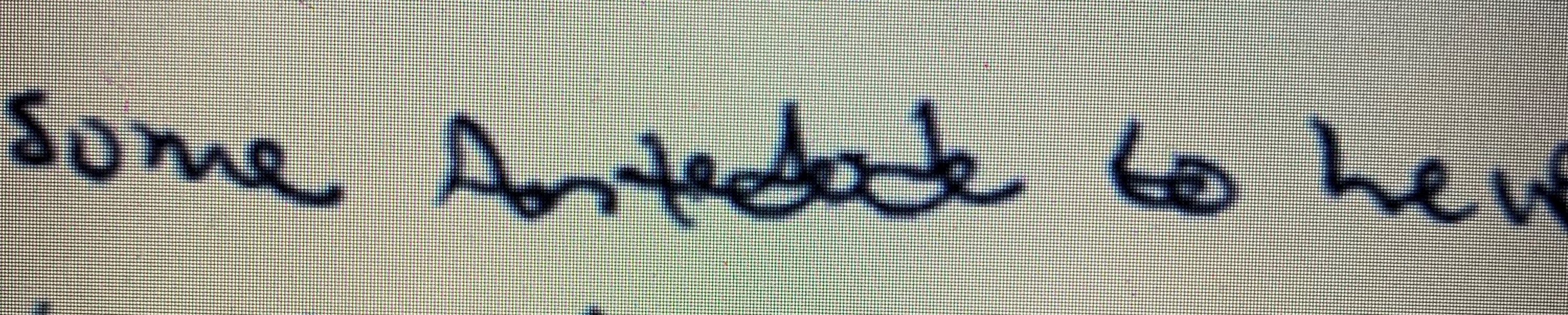
Also, here is the test in my handwriting, so you will understand why I am typing this.

Okay? So here we go.

First, the question:

AP English Literature and Composition 2023 Free Response Question #3:

Many works of literature feature a rebel character who changes or disrupts the existing state of societal, familial, or political affairs in the text. They may break social norms, challenge long-held values, subvert expectations, or participate in other forms of resistance. The character’s motivation for this rebellious behavior is often complex.

Either from your reading or from the list below [Side note: Ummmm, if you haven’t read the book you select to write about, you’re pretty well boned on this essay. So it really should just be the rest of this direction:], choose a work of fiction in which a character changes or disrupts the existing state of societal, familial, or political affairs. Then, in a well-written essay, analyze how the complex motivation of the rebel contributes to an interpretation of the work as a whole.

So the best work I know (though there are several good ones on the provided list of suggestions, including Antigone, Invisible Man, Kindred, One Flew Over the Cuckoo’s Nest, and Paradise Lost) to answer this question is Fahrenheit 451, by Ray Bradbury. The work I used to answer it was Pygmalion, by George Bernard Shaw, which musical film buffs will know as the original version of My Fair Lady.

Here is the essay, complete with the part where I just started cursing because I wasn’t sure exactly how to write this, and then the title I came up with (because of the cursing, so let me tell you, that’s some effective brainstorming) and the rest of the essay.

You know what? Fuck this. Fuck this prompt, fuck this test — and fuck you.

“FUCK YOU, I WON’T DO WHAT YOU TELL ME.”

— Zack de la Rocha

Language is one of the primary determining factors for a number of society’s categories. How we talk shows, or even determines, who we are and how we get treated. I talk about this every year, when I teach diction: how formal language and the use of specialized jargon helps to present me as a teacher, as a person worthy of (but frequently denied) respect. Casual diction, featuring the use of contractions, and slang, and even profanity or “inappropriate” language shows me as — something else.

But does it make me a rebel?

Zack de la Rocha, lead singer and lyricist of the band Rage Against the Machine, is in many ways a rebel. When the band performed their timeless classic “Killing in the Name Of” on the BBC, de la Rocha was asked to leave out a key word in the final refrain, which I used to title this piece. Clearly, asking him to change that particular statement was rather foolish: de la Rocha not only clearly enunciated the entire refrain, he flipped off the camera while he responded to the BBC’s attempted censorship. Violating rules by itself is not rebellious: but when you violate rules as a means of resisting the oppressive power structures that dominate our society, it is certainly rebellious.

Zack de la Rocha’s motivations for this rebellious act are really quite simple (though his motivations in forming the band, writing and singing the songs he does, are not), but more often, rebellious motives are complex. In the play “Pygmalion” by George Bernard Shaw, all of the main characters (Except for poor, pitiful Freddy) are rebellious in one way or another. Professor Higgins and the Colonel [Note: I could not remember the Colonel’s name, so I just used his title throughout. It’s Pickering. Colonel Pickering.] both defy the social order of Great Britain, as does Eliza Doolittle; Eliza also defies the misogyny and elitism which her two “benefactors” partake in unthinkingly, especially Higgins. Mrs. Higgins defies expectation in taking Eliza’s side over her son’s — thus also defying her class role in becoming a partisan for the flower girl — and Mr. Doolittle breaks stereotypes, social order, and all expectations by becoming an accepted member of the upper class, and by not being a dick despite the twin facts of his alcoholism and his neglect of his daughter. However, while they are all rebellious, not all of their motivations are complex, though some are.

Higgins’s motivations may be the simplest among the upper class characters: he wants to prove that he is smarter and better than everyone else. We can see this in his every scene, from his initial appearance when he shows off, and insults everyone at the market, to his final argument with Eliza when he is somehow simultaneously offended and offensive in telling Eliza he loves her but will never love her and love is stupid anyway. All he wants is to be the best, to be the possessor of the most respected and respectable opinion. Fuck him.

The Colonel’s motives are more confusing. He doesn’t want to be the best, nor does he want to prove that Henry is the best; he doesn’t really want to win his bet, he seemed genuinely curious as to whether or not it could be accomplished. Then as time goes on, and he fosters a paternal love for Eliza, his goal seems to be helping her — though in the third act he, like Higgins completely disregards Eliza and her accomplishments by focusing exclusively on the result of the bet with Higgins. Is that because he is comfortable with the elitism that motivates the bet? Is it because he is a kind man who wants to meet Higgins on his own ground? If we are seeing this play as a feminist or Marxist critique of the patriarchy or the class structure, then clearly the Colonel, for all his attempts at being genuine and kind, is simple one of those who work forces.

The same who burn crosses.

[Note: These last two sentences are lines from the Rage Against the Machine song, which is about how police and other soldiers of the power structure are racist and bigoted and attack marginalized people under the guise of enforcing state power. I’m just saying that the Colonel is part of the problem, in ignoring Eliza as her own person with abilities and accomplishments, treating her only as the product of Higgins’s abilities and accomplishments. And if you got that, I apologize for teachersplaining — but it occurs to me as I type this that the audience who would be that familiar with both Rage Against the Machine and Pygmalion is vanishingly small. It didn’t even include me until a week ago.]

Mrs. Higgins seems to be in the same category as the Colonel: generally a solid pillar of the oppressive social order, encouraging her son to act properly and to marry, frowning on but never actually opposing the exploitation of Eliza; but then towards the end, when the Colonel slips, it is Mrs. Higgins who steps up to help Eliza. But while this makes her, like the Colonel, likable and sympathetic, it’s clear that the underlying allegiance to the power structure remains as Mrs. Higgins wants to protect Eliza: rather than empowering her to take control of her own life. This makes both Mrs. Higgins and the Colonel complicit, rather than rebellious, because they see Eliza as an especial exception, rather than just one instance of a whole oppressed class, and by making an exception of her, they prove the rule.

Eliza’s case is more interesting. She participates in the experiment as part of a rebellion against the social order, not merely to prove her superiority, but because she finds fault in the order — why should she be any less than the toffs? She also breaks the misogynistic stereotypes by going to Higgins’s house, intending to hire him, and then continuing to live there in violation of the sexually oppressive morals of Edwardian society, again as an act of rebellion. But it’s no surprise that her acts are more clearly — and cleanly — rebellious, as she is the victim of the power structures she pushes back against. Her motivation is, naturally, selfish, therefore not rebellious — but she also displays a strong sense of justice, all the way from the beginning when she bewails her treatment at the market by all the wealthy people who treat her as an object. She does at that time use the oppressive patriarchal norms as a shield — you can’t treat me this way, I’m just a poor girl (Nobody loves me); but by the end, she objects to her exploitation by Higgins and the Colonel, as well.

And this idea leads to the most rebellious figure within the play, with the most complex motivations: Shaw himself. The playwright, in adapting the Greek myth to an Edwardian England setting, is attacking the mythology of the society he is depicting: because the man who crafts the perfect woman is not only the villain — he is indifferent to his creation, where Pygmalion fell in love with his Galatea. Shaw may be saying there is no love in England that the patriarchal egotism and contempt for the other leaves no room for love of any but the self. He also breaks down the norms of the theater for which he is writing, because where a comedy is traditionally to end in a marriage, and a tragedy in the hero’s fall, this play ends in the heroine’s rise — but without a marriage. What’s more, we are treated to a discussion of why the tale should not end in a marriage, why it is better without a marriage (because Higgins insists he is more honest and honorable for treating everyone badly) — and that’s how it ends, so either Higgins is right, or he has imposed his views on the audience as he imposed them on Eliza.

But then in the additional narration added to the play, Shaw does give us a marriage, though seemingly one that is only economic in character and theme. Thus breaking his own thematic conclusion, as well as his society’s.

Perhaps the most critical rebellion here is Shaw fighting against himself. In using language to criticize language by breaking it down to meaningless idiosyncrasies and stereotypes even as he breaks Eliza’s speech into meaningless phonetics; in using drama to criticize drama, by creating a comedy that rebels against comedy and a myth that rebels against mythology, Shaw undercuts his own authority, even his own argument. He rebels against himself, and like Higgins, rejects any connection to his own creation — and thus, perhaps, personifies God, the Devil, and Cain, who is not his brother’s keeper. nWhen Shaw looks up, flips the middle finger, and says “Fuck you, I won’t do what you tell me,” he is not speaking to the BBC, he is speaking to himself. And the only result is paradox.

Good stuff, right?

Well no.

Though actually, as I read through all of this, I realize that there are some genuinely interesting ideas here: I was just limited by, first, the time frame, and secondly, by the fact I couldn’t use the text to look up specific details, or the internet to look up general concepts and ideas. Give me a couple more hours and my usual resources, and I could have made this into something actually interesting. 

I would want to change the thesis, first of all because the one I have here is terribly awkward. “In the play “Pygmalion” by George Bernard Shaw, all of the main characters (Except for poor, pitiful Freddy) are rebellious in one way or another. Professor Higgins and the Colonel both defy the social order of Great Britain, as does Eliza Doolittle; Eliza also defies the misogyny and elitism which her two “benefactors” partake in unthinkingly, especially Higgins. Mrs. Higgins defies expectation in taking Eliza’s side over her son’s — thus also defying her class role in becoming a partisan for the flower girl — and Mr. Doolittle breaks stereotypes, social order, and all expectations by becoming an accepted member of the upper class, and by not being a dick despite the twin facts of his alcoholism and his neglect of his daughter. However, while they are all rebellious, not all of their motivations are complex, though some are.” I hate that last sentence, which was the result of me trying to include the prompt’s demand for complex motivations, clashing with the fact that not all of the characters have complex motivations: Higgins, the phonetics professor who helps Eliza Doolittle learn to speak like an upper class Englishwoman, really is just an arrogant twerp who wants to be right all the time; and I never should have brought up Eliza’s father, who is not a useful character, just a moment of comic relief. And if I was going to bring him up, I shouldn’t have called him a dick (or “not a dick.” Not better.) 

But also, this thesis says that all of the characters are rebellious: and that’s not true. Higgins does try to break the social order of England by helping Eliza, from the lower class, to become superficially part of the upper class; but he’s bending the rules of that social class, not trying to break them, not least because he doesn’t actually want Eliza to join the upper class: he just wants to trick everyone into thinking she is part of the upper class once he teaches her to speak in a certain way. That’s not rebelling against the social class, that is using the exception to prove the rule, showing that without Higgins’s own genius, the social classes would continue to correctly segregate the lower from the upper classes based on their patterns of speech. Colonel Pickering is the same, and Mrs Higgins does sort of defy family by protecting Eliza — which I would keep, because it is interesting — but again, it’s not like she changes the situation in the long run, or questions the values that put Higgins and Eliza at odds. She just feels sorry for the poor girl and thinks her son is a cad, which he is. 

I also don’t like how I moved from Eliza to Shaw by saying that this idea brings us to the biggest rebel of them all: and that’s not true, because there’s no particular reason why Eliza would link us to Shaw. It’s just that I was running out of time and I was tired of analyzing how these characters are or are not rebels; I wanted to get to Shaw and wrap the whole thing up. That idea, that the real rebel is Shaw himself, was the best way I could think of to resolve the difficulty I had (and still have) in figuring out the ending of the play, which seems to ruin every message the play itself could have: Eliza does not join the upper class; Higgins does not soften his misanthropy; British society does not break down its bigotry. The play just sort of ends with this “So that was a thing that happened, 23-skiddoo, let’s go have a drink!” I find it very frustrating. But I pretty much hate my ending more, because I was just starting to open up new ideas about what Shaw’s choices mean, when I just had to stop, because time was running out. So I did the thing I tell students never to do: I brought up new information in the conclusion, and didn’t explore it enough, even though there is a lot to explore there.

But that’s also the good part of this: because the end of this play is a genuinely confusing choice on the part of the playwright, and those choices are absolutely the best things to analyze and figure out. I don’t know if Shaw was really echoing (or prefiguring, since he wrote his almost a century before de la Rocha) Rage Against the Machine, but it’s an interesting thought. If language breaks down, and the norms of literature break down, then the standards of society that oppress Eliza both as a poor speaker of low-class British English, and as a woman, can also break down, because they are just as arbitrary as the other standards. That’s an interesting possibility, one I would like to explore. Did Shaw make Higgins into such a prick because he was trying to criticize all the arrogant middle aged white British men who were surely watching the play? Yeah, maybe; that would be interesting to think about and talk about. I wish I had. Maybe, when my class reads the play, we’ll talk about all of this; and as my students often do, maybe this class will help me figure this out. If they do, I may rewrite this and make it good.

But for now, I’m just going to write on this same prompt using the work I definitely should have used: Fahrenheit 451. I will post that essay tomorrow.

For now, enjoy this song, which I love, but which I forgot entirely was from My Fair Lady. I associate it with a pair of raccoons singing about a La-Z-Boy. And as always in movies like this, please enjoy the absurdity that is a film trying to make Audrey freaking Hepburn seem unattractive if she has dirt on her face. Sure, guys. Sure. Dirty-face-Audrey is super ugly. You bet.

(Also, here is the version with the raccoons, which I still love.)

What’s In a Name?

I want to write about the AP exam I scored. But those scores haven’t been released yet, and neither have the examples and so on, which show how the scores were earned; and I don’t want to get in trouble for posting confidential material.

So, without going into too much detail about the exam or the prompt or how a student earned a specific score, I’m going to talk about one general aspect of the exam which I noticed this year more than most: terminology.

In keeping with the theme I seem to have established of talking about my dad, and also of using quotations to center and introduce my thoughts, here is one of my dad’s all-time favorite quotes:

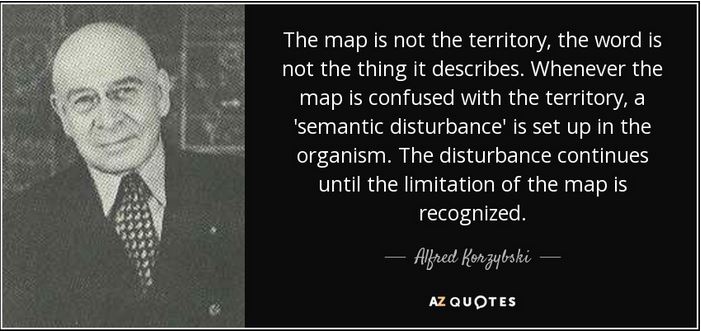
“The map is not the territory, the word is not the thing itself.”

This is from the science fiction novel, The World of Null-A, by A.E. van Vogt. It hasn’t been turned into a meme on the internet — so I’m going to put the cover of the novel here, because it’s awesome.

A.E. van Vogt – The World of Null-A (1948) Review | A Sky of Books and  Movies
Wouldn’t you love to live in Purple World? Arches and spires everywhere? STAIRCASES TO NOWHERE?!?

The quote is slightly adapted from a statement originally from Alfred Korzybski, a Polish-American philosopher and engineer, and while van Vogt’s words have not been memed, Korzybski’s have been.

Map And Territory - We Confuse The Map With The Territory

That’s the full quote, and you can see how quickly it makes one’s eyes cross. Here it is made even more confusing by the visuals:

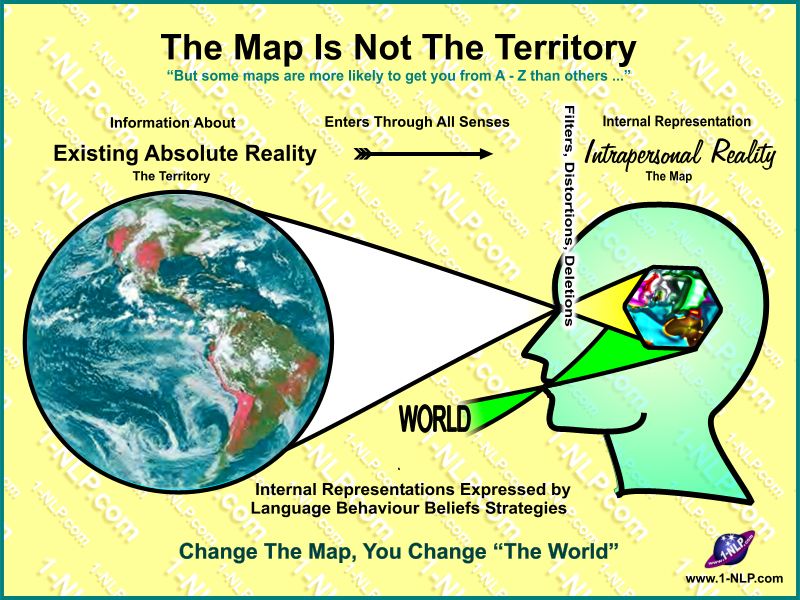
The Map is Not The Territory – Explained in Simple Terms – Welcome to Club  Street Post
This was made by someone who does not understand how to explain things.

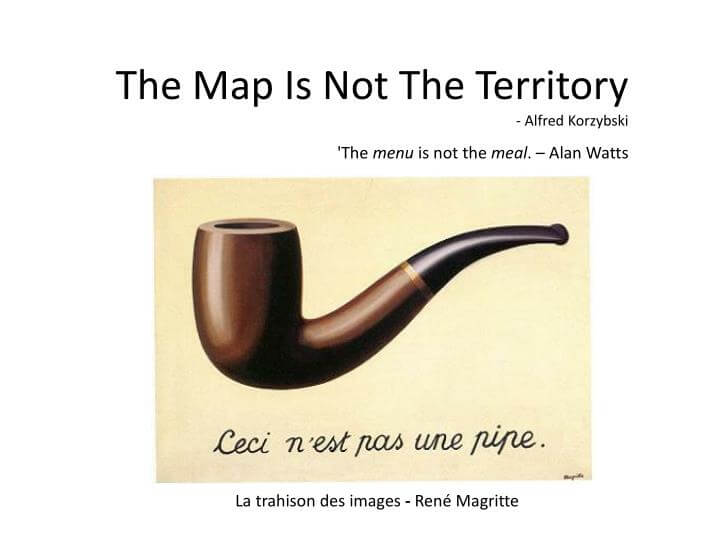
But that’s okay, here’s the simpler version, complete with standardized background image:

The more observant among you will notice the resemblance to a meme I used in yesterday’s post here.

But really, I prefer this last version, because I also like Watts’s iteration of this — and I love Rene Magritte.

The map is not the territory - Tom McCallum

So the point of this, then, is to recognize the limitations of representation and image — and of language itself. The map is probably the best example, because a map always sacrifices detail for coverage, showing a greater area while not showing everything about that area. If a map showed every detail of the area it depicted, it would be a photograph, not a map — and its value would be limited.

(Though it might be funny sometimes.)

On some level, this shows the difference between “book knowledge” and “world knowledge” — which my students still, still, call “street smarts,” a perfect example of a name that has lasted despite its limitations, which makes it a perfect example of the second half of this statement. If you know the name of a thing, that is analogous to “book knowledge;” and if you understand the thing (which is where I think the quote is going here, to a point about understanding, because certainly with a concrete object there is no doubt that the word could be the thing itself: I’m not sitting in the word “chair” right now.), that is equivalent to the experiential and deeper understanding implied by “street smarts.” Knowing the name for something does not mean you understand that thing, because the word is not the thing itself; again like the map, words reduce specific details in order to gain another value — generally universality, and economy, meaning I can communicate a fair amount of information, to a lot of people, without too many words. If I say I own a black SUV, then you don’t have much detail about my car — but (if you speak English) you have a general understanding of the category of vehicle to which my car belongs, and a general idea of its size and shape and appearance and so on, because we understand what aspects are included in the category “SUV,” and we know the color “black.” Also, as my wife has pointed out many times, with steadily growing annoyance as each year passes, all SUVs look the same — and a large proportion of them are black. But that means, while you can get a general idea of many, many cars with just two words, you can’t really identify those specific cars very well. And you definitely don’t know the things that make my car special, that make my car into my car. Not terribly important to understand the special things about my car, of course; but if you want to understand a person, you need to know much more than their name.

This comes into focus with the AP exam because I teach my students that they don’t really need to know the name of what they are talking about: but they need to understand the thing. This is, clearly, not how all AP teachers instruct their students, because I had MANY essays that used vocabulary the student did not really understand: and it showed. They named things they didn’t really have, because they didn’t understand the thing named. So that I don’t do that, to explain the details lacking in the term “AP exam,” so that you have more understanding of this thing instead of just knowing the name, the essay I scored last month was for the AP Language and Composition exam, which focuses on non-fiction writing, and examines primarily rhetoric. “Rhetoric” is another good example of a word which people know and use without really understanding it, because the connotations of the word have changed; now it mostly comes in a phrase like “empty rhetoric,” and is used to describe someone — usually a politician — who is speaking insincerely, just paying lip service to some idea or audience, without saying anything of substance; or in more extreme cases, using words to lie and manipulate their audience for a nefarious purpose. My preferred definition of rhetoric, the one I teach my students, is: “Using language to achieve a purpose.” What I am doing now in this blog is rhetorical: I am choosing words and using examples that I think will achieve my purpose — in this case to explain my idea, and to a lesser extent, to convince my audience that I am correct in my argument: that knowing the name of a thing is less important than understanding the actual thing.

So in the AP exam on Language and Composition, which focuses on rhetoric — or understanding and explaining how a speaker or writer uses language to achieve their purpose, as when a politician tries to convince an audience to vote for him or her — there are 50 or so multiple choice questions, and three essay questions. This year I scored the second essay question, which is the Rhetorical Analysis question; for this year’s exam (This is not privileged information, by the way; the questions were released right after the exam in May. It’s the answers that are still secret.) they used a commencement speech given at the University of Virginia at Charlottesville by former U.S. poet laureate Rita Dove. The goal of the essay was to “Write an essay that analyzes the rhetorical choices Dove makes to deliver her message about what she wishes for her audience of graduating students.”

Interestingly enough, the AP exam writers have given hints to the students in this instruction, which I’ve taken from the exam. They generally give important context in their instructions, quite intentionally; it’s easier to analyze rhetoric if you understand the context in which the speech or writing was delivered, so knowing that this speech was given at a commencement, at a university, in 2016, gives you a better idea of what is going to be said in the speech — you get the general shape of what is included in the thing named “commencement address.” One of the key aspects of this speech by Dove is both the expectation of what is included in a commencement address, and how she subverts that expectation: and that centers around the term “wish.” That’s the hint in the instruction there, along with the buzzwords “message” and “audience,” which are commonly part of a study of rhetoric and of rhetorical analysis.

Okay, that wasn’t interesting. I’ve lost you here, I realize. Let me use fewer words and just give you the general gist of my point: when students were analyzing Dove’s rhetoric, they did much better if they explained what she was doing and why, but didn’t know the proper name for her strategy; some of them knew the name of the strategy — or of a strategy — but couldn’t really explain it. They had the name, but not the thing itself.

Partly that’s because the study of rhetoric is very old, and thus has an enormous amount of terminology attached to it: much of it based on Latin and Greek roots, which makes the words sound really smart to modern speakers and readers of American English. It’s cool to use the words “antithesis” and “juxtaposition” and “zeugma,” so students remember the words and use them for that reason. I think it is also partly because a number of AP classes focus on remembering the word for something, rather than knowing the thing itself, because lists of words are easier to teach and easier to memorize and easier to test. Partly it’s because students under pressure try to impress teachers with the things they can do, to dazzle us and make us not notice the things they can’t do — like actually explain the thing they named.

Again, I don’t want to get into too many specifics on this particular essay because it hasn’t been released yet and I don’t want to get in trouble, so let me just give general examples.

There’s a rhetorical device called “polysyndeton.” (Cool name, isn’t it? Little annoying that the two y‘s are pronounced differently…) It means the use of more conjunctions than would be strictly necessary for grammar. If I listed all of my favorite activities and I said, “I love reading and writing and music and games and spending time with my pets and eating delicious food and taking walks with my wife,” that would be an example of polysyndeton. And if you were writing an essay about my rhetoric (Please don’t), you could certainly say that I used polysyndeton, and quote that sentence as an example. And if you used that sentence, it would be a correct example, and the person scoring your essay would recognize that you know what polysyndeton is, and you correctly defined and identified it, which is surely worth some points. Right?

But what does polysyndeton do? What did I do when I wrote the sentence that way, instead of, for instance, “I love reading, writing, music, games, spending time with my pets, eating delicious food, and taking walks with my wife.”? The ability to understand that, and to explain that — and, most importantly for the AP exam and for rhetorical analysis, the ability to explain how the effect I achieved through the use of polysyndeton helps to deliver my message, to achieve my purpose — that’s what matters. Not knowing the name.

(It’s a bad example here, by the way, because I made up the sentence just to show what the word meant, so it isn’t really part of my larger purpose; the purpose of using polysyndeton there was just to show what the hell polysyndeton is. And sure, I guess it was effective for that.)

The worst offenders here, on this year’s exam as in most, are the terms logos, pathos, and ethos, which are words used to describe certain kinds of argument, and also certain aspects of rhetoric. The words are Greek, and were chosen and defined by Aristotle; most rhetoric teachers at least mention them, usually, I imagine, as a way to show that there are many different ways to win an argument and to persuade an audience. That’s why I mention them in my class. But while a lot of students know the words, they don’t understand the thing itself, and so they find items in a passage they’re analyzing that looks like it belongs in one of those categories. Like statistics, which they identify as logos arguments, meaning arguments that appeal to reason and logic, which is indeed one way that statistics can be used. Dove uses a statistic in her speech, and a raft of student writers identified that as an instance of logos. The problem is that it isn’t logos, partly because it’s not a real statistic — she uses the phrase “150% effort,” and at one point lowers that to “75% effort” and “50% effort;” but at no time is she trying to present a reasoned and logical argument through the use of those numbers, which of course don’t come from any study or anything like that — and even more, because she’s not really trying to persuade her audience.

She was telling her audience an anecdote. And that’s where I ran into a stumbling block, over and over again in reading and scoring these essays: just because students know the name for something doesn’t mean they understand the thing: and just because students remember the name for something doesn’t mean they remember how to spell it.

Let me note, here and now, that these students are brilliant and courageous for even trying to do this damn test, for even trying to write three college-level essays in two hours AFTER answering 45 difficult multiple-choice questions in one hour. Also, because this was written under pressure in a short time frame, and with almost certainly only one draft, mistakes are inevitable and should be entirely ignored when they don’t get in the way of understanding. I knew what every one of these students were trying to say, so I ignored their spelling, in terms of scoring the essay. I also ignored their generally atrocious handwriting, not least because mine is as bad as any of theirs and usually worse.

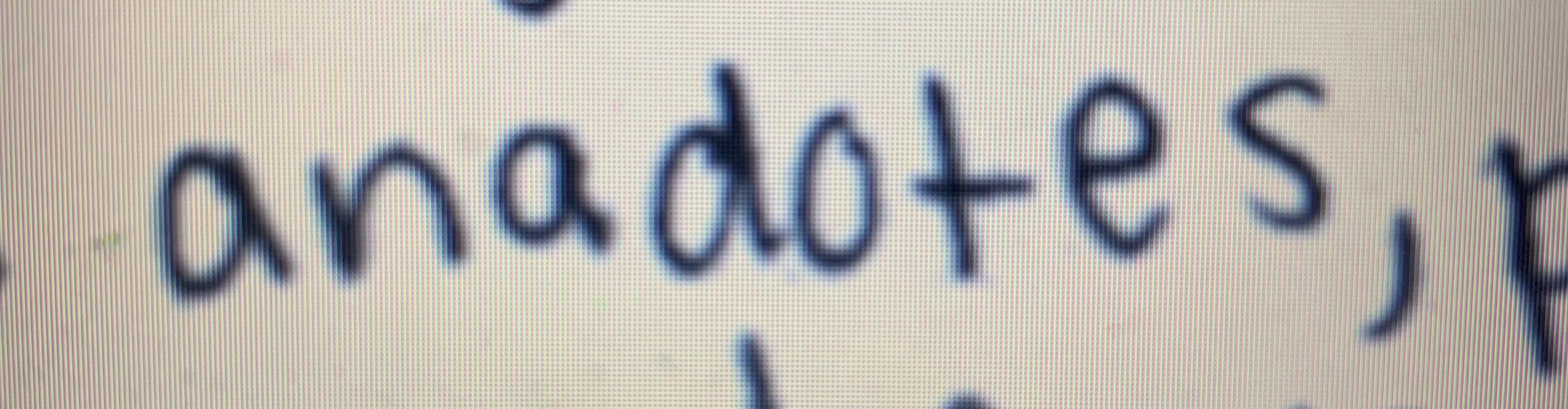
I just thought this was a fine example of knowing a term but not really knowing it. Ya know?

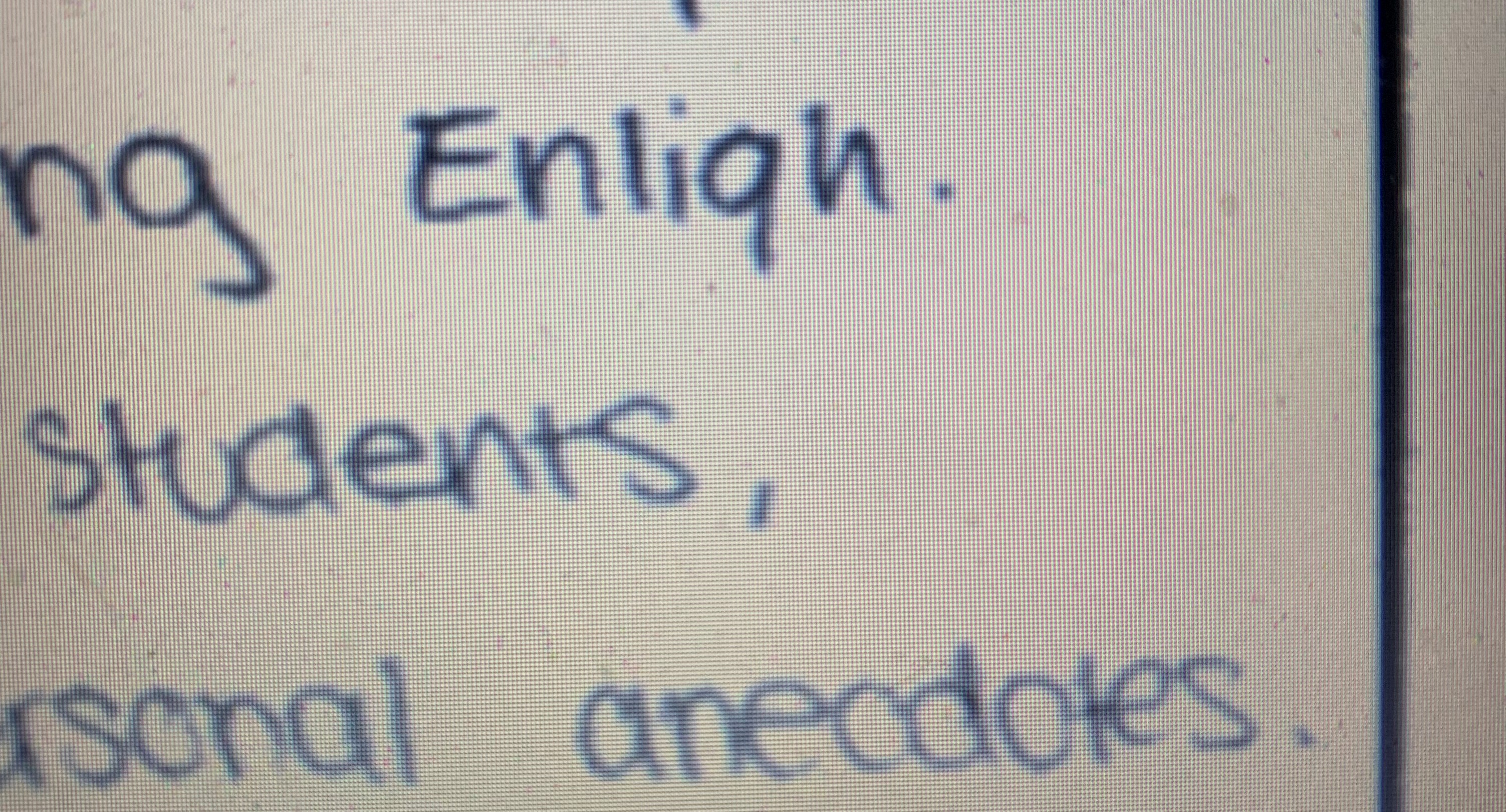
(Also I apologize for the image quality. Just trying to make a point. And the picture is not the point.)

The first one gets it right. Another one gets it right — but spells “English” as “Enligh.” Also please note the spelling of “repetition” which students repeatedly struggled with.

Fun, huh? I scored 695 essays this year. Last year it was over a thousand. And that exam passage also used anecdotes.

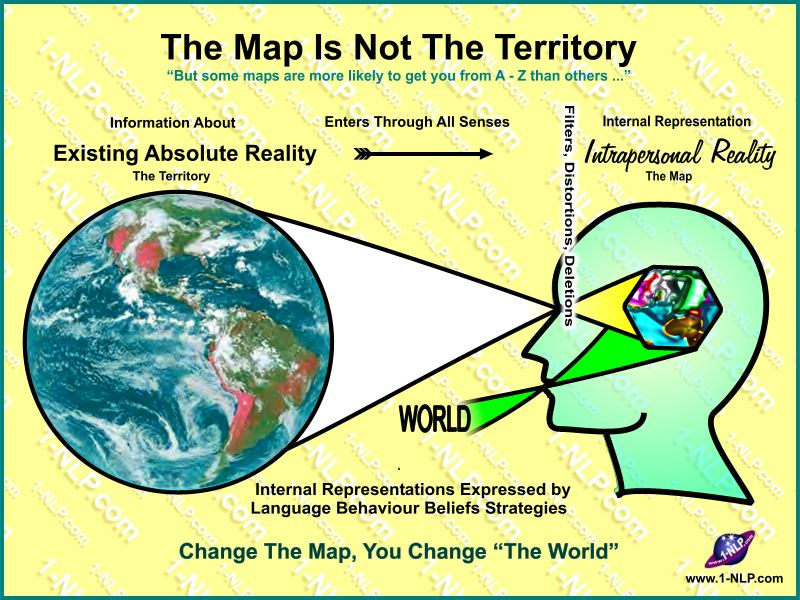
I’m really not trying to mock the students; just using this fact to show that knowing a term doesn’t mean you understand the term, because the word is not the thing itself. By the same token, knowing the spelling doesn’t mean you know the term, or that you understand the thing itself; which is why we ignore misspellings in scoring these essays. I think understanding the thing is much more important than knowing the word — and I’m a word guy. I love words. (Flibbertigibbet! Stooge! Cyclops! Wheeeee!) But I’m a word guy because I think this world is magnificent and incredible, and I want to understand as much of it as possible; words help me to do that, and to share my understanding of the world we live in. That complicated image I used above to show how some people can’t explain things well? Here, I’ll bring it down here so you don’t have to be confused which one I’m talking about.

This one.

This makes a few important points, even if it makes them badly. I do like how it goes from an image of the Earth, to a jumbled collage of colors inside the head, to the one word “world.” I think that, once you can follow it, makes this point well, how much translation and simplification happens between observed reality and the words we use to represent them. Though it should also lead to another head, of a listener, and show how that one word activates their own jumbled collage of colors in their head represented by the word “world.” (Far be it from me to suggest making this more complicated, though.) Because communication happens between two minds, and both minds contribute to the communication: which is why language works despite this simplifying process.

I do also like the statement at the bottom of the image: “Change the map, you change the world.” (Even though I hate how they capitalized and punctuated it.) Because that’s the last point here: while words are not the things they represent, they are incredibly important to our understanding of the world and our reality. Because we think and communicate in words. Not exclusively: my wife, for one, is deeply eloquent in communicating with images; my dogs can communicate with a look; musicians communicate with sounds that are not words. And so on. But language is our best and most effective form of interpersonal communication: and also one of the main ways we catalogue and recall our knowledge inside our heads. So getting the names of things right is incredibly important to our ability to use the information we know, and to communicate it to others. And what is the most important factor in getting the names of things right? Understanding the things we are talking about.

Because a rose by any other name would smell as sweet — but if you want people to know you are talking about one of these, you better call it a rose.

How to Say Rose in Different Languages | 1800Flowers Petal Talk

And for my sake, please spell it right.

Welcome Back

And if that made you think of the Sweathogs and Mr. Kotter, then we are friends.

Welcome Back Kotter Dance GIF - Welcome Back Kotter Dance ...

Okay: lemme ‘splain.

No. Is too much. Lemme sum up.

Let Me Explain Sum Up GIF - Let Me Explain Sum Up Too Much GIFs

School ended on May 25th. That was at the end of a week including Graduation, which I hosted as Master of Ceremonies (A student of mine expressed distaste for the term “emceed,” and when I told her what it stood for, she said the full term was MUCH cooler than the phonetic abbreviation, so I’m going with that from now on.) and the usual grade-fest, necessitated by the fact that I accept all late work up to the last minute. Then I took a week or so to relax — though I did make a bed, as I described in my last post nearly a month ago.

And then the rocks arrived.

These first three pictures are my front yard. Notice it is nothing but dirt and a few plants. (This is after I weeded it, by the way. Bottom right corner of the first pic shows the weeds I had not yet gotten to, in front of the sage bush.)

And this is eleven tons of rock being dumped in my driveway.

The ton or so of dust is complimentary. And inevitable, in Tucson, which is mostly dust.

So then I started working on getting the rocks spread out across the yard. That means digging up the dirt to turn it and remove all the weeds I could get; then putting down weedblocking cloth; then hauling wheelbarrows full of rocks over to the cloth and dumping them. Since the temperature here has been well over 100 degrees for several weeks, it was hot, dirty, difficult work.

But my wife still made it look good.

I joked that this was her Jackie O. pose; the scarf is actually weedblocker cloth. The gorgeousness is all her.
I’m not as pretty.

In addition to the rocks, on June 10th I started my usual summer job: scoring essays for the Advanced Placement program’s Language and Composition exam. So that meant about eight hours a day staring at a computer screen trying to understand student handwriting — and spelling. I’d get up as early as I could (which is no hardship as I have always been an early riser) and lie in my hammock and grade for a few hours; then I’d go out in the yard with my wife and spread some rocks.

The rocks are not done, by the way, but it’s getting close; and it looks great.

Progress. Improvement.

Until June 18th, when I flew to San Diego to attend a three-day AVID conference.

This one had a roundabout genesis: back in March or so, a good friend of mine asked if I would go to the conference, because she was going and she wanted someone along whom she got along with. At first I turned her down, because I do not generally like pedagogy and conferences; my style and philosophy of teaching are not what other teachers’ are, and so most of the time, pedagogical instruction is lost on me — and it makes me feel bad, because I have just enough self-doubt and imposter anxiety, even after 23 years of teaching, to suspect that I’ve been doing it wrong all along. And the people who present at these conferences always seem so sure that their system is right.

AVID has a little more credibility with me, because when I started teaching in California in 2000, the school where I taught had an AVID program, and the teacher whose room I shared, who took on something of a mentor’s role for me, was the AVID teacher. So I had first-hand experience of how well the program can work, and I was more interested in being involved in bringing AVID to my school than I would be in most teacher conferences. I’ll write more extensively about AVID at some point, but the basic idea — it stands for Advancement Via Individual Determination, which I both love and hate, as I love and hate all good acronyms — is that it helps students who would struggle going to college and being successful there for reasons other than intellect, and tries to make those students more successful through teaching organization and study habits, and how to work with people and advocate for yourself, and so on. It’s a good system.

But I still would never choose to go to a three-day teaching conference if I could avoid it. So I said no when my friend asked me to go.

But in February, my father’s wife, Linda, passed away. It was, of course, devastating to my dad; and I promised him I would come to the memorial, and help him out in any way I could. And somewhere around April, my dad told me that Linda’s memorial would be Saturday, June 24th: the weekend after the AVID conference. My dad lives in Paso Robles, in wine country closer to the central coast of California than to San Diego; but my brother lives in San Diego, and would be driving up for the memorial anyway, of course. So I checked with my brother, and then my principal, to make sure I could extend my return flight from the conference and get a ride — and in the end, I went to the AVID conference, and then drove with my brother to Paso Robles and attended my father’s wife’s memorial.

Where I served as the master of ceremonies.

It was a beautiful ceremony.

May be an image of 7 people and wine
This is my dad at the podium sharing his memories of his wife. My brother is the one leaning against the casks — the memorial was held at a vineyard, whose owners are close friends.

***

I’m telling you all of this because I hope it explains why I have not posted on this blog for the last three weeks. I usually write and post on Sunday and/or Monday of each week. Well, last Sunday and Monday I was in Paso Robles, both helping my dad deal with his grief, and also going through my own (far, far smaller) suffering: because my dad is an extrovert, and he and his wife are extremely popular and well-loved among their family and friends and their community, so many people wanted to express their grief about Linda’s loss, and also to help my dad know that he is not alone: so we had four gatherings of people in the five days I was there visiting. Which was a lot for me. The Sunday and Monday before that, I was flying to San Diego and then attending the first day of a three-day conference for a program that I would actually be interested in learning about and bringing to my school, so I was trying hard to keep up with the information; and that was draining. Aaaand the Sunday and Monday before that, I was scoring essays and spreading rocks.

So here’s my plan. I’m counting this one, which I know is a bit of a nothingburger in terms of its value as a blog post (When I told my wife I was going to write “just sort of an update” for this post, she said “That doesn’t sound very exciting. Don’t you want your blogs to be about exciting things?”), and then I will be writing and posting for the next three days, to make up for the three weeks I missed, ending with a post for next week — which I’ll post on the Fourth of July. In honor of which, I plan to yell a whole lot about how the Supreme Court is fucking up this country. I have another idea for one of the other blogs; not sure about the last one — but I’ll think of something.

I don’t have anywhere else I have to go. Or any essays to grade. The rocks are almost done, and though I also need to work on my pirate book, otherwise I am just staying home with my wife and my pets.

I hope you’re all having a happy summer, too.

A Day of No Need

So, as I frequently do, I assigned my AP students an essay. They weren’t happy with it. Most of them didn’t do it. So I wrote an example for them. The assignment was to describe, with imagery and details, your perfect day: and this would be mine.

I think this says more about me and my life than it does about my writing or about my students and this assignment.

A Day of No Need

My perfect day is in the autumn. Probably November: there is no longer any pressure over getting Halloween exactly right; Thanksgiving is coming, but thankfully, I will never host any gathering larger than myself and my wife and our pets, so there’s no pressure there. But thinking about what food we will eat on that day, and about the four-day weekend, blocks any worries about Black Friday or holiday shopping; this is the time of year when, if you see something you think someone on your list would like, you pick it up and buy it, and feel good about yourself for getting ahead of the game.

The weather is perfect: the sun is out, and bright, but not hot; the breeze is cool, sometimes becoming a wind that bites and makes you want to tuck yourself into your jacket like a turtle pulling into his shell. Jackets are a must: which is great because it means more pockets, and also a layer that you are almost required to take off when you go inside, which means you can be warm outside and not too hot inside. If there are leaves on the trees, they are turning into beautiful colors; if they have already fallen, they are turning into beautiful sounds with every step through them, every stride leaving a wake behind, a surging wave of leaves leaping ahead. The smell of warm, spiced apples rises from the cup of cider in my hand.

But in truth, all of that is negotiable. Almost any weather can be perfect: there is such a thing as too hot, and another such thing as too cold; but hot and cold between those extremes are both fine, and warm is as good as cool. Green leaves on trees are almost as lovely as fall colors, and the bright blooms of spring and summer break up any monotony in the foliage. I like rain, and snow, and clouds, and blue sky – and night, for that matter. I don’t need any weather for my perfect day.

I need there to be no need.

On my perfect day, nobody needs me. My parents don’t need to call, my in-laws don’t need to call me to tell me to tell my wife to call them, like some bizarre game of phone foursquare. I don’t need to get up, I don’t need to walk my dogs (though if I feel like it, it would be fine; I like walking with them, as long as I don’t need to), I don’t need to shower, I don’t need to pick out and put on my teacher clothes; if I shower, it will be only when I feel like it, and if I get dressed beyond my pajamas, it will be in whatever I feel like wearing. If I eat breakfast I won’t need to cook. I don’t need to make the coffee for my wife, I don’t need to get her up for work, I don’t need to feel bad for waking her up to go to a job she mostly doesn’t like. I don’t need to find or make lunch, don’t need to fill a water bottle, don’t need to make my coffee just right, because if it’s not sweet enough I can just go into my kitchen and add more sweetener, any time I want to. I don’t need to go to the bathroom before I leave, because there will be time to go whenever I need to. I don’t need to check and double check that I have everything before getting into the car, and I don’t need to drive through traffic for 30 minutes to get to school. I don’t need to change the radio 65 times over that 30 minutes just to find some goddamn music instead of radio DJ blathering or used car salesmen yelling (LOOKING AT YOU SCOTT LEHMAN).

I might go to work, because I like seeing my coworkers, and even some of my students sometimes; but I won’t have duty, and I won’t have to period sub, and I won’t have to run a lunch meeting, and I won’t have to have meetings after school where I have to report on a student’s progress, or even worse on my progress, and I won’t have to listen to somebody or other telling me that I’m not doing my job well enough. I won’t have to stay to watch a sportsing event, or to watch my NHS students sell snacks at a sportsing event.

And most of all: I won’t have to teach. My students will be ready to learn on their own: I won’t have to drag them behind me, or drive them before me, to force them to gain an education for their own good. I won’t have to argue with them about learning, or about what we are learning, and I won’t have to listen to them complain about and criticize everything I do, over and over and over again, even though they probably won’t do it regardless of how they actually feel about it, which is only rarely the same way they say they feel about it. I won’t have to listen to students lie to me about how hard the class or the assignment is, because they want to lower the bar so they don’t have to work as hard. I won’t have dozens of different people trying to wear me down so they can have a day off, even though they have ten times the down time that I have: after all, I don’t have PE, or study halls; and while they have to write the essays, I have to read them – and you figure if I assign an AP essay to my 40 AP students, and they average 2-3 pages per response, that’s somewhere around 100 pages of writing I have to read and respond to, while they ask me if I’ve graded that essay yet.

But not today. Today they don’t fight me, and they don’t argue with me, and they don’t complain at me about what I do to help make them and their lives better. Most of all they don’t need me: they do the work on their own, without the need for me to pressure them. I don’t have to walk around the room and check on them, don’t have to make sure that none of them are cheating or sleeping or skipping, I don’t have to monitor their bathroom visit duration, or make sure they are signing out like they know they have to. I don’t have to tell them to put away their phones or close their Chromebooks. Because today, on my perfect day, my students do what they know they should do, what they know they are expected to do, what is entirely rational and reasonable for them to do: learn the material without being cajoled or coerced, and without disrupting the learning for themselves or others, and without being rude to anyone involved. They act like young adults, today, and so, they don’t need me. If they ask me any questions, it’s only because they’re curious what I think, not because they want my answer so they can write it down so they don’t have to come up with one themselves. None of them will have a test or missing assignments for another class, so they have to ask me, once again, to let them ignore my subject because the other class is more important than mine.

Today none of my students, and also none of my friends, are in crisis, and so nobody needs me to listen to them tell me what’s wrong. It’s not that I don’t want to listen when someone needs me: I just want nobody to need me, for nobody to be having a panic attack, or an explosion or righteous anger, or a bout of severe depression. I want to not need to find a way that I can help even though there’s not really much I can do: because the one thing I can do is listen, and empathize, and I don’t want to have to do that. I want nobody to need that, today. I don’t want to have my own bout of righteous anger or an explosion of panic or a depression attack. I just want to be okay, and for everyone else to be okay. Just for one day.

I want none of my students to need me to grade that one assignment, or to help them figure out how to do that one assignment, or need me to find another copy of that other assignment. Nobody should have a field trip form, or a grade check for their parents, or a failing grade the day of the big game, or a letter of recommendation they need, or advice and editing help on an application essay.

Nobody thinks they need to take advantage of me. Nobody does things they know they shouldn’t do just because they know I won’t get them in trouble for it. Nobody says “Oh, Humphrey doesn’t care if we do nothing.” Nobody lies to me. Nobody cheats on my assignments. Nobody insults me or my subject, calling school useless or saying that reading is boring. Nobody even thinks that the only reason people need to read is so they can learn more vocabulary words. Nobody asks if they can re-read a book they read before, or if they can just watch the movie, or if watching subtitles on an anime counts as “reading.” Nobody asks if we can watch a video on YouTube instead of reading today. Nobody forgets what I taught them the day before. Nobody asks if we can just do nothing today. Nobody even mentions the word “chill.”

Nobody asks if we can play Head’s Up Seven Up.

At the end of the day, I don’t need to drive home, don’t need to go to the grocery store, don’t need to make dinner. I don’t need to make or keep any appointments, and I don’t need to pay any bills, or do anything for extra money. If I write, it’s only because I want to. My bird doesn’t scream at me, and my tortoise doesn’t try to eat my foot, and my dogs don’t whine at me when I’m petting the other one and not them.

The only one who needs me is my wife. Because I need her, and I need her to need me. She will need me to hug and kiss her, and tell her I love her, and she will need to tell me she loves me. We will need to eat together, and share stories about our day together, and then unwind in front of the TV or in our office/studios making art. Though I won’t need to make art, and I won’t need to write an angry rant about anything, and I won’t need to tell all the idiots on Twitter that they are idiots: if I want to play Minecraft, then I can. I would not mind if my dogs needed to greet me when I come home, or need to lie next to me so I can pet them while I eat or while I relax.

And when I go to sleep, I won’t need to take Advil to get rid of my headache, and I won’t need to take melatonin to help fight off my insomnia. I won’t need to lay awake for an hour in the middle of the night, worrying about what happened in school today, or what’s going to happen tomorrow. Nobody will send me late night messages, or early morning messages, because they need an extension on an assignment, or because they are having a crisis and need to vent to me, or because they need me to cover their first period class in the morning. And I won’t have to worry about how I’m getting older, and things about my health are starting to scare me, and how my life has not been everything I want it to be: and I will not need to be more than I am, because I will, the whole day, just. Be. Happy.

That would be perfect.

Lie For a Mockingbird

So I have this essay I wrote yesterday. It’s an example for two of my classes: my AP Literature students and my Honors Freshman English — the latter we enjoy calling HELA 9, while the former insists on “It’s Liiiiiiiiiitt.” I was going to write two essays, one for each class; but both are writing literary analysis, just on different works and using different prompts: HELA 9 is writing about To Kill a Mockingbird, using simple essay questions I came up with; the AP class  is writing about Macbeth, using old AP test prompts. I wrote this one about TKAM, using an AP prompt; I figured that way I could use it for both classes, without stealing anyone’s topic idea.

I don’t know if people want to read these essays I write for school; but right now, this is pretty much all I’m writing. And, as my wife pointed out when I talked to her about posting this, this is part of me, my life and who I am. And God, I love this book. Just reading the last scene to find the quotes I wanted actually made me choke up a little.

So, here you go. Enjoy. I’ll post another essay in a couple of days, and a book review as soon as I can get to it. You can always pop over and read my time-traveling pirate serial, Damnation Kane.


(2016) Many works of literature contain a character who intentionally deceives others. The character’s dishonesty may be intended either to help or to hurt. Such a character, for example, may choose to mislead others for personal safety, to spare someone’s feelings, or to carry out a crime.

Choose a novel or play in which a character deceives others. Then, in a well-written essay, analyze the motives for that character’s deception and discuss how the deception contributes to the meaning of the work as a whole.

There’s a lot to argue about in literature: was it the Lady or the Tiger, was Shakespeare one man or many (or a woman?), is it Gatsby’s fault or Daisy’s? But one thing we cannot argue about – for it is true beyond contestation – is that Atticus Finch is the best human being ever to exist. Best father, best lawyer, best person. Bar none. No question.

It says something, then, that at the end of Harper Lee’s classic, Atticus, the pillar of moral rectitude, the antithesis of all hypocrites and liars, the man who is the same on the public street as he is in his home – that man chooses to lie. And not only to lie, but to convince his young daughter, Scout – the second best person in all of literature – to lie, as well. It says that sometimes, in certain extraordinary cases, it is not only acceptable, but even good, to lie. Because sometimes, telling the truth would be like killing a mockingbird: harming someone who never did anything bad to anybody. And that, of course, is a sin.

Not all liars are good liars. Two other characters in To Kill a Mockingbird, Bob and Mayella Ewell, lie extensively, and perniciously. The court case the Ewells precipitate serves as the major conflict for the novel’s larger scope; the story is both about the children growing up, and also about this case, and how the Ewells attempt to take advantage of the prejudice of the time even as Atticus tries – unsuccessfully – to fight against it. The case is built entirely on lies, and Atticus shows the jury the truth – against their will, at least in part, because so many things would be so much easier if they could just believe that the Ewells are telling the truth. But they can’t believe that, because the Ewells are not telling the truth. Atticus shows the jury the truth, both about the specific case and also about the Ewells; and because he does, he becomes a target of Bob Ewell’s violent tendencies, his savage and furtive need for revenge; this then creates the need for Atticus’s own lie, and Scout’s as well.

Mayella, the victim of a series of family secrets, including her father’s alcoholism, his physical and mental abuse, and even his sexual abuse of his eldest daughter, tells a number of lies in the name of finding some small token of real affection – because what her daddy do to her don’t count, as we hear from her own victim. When Mayella, a 19-year-old white woman in the town of Maycomb, Alabama, in the 1930’s, decides she wants to kiss a man who is not her father, she seeks out a man she can manipulate and control: a black man. We can understand this, as Mayella has no control over her own life, which is spent taking care of her drunk father and her seven younger siblings; but Mayella wants something more than a life of filth and degradation, as we can see from the geraniums she grows and tends in the junkyard where her family lives in squalor. We appreciate this. Mayella is harmed, repeatedly, by those who are stronger and more violent than she; so when she looks for romance, she tries to protect herself from harm in this vulnerable moment – perfectly understandable. And, as far as it goes, this gives us a reason to at least forgive her various lies: she sends her siblings to town for ice cream, so that she can be alone with her would-be lover; she tells the man as he passes by that she needs help with a repair job inside the house,  so that he will come inside with her, which he would normally never do, knowing how impolite it would be considered for a black man to be alone with a white woman – and also, how dangerous. Then, when Tom Robinson, this kind-hearted man – chosen also because he is, as Scout sees, a fine figure of a man (or would be, if he were whole and not lacking the use of his left arm – and there can be little doubt of the symbolic value of that handicap for Mayella, who is frequently and savagely beaten by a left-handed man: Tom must be a man she does not need to fear), and chosen despite the fact that he is married with three young children – comes into the house, Mayella lies again to get him into her actual grasp, telling him to get her down something from on top of a tall bureau, and then grabbing him around the legs in an awkward and almost precious embrace.

All those lies for Mayella would be forgivable (Though the fact that she attempts to ensnare, through deception, a married man, makes all this much less sweet – a mood that is portrayed perfectly when Mayella tells Tom, “Kiss me back, nigger!” Ah, l’amour.) except for the most important lie, the lie that Mayella tells herself: that she can get away with this. It’s really quite absurd: we don’t know how long it would take the Ewell children to go to town and get ice cream, but neither does Mayella, and since Tom doesn’t see the children at all, they’re already on their way when Tom walks by after work. How much time does Mayella have, in the best case, for her tryst? Not even that long, of course, because her drunken abusive father returns home even sooner than the children – another circumstance she should have been able to foresee, but must have told herself was safely impossible – and catches her kissing Tom. In that moment, we see the truth of Bob’s twisted psyche: he does not rage against Tom, despite the obvious “sin” he has committed, the unforgivable sin of embracing a white woman; no, Bob yells, “You goddamn whore, I’ll kill ya!” at his daughter. Bob knows who is behind this, and we know a truth then about Bob. This truth, of his hatred of his daughter and his attraction to her, as well, leads him to beat her black and blue, even while Tom runs away.

But Tom doesn’t escape, as Mayella must have known he wouldn’t; she then turns him into her scapegoat, aided and abetted – perhaps provoked – by her father. It is not immediately clear to the reader why the Ewells do this, or even who is really behind it. Does Mayella insist that Bob help her create this fiction, in order to protect her virtue? Does Mayella see this as one small show of love she can actually garner from her father? Or does Bob run for the sheriff in order to teach Mayella a lesson? Maybe he does it to show Tom that he can’t get away with trying to put the moves on a white girl? Does Bob lie to himself about that? Do they seek only to gain the temporary approval of the white people of Maycomb, who are glad for a chance to put the blacks in their place, and might be a little grateful to the Ewells for creating that opportunity? That may be: Bob gets away with several small offenses against the elites of the town, including Atticus; he even, for a little while, gets a job, before turning back into the welfare-cheating drunkard he’s  always  been. But we don’t see any reward for Mayella. All she gets is a beating. Presumably more than one.

When Atticus argues this case in the Maycomb County Court, he describes Mayella’s act as something like what a child does when she breaks something: she puts the evidence of her crime as far away from herself as possible. Mayella, Atticus says, is putting Tom Robinson as far away from her as possible, in order to cover up her crime of lusting after a black man. Perhaps the childishness of that metaphor gives us our clue about Mayella’s role in this: perhaps she seeks only self-preservation. But I don’t think so: because it is Mayella, far more than the foolish and untrustworthy Bob, who seals Tom’s fate. After Atticus shows how much of her story is a fabrication, Mayella makes one last statement. She talks about another fiction of the time and place, Alabama in the 1930’s; a commonly accepted one. By calling up this fiction, she forces the men of the jury into a role that at least one of them (who argues for acquittal) does not want, but cannot escape. Mayella says,

“I got somethin‘ to say an’ then I ain’t gonna say no more. That nigger yonder took advantage of me an‘ if you fine fancy gentlemen don’t wanta do nothin’ about it then you’re all yellow stinkin‘ cowards, stinkin’ cowards, the lot of you. Your fancy airs don’t come to nothin‘—your ma’amin’ and Miss Mayellerin‘ don’t come to nothin’, Mr. Finch –“

In the next line of the book, Scout observes that “she burst into real tears.” Real tears, because Mayella is indeed distraught, as who wouldn’t be; but real, also, in contrast to the falsehood she just spoke. The men in the courtroom – and mostly, she is speaking to the jury, as Atticus and Judge Taylor and Sheriff Tate are unlikely to come to her defense – are not cowards, or at least not in this instance. But by insisting that she is the victim of a sexual crime, committed on her white self by a black man, those fine fancy gentlemen have no alternative but to act as Southern gentlemen would have acted at the time: they must kill the black man who defiled the innocent white girl. They cannot take the word of a black man over the word of two white people, not even when that word is the truth. And indeed, in the face of that universally accepted lie, Atticus’s fancy airs don’t come to nothin’. The jury convicts; Tom goes to jail; he is there shot and killed, supposedly while trying to escape – but that is another lie, as he is shot seventeen times, a number of wounds impossible to credit were he actually in the process of climbing the fence of the football-field-sized exercise yard. Tom was, of course, executed by the white prison guards, probably as revenge for his “crime.”

That’s a sin.

Bob Ewell tries to commit another sin, equally heinous; unable to directly harm his perceived enemies, Judge Taylor and Atticus, Bob goes after two other people who did him no harm: Atticus’s two children, Jem and Scout. Bob tries to kill them both as they walk home in the dark on Halloween. But Bob unwittingly chooses the worst possible place to make his attempt on the children’s lives: he attacks them near the Radley house, where lives the most dangerous man in the entire town: the mad boogeyman, Boo Radley. Boo Radley’s reputation is another lie, because the genuinely kind-hearted shut-in hears the struggle, and at great risk to himself, charges out of his hermit’s cave and saves the children by killing Bob Ewell with a kitchen knife. Sheriff Heck Tate investigates the scene once the children are brought home safe – by Boo, who may actually get to compete with Scout and Atticus for the title of Best Person in Literature (He’s certainly the dark horse candidate) – and then the sheriff goes to talk to Atticus about what he found. Atticus is trying to think clearly through his haze of terror about the near-murder of his children (At least partly his fault, both for opposing Bob Ewell and then underestimating the brutal drunkard’s willingness to cause harm), and trying to figure out how much red tape Jem will have to go through for having killed Bob in defending his sister, which is the story that Scout told them both. Not a lie, that one; she wasn’t able to see what really happened, and she’s guessing; Atticus takes her at her word.

But Sheriff Tate knows better: Sheriff Tate knows that Boo Radley brought out a knife from his kitchen and stabbed Bob Ewell with that knife. Tate knows this because he found Bob Ewell’s knife, a switchblade, at the scene, possibly in Ewell’s hand – he says he took the knife off of a drunk man. Tate pockets that knife, and then tells the Finches a lie: he says that Bob fell on his own knife, the kitchen knife, which Tate says Bob must have found in the dump. “Honed it down and bided his time… just bided his time.” Atticus thinks that Tate is trying to save Jem from having to go through the legal system, but that isn’t it. Tate is trying to save Boo. Because Boo is a shut-in, a deep recluse who is nervous just being in a room with other people; and if the truth comes out, then Boo will suffer.

“I never heard tell that it’s against the law for a citizen to do his utmost to prevent a crime from being committed, which is exactly what he did, but maybe you’ll say it’s my duty to tell the town all about it and not hush it up. Know what’d happen then? All the ladies in Maycomb includin‘ my wife’d be knocking on his door bringing angel food cakes. To my way of thinkin’, Mr. Finch, taking the one man who’s done you and this town a great service an‘ draggin’ him with his shy ways into the limelight—to me, that’s a sin. It’s a sin and I’m not about to have it on my head. If it was any other man, it’d be different. But not this man, Mr. Finch.”

Mr. Tate was trying to dig a hole in the floor with the toe of his boot. He pulled his nose, then he massaged his left arm. “I may not be much, Mr. Finch, but I’m still sheriff of Maycomb County and Bob Ewell fell on his knife. Good night, sir.”

And Atticus, finally understanding Tate’s point, makes the decision. He turns to Scout and says, “Scout, Mr. Ewell fell on his knife. Can you possibly understand?”

Atticus looked like he needed cheering up. I ran to him and hugged him and kissed him with all my might. “Yes sir, I understand,” I reassured him. “Mr. Tate was right.”

Atticus disengaged himself and looked at me. “What do you mean?”

“Well, it’d be sort of like shootin‘ a mockingbird, wouldn’t it?”

Atticus Finch – and Heck Tate, who is also a genuinely good man – decide to tell a lie in order to save Boo Radley from attention, which to him is equivalent to harm. The decision is surely made easier for them by the fact that Boo has not, in truth, done anything wrong; by the laws of our society, his act was justified, and no murder. But these men do not lie easily or willingly; throughout the book, Atticus has refused to contemplate saying something or doing something other than what he believes to be right. He won’t even tell little white lies: when his brother Jack explains to the very young Scout what a whore-lady is simply by putting her off with a distraction, Atticus says, “Jack! When a child asks you something, answer him, for goodness’ sake. But don’t make a production of it. Children are children, but they can spot an evasion quicker than adults, and evasion simply muddles ‘em.” And then when Scout asks Atticus what rape is, he responds by saying it is “carnal knowledge of a female by force and without consent.” Where most people would hem and haw, where even the otherwise bold and straightforward Calpurnia told Scout to ask her father what it meant, Atticus simply gives a clear and uncensored definition. He tells Scout the truth.

But in this case, in this one case, Atticus is willing to lie. He is willing to tell his daughter to lie, as well. Because Atticus knows that what makes an act a sin is not truth, or falsehood: it is harm. Because they do nothing bad to us, it is a sin to kill a mockingbird. It is not a sin to lie for one.

This Post Is Covered With Shit. But Not Full of It.

There are a lot of ways to look at education.

You can see education as a means for students to practice and perfect skills: writing skills, reading skills, math skills, science skills. Incremental improvement in ability over time, largely through careful, guided practice. The steady honing of a functional tool, which will then be slotted into its proper space in the Machine.

You can see education as a place for children to explore: to learn what is out there in the world, and what connections they can make to it, and to each other, and to themselves. School is a big pot of fun ‘n’ friends; the Best Time Of Their Lives.

You can see education as the passing on of a torch, the filling of a vessel with the golden ambrosia of knowledge — or maybe the cooking of a roast. New people come to the school, and they are unburnt, or empty, or raw; and we light them, fill them, roast them, and then they are — like us. Members of a culture and an intellectual tradition, with an awareness of what that means and how they can pass the fire/water/ uh . . . heat? What does cooked meat pass? Calories? A delicious aroma? Whatever, they can pass it on to the next generation.

Or you can see education the way my students do: as the longest, most agonizing obstacle course they have ever faced, filled with everything bad — pain, fear, sorrow, impotent anger, self-loathing, failure, futility, and wedgies — going on for years and years and years, draining every drop of life from them, only to spit them out the end: where they become, most likely, new obstacles on the course for the next batch of runners.

Or you can see education the way I do, the way most teachers do: it’s a job. Better than some, worse than others. Probably not worth what we put into it.

That’s not all it is, though. And I don’t doubt that most people see education as a combination of those things, and maybe a few others — I know there are certainly those who see it as indoctrination; at my last school, in a small rural town in Oregon, I know school was seen by many as the best source for husbands and wives, for fathers and mothers of the next generation, which they saw no reason to wait to produce. There was a daycare in the school building for the children of students. Also the children of teachers and a few children from the general populace, but still: that daycare housed a whole lot of, let’s call them extracurriculars.

However we see education, though — and I don’t think we all need to agree about what it is and what it should be; I think an ongoing debate about education is probably a healthy tension — the one thing we should all agree on is this: it is important. Maybe not school, maybe not for everyone or in every way; but education is a part of how our race survives: because humans are born useless and pathetic. Giraffes and horses and moosen can stand mere minutes after being born, and run not long after that; we can’t even put on our own pants for years. Humans without education are dead. Period. So if we matter, then education matters.

And it takes the same thing to make us matter that it takes to make education matter. That thing is substance. There has to be something inside us, something behind the mask, something that makes us move, that makes us act. Something that tells me the words to say next.  Some people are driven by their emotions and passions; some people are driven by their reason; and some people are driven by the desires of something larger than themselves, even if it is larger only in their own minds. That thing could be a religion, or a nation, or a father, or just society’s approval in general; whatever it is, those people take their cue from someone outside themselves, and that is what drives them: they live to please and honor that larger thing. And I don’t mean to denigrate that type of substance, especially not when it is so clearly part of my own motivation. I want to live up to the example of those who came before. I want to please my readers. I want to win awards. And I want to experience and honor my passions, and I want to follow the course set down by my reason. All at once. All mixed up.

Nothing’s ever simple, is it?

(That’s why we need education.)

My strongest motivation is this: I want to make my wife proud. I want to make her happy. I want to take away all of her regrets, and all of her fears, and all of her frustrations; I want to give her a perfect launching pad for her own life, for her own dreams, her own motivations; I want to be the support for her substance. I mean, I want my own substance, too; but I want her to have hers, first. Because she’s better than me. And I am not at all ashamed to say that: I am proud that I am the one she chose, and I am proud that I can work to give her her chance.

And I am furious that she has to deal with bullshit instead of flying free and doing what she wants, what she is capable of. It drives me crazy that she has to claw her way out of the muck of this cesspool of a world before she can become herself. It’s like a giant, sticky, neverending cocoon made of petrified bullshit: and people like my wife, people who are and always have been butterflies, have to kill themselves getting out of it. Goddamn it.

But what this all comes down is substance. I know, I know, I haven’t defined it well. I got onto a rant-tangent — a rangent, if you will (Or tangerant?) — because I am angry about my wife’s fight against bullshit. But let me try to get back to my point. I started with education because that’s what I know best, but it could as easily be politics, or commerce, or family, and the issue would be the same: to be worthwhile, to be something that actually does for humanity what it is supposed to do, the thing must have substance.

For a family to have substance, the family members have to actually do and feel and think the way a family is supposed to, fulfilling the role that family is to fill: they have to love and support one another. There has to be genuine connections between the family members, and all involved have to honor and maintain those connections. When a family has that real bond, then it improves the lives of the members of the family; it gives them shelter in the shit-storm (A veritable shit-climate, in fact), and a way to climb up out of the muck, to break free of their cocoons. (Can I call them poop-cocoons without losing the thread here? It’s just — it’s calling to me. Poop-cocoons. I can’t help it. Sorry.) Because there is something real there, it lends real mass, real energy, real velocity, to the constituent parts; their substance has something to back it up, to drive it, and so they can have real substance.

Am I making sense here? I feel like there’s a genuinely important thing underlying this, and I fear that I’m losing it. Let me keep trying.

When politics works well, then it creates an opportunity for the citizens of the political entity — call it a country for simplicity’s sake — to be something they could not be if they lived in a place where their politics did not work well. Because this country has, through much of its history, had politics that worked well, we have been able to do extraordinary things, to be extraordinary things. Not all of us, for a lot of reasons; but we have been extraordinary. We were the first to fly, and the first to touch the moon; we cured polio; we split the atom; we created the blues, and jazz, and rock and roll, and hip-hop. George Carlin was an American. Those things came out of this nation because the nation’s political structure had substance. It was driven by serious people working for serious reasons (whether those reasons for a particular person were emotional, logical, or ethical), and taking their jobs seriously. They didn’t just live up to the appearance of their role, the mere surface; they went deep inside. And I know that because look at what happened: it worked. We created substance, which only comes from substance. Something doesn’t come from nothing.

Nothing can come from something, though. Sadly. We can come from substance, from something real, and we can turn it into a joke. And there are as many reasons for that as there are for people to live with substance, but they all have one trait in common: they are shallow. Greed, for instance, if we can turn to commerce. When someone runs a business with substance, when they recognize their role in providing goods or services to customers, and earning a fair profit in return, then great things happen: Hollywood movies and Apple computers and Ford motors. But when people seek only profit, and they recognize that creating the appearance of substance is cheaper than actually creating substance — but if the facade is good enough to fool the customers, then they can charge the same as companies that have substance — then you get reality TV, and Goldman-Sachs, and Wal-Mart. Driven only by greed, they create only hollow hills, which collapse under their own weight when we try to climb them. They don’t get us out of the shit: they bury us in more of it. A neverending shit-storm.

When education has substance, no matter what is taught, no matter how fast students learn it or how many students learn it or how much exactly they learn — they learn. When education has substance, students come out of it changed, and improved, even if indirectly. Education with substance comes, only and always, from educators with substance. They don’t have to be teachers, of course, and most of the time, probably, they are not; I’d say the most common educators with substance are parents, followed by best friends. They teach us and they make us better. They use their substance to give us substance.

I do think the majority of teachers bring substance to their work. It’s hard not to, because it’s hard to miss the importance of the job — as I said, without education, there are no people; that’s a heavy weight, which I’m glad we don’t bear alone: but we hold some of it. When we have substance, we teachers, we can hold up a fair amount of that weight. Raise it up out of the shit.

And the worst thing in the goddamn world for teachers is when we are trying to maintain our substance — using up our own personal substance to do it — and we are forced to spend our time and energy instead on surface bullshit. On forms and paperwork that cover the asses of administrators, that stroke the egos of spoiled parents, that allow shallow, empty politicians to get elected one more time by people who don’t really know what the fuck they’re doing in the voting booth.

What precipitated this rant? A lot, actually; a lot of shit. But the clearest trigger was this last weekend, this three-day weekend, a holiday in honor of Martin Luther King’s birthday (A man of substance, to be sure), which my wife and I spent a large portion of shoveling shit. Not building a structure of substance for our students, or even better, ourselves, to stand on and reach out of the shit; no no no — we were throwing shit. We were working on a syllabus for an Advanced Placement class, because we both teach AP courses at the high school where we work, me AP Literature and AP Language, she AP Art. When you teach an AP class, to be allowed to use the official AP designation, you have to turn a syllabus into the College Board, which runs the AP program (Also the SAT.).

Those syllabuses are bullshit.

The requirements for what has to be included on the syllabus are so entirely unrealistic that I doubt that a single one — not one of the thousands upon thousands of AP courses out there who have gone through this — really represents what happens in the actual class. I know mine certainly don’t reflect reality, not for either of my classes. If I taught to an empty room, I couldn’t cover all of that material, not in the kind of depth that is needed. See, the purpose of an AP class is to earn college credit while still in high school; that’s why my students take it, at least. Well, that’s the surface reason. The real reason is because these classes are challenging, and they give students a better understanding of and ability in the subject. They are classes with substance. I know both of mine are. I go into those classes with everything I have: with my experience, and my expertise, and more preparation and organization than I have ever brought to my regular classes — and I’m a good teacher in a regular class. For the AP classes, I’m better. And my students respond: I watch them grow and improve, and for the most part, I see them succeed. Some of them don’t, but that’s because they don’t bring their substance to the class; they take the class because their friends are in it, or they think I am cool (I am — but only on the surface) and they wanted to take a class, any class, with me; or they didn’t really think about how hard it would be. Or they were put in the class without any input of their own. You know: surface reasons. Bullshit reasons. Those students don’t succeed, necessarily. But the ones who come with real motivation, who do real work for real reasons? They get better. They grow. They become educated. I give them a platform to stand on — which I bust my ass building and maintaining — and they climb up out of the shit. Sometimes they even fly away.

None of that is on my syllabus. Largely because substance takes time and focus, and so you can’t cover a whole lot of ground — it’s dense. Concentrated. Has to be. But the AP syllabus has to cover, for literature, all of Western literature from 1500 to the present day: poetry and drama and prose, both short form and novels. All of it. They have to know what a sonnet is, and how William Shakespeare’s differ from ee cummings’s. They have to know both the traditional canon of dead white men, and they have to be familiar with the contributions to Western literature that have come from non-whites, and from the non-dead, and from non-men (Also called women.). They have to be able to read deeply, and analyze correctly, and write eloquently, and do all of it in 40 minutes.

And I have to spend my weekend correcting a syllabus. To make sure that it covers every one of the required learning components, that it has sufficient evidence to show that it covers every learning component, and that the evidence is in the form the AP auditors prefer. And their feedback looks like this:

Component (Which I’m making up, but isn’t far from the truth) #28: The course shows students the wide range of literary techniques from Guadalajara, Mexico, as represented by the many poets and playwrights who have hailed from that locale over the last four centuries.

Evaluation guideline: The syllabus must include the wide range of literary techniques from Guadalajara, Mexico, as represented by the many poets and playwrights who have hailed from that locale over the last four centuries.

Rating: Insufficient evidence

Rationale: The syllabus must list specific literary techniques used in specific titles of specific types (prose, poetry, and drama) by specific authors. The literary techniques, titles, and authors must be specifically connected to specific activities that show specific criteria for student mastery of the wide range of Guadalajaran literature.

Please examine our sample syllabi, or contact a Curriculum Specialist for personalized feedback, though be aware that this latter course will take weeks and weeks and run you right past the deadline for when this syllabus has to be approved for this school year.

So we got this for the syllabus we were working on, right? And we added in “The course shows students the wide range of literary techniques from Guadalajara, Mexico, as represented by the many poets and playwrights who have hailed from that locale over the last four centuries.”
It’s a lie, because I don’t consider Guadalajaran literature important enough to cover to the depth demanded by the component; instead, I teach the same wide range of literary techniques with, say, Oaxacan literature, which I spend two months on in my class. We add this lie to the syllabus — no substance there, just a surface checkmark to please someone looking only at the surface — and send it in. And get it back. Rejected again. With the exact same feedback.

So we add more evidence. We list out those literary techniques, and we list those Guadalajaran authors, and the Oaxacan ones just for good measure, and then we throw in three or four haiku-writers from Tenochtitlan, just in case. We describe the multiple essays, treatises, and book-length theses the students are going to have to write on each and every one of these elements. And then we send that pile of sloppy, gooey bullshit in.

Approved.

And that’s the end of it. The College Board doesn’t follow up on this. They don’t come and watch the class. They don’t come and ask the students what they have learned — don’t even correlate test results with specific syllabi, and ask teachers to look for areas for improvement; none of that. They don’t survey students or parents or teachers. They don’t ask us to send in work samples, or example lesson plans. All they want is the syllabus. Which they want to say very, very specific things, but which they don’t write for us; they just keep telling us we’re writing it wrong until we get it right. Which is when it’s all bullshit. Which fact they have to know: there’s no way they couldn’t. Not when every one of those thousands and thousands of syllabi are nothing but bullshit.

Here’s the kicker: once the syllabus is approved, it never has to be resubmitted. It just gets re-approved, every year, automatically. Even though my class, like pretty much every class of substance, changes substantially from year to year. Doesn’t matter.  In fact, if the course had a syllabus at the same school with a previous teacher, the College Board encourages the teacher to simply copy and “update” the old syllabus.

It’s all bullshit. I have no doubt that the intent is twofold: to prevent lawsuits from students who fail the AP exam — “I’m sorry your daughter got a -6 on the test, Mr. Svenswinderssonsen, but the syllabus on file from her school clearly states that she was taught all of the Guadalajaran literary techniques.” — and to present the AP program as being extremely rigorous. Is it actually rigorous? Not through any fault of the College Board. And not as it is purported to be on those syllabi. Which took hours and headaches to get right. So that everybody can now ignore them until the end of time.

This turned into a much larger piece than I intended it to be. But I’m feeling pretty deep in the bullshit right now, and it takes a lot of shoveling to get out. Because this isn’t just an AP issue: this is all of school. Everything I do that isn’t actually teaching is related to the same sort of thing: I give bullshit tests to show bullshit data about bullshit growth so the administrators can tell the school board and the politicians that the school has the surface appearance of actual substance. I fill out forms for students who get IEPs for exactly one reason: to avoid lawsuits. To maintain a reputation. To create an appearance of rigor and value and substance. And every hour I spend on that bullshit is one less hour I have to provide actual substance to my actual students.

We’re burying ourselves in bullshit, and ruining the one thing that we actually need, just because — we’re looking at the surface, only at the surface. Not at the substance — or lack thereof — underneath it.

Maybe in this mixed-metaphor ramble, I have uncovered something of substance for you to stand on. Maybe you can make a little more progress on getting out of your poop-cocoon. I hope so, I really do. Some of us have to become butterflies. Some of us have to take to our wings and fly. All of this shit-shoveling has to lead to something good. Something extraordinary.

I’m just afraid that the most extraordinary people are exactly the ones neck-deep and shoveling, and the ones climbing out aren’t butterflies in poop-cocoons: they’re just giant bags of shit. Standing above us, and looking down.

Happy Inauguration Day.