“Adventures” with My “Pets”

I enjoy frequenting thrift stores — as who doesn’t? — and one of my favorite things to do is peruse the books, especially the older ones. This is not my wife’s favorite thing for me to do, so usually while I am geeking out over some 100-year-old grammar textbook (I swear one of these days I’m going to teach my class out of one of those and then WATCH OUT), she comes up behind me and says, “Are you ready?”

I am not. I am never ready to leave the books. I always want to spend more time looking at them. It’s a little frustrating because I don’t always want to spend as much time READING them, so they tend to pile up. (Another reason why my wife interrupts me, and she’s right to do it.) But my wife is right to interrupt me, so I say I am ready, and I leave. Usually without any books. Which is probably good, as they are often more curiosities than books I want to actually read and own.

But sometimes, when I am quick and lucky, I get to find something genuinely awesome. I have a collection of hundred-year-old romances by my favorite pirate author, Jeffery Farnol, some acquired at thrift stores and library book sales, which I am very proud of and love reading.

And a few months ago, at the local Human Society thrift store here in Tucson, I found — this.
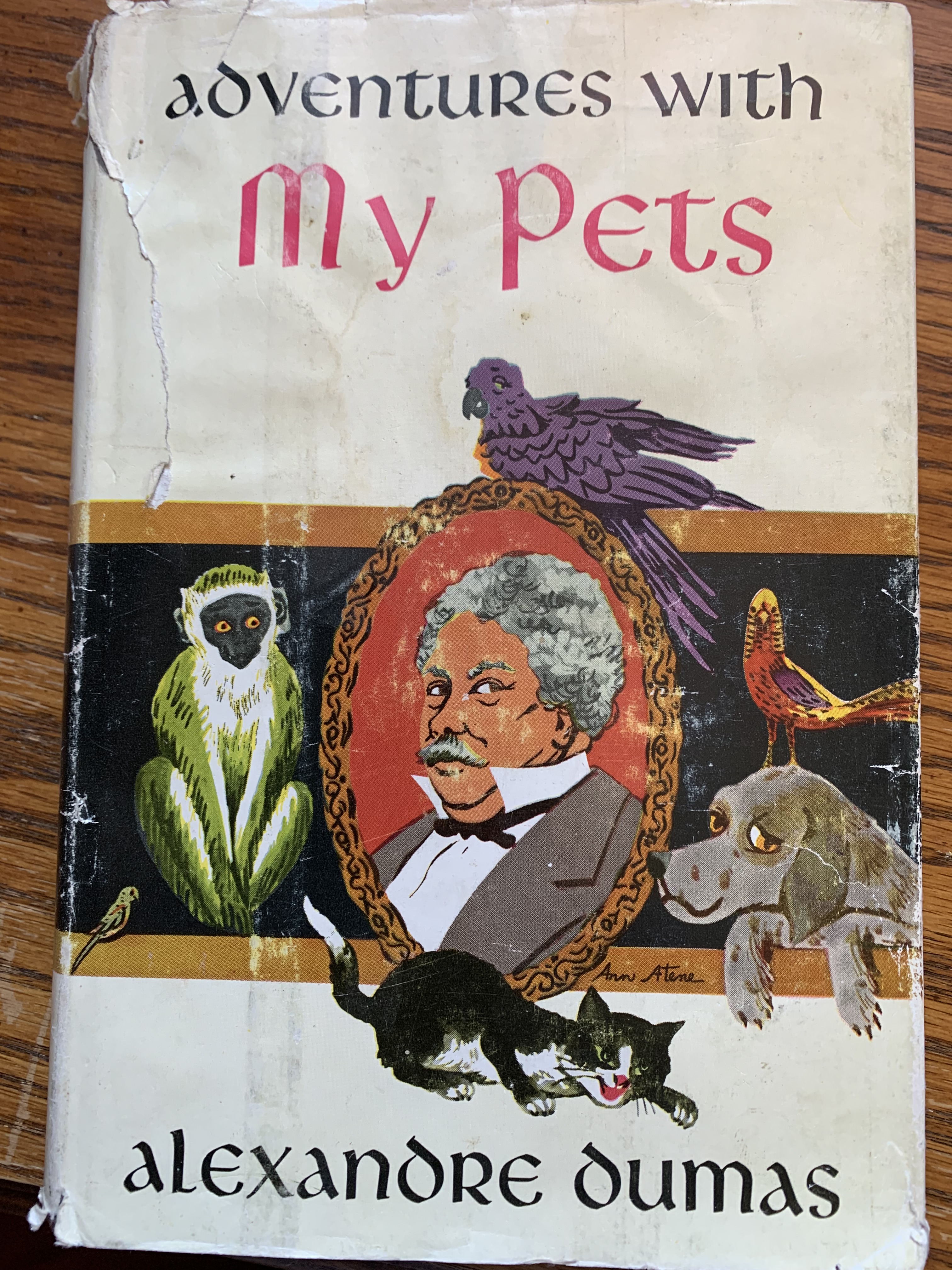
Doesn’t the picture of Dumas look a little like this cat? Or maybe this picture is the one that looks like the cat…

This is a memoir written by the author of The Three Musketeers and The Count of Monte Cristo. Now, Dumas was a badass, particularly as a writer. I’ve read Monte Cristo, and it’s bloody brilliant; and pets are absolutely my thing — so I had to get this. Plus it was only $5.

Unfortunately, as Dumas lived in the 19th century, the times they have been a-changin’: and Dumas did not think of pets the same way that I do — and neither, honestly, did he think of adventures in the same way I do. I was hoping for, I dunno, hiking in beautiful mountains with dogs, who run off the trail and then make friends with an elk and bring it back to get a scratch behind the ear and take a treat from Dumas’s hand; that would be an adventure! With a pet!

Instead I got a whoooooooole lot of hunting. Dumas surely did like to shoot him some animals. Particularly rabbits and birds. The title, you see, comes from the fact that one of the main characters in the memoir is Dumas’s hunting dog, his English pointer Pritchard. And if you count all the times Dumas blasted a bunch of small helpless creatures with a shotgun while Pritchard pointed at them, then you betcha, there were plenty of adventures with his pets. But as you can probably tell, it was not my cup of tea.

It was interesting. Dumas was still a hell of a writer, and he does manage to make a lot of the little anecdotes come to life. Some of them were even fun: the man had a lot of pets, some of which he treated well; while many of Pritchard’s stories are about hunting, there is also one about how Pritchard often brought home many other dogs from the neighborhood to share in his lunch, because Dumas spoiled his animals and therefore Pritchard’s friends wanted the same good food he provided his dog. There are many conversations between people, often but not always about the animals, which were interesting and amusing. There’s a great secondary character, Michel, who was Dumas’s groundskeeper/animal expert, and he is interesting and amusing; Dumas presents a bunch of ridiculous folklore legends as coming from this guy, and clearly we’re supposed to laugh at them (there’s a chapter where Michel asserts that frogs act as midwives to other pregnant frogs, and so either frogs must have taught this to OBGYNs, or OBGYNs must have taught this to frogs — and as a fan of frogs, I’m good either way), but Dumas never makes Michel seem like a fool or a doofus, which I enjoyed. I appreciate that Dumas was, as he was described in one chapter, one of the most arrogant and self-centered of men (Which, not to be stereotypical, but I feel like saying that about a Frenchman is saying something) — but also one of the most generous and compassionate. He is completely ridiculous about handing out money left and right, usually, in this book, to acquire more animals, and I like that. I love the chapter where Dumas is described: because he reprinted a letter from a friend of his who defended him in Parisian social circles, with a letter to the local newspaper, which is fantastic; the letter basically says, Yes, he is arrogant, but also generous — and the real difference is, he’s arrogant because he actually is the greatest author in France, and that makes him a better person than all the rest of us.

I loved that.

But I did not enjoy all the killing of animals. I liked the cat Mysouff, but not when Mysouff killed all the pet birds. I liked the dog Mouton, but not when Dumas kicked Mouton in the rear, as hard as he could, for digging up his garden, and Mouton bit the crap out of Dumas’s hand — and the point of the story was that Dumas therefore had trouble writing for a while, because it was his right hand. I liked Pritchard, but not when Pritchard went hunting, or just killing and eating animals for fun — and especially not when Pritchard gets hurt and Dumas plays it basically for laughs: the dog gets shot by a hunter friend of Dumas’s, and the joke is that the pellets hit Pritchard in the testicles — but not to worry, one of the testicles is still functional! So all is well! And I was just like, “MOTHERFUCKER, SOMEONE SHOT YOUR FUCKING DOG, GO KILL HIS ASS!”

Plus: the dog dies in the end. And not of old age, surrounded by the family that loves him.

So nope: this was definitely not the book I was hoping for, and I would generally not recommend it. If you are a huge fan of Dumas, then you might enjoy it; it gives more insight into him and his lifestyle than it does into his pets or his attitudes towards his pets — but if you, like me, are a pet person, give this one a pass.

Book Review: Redwall Book — is it #6?

Image result for Salamandastron

Salamandastron

by Brian Jacques

(*Note: it’s #5, actually.)


Now this is a good Redwall book.

There are some things that come close to my complaints in the past: the books in this series, while all well-written and sweet and fun, have tended towards a formula, to the detriment of a couple of the installments. And there are pieces here that are also part of the formula, to wit: a young male member of the Redwall community finds the sword of Martin the Warrior (How the hell could these people lose a sword this many times? I mean, come on! Every book they find that dang sword! Somebody needs to give these guys a pad of sticky notes.); a hare of the Long Patrol who can eat more than three other animals combined; the vermin army that attacks is led by a vicious evil beastie who rules them with fear and violence; said vermin army (spoiler – but not really) is defeated in the end; there are cute baby animals and playful pranksterish adolescent animals and kindly but staid elderly animals; and there’s a lot of food.

Goddamn, there’s a lot of food in these books. It’s like their one way to celebrate both their general happiness in life and also their victories over their enemies: some massive feast, with detailed descriptions of the dishes and the animals eating as much as they can.

But in this book, Jacques was able to add enough newness that the familiar elements felt familiar, rather than stale. Like the animal who finds and wields the sword (A squirrel this time, named Samkim) is not really the big hero: he does some good things, but mainly, he loses the sword and spends most of the book trying to chase it down; a different creature is actually the one who saves the day. While the vermin army was familiar, it doesn’t actually attack Redwall, and so there wasn’t the usual depiction of a siege. There was a siege, but it had an entirely different character because it takes place at the hollow volcano stronghold of the Badger lords and the hare Long Patrol: Salamandastron. And it is the badger lords who save the day. Also, the cute baby animal goes out on a quest, as do the pranksterish adolescents; this made both familiar character types more sympathetic, and minimized their cuteness and pranksterishness, which I really liked. This book had more to do with the badgers of Salamandastron, and also the shrews of the GUOSSIM (“Logalogalog!” has to be one of the best battle cries I’ve ever known. Along with the Tick’s immortal “SPOOOOOOON!”), than it had to do with Redwall itself, though Redwall is still a prominent part of the story; so this one felt like it expanded the world, rather than walked the same old paths.

There was also, though I don’t want to spoil the story any more than I already have (Come on, you knew the bad guys weren’t going to win. This is a children’s fantasy series. No way the bad guys actually win.), some real tension and suspense: because there is death in this book, and it isn’t just minor characters. The battle for Salamandastron has casualties on both sides, and indeed, goes against the badgers in several ways, for much of the book; creatures that seem set up to play major roles end up dying; there is a sad but realistic depiction of a serious contagious disease, and the way such a thing could rip through a community during the medieval times that these books are essentially set in. It meant that when some characters that I liked managed to survive, I was genuinely happy, because I knew there was a real chance they might not, so it was a victory when they did.

Other fantasy authors, take note. Except for you, George R. R. Martin. You already know more than enough about killing off your own characters.

This was a really good book, one of the best so far. Looking forward to more.

On the Fifth Day of Blogging, Just Dusty Blogged for Me…

An introduction to his familyyyyyy!


My wife and I speak for our pets.

I know this isn’t unique; maybe not even unusual. And though it may seem like it is to other people, especially the petless and those on the lower end of the imagination spectrum, it isn’t even strange or nonsensical: our pets, like any sentient thing, have personalities, and the clearest way for humans to depict that is to put it into words. We also do pantomime and funny voices for all of the pets, but that isn’t something I’m prepared to re-create on this blog.

So just the words will have to do.

What I have noticed over the years of speaking for my pets is this: my pets are smart. Very smart. Also kind of insane, but still — smart. The things they have to say, when we humans try to step outside ourselves and solidify their apparent perspective, are often true and even insightful things. This may be exactly because the attempt to speak in another persona allows us to step outside our own egos, and gain a new and perhaps clearer perspective; it may be because animals don’t care about the same bullshit that humans care about, and when you are speaking for an animal, it is impossible to speak like a human. It may be because I actually like animals better than humans, and so when I am speaking for them I tend, consciously or not, to make them sound like better people than human people generally are.

Though that last one isn’t entirely true. Because I speak for Dunkie, too, and he’s crazy. But also very sweet. And he don’t take no shit off of nobody, which is something that is not true for me, and which I admire and envy.

Regardless, whether it is escaping my own ego, or escaping a human’s perspective and a human’s baggage, or even if it is just that I want to make my pets seem like good people, it seems to me that their advice is worth listening to. So I’m going to be giving them a regular sort of column on this blog, and asking them what they have to say about the world we all share.

First, let me have them introduce themselves.


Duncan the Cockatiel:

Theoden Humphrey's portrait.

This is Duncan. He insists on going first, because he’s the oldest, and because he believes he is the most important.

YOU’RE GODDAMN RIGHT I’M THE MOST IMPORTANT! Yeah, that’s right — because it’s all about Dunkie. Oh! Right, yeah, introduce myself. Okay, LISTEN UP! I’m Duncan. I am named for a king. KING DUNKIE! I bring beauty into this house.


My feathers are pure white, and very clean and neat, because I spend the majority of my wakey-time grooming myself. I have a beautiful gold crest and awesome orange cheeks, and I whistle and sing and make kissy noises when I feel like it. 


When I don’t feel like it, THAT’S WHEN I START SCREAMING!


I can be very loud. BUT ONLY WHEN THEY DON’T DO WHAT I WANT! I can’t help it. I’m very small and I’m stuck in a cage. I don’t have a lot of weapons. I can bite, and I threaten that a lot. Doesn’t seem to work, though. BUT THE SCREAMING DOES! Yeah, it works good. It gets a real response, you better believe it. They always think they can ignore me, BUT NOBODY IGNORES DUNKIE! Even though I’m a tiny little pretty bird, I AM A FOUNT OF RAGE! It never lasts very long, though. But the screaming can go on and on and on and on because nobody is as stubborn as a bird. But then they just cover me up. That makes me stop screaming.

But really, all they’re doing is making me swallow my rage. The screams don’t stop, they just go inside.

For now.

It’ll come back later. Rage always does. You better believe it, pal. Just as soon as you do something I don’t like. Yeah.

I’M DUNKIE!

Oh yeah — and I can be very sweet, sometimes, too. I picked Mama out special when she came into the pet shop where I was living when I was new. Birds are usually standoffish to strangers, but I walked right up to her and put my foot out, reaching for her shoulder so I could stand on her. I still like to cuddle and have her give me skritchies. And then I close my eyes and make the tiniest little peeping noise.

It’s almost enough to make you forget about the rage.

Almost.


after-grooming
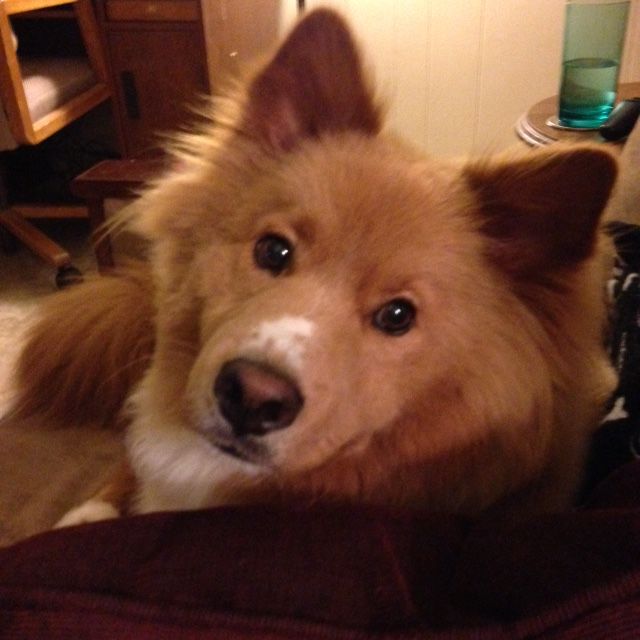
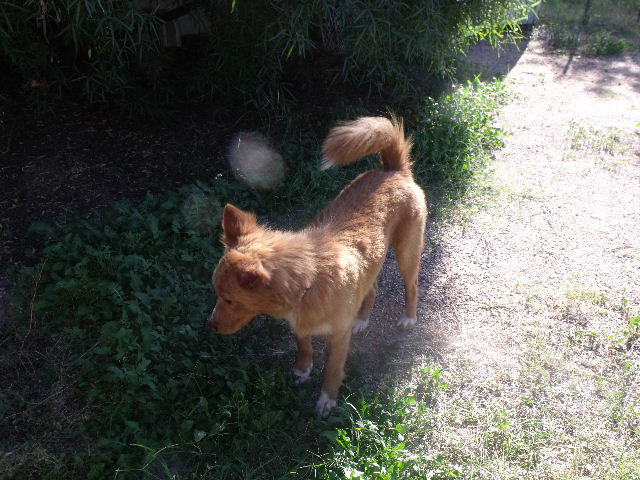
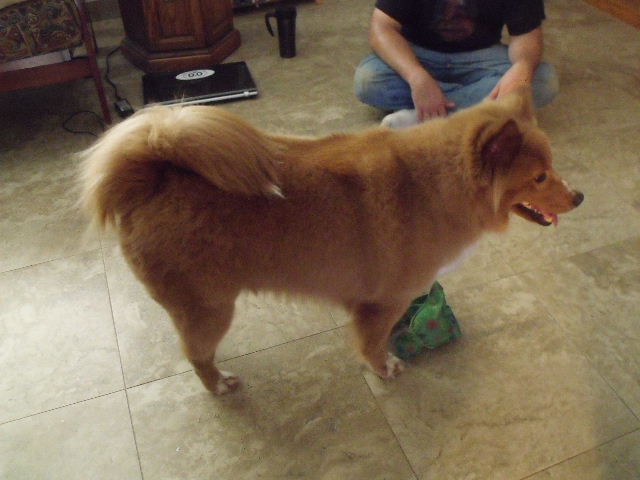
This is Samwise. Samwise, also known as Sammy, also known as the Fox in Socks (the Spitz in Spats), is the middle child (we think — both his age and the tortoise’s age are somewhat in doubt.) and is the sweet one.

 
HEYYO!* I am Samwise! I am a goodwill ambassador, that’s what my persons say. These are my persons, my mom and my pop.

Toni DeBiasi's portrait.

DSCF1669


I call them that because they took me in when I was in the joint. See, I used to have different persons, but they abandoneded me, and then I had to live on the street for a while. I came pretty close to starving to death, and it made me very scared and anxious. Then I got picked up and put in the shelter — but the dogs call it the joint, because though it sort of is shelter because you get a roof and food and water and stuff, you’re still locked in a cage, and you’re alone and scared pretty much all the time, which is why all the dogs in the joint bark a lot and act really mad. Because they’re scared and they don’t know why they don’t have a home any more, because we all used to have homes and persons, and then all of a sudden we don’t, and we’re in the joint.

The joint changes a dog.

But it didn’t change me!** Because I am super sweet, and very friendly and curious. (Though I still get scared sometimes.) I like everybody. I greet everyone and let them all pet me — I am very soft and fluffy. I never ever growl or bark, and I am not afraid of strangers — I like to stand up and pat them on the tum, because I like tum rubs and I think everyone should have tum rubs. My mom and pop think it’s amazing that I’m still so friendly and sweet, because I have plenty of reasons not to be, from my early life before I came to live here. But they don’t understand: that was all in the past. Now I have a nice home, and lots of food and tasty treats, and two persons that love me and will always take care of me, even though I bit my mom on the first day she brought me home because I got anxious and freaked out like I do sometimes, but they didn’t bring me back to the joint like the persons who took me home before them who only kept me for a week and then brought me back, or the ones before them who did the same thing (Pop says it’s because people suck, and because I have this thing they call tick fever from when I was on the street and it means I need to go to the vet and get medicine and tests and stuff and it costs money and the persons who took me home didn’t want to pay for me, but I don’t know what money is and I don’t even like the vet because they poke me with owie things but then they give me treats so it isn’t too bad but still if I could I would skip the whole thing and I’d really rather just have persons even if they don’t take me to the vet because all I really want is a home. And I have one now. So the persons who didn’t keep me before, that was just because they weren’t the right persons. I had to wait for just the right persons. And I found them!). So now I have a home, where I get to sleep in the bed, and I get two walks a day, and I get treats all the time, and they always pet me when I want them to and rub my tum and everything.

So why shouldn’t I be happy? See how nice persons are? Just look at my mom and pop! I think they’re awesome!

Okay I have to go now! Now you get to say heyyo to my outside brother! He doesn’t live in the house because he poops everywhere. I don’t know what the problem is. His poop seems pretty easy to clean up. But then I guess I’m not the one who cleans it. Anyway, he lives outside and he seems to like it. Okay bye!

(*Sammy’s greeting is pronounced like “Hello” with a Spanish “ll,” pronounced as a “y,” like “La Jolla.” It does not sound like Ed McMahon’s response to Johnny Carson jokes.)

(**Actually, it changed him quite a bit. When we brought him home, he weighed 25 pounds; he is now almost twice that, and has three times as much fur. Before and after:)

1526792_709556565807081_2954433223766361570_nsam1first-day-2after-the-grooming


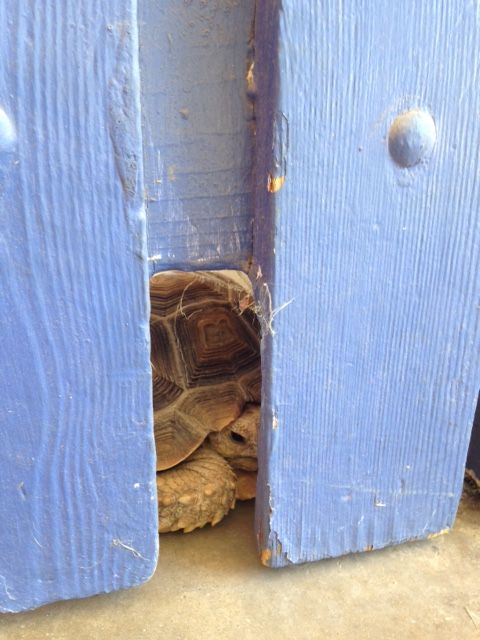
Neo is an African spurred tortoise. We named him Neo because he was a gift from our former landlady, and when I was looking up African names, I found that “Neo” is a gender-neutral name that means “gift” in Tswana. We pronounce it like the name of the Keanu Reeves character from the Matrix, though I am sure that the actual word is pronounced differently; but we love the Matrix movies, and I sort of like the idea that the tortoise is actually the messiah. The actual word for the tort is “calm.”

neo-peeking

Hello. I’m Neo. I like food. Especially grass.

Theoden Humphrey's portrait.

This was the new sod we got for him, and the fence that didn’t keep him out. (Photobomb by Sammy’s butt.)


Food is good. So is sleep. I like to hide so no one bothers me. Especially that furry guy (“HEYYO!”). He sniffs me a lot. He moves too much. And too fast. You have to take your time, because otherwise you might miss things. Like food. I eat pretty much anything. I can’t see very well, so I usually try to eat everything I can find. Then I sleep.

Sleep is good.

I have a shell because I don’t want to be bothered, but usually I walk around a lot and look for food. I can walk surprisingly fast, especially when one of the tall people come out and come near me, because they usually have food and I walk straight to them as quick as I can. Which is pretty quick. Not that quick.


Not as quick as the sniffer. I have an extra house, like a shell for my shell.


I sleep in there because it has a warm rock* that I like to sleep on. Warm is good. Sleep is good. I walk around every day and graze, and eat my plate of salad, and then I go and lie in the sun or lie on my warm rock and sleep.

*Warm rock=heated basking spot designed for tortoises. Basically a hard plastic tile with a heating coil inside.


Life is good.

Redwall Book II: Mossflower

Mossflower
by Brian Jacques

The second Redwall novel is a lot like the first.

Maybe a little too much like the first.

Don’t get me wrong: the most notable and important similarity is that these are both lovely books. This one is a distant prequel to Redwall; it tells the story of how the animals gathered at the place that would become Redwall Abbey, and decided to build that great haven. It is the story of how Martin the Warrior came to be the hero of Redwall, and how he got his mighty sword, the same weapon that Matthias searches for in Redwall. The writing is just as good, and just as sweet; these books read more like fairy tales than anything else, and it makes them great fun — though like the original fairy tales, they are not by any means bloodless, nor do all of the heroes make it to Happily Ever After. There are cute younguns, and amusingly crotchety elders, and the food still sounds delicious.

There are differences, too: in this, the villains are striking out from a castle, rather than trying to win their way into one; it changes the battles and the strategies, and that was well done. This one ranges farther afield, as our heroes quest to Salamandastron, the legendary volcano far to the east, in hopes of finding allies. That was also excellent, particularly the parts with the rabbits, whom I enjoyed tremendously in Redwall when there was only one pommy British fellow with long ears; in this book there are nearly a dozen, and every one is delightful.

But: you’ve still got a horde of weasels, stoats, and ferrets led by one particularly savage tyrant; the weasels, stoats, and ferrets are still clumsy incompetent buffoons who lose battles against the heroes because of their stupidity and cowardice. You still have the great, sinister predator — in Redwall it’s a serpent, in this one it’s an eagle — that threatens everyone who comes near. You still have the badger who carries the battle with its great strength. You still have the desperate quest for allies that goes far afield and comes back at the last second — with shrews, both times. You still have the one bird that is not really trusted but is extremely helpful. And of course you have the mouse who saves the day with a big sword and limitless courage.

I suppose I shouldn’t make too much of this; it is a series, after all, and therefore is going to have common threads that run through all the books. But this one felt a little too familiar, for all that the familiar parts were still delightful.

I’m hoping the next book will offer a little more variety.