Opening The Window

…Maybe Shouting Out of It

I have been thinking about writing. I do that a lot: mostly because I haven’t been writing a lot. But I just don’t know what to write.

Then I saw this:

@therapyjeff

You’ve got, like, 1 to 3 business days before hypernormalization drags you back under. #mentalhealth #therapy

♬ original sound – TherapyJeff

It hit me.

It’s hard to predict what will hit you, what will have an impact; that’s part of why I haven’t been writing as much — I don’t know what to say to have an impact on my audience (if I even have any audience left), and I can’t predict what will have an impact on me. And the hypernormalization that he talks about is definitely real, and strongly controlling of my day-to-day interactions with the world and the world of current events. I will also say that my role as a teacher is partly to encourage some of that hypernormalization, because my students freak out, often because they enjoy freaking out and more often because they are young people in a terrifying and confusing world; and whether they are freaking out for the sake of their shattered nerves, or for the sake of the meme (or freaking out for the meme as a way to disassociate from their shattered nerves) , the answer is always to remain calm and to try to pour water on the flames they are fanning. So I spend part of pretty much every working day trying to calm the tempestuous waters of teenaged souls. Then I come home, and sometimes my wife is freaking out — in that case it is never for the meme, it is only because of her shattered nerves or because the world really is a dumpster fire and sometimes we are caught in the flames (which is NOT FINE) — and then sometimes, again, my job is to make awful things seem normal and manageable and not a big deal. Sometimes my job is to freak out with her, which, sadly, I am bad at, because my freaking out usually looks like me getting really mad, and that doesn’t always make people around me feel peachy; but I do my level best anyway, Partly because my nerves are shattered, too.

But this is counterproductive for my writing, because I don’t want to write about how things are normal, how they are just fine. I want to write about how they are fucked up. I don’t want to freak out, because nobody wants to read pages and pages of AAAAAAAAAAAAAAAAAAAAAAAAAAAAAAAAAAAAAAAAAAAAAAAAAAAAAAAAAAAAAAAAAAAAAAAAAAAAAAAAAAAAAAAAAAAAAAAAAAAAAAAAAAAAAAAAAAAAAAAAAAAAAAAAAAAAAAAAAAAAAAAAAAAAAAAAAAAAAAAAAAAAAAAAAAAAAAAAAAAAAAAAAAAAAAAAAAAAAAAAAAAAAAAAAAAAAAAAAAAAAAfuckfuckfuckfuckfuckfuckfuckfuckfuckfuckfuckfuckfuckfuckfuyckfukfuyckfuckfuckfukfuckfuckfuck Hey that’s pretty fun when you get the rhythm going!

But it’s hard to write, calmly and rationally, about how things are fucked up when you are yourself freaking out. Which is, of course, what the powers that be want: they want us to draw into our individual isolated shells and hide from the horrors they have put into the world, because that makes us easier to control, and easier to eliminate; and that’s why this very nice therapist made this TikTok, in which he tells us to take a step, even a small step, towards interacting and connecting with others during this particular moment of jarring insanity; because, as he says at the close of that video, even that small step of having a conversation or connecting with a group of potentially like-minded people, is much bigger than sinking back into the hypernormalization without having done anything other than twitch bonelessly for the 1-3 business days of this moment when we can break loose.

So let’s break loose. Rationally. Without freaking out, but also without rationalizing everything into normality. Because this is not normal: a man shot Charlie Kirk in the throat. Charlie Kirk is dead — apparently assassinated, though one thing I will say is that we absolutely must stop speculating about shit we know nothing about, until we actually know what is going on. We don’t know that the murderer was an assassin in the sense that we know for sure that the killing was politically motivated, and that Kirk was murdered because he was a prominent political voice; he was a prominent political voice, so in the case that we see any such death as an assassination, then it was, but I think it is important to distinguish between John Hinckley’s attempted killing of Ronald Reagan and Lee Harvey Oswald’s successful killing of John F. Kennedy: Oswald intended to kill the US President because he disagreed with Kennedy’s political stances and actions, and maybe what Kennedy represented; Hinckley thought Jodie Foster would notice him if he shot the President. That second one is not, to me, an (attempted) assassination. If we assume that this one was an assassination, which is a reasonable assumption but not a certainty because the killer carved fucking memes into his bullet casings — “If you read this you are gay LMAO” is not a political statement — it is also not clear if it was done because Kirk was too right wing, or if he was not right wing enough, which means we may be able to label it as an assassination, but not then go on to say anything meaningful about that fact other than it was a terrible, horrible thing, like every murder, especially unnecessary ones. (Yes, there are necessary murders. Not many, and they are still terrible, but there are. Not this one, so that is not our topic.) We do not know, and I will disagree with the people saying all over the internet and TV, that Kirk was killed for his political views, or his ideological beliefs, or his past statements which the killer may have found too offensive or not offensive enough; when all of that becomes clear, then we can discuss it — though we are unlikely to come to any useful consensus about it. And that’s partly because of Charlie Kirk.

I don’t want it to be because of me, too. I like to think it never could be, because I, of course, am rational and reasonable — and also correct, which, as I like to tell my students (quoting the late great Bill Hicks), gives my argument that extra oomph — but of course we all think that about ourselves. I do certainly write divisive things, both because my arguments are aggressive and confident, sometimes even spoken in words as hard as cannonballs (to quote Ralph Waldo Emerson), and because my language and my personal statements about my opponents and enemies are frequently deeply offensive. If people who disagree with me read these posts, they probably get pretty mad at me, and at them. Though they may deny it, because of course online debaters must never admit that they are upset, that they are emotional and out of control.

I am quite emotional. I am often somewhat out of control, usually, as I said, because I have a temper, and because my nerves are shattered. Anybody who doesn’t feel the same, at least that last part, is either lying or a sociopath.

Because stuff is fucked up. Deeply, multifariously, evilly fucked up. A man was murdered, and we all flipped our shit about it: and on the same day, two children were wounded by a third, who shot them at their school and then killed himself. I don’t even know how many other people have died in the days since Kirk was killed, but if we keep up this year with last year’s average it would have been about 47 per day. The right accused the left of causing Kirk’s murder with our political rhetoric; the left accused the right of causing Kirk’s murder with their violent fascism; people posted about how saddened they were by the death, especially because his wife and children were there and saw it happen; other people posted about how they were glad Kirk had been killed because of the awful things he had said and the positions he had espoused in the past, including racism and sexism and homophobia and transphobia.

It’s all fucked up. And even the virtuoso guitar playing of Stevie Ray Vaughan (Who was only five years older than Kirk — 36 to Kirk’s 31 — when SRV died in a helicopter crash) can’t make it better, can’t make me feel calmer and more in control at this moment.

So I had a thought. A step to take, in this window (which may have closed already, because it’s been four days since he died; but I’m going to try to do this anyway because I don’t think I’ve sunk back into the hypernormalization yet) of opportunity. Not to argue for gun control, though I am doing that on social media; not to argue against hyperpartisanship because arguing against people arguing badly is a losing endeavor, no matter how you slice it; not to lament the loss of free speech in this country, because Malcolm X was assassinated sixty years ago — also in front of his wife and children — and the Alien Enemies Act signed into law by President John Adams in 1798 was used by President Donald Trump in 2025 as a legal justification for deporting both citizens and non-citizens without due process, so I would argue that we have never had fully free speech in this country.

I want to try to reverse the polarity of this moment. I want to try to speak positively. Not about Kirk’s murder, which is nothing but horrendous; I just want to use this moment to try to imagine a world in which Kirk would not have been murdered. A world that certainly could have existed, if we had made different choices as a nation and a people, and one that we can certainly bring into existence if we try. Maybe if I try to normalize hope, then we can have some when we sink back into our absurd routines.

Let’s start with a beautiful image. This one came from here, and is advertised as using no AI.

I don’t see why not. Hope is not any harder than despair: hope takes work, but we have to work to keep our despair gurgling inside of us, just as much. We have to spend time looking for more reasons to feel despair, have to keep thinking negatively about what is in our world or in ourselves — or what is not there — have to keep all of that front of mind, or else we might spot a video of a cute puppy and not be sad any more. If you’ve ever felt sorrow or despair, then you know the struggle to keep it that I am talking about. (Depression, now: depression does not require any work to maintain; that’s why it is depression. But I’m not talking about mental health, other than to say that hope and positivity in a non-toxic way might help with depression, as well. Not going to oversimplify the facts of depression, but still. Here’s that puppy.)

Your Puppy: What to Expect at 13 to 16 weeks - Vetstreet | Vetstreet
This is my favorite ear configuration: one up, one down. And nobody does it better than Corgis. This image is from here.

I’m not trying to slap some pretty pictures up over the horrors: that kind of forced, hollow veneer just makes things feel worse because we know how thin it is. I’m just using the images to counteract the — let’s call it the acidity of the first part of this post, the corrosiveness of horror and violence and conflict. But for the hope, I want to speak genuinely. Because I think the hope is real.

First, what am I hoping for? I’m hoping for a society that recognizes the value of all of its members, and takes all stakeholders seriously when considering what to do collectively. I’m hoping for a world where people are able to find and create joy, consistently, throughout their lives. A country where we try to find our common ground, and respect our common humanity, before we disagree about what our country should look like. A life where people recognize the liars and conmen, the gaslighters and manipulators, and see the corruption for what it is, and don’t tolerate it because it smells just like our own. A world of integrity and trust.

No. It isn’t impossible. I’m certainly speaking in broad generalities, because no, I don’t expect any world to reach a point where problems are eliminated, where there is no conflict, where liars are vanished and corruption is prevented before it taints everything. But I do know that our world, our society, our ethos, used to be different, in at least some ways and to some degree; and that means that change is possible. We talk about the pendulum swinging, and it does, and it will — though I suspect that the pendulum, like most other political machinery in this ever-so-exploitable country, has been manipulated in some way to ensure that the people in power don’t lose that power when the pendulum swings; but the power of the pendulum metaphor is that the swings are inevitable, and reactive: you can hold back the pendulum, you can even push it farther away from plumb; it’s just going to swing harder and faster when it finally goes, and swing farther in the other direction when it does. It can’t be stopped. And it can’t be stopped because people are essentially good, despite what our cynical profiteers would have us all believe — because they want us all hiding in our individual isolated shells, hiding from the horrors, easily controlled and easily exploited. No: people are essentially good. We are just — we’re really, really scared. That’s what we have to overcome.

Here’s a nice picture of individual shells:

🔥 Cuban snails ( Also said to be the most beautiful land snails ) :  r/NatureIsFuckingLit
These are Cuban snails. Image from the subReddit NatureIsFuckingLit. Hell yeah.

And it begins with trust.

That’s the message I want to share today. Hope is possible, and achieving what we hope for is possible, especially if we all hope for (essentially) the same things. It begins with trust: we need to trust each other, to believe that we all will cooperate, so far as we can, to achieve those things we hope for.

I know this because I am a high school English teacher. And I have watched my classes struggle more, in some ways, every year, as their attentions spans wane, as their interest in reading disintegrates, as they become less and less literate. I have certainly lost hope at times; I have certainly lost trust in my students, have believed that they do not want to learn what I have to teach, that they do not want to read, that they do not want to do anything other than play video games, watch TikToks, and be annoying. I have believed all of those things because there are days when they act like that. Some of my students act that way all the time, and some of those even say that they have no interest in learning to read better, no interest in ever reading as long as they live. It’s hard to keep trusting kids who say that to me, especially the ones who know the impact on me of what they are saying.

But those are only some days. And those kids? They are only kids. They don’t want to read because they don’t have any hope. They are not incapable of reading, and they are not incapable of hope. On my worst days, I don’t believe that; but on my best days, I inspire hope in them. I know it: I’ve seen it, and I’ve been told about it, both in the moment and years afterwards. I was having a rough day this last Friday: and then one of my students — now former student, because they have departed my school for online schooling — came back to thank me for being their teacher. They gave me a lovely hardback copy of To Kill a Mockingbird, the book I taught them. Because they saw it and they thought of me, and they wanted me to have it. They saw a book: and they recognized the value of that book, because I taught them that book had value. And, I mean, I’m a good teacher: but I’m no miracle worker. This was just an ordinary interaction, a regular unmotivated and difficult student, who I happened to connect with enough that they trusted me when I said that TKAM was worth reading: and then I proved it. And for the rest of their life, they will know at least one book that has value, that is something worth giving to another person as a thank-you gift.

That’s hope.

And it starts with trust.

I’m going to keep going with this idea, because I like it, and I think there is value in it. Hopefully I can get some of you (if there are any of you — but I trust that there are) to trust me enough to start hoping, as well. And if we can agree on what we should be hoping for, then we can make it happen. We’ll turn that goddamn pendulum into a wrecking ball — one made of candy.

That’s how we’ll change it.
Day of Hope

Yesterday was my birthday. I had a great day: my wife and I went out for an incredible brunch at a restaurant in Tucson called Blue Willow – HIGHLY recommend the breakfast burrito, if you go – and then went home and had presents – I got two awesome t-shirts and a video game, Skyrim for my Nintendo Switch, which is a lovely thing mainly because Skyrim was one of those games I avoided when it was new, since I knew it was exactly the kind of video game I love most (sandbox swords and sorcery) and would therefore consume all of my waking hours once I opened Pandora’s Box and started playing it, and as I told all of my students at the time when they asked if I was going to play Skyrim, I have a job; which means that now I have been given permission to go ahead and let my free time be consumed, partly because I deserve and need nice things, and partly because the truth is that I will not actually allow ALL of my free time to be consumed, that I can be trusted to do what is necessary even if I would rather just dive back into the video game (Hold on, the t-shirts reminded me: I need to cull my collection. Be right back. [Got rid of seven shirts. Good progress.]) – and then we went to an arcade with friends, where I got to play pinball and a car racing game and a pirate shooting game and the BIGGEST SPACE INVADERS IN NORTH AMERICA, and then we came home and ordered Chinese food in and then had huge slices of an AMAZING cake. It was a great day.

Yesterday in Washington D.C., the Republican party passed Donald Trump’s “Death to the Poors” bill (I will neither call it the B.B.B. as that shitmouth named it – though honestly I appreciate the bald hypocrisy of that, coming from the party that has been loudly and repeatedly criticizing large omnibus bills for years if not decades, until said omnibus comes from President Turdtongue – nor talk about it as a tax cut bill as the news outlets insist on calling it, while they also name it as a Asslips’s “most significant accomplishment,” which is a wild phrase: just imagine talking that way about, say, Auschwitz, or the Night of the Long Knives, or the invasion of Poland, as Hitler’s “biggest achievements” to date. I will come back to hypocrisy.), which Pres. Butt-Teeth will be signing today, in a continuation of his efforts to taint and corrupt every single piece of American culture so that nobody can ever enjoy anything ever again in this country.

Not that this is my favorite holiday: I’m a vegetarian, and I live in Tucson, Arizona, so barbecues at the park are out on both meat-related and heat-related grounds; plus my dog is terrified of fireworks, and I personally dislike the strong possibility of wildfires being started by an idiot with a bottle rocket and a match. But there are, nonetheless, reasons why I want to celebrate this holiday, and hold onto it in the face of ol’ Colon-Throat’s attempted appropriation. And I want to write about it today because I realized that the reasons for me, for us, to hold tight to the Fourth of July are the very same ideas that I want and need to write about.

I wasn’t sure what I wanted to write about. Part of me doesn’t want to write at all: I just want to curl up on my couch, pet my dog, and play video games. (And not only because I just got Skyrim, though that is definitely part of the draw… I can hear it calling to me right now… No, wait, that’s my cockatiel Duncan screaming because he’s upset about something.) And while I want to rant about Donald Trump, and the Supreme Court, and the Congress, because all three branches of government have been captured by the proto-fascists who want to turn America into a white Christian ethnostate with a patriarchal dictatorship that is decidedly unChristian, I don’t know what the value would be in ranting: the people who would read it already agree with me, and it would just make them sadder than they already are because the horror is relentless and it’s hard to remain so ourselves; and the people who might read it who don’t agree would find it tiresome to just hear more ranting; and the people who are on the opposite side of these issues (who don’t read, but just hypothetically) would be giddy with Schadenfreudish glee, cackling about how angry I am and signing up for WordPress accounts just so they can comment “Cry more!” and throw down some of the memes I’ve been getting hit with because I have (foolishly) been commenting on news stories on Facebook. And I don’t want to create any of those responses.

I recognize that the most important thing we can do is spread good information, and so that makes me want to become a journalist, and share correct information, and – I mean, maybe I should do that. But I already have a job. And it’s a hard job, and I work hard at it. And I have a family which I love, but which, like all families, requires a lot of time and energy – and not that I begrudge that, I do not, I would spend all of my time and energy on my family if I didn’t have to work, and I look forward to the day when that happens; I’m just saying that I will not take time and energy away from my family in order to become a journalist. There are already better journalists, trained and professional journalists, out there doing that work, so I shouldn’t have to. Clearly my fight against misinformation is in my teaching, and I will continue to do my very best there, in every way I can.

But that leaves me with nothing to write about.

It is summer, and so that makes me want to write, because over the school year I am often too tired and burnt out and frustrated to write; but I have been facing this conundrum about what to write about, and I haven’t been writing much. (Also my summer has not been all that restful, but it’s mostly been family stuff, so I don’t resent it.) As I haven’t been writing, however, I have been trying to get back into my other great passion that I haven’t been able to spend enough time on: I’ve been reading. And one of the things I’ve been reading has been these:

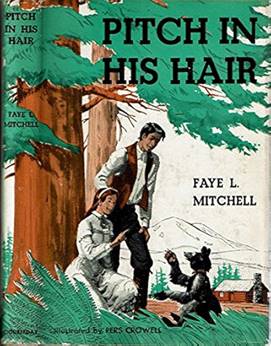
These are my great-grandmother’s novels, published in the late 50s, when she had retired from teaching. (Have I mentioned that I come from a line of teachers and writers on  my mother’s side? This is part of that line.) I’ve never read them before, partly because I never knew my great-grandmother; for most of my life I didn’t even know that she had written books or published them or that we had copies. So I’m reading them now, and they have shown me a couple of things. First, because these are young adult books, and historical/regional fiction (They are all set in western Washington, where the Mitchells lived and where both my grandmother and then my mother were born and raised, during the frontier times between about 1970 and 1890, when the Mitchells did not live there – Faye and her husband Burt emigrated from Kansas), they are not great literature in a canonical sense: but they are good stories. And this helps to settle in me something I have always struggled with, because I am not a writer of great literature, and though I don’t want to be, I always think I should be; but I think that in truth I am, like my great-grandmother, a storyteller, not a literary giant. And I would rather be that. Second, these books, because they are set where they are and because the main character, Abby Conner, is a young woman who wants to become a teacher and a writer and who talks about what it means to be a teacher and a writer, are helping me to be prouder of the teacher and the writer that I am, because I think that my great-grandmother would probably be proud of me, and I like that – and my Nonna, whom I loved and respected but who passed before I had even decided to become a teacher, would definitely be proud of me, and I love that. And third, because my great-grandmother clearly wrote about what he knew, I have been thinking about how I need to do that. Not with my novels, which are almost certainly going to stay fantastic and more about vampires and time-traveling pirates and magical dreams that change reality; but with these blogs, and with the things that I write every day: I need to write about what I know.

So this is what I’m going to do: I’m going to write about what I know.

So. What the hell do I know?

I used to be optimistic.

My wife talks about it, about how I used to be much more cheerful, and much more calm, and much more positive. She doesn’t make it sound as bad as I just did: she doesn’t say all those things at once, and she doesn’t say it with any kind of accusation or disappointment or anything – never “You used to be a lot more fun!” or anything like that. She has taken note of it out of concern for me: because my general demeanor has become darker and angrier over the last decade or so. And it’s coming out in ways and in places that I don’t like: I have had a hard time keeping myself from losing my temper with my students, and I have failed at that, and lost my temper, several times in the last few years, sometimes to my real regret. I am also having a hard time keeping my spirits up in order to push back against my wife’s occasional depressing outlook, which is sometimes something she needs me to do (Don’t we all?), and which I have not been doing as well as I used to.

I suspect this happens to a lot of people, if not to all of us. We lose our idealism, and our hopefulness – those of us who ever had it, that is, which is not everyone. But I think as time goes on, and life gets harder, and as people just keep on disappointing us, over and over again – say, by re-electing an orange-tinted fascist would-be dictator even after he tried to overthrow our government the first time: it’s hard to look down the road and think that it actually goes to a better place. And while Trump certainly wasn’t inevitable, the difficult and sad things that happen as we get older are inevitable: we lose people we love, and eventually we lose ourselves, and there is often a great deal of suffering on the way to that. As that happens to us more, and as we are shielded from it less, our lives become sadder in many ways, and it makes sense that we would do the same.

I do also think the last few years have been rough on people in this country. Trump’s two electoral wins and two administrations, the pandemic, the various economic and global crises: it’s been tough to keep looking on the bright side of this pile of shit. I certainly haven’t been immune to that. In fact, it has been directly detrimental to my optimism: because I keep thinking, and saying, and arguing, and preaching, that things are going to work out the right way: and I keep being wrong. I said that Trump was going to lose in 2016, both in the primary and then in the election, and I thought that he would go to trial for his crimes and that he would get convicted, and I thought he would lose in 2024. Wrong, every time. (Okay, he was convicted, but only of the least important one, and it didn’t affect his political ambitions in any way at all, which I also thought it would. Still: he is a fucking convicted felon, and anyone who claims it was only a politically motivated prosecution, you’re goddamn right, and it was a successful one, and it should have kept people from voting for him, and it was therefore the right thing to do – but I think we can see that, even though it was a politically motivated prosecution, that didn’t affect the general populace very much: the election is evidence that the jury was honest and sincere.) That record makes me not want to keep my hopes up: not mainly because I hate being wrong and looking dumb (though I do, both), but mainly because I don’t want to give people false hope and then have them fall farther and harder when my false hope is proven wrong. Again.

But okay: now let’s talk about the Fourth of July. (See, this is why I’m so goddamn wordy and circuitous in my writing, even though the only way to write great literature is to keep it short and simple, as much as possible, to edit even more than you write: because I’m not a great literary mastermind, I’m a storyteller, and this is how stories get told. Thanks, Great-grandmother. Actually, since I called her daughter Nonna, I’m just gonna call Mrs. Mitchell Grandnonna. I hope she would like that. And let me note that, as wordy and circuitous as I am, I get back to where I want to go. Eventually.)

The Fourth of July is a convergence of three of my heroes. Three of the greatest writers in American history, because all three were three of the greatest thinkers and idealists in American history. Not all the best people, but I generally think the art, and the truth, can transcend the people who discover it or create it. If you look at science, for instance, there is not and never has been a scientist who was worthy of the power of what they discovered: not Newton, not Darwin, not Einstein… maybe Carl Sagan. I don’t know if Galileo was a good man, honestly, but how could he possibly be good enough to live up to what he did for our understanding of the universe, for what he made possible? He couldn’t. The same with great artists: the people who affect the lives of millions and even billions of other humans in positive ways couldn’t possibly be good enough in and of themselves to really be seen as deserving of the praise that their impact deserves. Martin Luther King, Jr., could not possibly be good enough as a person to actually deserve the honor that he rightfully gets as the civil rights leader and genius communicator that he was, even if he hadn’t been an egotist who cheated on his wife. But his impact, his positive impact on the world, is beyond measuring: is beyond what one person could contain. So I am willing to praise the work, and the words, and the ideas, even if the person who created those things was worse than their impact.

This does not excuse J.K. Rowling, by the way, though I do also think the criticism of Harry Potter is lazy and vicious and incorrect; but Rowling is, it turns out, a terrible person who should absolutely be canceled entirely. While we all keep reading Harry Potter. Don’t worry, it will get easier when she is dead.

So: the three people who are connected by the Fourth of July and whom I find inspiring are Thomas Jefferson, Frederick Douglass, and Abraham Lincoln. (See what I mean about not the best people? Douglass was a saint, but I only say that because I don’t know enough about him to know the bad stuff; Lincoln was a racist egotist, and Jefferson owned his own children. But the point here is that we need to look at the work, and the ideas, and the words.) Thomas Jefferson, of course, wrote this:

When in the Course of human events, it becomes necessary for one people to dissolve the political bands which have connected them with another, and to assume among the powers of the earth, the separate and equal station to which the Laws of Nature and of Nature’s God entitle them, a decent respect to the opinions of mankind requires that they should declare the causes which impel them to the separation.

We hold these truths to be self-evident, that all men are created equal, that they are endowed by their Creator with certain unalienable Rights, that among these are Life, Liberty and the pursuit of Happiness.–That to secure these rights, Governments are instituted among Men, deriving their just powers from the consent of the governed, –That whenever any Form of Government becomes destructive of these ends, it is the Right of the People to alter or to abolish it, and to institute new Government, laying its foundation on such principles and organizing its powers in such form, as to them shall seem most likely to effect their Safety and Happiness. Prudence, indeed, will dictate that Governments long established should not be changed for light and transient causes; and accordingly all experience hath shewn, that mankind are more disposed to suffer, while evils are sufferable, than to right themselves by abolishing the forms to which they are accustomed. But when a long train of abuses and usurpations, pursuing invariably the same Object evinces a design to reduce them under absolute Despotism, it is their right, it is their duty, to throw off such Government, and to provide new Guards for their future security.–Such has been the patient sufferance of these Colonies; and such is now the necessity which constrains them to alter their former Systems of Government. The history of the present King of Great Britain is a history of repeated injuries and usurpations, all having in direct object the establishment of an absolute Tyranny over these States. To prove this, let Facts be submitted to a candid world.

Those two paragraphs might be the best argument ever written: because the words are perfect, the logic is perfect, and the idea was so much better than the people who formulated it that it has led to better outcomes and a better world for hundreds of millions of people, for two and a half centuries. We hold these truths to be self-evident.

All men are created equal.

(Which also means that we all suck. Just sayin’.)

And I think we know why this idea, these words, and this man are connected to this day, for me. For all of us.

Lincoln, on the Fourth of July in 1863, said this:

Four score and seven years ago our fathers brought forth on this continent, a new nation, conceived in Liberty, and dedicated to the proposition that all men are created equal.

Now we are engaged in a great civil war, testing whether that nation, or any nation so conceived and so dedicated, can long endure. We are met on a great battle-field of that war. We have come to dedicate a portion of that field, as a final resting place for those who here gave their lives that that nation might live. It is altogether fitting and proper that we should do this.

But, in a larger sense, we can not dedicate — we can not consecrate — we can not hallow — this ground. The brave men, living and dead, who struggled here, have consecrated it, far above our poor power to add or detract. The world will little note, nor long remember what we say here, but it can never forget what they did here. It is for us the living, rather, to be dedicated here to the unfinished work which they who fought here have thus far so nobly advanced. It is rather for us to be here dedicated to the great task remaining before us — that from these honored dead we take increased devotion to that cause for which they gave the last full measure of devotion — that we here highly resolve that these dead shall not have died in vain — that this nation, under God, shall have a new birth of freedom — and that government of the people, by the people, for the people, shall not perish from the earth.

This is sometimes described as the perfect speech – partly because it is so short, and therefore nothing that I ever could have produced – and there’s an argument to be made for that. I find it inspiring because I think it translates some of Jefferson’s ideals, which were intentionally more universal, into something more personal, more grounded: this is how the idea that all men are created equal comes to be an American ideal instead of a human one – though it is still, and always should be, a human ideal. Still, Lincoln and this address are why we as Americans should consider this to be something personal, something we own, not simply a truth that exists in the world. Jefferson and the Founding Fathers are part of that as well, because the Declaration of Independence was not just a statement of ideals, but also a political and pragmatic document (which is why I include the first paragraph in the quotation from it, and in what I describe as the perfect argument: that sets the purpose for the second paragraph, where all the intellectual brilliance is. But as a rhetoric teacher, purpose matters, so the first paragraph is part of that, and part of what Jefferson and the rest of them were committed to, like Lincoln.); but because the Founding Fathers were patriarchal slaveowners who didn’t want to pay taxes, their purpose doesn’t rise to the level of their ideals. Which makes them fascinating, really, because slaveowners who didn’t want to pay taxes somehow managed to formulate and then enact one of the greatest ideals in human history, that all men are created equal and that government should be based on that fact and all of the logical consequences of that fact, such as the necessity of consent; but Lincoln’s purpose in saying his words was, first, to honor the sacrifice of people who died for those ideals, which is one of the most important and perhaps most abused elements of recognizing the worth of all humans (and not something expressly focused on in the Declaration, not even in its lists of abuses and usurpations), and second, to maintain the existence of the nation based on that fact, and to help bring it closer to being a nation that lives up to its own purpose, a nation governed by a system based on the fact that all men are created equal. Those purposes are worthy of those words, of the ideas they express, as the words and the ideas are worthy of the purpose. Probably not so with Jefferson.

And then Douglass. I wish I could have heard Douglass speak, because unlike the other two, Douglass was a great speaker as well as a great writer; but at least we have the words he wrote down, and the story he told with them, the story of his own life. And if you don’t know why Frederick Douglass is connected to the Fourth of July, it’s because of this:

(1852) Frederick Douglass, “What, To The Slave, Is The Fourth Of July”

Frederick Douglass

Daguerreotype photo by Samuel J. Miller

That whole speech is worth reading. But let me focus on this:

Fellow-citizens, pardon me, allow me to ask, why am I called upon to speak here to-day? What have I, or those I represent, to do with your national independence? Are the great principles of political freedom and of natural justice, embodied in that Declaration of Independence, extended to us? and am I, therefore, called upon to bring our humble offering to the national altar, and to confess the benefits and express devout gratitude for the blessings resulting from your independence to us?

Would to God, both for your sakes and ours, that an affirmative answer could be truthfully returned to these questions! Then would my task be light, and my burden easy and delightful. For who is there so cold, that a nation’s sympathy could not warm him? Who so obdurate and dead to the claims of gratitude, that would not thankfully acknowledge such priceless benefits? Who so stolid and selfish, that would not give his voice to swell the hallelujahs of a nation’s jubilee, when the chains of servitude had been tom from his limbs? I am not that man. In a case like that, the dumb might eloquently speak, and the “lame man leap as an hart.”

But, such is not the state of the case. I say it with a sad sense of the disparity between us. I am not included within the pale of this glorious anniversary! Your high independence only reveals the immeasurable distance between us. The blessings in which you, this day, rejoice, are not enjoyed in common. The rich inheritance of justice, liberty, prosperity and independence, bequeathed by your fathers, is shared by you, not by me. The sunlight that brought life and healing to you, has brought stripes and death to me. This Fourth of July is yours, not mine. You may rejoice, I must mourn. To drag a man in fetters into the grand illuminated temple of liberty, and call upon him to join you in joyous anthems, were inhuman mockery and sacrilegious irony.

Here we see Douglass’s purpose, and the reason he also needs to be included in this list of great writers connected to the Fourth of July: because Douglass held this country to account for its hypocrisy. (Told you I’d come back to it.) Douglass showed, more clearly than anyone else, that the United States has never lived up to its ideals.

He said this:

I remember also that as a people Americans are remarkably familiar with all facts which make in their own favor. This is esteemed by some as a national trait—perhaps a national weakness. It is a fact, that whatever makes for the wealth or for the reputation of Americans, and can be had cheap will be found by Americans. I shall not be charged with slandering Americans if I say I think the American side of any question may be safely left in American hands.

I leave, therefore, the great deeds of your fathers to other gentlemen whose claim to have been regularly descended will be less likely to be disputed than mine!

My business, if I have any here to-day, is with the present. The accepted time with God and his cause is the ever-living now.

Trust no future, however pleasant, Let the dead past bury its dead; Act, act in the living present, Heart within, and God overhead.

We have to do with the past only as we can make it useful to the present and to the future. To all inspiring motives, to noble deeds which can be gained from the past, we are welcome. But now is the time, the important time. Your fathers have lived, died, and have done their work, and have done much of it well. You live and must die, and you must do your work. You have no right to enjoy a child’s share in the labor of your fathers, unless your children are to be blest by your labors. You have no right to wear out and waste the hard-earned fame of your fathers to cover your indolence. Sydney Smith tells us that men seldom eulogize the wisdom and virtues of their fathers, but to excuse some folly or wickedness of their own. This truth is not a doubtful one. There are illustrations of it near and remote, ancient and modern. It was fashionable, hundreds of years ago, for the children of Jacob to boast, we have “Abraham to our father,” when they had long lost Abraham’s faith and spirit. That people contented themselves under the shadow of Abraham’s great name, while they repudiated the deeds which made his name great. Need I remind you that a similar thing is being done all over this country to-day? Need I tell you that the Jews are not the only people who built the tombs of the prophets, and garnished the sepulchres of the righteous? Washington could not die till he had broken the chains of his slaves. Yet his monument is built up by the price of human blood, and the traders in the bodies and souls of men, shout —”We have Washington to our father.”—Alas! that it should be so; yet so it is.

The evil that men do, lives after them, The good is oft’ interred with their bones.

And this:

At a time like this, scorching irony, not convincing argument, is needed. O! had I the ability, and could I reach the nation’s ear, I would, to-day, pour out a fiery stream of biting ridicule, blasting reproach, withering sarcasm, and stern rebuke. For it is not light that is needed, but fire; it is not the gentle shower, but thunder. We need the storm, the whirlwind, and the earthquake. The feeling of the nation must be quickened; the conscience of the nation must be roused; the propriety of the nation must be startled; the hypocrisy of the nation must be exposed; and its crimes against God and man must be proclaimed and denounced.

What, to the American slave, is your Fourth of July? I answer: a day that reveals to him, more than all other days in the year, the gross injustice and cruelly to which he is the constant victim. To him, your celebration is a sham; your boasted liberty, an unholy license; your national greatness, swelling vanity; your sounds of rejoicing are empty and heartless; your denunciations of tyrants, brass fronted impudence; your shouts of liberty and equality, hollow mockery; your prayers and hymns, your sermons and thanksgivings, with all your religious parade, and solemnity, are, to him, mere bombast, fraud, deception, impiety, and hypocrisy—a thin veil to cover up crimes which would disgrace a nation of savages. There is not a nation on the earth guilty of practices, more shocking and bloody, than are the people of these United States, at this very hour.

Douglass said a lot that could apply to us today, which is why it is worth reading the whole speech. (And I’m thinking now I may teach it next year. We’ll see.)

But, since I have now gone on for far too long (Not gonna feel bad. Storyteller. Also, I was quoting.), let me get to my purpose: the reason why I wanted to talk about these three men and their writings on this day, the Fourth of July.

Because all three of these men represent hope.

If they did not believe that this nation could exist in its ideal state, or at least that it could come closer and that approaching that ideal would be better than moving away from it, they would never have said what they did. None of them lived in this nation in its ideal state, and probably none of them thought they ever would live in that nation: but they all believed it (or something close to it) could exist, and that that wonderful reality was worth fighting for. I know because all three fought to achieve it, for essentially all of their adult lives, with all of the considerable powers at their disposal. They fought, for years, for decades, in the face of insurmountable odds, of endless trudging through swamps of opposition, the stinking mud sticking to them and tainting everything they did and everything they saw, making absolutely no progress, for longer than some people have to live their whole lives.

But they kept fighting. Because they believed they could succeed. They did not give up. No matter what.

That’s what optimism is. It’s determination, and belief. It is hope. It doesn’t have to be based on reality and an understanding of the truth and the terrible odds stacked against us: but when it is based on that, it is that much stronger, that much more potent. That much more indomitable.

I don’t know if I’m indomitable. But I do know I’m stubborn as fuck. And maybe that’s the same thing.

I don’t know if I have that kind of optimism. But I hope I do: and so I’m going to keep fighting, and keep trying, and keep writing. Because I think that my purpose, and my ideals, are worth all of that effort, and all of that fight, and all of that struggle. And because I believe that the world I dream of is possible. Even if I never see it.

But I hope I do. And I hope you will, too.

Happy Independence Day.

Wrong.

Youre Wrong GIFs | Tenor

This isn’t about Trump. (That GIF aside.)

There’s going to be a lot about Trump, for the next four years (and then, with any luck at all, there will be NOTHING about Trump, ever again; I mean, I don’t care if he goes around the country on a Fuck The Libs Resentment-Palooza tour until the day he dies, but I very much want him to be irrelevant politically after this second term in office) and I’m certainly not going to apologize for that; I have been accused before of having Trump Derangement Syndrome, and I will be so accused again, but every accusation of TDS rests on the mistaken supposition that Trump is not, in fact, the biggest single influence on American politics and culture right now, and the speaker allegedly with TDS is making an issue about Trump when it’s not about Trump. But he is the biggest single influence on politics and culture right now: not only do half of this country’s elected officials kneel to kiss the ring in all decisions, but somewhere between a third and a half of the voting populace base their identity on him, in part or in total. If I keep bringing up Trump, and blaming Trump for things that go wrong for the next four years, it’s not because I’m obsessed with Trump: it’s because there has never been anyone more successful at taking over this country, mind and soul, in the past. Ever.

God, that’s depressing. The most successful and popular public figure in American history is that fucking stooge.

So when Trump comes up, and we complain about Trump and his actions, that’s not TDS; that’s reality. It is all about Trump. We on the left would really much rather that not be true, believe me. We really don’t want this country to revolve around that asshole. It just does. And so, therefore, does our conversation.

But this? This post, this argument? This isn’t about Trump. Honestly. And I’ll prove it, as soon as I get into the specific argument I want to make.

To show that I’m not simply targeting conservatives (I know, nobody who reads my blogs would think that – except wait…), and not even because Trump is not a conservative (But he’s not) and does not represent conservative thought or values (as he does not), but to show that I’m not simply targeting Trump or his supporters, I’m going to start with myself. I’m going to start with a confession, and then I’m going to proudly declare my innocence of wrongdoing, because that’s apparently what shows that I’m not only innocent, but above reproach.

Okay, that last one was about Trump. More about his supporters. But that’s not the subject.

The subject is wrongdoing.

I did wrong, recently. A couple of times. I have done wrong in the past: not often, because I generally get caught, and then I get in trouble, and I have an almost pathological need to avoid disappointing people – but when I was a kid, I stole, I vandalized, I trespassed; I consumed illegal substances; I threw a big ol’ keg party while my mom was out of town and my “guests” wrecked the house and drove the neighbors to call the cops. I’ve lied, though not a lot and never officially; I’ve certainly been nasty to people in various ways, insulting them or ignoring them or taking advantage of them.

That last one is the kind of wrongdoing I have done recently. On this most recent Election Night, I posted on Facebook, out of a sense of rage and outrage that my countrymen would re-elect the worst president, and the most dangerous man, to hold the office in better than a century (I’m going back to Andrew Johnson for the closest rival to Trump for that title of Most Dangerous, though Warren G. Harding may take the taco for “worst.” Still a century ago.), and I made – something like a threat, I suppose. It wasn’t a threat, but I worded it like a threat: imagine if I said, “If you say that about my mom, I’m going to fluff your pillow until you can’t lie down flat!” See? Sounds like a threat, and in context with the rest of the sentence it might be taken as a threat, because clearly I’m mad about what you’re doing, even though I’m just saying I would fluff your pillow. It isn’t important exactly what I said on Facebook and I don’t want to repeat it, because when I posted it the first time, someone complained to my employer, saying that I was giving the school a bad name, posting political statements and “threats” online. My boss called me in for a meeting to take the post down, which I had already done before the meeting; that resolved the problem because it is clear to anyone who knows me that I do not make genuine threats and I do not cause harm to people, not even over politics, so the only problem was the post.

But the post might, conceivably, have been bad for my employer, because people might have taken it the wrong way, and that might have done harm to my employer’s reputation and so on. So okay: I did wrong. I did the wrong thing in putting other people at risk for the sake of my online statement of my opinion in a less-than-friendly way. I got consequences, then, for my wrongdoing: I got called in by my boss for it, and asked to remove it. Not a serious consequence, but about what the act deserved. My boss was very cautious in that meeting, partly because he and I were friendly and he didn’t want to upset me, but more because I could have raised a big ol’ stink about my freedom of speech and censorship and so on; but I didn’t do that. I accepted that my act was wrong, if not very wrong, and a natural consequence of that was that I should eat my words – or delete them, rather. So be it. Deleted.

Then I got in more trouble for something else I did. That one I don’t want to talk about, because I dispute part of what I was accused of, but not the other part; and again, I don’t want to put my employer or my employment at risk by talking publicly about what happened. It was not that severe, please believe me; my violations fifteen years ago (Wow! Is that really how long ago it was?! Yeah, 2010. Wild. Back when Trump was just a shmuck in New York with a bad reality show, rather than the guy who turned our entire country into a bad reality show.) were much worse, and I’ve written about those in detail before. All I want to say is, I got written up for that recent one, a warning placed in my employee file, and I acknowledge that I shouldn’t have done what I did. My actions – my words, to be a little more specific – were wrong.

When I violated the rules in Oregon fifteen years ago, I acknowledged that, too. What I did was this: I posted angry, insulting things about my students during class, from my school computer, which I should not have done; I named three of my former students and insulted them in a second post a month later. After four years of wrangling, I was found to have committed gross neglect of my duty as a teacher and an employee of the St. Helens School District, and I served a 30-day suspension without pay for it. I accepted that punishment, even though I still think it was undeserved. I mean, sure, I shouldn’t have used class time to write angry things about my students; but how many times have people called friends and bitched about work while at work? How many private messages and emails, and letters and diary entries, have been written by people on the clock, complaining about the people who own the clock? I always thought the violations in Oregon should have been handled the same way these more recent (less serious) violations were: I should have been called in for an uncomfortable meeting; my violation should have been put into my employee file so my future employers can know what I have done in the past; I should have been asked to remove the offensive posts – which I also did, in that case fifteen years ago. Give me a warning, get me in trouble, so I won’t do the same thing again.

It’s funny, though: I thought, when I got called in for that meeting in Oregon about my online activity, that I was going to hear about a complaint filed against me by a local political figure whom I had lambasted a couple of times on my blog, and who I figured would absolutely go to my employer about his ire over my words; I was ready and willing to defend my First Amendment rights, that time. It went further than that because my superintendent was advised by the district lawyers to report me to the state, mainly to cover her and the district’s asses; and, my union lawyer told me, the state wanted to make an example of me because it was 2010 and they wanted to establish a precedent regarding teachers on social media: and my case connected to both a blog and Facebook. (That was another parallel: I had posted something – certainly more insulting, but also ENTIRELY unrelated to the blogs – on Facebook, something which got reported to my district by an irate homeschool parent who had a bone to pick with public school teachers. The district Googled me and found my much-more-offensive blogs. Guess I haven’t learned to keep my mouth shut, huh?) So essentially, mine was a political prosecution: it was a savvy political move for my district, and then an aggressive political move for the state agency. They went after me to serve their own agenda, not because my actions deserved that punishment, not because there was any real risk of me being in front of a class. I spent the entire four years between my offense and my punishment teaching, successfully, without any further incidents. I did nothing else wrong. As I said, nobody who knows me would believe that I would actually do harm to a student, nor to my employer.

But whether my actions were justifiable, or whether the punishment was deserved, or whether I was thrown under the bus for political reasons, or not, the fact is that I broke the rules, and I got punished for it. And I accept that: I accept my punishment as what should have happened to me in response to my wrongdoing. I accept it because there are worse people, doing worse things, and they should also get punished for their wrongdoing, because they actually do harm, which I maintain that I did not do (Mainly because nobody, certainly not the students in question, ever read those blogs.), but if I get away with doing wrong by breaking rules, then it makes it easier for them to get away with doing wrong by doing harm. It is not lost on me that, at the very same time my district was throwing me under the bus for saying mean things on a blog, there was another teacher at the school who was receiving multiple complaints for acting inappropriately with students, but the school ignored those complaints and did not punish that teacher at all; ten years later, I had moved out of the state, and that other guy was in prison for sexual abuse of a student.

And I got called morally reprehensible. (To be fair, I don’t know what they called that other guy. It was probably worse.)

That irony, though, that discrepancy between my crime and punishment and the abuser’s crime and punishment – that injustice – does not mean that I should have gotten away with what I did: it means that both the other teacher and I should have been punished for our actions, preferably in an appropriate way. I should have been written up; he should have been at least fired and banned from being around children, and maybe arrested (I do not know if he had actually broken the law and harmed a student when the complaints were made. Neither does the district: no investigation was carried out.). He did harm. I broke the rules. We both should have consequences.

We live in a society of laws. I actually could have stopped at “We live in a society,” because society does not exist without rules of some kind; and the important ones that restrict the misbehavior of everyone in the society should be called laws. Without laws, there is no society. (I invite any anarchists to explain to me where I’m wrong on that, but not here and not now.) That is not to say that I think that humans are inherently evil and will always do the wrong thing without a threat from the state to keep us in line; but I think we all do wrong things, often without realizing what we are doing. I honestly didn’t even remember doing the thing I got written up for recently, just as I didn’t remember the blogs I had written in violation of the rules in Oregon when I first got called in for a meeting with the superintendent. But now that I have gotten in trouble for doing those things, I can guaran-fucking-TEE you that those things will not happen again: because I do not want to get in more trouble, and now I know clearly what actions of mine will get me in trouble. It’s not just that I don’t want the trouble, either: I don’t want the other consequences of committing those acts again. I do not want to have the reputation of someone who would break the rules like that. I do not want to lose my job, my career. And I recognize, and regret, whatever harm I have done, both actual and theoretical: because I can see that someone who read what I wrote in Oregon could have been genuinely hurt by it, even though I don’t think anyone did. It could have happened, which is why I shouldn’t have written what I wrote and posted it.

Okay. That kind of sucked, honestly; I don’t like talking about the things I’ve done that are wrong: I want to justify all of them, to explain or excuse everything that I have done, so that nobody thinks I am less than a good person. I want to be a good person, and be known as such. It’s important to me. I would hope it would be important to all of us, even if there weren’t direct consequences for misbehavior. But it’s not, not for all of us. Which is why the rules have to apply to everyone, both people who will not do wrong again, and people who will, but who might not want to have consequences again after they have them the first time.

Now let’s talk about Trump.

Donald J. Trump is a felon. He was charged with 34 felony counts of falsifying business records, tried, and convicted by a jury of his peers. He is still appealing the decision, under the argument that some of the evidence in his trial should have been inadmissible because the Supreme Court decided that the President of the United States – specifically Donald J. Trump – is above the law (HA I wrote “against the law.” Thank you for that, subconscious. But it is not what I meant. More’s the pity: we’d be a lot better off if Donald J. Trump was against the law.), and that appeal may bear fruit, because every other judge in this country does what the Supreme Court majority has failed to do: actually follow precedent and respect the rule of law and the role of the courts. So if that appeal does bear fruit, then Trump’s conviction will be overturned. And then the breaking of our society will be complete: because then Trump will actually be entirely above the law, untouchable and unrestrainable.

Please understand me. I am not talking about what Trump will do as President; part of me – the cynical, angry, irony-loving part – is looking forward to that, because I want everyone who voted for cheaper eggs to see what they actually brought down on all of us; and more importantly, I want the actual villains, the bastards who want to tear down the government so they can abuse all of us for profit, and who installed Donald Trump (because he was able to bring together all of the disparate parts of his base to vote for him and because he distracts everyone who opposes those profit-driven bastards) to regret the achievement of their actual goals: because they will make the world a worse place, and no matter what they think their money will insulate them from, they still live in the world they are fucking up. There will be consequences for their actions, and I want those billionaire corporate overlords to suffer those consequences along with the rest of us. (I’m tempted to just drop a picture of Luigi Mangione here, but I don’t want anyone to take this as a threat. I don’t think what Mangione did was right, he is a murderer; but it is an example of the consequences you risk when you make the world a worse place, and then live in that same world. I will also note that Mangione is facing the consequences for his actions.) The people that support Trump and who use Trump to achieve their own agenda want him to get away with anything he wants to do because they want him to keep doing what he does: mainly flinging shit everywhere he can, because that’s what distracts the rest of us from the agenda going on behind Trump. I mean, come on: the Gulf of America? Conquering Greenland? He’s just a gibbon flinging shit, and we can’t tear our eyes away.

But when the specific way that Trump is enabled is to take away the consequences for his actions, the damage done is so much more serious than Trump making a fool of us all on the international stage. So much more serious than Trump increasing oil drilling in this country, even though that does nothing good and creates irreparable harm. Trump’s backers only did it, I don’t doubt, so that Trump could keep flinging shit (That’s why the Supreme Court left themselves as the arbiters of what should be considered an official act, and therefore immune to prosecution, so that if a president whose name is NOT “Trump” pulls any shenanigans, the Court can send them up the river), but what they have done is create a situation where there is no consequence for breaking the rules, and more important, no consequence for doing harm.

To be entirely clear: the case where Trump was actually convicted was a rule-breaking case. He didn’t do any immediate harm with that one. But the rules he broke were about election finance, and transparency, and to allow those rules to be broken without consequence allows other people to do the same: and that does unimaginable potential harm in the future, because it allows even worse people than Trump to hide where they got their money, and how they spent it, in pursuit of power. That’s the scary part. And the MUCH WORSE part is that the other cases, the ones that have been dropped or dismissed, those were even closer to doing actual harm: and the January 6th case was entirely about Trump doing actual harm. People were hurt on January 6th. People died. Our country, our democracy, was endangered. Trump was partly responsible for that harm. And Trump got away with it. Without any consequence, at all. The Senate refused to impeach because he would face criminal charges – and then he didn’t face any criminal charges because the Senate didn’t impeach, which allowed him to run for the White House again. And he won because Americans wanted cheaper eggs, and forgot about everything Trump did wrong: because there were no consequences, so there was no clear line drawn as to what is allowed and what is not. If what Trump did was allowed, then he did no wrong: and if he wasn’t punished, then it was allowed. That’s the situation that was created. That’s the damage.

And it was done for Trump, but the problem going forward is not only Trump: it’s everyone else who might now do the same things, or much, much worse, and get away with it because Trump got away with it. I am definitely not saying that Trump should have been singled out for his actions, or that Trump should have suffered extra undue consequences; I don’t think the courts or his conviction should have stopped Trump from running for office, for example. I said, well over a year ago, that I didn’t want Trump to lose the election by going to jail: I wanted us not to vote for him.

I guess the rest of the country doesn’t have my hangup about disappointing people. Or at least 75 million or so of you.

I do think Trump should have been impeached. But when he wasn’t, I was willing to accept that, because I was sure he would be tried and convicted for his crimes; even when the trials got delayed and delayed and delayed, I wasn’t worried, because I was sure he wouldn’t be elected again. Surely people wouldn’t support that guy, the one who did all those wrong things. But since so many of you all did, I don’t want the courts to take away the choice, the votes, the will of the people. As a result of the last election, I now want Trump to be president, and I’m not saying otherwise in this argument.

No: I am saying one thing. Trump was accused of crimes. Credibly accused of crimes, because in all four criminal prosecutions, he went through a grand jury process and was indicted: for falsifying business records in New York, for conspiring to suborn elected officials and steal the election in Georgia, for taking and keeping and mishandling classified government documents in Florida, and for conspiring to overthrow the government in Washington, D.C. Those accusations should have all gone to trial, unless there was a reason in advance to discard the accusation without trial (And the dismissal in the Mar-a-Lago documents case was not, in my opinion, valid, because the judge, an inexperienced political appointee with loyalty to Trump, based her dismissal of all charges on the idea that the special prosecutor does not have authority to investigate and bring charges: and that’s horseshit. But I’ll tell you what, I would be willing to accept the court’s ruling on the appeal that Jack Smith brought to overturn that dismissal and reinstate the charges, because I trust that other judges are willing to do what Aileen Cannon is not, and follow precedent and respect the rule of law and of the courts. I’d even be willing to accept it if our corrupt Supreme Court did their bullshit again and upheld Trump’s invulnerability, because that would be another dagger that might help to get rid of those particular destroyers of our society, which should absolutely be the consequences for the Supreme Court majority’s wrong actions – and the three other prosecutions would have gone forward. I would accept that BECAUSE I ACCEPT THE RULE OF LAW.). The trials should have offered Trump a chance to face his accusers, to see all those who testified against him, and to be competently defended. The proceedings should have been ruled over by an impartial and competent judge, in every case. Trump should have been convicted – or acquitted – by unanimous vote of a jury of his peers, randomly selected and vetted by both Trump’s accusers and his attorneys. And he should then have the right to appeal, to object to any injustice in the procedures: as he has been doing all along, and as has borne him fruit, quite spectacularly.

And then, if any of those convictions happened and held through appeal, Trump should have been punished.

His punishment should be appropriate to his crime. In the case of his sole criminal conviction, I think the punishment given to any first-time felon would be acceptable in this case; I’d expect it to be a fine, maybe some community service, maybe some probation. Maybe an auditor, of some kind, to watch over his business records and make sure he doesn’t do the same thing again. And he should have, and bear, the label “Felon.” The reputational damage, and the consequent damage to his career. I mean, 75 million people decided that Trump was above the law and that he should be put back into the White House to get us cheaper eggs and destroy the lives of as many people as possible, and that’s – well, it’s not “fine.” But it is part of our system: being a convicted felon is no bar to running for, winning, or serving in the Presidency, and I accept that.

Because I accept the rule of law.

This is the part that drives me nuts, the worst part of all of this. I hate Trump and what he stands for, and I hate what he has done to my country, and I dread what he will do to my country in the next four years. But the thing that makes me start yelling cuss words, out loud, even when I’m just listening to podcasts and walking my dogs, is hearing about how Trump has taken such an enormous shit on our justice system: and how it has broken under the weight of Trump’s feces. Forgive my continued scatological metaphors, but they show both the contempt, and the filth, that Trump has dropped onto the fundamental structure of our society, by breaking the law, and getting away with it, with the help of his supporters and backers. Gotten away with doing wrong, without consequences. Of any kind.

Have other people done it before him? Of course: in our capitalist society, there have always been two tiers of justice, justice for the poor and justice for the rich; and Trump already enjoyed all of the protections of wealth – it’s how he was able to delay three of his four trials until after the election, and how he has been able to delay or avoid actually paying all of the money in his two civil cases (He has posted a bond that will pay E. Jean Carroll if he loses his final appeals to her two successful lawsuits, and the other case for falsifying business records, which ended in a $454 million fine, was reduced to $175 million, which he paid. Why did he only have to pay a third of the original fine? Because he’s rich, that’s why.). But now there are three tiers of justice: one for the poor, one for the rich, and one for Donald J. Trump. Maybe for future Republican presidents (Forgive my cynical assumption that our current Supreme Court would be much more willing to find that a Republican president’s criminal acts are immune than a Democratic president’s acts, but – come on. We all know who and what we’re dealing with, now.), but for now, Trump is the only one who gets to get away with everything.

For now.

Again: I don’t want him removed from office for his crimes. (Other than the January 6th case. That crime was sedition, and someone guilty of sedition should not be in elected office of this country. He should have been impeached for it. He wasn’t because of partisan politics, not because he wasn’t guilty or didn’t commit a wrong act. But since the actual charges were conspiracy and obstruction, I am still willing to accept that a conviction of those crimes would not equate to sedition, and would not bar him from running for office. Though in that case I’d be yelling a lot more.) I am not opposing Trump here on political terms. Let him run the country: let him fuck it up and show all of you who supported him what you have done. And hey, if he manages to do some things right, as he did some things right in his first term, I will applaud him for those things. Go ahead and reform prisons more. Release money to the general public to help us endure a crisis, like a good Socialist would. Love it. Thank you for that, Donald. Do it more.

And I am in no way singling Trump out for any of this. You want to put Biden and Obama on trial for having documents in their homes? Do it. If they committed wrong acts, then they also should suffer the consequences for what they did. (Just bringing documents home is not a wrong act. No one is saying that is all Trump did, other than Trump. And he’s lying.) Any Democrat who claimed that Trump’s win in 2016 was illegitimate, who argued that the government should in some way block his election because he received assistance from Russia, and who the right has since accused of obstructing or conspiring to overthrow a legal election – put them on trial, too. Or rather, go through the process: have an investigation, put the facts to a grand jury, and have anyone who is then indicted put on trial, with attorneys, with the full protections of the law.

Right after Trump goes to trial for taking and mishandling classified documents, and for conspiring to overthrow Joe Biden’s legitimate election win in 2020. Because his trials were already in motion. He had already been indicted by four grand juries. He already had attorneys defending him, and judges overseeing the cases – three of them impartial. I’d like to see him go to trial for sedition, too, since he’s guilty of that; but I’m willing to accept the process, and the DOJ’s determination that Trump should be prosecuted for conspiring to obstruct and overthrow the election, and I want him to go to trial for that.

Because I accept the rule of law.

More than that, in fact: I cherish it. I believe in it. I know that society needs it. And whatever may occur with a president who makes bad political decisions, who cuts taxes to raise the deficit and concentrate wealth in the top 1%, who destroys environmental regulations and makes climate change even worse, who flouts international diplomacy and all norms of politics and decent behavior, I will accept all of that. All of it. Because the law in my country says that Donald Trump was twice elected President, and that means he gets to fling shit everywhere he wants to, and we all just have to clean it up. Or live in the stink.

But I will not accept that Trump has gotten away with committing crimes, and suffered no penalty for it. (He is innocent until proven guilty, so even though I’m PRETTY GODDAMN SURE he would have been found guilty in the Georgia case [where he was on tape committing the act] and the Mar-a-Lago documents case [where the crime was photographed sitting in his goddamn bathroom, and he is also on tape committing the crime], I will accept that he has not yet been found guilty of those crimes: but he sure was found guilty of 34 felony counts of falsifying business records, and he should have had a punishment for that. First time offender or not. 34 fucking FELONIES. So I get to say that he has committed crimes. And the fact that the judge in that case had to forgo any punishment because it would interfere with Trump performing the office of the Presidency is horseshit: and it’s why I get to say he got away with committing crimes without punishment.) The fact that he has done so undermines the basis of our entire society. Trump has broken the rule of law, and without law, we do not have a society. Everything the most rabid conservative, who thinks every Democrat is a Marxist Socialist unAmerican Commie, accuses the left of doing, the right has done in uplifting Trump while he committed crimes and avoided paying for other crimes. The outrage over the tearing down of the DOJ and the FBI, the way the Supreme Court just fucking spit on both the Constitution and the separation of powers in deciding that Trump should be immune to prosecution for all of his acts while President, should have been deafening, and it should have come from the right: from those who (loudly) support law and order, who cherish the traditions of our country, who defend the Constitution against all threats, foreign and domestic. I can’t accept that law enforcement watches this guy commit every crime possible, and cheers when he gets away with it. I can’t accept that military members, in large numbers, watch him destroy this country’s entire system, and still salute him. And vote for him. It is insane. It is deranged. It shows how damaged our country is, by all of this, how broken our society is, now.

75 million people voted for Trump, and even more supported him, even though he committed crimes, simply because people want him to be in office, because they think he will be good for the economy, or hard on immigration, or a strong defender of this country. (All political reasons. Political reasons to oppose the due process of law.) But no matter how much he fights for what he calls America, Trump is destroying it, he is destroying us, because he is destroying the rule of law.

I won’t accept that.

And neither should you. Whether you voted for Trump, whether you support him politically, or not.

No one should be above the law. Not me, and not Trump. Or else there is no law. And no America. At least no America worth defending. And nobody is worth that. Not even Donald J. Trump.

All Together Now: Split Up!

4C946FF5-5DA2-4750-A9F7-0FEC5E9E8926

World War III might be coming soon. (I mean, probably not, but who can say? Who’s to say what CheetoFace the Kleptocrat will do next?)

But the meme war has already begun.

I had a class ask about the war yesterday, and about the draft, and about everything they worry about or are confused by regarding the whole mess. I helped them as much as I could, which wasn’t enough — because I can’t stop the war. One of my students made a nice point, though: someone said that memes would be turned to propaganda for one side or the other, and another student said, “All propaganda is memes.”

That’s the truth. And the corollary is probably also true: all memes are propaganda.

I have a troubled relationship with memes. I think they’re funny a lot of the time, and I’m impressed by the creativity behind them; but I loathe when they are used as arguments. Memes are inherently reductive, and more often than not, flat out wrong. I used to make it a thing to argue with anyone who used a meme to establish a position, especially a political position, especially on a genuine controversial issue.

Like this bullshit:

Image result for gun control memes

Nothing on this meme is true. The U.S. isn’t third in murder rate; we are 77th. Washington isn’t even in the “top” 30 cities in the US with the highest murder rates, and the other three are not the cities with the highest murder rates; in 2018 the total number of homicides in the U.S. was 16,214, and if we take away the 765 murders in Chicago, the 174 in New Orleans, the 304 in Detroit, and the 160 in Washington D.C., (Admittedly, this is a hell of a lot of murders) the number drops to 14,811. My math gives us a murder rate of 4.49 per 100,000 residents; lower than the U.S. rate of 5.0 murders per 100,000 population, according to the FBI, but according to this chart, that would move us down — exactly nine spaces. To between Niger and Lithuania. I’m not even going to talk about whether those four cities do in fact have the “toughest” gun laws in the United States, though I will note that the states  with the most restrictive gun laws according to this article are Hawaii, Massachusetts, New Jersey, Connecticut, Maryland, California, Illinois, and New York. Soooo…. I guess Chicago might be in there. Right?

And is that woman really the Second Amendment? She seems too young.

Anyway, I’ve argued against a lot of memes over the years. It’s slowed down a bit: I stopped trying to argue with everyone and everything I disagree with, and the memes have increased exponentially in number, and increased (though not exponentially) in amusement.

But now we get to the current meme war.

Currently, the memes are showing up (from what I have seen, though my experience is certainly not comprehensive)  in two main forms: World War III is coming, and that’s fucked up and I’m scared, and therefore I’m going to use black humor to deflect from my fear. That looks like this:

Related image

I don’t have anything to say about those memes other than: I’m sorry. I’m sorry that my generation and the ones before mine sunk this country, and this world, into this nightmare of eternal war, and now the current generations have to pay for it. I’m sorry for all that my country has done to harm other countries. I do recognize that there have been some good outcomes of American military intervention; but those outcomes do not come anywhere close to making up for the damage we have done. Not even close.

But that’s not what I wanted to write about here. I’m a pacifist, I’m anti-war; my position on American wars is not surprising.

No: what I wanted to talk about is the other class of memes. Memes like this:

Image may contain: possible text that says 'Pay attention to who gets upset when a terrorist leader is killed. PAY CLOSE ATTENTION.'

And this:

Image may contain: 1 person, smiling

And this lil beauty:

No photo description available.

So look. People can be in favor of war with Iran. I don’t agree, but they have the right to believe that it is the right thing; there’s at least some kind of argument in support of that, so it’s not insane to think it. Iran certainly does and has done terrible things, and maybe war would stop that.

But first, we here in this country need to not act as though we have the moral high ground: we do not.

The truth is that Soleimani was not all that different from any of about five dozen current and former American politicians and bureaucrats — if anything, he was considerably more restrained about the use of force. Yes, he was involved in a lot of bloody wars — but so was every American president since 2000, and besides half the wars he fought in were started or fueled by the United States. It’s just another instance of America’s gigantic hypocrisy when it comes to war.

America is guilty of everything we accuse Iran of doing

Second, whether you are for war with Iran (or war in general) or not, your position does not in any way have any implications about your citizenship, your rights, or how you feel about this country. You can love America and hate the war; you can hate America and love the war; and everything else in between — and the one does not at all imply the other.

I’m not sure how to explain or argue for that idea other than just to state it. To state clearly that one of the foundations of this country is freedom of thought and opinion, and the freedom of speech that allows us to express those opinions in a public forum. There is not any requirement to support the government, the war effort, or even the troops; there are reasons not to support all of those institutions, and therefore someone could reasonably have that opinion, and still think the U.S. is a good country and want to be a part of it. And of course, an American can think that the U.S. is a terrible country, and hate every little thing about it — and still be an American citizen. No less of an American citizen than the most flag-kissin’, woo-hootin’, ‘Murrican-chaps-wearin’ yahoo out there. And if you don’t understand that, the problem is you, not the person who disagrees with the rising tensions in the Middle East. Not someone who sympathizes with Soleimani: because you can think a man is a bad man, and still not want him dead, or be sad that he died — and again, even if you think Iran is a fine country and Soleimani was an Iranian patriot hero, you will still be an American citizen. Because citizenship, moral or legal, is not predicated on one’s opinions. Ever. Actions can change one’s legal or moral right to citizenship; if you try to harm America, one can argue that you lose some right to call yourself an American (Though personally I would say you need to actively alter your legal status, intentionally [And thus President Obama’s killing of Anwar Al-Awlaki was murder and not an act of war] ; and to me, morality has nothing whatsoever to do with citizenship: good Americans and bad Americans are Americans alike.), but saying you want to harm America is only words, only an opinion. It would be far more harmful to America to try to strip someone’s citizenship for an opinion or a statement thereof, because that is a violation of that foundational freedom of opinion and of speech.

And refusing to support a war, a war that will most certainly harm America — and thus should be opposed by those who want to do what is right for this country — is in no way something that changes one’s right to be an American. Doesn’t even make you a bad American. Though I guess someone could have the right to flip me off for that opinion, so I shouldn’t put that last meme into my display of objectionable memes. (Though also, isn’t that desecration of the flag? Just sayin’.)

It’s bad enough that we have to deal with jingoist nationalists trying to murder people around the world. Please don’t also make me have to defend my right to inclusion in my own native country. Please understand the country you claim to love, at least as well as it’s understood by those you say don’t love it enough.

Try to understand the war as well as this guy: (The first Tweet makes the point, but go read the whole thread.)

I do love my country. I do. I hate war. And so I refuse to allow those two things to be seen as the same thing. Even by my countrymen: whose right to be wrong I will defend to my last breath. So please do the same for me.

Understand that we can disagree, but when we fight each other over our disagreements, when our different opinions make you consider me inhuman, or undeserving of inclusion in your group, then we become divided in a way that is incredibly difficult to put back together. And that division hurts us. Not the difference in our opinions: if I think stopping the war is best for America, and you think fighting the war is best for America, then we disagree, but we are not divided: we want the same thing. We stand on common ground. We can discuss it, because we can both start our arguments with, “I want what’s best for our country, just like you do, but…”

But if you think I am not deserving of the title “American” because I don’t share your opinion, then we can’t even talk: I say, “I want what’s best for America,” and you say, “No you don’t, you’re not even a real American.” Now we are arguing about me, not about our country and how to help it.

That is what benefits the enemies of this country, and what harms this country: if we cannot see each other as equals, who happen to disagree.

There’s been far too much of that lately. We should stop doing it. All of us. Right now. Especially as we consider going to war, again. Because if we have to fight each other, we can’t also fight our enemies — and please understand that, although I do not want war, and I do not want violence, I do want to fight my country’s enemies. Enemies like ignorance, and bigotry, and dehumanizing hatred. That is what I will fight. That is what I do my utmost to protect my country, and my countrymen, from.

Because I love my country, and I want what’s best for us all. All of us. That’s what matters to me.

Remember what matters most to you.

Remember: united we stand.

B7BE484E-2E55-4507-8C06-E8050CCFFFC1

This Morning

This morning I am thinking about ending gun violence.

Really, the solution is quite simple: after the apocalypse, when we’ve all reverted back to Stone Age savagery (Well, mostly died; those few who remain will revert), guns will be nothing but strangely-shaped clubs that occasionally explode. But since I seek to save lives, the idea of letting things go their course until the majority of people have died (My same solution would work for climate change, too, I’ll note) is antithetical to the purpose. So let’s be serious.

For simplicity’s sake, because I want this to be a short blog, let us assume that the Second Amendment is worth preserving. I’ll come back to it tomorrow and discuss it at length  (Hopefully not too-long length) but for now, let’s just agree that it’s part of our Constitution, that it’s the accepted law of the land, and that fighting against it or arguing against it directly is going to be counterproductive. I hope we can also agree that there is value in it — I think there is — but we’ll save that for tomorrow.

Because the first thing I want to say about this cause, preventing gun violence, particularly trying to put an end to gun violence in schools (This post is a continuation of this one, if you haven’t been reading along.), is this: it doesn’t begin in our schools.

It begins with the military.

There are two reasons. Three, really, but one of them will wait for tomorrow. The first is that we live in a culture soaked in violence, steeped in blood; that culture influences us to see violence as an answer. The military is the first and most prominent source of this idea, that violence is a solution to problems; because not only does our diplomacy start and end with force, but we laud it, incessantly, as the best thing about us: we are the world’s superpower, we are the global police force, we are the shining light on the hill — which we think is the Bat signal. Anyone anywhere needs help, one of the first things we do is send the Marines. Hoo rah. All of our military veterans are heroes, everything good about this country — our freedoms, our values — are due to the military.

And what does the military do? The military kills people.

Of course that’s not all the military does; and the other tasks, I would gladly maintain. I would cherish a global rescue force that sent in manpower and superior engineering knowledge to help with natural disasters. I would absolutely adore a massive collection of dedicated, patriotic men and women who actually lived and worked among real people in terrible places, and helped them, and got to know them; I think those soldiers, the ones who win hearts and minds, are indeed heroes, and the best possible face that we could put on America to people around the world.

But only if those same soldiers don’t kill the people they have gotten to know.

That’s the second reason why the military has to be the first place we do something to end gun violence: because an Iraqi child’s life is not worth less than an American child’s life, and while we grieve sorely for the school children we have lost to gun violence, I don’t hear the same outpouring for the tens of thousands of children in Iraq and Afghanistan whom we killed.

I don’t blame soldiers for the violence they commit and represent; that is their job, and it is we, the people, who ask — who insist  — that they do it. So this is the first place to start, if we’re serious about ending gun violence. Anything else, any attempt to remove firearms from the hands of our civilian populace, while we pay a million men and women to circle the globe with their fingers on the trigger, is absurd. First we have to put down the nation’s gun.

In a practical sense, I’d suggest keeping a massive and essentially unbeatable National Guard, with as much of it as practicable as Reserves: let’s go back the Minutemen, one of the first and most important ideas of the founding fathers, and one of the first that they lost, because a standing army is just such a useful tool. You can use that hammer to smash anything. Or anyone. I’d also suggest that as many of our current assets as possible be transferred to the UN for their peacekeeping forces — or to another similar body if we’re not happy with the United Nations specifically. I do recognize that force is necessary at times, to stop atrocities around the globe; but I also recognize that we are too reluctant to commit our own troops to that cause. So we should participate in the cause, but not be in charge of it. Frankly, we could use the humility.

That’s first. The second step in ending gun violence for real is something that should happen in this country, and it is this: legalize all drugs.

I don’t know that drug users and drug dealers are the biggest source of illegal activity that includes gun violence, but I know they are one of the worst, and also one of the easiest to put a stop to. Legalize drugs, control them, build a market for them, and not only does the majority of crime in this country stop (or take on a different tenor, which is certainly likely; the other thing we need to do to stop crime is reduce income inequality — but that’s a different blog and also a societal issue that leads to property crime more than violent crime. Drugs tend more towards violence, especially between and among dealers.), but also the majority of violent crime and societal instability in Mexico.

Are you listening, Trump? You want to make Central and South America a better place, with fewer gangs and less violence, and therefore less reason for people to emigrate to the US? Here’s your chance. Legalize drugs. Problem — not solved, but certainly ameliorated.

But the legalization of drugs, while it would stop some of the worst gun violence we face, would actually contribute somewhat to what is possibly the saddest cause of gun violence, and the hardest to fix: domestic violence and abuse. This is the third step we have to take. Not only because the thousands of women who are killed by their partners every year are not worth less than the school children we grieve so sorely, but also because it has to be obvious by now that one of the potential causes of school shootings is a violent, unstable home life, generally one cause by abuse and neglect. (And inasmuch as drugs and alcohol contribute to abuse and neglect, my second solution makes this one harder; however, I would hope that legalized drugs would have less stigma attached to seeking help, and maybe that would make some difference, too. There would need to be stiff penalties for crimes committed while under the influence. That’s probably another blog.)

I don’t know how to stop this, to be honest. I can’t understand someone turning in anger and attacking their own loved ones — and I also can’t understand someone living with people they don’t love. Of course desperation is part of it, especially for people who stay with abusers; so maybe solving our income inequality and poverty problems are more imperative in this cause than I thought. I do feel like this one is the hardest and the longest-lasting problem, one that will take at least a generation of hard work to reduce if not eliminate; because the only way to solve this is to break the cycle of abuse. Abusers are broken people; and they break the people they abuse. (Not everyone. But it’s no shame to be broken by someone who seeks to do it, and it does happen, far too often.)

That is, when the abusers don’t simply murder them. Often with guns.

So these are the first three steps we must take. And I’m fully aware that just that first step is essentially impossible in this country in this day and age; everyone in politics is beholden to the military, forced to kowtow to them in a country where even the NFL, a bastion of American spirit if ever there was one, was humbled by the rumor of disloyalty to the military. And of course there is the very real possibility that the military would not allow itself to be dismantled: there are a number of very powerful people with a vested interest in maintaining our addiction foreign wars, and if we think a military junta couldn’t overthrow our government simply because this is America, then we haven’t been paying attention. There’s also the awesome might and influence of the military-industrial complex, and they have less than no morals. I kinda feel like, if this blog were to go viral, they would murder me just for suggesting this.

That’s all right, I’m not scared of them.

I’m scared of someone coming to my school with a gun to kill people. To kill my students, my friends. To kill me. But despite my fear, despite the immediacy of it, if we don’t start with these three steps, then anything we do claiming to reduce gun violence is just hollow.

Let’s do this right.

This Morning

This morning I am thinking about competition’s price.

Competition pushes us forward, motivates us to work harder and to seek that competitive edge, that special something that separates the winners from the losers. The will to win is what makes Olympic athletes, and Fortune 500 CEOs, and America — particularly Donald Trump’s America. And as long as you are one of the people born with the opportunity to be a winner — someone with the physical gifts that an athlete needs, or with the background and connections to network your way to the top of a major corporation, or you happened to control half a continent with an embarrassment of natural riches, which was conveniently emptied of 95% of its population by disease just before you arrived to take over, well! Then competition can help you strive to achieve all of your potential, can create a situation where you can be dominant and reward you for that dominance. Competition can make you great.

But there’s a price. There’s always a price. Capitalism should have taught us that: there is no such thing as a free lunch. Somebody always has to pay. We think that the price we pay for winning is the hard work we put in to be the best, but that’s not it: that’s the labor that produces the end result, but it isn’t the cost of the raw materials, and it isn’t the waste that is left behind. Before I lose you with this oh-so-clever industrial metaphor (Which, I confess, is essayed with only the dimmest understanding of economics and industry, at least half garnered from civilization-simulator video games) let me make my point: the cost of competition is twofold. It consumes the soul of the winner, and the life of the loser.

Competition requires an environment where competition can thrive. That means it needs a contest, an opportunity for too many people to struggle for too few resources (Or, in the modern sportsing era where athletes “earn” the GDP of a small nation every year, it is too many people struggling for too many resources which are all consumed by one enormous glutton rather than being distributed to all in need) and for the possession of those resources to be claimed by the winner of the contest. This quite obviously hearkens back to natural selection, the struggle for survival, which also produces winners and losers — or, more appropriately, those who live and those who die. Competition takes that same instinct and channels it into a situation that is not life or death, with essentially the same result: all else being equal, those with greater determination win — the early bird gets the worm — but inevitably, those with the greatest adaptive advantages are selected. You can see it in sports, where athletes are bigger and stronger and faster than ever before.

But even more than that, for our strongest to survive in competitions, we have to train them, essentially from birth, to compete. Tiger Woods is a perfect example of this: he was raised, quite literally, to win. And so he won, and now he is back to winning, and I suppose that gives his life meaning and makes all his effort worthwhile. But look at the cost: look at the rest of his life. The man has destroyed his own family life; he has ravaged his standing and reputation in society in every way other than what standing he gets from the fact that he can hit tiny white rocks really, really far with a metal stick; he has damaged his body nearly to the point of crippling himself; he has struggled with substance abuse.

That’s what it looks like when you’re the best.

I mean, it makes sense. If you are raised and bred to compete, then you would be likely to compete in everything. Having just one wife wouldn’t be enough: you have to have the best wife, the hottest wife; and then you need more wives. Getting high isn’t enough, you have to be the highest in the history of highness: you have to beat out such luminaries as Snoop Dogg and Bob Marley, and when you try to hang with those guys, it’s gonna cost you. And when you aren’t gifted with a freakishly impossible advantage (That would be Shaquille O’Neal, who didn’t have to work hard to be successful, simply because nobody else in the basketball world was that big. Andre the Giant, as well.), then the cost of beating out other people with the same gifts you have is — well, whatever it takes. Sacrificing every other part of your life so you can get in more training is only the first step: after that comes cheating, and doping, and Lance Armstrong, who was gifted with natural ability (His lungs are preternaturally efficient, allowing him to move more oxygen and therefore put out greater physical effort for longer — like, say, when you’re riding a bike uphill) and a drive to win, and who still used performance enhancing drugs. And also ruined his otherwise successful life thereby. Of course, he wouldn’t have had that successful life if he hadn’t won, but it’s hardly his fault that our culture rewards only the first person across the finish line; I don’t doubt that Armstrong could have been top ten in every Tour he won, even without the walrus testosterone or whatever the hell he stuck in his veins.

And that’s the final cost. Competition may make winners: but it also therefore makes losers. And everything that winners gain, losers — well, lose. And the very nature of competition requires that loss to hurt, because otherwise the losers won’t strive to become winners. So at best, with only two people competing, competition creates as much overall suffering as it does overall reward. But of course there’s never only two competitors: which means that inevitably, in all cases, competition makes more suffering than reward. Competition hurts us. Always. Even, I would argue, those who do win, because at some point, no matter who you are, you stop winning. Athletes retire, companies get eclipsed by new up-and-comers or by simple shifts in the economy or the culture, and nations — no matter how great — fade and fall. Competition makes losers of all of us. That’s the price.


This Morning

(Twenty mornings! Score!)

This morning I am thinking about yesterday afternoon.

Yesterday afternoon, following a full day of teaching, and right on the heels of a vapid and hollow staff meeting (“Let’s sing ‘Happy Birthday’ all at once to everyone who’s had a birthday in the last two and a half months! Then, as a special gift, the birthday people can cut this crappy cake we got for them! Also, teachers with high test scores win all the prizes! Yay math and English!” Except with less energy and verve.), we had an interesting and useful training. It was called Stop the Bleed, and it was about how to deal with critical bleeding, how to apply first aid, tourniquets and wound packing and pressure and the like. I was glad to get the training, because I learned things I hadn’t known before, things that could be useful in a crisis, and I learned them from actual medical professionals and first responders.

But there were a few things that bothered me. Apart from the graphic wound photos and the fake detached limbs with enormous puncture wounds for us to practice stuffing gauze into. Geesh.

The first was the audience participation; we were asked to identify some signs of critical blood loss, and also some consequences of it if left untreated; there’s nothing quite like hearing a bunch of teachers, who are all lovely people, and who also want to be the one to give the teacher the right answer, shouting out, “Spurting blood!” “Missing part of a limb!” “DEATH!” The flip side of this was the trainer’s comment that our practice hemostatic gauze lacked the chemical additive that is in actual hemostatic gauze, which helps cause blood clotting, because our gauze was “educational.” I love the idea that the crappy knock-off version, the one that doesn’t do the critical thing that the actual product does, is the educational version. It’s like school Chromebooks.

Then there were the trainers’ unintentionally strange comments. (At least I hope they were unintentional…) “We are fortunate to have the experience of the military, so we’ve seen tourniquets applied for up to two hours without loss of limb.” “They have tourniquets for the torso now so you can apply them to the lower abdomen, but unfortunately they’re only for the military at the moment.” (I think they had a different understanding of “fortunate” than I do. Is the military really fortunate to have the opportunity to field-test tourniquets for hours at a time without losing limbs? To have access to abdominal tourniquets? I mean, I’m all in favor of saving lives — but “fortunate?”) The better one was the trainer’s attempt at humor: when explaining that wounds to the “torso junctions,” where the limbs meet the trunk, at the shoulders, neck, and groin, the trainer said, “Now, you can’t apply a tourniquet at these places  — although I’m sure many of you would like to…” which is either, if she was talking about the groin, the weirdest and most inappropriate dick joke I’ve ever heard, or else she was joking about us strangling our students to death, ha, ha, ha. It’s especially disturbing that the murder joke is by far the more likely.

That’s especially disturbing because the impetus for this training? Sandy Hook. The program was put in place after the 2012 mass shooting in Newtown, Connecticut, because at that horrible scene, the paramedics could not reach the victims in time to stop their critical bleeding because the police had to secure the scene before the medical personnel could be allowed in to help. So that means two things: one, this training is being given to me because, if the worst happens, I’ll already be in the unsecured scene, and so will have nothing to lose  by applying first aid to people who are bleeding to death, because I will already be in mortal danger myself. And two, that means we were sitting in the library of my school, at the end of a day working with students, talking about when a psychopath brought an assault weapon to an elementary school and murdered more than twenty people, most of them under the age of seven: and at least some of those people died by bleeding to death because the paramedics couldn’t be permitted in to reach them.

And this, this, is how my nation and my school respond to those facts, those unspeakable horrors. Not with gun control, not, in the case of my school, with hiring a full-time security guard and nurse: no, no. With training for the teachers in how to apply a combat-tested tourniquet, and how to pack gauze into a wound — gauze that, I learned, comes with an x-ray opaque strip so that once multiple yards of it are shoved into the wound, the gauze can still be found and removed in the hospital. Where the firefighter teaching us pointed out that we had to be careful putting our fingers into the wound because there might be sharp shards of bone inside, or even a bullet — which, he said, would still be sizzling hot.

All I can say is, God bless America.

Book Review: The Metaphysical Club

Image result for the metaphysical club

The Metaphysical Club

by Louis Menand

I’m not smart enough for this book.

But I want to be, and I think that means I have to keep trying to read books like this, and think about what they say while I’m reading them.

So this book traces the influence of four American intellectuals on the general mindset of the United States. The four are Oliver Wendell Holmes, Jr., the Supreme Court Justice; William James, philosopher and psychologist (And older brother of the writer Henry James); Charles S. Peirce, whom nobody has heard of but was an influential thinker and writer; and John Dewey, the philosopher who had more influence on American education than anyone else. The wonderful thing about the book is that the sheer volume of information is staggering, and yet it is told in a generally simple and straightforward narrative style, well-written, and with a deft human touch; Menand delves into the men’s youth, their childhoods and upbringings, their parents, particularly their fathers, and the influence those men had on these four men, and builds a fuller picture than I have seen in most histories – and he does it for all four of them, while also pursuing a history of a set of ideas. So for instance, we read about Charles S. Peirce, whose father, Benjamin Peirce, was a mathematician, author, and Harvard professor; we see how the elder Peirce’s ideas reflected and interwove with the dominant ideas of the time – since the book focuses on men who came of age in America in the second half of the 19th century, the most important event was the Civil War and the most important idea Darwin’s theory of evolution through natural selection – and how his father’s ideas influenced Charles’s thinking, and how Charles’s thinking was affected by Darwin and by the Civil War; and then lastly, how Charles’s thought influenced and was influenced by the thought of the other three men. Along with the philosophy of Emerson and Kant and Hegel and umpteen other pieces that go into an exploration of a whole set of ideas.

It’s a complicated web. That’s why I’m not smart enough: because I knew none of this, knew nothing about these men – had never heard of two of them, and could never remember whether Holmes Jr. or Sr. was the jurist – I could not keep all of the facts and names and such straight. By the end of the book I was having to look back to the beginning of the book to remember who people were; this was made easier by the extensive index in the back, but still, that’s not my favorite way to read. And while I enjoyed the book, it was hard enough to get through that I don’t want to read it again, which is obviously the best way to handle this much information.

But: while the book is a history of four important men (The details of whose lives, while interesting, are not things I really need to retain), it is more an exploration of a set of ideas. And those, I found fascinating, and do want to spend more time thinking about. The basic ideas that stuck with me, after this first reading and without doing more research and thought (I just finished the book fifteen minutes ago), are: truth is socially constructed. We don’t know if what we know corresponds in any way to an external reality, but we can know if it corresponds with what other people know – which, unless we are born with certain ideas already implanted in our brains and our DNA, is the only way we can learn anything. Identity also may be socially constructed, meaning that we only learn who we are in relation to who other people are, and thus who we are not. Conflict is always and only the result of a misunderstanding, which, depending on how optimistic one is, may naturally get worked out on the way to a common understanding. There are no rules that can be formulated that can trump the specific context of an individual case (though I’m probably misstating or overstating that one), meaning that the historicity and specific application of an idea are necessary parts of understanding it.

That’s where this book really shines. Because Menand gives context. To everything. Everything he talks about is grounded in the specific events of the day and of these men’s lives. He has a wonderful habit, too, of giving brief synopses of the end of the story; Charles Peirce divorced his first wife as part of a large scandal in the late 1800’s that cost him his academic career, and before this book is over, we know not only what happened to Charles afterwards, but also what happened to both his first wife and the woman he left her for. It’s great. Even somewhat minor characters, people that move quickly in and out of the lives of the four main subjects, get parenthetical descriptions, like, “Joe Smith (who would go on to international fame as the Ambassador-at-large for chickens), had an encounter that struck our hero in an interesting way.” That was my favorite part of the book as history.

My favorite part of the book as philosophy and thought-provocation? I’ll let you know when I’m done thinking about it.

I said I would still rant a little.

Let’s talk.

I know I just said last night that I was going to reduce the rants and move towards a simple journal about my experience trying to be a published writer. I also said I was terrible at arguing. Both of those things are true.

But also, I think that continuing the conversation is vital to our democracy. People frequently blame our president for his continuous denigration of the media, and you can see the results in how frequently that charge is echoed by his supporters; but the free press alone is not enough to protect our country and our liberties. We all need to think about it, and talk about it. The women’s marches, last year and this, are a wonderful example of citizens participating in the conversation, and the interview I heard this morning on NPR in which a woman criticized the marches for not having a clear message was, I think, missing the point. If you are determined that the answer must be clearly known and entirely solidified before you speak up, before you take action, then you’re assuming that the answer is simple, and therefore so is the problem.

We’re talking about our country. Our democracy. It is not simple. Especially not when you also include women’s rights in our society, women’s issues within our culture, gender politics, and the culture of sexual assault and harassment in the conversation. I recognize that the woman making the comment on the radio was trying to say that we should limit the conversation to a single talking point, but then it becomes easy to discard because that single talking point doesn’t affect everyone. Sometimes a single issue should be the exclusive focus, but sometimes it should be broader. Both types of conversation are necessary: a marriage can’t be considered healthy just because the two people have figured out who does the dishes, but no marriage can go on without figuring out who does the dishes.

So here’s a conversation I came across and that I would like to participate in. Not as an argument, just a conversation. It’s a couple of days old, now, but if Fox News will let me, I will link to this blog in the comments, and see if anyone gives me a response. I welcome responses of any kind.

It’s an op-ed called The Truth About Trump’s First Year, by Allen C. Guelzo, a professor of history at Gettysburg University. The first victory for the president, according to Professor Guelzo, is simply that he is still president:


But despite the Russia investigation by Special Counsel Robert Mueller, despite the unrelenting fury of the princes of the op-ed pages, despite President Trump’s hiring of staff he was forced to fire, and despite his much-criticized tweets, the president is still in charge at the White House. And he appears to be wearing down all but his severest critics.


The last sentence is the thesis of the essay (though Guelzo goes a bit further than that by the end of the piece), that the President is convincing all and sundry that, actually, he’s doing a better job than we have given him credit for. The slant of the piece is apparent in the list of “despites:” the Mueller investigation is not over, of course, and Professor Guelzo does not list the various elements of the investigation that have already called the president’s actions and associations into question; the “unrelenting fury of the princes of the op-ed pages” is a wonderfully loaded phrase, calling into question both the rationality and impartiality of the pundits, and also implying they are undemocratic, unlike the Man of the People in the White House (I will not point out that Mr. Guelzo is himself declaiming on the opinion page, as I’m doing the same; but I will include this picture of the Man of the People.);

Image result for trump private residence the tweets are “much-criticized” not because we’re all biased against the President, but because the man should not Tweet as he does – and nearly every interview I hear with a supporter of the President says the same. You think there’s broad bipartisan support for DACA? Run a poll on whether or not Twitter should close the President’s account. So I think that Professor Guelzo is already discounting things that should not be discounted, in any assessment of the President’s first year in office.

But let’s see how the President is wearing down his critics. The first issue raised is ISIS: Guelzo refers to a New York Times op-ed that discussed the collapse of the Islamic State this past year; the author, Ross Douthat, who describes himself in the piece as focusing primarily on finding fault with the President’s actions, grudgingly gives the President some of the credit for ISIS’s collapse:

So very provisionally, credit belongs where it’s due — to our soldiers and diplomats, yes, but to our president as well.

But Douthat’s argument isn’t terribly good, either:

I mean the war against the Islamic State, whose expansion was the defining foreign policy calamity of Barack Obama’s second term, whose executions of Americans made the U.S.A. look impotent and whose utopian experiment drew volunteers drunk on world-historical ambitions and metaphysical dreams. Its defeat was begun under Obama, and the hardest fighting has been done by Iraqis — but this was an American war too, and we succeeded without massive infusions of ground troops, without accidentally getting into a war with Russia, and without inspiring a huge wave of terrorism in the West.

Right, so as Douthat himself states, the war effort began under Mr. Obama, and was fought primarily by troops from the countries involved – Iraqis in the struggle to overthrow ISIS in their country, and Kurds and Arab soldiers in Syria; at least 160,000 fighting troops, and about 2,000 U.S. advisers, plus the American personnel carrying out airstrikes and artillery support – and so I immediately have to question how much of an American war this was. Yes, we were involved; but the President changed very little about that, he didn’t send more troops, didn’t appreciably change the strategy or the resources, didn’t bring new allies into the coalition. He gave the U.S. generals more freedom in deciding strategy, but how much influence did that really have? Were our generals behind the actual strategy as carried out by the fighting men? And then the success markers Douthat lists – we DIDN’T send in thousands of American troops, we DIDN’T get into a war with Russia, we DIDN’T inspire new terrorists (Well. Not yet. Right?) – I mean, that’s a low bar. I didn’t do any of those things, either. Can I have credit for the victory? (Snark aside, this article from the Guardian makes a compelling argument that the collapse of the actual Caliphate was inevitable, and that we have not yet seen what will come of ISIS as a stateless terrorist organization, which is what we have made of al Qaeda and the Taliban – both of which we are still fighting. I think this is not much of a victory at all, let alone a victory for the President. I will also say that the collapse of the Islamic State is a good thing, and that U.S. forces do deserve some credit.)

Next in Professor Guelzo’s argument is this:

Douthat’s observation was followed by never-Trumper and fellow columnist Bret Stephens’ insistence that, despite the collapse of ISIS and other achievements, President Trump must remain beyond the pale because he lacks “character.”

What Stephens didn’t say was that the Constitution does not list “character” as a prerequisite for the presidency, nor do voters necessarily reward it – or punish a perceived lack of character.

The issue of “character” certainly did nothing to affect Bill Clinton, or, for that matter, Lyndon Johnson and John F. Kennedy. Stephens’ attack was a pout, and when pundits turn to pouting, it means they have lost faith in their own argument.

This is, unsurprisingly, a poor rendition of Stephens’s argument. Stephens, who calls himself a conservative, discusses how the conservative viewpoint was once the one that touted character as the most important criterion for political office; he describes how the President’s particular personality has had harmful effects on his own administration. He makes a dozen points to support his contention, and to dismiss them all with “Well, character’s not in the Constitution!” is a pretty ridiculous red herring. Guelzo’s other point about character not affecting Clinton or Kennedy or Johnson is obviously false: Clinton was destroyed by the Lewinsky scandal, and Gore was sunk by the same torpedo; whether or not Kennedy would have been affected by character assassination was made moot by the other assassination. Professor’s Guelzo’s argument regarding this President seems to be that if one gets elected, and does not specifically violate the requirements in the Constitution, then that shows that one is satisfactorily performing the office.

I suppose we’re not going to talk about the emoluments clause. Did you know that Trump never even set up the blind trust (which wasn’t going to be that blind since his children are not exactly disconnected from him) for his company? I didn’t know that either.

Guelzo then refers to a third New York Times columnist, David Brooks, who wrote about how people meeting the President are surprised to find that he’s not actually a lunatic in person. I suppose that’s a victory. This is followed with these critiques of the left’s response to the President’s inauguration:

[A]s we turn the page on President Trump’s first year in office, the dirigible of anti-Trumpism is assuming an amusingly deflated look. It actually began deflating in the first few weeks of the Trump presidency, after Antifa thugs gave the “resistance” a self-inflicted black eye and a “Women’s March” made the wearing of funny hats its biggest accomplishment.

All right: so “Antifa thugs” that gave the resistance a black eye is only valid from a specific point of view, one that was looking for a black eye to give the left after the largest single protest movement in the history of humankind – which, apparently, only accomplished the wearing of funny hats. I think the only response to this is to reverse it: the white supremacists in Charlottesville gave the President’s party a black eye, which they tried to cover up with their MAGA hats. No, that’s not all the Republican party and the conservative movement accomplished in the last year, and the very worst elements affiliated with the right should not taint that entire half of the political spectrum. So too with the Women’s March or Antifa, which all by itself should not be tainted by its worst members – none of whom, I will say, drove their car into protestors.

What’s next, Professor Guelzo?

President Trump succeeded in getting Neil Gorsuch confirmed to fill the seat on the Supreme Court vacated by the death of Justice Antonin Scalia. In addition to Gorsuch, the Senate has confirmed 22 Trump nominees for federal appeals and district courts, with another 43 awaiting action.

What’s more, as Jonathan Adler of the Case Western Reserve University Law School has said: “The overall intellectual caliber of Trump’s nominees has been as high, if not higher, than any recent predecessor. That’s almost the opposite of what you might have expected.”

Okay, this is certainly an accomplishment; the appointment of Justice Gorsuch was one of the most pivotal issues that swung traditional conservatives to support the rather unconventional candidate picked by the GOP’s base. Turns out that this is actually an impressive number of judicial appointments:

Trump ranks sixth of 19 presidents filling the highest number of judgeships at the Supreme, appellate and District Court levels in their first year in office, while Obama ranked tenth, according to a Los Angeles Times analysis Friday.

The president has appointed 23 judges, including Supreme Court Justice Neil Gorsuch, a dozen appellate court judges and 10 District Court judges. Obama appointed 13 judges—Supreme Court Justice Sonia Sotomayor, three appellate court judges and nine District Court judges.

Source

Of course, context is everything. You know that, Professor: you’re a teacher. You teach history, for Pete’s sake. Why would you drain all the context out of this, if not to achieve a slanted partisan talking point?

Context:

Trump’s success comes in part from the fact that the GOP holds a slim majority in the Senate, which confirms Trump’s picks. In addition, Republican senators in Obama’s first five years blocked three dozen judicial nominations, Politifact found. Democrats used a simple majority to pass most judicial confirmation votes, not a super-majority of 60.

“Nominations pretty much came to a halt until the start of the Trump administration when the Senate started quickly confirming his nominees,” University of Georgia law professor Susan Brodie Haire told the LA Times.

Source


And as to Professor Guelzo’s comments about the intellectual prowess of Trump’s nominees, this is why he went with the opinion of a single pundit using a single subjective metric:

However, the American Bar Association’s Standing Committee on the Federal Judiciary has rated four of Trump’s nominees as “not qualified,” which is close to 14 percent of his picks and a higher percentage than recent presidents.

Of the 23 confirmed judges, only nine have previous judicial experience and most have backgrounds in litigation in either private practice or government. The association bases its ratings not on candidates’ politics, but their “integrity, professional competence and judicial temperament,” its guidelines state.

And while 23 confirmed appointments and 43 awaiting processing is impressive,

There are still more than 140 vacancies in the federal judiciary.

Source


Context, Professor.

At this point in the piece, however, Professor Guelzo does take on a more fair and balanced view of the President’s first year in office.

And despite an undeniable string of misfires with Congress (especially on the “repeal and replace” of ObamaCare), there are now more grins than grimaces among Trump loyalists from the increasing number of successes the president has scored over trade deals (withdrawal from the Trans-Pacific Partnership), the repair of the crucial diplomatic relationship with Israel, the decline in illegal border crossings, and the economy.

I mean, the withdrawal from TPP may have been a victory, but I have heard nothing but negatives about the renegotiation of NAFTA, the withdrawal from the Paris Accord, the attempted scuttling of the Iran nuclear deal. I suppose we have improved our relationship with Israel, though of course there are two sides in Israel and we have pleased the hardline conservative faction while upsetting the more liberal faction, so it’s more that the President shifted our relationship with Israel than that he repaired it; the President’s decision to move the U.S. embassy has also made our relationships with Arab nations much more difficult, especially Jordan, a nation whose population is 30% naturalized Palestinians, with another 2 million Palestinian refugees living in the country.

So what’s the clear victory here? Must be this:

“It’s the economy, stupid,” was once a Democratic battle cry; it may now become President Trump’s.

The Dow Jones industrial average has soared from 18,259 on the day President Trump was elected to over 26,000, in what one analyst called “the most doubted bull market of all time.” New jobs created topped 200,000 in December, driving the unemployment rate down to 4.1 percent – the lowest in 17 years.


I mean, how can I argue with this?

Luckily for me, I don’t have to. Professor Guelzo argued it for me.


Anti-Trump diehards will argue that these are not really Trump accomplishments at all, but the last successes of the Obama years. There is probably some truth in that. The reality is, though, that it’s irrelevant.

Every president takes the credit (or assumes the blame) for what occurs on his watch, and harvests the votes afterward.


Simply put, I don’t think the truth is irrelevant. I don’t think the ability to “harvest votes” (A strange phrase, when one thinks that every vote is a person) justifies all. He’s right, of course, that every president takes credit for things that aren’t his doing; but that sucks, and we shouldn’t accept it, let alone encourage it.

So let’s tell the truth. President Obama was not the greatest president in history. Nor was President Clinton. The Democratic Party has done some really bad work in the last two decades, including the catastrophe of the 2016 primaries that led to Hillary Clinton’s nomination. (Some specifics: President Obama never dealt with Guantanamo; the continued and in some ways intensified involvement in Middle East nation building – the longest war in our history, presided over by Obama longer than any other president including Bush – has had terrible consequences; Obamacare is a travesty of a gutted compromise when what we should have had was single-payer healthcare, or nothing. President Clinton ravaged the welfare system, took down the Glass-Steagall Act and thereby was the single most important precursor of the 2007 Wall Street collapse, and yeah, really did lack character in important ways, which have continued to resonate to this day. And the 2016 primaries? Superdelegates and collusion among the DNC leadership, anyone?) I also have argued and will continue to argue that the President should not be impeached until and unless he is proven to have committed high crimes and misdemeanors against this nation, just as I argued that President Clinton should not have been impeached just because he cheated on his wife; the idea that he lied about it and therefore perjured himself was too much of the snake eating its own tail. I think the Russia investigation is important to restore some faith and credibility to a democracy that got invaded by Russian hackers; but I doubt that it will bring down the President, and unless Mueller finds evidence of high crimes and misdemeanors committed by the President, evidence that has so far been nonexistent, it should not bring him down.

And on the other hand: it’s the economy, stupid. Our current President deserves little if any credit for the unemployment rate, which has been going down steadily since its height in 2008-2009. The arguments that conservatives have been using to knock that progress, that the official unemployment rate doesn’t include those who gave up looking for work, and that the current rate doesn’t reflect the number of people who are underemployed, are still true. The bull stock market only increases wealth disparity, as it concentrates more wealth in the hands of those who had the money to invest big in the market before it went up, an issue which the tax overhaul only intensified, and no amount of short-term tax cuts for the 99% can counteract. Income inequality is the number one place where our entire government, of millionaires for millionaires, fails to act to protect our country and our citizens; I hope I don’t need to actually argue that the election of a billionaire real estate developer has not brought progress on this issue. The deficit and national debt have been increased, as it always is by the majority party when they are in control, and despite past Republican claims that they would rein in spending, despite the President’s claims that he would drain the swamp and oppose the entrenched Washington interests. Did you see, by the way, that the President has now said that he will campaign for incumbents? Or at least that he’ll avoid primaries?

At the same time, the President has launched an all-out war against immigrants, which has had the effect of scaring millions of people, and therefore both reducing border crossings and increasing tension with other countries; I can’t see it as a good thing in the final summation – though it has not yet run its course, so we’ll have to wait and see before we can judge that. He has agitated our enemies (Iran, North Korea) and insulted our allies (Germany and the EU, the Arab nations, and all of those shitholes). He has, whether Professor Guelzo wants to admit it or not, so soiled the office of the Presidency that even his staunchest allies are forced to turn hypocrite or offer weak criticisms of his Tweeting while ignoring the bullying, the accusations of sexual assault and misconduct, and the clear racism. It’s true that poor character is not the exclusive province of the President; but it’s also true that he does exhibit it to an extent that Americans should decry, regardless of their positions on policy. It’s a tired trope, but I would get fired if I did half the shit that the President does, and I’m only responsible for a hundred or so students. That’s the truth.

Conservatives may be pleased by the reduction of regulations, by the dismantling of the EPA and the Department of Education; they should be pleased by the appointment of conservative judges, particularly Justice Gorsuch. I’m sure corporations are still whooping it up over the tax cuts, and those who are seeing direct benefits, such as the increased wages and the bonuses, should be happy too. The current administration has had victories, both symbolic and practical.

But that’s not the whole story. And the conversation should continue, and continue to be as honest as we can possibly make it.

Honoring America

Listen, listen – listen.

Listen to me, okay? I know: you’re pissed off. You have every right to be.

But listen.

I’m sure that, if you know me at all, I have pissed you off personally in the past. I tend to do that: I’m pissed off, too, and I lash out. I usually regret it, and I often try to take it back. But I can’t. Also can’t stop myself. Neither can you: we’re pissed off.

But listen, anyway. Because I’ve seen people, all kinds of people, with all kinds of views all over the political spectrum, saying that THOSE PEOPLE OVER THERE are trying to divide us. THOSE PEOPLE are trying to turn us against each other, trying to ruin what has taken generations to build: this country. This amazing, beautiful, irreplaceable country. We can’t let them divide us. Can’t let them ruin this country. Not even when they are we.

But listen. Really. Because I have to say this.

The military is not my country.

WAIT WAIT WAIT. The country wouldn’t exist without the military. I know it. The military, both past and present, veterans and casualties and current service members, are and have been a vital part of the creation and maintenance of this country. They protect us, they serve us, they are the reason we became and the reason we have been able to remain a sovereign nation.

But you know who else made it possible for this country to become and remain a sovereign nation?

Parents. And grandparents, and aunts and uncles and brothers and sisters and cousins and everyone else in the family who helps to raise us. Who teach us and guide us, protect us and encourage us. We would never survive without families. (There are people who do, and they are incredibly strong and impressive; but the majority of us couldn’t live like that. I couldn’t. I needed my family to survive, and I need them now to keep me going.) Our families are just as important to this country as is the military, because while the military has kept us a sovereign nation, our families gave us life, and made it possible for us to become who we are. Without our families we wouldn’t be here, so there wouldn’t be a sovereign nation for the military to defend, and there wouldn’t be citizens who would volunteer for our military. We need our families as much as we need the military: without either one, this country wouldn’t exist.

You can’t get mad at me for that, right? Being grateful to family as much as I am to the military? Saying that families are as vital to the country as is the military?

Okay, good. Because our families aren’t the only ones who give us life, who make us into genuine, complete people, people who can understand what a nation is, what it represents, what it can be and how we must strive to make it what it should be. You know who else is a vital part of that?

Doctors and nurses and medical professionals. Let’s face it: there’s at least one time in each of our lives when we would have died had it not been for the intervention and assistance of a medical professional. Even with the military to protect us, we still get sick, we still get hurt, disasters still strike; and we could not make it on our own. Our families often save us – but they are just as often the one who dared us, the one who held the ladder so we could climb on top of that thing we just jumped off. That’s when we need doctors, nurses, EMTs. Right? Without doctors we likely would have died, and without people there isn’t any country? Right?

Okay, and right along with that, you know what we need to survive? Food. I know this one’s a little more abstract, because we all can and do produce or obtain our own food without any help; I’ve grown tomatoes and basil, both, so if there was such a thing as a pasta plant, I’d have a mean plate of spaghetti right out of my backyard. But the point is, we don’t produce the vast majority of our own food, even if we grow food, because people who live on a working wheat farm tend to eat things other than wheat. For most of us, we couldn’t produce enough food to feed ourselves, let alone the entire nation. So we should recognize that the people who make the food: farmers, ranchers, fishers; and the people who move the food: pickers, processors, truckers (And all the variations of those things); and the people who bring the food and/or cook the food, restaurants, grocery stores, and the almighty pizza delivery people – the country wouldn’t run without them. You could live without a few of them, I suppose, but – even the military has to eat.

There wouldn’t be much of a country if we didn’t have any food.

And of course, we wouldn’t want to have food if we couldn’t have something to wash it down, and also to wash the food off, and our hands, and everything else we want to keep clean – and that means we need all of the people who provide our water. The workers, the managers, the hydrologists – oh, crap. I forgot about all the scientists. Wait: I’ll get to them in a second. Point is, we need the many, many people who gather the water, store the water, clean the water, transport the water, and then take away and handle the waste water; and of course, we definitely need plumbers. I can’t tell you how grateful I am for plumbers. Honestly, now: if we had the world’s strongest military – but not a single working toilet in the entire country – would that be enough? I think not. We need plumbers.

We need electricians, too. There are millions of people going without power tonight, all over the Gulf Coast and Florida, all over the island of Puerto Rico and throughout the Caribbean – millions of Americans – and they will stay without power for weeks. Months, in some areas. Think about that. Think about the fact that it’s September, and that even where I live in Tucson, it’s still in the 80’s and 90’s every day. I went a week without functioning air conditioning this summer, and it was hell – and eleven people died in a nursing home in Florida after Hurricane Irma killed their power and they didn’t have AC. I don’t mean to say that HVAC technicians are as important as the military, but I do think that the power companies, and the linemen and electricians who make it possible for us to have light and heat and communications, that power our factories and hospitals and, yes, our military bases: I think we could not survive as we do without them. If we had the world’s strongest military but we lived in the dark ages, I do not think we would feel the same way about our country.

And since we need all of these specialized workers, we need somebody to discover all they need to know, and then somebody to make sure that people know what each of us needs to know: and that means we need scientists and researchers, and teachers and librarians and authors. Now, I know a lot of people think that scientists get a lot of things wrong, and that they waste a lot of money; but the truth is that without scientists and researchers, we wouldn’t have the power or the water or the sanitation or the modern agriculture or the medical science or the military capability that we have. And of course, there are a lot of missteps and a tremendous amount of wasted effort and spent resources involved in science; but that is true of every single aspect of modern civilization. We may not like what they use up, but we certainly like their results – he said, typing the words into his laptop before posting them on the Internet for others to see at the touch of a button.

(Pausing to take a sip of clean, clear, refreshing water.)

As for teachers, I know that many people think we are incompetent and corrupt and generally terrible. And many of us are. We’ve all had bad teachers, we’ve all known bad teachers; I am sure that there are quite a few people out there who think that I am a bad teacher. But just like everything else in society, the problems and the complications don’t change the basic necessity: our world is complex, and somebody needs to help people get ready for it. Somebody needs to train our people in the work we need done, or else it wouldn’t get done. If there are people who don’t do it well, then we should try to help them get better or replace them – not throw out the entire system. Now I certainly include everyone outside of traditional school who helps people to learn and grow: homeschoolers, and tutors, and family members and friends who help explain how things work; religious leaders and technical/vocational teachers and master craftsmen, and those who help the new guy on the job figure out what to do and how to do it. You – we – are all teachers, and all of us are necessary. A country that can’t think is no country at all – not to mention all the people who have to know how to do what we need done. Including the military, who have some of the best teachers and trainers, to get people ready for some of the toughest and most important jobs, in the world. And I’ll bet – in fact, I know – that some of those trainers, and some of the people they train, are not very good at their jobs.

That, I think, is the other thing we have to remember about the military. It is just like our own families: some of our family members are, shall we say, less helpful than others. Some have less-admirable motivations. Some actually cause more trouble than they help us out of. The military is far too large and complex an organization – nearly a civilization unto itself – to think that every single member is just as good and valuable as every other one. If that were true, there wouldn’t be dishonorable discharges, and there wouldn’t be military police, military courts, and military prisons.

Right! We can’t forget them. We must have all of the people who protect our safety against things other than disease and enemy nations and ignorance: firefighters, and police, and all of the other parts of the criminal justice and public safety system: lawyers and judges and prison guards and parole officers and social workers and crossing guards. Just like the doctors, there is at least one time, I’d bet, for everyone when we needed someone in law enforcement, and/or public safety, to save our lives or our property.

There. Is that everybody? I could go on, of course: I didn’t even talk about mental health, or the inspectors and regulators who help to protect our safety by preventing crises from occurring, or those who provide shelter by building our homes; I didn’t talk about people who make roads, and build bridges, and run airports. I didn’t talk about the people who make our economic world possible, bankers and accountants and the stock market; nor the people who make it possible for us to have our regular-people jobs, employers and entrepreneurs and everyone who makes the money that makes the world go ’round. I think there’s even an argument for people who entertain us, because at some point, we all need to do more than live and protect our liberty: we need to pursue happiness. And, depending on how fine you focus this lens, that could even bring in – professional football players. Even those who take a knee during the National Anthem.

That’s my country. Yes: the military is a vital part of it. But it isn’t the only part of it. When someone stands up and puts their hand over their heart, faces the flag and salutes, and sings along or maintains a respectful silence, during the National Anthem or the Pledge of Allegiance, they aren’t just honoring the military: they are honoring this country. All 330 million people, all 3.8 million square miles, all 240+ years of history. That’s what the flag and the anthem and the Pledge represent: they represent America.

And America is not the military.

So if you want to honor this country, this is what you do: you recognize that we don’t all have to agree. That we can even be opposed, and maybe even bitter enemies. All of that can be forgiven as long as we all have the best interests of the country at heart, and remember that the other side, too, has the best interests of the country at heart. Of course we disagree on what those interests are, and what will best serve them, whether it is a strong military or a strong social safety net; whether it is a government that represents and serves all of the people, or no government at all; whether it is equality or competition – or both. That is the point of open and honest debate, enshrined as one of the most vital of our individual rights in our First Amendment; because in talking about what we think, we figure out both what to do, and where we agree. The biggest reason for the current widening partisan divide is simply because we don’t speak to each other enough. And I’m sure that there are people, Americans on some level, who do not have the best interests of this country and its people at heart; and they should be prevented from doing harm. But they are easy to identify: because there is a world of difference between people who want to do good, but are doing it wrong, and people who want to do evil, and are doing it – right. For the rest of us, the vast, vast majority of us – and remember that that large group includes the people who are doing the wrong thing for the right reason – we have to remember that we all have the same goal. We all love our country. We all want what’s best for it, and we are all grateful to the people who have lived and died in service to this country, both in uniform and out, on the battlefield and in the cornfield, in the hospital and the school and the courthouse and everywhere in between where people live and strive to do what is right. However you choose to honor those people, that history, this country, whether it is by standing up and taking off your hat while you are watching sports on TV; or whether it is by offering your effort, your reputation, or your life in aid of the ideals this country stands for, I, for one, thank you. I will salute you as I salute and honor my country, our country: in the way that makes the most sense to me.

Even if you don’t like the way I do it.


(Postscript: Bob Costas agrees with me.)