Book Review: The Alchemist of Souls

Image result for the alchemist of souls

The Alchemist of Souls

by Anne Lyle

First, the things about this book that I appreciate.

I appreciate, first and foremost, that Lyle was inspired (as she describes in her author’s note) by a name she came across in her research; she said that as soon as she saw the name Maliverny Catlyn, a minor but genuine historical personage, she had to use that name in her book. She’s completely right; the name belongs on the hero she created for this book; and since my own book was also inspired partly by a name, I approve of this wholeheartedly.

I appreciate that the book is exhaustively researched and detailed; that it covers quite a number of aspects of Elizabethan English life; I appreciate that it focuses on the theatre of the time but barely mentions Shakespeare. I appreciate that she made subtle changes, such as making Elizabeth I marry and bear two sons to succeed her, while keeping so many other things historically accurate (As far as I know, that is): that’s a fine line to walk, and she does it well. I really appreciated the religious and political tension she was able to capture; the intrigues were excellent.

I appreciate the skraylings as a theme: this is the major change that turns this into fantasy instead of a historical novel, that when the European explorers traveled to the New World, they discovered not merely the Native American populations, but also a humanoid race with an advanced civilization and apparent control over magic. So now Europe has a new ally to woo and also plot against in their wars between Catholic France and Spain, and Protestant England. It’s a good theme, and it’s done well.

I appreciated that there are strong gay characters and nobody really thinks too much about it. They get some grief for being all sinful and stuff, even from one of the other characters, which Lyle takes advantage of to create a great scene where the bigot gets called out for her hypocrisy. It’s extremely well done, and the most romantic aspect of the book, which does have a variety of romantic entanglements between the several characters.


What I did not appreciate about the book:

It’s too long. I don’t like to say that, since I’m a wordy writer myself, and I love 1000-page epic fantasies like the work of Robert Jordan and GRRM and the like. But this one dragged. There were a few too many characters and a few too many plotlines, and those plotlines went on for too long. While the two main gay characters were interesting in and of themselves, they could have been removed from the story entirely without any real loss to the plot, and the same goes for the weeks of buildup to the theatrical competition. There’s a lot of life in the book, which also has its own attraction, but isn’t necessary for this story. It’s a bit bothersome because this is the first in a series, and it’s like Lyle couldn’t stand to hold back and put some of the interesting things into later books, so she packed it all into this one – and it’s too much.

Though I liked them thematically, I didn’t really care for the skraylings. There were some really interesting tidbits that showed excellent thought and planning from Lyle – like the linguistic nugget that has the skrayling/English pidgin avoiding the letters p, b, and m, because skraylings find them effeminate; and the reason for this is that the skraylings show their canines as a gesture of assertiveness and dominance, and those three letters are the only sounds that require you to close your mouth entirely. That is cool as hell. (Though in the actual writing of the pidgin, Lyle uses normal English, essentially leaving the pidgin implied; so what the hell? I mean, that’s just lazy. There was a guy wrote an entire novel without the letter E, and you can’t write a few lines of dialogue without those three letters? THAT LAST SENTENCE DID IT AND IT WASN’T EVEN HARD! THERE, I DID IT AGAIN!) But the ambassador is a weak character, and none of the other skraylings are given a chance to stand out; I don’t understand the ambassador’s particular personal situation, nor the connection to Mal Catlyn; I don’t like the way Mal just keeps running away, and the ambassador passively lets him go. I just didn’t think much of them.

I hate the ending. At the end of this longish slowish book is a rapid-fire explosion of events that suddenly introduce a new bad guy, have a surprise twist regarding the main character and his family, grant magical powers where they haven’t been before, throw the characters into a search-and-rescue and also a duel to the death, and then end with the bad guys sort of winning. It’s clearly a set-up for the next book(s), and I doubt the bad guys will win in the end; but it made this particular book freaking annoying. Which makes me not want to read the next books.

It’s too bad about this book, because it does have some good elements; but the plotting and pace make it not worth the time. Don’t recommend.

Book Review: Darwinia

Darwinia

by Robert Charles Wilson


For the first 100, 150 pages, I really enjoyed this book.

The concept is intriguing: in an alternate history, in 1912, the continent of Europe vanishes and is replaced by a place soon dubbed Darwinia– maybe part of another planet. Wildlands, populated by plant and animal life that bears only a slight resemblance to Earth-life. No humans; no cities. France, Germany, Austria, England, Belgium – all gone. And there are, of course, many interesting repercussions from that, but perhaps most important: no World War.

The main storyline follows an American photographer, Guildford Law, who joins an expedition into the heart of the strange new continent, looking to explore and discover what lies behind the mystery. There are some good and bad parts here, honestly; the main character is a good guy, and the other explorers on the expedition are interesting, both good and bad. The new flora and fauna are very interesting, and the political turmoil that follows on the heels of the magical disappearance of every major power at the time are definitely intriguing. I was annoyed by the photographer’s wife, who struck me as a self-centered pain in the ass, and who has her own storyline, unfortunately. But that wasn’t too bad, really, because it gave me someone to dislike while I was cheering on her husband. The expedition runs into trouble, falling afoul of bandits (who may actually have hidden motivations, and surprising allies.) and harsh conditions. Then they find this abandoned city: completely empty, apparently ancient, certainly not a human artifact. It is something different, built of enormous square blocks of stone, piled together into buildings set into a perfect grid of square angles and straight lines. Cool: a mystery! There is still another story line, with a charlatan who has somehow become possessed with an actual paranormal power: he can channel a powerful spirit, which he calls a god, and maybe he’s right. He works his way into high society, where he begins living a life of debauchery at the urging of his “god.” Meanwhile Guildford Law is trying to survive the harsh winter, trying to keep his sanity despite extremely strange dreams, and his wife is off being a pain in the ass. Everything is going well.

And then Wilson went and screwed the whole thing up. In my opinion.

There’s a twist that comes around this time, between a third of the way and half way through the book. When we find out that none of this is actually true. Not only is the missing continent of Europe explained, but so is the charlatan’s “god,” and Guildford Law’s dreams, and the mysterious abandoned city. And the explanation is crap. It’s obnoxious. Sure, it explains how the European continent could vanish overnight, and what is going on, and it sets up the rest of the book, which is a struggle between Guildford Law and others like him and a terrifying and alien enemy; but it makes the whole book meaningless. It’s as if Law suddenly found out that he’s a character in a science fiction novel by some guy named Robert Charles Wilson. It’s annoying: it feels like the kind of thing that would really amuse a stoned person – though because Wilson is clearly up on his astrophysics, it would have to be a stoned astrophysicist. Unfortunately, I am not a stoned astrophysicist, and so I prefer my novels to be set in real places, with real human characters – even if the places are invented and the characters aren’t entirely human. I can take strangeness; I can’t take the revelation that everything I’m reading is a lie.

The story goes on from there, and there are some good parts; the final battle scene in the abandoned city is great, really. And there’s a wonderful poignant moment, when innocents are killed, and your heart breaks. Good stuff. Wilson’s a good writer.

But I hated this idea. And therefore didn’t really like this book.


Oh — and “Darwinia” is a stupid name.

Book Review: Japanese Steampunk

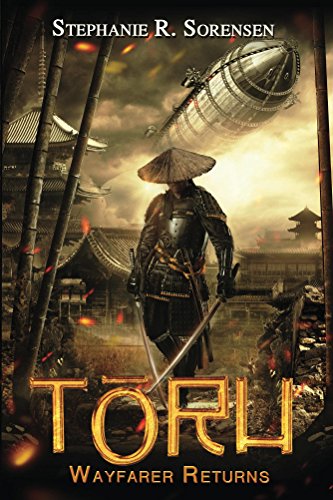
Toru Wayfarer Returns

by Stephanie R. Sorensen


(Full disclosure: I was invited to review this book and given a free copy so I could do so.)

Do you prefer ninjas, or pirates? How about history, or steampunk?

Here’s an idea: why not have both?

Okay, strictly speaking this isn’t a novel about either ninjas or pirates; it’s a story about Japan’s “opening” to the west when Commodore Perry of the U.S. Navy sailed into Edo Harbor in 1853 and threatened and insulted the Japanese into negotiating with him, or else face bombardment from his entire fleet, which he brought back in 1854. Japan was unprepared for this aggression, the country having been isolated and controlled by the Tokugawa Shogunate for the past two and a half centuries: their military was still mostly medieval, and could not fight back against modern warships, steamships, cannons, and rifle-carrying Marines.

But what if? What if Japan had found a way to be ready for that attack? What if the nation, alerted to the threat of the West by the actions of the British in opening and conquering China and India, had modernized and industrialized? What would have changed in world history if Commodore Perry had found the harbor blocked, and armed, the Japanese a growing world power, perhaps even a legitimate threat to the US?

I’ll tell you what: that would be a story worth reading.

And so it is. Stephanie Sorensen has found just what the alternate historian needs: a critical moment when world events went in this direction instead of that, and then thought of a way to make it go that way. The change is in one man (as history’s pivotal moments so often are): Himasaki Toru, a fisherman with something of a mysterious past, who is lost in a storm and rescued – by an American whaling ship. Toru spends two years in America, and while there, he realizes that the US, with its military and economic might, and its brash disregard for the slow grinding of polite diplomacy, could pose a threat to his motherland. A faithful son of Japan, Toru has only one choice: break the Shogun’s law that bans anyone from entering Japan from the West on pain of death, and find a way to convince his nation to adopt Western technology and industry so that when the US comes, Japan would be ready.

It’s an impossible task, made even more so by the fact that Toru is only a peasant, a fisherman; no nobleman, no daimyo, no samurai would ever listen to one such as he, let alone the entire nation. But only the efforts of the entire nation, working in concert, can possibly give Japan the chance to meet the West’s incursions from a position of strength. Toru works with the weapons he has: his intelligence and his passion; the books and machines he purchases in the West and tries to smuggle back into Japan; and a rebel’s greatest weapon: luck. Toru is lucky that the lord whose domain he lands in, Lord Aya, is himself unconventional, made so by his unconditional love for his unconventional only child – his beautiful daughter Masuyo. With luck, and with the help of Lord Aya and Masuyo, maybe Toru can save his country.

I liked this book. I mentioned pirates and ninjas above because this book combines some of the best features of both: Toru is a rebel, though one with a good heart and good intentions; he breaks the rules because he has to, to succeed. Like a pirate. Masuyo does this even more, as she refuses to meekly accept the role of women in her culture; she uses her brains and her courage to help Toru in his task, and takes her place in the forefront of this revolution against the status quo.

As for ninjas – well, the story is set in 19th century Japan. There are ninjas. There are samurai, and swordfights, and honor. And then, because it is steampunk, there are trains, and telegraphs, and Babbage Difference Engines, and dirigibles painted like dragons, powered by steam engines, swooping down out of the sky to awe and terrify allies and enemies alike.

Honestly, Sorensen, who has a background in Japanese and Asian culture and studies, does a better job with the Japanese aspects than the steampunk aspects; the steampunk isn’t bad, but it isn’t really the focus. The focus is on the culture of the Shogun’s Japan, and how change could come to such a rigid and traditional culture, and what would happen when that change did come. As a novel of alternate history, this is a good book. As a steampunk book? It’s okay. The dirigibles are really cool. The writing is generally good, though not spectacular. The industrialization of Japan within the timeline and despite the cultural roadblocks requires some suspension of disbelief, but I thought the political interactions were well done, both within Japan and then between Japan and the US.

But anyone interested in Japan, in samurai, in traditional cultures, or in the clash between tradition and modernity – you should read this book. And the sequels, when they arrive. And anyone who likes a well-written story of one man struggling both for and against society, anyone who is interested in the struggle to break out of a rigid class system and become more than the role created by one’s birth, you should read the book, too.

Oh – and if you like romance, there’s some of that, too.

Overall, I recommend it.