This Morning

This morning I am thinking about my midlife crisis.

I think I’ll skip it.

I am,with luck, just about midlife now. I’m 44, my grandparents lived to be 87 and 88  –the two that lived past their 60s. And I’m aware that time is passing, and the door is closing on certain opportunities: I’m not as hot as I once was, and I won’t be hot at all before too much more time passes; soon I won’t be capable of picking up women in bars.

Which is too bad, because I was never capable of picking up women in bars. I mean, I never tried it, because I met my wife before I could legally go to bars; but up until that point, I was staggeringly bad at picking up women, so I have to assume that the application of alcohol would not have improved my game. Fortunately, I have literally zero interest in picking up women anywhere, with alcohol or not; my wife is the finest and most wonderful woman who ever existed, to me, so I already won this game: I can retire undisputed champion, right now.

Speaking of champions and retirement, I’m not as physically fit as I once was: I’m now in the age where I heal slower, where exercise offers less positive result, and what there is comes slower. I grunt when I stand up, and often when I sit down. I have aches and pains that don’t go away — I have had more than one bout with plantar fasciitis, which sounds like a villain from the original Star Trek series. Soon I won’t be able to do all those physical things I meant to do: master a martial art (and KICK SOMEONE’S ASS), climb a mountain, learn to surf, to ski, to skydive.

Oh wait, that’s right: I never meant to do those things. Never wanted to skydive, nor ski; and I’m afraid of drowning and of sharks, so I think surfing is right out. I would like to climb a mountain, but really, I’m most interested in the kind you can walk up: and I can still walk. I admit I kinda do want to kick someone’s ass. Maybe I can look into martial arts lessons.

The main thing is, I don’t want to feel old. I don’t want to feel like my life is over, or the good part is over, or I’m running out of time to do young things. Maybe I should buy a sports car, get a body part pierced; maybe I should go to some all-day rock festival with all of my students.

Wait a second: I don’t want to hang out with my students. I don’t want to be like my students. I don’t envy them; I don’t miss being a teenager; I hated being a teenager. I hated being in high school, hated being condescended to and instructed as to what my life would be and what it should be and what I needed to do in order to get there. I hated having people tell me that what I wanted  to do was right or wrong, when it wouldn’t have bothered anyone to just let me do what I want. (For the most part. There were a couple of things I genuinely shouldn’t have done, shouldn’t have been allowed to do, things which did indeed hurt other people. But other than those, and there weren’t many of them, I could have been given free rein and nothing would have gone wrong.) I much prefer being an adult.

Hell, I prefer being middle-aged. And I don’t want to do anything new, don’t want to catch up on the experiences I missed out on; certainly not with any urgency. I mean, I’d love to have a nice car — though I’d prefer some enormous boat of a car, a Cadillac or a Lincoln or one of those 1950’s five-ton Detroit rolling steel behemoths, rather than a sports car; I hate going fast, but I kinda like the idea of taking up the entire road, the entire parking lot — but I don’t see anything wrong with getting that car when I’m 80. I’d rather have it now, I guess, but I don’t need to hurry. I do want to travel the world, and I’d like to experiment with some different careers; but again, I don’t need to do that before some arbitrary deadline when I imagine time runs out. I’d like to do it soon, I can wait, and whatever I don’t get to, oh well.

You know what I really want? I want the second half of my life  to be as good as the first half has been. I’ve been quite lucky, and I’ve done pretty well, and I’d like to have more of the same. I expect the last fifteen or twenty years to mostly suck, but the first fifteen or twenty mostly sucked  too, so it’s a wash. But even if I don’t get that wish, here’s the truth: I’ve had a good life. Not a perfect life, but nobody has that. For not perfect, I’m  quite happy with what I’ve had. So even if every subsequent year is less pleasant from here on out, I’ve already had a good run.

No crisis for me, thank you. I’ll just take more life.
Triple Review: The Great White Hunters

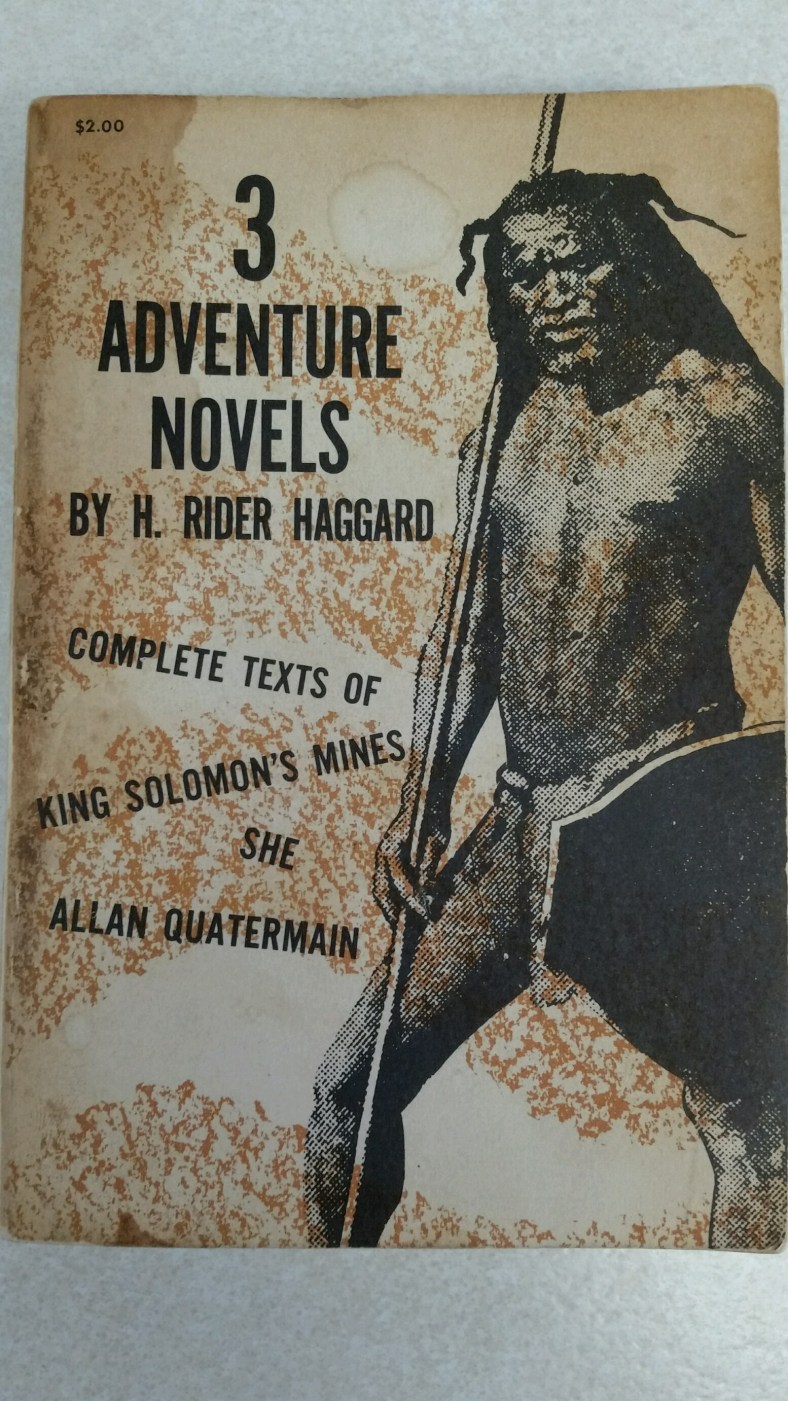
20171028_085108

Three Novels by H. Rider Haggard:

She

Allan Quatermain

King Solomon’s Mines


These books made me feel bad.

First, I had some serious white guilt issues. I don’t go in for that normally; I have read Mark Twain’s Huck Finn several times, and Ralph Ellison’s Invisible Man, as well, not to mention the uncomfortable To Kill a Mockingbird. I read them, all three of those and others, out loud to my students. I admit I skip over the N-word: because I am of the opinion that, while an ideal world would lack any racial terms, or would at least have removed from the terms all power to hurt, we don’t live in that ideal world, and that word coming out of my white face as I stand at the front of the classroom with power over my students – that is not a powerless word, that is not a word that I can be sure won’t hurt anyone. But otherwise, I don’t mind reading either the silly caricatures of minorities, or the swaggering white titans (Whitans? Or all three words, and make it Swhitans?) who bestride the world like a colossus. While I want to include people of color in the authors my students read and that I read, I am not against reading a dozen great novels by dead white men. I am comfortable with being a honky.

But this book (It was all three novels in a single collection) made me uncomfortable. It was more to do with the unquestioned superiority of the white men than the savagery of the Africans; sure, the Africans were savages, described as ignorant, violent, often childish, having outlandish costumes and going in for cannibalism (With the completely absurd description in She of the tribe’s use of a heated metal pot, clapped over the head of the intended victim who is thus both tortured and killed, and then turned into stew. And they called it the Hotpot. And the goofy white character, the servant guy who played the role of Stan Laurel or Lou Costello or Kramer or Chris Farley – the guy who panics all the time – was constantly terrified of the Hotpot. “Don’t leave me alone with the savages! They will give me the Hotpot!” How do you say that with terror in your voice? I just couldn’t take it seriously.), but the bigger problem was the way the white men took over the ancient African societies they came across, simply assuming they had greater ability to lead. And not even for the usual reason of needing to bring Jesus to the heathens; no, this was usually because they had greater knowledge of guns and of how to win a battle. Which I think is, first, no good reason to assume power, and second, nonsense, at least in terms of battle: modern warfare uses modern weapons, and when you take away said modern weapons, the idea that a group of honkies who have never been in the area could lead their men to victory simply by virtue of their whiteness is absurd. Yet that is exactly what happens in both Allan Quatermain books (and it annoys me every time I see that name, because there should be another “r”), particularly King Solomon’s Mines, where the battle includes tens of thousands of African soldiers. Led by the white men to victory, just because they were white men – because the battle plan is “Get the high ground and send our best troops against their weakest.” Boy, thank god the crackers were there to explain that! No way that African civilizations that have existed for millennia could have figured that out without help. And guess who the mightiest single warrior is: well, there is much made of a particularly hardcore Zulu chieftain who travels with them; but right by his side is the biggest, strongest white man, who is better in hand-to-hand combat than people who have spent their lives doing just that – but, after all, he is British.

And then there was the penis factor. Not only did the whites win because they were whites – and in both She and Allan Quatermain, the rulers of the hidden African kingdoms were white people, mysteriously existing in the heart of Africa – but the men were worshiped as masters of all things because they were men. In King Solomon’s Mines, the rival rulers were men, so this was less of an issue; but in Allan Quatermain, there is a pair of sisters who are co-rulers of an ancient kingdom of great wealth and sophistication; and the minute that the Englishmen get there, the two queens both fall in love with the hunkiest of the three Great White Hunters; he chooses the whiter queen – the blonde one, of course; the one with the darker hair is both sluttier and witchier than the gooder, purer, whiter sister – and she not only marries him, she immediately swears to obey him in all things, stating categorically that he is her lord and he makes her feel safe and taken care of by his mighty manly parts. The queen, this is. Lifelong ruler of a hereditary monarchy, a completely self-sufficient kingdom that has been cut off entirely from the modern world. And she’s freaking swooning and mincing and clinging. Pathetic. Meanwhile, her badass witchy sister – also clearly the sexy one, though Haggard assiduously avoids even the hint of sex in all three books – denied the personal domination of the hunky honky, settles for the other white dude (Quatermain himself is somewhere around 70 in this book, and though there’s no particular reason Haggard couldn’t give him the virility claimed by all old white dudes who pretend they can have a real relationship with a hot wife half their age [TOTALLY NOT DIRECTED AT THE PRESIDENT OF THE UNITED STATES], I thought it a sign of marginally good taste that Quatermain is never considered a love interest.) who is fat and too old for her and entirely unattractive, not to mention annoying; but hey, he’s a white Englishman, so clearly a catch, right? Even for a queen? Sure, I guess so. She dies (Sorry for the spoiler – but you knew she couldn’t win; she’s the bad sister. The not-blonde one.) impaled on a ceremonial spear, which is totally not phallic. Totally not.

I have to say, I did like She. The goddess in that book is a genuinely strong female character. There is too much focus on her love life, as she chose immortality so that she could survive to see her true love reborn, which happens after a mere 10,000 years or so; but the goddess-queen character (Named She by her subjects, essentially like She Who Must Not Be Named, out of a perfect sense of awe) is the most interesting person in the story and, I thought, the most sympathetic, as the dude who is her love reborn has some ridiculous fling where he “falls in love” with a woman who nurses him when he is sick, even though he can’t communicate with her: she is humble and subservient and loyal to him, whom she loves because, errrrrrrm, because he’s a very handsome man, I guess, and so she becomes his ideal woman and he loves her. Sure, whatever. I thought he should have gone with She, who wielded power and wrath and majesty, along with being so achingly beautiful that the misogynistic protagonist falls in love with her after a single sight of her without her usual veils on, which led to a nice conflict between the white characters. I also liked the ending, and the strong implication that human power is nothing in the face of the mysteries of the universe. And there is this unbelievably warped element: the society exists inside a mountain that was hollowed out by an Atlantean-style vanished race of supermen; they still exist inside the mountain, because they had complicated and extensive burial preparations for their dead, which included a perfect form of embalming that leaves their bodies in perfect condition apparently forever: but it also makes them highly flammable. And She, the immortal goddess-queen who inherited and still rules their kingdom – uses them as torches. Their body parts. Regularly. It was gloriously twisted.

Overall, I see the draw of Haggard’s books; he wrote outstanding adventure and action scenes, from battle scenes to suspenseful travels through mysterious caves and rivers and jungles. The characters do at least inspire a response, even when it’s irritation or outright hatred. He had some really cool ideas, and amazing descriptions; I liked reading his words, which were interesting and often lovely. But seriously: tone down the Great White Hunters, like, ten notches, okay? Sheeesh.

Book Review: Jack London and Captain! David! Grief!

On the back is a closeup of that grimacing face.


The Adventures of Captain David Grief

by Jack London


I saw this one, by Jack London, with that unbelievable cover, and I just had to buy it.

Took me a while to get around to reading it, though. Because I don’t know how I actually feel about a character named Captain Grief. I mean, really? Captain Grief? Now, if he was a pirate, that would make sense; but he’s not. He’s a capitalist. A man’s man, taming the South China Sea with grit and pluck and stick-to-it-iveness, and sheer manneosity. Is that a word? Should be. Because with Captain David Grief, the manneosity never ends.

But I did finally read it, and it was totally worth the wait, and the $3.95 I paid for it. Because, for one thing, Jack London really was a hell of a writer. I like the way he characterizes, and the descriptions of the South China Sea are detailed and interesting. He does action very well, particularly suspense and the kind of moment where you suddenly plunge into a much more serious danger than you thought was going to happen, like wading into the ocean and suddenly hitting a dropoff and you’re over your head and sinking. It’s a short book, and it was fun to read.

It ain’t all wine and roses, though. It’s thoroughly racist, for one thing. David Grief – bearer of the White Man’s Burden – is a millionaire entrepreneur who “tames” the “wild” islands of the South China Sea, Indonesia and Polynesia and Melanesia and Micronesia (Can’t believe there’s not a Griefanesia – but there will be soon, by God!) and forces them to turn a profit. He befriends the natives – described by color, dress, and essential level of savagery in comparison to the Mighty Grief – and convinces them, through a mixture of trade, bribery, and violence, to allow him to build plantations on their islands, which he then works for MIGHTY, MANLY PROFITS. Inasmuch as money is interesting, this aspect of the book is; I admit I dreamed of being a man tearing a living from the jungle through the strength of my arms and the quickness of my wit. And being rich sounds nice, too, which Captain Grief is. So, cool.

But that’s not the main attraction here. The main attraction is the way Grief is fearless and capable in all things. The way he sails his ships better than anyone else, navigates better than anyone else, reads the seas and the skies better than anyone else (Actually, the sailing parts were really interesting. London knew a ton about ships, and sailed to Hawaii and elsewhere in this part of the world, and that knowledge shows. I liked it.). The way he assesses the value of pearls better than anyone else, and grows coconuts better than anyone else. The way he reads more books, knows more languages, and has been more places than anyone else. The way he always acts as a consummate gentleman, and gives a gentlemanly thrashing through whatever means are at hand for administering lessons, be it bare-knuckle fisticuffs, or bundles of dynamite, should that be called for – and in one case, it is – to anyone who doesn’t act as gentlemanly as he does. In one story, he beats a guy in a sailing race; in another, he beats a guy at cards; in my favorite, he just beats the guy with his fists, and then makes him spend days on end cleaning an old rusted chain until the guy knows what it is to be a man. A man who can hold his liquor, dammit. (The guy Grief beats is an alcoholic. Grief is, too, judging by the amount of drinking that goes on in the stories – but Grief, like a man, never gets drunk.) Of course it goes without saying that this sort of thing is only for the other white men; the savage islanders don’t get treated with the same respect. No thrashings for them. Grief trades them liquor and cigars and talks to them in pidgin, before sailing off with some exclusive trading contract back to the white-only country club resort island.

I was stunned that there was no torrid affair, no woman he could seduce and then sail off, leaving her pining for him on a tropical beach under the Pacific sun.

The book was goofy in a lot of ways, most definitely. But it was fun, too.

And here’s the really funny thing (Other than the cover – and London’s original title for these stories, which was “Sun of the Son.”): they made a TV show out of this.

If you like cheese and pulp and a dash of pirate, and the tropics, then I definitely recommend this.

I’d read it 13 1/2 times.

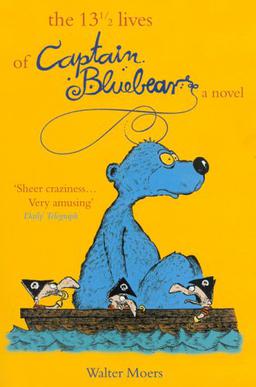
The 13 ½ Lives of Captain Bluebear

by Walter Moers

What I really want to do is spin a yarn worthy of this book. Something about how I found it rattling around inside a mandolin that was given to me by a Chupacabra who had disguised himself as a mariachi in order to hide from his family, who didn’t understand his determination to give up sucking the blood of goats and stick entirely to turnip juice, which he found much less phlegmy.

But that’s not my task. My task here is simply to tell people about this book, and how it was to read it; I have to tell you about Walter Moers’s imagination.

So here it is: this is an amazing book. Simply amazing. The cover says that it is “equal parts Douglas Adams, J.K. Rowling, and Shel Silverstein.” That’s essentially right, though it is honestly not quite as funny and improbably absurd as Douglas Adams’s books (But then, what is?). But it does have the same sort of basically shy, unobtrusive main character swept up in events larger than he, though Bluebear does come into his own more than Arthur Dent ever did, and it does have the same no-holds-barred universe, where literally anything is possible: where a character can transform into a fish in midair to save themselves from a fatal plummet off a cliff; where one can walk into the brain of a giant and have adventures accompanied by a thought; where an entire city can exist inside a tornado, and another can launch itself as a giant spaceship. Most importantly for the Adams connection, this book has an explanatory device that functions like the Hitchhiker’s Guide: Professor Nightingale’s Dictionary, which Bluebear has inside his head, after studying with the Professor himself for a time, and to which he refers whenever he is mystified by his surroundings – which is frequently. Those are some mystifying surroundings.

They are magical, too, which is how like this book is like Rowling’s work; the depth and breadth of the world is much like the magical realm of Harry Potter; and this one, too, exists within – or perhaps parallel to – our own world; I wish I could walk into Zamonia just like I wish I could visit Diagon Alley and Hogwarts.

And what’s more, this book is illustrated by the author, whose style is much like Silverstein’s. As if the wonderful story wasn’t enough, he adds these adorable cartoony drawings, just to bring it that much more to life.

There are a few other books and authors that this novel reminds me of: Alice in Wonderland springs to mind, of course, as does Winnie the Pooh, whose sweet innocence and serenity are echoed in Bluebear (Who is also, of course, a bear: one with blue fur, as the name implies). China Mieville’s UnLunDun is the most recent book I’ve read that has the same magical realm close to our world in it, which also brings me to Neil Gaiman’s Neverwhere, though that book is darker than this one. My own childhood mythology included the Moomintrolls of Tove Jansson (Also European, also translated, also illustrated by the author, as is Bluebear), and in the epic and episodic nature of this adventure, I can see just a little of Don Quixote and my favorite fantasy series, The Lord of the Rings and The Wheel of Time.

It’s got a bit of everything, and so I would recommend it to – well, everyone. Quite highly.

Book Review: The Aeronaut’s Windlass

The Aeronaut’s Windlass

by Jim Butcher

I’m tired, now.

I’m not tired because it’s Monday (Okay, no, I am tired because it’s Monday – but that’s not the main reason.), but because I just got finished being dragged along, like a dinghy tied to the back of a battleship, in the wake of probably the best action writer working right now.

Jim Butcher.

The Aeronaut’s Windlass is the first book in a new series, The Cinder Spires; it is science-fiction, and it is steampunk. It is set in a world where the people live in impossibly tall structures, called Spires, that stand miles into the atmosphere; people travel between Spires on airships that fly using electrical currents in the atmosphere which they catch with great webs of silken ropes, like solar sails. The main characters include the captain of the fastest air ship on the planet – which is not Earth; it seems to be a planet with a much denser atmosphere, as the ships are described as sinking down into the permanent mist, or sailing up out of it in order to navigate or to fight – as well as a pair of what might as well be called wizards, master and apprentice Etherealists with strange powers and the strange penalties that so often accompany power. There are also a selection of nobles of the main Spire in the story, Spire Albion; nobles both wealthy and poor, honorable and deceitful, beautiful and deadly. They duel, they backstab, they fight for position and prominence and power. There are several soldier characters, as well, as this is the story of a war between Spires, or at least the beginning of the war: and the first strike is not only the deadliest, but it carries deeper meaning, as well. There are wheels within wheels, here, and fires within fires. There are also some of the nastiest villains I’ve read in quite a while: an evil Etherealist and her bodyguard, and they are extraordinarily vicious and disturbing. All I’ll say is: their allies of choice are enormous alien arachnids that skitter up walls before they leap down and tear limbs off with their giant insectoid jaws, wrapping up their human opponents in strands of sticky web-silk. And those are the less-frightening ones.

But hold on: because all is not lost. As confused and desperate as these humans become – and the heroes really do sink pretty low, though I’ll spoil this: they don’t lose every fight – they still hold onto hope.

Because some of the characters in this book are cats.

That’s right: steampunk, airships, war, magic, battle, alien spider-monsters – and talking cats.

And because it’s Jim Butcher, the battle scene starts about a third of the way into the book: and then it. Does. Not. Stop. Even on the last page, we are finding out about new betrayals, new dangers, new challenges that face our heroes. It is enormous fun to read, because Butcher does it the right way: he has his characters face setbacks and surprises and even awful defeats; but then the right person with the right ability is in the right place at the right time, and out of that good fortune or good planning comes– victory. At least a small one. Sometimes a large one. And you’re cheering for them the whole way, because Butcher also writes wonderful characters, complex and intriguing and genuine, and of course, Butcher has that wonderful sense of humor, which sparkles through the whole book – particularly the scenes with the cat interacting with his human companions (and inferiors, as he sees them; he is, after all, a cat.).

It’s not flawless; the way the airships function was hard for me to follow at times, and the world is larger and more complex than could ever be covered in one book unless that book was nothing but history and atlas. This one isn’t, so there are things I want to know more about and things I don’t yet understand. But this was tremendous fun to read. And for the rest?

You’re durn tootin’ I’m going to read the next book to find out. And the one after that.

Book Review: MacHugh and the Faithless Pirate


MacHugh and the Faithless Pirate
by William S. Schaill


First, let me say something about the publisher: because this book is from Fireship Press, (Website is here) a small independent press here in Arizona that specializes in nautical and historical fiction. I found this press, and this book, at the Tucson Festival of Books, a glorious local event that celebrates the printed word, and because I am a pirate fanatic, this book jumped out at me immediately. But Fireship has a number of authors, with a number of titles, and the books themselves are top notch, good printing, good binding, good cover art. The copy editing was imperfect — but honestly, I just read another book published by Bantam Spectra which had as many typos if not more, so I won’t split hairs. This is a good press that makes good books.

And this is a good book. It’s not a great book, I’ll say that; the characters are a little too simply drawn, and the main character annoyed me a little at certain places (Largely because he thinks of younger women as romantic interests, which was entirely accurate for the time period, but still a little weird to read — a grown man going over to the home of a friend and checking out his daughter is just too funky for me.) and I wish the Faithless Pirate could have been more than just a villain, because I do love pirate narratives.

But this is, bar none, the best nautical action/adventure I’ve read, in terms of its accuracy and its verisimilitude and its author’s encyclopedic knowledge of the sea and tall ships and marine combat. Reading about these men struggling with this ships on these seas, fighting weather and currents and politics, searching for pirates, finding them, fighting them, winning and losing various battles in various ways — it was just great fun to read. The suspense is excellent, the action is exciting, and the historical and nautical details are as accurate as any I’ve known. For the sake of enjoyment, and for the sake of reading about cannons blasting and cutlasses slashing and blood spurting and everything else, this book was excellent. I hope the author continues to write MacHugh stories — because whenever he isn’t creeping on 18-year-olds, I thought this Scottish wine merchant/privateer was a great character (Though he did seem to have a whole lot of “In his younger days” adventures that made me wonder: just when did this guy start living this life of adventure? And did he ever, I don’t know, take a week or two off?) and I’d love to read more.