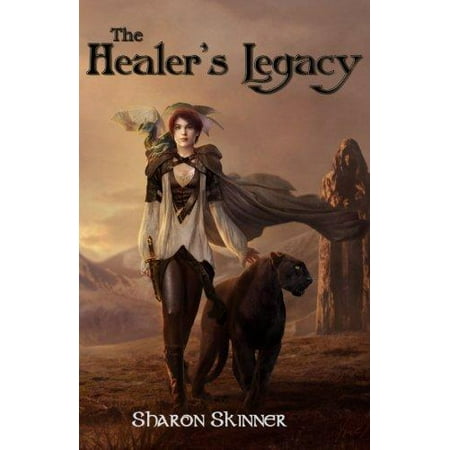
Book Review: The Healer’s Legacy

Image result for the healer's legacy

The Healer’s Legacy

by Sharon Skinner


So I bought four books at the Tucson Festival of Books. All independently published, all of them bought directly from the authors (And all the authors signed their books for me, which is excellent.). Unfortunately, two of those books were not very good, and I didn’t finish reading them.

But two of those books were excellent. And interestingly, they were both from the same publishing house, Brick Cave Media. I think those folks have their act together. The first good one was Platinum Magic by Bruce Davis; the second is this one, The Healer’s Legacy by Sharon Skinner.

It’s a high fantasy, swords and sorcery, magical beasts and inhuman races; but like all good fantasy, the setting and the world is only that: the setting. The story is about Kira. And sure, Kira has a psychic connection with a moon cat (Essentially a black panther) and a wyvern (a tiny dragon), and she has training in herbalism and the healing arts; but the main thing is that she is an orphan who was taken in by a healer who made her an apprentice, and when Kira reached her adolescence, she quite naturally rebelled, and ran away from home after an argument; she then met a man. A strong, handsome, dashing man, who swept the young woman off of her feet and made her a princess – because this man is the Warlord, the leader of a mercenary company that fought off an invasion and saved all of the people of the countryside.

But this man is also abusive, violent, unstable, and obsessed with Kira. And that, more than anything else, is the story of this book. Kira manages to escape in the beginning chapters, and then she nearly kills herself throwing off pursuit, because the warlord’s men do not give up, as they know their master will not give up. But Kira does manage to give them the slip, and then, for a while, she finds peace, and what may be a new home – maybe even a new family.

Until the Warlord finds her again. Then she has to decide whether she will run away, or try to stand and fight: the second option is her only hope for a lasting freedom from her abuser, but it is immeasurably more dangerous for her and for the people she’s grown to care about.

And of course I won’t spoil which option she chooses. I will add that there is an additional reason for Kira to be traveling: she isn’t just running away from something terrible, she is also running towards something – the hope that she can find out something about her mother’s people, which is where she got her red hair and green eyes, and might be where she got her psychic ability, as well. And the place where she stays, and where she might decide to make a stand, is not filled only with welcoming kind-hearted folk; she has enemies there, enemies that might even be more dangerous to her than is the warlord himself.

The characters are really good: deep and complex, well-realized and genuine despite being characters in a fantasy novel. There are all the elements of a good story here, and that story dominates, complemented by the fantasy world and the political intrigues and the rest of it. The fantasy world is also good, with an interesting depiction of feudalism and a good use of Kira’s healer training, one which made both the character and the world more relatable and realistic.

It’s a good book. I will be reading the sequel. And also checking out more stuff from Brick Cave Media.

Book Review: The Fallen Country

The Fallen Country

by Somtow Sucharitkul

I think I may have learned a lesson from this book. Actually, two.

You see, I read this book when it was new, in 1986, when I was an angry twelve-year-old boy. I was angry for the usual twelve-year-old reasons, and to the usual twelve-year-old degree – for both, the answer is “Not much” – and reading this novel, about a boy who escapes his truly awful life of neglect and abuse through his neverending rage, which takes him into a world of snow and ice, where the cold deadens the pain and his white-hot anger is a great and powerful weapon, may have helped me realize that I didn’t really have much to be angry about, and really, I wasn’t all that angry. Not angry like this character is. There’s a scene in the book where his friends accompany him to this world, the Fallen Country, and in order to take them there he asks them to think of all of the injustices they have suffered, all the torments they have endured, and focus all of their anger into helping him reach this other place; afterwards, they confess that they were thinking about – getting grounded. Or failing Algebra. Or being jealous when their crush was smiling at another boy. Only the main character is angry about the years of systematic, violent beatings he has suffered every night from his adoptive father, or the way his adoptive mother ignores this terrible abuse, along with everyone else he has ever known, who have all been unable to help him in his war against the Ringmaster, the evil god who enslaves and tortures all of the inhabitants of this magical realm.

I think now that this book may have helped me realize that I was more like the friends, and less like the main character. And that that was okay: because while his anger gives him great strength, and the Fallen Country sounds like a wonderful place to escape to – he rides a dragon and rescues princesses, slaying hydras with his ice-sword of rage – the point of the book is that this is not a good way to live. And it makes that abundantly clear: you do not want to be like this kid. Harry Potter does the same thing, shows that while it’s awesome to be a wizard in a magical world, really, it’s probably better to have parents that weren’t murdered when you were an infant. Same thing here, only more so, because the beatings that Sucharitkul described are truly terrible.

And now that I have gone back and re-read it, here’s the second lesson I learned: books I loved in my youth should, sometimes, stay there. You see, this isn’t that great a book. There are some good things about it: the characters of the friends are nicely drawn, good renditions of Average-teenage-kid; the Fallen Country is incredible, both enchanting and terrifying, poetic and with the ring of truth; the plot and the final resolution between the main character and the Ringmaster are nicely done. But the way that the abused child is rescued by the people around him, after not having been rescued in the past, is cheesy in the extreme, and very hard to believe – nobody has cared before, even though he shows up to school daily with bruises and cuts and welts; then these characters decide to care, and lo, he is saved by their caring – and the adult characters are all awful. Not terrible morally, though the abusive parents certainly are; but just unrealistic and superficial. There’s a school counselor who doesn’t realize that her job is to report the abuse until she is talked into it by one of the teenagers. Whom she also flirts with. Yikes. It feels like the author was trying to simplify, as this is intended as a young adult book, but honestly, it my be a little too dark for that; and the result is a good book, based on a good idea, that isn’t written very carefully, or very well. Sucharitkul underestimates his audience, assuming they will believe the cardboard characters, or at least not care that they are cardboard; and the same for the weak points in the plot.

You know, I wonder if the reason I liked this author so much was because none of my fantasy/sci-fi friends had ever heard of him; I discovered this book, and I was the only one who read Sucharitkul. I also remember being enchanted by the foreignness of his name; I remember memorizing the way it was spelled, and practicing what I assumed was the correct pronunciation (Since I was never exposed to any other Thai names at the time, I was probably wrong.), and thinking how cool it was that he was also an accomplished composer of classical music.

Dammit. I was a teenaged hipster. Yeah: some things should definitely stay buried in the past.