Caveat

*world's


Caveat Emptor, they say. Let the buyer beware.

I want to add a caveat: Caveat Magister. Let the teacher beware.

There are a lot of problems and difficulties, even hazards, in being a teacher; someday I’ll write about all of them, and why people should — or, more likely, why you should not — go into teaching. But right now, I want to focus on only one problem. It’s tempting to say it’s the worst or the most serious, but it may not be; what it is, though, is the source of a great number of difficulties that teachers face, on a great number of fronts.

It is this: very few people understand what we do.

Please don’t add a new misunderstanding: I am not complaining “Nobody unnerSTANDS me!”; I am not feeling a black, absinthe-scented drizzle of angst slipping icily down my spine; I am not currently pouting. (All right, I’m pouting a little. But it’s because I’m hungry and yet I have to wait for my lunch to cook. Where the hell is my Star Trek replicator? Or maybe those instant food-pills they had on the Jetsons? Hell, right now I’d take the fat-making shakes from Wall-E.) The issue is not that being misunderstood makes us sad. The issue is that being misunderstood, because of the way we are misunderstood, means that our job, the task of teaching, becomes impossible, if one means to do it in any meaningful way.

The issue is this: at some point in the past fifty years (I’m looking at you, 1980’s) this country decided that all that mattered in life was income. Now, we are a democracy and a capitalist society, which means that we have always focused on money as motive: because in a free society, anyone can improve their lot in life; and in a capitalist society, one rises through wealth. Put these together, and you have a country where cash is the key to the kingdom, and here we are: in a world where we teach our children that they can be anything they want to be — and what they want to be, we tell them, is rich. But looking at our social institutions, particularly education, one sees the pervasive and controlling belief that education was good for people: good for the mind, good for the soul; not just good for the wallet. People used to fight for education; now they just fight it. College cost less, and taught more; K-12 schooling was more difficult, more challenging, more effective, more reasonable. Teachers were more respected, seen as experts, because what they offered was valuable in a larger, holistic sense — the way that religious leaders are respected, the way that doctors and law enforcement and firefighters are respected, because they offer something more than a simple exchange of goods and services for money: they give something that means something. Teachers used to be seen that way, I would argue. It is possible I am wearing rose-colored glasses.

But we certainly don’t think that way now. The predominant (though not the only) view of school is as a means to one very specific end. The progression goes like this: elementary school gets you ready for high school; high school gets you ready for college; college gets you a job. The goal is the job. We have a somewhat broader view of that end, because we want our children to have a job that is satisfying, and valuable, in addition to financially rewarding; but the crux of the biscuit is the number of zeroes in front of the decimal point at the end of the year.

My students think this, universally and uncritically. Whenever I ask them, “Why are you here?”, which I do with some regularity (Because I am fascinated by this and terrified, too), they joke that they’re here because they are forced to be (They’re not joking.). But then the serious answer, the one they think I want to hear and the one they parrot with eerily similar language, year after year, is this one. High school gets you ready for college, college gets you a job. They even have a similar cutoff of the pragmatic value of education: they all tell me that you learn skills and knowledge that are directly applicable and necessary in life until around 8th grade; then, once you know all the math and literacy you will need to get through your day, it’s all about the college-job-paycheck.

They think this because their parents think this. Their parents want them to do well, but mainly, they want them to be made ready for college, and to get into a good college, because a good college means you get a good job — a mediocre college means you get a mediocre job. Or at least, a good college means a better job.

And because the parents think this — or perhaps this is the reason the parents think this — the administration and the political system behind schools all think this. Our success is determined by our graduation rate, and inasmuch as we can follow it, the rate at which our students go on to successful (meaning well-paid) careers.

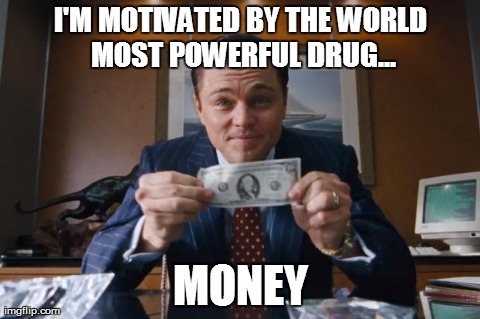
These aren’t bad goals, of course. The job you do matters, both to you and to society; and in this society, money talks. I do this job because I get paid to do it, and though there are times when I wish I could leave it, I don’t because I don’t know what I would do that I would enjoy more and get paid as much. And college was a prerequisite for doing this job. I even agree that most people get by on what they learned before 9th grade. That’s why they have so many problems spelling text messages. (Please note the meme above.)

But there’s a problem when you focus on the financial side to the exclusion of all else. When money is the only thing that talks. We see that in our national politics these days, when the wealthy get elected to represent the interests of the wealthy, and the rest of us just shuffle along behind hoping we don’t get trampled on by the sudden changes in direction. The problem in the predominance of money in education is this: when we keep our eyes on that particular prize, we blind ourselves to all else.

When elementary school is only intended to prepare one for high school, then all that matters is promotion through the grades. Parents pressure administrators, administrators pressure teachers, and students who aren’t ready get promoted, when twenty years ago, they would have been held back until they learned what they needed to learn — back when the goal was education and improvement, a goal that takes some people longer than others. Parents don’t care now if their kid is learning everything; they care if their kid gets promoted. Because elementary school isn’t what matters: high school matters. Because high school gets you into college and college gets you a good job, and nowhere in that equation does a child need to master the multiplication table. If a kid has trouble with math, well, he’ll go into a career that doesn’t need math. He’ll be a lawyer. He likes to argue. Besides, his brother is good at math. Can’t read, but he’s good at math. That one’s going to be an engineer. Probably with computers. Computers magically make something a good job, did you know? Yes: that’s why we have to have computers in school, now. Because kids need to learn the skills that are necessary in today’s economy. That’s why they’re in school.

So the children are promoted to high school. Now it’s time to get serious. Serious about grades, that is. Because the purpose of high school is to get into a good college, and so all that matters is the GPA. Sure, sure, they need to learn how to do the things they’ll do in college — and that’s the magical argument, by the way, which we all use, including me: they need to read this book because it’s the sort of thing they will do in college — but really, the focus is the grades. We trust the grades to tell us that the child is progressing properly, learning what he needs to succeed: the grades are all we need to worry about. And the same thing for the administration and the politicians, except you can replace “grades” with “test scores.”

I’ve never taught at the college level, but I have no doubt it is the same thing there: the second a child is accepted to a school, he is expected to know what his career after graduation will be — preferably down to the exact position he wants and the exact company where he wants that position, but at the least, a field of endeavor and a job class. And I am sure that everyone grumbles about the classes they are forced to take but don’t need for their career, just like they did in high school, just like they do in elementary school about the stuff they won’t need in high school or college, like learning cursive. And I am sure this myopic view of college as nothing but a series of hoops to jump through until you make lots of money has all the same deleterious effects as it does in K-12.

And what are those, exactly? What are the problems with focusing on promotion — grades — career? Only this: you learn what you set out to learn, gain what you intend to gain, from everything in life. And if all you mean to gain from school is getting out of school — then that’s all you get. I know: that’s what I got from high school. All I wanted was to be left alone. So I was left alone. It was college where I found that learning could expand my mind and make me into a person I liked more with every new thing I learned. College made me who I am. High school didn’t even make me ready for college, because I didn’t try to make it do that for me. I had friends who went to the same high school I did, who went on to far more intellectually challenging college experiences than mine, and into more — well, maybe not “challenging,” but I think probably more cognitively difficult careers than mine, and I’m sure that our high school prepared them better than it did me. Because they went there trying to do that. They focused on learning, and they learned. Garbage in, garbage out: and so with nothing.

There are other problems. The focus on promotion — grades — career moves resources and support into those areas, and not into others. If we need our students to learn more math in order to increase promotion rates, then we will focus on math, and drop art and music. Because after all, they don’t need art and music to succeed in high school or in college or in their careers. If students are having trouble in high school English, then we don’t add classes or more teachers to reduce class size: we dumb down the curriculum, restrict it to basic skill drilling. It doesn’t matter if they learn less, because as long as the curriculum focuses on easily mastered skills, they will inevitably get good grades, and that means they will get into college and we win. And thus we have Common Core, where the focus is on easily mastered skills, and which has been and continues to be pushed onto teachers so that students can get good grades and good test scores, and our graduation rates go up and our college attendance rates go up. Sure, our college graduation rates suffer; but that doesn’t matter to us here at the high school level, just as high school failure based on students coming in with below-grade reading skills doesn’t matter to the elementary schools that focused on promoting students no matter what the cost, because that is the only thing that matters to the administrators, because it is the only thing that matters to the parents, because all that matters in life is a good job with a big paycheck.

It’s not true. Of course future failure bothers teachers, but we have little control over this. I am, for the first time in sixteen years, teaching Common Core this year. Because that is what my administration told me to do, and because I now work in a school that has no tenure — because teacher’s unions are essentially non-existent in this Republican-controlled Right-to-Work state (A state of affairs that exists largely because teachers are not respected like they used to be, because all we do is give kids good grades and get them ready for college so they can get a good job, and then, when the child does eventually fail, because the entire system is broken, teachers make a handy scapegoat. And if it doesn’t sit right with your conscience to talk about teachers like they are all incompetent pinko hellspawn, because you remember your own teachers being good to you, well, you can always blame the teachers’ unions.) — and therefore I have to do what I am told if I want to continue earning a living. And so because my school focuses on grades and test scores and graduation and college acceptance to the exclusion of all else, I am told to teach a canned curriculum that focuses on improving basic skills in order to improve grades and test scores and graduation rates and college acceptance. And I do it.

And here’s what gets lost: novels. There aren’t any in my Common Core curriculum. Because the focus is on easily mastered skills, and because the tests that create the test scores do not require the completion of any full-length texts, just comprehension of short passages. Unless I change the curriculum in some way, I will not teach any full-length novels to my classes this year. No Shakespeare plays, except in excerpts. These students will not have the patience or the perseverance to finish anything that can’t be finished in one setting. I hope that they will learn it somewhere else, because they won’t learn it from me. But I know they won’t. (One quick note: I am allowed to change the curriculum. They will by god read To Kill a Mockingbird. And all of one Shakespeare play. But if I wasn’t the age that I am, with the experience that I have, and the curmudgeonly attitude, I wouldn’t change that curriculum. So what happens when a kid who wasn’t raised reading novels takes my place?)

Here’s what gets lost: our culture. I know it seems like America doesn’t have any beyond Disney and organized sports and bacon, but we do: we have Mark Twain and John Steinbeck and Emily Dickinson and Robert Frost and Toni Morrison and Maya Angelou and Ernest Hemingway and F. Scott Fitzgerald. People in this country read To Kill a Mockingbird and Catcher in the Rye and The Call of the Wild. Our schools have always taught those works, and that gives us something important, along with all of the wonderful gifts that come from making literature like that a part of you: it gives us something in common. It’s books like these, learned in school, for no other reason than because they are worth learning, that make us who we are and that keep us as human as we are, because they are the ones that teach us it’s a sin to kill something that doesn’t do any harm to us, and that we should stand on the edge of the cliff and catch those kids running through the rye, and that every life counts, even a dog’s. And I’m only focusing on the literature because it’s what I know, but you could do the same thing with art, with Norman Rockwell and Andy Warhol and Jackson Pollock and Frederick Sackrider Remington (No — I’m not making up that middle name.); you could easily do the same thing with music, or with film.

None of these things are part of the promotion — grades — career path. All of them are our culture. And if we don’t teach any of these things in school — and we don’t, because they don’t relate to our one overriding purpose for education — then we’ll have no culture left except for organized sports and bacon. And perpetual war, of course.

Toni and I just watched The Wolf of Wall Street last night. It’s about a guy who cared about nothing but money, and did whatever it took to get as much of it as possible, and then went about living the most worthless, hollow excuse for a human life I can think of outside of serial killers and the Inquisition. And the movie focused on that, for three hours, in excruciating detail. I have never seen that many scenes with hookers in my life. It’s a true story, based on an autobiography of the same name; the reviews online of the book (which I will not be reading myself) make the guy sound just as he was portrayed in the movie: as a guy who would lie and cheat and steal as much as he had to just to get more money to put on the pile, so that he could spend it on drugs and prostitutes and midget-throwing parties at work. (Not making that up, by the way.) Who would not regret anything in his life, because, in my opinion, he lacked sufficient humanity to know regret. All he knew was money. All he cared about was money. Now, because the movie was made by Martin Scorsese, it was not actually a celebratory movie: it was an expose of the emptiness of this kind of existence. And I have never felt happier about my life and my choices than I felt while I was watching this epic debauch. I am so proud of myself and everyone who helped me to become what I am — my parents, my wife, my teachers, my culture — that I care about things other than money, that I see money only as a means of survival and not of any source of self-worth or identity definition. I am so happy to be me instead of that shit-heel who called himself “Wolf.” I hope that was Scorsese’s intent, because if so, it was a masterful piece of work that was completely successful.

But I couldn’t help but think: if my students watched this movie, they would want to be this guy. Because he made money. And if I asked them, the next day, why they were in school, they would tell me “Because I want to be like the Wolf of Wall Street.” (I’ve heard similar sentiments in the past, but using Hugh Hefner as an example, or Bill Gates.) And that scares the hell out of me.

Caveat Populus. Let all of us beware.

The Warrior of World’s End

The Warrior of World’s End (The first book of the Gondwane Epic)
by Lin Carter

I’ve been reading some of the older pulp fantasy/sci-fi books, and this was one of those — a Daw paperback, the pages yellowed on the edges, the cover price only 95 cents. Lin Carter is one of those names I always see on rows of thin, dog-eared paperbacks in used bookstores, but not one I ever needed to read.

But that was only because I didn’t know what I was missing. And if you’re a fantasy fan, especially a fan of cheesy Robert-E.-Howard’s-Conan style fantasy, you must read Lin Carter.

This book was brilliant. I can’t wait to get back to the used store and buy the second book in the Gondwane Epic, and then keep going until I get to the end — and I hope that’s a long way off. The basic idea is this: 700 million years have passed since our current era, and the Earth’s continents have drifted into each other to form a single mega-continent — the title of the epic and name of the continent coming from the primordial Gondwanaland, the mega-continent that was the southern half of Pangaea, when all of the Earth’s land surface was in one land mass that became two and then became many — and things are, of course, very different. It’s a fantasy world-building technique that I’ve always enjoyed; my other favorite use of it was in the Wheel of Time. In this case, you have a traditional swords-and-sorcery society, with the opening narrative from the point of view of a trader riding a donkey from one great city to another, passing through the Crystal Mountains by a great desert, with his wife, who is actually a sentient plant-being. On the way through the mountains, an earthquake shakes the land, and soon they discover a Great Epic Hero wandering through the aftermath, lacking even the ability to speak intelligibly — but his thews are mighty, and his hair is glittering silver. This is Ganelon Silvermane, the hero who will save the world from doom: the star of the epic. The trader and his wife take Ganelon in and raise him like a seven-foot-tall bodybuilder/baby; they teach him to be honorable and courageous and everything a hero should be, and then off he goes a-heroin’.

It’s great. Carter uses all kinds of unnecessarily fancy words and complex sentences, but without making the book as hard to read as, say, H.P. Lovecraft’s work. There is a simplicity and childish glee in it that made me smile the whole time. It reminded me very much of Conan, or of Edgar Rice Burroughs’s John Carter of Mars series, but with a heavier tilt towards fantasy and away from SF — since there is a Red Enchantress, and an Illusionist, and Death Dwarves, and a magic flying bird-vehicle made of brass and granted intelligence and a personality, and the ability to speak. Ganelon meets a lithe Amazonian-type warrior woman, whom he saves from evil priests, and who I’m sure will be a love interest at some point, but our hero is too innocent of the ways of love as of yet; so far all he does is fight great battles and break large things with mighty swings of his flashing sword, all that kind of stuff.

It was a hoot. Highly recommended for those who like this sort of thing.

If you liked this book, you might also like:

Conan stories by Robert E. Howard or Robert Jordan

John Carter, Warlord of Mars series by Edgar Rice Burroughs

The Genius of Dogs

The Genius of Dogs
by Brian Hare and Vanessa Woods

This was a good read: it was a decent book with fascinating information in it, and not just because I love dogs. Though that certainly didn’t hurt.

The basic idea is this: dogs are geniuses in one specific area of cognition. The book carefully and precisely documents that genius, and discusses how it came about and what it means, both for dogs and for humans. Brian Hare is a cognition expert, and has made an exhaustive study of this topic, which resulted in this book; because it was exhaustive, he studied not only dogs, but also foxes, wolves, dingoes, and New Guinea Singing Dogs, along with as many different breeds of dog as he could, all in order to test the parameters of dogs’ genius.

The genius of dogs is this: dogs are better than any other species — better than dolphins, better than chimpanzees or other primates, and MUCH better than cats (Had to get that dig in there — but seriously, if you want to win every future argument about which are smarter, dogs or cats, this is the book for you) — at understanding humans. They can grasp more words, more gestures, more specifically taught abilities, than any other creature. Most interesting and most impressive is this aspect, which Hare goes into in depth, complete with cute anime-style illustrations: dogs don’t just understand what we tell them, they understand our intent. Dogs can learn to obey any gesture, from a spoken command to a pointed finger to a nod of the head or a turn of the body, so long as that gesture conveys the human’s intention. That is, if you want a dog to look underneath a box for a treat, you don’t even have to say it: you can point, or nod, or turn your body towards the thing you want the dog to do, and the dog will do it. This is actually quite remarkable, as it shows a level of empathy between species that would seem impossible for any but humans — and not even most of us.

Reading about the science and the stories of dog genius was interesting and touching for me as a dog lover. I will say that the book’s writing is not genius: Hare is a scientist trying to write a popular science book (with the help of his wife, Vanessa Woods), and he doesn’t do a great job of it. The book seems self-serving at times, with Hare giving himself credit for discovering the remarkable intelligence of dogs; he’s actually being tongue in cheek, but it doesn’t come through, and you want to roll your eyes a few times. But the man knows his science, and he loves his dogs; and that’s all you can really ask for from a book, don’t you think?

Rental Insanity

You know what’s insane?

Renting a home. It makes no sense at all. The basic concept of the capitalist exchange doesn’t work, here, because you’re not exchanging money for goods or services: the tenant does not own the home, and the landlord is not doing anything for the tenant. Yes yes of course, the landlord is selling the right to live on his property; but he’s not really selling it, because there are stipulations. (And how does one sell the right to live, anyway? I swear I read something once about inalienable, or some such.) Stipulations are only possible when ownership is not exchanged: a landlord telling a tenant he can’t have a dog is like someone selling you a car and saying, “But you’re not allowed to use Reverse. You can only drive forward.” That would make sense if someone was borrowing your car (and you had a pathological fear of moving backwards, or of mirrors, or of the letter R), because you still own it, and you can tell the borrower how to drive it. But that isn’t analogous to renting a home, either: because borrowing is done on a single-use basis, and only with people who know and trust the owner. I have lived in many homes whose owners I have never met, not even seen or in some cases known their names. Nobody would lend things like that. You’re giving someone a valuable thing (Because if it isn’t valuable enough to give back, then it isn’t borrowing — as we all remember from that guy in school who used to ask to “borrow” a sheet of paper every class, and who used to get crap for that verb. “Sure, Tad-Biff — you gonna give it back when you’re done?”) with the expectation that you will get it back after it has been used — generally used once. The borrower reads the book and gives it back; watches the movie and gives it back; makes punch and serves it in the bowl and then gives the bowl back. Unless you’re Ned Flanders and you’re giving your stuff to Homer Simpson, that is. But that just proves my point, because the Simpsons is a satire of modern life, with Homer as the man who does not ever abide by the social contract.

What does it say about landlords when their basic transaction makes them like Homer Simpson?

The real divergence, though, is in the money: if you let someone borrow your car, that person should certainly be responsible for the gas they use and any damage they do; but what kind of full-bore jackass would you be if you charged money just for the simple use, on top?

“Sure, you can use my car while yours is in the shop. Cost you $20 a day.”

You’d be a landlord kind of jackass.

Of course I’m oversimplifying in some ways. There are plenty of businesses that lend use-without-ownership of something valuable in exchange for money — cars, power tools, DVDs, electronics, furniture, even money; but a home isn’t a thing you “use.” Living somewhere is not using the home; we don’t say “Last year I used outside of Denver, but now I use in Colorado Springs.” It’s much more than that. A home is the place where we live: a home is where we spends time with our family; a home holds and protects all of our possessions, which shape and define our time, and therefore our lives, in all the spaces our families don’t. A home becomes a touchstone for almost everything — it’s where people find us, where they send things to us, where they bring us when we’re too drunk to get there ourselves. A home defines a person, in many ways, because it allows you to do the thing that defines you — you can’t be a gearhead without a garage, or a cook without a kitchen, or a gardener without a garden. You also can’t survive at all without shelter or safety or sleep, all of which become extremely difficult to acquire without a home — and therefore a home makes you human. Home is where the heart is, where life is.

How can I live in a place that doesn’t belong to me?

The answer is, I can’t; that’s why the laws defend the resident, the tenant, and even the squatter much more than the owner. Possession is nine-tenths, and our society recognizes that — though that last tenth, in the hands of the 1%, means that our government has done quite a lot to protect the landlord, too. But in essence, we know, deep down, that the person who lives in a place has some right to it, has some claim of ownership on it. It’s just too bad that we don’t actually live according to what we know to be right.

All right, enough: let’s pretend the basic concept is sound, and discuss the jagged little pieces of insanity that come with renting a home. First, landlords lie. The photos online do not in any way resemble the actual property; at best, they choose the one flattering angle and then stand on the garbage can in order to crop out the broken fence, the tumbleweeds, and the rusty nails and shattered beer-bottle glass spread across the yard like tinsel on the world’s worst Christmas tree. Why do they try to change the way the house looks in the pictures? Do they think we’re not going to see the place when we show up to look at the inside, or to rent it, or to take possession? Are they going to stand directly in our line of sight, holding up an enlarged copy of the photo from Craig’s List, saying, “Here, see? Here’s the house, you can see it right here. NO! Don’t turn your head. Close your eyes for a second and I’ll show you the other rooms, one at a time.” Or do they think that we’ll show up, see the reality, and think, “Well, it sure looked better in the pictures. Maybe this is just an off-day. Maybe the light is bad here. I’m sure once I’ve given the landlord money, it’ll look like it did online!”

Maybe landlords just do a lot of internet dating, and got into the habit of using fake pictures and hoping the other person doesn’t bolt when they see the truth.

Now, Toni and I have in fact rented two different properties from a distance, once when we moved to Oregon and then again when we came to Tucson; but for the second one, we had a local connection, a good friend of mine from high school who lives in Tucson, who went around and scouted out our prospects for us. This means that out of the times that we have rented a house, there is exactly one time that deceptive photos online would have taken us in. So then why?

It’s not just the photos, either. “Single-family home” in the ad becomes “Broken-down dirt-crusted center unit in a triplex” when you drive by. “Fenced yard?” Sure, if you think the row of old bent croquet wickets lining the dirt patch qualifies. “Great neighborhood” if you intend to get jumped into the local Crips — is it called a lodge? A chapter? Crips Country Clubhouse? Anyway. “Off-Street Parking” means you can park on the sidewalk between the dumpsters and the rats’ nests. “Cooling system” means you can open the windows and hope for a breeze. We all know the buzz words: “cute” and “quaint” and “cozy” all mean “small;” “character” means “old,” as does “traditional;” “easy maintenance” means “it’s already broken.” Sometimes things just vanish: the included washer and dryer, the recessed lighting, the covered patio “great for entertaining.” And in every case, I wonder: did they think we wouldn’t notice? It’s one thing if you sell a kid a toy in a cardboard box, and it’s only when he gets it home that he discovers that his new G.I. Joe Attack Helicopter doesn’t actually fly by itself — thanks for that emotional scar, Hasbro — but this is a home. The customer is going to live in it, for a very long time. They will notice that the front door is missing, and they will say something about it to the person who still legally owns the home.

But let’s say you find a place. The ad looks great, you drive by and the neighborhood seems acceptable — you know, drug deals happen in a BMW instead of a burnt-out Toyota shell, the graffiti is aesthetic, the local hoarders keep their piles inside instead of in the yard — the place has what you need. So you call: Sorry, that was rented seven years ago last July. Yeah, I need to remember to take down that Craig’s List post.

A moment about Craig’s List: all websites have their problems; some don’t filter well, some have too many ads or not enough information, some don’t have a good map or the photos are too small; but Craig’s List is special. Only there can a month-old listing be automatically renewed and then get labeled as “Posted six hours ago.” Only there can one person list the same property seventy-nine times, so that your search for a place turns up just that one freaking condo. Only there can people post an email address as their sole contact information, and then fail to return any and all correspondence. I’m glad that Craig’s List exists, because I prefer renting from individuals rather than property management companies with their own professional, polished websites; but I really wish someone could keep some individuals from using it.

But as I said, all websites have their problems. No pictures is one. That’s just absurd. Am I supposed to fall in love with the place based on your turgid prose? What is this, the nineteenth century? At least show me an etching. Another problem is failing to give particularly vital information — like the cooling system, here in Tucson. I don’t mean to be single-minded in my housing criteria, but you better believe I want to know about the air conditioning when the summer days regularly reach 110. (Side note: why the hell do all these houses have no air conditioning? Are you aware you live in the desert? And that extreme heat is uncomfortable? What is this, the nineteenth century? Shall I just sweat into my waistcoat and then bathe after a fortnight?) Another problem is when they don’t give the address unless and until you contact them and listen to a spiel about the place. It’s the same thing as the lies: you can say what you want, but I’m still going to drive by, and then insist on seeing the inside, before I give you a dime.

That brings me to a new problem we encountered on this search, but not in the past. There is a company here in Tucson that has two businesses related to rentals: they manage some properties, and they also offer a listing service — meaning they will sift through the dozens of websites and find listings that match your criteria and then send them to you, for a $60 fee for three months of emails. Fine and good. I don’t want to use the service, but I can see the value of it, particularly for very busy people, or those with the time and inclination to look for that one perfect needle in the haystack. The issue I have with them is that their listings, the properties they actually manage, are used as bait: they set the rents low, post listings on all of the regular sites, and conceal the addresses, offering their phone number for more information. Then you call and ask about that one place you saw online, and what do you get? A sales pitch for their listing service, which you need to sign up for before they will tell you a single thing about that one place you called for. Most annoying business model since the Jehovah’s Witnesses.

And by the way: did someone say rent? Did someone say the rent is too damn high?

I can’t go into numbers, because they vary too widely from place to place, but the fact is, the amounts we are expected to pay for housing are just absurd.

A recent report from the Joint Center for Housing Studies (JCHS) at Harvard, puts some numbers on just how bad this problem is: About half of all renters in the U.S. are using more than 30 percent of their income to cover housing costs, and about 25 percent have rent that exceeds 50 percent of their monthly pay.

from The Atlantic

How some of these people can stand to demand this much money for the broken-down shacks they offer is beyond me. I am extremely happy that we have moved to a place where there is enough inventory, and enough vacancy, to enable us to find a place for a decent price — which occurred partly because it was empty long enough for the landlord to bring the rent down — but sadly, the state where we live is one of the worst for paying teachers, so even with reasonable rents, the rent is still too large a piece of our income. But I know I am saying nothing that people don’t already know, and already bewail. Allow me just to point out that in Jonathan Swift’s famous essay A Modest Proposal, the one about eating Irish babies, the villains he names specifically are the landlords who take every penny that the poor Irish could earn or beg, leaving them no choice but to starve:


I grant this food will be somewhat dear, and therefore very proper for landlords, who, as they have already devoured most of the parents, seem to have the best title to the children.

Source

The rent has always been too damn high. Always.

Let me move on to something that not everybody will know about: renting with pets. The first problem is that this cuts your choices in half, if not by two-thirds — although (and this is even more annoying than the number of landlords who won’t allow pets) several of those just don’t have it listed as an option, but if you call them, they don’t mind pets at all. Jerks. The second problem is the types of pets that are allowed: cats OK, but not dogs. Dogs OK, but not cats. Dogs and cats OK, but not over 25 pounds. I had a landlady turn us down once when I told her I had an iguana in a terrarium. The biggest problem, though, is that owning pets seems to be seen as a license for landlords to demand stuff: additional clauses in the agreement. Pet deposits. Pet rent. I mean, pet rent? Are you assuming that my pet has an income, and therefore you deserve a piece of it? Let me tell you: he doesn’t. Nobody pays him to be cute. He gives it away for free. Which is what makes him a better person than you. Let me also note that this whole scheme is bunk: would you charge me different rent based on the number of people living in the place? What if I had two jobs — would I pay two rents? The whole thing is ridiculous. An additional pet deposit on top of the security deposit presumes not only that my pet will do damage to the home, but also that said pet damage will be on top of the damage that I will do to the home, which will consume the entire security deposit. Same thing with additional pet clauses in the agreement: can’t you just leave it at “Don’t mess the place up?” Do we need to describe the ways I am not to mess the place up? Thank you for your trust. Here is all of my money.

All of it, and not just for rent. I’ve seen places that want first and last and a security deposit and a cleaning deposit and a deposit for each pet. A new one this search was a place that actually said the deposit was non-refundable. So does that mean they’re just going to keep it when you move out? Not surprising, that happens more often than not, but to just say it like that takes a lot of brass. Then they want fees: application fees, up to $80 per adult (And again: why do you need both of us? If I can pay the rent with my income, aren’t we done talking?). Just to apply for the opportunity to give you all the rest of my money. They want a credit check, a background check, proof of income (which must be three times the monthly rent), proof of employment, rental history going back five years, references from your last landlord and from three trustworthy individuals who know your character. It’s insane.

Look. I just want a house. Not a big house. It doesn’t have to be brand new, and it doesn’t have to be in perfect condition, and it doesn’t need to have nine bathrooms and a spa and all chrome-and-platinum appliances. I just want a place where my family can sleep at night, and then get up in the morning and go about our day. A place where I can write, and my wife can paint, and our dog can play with his Wubba. Somewhere that has rooms that fit our furniture, with enough space left to walk around and between things. Somewhere I can put my books on shelves, instead of in plastic tubs in the storage shed in the backyard. A cute place would be nice, but I’ll take a place with potential. Somewhere we can feel safe. Somewhere to live.

Is that too much to ask?

Who Goes There?

I am an atheist: start from there. There is no God, no higher power, no consciousness directing the universe. Everything that happens, happens because of random chance, multiplied by time. The essential symbol of my worldview is the Big Bang: everything that exists came from an explosion.

So then how do things make sense?

How does an explosion create a stable planet, in a stable solar system, at the Goldilocks distance from the sun, with liquid water and an oxygen-nitrogen atmosphere? With a tilted axis and an oversized moon allowing for seasons and tides? How does an explosion, nothing more than energy added to matter, create life? How does that life continue to exist long enough for evolution to take place, which eventually leads to – me? How can I be sitting in my air-conditioned living room, next to my dog (who is lying on his back waiting for tum rubs [He gets a good skritch every time I pause. Like now.]), typing these words in English on my laptop computer, drinking coffee with half-and-half and stevia and and cinnamon-flavored honey – because of an explosion?

People of faith see the answer to these questions clearly: the answer is God. We are surrounded by miracles, and there is no clearer evidence of the existence of a benevolent creator. People have been reaching that same conclusion independently for tens of thousands of years, all the way back to the people who were buried with Earth Mother figurines, and those who raised Stonehenge or made the heads on Easter Island. We look at the amazing world we live in, and we assume it had to come from someone or something divine.

But there is no God: that is the starting assumption. So then how?

I hear people say, “Let go, and let God.” I mock it, because I find the idea of surrendering free will, of one’s own free will, inconceivable. I hate being told what to do. I hate trusting someone else to figure things out for me. If I could, I would grow my own food, fix my own car, whittle my own furniture. I have been struggling recently because in the upcoming school year, I have been instructed to use a pre-determined curriculum, one detailed and prescribed down to two-minute intervals, scripted and designed and carefully laid out in every way. Oh, I’ve been told that I can, and should, adapt it to my own preferences; but my preference is to chuck the entire thing out of a moving car, preferably into the midst of a brawl between switchblade-wielding badgers. I don’t want to teach what someone else tells me to to teach. I have never liked that, and I have never done it: other than some small things here and there, an idea for a lesson, a single handout, I have never followed anyone else’s plan for a class (Except for one: I taught David Schmor’s Speech class, pretty much start to finish; his assignments, his lectures, his grading methods. But that says more about how well David designs a class than it does about my predilections. We’ll call it the exception that proves the rule.). Whenever problems arise in my life, I handle them, either by myself or with my wife by my side: two of us against the world. I don’t like the idea of relying on anyone else: certainly not on God, whom I don’t believe in and wouldn’t trust if I did.

But how can I do that? How can I create everything I do as a teacher out of my own head? I was a terrible high school student – skipped or slept through many of my classes, never did the work, passed because of a good memory and a love of reading, and with the mercy of more than one teacher. I didn’t learn anything in my teacher-preparation program, except from the time I spent student teaching – which I largely did on my own; that is to say, I got advice and feedback from my master teachers, but I designed the lessons, I taught the material, I graded the work. I read pedagogical textbooks with an eye so jaundiced it’s nearly blind; whenever I take any teacher training workshop, I either don’t pay attention or I don’t do what I’m told. So how on Earth am I a good high school teacher? Where did that come from?

It’s nearly the same thing when I write. I have never really studied writing, other than as literature I have read; I’ve never had a writing mentor. I don’t edit: the first draft is pretty much the final draft. I don’t think much about what I’m writing in advance; I plan out my novels pretty extensively, but my blogs? I just pick a theme, think of an opening, and go. When I hit the last sentence, I post it On top of that, I’m generally pretty damned lazy, and unfocused: I am one of those people who pick up new hobbies and put them down again right away, because I’d rather be playing video games. How did I get to be a good writer? Where did this ability come from? Not from my parents, who are both intelligent but non-creative. I have writers in my family tree, but are creativity and writing acumen really genetic?

The miracles that surround us aren’t just natural: this morning as I stood in my shower, hot water streaming over me, sluicing away the shampoo and soap, looking at the tile walls, glass window, wood and brick house, electric lights, municipal water supply and sewers, I thought about: how could people possibly create all this? Particularly what has been added to our world, in terms of capability, of convenience, of complexity, all in the last century? A hundred years ago, if I had the running water (Never happen on a teacher’s salary then – but would I have been a teacher 100 years ago?), it wouldn’t have been hot, and I wouldn’t have had the electric lights, the coffeemaker, the refrigerator (Maybe an icebox), the computer, the dog adopted from the animal shelter. Just 100 years ago. My grandparents were there. How have human beings been capable of creating all of this? Did we have guidance? Divine inspiration? Can we create because we were made in the image of a creator? And if not (Not, indeed), how?

When one of the millions of the faithful “lets go and lets God –” what happens? Who goes there? Things don’t stop happening, and the lives of those who put their faith in God do not fall apart in a spectacular collapse; things often work out just fine. It’s like someone’s guiding them, making things work out. So if it isn’t God (And it isn’t. Spoiler alert: this writing is not leading to my spontaneous conversion.), then who is steering the ship? Starting from my basic assumption of atheism, of a universe without a creator; who or what makes things work out for the best?

My wife and I have adopted two dogs from shelters, one in California and the second here in Tucson. Both of our dogs have been absolutely lovely: very smart, very loving, almost no trouble to train and care for. In neither case could we possibly have predicted, when we chose them and brought them home, that those dogs could have been the sweet, wonderful companions they both proved to be. And we frequently ask ourselves: How did we get so lucky?

I’ve been reading The Watchmen, and one of my favorite moments in the book is when Dr. Manhattan, a man-turned-divine being who is trying to decide if he should save corrupt and fallible humanity, tells his former (and very human) sweetheart that he longs to see a thermodynamic miracle: an event so unlikely that is is effectively impossible, like oxygen spontaneously turning into gold. He says that he has realized, in talking to her, that he is in the presence of one such event: her. The chances of her parents coming together to make a child; of one particular sperm out of hundreds of millions uniting with one specific egg; of that zygote’s survival to become a child; of her upbringing and life experience turning her into the woman she is, and of her meeting and loving (and being loved by) Dr. Manhattan, a blue-skinned superbeing who can see neutrinos – that’s a miracle. Every human being is a miracle, Manhattan says; and he decides he will save humanity because of that.

I’ve used a similar example with my students. I met my wife Toni at Cabrillo Community College in Santa Cruz, California. She worked in the bookstore for her workstudy, and I had a job one semester taking ID photos, in the cafeteria upstairs from the bookstore. The IDs were $8, and so I always had to get change; I went down to the bookstore to get it. That’s how we met.

But look at the probabilities involved. Toni didn’t go to college right out of high school; like me, her academic transcript was spotty at best. She chose to enter the world of employment, where she did quite well for several years. She decided to leave a perfectly acceptable middle-class lifestyle, one that would have satisfied millions of Americans, and go back to school to study art. She decided to start her education at the community college; she decided to go full-time, and leave her job, which is how she ended up working in the bookstore. If she had gone to school earlier, or later, or if she’d kept her full-time job or gone to work in the registrar’s office instead of the bookstore, we’d never have met. Me, I wanted to go to UCSC because I wanted to study creative writing, and because my father, who worked at Stanford at the time, had a friend who taught physics at UCSC, who told my father, who told me, that they had a good creative writing program. He showed me the town on one visit, and so I decided to go there. But my grades were terrible, and so I couldn’t get in to UCSC. But rather than choose one of the thousands of other schools – rather than stay in Massachusetts, where I grew up – rather than join the Peace Corps or start a grunge-rock garage band, I decided to go to the community college in Santa Cruz, 3,000 miles away from the place where I lived, with no better recommendation for the university I had decided on than the word of my dad’s friend, for two years before transferring to UCSC. Except then my Cabrillo counselor screwed up, and my general ed. program turned into three years, instead of two.

I met Toni during that third year.

How did this absurd chain of events (And it goes farther: I had just ended a relationship about a month before meeting her. What if I hadn’t? Our first conversation ever featured me acting like an idiot, mumbling and stumbling through every sentence; what if she hadn’t wanted to speak to me again? What if, what if, what if?) come to pass, and lead eventually to my finding the love of my life, my soulmate? It’s no wonder people decide that fate is real, or karma, or God. What other explanation makes sense?

When people pray, and then hear the voice of God tell them the answer, what voice is that? Something tells them what to do, where to go, how to act; something gives them the solution to their problems, the inspiration they need to create something new and revolutionary, or the comfort to survive the slings and arrows of outrageous fortune. If it’s not God, then what is it?

It’s not God. That I’m sure of. So you know what I’ve decided it is? What is responsible for humanity’s incredible accomplishments, and our unbelievable resilience, and adaptability? The reason we can handle anything put before us? The force that makes our world full of wonders, that brings long chains of coincidences into some kind of order?

It’s us. We do these things ourselves. Because we’re fucking awesome.

How can I teach well, without any resources other than my own brain? Because I’m just that good. How do I write well? Because I’m a genius, and because I read the writing of other geniuses, and I pay attention. I am standing on the shoulders of giants, but they are tall because they stand on others’ shoulders – not because God raised them up. Human beings made the miracles, not the other way around.

How did Toni and I get to be the couple we are? The actual meeting had some dumb luck to it, but mostly, we made it happen because we wanted to. She chose to speak to me, and then she chose to speak to me again; eventually, I broke through my awkward shell, and she saw how awesome I am.

How did we get awesome dogs? Because dogs are awesome, and we treat them well and appreciate them for what they are.

How can people handle whatever terrible trials that life throws at us? By being absolutely incredible, strong and determined and intelligent and resilient.

We are incredible. We can do anything. There is no God: we need no God. We are enough, and more. We are.

So the next time your life seems about to overwhelm and drown, remember: remember what humans have done, remember what humans can do. You can do it. You’re human. You’re awesome.

No better way to close this than with the collaborative work of several of my all-time favorite creative humans.

Third Time’s the Charm

UnLunDun
by China Mieville

I’ve tried to read Mieville’s books before. Twice. Couldn’t do it either time. (Same thing with Mervyn Peake’s Gormenghast trilogy. Two strikes. There won’t be a third pitch with that bloated sack of wood pulp.) Admitting that makes me feel like less of a fantasy reader, as everyone seems to just love China Mieville’s work. He”s one of the stars of fantasy fiction of the last ten years. What kind of a twerp can’t appreciate his writing?

So that feeling of inferiority, that niggling voice that tells me that everyone else is right, and I’m just not reading this stuff the right way (Must be because I’m not smart enough?), made me go back a third time to try Mieville’s work. I tried to read Perdido Street Station and couldn’t; I tried to read King Rat and couldn’t — maybe this one will be better.

UnLunDun.

You know what? This one was better.

In fact, I loved this book. I loved the two heroines, the pair of school-age tween girls from the council flats (British version of the projects) who find their way to UnLunDun; I loved the Wonderland feel of the anti-city that these two girls go to; I loved the characters they meet there, particularly the bus conductor, the strong man in the diving suit, and the rooftop Parkour gypsies. I loved the humor of the book, the sheer joyful whimsy of it. I loved the bad guy, the patsies, the thugs and monsters on both sides. I loved the ladder-tower of books — and I know what my UnLunDun job would be. I loved the morals tucked away here and there between the puns, and how they didn’t rise up and slap you in the face, but just sat there, quietly, waiting for you to notice them: books are a path to wonder. Destiny doesn’t matter as much as choice. Courage and loyalty can win the day — sometimes. Corruption is everywhere — but it can be fought.

This is a book I would strongly recommend. I would recommend it to people who love fantasy, to people who love humor, to people who want to see the world in a new light. I would highly recommend it to young women looking for fantasy books with female heroes, as this may be one of the best examples I’ve read of that particular under-represented character in the fantasy/sci-fi world: girls who kick ass.

And I’d recommend it to people who want to read China Mieville but just can’t get into his books. This one worked for me.

Maybe I’ll give another of his books a try.

Yup. I read it.

Go Set a Watchman

by Harper Lee. Duh.

The answers to your questions: it is not as good as To Kill a Mockingbird. You don’t have to read it. That is not to say you shouldn’t, or you won’t enjoy it – I did – but you don’t HAVE to read it.

It is precisely what it is purported to be: the story of Scout Finch, all – or almost all – grown up. It is also a rough draft of sorts of Mockingbird; there are passages that were taken straight from this book and put into that one, some descriptions of Aunt Alexandra, the history of Maycomb’s founding, that sort of thing. It is not the same book, retold at a different time; it is also not the sequel, as there are several small details that do not mesh with Mockingbird — Cousin Francis is Alexandra’s son, not her grandson; the Radley family is missing entirely, but there is a reference to another boogeyman who sneaks out at night and eats cats.

For someone who has never read To Kill a Mockingbird, this would likely be a good, but probably not a great book. This is me theorizing, of course, because I’m a high school English teacher, and I’ve taught Harper Lee’s masterpiece (It gave me a laugh to look inside the front cover and see “Also by Harper Lee:”) and read it a dozen times. I think the reality, the tangible, concrete weight of the characters and their personalities was already in me from Mockingbird, and I’m not sure it would be present for someone who didn’t read that book. This book’s central conflict climaxes with more speechifying, as if Atticus’s closing argument were moved to the final chapters and combined with the conversations about Boo Radley and Jem: more slow buildup and a longer period of talking through it. But the writing is still Harper Lee, and it is still wonderful: there is the same elegant prose, the same remarkable ability to switch from formal to casual, the same ironic humor, the same incisive understanding of the people and history of the South, and it’s still a joy to read. So I would recommend it.

For those who, like me, have read Mockingbird and loved it, you should think carefully. This book is good, but it is not a masterpiece. The wonder of Mockingbird hinges on the choice to make Scout a child. That simplified the story, and enabled Lee to treat race and hate and human nature with innocence and simplicity – through a child’s eyes. The adult Scout – now Jean Louise, an emblematic change – doesn’t have it so easy. She is much more reflective, thinking about what people say and whether they actually meant it or not; trying to decide whether their words and their character are a match to what she remembers of them from the past; trying to decide for herself where she belongs, and what she loves and what she can’t stand. The characters that were simple are now not, particularly – and most tryingly – Atticus. In Mockingbird, Atticus is the perfect father-hero. But now, Scout is older, and in this book, she finishes growing up. And it hurts to see Atticus the way she is forced to see him. It made this book hard to read. And, to tell the truth, so did Lee’s erudite references to Victorian authors and 1950’s historical and cultural icons, several of which I did not understand.

I would absolutely recommend this book as an exercise in the writer’s craft to those who teach Mockingbird, and to those who write themselves and know Lee’s classic. It is fascinating to see the changes between this earlier book and the later one, to see the author’s choices that made that book great, and this one less so.

For those who love Mockingbird for its own sake? If you think you can handle it, I would highly recommend this book to you, too. Because just like Scout, I think we need to grow up, and see our heroes in a more human light. And even though this book is more complex, more troubling, it is the difference between idyllic, idealized childhood and murky, gray-shaded adulthood; and this is still Scout. It’s still Atticus. It’s still Maycomb. It’s still Harper Lee. It was wonderful to go back and see it all again.

The Wordy Shipmates

I was hoping this book would be a revelation. It wasn’t.

That’s not to say I was disappointed with it. Okay, I was, but that was no fault of the book’s: it’s a good book, well-written, interesting, informative. It’s just that I wanted my jaw to drop, wanted my impressions of the Puritans — built through a childhood spent in Massachusetts, going to Plymouth Plantation  on a school field trip every year between third grade and eighth–  to undergo a startling transformation. It’s happened to me before, when I first seriously taught Arthur Miller’s play The Crucible, about the Salem Witch Trials; because in the play’s text are extensive passages of background about the Puritans of 1692 Massachusetts, and one of the companion pieces I taught with it was On Plymouth Plantation by William Bradford, the first governor of the Plymouth Colony. That was the first time I saw the Puritans as courageous, traveling thousands of miles into an unknown, landing in the wrong place, losing half of their number in the first winter — and then staying there anyway, and fighting for survival in a harsh and hostile environment. Miller talks about how this circumstance forced the Puritans to live in each other’s pockets, because they either worked together and protected each other, or they all would die; it was just this sort of all-in collective life, surrounded by a danger that the Puritans personified as Satan (who lived in the woods and had wild animals and the Native American “savages” as minions) that led to the Witch Trials as Miller depicted them in his play.

I was hoping this book would change my mind again, and give me yet another perspective on the Puritans beyond “Religious fanatics whose draconian morality caused half of our country’s hypocritical opinions regarding sin and pleasure, and work ethic and such,” or “Those Thanksgiving guys (who actually betrayed and slaughtered the Native Americans who helped them out).” And it sort of did, because Vowell shows that the Puritans were extraordinarily literate — hence the “wordy” in the title —  and valued learning and reading and writing and thought, all of which  I appreciate. She shows how their remarkable idealism was what really pushed them to become the trailblazers they were, and allowed them to survive in the conditions they met on that trail. She shows most clearly how that idealism both informs our modern view of America, and how it has been corrupted by cynical politics, when she speaks of the co-opting of “the City on a Hill,” which came from a Puritan minister’s sermon, and was then used by both John F. Kennedy and Ronald Reagan, among others.

But while I hadn’t known how literate the Puritans were, I don’t know how interesting that is. Which is how I felt about the book. Maybe I was already too aware of the Puritans and their history; maybe I am not aware enough of the history of literacy and the valuing of education; but the book was good when I wanted it to be great.


I hope someone else can find it great.

Good Movie? Pssh. Let’s Watch Sharknado!

You’ve seen Jaws, right? We’ve all seen Jaws. Jaws is a brilliant movie. It is a classic of cinematic art. Jaws has built lasting artifacts in our psyches: the theme song (duh-dun . . . duh-dun . . . Unfortunately impossible to render phonetically and keep the air of menace. Just picture a shark circling around your ankles. And not that nice Bruce from Finding Nemo.), the idea that great white sharks are a terrible danger to humans (There were 106 great white shark attacks between 1916 and 2011, only 13 of them ending in fatality. In 1996, 11,000 people were injured by buckets.), the movie’s most famous lines — “You’re gonna need a bigger boat,” and “Smile, you son of a bitch!” and “This was no boating accident.” Jaws has done what art should do: it has made an impact. Thrown into the pond of our collective consciousness, there have been ripples that have spread across the entire surface, and they are still echoing.

You know what else Jaws created? Sharknado.

Now, I’ve seen a lot of bad movies. I enjoy them: I used to have video tapes of Chopping Mall and Return to Horror High; Summer School with Mark Harmon and The Principal with Jim Belushi. I’ve seen eight action movies starring Jean-Claude Van Damme, and all of Arnold Schwarzenegger’s comedies, including Red Sonja. I’ve sat through six Police Academy movies, four Hellraiser movies, and nine Friday the 13th movies. I’ve seen Superman IV, Highlander II, and Leonard Part 6. Howard the Duck. Showgirls. Battlefield Earth. Thanks to Mystery Science Theater 3000, I’ve seen Manos: The Hands of Fate and The Robot Versus The Aztec Mummy and Gorgo. I’ve seen Roadhouse. Several times. Red Dawn, too.

I like to play Six Degrees of Separation not to Kevin Bacon, but to Red Dawn. It’s not hard: the movie starred Patrick Swayze, Charlie Sheen, C. Thomas Howell, Lea Thompson, Jennifer Grey, Harry Dean Stanton, and Powers Boothe, and was directed by John Milius, who wrote Apocalypse Now. The horror. So Jaws starred Richard Dreyfuss, who was in Stakeout with Emilio Estevez, who is Charlie Sheen’s brother and has been in several movies with him, including Men At Work, Young Guns, and The Outsiders. Charlie Sheen played Matt Eckert in Red Dawn. Three degrees.

So my point is, I didn’t just watch Sharknado. I loved it. I haven’t laughed that much since Big Trouble in Little China.

Sharknado is everything a bad movie should be. The writer, the impossibly named Thunder Levin (Who also wrote Mutant Vampire Zombies from the ‘Hood, which starred C. Thomas Howell — who was also in Red Dawn.), knew it, and that’s why the tag line of the movie is “Enough said.” He knew he had something brilliant, something timeless. Something that should be cherished.

Because this might be the worst movie ever made.

The premise is: global warming (clearly identified as the villain during the expository TV Newscast scenes explaining the strange events happening in LA) has caused an unprecedented number of sharks to come closer than ever before to the LA coastline, followed immediately by the first hurricane to strike California (Fun fact: this is marginally plausible! The reason no hurricane has struck California full-bore is the cold water along the coast, so if climate change increases the surface temperature of the water . . . watch out for flying sharks.). The storm causes waterspouts, which lift up uncountable sharks and then move over land, flinging airborne sharks all over the place. Whenever the sharks fly by or land on someone, they bite, tearing off limbs, heads, faces, you name it.

Yeah, that’s right. Waterspouts moving over land and not dissipating (until they are blown up by the heroes!). Flying sharks, tumbling through air (and therefore strangling), and they still bite anything human they come into contact with. At one point a shark bites through the roof of a car. How did it open its jaws wide enough to sink its teeth into a flat metal surface in a perfect ellipse of pointy doom? Why did it tear out the section of roof, spit it to the side and then try to eat the humans inside, when it should have been busily dying of oxygen deprivation? BECAUSE SHARKNADO!

The movie has one of the weirdest opening sequences I know. You know in Godzilla, and Jurassic Park, they show the monster wreaking some havoc and some innocent person on a beach or a fishing boat getting stomped and eaten? Right: in this one it’s a fishing boat harvesting shark fins. Just to make us wonder if maybe we deserve what’s about to happen. The seedy criminal captain is bargaining with an Asian man who wants to buy the cargo of shark fins — but he doesn’t want to pay full price! There is a bizarre confrontation involving guns on both sides and a storm the ship sails into; it ends when flying sharks tear off the captain’s face, one piece at a time.

This is Sharknado.

We move ashore, where we meet our hero, Fin Shepard, a divorced father of two (Forgive that — errr — spoiler, but I didn’t want anyone who hasn’t seen the film yet to be as blindsided by Fin’s status as a middle-aged divorced father as was his shotgun-toting, worst-fake-scar-outside-of-a-six-year-old’s-Frankenstein-Halloween-costume-having, exploitative-bikini-wearing barmaid Nova Clarke. Her reaction to the news that her boss and vague awkward crush has an ex-wife and two kids, “WHAT?!?! You have a SON, TOO?!?” was more extreme than her reaction to the flying people-biting sharks, the which she tends to just kill without any reaction, emotion, or facial expression, finishing with her own patented quip: “I REALLY hate sharks!”). Fin surfs, and so is in the water when the still ocean-bound sharks attack innocent civilians at the beginning of the movie; he rescues his Aussie buddy Baz by using his surfboard to vigorously poke the shark that nearly bit Baz’s leg off, an injury that disappears almost as soon as it happens (Because, y’know, he got it bandaged. Hey, if Rambo can seal a gunshot wound through his kidney with gunpowder and a burning twig [Rambo III? Yeah, I’ve seen that. Oh: and Sylvester Stallone was in Demolition Man with Wesley Snipes, who was in Major League with Charlie Sheen.] and then slaughter an entire camp full of Commies, then Baz can handle the Sharknado even with a game leg.), even though everyone else who gets even sideswiped by a shark loses whole limbs in mere instants. Fin also owns a crappy bar right at the end of a pier, the which is first invaded by sharks (Not to worry — Nova doesn’t even blink before she kills the first shark to crash through the window and land on the floor snapping at passersby. She stabs it with a pool cue.) and then washed away by the hurricane. He then drives his friends up into the hills to rescue his ex-wife and children (BAZ: “They’re like a thousand miles inland!” FIN: “They’re 6.6 miles inland, and it’s not far enough. Not for this storm.”), stopping along the way to rescue drivers standing zombie-like on an on-ramp, a school bus full of children, and then finally all of the students at his son’s flight school, before helping to end the Sharknado. What a dad. What a hero.

Ladies and gentlemen, I give you Ian Ziering. From Beverly Hills, 90210 straight to Sharknado, with a brief stop at Melrose Place in between (And not a whole lot else.). The funny thing is, he was the best actor in the movie, and I’m including John Heard, a genuinely good actor who made me very sad by playing George, the lovable lush with the barstool, whose alcoholism and creeping on the ingenue are redeemed when he dies to save a trapped dog from the tidal wave of sharks, by smashing the car’s window with his padded barstool (He killed a shark with the barstool earlier.). Dog’s a golden retriever, of course, because Hollywood’s racist — pit bulls only get to play servants and villains. Though I need to know how the dog’s owner, one of the people who senselessly park and get out of their cars on an LA freeway on-ramp during a hurricane, managed to lock both her dog and her keys in her car, necessitating George’s barstool-rescue.

I can’t tell you how bad the acting is. And the script. And the continuity. The sharks are either really bad CGI or stock footage, as is the weather; the best part is that since the film was made in LA, there is no bad weather when the camera is on the heroes; then we look behind them, and the world-ending global-warming-produced hurricane is chucking sharks at them in between thunderclaps. Then back to Ian/Fin, who is dry and standing in sunlight. Remarkable. The weather pauses whenever they have need of a pensive moment — to mourn the loss of George, for instance, or to wonder, as the characters do on several occasions, about the absurdity of their own situation (“Man. Unbelievable!” Ian/Fin mutters as he drives away from the shark-infested on-ramp. All you can do is nod.) — and then returns when it’s time to get sharky again. Floods dry up instantly; when Ian/Fin rappels from a bridge down to the roof of the school bus to save all those kids — even though all he does is hand them the rope, whereupon Baz, the unsung hero with the nearly-severed leg, hauls them all the way up to the bridge with the help of a single block-and-tackle attached to the bumper of Ian/Fin’s SUV — the bus is nearly inundated by water, with sharks swimming all around it; except the water recedes as soon as Ian hits the bus, falls off the roof and swings around like a doofus for a moment before he opens the emergency door on the back.

When we visit the palatial home of Fin/Ian’s ex-wife — played by the hard-plastic-shelled Tara Reid, and I refer both to her post-operative body composition and to her acting — the sharks invade on a wave of water through the windows, flooding the house to a depth of three or four feet, enabling both the shark-ingestion of Tara’s shmuck of a boyfriend (Clearing the way for our heroes’ reconciliation — I can’t wait to see if they’ll get back together!) and a knock-down drag-out brawl with a shark whom Fin/Ian and Baz fight off with a bookcase. But then they escape through the front door — and the front yard is dry. I don’t mean mostly dry, it’s dry. “How can the house be flooded?” we ask; and then the house bursts in an explosion of water and sharks, giving us the answer — clearly it was built atop a shark geyser (Covering a massive lake of burning hot death-juice, known at Old Faithful as magma, and in Sharknado as the script.). This must explain the completely absurd observation by Nova, who looks out at the flooded LA cityscape and says, “It’s like Old Faithful!” Which, though I have never been there in person, I cannot think in any way resembles a hurricane-flooded major metropolis, with or without flying sharks. My assumption is that she is clairvoyant, and while she may be staring at LA in that moment, in her all-seeing mind’s eye, she is gazing on the collapsing house that flooded in a dry field. Like Old Faithful. With sharks.

There are several shooting scenes — including when Baz puts a scuba tank into a shark’s mouth and Fin shoots it, blowing the shark into smithereens (But he never says “Smile, you son of a bitch,” so clearly, this wasn’t stolen from Jaws. Yeah. And Vanilla Ice wrote the tune for “Ice, Ice, Baby.”). Nova — played by a woman who clearly has never even handled a shotgun, let alone done any actual acting — blasts a shark five times in the head, opening funnel-like holes in its skin, kind of like when the super-terminator in Terminator 2, played by Robert Patrick (Who was also in Striptease with Demi Moore, who was in Ghost with Patrick Swayze — who played Jed Eckert in Red Dawn) gets shot by Arnold Schwarzenegger’s Terminator (Also in the first Terminator? Michael Biehn. He was in Navy Seals with Charlie Sheen. Three degrees.) and yet keeps running; this shark dies, flooding the entire pool-sized living room with enough blood to turn the water a murky deep red color (Baz makes a menstruation joke! “Looks like it’s that time of the month!” Pure hilarity!). When the shark bites through the roof of the SUV, Nova shoots that one in the face, and one shot is enough to launch the shark off the car’s roof, flipping it in the air before it crashes to the ground with half of its face torn off. She must have used the big shells that time. My favorite, though, was when Ian/Fin is protecting his son, Matt, while Matt and Nova fly a helicopter into the storm so they can blow up the sharknado; there are half a dozen sharks flying at the helicopter, and Ian/Fin draws his pistol, closes one steely eye, and fires off exactly one shot per shark, each of them falling out of the sky instantly with each pull of the trigger. If a cartoon dog popped up with the sharks in his paws, it would have been Duck Hunt.

All right, let’s get to the climax. So the sharknados (Sharknadoes? What’s the plural here?) — are swirling around downtown LA. Ian/Fin has rescued his ventriloquist dummy of a wife, and the pouty angsty ball of helplessness that is his daughter, and they have arrived at the flight school where his son Matt is a student. They decide they can’t just run and leave LA to the mercy of the flying sharks (And the devastating tornados and the hurricane, I guess — but really, the scary part is the sharks, am I right?); they have to do something. So they have an idea: there’s a helicopter there, and since the instructor was sucked up when the sharknado passed over the flight school, the only one who can possibly fly it is Matt. So they go to a nearby warehouse filled with various tools and hardware implements (I had A-Team flashbacks at this point) and get strapped up: Fin/Ian gets himself a chainsaw — and hands to his wife a hedge trimmer. An electric hedge trimmer. Baz, Matt, and Nova make bombs out of propane canisters. The plan is for Matt and Nova — who have a moment of just sublimely bad acting while they are building bombs and Matt asks about Nova’s weird fake scar, which is on the side of her thigh and looks kind of like she was clawed by a tiger with the shakes, four or five parallel ridges that could not ever have been made by a shark’s teeth; Nova explains how her grandfather took her fishing and they went overboard and everyone but her got eaten by sharks (She actually echoes Quinn’s WWII shark story from Jaws, saying, “Six men went into the water that day. I was the only one who came out.” I really wanted her to break into “Farewell and adieu, ye sweet Spanish ladies.” And maybe grow a scraggly beard.), and then she ends with a heartfelt, “That’s why I hate sharks.” Matt responds, “I think I hate sharks now, too!” — Matt and Nova will fly over the sharknados and drop their propane bombs into them. Because a tornado is the result of warm air crashing against cold air, Matt tells us (with all the sophistication of someone who saw it on Weather Wiz Kids one Saturday morning), and if an explosion could change the balance, the tornado might dissipate!

I don’t mean to lose my willing suspension of disbelief here, but — a flight student. Is going to fly a helicopter. Into a hurricane. Above a tornado. And drop a bomb made of a can of propane, a smoke alarm, and a roadside flare all duct-taped together, which can’t weigh more than five pounds, total. And this thing is going to explode, and — blow up the tornado, essentially.

Sure, okay.

They do it, and they kill two of the sharknados. But there are three sharknados, and they run out of bombs. And then the sharks from the third sharknado hit them, and one grabs onto the skid. And in trying to dislodge it, Nova falls out of the helicopter, and is grabbed, in midair — not by that shark, but by another one flying by at just the opportune moment. How sad! There was a romance brewing there! (A word about that: the woman starts off as the love interest for Ian/Fin, but she gets scraped off on his son before the ending, once the ex-wife has finished her bitchy sniping at the younger, hotter woman, so that Fin/Ian can reconcile with his ex-wife, proving that absence and flying sharks both make the heart grow fonder. And that Stephenie Meyer is not the only writer to use “Well you can date my child instead of me!” as the deus ex machina to end a love triangle. People are so frigging creepy.) Sharks crash into the helicopter, which comes down to a crash landing nearby where Fin/Ian and wife and daughter are hiding in a retirement community (Because he already saved kids and dogs; now he just needs to rescue old people. Which he does. From a shark that lands in their swimming pool. Why were they swimming during a sharknado-producing hurricane, you ask? Because the weather is just fine where they are. Apparently the stock footage of the storm hadn’t caught up to them yet.). They lost Baz to sharks at the flight school/warehouse, so now it is up to Fin to drive the oversized Hummer they picked up after their SUV was eaten, and which Baz has filled with explosives, in a re-creation of the climactic scene of Twister: he drives the Hummer straight at the last remaining Sharknado, lights the fuse on the bomb, and then leaps out of the truck (which appears to be going about 80 mph, so he has to roll an extra time in order to come to a stop unharmed) and lets it jump off of a ramp (At the end of a highway switchback that appears to lead absolutely nowhere. In downtown LA. Or maybe we’re in the hills outside of LA. It’s not really clear.) into the Sharknado, where it explodes and saves the day.

But that’s not the end.

Because the sharks that were airborne, are now falling from the sky. It’s raining sharks. Ian/Fin jumps up from the concrete, and — without even an attempt at continuity — he is suddenly running down an alley towards his family, his daughter yelling “Daddy!” as she runs toward him while he’s waving her away, yelling, “Get outta there!” Because she doesn’t see the shark falling behind her: coming right at her. And in a series of jump-cuts worthy of Army of Darkness, Ian/Fin shoves his daughter out of the way of the flying shark, starts up his chainsaw, runs forward with the Gritted Teeth of Fury, and leaps up into the shark’s mouth.

The shark falls. Our hero is dead, giving his life to save his daughter.

But wait — the shark’s belly moves. A sound is heard. And then — a miracle! The end of the chainsaw bursts out of the shark! The blade comes down, a large slit is made, and from out of that beast’s belly (Sliced-open shark belly really looks a lot like foam rubber. Who knew?) is born our hero, blood soaked and screaming incoherently.

Then he reaches back into the shark, and pulls out Nova.

That’s right. Matt performs CPR, she spits out water — water? I guess she was drowning inside the shark’s stomach. Or maybe she got a mouthful from the storm when she was screaming, “WHY WON’T YOU DIE?!?” at the shark on the helicopter skid. Anyhoo — and they embrace. And, in one of the best examples I’ve ever seen of an actress who cannot bear to do what the sript calls for, Tara Reid wipes the blood off of Ian/Fin’s mouth and they have a kiss, after which her look of disgust is impossible to miss.

And appropriate, considering the movie that preceded it.


Why have I told you all of this? Why dedicate this much time and this many words to a movie that was all the ironic rage two years ago (and which has spawned two sequels, the upcoming installment entitled Sharknado Oh Hell No) but is now just something really awful that the Scify Channel made once?

Because this is what movies are supposed to be. It was fun to watch. I was entertained. Sure, I wasn’t entertained in the way they wanted me to be; the filmmakers weren’t clever enough to make this thing truly ironic in the tradition of the Evil Dead franchise; they wanted me to relate to the characters and sympathize with them, and to imagine how terrible it would be if there were sharks raining down on my family, and all I had was a chainsaw and gritted teeth. And I couldn’t do that, because I was too busy laughing. So it didn’t do what the filmmakers intended it to — but it did live up to its purpose. At a workshop I attended last week, on teaching AP Literature, there was a moment when the instructor declared unequivocally that “No novel has a message. The purpose of literature is to entertain. Great novels give insight into the human condition — but the author’s goal is entertainment.”

Jaws is a great movie. It gives insight into the human condition; I can relate both to Sheriff Brody, who is swamped in bureaucracy and ignored by his superiors despite being right, and to Hooper, the scientist with a passion that everyone else thinks is crazy. And who is invited in as the expert, and then they don’t listen to him either, and his angry sarcastic rants at the idiots who won’t listen could just as easily have come out of my mouth. The movie asks about the dangers we face when the natural world, which we don’t understand, is ignored in favor of capitalism and profits and maintaining appearances; I consider that a very real issue, one that we should spend more time thinking about. And at the same time, Jaws is entirely entertaining: from the first swimmer getting pulled down, to that eminently satisfying concluding explosion, Jaws is fun to watch.

So is Sharknado.

And only one of those movies has a scene with a chainsaw.


Oh: and John Heard, who plays George of the Barstool? He was in My Fellow Americans. With Richard Dreyfuss. Jaws to Sharknado in just two degrees. The circle of life is complete.

Here. Have a chainsaw.