Nightglory

Nightglory

by Mathew Babaoye

I liked this book. I just wish I could have liked it more.

There is a lot to like. The concept is good: it is about a supernatural Lady, the Queen of Night, and her struggle to consolidate her control over her world. She struggles with her subjects, with her responsibilities, with her power, and with herself; it’s a story with a lot of interest, a lot of conflict, a lot of places it could go. I like the writing style: short sentences, short paragraphs, breaks where there shouldn’t be breaks; it makes the reader consider the words more carefully, makes us notice what’s being said. There’s an element of the epic in the writing, in the way certain phrases – her blue-black hair and black dress; the old hard-bitten gold carpet in her throne room – are repeated, almost Homeric. And the name, of course, is brilliant: Goldenslaughter. I still don’t know: are the last two syllables “slaughter” – or “laughter?” I love that ambiguity, as much as I love both possibilities.

But the potential is not quite realized. The writing style is interesting, but the mechanical mastery is insufficient to allow the style to really flow; there are flaws in the writing, in the editing, that make the reader question what is intentional, what just a mistake, and that means the moments when you notice what the prose is doing, when you see it start to dance – you don’t know if it’s only stumbling. The epic phrases are too few, and too often repeated; they start to seem dull, rather than classical. The storyline gets lost in the mystery: the story begins with Goldenslaughter already having conquered her realm, gained the loyalty of her subjects, and then lost that loyalty through an attempt to gain total mastery of the Power that keeps her on the throne. Coming in to the middle of the plot can work, but there has to be a careful process of backbuilding, through flashbacks and the like, so that the audience can gain a complete understanding of how the story got to where it is; this book doesn’t do that. The best way I can put it is that the book makes the reader work too hard to understand what’s going on, rather than the writer doing all of the heavy lifting for the audience. Here: an example. There is a scene in the early going when Goldenslaughter confers with the Lady of Elements, who has had a prophetic dream; that dream gives hints of what will happen to Goldenslaughter. By the end of the book, that dream comes true, and after that happens, Goldenslaughter and the Lady mention that earlier discussion, and the warning that the Lady offered to her Queen, which the Queen did not heed. This is all fine: except the poetic language the two use in the first discussion is too abstract, and I for one had no idea what the Lady was talking about until the later scene when Goldenslaughter refers to it. So the foreshadowing of the prophecy was lost on me, as were all of the hints of what Goldenslaughter meant to do and why it would be challenging and dangerous.

The end of the book is the best part: the final climax is well-done, with a good battle scene and a really fine resolution to the central conflict, when Goldenslaughter makes her choice about who and what she is. I just couldn’t really follow most of the book leading up to that, even though I enjoyed reading it.

Zombie Spaceship Wasteland

Zombie Spaceship Wasteland

by Patton Oswalt


I can’t tell you how happy I was to unwrap this gift from my wife: not only am I a tremendous Patton Oswalt fan; not only have I been reading bad books lately; but it was Jolabokaflod, the Icelandic “Christmas Book Flood” tradition which we tried out this year – you give each other a book for Christmas Eve and then spend the rest of the evening reading. Okay, I waited until Christmas Day to read most of it, and finished it on Boxing Day – but this was an excellent present to start off the Christmas gifts with, and an excellent book to read.

In some ways, it reads like Oswalt’s standup: it’s eclectic and unexpected, shifting subject and pace and even genre with no notice at all: you read the prologue, and then the first piece, which is a personal essay about Oswalt’s youth – and then the second piece is a mock-up of movie notes on an imagined zany comedy about an amnesiac getting married. And the first piece is so interesting and insightful and intelligent that it takes you quite a while to realize that the second one is entirely – not. Well, no, it’s still interesting: but now it’s interesting because it’s a joke, not because it is a reflection on the moment when one realizes one is an artist at heart; even though that realization came to Oswalt in an amusing circumstance, the essential concept of the essay is to describe that self-realization, which, like most great insights, slipped away again almost immediately, to return only in fragments spread out over years –and, I hope, truly recovered for Oswalt in this writing.

Because Patton Oswalt is an artist, a comic artist. This book has humor in every way it is possible to have humor: it has over-the-top toilet humor (The amnesiac bride piece has it all – drunkenness, vomit, nudity, dildos falling onto sushi platters – all the classic gags.); it has subtle and ironic humor, often dark and often self-deprecating; it has one-liners and pieces that are all one long set-up for the final punchline. There are visual jokes as well as literate ones. And like any great comic artist, Oswalt has managed to include a number of genuine insights, frequently hidden as jabs thrown at the world and society’s ugliness and stupidity. Because as Oswalt tells us in the title piece – which title comes from a very effective system of dividing the nerd world, into those who prefer zombie stories, versus spaceship stories, versus wasteland stories – he is a wasteland guy, a fan of the Road Warrior: one who would, in his imagination, destroy the world and society, in order to focus on the last remaining survivors and their idealistic quest to keep their own sense of what’s important, even in a world that has gone mad around them. It’s a quest that Oswalt has stuck to, and a torch of reason and compassion that he carries still, and that carries through this book. It was a joy to read it, to laugh along with him, and even more, to think with him.

Happy Holidays

Merry Christmas, everyone!

I love that about this time of year — the most wonderful one, according to song (though honestly, that song doesn’t have a whole lot of the most wonderful things in it: sure, it’s got the “gay happy meetings and holiday greetings,” but what’s with the “scary ghost stories and tales of the glories of Christmases long long ago?” I suppose it’s talking about A Christmas Carol, which is an excellent movie; but otherwise, who tells ghost stories on Christmas? What kind of bizarre family did that songwriter grow up in? And you know what that song doesn’t have? Eggnog.) — because I like when people wish each other well. I am not a Christian, don’t believe in the Messiah; but I still want people to be merry, and so I wish them happiness for the holidays. And other people, who don’t even know me, say the same thing: after the usual “Thanks for shopping at ____ and have a nice day!” that people recite by rote without any particular meaning behind it (Because what cashier really cares if you shop at Wal-Mart or Safeway? This is a good reason to shop small: because they mean it when they say it. Though still, I wonder how many people think about what they’re saying when they say that. I know I don’t think about it when I say “Thanks, you too.”), now they add, “And Merry Christmas!” it adds a second, more intentional level of goodwill: people actually think about it (Hopefully not only because they worry about offending people; I am generally against political correctness, as it leads to censorship; but I think we can all agree that there’s no political correctness stupider than the reaction against the “War on Christmas.” And if you don’t agree, you may not want to keep reading this blog, as I am not going to say a lot of things that make you happy. But you know what? Have a Merry Christmas, anyway. Thanks for stopping by my blog and upping my Visitor Counter. I actually appreciate it: because I have so few visitors that every one matters to me.), and they actually mean that wish: they want you to have a merry Christmas. They want you to have some happy holidays. There is kindness, during this season, in even the simplest of social interactions — pass by someone on the street, and they might smile and say Merry Christmas, too, particularly on the day itself.

You know what? We should have more days like this. More days when people think about their greetings, and mean what they say when they wish people well.

I got up this morning at about 6:15, because I went to bed late last night because I had a nap yesterday afternoon. None of these things are normal for me: I generally get home from work too late to have a nap, and so I am frequently exhausted by about 9:30 and asleep by 10:00, and that means that I wake up around 4am (I generally sleep about six hours a night. Don’t judge me. It’s Christmas.), and, more often than not, I start thinking about school and my students and the work I have to do. That means I don’t really go back to sleep, though I do sometimes, which is nice; but when I don’t, that means I’m already tired when I get up about 5:00, and through my entire day; this makes me cranky with my students and angry at my job, when neither of those things are at fault: it’s only because I’m an early-morning insomniac, which I inherited from my father. Who would also rather not wake up at 4am and fret. And, of course, since I am tired from the get-go, I am exhausted about 9:30, 10:00, and I go to bed early and sleep for about six hours.

But yesterday, Toni and I took a nap in the afternoon, for a good hour, hour and a half. So I was able to stay awake and enjoy Love Actually last night, even though we didn’t start it until 9:00 or so. Then we went to bed, I read for a little while, and then went to sleep, and slept until 6:15. And when I woke up, the most anxious thought I had was, “Oh — I have to remember to get the cinnamon rolls out of the fridge.”

You know what? We should have more days like this. Days when people can sleep in a little, and wake up thinking happy thoughts. Days when we wake up without stress, without fear.

This morning, I opened up my new container of eggnog — because the first one I bought was terrible; it was either poorly made or it was going bad when I got it, because it had that sour aftertaste that eggnog can get, a little like drinking gasoline — and took a swig to make sure it was good (No, I didn’t drink from the container; I poured it in a cup. What am I, a savage?), and it was delicious. That was a wonderful first taste for the morning. Then my coffee got finished brewing (And my coffeemaker kindly decided to get it right this morning; it has been struggling with the workload in this house, where no morning goes by without two or three pots of coffee, with another frequently brewing later in the day [On days when there isn’t a nap, that is.], and has been giving up the brew before all the water is gone from the reservoir, beeping its little beep to tell me there is coffee — until I pick up the pot, and it’s light, because it’s mostly empty, because most of the water is still in the machine, unheated, unbrewed: unacceptable. But today, that beep meant “Coffee’s ready! And Merry Christmas!”) and I poured a tall cupful into the mug I got as a gift from one of my students, added sweetener and honey and a splash of eggnog, and: perfect. Ambrosia. And I did remember to get the cinnamon rolls out of the fridge: the cinnamon rolls which Toni made from scratch yesterday, the which we enjoyed after our morning walk with Sammy. They were incredible: gooey and warm and rich and delicious. The perfect first meal of the day. Fresh cinnamon rolls, and good coffee, and eggnog.

You know what? We should have more days like this. Days when we enjoy our morning sustenance, when breakfast is a meal, rather than a fueling stop; when the coffee is enjoyable, rather than a necessary bulwark against narcolepsy. Not that I expect my wife to make cinnamon rolls every morning, far from it; I want to be able to stand and walk, in the future, and cinnamon rolls every morning would quickly turn me into one of the hoverchair-bound blobs from Wall-E. But I actually like the cereal I eat, and Toni loves toast; we both enjoy a good bagel on a weekend. The point I’m going for here is that food should be tasted, and the taste should be good; breakfast most days is neither of those things, for most people. And we should change that. Breakfast should feel like it does on Christmas.

This morning, I will be reading my new book, Zombie Spaceship Wasteland, by Patton Oswalt. My wife bought it for me at Barnes and Noble, on a whim, because though I haven’t read Patton Oswalt before, she knows that I love his standup comedy, and she knows I like reading books by comedians I like. So she bought it, I bought her a chick-lit book of the kind she likes (which I hope is good, but it’s an author I don’t know. I liked the description, though, and the fact that there is an Aunt Midge. Can’t go wrong with an Aunt Midge.), and we decided to celebrate Jolabokaflod, the Icelandic tradition of “Christmas Book Flood:” when you give each other a book on Christmas Eve, and spend the rest of the evening reading. Okay, we watched Love Actually last night instead of reading; and I have been writing this blog — and also playing Facebook games while petting my dog — instead of reading this morning, but I plan to get to it later. The point is, we looked for books for each other not working from a wish list, but just browsing, in an actual store, and picking something out that looks good based on the likes and dislikes of the intended recipient. Then we gave those gifts to each other mostly because we wanted to, not because of tradition or obligation or any attempt to impress or make up for past sins or conflicts. And they’re books.

You know what? We should have more days like this. When we find gifts for each other based on what we think the other person will like, not what they ask for. When we take our time shopping, and give the result to someone we love, just because we want to make them happy.

There are things I don’t like about Christmas. I am charging my phone, because I expect to get obligatory family phone calls today; if I don’t receive them, I will make them. And it’s not that I mind talking to my family, but I don’t like doing it only because we have to, because it’s Christmas. In a few days I will be flying to see my family, which I don’t want to do; not because I don’t want to see my family, I do, but because I am doing it largely out of obligation instead of preference, and because I don’t want to fly, and I don’t want to leave my wife and my pets for the four days I will be visiting. These sorts of things go on at Christmas. We have been having a bit of a rough month, mostly because work piled up for me and I was frustrated and resentful about it; we haven’t been feeling very Christmas-y for the last month. But because it is Christmas, and because there is such a weight of tradition around this holiday, this unfestive situation has come with a bonus: guilt. I have felt guilty for making Christmas feel melancholy, and Toni has felt guilty for not getting into the Christmas spirit and decorating and drawing her own Christmas card and sending it out early in the month to all of our friends and family. Going to visit family also reminds me of the family I will not be seeing — my mother, mainly — and that brings its own guilt. And this time of year, I feel particularly bad for the people who are down and out, and I wish I could do more to help them — and I feel guilty that I can’t. Same thing with the limited funds I have for present-buying: there are a hundred things I would buy for my wife, and for everyone I know, if I had the money. But I don’t. Because I am not wealthy. More guilt, and probably the stupidest guilt there is; but here it is, and because of Christmas.

So I’m thinking that we should have more days like Christmas, but not more Christmas.

I’ve noticed that there has been a push towards this, and away from the religious holiday season, for a while, now; that’s presumably why some folks see a war on Christmas, and fight back by getting belligerent about the “reason for the season” — you know, the Prince of Peace. But I don’t think it’s a rejection of religion so much as a common desire similar to what I’ve been talking about: we want the good stuff of the holidays, without the bad; the joy without the baggage, the presents without the wrapping, so to speak. The best thing about this day is the quiet: go outside, take a walk, and recognize how few people are driving around, how many people are at home, with their loved ones, spending some quiet time. It’s like the whole world is taking a breath. It’s lovely, and it’s rare; I think the only days of the year when this happens are Thanksgiving, Christmas, and New Year’s Day. Only three, really — and what’s worse, they’re all piled up on one end of the calendar.

I think we should have more. And I think we should space them out. It’s good to breathe, to breathe deeply, and take a moment to pause and enjoy what we have.

So I would like to start a new tradition. I don’t want to take away from the old tradition; there is nothing that can — or should — replace Christmas. I certainly don’t want Christmas music to be played all year long, but I also don’t want a December to go by without a chance to sing along with Blue Christmas — or this one, which I think may be my new favorite, because it’s a mix of the classic and the new — well, sort of new; newer than Bing Crosby, anyway. And I like the message coming through loud and clear, but still paying respect to Christmas itself.

Same for eggnog: I love the nog, but I wouldn’t want it year-round.

Here, then, is my suggestion. We take the parts of Christmas that we all love — the kindness, the peace, the generosity, and the deep, calming breath — and do it at other times during the year. We can start small: I’m going to suggest the Solstices and Equinoxes, the old Sun and Fire festivals of the Celtic past. Because they’re nicely spaced out, and each has its own theme: the Spring Equinox is rebirth and planting; Midsummer Night is a celebration of life and love; the Autumn Equinox is a perfect time for harvest and a celebration of plenty; and then winter, the Yule, a time of gathering in, embracing old traditions and family and closeness and warmth. Start with those four, a new one every three months, and maybe we can expand it more: have a celebration of kindness and love every month — or every week. Or every day.

A time of peace, and goodwill towards men. Shouldn’t we have more of those?
Merry Christmas, everybody. Now I’m going to go drink some eggnog.

Book Review Request: The Nth Day

27815772

The Nth Day

by Jonathan Huls

I was given a free copy of this e-book and asked to provide an honest review; so here goes.

This is a terrible book.

There is almost nothing good about it. The writing is bad on every level, from grammar to logic to elegance. I have taught many teenagers who have a better grasp of English than this book shows. The mechanics are poor, making it hard to read; the overly long sentences wind and twist clumsily before snapping from the strain, making the reading even harder; and several times, the wrong word is used – “seized” instead of “ceased,” for instance, or “communal” instead of “tribunal.” This book need more than an editor: this book needs a writer.

The plot doesn’t make much sense. The basic idea is that God is born into modern times, and His coming brings mayhem and destruction; not immediately, however, as the child first must grow up like a reasonably normal human being, though his youth is filled with strange events and miracles. Around the age of ten, his father – well, his stepfather, really, as the child was born of an immaculate conception – tries to discipline the boy, for the first time, over a temper tantrum during a board game; and the young God, in a moment of even more petulant wrath, destroys his parents with a sudden tornado. He then strikes out walking across the country, leaving more destruction and inexplicable occurrences in his wake, until he reaches his destination. Unfortunately, the book ends without any actual resolution: he reaches his destination, causes some more destruction, and then vanishes. That’s it. No explanation for the journey, no reason for the mayhem he caused, no actual point to the book.

The only thing Huls does with any style is disgust the reader: the lengthy, detailed descriptions of vomit and excrement and blood and rot are the most vivid moments in the book. There are a lot of them, and they made me more nauseated than any other reading experience I can think of. And although there isn’t a lot of it, this author also made sex more distasteful than any other author I can remember reading. The sweet moments – and there are actually a few, including a loving union between two of the characters, and a father-child relationship that was somewhat heart-warming – are surrounded by so much putrescence that there was just no way to enjoy them. The father-child relationship, for instance, begins with the child saving the father-figure from choking on his own vomit in a drunken stupor; said puddle of vomit figures prominently in the next dozen pages, before the two share a laugh over a raucous belch. Hard to see a Zuzu’s petals-moment there.

If I had to give a reason for the creation of this book, I would guess that the author hates humanity. The people are almost entirely horrible, representing every deadly sin with their every word and deed; the heroes, if that word can apply to the point-of-view characters, are better, but they are also generally victimized by events, and since there is no final resolution, there seems to be no reason for their suffering other than “Life is awful, and so are human beings.” By the end of the book I was rooting for an apocalypse, but even that opportunity was missed, as the young God apparently decides to let the world continue. Until the next time someone beats him at Connect Four, that is – and then watch out.

Out With The Old, In With The New. Well, Maybe.

Toni and I just got SlingTV a month ago, and for the first time in two years, we can watch HGTV. At last.

First, let me just say that this “a la carte TV” thing is starting to work out. We first killed our cable (though at that time it was Dish) in 2006, because we had been watching too much and paying far too much for the privilege. For two years, we got all of our news from the internet, and watched DVDs. It was good, for a time; this was when Blockbuster was still renting movies, and we had a store in our town, and they had their mail-order service working; so we would get DVDs of interesting movies in the mail, and then we would go and trade them in at the store for a free rental of another interesting movie. We watched some TV shows that way, too – Deadwood, if I recall, and The Sopranos, and the first season of Dexter. It was tough to manage the TV shows, though, because you only got them one disc at a time, and you had to space them well in the queue of discs you wanted to rent so that you could get the next one when you wanted it, but not be inundated with show discs.

But then Blockbuster went bankrupt, and the store in our town closed, and the mail-order service folded soon after; the go-to entertainment activity of my youth went away, to be replaced by “Netflix and chill.” (I have only recently discovered that this is the slang for “Come over and let’s have sex.” Back in my day, we just said “Come over and let’s have sex.”) We looked into cable again, because we had Comcast for internet, and we decided to get regular broadcast television again. It was nice, to go back to watching actual shows as they were broadcast instead of months or years after they had ended, though our movie consumption went down again as we didn’t have to fill up a queue with movies that we thought we might want to watch; on the plus side, we stopped watching so many bad movies. Plus we had HGTV, and Animal Planet, and Bravo and AMC; we got to watch The Dog Whisperer, and Millionaire Matchmaker, and The Amazing Race – and our beloved House Hunters. This period ended when Comcast just got too expensive for the package we wanted: it became our highest bill, and we just weren’t watching enough TV to justify it.

But we had heard of Hulu, and Amazon had TV now, and of course there was Netflix, that flimsy cover for teenage hormones. We had just bought a Playstation 3, and we decided we’d try out streaming all of our TV and movies. The price was wonderful, and the convenience, as well; there was also a Redbox, now, that we could walk to when our streaming TV had nothing worth watching – which frequently happened, as they didn’t have a lot of good stuff on there, none of the premium channel shows we had been watching on cable, no Nurse Jackie, no Shameless. But we knew we would be moving, and we didn’t want to get caught up in contracts.

So we moved, and because Comcast didn’t cover Tucson, we had to change internet providers; fortunately – I guess it was fortunate – Comcast had a sister company, another tentacle of its media juggernaut beast-parent company, that ran the cable business in southern Arizona. So we went to Cox and signed up for internet service – and they offered us a bundle with TV, for the same price. Only the basic channels, but with HBO and Starz, free for a year. Sure, we said, free TV? Why not? Well, because the basic service had about two channels that weren’t home shopping, religious, or local access, and those two channnels were generally filled with shows we didn’t much want to watch. And we still had the Playstation and subscriptions to Hulu and Amazon – we would have kept the Amazon Prime regardless, as it gave us free shipping on our frequent Amazon orders. Plus they had Downton Abbey and Sons of Anarchy.

But of course, Cox jacked up the price at the end of our free year of TV bundling (That’s what they used to call sex back when the Puritans had cable), and so we shut them off and went back to streaming. And now, after two years without HGTV or the Food Network, we found SlingTV, and signed up for a three months’ subscription which got us a free Roku. Now, once more, we can watch House Hunters. And see broadcast news on CNN, and even ESPN, if I ever decide to follow basketball again.

All of which is not the topic I meant to discuss. (Don’t worry; this will all come together in the end. Which is what they used to call sex back in the 60’s.) I was going to use House Hunters to introduce the conflict I am interested in: the tension between tradition and progress. So let me get to that. (That was how they asked for sex in the 70’s. At least that’s how Shaft did it. And his woman understands him, even if no one else does.)

House Hunters, if you are not a devotee, shows people, usually a couple, who are looking for a new home. The show and its spin-offs span the globe, though the majority are in the US; they have people looking to rent $500-a-month apartments, and to buy $5 million islands. There is no host, just a camera crew and some voiceovers and graphics added later, and the pattern is always the same: the realtor shows the client three places, and the client tours them, complains incessantly about minor deviations from perfection, and then makes a choice, first eliminating one and then picking between the other two. The last minute of the half-hour program shows them after a few days or months living in their new home and talking about how happy they are with their purchase. It’s a great show, and it will never run out of episodes, because there will always be people looking to buy homes and be on TV, and the only overhead is the camera crews (I presume there are several working all at once, as they pump out episodes at an amazing rate; you can watch two of these a night and never see a repeat.) and the one woman’s voiceover salary. No host, no script, no studio, nothing but homes. And carping clients.

The inevitable tension on the show comes from the different wish lists of the people buying the home; I presume the show prefers couples so they can have that drama, because they always play it up. And the conflict is almost always the same: he wants modern/contemporary, clean lines and open spaces, and she wants traditional, with historical charm and cozy comfort. He wants it to be move-in ready, and she wants a fixer-upper, or at least some projects, so she can put her stamp on it, make it her own.

Since we’ve been watching this show at least once a day since we got the Roku, I’ve been thinking about this conflict a fair amount. And it occurred to me that it related to the question a friend of mine posed after the last blog I wrote about education – You Have Been Weighed, You Have Been Measured – which was this: Trend v. tradition. The powers that be seem to thrive on pushing us deeper and deeper into proficiencies and standards, yet they cling to an archaic grading system of A-F? Once the dust settles from all the rubric scores we then assign a letter grade??? What gives?”

Why is that? Why is there a strain between conservative and progressive, between clinging to the past and reaching for the future?

I have at least something of an answer. (Thanks, HGTV.) Though I’ll have to stretch a bit to make it suit the actual question about education. Here goes.

When we are trying to do something that will last, like buy a home or teach a class, we look back to the experiences we have had ourselves: we buy homes based on the ones we lived in, we teach based on the way we learned. This probably goes for everything: I write the way I do because of the authors I have read; Toni paints the way she does because of the art she has seen. We raise Sammy the way we have because of our experiences with Charlie, and, I would assume, people raise their human children using their own parents as a model.

But not everything we have experienced is positive, and so we use our past experiences as both examples and warnings, things to do and things not to do. If I were to have children, my children would read the same way my parents had me read: they gave me the best children’s books in the world, Harold and the Purple Crayon and Where the Wild Things Are and of course Dr. Seuss, Green Eggs and Ham and The Fox in Socks and The King’s Stilts. My mother read me the books she had loved as a child, like The Land of the Lost and Uncle Wiggily and Freddy the Pig. When I was past that stage, my father read stories to the entire family: Sherlock Holmes and Edgar Allan Poe and J.R.R. Tolkien. My kids would have that same experience, with the addition of books that are more recent but also awesome – my kids would read Harry Potter. But on the other hand: my parents gave me the opportunity to participate in the classic team sports, soccer and baseball – which I absolutely loathed. So my child would not suffer through that experience. My child would do something more awesome, like rockclimbing or kayaking or hiking or martial arts. (My parents did put me in martial arts, which I liked but was no good at, so it didn’t last long.) Or fencing and sailing. I’d like to make my child into a pirate. But that’s not the point.

The point is that we try to keep the things we like, and replace the things we don’t like. I think it telling but not surprising that this plays out along gender lines on House Hunters: traditionally speaking, women have the role of nesters, seeking to make things comfortable and welcoming; hence traditional and cozy and charming. Men traditionally seek to build things and make things bigger and better and newer, to conquer new heights and expand into new territory, partly for the glory and partly to improve their family’s situation. And so, when looking for a home, men seek modern things, things that are new and don’t need to be patched up, things that require little maintenance – because they have to go out there and get to work bringing home the bacon, hunting down a mastodon, subjugating the neighboring tribes. You know – man stuff. And of course this isn’t always the way it breaks down: I hate modern and contemporary styles, and while Toni also dislikes the coldness of modern homes, she does like to have as little maintenance as possible: when we are watching someone coo over their enormous bathroom with its walk-in shower, Toni’s inevitable thought and frequent comment is “Do you know how long it would take to clean that?” There are sometimes couples that agree, or with the reversed preferences; because traditional gender roles are sometimes discarded for something more new, something that works better than what was done in the past.

So that explains both House Hunters and a la carte television, which allows us to watch the shows we’ve liked for years, and also try new things like Mozart in the Jungle and Orange is the New Black, which never appeared on broadcast television. But does it answer the original question?

I think it does. I think people teach based on the way they learned, and they keep what they liked and they try to replace what they didn’t. So those of us who didn’t like handwriting instruction embrace word processing, and those who write a lovely script bewail the demise of cursive. People who have fond memories of running track or making it to the state championships in softball argue that sports are an integral part of schooling, and people who eschewed jocks and embraced the arts consider music and drama and painting to be the linchpin of education. And even in the classroom: my favorite teachers used to discuss the subject matter at length; they would joke with us and tell stories. There were very few worksheets and not a lot of group work – I hated group work. I hated having to be teamed up with people I couldn’t stand, and I hated doing all the work for them. I didn’t mind doing all the work, but I hated the freeloaders getting a grade that I earned them, that they couldn’t have gotten without me – because it was unjust, and even worse, the pricks were never grateful enough to stop picking on me.

So what does my classroom look like? It’s fun; we discuss and tell stories; I love my subject and I show that to my students. And there is never, ever, any groupwork, and there are only worksheets when I’m angry and want to punish them. Other than vocabulary. I loved vocabulary. And silent reading, though that doesn’t work very well, since my students don’t really love to read.

This is not merely an emotional reaction to our own childhood (though I think the power of that should never be discounted): there is logic in keeping what works and replacing what doesn’t. The only question remaining, and it’s a difficult one with education, is – how do you decide what works? And when something doesn’t, how do you get rid of it? Because letter grades, as I argued before, don’t work: they really don’t work when, as my friend pointed out, we use more modern assessment methods, like rubrics and working portfolios and the like, which clash with the overly simplistic letter grades.

The answer, I think, is that those things stay because the people making the decisions like them, and think they work just fine. Because most of the people in charge are the ones who won their spots on top of the heap because they work well within the current system, the same one they came up through. When our current politicians and superintendents were in school, they were popular; they were elected to class office; they had great GPAs because they wrote neat papers and did well on multiple-choice tests. They were proud of their A’s, and they remember fondly how happy their parents were when they got that report card at the end of the semester, how they called Grandma to brag, and posted the grade printout on the fridge with a magnet. (This also describes the majority of teachers, by the way.) Those people think that system works beautifully, and so long as it continues to produce people just like them, and reward those people for doing those specific things well, then they will continue to believe the system works well. And as long as the system puts people like that into positions of authority, they will keep making the same decisions; and as long as people keep thinking that certain things have to be the way they’ve always been – as long as we keep telling our students, and they keep believing, that grades are a valid means of figuring out how well or how poorly one is doing in a class, and as long as we keep thinking of an A as a reward and an F as a punishment, and telling our students that they have to do the work in order to get the grade, the system will remain in place. I really don’t think the commercial education industry (which is the other major driving force behind changes in education, though that is only partly for the sake of improving what doesn’t work, with the other half coming from what is most profitable) cares at all about letter grades. But my students’ parents certainly do. So here we are.

And here I am. Facing the truth: that I don’t want either a traditional Victorian or a modern loft: I want a castle. On top of the Cliffs of Insanity, with a pirate ship docked below. I don’t want the past, or the future – I want the fantastic. I want the epic. I want the legendary.

I’m just not sure where to find it.

Mr. Mercedes

Mr. Mercedes

by Stephen King

I can’t decide if this is one of King’s least frightening books – or one of the scariest.

It lacks a number of the elements that King usually includes to create fear, most notably the supernatural. There are no demons in this book, no ancient mystical objects, no magic spells or incantations; nobody is possessed, nothing comes to life, nobody comes back from the dead. There is also no raving psychotic waving a bloody knife, and – though I don’t mean to spoil anything – the dog doesn’t die. (It was King who said in an interview that the fastest way to get the audience to hate a bad guy is to have the character hurt or kill an animal; this is true, but it also makes us hate the author – I’m looking at you, Richard Matheson!)

But what this book has instead is: reality. And in some ways, that’s even more frightening. The murderer uses a car to kill people. It’s so incredibly ordinary that I can’t believe it doesn’t happen more often, with results as horrific as what King describes (Because of course there’s gore: I said nobody comes back to life, not that nobody dies, or that nobody has their arm torn off or their skull caved in. It is still Stephen King.). In the past, King has come up with some of the most unique madmen I’ve ever read – the Trashcan Man in The Stand comes immediately to mind, and the sheriff in Desperation, and the whole cast of the Dark Tower series – but the bad guy in this one, Mr. Mercedes himself, really isn’t that crazy. Oh, he’s crazy; but it’s an everyday kind of crazy. And whereas King often steals his lunatics’ sanity through some particularly appalling supernatural experience – thinking of Henry Bowers in It – this guy is crazy for a very ordinary reason, and is a largely well-controlled crazy. He’s a high-functioning lunatic, and because of that, he is able to walk among us, and plot our deaths: and that is very, very frightening.

What you have here is a bit of a mystery: not a whodunnit – King introduces the villain as a point-of-view character, as he frequently does, and then proceeds to freak us out with him, as he frequently does – but a How-did-he-do-it? The prologue shows his initial crime, the murder of several people using a Mercedes sedan as his weapon; the main plot of the book is some time later, after the lead detective on the case has retired, leaving the Mercedes Killer case unsolved. The killer has since struck again, but he has changed his modus operandi; and his new target is the retired detective himself. The detective, no easy target, begins to backtrack through the attempt on his life (And I’m giving away less than you think, here), and through the unsolved questions about the original crime, and tries to catch the one who got away during his active career. That investigation is the core of the book. Until, as so often happens in thrillers, everything falls apart and the killer moves on to a new target: then it becomes a race to see if he can be stopped – if, that is, they can even figure out what he’s planning to do. King leaves their success or failure truly in question until the very end; you really don’t know how it’s going to end until it does, and even then, it’s a surprise.

If you’re looking for a Stephen King-style gore/horror fest like It or Carrie, I’d recommend Desperation or The Dark Half. But if you want a genuine thriller, combining both mystery and suspense, by the master-of-all-dark-genres, then this one is the one to grab.

Good Neighbors

In his poem “Mending Wall,” Robert Frost wrote, “Good fences make good neighbors.” He’s not wrong: some neighbors, you want a minefield and electrified barbed wire. And a moat. My current neighbors would only please me if they were encapsulated in a soundproof dome, so I wouldn’t have to listen to them play beer pong at 3am. Nothing like a drunken coed caterwauling “WOOOO!” after a good bounce to rock you to sleep.

But the thing that has made me a better neighbor, apart from my aversion to early-morning alcohol-fueled yodeling, is not my fences, not the separation between us and mutual respect for privacy. It is my dog.

In fact, my dog has made me a better person in a number of ways. I am cleaner, especially now that I have a dog who will eat things that aren’t food if I leave them lying around within his reach. I am braver, because while I will avoid confrontation for my own sake, I do not hesitate to get between him and any danger that threatens him. I have more patience, because losing your temper at a dog doesn’t do anything but break your own heart when he cowers away from your yelling, the toy falling from his mouth, his tail tucked between his legs, his wide eyes seeming to say, “But . . . but . . . I just want to play with you!” I laugh more, because there’s nothing better than watching a dog run towards you – unless it’s watching a dog dream about chasing things, his feet a-twitch and his throat squeaking out sub-vocalized barks. And I have far more tender moments when he curls up next to me, or turns on his back so I can rub his tummy.

But my most stubborn and problematic trait is probably this: I am an introvert. Being around large groups of people, especially talking to them and interacting with them, exhausts me. Therefore, I avoid it, as much as humanly possible. I like people; I just don’t want them around me. Given the choice between going out to a crowded, lively bar, and sitting home alone, drinking bitter, rum-laced coffee in a dark, empty room – maybe with Tom Waits playing in the background and cold rain sheeting down the windows – I’ll take the depressing solitude, every time. Actually, it sounds nice. Peaceful. Given the choice between, on the one hand, calling an electrician, describing the problem, making an appointment, greeting them when they arrive, making small talk while they work, smiling the whole time; and, on the other hand, learning how to change a broken light fixture myself – complete with slight electrocution when I brush the bare wires – I will grab my pliers and hope I don’t burn down the house. The only reason I haven’t burned down the house is that my wife won’t let me do the serious wiring myself. Sometimes my fondest wish is for the ability to cut my own hair and clean my own teeth.

And all of this anti-socializing is exacerbated, of course, by the fact that most people kinda suck.

But you see, I have a dog. My dog needs to be walked. (I have to break in to mention this: he is, at this very moment, curled up on his back by my left side, as I type this on the laptop sitting on my couch. I’m typing one-handed, because he has wormed in close enough that his foreleg has curled around my left wrist, as if he’s asking me to hold his hand, or maybe to escort him to the Governor’s ball; and so of course I’m petting him with my left hand while I hunt and peck with my right. Because writing is important to me – but I know what my real priorities are.) And there is a rather amazing thing that happens when you walk a dog: you make friends.

I don’t know most of my neighbors; in most cases, most places that I’ve lived, I’ve never even learned their names. I don’t throw nor attend block parties; despite my genuinely good intentions, I don’t go to neighborhood cleanup days. I’ll wave and nod when I see my neighbors outside – and then I turn away, and hope they’re gone by the time I look again. Normally when I walk down the street, I look away from anyone coming the other way, at most giving an awkward nod if I glance at them while they’re glancing at me. But when I have a leash in my hand, with a dog on the other end – suddenly, I’m chatting, I’m smiling, I’m making eye contact. I’m meeting my neighbors, and introducing myself and my four-footed furry companion. Suddenly, I’m friendly.

It’s him, of course. My dog is an extrovert. He loves meeting people, especially other four-footed furry people; as soon as he spots someone coming towards him, while I’m looking down at the ground to avoid their gaze, he starts wagging his tail and pulling towards them, hoping to get some petting and maybe a nice compliment on how soft his fur is; at the very least he’s hoping for a chance to sniff some new people-smells (And he thinks furry-people smells are the best.).

And while he’s standing there, wagging his big fluffy tail, nose squiggling inquisitively towards them from under his bright button eyes and pointed fox ears? I have to talk to them, if they’re human people, or to the people that walk with them, if they’re furry. I have to introduce my friend Sammy, and tell them he is friendly and not dangerous, though sometimes he gets rambunctious and jumps up on people. If it’s a human person alone, that’s all I have to say; they generally give him some pets, and they always say how soft he is, usually how pretty he is (I also have to tell them he’s a boy; if they make any comment that has a feminine twist – “Oh, she’s lovely!” – then I shorten his name to Sam, or lengthen it to Samwise, and I usually say “Good boy!” at some point. I’ve been mistaken for a girl, back when I had long, pretty hair; I didn’t care for it much.), and then they head off on their way, with a smile on their face and a wish for a good day for me. They often thank me. These encounters are, without question, the easiest, most positive interactions I have ever had with strangers.

If there is a furry person involved, the conversation is a little different: he generally ignores the human person, going straight to sniffing the furry one and being sniffed simultaneously. I still tell the human person that Sammy is friendly and will not bite, though occasionally he gets rambunctious; but I never have to say this to the furry person. It doesn’t matter if they’re twice his size, or one-quarter of it: there is never any fear when Sammy meets another dog. He will sometimes shy away from a dog barking from behind a fence if it seems angry; I use his response as a litmus test to tell me if the barking dog should be avoided or can safely be ignored. Sammy seems to know best. But if it’s a dog on a leash on the street, then it’s nothing but tail-wagging and nose-stretching, and it’s up to the human people to keep them from tangling their leashes.

And for the human persons, there is always more to say: they ask what breed Sammy is, generally with a compliment on how handsome he is – sometimes they say he looks like a fox, which he does. I tell them we don’t know: he’s a mutt we got from PACC, the county animal shelter here in Tucson. Then they often guess: and they always say Chow-Chow. Well, he is the right color, almost, and he does have thickish fur and a curled-up tail; but our last dog Charlie was at least half Chow, and Sammy looks very little like him, and acts nothing at all like him. The conversations Charlie had, whether with furry people or with human people, always started with him saying, through his attitude and body language, “I’m the Alpha. I’m in charge.” His body language was very clear: We took Charlie to an obedience class once, and he made a puppy pee itself in fear only by staring at it. The other dogs we met on the street either bristled at him, or, far more often, submitted to him, usually looking down and backing away. He didn’t allow human people to put their hands on top of his head, pulling back from their stroking fingers with offended dignity – though he would allow them to scratch his chest. And if it was a child, or the young woman with Downs’ syndrome whom Charlie met a few times at the library, Charlie would be completely calm and passive, would allow them to pet him anywhere they wished, would lick their hands and take food from them. But generally speaking, Charlie’s conversations were more formal, more dignified; based on what we’ve read about Chow-Chows, which are one of the “Ancient breeds” and were used for centuries as guard dogs in Buddhist temples in China, this had much to do with his heritage.

There’s nothing formal or dignified about Sammy. And as he’s hopping about, trying to shove his nose either into the face or under the rear of the other dog he’s greeting, the human person and I will talk about dogs, and about being dog-owners. I compliment their furry friend as they complimented mine – because all dogs are beautiful. We’ll chat about the weather, and about the neighborhood. We’ll let each other know if there is anything to watch out for or that needs to be avoided – a dog that has been spotted roaming loose, or a patch of sidewalk littered with broken glass. Eventually we’ll break off the sniff-fest and pull away, with several goodbyes.

Then, if we meet again, we recognize each other: I tell Sammy, “Look, it’s your friend!” And he acts like it: by the third time or so meeting the same dog, Sammy graduates from sniffing to trying to play, batting at them with his paws, rearing up or play-bowing as dogs do. The other human persons greet him by name – they still don’t know mine – and give him a little skritch about the ears or shoulders. Now the humans’ conversations also get more friendly, and we start getting to know each other. I have never spoken to two of the people living in the house next door to me; but I know the woman down the street, who walks her Dachshund twice as day as I do Sammy. She’s 87 years old, from Germany (I don’t comment on the amusing stereotype of a German woman with a Dachshund, but I think of it and smile), and she’s a badass: she walks that dog for miles, takes aerobics classes, and carries a wooden cane not to walk with, but to smack the heads of dogs that come after her little friend, because a loose dog once got into her yard and picked her dog up and shook it violently. Whenever I pass the two of them – which is frequently, as her walking schedule coincides with ours – we wave and greet each other with fond smiles, even yelling across the busy street. I like her. Her dog is also the sweetest, calmest Dachshund I’ve ever known; I have never heard him bark, and when he and Sammy met after he had had some teeth pulled and a growth removed from his snout (non-cancerous, his person told us – and expensive to have removed, but “Vat can you do? Zey are our children.”), Sammy sniffed carefully all around the wound, gave it a little lick, and the Dachshund let him.

That’s how it is, when you walk a dog: you get to know the other dog-walkers in the neighborhood, and their dogs. You smile and wave to each other; if your dogs get along, you cross the street to greet each other and have a little sniff-fest. If your dogs don’t get along, there isn’t any judgment, no grudges held; you simply cross the street away from each other, or pull one dog off the sidewalk to allow the other to pass without incident. (This was much more common with Charlie, but Sammy still does get nervous around some dogs; we simply stand aside, and there’s no issue.) I’ve shared poop-bags and treats with dog-walking friends who forgot one, and many a piece of advice or encouragement about training or health or food or general pet care; I’ve recommended vets and groomers and the obedience classes we took Charlie to. We’ve never actually been invited to a doggy birthday party, but they have been discussed, as have Christmas presents and special treats and favorite toys and games. We’ve told fond and interesting stories, and sometimes poignant ones: now that our family has been through the grief of losing Charlie, we have some more somber stories to talk about – but we can always lighten the mood by discussing Sammy, who is an absolute bundle of joy.

I’ve made friends, several of them, but not through any effort of my own: simply because I have a dog, I walk my dog, and I love my dog. Good fences don’t make good neighbors: good dogs do.

Book Review: The Patron Saint of Lost Dogs

By the way: that cute dog isn’t even in the book. So disappointing.


The Patron Saint of Lost Dogs

by Nick Trout

So it turns out the author of this book is a real vet. And it reads like it.

I don’t mean to be too critical: this was a sweet book, with a genuinely happy ending; I was rooting for several of the characters – hoping for rewards for some, and comeuppance for the others – and pretty much everybody got just what they deserved. And, not to spoil anything, but there is no terribly sad animal death, as there is in nearly every other book about pets, from Where the Red Fern Grows to Marley and Me. It was lovely to read about animals who come into a vet’s office not feeling well, and then leave feeling better. It made me smile, and if that would make you smile, the book is worth reading.

But the hero, Dr. Cyrus Mills, is just such a weenie. There are reasons for it, and he deals with them and improves; but it takes him so long to dig his way out of his weenie-ness that first the book feels annoying, and then a little unrealistic, because how could a guy who’s that deep in the ween-pit finally turn it around that quickly? And while not all of the small-town Vermont characters were obnoxious, there were several who were, and when the hero-weenie can’t deal with them beyond getting tongue-tied and scratching at the back of his head, which is quite literally how every conversation ends for the first half of the book, it makes you want to crawl into the book and start punching. Which is less sweet than the feeling you get from cured animals.

Mills is not a people-person: I get that. I’m an introvert myself, and I don’t handle confrontation well, either; but the trouble is, he’s not even good at not being a people-person. Mills is a veterinary pathologist by trade who finds himself in a small-town vet practice, trying for the first time to deal with actual living pets and their owners, rather than slides of tissue and the remains of deceased pets in a quiet, sterile lab. He is cold and clinical and tends to hide in scientific jargon. All of that makes sense. But he is also tender-hearted: being around the animals is almost instantly emotional for him, breaking through his shell; this is what makes him tongue-tied, because he is aware that he is cold and harsh-seeming, and he tries to change that for the sake of communicating successfully with the pets’ owners. I don’t buy that. If he has spent fifteen years in a basement lab with dead things, and liked it enough to do anything he can to get back to it (which is the basic conflict in the plot), then he would be indifferent to the feelings of the humans who come to see him, and probably of the animals, too. Sure, the sweet puppy faces might break through that hard exterior, but it wouldn’t happen with the first one. If, on the other hand, he’s a big softie who loves the animals – a position I fully support – how could he have been happy sitting in his basement lab for fifteen years, never even owning a pet?

All the reader is left with is the determination that this guy is a weenie who either doesn’t know what he really wants, or doesn’t have even a little of the gumption needed to go out and get it. By the end of the book, he sorts this out – but I disliked him enough in the beginning to not really care that he wins by the end. I was happy that his victory works out well for a lot of other people in the book, who I actually liked better than Cyrus himself.

Especially Frieda Fuzzypaws.

Overall, it’s not a bad book. There are probably better.

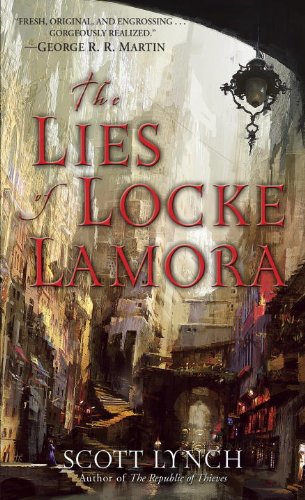
Book Review: The Lies of Locke Lamora

The Lies of Locke Lamora

by Scott Lynch

I should have loved this book: I like fantasy, particularly with intrigue and action (I would love the Song of Ice and Fire, except I’ll NEVER FORGIVE GEORGE R. R. MARTIN); I like caper stories; I am passionate about pirates – which is what drew me to this book, which definitely has a swashbuckling feel to it. The premise is really great: a thief takes in a group of orphans, and sets about making them into the first (and greatest) gang of long-con confidence men this town has ever seen; he intends to unleash them on the nobility, and see just how much they can steal. Move forward twenty years and the plan has succeeded: these thieves are the most successful in a city full of thieves, with a hidden vault full of a vast fortune. But then there is an upheaval in the underworld: a new challenger has arisen to take on the King of Thieves – and he is a threat to our heroes, as well. And not to spoil anything, but this is a revenge fantasy to make Hamlet an envious shade of green.

The setting is good: the city is an independent duchy in a crumbling empire, independent, sprawling, and wealthy; there is a vast divide between the rich and the poor, with the poor living in crowded, squalid slums while the rich dwell in ancient and mystical towers built by a race long gone. There is magic, but it is not common; there are many gods, but prayers and sacrifices to them are traditional rather than earnest. A few tweaks and this could be Venice or Algiers, New Orleans or Hong Kong. It works well for the storyline.

The concept of the characters is great: the gang of con-men are splendid black-sheep heroes; the kingpin of crime is the perfect blend of honorable man and savage; the nobles depicted are both cruel and arrogant, but also with surprising depth, shown to have as much humanity as the poor they oppress.

I should have loved this book.

But I didn’t love this book.

The problem is one that I seem to be encountering more and more these days, either because I’m getting bitter and pretentious as I age, or because books really are getting crappier: the writing just isn’t that good. The first problem with this particular book is that it’s about 200-300 pages too long: a caper story should move quickly, even one that starts with this much backstory; but this one does not. Lynch chose to sprinkle the flashbacks in between chapters, and it was a mistake; it just slows everything down, and it became annoying to get to the end of an exciting chapter, often with a cliffhanger, and have to flash back fifteen years to a training montage. And while the exploration of the thief-training was well done, the characters themselves are given only the vaguest motivation: the lead, Locke Lamora, for instance; we know he’s an orphan who becomes a thief, and quickly proves himself the most audacious thief ever. Why? What makes him this way? No clue. He just is. I’d say it’s in his blood, but we have no idea what his blood is – because orphan. Now, there are sequels, and maybe this will be a grand reveal; but for this book, it was annoying.

There’s more: the action was well-described in slow motion, but the larger scenes of combat and riot were not; overall, there is a feel of missing the forest for the trees, a poverty of grandiosity that ruins the crumbling glory of the old empire feel of the piece. If I may be forgiven some fantasy name-dropping, Lynch should have read more Michael Moorcock: a good chunk of Melnibone would have helped a lot. That combat had the nice realistic touch of pain for everyone: nobody gets out of a fight unscathed, even the ones who are good at fighting, and I like the way Lynch did that – but at the same time, he then has his characters heal real quick so they can get on to the next scene, and so in the end, the bloodshed becomes as unrealistic as an unblooded victor would have been. And though this doesn’t normally bother me, there was a whole lot of gratuitous profanity in this book. I believe in the timely use of the F-word; there’s no better way to express certain emotions. But when you use it too much, it loses that power – by the end of Scarface, you don’t even notice it any more. Same thing here. And in a writer,especially a fantasy writer who has a free hand with inventing language, it just shows a lack of imagination.

I would love to read this book if Jim Butcher or Robert Jordan had written it. But as it stands, this one is only middling good. Not worth recommending.

The Shortest Lines

This morning, I woke up at about three, and I went to my bathroom to relieve myself.

As I lay back down on my soft pillow in my warm bed, I thought, “There are people outside, right now, waiting in line to buy things.”

Then I went back to sleep.