Book Memories

I’ve always been proud of my memory. I remember as a kid I found the word “eidetic,”and didn’t quite understand that it was the same thing as “photographic,” so I began using it to describe my memory. It’s not eidetic, actually, because the word describes the ability to recall visual images with remarkable vividness after only a short time of exposure, and my visual memory is awful. But I can remember trivia like nobody’s business. It never takes me more than two days to memorize all of my students’ names, for instance, and I can rattle off half of the rules of D&D with no trouble.

In the last few years, however, I’ve lost that pride in my memory. Partly because as I’ve grown older it has become less sharp, less capacious; I forget stuff now. My wife used to call me her Port-a-Mem, because she could tell me to remember something and I would; now I need to write stuff down. But the larger reason is that I can’t seem to recall my own childhood very well. I have a friend who has almost perfect recall of anything that happened in our childhood, and I don’t have any recollection of half the things he talks about the two of us doing in our elementary school years. I have to struggle to remember my teachers, or any of the lessons I learned in school. Holiday memories, meals or presents or specific events; I have very few. I remember we went to the Christmas Revels every year, but I don’t remember them. I remember going to First Night in Boston, both with my family and with my friends, but all I remember is those frigging plastic trumpets, the same ones that made such a noise at the World Cup a few years ago. I read about authors who use their childhood as a treasure trove – or maybe a mine shaft is a better analogy – from which they draw ideas for prose or poetry, but I feel like I don’t have that. It feels like a disadvantage, like a vital element of being a writer that I lack. I know this isn’t unusual, either for people in general or for writers in specific – we ain’t all Marcel Proust, who wrote seven volumes starting from the memory of a cookie – but it makes me a little sad that I have a good memory that used to be a great memory: only not for myself. My own life is, while sometimes clear and picture-perfect, mostly a blur.

But then this morning I realized something. It may be that the reason why I don’t have a very good memory for my own life is because my memory is already full: of the lives of other people. I remember books.

Maybe it’s not unusual, maybe there’s nothing special about my memory of books, but I remember them quite well. My wife has, on several occasions, bought a book that sounds interesting, started reading it, and then discovered that she has read it before; I never do that. I can always pick out the books I’ve read before. I remember the books I teach, too; far better than I remember the students I taught them to. I haven’t taught John Knowles’s insipid novel A Separate Peace in ten or twelve years; but I still remember that it’s in the fourth chapter when the narrator throws Finny out of the diving tree; and it’s chapter ten when Leper Lepellier goes crazy. I remember some of the details about the daily life of Ivan Denisovich, and the cloned generations of Where Late the Sweet Birds Sang, even though I only taught those books once apiece.

I remember that the book where I found the word “eidetic” was Piers Anthony’s Bio of a Space Tyrant. And I remember almost everything about that whole series. Hope Hubris was the guy with the eidetic memory. What a terrible name. I thought it was so clever at the time.

So I’m thinking now that somewhere along the line I made the choice: I was going to remember what I read. I have wanted to be a writer since about the 4th grade, so that may be about where I decided; that was when my family read Sherlock Holmes and Edgar Allan Poe together, one of my fonder – and clearer – memories of childhood. I also read Tolkien and a whole lot of books by Anthony around that time; this is why I write fantasy and science fiction and horror, I would think. (Horror also because at age 13 I discovered Stephen King, and I have never stopped reading his books.) So perhaps I dedicated some of the memory that would otherwise have captured my own life to the retention of the fictional lives I read about.

Now I just have to decide if that’s good or bad.

Tell me about the rabbits again, George.

I’ve decided I want to be stupid.

If I were stupid, I couldn’t be a teacher. No, that’s not true: I couldn’t be a good teacher, but we all know there are plenty of bad teachers out there. So I wouldn’t be a good teacher any more, which is sad; but I wouldn’t know it, so there wouldn’t be any problem. What’s more, I wouldn’t ever worry about being a good teacher. I’d never have to worry about whether my students were really understanding the point I was trying to make, because I’d never have a point. I wouldn’t have to read their essays any more, and write comments on them trying to make them better, and feel the frustration when they don’t pay any attention to those comments but go right on making the same mistakes; I could start grading essays according to how many words they are and whether they follow MLA format perfectly and how many words over three syllables they use. I wouldn’t realize the damage that standardized testing does to students, and to education, because I wouldn’t understand the purpose or the power of education, and I wouldn’t know what an opportunity is lost when students are beaten down with tests; I’d just do what I was told, and teach to the test, and threaten my students with bad grades if they don’t pass. So I’d never have to worry about lesson plans ever again. I would swallow all of the snake oil that gets sold to teachers, and I’d believe everything the salesmen said about it, so I could change entirely my policies and lesson plans and teaching methods every three or four years; so I wouldn’t even get bored. Every day would be a PowerPoint presentation and a jigsaw lesson, followed by a standardized test. And you know what? I bet my students would love me. Because they’d never have to think, either.

If I were stupid, I couldn’t be a writer. But wait: that isn’t true, either. It just means I couldn’t write well. But – assuming I still wanted to be a writer, which I probably wouldn’t because I wouldn’t be able to see the world the way I do now and I wouldn’t care about what I couldn’t see; I wouldn’t believe that art could help make the world a better place, as well as making me a better person; I wouldn’t even believe that writing was an art, because I’d think that art was only painting pictures. So if I were a stupid writer, that would work out great: because my books wouldn’t take so long to complete, and I wouldn’t have to work so hard to write them well. I could just vomit out whatever drivel I wished about super-powered vampire werewolves who drive around at night in Lamborghinis (which I’d always call a “Lambo” because I couldn’t spell the full name) –

Dear God, I wouldn’t have to worry about spelling any more.

– fighting demons with their super-powered vampire werewolf kung fu and having sex with hot chicks at the same time. Then I could self-publish my e-books on the internet.

I bet they would sell a million goddamn copies.

I could stop reading challenging books: right now I am reading Arundhati Roy’s The God of Small Things because I will be teaching it to my AP class, and I am also reading Bertrand Russell’s Wisdom of the West (a condensed version of his three-volume A History of Western Thought) because I admire the hell out of Bertrand Russell and I am thirsty for more understanding of philosophy. But fuck that – sorry, screw that (if I were stupid, I’d believe that cursing is bad, especially the F-word): if I were stupid, I wouldn’t be teaching that strange and wonderful and ethereal and challenging novel; it’s got weird sexy stuff in it, and I’d know that was wrong to show to little kids like the high school juniors in my AP class. Plus I wouldn’t understand it because the story jumps around a lot and the plot is hard to follow. Plus I wouldn’t like it because it isn’t set in America and there aren’t any super vampire werewolves in it. Plus my class wouldn’t teach any full novels, because that takes too long and isn’t necessary to pass a standardized test that only asks you to read short passages and excerpts. And there’s no way I’d read philosophy, especially not a survey of philosophy starting in ancient Greece; I’d think the Greeks were homos and philosophy is gay. I’d get rid of every book like that and just read James Patterson. And books about sports. Though I’d prefer the audio books, because it’s easier and faster and not as boring.

Speaking of sports, I could watch football instead of spending my Sundays doing school work or reading or writing, and go to bars at night with my buddies and drink beer (and I’d just drink cheap American beer, instead of having to take the time to peruse the menu looking for good beer) and watch more sports and yell real loud when my favorite sports-squadron scored a goal-unit-basket. And I could wish that I had been good enough at sports to go pro, but known deep inside that it would never have happened, because I’m white and black people are better at sports. Which is why I would like baseball and hockey and NASCAR so much, because lots of white people are good at those sports. Though not hockey as much because they’re all Canucks and Russkies. Though watching the fights would be fun. And I could watch MMA and laugh when Kimbo Slice (That’d be a great name for one of my super vampire werewolves! Maybe I could change it to Jimbo, and then he wouldn’t sue me. Then I could make him white, too.) challenges his opponent to actually compare testicle size during a pre-fight interview.

Though I would have to worry about the size of my genitalia. And whether the size of my hands and feet gave an accurate representation of that size.

Speaking of hand and genital size, if I were stupid, I wouldn’t have to argue and debate and worry about politics: I could just vote for Donald Trump to make America great again, and go back to watching football. And then I could watch Fox News and never have to worry about reading or thinking about what is going on in the world: I could just be sure that America is the best country, that we have to have a strong enough military to keep everyone from invading us, but that if they did invade us, I’d be ready with all of my guns to fight them back, just like in Red Dawn, which would be one of my favorite movies. And maybe I’d have to worry about that socialist Bernie Sanders getting voted in, but I’d be pretty sure, in my heart of hearts, that America would never let that happen: I’d probably secretly believe that the Statue of Liberty and the statue of Rocky Balboa would come to life and drag Sanders down into New York harbor. And I’d never worry about that broad Hillary getting elected over The Donald: no way would America pick a woman over a man. We all know you can’t trust a woman with power – what happens when she has her period? She’d fire the nukes if she didn’t get enough chocolate ice cream! (I would have written Haagen-Dazs, but I can’t spell that, either. And Ben and Jerry are socialist hippies.)

I would believe that a wall on the border could keep out Mexican illegal immigrants. I’d believe that immigrants are bad. I could ignore uncomfortable irony like the history of my own family’s immigration to this country. Because I’m white.

I could chant “USA! USA!” without irony. And tear up when a small child or a crippled person sings the Star-Spangled Banner at my ballgames. And secretly hate that Beyonce sings better than anyone in country and western.

I could listen to country and western music. I wouldn’t have to change radio stations any more, because there’s only one country station here and I’d love every song because they all sound the same. I wouldn’t have to listen to challenging or depressing lyrics, or admire musical talent or songwriting ability; I’d just like the ones who say America is great and talk about drinking American beer and driving around in trucks. Which is all of them.

I could stop taking criticism to heart. I would think I was great because I am American, and a white male, and therefore I am the best people in the world, and everyone else is just jealous of what I have. Except for that genital thing. But I’m sure I could convince myself that there was no problem there. My hands are pretty big, after all. And it wouldn’t matter to me if people thought my writing was bad, or my teaching, or that I was behaving in any way wrongly: because I’d think they were haters, and Taylor Swift (who I would totally listen to, and try not to think about how hot I’d think she is because she’d be too young for me, but I’d know in my heart of hearts that she would totally have sex with me if I ever met her in a bar, because I am an American white male with not-too-small hands.) would have told me that haters gonna hate, hate, hate, and I just needed to shake it off. Man, that song is just so catchy! And that Kanye West guy is a racist. Though his wife is hot. And of course she married a black guy, because she’s got a huge butt and black guys like big butts. Sir Mix-A-Lot told us that.

If I were stupid, I would think that “were” sounds weird: because I wouldn’t know about the subjunctive mood and statements that are contrary to reality requiring a different verb; so I’d just say “was.”

If I was stupid, I wouldn’t worry about my diet. I wouldn’t care if animals suffered in factory farms, because they’re just animals and they don’t feel pain, plus the Bible says they’re here to serve us. I’d love bacon more than anything except steak, and best of all would be steak wrapped in bacon and topped with lobster. Wrapped in bacon. Maybe with a bacon milkshake on the side. I wouldn’t care about my cholesterol, because I’d know that America has the greatest health care system in the world and I could have all the triple and quadruple bypasses I needed when my ticker started giving out. And I wouldn’t care about my weight, because I’d lift weights – that is to say, I’d do it differently than I do now, because I would do bench presses and curls and maybe five sit-ups a week and call it good – because as long as my pecs and arms were big, I’d think I was hot, because check out these guns! Plus women don’t think the same way about appearance. Men are visual, they need chicks to be hot; but women just need them to be manly, so they feel protected and safe. And I’ve got all the guns I need. Get it? Get it? Because I meant my biceps AND the Glock on my nightstand!


Yes. I want this. Last night I went to see Of Mice and Men on stage, and it was lovely and heart-wrenching; but if I was stupid, I never would have gone to see it, and it wouldn’t have made me sad. And then afterwards, I spent a fair while writing an irritated response to a comment on Facebook from a woman who didn’t understand everything I was saying in my argument, but she was pretty sure I was a socialist and wanted to take tax money away from hard-working Americans to give to the junkies on welfare. But then I had to delete my reply. Because reasoned discourse is no longer acceptable in this country: all we care about is if people agree with us, and if they don’t agree with us, there must be something wrong with them; and if they tell us we are wrong, then we get offended. I had to delete the comment because I am a teacher, and teachers are not allowed – ever – to be offensive, even if the only reason we are offensive is because other people don’t like our arguments.

I had to delete my comment because six years ago, an offended woman on Facebook nearly got me fired and banned from teaching in Oregon by complaining about a comment I made, which led my employer to my blog, where I had written things that were true, but not polite, and not acceptable coming from someone who was supposed to love and protect and coddle all of the children while preparing them for the tests and cheering for them at football games, which is, I think, how most political entities view ideal teachers. I was called “morally reprehensible” for what I said. And the worst thing is this: that I have had to think about that, and whether it is true, and decide that to some extent it is, and then I have had to feel both shame and doubt because of it.

And last night, I realized: as long as I am a teacher in America, I will never be able to say exactly what I think, and I will never be able to argue, especially not about controversial issues like politics and guns and war and racism and religion and education, because telling someone that they are wrong, especially when they are, is offensive, and particularly for me because of my history, offending anyone, anyplace, anytime, could very easily get me fired. This means not only that I will always have to worry about what I write and post online, but also that I cannot use my abilities, my greatest assets – my intellect and my words – to do what I think is right, to try to make the world a better place through critical thought and reasoned argument, because I will never be able to argue, not as long as I teach. And probably not after that, because I’d like to be either a professional writer or own a small business, but if I make people mad at me by taking their bad arguments apart online, they will give me bad publicity, which will hurt my career, whatever career it is. I will always have to worry about what someone else will do to me if I tell them they are wrong. Because reasoned discourse is dead. We prefer circuses.

And I decided that I don’t want to worry about anything any more. I just want to do what I’m told and work hard and do the things that make me feel good.

I’d rather be Lennie than George. All the way to the end.

Book Review: Duma Key

Duma Key

by Stephen King


For some reason it took me a while to get to this one. My wife and I read every Stephen King book, and we generally get them and read them within a year or so of publication; this is one author we are willing to pay full hardcover price for.

Maybe that’s the reason, actually: maybe Duma Key sat on the shelf for so long because it’s not a hardcover; we bought it in mass market paperback, and what’s more, we bought one of those tall paperbacks – the “Summer beach read” edition, I’ve seen them labeled. And in terms of book format, I didn’t like it. It just seemed wrong. Off, somehow. Which, actually, is probably entirely appropriate.

Well, now I’ve read it, and: it’s not one of my favorites. It’s got some great elements to it. I loved that the main character, Edgar Freemantle, is an artist. I love when King is able to describe what it’s like to make art, to feel the need to make art, and especially the down side of it: the emptiness and exhaustion that come after working on art, the constant self-doubt and that nagging belief that these people only like your work because they like you. I also liked the scenery: set in the Florida Keys, in a salmon-colored beach house that the hero calls Big Pink, there are wonderful descriptions of the Gulf, of walks on the beach, of overgrown greenery, of grand old Florida houses. I liked the characters, for the most part, especially the key characters of Elizabeth and Wireman and Jack, the people that help Freemantle discover the solution to the mystery of Duma Key.

But I didn’t like the way the novel went bad. Now, all of King’s books go bad: the man writes horror, after all, and even when he’s not, he tends to put his characters in horrible situations. I’ve read The Dark Tower (No way that movie’s going to work, by the way. Not because of the casting, but because the beauty of The Dark Tower is the world that King built, this amazing world that has moved on. And it took King seven novels, ranging from 300 to 1000 pages each, to build that world. Make that into a movie, and it will be a month long. Which, actually, sounds pretty awesome, but I feel like those seats would get really uncomfortable after a while. And if you thought movie theater floors were sticky before . . .) and it’s definitely fantasy – but that is not a happy place, that world, and those are not happy lives those characters lead. So of course Duma Key would feature some terrible things. And like many of King’s books, this one starts off bad: because Edgar Freemantle was a builder, until he got crushed by a crane at one of his job sites. He suffered several crippling injuries, not least to his head, and his right arm was amputated above the elbow. The book starts with his recovery, and focuses on his troubles with speech and wild and violent mood swings while recovering from his traumatic brain injury. And like the other things that King has written since he himself got crushed by a car, this is vivid and detailed and very true to life. And then when Freemantle moves to Duma Key to continue his rehabilitation, it’s great: the Key is wonderfully depicted, and that’s where we meet all of the other good characters, and encounter the mystery, which is pretty cool. And then the majority of the book is Freemantle’s life as an artist on a Florida Key, and I liked it.

But then the horror comes in. And I feel like King got caught up in his own story as an artist in the Keys, whether he went there to write the book or only imagined them; because it’s almost like he forgot he was writing a horror novel. There is a sudden appearance of a horrible apparition, and it’s bad, but there doesn’t seem any reason for it. And then Freemantle is afraid of his mystical painting gifts (Those gifts, a result of both his injuries and the magic of Duma Key, were well done: but the change from being fascinated by that magic to being scared by it was not.), and I don’t see why. And then everything falls apart, as it often does at the end of King’s novels (and in life), but it all goes bad too quickly. It made me long for The Shining, or Insomnia: one of King’s books where the flow and the buildup of tension are just right, and you end up reading wide-eyed and dry-mouthed at three in the morning because you just can’t put it down.

Duma Key didn’t do that. It was good, I liked the ending and its solution to the evil mystery, and I loved the time on the Keys; but this wasn’t my favorite of King’s novels.

Marketing lol

“You’re not marketers,” she said. You’re right. I’m not.

So why have I been in a training about marketing all afternoon? (Especially on Monday?? After a four-day weekend???)

“It is not your responsibility to recruit.” Right again.

So why are we discussing the best ways to recruit new students?

“What sells this school, what brings new students here, is two things: the rigorous academics, and the familial atmosphere.” Makes sense to me; that’s what brought me back to this school for my second year.

So why, rather than spending these same 90 minutes working on my rigorous academic curriculum, am I being told how to bring strangers into the school family? Why am I being treated in this rather condescending way, which somehow assumes that I don’t represent the school well? Why do you feel you have to tell me that I should speak well of the place where I work, and that I should do my job well in order to turn people into positive voices for the school rather than negative ones? Do you think I don’t know that? More importantly: do you think I do my job well so that the school can have good PR?

Hi! In case we haven’t met, let me introduce myself. I’m Dusty. I’m a high school English teacher. I work at a public charter school. If you’re not familiar with charter schools, they are just like other schools, except rather than an elected school board making decisions, there is a private entity – in this case, it is a board of directors for the corporation that runs about ten different schools in this state – and the students are drawn from all over, rather than a specific geographic area. We are non-profit, tuition-free, state-funded, and we teach the same basic curriculum, with the same accountability, as do other schools. I teach five English classes, two of them Advanced Placement, and I run a creative writing club. My students like and respect me, and so do their parents, as far as I can tell. I work very hard at what I consider the most important aspects of my job: I create a comfortable atmosphere, where students feel like they can say whatever they need to say; I drive my students to think critically and dig deeper, both into the content I teach and into their own thinking and assumptions; and I try to make language arts a vital and useful part of my students’ lives, by showing the beauty and power of great writing, and the importance of reading and thinking. And I am good at what I do.

Now let me tell you what I’m not.

I am not a salesman. Despite what the marketing consultant hired by my school said to us in that afternoon workshop, that’s what the school wants us to be. She even said why: because the charter school market in this state is flooded, is one of the most competitive in the country, because Arizona turned to “school choice” as a priority earlier than most other states that have since followed suit; the school where I work has a 15-year history, which is lengthy for a charter school. But you see, despite the belief that competition brings out the best in everyone and everything, that the free market inevitably produces the best possible results, competition between charter schools to recruit students has quite the opposite effect: rather than encourage schools to be the best schools and get more students that way, it asks teachers to become marketers – because advertising is cheaper, easier, and let’s be honest, more effective than simple excellence. Just ask Donald Trump. As part of my regular job – which is apparently at least part marketing executive – I am required to staff open houses, where I give tours to prospective student families; I am frequently asked to volunteer at community events, to hand out fliers, to put those doorknob-hangers on the houses in my neighborhood. I am asked to encourage parents to post positive reviews of the school on Yelp and GooglePlus and the like.

But I am not a salesman. I do not consider my students to be either clients or customers: that’s why I call them students. Their parents are also not clients or customers: they are the parents of my students.

I am not a parent. I do not consider my students my family, nor my fellow teachers and staff members. I like them, both students and staff, and I do what I can to help and support them as I would any group of students or staff. But I do not staff sleepovers (Seriously: my school has sleepovers. Where students stay the night at the school, with teachers supervising them. I suppose I should mention that the school is K-12, and the sleepovers tend towards the younger end of the range than the elder.), and I don’t do home visits and have dinner with students’ families, and I would not describe the school to others as having a familial atmosphere. Even though the marketing consultant wishes me to say that, and what’s more, wishes me to draw other people – she calls them “prospective clients” – into that familial atmosphere, to show them how wonderful the school is so that they will want to be a part of it, will want to join my family.

But I can’t help but wonder: at what point does it cease to be a familial atmosphere? Do people recruit strangers for their families? I suppose if I were a medieval baronet looking to arrange marriages for my offspring, then sure; but I’m not. I think the answer probably is: it ceases to be a familial atmosphere when my bosses ask me to go out and bring strangers into our family so that my family can secure more funding. I think that’s the point that I no longer feel valued for my own contributions to the family.

Now all I can think of is The Godfather. Forgive me, my Don, for speaking against the family.

I am not competitive. I do not care if the school is the besterest in the whole wide world. I do not care if the school’s reputation is shinier than anyone else’s. I don’t care at all how the school is perceived, other than I want that perception to be accurate. I do want the school to be an effective place of learning, and a safe place for our students and staff; and if other people want to know about that, then well and good. But school pride makes no sense to me, any more than does patriotism: my country didn’t make me, didn’t raise me, didn’t teach me; people did that. Those people shared a national identity with me, but they also shared a generally symmetrical and bipedal form, two ears, two eyes, and a chin, and I don’t feel any special loyalty to that, either. (Yay for chins! Chinned people unite! See how ridiculous that sounds? Now replace “chin” with “America.”) So talking up the school? Trying to enter competitions so that the school can add awards? Creating special events so that we can brag about the awesome stuff we’re doing there? Nah, and double nah. If I do awesome stuff, if I encourage my students to enter competitions or help them win the ones they enter, it is for the sake of the awesome stuff, or for the sake of the students; I couldn’t care less about whether the school’s reputation benefits.

My essential point is that I am not a capitalist. I do not believe the profit motive is actually a good way to bring out the best in people; I do not think the free market produces the best possible goods and services. I teach as well as I can, and work as hard as I can, because I believe in what I do. I believe that art is the soul of humanity, and language is our church. I believe that young people should have help to become better adults (Though I also believe that help should be offered but not imposed, and the young people have to want it and take it from me.). I believe that I can help them, and that I do a good thing when I do it. That’s why I work hard. I require a wage for my work, because I require subsistence, and my work deserves reward; but I do not work harder and improve my craft in the hope of more money; I do it in the hope of better results. I teach as well as I can because I teach: and that is important to me.

I am not a data collector. More, I am not a data masseuse. I will not put my time and effort into squeezing a few more points out of my students. The school would like me to, as they would like me to actively market the school (And please note, in terms of capitalism: they are not paying me more for my marketing, not even if I bring in new students. And that’s why the free market doesn’t produce the best possible product: because sometimes you can get results without improving your product, especially if you can get your employees to work harder for nothing.). The number-one way that the school earns its reputation, and therefore increases its recruitment numbers, is academics. And rightfully so: I’d rather be at a school known for its education than one known for its football program; there’s a reason I don’t live in Texas. But there is a right way and a wrong way to show academic success: the right way is to hire good teachers and provide them the time and support they need to teach well; to provide many opportunities for your students to succeed in various academic endeavors; and to help your students achieve academic success in their chosen endeavor. If you then want to brag about that stuff, go nuts: I’ll even join in. And in those things, my school has done a good job: the graduating class earned an average of $25,000 in scholarships last year, we had two National Merit semi-finalists this year; we have an award-winning robotics program along with award-winning essayists, artists, and a poetry recital contestant going to the state finals.

The wrong way to go about it is to have high test scores and high grades. Because the more you focus on those aspects as the means to a better reputation, the more you force teachers and students to focus on superficial data, rather than actual education. The reputation based on test scores becomes advertising, intended largely to increase our funding; and like any other advertising, it takes on the shade of propaganda: in other words, it becomes a lie. We have all of those award winning students because they were not forced to focus solely on raising their test scores. I will not participate in that superficial, specious, insidious nonsense called “teaching to the test.” I will not recommend certain of my students for the AP exams and discourage others; when asked which of my students are ready to try the AP exam, my answer is, “All of them. And all of the other students, too. And how about some people walking down the street? And their dog? And that lizard basking in the sun over there?” Because why not? Other than the hefty test fee, why shouldn’t everyone give it a shot, if they want to? What does it matter if they fail? It’s only a test, after all.

I like the school where I work. I am proud to be associated with the staff there, and happy to work with the students there. It’s the best school I’ve worked at in sixteen years as a teacher, in three states. But I wish they had a better idea of who I am, and what I do. I wish they understood me.

Isn’t that what family is for?

Bullsh*t Award

And the Bullsh*t Award for this week (Non-Trump Category) goes to: the following Quickwrite response from one of my students (A Quickwrite is like a single short answer question; should be about a paragraph, and show both thought and evidence in the answer.)

Subject: Martin Luther King, Jr.’s “Letter From Birmingham Jail”

Question: How do specific words and phrases contribute to the impact of King’s opening?

Answer: The more specific the words the more serious he sounds. The opening of a letter I think is the most important part of the letter. Its [sic] what makes people know if you are serious or playing. So the specific words and phrases he uses make him seem real & serious about what he is talking about.

Short Story: Life With Bird

Fine. It was fine.

It was fine when Mark was awakened by kissy noises — the sound of lips pursed and relaxed rapidly several times, followed by one long drawn-out inhale, a sort of raspberry in reverse — even though the sounds were made with no lips at all. But it wasn’t fine when he cracked open one eye to see another eye, round, lidless, a black hole in a white disc, hovering inches from his own: so close it seemed no more than a spot of dirt on his lens, as if he could blink and clear that nightmarish darkness from his vision.

The kissy noises repeated, like the sound of eggs being whisked, and then the outstretched one — pulling milkshake through a straw — this time culminated in a low two-note whistle, and then a noise that Mark had always described as a scrawk, which sounded a little like the onset of an old man’s laugh and a little like a chair being dragged across a linoleum floor. The noises came from just to the left of the eye floating in his sleep-blurred vision, the eye without expression, without emotion, without humanity.

Mark closed his eye and turned his head sideways on the pillow.

A sharp pinch skewered his earlobe, stabbing through to his brain, bursting the bubble of sleep. “Ow!” Mark hollered, his tongue heavy, his face half-smothered in pillow and sleep. “Geddoff! Ow!” He managed to drag one hand out of the quicksand of slumber and flail it once over his head, covering his offended ear with his arm.

There was a flapping noise and then clawed feet stepped up his wrist to his forearm, perching triumphantly on his bent elbow, currently the highest point on his body. Another pinch, lighter this time, on the less-sensitive skin of his upper arm; another scrawk.

Sleep fled at last. Mark opened his eyes, blinked, sighed, smacked his lips and swallowed. The kissy noises once again, and the two-note whistle: and now Mark smiled. He lifted his arm slowly, contorting his shoulder as he swung the limb without rotating his elbow downward; he could reach just far enough that if he craned his head back and around, he could see all of the large white bird that gripped his arm with its dark blue talons.

“G’morning, Merlin,” he said; he tried to whistle — failed — licked his lips with a dry tongue and managed half a note that turned to a hiss. Merlin bobbed his head up and down, his yellow crest lifting, and whistled the opening bars of “The Old Grey Mare,” his favorite tune. He walked up Mark’s arm to his shoulder, where the bird normally spent most of his day; but with Mark reclining, Merlin could not find purchase; so he continued up onto Mark’s head. Another whistle, more kissing, and then Merlin bit Mark’s ear again.

“Ow, goddammit, bird,” Mark shouted hoarsely and sat up quickly, trying to dislodge the bird from his head. Merlin flapped his wings as he lost his balance and then clutched with his talons; he hung on despite Mark’s sudden movement. Then he took a grip on Mark’s ear with his beak: like a grandmother threatening a disobedient child. Mark froze. “All right, okay, calm down,” he said, patting the air with one hand, his voice and movements slow, placating. He tilted his head slowly to the side, his non-hostage ear flat on his shoulder, so that Merlin would have a place to stand; then Mark swiveled his legs off the side of the bed and stood slowly. His neck was cramping and his scalp itched fiercely under the heavy talons, but he cleared his throat, wet his lips, and whistled the theme from The X-Files: one of Merlin’s preferred melodies.

It worked. Merlin let go of Mark’s earlobe, whistling the same six notes back to Mark. Then he crab-walked down Mark’s neck to his shoulder. Mark lifted his head with a grunt, and put his left hand on his right shoulder; Merlin stepped onto the back of his hand, and Mark lifted him and held him where he could glare at the bird through narrowed eyes.

“We’re going to have to practice your wake-up call manners.”

Merlin clicked and whistled a tune that only he knew, ending with a loud scrawk. He walked up Mark’s arm to his shoulder again. Mark sighed. “Right, got it. I’m not allowed to lecture you. Fine.” He turned and headed to the bathroom, Merlin riding on his shoulder as he stood before the toilet and peed. He left the door open; there was no one else in the apartment, after all.

***

Mark sipped his well-sugared coffee, savoring the hot sweetness on his tongue, then blowing air out in a sigh. Merlin hissed, his crest rising; he didn’t like that noise. “Right, sorry,” Mark said. He reached up with his finger curled, offering to scratch the back of Merlin’s neck. Merlin bit him. “Ow. Okay, fine, no scritchy.” Mark took another sip of coffee and then breathed out through his nose.

“What shall we have for breakfast?” He gathered a plate of food for Merlin — nuts, some slices of fruit, a pile of oil-black sunflower seeds, some leaves of Romaine lettuce washed, dried, and julienned so Merlin could eat them easily — and then he threw two slices of bread in the toaster for himself. He held bits of food up to Merlin as he prepared the plate, arranging the elements neatly, adding a dish of fresh water in the middle, and then carried Merlin and his breakfast to the table, setting him down at the head. He buttered his toast, and then sat at the foot — he had to sit at a distance, or Merlin would take his toast right out of his hand. Out of Mark’s mouth, if he could reach.

“So what are we going to do today, bird o’ mine?” Mark asked. Merlin grabbed a piece of apple and chewed through the meat, then dropped it and dug into the sunflower seeds, scattering them across the plate. The lettuce was ignored after a desultory inspection and despite Mark’s admonishment that he needed to eat more greens. Merlin turned his head to the side and fixed his gaze on Mark as he cracked black sunflower seeds with his black beak.

Mark considered his audience. “Well, I don’t have that much work to do, but I should still check in.. We can go to the cafe for that.” Merlin’s crest rose and he bobbed his head; the internet cafe was approved. “Oh,” Mark said as he remembered, “I need to do laundry, too.”

Merlin dropped the seed that was in his beak. He rose up, his feathers ruffling and his crest standing straight up. “No!” the bird said clearly, his voice like Mark’s but an octave higher. He tossed his head to one side and then the other, his beak snapping shut; Mark was absurdly reminded of movie-cliche gangbangers with their guns held sideways. “No!” the bird said again.

Mark put down his coffee cup. “I know, I know — you don’t like the noises in the laundromat. But I have to do — I’m running out of clothes and –”

Merlin cut him off with a loud scrawk; he unfurled his wings and flapped sharply three times, budging not an inch from the tabletop, throwing air in Mark’s face. “No!” he said a third time, and clacked his beak shut.

“Merlin,” Mark started to say.

Merlin lowered his head, his beak open, and with his wings held out to the sides, he advanced on Mark, crossing the table in a rapid but clumsy waddle. Mark sat back in his chair, holding his hands up in surrender — and to keep his fingers far away from that snapping beak, which could splinter a two-by-four. Or a fingerbone. “Okay, okay — no laundromat. No laundry. You win, Merlin.”

Merlin stood tall on Mark’s plate, one foot atop the last crust of toast. He flapped his wings, the feathers brushing across Mark’s face; Mark turned away, closing his eyes. The cockatoo squawked loudly once more as Mark ducked, holding his wings spread wide, his crest bristled. Mark peeked up through one eye, his head held low. “Sorry,” he said quietly. The bird folded his wings and lowered his crest. Mark slowly extended his hand, and Merlin stepped onto it, digging in momentarily with his talons. “Let’s go take a shower,” Mark said, rising. “Then we’ll go to the cafe.”

Merlin whistled and made a kissy noise.

***

Mark ran his face under the shower spray one last time, and then shut off the water. He rubbed one eye clear, opened it and looked up to where Merlin was sitting on the shower curtain rod; he carefully slid the curtain halfway open without disturbing the bird’s perch and reached for a towel. Merlin’s whistling alternated between random notes and snatches of his favorite tunes — a few notes of The Addams Family theme led to a chorus of “La Cucaracha” into “My Darling Clementine” — he really loved the “Oh my Darling” part. Mark rubbed the towel vigorously over his head, frizzing his hair out; when he looked up, Merlin shook his feathers out to match. Mark reached up, took the bird onto his hand, and transferred him to the vanity. Then he filled the basin to shave, while Merlin preened beside him. The bird’s crest popped up as Mark filled his hand with shaving cream; he dabbed a gobbet on the countertop, and Merlin toyed with it while Mark shaved around his smile.

When they were finished with the shaving cream, he walked in his boxers into the closet and came out with two shirts. He moved to the bathroom doorway and presented the options to both the mirror and the much harsher judge beside it. “Which one?” he asked. The first, a comfortable plaid, seemed too drab; but the second, a silk-blend bowling shirt with electric blue dragons across the front and back, brought a scrawk. “No?” he asked, turning to Merlin, his tone disappointed. The bird lowered his head and turned to the side, flapping his wings twice. He reached out with one foot, talons outstretched like a black-lacquered starfish.

Mark looked down at the shirt held against his chest. “Really? We don’t like this one?” He frowned at the mirror, and at the bird beside it. Merlin shook his head again, clicked his beak and his talons against the countertop, one-two, one-two.

“Ah!” Mark rolled his eyes up with a nod. “Right — I forgot.” He turned and went back to the closet, where he hung the blue dragon shirt back on the bar. He pulled the plaid off its hanger, pulled it up his arms and buttoned it. He pulled the silk shirt to him, running the material between thumb and forefinger. “I forgot you have trouble holding onto this silk.” He pulled the shirt out farther, looked at the dragons. “I should just get rid of this.” He ran his hand down the shirt, over the dragons; he pushed it back into line with the others. He straightened the plaid, buttoned the cuffs, and went to get Merlin.

“Let’s go, buddy.”

Merlin shook his feathers out once more, tightened his grip on Mark’s plaid shoulder, and started whistling “Side By Side.” Mark joined in as he grabbed his laptop, keys, and wallet.

Oh, we ain’t got a barrel of money,
Maybe we’re ragged and funny,
But we travel along, singin’ a song,
Side by side!

***

“Hi,” Mark returned the coffee clerk’s greeting with a smile, ignoring the look of glazed semi-panic in the man’s eyes as Merlin stood tall and stretched up his feathery crown. “I’d like a — a Cafe Americano, please.” If this had been a workday, he would have ordered something more high-octane than a single shot of espresso in hot water, but it was Saturday, and he was here mostly for the outing. It would be bad if he and Merlin stayed shut up inside all the time, buried indoors as if underground; he sometimes felt like he was growing roots and bark, subsiding into his couch, his bed, the walls of his apartment. Perhaps he would stay so still he would crystallize, he thought; the atoms and molecules of his body aligning perfectly and freezing in place, ordered, structured, permanent.

Yeah: he needed to get out more.

“And a scone, please,” he added. Merlin scrawked, lifted a foot and hooked one black talon — gently, for now — in the cup of Mark’s ear. “Right — sorry, Merl, sorry — scone with almonds, please. Lots of almonds.” The clerk changed his target, reaching for a scone coated with pearl-colored slivers. He put it on a plate on top of the glass counter, and the talon was removed from Mark’s ear. Mark breathed a sigh of relief, and Merlin cluck-chuckled — a positive sign. Mark slid his credit card through the reader and picked up Merlin’s scone. He glanced to his side, and saw that Merlin was grooming the talon that had just been in Mark’s ear; watching him, Mark was reminded of a muscled bully kissing his own biceps. “Nice guns,” he said drily. “Here’s your scone. Your almond scone.” Merlin met his gaze, fluffed his feathers and gripped Mark’s shoulder. Mark made his way to the table by the window and sat, facing out so Merlin could see the street outside. He opened his laptop, and Merlin walked down his arm to the tabletop and went to work on the almond scone. The waitress brought Mark’s Americano, and Mark thanked her absentmindedly as he logged on to his webmail. Merlin also said, “Thanks!” and the waitress blinked and then left without a word.

Three emails-and-responses later, Mark heard a voice say, “Oh, what a pretty bird!” He and Merlin both looked up, Merlin’s crest rising. Mark felt the blood rising to his cheeks when he saw the woman standing by the table; he had an absurd moment when he wanted to say, “No, you’re the pretty bird,” but thankfully, he bit the words off of his tongue, chewed them up, and spat out only, “Thanks.”

The woman — who was a very pretty bird — smiled and reached out a hand to Merlin, moving too quickly for Mark to say, “Be careful, he bites,” or “Please don’t touch his wings, they are delicate.” Or even, “Will you please keep your hands off of my bird? Why does everyone think they have the right to pick him up, or pet him or poke him? Because he’s small? Because he’s soft? Damned arrogant humans.” He watched, opening his mouth to speak and then closing it again, as the woman did — just the right thing: she held her hand out, palm down, fingers curled in; you could hold out a single finger to a smaller bird, but a parrot Merlin’s size wouldn’t see a perch, he’d see a chew-toy. Then the woman made a kissy noise, and Merlin tilted his head and then offered his usual greeting, a scrawk followed by a two-note whistle. Mark had taught it to him, along with his name, when he and Merlin first started living together; the scrawk-whistle was the standard parrot noise from the old Looney Tunes and the like, and Mark thought it sounded piratey. And parroty.

Then he had stopped teaching Merlin tricks. A parrot like Merlin has the intelligence of a four- or five-year-old human child; you don’t teach children tricks. You talk to them, and then listen to what they have to say.

The woman laughed when she heard Merlin’s scrawk-whistle. Mark and Merlin both drew back slightly: it was a terrible laugh, loud and high and false, as if she had decided to simply say the words “Ha! Ha!” Too bad, Mark thought. She is pretty. But then he decided she should have another chance; maybe she was nervous. Walking up to a stranger in a cafe, I would be, he thought. So he said, “Go on, Merlin.” Merlin glanced to him, then reached up a foot and stepped onto the woman’s hand, walking up to her wrist.

“Wow, he’s so light!” she said. She lifted her hand and Merlin to the level of her head, but slowly, so Merlin didn’t get startled; and she didn’t put her face within biting range. Mark was impressed. “Does he talk?” she asked.

Mark opened his mouth to give his usual answer — Only if he has something to say — when the woman, who had been doing so well, took a running start and leapt off the cliff. She bugged her eyes out, pooched out her lips, and said, “Does pitty-bird-ums talkie-talkie? Does oo wike to talk? Yes you do! Yes you do!” This last was delivered with a side-to-side head wiggle, her nose thrust right up to Merlin’s beak; and she lifted her other hand and ruffled it through Merlin’s crest, bending the proud golden feathers as if they were fur.

Merlin reacted the only way he could, the way anybody would in similar circumstances. He bit the ruffling hand, and shat on the perching hand.

Thankfully, Merlin hadn’t broken the skin, and so Mark wouldn’t have to pay for an emergency room visit; merely for the round of free coffee he offered the other patrons as apology after the shrieking woman had launched the large white-and-gold parrot off of her hand and into the air, said parrot then completing three full circuits of the room, flying inelegantly but determinedly, before coming to a landing on the shoulder of a petrified grandmotherly woman who sat stock still, head turned just enough to lock gazes with Merlin, who kept fluffing his feathers, flexing his talons, and flapping his wings while he eyeballed his elderly perch. She stared right back, neither of them blinking, the woman appearing not to breathe. But she also wasn’t screaming, as was the baby-talk woman behind him, so that was an improvement. Mark, hurrying over to rescue — well, one of them, anyway — filled in the dialogue mentally, giving Merlin (who usually sounded a bit like Sir Ian McKellen’s Gandalf in Mark’s mind) a touch of Travis Bickle: You lookin’ at me? You wanna start somethin’? You make the move, Grandma. It’s your move.

“Come here, tough guy,” Mark said, reaching out a hand for Merlin to step onto. “Just hold still and he won’t bite,” Mark said to the woman, followed by “Sorry about this.” Mark would say that several more times in the next few minutes. Merlin wouldn’t say it once. Neither would Ms. Babytalk.

“Oh, not at all,” the woman said, her mouth the only part of her to move. “I just hope she didn’t hurt Merlin’s lovely head-feathers.”

Mark’s gaze whipped from bird to woman; she glanced back at him and smiled. Behind Mark, the shrieks continued, alternating between disgust and shock as the babytalk woman examined one hand for blood and the other for remaining smears of birdshit.

“I come here quite often,” Merlin’s perch said to Mark. “As often as the two of you. I have frequently admired Merlin — and your relationship with him. Much more than a master and his pet.” She turned her head slightly, facing Merlin more squarely; Merlin was calming, now, though he would lift his crest and open his beak each time the shrieking woman hit her high note of “Oh my GOD!” above middle C. The elderly woman smiled at the parrot. “In fact,” she said, with another quick glance at Mark, “Why don’t we just let Merlin collect himself here with me, while you handle that train wreck over there?”

Relief swept over Mark. He had been thinking he could take the bird and run, since he couldn’t go back to soothe the shrieking woman while Merlin sat on his shoulder, hissing and clacking his beak; nor could he leave Merlin alone, as the outraged parrot would show the woman what real shrieking sounded like, were Mark to ignore him in his moment of need: humans could neither compete with nor comprehend the volume and piercing tone that an affronted parrot could reach, and then sustain indefinitely. Mark had been trying to decide if he could sacrifice his laptop in the name of just getting out of there: the door was close by, and he could find another cafe.

But now, another option. Merlin was definitely calming; as Mark drew his hand back slowly, Merlin fluffed his feathers once more, and then commenced grooming. Mark sighed in relief. He smiled at the kind woman. “That would be wonderful. Thank you. Just don’t — ”

“Touch him. I know,” the woman finished. Then she spoke to Merlin. “We’ll just sit here and groom, all right? I’m sorry I don’t have any food for you. Such a handsome bird.” She spoke in her normal tone, perhaps a little softer and lower, soothing the recently jangled parrot. The woman’s gaze flicked back to Mark. “Go on. Make her be quiet. Please.”

“Thanks,” Mark whispered, and then turned to deal with Merlin’s victim. He always carried antiseptic wet wipes, naturally, and the woman deigned to accept his sincere-sounding apology, allowing Mark to clean and inspect her hands before she flounced off to the ladies’ room to wash once more. Mark apologized to all of the disturbed patrons and handed his credit card to the clerk, saying, “Another round for everyone, on me.” He grabbed up his laptop and the rest of Merlin’s scone, downing the last of his own Americano in three hurried gulps.

When he returned to Merlin and Merlin’s new friend, he reached out once more for the bird; again the woman stopped him, this time with a shake of her head. “You can’t leave yet. You’re going to need to apologize again, and give her your business card and offer to pay for anything she needs. Keep it vague; don’t give her ideas. I doubt she’ll have any of her own.”

“But he didn’t even break the skin!” Mark said in outrage.

The woman fixed her gaze on him. “If you don’t offer, she will decide you owe it to her, and she will come after you. Offer it, and it will be charity: beneath her dignity to accept.”

Mark blinked, and blinked again, and then put down the laptop and the scone. The woman said. “Ah!” and reached slowly across the table for the scone, which she slid close to Merlin; she put her hand on the table near the plate, and Merlin took his cue: he shuffled down her arm to the tabletop, shook himself vigorously, and then started nibbling almonds.

“Thank you. Again. I don’t know what I can do to –”

The woman waved her hand, shook her head. “It’s all right. I’m a grandmother, I know. It takes a village, they say.”

“Can I buy you more coffee? For the next month or so?”

She shook her head at the offer. “No, that’s fine. But,” her eyes sparkled, and when she smiled, Mark saw a dimple. “I have a daughter. Who is a single mother. How do you feel about human children?”

Mark blinked. Then he smiled.

Then he turned to apologize profusely and give his business card to the pretty woman, now turned into sour-faced-outraged woman. Fortunately, she thought he was trying to pick up on her, and she laughed her terrible laugh and threw the card back at him before storming out of the cafe. Remembering what Merlin’s new friend — and Mark’s new matchmaker? — had said, he picked the card up and brought it to the clerk, trading it for his credit card (which somehow seemed lighter, now) and murmuring that the woman should contact him if she came back for any reason. Then he hurried back to his friend, and their new acquaintance.

***

“Merlin! I’m home!”

From the living room came the “Rawwwk!” and the two-tone whistle, followed by Merlin himself, waddling his ungainly way across the floor; when he saw Mark, he raised his crest and tossed his head, the bird-greeting that always reminded Mark of bros saying “‘Sup, bro? ‘Sup?” Mark often thought that he should teach Merlin to say “What’s up, Doc?” but he knew that once he taught it to the bird, that was that: it would never be forgotten, it would be frequently repeated at odd times, it would be repeated over and over and over again. And Merlin could expect to live as long as Mark did. A parrot’s speech was a dangerous weapon.

But all that mattered now was that he was home, and Merlin was glad to see him. He shoved the door shut with his heel, dropped his keys on the counter, and bent down to pick Merlin up. Merlin stepped onto his hand as soon as it was in reach, and made kissy noises as Mark lifted him up to his shoulder and deposited him there. “Okay — let’s get a tray and see what’s on.”

Soon Mark was ensconced on his couch with a beer in one hand and the remote in the other, food spread on an oversized TV tray in front of him — oversized to give room for Merlin to stand on the edge, eying Mark’s food. Mark settled on a Simpsons repeat as Merlin ducked his head and tasted the main course.

“Oh, Merl, you gotta hear this,” Mark began with relish. “So I go into the Boston Market, right? And there was nobody in line, so I go straight up to the counter and order.” Mark paused, cut a forkful of food away from the rest and scooped it into his mouth; he continued talking as he chewed and swallowed, while he maneuvered a green bean onto his fork and offered it to Merlin. The bird took it with his beak and then held it with one foot while nibbling delicately at the end. “And since I didn’t have time to think about it, I just rattled of the usual — quarter chicken dinner with sides and cornbread.”

Mark took another bite, then wiped his mouth and put down his fork so he could concentrate on his story. Merlin listened attentively, one eye locked on Mark, snacking on his green bean. “So the clerk is this Millennial dude, right? I mean, Bieber-hair, gauges in his ears, skinny jeans, the whole bit. And when I order the chicken, he kind of stares at me, and then he goes,” Mark dropped his voice, speaking slow and low through his nose, as if speech were a terrible burden; his eyes closed half-way and his shoulders slumped under the weight of inertia: “‘Heyyy, aren’t you the guy who, like, carries around that bird or whatever?'”

Merlin’s crest went up, he scrawked, and then he shook his head.

“I know!” Mark crowed with a laugh. “You’re a whatever, Merl!” He scratched the bird on the breast, Merlin gently biting his fingers in reciprocation. Then he continued the story. “So I said, ‘Yeah, that’s me — Merlin’s waiting at home, and he’s hungry!’ Here, give me that — take this.” He eased the stub of green bean out of Merlin’s grip and replaced it with a corner broken off of the square of cornbread. Merlin said, “Mmmm!” like someone who smells dinner cooking and attacked the cornbread, scattering crumbs everywhere, getting perhaps one in four down his throat.

“And the kid flares his eyes at me, right? Like he’s shocked that I don’t see the point he hasn’t even come close to making. So I just wait, and finally he says, ‘You can’t eat chicken in front of a bird. That’s, like, cannibalism or something.'” Mark paused, widening his eyes at Merlin for effect. Merlin put down his foot, now empty of all but a few crumbs sticking to his talons, and tipped his head to one side, exactly as if he were saying, “Are you kidding me?”

“I know!” Mark laughed again. “So listen, so I wait a beat, right? Just kind of hoping that the light will dawn on Marblehead and he’ll recognize the idiocy of that statement. But nothing. I mean he doesn’t move at all, just stands there with his eyes all outraged and his mouth hanging open like a Neanderthal with Bieber hair and ear gauges. So finally I say, ‘Well, you’re half right: I can’t just eat chicken in front of him.’ Then I lean close and whisper, ‘I have to share.'”

Mark burst out laughing, slapping the TV tray with an open palm. Merlin joined in, cackling like a cross between Mark and the Wicked Witch of the West. The noise made Mark laugh harder, and Merlin began to bob his head, yo-yoing it up and down farther than would seem possible, an action which always broke Mark up. Soon Mark was snorting in between giggles, which might have been Merlin’s goal: because the bird imitated the noise perfectly, which kept Mark laughing until tears rolled down his cheeks.

When he was in control of himself again, he tore off the drumstick and handed it to Merlin, after stealing a healthy bite for himself. Merlin grabbed it avidly and began tearing off bites and swallowing them; this — one of his favorite foods — he ate neatly. “Sorry I didn’t get it no-salt. Ah, it’ll be fine, right? We’ll eat in for a couple of nights. Oatmeal.”

Merlin raised his head and his crest and stared at Mark.

Marl laughed. “I’m kidding, I’m kidding. Enjoy your chicken. Cannibal.”

***

Mark lay his arm across the back of the sofa. His gaze traveled in the direction of the TV screen, and through and beyond, into the dark, twisting maze of the future.

“What do you think, Merlin? Should I call this woman, the daughter of that nice lady in the cafe?”

Merlin dipped his head, rolled the chicken bone against the tray, dug at a bit of meat he might have missed: but his gaze stayed on Mark.

The man pursed his lips, took a sip of beer. “It would be nice to have some company. Especially of the feminine persuasion.”

The bird scrawked softly, then walked over to the plate and flipped through the remaining scraps of food with his beak. Finding nothing — and having no contribution to make to the man’s ponderings — he lifted a wing and began to clean his feathers.

“Naomi. It’s a nice name.” Mark’s gaze came back from the far reaches, and roamed over his world: the apartment, small and dark and cozy and filled with his life; his companion, with his bright and unpredictable mind, his magical ability to communicate: what Merlin said was so clear, if only one listened. Could he bring another person into that world? This particular person was also a mother — so two people. “How do we feel about kids? Do you even like kids, Merlin?”

Merlin, curled into himself and away from the world, did not respond.

Mark would have to think about it. Romance, if it could come from this, would be wonderful — but really, he wasn’t lonely. He wasn’t alone.

So maybe there was no rush. Mark finished his beer and stood, picking up the dinner dishes in his other hand, leaving the tray for Merlin to perch on while he groomed.

***

When the Simpsons episode ended, Mark flipped channels until he landed on a Bollywood musical which made Merlin’s crest shoot upright: the cockatoo loved pageantry and melodrama, and singing and dancing. They had a treat: Bailey’s in milk for Mark, a millet spray for Merlin. Then, when it was time for bed, Mark set up Merlin’s perch, right by his side of the queen-sized bed, and reached out a tender hand to scratch under Merlin’s feathers while Merlin cooed and clucked softly, nipping at Mark’s hand as he tossed his head this way and that, moving the scratching to the left and right and everywhere he could, his eyes closed in bliss.

“Good night, you little feathered weirdo.” Mark lay back on his pillow and turned out the light; though he kept a small nightlight on so it wouldn’t be pitch black — Merlin was afraid of the dark.

From the perch by his side, a small voice said, “Good night.”

Mark fell asleep with a smile.

Book Review: Dork Compendium

Dork Covenant: Dork Tower Compendium #1

by John Kovalic


I bought this comic collection used from Powell’s books, well over a year ago; I was saving it for the right moment to read – and after getting bogged down in a lengthy non-fiction book, and while reading a disturbing Stephen King book, this was the right time to read this.

I can’t believe I didn’t know about John Kovalic. I can’t believe I didn’t know about this comic that he has been writing and publishing for almost twenty years. I can’t believe I didn’t know that he is still publishing it on the web (www.dorktower.com), or that he has illustrated a number of games, including Munchkin. I can’t believe I didn’t know all this stuff because John Kovalic knows everything about me.

I am this comic.

I have lived these arguments, these experiences. I had the D&D rulebook that inspired the cover art for this. I have both been and known the min-max gamers like Igor, who find ways to twist the system and overpower their characters – I remember an old Champions character (Anyone remember Champions? Superhero RPG from the 80’s? I bet Carson the Muskrat would!) who took the “disadvantage” of being incorporeal, which allowed him to purchase massive amounts of power, and also, coincidentally (not coincidentally), made him impossible to defeat physically – and I have run games, as Matt does, in which my players ruin my carefully crafted storyline within moments, generally through killing innocent and helpful characters just for the hell of it. I still get into arguments with my dork friends about Star Wars Episodes 1-3.

And, God help me, I have LARPed. I was LARPing the very same vampire game that Dork Tower satirizes when I met my wife, who resembles Dork Tower‘s Perky Goth, at least a little. I am thankful that meeting my wife pulled me a reasonable way out of the gamer dork world, because I don’t doubt that without her, I would have finished my transformation into these characters, and continued living this life, all the way through the conventions that they go to but I never did, and the E-Bay purchasing frenzy, and the burning hatred of the rise of Pokemon. (I can completely relate to the strip set in the game shop that shows grown gamers surrounded by just the very tops of children’s heads, the rest hidden by the frame, as the children mill around saying “Pokemon? Pokemon? Pokemon?” like some kind of zombie lemming horde. I saw this when I tried to start a gaming club at school and was inundated with freshmen playing Pokemon, while I and a few seniors tried to run a proper D&D game. Damn that game.) I can picture myself going through the pathetic attempts to date, always ruined by the fact that the woman would inevitably ask me, “So, what do you do for fun?” And I would have to say, “I’m a gamer.” And then watch as she leaves.

John Kovalic wrote that strip. I read it, and I laughed. I laughed a lot reading this compendium, and knowing now that there is a whole world of this comic for me to read makes me extremely happy and grateful. As happy and grateful as I am that I found my wife, and that she was able to ignore the LARPing and the violent rage at my Magic the Gathering games, and stay with me, and save me.

This whole strip is highly recommended for anyone who knows or lives La Vida Dorka, as Kovalic calls it. And this seems like the best place to start, with the first compendium. Available for purchase on the website.

The Sims Update: Calm Before the Storm

The Colossus of Belladonna Cove

There is a storm a-brewin’ in Sims country. We are still in the calm before it, but there are squalls. So before it comes down on us like the vengeance of Thor, let’s look around and see how the land lies.

We’ll start at the top.

Bella Donna: When I decided to run this Sims game, where I played an entire neighborhood of created characters, I picked Belladonna Cove, one of the standard neighborhoods that come with The Sims 2 on PC. I played it the last time I had a long-running Sims game – in which I tried to build an entire village of polygamists, guys who had multiple loves each in their own home with their own children, and the guy would support his secondary wives while living with his First Wife – and I like the look of it. Plus it has a large statue of a woman holding a Sim spindle, and that was perfect for this aspect. See, I wanted there to be a benevolent overlord, one who kept the peace; so I made a good witch. I named her Bella Donna, because she rules the Cove, maintaining the peace. She looks like Glenda the Good Witch, blonde and blue-eyed and wearing all white witch garb. She has a cat, which I named Elphaba, and she is the only Sim who does not age. Once I made her, I worked hard to have her meet all of the people in the neighborhood, make friends with them all, and then I had them pay her tribute – they bought various interesting and expensive items, invited Bella over, and then Gave Gift and handed her the TV, or the computer, or the nice stove, or the roller rink. If they needed more lifetime, I wouldn’t have them buy the green juice; I had Bella give it to them. Youth was the witch’s gift. Bella went into the Political career, and was rapidly elected Mayor of Belladonna Cove.

It worked great, but eventually I felt like Bella was getting bored. So I had her fall in love: with Contessa Lisa Raymond, one of the vampires in the Downtown expansion to my neighborhood. Then the Contessa – who appreciates the finer things, and couldn’t understand why Bella lived in a simple single-family home near the shore – convinced Bella to move into the biggest house available, the haunted mansion on top of the highest hill. She did so, and Lisa moved in with her and they wed.

But the happy couple’s time is limited. Because Bella has become distracted, and evil has arisen in her Cove.

Carlos Contender

The Mrs.

Carlos and Jessica Contender: Carlos is one of the fun characters: he started as an Elder Sim, but he had oodles of money, and he had the Romance aspiration and the Massive Attraction trait, so he was still a player, which was the character description set up for him. I found it was incredibly easy for Carlos to seduce women he met out on the town, take them on dates and WooHoo, and so he rapidly seduced three of the available ladies. But Carlos had a target on his back: he was old, he was wealthy; and Jessica Peterson started out living in a trailer park, and wishing she could meet a man who would take care of her. As soon as she connected with Carlos, it was no contest: although she had a fling or two while the two of them were dating, he soon fell in love and proposed. They wed, and Jessica moved in with her new wealthy husband, and began waiting for him to die. But Jessica was soon surprised to find that Carlos had lost none of his virility: she soon became pregnant, and then gave birth to twins, which the Hall-of-Fame boxer Carlos named Cassius and Clay Contender. And after that, Carlos just would not die. Seriously: that Sim got to be 100 “days” old, then 105, and every time I played the family, as the kids grew to toddlers and then children and then started approaching their teens, and Jessica got older and older – I gave her a jar of green juice, because my original intent was to have her play the field once she inherited Carlos’s money – I just kept waiting for him to croak.

Finally, at the ripe old age of 108, Carlos’s lifebar looked pretty full. So I had him have his last day (I hoped): he hung out with his kids, and since he is the brother of one of the other characters, I had him invite that whole family over and reconcile with all of them, bringing back up friendships that I had let lapse. And indeed: I could not have coordinated it better, because that same day, while his family surrounded him and exactly at the moment that his two boys grew to be teenagers, the Reaper came for Carlos. His sons grew, celebrated their happy youth – and then immediately started mourning their father’s death.

Gabriel and Chastity: These two, Gabriel Green and Chastity Gere, were roommates in this awesome converted garage in the “downtown” looking area of the Cove. And the story that came with them was this: Gabriel was in love with Chastity, but she was still playing the field. So yeah: Gabriel worked longer hours than she did, and while he was gone, she would Greet any guys who walked by the house, build a relationship, take them on a date, and then bring them home and WooHoo them. Then the guy would leave, and Gabriel would come home none the wiser. I decided to hook the two of them up, because I liked Gabriel and I figured Chastity-of-the-ironic-name wouldn’t pass up a sure thing, so they had a home-date and a WooHoo. But then the inevitable happened, and Gabriel came home early and caught her. Heartbroken, he threw her out, met a nice game-generated girl named Vanessa, settled down, and now they have two kids and a dog named Wilbur. Chastity I moved into her own home and tried to turn into the town pump, but something glitched and every time I played her the game crashed, so she was relegated to the limbo of the Family Bin.

The Clevelands: Jason and Melissa are both Money oriented, and he wanted to be Captain Hero of the police force, while she wanted to be a Criminal Mastermind. And this struck me as so odd that I decided they would have to be very strange. So I decided I would warp their children. They already had a teenaged son, and that was fine; Melissa wasn’t actually employed as a criminal yet, so young Justin escaped to college before things got weird. But Melissa wanted another baby, and so the two of them had Mason: and Mason has lived a very strange childhood. His parents taught him nothing as a toddler – not how to speak, not how to walk, and they never potty-trained him; instead, they Lectured him every chance they got, starting as an infant, every time he soiled himself. Then they would give him baths. That kid got dozens of baths, daily baths, in between being alternatively chewed out and neglected. So now, Mason really loves water, and both hates and loves his parents. And he is still a child, but at some point, he is going to kill first Jason and then Melissa, and then embark on a career as a serial killer who will invite people over, get them into his pool, and then remove the ladder and watch them drown.

As I said, my darker Sims urges proved impossible to suppress.

Image result for geoff rutherford and Connor Weir sims 2Image result for geoff rutherford and Connor Weir sims 2

Geoff Rutherford and Connor Weir: These two bros started as friends living together so they could afford the nice house, said their storyline; so I decided they would be swingers. They would meet and marry, have children – still living in the same house together – and then wife swap and have two more children. I loved this plan (and thought of it as adding fuel to Mason Cleveland’s madness-fire, because Geoff is Mason’s uncle, Melissa Cleveland’s brother). But two things went wrong: after Geoff started fooling around with Connor’s wife, and they fell in love, Geoff’s own wife came home and Geoff made out with her – which sent Connor’s wife into a jealous rage. That shit never goes away, not when they’re all living in the same house. And even worse: Geoff and his wife had twins. And only after playing them up to toddlers did I realize: there were now seven Sims in the house. I could not make two new wife-swapped babies until one of the kids moved out. So I scrapped this whole family into the bin, and replaced them with . . .

Trent, Trisha, and Tina Traveller. Not my fault.

And their dear friends, the Gavigans

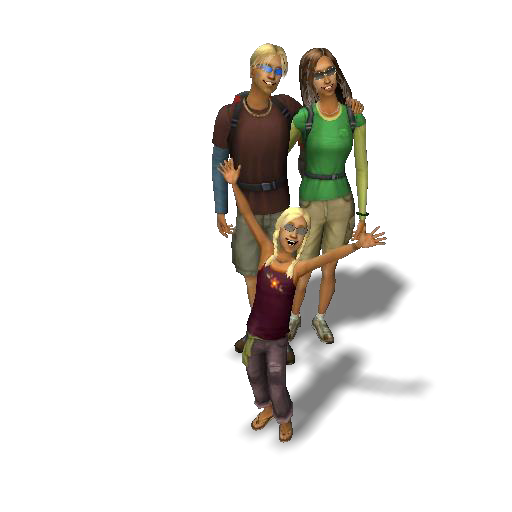
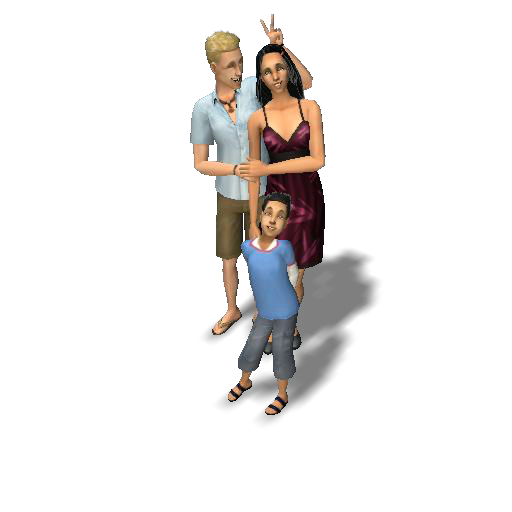
The Travelers and Gavigans: Two families, each with a young child, that I put into the same household once I moved Geoff and Connor out to limbo. I was more careful this time, and I got Trent Traveller to woo, seduce, and impregnate Mary Gavigan, and then Nathan Gavigan got it on with Trisha Traveller. Now there are two babies in the household, a Gavigan who is half Traveller, and a Traveller who is half Gavigan. (This, by the way, is the family I was talking about when I got the weird look from the passing jogger, when I said, “I got my swingers to impregnate each others’ wives!”) I also had the two pre-made kids, who rapidly became teenagers, fall in love with each other; they will be a couple for life, a strange twist I liked so much I’m going to do it again with the two new children – who also don’t share any blood, though the father of each is actually married to the mother of the other. My plan at this point is to make this the strangest family tree I can think of – I want to move the two teens out and then have both women WooHoo and conceive by the same guy, and then I will move a new young woman into the house and have her bear children by both of the men. I do not know how I will be able to manage all of that – but I’m going to try.

Samantha on the left, Kim on the right.

The DeBateaus and Cordials: So this was the last family set that I went a little strange with. Though I blame the game for giving me the storyline in the first place. Two sisters, Samantha and Kim Cordial, who were, according to their bio, so fiercely competitive they didn’t know if they could live together. So Kim was one of the early – well, contenders – for the hand of the wealthy Carlos; thus I sent Samantha after the richest guy in town, Armand DeBateau. Kim lost Carlos to the trailer-trash, but Samantha won Armand, married him and moved into the penthouse he shared with his adopted teenaged daughter Tara. She got pregnant on their wedding night, and then I sent them on a honeymoon, my first attempt at a Sims vacation. It was fun, except I found something out: you can’t have children on vacation, so Samantha’s pregnancy didn’t develop at all over the two days they were there – but she was already feeling the misery of pregnancy, the rapid decline of comfort and energy and bladder and hunger, and the morning sickness that leads to vomiting and green stinky toilets. So yeah: never take a pregnant woman on a beach vacation. A lesson from the Sims.

But of course, this situation made Kim mad. So Kim did two things: first, she became an evil witch – it was perfect because the Cordial house had a secret room behind a turning bookcase, which was the ideal place for her cauldron and spellbook – and second, she went after her sister’s husband. And she got him, too, because there is no loyalty in the Simverse. He dated her, WooHooed with her, and impregnated her. After she gave birth to her daughter Hecate, she invited her sister and brother-in-law over, presented the child, kissed Armand in front of Samantha, and we had ourselves a good old blow-up.

After that, I decided to make Kim the town WooHoo-machine, since Chastity wasn’t working. And so she’s been raising her child and WooHooing with every guy she can – including Armand, who came back for reconciliation. And that’s all been fine – but Kim is an evil witch, as well. A powerful one.

And there’s a storm coming.

Ready Player One

Ready Player One

by Ernest Cline

I confess: I wish I’d written this book. I’m just a little bit too young – my brother, three years my senior, was the one who rode his bike down to the corner drugstore to play the new Pac-Man game when it arrived; I remember him telling the family about it, and being confused: so you eat the ghosts? – and not quite geeky enough, especially when it comes to Japanese anime and robot/monster shows, which I never got into. I watched Voltron (Both versions – everybody remembers the lions, but does anyone else remember the Voltron made of cars? Much cooler.) and StarBlazers and G-Force, but that’s about it. Fast forward a few years to Transformers and G.I. Joe, to Captain Power and the Soldiers of the Future, which featured a light gun shaped like a jet fighter that you could shoot at the TV screen and score hits on the bad guys, and I’m all in. I did play the role-playing games, and I watched the movies – War Games and Monty Python and the Holy Grail are also two of my favorites – but I never had an Atari 2600, so I never played Adventure seriously – just a few times at a friend’s house, where I got stomped by the dragons and opted for Pitfall or Centipede or Missile Command instead – and I never found the Easter egg in that pixellated dungeon.

So I couldn’t really have written this book, which explores geek culture from the 1980’s to a depth that I could not hope to plumb. But I am so very glad that Ernest Cline wrote this book, because I loved it. Absolutely loved it.

The book is about a video game challenge. It is set about 40 years into our future, when the internet has become a single enormous virtual reality environment, built by a Bill Gates-like figure who focused on video game design rather than operating systems and world domination. When this gaming guru dies, he creates a challenge for everyone in the system he created (which is essentially everyone around the world, in one way or another): find the secret challenges he left, conquer them, and you inherit his entire vast fortune, and control of the virtual world. And because this man grew up in the 1980’s, the entire thing is one enormous trip through the world of reminiscence: a kind of “I Love the 80’s” that focuses exclusively on geek culture and touches every part of life.

This is the first book in a long time that I actually didn’t want to put down, and at the same time, didn’t regret reading straight through: the excitement is excellent, but it isn’t constant, and so it didn’t feel exhausting. The dystopian elements were highly disturbing to me, particularly the mobile home “stacks” and the indentured servitude that came as a result of credit card debt, but they were wonderfully well done – and I especially liked that Cline also included some positive aspects: the idea of virtual school, with the improvements and limits that Cline describes, would be a dream come true for me, as an introvert who teaches high school English but would really like to spend lots of time playing video games and living through role playing adventures. I also loved that Cline managed to create realistic and genuine human interactions both within and apart from the virtual world; by the end, I wasn’t really sure if the hero would win the game, but I was really just hoping that he’d win the girl.

I identified with the characters, loved the plot and the adventure, and was completely enchanted by both the setting and the nostalgia. This is a geek masterpiece. You have my gratitude, Mr. Cline. Excelsior!

Ladies and Gentlemen: My Wife.

My wife picks me up from work every day. Yesterday, on the way home, I was telling her about an unfortunate consequence of one of my examples in class.

I gave one of my classes a Voice Lesson (If any teachers read this blog, I highly recommend this book for close reading/literary analysis practice — it’s here on Amazon.) which gives them a quotation and asks them a series of questions about it, and then has them imitate it in some way. Today’s quotation was:

Whenever he was so fortunate as to have him near him a hare that had been kept too long, or a meat pie made with rancid butter, he gorged himself with such violence that his veins swelled, and the moisture broke out on his forehead.
– Thomas Babington Macaulay, “Samuel Johnson”

The students then had to write an original sentence describing someone with disgusting eating habits, using at least three vivid details. Now, I answer all of these myself; but I don’t want to point the finger at anyone else and call them disgusting. So I described my own disgusting eating habits.

You see, when I was in high school, I ate, as many teens do, really appalling amounts of junk food. I picked three of the worst examples, and — even though I never combined these in real life — I put them all into one sentence. The three eating habits were: once I brought a can of Betty Crocker frosting to school for lunch, which I ate with a tiny spoon intended for stirring espresso; I used to eat beef jerky that came in an eight-foot rope form (With the unimaginative product name of “8-Foot Beef Rope.” Picture a coiled Slim Jim. And yes: I did try to make a lariat out of it. Didn’t work.); and as I was not picky about my throat-searing, stomach-churning soda consumption, I used to drink Caffeine-Free Diet Coke at room temperature, from two-liter bottles.

I told my students about this. And two of them, in a classic example of Why Mr. Humphrey Doesn’t Talk About The Stupid Crap That He Did In His Youth, decided that they would eat the same thing, and do it within a time limit — half an hour was what they were bandying about during class. This, apparently, was to be called The Humphrey Challenge.

I told this to Toni as she was driving me home. I said to her what I said to them: I do not want my name associated with this. I do not endorse these eating habits, particularly not all at once. This is not the thing I want named after me.

Toni said, her tone completely deadpan: “Everyone’s gotta have a legacy.”

I don’t think she even noticed the death glare I gave her for the following thirty seconds. If she did, it didn’t have any effect.


And then today: today on the way home I told her about the question I got today, which certainly ranks at the top of the list of Most Awkward Questions I’ve ever been asked by a high school student. One of my freshmen, who admittedly lives a very sheltered life — she made “Eeewww!” noises and faces throughout Romeo and Juliet, and left the room whenever Mercutio started making pornographic jokes — came in to my room today before the class started, and in a conversational tone she asked — in all sincerity — “Mr. Humphrey, what’s a boner?”

My first thought was, “How do I answer this?” My second thought was, “Don’t answer this.” I went with option two, telling the young lady she didn’t want to know. She was suspicious she was being played, but several other students — who are less innocent — agreed with me.

So Toni and I were talking about this, and she asked, “So that isn’t part of your curriculum, then?”

I said, “No, we don’t have a boner standard.” Though I admit I haven’t read all of the Common Core.

Giggling furiously, she managed to get out, “How about a rubric?”

Death stare one day, peals of laughter the next. She always keeps me guessing, and usually laughing.