(With apologies to those who have seen actual combat, because what I got ain’t that.)
I was going to write about Biden today.
I started the post and everything — jotted some thoughts down this morning, came up with a title (which I will probably change because unless the title is reeeeaaallll simple, I almost never like the ones I come up with. “The Adventures of Damnation Kane,” about a man named Damnation Kane having adventures. Good. “Brute,” about a brute. Nice. “Lesson,” about a teacher. Cool. “The Dreamer Wakes?” Mmmm, feels off somehow.), thought off and on today about what I wanted to write about. I feel bad, because I’ve been putting this one off, but I know that it’s important; and then also because I had the last week off, and I never got around to writing it. Of course, that’s partly because the week of Spring Break is when teachers get all of their life stuff done — I went to the dentist, the hair salon, and the tax accountant, in addition to donating blood, seeing friends I haven’t seen in a while, and doing hours of yard/housework — and partly because I spent part of the last three days grading student work. I could have spent those hours writing about politics instead, but — well, it’s my job, right?
It’s fine, I thought: I’ll write it Monday evening.
And now it is Monday evening. And I am too tired to write.
I’m so freaking tired.
Why, though? It was only ONE DAY. One day of classes — and Monday is my easiest day in some ways, because I have one extra prep period, because one of my classes only meets four days a week. One day, with one less class, after a whole week off?!? Why the heck am I so tired???
And then my wife, in recounting a conversation she had with one of her students today, put it into words.
“Miss,” one of her students asked her after she had snapped at some loud talking, “why are you so mad?”
“I’m not mad,” she replied, “I’m just annoyed.” (I wasn’t there, so I won’t argue with her characterization of her mood, but in my experience, every single time someone says “I’m not mad,” they’re actually mad. And “Annoyed,” for me, is “I’m mad but trying to control it.” So, respect to my wife for fighting back the rage.) And then she explained to the student why she was annoyed. “This? Teaching? It’s just a job. I didn’t get into it because it was some calling, it’s just a job. I should be able to show up and do my job and that’s it, no big deal.
“But you guys — you make everythingso hard. Everything about this job is more difficult because of the students, and how you all act. Imagine,” she said, “if you had to go to work at a fast food restaurant, or whatever — and every customer was a problem. Every. One.”
The student nodded in understanding. My wife went about the rest of her day, and then when I came home she told me this brief story,
It spoke to me. Because that’s it: that’s why I’m so tired. That’s why this job, this teaching, is so damned exhausting all the time. Because every customer I have (Or nearly every customer, and I will also say that every one of them has good days when they are easy and even fun and rewarding to work with [when they order the food]) makes every damn thing so bloody difficult.
So picture this. Most people have worked in fast food; I actually never have, but I have sold concessions at a concert hall, and I have worked a register in a retail store, so I get the idea of this.
Imagine you’re behind the counter at a Popeye’s Chicken or a Five Guys or whatever. Someone comes in, bell on the door dings, you say, “Welcome to Five Eyes!” in your bright customer service voice.
They don’t say anything.
They walk slowly up to the counter — they do not look at the menu — and they stand directly in front of the register. They have a hoodie on, and the hood up, and Airpods in their ears. Phone in hand, they stand there, at the counter, in front of the register, and look at their phone.
“Hi, can I take your order?” you say.
They don’t say anything. They don’t look at you or acknowledge your existence. They keep scrolling through Instagram or Snapchat or whatever on their phone.
“Would you like some of our delicious Chickburgers? Or some fried ham?” you ask, naming two of your favorite items from the menu, two of the most popular orders, which you know all about how to make just right, and people have told you in the past you prepare perfectly.
No answer. Still scrolling. And now there is a line forming behind them.
“If you’d like some more time to look at the menu, maybe you could step to one side and consider, and I can help the people behind you. Whenever you’re ready I can take your order.”
They glance behind them, see the line of people waiting, and then go back to looking at their phone. They still have not looked at the menu, nor responded to you in any direct way. They have not yet acknowledged your existence.
Now you’re getting annoyed. “Sirma’am, I need to help the other customers. If you know what you want, I’d be happy to take your order right now.”
Now they laugh at something on the phone. They do not respond to you.
“Ma’amsir, if you could just look up at the menu and let me know what you want — or even just give me some idea of what you feel like eating, and I can help you pick something. Do you want biscuit fries? Maybe some gravy nuggets?”
Their phone rings. They answer it, and begin a conversation. They do not step away from the counter. They do not look at you, or at the menu. They are talking loudly and laughing, though what they are saying is mostly inane: “No, yeah, I know, yeah, right? I mean, for real, like for real for real. Yeah. Yeah, I know.”
Now you lean over the counter and stare into their eyes from six inches away. They look back at you when you do it, but their eyes are blank. “Ma’sir’am,” you say firmly, “You need to either order, or move aside.”
They stare at you, blankly. They do not respond. You see, out of the corner of your eye, your manager coming up behind you. So you try to remain calm. “Sma’amir,” you say calmly, though there is a growl in your voice that doesn’t seem right, and your heart is beating pretty fast and you seem to be kind of panting and maybe sweating a little — all of which would be normal if you were on the fryers, but not on register. Is something wrong with you? “Do you want to order anything?” You say it loudly, though also, you think, calmly, and slowly.
“Is there a problem here?” the manager asks.
“They won’t — ” you start, but then the customer cuts you off.
“No problem,” they say. They flash the manager a smile. They look at the menu.
You and your manager lock eyes. “Take it easy,” the manager says to you, “just take their order, okay?”
Flabbergasted, you can only nod. The manager walks away again.
The customer looks back at their phone.
You decide to just wait. They looked at the menu, they came in here and stood in front of the register: they surely want food, food that you have, food which you spend all day providing to hungry people. You can’t tell if this person looks hungry, exactly — but come on, everyone needs food. That’s what you sell here. Why would anyone come into this place if they didn’t want food? In the past people have come in already knowing exactly what they want, delighted and even grateful for what they get, for what you provide them with a smile. You brighten days. You provide vital nutrients, and you brighten days!
Minutes go by. They still don’t order.
You slap the counter. “COME ON!” you shout. “ORDER SOMETHING!”
The kitchen behind you goes silent. The people in line look around the person in front, and stare at you. The manager pokes their head out of the office and glares.
You take a deep breath. “Sorry about that. I would really like to take your order and get you some delicious food. Don’t you want delicious food?”
The person in the front is now staring at you, after your outburst. The phone is now in their pocket. But they still don’t order anything. They just stare at you, blankly. They don’t order anything.
Finally you shake your head. You lean close. “Okay, look. If you decide you want to eat something, then you go ahead and tell me what you want, and I will get it for you. But for now, I need to help the people behind you.” They don’t respond. You lean to one side, and look at the person right behind them. “Next, please! Can I help you?”
The second person in line is wearing Airpods. They are staring at a phone. They do not answer you, or look up.
They do not order food.
That’s what it’s like. All teachers want is to help: we know how to help, we have the help ready to give. Students need the help, and mostly even want the help. And yet they are difficult. All the time. One after the other, all day long. For no reason. Annoying their teachers constantly, just because they don’t think about what they’re saying or doing. Avoiding, at the same time, the one thing that would actually do them some good, the whole point behind school, behind teaching, behind all of it. They frequently apologize, especially when the teacher snaps angrily, or chews the students out for not doing enough work or caring enough about their own education. They say they’re sorry — and then they go right back to doing exactly what they were doing before. Nothing. Annoyingly.
My students want to learn. They should learn. But they don’t. Because they won’t try. I have to work five times harder, ten times, a hundred times, to get them to do the thing they should be doing, and they know they should be doing it; but they don’t.
All day long. Every day. For no reason. And that might even be the worst part: because I can’t explain why they won’t do it. I can’t understand why they won’t do it. Neither can they. I can empathize, because I didn’t want to do work in high school either; but I actually liked learning — and I recognized that I needed to do enough work, to do enough learning, at least to pass and move on.
In other words, when I went into the fast food restaurant, I ordered the goddamn food.
My students don’t. They just stand there. It’s not their fault, and they don’t do it intentionally — but my God, I am so very tired of fighting them just so they can eat a delicious meal.
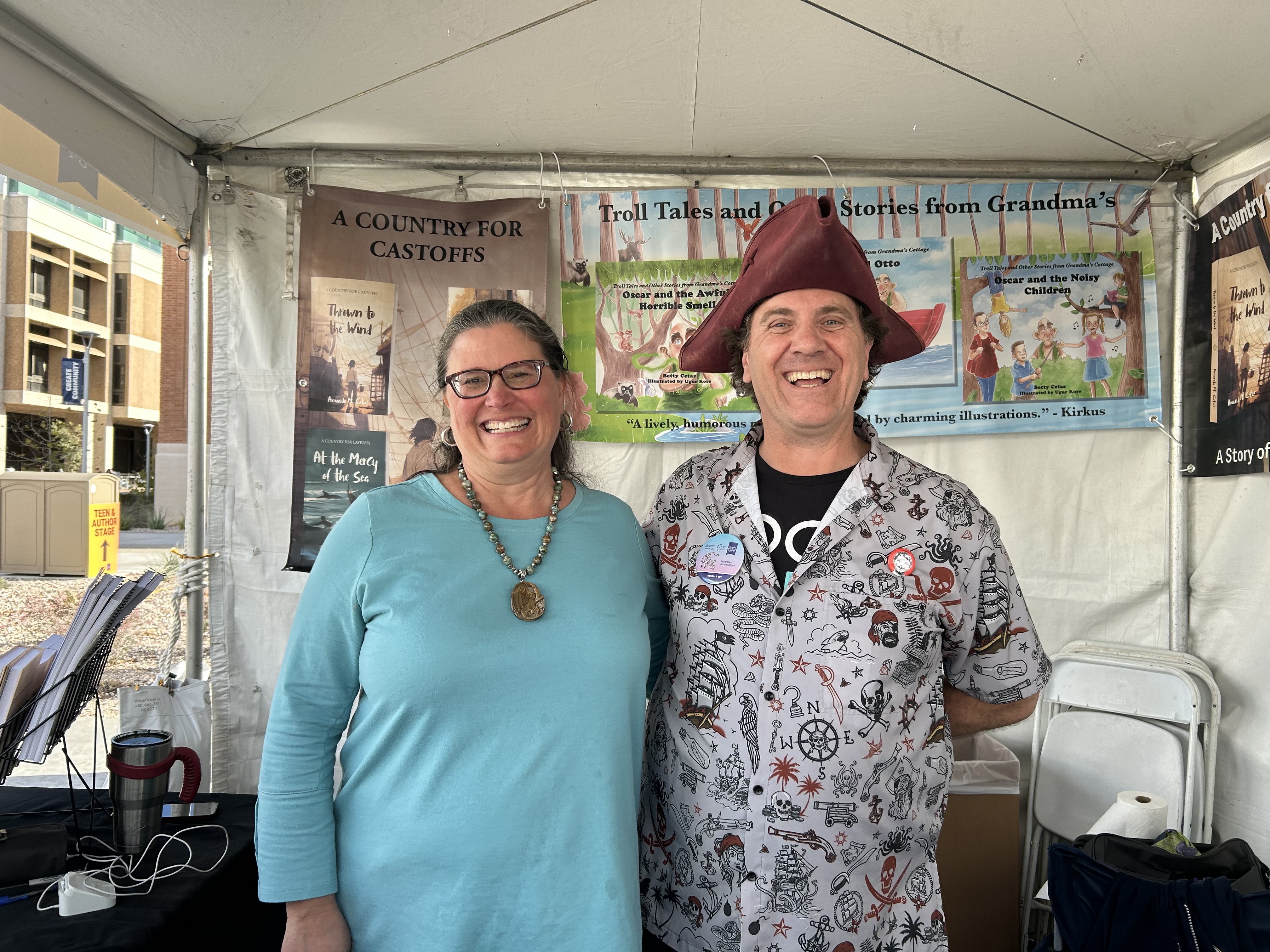
This last weekend was the Tucson Festival of Books. And for the fourth year, I had a booth, and I offered my pirate books, the three volumes of The Adventures of Damnation Kane, for sale to anyone who: 1) Saw my tri-corner hat and pirate-themed shirt; 2) Noticed the name of the booth, or 3) Paused to look at the INCREDIBLE art that my wife Toni DeBiasi created for all three Volumes of the series.
And that was a LOT of people.
I went there with, I think, about 65 books.
The first day, Saturday, I sold 42 of them. (The Answer to Life, the Universe, and Everything!) I sold every copy of Volume I I had with me. I went home, got the four other copies of Volume I at my house, also grabbed my VERY FIRST copy, the first printed copy of any book I have ever written, and brought that on Sunday. I used the very first copy (which was NOT for sale) as a display copy.
I sold the other four. And six more copies of Volume II and Volume III. And I unfortunately had to turn away a few other people because I didn’t have a copy of Volume I to sell them, at the end of the day, or else I would have had at least two or three more sales.
I now have 13 copies left of the 69 copies I brought with me to the Festival.
I have never done that well. The Festival has always been pretty good to me: I have a good book (Three of them, I think), I have a good hook — “Can I tell you about my time-traveling Irish pirate?” — and the aforementioned three attention-grabbers (sign, cover art, and stylish chapeau) brings people close enough to get drawn in by my elevator pitch. But my previous record was, if I remember right, 29 books sold. So I almost doubled that.
Thank you, thank you, thank you, to everyone who came and bought my books. I am honored beyond belief. And now I am anxious as hell that you all won’t like the books, or that you won’t like the third book, or — I dunno, something. So if you could see your way clear to tell me if you do like the books: go to the Contact link at the top of the page (Under the three lines, on mobile), or click on the Feedback link that should be floating in the bottom left corner of the page, and send me a message. Send me a Facebook message or Instagram message — @TheodenHumphrey, in both cases. (Also the same handle on X, if you are a glutton for punishment — or Threads, if you’re a glutton for social media.) Or if you’re really feeling good about my work, post a review somewhere — Amazon, or Goodreads, or Lulu.com where the books are produced — and then let me know that you did so. Thank you.
Thank you, as well, to my fantastic booth partner Amanda Cetas, who stood with me on a patch of sole-stabbing gravel for eighteen hours over two days, who covered me when I wanted to take a break (And made sales for me, too), who directed people to my side of the booth when they seemed more interested in fantasy than in historical fiction, and who stayed positive and energetic all the way through. Thank you, also, to all the people who bought Amanda’s books — she said she did better this year than she has before, too, so it wasn’t just the Pirate who made out like a bandit.
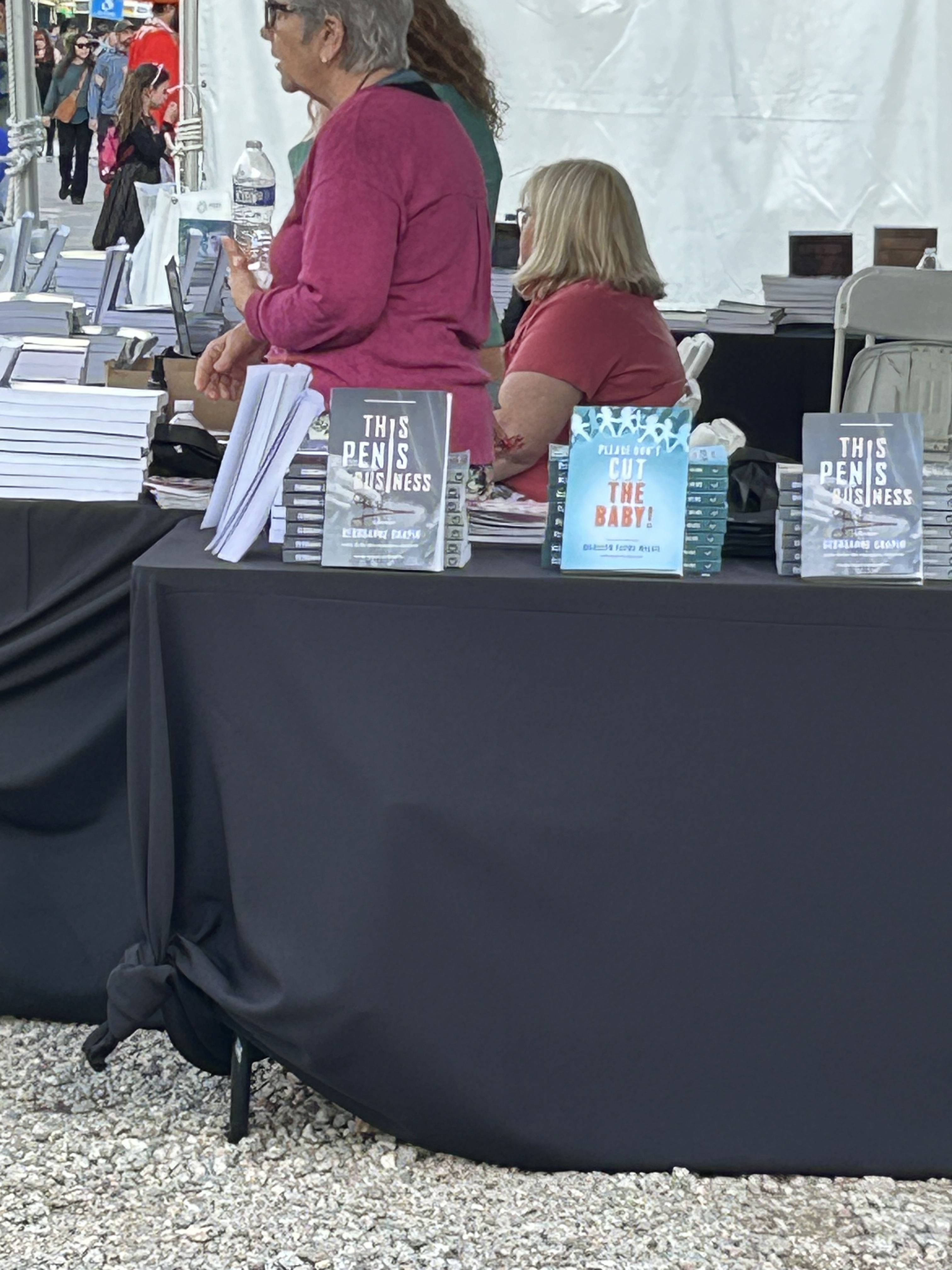
Amanda also shared my confusion over our nearest neighbors, who were… intactivists. Anti-circumcision activists. With whole books. About… circumcision. Now, I actually know the arguments against circumcision, and — how do you fill an entire book with them? Let alone TWO?!?
Needless to say, they did not send many customers over our way, and we didn’t send any their way, either. I didn’t have any people come to my booth and say, “Pirates, huh? You wouldn’t have anything about foreskins, by any chance?”
(I would have sent them over if they did. But they didn’t. The people over there still had people at their booth all weekend, so I think they did fine, too.)
If you didn’t get the book or books you wanted, or you now want more books, then please use the links on this page to Contact me or to order yourself a copy from Lulu.com. (If you Contact me, I will sign the book for you before I ship it.) If you didn’t make it to the Festival this year, then come to next year’s — Amanda and I will be there (Hopefully with our partner, the Poet, Lisa Watson, who wasn’t well enough to attend this year), and I will have all of the Adventures and at least one new book, as well. Amanda will probably have nine new projects, all of them as wonderful as the ones she has right now.
And if you bought books, two things: thank you for reading. You, along with the rest of the literate people, are the bulwark holding back the tide of Fahrenheit 451. You are giving my world meaning. You are joining me in this weird sort of slow-motion conversation that is a novel.
And also: get off the internet and go read. Like I’m about to do.
(If you’re wondering, I only bought two books this year. But that’s because this is my TBR pile.
So I recently got asked to do a second interview by the same website that interviewed me before, though now it was for a new — page? A new site? A new theme? I dunno, it was an interview, and it was all done through email, so that’s the kind of interview I like. They did a lovely job with both interviews, I thought. So go check it out, give them some views, maybe find out something about me and my writing.
And then a couple of months ago, a student of mine had to make a website about a teacher, and he chose me. I am a little displeased that he included every time I said “like” in the interview, but he was certainly accurate in his transcription. And otherwise, it’s a lovely site and a flattering compliment.
All right: and then, for some new content in this post, I looked up Bad Interview Questions, and got this list of 100. I am not going to answer them all: they are British, some are about sports, some are Gotcha questions about physics that I do not know. But maybe this will be fun. Let’s see.
1.‘ If you could be Batman or Robin, which one would you be?
Come on. Batman. Let’s not be stupid. Who the hell would say Robin? “Would you rather be a billionaire playboy who is secretly the coolest gadget-centric superhero in history — or a ward named after a bird?”
2.‘ What football team do you Support? ‘ Why them?
No, we’re not going to answer that.
3.‘ Do you prefer cats or dogs?
I do not. All pets are wonderful.
4.‘ Why on earth are you here today?
On Earth? As a human? I think our purpose as conscious beings is to experience the universe in whatever way we can. I think our purpose as human beings is to create art and discover truth. I want to do all of those things. I’m here today because it’s today, and I should be here: on this blog, posting.
5.’ What was the most traumatic experience to happen in your personal life?
Definitely not going to answer that one.
6.’ Sing a song that best describes you.
I mean…
7.‘ When you go on holiday, when do you pack your case?
9.’ How would you explain a database in three sentences to your eight year old nephew?
My question would be: how the hell did I get an eight-year-old nephew?
10. ‘If aliens landed in front of you and, in exchange for anything you desire, offered you any position on their planet what would you want?
I don’t see the downside here. Why is this a trade?
11.’ If Hollywood made a movie about your life, whom would you like to see play the lead role as you?
Imma go with Jameela Jamil. I’d like to be that beautiful once.
12.‘ If someone wrote a biography about you, what do you think the title should be?
Cap’n English Sings The Blues
13.‘ If I assembled three of your format supervisors in a room and asked them about you, what would they say about you that you would say is not true?
First YOU tell me what a format supervisor is.
If you asked my former principals, they would probably say that I was stubborn as hell. I’m not: except when the policy is stupid, and then no, I won’t obey it.
14.’ How would you design a spice rack for a blind person?
Specific single-jar dividers and either braille or raised letters to identify each spice.
15.‘ If you were a character from Star Wars, which one would you be?
Darth Vader because he’s the best. The most like me is probably Obi Wan Kenobi: I think I’m a good enough teacher, but I’ve probably helped create the end of all good things, and my winning move is sacrificing myself.
16.‘ Sell me this glass of water.
*Grabs collar*
*Smashes water glass across face*
*Threatens with shattered glass shards*
“GIVE ME ALL YOUR MONEY!”
17.‘ What has been your most bizarre life experience?
Teaching for 24 years.
18.’ Why are manhole covers round?
So they don’t fall down the hole.
19.‘ What do you think would be a fitting epitaph on your gravestone?
“I’m Crowded…. Roll Over”
20.‘ What’s the most interesting holiday you’ve ever had?
My first Christmas with my wife, when she went back to visit my mom with me in Massachusetts and I almost killed her with a train.
21.‘ What would you choose as your last meal?
My own heart.
22. ‘How would you define your personal work-life balance in terms of ratio (50/50 70/30 etc)?
I think 50/50 is probably accurate, but I’d like to shift that to less work and more life, more like 30/70.
23.’ Given the numbers 1 to 1,000, what is the minimum number of guesses needed to find a specific number, if you are given the hint ‘higher’ or ‘lower’ for each guess you make?
One if you guess it right.
24.‘ Using a scale of 1 to 10, rate yourself on how weird you are.
Banana.
25.‘ Explain quantum electrodynamics in two minutes, starting now.
26.‘ How many balloons would fit in this room?
Inflated? Several hundred. Empty? Probably hundreds of thousands.
27.‘ If you were shrunk to the size of a pencil and put in a blender, how would you get out?
I’d be poured out with the rest of the goo. Now you tell me why the fuck you picked a pencil as the size comparison for a question about blenders.
28.’ You have a bouquet of flowers. All but two are roses, all but two are daisies, and all but two are tulips. How many flowers do you have?
Three: one rose, one daisy, one tulip.
29.‘ What is the philosophy of martial arts?
30.‘ Explain to me what has happened in this country during the last 10 years
The culmination of the 50-year project by the corporatocracy to create their utopia, in which the rest of us rank somewhere between slaves and livestock.
31.‘ If you could be any superhero, which one would you be?
I’m tempted to say someone with infinite power, but I’d really just like to be Spider-man.
32.’ How do you weigh an elephant without using a scale?
Guess ten tons: if the elephant is flattered, double it; if the elephant is offended, halve it.
33.’ If you had 5,623 participants in a tournament, how many games would need to be played to determine the winner?
IT’S ME. I’M THE WINNER.
34.’ How many bricks are there in Shanghai? Consider only residential buildings.
No.
35.‘ You have five bottles of pills. One bottle has 9 gram pills; the others have 10 gram pills. You have a scale that can be used only once. How can you find out which bottle contains the 9 gram pills?
What the fuck kind of scale can only be used once?!?
36.‘ How would you market table tennis balls if table tennis itself became obsolete? List many ways, then pick one and go into detail.
I’d have my wife paint eyeballs on them.
37.’ How many Smartphones are there in London?
Nah.
38.’ You are in charge of 20 people. Organise them to figure out how many bicycles were sold in your area last year.
19 to ask around, one to ask you why you care.
39.‘ Why do you think only a small percentage of the population makes over ‘125,000 a year?
See Answer #30 about the corporatocracy. Income inequality is their mission.
40.‘ You have three boxes. One contains only apples, one contains only oranges, and one contains both apples and oranges. The boxes have been incorrectly labeled so that no label accurately identifies the contents of any of the boxes. Opening just one box, and without looking inside, you take out one piece of fruit. By looking at the fruit, how can you immediately label all of the boxes correctly?
Open the one that is labeled apples and oranges and pull out one fruit: if it’s an apple, then label that box as such, label the Orange box “Apples and Oranges” and the Apples box “Oranges.” If it’s an orange, reverse this.
41. ‘How many ball bearings, each one inch in diameter, can fit inside a 747 aircraft?
More than a couple.
42.‘ You need to check that your friend, James, has your correct phone number but you cannot ask him directly. You must write the question on a card which and give it to Heidi who will take the card to James and return the answer to you. What must you write on the card, besides the question, to ensure James can encode the message so that Heidi cannot read your phone number?
JAMES WHY THE FUCK CAN’T I ASK YOU DIRECTLY IF YOU HAVE MY PHONE NUMBER AND WHY DON’T I WANT HEIDI TO KNOW IT?
43.’ If you were given a free full-page ad in the newspaper and had to sell yourself in six words or less, how would the ad read?
“Buy me. I’m dope af. 100.” Gotta appeal to that Gen Z demo.
44.’ How do you feel about affirmative action?
It’s a poor solution to a much larger problem — but it’s better than nothing, which is what we have without it. And if you’re asking would I be willing to give up a job in favor of a minority candidate? Yes, I would, because I can go find another job, and I don’t think something, like a job I’m applying for, or a slot in a college, belongs to me when it… doesn’t belong to me.
45.’ You are given 2 eggs, you have access to a 100-story building.’ Eggs can be very hard or very fragile which means they may break if dropped from the first floor or may not even break if dropped from the’100th floor. Both eggs are identical. You need to figure out the highest floor of a 100-story building an egg can be dropped without breaking. The question is how many drops you need to make. You are allowed to break 2 eggs in the process.
Chuck them both at the interviewers while singing this:
46.‘ Are you a cat person?
No, just a regular human.
47.‘ If you were a salad, what kind of dressing would you have?
I think I am salty and bitter at heart, so that’s probably how I taste (Also describes much of my diet, so) — which means I’d say I’d taste best with something a little sweet. I’ll go honey mustard.
I understand if you don’t want to discuss the election that will take place later this year. I sympathize, I absolutely do.
But I’m going to talk about it. And I’m going to ask you to listen, even if you don’t want to — or really, to read, even if you don’t want to. I’m going to ask that you take a deep breath, let it out, say out loud — as loudly as you can — “I don’t want to think about this” (and if you are so inclined, add “shit” at the end of that sentence).
And then read what I have to say. Because it’s important. Not because I’m saying it: I’m just a regular guy, smarter than some and not as smart as others; good with words but far from the best; aware and knowledgeable in some ways and deeply ignorant in others. Just a regular guy. But the topic is important, which is why I’m writing about it — even though I don’t really want to. I want to take a break from writing: I just finished editing my book. I want to take a break from politics: I’ve been much too closely involved in the subject for way too long now.
But this election, this November? It’s a big one. That’s not to say it is the only important election; all elections are important, to some people, for some reason. But this one is important to all of us. And I mean ALL of us: this one has literal global implications, pretty serious ones. It’s our responsibility as people to be decent to each other, to try not to harm each other, to try to help each other; and in this case, that means we need to talk about the election in November, and we need to think about it, and then we need to do the right thing. Or else we are not living up to our responsibilities as human beings. I don’t want to be that person, and I presume you don’t, either — or else you’ve already clicked away from this, and you’re not reading these words right now.
(By the way: if you clicked away, it doesn’t mean you’re not a decent person; but if you’re not a decent person, you’ve definitely clicked away. Because I’m gonna get all woke and try to shame you, and you don’t put up with that kind of shit. But getting all bunched up about being woke-shamed? That means you’re an asshole. Not to say that woke-shaming is good; I have people who try to woke-shame me, and it’s obnoxious; but I put up with it because I’m not an asshole. If you’re still here, you’re at least tolerant, and therefore not an asshole.)
I’m not actually going to woke-shame you, by the way. Because I don’t need to. You don’t need to be a woke liberal snowflake to recognize the right thing to do in this election. That’s the point of this post: I’m not even talking about my opinions about what is best for this country, or the best choice to make in November; I may talk about that some — I plan to get into the best choice in the next post. But for this one, it is simple, it is stark, it is clear: it is black and white.
Vote No on Donald J. Trump for President of the United States.
Now, I get it: I’m tired, too. I’m tired of the political game the two parties play, where you have to vote for OUR candidate because THEIR candidate is SO MUCH WORSE. We have to vote for the lesser of two evils, and it’s exhausting and depressing to never vote for anyone with some actual hope in our hearts. Honestly, that’s why the last two presidents — not the current one — got elected: because people felt hopeful about their candidacies. Obama was inspiring; Trump was energizing — for different sections of the society, of course. People who were inspired by Obama did not find Trump energizing. But in both cases, Obama and Trump offered something different from the usual kind of political candidate, and that newness had a lot to do with how they won. And I hate, I loathe, that the Democratic party, rather than taking an opportunity to back a candidate who had some new ideas, who had some integrity and consistency, and who inspired some of the same energy in their electorate — Bernie Sanders — went sprinting straight back to a 50-year Washington insider, an old white male politician who has literally never inspired anyone to do anything.
But we’ll talk about ol’ Sleepy Joe next time. This time we have to talk about the other old white male politician running for this election. The dangerous one.
This guy.
Trump will only be a dictator on Day One
No, no, I know he was kidding. Of course he was; he says that he has two intentions on day one, for which he claims he would use power dictatorially: to close the border, and to drill, drill, drill (for oil). “After that,” he says, “I’m not a dictator.” Totally harmless. I shouldn’t take things so seriously, especially not when Trump says them, right? He’s just kidding around. Just a lil funnin’.
But let’s be clear. First of all, in terms of the joke, Sean Hannity set that up as a serious question, saying “Under no circumstances, you are promising America tonight, you would never abuse power as retribution against anybody.” When Trump drops his joke, there is a clear moment of horror, because he didn’t say “Absolutely.” He didn’t say “Of course I would never do that.” He didn’t say “In America we believe in the rule of law and in democracy, so I would never act like a dictator in any way.” He said “Except on day one.” In a moment when he was asked for sincerity, for honesty, for a promise to the American people: he made a joke. A joke about being a dictator.
And considering it realistically, it seems perfectly reasonable to assume that he is sincere in his two intentions to use power dictatorially: to close the border, which would mean violating dozens of laws and international treaties and disrupting the lives of millions (because I assume by “close the border” he means stop allowing people to cross the border, including innocent legal travelers; or else he means send overwhelming military force to stop all illegal crossings at the southern border, while also defying due process in order to build some ridiculous wall covered in electrified barbed wire and anti-personnel mines filled with Sarin gas and anthrax: either way he would be breaking the law and disrupting the lives of millions.), and defying all science in order to destroy the environment while feeding money into the bottomless maw of the fossil fuel industry: also in violation of who knows how many laws and policies of our own government. Of course he is serious about that: those are two of the “policies” (To be clear, he has no policy positions or plans at all; he’s running purely on hate and lies) he is running on, which are both very popular: fuck everyone who isn’t already American (by which we all know he means “white”), and fuck the environment and everyone who cares about it.
I refuse to then believe, subsequent to misusing presidential power for these two issues, that he would not immediately misuse presidential power to do what he does not tell Sean Hannity, what he does not promise the American people, that he would never do: seek retribution against his perceived enemies. Because of course he would do that: it’s all he ever does. He did it while he was in office, he has tried to do it since; he ran on the promise that he would lock up Hillary Clinton, and he is running now on the promise that he will weaponize the DOJ and FBI and go after all of his enemies, while filling the government with people loyal to him.
You know all this, right? I mean, I know we’re all tired of listening to him speak, and we’re exhausted by the constant news cycle of the whatever is the most recent travesty he said aloud — a news cycle that has gone on uninterrupted for the last nine years, since Trump declared himself a candidate for the Presidency — but still, the information is everywhere, the facts are unavoidable.
I’ve been avoiding writing this post because I can’t think of anything new to say. Every time I think, “I need to write that post about why people should vote against Trump, why people should fight Trump’s reelection,” I then think, “But what will I say?”
What can I tell you that you don’t already know?
What insight can I offer into the threat that Trump poses that you’re not already aware of?
But if you know everything that I know about Trump, why the fuck is he leading in the polls???
Seriously, I cannot fathom this. It has been driving me nuts. I keep telling people my opinion: Trump hasn’t done anything to make himself more popular, so he can’t possibly be more successful in this election than he was in the last — which he lost, as I hope everyone reading this is painfully, exhaustively aware. But every time I say that, smart people around me say, “I dunno, man. He’s leading in the polls.” Every time I open a newsletter or listen to an episode of my favorite political podcast, Unfucking the Republic, the host is saying he expects Trump to win this next election. Trump. To win. Not cheat his way into the White House like he already did in 2016, not lead an insurrection to take control of the country like he tried to do in 2021, but win. The election. With votes. From Americans.
I know you have to sign in to watch this, but do it. For me. And for America.
This is about something else, but the lyrics are apropos. Plus it slaps.
I honestly don’t know how to deal with this. I know I’m not alone: listen to Jonathan Capeheart coming a hair’s breadth away from just losing his shit in this interview with Presidential historian Michael Beschloss, about 2:45:
(The Black, gay, liberal MSNBC host clearly has reason to lose his shit, as he expresses later in the clip.)
Okay, I understand some of the issue here. I get that if 44,000 votes, out of 150,000,000, had gone the other way, then Trump would have won reelection. And actually, I get that if he had, a number of people think things would have gone better, or at least not much worse, over the last three years; they’re wrong, but I can’t disprove a hypothetical any more than they can prove it, so I can accept that people believe it. It pisses me off that people mock the opposition to Trump by saying the only reason we don’t like him is because he was too mean on Twitter, like there aren’t a thousand reasons to despise Donald Trump and what happened during his administration (Top ten: insurrection; impeachment; second impeachment; The Big Lie; 6-3 Conservative SCOTUS; COVID non-response; tax cut for the rich and $8 TRILLION added to the deficit; “Very fine people on both sides” and also the trans ban for the military; pulling out of the JCPOA and Paris Treaty and shit-talking NATO and all other treaties; and it wasn’t part of his presidency, but I’m not going to ignore all of his sexual assaults) — but I understand that people believe lies about all of those things, or those things at least align with things they do believe. And I mock the other side for their stupidity, so I can accept that they mock me for what they perceive as mine.
I know that, in conjunction with what I’ve just been saying, the country is so divided along partisan lines that people would generally vote for a disease-carrying mosquito rather than cross party lines; and that means any GOP nominee can count on 200 or so electoral votes, just as any Democratic nominee can count on 200 or so different electoral votes, and while Trump has only gotten worse over the last four years, so has inflation, which people blame Biden for. They shouldn’t, but again, I don’t know how to prove that, either. If you don’t know that corporate profits and supply chain issues were responsible for the inflation of the last three years, then you’re not paying attention — or you’re paying attention to the wrong things. (Best line from the article at that last link: “It is unlikely that either the extent of corporate greed or even the power of corporations generally has increased during the past two years. Instead, the already-excessive power of corporations has been channeled into raising prices rather than the more traditional form it has taken in recent decades: suppressing wages.”) I know that our country is awash in lies about socialism and government takeovers. I know, also, that there are people who vehemently believe in Great Replacement theory, the conspiracy theory which claims Democrats (Or even better, the “global elite” led by Jewish people) are bringing dark-skinned people into this country to replace white people, because one of them yelled at me on Facebook not too long ago.
I know that people are not excited about voting for Biden. I hoped he wouldn’t run, too — but come on. Let’s not pretend that anyone who decides to be President doesn’t already have an ego that needs its own West Wing. You can’t be an ordinary person and believe that you would be the right individual, the only right individual, to lead this entire country. You have to think you are the greatest ever. That’s why we have term limits in the first place: because after FDR, who clearly believed himself to be the only person who could ever run this country, believed it strongly enough to run FOUR TIMES, we recognized that it was genuinely unlikely that a modern President would give up power. And look at how they all run for that second term. All of them. (Quick tip of the hat to LBJ for backing out of a second run because he thought the country was too divided over his war in Vietnam) So we all knew he would try for the nomination again — and if the DNC backed him over Bernie in 2020, why would they stop backing him now?
I want to talk more about voting for Biden, because he’s actually done an outstanding job as president; but that’s not the topic for today.
The topic for today is voting No on the question of whether Donald J. Trump should once again be President of the United States.
This is our duty. It is our responsibility, both for the sake of our country and our democracy, but also for the sake of the world. Everybody, literally, is counting on us to stop this asshole from fucking up everything in this country that he hasn’t already fucked up.
I know we don’t like voting for the lesser of two evils, so let me put it this way: I’m not asking you to vote for the lesser of two evils. I’m asking you to vote against evil.
I don’t actually care how you do that. I think the safest course is to vote for Biden, because in our winner-take-all electoral college system, voting third party is potentially dangerous; but if you want to vote for Jill Stein or Cornell West, please do so. I’d love to see the Green Party gain more national attention, and I think Dr. West is far and away the best candidate running right now. (Oh — don’t vote for Robert F. Kennedy, Jr. Libertarians are dangerous, particularly when they are also anti-vax. And he is the worst kind of anti-vax. Don’t give him a platform, please.) But what matters is taking away votes from Donald Trump, so if you were going to vote for the Democrat and you don’t want to vote for Biden, be aware that taking your vote away from Biden is not voting No on Trump. It is voting No on Biden. You are welcome to do that, as I said, especially if you live in a safely blue state like New York or California; but you first need to vote No on Trump.
Vote No on Trump by giving a political donation to the Democratic party. Vote No on Trump by volunteering to help the Democrats get voters out and registered and to the polls — which is still what I plan to do, now that MY BOOK IS FINISHED and now I have time to do that. Vote No on Trump by convincing a would-be Trump voter to change and vote for someone else (They can even vote for RFK, because if he pulls votes from the GOP he’ll never get conservative backing again, and that would be swell.). Vote No on Trumpism, as well, by supporting those who oppose him: vote Democratic or Green or Progressive or left-leaning Independent on all of the downticket races; pay for and consume media that does not support the Trumpiverse view of things.
Or vote No on Trump by voting for Biden, even if you don’t like or agree with him, because in our system, Joe Biden has far and away the best chance to stop Trump from becoming President again.
This isn’t a matter of picking between two identical puppets run by the same political machine. It’s certainly true that the moderates of both parties are frequently indistinguishable in their actual governance, even if their rhetoric has contrasts; but the Republican party has had to fall in line behind Trump — and they have done it. They are obedient acolytes, they are foot soldiers, drones, servants of their Beloved Leader. Trump knows it, and he pushes them around at will; he will, of course, continue doing it as President — because while he may be a lame duck president, he will continue to apply pressure to the members of his party; he will anoint the chosen and castigate the insufficiently loyal: and all of them, it seems, will dance to his tune. Biden may be a puppet of the powers-that-be, and that is dangerous; but he’s not the puppet master, and Trump is. (Even though Trump himself may be controlled by others, either autocrats like Putin and Netanyahu and Kim, whom he somehow needs to impress, or anyone with power enough to gain access, and brains enough to manipulate that goddamn idiot.) If we retain Biden and those who have influence over him, it won’t lead to the collapse of this country’s democracy. Trump’s election might. I won’t say he definitely will turn himself into a dictator and end American democracy entirely — but I also won’t definitely say he won’t do that. He is a danger to this country, and because we are the richest, most powerful, and also the most toxic country in the world, Trump is therefore a danger to everyone — look no further than Avdiivka for that.
We all know that all that is necessary for evil to triumph is for good men to do nothing. Donald Trump is evil. Whatever else you think of him or about him, his intentions, his corruption, and his ability to do harm through the office of the Presidency are far too great for any of us to ignore. So please: do something. \
Vote No on Donald J. Trump for President of the United States.
So I noticed, not too long ago, that I was getting pretty close to 500 posts on this blog. That’s a lot of writing, over the last nine years I have had this blog, especially since there have been a couple of fairly lengthy hiatuses — hiati? — lacunae in those years. The majority of those posts are pretty substantial, some running to several thousand words and hours and hours of effort; though some are just short comments or jokes or links. But still, 500 posts seemed like a lot, and also a number worth celebrating.
And then I hit a wall, when my family crisis happened in October. That last post before the crisis was #497. And a month or so ago, I posted an explanation as to what was going on and why I hadn’t been following the carefully established once-a-week-new-post pace that I had maintained fairly well for about 16 months at that point; that explanation was #498.
Last week I posted about politics, and my desire to take up the fight. I will have more to say about that — but also, I couldn’t help but notice (though of course I already knew) that that was post #499. Which meant this one was the big one.
So what to post about? More politics? Teaching, which has been the bulk of the last 499 blog posts? I thought about a book review, because I have a good one to write.
But then this happened. I did it. It came in the mail.
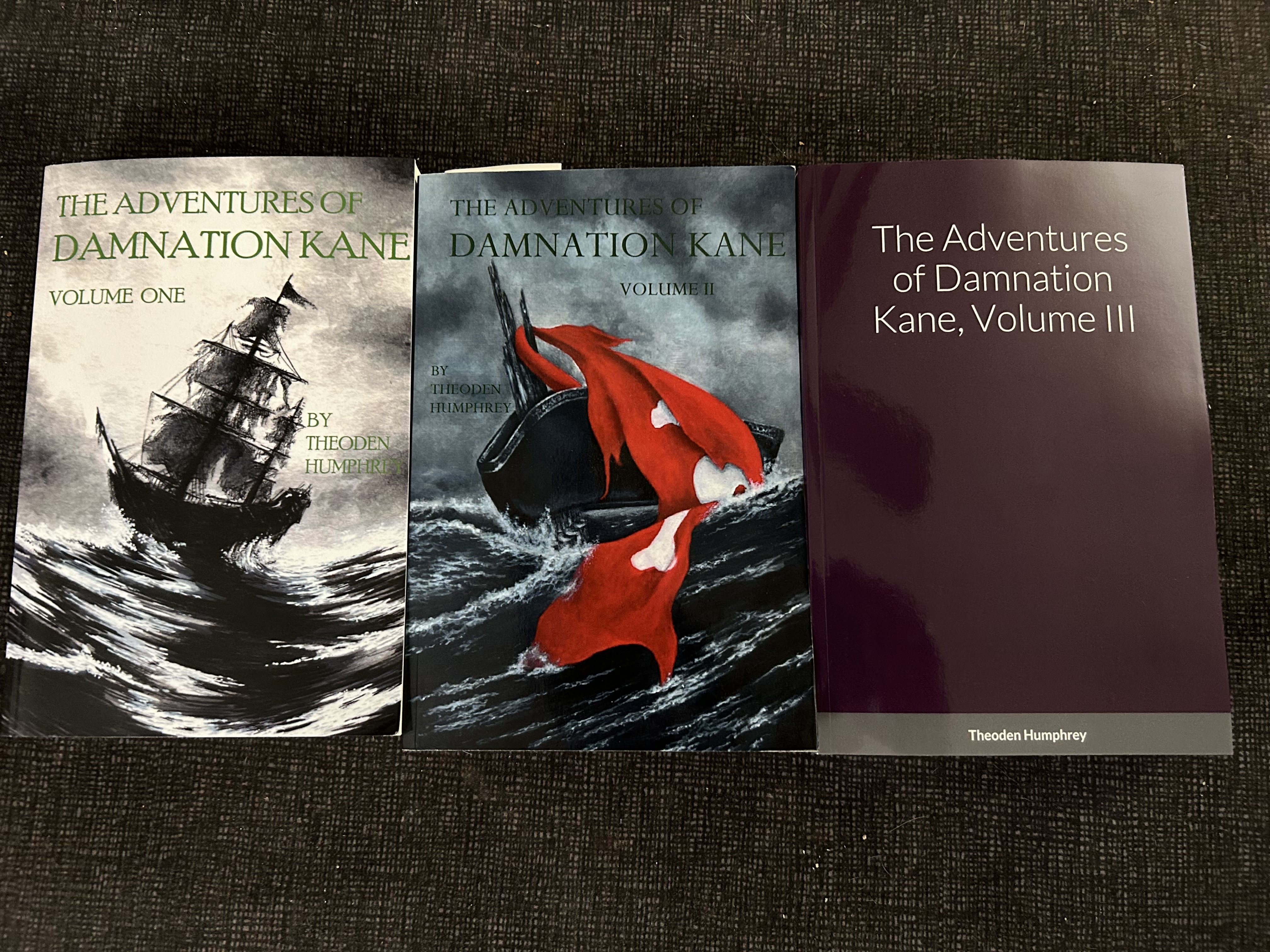
Volume III of The Adventures of Damnation Kane.
It’s bizarre to me that this is such a clear mirror: but I had to take advantage.
This is not, of course, the finished book, because that will not be the cover image; my wife had a great idea for it, and she is prepping the board for the painting. (**Please note: if for any reason she is not satisfied with her image, then I will use something else for the cover; probably some old painting of pirates which is in the public domain. I’m just trying to say that the plan is for all three books to have original Toni DeBiasi covers, but if they don’t then they don’t, and so be it.) I printed one copy with a nothing cover as a galley proof so I could do one last edit of the text, which I find easier when it is printed on actual paper.
But the book is written. The story is done. This is the end of the Adventures of Damnation Kane.
Here they all are.
So this is my 500th post: it is announcing to all of you that the book is done, and it will be published and available within the next two months. And I am very, very proud of me.
Thank you for reading, to all of you who read, for whatever you read. If you are reading my pirate books, you’ll have one more to buy pretty soon.
The Republican voters are caucusing in Iowa tonight, starting in a couple of hours and finishing sometimes before midnight. And the expectation is that Donald J. Trump (Is it meaningful at all that it just took me three tries to type his name correctly? Probably only indicative of the fact that I’m pretty tired right now, and I haven’t done a lot of typing in the last few weeks. Or it’s an omen.) will win, thereby “signaling” that he is “most likely” going to be the Republican party’s nominee for President this year.
Seriously, guys? I mean, come on.
So here’s the reality. Trump is definitely going to win the Iowa caucus tonight, despite the absurdly cold weather, despite the hilarious fact that some unknown number of Iowans registered as Republicans specifically so they could vote against Trump in the caucus, and, of course, despite the fact that Trump has been indicted in four different criminal cases, along with currently being in court for two civil cases, and fighting off who knows how many other claims against him personally and against his businesses. He’s going to win the Iowa caucus for the same reason he’s going to win every single Republican primary in every single state: because Republicans love him.
They love him for a variety of reasons. Some think he did a phenomenal job as President. Some think he projects an aura of strength, which they think we need with so many problems going on in the world today. Some think he is just like them, and they want to see him succeed because that implies that they, too will succeed. Some love him because he’s a racist, sexist piece of shit, and so are they, and they think he will help them to achieve the racist and sexist dreams they hold close to their hearts.
(All of these people are wrong, by the way. But they believe they are not. Don’t judge them too harshly: we all believe lies. Many people reading this believe that Barack Obama was a great man and a great president. Many people reading this believe this country is a democracy, and that we are free. Many people reading this believe that things will turn out all right in the end. None of those things are true, either.)
And then there’s the biggest group: the people who will support Donald Trump despite knowing that he’s a racist, sexist, corrupt, narcissistic piece of shit, because they believe he will be better for the country than the Democrats, and specifically Joe Biden.
Those people might be right.
All right, hold on; no, I haven’t lost my mind, and no, I haven’t surrendered to the cynicism that did definitely increase thanks to the pretty awful situation my family has gone through over the last year or so. I am probably trying to be more honest in this post than I frequently am, because normally I shape what I’m saying for my audience, and I am rethinking that. I am also certainly looking to shock some of you with this opening; and now that I have your attention and you are maybe a bit off balance, I will explain further, and see if we can come to a consensus.
Unlike Americans.
See, there has never been a single majority opinion held by Americans. Not by the majority of us. The majority of Americans do not vote, so no election has been decided by the majority; and the majority have not been consulted in every non-democratic decision made in this country, which is the vast majority of them. We don’t all agree, and we never have. What we do is comply, and accept.
We accept that the two-party system is what we are stuck with, and then we comply with that system. We accept that capitalism is the system we are stuck with, and then we comply with that system. We accept that we cannot eliminate racism from the American consciousness, and then — and this is the difficult part, but it is a true thing — we comply with the system of racism that exists in this country. We may not do it, depending on who we are, for racist reasons; I am not a racist, and I hope and trust that most people reading my writing, therefore, are not racists. Though I was brought up within a racist system and a racist culture, so there are definitely racist ideas in my head and racist feelings in my heart, and there always will be, because we do not, ever, escape our childhood and upbringing, a fact that has been brought home to me recently. But I am not a racist because I do not subscribe to those thoughts and feelings when they arise: I question myself constantly when I think about race, and I question whether my instincts are reasonable, or racist; and if they are racist, I try not to listen to them.
But I comply with a racist system. Take, for example, de facto segregation in this country, which is almost universal. I live in a less-desirable area in Tucson, Arizona. I used to live in a much more desirable area, but we rented there, and we own our home here. We own our home here because this is what we could afford: we had an area we wanted to buy in, and an area we were willing to buy in — and then there was the area we could afford to buy in. Which is where we bought.
Now: guess which, of the desirable area and the less-desirable area, is more diverse racially. You already know, don’t you? And because we want to move to the more desirable area, we will be moving out of the racially diverse area and into the racially homogenous area as soon as we can afford to. And there are plenty of good reasons for us to move — one of which is, honestly, entirely unrelated to race, and it might even be the best reason to move: our commute is too bloody long, and we’d really really like to live closer to school — but all of them, all of them, comply with and therefore encourage and maintain the racist system that is the status quo in this country. There is more crime where we are now, and less in the desirable area. The property values are better in the desirable area. There are fewer homeless people, and less trash on the street, in the desirable area. There is more open space and more green space in the desirable area to walk our dogs. Those are all good reasons for us to move, and they are why we will move. But when we do that, we will be moving our white selves into the white area, and out of the more racially diverse area. We will be maintaining the segregated status quo in Tucson.
Why? Because we can’t change it. And because we have enough other shit to deal with in our lives without spending what energy and passion we have in a futile effort to change Tucson’s, or Arizona’s, or America’s, or the whole world’s racist systems.
But, see, that’s where we’re wrong. We do impossible things by doing them. Not by recognizing that they are impossible, and then walking away without fighting. We decide to try, even though we know it is impossible, and we try, and we fight — and that’s how we win. That’s how things change.
Does it always happen that way? Of course not: impossible things are impossible for a reason, and that reason is usually enough to overcome efforts to change things that cannot be changed.
But sometimes? Sometimes things change.
And on this day, named in celebration of the Reverend Dr. Martin Luther King, Jr., I think it is only appropriate to recognize that sometimes, it is worth fighting the impossible fight, because sometimes, you win.
Even if you then get assassinated and much of the country goes right back to the same racist status quo.
It’s worth fighting for change because even though that happened to Dr. King, he still made things different. He moved the needle. Trump is no worse a racist piece of shit than half of the past presidents of this country, but the main difference now is that we recognize that he is a racist piece of shit. And that is a problem for him. He needs to fight that perception, he needs to talk in dog whistles. Not always, because there are plenty of racist pieces of shit who support him, and they like when he says shit directly like “Immigrants are poisoning the blood of this country.” (And then defends it by saying he didn’t know that was a racist piece of shit thing to say.) A century ago, he wouldn’t have had to defend that, he would have repeated it and made it part of his stump speech. So: progress. Change.
Why hasn’t the change been larger? Simple: because not enough of us fight. That’s why it hasn’t lasted longer, and why it hasn’t spread farther, and why so many of us don’t see positive results. Not enough of us fight that fight.
I want to fight. I intend to fight. Probably for more than one thing, more than one cause, more than one change. I do want to fight systemic racism: but not only that. But I want to do it right. I want to do it strategically, and intentionally, and thoughtfully — which has never been how I’ve written, or how I’ve done anything. I vastly prefer flying by the seat of my pants.
But I just spent the last eleven years writing a single story, The Adventures of Damnation Kane. And while I think I’ve written some excellent pieces on this blog, and I’m proud of everything I’ve written on this blog, that story — those books — are better. Because I spent even more time thinking about them than I did writing them.
So I need to think more about this, and I need to strategize and I need to plan. Then I need to get to work.
This post is intended to make that public, in order to give me more motivation to do this thing the way I need to do it. It’s sad that I need an additional push, but that’s the truth: I do. Otherwise I’m just going to fly by the seat of my pants. (By the way, I’m also still going to write about teaching and school, and to review books and all of that. But there will definitely be more political speech in this, and more attempts to drive and enact social change. That’s the fight. And I’m going to get into it.) And I suspect that I will continue to fly by the seat of my pants, and to write extemporaneously, while I work on my strategy and my plan; because writing is how I form and crystallize my thoughts, and this is a good way to do that; and because I am loath to try to conceal my plans. I think it will be more convincing if I can be open about what I am doing and why, all the way. Here’s hoping I’m right.
So let me bring this back to where I started: now that it is nearly 4pm MST, and that means the Iowa Caucuses are probably starting to cast their votes for Donald Trump.
I, like everyone else who opposes Donald Trump becoming President again, wish that he would just go away. I wish that he would die (and I won’t apologize for wishing that, not when he talks openly about killing people as a joke), or I wish that he would be convicted and go to jail.
But I realized something in the last week. That’s wrong.
Trump should run in the Presidential election. He should run: and we should fight him.
And we should win.
We need to have that fight, in this country, and we need to shoulder our part of that fight, and do what needs to be done. That’s what will make the greatest change.
So: I want Trump to win the caucuses tonight. I want him to succeed in putting off all of his trials until after the election. I want him to hold rallies, and say every shitty thing that comes into his little hairball of a brain, and I want millions of Americans to laugh and cheer and agree with him. I want him to win the GOP nomination and have every Republican line up behind him, and I want him to run in November.
And then I want for all of us to fucking destroy him at the polls.
Then I want him to go to jail for the rest of his miserable traitorous life. I want him to die in prison. And I want the history books to describe his legacy in actual, factual terms: I want historians in the next fifty years to write about how lucky we all were that Trump never got a second term, because of the existential danger he posed to democracy and to the rule of law and to America as a nation and as a people.
I do not want people to turn him into a martyr and pine about what could have happened if the Democrats hadn’t put him in prison (or killed him with COVID vaccines, which is, I don’t doubt, what millions of dipshit Americans will believe whenever Trump dies, however he dies) and he had been allowed to run, and they had been allowed to cast their votes the way they wanted to. I want them to vote for Trump.
And I want them to lose.
I want to fight.
I hope to convince you all to join me in that fight.
Some of you were probably wondering why I vanished.
Two months and a day since my last post. Nothing on here since October 3rd, when before that I was posting every single week, pretty consistently — I lost it in May and June, sure, but that’s the end of the school year; there’s no particular reason why October and November would see me go dark and silent. I mean, sure, October is the month of darkness, and — can I make any connection between Thanksgiving and silence? Or no, how about Veterans’ Day? Or Indigenous People’s Day, maybe?
Never mind. I don’t have it in me to joke or to bullshit much.
I do apologize for my absence; I really did intend to stay consistent for as long as I could, and I still want to write. But both things became impossible about ten days after my last post. In the time intervening, I have learned some more about what I’m capable of, and what I’m not, and more about what matters and what doesn’t.
What matters is the truth. What doesn’t matter is polite fictions.
So the truth is, my father-in-law — step-father-in-law, really — killed himself. He used a gun. He was 87, and a drug addict, among other things. He was also a veteran, a former US Marine, and so for the sake of Veterans’ Day and all, I don’t want to get into too much detail about him or the circumstances or the reasons for his death. But he did it at his home in Kingman, on the other end of Arizona from where my wife and I live in Tucson, about ten days after my last post — somewhere around the 13th of October. And that’s why I haven’t posted, or written, since that last post two months ago: because my wife and I have been dealing with the consequences of his death.
You see, one other thing my stepfather-in-law — his name was Wes, which is much shorter than his title, so I’m going to use that — one other thing Wes was, was his wife’s caretaker. My mother-in-law, Jo. Jo has advanced dementia. She doesn’t have Alzheimer’s, she suffered a pair of traumatic brain injuries stemming from two falls she took, both of which resulted in a concussion, in the last few years. She has also gone through some unknown number of mini-strokes. She had been living at home with Wes, who was physically disabled but mentally capable — up until he killed himself.
I got a phone call on the morning of Sunday the 15th of October. I was outside working on my driveway — I’m expanding it because we got a second car, a sweet bright orange 1973 VW Bug — and I wasn’t expecting a call. I normally wouldn’t have answered it: I don’t like phone calls, and I don’t like getting them on the last day of my week-long fall break, which that Sunday was. But I looked at the phone, because I had called Wes the day before and left a message; he had fallen and hurt his knee — he has bad knees (Sorry: he had bad knees) — and had told me he was in a lot of pain, when I talked to him somewhere around the 9th or 10th of October, I don’t remember when. I wanted to tell him then that my wife and I would do anything we could to help. I didn’t say it, though. It wouldn’t have mattered. But I called him on Saturday the 14th, and left him a message saying I was checking in to see how he was doing.
Turns out he was dead. And Jo was at that point in the hospital, though I didn’t know it when I called.
I found that out when I answered the phone Sunday morning: because I looked at my phone, and it was Wes’s daughter, my wife’s stepsister, Dana. I’d never spoken to Dana before: she and Wes hadn’t been that close, and she never got along with Jo, or Toni, my wife. So if she was calling me, I knew it was serious, and it was probably bad. So I answered.
And she told me, tearfully, that her dad was dead, and that Jo was in the hospital. She didn’t know many details, other than the fact that Toni is the executor of both of their wills, as well as the possessor of a durable power of attorney and the responsible party for their medical decisions if they were incapable of making them themselves, for both Wes and Jo. Dana wanted to make sure that Toni would let her take some personal items to remember her father by. I told her that would be completely fine, of course, that I’d talk to Toni and we’d be in touch.
I hung up. I cussed a lot. I felt the beginnings of sadness — but more dread. We had seen some kind of crisis coming for a long time, and here it was.
Then I went inside and told Toni.
So in the last two months — not quite two months, I guess, though it sure feels like three or four years — Toni and I have made two trips to Kingman, a six-hour drive; we have brought Jo down to Tucson and found her a place in a memory care unit in a local assisted living facility. We were able to pay for it because my family has loaned us money, which we expect to pay back when we sell their house — which, the fates and gods willing, should happen very very soon. The second trip was all for dealing with their house. My brother, who had just left his job as a software engineer in order to pursue his personal projects, gave up his time and energy to help us, and drove to Kingman from Mason County, Washington, to help with the house. Together the three of us emptied a three-bedroom house of a couple’s accumulated possessions; we kept everything we thought Jo could use in her new living situation, and donated everything we thought was donatable. The rest went to the landfill. Then my brother, who stayed at the house for an extra week after Toni and I came back to Tucson to go back to teaching, cleaned up and repaired everything that could be done in the house, making it ready to go on the market, which it did, right after Thanksgiving.
We also made sure that Wes got cremated and his daughter took his remains. She also got to take whatever she wanted of his, as did his nephew, who also came to help that first weekend.
We also took care of their two pet dogs. Which I am not going to talk about.
We are still trying to finish arranging things for Jo: the assisted living is, as you may know, ridiculously expensive — over $5,000 a month, all included. It’s a good place: and also one of the cheaper ones in Tucson. But obviously we can’t afford to pay for it. It is not clear how long Jo will live, but it doesn’t matter because we couldn’t pay for one month on our own. And when we first brought her home from the hospital in Kingman, we took care of her for four days: and after that, there was no question that we can not take care of her ourselves. She needs constant care, at a professional level, and we just can’t do that. She will get social security, and since Wes was a veteran, she gets survivor’s benefits; we’re hoping for somewhere in the range of $3000-4000 a month out of those two along with a small pension Wes had which will transfer to Jo. The rest of her monthly costs will come out of the proceeds from selling their house, which fortunately they owned outright — though they did have a reverse mortgage which we will have to pay off out of the proceeds, first. When that money runs out, if Jo lives that long, there is a program called the Arizona Long Term Care System, which should cover the rest of the monthly expense of her care. We may need to find her a cheaper place to live in order to qualify for that program, I don’t know yet — we can’t apply for it until she has less than $2000 in assets.
The point is that we are two months into this, and $15,000 deep, at least. We are still waiting to find out how much money Jo will get from the government.
My wife hasn’t slept well in two months. She has nightmares. I am sleeping better than she is, but I have struggled trying to keep my calm with my students. I snapped on them, the day before we drove up to Kingman for the first time. Snapped harder than I have in two years, and it wasn’t justified. I don’t feel bad, it’s just where I was at the time.
Here’s what I’ve learned from this.
Suicide is an act of violence which harms all of those around the victim. It does not spare anyone from anything: it makes things worse. I guess it spares the dead person. It certainly seems to have been Wes’s escape. I loved the guy, but if it sounds like I’m mad at him and I blame him for what he did, I fucking am, and I fucking do.
Dementia is a terrible condition. Trauma is worse.
There’s not much sadder than the place where someone used to live, and the things they used to own.
The government is slow, but they do good things. Banks and hospitals are fast, and expensive, and they are ABSOLUTELY FUCKING TERRIBLE. (That is not universal. Some wonderful people work in hospitals, along with some bags of crap. Banks seem to be all bad, but my wife and my mother-in-law both worked for banks, so they’re not all bad people. Foothills Bank, a subsidiary of Glacier Bank, though? Absolute garbage.) The real estate industry is both fast and good — but not cheap. It’s okay, they’re worth it.
Insurance is a good thing. You should get some, and then you should keep it. As much as you can. If you are aging, and in ill health with physical disabilities, and you have home health care insurance, FUCKING KEEP THE GODDAMN INSURANCE. Please. I beg you. This shit is too expensive for anyone to just pay for. I know that insurance premiums are costly, too, but this is so much worse: so much more expensive, and so much harder to deal with when you have to deal with the problems of getting sick people what they need, right now, and hope you can find a way to pay for it, too. Get the insurance. Pay for it.
When someone asks how you are, tell the truth. I have spent my life lying and saying I am fine when I’m not. That’s not to say I’ve never been fine; I have lived a good life so far, and I have mostly been fine; but when I’m not, I have always lied. It felt rude to bring people down just because I felt bad and they asked how I was. But I stopped doing that this last two months, and — it’s better. I don’t go into detail — this post is more than I’ve said to any but a handful of people — but when people ask how I am, I make a face, sort of a grimace, and I say, “Not good.” If they want to know and have a right, I tell them something like “There was a death in the family and we’re dealing with the estate;” if they don’t ask or have a right to know, I leave it at Not good. They say they’re sorry I’m going through shit, sometimes they offer to help. I thank them.
It is better than politeness.
The hardest thing has been that we did not know what Wes and Jo were going through. They needed help: and we didn’t know it, because they never said. Wes complained, constantly; but he never asked for help. We tried to get them to move closer to us so we could help; this past summer they agreed — but then Wes changed his mind. He said it would be too hard for Jo to make the transition. He might have been right. But it’s now entirely fucking clear that staying where they were could not work.
So the most important thing I have learned is this: when you need help, ask for help. Don’t be ashamed of need. Don’t back away from help because you don’t know what other people can do for you, or how it will work or what the costs and consequences will be: ask for help from someone you trust, and figure it out with them. I have gotten help from my family, from my friends, from my employer. I have given help, as well; I have been able to do so because I got the help I needed.
If Wes had asked for help, then we could have helped him get the help he needed to take care of Jo, and this horror might not have happened. Instead he hurt all of us, by killing himself. He would have done that anyway: it was not because he was abandoned and alone, he was surrounded by people who loved him, who were willing to help him; he was suicidal for many reasons that had nothing to do with help. But this situation wouldn’t have been as bad, particularly for Jo, if people had been able to help. We would at least have known what was happening, even if we couldn’t have done anything to make it better. The unfortunate truth might have made everyone unhappy: but it would have been better than not knowing.
Please ask for help.
Forgive me for not writing more often; I am also (Though this is not the most important thing) trying to finish my book, and my scant writing time and energy goes to that more than this blog. But I’ve been trying to write this post for two months, and failing; I needed to do this. I apologize, as well, if this has been hard to read, but I won’t lie about how I am. I am not well. I’m better than I was a month or so ago; that first week was by far the worst. I might need to write about all of this more; I will, when I can. I’ll write about other things, too — I have a couple of humdingers in me about school from the last two months.
Please go tell the people you love that you love them. And if you need help — ask for it. Don’t lie about how you are. The truth is better.
*Two of my classes are reading To Kill a Mockingbird, and this week we read one of my favorite sections, the two chapters when Scout goes to first grade for the very first time, and meets her new teacher, Miss Caroline. These chapters are the first which show the novel’s dominant theme, the idea of empathy, that you don’t understand someone until you see events from their perspective; Miss Caroline, seen from Scout’s perspective, is a terrible person who treats Scout badly, shames a poor farm boy named Walter Cunningham, and has no idea how to teach or manage a class. But when you see these chapters from Miss Caroline’s point of view — she is a 21-year-old woman, this is her very first day teaching, and in addition to several other problems, one of her sweet lil angels calls her a snot-nosed slut. First graders, man. Freaking savages. — you recognize that this teacher has had the very worst day ever. I explain the chapters from Miss Caroline’s point of view, which I understand as a teacher, and I show students how she is not bad, she’s just having a bad day. A lot of times in the past, when I’ve taught this, they get it; my students understand how frustrating and soul-searing Miss Caroline’s day is, and they realize she shouldn’t be blamed or hated for her choices, even when she screws up, as she does a few times.
Part of Miss Caroline’s bad day is that she reads her favorite children’s story to the class — and they don’t react at all, because they are, as Scout puts it, “immune to imaginative literature.” And I look out at my class, half of whom are looking at phones or computers, another third of whom are chatting or spacing out while I talk about this novel, which I have told them is one of my very favorite works of literature, and I say, “Can you imagine what that’s like, to share one of your favorite stories with a class full of students who just don’t care? Who aren’t paying attention? To whom the story makes no difference at all? Can you imagine what that would feel like?”
They couldn’t.
*Yesterday a student climbed up onto a metal stool in my room in order to unplug another student’s Chromebook, which was plugged into an outlet that for no good reason is about seven feet off the floor, near my whiteboard. The student then called out “CANNONBALL!”, jumped off the stool, kicking it out sideways, landing awkwardly as the stool shot out and crashed into a bookcase.
*One of my other classes, in reading through a passage from the novel Maud Martha, by Gwendolyn Brooks, commented “I didn’t think these characters were African-American. They don’t have African-American names.” The names in question were Maud Martha, and Helen. One student pointed out that Helen is a Greek name, as a way of proving to me that these were clearly not African-American names. (I refrained from pointing out that the student’s name is Roman in origin, though the student in question is Southeast Asian.) Another student told me that the activities the family pursue in the passage are rural, country kinds of activities — specifically gathering wood for a fire — and that made them think the characters were White. To which I responded “Because rural areas are only White? And African-Americans don’t gather firewood?”
Did I mention that my principal was observing me that class? He was. His comment later was that I had had “several teachable moments” in the period. (He also said I handled it well, so that was okay.)
*Today one of my students came back from the restroom, started talking to the other students about something (This was, by the way, while I was talking about Miss Caroline and how it feels when students don’t listen to your favorite story), and at some point I realized that what they were saying was that this student, on the way across the hall to the restroom, had seen someone they didn’t recognize outside the school door (Which is mostly glass and is at the end of the hall near my classroom — who needs that “security” stuff?), that my student had let them in, and that the person in question, referred to both as “kid” and “guy,” was wearing a mask, carrying a backpack, and was currently in the bathroom. Refraining from asking the student why IN THE NAME OF ALL THAT IS GOOD AND HOLY they had let some literal masked stranger into the school, I went to the bathroom to see who was in there. There was someone in the stall, but I could only see shoes. So I quickly went to get an administrator to check on the bathroom, and then I went back to my class — where I received the clarification that the student had not let the person in, a teacher had, which almost certainly moved this from “Possible crisis precipitated by a student who lacks critical thinking skills” to “A student went out to a car, with permission from a teacher, came back in, and my student didn’t recognize them.” And the second option is what it was, and a few seconds later the administrator gave me a thumb’s-up on the way back from identifying the person in the restroom as one of our students.
But it was a fun five minutes.
None of this is what I wanted to write about tonight, however. (Actually I wanted to write about it last night, but another thing that happened this week is my phone stopped working, so I spent last night ordering a new phone.) What I wanted to write about tonight was the worst thing I’ve dealt with in the last week. One of the worst things I’ve had to deal with all year.
Data Day.
Last Friday was our first Data Day. And the big problem with this particular occasion was that it was our very first Data Day at this school. At least the first one involving my department. To be sure, we have looked at data before: data is inescapable in public schools today. We start every school year with a brief overview of the school’s test data from the year before. Which is all about students who have already left the classes in which the data was collected, which might seem to some people as though it reduces the value of the data.
Some people.
Anyway, we look at data all the time. But I work for a small charter school, which has a hell of a lot of turnover in the staff and the administration, and every year things get a bit discombobulated and confusticated and lost in the shuffle; and so we have never done a Data Day like this Data Day. Unfortunately, those in charge of Data Day thought we had all surely done Data Days before, and so didn’t think we would need specific instructions about how one carries out a Data Day. But since we have never had a Data Day before, we did need those instructions, and we didn’t get them, and so the day was — awkward.
But hold on. Before we even get to the awkwardness of the actual day, I can hear you asking “Wait — what even is a Data Day?”
A Data Day is when teachers get together in groups and look at the data for our students — in other words, their test scores. This Data Day was scheduled after we gave our first major standardized test this year, a practice ACT. The ACT, a sort of West-Coast cousin of the SAT, has four parts: Reading, English (grammar, that is), Math, and Science. Now, as I assume that all my readers are among the most astute people in the population, so I assume you have noticed that this selection of tests leaves out a few of the usual departments in a high school: Art, PE, foreign language, computer science, ESS (or SPED) — and, of course, history and social studies.
But that’s fine! Even if not all teachers have data and so can participate in Data Day, the thing to focus on is the subjects which do have data. And lucky for me, English has double the data! And EXTRA lucky for me, this is my first year as head of the English department. So not only do I have double the data — but I get to run the meeting!
Did I mention that my principal was observing my meeting? He was. He did not tell me that I handled this one well. I think I did okay. We had several teachable moments.
But we didn’t have everything. We should have had our individual class data, from the shorter single-subject quizzes we’ve been giving over the course of the semester; we should have all been looking at our individual laptops and comparing our individual data to the school wide data, so we could find where our specific classes were different from the school population as a whole — that is, what are my 10th grade students failing to learn in my class, which the school as a whole is mastering? Those are the areas where I can make changes in my class in order to improve the instruction and the learning in specific skills and knowledges, to help my students catch up. And that was where we were supposed to develop our Action Plan, building SMART goals (Specific, Measurable, Achievable, Relevant, and Time-bound) so that, when we have our next round of ACT practice tests in December, we can move straight into our second Data Day, and we can see what areas have improved and where we need to keep working, maybe finding new strategies that can make a difference in the scores. That is the goal of a Data Day.
I ran the meeting. Completely making it up as I went along, because I have never done a full Data Day. I didn’t tell everyone they needed to bring their laptops and individual classroom data. I didn’t have my individual classroom data. I had not examined the school wide data previously, and so while I pointed out a couple of obvious things — our students did better on reading and English than they did on math and science (I work at a STEM school, if you didn’t know.), better on English than on reading (which mystified me because they mostly can’t answer a single grammar question correctly — but I guess they can correct grammar on a multiple choice test?), and in some cases better, in others worse, when compared grade to grade. But everything I said was obvious. I didn’t know that we were supposed to create a SMART goal, or how to do that, and I didn’t take notes or guide the discussion or watch the time — or delegate any of those tasks. I did a bad job with the meeting. It was uncomfortable. That was my first Data Day.
So.
You all know that whole thing is a pile of horsepucky, right?
I knew you were all astute.
Okay, let me be clear: the basic idea of examining what my students know and what they don’t know, identifying areas where they have mastered the class content and where they still need work, and then strategizing methods to improve their learning? All of that is fine. None of that is horsepucky. We can get general ideas about how things are going, and we can find some ways to maybe make them better; that’s fine. It is a lot of work, for a questionable reward, and since I am already obscenely overworked, and still behind where I should be, I question whether or not this is the best way for me to spend my time; since I have 300 ungraded assignments turned in on my online education platform, I have a better idea of how I could spend a good couple of hours on a Friday afternoon.
Yup. Drinking.
I grade on Sundays. I shouldn’t. But I don’t have any other option. I’m not kidding about the 300 ungraded assignments, and that’s after I spend at least a few hours working every Sunday, and have done since the school year started August 1. A couple of hours on Friday afternoon, even if I hadn’t used that time as I deserve and gone drinking, would have helped make a dent in that pile — though of course it wouldn’t have eliminated the pile. But Data Day didn’t help at all. In fact it stressed me out so much that I didn’t even get my other tasks finished on Friday: I went home and collapsed uselessly on my couch. I did play some Minecraft, so that’s a win, I guess.
But let’s imagine that I did have some extra time, a couple of spare hours that I didn’t have to spend teaching class or working with students or grading essays. I could have done Data Day. I could have compared the results of a test which the students didn’t care about and didn’t try their hardest on, because they knew perfectly well they weren’t going to get graded on it, and that it wasn’t the official ACT, and therefore this test didn’t give them a chance to get a high score they could use to get into college or win scholarships; to the results of a series of short, five-question multiple choice assessments I give in my class, one for each standard they are supposed to master this school year. Those, also, the students didn’t care about and so didn’t try on. But hey, that makes the comparison more valid, right? The students taking it didn’t care, in both cases! Matching apathy! Also, neither set of tests was designed by me, or related directly to the content I used to teach the standards — none of them are on To Kill a Mockingbird, for instance. Oh, and also, the ACT is not broken down by standard, so I’m comparing a five-question multiple choice quiz on a single standard to a 40-question reading test and a 75-question English language test, on all of the standards taught in all four years of high school, and also quite a few that come up in middle school and a couple that are only used in college or adult life. Because one aspect of the ACT is that it is designed to be too hard, in parts, for any student to get a 100% on. Because the goal is to find the extent of a student’s knowledge and ability, right? If I give you a quiz on what you know, and you get 100%, I have not found the extent of your knowledge: those questions might cover every single thing you know on the subject — or they might only scratch the surface of your galactic levels of knowledge. To find out for sure, I have to make the questions get progressively harder until you cannot answer them correctly. That’s where I can assume your knowledge ends, when you can’t answer the questions any more. Which means the ACT tests, like all similar tests, is intended to get progressively harder until it becomes impossible for any high school student to answer the questions.
Which means, of course, that there will always be gaps and areas for improvement, no matter how spectacularly I teach and the students learn, because of the way the test is designed. So if I take this concept seriously, that I need to teach my students enough for them to be able to score 100% on the test, I can never be complacent. Ever. I will always have more to teach. But of course, my students will move on out of my class before I finish teaching them; but that’s fine, they can learn the rest of everything in their next class.Right?
Sure.
More to the point, did you catch where I described how different the two tests are? Five questions on a single standard, compared to 115 on the general areas of reading and writing. Also, the standardized tests are given in very short timeframes, because the ACT’s base assumption is that the more you know about a subject, the faster you can answer the questions. An assumption that is so deeply flawed that it casts doubt on all of the ACT results — because of course speed has little if anything to do with knowledge or skill. A genius with bad eyesight or dyslexia or a headache the day of the test will not be able to answer all the questions within the time limit, which is 35 minutes for the 40 reading questions (which are about four different reading passages, with 10 questions each), and 45 minutes for the 75 grammar questions, which is just cruel. Oh wait, sorry: that’s only for the 11th graders. The 10th graders took shorter tests in shorter time limits — 24 reading questions in 30 minutes, and so on. But that’s fine, I’m sure we can compare the two classes and get some kind of useful idea of how much students know. Right?
Right?
Sure.
Here’s the part that killed me. Right at the start, when I’m trying to fumble my way through the schoolwide data we have about the ACT and Pre-ACT tests, and the middle school results from an entirely different assessment which the 6th-8th graders took, we were told to ignore the gaps in the test results that were caused by students who were having a bad day, or who had a headache the day of the test, or who didn’t care and so didn’t try. Because we can’t control those things. We need to focus on the places where we can have an impact, where we can raise those scores.
Uhh — excuse me? How can we know which areas are lacking because of a flaw in the program, and which are lacking because students didn’t feel like trying their hardest? That’s right: we can’t. Just like we can’t see the specific standards for the questions on the ACT (I don’t think; there might be a way to break it down like that, but I didn’t know it, so.), and we can’t know if the five-question multiple choice quizzes give us good information, either, because in addition to being skewed by student apathy and also student humanity, five questions won’t do a good job of determining what the student knows and what they don’t. You can randomly guess on five multiple choice questions and have a not-insignificant chance of getting them all correct even if you couldn’t read at all. And also, let’s not forget that if a student learns all the material, but then fails the assessment because of a non-academic reason like a disability or an illness or a lack of motivation or a grudge against the school or the teacher or a bad testing environment or a bad breakup or a bad bit of potato they ate the night before which gave them vivid dreams in which they were visited by three different spirits of Christmas — that student did not succeed. They do not pass Go, they do not collect $200, because our system is based largely on high-stakes tests and the ability to pass them. And it doesn’t matter what I teach or how well I teach if a student who fails the assessment, despite knowing everything about my subject, is considered a failure. All of the things that I was told to ignore, because they are out of my control, are the entire reason why that hypothetical student could fail my class.
But guess who would still get at least some of the blame for that student’s failure. And who would have to make SMART goals to try to improve that student’s test results. And who would have to examine that student’s data, again and again, to find the reason why the student was unsuccessful. But please, keep ignoring the aspects we can’t control, like a lack of motivation.
Right.
Sure.
And while we’re at it: who the hell told educators that we could control anything? Listen, you don’t know how hard I tried today, to make my students learn the lesson of Miss Caroline. And instead they were distracted by the possibility that someone had let in a school shooter — which was exactly where all their thoughts went when they heard that there was a possible stranger in the school, in a mask and carrying a backpack. Because of course that’s what they thought. And I’m supposed to teach those kids? To control their learning? To specifically assess the lessons that worked and the ones that didn’t, and to make adjustments which will ensure all the learning happens exactly as we want it to, which will then be shown clearly on the test?
Let me also say: if I go back tomorrow and try again to teach the same lesson, my students will say “We already went over this yesterday.” And if I say “Right, but you didn’t learn it as well as you should have, because you were distracted,” they will then reply, “That’s okay, we learned enough. We should move on.” And it wont matter how much I try to teach the lesson, how hard I want to reteach it, or whether I know exactly how to make that lesson more effective: it was ineffective because of events outside of my control. The opportunity was lost. We did not have a teachable moment today.
Here’s the truth. That neat, data-driven ideal, where teachers do the math and find the perfect way to help students reach mastery? School doesn’t work that way. Students don’t work that way, learning doesn’t work that way, even tests don’t work that way. None of it is scientific. None of it is precise. There are real benefits to teachers getting together and talking about what works and what doesn’t, and trading ideas and strategies; to that extent, Data Day was a real success. But otherwise? There is no data. Not anything real, not anything reliable. It’s all guesstimates, all gray area. Teachers do things that seem like they work, that seemed like they’ve worked in the past; students seem to learn things, and seem to get grades that reflect their learning. Somewhere in there, real learning happens, and part of it is probably because of what teachers do. But not all of it. And none of it for certain. Data Day is an attempt to pretend otherwise, to pretend that we can capture a mathematic truth about human beings, who are not by our nature quantifiable. And it just doesn’t work.
But hey, maybe that was just this time. All those things about human nature and whatnot? All out of our control. Let’s try to focus on what we can control, and we’ll circle back around in a few months and see what the data tells us.
That’s not entirely true. I have had a metric fuck-ton of arguments in my life. It’s been a whole thing for me: it is a strong aspect of my teaching, mainly because it is a required essay format that all students have to learn, and so I always teach; it is largely what brought me online in a meaningful way, along with books, because my first two serious website interactions were with a book club and an argument site; it has taken up probably the majority of my online time (Though I don’t know how to measure that, really, so “majority” may be an exaggeration. But a lot of the time I have spent online, I have spent arguing.). I also argue with my students, but since they suck at arguing, that is closer to modeling good language use than it is an attempt to convince anyone of the truth. The online arguing is the larger issue. It has become a way I define myself, a point of pride; I tell my students, when I first introduce myself to them, that I am a pacifist — but I argue online all the time.
I mean that to be ironic. Why would someone who believes in peace and nonviolence and being nonconfrontational also go after people online?
And now I am thinking: maybe I should stop being ironic. Maybe I should just be who I think I should be, who I want to be. Someone who believes in peace, and nonviolence, and being nonconfrontational. It’s not that simple, of course. Because one of the paradoxes of being a pacifist is that I have to live in a world in which people are violent and confrontational, and love fighting; so if I maintain my belief in being nonconfrontational and noncombative, all that happens is I get railroaded, and squashed flat, and violent people take advantage of me. The only way I can be a pacifist is, sometimes, to fight back against those who would create conflict, in order to maintain a larger peace. I believe that; I have accepted it. So I fight: I try to fight against those whose opinions would promote conflict and violence and abuse, both those who are bullies and those who work, intentionally or not, on creating a world where it is easier to bully.
So for the last few years, that has been my intent. I have fought against those whose political stance promotes the supremacist and fascist stances of the Republican party, particularly those who promote Trump and claim to oppose Covid-19 vaccines and climate change policies, because those three things — the devastation of the global climate, the suppression of medicine which prevents the spread of a deadly pandemic, and one orange-skinned motherfucker who wants to take over the world and make it dance for him and him alone — are the greatest threats we face, in my opinion. Trump is largely symptomatic, not causative, but the movement he represents is unquestionably an existential threat, particularly for marginalized and endangered communities. I do also argue against censorship, particularly in schools, and against the attempt to destroy public schools (both largely promoted by that same Trumpian movement), and I try to argue whenever I can for trans rights because I see trans people as the population currently suffering the most virulent and vituperative attacks, at least in my proximity. I think it is a good thing that I have stood up for those causes, for those groups and those people, and against those groups and those people who would attack and do harm. It has not been good for me: that’s for damn sure. I get mad almost every time I get into an argument, and that is not healthy, neither mentally and emotionally, nor physically; it disrupts my sleep, spikes my blood pressure, distracts me from other things I want to do so that I am more often frustrated and unproductive, and therefore I take away from other things — like sleep, or relaxing downtime — so that I can accomplish my productive tasks. Because I already burned up my productive time arguing with some choad about how women’s sports do not need to be protected from trans women because trans women are women, goddammit.
But how much good have I actually done in all those years and years of arguments?
Probably none.
I hate that. But it is probably the truth.
I said last week that I have been persuaded, that I have read an essay by A.R. Moxon which showed me that my habit of fighting online is not only unproductive, but even damaging to the causes I believe in. Moxon pointed out that when someone — like me — says the same points that conservatives and fascists and transphobes and whoever have already heard before, it only shows those people that liberals and progressives have nothing new to say, all think the same things, only echo what we have been taught by our progressive liberal media sources.
The same things I believe about conservatives.
The more I argue, the harder this conviction sets in for my opponents. The more they believe that people on my side are fools, or liars, or mere puppets. I’ve seen this: I’ve seen people take my arguments as signs that I don’t understand the truth, or that I believe lies, or that I don’t care about truth because I have a political agenda; and even as I steadily disprove their points and prove mine, they simply become more strident in hollering that I am a liar and a fool and a sucker. Sometimes they do this while proving some of their points and disproving some of mine (Because while my stances are always right, my arguments are not always perfect, and sometimes I am mistaken), but whether they are right or wrong about their arguments, the point is that they become more adamant about never accepting my arguments, the more I argue with them.
My arguments, in other words, make people less persuadable.
This means that my arguing is bad for everyone. That cut out the last string that was holding up my need to argue. I already knew it was bad for me. I already knew I didn’t like it any more. I already knew I’m not actually as good at it as I thought I was, or told myself I was, in the past. But I still thought it was the right thing to do because I had to stand up for my causes: but not if I’m harming the cause by agitating the opposition, by making them harder to convince, not least because I almost always get mad and take that out by insulting my opponents, even though I know, and have taught my students for years, that insults lost arguments, that the second I mock my opponent, they stop listening to anything I have to say, even if everything else I say is deeply persuasive. All they focus on is the insult.
And rightfully so: because when my opponent insults me, I get so pissed off at that audacity that I no longer care about the argument: I care about showing that sonuvabitch that he’s not only wrong, he’s an idiot. I frequently prove that when I set out to do it – but it never helps. Of course. It just makes them madder and more smug, even while I keep getting madder and more smug. And of course, that leads to my worst habit: I am terrible about needing to get the last word. Even if it keeps me going back to a terrible argument, I keep doing it as long as the other person keeps replying to me. Even though I mock people for arguing simply to satisfy their need to win points and one-up people they disagree with.
Like I said. I need to stop being ironic.
It wasn’t just this essay that convinced me I need to stop. For one thing, I have walked away from arguing in the past – first when I finally escaped from the debate websites I started on, where I did the most harm to myself, wasting the most time, destroying the most sleep, wrecking my own mental health just because some asshat said something shitty about gay people or about public education in this country – or, God forbid, about gun control.
This was me. Of course.
Also this. My wife, who has been trying to gently persuade me to stop hurting myself with this stupidity for just about fifteen years, has always been able to tell when I am arguing because I type harder and faster and with an angrier expression on my face.
Though I’ve never actually shed blood on the keyboard.
So I’ve known for years that I should stop. I’ve had my wife telling me so, and she’s always right. (I never argue with her, by the way. I know my limits. Sort of.) I have also, in the last few years, recognized that my teaching of argument has not actually helped my students learn how to write better arguments: they write terrible arguments, both before and after my instruction. And I suspect that some of that is because I go into the teaching of argument mainly looking to win arguments, which is one of my favorite things to do in the classroom. But it has definitely struck me that my students still make the same terrible arguments now that they did five, ten years ago. And I can’t take all the blame for that: much of it is because of the inherent problem with arguments, and the problems with social media, which is where they learn to argue, and where they find the topics they want to argue about.
I’ve recognized the problem with arguing on Twitter as Twitter has descended into the depths of Hell. I don’t even want to be on the site any more. Even worse, the more I interact with assholes on Twitter, the more money I make for them, because Musk pays them for their number of interactions. So why do I still go there to argue?
Okay, I tell myself that I am fighting the good fight: but a week or so ago, I was arguing about who was the greatest tennis player of all time. Which is – you may be surprised to hear – not one of the important arguments I need to take a stand on. I mean, it was related, because the original post had the pictures of four candidates for GOAT, and they were, as might be presumed, all white men – Pete Sampras, Roger Federer, Rafael Nidal, and Novak Djokovic. But the correct answer, of course, is Serena Williams. So I commented that, and like a few other comments that had made the same argument; and then I found this thread where someone had posted Serena’s unmatched statistics – better by far than any of those four losers – and someone else had replied that Serena would lost a head-to-head match to any of them. But that’s dumb. Because that’s not how you decide who the best of all time is. Nobody arguing about Michael Jordan vs. Lebron James talks about which of them would win a 1v1. You talk about their impact on the game, on their team; their championships, their individual statistics.
So I joined the thread and fought for my side. I made a joke (It was a stupid joke, but I thought it was funny) in order to mock the guy who had said Serena would lose head-to-head. And another guy started arguing with me: saying that I was wrong and dumb, because the way you decide who is the best of all time is exactly to debate who would win head-to-head, and even Serena has said she would lose against a male champion.
We went back and forth. For less time than some of my arguments about more serious topics, but still, this went on too long. And somewhere in there I realized: who decided how you debate the GOAT of a sport? Who says it isn’t about a head-to-head matchup? Did I have some special knowledge? Of course not: because actually, half the fight about who is the GOAT is arguing over which methods of comparison make the most sense. And in lots of these arguments, none of which is ever meaningful, the key point is indeed head-to-head. Boxing, for instance (which I had even referred to, because I’m a dummy), is almost always about head-to-head matchups, not statistics. So I had a bad argument, and was arguing in bad faith. And the worst part was that the other guy was funnier than me with his insults and comebacks. Which just pissed me off more – but since it didn’t make my argument better, I finally just quit.
He got the last word. And it was funnier. (Not really funny, to be clear. It was still a sexist argument, which I have problems with. But I tried to end with a barb, and he threw one back, and his was better than mine. Dammit.) Now, I still believe that Serena Williams is the best tennis player of all time – because she was more dominant in her specific competitive circumstance than Sampras or Federer or Nidal or Djokovic – but what did I gain by arguing for it?
Nothing. I just wasted my time. And I’m still wasting it, because I’m still arguing my point here, now, with you.
This is why I need to stop arguing online. And also why I need to stop arguing with my students. But then that brings me around to the title of this piece. What do I do now? If I’m not going to argue (And to be fair, I doubt I will ever stop arguing entirely; I still exist in this world, and people say some appallingly stupid shit; and also, I do think there is value in standing up for my beliefs and for the particular people I advocate for – but I have lately been stopping myself before I post, and deleting the comment, and scrolling away from the initial post that made me want to reply; so I’m getting better), what do I do? Nothing?
I don’t want to do nothing. I think there are fights that need to be fought. Even if I am a pacifist, because as I said at the top of this, even we pacifists need to fight bullies, or else we allow suffering and oppression and violence to grow and spread in the world. And I can’t abide that.
The obvious things I can do are: I can try to persuade people, without arguing; and I can take actual action, to try to create political change around the causes I believe in, to try to limit the power of fascists and bullies.
I plan to do both. The political action is going to wait, for now, because I have too much other shit going on; I’m writing a book, dammit. And one of the other facts that makes it easier for me to give up arguing now than it has been in the past is the fact that I have been fighting the good fight – victoriously or not – for a long time now. It’s like teaching: I still want to do it as well as I can, because my students today matter as much as those I taught twenty years ago; but in terms of my own sense of self-worth, I have already accomplished every good thing I could ever hope to accomplish as a teacher. I could retire now and feel satisfied with what I have done. (I can not retire now and continue eating and having electricity and so on.) So even if I don’t take action right away, I don’t feel bad, because I’ve done a lot of good things in my life. But causes today matter, so I do want to take an active role, in some small way; specifically, I hope to volunteer for the Democratic party, or simply for my local jurisdiction, to help with the 2024 election. Because make no mistake: the only way Trump and the Republicans can win is to cheat. Which doesn’t mean they will give up: it means they will cheat. And that means we need to stop them from getting away with it. I live in a battleground state with a strong pro-Trump Republican power structure; so my help is needed and important. I’m going to give it.
But right now, in my classes and on this blog and wherever I can, I’m going to try to do what I should have done a long time ago: I’m going to try harder to persuade people. Not to argue with them, not to prove them wrong and me right; not to get the best dig or the last word. To persuade them. A.R. Moxon persuaded me that persuasion is this:
“Preaching to the choir” is simply giving voice to an existing desire for truth, in a way that helps people see things in a way they already know to be true, but gives them the language, the pictures, the words, to keep knowing it. It brings the message to those receptive, rather than falling into the supremacist trap of viewing persuasion as proselytization, a competitive sport of one mind’s victory over another. It honors unpersuadable supremacists minds by leaving them eating the salad they’ve shat on, free to be persuaded any time they want to become persuadable.
I actually don’t think there’s much that is more persuasive than giving people language to understand things they already know are true, to help them in the real work of individual persuasion—new language, new frames, new pictures.
Having that picture helps to more clearly understand the things we already know.
Understanding it more clearly helps us believe it is possible.
Believing it is possible helps us expect it to happen, and understand that we can do it.
It’s not entirely new: I think I’ve been doing that for a long time. I think I have sometimes done it effectively. But I also think I could be a lot better at it, and a lot more thoughtful in my attempts to do it well. After all, I study and teach rhetoric – the effective use of language to achieve a goal – and I teach my students to examine the relationship between speaker and audience and subject, and the context, in order to determine what makes a piece of text effective. So why don’t I do that with my own writing? Because I’m busy telling that asshole that Serena Williams is a better tennis player than Novak Djokovic, who is just taller and stronger. Like that determines who’s better. Please. If that mattered, then Shaquille O’Neal would be a great basketball player, instead of the overlarge stooge I’ve been arguing he is for years.
Enough of that. Enough arguing. Enough fighting.
It’s time to try harder, and to think more. It’s time to do good.