Investigation

There should be an investigation.

Sorry: I assume that I don’t need to give any more explanation than that of my topic here; but in truth, there are several things happening right now that could lead me to call for an investigation, so I should certainly give my audience a little more than that.

There should be an investigation into the accusation of sexual assault made against Brett Kavanaugh.

There. Is that clear enough? Mmm, perhaps not; I know this story has exploded into unavoidability, but I also know that many of my fellow citizens, and many interested parties around the world, make a point of staying away from the mass media and the political news cycles; those people may need more information. I don’t expect that any of them read this blog – not sure that anyone will read this blog once they have realized what my subject is – but in case they do, I should explain.

Judge Brett Kavanaugh, currently an appellate judge on the U.S. Court of Appeals for the Washington D.C. District, has been nominated by President Trump for the seat on the U.S. Supreme Court vacated by Justice Anthony M. Kennedy. Judge Kavanaugh is on the fast track to confirmation, partly because he’s a fine conservative judge with excellent experience and credentials, and therefore a good choice for the seat (if you don’t mind the fact that he’s a perfect fit for the mold of Republican Honky, having grown up wealthy and privileged and white, attending private schools and Yale, working for the Bush White House, et cetera, et cetera. He’s even married with two children whom he coaches in softball, for God’s sake. He’s a Republican Ken doll. Does that make him a good or bad choice for the Supreme Court? Honestly, I want to help my party stop playing identity politics, because identity politics are bullshit, and so I’m going to say we should let Judge Kavanaugh’s stereotypical markers go, and focus on his actual record of words and deeds), and partly because the Republican-controlled Senate wants to fill Justice Kennedy’s seat before the November elections, when the Democrats may win control of the Senate, and may then cast out any Republican judicial nominations while chanting “Merrick Garland! Merrick Garland!”

I have to say: I had this splendid and insane idea. What if the Democrats, should they win the elections in November and take control of Congress, could call Merrick Garland for a hearing, and then vote him into Kennedy’s seat? I mean, he was nominated for the Supreme Court by a President, and he wasn’t voted down by the Senate, simply never given a chance to be considered. Could they go back and pull his nomination out of the cold case files, so to speak, dust him off and put him through the process now?

The answer is no, sadly. His nomination officially expired when the 114th Congress closed in January of 2017. Too bad. Think how sweet that would have felt. It might even have precipitated the second civil war, and about time, I say. I don’t mean that.

Anyway. Judge Kavanaugh was going forward with his successful bid to become an entrenched 30-year bastion of conservatism, when suddenly the car went off the road and crashed down a hillside. It is currently flying, in super slow motion, over a cliff’s edge; it is not clear yet whether it will flip over, smash into the ground and explode in red-white-and-blue flames, or if it will glide perfectly onto another roadway on the other side of the narrow chasm it may currently be flying over. That is to say: Kavanaugh’s nomination has suddenly gone awry, but it may still straighten out and land him in a seat at the Supreme Court.

The reason the Kavanaugh car went off the road is a woman named Christine Blasey-Ford, Dr. Christine Blasey-Ford, who has stated publicly that, when she was a teenager known simply as Christine Blasey, she was assaulted at a party by a drunken 17-year-old boy who pushed her down, lay on top of her, groped her and kissed her, tried to take her clothing off, and when she tried to scream for help, he put his hand over her mouth to silence her. That drunken assault was committed, according to Dr. Ford, by Brett Kavanaugh.

Okay. Cue outrage. Cue insanity. Cue tens of millions of people all saying, “Oh, shit.” I know I certainly did, several times, when I first heard this story after it broke. But after the outrage and insanity and the Oh-Shits have passed, we now have to deal with this situation. And the question is, what do we do?

It’s not fair to treat this as a special case because of the political ramifications. If Dr. Ford’s story is true, then she was attacked by a drunken savage, who may quite possibly have raped her had his equally drunken buddy, a man named Mark Judge, not jumped laughingly atop the two while they struggled on the bed, knocking all three to the floor and enabling the young woman to get away. (I have to say, though maybe I shouldn’t, but I have to: that’s the part that makes me think Dr. Ford’s story might be true exactly as she said it. That is not the kind of act someone would make up, because it’s so absurd, so entirely dumb; it turns an attempted rape into a bad Three Stooges skit. It makes the rape attempt seem less serious, which would undercut the narrative if Dr. Ford wanted to invent an attack to use as a weapon. But it is also clearly something that a drunk-ass teenaged boy would do. I also think it is something that a guy would do if he thought his buddy was taking a joke too far, and he suddenly got disturbed that maybe this wasn’t a joke, to his buddy: according to the story Dr. Ford recounted, Mark Judge was laughing wildly the whole time, and he jumped on top of them twice, only knocking them off the bed the second time. I can quite easily see that young man doing that intentionally to make Kavanaugh stop, maybe after seeing Kavanaugh do something that wasn’t playful and funny in that Ha-ha-we’re-drunk-guys-assaulting-a-girl-but-not-really kind of jokey way. Maybe putting his hand over her mouth after she screamed? However: I also have to note that there is no indication other than Dr. Ford’s testimony that the two guys who carried out this, to me, realistic-sounding attack, were actually Brett Kavanaugh and Mark Judge. So I believe the event happened. I do not know for certain if Kavanaugh was the one who did it. That depends on whether we believe Dr. Ford. Is it believable that she would forget who did this to her? It is not; trauma creates strong memories, and she knew both boys’ identities at the time. Is it possible, since memory is often deceptive, that she has mixed up the identities of her attackers in the intervening years? It is possible, and it is also possible that Dr. Ford is lying intentionally. So I can’t be sure; there is a reasonable doubt. Forgive the ridiculously long aside.) Whether that savage would-be rapist is now a judge, or nominated for the Supreme Court, or if he was just some dude who drove a bus or sold insurance or ran a car wash would make no difference. Dr. Ford’s account should be considered carefully, and the reasonable next steps should be taken. We are well past the statute of limitations, so there cannot be any criminal or civil action taken against Dr. Ford’s attacker; but the purpose of acting on an accusation of assault shouldn’t be for the sake of punishing the attacker: it should be for the sake of trying to make things right, however that can be done. The truth is, of course, it can’t be made right, because Dr. Ford can never be relieved of the burden of what happened to her; but that makes it more important, not less, that we try.

At the same time, this case can’t be separated from the politics. The potential stakes have been raised, all the way to the highest court in the land. This may be important not only for those involved, but for the entire country. It doesn’t change the situation, but it changes the extent of it, and therefore changes the extent of our response to it. Howsoever far we might be willing to go for the sake of doing what is right for Dr. Ford – and I’d argue that that should be pretty goddamn far – we have to be willing to go much, much farther to do what is right for all of us.

So what is the right thing to do? Let me start by stating, as I think I’ve been doing all along, the obvious: we should not be playing partisan politics with this. And as is always the case, neither party is innocent of that crime, the crime of exploiting intense suffering, perhaps even causing intense suffering, for the sake of partisan political gain. It is utterly appalling that the Democrats, specifically Senator Dianne Feinstein, sat on the accusation for two months, revealing it only when it was the last bullet in the gun and could be used to delay Judge Kavanaugh’s nomination as long as possible. It seems likely that the political calculus here also sought to make it impossible for President Trump to nominate a replacement in time to get someone confirmed before the midterms if he and the GOP should decide to abandon Kavanaugh, which means they have little choice politically but to stick with the man accused of sexual assault, which will surely be used to make much political hay regarding the President and the rest of the privileged white dudes in power and their tendency towards sexual violence and misconduct. That’s a disgusting abuse of Dr. Ford and Judge Kavanaugh and the entire political system. (Honestly, if I may be allowed another aside, I have to say that I think President Trump did nothing wrong here. I’m already seeing memes associating Trump with all of the sexual misconduct in the GOP, and though he certainly bears responsibility for his own alleged crimes and multiple verified instances of misogyny and sexual misconduct, he didn’t make the Republicans, nor the Democrats who have also committed crimes and sexual misconduct, into the scum that they are. He could not possibly have known about this assault accusation against Judge Kavanaugh, and so he should not be taken to task for picking a man who had this hidden in his past; it was hidden too well and too deep for anyone to know, which is why Judge Kavanaugh has the title and the position that he does. I saw Trevor Noah of the Daily Show making a comment about how Trump seems drawn to other sexual assaulters, and while that may be true, it also hides the truth that people who commit sexual assault are not always, not even often, clearly criminal in their demeanor. There is nothing to show, on the outside, that someone may have committed sexual assault in their past. The nicest guy you know might be guilty of sexual assault, and still seem like the nicest guy you know. There’s no particular reason to think that Trump could sense if Kavanaugh is guilty of this, and he couldn’t have known that Kavanaugh would be accused of it. That being the case, I actually think the honorable thing for the President to do is to stand by his nominee until and unless the truth is proven; and that’s what Trump is doing.) I don’t believe the cover story of protecting Dr. Ford’s anonymity; it wouldn’t even be hard to bring up the accusation without details but with enough information to scuttle the nomination before it went to committee. Senator Feinstein could have gone to President Trump’s advisors and presented the situation, and they absolutely would have steered the President to a different nominee; it’s not like Brett Kavanaugh is the only good Republican Ken doll in the judicial branch, and there were a dozen other possible names floating around for the seat. No, it seems clear that Senator Feinstein held this grenade until the very last second so as to inflict maximum damage, and that is simply gross.

On the other hand, the idea that the Republicans can push this nomination forward to a vote without properly pursuing the matter in a manner befitting the seriousness of the allegation, and the potential impact of putting a man guilty of sexual assault onto the Supreme Court for the rest of his life, for the sole reason that that man is also a conservative, is just as utterly disgusting. I can’t imagine being so cynical that I could do what the GOP seems to have done, which is to find a way to spin this that seems acceptable to enough of their base that they can then go ahead and do what they planned to do before this came to light: put a fifth conservative justice on the Supreme Court and start laying down precedents that will help them win the culture wars. But all I hear from them is, “Well, she’ll have a chance to speak, but we can’t delay this nomination. Don’t have time. Got to get this done fast.” Their reasoning is clear, and grotesque.

The right thing to do politically would be to go to a vote and vote Kavanaugh down, right now, and then get a second nominee through the process as fast as they possibly can; I would also argue that this would be the right thing to do for Dr. Ford and Judge Kavanaugh, because it would take all of the ungodly pressure and scrutiny off of the case, and Dr. Ford could pursue it as she saw fit. It should be pursued, now that it’s out, both for her sake and because even if he is not headed for the Supreme Court, Kavanaugh is currently a judge on the Court of Appeals: he may not be one of the nine most powerful judges in the country, but he is one of the 188 most powerful judges. But bringing an accusation to light, proving the allegations, and potentially calling for Kavanaugh’s impeachment from the appellate court, none of that has the same insane heat as this does. And that way, the GOP could go ahead and get their fifth judge on the Supreme Court. Without inflicting a second justice, along with Clarence Thomas, who may be (is, in Thomas’s case) guilty of criminal sexual acts. (And Democrats worried about the long term effects in the culture wars should keep Thomas in mind. He is 70 years old, and he will not want to live out his last years as Ruth Bader Ginsburg is doing, working into her 80’s through ill health because she needs to keep her seat and do the right thing. Thomas does not have a hundredth part of Ginsburg’s strength, and his moral character is essentially nil. So make sure that Congress is Democratic, and Trump is out by 2020, and you’ll get a fifth liberal judge when Thomas steps down.)

But this is all beside the point. Because this is not a political issue. There are political issues attached to it, which change the dynamics of it; but they do not change the core issue. The core issue is that a woman has said she was attacked. And while there is no evidence beyond her word that Kavanaugh was the man who did it, there is evidence that it happened, both in her willingness to come forward with the accusation when there is little evidence that she gains thereby (I say “little evidence” because she might be using this allegation to hurt Kavanaugh and Trump, and her gain might be their loss. But there’s no evidence that Dr. Ford is a fanatic who would throw away her entire life for the sake of sticking it to Trump, just so he could nominate a different Republican Ken doll to the court after tossing out Kavanaugh. Also note that if her intent was political drama, she would have made the very same play that Feinstein made, coming out publicly at the most intense moment, rather than sending a letter to her congresswoman two months ago.), and in the fact that she recounted the attack to her therapist in 2012, long before she could have predicted she’d make an allegation against a Supreme Court nominee. It is not clear that she is telling the truth, because it is not clear that she definitely recalls the truth; that it happened seems likely, but that it was Kavanaugh is in some doubt. She took a polygraph test and passed it, but that isn’t good evidence; the therapist’s notes from 2012 differ from her story in critical ways (The notes say there were four males in the room when she was attacked. Kavanaugh is not named in them.); she can’t recall many details about the overall situation (though she has not had the opportunity to speak about this and answer questions, so we don’t yet know everything she recalls, only what her initial public statements describe); the other people in the room deny her allegations. That Kavanaugh denied it doesn’t show he’s innocent, because of course he has quite a lot to gain from denying it and nothing to gain from admitting guilt; the testimonials of his good character and the fact that there are many women whom he hasn’t attempted to rape do not, of course, mean anything at all.

So what do we do when there is a credible but not airtight accusation of a serious crime? It depends. What would be gained from pursuing the matter? What would the costs be? If this was just two people with an old trauma between them, then there wouldn’t be much for society to gain, and it wouldn’t be worth very much to pursue it; it would of course be worth the world for Dr. Ford to pursue it, and people who could help her would be, I think, honor bound to do so if they could, for her sake. But this is a 35-year-old crime, and if she brought it to a Maryland prosecutor, even if the statute of limitations didn’t exist (And by the way: it shouldn’t. The statute of limitations is that “Boys will be boys” bullshit made into law – “Well, shucks, he hasn’t raped anybody since then, so what’s the big deal?” – and it’s everything wrong with our justice system.), the prosecutor might not pursue it because there are other crimes and other criminals that pose larger threats. I think the story should be published, because there is not a better way to find out if other women might have suffered similarly; and if there is a pattern of behavior, suddenly there is much more reason to pursue charges against the assailant, to protect other innocents from harm.

I recognize that publishing an unproven allegation would ruin a man’s reputation. I face that possibility myself, all the time, because society believes someone like me, a man in his 40’s who spends all day with teenagers, is already probably 40% of the way towards child molestation; a credible public accusation would be more than enough to end my career forever, and prevent me from ever working in anything remotely like this field again. But the truth is that victims are destroyed by sexual assault, and it is the work of a lifetime to rebuild themselves; many can’t ever do it, particularly not if they are victimized more than once. Coming forward in our society with an accusation is even more dangerous than being accused: Brett Kavanaugh might lose his nomination for the Supreme Court; Dr. Ford has received death threats and has had to move out of her home, just in the last week. There isn’t an instance of public accusation that doesn’t go approximately that way: for all the grief that Bill Clinton (And Hillary Clinton, and Al Gore) got because of Clinton’s misconduct, it wasn’t a patch on what Monica Lewinsky went through. Laughing stock of the entire nation, for – well, for life, really, though she has done an admirable job of rebuilding herself since then. If I were accused of sexual misconduct, I’d be ruined; but the one who accused me, because I am a successful and popular teacher and a good guy, would be the target of every single bit of anger and hate that all of my friends and family could bring to bear. It would be bad. If someone were willing to do that to themselves, it would stand as reasonable evidence that the allegation were true. Proof? Of course not. But evidence. And because I recognize that, I work hard to make sure I don’t ever make it easy for someone to bring a false accusation against me, and I work even harder to make sure that no one could make a genuine complaint about my behavior, could accuse me of harassment or discrimination or something similar.

Plus, I’m not a rapist. Which makes it a lot easier to avoid accusations of rape.

I have to say, I got drunk as a teenager, more than once. Really drunk, sometimes. At parties, even. And I never even jokingly pretended to rape anyone. There is a difference between someone who will commit an act this heinous when their inhibitions are lowered, and someone who would never commit the act. That difference matters. And it has nothing to do with age and nothing to do with alcohol. People who say “Boys will be boys” about sexual assault, or who use a phrase like “drunken hijinks,” need to learn that.

So as I said above, what do we do when there is a credible but not an airtight accusation of a serious crime? We investigate. Of course we investigate. We ask questions. We send professionals in to interview everyone involved, and everyone who might know the truth, and we find out everything we can about it. Everyone should want this: Kavanaugh is already at risk from the accusation; if he’s innocent, an investigation is the best chance to prove it. If it were me, I wouldn’t be satisfied with being able to deny it – even if I categorically denied it, as Kavanaugh has – and then move on, I’d want someone who knew what they were doing to ascertain the truth, and make it known as an objective fact. Dr. Ford should want an investigation in order to prove that she’s telling the truth, and to bring herself one step closer to justice and the good rebuilding of herself from her trauma. And indeed, Dr. Ford has asked for, even demanded an investigation. Well, one out of two ain’t bad. The Republicans should want an investigation because it will be far faster than pursuing another nominee if Kavanaugh is innocent, and far better than either confirming an attempted rapist to the Supreme Court if he’s guilty, or abandoning a man just from an accusation, which is neither good nor politically savvy. For those concerned about how a mere accusation can do irreparable harm to a man’s reputation, an investigation would increase the penalty for those who make false accusations, and show that the accusation alone is not the end of the story.

For all the rest of us, an investigation would help ensure that we get a decent person on the Supreme Court (Partisan politics aside, please: a decent person who is a conservative is a decent person; many and many a conservative Justice have made decisions that have been good for the country. And remember that any decision does not have to be the end of the fight, because even the Supreme Court can be overridden by the will of the people. Even if we don’t get Kavanaugh, we are going to get a conservative: because even if the Democrats win in November, they won’t take control until January, and that’s plenty of time for a whole new nominee. So let’s get a decent one). An investigation would help us learn the truth, and help a victim work through a trauma, and those are both good things regardless of other considerations. An investigation would help us remember how seriously we have to look at sexual assault, and if Kavanaugh is guilty, it may help us start thinking seriously about how we can work to prevent similar things from happening, and also how we can’t assume that all sexual assaults happen in the same way, or that all those who commit sexual assault are the same kind of person, or that finding 65 women who think you’re nice shows that you couldn’t possibly have tried to rape a 15-year-old girl, and gagged her when she tried to scream.

Nobody knew about what happened at that party when it happened, because society has stigmatized victims more than attackers, and girls more than boys, for millennia. We have to change that. We should make sure we all know now what happened then. There should be an investigation, a complete investigation by the FBI, intended to help ensure the best outcome for our national interest, as well as do the best we as a society can do for the victim.

Christine Blasey-Ford has been silenced once before. Now she should be allowed to speak.

Making a New Impression

There’s a lot that’s wrong with this country.

We have the highest medical costs combined with some of the worst outcomes; one of the highest rates of infant mortality among the industrialized world, and also one of the highest rates of death in childbirth for women.

We have the largest and most expensive military in the world, and by any estimate, we are one of the most war-mad nations on Earth. We currently have active duty military personnel stationed in 150 countries around the world.

Our education system is inefficient where it is not simply ineffective. As a country, we don’t read. (So really, I’m not sure why I’m writing this.) We have a biased and often irrational media, run by a steadily shrinking number of corporations and consumed by a shrinking minority of the people.

Wealth and income disparity have been increasing, and our rates of poverty, childhood poverty, and especially food insecurity have been increasing steadily for decades. We also, not coincidentally, have the largest and most expensive prison system, with the greatest number of prisoners of any country on Earth – over 2.2 million adults incarcerated, with another 5 million on parole or probation.

And even fifty years after the civil rights movement, every one of these problems is worse for minority populations than it is for white citizens.

There’s a lot that’s wrong. But despite all of that, there is one thing, at least, that we do right, and it’s more important than all of these: this country is still a democracy, where the votes of the citizenry select our leaders; where we have the power to elect, and to remove, essentially anyone in power over us. If and when the people of this country develop the political will to tackle any or all of these problems, we are the ones who have the power to do so: we set the agenda, we determine the government’s size and shape, and we choose its priorities. The only thing stopping us from at least trying to deal with these issues is ourselves.

And that means that perhaps the worst problem this country faces is this: only about 50% of eligible voters actually cast their ballots in an election. In Presidential election years, it’s around 60%; in midterm elections it’s about 40%; the rate is lower for local and special elections. The primary happened here in Arizona this past Tuesday, and we seem to have set a record for primaries: we cracked a million votes cast. Of course, there are more than three and a half million registered voters in the state, so our record is less than 30% of the potential total. Exciting.

Even though we have the ultimate power to determine our nation’s path, we don’t do it. Not that we can’t, we just don’t. The best thing about this country, and we don’t take advantage of it.

So why don’t we? Honestly, there are a lot of reasons: the biggest is that people don’t think that their individual vote will matter, so they don’t cast it; that’s a tough one to overcome, too, because logically, it’s true. There has never been a serious election won by a single citizen’s vote. Small elections can build momentum for large elections, and so there might be a snowball effect started by a single person’s vote; but even an argument like this one I’m making here, trying to convince people it’s important to vote, has to rely on large aggregates of voters: if all of the citizens who didn’t vote in the last election voted in the next one, they could almost outvote the entire election, in which only 58.1% of eligible voters cast a ballot. Certainly that group of voters would have been larger than either of the groups who voted for the two major candidates. But that fact, while disturbing in the extreme, is still about millions of voters – tens of millions of voters. Nobody can argue that one single person’s vote would have turned the tide.

Then there are the institutional obstacles to voting: the fact that U.S. elections happen on a workday, that polling places are limited and sometimes hard to get to, especially in rural areas; in many cases there are factors that cause voter suppression, sometimes even deliberately, such as pre-emptive removal of voters from registration rolls, or the frequent imposition of ID requirements for voting. The 2.2 million prisoners I mentioned above, along with a large number of the 5 million parolees, have had their civil rights suspended or stripped because of their crimes, often including their right to vote. I myself was disenfranchised by my state, Arizona, in the 2016 primary because even though independent voters, which is how I registered in Arizona in 2014, can vote in primary elections, they cannot vote in presidential preference elections, which is what that primary was called, when we were offered the chance to choose between Hillary Clinton and Bernie Sanders. I didn’t get to do it because of that rule and the way the state defined that particular election.

Of course there are circumstantial reasons why people don’t vote: they’re busy, they’re sick, they couldn’t find a babysitter, there were unforeseen complications. When we’re talking about 100 million uncast ballots, the number of people who didn’t vote because they had food poisoning that day is probably in the hundreds of thousands. And I don’t really have a solution to offer there, other than to stay away from the clams; they seem a little sketchy. Also, gross.

But avoiding bad seafood is not going to solve this problem. Of course not. However: the argument that one single voter does not change elections, while true, vanishes in the face of another truth: that the 100 million votes, which are more than enough to swing the last election in any direction at all, are made up of individual, insignificant votes. There is little significance in a single vote, but there is nation-shattering significance in the 100 million votes – and that means that each of those votes contains a small amount of that earth-shaking power. Getting people to stay away from shellfish wouldn’t change a national election; but it would change (I’m assuming) some number of potential non-votes into votes: and in conjunction with everything else we might do, it might just change enough non-votes into votes to actually change the election, change the government, change the country: change the world.

So seriously: stay away from the clams, for at least a couple of days before the election.

In thinking about all of this, particularly while reading the President’s Twitter account, where he stumps for every Republican candidate he can think of, and also in my disappointment over the blue wave here in Arizona in the primary this week (The turnout may have been record-setting, but there were still only about 400,000 Democrats who voted, compared to over 500,000 Republicans. That’s not a blue wave, that’s a red splash with a blue ripple.), I thought of one small factor that, by itself, may not amount to much, but I think does have an impact on election turnout. Maybe even as much as the clams do. And if it isn’t directly causative of non-votes, it does, I think, have some influence: and it’s one of those things that would be easy as well as beneficial to change, in ways other than the effect on voter turnout. Also like avoiding clams, which is good for health and also because they’re gross.

The factor is this: our first impression of elections.

We all know that first impressions can make a difference. They don’t always, and even in the cases where they do, subsequent interactions can entirely overwhelm that first impression: my wife’s first impression of me was that I was cute but dumb; then she thought I was an arrogant jerk; and then she realized that I was cute but socially awkward. It’s the third impression that found the truth – though there’s a pretty strong argument for that first impression, I’ll admit. (And probably for the second.) I almost lost my chance at my favorite college job, my position as a custodian at the Civic Auditorium, because my initial interview gave my boss the impression that I could not work with managers – my application said that my previous two jobs had ended because of personal conflicts with management. Fortunately, they listened to my explanations of those personal problems (In one case, the management was badly mishandling the clientele, and I couldn’t abide it; and in the other case, the manager had a crush on the very beautiful woman who is now my wife, and resented that she made it all the way to that third impression of me and the dates that came afterward) and gave me a chance, which led to my five years of work for the Civic.

But those first impressions mattered. I have two examples where a bad first impression was overcome, but that’s because I don’t remember most of the situations where I made a really bad first impression: because those first impressions led to – nothing. Those are the dates I never went on, the jobs that never even called me back. There are more of those than the other kind, for me as for all of us; and first impressions have a lot to do with that.

And what are our first impressions of elections, of voting? In the most informal sense, it’s the mock-democracy – the deMOCKracy, if you will (I’m sorry about that. But not sorry enough to take it out.) – of voting to decide where to go for a night out, or what to do with a group of friends. In essentially every case where we vote for something like that, the outcome is a foregone conclusion, the vote is a sham, and the only point is to make the loudest dissident shut up so we can all just go to Olive Garden. The person who calls for a vote is the one who realizes that they have the majority on their side, and if they can get everyone to abide by “Majority Rules,” then the argument is over and they win, without all the bother of having to convince everyone. In some cases the vote is even shadier, because these are the kind of elections where parents decide that their votes count twice. We’ve all done this, and we do this still, and while it isn’t good governance, it’s also not very easily connected to national elections; as young people we may realize these elections are fixed, but we also realize that it’s probably okay if we just go ahead and go to Olive Garden, and that while it’s unfair that Mom and Dad get two votes each, we also realize that we kids have the power of the Whine Veto. (The Whine Veto is when a child overrides parents’ votes through whining: “Mooooooooooommm, Iiiiii dooooonnnnnn’t WWAAAAAAAANNNNNNNNAAAAAAAAAA go to Olive Garden!” “FINE! We’ll go to McDonald’s!” If Mr. Trump could do the same thing, he’d be the most effective president in history, in the sense that he’d get a lot of things done. Would they be the right things? How much do you like eating at McDonald’s? Or, more realistically, eating Trump brand steaks at Mar a Lago?)

Those votes, in this argument as in life, don’t really count. No: the first place we encounter actual voting for actual elections, on a smaller than national scale, is in school. When we elect student council officers. That, I would argue, is our first impression of the democratic process in this country: and not only does it give us a bad first impression, but it’s also an accurate bad impression, because the things that are wrong with student body elections are also what’s wrong with our national elections.

First of all, there are the candidates. For every serious student body candidate, for every student who wants to do a good job and help out the school and the student body, there is a goofball who runs because they think it’s funny, and at least two candidates who run because they want the attention, they want to win for the sake of winning, they want to put “Student Body President” on their resume. And so it is in our national elections: for every Barack Obama, John McCain or Mitt Romney, there’s a Vermin Supreme, a Deez Nuts, or a Donald Trump. (Note: I don’t mean to ride Mr. Trump in this piece; but I maintain that there was nobody in this country who was as surprised by his election win as he was himself. Actually, his wife might have been more surprised.) And though Harambe, who was at the time of the 2016 election not only a gorilla, but also dead, only got a small number of write-in votes for president, sometimes, the joke candidate wins.

My high school elected two very capable young men to the position of President and Vice President for three years, alternating positions between them. They were good guys; they did a good job. Then our senior year, another guy ran as a joke. He was a nice guy, but not really presidential; he wasn’t involved in student body activities, didn’t have any leadership experience, didn’t really care about school politics; he just thought it would be funny to run. And as students do around the country, the rest of us thought it would be funny as hell to vote for him, instead of the two guys we actually wanted to have as student body president.  And of course, I don’t have to tell my fellow American citizens, he won. And I will say he took it on, tried hard, and did a decent job; but the lesson to be learned is – well, it’s one we clearly haven’t learned as a country, because people wrote in Harambe.

I would argue that it’s student body elections that teach us to vote based on humor and irony, rather than considered and rational opinions.

Speaking of Harambe, one of the student body elections at the school where I now teach featured a poster that made a joke about Harambe, and who he would have voted for had he not been killed. There’s another aspect of elections where student body campaigns echo, or foreshadow, national elections to the detriment of our democracy: because student body election campaigns, even more than the candidates, are a joke. The kids slap up some homemade posters, heavy on the glitter; they make a single speech, usually during lunchtime; and then people vote. That’s not a campaign, that’s a plug for a would-be You-Tuber: Click like and subscribe if you enjoyed this poster, if you laughed at this speech. There aren’t any discussions of issues or causes, no proposals made other than the most basic; student elections are pure identity politics, nothing but a popularity contest. If people don’t vote for their bestie, then they vote with their sense of humor (if they’re not voting for the cutest candidate, that is.).

How does that prepare us for a substantive debate of the issues, for an election that will help set the course of our entire country for some number of years? It doesn’t. It does help to prepare us for elections that run entirely on attack ads, negative campaigning, gotcha media strikes, manufactured scandals, and of course, partisan politics, where people vote for their team and not for the other team for no other reason than that. And look: that’s exactly what we have.

Again, I’m not trying to argue that student body elections are the cause of our current madhouse of a democracy; but first impressions do matter. We see trends in student body elections that recur in national elections, and unless those flaws are inherent in the system, inborn in us and therefore inescapable, then what this repetition shows us is that we vote as adults in the same way and for the same reasons that we vote as children.

So the question is, why do we vote that way as children?

I think it’s mostly cynicism and despair, honestly. As students in school, we are all too aware that we don’t control things. That the student body president, even if we elect one that is after more than a bullet point on a resume, is really not much more than a bullet point on a resume. That the aspects of school life that are controlled by the elected student officers are not the important aspects; that they are ceremonial, maybe even just distractions. Like a president who gives speeches, who hold press conferences, who streams out comments on Twitter, but who doesn’t really do much of substance to change the lives of ordinary citizens, certainly not on his own. We know it as students, and we suspect it as adult citizens, and so the natural response is to either vote as a joke, or to not vote at all: because to participate sincerely is to get played for a sucker. “You thought this mattered?” our fellow says, and rolls his eyes at our naivete; rather than face that, we write in Harambe. We go to work, or stay home, rather than drive to the polling place on the second Tuesday in November. Just like we did in high school. I said “we” elected a pair of nice young men as our student body president and vice president for three years, but that was a lie; I never voted in those elections. I never cared.

When it comes to national elections, that indifference, that desire to avoid looking a fool, is wrong. Elections do matter, now; votes do matter. In high school, they probably don’t: and therein lies the solution I’d like to suggest. Because just like fighting the influence of bad clams, I think it is at least possible that student body elections help to suppress at least some votes, because people who go through elections that don’t matter may not care enough to vote in the very next election available to them, which may be a national election the November after they graduate high school – or even while they are still in high school, if they are 18 their senior year – and if they don’t vote in that one, they may not vote in the next one. I think that probably happens, and when we’re talking about 100 million non-voters, it may happen hundreds of thousands of times.

Here’s what I propose. I say we make student body elections matter. Doing so would be simple, and would actually have a number of benefits: all we have to do is make student leadership positions matter. We have to allow student council members to have real power. They should win a place on the school board. They should have a seat in administrative meetings, at least ones that don’t relate to confidential matters. They should actually be able to speak for the student body, in some way that genuinely matters at the school.

If the position was more than a ceremonial sash, then the elections would become more serious, almost instantly. The students would care who was representing them if that representative could actually make a difference in their lives; and in a high school, that is not only possible, but preferable. There are a large number of aspects of daily high school life that don’t matter much to the adults in the room, but matter quite a lot to students. Like the dress code. Like the tardy policy. Like off-campus privileges. If a student body president could actually fight for and win those privileges, then students would elect a president who could do those things, and they wouldn’t vote for Harambe.

Doing this wouldn’t just change the votes and the elections. It would also change the leaders: it would prepare those students for positions of larger responsibility. It would show all of the students that elected leaders can and should make a difference in the lives of their constituents. It would show all of us that democratically elected leaders can have some impact, despite the Powers That Be looming above and behind them. It would also make public schools more responsive to the will of the student body, which, I would argue, is sorely needed all on its own merits. I’ve watched my school grow more and more autocratic and dictatorial, for no reason other than they can and because they don’t care how the students feel about it; I’ve watched my students grow more angry, and also more cynical and hopeless about it; and then I see my fellow Americans. I see 30% voter turnout. I see candidates like Joe Arpaio, the 86-year-old convicted felon who ran for Senate in Arizona, and pulled in over 100,000 votes – ten percent of the total, almost 20% of his party’s total votes. I see that, and I wish those people had written in Harambe.

But really, I wish to find a way to change these trends, to make our elections and our democracy into what they should be. And though I don’t think I can stop people from eating clams, I think I might be able to get them to make a change in high schools. We can, and we should, for all kinds of reasons. There’s a lot that’s wrong with this country: let’s make this one right.

Book Review: Time and Again

(Sorry about this; I know it’s been a month, and this is lame, but I wanted to make sure I posted something in the month of August. I’m teaching now, so therefore not doing enough of what I should be doing, reading and writing. I’ll try to get something better up soon. For now, here’s this.)

Image result for time and again jack finney

Time and Again

by Jack Finney

I bought this because Jack Finney wrote Invasion of the Body Snatchers, which is a science fiction classic, and one of my all-time favorite short stories, Contents of the Dead Man’s Pockets, which is just brilliant. Also, my copy of this is from the Fantasy Masterworks series; and, last but not least, it’s about time travel. I wrote a book – two, now – about time travel. Clearly I need to read this fantasy masterpiece by an excellent author about a theme similar to mine.

Now I’ve read it; I’m not sure I really needed to read it.

The book is the story of a government project to realize time travel. The concept is deceptively simple: based on Einstein’s theories that time is similar to space in that it is a dimension of the space-time continuum, which means it has an axis, and therefore just as you could move in either direction along one axis in space (up-down, right-left, forward-back), you should be able to move in both directions in time. I don’t want to get too far into it, but the government project is, I think, quite well done: they do things the government would do, in the way that government would do them. The main character is a graphic designer and illustrator living in New York City in the 1960’s or so (The actual date of the modern era is left vague), who eventually attempts to travel back in time to 1882. The key is to find a space that can be isolated from the modern era completely: in this case (though there are several different attempts going on at once), the central element is the Dakota, a residential apartment building/hotel in New York City that has remained unchanged from the 1800’s until now. It’s a clever idea, honestly, and Finney does it really well.

There are some things about this book that are incredible. The level of detail that Finney was able to summon and wield in order to capture the time frames, both the character’s starting point and the destination, is amazing. The world he describes is lovely, but not actually idealized – one of the very best scenes is a conversation the hero has with a wagon driver in 1882 who describes what absolute hell it is to have his job in the New York winters, and it’s a brilliantly dark moment – which just made its loveliness more impressive; reading the book feels like being nostalgic for an era that I never knew, and a city I have visited but never cared too much about. As much as anything else, this book is a love letter to New York City: the comparison between the Big Apple of the past and the modern one makes both cities seem glorious, from Central Park to St. Patrick’s cathedral to Madison Square, from the Museum of Natural History to the Dakota building to the Statue of Liberty. It’s all wonderful. The descriptions are specific and detailed and interesting, and Finney made liberal use of original photographs and drawings from 1882 New York, making his main character into an artist as a means of drawing the actual historical art into the narrative. Some of the reproductions in this paperback edition were a bit sketchy or blurry, but it did certainly bring the setting to life, and I loved that.

You know what I didn’t like, though? The characters. Not a one of them. The main character, Simon Morley, struck me as an arrogant putz, and they went downhill from there. The best people are the cast of characters in the past, but several of them are, as you might expect, a little too alien for me to relate to very well; I suppose I can appreciate gathering with the other roomers in my boarding house to sing songs together in the drawing room, but I can’t help but think it strange, too.

You know what else I didn’t like? The plot. The major conflict is resolved in the first 150 pages (of 400) when – spoiler – time travel works. After that it’s Simon Morley putzing around, making bad decisions and then following them up with worse decisions; it does, I admit, make him realistic, because I think most people would do a lot of the things he did – but they were stupid things to do, so I can’t like him for it. I do like his final decision, which I will not spoil here but which did surprise me; unfortunately, it made reference to an earlier detail that I had forgotten entirely, so the poetic denouement was lost on me. Part of that is because the book took me a long time to read: a slow plot and annoying characters, combined with the start of the new school year, dragged this one out for a couple of weeks, which is a long time for me.

Don’t let me ruin this one, though. The time travel idea is interesting, if in some ways far fetched (Yes, as compared to the far more realistic means of time travel from other books – like mine, where it is, y’know, magic. Reality squared, that’s what that is), the writing and the descriptions really are remarkable, along with the photos and the historical details. It’s a good book. I just wish Finney had written a better hero.

Book Review: 19 Varieties of Gazelle

(In honor of the sad fact that I start teaching next week, here is a book I got from school. Fortunately, it’s a lovely book.)

Image result for 19 varieties of gazelle

19 Varieties of Gazelle: Poems of the Middle East

by Naomi Shihab Nye

I don’t read enough poetry; most of what I do, I encounter at school, while teaching literature to my high school students. That’s where I’ve read Naomi Shihab Nye’s poetry before, as she is often collected in literature textbooks (Particularly in the last twenty years, as the call has gone out for diversity among authors, seeking more women and people of color to break up the Great Wall of Dead White Dudes), and it’s where I got this book. Teachers, take note: the teacher who was in your classroom before you probably had some neat stuff, especially books. Check your shelves and cabinets and desk drawers. Trust me.

I’m very glad I found this, and very glad I read it. It’s a beautiful book. Nye has the gift of using few words to say many things, and to create strong and tangible, poignant moods. I feel like I know her father from her poem about him and his fig tree, and what’s more, I feel like I know more about figs, and also about her because she grew up with that father and those figs. She has captured a clear and powerful picture of the Middle East, particularly Lebanon and Israel and the life of Palestinians, as the book’s poems are largely from the 90’s and early 2000’s. She has also shown what it’s like to be Arab-American, and to feel both connected and separated from life in the Middle East: she has this remarkable view, like an outsider with just enough of a connection through culture and heritage and language to see inside more clearly than an outsider normally can; just clearly enough for it to hurt, mostly, though she is also in awe of the people she feels she can almost, but not quite, understand. And then her ability to write poetry allows me to feel the same thing about her, and about her subjects at that additional remove; I feel for her feeling for them.

It’s an experience. These are beautiful words, and a good book. And, as always, it’s timely, even fifteen years later, because it seems the Middle East never changes.

Book Review: City of Bones

Image result for City of Bones martha wells

City of Bones

by Martha Wells


I don’t know why I’ve never heard of Martha Wells.

It’s clearly my problem; she’s written more than a dozen novels since the mid-90s, been nominated for Hugos and won a Nebula, along with several other awards. I mean, I’m not THAT deeply involved in the F/SF world; I don’t go to ComicCons, I don’t really belong to any fandom, I don’t dress up as any characters (Other than my generic pirate costume, which is the only costume I will ever wear for any appropriate occasion), I don’t obsess over Star Wars or Star Trek (And that might have been a way for me to learn about Ms. Wells, as she has written a Star Wars universe novel. But I haven’t read it.), I read things other than genre fiction. There’s a lot I don’t know.

The surprising thing is not so much that I’ve never heard of a fairly well-known and successful SF/fantasy author; the surprising thing is that I’ve never heard of her despite the fact that she’s so damn good. I guess I need more reader friends to recommend books and authors to me. Maybe I should go to some Cons. Get a new costume.

This book surprised me. I got it entirely at random; I found it in a local thrift shop when I was looking for fantasy and sci-fi books I did not know to give to a former student. The former student ended up not wanting the books, so I kept them and have been reading them slowly, and happily, it was this book’s turn. And what do you know: this is a damn good book.

It’s sorta post-apocalyptic in the sense that there were Ancients who might have been us, who destroyed the world but left relics and mysteries behind. Those relics and mysteries are magical more than technological, so it might be an alternate world entirely; it’s left unknown. Reminded me of the Wheel of Time, which of course means I liked it. The society that has managed to survive the cataclysms of the past is essentially city-states on the edge of a giant wasteland that is the result of a supervolcano eruption caused by the Ancients in some way. The book takes place in one of those city-states, and the society that Wells creates, as well as the world she builds, are excellent: detailed and complex, as well as believable and realistic. It’s a sort of a caste city; built in eight tiers, each of which is separated from the others by gates and guards, and mainly by social rules and expectations, the people range from the desperate beggars of the Eighth (bottom) tier to the hereditary monarchs and powerful government officials of the First Tier. The book ranges all the way from top to bottom. It also goes out into the Waste, where the largest relics of the Ancients are: buildings called Remnants, it is unclear what their purpose is, and since they are surrounded by deadly terrain filled with venomous predators and roving bands of cannibal pirates, most people leave them alone.

But not the characters in this book, which was the other great strength here: these are good characters. The main three are two sort of Indiana Jones-type adventurers, dealers in ancient relics, experts in identifying and valuing the objects that have survived since the cataclysm (They are also badasses, though Wells doesn’t go overboard with that, which I liked.), and a young woman from the First Tier, the daughter of a wealthy family who is also a newly trained wizard/guard for the city, called a Warder. She hires the two relics dealers to help her solve a mystery involving three ancient relics, along with a book, written apparently by the ancients, which explains the use of the relics and gives both a tantalizing hint of power, and also a dire warning. Guess which one the power elite of the city pays attention to, and which they ignore.

The book follows the quest of these three to solve the Ancient mystery, while also delving into the daily lives, the trials and tribulations, of the two relics dealers, who live on the Sixth tier – high enough to avoid beggary, but low enough to have to deal with thieves and gangs and organized crime, which touches them because there is a black market for relics, and they have to deal with it. The characters are well-developed, and are both sympathetic and also not, in a proportion that makes them seem very much like genuine people: the main character, the relics dealer Khat, is often sullen and secretive and obnoxious; but of course he is, because he lives a hard life surrounded by people he can’t trust, and he is also a member of a racial minority (A non-human race, that is, because this is a fantasy novel) and so he deals with constant prejudice, as well. His partner, Sagai, is a husband with four children, and so has to take fewer risks and also be assured of making enough money to support his family. The noble Warder, Elen, is somewhat sheltered and therefore naive, but has also put her trust in the wrong people, and suffers for it.

Overall, the book was great. Good characters, good world, good plot. It goes from feeling more like a historical novel, maybe set in Egypt or Baghdad in Biblical times; to feeling like a full fantasy novel with magic users and relics and magical creatures, as well. It’s impressive, and I highly recommend it.

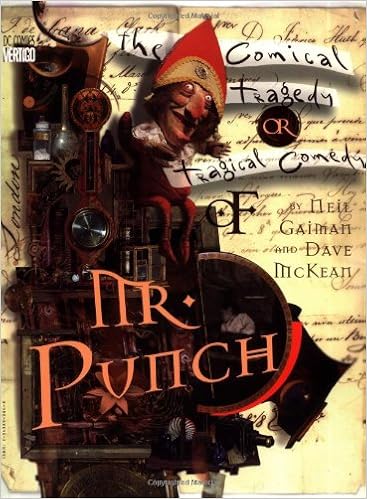
Book Review (Graphic Novel) Mr. Punch by Neil Gaiman and Dave McKean

Image result for neil gaiman mr. punch

The Comical Tragedy or The Tragical Comedy of Mr. Punch

by Neil Gaiman and Dave McKean


This is the second book I’ve read (Riddley Walker by Russell Hoban was the first) that focused on the traditional Punch and Judy show. That one was disturbing because it’s post-apocalyptic, and written in a language that is not quite English and is very difficult; this one is disturbing because it’s Neil Gaiman and Dave McKean. Both are disturbing because Punch and Judy? That’s one messed up story.

So the basic plotline, if you can call it that, of the traditional Punch and Judy puppet show follows the story of Punch. Punch is a sinner: a violent, horny, drunken lout who is clever enough and evil enough to get the better of everyone else in the show – if by “get the better” we mean “beat to death with a stick,” which is basically what Punch ends up doing to everyone, including Judy, who attacks Punch after he throws their baby off the stage to its presumed puppety death. Punch also murders a doctor, a police officer, a crocodile, and the Devil himself; I assume there are variations performed by different people, but both novels tell the same basic story about the murderous Mr. Punch.

Both also describe the traditional puppeteers who tell the story. They are strange people, with an unhealthy and almost religious, even zealous, respect and devotion to the show, especially to Mr. Punch himself. In Russell Hoban’s book, the Punch puppeteer is still doing the same story from medieval England, even though the book is set hundreds of years after the nuclear holocaust that wiped out our civilization; all that remains are some broken fragments of language (the book is written in a very strange invented patois), some relics and buildings and such, and the Punch and Judy show, which is retained in exactly the same form.

In this one, the puppeteer seems to be mystical, in that he talks about an old man, one of the other characters, as having been his apprentice long ago, which would make the puppeteer unnaturally long-lived, it seems. Though it’s hard to say, because the story is told from the point of view of a young boy with a strong imagination, and there are other elements of almost magic realism: the main setting is in a carnival at the seashore in England, and the narrator’s grandfather (the one who used to be the puppeteer’s apprentice) has employed a woman to perform as a mermaid, sitting in a costume on a rock in an indoor pond, brushing her hair and singing. The boy takes her as a real mermaid, so maybe the longevity of the puppeteer is imagined, too.

But there’s also the puppets. The puppeteer talks to the boy and tells him about the Punch show, and he seems to imply that once you put the puppets on your hand, then you gain secret knowledge – and lose something, as well, mainly the ability to take the puppets off again, metaphorically, at least. The boy puts on the crocodile puppet and comments on how magical it is that a puppet can come to life once your hand is inside it; the puppeteer offers him the Punch puppet – the one that is the key to the show, and the only puppet that never comes off the hand, as the Punch and Judy show is a one-man act, so there are never more than two puppets on stage at a time (And the narrator points out that this helps to explain all the murders, as the puppeteer has to keep getting rid of the left-hand characters so he can introduce a new one), and one of them is always Mr. Punch. Who, after he kills another puppet, says, “That’s the way you do it!” Freaking weird. And this is a children’s entertainment. I think knowing that he grew up watching Punch shows helps to explain Neil Gaiman, and maybe a lot of other English authors and creatives.

To add to the weirdness, the book is not only about the Punch puppet show; the boy’s grandfather is losing the last vestiges of his sanity, and also about to lose his carnival house, since nobody goes to the seashore to go inside and see a sad mermaid or a weirdass Punch show. The boy is shy and awkward, and not treated well by his maddening grandfather; there is also some tension between the grandfather and his brother, who helps out with the show and who has a hunchback, though the reason for his deformity is a bit of a mystery commented on by the narrator. There is also an unfortunate love affair involving the mermaid girl, though the boy doesn’t understand it and so neither do we, since the story is told from his point of view.

Overall, it is strange and depressing, but also utterly fascinating, like most Neil Gaiman books. And if there were no other reason to read this graphic novel, it would be worth it just for the art: because Dave McKean is a freaking genius, and the way he mixes painting and drawing and collage and photography in the images of this book make the entire experience twice as fascinating as it would be without him; and it’s fascinating enough already.

Highly recommend, though with a warning about the creepiness and the sadness, which is not resolved neatly at the end. Like life.

That’s the way you do it.

Book Review: The Alchemist of Souls

Image result for the alchemist of souls

The Alchemist of Souls

by Anne Lyle

First, the things about this book that I appreciate.

I appreciate, first and foremost, that Lyle was inspired (as she describes in her author’s note) by a name she came across in her research; she said that as soon as she saw the name Maliverny Catlyn, a minor but genuine historical personage, she had to use that name in her book. She’s completely right; the name belongs on the hero she created for this book; and since my own book was also inspired partly by a name, I approve of this wholeheartedly.

I appreciate that the book is exhaustively researched and detailed; that it covers quite a number of aspects of Elizabethan English life; I appreciate that it focuses on the theatre of the time but barely mentions Shakespeare. I appreciate that she made subtle changes, such as making Elizabeth I marry and bear two sons to succeed her, while keeping so many other things historically accurate (As far as I know, that is): that’s a fine line to walk, and she does it well. I really appreciated the religious and political tension she was able to capture; the intrigues were excellent.

I appreciate the skraylings as a theme: this is the major change that turns this into fantasy instead of a historical novel, that when the European explorers traveled to the New World, they discovered not merely the Native American populations, but also a humanoid race with an advanced civilization and apparent control over magic. So now Europe has a new ally to woo and also plot against in their wars between Catholic France and Spain, and Protestant England. It’s a good theme, and it’s done well.

I appreciated that there are strong gay characters and nobody really thinks too much about it. They get some grief for being all sinful and stuff, even from one of the other characters, which Lyle takes advantage of to create a great scene where the bigot gets called out for her hypocrisy. It’s extremely well done, and the most romantic aspect of the book, which does have a variety of romantic entanglements between the several characters.


What I did not appreciate about the book:

It’s too long. I don’t like to say that, since I’m a wordy writer myself, and I love 1000-page epic fantasies like the work of Robert Jordan and GRRM and the like. But this one dragged. There were a few too many characters and a few too many plotlines, and those plotlines went on for too long. While the two main gay characters were interesting in and of themselves, they could have been removed from the story entirely without any real loss to the plot, and the same goes for the weeks of buildup to the theatrical competition. There’s a lot of life in the book, which also has its own attraction, but isn’t necessary for this story. It’s a bit bothersome because this is the first in a series, and it’s like Lyle couldn’t stand to hold back and put some of the interesting things into later books, so she packed it all into this one – and it’s too much.

Though I liked them thematically, I didn’t really care for the skraylings. There were some really interesting tidbits that showed excellent thought and planning from Lyle – like the linguistic nugget that has the skrayling/English pidgin avoiding the letters p, b, and m, because skraylings find them effeminate; and the reason for this is that the skraylings show their canines as a gesture of assertiveness and dominance, and those three letters are the only sounds that require you to close your mouth entirely. That is cool as hell. (Though in the actual writing of the pidgin, Lyle uses normal English, essentially leaving the pidgin implied; so what the hell? I mean, that’s just lazy. There was a guy wrote an entire novel without the letter E, and you can’t write a few lines of dialogue without those three letters? THAT LAST SENTENCE DID IT AND IT WASN’T EVEN HARD! THERE, I DID IT AGAIN!) But the ambassador is a weak character, and none of the other skraylings are given a chance to stand out; I don’t understand the ambassador’s particular personal situation, nor the connection to Mal Catlyn; I don’t like the way Mal just keeps running away, and the ambassador passively lets him go. I just didn’t think much of them.

I hate the ending. At the end of this longish slowish book is a rapid-fire explosion of events that suddenly introduce a new bad guy, have a surprise twist regarding the main character and his family, grant magical powers where they haven’t been before, throw the characters into a search-and-rescue and also a duel to the death, and then end with the bad guys sort of winning. It’s clearly a set-up for the next book(s), and I doubt the bad guys will win in the end; but it made this particular book freaking annoying. Which makes me not want to read the next books.

It’s too bad about this book, because it does have some good elements; but the plotting and pace make it not worth the time. Don’t recommend.

Book Review: The Demon-Haunted World

Image result for the demon-haunted world

The Demon-Haunted World

by Carl Sagan

Published the year he died, Sagan’s The Demon-Haunted World is a haunted book. I haven’t read his other work (Though now I plan to), but this one seems darker than what I had imagined his work would be like. It’s not hopeless or despairing; it’s a serious warning about a serious problem, and what seemed to me like a fairly frustrated attempt to cut through a thick layer of hogwash on a specific issue that obviously bothered Sagan quite a lot: namely the idea of alien abduction.

The general warning about the serious problem is the overall thrust of the book, and it is about the need for a free people to think skeptically. Sagan being who he was, he came at the idea from a scientist’s perspective; he describes at length the need for scientists to be skeptical, to be willing to question anything, most particularly their own most cherished beliefs. He gives example after example of scientists describing the need to build beautiful, elegant theories that explain great answers to great questions – and then tear them down completely when those theories are contradicted by the evidence. He talks about the shift from Newton to Einstein to quantum mechanics, and he talks about how astrophysicist Fred Hoyle was able to contribute as much to the field of astronomy when he was wrong as he was when he was right (and in both cases his contributions were prodigious, Sagan says).

Because Sagan is not only talking about science, and because he practiced what he preached, he makes a concerted effort in this book to talk about the flawed nature of scientists, the scientists who did more harm than good, the ones who told themselves they could ignore the ethical responsibility of considering the potential uses of their discoveries – a deception, Sagan argues, as he states unequivocally that the extraordinary power of modern scientific discoveries and the technology that comes from them imposes a greater responsibility than ever before for scientists to act as ethically as possible in considering what potential harm could be done by their work, and taking action to minimize that harm. He talks about the various ways that science can be manipulated and used to do harm; though he is also clear that none of that harm tells us that science is itself harmful or bad or should be feared or avoided. Knowledge is power, and power can be used to do – well, anything; but ignoring the power doesn’t protect us from it, it simply makes it easier for someone else to use it harmfully.

What else is Sagan talking about other than science itself, than the beauty and power of the scientific mindset, of skeptical thinking and a reliance on repeatable experiment and observable data? He’s talking about everything, really. There isn’t an aspect of life or modern society where a skeptical mindset would be inappropriate. The book covers a lot of aspects of society and culture; the exploration of the alien abduction myth, rather than simply being a screed against a continuing falsehood that Sagan, as an astrophysicist, took personally; he goes back through history and connects the alien abduction myth to past myths, of fairy abductions, of divine intervention in the lives of mortals. In addition to showing how a skeptical mindset quickly takes the alien abduction story apart, he also shows how it could be used to remove a dozen other pernicious ideas in our culture, including racism, sexism, and nationalism.

It’s beautifully done. This is a lovely book, fascinating in its ideas and easily digestible in the presentation of them. And as I said, it isn’t hopeless: Sagan also makes sure to express to the reader his unquenchable curiosity and his enormous capacity for wonder, which he also says must be fostered and encouraged along with the skeptical mindset; because when our cherished ideas are disproven by the evidence, when the flaws in our reasoning are found by our own penetrating, skeptical questions, it is our sense of wonder and our need to feel awe that makes us look again for a new answer to replace the one we just discarded. Wonder makes us get up and try again, after we knock ourselves down; and the combination of those two qualities is what gives this book its hope.

The thing that makes it scary is that Sagan wrote it twenty years ago. And on the first page – the first damn page – he said this:

Science is more than a body of knowledge; it is a way of thinking. I have a foreboding of an America in children’s or grandchildren’s time – when the United States is a service and information economy; when nearly all the key manufacturing industries have slipped away to other countries; when awesome technological powers are in the hands of a very few, and no one representing the public interest can even grasp the issues; when the people have lost the ability to set their own agendas or knowledgeably question those in authority; when, clutching our crystals and nervously consulting our horoscopes, our critical faculties in decline, unable to distinguish between what feels good and what’s true, we slide, almost without noticing, back into superstition and darkness.

[…]

The candle flame gutters. Its little pool of light trembles. Darkness gathers. The demons begin to stir.

Yeah. This book scared me, all right. I hope it also inspired me. I do intend to use one entire chapter/essay in my classes this coming school year, to try to make that candle burn a little brighter, if I can; and I would like to recommend that everyone read this book when you get the chance, because after Sagan finishes talking about alien abduction, he talks about democracy, and the need for scientific skeptical thinking and also scientific wonder and awe, to save our democracy, to save our country. And I for one think he was right.

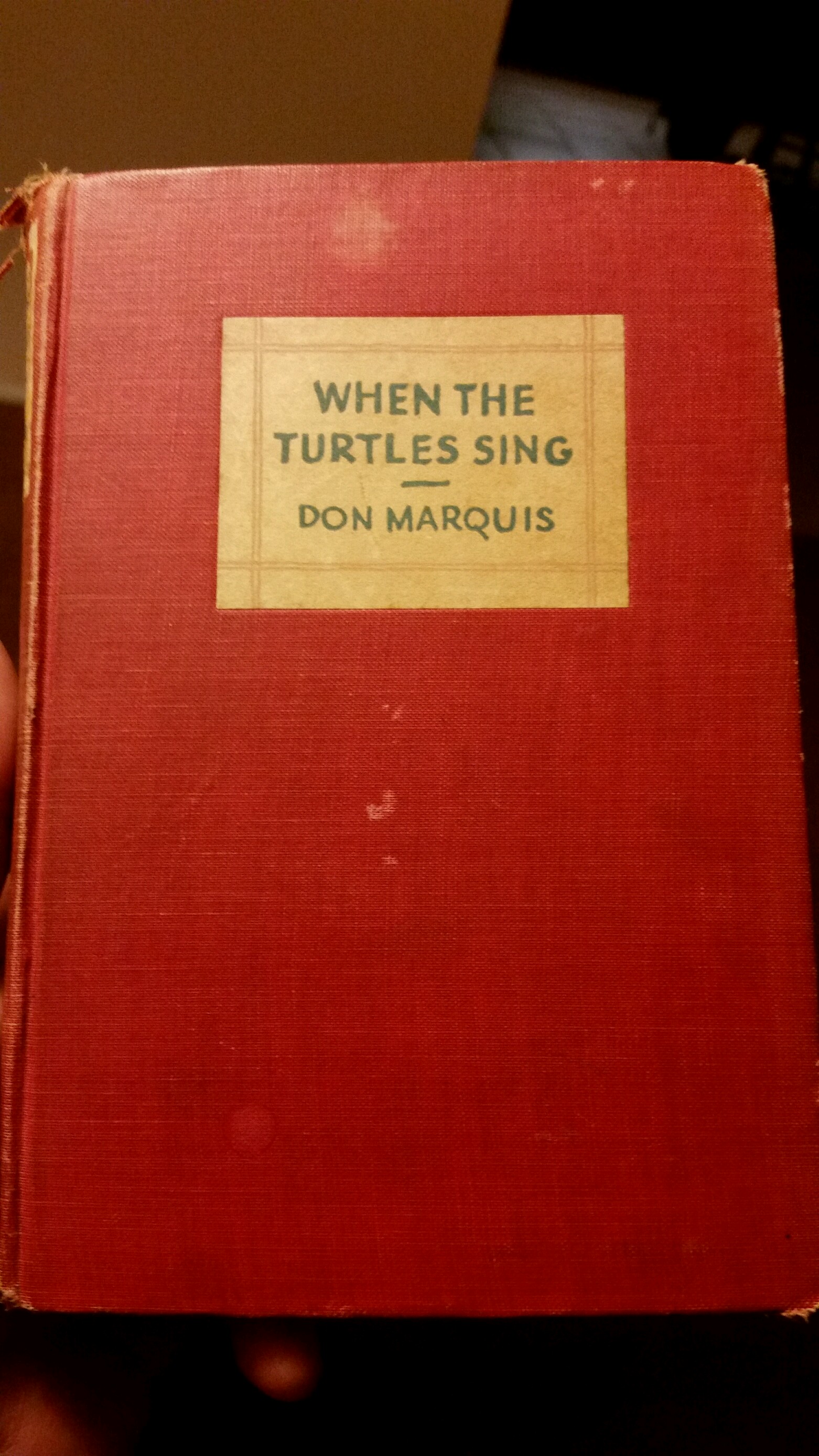
Book Review: When the Turtles Sing

When the Turtles Sing

by Don Marquis


This was a sweet book.

It’s ten short stories, published in 1928, by Don Marquis, a humorist and poet that I have been long acquainted with because my parents read and shared with the family Marquis’s collection Archy and Mehitabel, about a cat and a cockroach who are both reincarnated spirits; the cockroach was a poet, and he sneaks out at night and types poems on Marquis’s typewriter, one key at a time, without any capital letters because he can’t hold down the Shift key. I loved that book, and got my dad’s old copy of it a few years ago, whereupon I read it to my wife, who also loved it. So when I was at the Friends of the Library Book Sale, and I saw this lovely old hardback with a great title and a familiar author, I had to get it.

I’m glad I did. Marquis had a hell of a sense of humor, and more important, he had a hell of a sense of fun: these stories are mostly just fun. They’re good ideas, and they’re actually well-realized; a couple of them take really surprising dark turns, which fits the characters and plots, even if it doesn’t seem to fit the book. But it was an interesting choice, because you have what seems a parody, a caricature of human beings, who get into absurd situations – and then, for some of them at least, you have a fairly serious result, one which follows logically from the story’s events; but I didn’t think we were speaking logically.

The humorous stories are in two sets, one a trio of stories recounted to us by the Old Soak, an elderly gentleman who tells us stories about the strange residents of his small town, particularly the ones who live in a nearby swamp. One of the stories, the title one about the turtles singing (which is actually a quote from the Bible), has a mixed-up comic romance worthy of Shakespeare; but another of the Old Soak’s stories tells about a love triangle that might include a murder, as one man dies accidentally while in the presence of the second man. That story might get wacky, except it was much more about the woman’s attempts to become a full and complete version of herself despite the town’s bias against her, as she comes from the swamp and is therefore unclean and unacceptable. Her story is something of a triumph, as she finds a way to go to college and complete the education she had to begin herself, and then travels to Europe, unencumbered by marriage (She does marry both guys, but the second marriage is more open and free companionship than the sort of ownership that would have been common at the time) and child-rearing; all fine and good – except the story ends with her husband going mad with guilt over the death of the first man, and at the end he shoots himself. So, y’know – not funny.

The other funny ones are much funnier: a pair of tall tales told by an Irish father to his two sons; Marquis gives in to the temptation to write in Irish dialect, which isn’t my favorite thing to read, but he does it well and not too excessively. He does it with the Old Soak stories, too, which have a Twain-esque hillbilly style to them, with a number of malapropisms and strange spelling/pronunciations from a Southern American English dialect. More important, he doesn’t rely on the accent for humor: the stories are funny, and the narrator is hilarious, in both cases.

So I enjoyed the book, which was generally light-hearted and well-written. But now I’m sort of stuck: you see, I liked it, but I wasn’t inspired by it, so normally, I’d sell this book back into circulation so someone else could enjoy it. But this copy is actually from 1928, and it’s falling apart; the binding is broken, and the pages are coming loose from the spine. So I can’t sell it, and if I give it away, it will just get trashed. I can’t let Don Marquis get trashed. Not a book about singing turtles, either. I think that this book will get to sit on my shelf, hanging around like the Old Soak, just waiting for someone to sit for a spell and listen to his stories.

I like that.

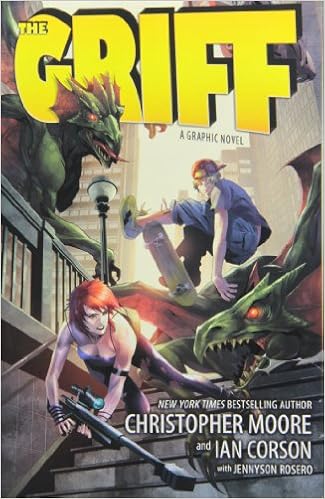
Book Review: Christopher Moore’s (Alas!) Bad Book

Image result for the griff

The Griff

by Christopher Moore and Ian Corson


I hate this. I hate it!

I love Christopher Moore. He is one of my all-time favorite authors, one of my heroes. I’ve read everything he’s written, and I’ve loved everything he’s written.

Except this.

This is a crappy book.

Well, I suppose it had to happen sometime; there have been some of his books (Island of the Sequined Love Nun, Lust Lizard of Melancholy Cove) that I haven’t liked nearly as much as his best works, like Lamb and Fool and Sacre Bleu. It’s reasonable to think that one of them could sink down low enough to actually be unenjoyable. It is not surprising to me that the one that did so was a collaboration, which none of his novels are; and that it was a graphic novel, which is not Moore’s usual medium. I would guess that Moore had little to do with the actual illustrations – which, unless I’m reading the credits in the book wrongly, seem to have been sort of mass-produced? They are all owned by Harper-Collins, and though a half-dozen people are thanked, no one is listed as the actual artist, other than the person who did the cover, Jennyson Rosero – and the illustrations are a fair piece of the problem with this. But really, there isn’t much here that’s good, so I can’t cover Moore on this one. He made a stinker.

All right: details. So this is an apocalypse story. The Griff are, quite literally, monsters from outer space. They are called The Griff because they look something like griffins: four legged beasts with claws, wings, and lizard/dragon like heads with sharp beaks. They arrive in large space ships, much like Independence Day, and immediately fall to wiping out humanity. (Reminded me of Footfall, if any of you are as deep into sci-fi nerdery as I am. Also, they seem to be summoned by an accidental signal sent into space by guys who uncover a mysterious artifact from the sea-bottom, which made me think of Star Trek IV. Woo! Nerdiverse!) So far so good: but that’s where the first problem appears. The design of the book is so poor that there are a couple of pages that literally can’t be deciphered; the rapid transitions between scenes of slaughter and ineffective human resistance to the invasion are just a jumbled mess. But that doesn’t really matter, because the majority of this story is about the survivors of the initial onslaught.

Which is where the larger problems come in.

First, the character development and much of the plot leans heavily on people being comic book hot, and endlessly horny. Now, Moore uses a lot of humor around sex; but this isn’t funny, this is just lame. The two female characters are in absurdly revealing outfits – one woman wears a wetsuit for the entire story, which seems to be the only reason she is a trainer at SeaWorld – and the male characters do nothing but make horndog remarks, which the women shoot down. Then the one woman – not the one in the wetsuit, the one with absurdly large breasts in a skin-tight spaghetti-strap crop-top, which is generally what one wears as the world ends – has a ridiculous sexualized response to finding a BFG, a Big Fucking Gun, with which she’s gonna go Griff-hunting. Because that woman is a gamer, a master programmer and a genius; therefore, somehow, she is capable of using an actual .50-caliber military rifle, since she’s used them in video games. Suuuuuure. I mean, she’s played all the video games, even created some of them, so she’s badass, right? But hey, none of that matters: what matters is that she’s hot. And, as the book goes on, horny. Her character is mostly depicted as a pinup. Who does finally sleep with the goofy nerd horndog who’s been coming on to her, because comics are all about nerd wish fulfillment.

Image result for the griff graphic novel

Then, at the end of the story, though there is a good twist regarding the Griff, it turns out that the Griff are the minions of – the little gray men. Yes, them. Scrawny bodies, large heads, huge featureless black eyes. Them. Just like every other alien story for the last 20 goddamn years. And the humans finally win, because that’s what humans do: we fight, and we kill, and we win. WOO! USA! USA! I mean – Earth! Earth! Earth!

Anyway. Characters are lame, design is poor, the art is too CGI-crisp for my taste (though to each their own) and the climax and ending of the plot were cliché and anti-climactic and annoying.

I hate that Christopher Moore wrote this, but not that much; everyone throws out a pile of crud every once in a while. Much more than that, I hated this book. Do not recommend.