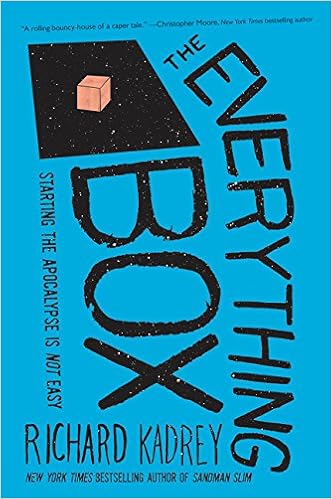
This Morning (Book Review: Everything Box)

This morning I don’t know if this is a good idea? I wrote a book review, which I want to post; I don’t want to interrupt this stream of This Morning blogs, so I thought I would use the book review for This Morning. Opinions? Is this a copout? Just the wrong sort of thing for me to do, because This Morning is about my thoughts and feelings? I dunno.

I can make book reviews a part of this streak, or I can make separate posts.

Leave a comment and let me know what you think, if you have thoughts.


The Everything Box

by Richard Kadrey

I’ve read three Sandman Slim novels (And if you haven’t, you should – dark horror/fantasy with a punk edge and a great sense of humor), so I had some idea of what to expect with this book; but I didn’t expect this book.

It’s a caper story, a one-off novel with no connection to other Kadrey books (And I just found out this second that there are sequels) about a professional thief who gets hired to steal the wrong thing, and even though he manages to do it, he gets sold out on the job by a fellow thief, who, predictably, has no honor. Coop (Charlie Cooper, though no one calls him that) gets sent to a special prison for the next few years, before he is sprung, by the same guy who put him away, and for the opposite reason: this time the guy, Morty, needs Coop’s help.

He needs Coop’s help specifically for the same reason that Coop was in a special jail: because Coop is not a normal thief. He is a magical thief, who steals mystical and mysterious items for mystical and mysterious people who can pay him in cold, hard cash.

That’s the setup (And forgive me for spoiling the first two chapters), and it’s a good one. The opening scene when Coop is on the job is a lot of fun, and the subsequent caper action is just as good, all the way through. The book does start a little slow, as Kadrey has a pretty broad cast of characters; there’s a madcap element to this, as it ends up with one of those Mad Mad Mad Mad World scenarios, with everyone running around looking for the same thing – the Everything Box of the title – and so getting all of those characters with their disparate personalities and motivations into the reader’s mind is a challenge. Kadrey does it as well as any, I think, but simply because it’s a single book, he has to fall back on some fairly generic tropes and character types. He does at least one wonderful thing, though, which is to completely flip some of those tropes: there are two different demon-worshipping doomsday cults involved, one led by a High Dark Magister (Or is it Dark High Magister?) with a bad back whose throne is a Barcalounger, and the other led by a very traditional suburban family who hold bake sales to raise funds for their dark rituals. (The bake sale scene is one of the funniest things in the book, and one of the funniest scenes I’ve read in a long while.) But there are some confusing moments: there was one character who I actually thought was a different character until they met each other, and I got lost in the earlier chapters and had to slog a bit. But it picks up, and the last 100 pages whiz by; the ending is great.

Apart from the caper action – which takes more than enough twists to keep you guessing; I honestly kept thinking, “That’s it? That can’t be it. Oh wait – that’s not it!” – the book does one other thing remarkably well, which is make you like the characters. Almost all of them are generally likable and amusing, including the ones opposed to our hero Coop, who is an excellent sort of everyman guy who just happens to be a thief. But both because they are a bit one-dimensional, and also because they are pretty goofy, you don’t mind too much when bad things happen to them – and like all of Kadrey’s books in my experience, a lot of bad things happen to a lot of people.

And I liked it.

This Morning

This morning I am thinking about rules. And breaking them.

I don’t have any particular plans to break rules today, apart from  the ones I always break (I am insufficiently formal with my students! I don’t take their cellphones away! I DON’T ENFORCE THE DRESS CODE!!!); since I have become a teacher, I am generally on the side of rules enforcement (Not the dress code. Dress codes are a poor system. I’ll write about that some other morning.), because I recognize that most rules are intended to uphold the One Rule: Primum non nocere. First, do no harm. In my classroom that is the first rule and the only rule that gets regularly and consistently enforced. But other corollary rules are reasonable when they help maintain that one rule: the tardy policy is acceptable because students who come in late miss class, which is harmful to their education; they disrupt the classroom, which is harmful to everyone else’s. It is a minor harm in both cases, and so the punishment for tardiness should be a stern look, maybe a talking to (Especially in the case of schoolchildren, who are rarely tardy on their own behalf; I was late to homeroom for essentially my entire freshman year because my older brother drove me to school, and he didn’t have to be in homeroom, ergo late.), but there is harm, and the rule makes sense.

The more interesting situation is when someone — like me — decides that some rules should be enforced and not others. Because then it becomes a matter of reason and authority; argument, in other words. I have decided that the no-cellphones policy at the school where I teach will not be enforced in my classroom with the sole exception of tests. I confiscate their phones during tests; otherwise I let the students use them during class. Conversely, I insist that essays and projects be on school appropriate subjects. I can justify the enforcement of one rule and not the other, but am I the one who gets to decide that? My supervisors would say No. My students, who like my laxity, say Yes. I do what I want, ‘cause a pirate is free, and I am a pirate.

But then there are the rules, and particularly the uneven enforcement of rules, that I believe are problematic. My administration insists that the students do not talk during fire drills, that the entire school remain in absolute silence. They instruct the teachers, during every drill, to send the students who talk to the administration to be disciplined. They do not have a reasonable argument for this. The district insists, as a precaution against school shootings, that all classroom doors be closed and locked during the entire school day, with the sole exception (Other than when people are coming in and out of the doors, of course — though I have been frequently tempted to slam the door closed and yell, “IT’S A SAFETY PRECAUTION!” when people are trying to come into my classroom. Particularly when it’s administrators.) being when there is a teacher alone in the room with a single student; then the potential lawsuits override the risk of being shot, and so the classroom door must remain blocked open. They do not have a reasonable argument for this. My administration is constantly walking by my classroom and closing my door, which I habitually leave open because I have an open-door bathroom policy, and also because it helps keep the room a comfortable temperature.

Those rules, despite being irrational, are enforced consistently and vigorously. But other rules, such as suspension and expulsion for serious offenses — rules which do have a rational basis — are consistently bent or broken, generally for the same fear of lawsuits that governs our door closings. There are students at the school who should probably not be at the school, because their actions pose a genuine threat to themselves and the other students. But those students are generally allowed to remain, and even allowed to make up work missed during suspensions. I am not one to insist on expulsion; other solutions to the issue could certainly be tried — but those things don’t happen, either.

Let’s imagine, as an example, that a student was running around whipping people with goat skin in order to increase their fertility. (What? That’s where Valentine’s Day comes from.) A student who did that should be suspended, and certainly, if the student was naked as the Romans were when they did that, that student should be expelled and probably arrested. I could understand if, instead, the student was required to attend counseling, GoatWhippers Anonymous and the like; but my school, and the school where I taught before this, frequently did nothing post-suspension. The goat-whipper comes right back, sits in class, makes up work and gets their credits. And frequently, re-offends. With the same result.

I broke the rules almost ten years ago. I wrote angry blogs about my students, while I was in class, using a school computer; I also named former students and insulted them. I’m honestly not sure that my particular actions caused direct harm (largely because none of the students I talked about knew about or read the blog), but certainly the rules that I violated are intended to prevent harm: teachers should not insult their students, we should not post on social media or the internet during class; we should not name our students and violate their privacy. I should not have broken those rules. I was punished for them, and I still pay for it; and that’s as it should be. Especially because I still write this blog, I have to remain aware of where the line is, and not cross it. I suppose you could argue that I do cross it, that I shouldn’t write, that I shouldn’t write about my school or the administration or similar topics; but rules that prevent harm should not cause harm. And censorship is harm. My punishment taught me to be more responsible, and therefore I, who am closest to the potential damage, have become a means of preventing further harm. This is exactly what rules and punishments are supposed to accomplish: reform and prevention. For the offender far more than others who observe, but the idea of a deterrent is not absurd.

There are other instances where, rather than a poor policy or an unfairly enforced rule, specific individuals are allowed to skirt the rules — or simply to break them with impunity. Where, say, family members are allowed to have freedoms and privileges that they should not have, in violation of rules. This is, quite simply, corruption; not only does it allow harm to happen to all involved, but it creates harm directly. It allows others to be corrupt themselves, and therefore the harm spreads. And it begins at the top.

Looking at you, Mr. Trump. And your children.

When  the people who are given the authority to make the rules and enforce the rules do a poor job of choosing which rules are vigorously enforced — generally, rules that allow them to maintain and increase power and control over subordinates, but which do not tangibly prevent harm — and which are laxly enforced or not enforced at all, then the system is broken; then, unfortunately, it falls to those not in the position of authority to make decisions regarding which rules to enforce and which not. That’s where I come into this. If my students were not consistently and adamantly protected, by their parents and de facto by the school in that they do not enforce a schoolwide ban, in their right to have a cellphone with maximal functionality, I would enforce a ban in my classroom. If my administration acted in all ways with the safety and benefit of the students foremost in mind, then I would enforce their reasonable rules vigorously. As none of those things are true, I am forced to pick and choose.

I hope I choose well. I will take responsibility for the choices I make.

I learned that from my punishments.

This Morning

(Twenty mornings! Score!)

This morning I am thinking about yesterday afternoon.

Yesterday afternoon, following a full day of teaching, and right on the heels of a vapid and hollow staff meeting (“Let’s sing ‘Happy Birthday’ all at once to everyone who’s had a birthday in the last two and a half months! Then, as a special gift, the birthday people can cut this crappy cake we got for them! Also, teachers with high test scores win all the prizes! Yay math and English!” Except with less energy and verve.), we had an interesting and useful training. It was called Stop the Bleed, and it was about how to deal with critical bleeding, how to apply first aid, tourniquets and wound packing and pressure and the like. I was glad to get the training, because I learned things I hadn’t known before, things that could be useful in a crisis, and I learned them from actual medical professionals and first responders.

But there were a few things that bothered me. Apart from the graphic wound photos and the fake detached limbs with enormous puncture wounds for us to practice stuffing gauze into. Geesh.

The first was the audience participation; we were asked to identify some signs of critical blood loss, and also some consequences of it if left untreated; there’s nothing quite like hearing a bunch of teachers, who are all lovely people, and who also want to be the one to give the teacher the right answer, shouting out, “Spurting blood!” “Missing part of a limb!” “DEATH!” The flip side of this was the trainer’s comment that our practice hemostatic gauze lacked the chemical additive that is in actual hemostatic gauze, which helps cause blood clotting, because our gauze was “educational.” I love the idea that the crappy knock-off version, the one that doesn’t do the critical thing that the actual product does, is the educational version. It’s like school Chromebooks.

Then there were the trainers’ unintentionally strange comments. (At least I hope they were unintentional…) “We are fortunate to have the experience of the military, so we’ve seen tourniquets applied for up to two hours without loss of limb.” “They have tourniquets for the torso now so you can apply them to the lower abdomen, but unfortunately they’re only for the military at the moment.” (I think they had a different understanding of “fortunate” than I do. Is the military really fortunate to have the opportunity to field-test tourniquets for hours at a time without losing limbs? To have access to abdominal tourniquets? I mean, I’m all in favor of saving lives — but “fortunate?”) The better one was the trainer’s attempt at humor: when explaining that wounds to the “torso junctions,” where the limbs meet the trunk, at the shoulders, neck, and groin, the trainer said, “Now, you can’t apply a tourniquet at these places  — although I’m sure many of you would like to…” which is either, if she was talking about the groin, the weirdest and most inappropriate dick joke I’ve ever heard, or else she was joking about us strangling our students to death, ha, ha, ha. It’s especially disturbing that the murder joke is by far the more likely.

That’s especially disturbing because the impetus for this training? Sandy Hook. The program was put in place after the 2012 mass shooting in Newtown, Connecticut, because at that horrible scene, the paramedics could not reach the victims in time to stop their critical bleeding because the police had to secure the scene before the medical personnel could be allowed in to help. So that means two things: one, this training is being given to me because, if the worst happens, I’ll already be in the unsecured scene, and so will have nothing to lose  by applying first aid to people who are bleeding to death, because I will already be in mortal danger myself. And two, that means we were sitting in the library of my school, at the end of a day working with students, talking about when a psychopath brought an assault weapon to an elementary school and murdered more than twenty people, most of them under the age of seven: and at least some of those people died by bleeding to death because the paramedics couldn’t be permitted in to reach them.

And this, this, is how my nation and my school respond to those facts, those unspeakable horrors. Not with gun control, not, in the case of my school, with hiring a full-time security guard and nurse: no, no. With training for the teachers in how to apply a combat-tested tourniquet, and how to pack gauze into a wound — gauze that, I learned, comes with an x-ray opaque strip so that once multiple yards of it are shoved into the wound, the gauze can still be found and removed in the hospital. Where the firefighter teaching us pointed out that we had to be careful putting our fingers into the wound because there might be sharp shards of bone inside, or even a bullet — which, he said, would still be sizzling hot.

All I can say is, God bless America.

This Morning

This morning I had a blog idea that didn’t work. It was taking too long, and I wasn’t even sure of the point I was trying to make. So I’m scrapping it, and thinking about how you have to be willing to spend time and effort on failure. Not every idea is the best one, is the right one, but if you wait around for the perfect idea to come to you, you’ll be waiting forever, because perfection needs to be built, not discovered. And when you try something that doesn’t lead to perfection, especially if you see the path ahead before it’s finished, then you have to get off that path and try something else.

I’m also thinking about how yesterday I was listening to this song, and making matching friendship bracelets, and I wonder if this year’s Daylight Savings Time adjustment actually set the clock back to 1990.

This Morning

This morning I am thinking again about friends.

I wrote about friends five mornings ago, and said that I don’t really know that I have many friends. I ended with saying, “Maybe I should just stick to dogs.” And since at this moment, my beloved beautiful fuzzball Samwise is curled up right next to me, I think that sticking to dogs is just about right.

But I also think that I do have friends. Good friends. Lots of them.

Because yesterday I sent out a call for help, and my friends responded. Immediately. And though I am sure that several of them rolled their eyes at El Sonorridor!, they didn’t give me grief for it, didn’t mock me, didn’t tell me it was stupid. No: they went to the ADOT website and commented that the new interchange should be named the Sonorridor. They encouraged me. They complimented me. They made me happy.

That’s a friend. My friends. Thank you all.

This Morning

This morning, I need your help.

ADOT, the Arizona Department of Transportation, is planning a new highway project here in the Tucson area, south of the city. For those who are local, it is an interchange connecting I-19, the main route to Nogales and the border, with I-10, the major route to all points both east and north. The plan is to make it so that cross-border traffic headed for either Phoenix, et al, or to New Mexico, does not have to go through Tucson proper.

But that’s not what’s important. I mean, sure, it sounds like a fine project and all, I guess, though it will probably take 20 years to build at ADOT construction rates; but I don’t have any particular dog in this race.

What I care about is the name.

They’re calling it the Sonoran Corridor.

It should — it must — it WILL — be called:

The Sonorridor.

This is my contribution to this community. I haven’t lived here that long, haven’t done much with my community (other than teaching, and I don’t mean to belittle the importance or impact of that  — but that’s not the subject right now), I don’t know whether it’s mattered at all that I’ve been here, whether I’ll be remembered.

I want to be remembered for this. The Sonorridor. The perfect portmanteau. The kind of name that, once it gets out there, it will become viral, and the highway will never be called anything else (I hope). The kind of thing that will make generations of travelers say, “Who the hell thought that was a good name?”

I want Tusconans to smile and nod (Or shake their heads and spit) and say, “Dusty Humphrey. That’s who.”

That’s why I need your help.

ADOT is taking public comment on the project right now. There are only two questions and a quick name/email/Not-a-robot identifier; the only required parts are the email and the robot test. The link is here. There are also tabs at the top of the page for overviews and documents and public meetings and the like, if you’re curious.

I would like everyone reading this, regardless of where you are, to go to that website, and under the second question, Additional Comments, please recommend, insist, demand, that the project be named the Sonorridor. You don’t need to be a resident. I’m not asking you to weigh in on the actual project — just the name. Here’s what I’m commenting this morning:

I believe, with all of my heart and mind, that the most important contribution I can make to this project is this: it should be called the Sonorridor. Sonorridor! It rolls off the tongue! It’s clear and simple, humorous without being absurd. It sounds like the wind, like a zephyr whisking cars along the road in speed and comfort. Sonorridor! Welcome to the Sonorridor, the pathway to the North! It even sounds Spanish — Bienvenidos al Sonorridor!
Thank you for your consideration.

(Here’s also my opinion on the first question, which is about which of the three proposed routes would be best: “I think the Corridor makes sense, but I think the people in the neighborhoods directly impacted should have the most influence on route, alongside the practical considerations re: budget, time, etc., which also clearly have a strong influence. Anyone whose major impact from this construction will be traffic-related will be better off with the Corridor than without it, and so their influence on specific route should be minor. I am in this second category.”)

Please help me. Please spread the word, and let’s make this a cause. Let us bring the Sonorridor to Tucson, and the world.

Thank you.

**Go here to help with a public comment about naming this project the Sonorridor:

https://www.azdot.gov/planning/transportation-studies/sonoran-corridor-tier-1-environmental-impact-statement/provide-your-input

This Morning

This morning I am thinking about waiting.

Time heals all wounds, we’re told, and it doesn’t. That’s a lie. Not all wounds heal. The implication that we don’t need to do anything actively to heal the wound is often a lie, as well. But it is true that wounds that can heal, will heal with time. I’ve always liked when I see this metaphor taken to completion and the healing described as full medical wound care, because wounds need treatment: once you have cleaned a wound, and applied first aid, and assuming there aren’t deeper complications in the wound and the damage done by the original wound isn’t critical — THEN time heals all wounds.

That doesn’t have the same pithy brevity, though. Too bad: because what could be a valuable piece of advice about patience and waiting and allowing things to happen, rather than going out and forcing them to happen, is somewhat ruined by — well, by impatience, by the need to keep the truism short and to the point. Four words sound good; forty tell the truth; we generally pick the four. It’s faster. Easier.

And, often, false.

Waiting is one of the best things to be good at. One of the hardest things for a new teacher to master is wait time: when you ask a question, you have to stop and give your students time to come up with the answer. It’s hard, because of course you as the teacher already know the answer, so in your brain, the necessary wait time is zero, and there you are, staring out across this room full of blank faces, thinking, “Come on, how do you not know this? It’s hyperbole, for god’s sake! Everyone knows what hyperbole is!” And if no one comes up with it immediately, you turn into that annoying kid who blurts out all the answers. It’s unfair, and it’s not good teaching — but it feels good, because first of all, you know all the answers (Maybe the hardest thing about teaching well is learning to not need to be the smartest person in the room.) and secondly, it’s so awkward, sitting there in a silent room while nobody is saying anything! If you just give the answers right after the questions, then everything moves forward, quick and smooth and easy.

And without learning.

Learning to resist that urge, learning to wait, is extremely difficult. Took me years. It took me enough instances of saying the answer just to have a student say, “I was just going to say that!” and feeling guilty for cutting the student off, and enough instances of recognizing how great it is when they come up with the answer themselves instead of me saying it, to learn to wait for someone to answer. It has made quite a difference in my teaching.

Now, of course, I have also learned to enjoy their (slight) discomfort. I like making them wait in silence. I like making them feel the need to fill that void with something, anything, at least a guess. I like asking hard questions, and watching them have to stop and think. I especially like staggering a smart student, one who is rolling along, doing great, smashing every question out of their way like a marathoner going through those ribbons at the end of the race — and then I ask something that needs more thought, and they have to come to a halt to consider. I like to be the wall the marathoner bounces off of. I love that. (I love it even more when, after a five- or ten- or even twenty-second pause, that same kid comes up with the answer. That’s the best thing.) I might love it too much: I am well known among my students for refusing to give them answers, ever. I’ll ask a difficult question —  why does the author make this choice instead of this other choice — and then they try a few thoughts, and we discuss it and those thoughts don’t work; then a pause, then they try another, and it doesn’t work either. Then somebody says, “Well, will you tell us why?” And my response is generally, “Oh, I’ll never tell you. You’ll figure it out, or you won’t know.” They groan. I grin.

But the point is, the waiting is the key. Time may not heal all wounds, but time is a necessary component of any change: from unprepared to prepared, from sad to happy, from good to great. It is rarely, in my experience, the only component; I think effort is probably equal in almost anything, and also thought — but time is necessary. Patience is necessary.

I’m still learning that. I’m 44, soon to be 45, and I’m still unpublished. (I am traditional enough to think that self-publishing doesn’t count. It does. But it isn’t what I really want, what I really really want, therefore…*) I think my writing has improved, but I haven’t reached my goal. It is not easy to deal with. Ten years ago I blamed everything on callow agents and a heartless publishing industry that just wouldn’t recognize my talent; now I tend to blame myself for not being good enough, for not having the right ideas. But in either case, I still don’t have what I want, and it hurts. It hurts all the time. It bothers me every time I see someone younger than me publishing books. It feels a little better when I see those posts and memes that list the ages of successful artists and authors who were older when they had their first breakthrough; but I’m starting to move into the middle of that pack, too. I saw on Twitter yesterday where someone was trying to give this kind of affirmation, and said, “I didn’t publish my first book until I was 38. Now I’m contracted for my tenth.” And I thought, Shit.

I also don’t always wait and think things through, especially about the effects of my words. I like to just type and go, hit Post, Reply, Send; I like doing that fast. It was a problem when I argued online regularly; now I do that less, but I still have the same problem. And it is a problem, not just  because I often misspeak when I do that; it also means I don’t realize the effect of everything I am about to say before I say it, and so I do things to people that I don’t mean or want to do. I make them angry or I make them sad, or I make them laugh and scoff at me, or I make them feel embarrassed or ashamed. And if I would just stop, and think, before I hit Send, and re-read what I wrote, then I would probably realize, “Oh, no, I shouldn’t say that, I shouldn’t say it that way.” And I’d fix it, and then I would prevent a problem that is caused by my own desire to hurry, my own inability to wait. But I hurry, and so I do harm, to someone else or to myself.

In other words, time may not heal all wounds: but impatience causes them.

Waiting is the key.


*Yes, that is a Spice Girls reference. Here, watch this: this will make it better.

This Morning

This morning I am thinking about women. Yesterday was International Women’s Day, and today, I think that women are incredible. All of the women in my life are amazing: my wife, my mother, my friends; my wife’s mother, my female coworkers and supervisors, heck, even my aunts are generally cooler and nicer and more interesting than my uncles. Certainly, all of them are better than me: smarter and more talented and calmer and less prone to stupidity and temper tantrums.

Women are just better. That’s what I think. And I think that, as a man, I should take this chance to just  — shut up. My last thought is this:

Every day should be Women’s Day.

This Morning

This morning I’m tired.

I’m tired of incompetence, malfeasance, and foolishness. I’m tired of administrators who are so afraid of lawsuits that they make bad decisions and do harm to the very school they are supposedly trying to protect. I’m tired of those same administrators being so slavishly devoted to conformity and universality of results that they take away everything that is good about teaching and learning, and about school. I’m tired of students who are more willing to fail than try to learn, who take every opportunity to ask for a free day, who say, “Why don’t we just do nothing today?” Who say “I don’t know how to do that” when they do, just because if they don’t know how then they won’t be asked to try, and they can sit and stew in their own torpor, staring at anything even vaguely stimulating. I watched four students watch one student spin a quarter on the desk for half a period. Just watching him. None of them doing the work they were supposed to be doing. I mean, I was a lazy student, sure, but — seriously?

I’m tired of parents who expect teachers to parent their children, and of teachers who are willing to do it. I’m tired of parents, and teachers, who focus on the signs and symbols of learning rather than on the actual thing itself. I’m tired of telling students that they’ll need this in the future, and that their boss won’t put up with the same crap that I put up with, as if everything I do is designed only to train students to be good employees.

I’m tired of doing things designed only to train students to be good employees.

I’m tired of being a good employee. I’m tired of teachers who obey inane rules rather than rock the boat, and I’m very tired of being one of those teachers. I’m tired of being cautious, and tired of being afraid, when I should be respected  and proud. I’m tired of wasting my time on things that don’t really need to happen, and of falling behind on the things that really do need to happen. I’m tired of trying to find time for myself in between the time I spend on others.

I’m tired of making the same old complaints and accusations.

I’m tired of being tired.

Boy, thank God it’s Friday, right?