What’s In a Name?

I want to write about the AP exam I scored. But those scores haven’t been released yet, and neither have the examples and so on, which show how the scores were earned; and I don’t want to get in trouble for posting confidential material.

So, without going into too much detail about the exam or the prompt or how a student earned a specific score, I’m going to talk about one general aspect of the exam which I noticed this year more than most: terminology.

In keeping with the theme I seem to have established of talking about my dad, and also of using quotations to center and introduce my thoughts, here is one of my dad’s all-time favorite quotes:

“The map is not the territory, the word is not the thing itself.”

This is from the science fiction novel, The World of Null-A, by A.E. van Vogt. It hasn’t been turned into a meme on the internet — so I’m going to put the cover of the novel here, because it’s awesome.

A.E. van Vogt – The World of Null-A (1948) Review | A Sky of Books and  Movies
Wouldn’t you love to live in Purple World? Arches and spires everywhere? STAIRCASES TO NOWHERE?!?

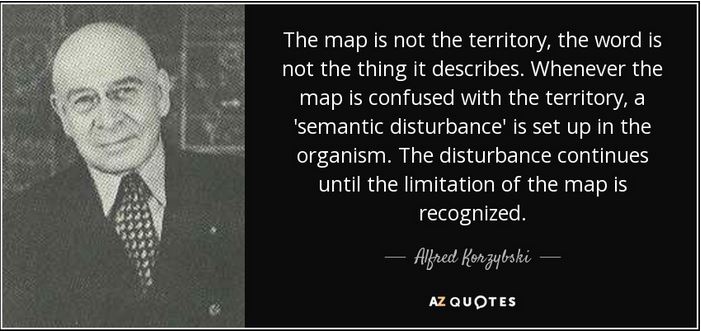
The quote is slightly adapted from a statement originally from Alfred Korzybski, a Polish-American philosopher and engineer, and while van Vogt’s words have not been memed, Korzybski’s have been.

Map And Territory - We Confuse The Map With The Territory

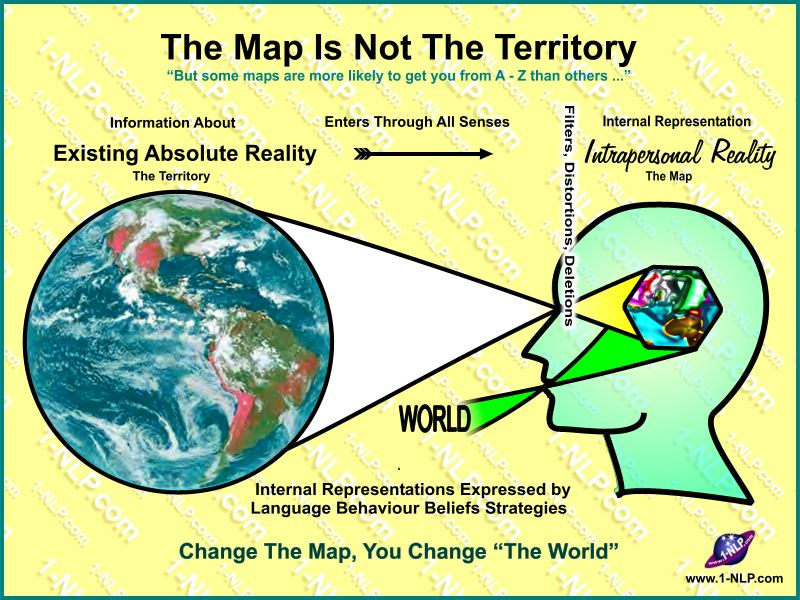
That’s the full quote, and you can see how quickly it makes one’s eyes cross. Here it is made even more confusing by the visuals:

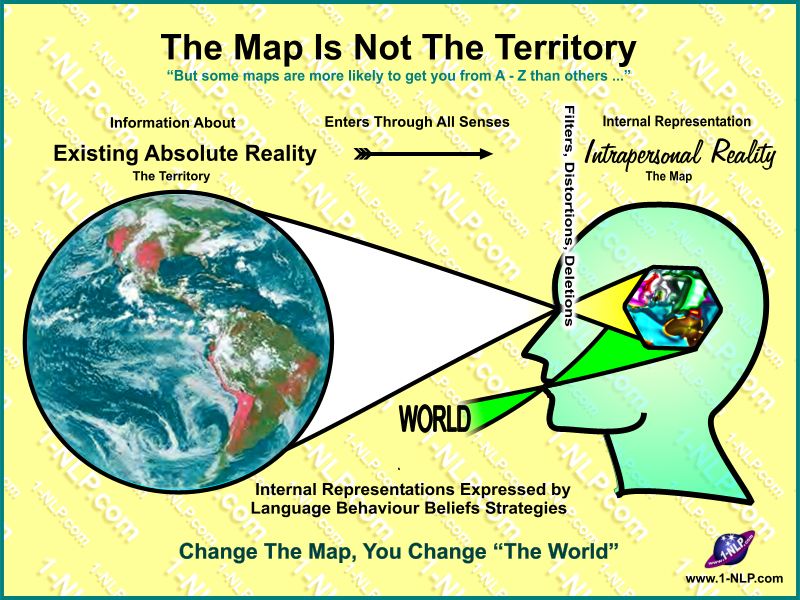
The Map is Not The Territory – Explained in Simple Terms – Welcome to Club  Street Post
This was made by someone who does not understand how to explain things.

But that’s okay, here’s the simpler version, complete with standardized background image:

The more observant among you will notice the resemblance to a meme I used in yesterday’s post here.

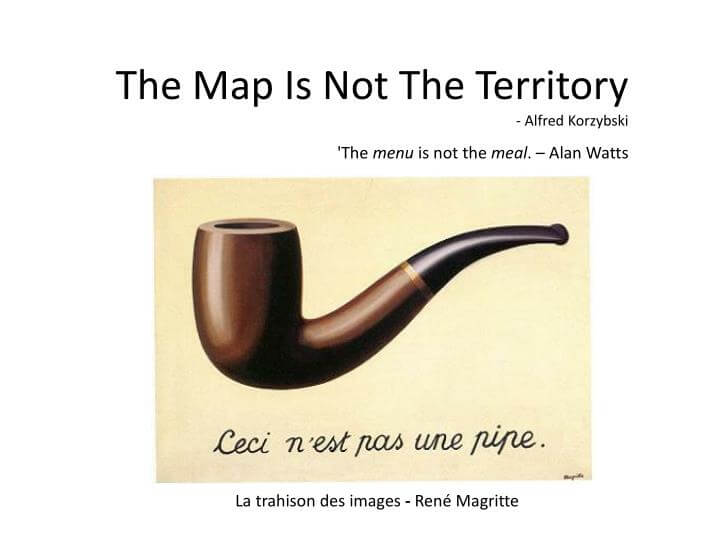
But really, I prefer this last version, because I also like Watts’s iteration of this — and I love Rene Magritte.

The map is not the territory - Tom McCallum

So the point of this, then, is to recognize the limitations of representation and image — and of language itself. The map is probably the best example, because a map always sacrifices detail for coverage, showing a greater area while not showing everything about that area. If a map showed every detail of the area it depicted, it would be a photograph, not a map — and its value would be limited.

(Though it might be funny sometimes.)

On some level, this shows the difference between “book knowledge” and “world knowledge” — which my students still, still, call “street smarts,” a perfect example of a name that has lasted despite its limitations, which makes it a perfect example of the second half of this statement. If you know the name of a thing, that is analogous to “book knowledge;” and if you understand the thing (which is where I think the quote is going here, to a point about understanding, because certainly with a concrete object there is no doubt that the word could be the thing itself: I’m not sitting in the word “chair” right now.), that is equivalent to the experiential and deeper understanding implied by “street smarts.” Knowing the name for something does not mean you understand that thing, because the word is not the thing itself; again like the map, words reduce specific details in order to gain another value — generally universality, and economy, meaning I can communicate a fair amount of information, to a lot of people, without too many words. If I say I own a black SUV, then you don’t have much detail about my car — but (if you speak English) you have a general understanding of the category of vehicle to which my car belongs, and a general idea of its size and shape and appearance and so on, because we understand what aspects are included in the category “SUV,” and we know the color “black.” Also, as my wife has pointed out many times, with steadily growing annoyance as each year passes, all SUVs look the same — and a large proportion of them are black. But that means, while you can get a general idea of many, many cars with just two words, you can’t really identify those specific cars very well. And you definitely don’t know the things that make my car special, that make my car into my car. Not terribly important to understand the special things about my car, of course; but if you want to understand a person, you need to know much more than their name.

This comes into focus with the AP exam because I teach my students that they don’t really need to know the name of what they are talking about: but they need to understand the thing. This is, clearly, not how all AP teachers instruct their students, because I had MANY essays that used vocabulary the student did not really understand: and it showed. They named things they didn’t really have, because they didn’t understand the thing named. So that I don’t do that, to explain the details lacking in the term “AP exam,” so that you have more understanding of this thing instead of just knowing the name, the essay I scored last month was for the AP Language and Composition exam, which focuses on non-fiction writing, and examines primarily rhetoric. “Rhetoric” is another good example of a word which people know and use without really understanding it, because the connotations of the word have changed; now it mostly comes in a phrase like “empty rhetoric,” and is used to describe someone — usually a politician — who is speaking insincerely, just paying lip service to some idea or audience, without saying anything of substance; or in more extreme cases, using words to lie and manipulate their audience for a nefarious purpose. My preferred definition of rhetoric, the one I teach my students, is: “Using language to achieve a purpose.” What I am doing now in this blog is rhetorical: I am choosing words and using examples that I think will achieve my purpose — in this case to explain my idea, and to a lesser extent, to convince my audience that I am correct in my argument: that knowing the name of a thing is less important than understanding the actual thing.

So in the AP exam on Language and Composition, which focuses on rhetoric — or understanding and explaining how a speaker or writer uses language to achieve their purpose, as when a politician tries to convince an audience to vote for him or her — there are 50 or so multiple choice questions, and three essay questions. This year I scored the second essay question, which is the Rhetorical Analysis question; for this year’s exam (This is not privileged information, by the way; the questions were released right after the exam in May. It’s the answers that are still secret.) they used a commencement speech given at the University of Virginia at Charlottesville by former U.S. poet laureate Rita Dove. The goal of the essay was to “Write an essay that analyzes the rhetorical choices Dove makes to deliver her message about what she wishes for her audience of graduating students.”

Interestingly enough, the AP exam writers have given hints to the students in this instruction, which I’ve taken from the exam. They generally give important context in their instructions, quite intentionally; it’s easier to analyze rhetoric if you understand the context in which the speech or writing was delivered, so knowing that this speech was given at a commencement, at a university, in 2016, gives you a better idea of what is going to be said in the speech — you get the general shape of what is included in the thing named “commencement address.” One of the key aspects of this speech by Dove is both the expectation of what is included in a commencement address, and how she subverts that expectation: and that centers around the term “wish.” That’s the hint in the instruction there, along with the buzzwords “message” and “audience,” which are commonly part of a study of rhetoric and of rhetorical analysis.

Okay, that wasn’t interesting. I’ve lost you here, I realize. Let me use fewer words and just give you the general gist of my point: when students were analyzing Dove’s rhetoric, they did much better if they explained what she was doing and why, but didn’t know the proper name for her strategy; some of them knew the name of the strategy — or of a strategy — but couldn’t really explain it. They had the name, but not the thing itself.

Partly that’s because the study of rhetoric is very old, and thus has an enormous amount of terminology attached to it: much of it based on Latin and Greek roots, which makes the words sound really smart to modern speakers and readers of American English. It’s cool to use the words “antithesis” and “juxtaposition” and “zeugma,” so students remember the words and use them for that reason. I think it is also partly because a number of AP classes focus on remembering the word for something, rather than knowing the thing itself, because lists of words are easier to teach and easier to memorize and easier to test. Partly it’s because students under pressure try to impress teachers with the things they can do, to dazzle us and make us not notice the things they can’t do — like actually explain the thing they named.

Again, I don’t want to get into too many specifics on this particular essay because it hasn’t been released yet and I don’t want to get in trouble, so let me just give general examples.

There’s a rhetorical device called “polysyndeton.” (Cool name, isn’t it? Little annoying that the two y‘s are pronounced differently…) It means the use of more conjunctions than would be strictly necessary for grammar. If I listed all of my favorite activities and I said, “I love reading and writing and music and games and spending time with my pets and eating delicious food and taking walks with my wife,” that would be an example of polysyndeton. And if you were writing an essay about my rhetoric (Please don’t), you could certainly say that I used polysyndeton, and quote that sentence as an example. And if you used that sentence, it would be a correct example, and the person scoring your essay would recognize that you know what polysyndeton is, and you correctly defined and identified it, which is surely worth some points. Right?

But what does polysyndeton do? What did I do when I wrote the sentence that way, instead of, for instance, “I love reading, writing, music, games, spending time with my pets, eating delicious food, and taking walks with my wife.”? The ability to understand that, and to explain that — and, most importantly for the AP exam and for rhetorical analysis, the ability to explain how the effect I achieved through the use of polysyndeton helps to deliver my message, to achieve my purpose — that’s what matters. Not knowing the name.

(It’s a bad example here, by the way, because I made up the sentence just to show what the word meant, so it isn’t really part of my larger purpose; the purpose of using polysyndeton there was just to show what the hell polysyndeton is. And sure, I guess it was effective for that.)

The worst offenders here, on this year’s exam as in most, are the terms logos, pathos, and ethos, which are words used to describe certain kinds of argument, and also certain aspects of rhetoric. The words are Greek, and were chosen and defined by Aristotle; most rhetoric teachers at least mention them, usually, I imagine, as a way to show that there are many different ways to win an argument and to persuade an audience. That’s why I mention them in my class. But while a lot of students know the words, they don’t understand the thing itself, and so they find items in a passage they’re analyzing that looks like it belongs in one of those categories. Like statistics, which they identify as logos arguments, meaning arguments that appeal to reason and logic, which is indeed one way that statistics can be used. Dove uses a statistic in her speech, and a raft of student writers identified that as an instance of logos. The problem is that it isn’t logos, partly because it’s not a real statistic — she uses the phrase “150% effort,” and at one point lowers that to “75% effort” and “50% effort;” but at no time is she trying to present a reasoned and logical argument through the use of those numbers, which of course don’t come from any study or anything like that — and even more, because she’s not really trying to persuade her audience.

She was telling her audience an anecdote. And that’s where I ran into a stumbling block, over and over again in reading and scoring these essays: just because students know the name for something doesn’t mean they understand the thing: and just because students remember the name for something doesn’t mean they remember how to spell it.

Let me note, here and now, that these students are brilliant and courageous for even trying to do this damn test, for even trying to write three college-level essays in two hours AFTER answering 45 difficult multiple-choice questions in one hour. Also, because this was written under pressure in a short time frame, and with almost certainly only one draft, mistakes are inevitable and should be entirely ignored when they don’t get in the way of understanding. I knew what every one of these students were trying to say, so I ignored their spelling, in terms of scoring the essay. I also ignored their generally atrocious handwriting, not least because mine is as bad as any of theirs and usually worse.

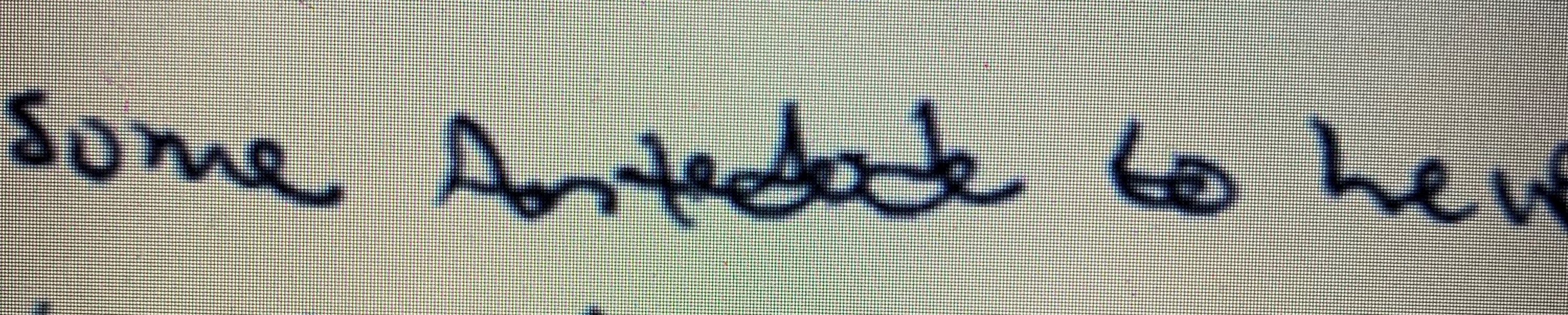
I just thought this was a fine example of knowing a term but not really knowing it. Ya know?

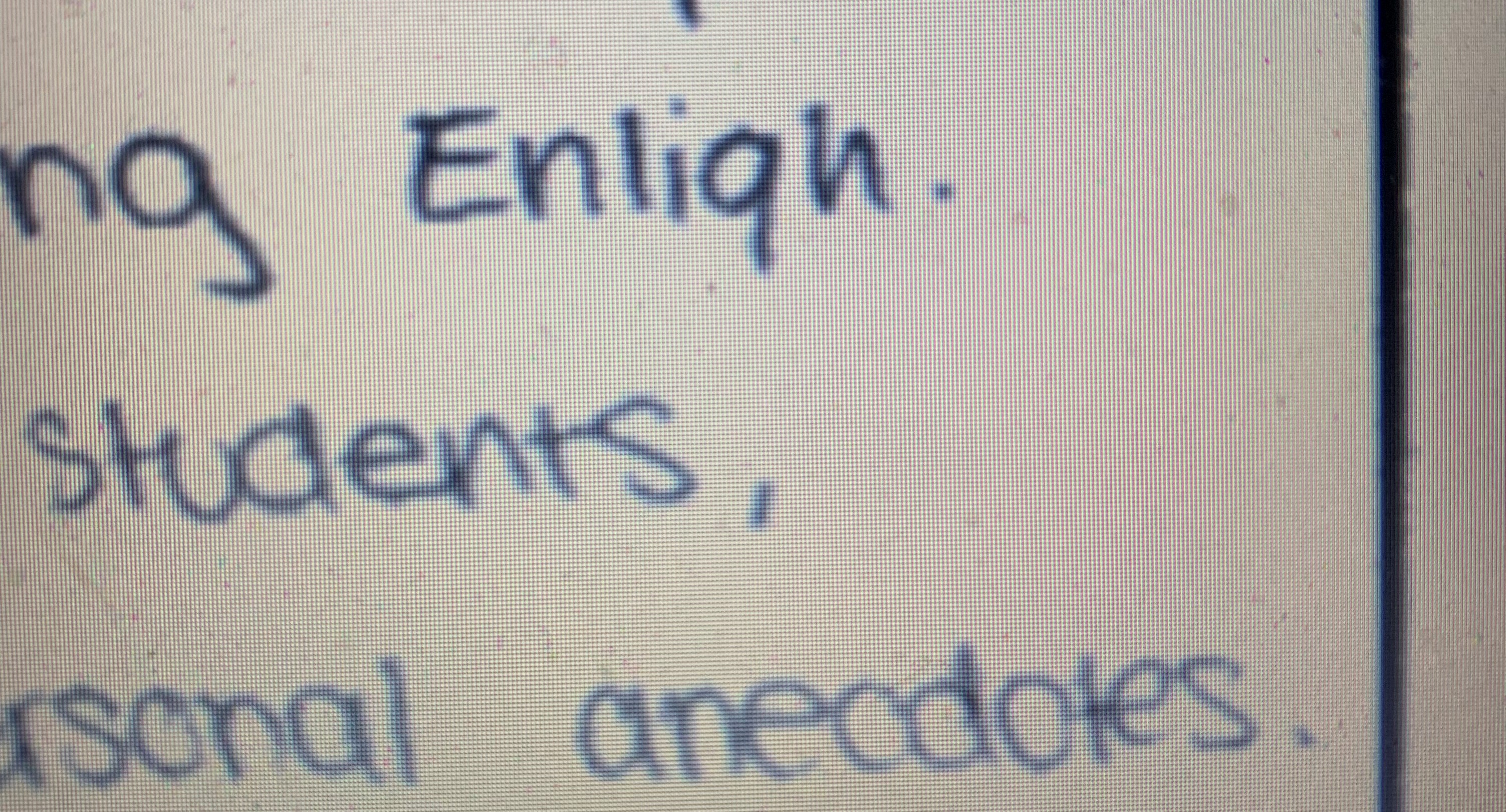
(Also I apologize for the image quality. Just trying to make a point. And the picture is not the point.)

The first one gets it right. Another one gets it right — but spells “English” as “Enligh.” Also please note the spelling of “repetition” which students repeatedly struggled with.

Fun, huh? I scored 695 essays this year. Last year it was over a thousand. And that exam passage also used anecdotes.

I’m really not trying to mock the students; just using this fact to show that knowing a term doesn’t mean you understand the term, because the word is not the thing itself. By the same token, knowing the spelling doesn’t mean you know the term, or that you understand the thing itself; which is why we ignore misspellings in scoring these essays. I think understanding the thing is much more important than knowing the word — and I’m a word guy. I love words. (Flibbertigibbet! Stooge! Cyclops! Wheeeee!) But I’m a word guy because I think this world is magnificent and incredible, and I want to understand as much of it as possible; words help me to do that, and to share my understanding of the world we live in. That complicated image I used above to show how some people can’t explain things well? Here, I’ll bring it down here so you don’t have to be confused which one I’m talking about.

This one.

This makes a few important points, even if it makes them badly. I do like how it goes from an image of the Earth, to a jumbled collage of colors inside the head, to the one word “world.” I think that, once you can follow it, makes this point well, how much translation and simplification happens between observed reality and the words we use to represent them. Though it should also lead to another head, of a listener, and show how that one word activates their own jumbled collage of colors in their head represented by the word “world.” (Far be it from me to suggest making this more complicated, though.) Because communication happens between two minds, and both minds contribute to the communication: which is why language works despite this simplifying process.

I do also like the statement at the bottom of the image: “Change the map, you change the world.” (Even though I hate how they capitalized and punctuated it.) Because that’s the last point here: while words are not the things they represent, they are incredibly important to our understanding of the world and our reality. Because we think and communicate in words. Not exclusively: my wife, for one, is deeply eloquent in communicating with images; my dogs can communicate with a look; musicians communicate with sounds that are not words. And so on. But language is our best and most effective form of interpersonal communication: and also one of the main ways we catalogue and recall our knowledge inside our heads. So getting the names of things right is incredibly important to our ability to use the information we know, and to communicate it to others. And what is the most important factor in getting the names of things right? Understanding the things we are talking about.

Because a rose by any other name would smell as sweet — but if you want people to know you are talking about one of these, you better call it a rose.

How to Say Rose in Different Languages | 1800Flowers Petal Talk

And for my sake, please spell it right.

Photo Dump

This is the last week of school, and my brain is broken, so I will not be writing. But here are pictures.

Every year we get teacher appreciation certificates. And every year, my administration tries to personalize them for every teacher — and every year, they think “Well he likes pirates…”

This appreciation gift, from one of my graduating seniors, was MUCH better. Those darts can really fly.

Last night the graduated seniors did the traditional Senior Prank. We have very nice students, so they try not to damage anything. This is what they did to the Dean of Students’ office:

They also came in this morning to clean up the mess.

And this is what they did to my room. This year’s theme was apparently — cabbage? I’m assuming it was an Avatar, The Last Airbender reference, but — I dunno, man. Cabbage. They left radishes, too.

The ridiculous mess of books and papers, by the way, is all me: I am not a neat man. And it is the end of the year.
See the two radishes? One in front of my keyboard, the other is under the phone.
This was the best cabbage placement. I left this one up for the day. (By the way: on top of the clock is a 3-D printed figurine of the Comic Book Guy from The Simpsons. He lives there.)
The cardboard head cutout was from Graduation; it’s a good likeness of one of our newest alumni. When he and I took a photo after the ceremony, I asked if I could have the head; so he left it for me last night. The Snickers bar, unfortunately, appears to be a new tradition: last year’s senior prank also included poop-chocolate on my chair. Sigh.
This is where the head cutout lives now: on top of the large Darth Vader cutout I already had on the inside of my door. This is now #DarthDrew.

And then one last thing, which has made me much happier than I was last week: at Graduation this year, and last year, we had a Flower Ceremony. We gave the graduates roses and asked them to deliver a flower to the person or people who helped them reach this achievement. Last year my favorite student tried to give me his rose (We only gave them one flower apiece last year; we realized the problem there and gave them two this year) and I told him to go give it to his mom. Then this year — I got four. Left me pretty close to speechless. Here they are (The fifth rose is actually an extra one I gave to Toni because she should always get flowers, but I’m letting it stand in for the flower I turned down last year. [Also I got her a new bouquet of flowers today because she should always get flowers.])

Thank you Than, Alex, Julia, Sofia, and Meghan. This meant the world to me.

Stop Apologizing For Hurting.

Hi me, this is yourself. You want to talk to me about something.

You weren’t going to talk to me about this today, or tomorrow, though you thought about it last week, when I posted yet another self-denigrating comment attached to a pair of links.

Listen, me. I don’t suck. I am sad.

I am sad for a number of reasons: the school year is ending, and my students don’t want to learn anything. There are a number of stressful things happening in my life, mostly around the end of the school year and graduation, but also with my writing, and with the summer, and with my house, and with family. People around me are hurting, and I want to help, and I usually can’t. All those things make me sad, and you know it.

But I also know that being sad when hard things and sad things are going on is not a failing. It is not a weakness, it is not a mistake: it is a reasonable response to a situation that I can’t control.

It is also bothering me that I can’t control the situation. I really, really want to. You do too. But I can’t. Not even the things I want to control.

I can’t control how my students feel about school. They don’t want to learn at the end of the year. This is neither new nor surprising, students kinda never want to learn anything (though they always want to learn interesting and useful things, and that should say something about the curriculum we teach in our schools, which they do not want to learn most of the time), especially not in the last month or so of school. I’ve always fought that, you know, because I hate wasting time, and I want the students to gain as much as possible from their opportunity to learn, particularly a love and appreciation of learning, and also a love and appreciation of literature and language. But I’ve always, always failed. No, that’s not true; I have instilled something of a love of learning and of literature into some of my students, and I have encouraged the love that was already there in a number of others. I have helped students get through difficult times, and made their lives easier and better. But I’ve never been able to do those good things with all of my students. Maybe that shouldn’t matter to me, but when I keep hearing about how children fall through the cracks and get forgotten, how every student is precious and none of them should get left behind — it makes me feel bad that I fail to reach all of my students.

And then I tell my friends and fellow teachers not to take it to heart when they can’t reach all of their students, when some of their students have issues and opinions that no teacher will ever be able to touch, or solve. Especially now: because the pandemic had long lasting effects on students, and they, like us, are sad. They are dealing with a whole lot of shit, and it’s hard, and they’re not good at it. It doesn’t help that the adults in their lives are dealing with our own shit, so have less time and energy to help deal with theirs: but we can’t be sorry for that. There’s only so much of our shit we can push aside in order to deal with someone else’s shit, before we just pile up too much shit of our own, and we can’t handle it any more. I think I’ve been doing that a lot for the last few years, and I don’t think I can do it any more. And I’m not sorry about that.

If I should be sorry for anything, it is not taking my own advice to heart. Because I really, really suck at that. But that doesn’t make me suck: it just makes me like everyone else. Which also makes me a little sad, because if I can’t even solve my own stupid issues, then how can there be any hope for humanity? My issues are stupid: I am smart. I should be able to solve those stupid issues, I tell myself all the time. And yet, here I am, feeling bad for feeling bad. Partly — but not entirely — because if I could simply solve all my issues, then I would have so much more capacity for helping those around me deal with their issues, which I really want to do. It’d be awful nice if I could do that. But I can’t. And I feel bad about that. For still feeling bad.

I was just talking to a student that struggles with depression, and I was telling them that they are not allowed to feel bad for feeling bad. Depression is a real thing, and feelings are not logical and cannot be reasoned with; we have essentially no control over them, and therefore should not feel bad about having them, because you shouldn’t feel bad for things that weren’t your choice, which you can’t control. And there I was, telling them they shouldn’t feel guilty for feeling bad, which they do because they are empathetic and intelligent enough to recognize that their sadness makes people around them sad, as well; but feeling guilty is useless, and trying to remove or reduce feelings because you don’t like them has not ever worked and will not ever work.

And only at the end of that conversation did I realize that I was telling them to stop being illogical with their feelings, that the feeling of guilt wasn’t reasonable and therefore they should be able to eliminate it, by reasoning with their feelings and taking control of them to eliminate them. Like the feeling of guilt is any different in essence from the feeling of depression.

And only this morning did I realize that I am doing exactly the same thing to myself.

I shouldn’t be sad. I have a good life: I am a respected and even beloved teacher, with complete job security and a sufficient if not entirely satisfactory income. I have my health: I have never been seriously injured or seriously ill, and I can pretty much do everything now that I could when I was 25. I am proud of my past accomplishments, and of the person I am. I am married to my soulmate, and I love our family of pets. I do not suffer from clinical depression, nor from past trauma. I should be fine. Sure, my country is currently mired in a political shitshow and an economic train crash, and the globe is filled with political unrest and violence, with hatred and suffering, with climate change that will make all of us and our feelings moot…

Sorry, I was going to say that none of those things should make me sad: but of course they should make me sad. They are sad and terrible things, and I am an intelligent and empathetic person, and I recognize the state of the world around me, and how it could and should be so much better than it is.

Also, my feelings aren’t reasonable, and don’t respond to logical argument. I can’t even say that the desperate state of the world is the reason for my sadness: it’s not clear to me that my sadness has a reason. It might, of course; I started this post off with a list of reasons why I am sad, and any or all of those might be the cause of my emotions. It also might in that there are things around me that create stress in me, and that stress, unresolved as it is, is more likely to bring my mood down, even if the thing itself isn’t necessarily sad; for instance, graduation stresses me out, because I have to be the MC for it (I don’t have to, but it’s expected of me and I agreed to do it, so that’s stressful), but I’ve been the MC for graduation for the last five years, and it’s always gone fine; and also, graduation is a happy day; and also, it’s not about me, so I could screw it up in a dozen different ways and nobody would care at all, because they’re focused on the graduates, not me. But I’m still stressed about that. And about renewing my credential. And about finishing my grades. And about all the other tasks I have to do in the next month or so. All of that might be what’s making me sad.

But it’s also entirely possible that I’m just sad. For no reason.

And the important thing is this: it doesn’t really matter what the reason is, because emotions are not logical. They do not necessarily come to me because of reasons. To be more clear, there may be reasons, in that there may be triggers, situations and thoughts and experiences that create despair or sorrow or grief or anxiety, which then transforms into sadness and depression; but it’s essentially impossible to know the single cause of my sadness and to therefore address the single cause of my sadness — and therefore remove the sadness. I can find the potential trigger, and I can address it; but that’s not necessarily going to remove the sadness. Because sometimes I’m sad for multiple reasons, and solving one might even highlight the others which I can’t solve. And sometimes, I’m just sad for no reason.

I just had to go through that last paragraph and change the pronouns: because I had written it, as I often do in these posts, using “we” and “one,” as in “We can find the potential trigger, and we can address it; but that’s not necessarily going to remove one’s sadness.” I started this post talking to myself so I could face the truth head on: I am sad. It’s affecting me. I can’t simply control it and remove it. That is the truth. I want to face that, and say it to myself, so I hear it, from me. (I’m just dragging you along into my internal dialogue for the hell of it.)

And, as I realized both from talking to my student and in reflecting on it with regards to myself, I can’t control the feelings of guilt and inadequacy that happen in me because (If these feelings are caused by anything?) of that sadness. See, I don’t think I should be sad. I try to talk myself out of being sad by telling myself there isn’t any good reason to be sad, that on the contrary I have many reasons to be happy. And I frequently am happy: though not as frequently of late. Too much sad time. But that sad time is getting in the way of the things I want and need to do: I should be writing blogs — I was supposed to write a book review of the excellent book Shock Doctrine by Naomi Klein, which I just finished reading and discussing with my book club — and I should be working on my novel and I should be working on my house and I should be grading my students’ work; and all of those things just sitting out there unfinished is stressful, and that’s not helping me.

And yet when I came in here, to my office, to write the book review, instead I spent half an hour scrolling idly through Facebook. I don’t even like Facebook that much any more. But I still look at it. Same thing with Twitter: I almost hate Twitter nowadays. But I still look at it. I tell other people that social media is probably not good for their mood; I tell myself that I should avoid getting into arguments online and reading negative and hateful things; but I still do both.

Because I’m sad. And I don’t have the energy or will to do the things I know I should be doing. Which, of course, makes me (Does it make me?) feel guilty and also pretty useless; and then I feel bad about myself, and that makes me (?) sad.

Or maybe I’m just sad in the first place, and these are reasons I’m applying to that feeling in some attempt to take control of my feelings, and change them through logic and reason and force of will.

Which, of course, doesn’t work.

My student told me that they have had other conversations about being depressed, and people have asked them why they were sad: and they can’t come up with a reason. They’re just sad. And then they felt stupid because they couldn’t explain reasonably why they were sad. I immediately responded that there doesn’t have to be a reason for sadness, sometimes sadness just is, and they should never feel bad about their feelings. (See how good I am at telling other people about their problems? This is why I needed to talk to myself about this.)

But I still asked why they were feeling sad, when they told me they were. Because even though I know that emotions don’t necessarily have reasons or reasonable causes, I still act like they should, and we should be able to deal with our emotions through considering those causes and then addressing them.

The problem, of course, is that sometimes it works. Sometimes talking about why we feel a certain way makes us recognize apparent causes for our emotions; and sometimes — more rarely, but still, sometimes — we can then address those apparent causes, and feel better. (Sometimes — often, even — simply talking about them makes us feel better.) Like, I worry a bit about my health. I am 48, and I am a bit overweight; not too much, but I have a pretty sizeable amount of body fat around my middle. Which is unhealthy for someone my age, as it puts stress on my cardiovascular system. I also eat WAY too much salt, drink WAY too much caffeine, and I have high blood pressure — for those reasons, and also because of stress from my job (and everything else) and also because I don’t sleep well. Because of stress and so on, and my tendency towards insomnia, which I inherited from my father. And also probably (definitely) because of the caffeine that I drink. So, okay, I should address these things before they become too serious — before they become risks to my health, before I have a heart attack or a stroke. (When I think about this, I think of my grandfather, whom I never met because he died of a massive stroke before I was born. But I try not to think about it too much. It might make [?] me sad.) So I started meditating, about two years ago. And I started going to the gym, which I have done off and on for years now, but I’ve been good about it for the last four months or so. I have also cut down my caffeine intake, though it hasn’t yet paid off in good, solid, consistent sleep.

But I have seen results. I have lost a little weight. I have gotten stronger, and I have more stamina. My sleep has improved, and the meditation has maybe had an effect on my temper, which I don’t lose as often or as intensely as I used to (Though that also may be because I am sad, and particularly because I am tired. But it may be the meditation.). My blood pressure hasn’t gone down and stayed down — but also, my measurements for that are from when I donate plasma at the Red Cross, and there are other likely reasons for my blood pressure to be high when I go to get stabbed with a needle and then drained of my precious bodily fluids. So the worry about my health has brought to mind issues that may contribute to my anxiety, and to my sadness, and I have acted to address the problem, and I have seen some results.

But then I look at the images of myself recorded by our video doorbell, and I think, “Jesus, I’m fat. When did I turn into a potato?” And then I’m sad.

And notice that my reason for feeling sad is nothing to do with the other reasons I mentioned for why I worry about my weight.

And realize, also, that my video doorbell is not a fair camera: because it is a fish-eye lens, intended to capture a wide field of view, and not intended to take flattering pictures of me as I water the plants. Reasonably speaking, I shouldn’t feel bad about either my health or the way I look.

Hey, maybe I don’t. Maybe I’m sad because my father is grieving, because he lost his wife of thirty years this past February, and though I can talk to him and support him, and he says often that talking to me makes him feel better, I can’t make him not be sad, which makes me sad. Also thinking about my health makes me think that I need to make sure I am as healthy as possible because I don’t want to die and put my wife through what my father is going through. Also I don’t want to die. Maybe thinking about that is making me sad.

Maybe I’m sad because I can’t go visit my mother this summer, because I have to do too many other things and my school shortened my vacation, and I have too many things I want to do.

Maybe I’m sad because I have too many things I want to do and not enough time, and that stresses me out, particularly when one of those things is write: because I need to define myself as a writer, or else I will only be a teacher, and that would make me sad because I can’t make all of my students learn all the time, and therefore that makes me feel like a bad teacher. Also teachers don’t get paid enough, and I don’t want to think of myself as undervalued. Not that I get paid as a writer, of course, or at least not much. I don’t sell that many books.

And maybe I’m sad because I don’t sell many books, and so it doesn’t matter if I write the next book or not, because even if — WHEN — I finish it, it won’t sell, and that’s because I’m not that good a writer, and I should just go ahead and accept being a teacher. Even if that means everyone who disparages me and my fellow teachers online will have a better case for criticizing me, and I may have more trouble ignoring their criticisms by telling myself I’m really a writer as well as a teacher.

Maybe I should stop arguing online with people who disparage teachers. Though I do feel like I should take action when I can to make our world, and especially our society, a better place, and that means standing up to people who say nasty things, and correcting and teaching people who don’t know the truth or don’t know the whole story — and that means arguing. Even though it frustrates me and makes me despair, sometimes, because people just don’t listen or don’t change their ideas or their feelings, and no matter what I say or how I fight, I can’t control their feelings.

Maybe I’m sad because I can’t change people’s feelings: not my dad’s, not my students’, not my friends’. Not mine. I want to help all of us: but I don’t have control over that, over any of it, because emotions aren’t something you can control with willpower and rational thoughts.

Maybe I’m just fucking sad.

But here’s the thing: and this is the point I’m trying to make, and the reason why I decided to write this instead of the book review (Which I will write — it’s a good book and one worth reading, even though it’s depressing [Hey, maybe that’s why I’m sad…]): because while we can’t control our feelings with our thoughts, and we can’t even really control our thoughts (Also, that’s why I’m bad at meditation, which is a stupid thing to think, and one that the teachers on the meditation app I use keep telling me not to think, but the truth is that I can’t focus my attention solely on my breathing: the thoughts keep coming, and I keep focusing on them, even after two years of practice. I feel pretty dumb about it, and also kind of desperate because of it, because if I can’t keep myself calm through meditating, then what can I do to control my blood pressure or my anger? [Hey, maybe that’s why I’m sad…]), what we can control is our behavior.

I don’t like that I’m sad. I have shit to do, shit that I know will make me happier, but I have trouble making myself do it — because I’m sad. I don’t think I deserve to be sad, which makes me think both that I’m not really sad, and also that I’m just being self-indulgent, having a little pity party, when actually my problems aren’t that bad and I shouldn’t be upset about them. People around me are much sadder than me, for much better reasons; I should be supporting them, not making their situation worse by being sad all over the place. (Also, I shouldn’t be talking about it on this blog. This is going to make people sad, and that’s a terrible thing for me to do. But I’m doing it. [Hey…])

But rather than telling myself that I shouldn’t be sad, or that I’m really not sad, what I should do is: give myself room to be sad. Maybe don’t worry about the weekends where I can’t bring myself to write a blog. But if I do worry about that and feel bad about it — because I can’t actually control my feelings — I can still do something: I can not apologize, or be mean to myself. I don’t deserve to be mean. I don’t deserve to suffer my meanness. Nobody who reads these blogs needs or wants an apology from me on the weeks when I can’t bring myself to post. If I don’t feel like writing a particular post, rather than trying to force myself, or getting mad at myself for it, maybe I can post something else, like good links. Or maybe I can write something else, like an overly personal babble about my feelings, instead of an insightful book review. Will those things make me feel better?

As of this very moment: yes.

Though maybe I feel better because I also just took a break, took my dogs outside, cleaned up the yard a bit and watered the grass so the tortoise will have something to graze. And stood out in the sunshine, which was warm but not too hot.

I don’t know why I feel a little better now. My feelings aren’t rational, and the causes aren’t clear. But the fact is, I do feel better, and so it’s reasonable to think that maybe I can do these same things again and feel better again. Maybe when I am sad, I can write about being sad, instead of trying to ignore it. Maybe when I can’t face doing a large task from my home improvement list, I can do a small one. Maybe when I think about the problems I am having, I can also remind myself of the things I’m doing to make them better — how I’m supporting my dad, even if I can’t “fix” him. How I told my student that they can always be sad, and can talk to me about it if they want to, even if I can’t rationalize their feelings and therefore eliminate the bad ones; and that made them feel better. How even if I haven’t lost all the weight I want to yet, I’ve still gone to the gym twice a week every week for four months now, and I can see and feel the results. How even if I can’t empty my mind like a Buddhist monk, it’s still good for me to sit quietly and breathe deeply for fifteen minutes or so a day.

And maybe I can stop looking at myself in the videos from that goddamn doorbell.

And what I can do, for sure, is to stop apologizing for my feelings. Because I didn’t choose them and I can’t simply control them: so they are not my fault. And while I can try to work around the limitations that my feelings put on me, the first thing I have to do is recognize both the feelings and the limitations, and accept them. Because by doing that, I accept myself — whereas apologizing for myself and my feelings tells me that I am wrong, that I have done something wrong, and that I should fix it.

That act sucks. But I don’t.

Thank you for reading this. Thank me for writing it. Let’s try being better to ourselves, first. We’re worth it.

I’m Doing My Best

Yesterday was a bad day.

That’s why I didn’t get a post up; I had one, about half done, which I started last Thursday; but yesterday I couldn’t handle finishing it and posting it.

Because yesterday, I lost faith in myself.

It’s pretty easy to do, really; I’m human, I make mistakes. All the time. Sometimes those mistakes are easy to brush off — I’m terrible at estimating time and distance; I know this about myself, so usually I don’t trust my first instinct when I think, “Oh, that’ll only take ten minutes to drive there. What is it, five miles away?” Because I know both of those numbers are wildly inaccurate. So if I need to know the distance, I will look it up; if the time to get there is important, I will double my original estimate. Or triple it, maybe. So that means I generally leave early and arrive early: but that’s no problem, because I get up every day at the crack of dawn anyway, and if I arrive early, it just means I don’t have to search for parking or an empty seat, which I hate doing anyway.

What I don’t do, however, is get mad at myself for mistaking the time or distance, and decide that I’m an idiot who can’t do anything right, and I’m therefore doomed to a life of mediocrity and failure, and it’s my fault for not working hard enough, or learning enough, or making the right decisions in the past. No, I save that kind of existential crisis for when I’ve done the worst thing I do: screw things up for somebody else.

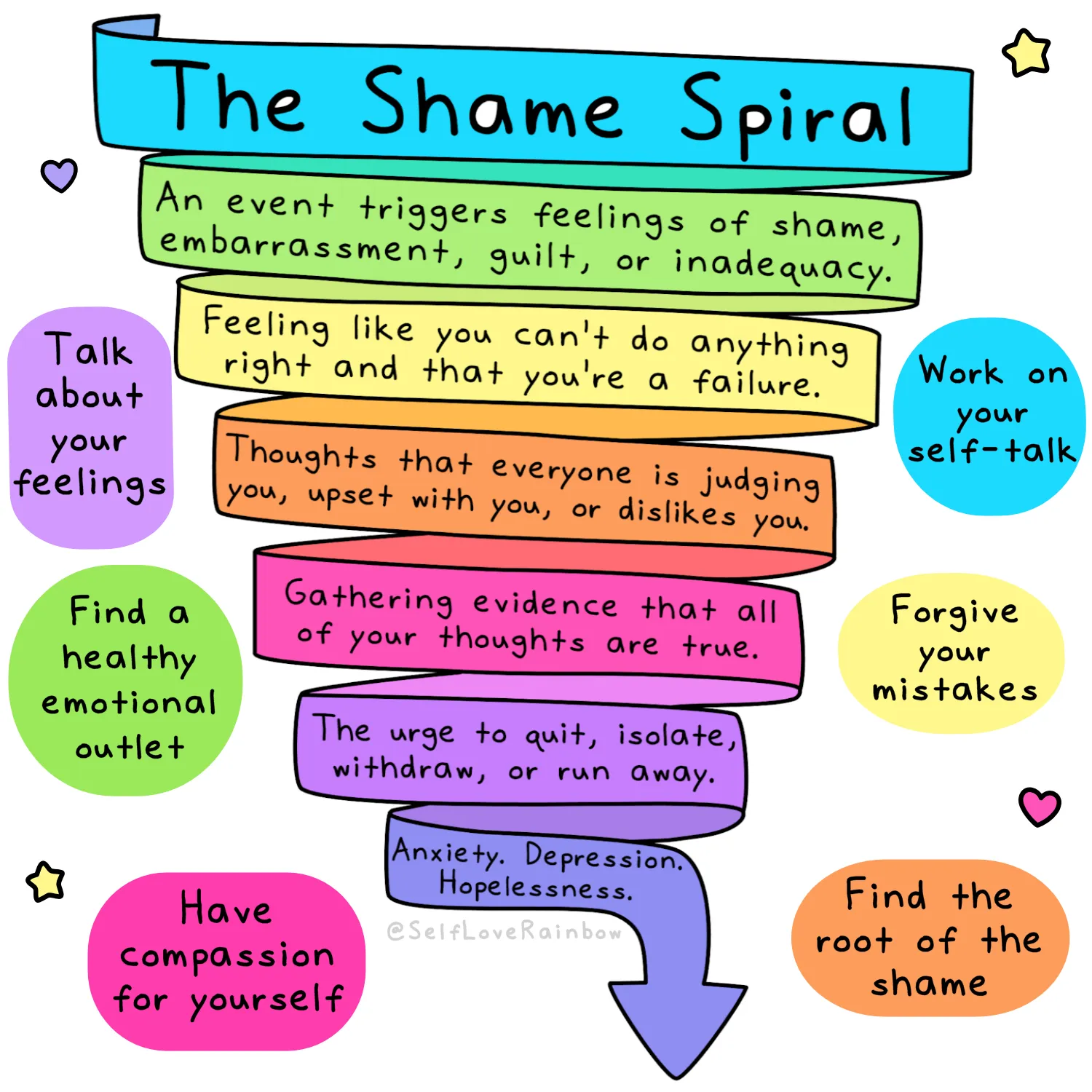
It doesn’t have to be a big thing. If I give bad advice, or advice that doesn’t help; if I teach badly, or fail to control my class, and get called out on it; if I try to do a thing and fail at it: any of those are enough to send me into a certain kind of shame-spiral, when I start thinking, Well, if I can’t do that right, then I probably can’t do those other things right; and that means everything I do is wrong, and I’m useless and stupid and I’ve wasted my life and harmed people by inflicting my stupidity on them when what they really need is someone who can help them. Basically, I think of myself as an intelligent person, and if I experience something that makes me feel unintelligent, then I doubt everything connected to my intelligence, and everything that I’ve ever done comes crashing down like a house of cards.

Of course, this is not a new phenomenon. And it is not unique to me. There’s a whole thing.

This came from this site, which looks quite delightful and helpful, so please go look if this speaks to you:

The bubbles around the edges are the ways to fight the downward spiral. I didn’t do those yesterday; I went straight to avoidance, and spent most of the day playing Minecraft. (I’m going to have to do a post on Minecraft, by the way, which I have only discovered this last year — that is, I knew about it, but I didn’t know that I would love it as much as I have grown to in the last year.) And so last night, I couldn’t sleep: because I was ashamed of having done nothing useful yesterday, including this blog, which I really do want to keep up with; and I failed. I blew it. I must be a terrible person…

Fortunately, my shame spiral this morning was interrupted by two things: first, I started writing this blog while I was eating my breakfast bagel, with the intent of finishing it tonight, because I can certainly accept posting one day late (Have I mentioned that I’m not real big on deadlines?), and so that reminded me that I can give myself one day of grace on my tasks without assuming that I am worthless; and second, I had to stop writing this blog so I could go to school. And while I was completely exhausted at school today — I was falling asleep while I was grading AP essays this morning (That is not a comment on how boring those essays were [Yes it is.] and also I surely did not lose focus on the essays while I was determining their final score […]) — and that made me cranky as hell, I also taught today. And I taught well. We went over the climactic end of the first act of The Crucible, and while my other class is not grasping the play, this class is. My AP Lit class is really getting into the details of Donald Barthelme’s amazing story GAME (Though they still haven’t figured out why Shotwell has the jacks). The Fantasy/Sci-fi class finished another chapter of The Hobbit, and I got to do a Mirkwood-spider voice, which was fun.

And now here I am, back trying once more to finish this blog.

So I am not stupid. I am not lazy. I am not incompetent, or incapable.

It is true that I’m not sure I have the level of expertise that makes this blog worth reading. Depending on the subject: when it is literature or teaching or writing, I’m fine; I understand those things better than most people, and anyone who understands them more than I do is always welcome to take issue with what I say. (Anyone is, really. Please feel free to comment on the post, or use the Feedback link on the bottom left of the screen, or go to the Contact link at the top. I’d love to hear from you, for whatever reason.) But the post I started last week is not about any of those things, so I’m more uncomfortable about it; hence, yesterday, when I was doubting myself and my abilities and my worth, I couldn’t gather the confidence to say what I want to say on the topic.

But, see, I don’t really write this blog as an expert. As I said, in literature and teaching and writing, I think I can at least hold my own, at my level — you will not find any doctoral theses on this page — but otherwise, when I write about politics or society or life, I’m not writing as an expert. I’m writing as a person. I have my perspective. I think the value I offer in this blog is not necessarily the brilliance of my insights: it is the clarity and the precision, and to some extent the humor, that I add in the writing of my insights. Basically, I’m just a guy with some ability to observe the world around me, and crystallize what I observe into a thought: and a genuine ability to put all that into words. And if that’s enough to make you read what I write, great: I hope my words on my perspective help you to have some thoughts of your own. I don’t think of it as advice.

If it hasn’t become clear, the specific problem yesterday was that I gave a student advice, and it wasn’t good advice. I mean, so it goes, right? I gave it my best shot, I didn’t make the best call. Nobody died, nothing was permanently broken. But I got into this thought pattern like: If I don’t give good advice, what am I doing teaching? If I don’t understand teenagers well enough to know what they should do in a certain situation, why do I work with them? Why should they listen to me? And if I’ve wasted 23 years of my life teaching when I shouldn’t be doing it in the first place, am I doing that only because I need to avoid being a writer for real? And I’m just fooling myself into thinking I’m a good teacher when actually I’m just kinda charming and easygoing, and so the students like me because I don’t make them work too hard, and that’s why I’ve kept my job even though I’m basically incompetent and, let’s face it, just pretty fucking stupid, right???

And what the hell am I doing offering my wisdom on this blog if I can’t even give good advice? Why would anyone listen to me?

I dunno. Why would anyone listen to anyone? Because sometimes, we get things right. Even if sometimes we don’t.

So here’s what I want to do. I don’t want to give advice: because I don’t know more than other people do, except in my small areas of expertise. But I do want to share some of the things I have figured out. I want to share my understanding, my perspective. And if it is helpful, or if it is interesting, then great: and if not, come back next week and see if I have anything better to say.

Okay?

Here we go.

#1: Love really does make the world go round.

Also The Beatles are even more wonderful than you think they are.

My greatest joy is my wife. Living with her, seeing her, talking to her; supporting her, cheering her on, protecting her, watching her be amazing. She is my everything: because I love her. That keeps me wanting to do more with her and for her, and keeps me from being tired of her or resenting her or any of that other shit that comes between people. I am incredibly lucky that I can still feel this strongly for her after almost 30 years: but if I didn’t, if she didn’t still love me, then I would hope we could amicably separate, and go find other people to love. Because love is the most important thing in our relationship, as it is the most important thing in any of our lives. That love is more important than the relationship: the relationship remains because the love remains (And if we fell out of love, we might have a companionable love that would remain, and we could stay in that kind of relationship, and that would be fine: as long as there is love. It doesn’t always have to be the same kind of love. [Though I hope it does stay. It’s awfully nice.]), and the love is what matters, more than the relationship.

I write because I love it. I read because I love it. I teach because, basically, I love humanity. I am a pacifist for the same reason (Even though sometimes I want to hit my — well, maybe not my students. But I want to hit things around them, you know?). Every important thing about me is based on what I love, or what I don’t.

Love is everything.

#2: Life is long — but never long enough to do everything you want.

I hear people talk about how fast time goes: and I don’t understand it. I mean, sure, my childhood is loooooong gone, and I don’t remember everything that happened between then and now; so that might seem like it was a shorter time than it should have seemed like; and I have definitely felt some dilation of time in the last few years: I cannot fathom that the pandemic and the quarantine were three years ago. So I definitely do that thing where I go “What?!? Three years??? Seriously? Where did the time go?”

But then I actually think about it: and the last three years have been — three years long. I’ve done a whooooole lot of stuff in that time. A lot of it is the same stuff over and over again, but it’s been different every time. And it’s always like that. Life is very long. I hear the cliches about how we only have a very short time on this Earth and in this life, and that’s true: but only from the perspective of mountains. From a human perspective, we have a very long time to live. My students are so goddamn young; and I am 30 years older than they are. And 30 years? That’s a long fucking time. If I have 30 years left to live, that’s a long fucking time left. A very long time.

At the same time: in those 30 or 40 or 20 or however many years I have remaining, there are more things that I will not do, than there are things I will do. Partly because I will have to spend a huge amount of those remaining years doing shit like — grading AP essays while I try not to fall asleep. And that time lost will be sad, because it won’t be spent doing things I love. And it should be. Because see #1.

So we have to pick and choose what we spend our time doing. It’s important to choose, and to do it intentionally, and thoughtfully, as much as we can. Don’t let time slip by without paying attention to it at all; because we have a lot of time — but we can still waste it, and we shouldn’t. We should love our lives, as much as we can. Because #1.

#3: There are three things you can have with any job, any task, anything you buy or hire for: you can have good, you can have fast, and you can have cheap. You can only have two of them at a time. So if it’s good and fast, it ain’t cheap; if it’s good and cheap, it ain’t fast; and if it’s fast and cheap, it ain’t good.

This is the best single piece of wisdom I ever got from my dad (Though there are a lot of other things he’s taught me, more than I could count. It’s just that this is the best.). I think about this all the time. I’ve written about it a lot of times, too. Hiring a plumber: not cheap. But usually they do good work, if they’re professionals; and it’s always MUCH faster than doing the repair yourself. Or you can think about it in terms of buying a car: you can get a POS rusted-out Mustang, that still might be fast, and it will be comparatively cheap: but that won’t be a good car. Or you can get a good, cheap car like a used Toyota — and it will not be fast. Or you can buy a good fast car: but it’ll cost you. Or getting music on the Internet: you can get free music without ads (That’s what I’m calling “fast” in this case: no download delays and minimal interruptions), if you don’t mind listening to shit on Soundcloud; or you can get good music fast (without ads) if you don’t mind paying for premium services; or you can get free good music on YouTube (I’m currently listening to this, which I find both beautiful and amazing, but I also genuinely feel bad for this guy’s forearms. It’s like you can smell the tendonitis in the air, like smoke.) if you don’t mind sitting through ads.

Also: you don’t always get two. You can get only one. Or you can get none: because you can buy expensive shit that takes a long time to get finished, and when it’s done, it still sucks.

#4: The most important thing in any relationship, from friendship to love to family to business to neighborhood association to — anything — is communication.

I’m teaching argument right now, and if my students are understanding it, they should be figuring out that the first key to any argument, to understanding what someone else is saying, is always to define your terms. And clarify your meaning. And show where you get your information from, and why it leads you to the conclusions it does. And the same is true in any interaction: I am a good teacher because I want to understand my students, and I’m good at making them understand me. My wife and I still have a strong relationship, apart from our love, which is irrational and magical and incomprehensible and the most powerful force in the universe, because we communicate: because we tell each other what we think and feel, and we listen when the other is talking. I get along with my coworkers because I talk to them and listen to them. My students don’t complain about my grades because I am clear about why I give students what I give them — and if they have opinions about those grades, I listen to them, fairly. And if their communication makes sense to me, I am willing to change the grade. Their parents don’t complain about me because whenever they have a question for me, I answer it, fully, completely, and honestly.

Corollary to #4: communication requires honesty, which is why honesty — not patience, not courage, not intelligence nor openmindedness nor anything else — is the most important virtue.

No, you don’t have to be honest all the time. Yes, you can lie and say someone looks good in that outfit, or the food was tasty when it was not. But understand the consequences of those lies. And be as honest as you can.

#5: Everybody should have pets.

I have no opinion for or against children: if you want them, I wish you the very best; if you don’t, I wish you the same. But everyone should get pets. They are pure love and they teach pure love.

I always use the dogs for this, so here’s a video of Dunkie the cockatiel whistling. He’s adorable, too.

#6: Everybody should exercise, even if it’s only walking. Or dancing.

When I was a kid, I rode my bike everywhere. So much better than driving. Now I walk my dogs every chance I get, and also go to the gym. Movement helps with everything physical, mental, and emotional. We were made to move: so do it. Make sure it is something you enjoy, or you won’t do it — but when you enjoy it, do it as much as you can. It’s always good for you.

#7: Doing it yourself is better than buying it: but see #2. And #3, because doing something yourself instead of buying it is cheap, which means you can’t have it be both good and fast.

I was thinking of this in context of making food. Cooking yourself is healthier, in this country; generally cheaper than food from a restaurant (If it’s not cheaper, it’s DEFINITELY healthier), and if you can do it right, it tastes better, too. My advice for cooking is to learn a couple of specific dishes, and really master those: I can’t make eggs, but I can make three different kinds of mac and cheese, and they are all AMAZING. Also I am good with sandwiches. And my wife says I make good salads, too.

But it goes beyond that: my wife and I (with my dad’s help when he came for a visit) painted our first house, the entire exterior, two coats; and we did a hell of a job, and it was an accomplishment I was proud of. It was worth doing. But it did take a damn long time, I will say. It was a lot of work. Because of that, it is certainly worth it to hire an expert to do things for you sometimes, rather than take the time to do it yourself, always, because #2 means you have to pick and choose where and how you spend your time.

But if it’s important to you, and if you love it, do it yourself, as much as possible. Learn how and then do it.

#8: Everybody should read.

More than we do, unless you already read as much as you possibly can. I’m not against watching TV and movies and playing video games, and all outside/physical activities are good too, as is just relaxing and doing nothing. But we all need to read. It does more for the mind than any other intellectual activity. It brings us closer to the world every time we do it, because good writing is about the world. And writing is communication, which allows us to build and strengthen relationships, every time we read. It’s just the best thing. We should do it more.

Also, it will prevent the arrival of the world of Fahrenheit 451, which is closer now than ever before, and getting closer all the time — and that is not a good thing.

Also: everything is better with music. So listen to lots of music.

Now I’m listening to this. And to be honest, I have something of a pseudo-crush on the singer/songwriter/rhythm guitarist for this band. Which I’m only saying because honesty is important. And nobody is 100% straight. And damn, he’s got a good voice.

Also, this is maybe my favorite love song. Though I don’t have a crush on this singer. But he does have an amazing voice. Damn fine piano player, too. And I have no idea how he made this gruesome concept into a romantic song — but he did.

And this is one of my favorite songs about life. Which I should listen to more. It makes me feel better about myself.

#9: Put your own mask on first.

When the oxygen masks fall from the ceiling in an airplane emergency, what do they tell us to do? Put your own mask on before helping anyone else. Because if you pass out from lack of oxygen, you can’t help anyone.

I suck at this. I sacrifice myself for others all the time. Not in the grand sense: there’s almost no one I would be willing to die for; and the ones I would be willing to die for, I don’t want to die for, because I want to stay alive so I can love them and be loved by them. But I give up way, way, WAY too much of my time and energy for other people. I fight for my political beliefs because I want to do good in the world. I spend too much time working on my teaching because I want to help my students. And I do these things even when I can’t find the strength to do it: because it’s important to me. And then, when I do take a day off to play some Minecraft, I feel guilty about it for days afterwards. I get mad at my wife when she does things that I was going to do — say, vacuum or wash the dishes — because I was going to do them, and she shouldn’t have to do my tasks. But one of my favorite things to do for her is to take a chore that she was planning on doing, and do it for her, so she can relax.

But the more I spend of myself on others, the less there is of me. We get used up. And we don’t realize it, because we think we’re happy helping others — and we are (At least I am [and maybe I should have included the statement Don’t Be a Selfish Asshole, but I feel like we all know that already. Right?]), but helping others takes energy. It takes time. It takes: when we give, we lose something, even if we get a little bit back from sharing joy and human kindness. Whereas if we would take the time to take care of ourselves, we would have more to spend helping the people we want to help, the more capable we would be to do the things we want to do, which would then give us more time and energy and satisfaction/happiness to be able to share more with others. Think of it in terms of #2: a low-stress life will let me live longer; and the happier and more content I am, the more energy and will I would have to do things that I want to do — like paint my own house. Or help my students learn how to write better arguments. Or learn how to cook eggs. But if I am stressed, then I don’t want to learn to cook eggs: I just want to order a pizza and watch TV.

So: take care of yourself first. And then take care of other people. Definitely do the second one: putting time and energy into other people helps with #1, and makes all of our lives better; but do it second. Put yourself first. When you don’t need any more attention, you’ll turn to others; and it won’t be a struggle. Happy people are helpful people. Helpful people are happy people.

And that explains the current state of the GOP.

Frank Thorp V on Twitter: "Randy Rigdon of Cincinnati wears a "TRUMP 2016 - FUCK  YOUR FEELINGS" shirt at Trump's rally at the US Bank Arena ==>  https://t.co/HFDnuJYdHJ" / Twitter
Look at ’em. Are those happy people? They are not.

#10: Be kind. Everybody deserves it — though not everyone deserves it twice.

Make sure you are kind to yourself, too, and that certainly means removing unkind people from your life: and don’t feel bad about it when you do it. But otherwise: start every interaction with kindness, and try to end every interaction the same way. Why? Because

Follicular Analogy

I have to get my hair cut.

Ugh.

I hate getting my hair cut. I don’t like spending money, or making appointments and keeping them — actually, making appointments is no problem at all; I enjoy being flexible with my time, since I have few commitments that occur at determined dates and times, and I like feeling accomplished because I did an organizing thing. But I hate keeping them. And I hate small talk, which is almost inescapable with a hair stylist; fortunately they are incredibly nice people most of the time, but that just makes me feel guilty for not wanting to chat about my day, and not having a dozen insignificant topics to draw from. Hey, what can I say? I don’t watch sports, I don’t pay attention to awards shows or The Bachelorette, I don’t go out on the town, I don’t have children. Unless you want to talk about my dogs, or the annotated edition of J.R.R. Tolkien’s The Hobbit which I am currently reading, I don’t want to talk about whatever you want to talk about.

Is it wrong to say that I like it when I find hairstylists who don’t like talking? It feels mean. I don’t mind the ones who like talking, because they tend to carry the conversation for me, and I can react to other people talking about their kids or their sports teams or what have you. But it’s nice when I can just be left to my own thoughts. It’s rare, though, which is part of why I don’t like getting my hair cut.

I used to have the perfect system: I had very long hair when I was young.

No photo description available.
Me in high school with my dad
No photo description available.
Me in college with my iguana Carmalita. Who never kicked my ass at Gin Rummy like my father was doing in the above photo.

It was easy! I just never got my hair cut. If you look at the end of my ponytail in the second one, you can see all the split ends; but if you just don’t care about things like that, then you never have to worry about getting haircuts.

I used to get grief for the long hair, in high school when they used to call me a hippie, and in college when they used to call me Fabio; but it was worth it to avoid the haircuts. (Also, my hair was one of the things my wife noticed when she first spotted me, so it was part of the reason I found the love of my life — so there, all you long-hair-haters) But as I got older, and my hair got thinner on top, it started looking really bad when it got too long; so my perfect solution eventually stopped working.

I found another solution during the pandemic: I shaved my head.

No photo description available.
I shaved my beard off this last summer; I like saying that I shaved the top half of my head in 2020, and the bottom half in 2022.

That also meant I didn’t have to get a haircut for quite a while; but on the other hand, shaving it was a pain — I also don’t particularly like shaving, though for different reasons; I don’t have to worry about small talk when it’s just me with a razor. Then again, I never worry about shedding blood when I go to a hairstylist, so. — and I decided there will come a day when I will have little choice but to shave my head, and I might as well enjoy my hair while I still have it. I do recognize that I am lucky to have most of my hair at 48, and that it is mostly still my original color and texture. All of which I like.

I originally started growing my hair long not actually for the sake of growing my hair long: but because I got a terrible haircut. (This is not a good comparison, but there’s a meme about people being complimented for their maturity, and they say “Oh, thanks, it was the trauma.” I did that not long ago, with one of my students who is very mature and extremely self-aware; after I complimented them on it, I realized that it was because of the severe anxiety they have always dealt with, which makes them hyperaware of their own emotional state, and the years of therapy they have gone through because of that anxiety, which has taught them coping mechanisms. I adjusted my compliment.) It was during 8th grade, when I had been growing my hair out somewhat intentionally because my friends had long hair and liked heavy metal music, as I did; but at the end of the school year I signed up for a class trip to Italy, led by my Italian language teacher, and my mom took me to get a haircut before my passport photo. The stylist she brought me to was an Italian-American man (Not unusual in Boston, of course), and when I mentioned during my awkward small talk that I was going on a trip to Italy, the stylist said, “Oh, well, Italian girls like short hair.” And he cut all my hair off. Even worse, he poofed it up in front, which was very much the style at the time — and very much not my style, ever. I went out to the car while my mom paid, and I looked in the mirror, and I actually cried.

06.02.2014: Happy 48th Birthday, Mr. Rick Astley! | Rick astley, Peliculas  en cartelera, Cantantes de los 80
I looked a little like this. Not as cool, though.

(By the way, if you’re hoping for a photo of Bad Pompadour Dusty, no such photo exists. The poof washed out of my hair, and I just had short hair in my passport photo. And a sad look in my eyes.)

So after that, I just stopped going to hairstylists. And as I said, it worked for me very well for almost twenty years. (I will also note that the last decade of those twenty years, my wife trimmed my hair for me when the split ends got too bad.) And now that I can’t do it any more, I’m a little sad; but also, I have a stylist I like a lot, and when my hair gets too long, as it is now, I make an appointment, and I go. I don’t want to, and I bitch about it — but I go.

Just like the dentist: though that didn’t work as well when I didn’t go to one during my first years of college. Now I go regularly, even though I hate it even more than getting haircuts: it’s even more money, and far more discomfort, and now somehow I am supposed to make small talk while my mouth is cranked open and filled with dental instruments and dental fingers. And sometimes, just as I dream of shaving my head permanently, maybe with lasers, so I never have to get another haircut, I dream of just pulling out all my teeth and getting dentures: so that when those teeth break, I can just order new ones without ever having to sit in one of those torturer’s chairs ever again.

This last week has been a bad week, so when I thought about this topic — when I remembered that I had an appointment this afternoon — I thought it would be nice to write about something superficial and simple, like hair, and how much I liked having long hair and how much I dislike having to get haircuts. I had been thinking about writing on an education-related topic — namely the argument I had on Twitter (The brief one; the long one is also vaguely education related, but much more bigotry-focused and education-adjacent, and that will get its own full length post, because the topic deserves it as hair does not) about how to address behavior problems in students at school. An education “pundit” named Daniel Buck — who is really just a troll who wants to make himself a name as a right-wing education pundit, and has succeeded to the extent that he’s already gotten a book published and been called in for at least one interview on Fox, where he repeated his talking points without offering a single scrap of evidence, as he is wont to do — commented about how good students prefer to be in classrooms where discipline is strictly maintained. Another person replied to his Tweet with the observation that 80% of misbehavior comes from 20% of students, and recommended expelling those students so the rest of the kids could learn and teachers could focus on teaching.

I have a lot to say about that. But I had trouble yesterday, when I generally sit down to write these posts, and then again this morning; I was much more tempted to just dash off something quick about how much I liked having long hair and how much I hate paying both money and time to get my hair cut short. It didn’t help that I went to the gym this morning — and came out to a flat tire on my bike, which made me have to walk home. I don’t mind walking, of course, and the travel either by foot or by bike is good cardio and cooldown regardless; which I definitely need because I have high blood pressure which ain’t gonna get any better the more I deal with student misbehavior (or arguments on Twitter) — but it did take longer to walk home, and at the end of it I was tired.

But somewhere on that walk, I realized: these are the same topic.

(That’s right, folks — I’ve trapped you into reading about education all this time with another long-winded analogy. Though the title of the post should have given it away. I will also note here that my first attempt at a title for this post was AnaloJollies, trying to make a funny portmanteau out of the word “analogy” that had a lighter tone to it; but seeing the word written out like that made me realize it had a whooooooole different impact based on what it looks like I would be talking about in a post titled that. I will not be writing THAT post.)

(At least not until I get my colonoscopy next summer.)

You see, the argument for expelling the 20% of students who are responsible for most misbehavior is flawed for a number of reasons. The first and most important is that the identification of those — let’s call them “troublemakers” for the sake of the argument — is fraught. Very fraught. Let’s start with the fact that the 20% responsible for 80% of misbehavior are dependent on the misbehaviors being measured: they are not the same students across the board. In other words, while 20% of students or so are responsible for 80% of tardies, and 20% of students are responsible for 80% of disrespectful defiance of teachers, those 20% of the students are not the same. It’s a Venn diagram: there is some crossover, some number of students who are mainly responsible for tardies and for defiance; but the slice is not the whole circle. So in determining which 20% of students we want to expel, we need to start by deciding which behavior is the one that deserves expulsion: and first, we need to realize that violent behavior, or drug use or sexual assault or theft or anything really severe, generally already results in expulsion; and second, we need to realize that expelling the 20% of students mainly responsible for defiance will not reduce tardies by 80%, but by some much smaller number — and so for the rest of the behaviors we don’t like.

Furthermore, identifying the behaviors that “disrupt learning” for the “good” kids is not so simple. If a student is habitually noisy, if they speak loudly and often out of turn during independent seatwork, if they ask constant irritating questions of the teacher — but also they are generally respectful of others, especially of teachers, and are never late to class or what have you — which misbehavior expulsion will catch that kid? Which expulsion net will remove the distraction of a kid who just likes to make loud noises with their mouths while they work? (This example, by the way, was brought to you by a middle school student I have been acquainted with, a straight-A student who could not be quiet for more than 30 seconds at a time. Very respectful. Very smart. Deeply fucking annoying. But I don’t think “This kid annoys the shit out of me” is reasonable grounds for expulsion, do you? Particularly not if our goal is to isolate the students who want to learn, because this kid very much wanted to learn. They just wanted to do it noisily.)

And lastly, the big issue here (Actually there are two, I’ll get to the other big issue in a sec) is the false assumption that misbehavior is static. That the 20% who are responsible for 80% of misbehaviors are always the same kids, and that once you remove them, the problem will be solved. Obviously that’s not true, simply because new students come to the school, to every school, with every new school year; but to this the supporters of 20% expulsion rates would simply say that we would need to identify the bad 20% in the new class and chuck them to the curb as quickly as possible. But even more than new students, the problem is this: nature abhors a vacuum — and so do students. If you remove a child who is disruptive of a learning environment, there will be others who will begin to act up in much the same way that the removed child did. I’ve seen it happen several times. Often the most disruptive student is intimidating to other students, who then feel free to act out when the #1 student is no longer there to intimidate them; even more often, at least in high school, students enjoy the disruption, even if they sometimes get mad about losing learning time, because school is boring, and watching a teacher get mad and a kid get in trouble is interesting. So if the #1 troublemaker vanishes, other students will likely fill in by becoming more disruptive, to break up the boredom, because then they will get the attention and even the admiration of their peers. Or, in an even more likely scenario, a student’s behavior will change over the school year: because misbehavior is not actually static, because kids act out for many reasons, very few of which are their immutable personal characteristics. Tardies are probably the best example of this: if you look at school-wide data, you will find that many tardies come from the same small group of students, who are frequently late to class because they walk slowly, or they hang out with their friends, or they avoid class for any one of a hundred reasons — but you will also find that many students are late only to one class, maybe because the two rooms are too far away from each other, or maybe because their ride to school won’t leave early enough to get them there on time. My freshman year of high school I had some obscene number of tardies — because my ride to school was my older brother, who didn’t give a shit about getting there on time. So I never got there on time. And you can see this behavior frequency change overnight, if a kid changes parent custody, or if they move farther away from school, or if there’s a sudden issue with a car, or a change in parent job status, and so on. And though it is a good example, it’s not just tardies: students often, if not usually, if not always, act out at school because of what’s going on at home. You can bet that, after you expel the troublemaking 20%, some other kid’s home life will fall apart due to divorce or a parent losing a job or some other unforeseeable circumstance, and that child will begin to act out in class.

The point is, you can expel the worst troublemakers, and you will still have trouble. Trouble is inevitable. It is school: they are children. Anybody who pretends there weren’t problems in the past exactly like the problems today is lying, or privileged. Sure, there were very few gang fights when I was in high school: but it’s not because the school expelled all the gangsters before they could start fights; it was because I went to a wealthy suburban high school where the student body was 90% White, and there were no gangs. And I can state for an absolute fact that we had the same number of students who were disruptive because they had ADHD, because I was friends with several of them; they were just undiagnosed, and frequently self-medicated with marijuana by the time they reached high school. When they were kids we called them “hyper,” and laughed at their antics in the classroom. Listen to the immortal George Carlin do his routine on being a class clown, in the 1940’s and 50’s in New York, and you will quickly recognize that young Mr. Carlin was bright, respectful — and deeply, constantly disruptive. Wouldn’t surprise me at all to hear that he had ADHD. I guarantee that Robin Williams did.

Listen closely around 7:45 when Carlin gets his audience to make one of the best group-based noises I’ve ever heard.

The other big problem here is the idea that expelling children from school is a good thing. The idea that the children you expel are deserving of expulsion — or that they are not deserving of an education. This is false, and it is a travesty. Again, while I recognize that some children are genuinely dangerous to their peers — I have been in public education for 23 years, after going through 13 years of public school myself; of course I realize that some children cannot be trusted to respect the safety or the rights of others — I expect that children who are actual threats to others will be expelled from school, and probably should be. But even those, even the worst troublemakers, even the ones who harm others: they are still children. And children both need and deserve an education. Some should not receive their education in the same place as other children; but accommodations can be made for that. Particularly now that we can offer many students the option of remote learning. Even if that weren’t an option, we should all realize that the best thing that could possibly be done for most students who have and cause trouble in school is — an education. If those students cause trouble because they are struggling, then finding a way to help them learn will eliminate the struggle and thus the misbehavior. If someone misbehaves because they are on a bad track, which may lead them to more serious issues in life, such as addiction or criminal behavior, then again, the best thing a school can do for them is help them gain an education and more positive and productive skills and knowledge. Expelling students does none of these things: it simply tells the student that they are less important and less valuable than the other students, less deserving of education and all the things that come with it; and that’s not going to help anybody get better at anything.

No: expulsion of problem students is not the answer. The answer has much more to do with all of the ideas that Mr. Buck and most right-wing edupundits find anathema: restorative justice and social services and educational supports for students in need, despite (or even because of) their disruptive behavior in class. As I have now said several times, students who are dangerous to others should be removed from a classroom of potential victims; but even there it is more useful to think of that process as isolating those students, while maintaining their status as students, as children with the right to an education, who will benefit from an education. We should remember that isolation does have negative impacts on the students who are isolated, but the basic goal of educating all members of our society is not lost with isolation, as it would be with expulsion. (I do realize, as well, that students who are expelled are given further opportunities to learn and improve; I support those systems. I’m just responding to the argument as it was presented to me: the final response was expulsion. The reason was to “save” the “good” students from having their learning “ruined” by the “bad” students.

(Here is where I bring it back to the analogy. That’s right: time to talk about cutting hair. It’s okay if you forgot.)

Expelling students to solve the problem of behavior is seeking a permanent solution to an ongoing problem. It is exactly like trying to fix one’s hair by yanking out the bad hair. In order to avoid the difficult work of handling students who misbehave, trying to find why they act as they do and then addressing the underlying issue, we simply remove the students: it’s like shaving your head to avoid having to get your hair cut. Or, I suppose, plucking out the long hairs, keeping the short ones. Though I suppose “long hair” is not the analogous problem; I should talk about hair that causes problems — you know, the hair in the cowlick, which won’t lay right no matter how you try to comb it; that one hair that curls around and tickles the inside of my ear, or pokes me in the eye. Those hairs should definitely be plucked. Doing so will solve the problem entirely. Then I can focus on the good hairs, and keeping them on track where I want them. And if any of those good hairs step out of line — I’ll pluck them, too.

Rather than seeking simple, permanent solutions to complicated problems like student misbehavior, we should think of addressing student misbehavior the way we think of maintaining hair, or working out, or doing anything that requires long term effort: the key is to build a routine. To find the right tools and resources, to recognize the roots of the issues (No pun intended), and to realize that long term, incremental changes are most likely to have positive effects. If one has high blood pressure, say, the answer is not to remove the angry blood causing the problems, as they would have in Shakespeare’s time (Which I hope we can agree was not a good system); and it is not necessarily to expunge all the causes of stress instantly and without consideration. I would have much less stress if I quit teaching: but the new situation I found myself in would cause me new problems, which would give me all new stress. If one has bad hair, one should look at one’s shampoo, one’s hair care routine, one’s hairstylist and relationship with one’s hairstylist, and try to work through all of those concerns to fix the bad hair — rather than just yanking out 20% of one’s hair and throwing it away to concentrate on the other 80%. The answer is also not to do what I did when I was young, and simply accept that bad behavior exists, like split ends, like cavities in teeth; the analogy falls apart here because an individual hair is not important, and an individual child is. But the prescription for all of these issues is the same: address the problem. Slowly. Carefully. But address it, don’t just ignore it or remove it and throw it all away.

If we want to address student misbehavior, the key is not to expel the “bad” students; it is to work, over the long haul, to turn “bad” students into “good” students. To help the problematic students to solve their problems, and to make progress instead of trouble.

Now I have to go get a haircut.

Imperfect Persistence


One of my flaws as a teacher is my insistence on persistence. I like finishing things: I don’t like leaving them incomplete. It’s a problem for my classroom because it means that I don’t always adapt quickly to how my students are taking in the material, how much they are learning from it; I have, more times than I can count, stubbornly kept on reading the same piece, the same essay, the same story, the same book, even though my students have completely lost interest, simply because WE’RE NOT DONE YET. Maybe even worse, I have gotten irritated about reading excerpts, and have gone ahead and given my students the entire piece to read, just so we can do the whole thing; then, when they get tired of it — or, honestly, if the author gets out of their golden zone and drops down into less stellar writing — and nobody is paying any attention to what I am reading, I keep reading it anyway. Why? BECAUSE WE’RE NOT DONE YET. Again, this is because I was unsatisfied with an excerpt, and insisted on reading the whole thing. (This example, by the way, comes from my experience with Ralph Waldo Emerson’s “On Self-Reliance,” which is a lyrically beautiful piece of writing, with amazing ideas in it — aaaaaand it’s also over 10,000 words long, which is about 19 pages of 19th century transcendentalist sermon. Most textbooks that cover the era or the genre have excerpts from it. I gave a class the whole thing and tried to read it to them. The excerpts were better.)

To be somewhat more fair to me, I love literature and words and writing and reading more than I can clearly explain; so for me, all of Emerson’s essay is beautiful, and essentially all of it can be inspiring. I also feel a sense of — duty, I suppose, in that I find it disrespectful to take only excerpts from a longer piece. If all Emerson had to say was the thing about trusting yourself, that’s all he would have said; obviously, he thought there was more that was worth saying, and since Emerson was an incredible genius with words and ideas, and one of my heroes and inspirations, I want to honor the man and his work by taking it in, and giving it to my students, in the form Emerson intended: all 19 pages of it. So I gave my students the whole thing to read because I thought, and I think, that it’s worth reading the whole thing, that reading the whole piece is the right thing to do.

It turned out they disagreed with me, and as always, the students win those arguments by the simple expedient of shutting down, no matter how passionately I read, or how carefully I point out the valuable material in the rest of the essay after you get past the “Trust thyself: every heart vibrates to that iron string.” Maybe there’s a way I could have maintained their interest as Emerson goes on and on and on — no, there’s definitely a way; I just don’t know that it’s worth it when there are other good things to read in the world, and limited time to do that reading. At some point even my desire to finish things caves in the face of continued passive resistance, and I do (I did with Emerson) give up and discard the piece in favor of something newer and more interesting for the class to work on.

Though if I think their resistance to the learning was because they were being lame, rather than me being lame in my choice of material or pedagogy, I will often re-inflict the same sort of thing on them. I mean, what if we move on from Emerson — and go straight to Thoreau? CheckMATE, teenagers! Transcendentalism IN YO FACE!

On the other hand, one of my flaws as a political activist is a distinct lack of persistence. Or maybe it’s a lack of focus: I don’t have a single cause that I fight for; inasmuch as I have a political side and a set of causes to fight for, I don’t push myself very far into that fight. I give up very easily. I will argue until the cows come home — and then I will argue with the cows — but I won’t go out and do things, won’t collect signatures or donations, won’t canvass or march, won’t join political action committees or grass roots organizations. It goes straight back to the same point I made with what I teach in my class: because as much as I love literature, I do not love being around people. I guess I won’t say I hate it, because there are certain people I like being around as much as possible; but I hate going out among strangers. It’s one of the things that makes teaching an acceptable career for me, as an introvert; because I get to know my students, in some cases quite well, and that makes me more comfortable being around them. I hate the beginning of the year, and I hate getting new students and losing old students I like; because new students in new classes are strangers, and I don’t want to be around them until I get to know them better. (I don’t have to like them, actually, but I still feel more comfortable and get along better with students I know and dislike, than with students I can’t even recognize or attach a name to.) But that same discomfort with new, strange people keeps me out of political activity: because a march is thousands of people I don’t know, and all other grass roots political activity is focused entirely on meeting new people and getting them into the fight on my side. And I don’t want to do that.

But the result is, I don’t do much to make the world a better place, even though I want to, even though, knowing my abilities, and ignoring my personality and preferences and comfort level and anxieties and everything else apart from my abilities, I always tell myself that I would be good at politics. And I would: I think well, I listen well, I speak well; I’m very good with people. But also, there’s simply no way that I could be happy and comfortable being surrounded by strangers all the time, which is essentially the life of most political activists. Certainly the life of politicians, which I have also thought (And continue to think, in my less self-aware moments) that I could be successfully. I could give a speech. I could draft a law, and argue for it. Of course, I wouldn’t be able to make and maintain the friendships and alliances that would be absolutely necessary to get anything at all done in politics; I’d always want to just go back to my office, sit by myself, maybe read something; but that doesn’t matter, right?

Thinking this way has always had me considering whether or not I should start running for political office. (Also my students frequently tell me that I would be a good candidate and they would vote for me. It would mean a whole lot more if they voted. Or knew anything about political candidates beyond the most superficial information. Hey, they’re kids; what do you expect? It’s nice to hear, which is actually their point anyway.) I could start small, maybe a local school board; then something like a state representative, and then who knows? Congressman Humphrey? Why not? I wouldn’t want to go much farther than that, since greater power requires greater compromise, and I wouldn’t want to sell out; but I hear about congresspeople like Earl Blumenauer of Oregon, who do the work of the Congress, who do the research and write the bills and all the behind-the-scenes grinding that is required to get stuff done. I could do that, I think. It would be useful if I did that. And I would give a good speech, and I would be awesome in a debate. Which makes me think I could get some useful things done, if I could go that far.

It struck me hard in this strange, idle ambition of mine when I heard that Mitch McConnell, whom I loathe more than most politically opposed people in this country, but who is unquestionably one of the most effective politicians of the last half-century if not more, absolutely hated working with Barack Obama: because Obama wanted to explain the ideas behind his political goals and actions, wanted to get into the philosophy and convince McConnell to work with him on the merits of the thoughts and his ability to communicate them; and McConnell just wanted to do a fucking deal. Because that would 1000% be me, trying to get into the underlying morality and the cause and effect of any legislation or policy I wanted to pursue; and the other politicians, the deal makers and negotiators, all those goddamn extroverts, would just roll their eyes and say they had another appointment.

So no. I should not go into politics. I should not run for office. If I could just jump straight into the role for which I am suited, I would be a real asset to the country or the state or whoever I worked for — I would make a hell of a speechwriter, I think — but that’s sort of like the ambition I had when I was a kid, to work my way into the NBA by becoming a 100% never-fail flawless free-throw shooter, who they could substitute in whenever a foul was called, and then I could calmly hit all the free throws and help win the game, despite being 5’10” and essentially unathletic. The problem being, of course, that the game doesn’t work that way. To become a speechwriter for a political campaign or organization, I would have to work in the field, and especially network in the field, for years; and I would have to do all the things I don’t want to do in order to do the one thing I want to do.

This same persistence makes me a good author, because I can keep working on one story until it is a whole book. And the same lack of persistence makes me an unpublished author with five — almost seven — genuinely good novels sitting on my computer, and not on bookstore shelves. The contrast, and what seems to me to be fairly extreme opposite traits, is difficult to wrap my head around sometimes: because how can I give up so easily on some things, and fight so goddamn hard and so goddamn long on others? If I’m willing to put in so very much time and effort to write a novel, to the extent that it takes over my life at times, and becomes one of my defining attributes, that I am a writer, that I am a novelist: why on Earth won’t I fight to get my books published? Do I just want to write, but not have other people read what I write? Why would I want that? And yet, that seems to be exactly the life choice that I have made: I’ve been writing novels for almost 20 years now, and have not published a single one, other than through self-publishing. (I know, I know — hang on, I’ll come back to it.) But you see, I know, with a bone-deep conviction of total understanding, that writing is communication, and therefore requires an audience for the writing to be anything real. I want people to read what I write. I am happy that people came and read my blog two weeks ago, when I posted the chapter from my novel Brute, and I am disappointed that fewer people read the one from last week, about Martin Luther King’s Letter from Birmingham Jail. (That combination has contributed significantly to this topic, by the way. I’ll come back to that, too.) I do want readers. I want my work to be published.

So why do I give up?

And the larger problem is, how do I get myself to change? If I can’t understand my motivations, the causes of my actions, I can’t address them, can’t change them; self-awareness is the most important factor in self-change. How do I tell myself to keep fighting for the things I give up on, when there’s no simple explanation for why I give up on those things and not on others? I’m neither 100% stubborn, nor 100% (Hey, what’s the opposite of stubborn? Wishy-washy? Flimsy? Weak-willed? Maybe adaptable.) adaptable, so I can’t just point at my nature and say “That’s just who I am, I never/always give up.” At the same time, if I’m willing to give up on things because of inherent or essential aspects of my personality — I am not going to stop being an introvert, which means I’m never going to be a good political operative — why do I keep persisting in the areas that are just going to keep hitting this wall? If I’m never going to be a good political operative, why do I keep trying to get involved in politics? If I’m never going to push myself to publish a novel, why the fuck do I keep writing them?

This is where I come back to self-publishing, then. Because honestly? It’s the perfect compromise. I have printed and sold somewhere in the hundreds of copies of my three published novels. (One has never been printed because it’s only available as an ebook. But there are a fair number of people who have read it electronically.) That means I have an audience: I have readers. The feedback I have gotten from my readers about my novels has been almost entirely positive. (Some people think I’m too wordy. No, sorry: EVERYBODY, including me, thinks I’m too wordy; some people think that’s a problem with my books. Mostly agents and publishers.) It also means I don’t have to do all the shitty things I would have to do if I were to become a professionally, traditionally published author, namely: I don’t have to compromise. I don’t have to edit my books to someone else’s standard, which standard would be almost entirely derived from what the market research said would be most profitable. Why didn’t my first novel sell? Because it was too long: it’s a young adult fantasy novel, based almost to the point of plagiarism, on Harry Potter, and it’s 600 pages long. And sure, the last HP books topped 600 pages — but the first two did not. After those first two became the most popular YA fantasy novels of all time, Rowling was able to write whatever the fuck she wanted and sell it to anyone, which is how we got The Cursed Child. (By the way, I liked parts of that. But not enough of it. And there’s no reason on Earth why it is a very short play, rather than what would likely have been a very good novel, other than Rowling decided she wanted to write a play, and was arrogant enough to think she had to be right because she’s JK Rowling. Which is also how we got this neverending TERF bullshit that has tainted the entire franchise. Sometimes persistence is not a virtue.) So once again, I want to skip all the difficult stuff and just go right to doing whatever the fuck I want to do, namely writing the very long books I enjoy writing.

However: let me also point out that the book is so long because it’s actually two and almost three books combined into one: the character has a life in the “real world,” a second life in the world of dreams which is the main fantasy aspect — and a third life in a role-playing game he runs, which I narrated as a real story, lending the book an element of swords-and-sorcery fantasy which I think is a real strength. Telling three stories means a lot of pages. Also a lot of work. But even writing this paragraph out here is making me excited about the concept all over again; maybe it’s time to go back and write the sequels I never wrote. Because I gave up on that series when it didn’t sell, even though I loved it and loved where I planned to have it go.

So maybe I do give up on writing sometimes. Well, like I said, I did eventually stop reading “On Self-Reliance” at my students. I don’t like doing things that don’t work. I don’t like wasting time. I have too much other stuff to do. More productive stuff.

More productive stuff like publishing my own books. Another accomplishment I am very proud of. And even though I don’t like being around strangers, I have, twice now, been very successful at selling my novels to strangers at a booth at the Tucson Festival of Books. Which I’m going to do again this year. And that’s an area where I actually like interacting with people: because they are book people, and I get to talk to them about pirates and stuff. And then they give me money, and they take my book away with them, and hopefully read it and enjoy it. A couple of them have told me they did read it and enjoy it, so I think I can assume that other people did, too. (I know for sure that several of my friends have read and enjoyed my books, and I’m grateful for that, and for them. I’m just saying that of the strangers who bought my books, most of them probably read the books, and some number of them enjoyed the books. A couple of those strangers have told me so.)

So then, why, if I’m happy self-publishing, if I get an audience and also a sense of accomplishment, and freedom as a writer — why do I still want to publish with a traditional legacy publishing house?

Because my other dreams and aspirations persist, too. I don’t just want to write: I want to get rich from writing. I want to be famous because of my writing. I want to be invited to speak on a panel at a convention, where I can see people dressed as my characters. I want people to write essays about my books like I have written essays about the authors whose works I admire.

It’s the same thing with politics: I don’t want to be around strangers and I don’t want to compromise; but I do want to make a difference. I do want to make the world a better place, to make people’s lives happier and more fulfilling. And sure, I’d like to be famous as a politician, too. As someone who made a difference. (Also, if I was a politician then I could get my damn books published.)

I meant for this topic to be just a brief introduction, a lil hook, to my intended goal with this post: to finish talking about Dr. King’s Letter from Birmingham Jail. There’s a whole second half, more than half, of that essay which I left off, last week. I talked to my brother, who told me the interesting truth that Martin Luther King Jr. Day is his favorite holiday: that the ideas and values represented by the holiday, associated with Dr. King, are closest to him, most important to him, compared to those associated with other holidays. And I told him that I had just written about Dr. King that weekend, about the Letter, and he asked which piece by Dr. King that was: was it the one about the long, slow arc of justice that bends towards freedom? No, I said, it was the one where he said “Injustice anywhere is a threat to justice everywhere.”

“Oh,” my brother said, “the one about white moderates, about how he was disappointed by the white moderates.”

“That’s the one,” I confirmed: and immediately felt guilty. Because I left that part out. I stopped before that section of the Letter, which goes on for many more pages, covering many more ideas — and continuing to be brilliant.

I should have kept going, I thought. I didn’t finish the piece, and I left out important parts of it.

But then again, my wife, after reading the post last week, said it was good — but also that it was long. And my WordPress stats counter told me that not very many people read it. (Actually, my most popular posts continue to be my old book reviews, a couple of them in particular, and some of my essays about novels — especially the one about The Lord of the Rings and Gollum, and The Metamorphosis and Gregor Samsa.)

Regardless, though, I thought this week, I would finish analyzing the rest of the Letter. For Dr. King, another of my ideological and wordsmithing heroes; and for my brother, and for the sake of getting to the powerful statements the Letter makes in the last two-thirds, particularly about just laws and unjust laws, and about white moderates. Because, first, I want to finish the piece; and second, I worry that I am one of those white moderates who would have disappointed Dr. King. Because I don’t keep fighting for justice, don’t maintain my persistent participation in the political struggles that affect people in this country and in this world.

And thinking about that got me to here. On a subject about which, apparently, I have a lot to say. (I think I will probably finish analyzing the Letter next week. But we’ll see.)

I don’t want to be one of the white moderates who disappointed Dr. King. I don’t want to be wishy-washy, and tell myself that I’m being adaptable, when the thing I am adapting to and accepting is failure to do what is right, what should be done. If I should get my books published, I don’t want to be a coward who gave up and failed simply because I didn’t have the strength of will, the persistence, to keep fighting. If I have a role to play in achieving a more just world, I do not want to be the person who backed away from the fight simply because I don’t feel comfortable around strangers.

But the answer to this is not what I am implying there — what I frequently catch myself saying to myself, as a criticism, until I remember that it should not be a criticism, not even of myself. The answer is not to never give up, ever, for any reason under any circumstances ever ever ever. The answer is not to become a zealot who never compromises, to become an extremist. (Though Dr. King makes a wonderful point about extremists in the Letter, calling himself an extremist for love, and for freedom, and for justice. I could be that kind of extremist, I think.) Dr. King himself was a moderate: he wanted change to come without violence, without tearing down the systems and institutions that were tainted with intolerance and injustice. He wanted this country to be better: but he still wanted it to be this country.

I’m reading a book, currently — Shock Doctrine, by Naomi Klein — that is about extremists who were willing to do anything to achieve their ideological goals: they recognized that the only way to really achieve the change they wanted was to create a crisis, a shock, that would set a people back on their heels, and while the people were all reeling, the changes could be implemented because people wouldn’t be able to resist. And those people? They’re evil. Not only because their ideas were wrong and bad for humanity (The specific group Klein is focusing on is the neoliberal economists of the University of Chicago, under their prophet Milton Friedman — and fuck that guy), but because they refused to accept anything less than everything. They were not moderates. Their economic theory requires absolute purity, not a single element of compromise; and so they are zealots. And because Friedman was himself a zealot, who spent his long life fighting for this one cause, for this one idea, for the supremacy of his theories and the absolute elimination of all else, he did incalculable harm to this world. And it stuns me, and I’ve commented to myself in my annotations in the book (Of course I annotate books I read. Don’t you?), that Friedman and his colleagues and disciples could have such complete courage in their convictions, such unwavering confidence in themselves and their rightness, and their righteousness. Such complete, perfect, persistence. The ideology and Friedman’s example both lend strength to that tendency; but I think that’s a sign of zealotry in all cases, that absolute unquestioning confidence. And zealotry, in all cases, is bad.

I don’t want to be a zealot. Not even for a good cause. But I also don’t want to be weak, don’t want to give up when a fight is worth fighting.

So the answer?

Compromise.

Self-publishing my novels is the right thing for me to do. It’s where my focus and my energy should go. I may send away queries to agents, sure, and I may even hit the lottery and get published; but otherwise, I should compromise between what I want, and what the reality of my strengths and weaknesses dictate. There’s no point in wishing I could network with the publishing industry and get published that way; it’s not who I am. Sure, self-publishing means I am unlikely to ever get rich and famous from my writing; but that’s the idea of compromise: you don’t get all of what you want. But you focus on the main goals, and you work hard to get those, even if you have to give up something else.

My main goal has always been to be a writer. To create worlds. Part of that means I need to have people read and participate in my writing. That’s the main goal. That’s what’s important. And if I have to give up fame and money in order to achieve that? Fine. Probably better for me, even if it doesn’t feel like that.

Another of my main goals has always been to help people. This one, like the goal of becoming a writer, is essential to who I am, and who I want to be. If I want to make a difference, it doesn’t have to be a difference that affects the whole world, or even the whole country or the whole state: making a difference for one person is making a difference in the world. And I do that: for my family and friends, for my readers, and for my students. And since I’ve had thousands of students, I can actually say that I’ve had a pretty strong impact on the world around me, because I have had an effect on a pretty big number of people.

And I did it by staying true to who I am, and knowing what I can do and do well, and then doing that, exactly that. Not by wishing I could do something else, or be someone I am not. I do wish, sometimes, that I could do or be more than I am — I wish I was more tech-savvy as a teacher, and more organized, and better about using different styles of teaching and learning; and I wish I could be more of an extrovert when it would be useful to interact more with other people — but I have my strongest effect, and make my greatest progress, by doing what I do well, and persisting in that. Knowing what is actually important and what is actually good — and knowing, on the other hand, what would be nice, but isn’t necessary. And also, in contrast to Milton Friedman and his Chicago Boys (And if you want to know why I will continue to say #FUCKMILTONFRIEDMAN, read Shock Doctrine, or listen to Unfucking the Republic.), being open to the idea that what you think is the most important thing, and what you think is true, may not be — and being willing to learn what is true. That is also part of knowing what is really important, what is really good. I believe that reading is vital for everyone, that to be able to have a full and valuable life you must be literate: but I am coming to accept the idea that people don’t need to read. It’s still good and always will be, and for me personally it is vital; but not everyone needs to read. I can accept that. Because I’m not a zealot. And I’m not an asshole.

I’m not saying you shouldn’t have some confidence, some persistence in believing that what you think is actually true: you need some. I have to believe my writing is good enough to publish, or I would never put it in front of any audience, and then I would not be a writer. It’s important to believe in yourself and your decisions, to trust your decisions about what is important, which means you need to trust yourself; but the best way to do that, in my experience, is to trust your process whereby you came to the decision, and to base it on good processes: gather information, verify the information, draw conclusions from what you know; be open to newer or better information, even if it contradicts what you used to believe. As long as you are willing to abide by new information (also, good information), then what you decide based on what you currently know is the best you can do: and that should be good enough. Trust yourself — but verify your information. Friedman never questioned himself, not even when other facts interfered with his conclusions; he had an explanation for everything that showed how his theories weren’t flawed, it was the world that was wrong. That’s too much self-confidence. That’s arrogance and zealotry. But also, when I ask why I never got published, part of me wants to think it is because I’m not a good writer: and I know that isn’t true. I am a good writer.

What I am, is someone who has read Emerson’s “On Self-Reliance,” the whole thing. I understand what he meant when he said “Trust thyself.” And I know that his point rests on an older commandment, which is even more important: Know thyself. Know what you can do. Know what you should do. And when those two streams converge, when the two strings vibrate in harmony: keep going, keep fighting, and never give up.

More Weight

Continuing from last week’s post, I still want to discuss the probability of education collapsing under the current weight we are carrying. In last week’s post, I wrote about how educators are leaving the profession, largely but not exclusively due to the poor pay compared to the duties and expectations of the job; and rather than deal with that problem, America is asking teachers to do more to cover the gaps left by those who have already made it off of the sinking ship, which is making it even harder on those of us who remain.

Today I want to talk about the other reason why people are leaving.

It’s because we’re tired.

I had another day, yesterday. Another day that wore me out completely, that left me dragging my way home, feeling drained and depressed even after I had a lovely, fun, relaxing evening with friends, and even after dinner with my wife. I woke up this morning feeling the same way: at least partly because I have to go back and face the same classes, the same students, who wore me out yesterday, which certainly puts a pall on the morning; but partly because I just don’t have the energy to keep going back and doing all of this, day after day after day. I used to have it: but it’s gone now. And that fact makes me worry about my long-term future as a teacher, and even more, it makes me worry about the long term future of education.

Now, I don’t want to sound like I’m whining: I recognize that everyone is dealing with this, and all of us for the same reasons. I do not think that teachers have it harder than everyone else; that’s not my point.

My point is that teachers have it harder than we used to have it.

I’ve been a teacher for 22 years, and it’s always been hard. But it’s gotten tangibly worse in the last three years.

Here’s the problem, and what I felt yesterday and what I have watched get worse and worse and worse for the last three years: we’re tired, more now than ever before, and all for the same reason. All of us: students, teachers, parents, administrators and staff. We’re all so tired. The pandemic and the shutdown took this already difficult and troubled endeavor — using limited and uneven resources to provide a complete education for every student in the country — and made it so much harder. Over a two-week span, between March 13 and March 31, I had to change everything I had done for 20 years before that, and essentially without any help or guidance, because everyone else was doing the same. Students, too, had to try to adjust to a brand new, entirely different way of learning, at the tail end of the school year — and they, like their teachers and parents and all of their supports, were also dealing with the threat of a deadly pandemic, and all of the political and economic turmoil that came with it. Worrying about ourselves and our loved ones, and the whole world, while trying to build whole new resources for learning, on the fly, before the school year ended. It’s the hardest thing I’ve ever done.

And it didn’t stop there: at the end of that school year, we were still in a serious quarantine, still watching the crisis take the lives of millions of people around the world, watching economies crumble, watching our “leaders” screw the whole thing up in a hundred ways (And worrying that the election in the fall was not going to fix that problem, and uncertain what we could or should do about that) — and knowing, the whole time, that we would need to continue doing things differently in the fall, when classes started up again. That whole summer, I had no idea what to do about the coming school year. I wasn’t sure what it was going to look like. At the time, I was primarily worried that we would have in-person classes, and I was confident that I would, therefore, get COVID, because children are germ factories, and every teacher gets sick every year, usually several times, because children sneeze on us; so I knew that I would probably get it, whatever precautions I took — and I was certain that I would bring it home and give it to my wife, who has indeed gotten numerous colds and flus over the two decades of my teaching career for precisely that reason; and because she has severe allergies and consequent asthma, I was terrified that COVID would kill her. That’s what I spent my summer worrying about. And I know I wasn’t alone.

And before I leave that terrible summer of 2020 to talk about the terrible school year of 2020-2021, let me point out another aspect of the whole ordeal that affected me and other high school teachers — and to a different extent, teachers at all grade levels: graduation. It’s one of the parts of the school year that makes being a teacher worth it: to watch our students cross that final finish line, accomplish this remarkable achievement, and to celebrate it with them, is one of the great joys of being in education. I expect elementary and middle school teachers have the same feeling watching their students move on to the next stage; but high school graduation is the real rite of passage, and it is a tremendous source of joy and satisfaction. I have for the last five years taken a key role in the actual commencement ceremony at my school, as I took over the Master of Ceremonies duty after my predecessor left: I’m the one who welcomes the students and their families to the ceremony; I’m the one who reads all their names as they come up to get their diploma; I’m the one who tells them to turn the tassels to the right, to officially mark their completion of their mandatory education. It means a lot to me, because it means a lot to them.

And in 2020, we didn’t have it.

We did, actually; precisely because we knew graduation meant so much to the students and their families, and because the seniors who were graduating in 2020 had already lost the last third of their senior year, including Prom and the Senior Trip, we found a way to make graduation work. We had it outside, during the day — in 100+° heat, in glaring sunshine, in masks with social distancing. But it was terrible, and the graduates have told me since they wish we hadn’t had it then; they would have preferred to come back a year or two later and had a proper ceremony inside, with a tiny hint of reunion. Ah, well. Hindsight is — never mind.

We had a graduation ceremony, but it didn’t feel right. Just like everything else that year didn’t feel right. The usual rewards for what we do were missing. The usual joys were all stripped away from us, leaving only the bad things behind, the worry, the stress and anxiety and fear. And the anger. And the exhaustion. The exhaustion from doing all the work, first, while also trying to make joy when there wasn’t any, trying desperately first to hold onto normal, and then to recapture and recreate normal after it had vanished. It didn’t work: we would have been better off moving on to new normals, finding new joys. Frankly, we should have known that from the outset, should have accepted it and dealt with reality instead of trying to cling to a doomed past; but I guess when it comes to longing for what has been lost in a time of upheaval, we’re all Boomers.

But we tried. We tried to lift up that weight, to make everything okay even when it wasn’t okay. And like adults all over the world who try to conceal difficulty in order to protect their children, we were suffering ourselves while we were trying to lift up that weight. We couldn’t do it, but we tried. And that trying took everything we had.

We haven’t gotten it back.

Okay. I’m losing control of this. I apologize: I started this post Friday morning, and now it is Sunday morning, and I want to finish it and post it, but — I don’t know what else to say. I don’t know what point I’m making. I don’t know where I’m going with this.

I don’t know if any of this makes sense; I don’t know if other people had the same experience — or a worse one. I’ve tried to imagine what it must have been like to go through all of that and also lose your job and your home, move back in with family with your own family coming with you, or even move onto the streets; I certainly have enough examples of people all around me who have lost their homes, as the unhoused population has exploded in the last two years, here in Tucson, where it doesn’t snow and kill people with cold (Though the heat is certainly deadly in the summer) and therefore the population of visibly desperate people is larger and more obvious; but I find myself shying away from that. It’s another result of everything we’ve gone through, the trauma we have suffered, the grief we are still suffering for what we have lost, for the joys that were taken and have not and will never return: the loss of empathy. I can’t do it, can’t reach out and take on the feelings of other people, not like I used to. I don’t have room. I have too many feelings inside me already. And yes, that means I shouldn’t be talking about all of this to other people who are also suffering empathy overload. All I can say is, I seem to not have any choice. I looked back at my posts for the last two years, and I realized that I keep writing this same thing, over and over, about every six months: I’m tired. This sucks. I can’t take this any more. And here I am again. Again. I’m frankly getting sick of myself feeling this way.

And just like that, I know that I am speaking for others as well: because I know other people feel that, too. We’re sick of ourselves feeling this way. Sick of being tired. Sick of being angry. Sick of not feeling the happiness we used to feel. Just fucking sick of all of it. Aren’t you? Aren’t we all?

I’ve had more students come to me for help this year. Not help with school work, my students never do that; help with their lives. Help with their emotions. I am sort of a pseudo-therapist: mainly because I listen well, and I know how not to give too much advice when people really just need to talk. And I’m very pleased that I can help young people who need help: but also, I don’t know how much more weight I can carry. Judging from how this post has gone, the answer is — not much.. Not very much more weight at all. I got pissed, just furious, on Friday this past week, the same day I started writing this post, because my administration sent out an email reminding all of the teachers that we need to update our grades, and that the expectation is that we should all have two grades per week, per class, which means we should now have 10-12 grades in the gradebook. The reason they sent this email and prodded us to update our grades? Sports. The student athletes who had failing grades, who had turned in their work, had not had their grades updated for as long as three weeks, and so they still couldn’t play.

This blew my top. Completely. First because I don’t have two grades per week per class; not every class does work at that exact pace — my AP classes, for example, tend towards larger, longer projects, because they are doing college-level work, which for English generally has complete essays to write and full books to read, not worksheets to complete in a half hour — and secondly because I don’t have all the assignments graded. Know why? Because they are essays. I read them. I comment on them. I give suggestions for how to improve them. It takes time: 20-30 minutes per essay. I have just about 100 students in classes that write essays (I teach two electives that don’t currently include essay writing): that means, if I give them all essays and they all write them (The latter is far less likely than the former, though they do all trickle in eventually), then I have 50 hours of grading to do. That’s on top of all of my other work. And of course grading is part of my job, and yes, there is some time built into each day to get it done: one hour. Per day. Actually, 50 minutes, because I have one prep period and our periods are not a full hour long. So if I can get two essays done in that time, that means I can get all of the essays done in — yup, only ten weeks.

So of course I work before and after school on grading, and on the weekends as well; but I also have prep work to do, to get ready for my other classes. And those students who come to me for pseudo-therapeutic help? That takes time, too. And I don’t want to turn them away, because I know they’re close to the edge, and I don’t want them to harm themselves, and I don’t want them to suffer additional trauma because they get desperate and feel alone and lost. So all of that time is not spent on grading essays.

And then my admin gets on my case because kids want to play sports.

I get it: of course I do. Those sports are exactly the source of joy that I’ve been talking about which is missing. Of course those kids need that joy. And why should I stand in the way of them having that joy, when all that is needed is for me to go back and grade a piece of late work and enter it into the gradebook? Then everyone will be happy.

I mean: not me, of course. But the kids will be. And that’s all that matters, right?

I lost control of this, and I’m sorry. My wife read my last post and was pleased and complimentary to see that I had stayed on topic the entire time, which is unusual for me; I was proud of that and meant to do it again, this week. I’ve failed. But you know what? I just don’t have the strength to keep up with all of everything, and also take on more weight. I need to put something down. This week, it was this blog being rational and organized; I need to use it to vent. I will honestly try to get back to the actual project of rationally discussing and exploring the world of education; but I think I won’t be able to be focused and reasonable every week. But I do want to post every week, because I need to write and keep writing. So, for this week, here it is.

I’m fucking tired of being told, desperately, that I need to do everything I used to do, and also all of the new things that people have realized also need to get done, right away, or else everything will fall apart. That’s what it has felt like to be a teacher for as long as I’ve been teaching, because every year, they add new things, but they never take anything away: it’s just that now, it’s worse. Much worse. Because I have all this other weight on me from the pandemic and everything that came with it, including the trauma and the grief and the loss of joy. I’m fucking tired of being asked to help other people out with their needs, while not being given help with mine. (Please note: my friends, my family, my wife, they are all doing everything they can for me, all listening, all present, all willing to offer support. I’m only speaking of school people, and not the friends I have there.) And on top of all of that, I’m just fucking tired. Scroll back through my other posts for a better description of why.

Arthur Miller’s classic play “The Crucible” is about the Salem Witch Trials, and about the Red Scare of the 1950s. But really, it’s about a society turning on itself during a crisis, and devouring itself, starting with its best and most beloved members, who are destroyed mainly because they just can’t prevent the destruction, and so they become the first targets. I love teaching the play — though it’s hard to get it right, because the students have to get swept up in the story, and sweeping teenagers up in anything is difficult — and one of the big reasons is Giles Corey. Giles Corey was a real person in Salem, Massachusetts in 1692; he was an 83-year-old farmer at the time, and he was one of the casualties of the society’s inward collapse. Miller turns him into a fantastic character, a cranky old coot with a heart of gold who argues with everyone but means no real harm, who screws up and gets his wife arrested for witchcraft, and then tries desperately to save her. Because he tries to save her — because he failed to protect her in the first place — he gets accused of complicity in the conspiracy, and therefore of witchcraft. One of the complications in the original trials, highlighted in the play, is that when someone was accused of witchcraft, they had to plead guilty or not guilty; if they pled not guilty, they would go to trial, and at the time, they would surely be convicted and sentenced to death. If they pled guilty, there would be no trial and they would not serve time in jail — but their property would be confiscated and sold at auction to the highest bidder. People accused their neighbors of witchcraft in order to essentially steal their land.

But Giles was too smart for that: he had children, and he wanted his farm, which was large and prosperous and valuable, to go to his children, not to his corrupt and greedy neighbors. So when he was accused of witchcraft, he refused to plead. He wouldn’t say guilty; he wouldn’t say not guilty. (In the play, he won’t reveal the name of a friend who gave him evidence, because he knows that friend would be accused in turn; but the end result is the same.) He just kept his mouth shut and sat there.

So they tortured him. They pressed him with stones: they laid the man flat on his back, and put heavy stones on his chest, one at a time, one on top of another. And after each one, they asked him, “How do you plead?”

And Giles Corey simply said “More weight.”

I love that. I think it’s amazing, and brilliant, and courageous, and the perfect cantankerous coot’s way to say “Fuck you” to people who really need to hear someone say “Fuck you.” I admire Giles, and want to think I would be willing to do the same, to suffer torture in order to protect my family and my rights.

The problem, of course, was that Giles Corey died from the weight.

So my question for myself, and my fellow teachers, and for the society and the school system that keeps piling more on us is: how much weight can we hold? How much will they keep adding? How much weight is there?

How much more weight?

Himself

“Why am I feeling so melancholy?” he asked himself as he sat down at his computer, preparing for another long day of repetitive but difficult tasks at his second job — the second job he needs only because his first doesn’t earn him enough, no matter how hard he works at it, no matter how successful he is at the work.

“I’m just feeling so down, and I don’t know why,” he told himself, as he reminded himself to purchase the tickets sometime today so he can go visit his aging father. He adamantly doesn’t let himself think about how this could be the last time he sees the man who raised him, the man who will always be just slightly disappointed in him. Or about how he also needs to figure out how to go see his mother. He definitely doesn’t think about all of that chaos.

“I wonder what’s bothering me,” he ruminated to himself, seeing a notification that he would need to not eat anything for two hours before his appointment tomorrow, when a giant magnet will scan his head to see if there is a growth inside his ear canal which is causing the hearing loss and constant ringing he has been trying to ignore for the past year or two. His doctor assures him the growth, if it’s there, will be benign and slow-growing; the constant ringing, never getting much better or much worse since it appeared (which was probably just when he noticed it for the first time), says that the doctor is right. Though that still means that if there is a growth, then only surgery on his ear canal will alleviate the problem; and if there’s no growth, then he will have to live with this irritating sound, louder and more noticeable whenever there is a quiet moment, slowly growing louder and louder until it is the only thing he will ever hear again.

“I hate when I feel this way and don’t know why,” he complained to himself as he walked past the thermostat, which told him both that it needed servicing (The system had cost them more than they could afford a year ago, right after they bought the house they couldn’t really afford. He also doesn’t think about the inflation that has been moving up the price of everything, but never moving up his wages.) and that it was 80 degrees outside at 6:30 am. Seems like it never gets any cooler, these days. (He doesn’t think about the climate that would cost all of humanity more than they can afford in a generation or two. But he can’t do anything about that. That is, he hasn’t been able to solve the problem all by himself; he does what he can, and doesn’t think about what more he could do. He doesn’t think about this any more than everyone else does. Which is, of course, the problem. But he can’t solve that. Any more than he can solve the inflation or the political turmoil that the inflation is driving, which seems to be moving his country closer and closer to fascism. But he can’t do anything about that, so it’s better just to not think about it. Right?) But he needs to get to work.

He sits down at the computer, and as he begins to log in to the online test system where he will be scoring student essays (Always the same essay, over and over and over again) for the next several hours, he decides to stop and write about what he is feeling. “Maybe this will help me figure out what’s wrong,” he tries to convince himself, though he knows he shouldn’t be spending time writing, he needs to get to work, needs to get his hours in because they need the money, and writing — his passion, his calling, his greatest gift — has never been enough to earn a living. He has never been good enough to make a career out of it. And so he keeps teaching, and grading essays in the summer, and trying as hard as he can, every single day, not to let himself think about how he doesn’t ever have the time or the energy to write, and when he does find the chance to write, he has to keep himself from reflecting on how this writing, too, will not be good enough to get him what he wants, what he has always wanted. Because if he thinks about that, he won’t be able to find the words he wants, and finding just the right words is a great joy — and the only reward he gets from his writing, most of the time.

Himself, tired at last of listening to all this nonsense, tells him, “You’re kind of a fucking idiot, you know that? Maybe you should actually think about your thoughts, and actually feel your feelings; then you wouldn’t be confused by everything you suppress all the time.

“Dumbass.

But he doesn’t listen to himself.

Instead he takes another sip of coffee and goes to work.

He’s sure everything will work itself out.

Showing Up

One thing I have done to try to improve my situation and specifically my mood and mental health, is that I have begun meditating.

It’s something I’ve thought about doing for years, but stupidly, never thought to actually try. Well, no, I tried a time or two; I asked my wife, who has practiced meditation for years (She’s not strictly a Buddhist, but her philosophy and mindset are often — let’s call it Buddhist-adjacent) how to do it; she tried to tell me, but I wouldn’t take the step of actually having her guide me through the practice, I just wanted instructions so I could do it on my own. And she tried, but it’s hard to work just from someone’s description of meditation, so it never really came together for me. Also, I am very aware that I don’t have much time during the average day: my work day is from 8:00-4:20 (And isn’t it amazing that my high school chose 4:20 as a significant time during the day, as the time when the students need to go home; it’s surely only a matter of time until they decide that each class should be 69 minutes long, and then every middle school boy there will be lost), and my commute is about 45-60 minutes depending on traffic and who’s driving for my carpool; then I need to do the usuals around the house — I tend to get the groceries and wash the dishes because my wife does the cooking; I usually feed the dogs and take them for walks, because she cares for the birds and the tortoise– and so on. I don’t need to list the daily tasks to help you understand why my day is full. But there is the extra factor that teaching means you work at home as well as at school, and also that the work is never done. So literally any time I have a choice about what to do, one voice in my head (sometimes soft, sometimes very loud) says “Maybe you should grade something.” And then because I’m a writer, which is also a task that requires a tremendous amount of time, another voice says “Maybe you should write something.”

All of which is to say that I have struggled to set time aside for something as seemingly unnecessary as sitting quietly with my eyes closed for ten or twenty minutes, trying to empty my head. Surely I should be grading. Or writing. Or vacuuming.

But then this year, my already-full head got over-full. Might have happened with the pandemic; might have happened with buying a house this past spring; might have happened with various health crises and concerns happening to my parents and my wife’s parents. What has always been “a lot” in my head finally became “too much.” I cried out for help, on Twitter, as it happened, and a very kind fellow teacher recommended a meditation app called Headspace, with the extremely strong recommendation that the app is free for teachers. He said it helped him deal with stress, and maybe I should give it a try.

So I gave it a try.

And I liked it.

Now, it has not solved my problems; clearly, since writing these blogs is another attempt to deal with the issues I’m facing. Headspace focuses on what is called “Mindfulness meditation,” which is essentially trying to be present in the moment and fully aware of where you are and what you are feeling, without judging or thinking about the moment or where you are and what you are feeling. And maybe that’s how all meditation works; I dunno. But this meditation is mostly about emptying your mind while focusing on your breathing.

I’m proud to say that I’m good at breathing. I sort of always have been; I’ve been a singer all my life, so I’ve got pretty good breath control and lung capacity. I lost much of that when I became a smoker during my senior year of high school, and for the subsequent 19 years when I kept my pack-a-day cigarette habit; but I gave up smoking better than ten years ago, now, so my breath is back — and seriously, that does make me proud.

But I SUCK at emptying my head.

That’s oversimplifying it, because the idea is not really to empty your head; it is to step back from your thoughts, observing and acknowledging them as they arise, and then letting them go without getting caught up in them. So the thoughts come, as thoughts always do; but they don’t stay, because you don’t stay with them. I like that concept, because it makes much more sense and feels much more realistic than my original misunderstanding of meditation, which was that you were to control your mind so completely that it doesn’t think anything beyond “Ommmmmmmmm.” (And again, not an expert, so maybe that is exactly what Zen meditation, for instance, is supposed to do; but I doubt it. Because I can’t really picture that kind of thought control being possible.)

Regardless, though, I still suck at it.

I think too much. Particularly, for me, I think of scenarios and then imagine myself in them. In those scenarios, I mostly interact with other people who I am also imagining, usually my mental versions of real people I have to, or should, talk to for one reason or another. I plan out conversations, imagine the responses I would get, and then consider ways to reply to them. Sometimes they are pleasant conversations I would like to have — I might think about talking to my wife about dinner plans, for instance — but much more often they are things I am somewhat anxious about, or angry about. I think a lot about what I will say to my students, and also about what I should have said to them but didn’t say. And because I’m picturing whole scenarios and conversations, I get caught up in the thoughts much too easily. I don’t simply observe the thoughts, acknowledge them, and let them go; I grab them and hold on tight. I swallow them whole — or maybe I let them swallow me.

Point is, I can sit quietly, breath deeply, still my body; but then I sit there and think about the same bullshit I’m always thinking about. And in this last year, especially, that bullshit has become extremely stressful.

I took a walk with my dogs this morning. A long walk, which is one of my favorite things to do on the weekends, when I have time. Usually I like to listen to podcasts; that’s been how I get my news, and also how I work slowly on improving my understanding of philosophy and a few other subjects I’m especially interested in. But this morning, I stopped the podcast after no more than a minute, because I had to think about that one class.

All teachers know that one class. (Though one of the especially difficult things about teaching is that that one class changes over the course of a school year, as the students come and go, or as the year progresses and their attitudes and demeanors shift.) Mine is currently my last period sophomore English class. I don’t want to get into details, but we’ve reached the point where something has to change. And I spent the walk thinking about that. The whole time. I went through three different ways I could handle the situation, three different attitudes I could present to the students; each one with an imagined speech I would give to them on Monday.

So that’s what I mean. I get caught up in the thoughts, think about them too much, and I lose time that I should be spending relaxing and enjoying myself — which is something I very much need to do in order to reduce my stress and discontent. I’ve always done it, always gotten caught up in overthinking; but it’s worse now both because there are more things bothering me, and because I’m struggling to deal with being bothered; it takes me longer to work through the problems in my head. Often I can’t work through them.

Though I am proud to say I have come up with a solution for the class, one that I like, and I feel ready for Monday. Which is good because it means I won’t keep thinking about the same issue every time I go to sleep, and every time I wake up. When I do that, lately (another thing I’ve always done, lay in bed overthinking and imagining scenarios), I’ve tried to follow my meditation practice: focus on breathing, relax my body, let the thoughts go.

I can’t do it. Too busy thinking. And also, I suck at meditating, so I don’t really commit to relaxing into meditation, because my insomniac brain doesn’t believe it will help. By which I mean, I don’t believe it will help, because I am my insomniac brain, and I have not yet learned to trust and believe in my meditation. Because I suck at it. Can’t stop thinking, and getting caught up in my thoughts.

You know what, though? I’m still doing it. I’m still meditating. Almost every day.

And I like it.

I like taking that ten minutes or so for myself. I really like being quiet for that time. I like making a commitment, every day, to trying to do something good for me and my mood and my mental health. I like breathing deeply (Maybe I mentioned that I’m quite good at breathing) and I like trying to relax and let go. Even if I suck at it.

I think it’s helping — though again, it clearly isn’t enough on its own to make me feel good all the time — but more importantly, as the guides on the Headspace app keep telling me, it’s not about being successful, or reaching a certain goal or achievement; it’s not about judging the success or failure of my meditation practice. It’s about practicing. It’s about showing up every day, taking the time, making the commitment. And they keep assuring me, if I keep doing it, eventually I will get better at it.

We’ll see.

But the whole point about showing up, taking the time, making the commitment? That’s true. I know it from — well, everything.

I know it from teaching, because I know one of the most important things I can do for my students is show up for them, every day or as close to it as I can manage, and willing to work to help them, or as close to that as I can manage. One of the worst things I can do to them is give up on them. One of the most frustrating things about teaching is that they give up on me. Quickly. Repeatedly. En masse. But my job is still to show up for them. Which I do. But it’s hard. And getting harder. But still, I take the time, I make the commitment; and it works. If nothing else, my students almost universally respect me as a teacher, and that’s why.

I know this also from my marriage. My wife is amazing, but also, we’ve been together for more than a quarter-century (and HOLY SHIT I just realized that), and that means not everything is or has been perfect, and that means work. But we haven’t drifted apart, or lost our deep connection, because both of us show up for each other, and keep showing up for each other. Every day.

I know it from writing, because I know that writing requires me to try to keep writing, as much as I can, as often as I can. That one’s tougher, because I don’t see the rewards from it. But I do see some rewards, because I know that my writing now is better than it used to be. And it’s not because I took a class, or apprenticed myself to a mentor; it’s not because I had an epiphany, and it’s not because I met the Devil at a crossroads at midnight and sold my soul. It’s just because I keep doing it. I keep trying, I keep putting in the time and the effort.

I keep showing up.

And things get better.

So that’s what I’m hoping for with meditation.

And with everything else.

Not Much. But Something.

I’ve led a pretty charmed life. Part of me wants to feel bad about that, because I know many people who have had a much rougher time than I have, and it’s not fair; but also, it’s not my fault. I don’t think I take advantage of my advantages and privileges too much — though that doubt tells me I do it to some extent. That’s okay; I’m not perfect and don’t have to be. But with the advantages I’ve had, growing up as a white male American, with middle-upper class parents, blessed with good health and so on, I’ve been able to do pretty much everything I’ve wanted to do, other than the wilder dreams like owning my own island or becoming a space pirate and whatnot. I went to college, graduated basically debt-free, immediately gained middle-class employment as a teacher, which I’ve kept for over twenty years now — and it turns out I’m good at it, too. I have a wonderful marriage and the family of pets and no children that I’ve always wanted. I’ve been able to write a handful of pretty good books, and there will be more to come.

So why do I need help?

Partly it’s that all the privilege in the world, and all the luck, too, doesn’t actually keep me safe from troubles. It certainly shields me from many difficulties that others have to deal with on top of the troubles that I have; but the fact that I have it easier doesn’t mean I have it easy. Stress doesn’t go away just because other people have more stress. Not even if you’re aware that other people have more stress. I suppose I could try to live with more gratitude, keep counting my blessings and focusing on the positive; but when I try that, the problems keep coming back up, no matter how much I turn my focus away from them. In fact, I think that the good luck and the privilege and the blessings I do have make it harder for me to realize that I need help. They certainly make it harder to recognize this fact. Not that I’m bemoaning the white man’s burden, oh isn’t it hard to not be a victim in a world full of victims; I don’t think that about other people nor about myself. But whenever I feel troubled, I tell myself something along the lines of “What the hell are you bitching about? Look at how hard other people have it! You have all the advantages, who are you to complain?!”

But even when that works (And it usually doesn’t, because there’s a certain amount of schadenfreude in the idea that I should feel better because other people are suffering more than me; and also, comparing your life to others’ lives isn’t a good idea no matter who has the better situation), it doesn’t make the problems go away any more than gratitude does. The stress and difficulty and anxiety and sadness are still there.

A lot of it is because of teaching. It’s a stressful job to begin with, which I’ve written about at length and don’t need to rehash here; but realize that the essential task of the job is too abstract to ever feel confident about, yet everyone involved expects tangible results; and that everyone’s life touches or is touched by education, which means EVERYONE has an opinion about it, and that it is genuinely very important; and that my personality is not at all suited to teaching, even though my skills and abilities are — and I think you can see why it’s often troubling for me. I care quite a lot about doing it well; it’s hard for me to do it well; it’s impossible to know if I’m doing it well; a lot of people are watching to make sure I’m doing it well; many people think I am not doing it well, and they let me know. That’s a lot to deal with.

Now add the pandemic.

So I have been suffering. That’s the truth. Not as much as some people, but enough for me to feel it, enough for me to lose sleep, and question everything I should feel confident about (and question everything else twice), and fall occasionally into pretty deep emotional holes. Enough for me to lose my temper too often, over things that should not bother me. Enough for me to lose hope, and to feel like there’s no chance for success or improvement in the future. I won’t say I’ve been depressed, or anxious, because I have had ample experience with other people going through those specific difficulties, and mine are not the same; but a semblance of it, a shadow of it — yes. And frankly, it has sucked.

And at the same time, I hate saying that, hate saying that I’ve been suffering, because it seems to make light of other people who have it worse. But ignoring what I feel would be making light of my feelings, and that’s not fair, either. To some extent I feel some of that “MEN DON’T CRY! BE STRONG!” kind of ethos, but not very hard; I’m not very manly, and never have been, and I don’t give a shit. But I do care about other people, usually more than myself. Because it’s easier to deal with their problems than mine, of course; but that’s another thing that has become clear to me in the last eighteen months, and which helped precipitate this blog: it’s not feeling that way any more. I don’t want to help other people more than myself. I want to help myself.

Without making light of what I’m dealing with, I know that I don’t need a lot. I don’t need medication; my emotional turmoil has never yet been overwhelming. It has never kept me from going forward, from doing what I need to do — though it has sometimes kept me from what I want to do, which is why I haven’t been writing enough in the last year-plus. I am not as sure that I don’t need therapy. I don’t think I do. I admit there is some comparing there, because I know people in therapy, and they have it worse than me, which does make me say to myself, “Come on, you’re not that bad off.” There’s also the fact that I was in therapy for six years when I was a child, and though the experience has faded with the years, I remember that it didn’t seem to help anything other than the psychiatrist’s income. So I don’t think I’m at that point. I want to talk to someone, but I’m too private for that, most of the time.

So here I am. Writing these vague, rambling puddles of thought-drool.

I think it’s helping. It’s hard for me to say; I’m not very good at reading my own emotions. Not sure if that’s another aspect of the “MEN DON’T CRY!” piece of my psyche, or if it is the result of trauma that is more serious than I think it is, or if I’m just emotionally pretty stupid. All possibilities, and I have no idea how I would distinguish between them — which is also how I feel about distinguishing sadness from worry from anger from depression from — I dunno. But like I said, things tend to become more clear for me when I can write about them, so I’m going to keep trying.

Because I need something. Not much. But something.