Happy Holidays

Merry Christmas, everyone!

I love that about this time of year — the most wonderful one, according to song (though honestly, that song doesn’t have a whole lot of the most wonderful things in it: sure, it’s got the “gay happy meetings and holiday greetings,” but what’s with the “scary ghost stories and tales of the glories of Christmases long long ago?” I suppose it’s talking about A Christmas Carol, which is an excellent movie; but otherwise, who tells ghost stories on Christmas? What kind of bizarre family did that songwriter grow up in? And you know what that song doesn’t have? Eggnog.) — because I like when people wish each other well. I am not a Christian, don’t believe in the Messiah; but I still want people to be merry, and so I wish them happiness for the holidays. And other people, who don’t even know me, say the same thing: after the usual “Thanks for shopping at ____ and have a nice day!” that people recite by rote without any particular meaning behind it (Because what cashier really cares if you shop at Wal-Mart or Safeway? This is a good reason to shop small: because they mean it when they say it. Though still, I wonder how many people think about what they’re saying when they say that. I know I don’t think about it when I say “Thanks, you too.”), now they add, “And Merry Christmas!” it adds a second, more intentional level of goodwill: people actually think about it (Hopefully not only because they worry about offending people; I am generally against political correctness, as it leads to censorship; but I think we can all agree that there’s no political correctness stupider than the reaction against the “War on Christmas.” And if you don’t agree, you may not want to keep reading this blog, as I am not going to say a lot of things that make you happy. But you know what? Have a Merry Christmas, anyway. Thanks for stopping by my blog and upping my Visitor Counter. I actually appreciate it: because I have so few visitors that every one matters to me.), and they actually mean that wish: they want you to have a merry Christmas. They want you to have some happy holidays. There is kindness, during this season, in even the simplest of social interactions — pass by someone on the street, and they might smile and say Merry Christmas, too, particularly on the day itself.

You know what? We should have more days like this. More days when people think about their greetings, and mean what they say when they wish people well.

I got up this morning at about 6:15, because I went to bed late last night because I had a nap yesterday afternoon. None of these things are normal for me: I generally get home from work too late to have a nap, and so I am frequently exhausted by about 9:30 and asleep by 10:00, and that means that I wake up around 4am (I generally sleep about six hours a night. Don’t judge me. It’s Christmas.), and, more often than not, I start thinking about school and my students and the work I have to do. That means I don’t really go back to sleep, though I do sometimes, which is nice; but when I don’t, that means I’m already tired when I get up about 5:00, and through my entire day; this makes me cranky with my students and angry at my job, when neither of those things are at fault: it’s only because I’m an early-morning insomniac, which I inherited from my father. Who would also rather not wake up at 4am and fret. And, of course, since I am tired from the get-go, I am exhausted about 9:30, 10:00, and I go to bed early and sleep for about six hours.

But yesterday, Toni and I took a nap in the afternoon, for a good hour, hour and a half. So I was able to stay awake and enjoy Love Actually last night, even though we didn’t start it until 9:00 or so. Then we went to bed, I read for a little while, and then went to sleep, and slept until 6:15. And when I woke up, the most anxious thought I had was, “Oh — I have to remember to get the cinnamon rolls out of the fridge.”

You know what? We should have more days like this. Days when people can sleep in a little, and wake up thinking happy thoughts. Days when we wake up without stress, without fear.

This morning, I opened up my new container of eggnog — because the first one I bought was terrible; it was either poorly made or it was going bad when I got it, because it had that sour aftertaste that eggnog can get, a little like drinking gasoline — and took a swig to make sure it was good (No, I didn’t drink from the container; I poured it in a cup. What am I, a savage?), and it was delicious. That was a wonderful first taste for the morning. Then my coffee got finished brewing (And my coffeemaker kindly decided to get it right this morning; it has been struggling with the workload in this house, where no morning goes by without two or three pots of coffee, with another frequently brewing later in the day [On days when there isn’t a nap, that is.], and has been giving up the brew before all the water is gone from the reservoir, beeping its little beep to tell me there is coffee — until I pick up the pot, and it’s light, because it’s mostly empty, because most of the water is still in the machine, unheated, unbrewed: unacceptable. But today, that beep meant “Coffee’s ready! And Merry Christmas!”) and I poured a tall cupful into the mug I got as a gift from one of my students, added sweetener and honey and a splash of eggnog, and: perfect. Ambrosia. And I did remember to get the cinnamon rolls out of the fridge: the cinnamon rolls which Toni made from scratch yesterday, the which we enjoyed after our morning walk with Sammy. They were incredible: gooey and warm and rich and delicious. The perfect first meal of the day. Fresh cinnamon rolls, and good coffee, and eggnog.

You know what? We should have more days like this. Days when we enjoy our morning sustenance, when breakfast is a meal, rather than a fueling stop; when the coffee is enjoyable, rather than a necessary bulwark against narcolepsy. Not that I expect my wife to make cinnamon rolls every morning, far from it; I want to be able to stand and walk, in the future, and cinnamon rolls every morning would quickly turn me into one of the hoverchair-bound blobs from Wall-E. But I actually like the cereal I eat, and Toni loves toast; we both enjoy a good bagel on a weekend. The point I’m going for here is that food should be tasted, and the taste should be good; breakfast most days is neither of those things, for most people. And we should change that. Breakfast should feel like it does on Christmas.

This morning, I will be reading my new book, Zombie Spaceship Wasteland, by Patton Oswalt. My wife bought it for me at Barnes and Noble, on a whim, because though I haven’t read Patton Oswalt before, she knows that I love his standup comedy, and she knows I like reading books by comedians I like. So she bought it, I bought her a chick-lit book of the kind she likes (which I hope is good, but it’s an author I don’t know. I liked the description, though, and the fact that there is an Aunt Midge. Can’t go wrong with an Aunt Midge.), and we decided to celebrate Jolabokaflod, the Icelandic tradition of “Christmas Book Flood:” when you give each other a book on Christmas Eve, and spend the rest of the evening reading. Okay, we watched Love Actually last night instead of reading; and I have been writing this blog — and also playing Facebook games while petting my dog — instead of reading this morning, but I plan to get to it later. The point is, we looked for books for each other not working from a wish list, but just browsing, in an actual store, and picking something out that looks good based on the likes and dislikes of the intended recipient. Then we gave those gifts to each other mostly because we wanted to, not because of tradition or obligation or any attempt to impress or make up for past sins or conflicts. And they’re books.

You know what? We should have more days like this. When we find gifts for each other based on what we think the other person will like, not what they ask for. When we take our time shopping, and give the result to someone we love, just because we want to make them happy.

There are things I don’t like about Christmas. I am charging my phone, because I expect to get obligatory family phone calls today; if I don’t receive them, I will make them. And it’s not that I mind talking to my family, but I don’t like doing it only because we have to, because it’s Christmas. In a few days I will be flying to see my family, which I don’t want to do; not because I don’t want to see my family, I do, but because I am doing it largely out of obligation instead of preference, and because I don’t want to fly, and I don’t want to leave my wife and my pets for the four days I will be visiting. These sorts of things go on at Christmas. We have been having a bit of a rough month, mostly because work piled up for me and I was frustrated and resentful about it; we haven’t been feeling very Christmas-y for the last month. But because it is Christmas, and because there is such a weight of tradition around this holiday, this unfestive situation has come with a bonus: guilt. I have felt guilty for making Christmas feel melancholy, and Toni has felt guilty for not getting into the Christmas spirit and decorating and drawing her own Christmas card and sending it out early in the month to all of our friends and family. Going to visit family also reminds me of the family I will not be seeing — my mother, mainly — and that brings its own guilt. And this time of year, I feel particularly bad for the people who are down and out, and I wish I could do more to help them — and I feel guilty that I can’t. Same thing with the limited funds I have for present-buying: there are a hundred things I would buy for my wife, and for everyone I know, if I had the money. But I don’t. Because I am not wealthy. More guilt, and probably the stupidest guilt there is; but here it is, and because of Christmas.

So I’m thinking that we should have more days like Christmas, but not more Christmas.

I’ve noticed that there has been a push towards this, and away from the religious holiday season, for a while, now; that’s presumably why some folks see a war on Christmas, and fight back by getting belligerent about the “reason for the season” — you know, the Prince of Peace. But I don’t think it’s a rejection of religion so much as a common desire similar to what I’ve been talking about: we want the good stuff of the holidays, without the bad; the joy without the baggage, the presents without the wrapping, so to speak. The best thing about this day is the quiet: go outside, take a walk, and recognize how few people are driving around, how many people are at home, with their loved ones, spending some quiet time. It’s like the whole world is taking a breath. It’s lovely, and it’s rare; I think the only days of the year when this happens are Thanksgiving, Christmas, and New Year’s Day. Only three, really — and what’s worse, they’re all piled up on one end of the calendar.

I think we should have more. And I think we should space them out. It’s good to breathe, to breathe deeply, and take a moment to pause and enjoy what we have.

So I would like to start a new tradition. I don’t want to take away from the old tradition; there is nothing that can — or should — replace Christmas. I certainly don’t want Christmas music to be played all year long, but I also don’t want a December to go by without a chance to sing along with Blue Christmas — or this one, which I think may be my new favorite, because it’s a mix of the classic and the new — well, sort of new; newer than Bing Crosby, anyway. And I like the message coming through loud and clear, but still paying respect to Christmas itself.

Same for eggnog: I love the nog, but I wouldn’t want it year-round.

Here, then, is my suggestion. We take the parts of Christmas that we all love — the kindness, the peace, the generosity, and the deep, calming breath — and do it at other times during the year. We can start small: I’m going to suggest the Solstices and Equinoxes, the old Sun and Fire festivals of the Celtic past. Because they’re nicely spaced out, and each has its own theme: the Spring Equinox is rebirth and planting; Midsummer Night is a celebration of life and love; the Autumn Equinox is a perfect time for harvest and a celebration of plenty; and then winter, the Yule, a time of gathering in, embracing old traditions and family and closeness and warmth. Start with those four, a new one every three months, and maybe we can expand it more: have a celebration of kindness and love every month — or every week. Or every day.

A time of peace, and goodwill towards men. Shouldn’t we have more of those?
Merry Christmas, everybody. Now I’m going to go drink some eggnog.

Good Neighbors

In his poem “Mending Wall,” Robert Frost wrote, “Good fences make good neighbors.” He’s not wrong: some neighbors, you want a minefield and electrified barbed wire. And a moat. My current neighbors would only please me if they were encapsulated in a soundproof dome, so I wouldn’t have to listen to them play beer pong at 3am. Nothing like a drunken coed caterwauling “WOOOO!” after a good bounce to rock you to sleep.

But the thing that has made me a better neighbor, apart from my aversion to early-morning alcohol-fueled yodeling, is not my fences, not the separation between us and mutual respect for privacy. It is my dog.
In fact, my dog has made me a better person in a number of ways. I am cleaner, especially now that I have a dog who will eat things that aren’t food if I leave them lying around within his reach. I am braver, because while I will avoid confrontation for my own sake, I do not hesitate to get between him and any danger that threatens him. I have more patience, because losing your temper at a dog doesn’t do anything but break your own heart when he cowers away from your yelling, the toy falling from his mouth, his tail tucked between his legs, his wide eyes seeming to say, “But . . . but . . . I just want to play with you!” I laugh more, because there’s nothing better than watching a dog run towards you – unless it’s watching a dog dream about chasing things, his feet a-twitch and his throat squeaking out sub-vocalized barks. And I have far more tender moments when he curls up next to me, or turns on his back so I can rub his tummy.

But my most stubborn and problematic trait is probably this: I am an introvert. Being around large groups of people, especially talking to them and interacting with them, exhausts me. Therefore, I avoid it, as much as humanly possible. I like people; I just don’t want them around me. Given the choice between going out to a crowded, lively bar, and sitting home alone, drinking bitter, rum-laced coffee in a dark, empty room – maybe with Tom Waits playing in the background and cold rain sheeting down the windows – I’ll take the depressing solitude, every time. Actually, it sounds nice. Peaceful. Given the choice between, on the one hand, calling an electrician, describing the problem, making an appointment, greeting them when they arrive, making small talk while they work, smiling the whole time; and, on the other hand, learning how to change a broken light fixture myself – complete with slight electrocution when I brush the bare wires – I will grab my pliers and hope I don’t burn down the house. The only reason I haven’t burned down the house is that my wife won’t let me do the serious wiring myself. Sometimes my fondest wish is for the ability to cut my own hair and clean my own teeth.

And all of this anti-socializing is exacerbated, of course, by the fact that most people kinda suck.

But you see, I have a dog. My dog needs to be walked. (I have to break in to mention this: he is, at this very moment, curled up on his back by my left side, as I type this on the laptop sitting on my couch. I’m typing one-handed, because he has wormed in close enough that his foreleg has curled around my left wrist, as if he’s asking me to hold his hand, or maybe to escort him to the Governor’s ball; and so of course I’m petting him with my left hand while I hunt and peck with my right. Because writing is important to me – but I know what my real priorities are.) And there is a rather amazing thing that happens when you walk a dog: you make friends.

I don’t know most of my neighbors; in most cases, most places that I’ve lived, I’ve never even learned their names. I don’t throw nor attend block parties; despite my genuinely good intentions, I don’t go to neighborhood cleanup days. I’ll wave and nod when I see my neighbors outside – and then I turn away, and hope they’re gone by the time I look again. Normally when I walk down the street, I look away from anyone coming the other way, at most giving an awkward nod if I glance at them while they’re glancing at me. But when I have a leash in my hand, with a dog on the other end – suddenly, I’m chatting, I’m smiling, I’m making eye contact. I’m meeting my neighbors, and introducing myself and my four-footed furry companion. Suddenly, I’m friendly.

It’s him, of course. My dog is an extrovert. He loves meeting people, especially other four-footed furry people; as soon as he spots someone coming towards him, while I’m looking down at the ground to avoid their gaze, he starts wagging his tail and pulling towards them, hoping to get some petting and maybe a nice compliment on how soft his fur is; at the very least he’s hoping for a chance to sniff some new people-smells (And he thinks furry-people smells are the best.).

And while he’s standing there, wagging his big fluffy tail, nose squiggling inquisitively towards them from under his bright button eyes and pointed fox ears? I have to talk to them, if they’re human people, or to the people that walk with them, if they’re furry. I have to introduce my friend Sammy, and tell them he is friendly and not dangerous, though sometimes he gets rambunctious and jumps up on people. If it’s a human person alone, that’s all I have to say; they generally give him some pets, and they always say how soft he is, usually how pretty he is (I also have to tell them he’s a boy; if they make any comment that has a feminine twist – “Oh, she’s lovely!” – then I shorten his name to Sam, or lengthen it to Samwise, and I usually say “Good boy!” at some point. I’ve been mistaken for a girl, back when I had long, pretty hair; I didn’t care for it much.), and then they head off on their way, with a smile on their face and a wish for a good day for me. They often thank me. These encounters are, without question, the easiest, most positive interactions I have ever had with strangers.

If there is a furry person involved, the conversation is a little different: he generally ignores the human person, going straight to sniffing the furry one and being sniffed simultaneously. I still tell the human person that Sammy is friendly and will not bite, though occasionally he gets rambunctious; but I never have to say this to the furry person. It doesn’t matter if they’re twice his size, or one-quarter of it: there is never any fear when Sammy meets another dog. He will sometimes shy away from a dog barking from behind a fence if it seems angry; I use his response as a litmus test to tell me if the barking dog should be avoided or can safely be ignored. Sammy seems to know best. But if it’s a dog on a leash on the street, then it’s nothing but tail-wagging and nose-stretching, and it’s up to the human people to keep them from tangling their leashes.

And for the human persons, there is always more to say: they ask what breed Sammy is, generally with a compliment on how handsome he is – sometimes they say he looks like a fox, which he does. I tell them we don’t know: he’s a mutt we got from PACC, the county animal shelter here in Tucson. Then they often guess: and they always say Chow-Chow. Well, he is the right color, almost, and he does have thickish fur and a curled-up tail; but our last dog Charlie was at least half Chow, and Sammy looks very little like him, and acts nothing at all like him. The conversations Charlie had, whether with furry people or with human people, always started with him saying, through his attitude and body language, “I’m the Alpha. I’m in charge.” His body language was very clear: We took Charlie to an obedience class once, and he made a puppy pee itself in fear only by staring at it. The other dogs we met on the street either bristled at him, or, far more often, submitted to him, usually looking down and backing away. He didn’t allow human people to put their hands on top of his head, pulling back from their stroking fingers with offended dignity – though he would allow them to scratch his chest. And if it was a child, or the young woman with Downs’ syndrome whom Charlie met a few times at the library, Charlie would be completely calm and passive, would allow them to pet him anywhere they wished, would lick their hands and take food from them. But generally speaking, Charlie’s conversations were more formal, more dignified; based on what we’ve read about Chow-Chows, which are one of the “Ancient breeds” and were used for centuries as guard dogs in Buddhist temples in China, this had much to do with his heritage.

There’s nothing formal or dignified about Sammy. And as he’s hopping about, trying to shove his nose either into the face or under the rear of the other dog he’s greeting, the human person and I will talk about dogs, and about being dog-owners. I compliment their furry friend as they complimented mine – because all dogs are beautiful. We’ll chat about the weather, and about the neighborhood. We’ll let each other know if there is anything to watch out for or that needs to be avoided – a dog that has been spotted roaming loose, or a patch of sidewalk littered with broken glass. Eventually we’ll break off the sniff-fest and pull away, with several goodbyes.

Then, if we meet again, we recognize each other: I tell Sammy, “Look, it’s your friend!” And he acts like it: by the third time or so meeting the same dog, Sammy graduates from sniffing to trying to play, batting at them with his paws, rearing up or play-bowing as dogs do. The other human persons greet him by name – they still don’t know mine – and give him a little skritch about the ears or shoulders. Now the humans’ conversations also get more friendly, and we start getting to know each other. I have never spoken to two of the people living in the house next door to me; but I know the woman down the street, who walks her Dachshund twice as day as I do Sammy. She’s 87 years old, from Germany (I don’t comment on the amusing stereotype of a German woman with a Dachshund, but I think of it and smile), and she’s a badass: she walks that dog for miles, takes aerobics classes, and carries a wooden cane not to walk with, but to smack the heads of dogs that come after her little friend, because a loose dog once got into her yard and picked her dog up and shook it violently. Whenever I pass the two of them – which is frequently, as her walking schedule coincides with ours – we wave and greet each other with fond smiles, even yelling across the busy street. I like her. Her dog is also the sweetest, calmest Dachshund I’ve ever known; I have never heard him bark, and when he and Sammy met after he had had some teeth pulled and a growth removed from his snout (non-cancerous, his person told us – and expensive to have removed, but “Vat can you do? Zey are our children.”), Sammy sniffed carefully all around the wound, gave it a little lick, and the Dachshund let him.

That’s how it is, when you walk a dog: you get to know the other dog-walkers in the neighborhood, and their dogs. You smile and wave to each other; if your dogs get along, you cross the street to greet each other and have a little sniff-fest. If your dogs don’t get along, there isn’t any judgment, no grudges held; you simply cross the street away from each other, or pull one dog off the sidewalk to allow the other to pass without incident. (This was much more common with Charlie, but Sammy still does get nervous around some dogs; we simply stand aside, and there’s no issue.) I’ve shared poop-bags and treats with dog-walking friends who forgot one, and many a piece of advice or encouragement about training or health or food or general pet care; I’ve recommended vets and groomers and the obedience classes we took Charlie to. We’ve never actually been invited to a doggy birthday party, but they have been discussed, as have Christmas presents and special treats and favorite toys and games. We’ve told fond and interesting stories, and sometimes poignant ones: now that our family has been through the grief of losing Charlie, we have some more somber stories to talk about – but we can always lighten the mood by discussing Sammy, who is an absolute bundle of joy.

I’ve made friends, several of them, but not through any effort of my own: simply because I have a dog, I walk my dog, and I love my dog. Good fences don’t make good neighbors: good dogs do.

The Shortest Lines

This morning, I woke up at about three, and I went to my bathroom to relieve myself.

As I lay back down on my soft pillow in my warm bed, I thought, “There are people outside, right now, waiting in line to buy things.”

Then I went back to sleep.


Heroes and Villains

I don’t wake up easily from a deep sleep. My wife has had to suffer the consequences of this for years – consequences that include getting whacked across the head with my arm when I roll over too vigorously, and my apparent indifference should she feel scared or upset and want companionship – or if she would like to register her displeasure with a recent arm-whacking; my first response to her gentle prodding is just more snoring, and should she poke me aggressively enough to disturb my sleep, my response is to pet her sort of how one might pet a Wookie, with too much force and not enough aim, my hand making contact and then moving over face, hair, shoulder, blankets, whatever, while I mumble, “’Sokay. Don’ worrry.” Then I roll over and go back to sleep. Not terribly helpful when she heard a disturbing noise outside, or wants to talk about the nightmare she may have had.

This would probably work.


But last night, I was torn from sleep by terror: in the middle of the night, my dog barked. Sammy never barks. Not just because he is too friendly and curious to be a watchdog, though he is; but also because his barking noise sounds nothing like a bark: it’s a strange, yodeling kind of sound that starts high and squeaky and ends in a broken-note rumble, kind of like Dory the fish doing whale noise. We call it a bodel, for “bark-yodel.”And it turns out, when one is completely asleep, it sounds a lot like a dog screaming in agony. And before I even knew what I was doing or that I was awake, I was out of bed, out of the bedroom, my heart in my throat as I ran to find my dog and save him from whatever was killing him.

Nothing was, of course; he just happened to be awake (Toni didn’t sleep well last night, and was up and down a lot; Sammy was probably trying to keep her company) and heard something that he felt needed a barking. Might have been the dogs next door, who are kept outside all night by our douchebag neighbors; might have been a glimpse of a rabbit or a cat outside the front window. When I came tearing out of the bedroom in a full-on panic run, I’m sure I scared the crap out of him just as he had done to me. I grabbed him and hugged him and made sure he wasn’t missing any limbs or vital organs; Toni came in (she had been awake already) and calmly said, “He was just bodeling.”

Toni’s face when she realizes that I won’t wake up for her, but I leap out of bed to save the dog.


That’s the most scared I’ve been in a long time. Since the night our dog Charlie died, when we woke up in the middle of the night to find him thrashing in a grand mal seizure. I’m sure that memory, which is seared into my nerves and chiseled into my bones, had something to do with moving me out of sleep and into panic before Sammy had even finished making the noise that woke me. After I went back to bed, I couldn’t go back to sleep; I lay there for a good 30 or 40 minutes trying to calm down, and instead imagining other scenarios in which I could suddenly lose my family: I imagined car accidents, armed intruders, catastrophic house fires, you name it. Even once I knew everything was fine, the fear wouldn’t leave me, wouldn’t let go of me that easily. I’m starting to think that once it sinks in its fangs and talons, fear never lets go. It’s always there, and it’s always terrible, and it changes the way you think and the way you act, forever afterwards.

Which is why terrorists murder people. Because the fear, both the fear of being murdered and, perhaps more insidiously, the fear of seeing those we love murdered, will change the way people think and the way we act. Once that fear gains a strong and lasting foothold, we will never tear it out, and it will become much easier to think: Maybe if we just let them have their way, they won’t bother us; then we won’t have to be so afraid.

We really don’t want to be afraid. Fear is a terrible thing. It’s a sickening feeling, and an entirely overpowering one. Really, the only way to stop it coursing through us is to summon up a stronger feeling. Like anger.

How many of us have seen it and heard it in the last week, since Daesh terrorists struck Paris on Friday the 13th? “Those bastards, those maniacs, those savage barbarians – they should be killed. They should be wiped out. We should just bomb them flat.” Other people have turned on a closer target, and attacked those who express sorrow or anger over the deaths in Paris: “What about the people in Beirut?” they ask. “What about Kenya? Where was your outrage then?” For myself, I can’t understand why it’s wrong to feel grief for a terrible loss, even if one hasn’t felt it for some other loss: I don’t think grief is subject to hypocrisy. Though self-righteousness certainly is; because the reason more people weren’t grieved by the attack in Kenya was that the media didn’t report it the same way, not because people saw the story and thought, “Pssh, who cares? They weren’t white Westerners.” (Okay, Trump probably thought that.) And if you were one of the people who attacked everyone else for their uneven outrage – where were you when the attack happened in Kenya? Or in Nigeria? Or Beirut? Or now in Mali, where a hotel was attacked by armed gunmen yesterday? Did you spread the word? Do what you could to make up for the mass media’s failings? Take advantage of social media, which has the word “media” in its name for a reason?

Probably not. Because the goal of these people is, in my estimation, the same as those calling for fire to rain down on the Middle East: getting angry stops us from feeling afraid. Ask the average American gun-owner why he feels he needs a deadly weapon by his bedside, and you will probably get the same progression: he will speak of an intruder, someone threatening his family; and then he will speak of his intent to bring bloody vengeance with the fiery sword. The word “motherfucker” will probably make an appearance. A red rage will gleam in the eyes of the most mild-mannered.

Because violent anger leaves no room for fear, and violent anger feels better. Violent anger has a target; fear makes us the target.

And you know what’s even easier than violent anger? Hatred. Because hatred doesn’t need to be stirred up, doesn’t need an immediate, proximate cause; hatred just sits inside us, calmly simmering, and spinning off little bursts and pops of bitter cruelty. Hatred never has to fade, the way anger does, leaving room once more for the fear to rise up again. And hatred gives the illusion of control, which anger takes from us as much as fear does. When we hate, we can pretend to act rationally: we can speak calmly of the need for caution when deciding what to do with the four million Syrian refugees; we can say that it isn’t in the best interests of this country to uphold the ideals on which the country was founded; we can pretend that our proud role as global leader doesn’t include acting responsibly; we can say that the last thing we should do is treat other people precisely the same way that our people were treated in the past. We can turn our backs on people in desperate need of help that we could easily provide. When we hate, we can lie. When we hate, we can betray. And because we hate, we can pretend that we are doing the right thing.

There’s an obvious parallel here. The new Star Wars is coming out soon, and so like many other fanfolks, Toni and I have been watching the movies. We started with the more recent trilogy (Because epic stories should be experienced from the beginning. And because the supreme irony of these movies is that the biggest fans followed the same progression: fear that the movies would be bad led to anger over what flaws there were [Flaws that were already present in the original trilogy, and ignored because childhood things are shinier in the memory than in the hand.] led to hatred of JarJar Binks and the artist formerly known as Saint George.), and so the downfall of Anakin Skywalker was fresh in my mind, all this past week. When I saw rational, good-hearted people speaking out on Facebook against refugees, or for violent and brutal retaliation, I immediately thought, “That’s because of fear.” And then right on the heels of that I thought, “Fear leads to anger, anger leads to hatred. Hatred leads to the Dark Side.” This was confirmed for me when I saw posts claiming that all Muslims are dangerous; that all Middle Easterners are potential terrorists and not to be trusted, just like the Russians; and when I saw someone tell a Marine “If ya could take out some of those sand worshipers for me that would be great.”

The Jedi and Sith are metaphors, allegories; but what they represent are quite real. The Dark Side is the pursuit of power and dominance; and the road that leads to it begins with fear. Fear for our loved ones and for ourselves – fear that very well may be founded in reality (I won’t say “rational” because fear never is); when Anakin feared for his mother’s life, he was correct: she was in danger, and she did die before he could save her. Terrorists are a threat, and as the actions of Daesh clearly show, they are a threat to all of us, to anyone, anywhere; because they seek power and dominance.

But here’s what really matters, here’s the heart of this issue: you don’t fight the Dark Side with power and dominance. When you do that, you become it. You fight the Dark Side by removing the fear of those who serve it. When Luke trusted his father, showed love for him, Anakin lost his fear of being alone; he turned away from the Dark Side and remembered his goodness. And because of that, the Sith were destroyed.

I am not saying we should embrace the terrorists themselves; they have gone too far, have been completely corrupted – there is no goodness left in them. Emperor Palpatine had to be thrown into a nuclear reactor, after all. But just like the leaders of our terrorist organizations, Palpatine used others, and then discarded them when it suited him, when doing so would cause the most harm, and bring him the most power and dominance. And just like Darth Sidious, the only ones who can stop those people are the people they corrupt, the ones who serve them and believe in them. We in the West have killed dozens of terrorist leaders; and all that happens then is another one takes their place. The current leader of Daesh, Abu Bakr al-Baghdadi, is the third to run this particular organization; the first two (Abu Musab al-Zarqawi – remember him? – and Abu Ayyab al-Masri) we killed. We might as well call them Darth Maul and Darth Tyrannous. (I really don’t want to point out the parallel in the similar first names, or the fact that all of these names are not birth names, but were adopted for symbolic reasons. But I will point out that George Lucas is an extremely smart man.)

What we need to do is what Luke Skywalker did. We need to trust that there is still goodness in people. We need to encourage that goodness. We need to deny our own fear, even at the risk that the thing we fear will happen anyway. Look: we are all going to die. There is no guarantee that we won’t be dying really soon, in an accident, or even in an attack. There is no guarantee that our loved ones won’t be taken from us; in fact, they probably will. I am sure that I will grieve for Sammy as I grieved for Charlie. All we can do is try to make the world we leave behind into a better place. We can remember what would make our loved ones, our lost ones, proud, and try to live up to that. We can honor our dead, and our ideals; we can live up to our responsibilities; we can be good people and do the right thing.

And we can fight back against fear, and maintain control over ourselves. Not power and dominance over others: control over ourselves. As long as we react to the fear, we are giving power away to others, and losing our control. We are increasing the power of the terrorists, because we are feeding them terror. And when we react with anger and hatred, we are doing the same: it is no coincidence that terrorist activity swells after each callous, arrogant intrusion into the Middle East from the West. No coincidence that Daesh is centered in the Iraq that we made when we invaded, that al Qaeda and the Taliban were centered in the Afghanistan that the Cold War created.

I don’t mean to blame the West for the actions of terrorists: they are the ones who turn to the dark side, who allow their own fear to turn to anger, to turn to hatred; I blame those who pull the triggers, who detonate the bombs, who hijack the planes. Even more I blame those who take scared, desperate people and, for their own aggrandizement, turn those scared people into human weapons, in order to create more fear and misery. But blame is not the solution. The solution is to remove the fear, from both sides, from all of us – and the only way to do that is with kindness. With compassion.

By the way: I’m not Yoda. This is Yoda. (He even sounds like Yoda.)


Just imagine: if instead of four million angry, desperate, miserable refugees, stuck in camps in the Syrian and Iraqi deserts, who have nothing to turn to for solace but their own faith, and who are therefore easy pickings for the corruptors who call themselves prophets of that faith, there were four million people living in the West, filled with gratitude to the nations and the people who saved them and their families from the villains – those same corruptors – who destroyed their lives and homes. Imagine if the Syrian refugees stopped thinking of the West as their enemies, and thought of the West as their home. Imagine what allies they could be in the quest for a lasting peace and a stable Middle East. Imagine the people who could become leaders, diplomats, mediators between the countries of their birth, and the countries that welcomed them in when they were in desperate need. Don’t you see how that would make an end to organizations like Daesh and the Taliban? They drive the people out, with anger and hatred; and we take them in, with compassion, and without fear.

It would bring us strength. It would grant us control. It would make us Jedi.

You Have Been Weighed, You Have Been Measured.

I spent a large part of last weekend grading. Not unusual, really; I’m a teacher. I generally spend part of every weekend grading, along with every free moment in between classes during the school day (and the former because there aren’t many of the latter, between teaching and planning and corresponding); and that’s even after my student count was cut in half when I changed from the comprehensive public school to the STEM charter school where I am now. Grading is something I have ranted and raved about far too often in the past; because it is, quite simply, the worst thing about teaching. Well, maybe the second worst thing: being treated like a criminal is no frosty chocolate milkshake.

But enough of ranting about grades: I need to be more positive. I need to spend less time being angry, and more time trying to see the light and share the light. I need to make more jokes. I need to offer solutions instead of pointing out problems, especially problems that everyone already knows about. The time has come to try to fix the problem. Today, I wish to share my plan: how to replace grades with a system that would actually work.

A brief summation of the many, many rants: The problem with grades is that they summarize what should be expanded upon. A student is a person, a complete person; not an A or a B or an F. Because grades are only summaries, everything that matters is lost: character, personality, the challenges and obstacles one faces and overcomes – none of these are apparent in a grade. The grade doesn’t even clarify positive traits: was it earned through natural intelligence and aptitude for the subject? Through grueling hard work? Through charm and sly manipulation? It isn’t clear: but this answer is terribly important, because the decisions we make based on grades are intended to be based on these actual qualities. If you want to hire an applicant for a job, or accept a student into your college, you want to know how they got A’s: was it work or talent? Or charm?

In other words: was the applicant in Ravenclaw, Hufflepuff, or Slytherin? Or perhaps they had the courage to overcome great personal difficulty, earning a high grade by fighting for it, the way a Gryffindor should?

People need to know these things. But we don’t do that. Because all they know is this: B+ in Language Arts. A- in Math. C in Economics. A in Physics. And because I don’t teach at Hogwarts. Which is too bad: I’d be an awesome wizard teacher.

This lack of useful information means that grades are not doing their intended job. I would give grades an F. (Now imagine if all I said in this whole piece was “Grades get an F.”) But I’d also include a note that it isn’t really their fault; we just ask too much of their limited abilities. Grades shouldn’t be graded, really; they’re not up to the work we are demanding. They are incapable. Really, they should be on an IEP or a 504; they need extra support.

Man, there’s just nothing like a SPED joke.

But the reality is, we make those decisions that matter — about hiring, about college entrance — the way they should be made; and in every case, grades are not discounted, but they are negotiable. You can get into any college, and you can, I think, get any job you want, with poor grades; it’s just a matter of what else you can do to show your ability and character, and what explanation you can give for the grades.

So why are grades given such weight? Why is it so ingrained in us to seek grades, to give grades, to look for grades as the answer to our questions – how many stars did this book get? Did this movie get two thumb’s up, or only one? Did you get an A- on that test, or only a B+? (Please note that the difference between those grades is exactly one percent. Where else does one percent matter to us quite so much as the line between 89 and 90? I mean, other than milk, of course.) It’s because grades are symbols. We like symbols. We like attaching additional meaning to things that don’t have it intrinsically; this is why we salute and pledge allegiance to the flag, rather than to our actual country or its leaders. We actually enjoy reinterpreting symbols to mean what we want them to mean, completely apart from what the symbols originally meant; this is why Republican Jesus exists.

Republican Jesus - republican jesus prefers guns for all instead of ...: Politics, Dust Jackets, Dust Wrappers, Even, Republican Jesus, Book Jackets, Liberalism, Dust Covers, Republicanjesus

The problem is that we very often reinterpret and reinterpret symbols until – we forget what they actually stood for. Kind of like the decorations on a red Starbucks cup. Grades are only symbols representing a student’s work/aptitude/determination; but we have forgotten the actual matter represented, instead focusing solely on the symbol itself: parents are happy, students are happy, schools are happy, the President is happy, as long as students are getting A’s, because each of us takes that grade to mean exactly what we want it to mean. As a teacher, I take my students’ good grades as evidence that I taught well, and they “got it” – frequently, I think, despite their lack of ability. Go me. I have no doubt that my students take their good grades as representative of their own hard work, frequently despite poor teaching. Their parents take them to represent good parenting, and possibly an early retirement with little Syzygy and her brother Ermingarde  footing the bill. We don’t really care how we get the good grade as long as we get the good grade – but that’s the only thing about an A that actually matters: how did you get it? Grades conceal that.

Okay, so not a brief summation.

Let me try again: At the end of a time of learning, a student should be told whether or not they were successful. (though I would argue that they already know; but it is true that we learn to judge these things by having our own judgments confirmed by experts; it is also true that there are a few folk in the world who think they’re much smarter than they are.) The student should be aware of strengths and weaknesses, and especially where they showed improvement and what future potential this area of education holds for them, and they for it. A letter grade simply cannot carry all of that information.

A better system is narrative evaluations. At the end of the semester, the end of the class, the teacher writes up a paragraph or so explaining what each student in the class did well or did poorly: “Odwalla does very well on tests, but listening to her speak in class is like hearing someone bash one of those ‘The cow goes MOOO!’ toys with a sharp rock.” These allow instructors to go into more detail regarding a student’s strengths and weaknesses, their successes and failures. Switching to these would be a real improvement, in part because it would force teachers to get to know their students better, and would thus (it is to be hoped) force schools to keep class sizes low enough to make it possible for teachers to do this job how it should be done.

Here we see one of the problems with grades: it is a problem with schools. The fact that teachers can’t teach 40 students in a class didn’t stop us from putting 40 students in a class. We are not willing to do what it takes to make education work. Which means this endeavor is doomed unless we re-form society, as well.

I’m working on that. My own Republic. Needs a new name, though – that one’s been taken.

But for now, let’s try to deal with the present. Going to narrative evaluations would not change the way people think about grades: students and parents – and probably admissions officers and employers – would scour through the evaluations looking for buzzwords, and then translate the evaluation into a letter grade. I write the equivalent of narrative evaluations on student essays, telling them everything I can about what they did well and where they need to improve; and every time I hand back a paper, students run their eyes over the margins, looking for a letter or a percentage standing alone, like wolves searching for yak calves (Can those be called “yaklings?” Actually, can my students be called yaklings? Or yaklets?)

Mama yak and two yaklets.

that wandered away from the herd; when they don’t find one, they turn on me. “What did I get on this?” they cry. If narrative evaluations came only at the end of the class, parents and students would go back through and do the math, adding up grades and percentages on individual assignments, and then they would report that in some way, posting it on Facebook for their own satisfaction, and making sure that the grade percentage got into the application letter for the college or was dropped casually in the interview. We could try to do narratives for every assignment, but not only would the workload become prohibitive, not every assignment deserves a narrative evaluation: if I give a three-question multiple-choice pop quiz, what could I write in the narrative? “Helsinki got all of the answers right, but she needs to work on the way she circles the letters of the correct answers. Those ‘circles’ are at best ovoid, and one of them wasn’t even closed.” I guarantee you, as well, that plenty of teachers – every single math teacher, for one – would write narrative evaluations that looked like this: “You got a B. 85% on tests and 84% on homework. Good job.”

We can’t simply replace grades with a longer grade. We need to change the way we think about evaluating students and putting that information before those who need to know it. Like I said: we need to remake society entirely.

So, ignoring for now all of the societal changes we would need to make in order to get to the schools that I think we should have, let me describe how student evaluation should work.

One of the constant threads in the mad tangle that is education is the idea that students should do the work, rather than teachers. Modern pedagogical theory (which will henceforth be known as “edutainment,” first because it fits their “Make the ‘customers’ [the students and their parents] happy!” philosophy, and second because those yak-butts don’t even merit a good nickname) takes this too far, as edutainment does with everything, saying that teachers should guide the students to creating their own knowledge rather than transmitting information to them; this becomes a large problem that will receive its own essay. But the essential concept is correct: students should build their own knowledge. I think that part of knowledge building is the awareness of your progress. Not a psychic vision of a loading bar that reads “Chemistry – 51% complete,” but the ability to judge, or at least to ascertain, where you are sufficient and where not, and what you can do with that.

So let’s have students do that. What’s the best way to know if you’re ready to move on to the next stage, to go from Spanish 2 to Spanish 3? It’s to go from Spanish 2 to Spanish 3. It is to move on to the next stage, where you will succeed or fail. It is to find the place of your competence and your struggle, and try to advance that place further along the continuum.

You gotta set the difficulty to Hard to know if you can win the game on Hard.

Why should teachers be the arbitrators of advancement? The trouble with me as the gatekeeper is that I don’t know everything about my students, not even within my own subject: if a student does poorly in my class, was it because of the subject and the student’s aptitude within it? Was it because the student doesn’t get along with me, didn’t like me, didn’t want to do the work I assigned? Was it because of entirely external struggles that happened to coincide with my class? I don’t know. You know who knows? The students know.

So let’s have the students decide for themselves. Just think how satisfying it would be to have some precocious, arrogant teenager tell you “I don’t need this class, I already learned this,” and you say, “All right then, go. Get out.” And then the kid actually leaves. Oh, that would be sweet.

But of course the students will frequently be wrong. They will want to change classes because they are bored or because the teacher has weird hair. They will want to move on with their friends. Their parents will want them to advance fastest so they can WIN! They will believe they learned the subject when they only scratched the surface. In all these cases, they will move on to the next level – where they will fail. So what we need is the ability for students to go back to the previous class and try again – and for this not to have a stigma.

This means we need to eliminate the “levels” of school, the numbered grades. Students shouldn’t be segregated by age; they should be sorted by ability. I hope we all realize how ridiculous it is to put students together based on when they were born, rather than what they know and what they need to learn; just think back to your own elementary education and remember the difference between the smartest kids and the dumbest in your class. Yup. But at least you all had the same number of candles on your birthday cakes. This means we’ll need K-12 schools, with all grades in one building, so that a 10-year-old math whiz can take calculus classes with the older students while sticking with his age group for English; but frankly, I think that would be an advantage: it would certainly make it easier for parents with multiple children, who currently have to run to as many schools as they have kids, and who therefore have to miss some events, and have to make extremely awkward arrangements for transportation, care, and feeding of little Cabaret and littler Burlesque. Older siblings could look out for younger siblings at the same school – or serve as constant reminders to little brothers and sisters of what not to do. Either way is good. It would enable the staff to get to know kids and families for the long term, to build relationships with them, which would also be beneficial.

So here we are: in a K-12 school, which is no longer a K-12 school because there is no K and no 12. Students go into the classes they think they are ready for, and then go back a step if they were wrong. There would need to be a fair amount of give in the structure of the classes; the first month or so, you’d have a lot of students transferring up or down, and they shouldn’t have to be left behind when they did. There are no grades apart from marks and critiques: this answer is right, this one is wrong; this aspect of this project needs improvement. There will still be some temptation to translate those marks into letter grades, so I would recommend that the teachers try to focus on narrative evaluation here as much as possible; after all, even on a math test, would you need to know exactly what problems you got wrong if the teacher writes “You need to work on simplifying fractions” at the top of the paper? Wouldn’t that be enough to guide the student to improving what they need to improve? Perhaps not; perhaps the red pen is still necessary. Even with that, if a total percentage correct is not given (because the total percentage means nothing, of course, just like every grade) and there is no emphasis on grades as markers of success, the temptation to do one’s own math and wear the total as a medal or a scarlet F would fade away soon enough. Education would focus on learning, rather than just the empty symbols of it.

The only question left is graduation: when is a student ready for the real world, for college or jobs? And how will those colleges or employers know what the former student is capable of?

The obvious answer is that when a student finishes the sequence of classes, they are ready to graduate. But first, if we’re letting students decide, there’s going to be a fair amount of backtracking – especially when the decision is when one is ready to leave school. Are there any kids who don’t think they’re ready to go out on their own somewhere around 14 or 15? When everything, every rule, every adult, every responsibility, is stupid and pointless, and you just want to be free to live like adults do, hanging out with your friends all day, playing video games all night, eating Cheez-Its with frosting for every meal? Those kids who leave school before they are actually ready need to be able to come back, but if they are free to try, a lot of time will be wasted, a lot of awkward changes will need to be made and unmade, for no real good reason. The second problem with simply allowing students to leave when they feel they have mastered a subject is that almost no one learns all subjects at the same rate, so a student may be done with math but still need to work on English and social studies. I’m not even going to get into the issue of students who believe they will never need math, ever. We’ll leave it at this, that students may be done with some things but still need to master others; and the question is, how many subjects must they master, and to what extent, before they can leave school? We can’t leave it entirely up to them, and we can’t go entirely the other way – that students have to master EVERY subject the school offers before they may leave. Though that is tempting. I love the idea of a balding 35-year-old who just can’t get the notes right for “Hot Crossed Buns” on the recorder, but he can’t graduate UNTIL HE CAN PLAY THAT SONG!

“Welcome to Adult Recorder Education. Thank you all for obeying our dress code.”

A couple of answers: one would be internships. If a student had mastered all of the math classes, and was interested in going further with math while still working in language arts in a school setting, that student could go out and do an internship, part-time after the school day (which would be shortened to just some Language Arts classes, etc.), in a math-based field, computers or architecture or what have you. That way, the transition from school to skilled work would be essentially seamless: as the student/intern finished up classes, they would have more time to work, and would eventually just be an employee of the company where they interned. Or they could move on to college with some real-world experience and an excellent bullet point for a resume. This does presume professional work settings close by the schools, which would be an issue in more rural areas; but educational opportunities are already limited in rural areas, which is a larger problem than I am proposing to fix (But which I will address in my utopia.); the best we can offer those in the boonies might be the internet.

Another piece of the answer is that it may not be so bad: if some students figure they can leave school early, because school is stupid and stuff, and then those students slink back with their tails between their legs, it may be an effective object lesson for the rest. As well as for those students themselves: one of the best students I ever taught left school after sophomore year, and then came back at the age of eighteen to finish two years of high school. Worked harder and tried more, and did better, than anyone else.

The rest of the answer is for me to go back on what I said earlier: teachers would become the gatekeepers. I said that I can’t really know why a student has done well or badly in my class, and therefore I shouldn’t be the one to decide when a student should go on to the next level; but more importantly, I can know when a student has actually mastered the material, learned the skills necessary to succeed in my subject, even if I don’t know for sure how they did it. It still holds that students should be the ones to decide when they are ready to move on, because they should be aware of what they know and what they don’t, of what they can do and what they can’t; but when the transition in question is one entirely out of school, they should have some confirmation of their self-analysis.

So there should be a conversation. Between the students and the teachers, and anyone else involved – the prospective employer, the college admissions officer, what have you. There can be a task to prove competence, such as a senior project or a thesis with an oral examination; but I would argue the best way would be for teachers to simply get to know their students well enough to say when they were done learning what that teacher, that school, has to offer. And after that conversation, if everyone agrees, congratulations, Graduate. On to college, on to employment. And if the employer or the admissions officer can’t actually sit in on every conversation, then they should contact the teachers, or a school graduation representative – call it a counselor – and have a conversation about the conversation with someone who was in it and who knows the student. It is hard for me to accept that student application essays and teacher letters of recommendation are the best way to know if a kid is ready for college or a job; I know for damn sure that transcripts aren’t it. Maybe a conversation with a counselor wouldn’t be any better, but I think it might, provided the counselor actually knows the student and had some interest in what was best for J’oh’nn’y. Of course, all of this assumes that relationship between teacher and student, along with a teacher’s genuine ability to judge mastery of the subject, which certainly implies mastery on the part of the teacher.

But shouldn’t we be able to assume those things? Shouldn’t all schools be interested in what’s best for their students? Shouldn’t all teachers be masters of their subjects? I’ll tell you this: I could spend more time learning about my students, and I could spend more time improving my own knowledge in my subject, if I could spend less time grading papers and filling out report cards. I’m not talking about telling students what they did right and what they did wrong; I’d still need to write comments and critiques on essays, and mark answers right or wrong. I’m talking about the time I spend thinking, “Is this paper a B+? Or an A-?” I’m talking about the time I spend recording those letters into a grading database. Most of all, I’m talking about the time I spend telling students, and students’ parents and coaches and other teachers, what little Aardvark’s grades are, why they are what they are, what Aardvark can do to improve her grades, how much effect every individual assignment has on a grade, what the hypothetical grade would be if the alleged work is turned in tomorrow, and then arguing with all of those people in all of those circumstances why the grade shouldn’t be just one percent higher.

Believe me. It’s a lot of time. And all wasted.

Now if you’ll excuse me, I have essays to grade. I can’t spend all my time thinking and writing. I’m a teacher, after all.

The Three Fates

We had Chinese food last week. Which means we got fortune cookies.

3 Cookies

I feel like they should be singing “Three Little Maids from school are we . . .”

Three fortune cookies. For the two of us. Now, on some level I take that as a judgment passed by the restaurant on the quantity of food we order — “Jesus, there’s no way only two people could eat this much! Must be three of them.” (They’re half right, by the way; two people couldn’t eat that much at one sitting. We also had enough for a leftover lunch.) — and on another level, I think it likely that the person who put the box of food together reached into the barrel of cookies and grabbed a random handful.

But it could also be fate. Maybe there are three paths my future could follow. Maybe there is one path, and these mark three momentous moments along the way.

I decided I was going to write about it, to bring you along as I discover what the Fates have in store for me, what my future holds. What is my fortune?

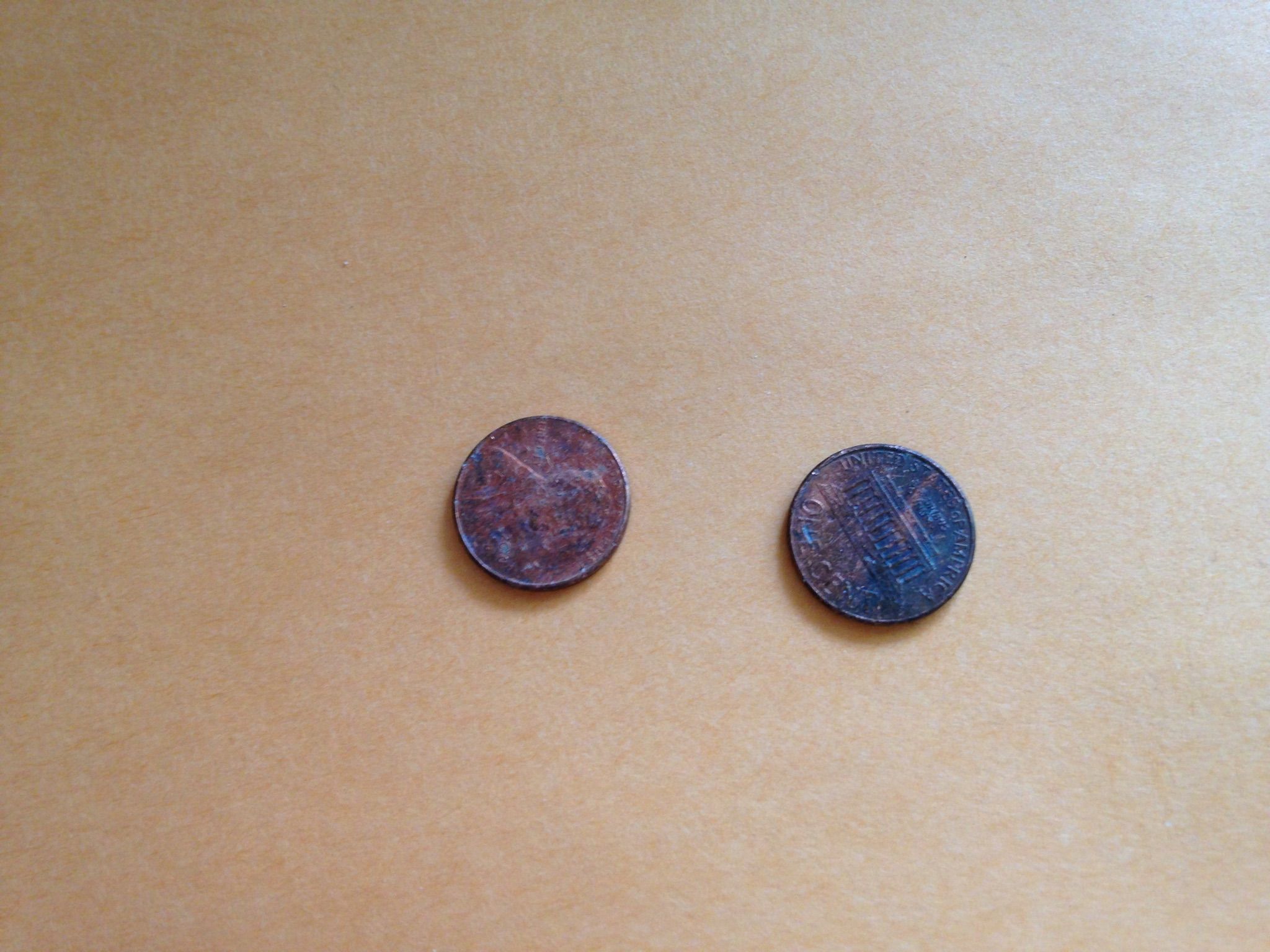
Plus, yesterday I found two pennies — one head’s up, one head’s down. I’m taking that as a sign that the future hangs in the balance, that it could go any way; now is the time to chart my path through these rocks and shoals, between this Scylla and Charybdis.

I'm probably going to use this image a lot.

I’m probably going to use this image a lot.


And these little cookies will be my map, my compass, my guide.

"Filled to the brim with girlish glee . . ."

“Filled to the brim with girlish glee . . .”


I don’t think it’s a good sign, by the way, that they have little cartoon pandas on them. I hate pandas.

(I like this one.)

But they are from New York, and so am I. So maybe that balances, too.

Now: which one first? Which shell holds the pea? Where’s the red queen?

Middle one? Sounds good. Here we go.

Dammit! No pea. This game sucks.

Dammit! No pea. This game sucks.


ALL progress? Are you sure about that, Cookie Panda? THEN WHY AREN'T YOU DIFFERENT FROM YOUR TWO FRIENDS?!?

ALL progress? Are you sure about that, Cookie Panda? THEN WHY AREN’T YOU DIFFERENT FROM YOUR TWO FRIENDS?!?


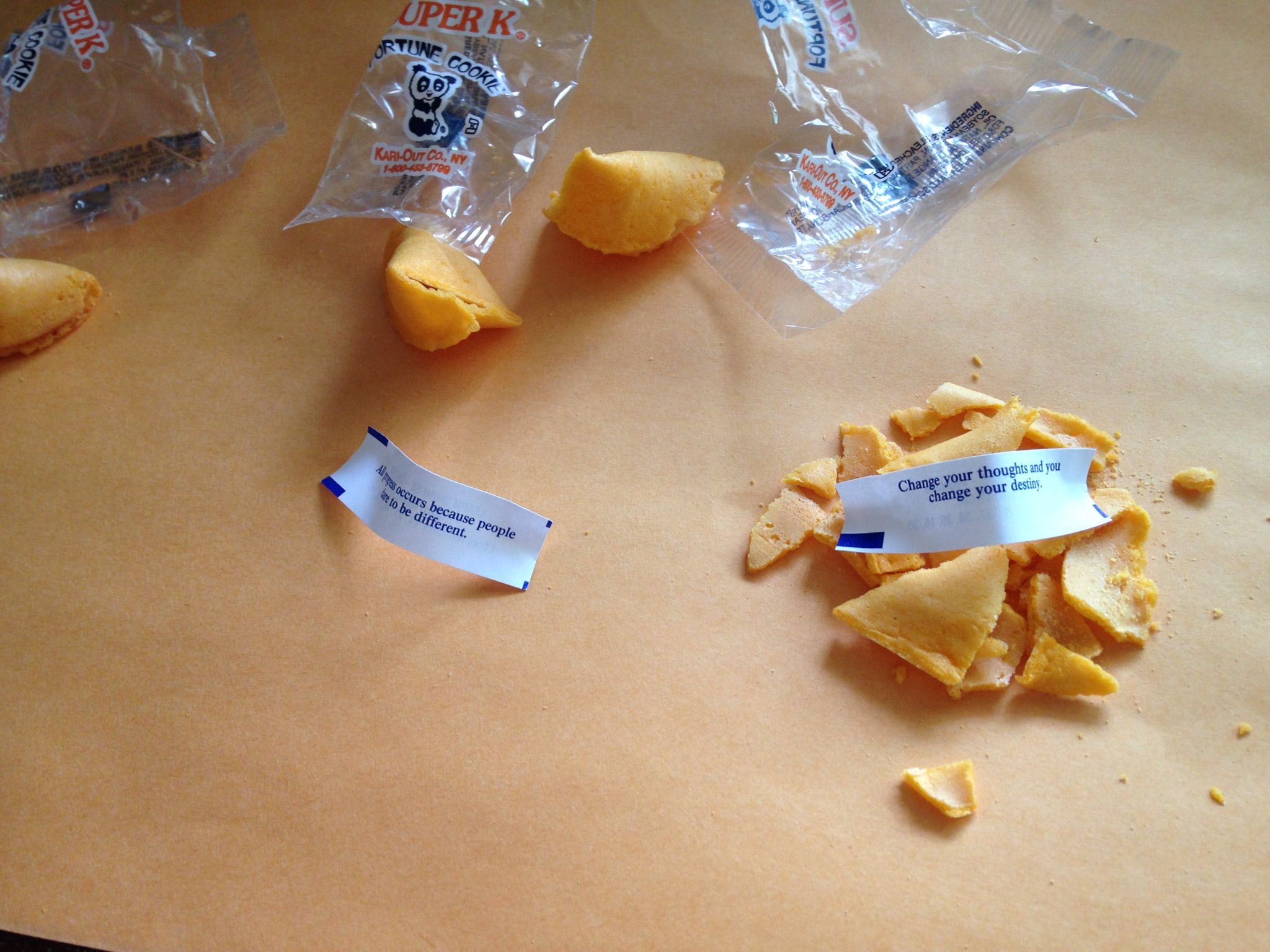
Hmm. All progress occurs because people dare to be different.

Okay, I like that. I like the idea that progress can be made, and that people can be different, and that it takes some daring to do that, both to stand out and to move forward. I hope that this applies to me. I know that I am indeed different, and probably different in a manner and on a scale that goes beyond the “Well, everyone’s different, aren’t they?” I think I am probably different in certain areas where most other people conform. I am an artist. I am childless but for my animals. I have been in a devoted relationship for more than half of my life. All of these are probably outside of the status quo, and they are some of my defining characteristics.

Do I create progress? Am I progressing? I think I’m a better writer than I was ten years ago; I know I’m a better teacher. Is it because I’m different?

The cookie says so.

All right, off to a good start. Let’s see what’s next. Left side, or right side? Hmmm — right is more common, right-handed being more frequent than left; so let’s be different and make progress. Left is right!

Big bucks no Whammies no Whammies no Whammies . . . .STOP!


"It's something unpredictable, but in the end is right. . . I hope you had the prime of your life."

“It’s something unpredictable, but in the end is right. . . I hope you had the prime of your life.”


“Be on the alert to recognize your prime at whatever time of life it may occur.”

You know what I like about this? It’s in the future tense. I like that. It means I haven’t hit my prime yet. It’s still ahead of me. Yeah, that’s cool.

But wait: that means that everything I’ve done up until now has not been good enough, has not been connected to my prime. 41 years, and I haven’t stopped sucking yet? That seems less good.

Let’s go straight to #3. I noticed that panda was grinning at me. Maybe he’s just screwing with my head. Let’s try — crap, he’s smiling too. Are these all tongue in cheek? Has my prime already occurred, and I didn’t recognize it, and now the cookie is rubbing my nose in the long slow slide into mediocrity that is my future? Maybe the first cookie was saying I haven’t been the impetus behind any progress, because I’m not different enough. Dammit, why didn’t I get more tattoos and maybe some ear gauges?

All right, Right Cookie: hook me up.

DUSTY SMASH!! . . . a small sugar cookie that never did nothing to nobody.

DUSTY SMASH!! . . . a small sugar cookie that never did nothing to nobody.


Changed that cookie's destiny, didn't I?

Changed that cookie’s destiny, didn’t I?


Seriously? What are you trying to say, that — I’m in charge of this? Are you telling me that what comes is up to me? That however I interpret these cookies is the answer, that if I see them as negative, then they are? And if I see them as positive, they are? And that whatever I choose, I can also change, at any time, and doing so will change the path I am on?

IS THAT WHAT YOU’RE SAYING?!?

Fortune Change
Huh. You know, I like that. That’s a good cookie.
Or maybe they were just trying to tell me chocolate skiing vegetable, all along.

Good to know my lucky numbers are 14, 21, 16, 42, 32, 11, 49, 32, 28, 38, 7, 43, 29, 37, 38, 39, 16, and 35!  Surely there's a lottery ticket somewhere with that many options.

Good to know my lucky numbers are 14, 21, 16, 42, 32, 11, 49, 32, 28, 38, 7, 43, 29, 37, 38, 39, 16, and 35! Surely there’s a lottery ticket somewhere with that many options.


The Wisdom of the Ancients has been spoken.

No Art, No Peace

I am generally opposed to the standardization of education (which puts me, amusingly, in line with much of the GOP), but here’s a wish: if schools had all used the same curriculum when I started teaching that they use now, then Toni and I might have known better than to move to Oregon.

We’ve talked about this before, about whether moving there was a mistake. Because Oregon was bad for us. There were some good things: we made some friends; we bought a house and learned some of the treats and tricks of homeownership; it was a good home for our dog, Charlie; and we found our beloved mutant cockatiel Duncan there. But for the most part: the school where I worked for ten years was badly run and badly funded; the community was largely an ignorant backwoods that offered rednecks and mudding as its entertainments, Wal-Mart and Fred Meyers as its shopping; the weather was – I need something beyond “bad” here. Because the issue with the weather wasn’t that it was wet, or that it rained a lot; I grew up in Massachusetts, where it rains and snows and sleets a lot, and Toni is from the rainy section of California, so rain is not the issue. Bad weather is not the issue. But the weather in Oregon is not just bad; it is tortuous. The clouds descend, and seem to wrap around the world, from horizon to horizon; and then they do not leave for the better part of a year. There is nothing at that time in Oregon – not people, places, nor things – that is not coated and permeated with mud or mold. Everything is cold, everything is miserable; the natural world seems to want to curl up and disappear into itself, and you want to go too.

We spent ten largely unhappy years there, and came out no better than we went in, having gained nothing but – character. I’ll say that; Oregon builds character. Oh – and I won teacher of the year. And almost had my teaching license stripped from me in a four-year bureaucratic ordeal worthy of Kafka or Orwell, that earned me the new title of “morally reprehensible.”

We don’t regret moving to Oregon, because there were good parts, and because every place has bad parts. But it would be a good world if we had never moved there. And that world might have existed if I had taught William Carlos Williams’s poem “Raleigh Was Right” back in Escondido, California, in 2003.

The poem is the third in a series, which forms a conversation between three (Actually several; but three are directly connected to this) poets separated by about 350 years and an ocean – and by death. The conversation started with Christopher Marlowe’s poem “The Passionate Shepherd to his Love,” a poem in which a starry-eyed (actually sheepy-eyed) shepherd asks a nameless woman to come live with him and be his love. As an inducement he offers her a variety of gifts, all drawn from the natural world – beds of roses, a cap of flowers, a kirtle embroidered with myrtle. He also says they will sit on rocks and watch the shepherds feed their flocks, which tells you something about this guy’s standard of entertainment. The poem is a quintessential example of the pastoral tradition, mythologizing the Good Old Days Back in the Countryside, when everything was simple and everyone was happy sleeping on beds of roses and watching sheep eat. Marlowe got ripped for his youthful idealism (and his writing style, but that’s neither here nor there) by the older, jaded explorer/pirate/courtier/poet, Sir Walter Raleigh, who wrote “The Nymph’s Reply to the Shepherd.” Raleigh’s poem has that nameless woman rejecting the shepherd’s advances because she can’t take the naivete represented in an offer of love that comes with a cap made of flowers and the chance to sit on rocks; she also tells him that she thinks he’s full of crap (“If all the world and love were young/And truth on every shepherd’s tongue/These pretty pleasures might me move/To live with thee and by thy love.” The key word is “if.”) and she wouldn’t take his offer if he were the last man on Earth. Raleigh won the argument, mainly because both poems were published several years after Marlowe’s death (Which, I have to say, pretty much means that Raleigh loses the moral argument. Because arguing with a dead man is pretty low. But I won’t stoop to repeat his mistake. I’ll let Dr. Williams do it for me.), but that wasn’t the end of it; poets from John Donne to Robert Herrick to Ogden Nash have piled on to poor dead Kit Marlowe, mocking his poem and his theme. William Carlos Williams seems to have been the exclamation point, the last one to stick his nose in and say, “Yeah, what he said!”

But the aspect of the poem I am thinking of is not the whole nymph/shepherd/Marlowe/Raleigh thing. It’s the reasons Williams gives for siding with Raleigh’s nymph against Marlowe’s idealistic shepherd. These are good reasons.

Williams starts his poem with:

We cannot go to the country
for the country will bring us
no peace

This is why the nymph won’t go with the passionate shepherd and be his love: not because he’s an idiot, or because the gifts he offers will eventually fade and die (Which is the main reason why the Nymph says no in the Raleigh poem); but because he’s wrong: the countryside is not a wonderful place full of roses and dancing shepherds’ boys. It is a place that will bring us no peace.

Williams goes on:

Though you praise us
and call to mind the poets
who sung of our loveliness
it was long ago!
long ago! when country people
would plow and sow with
flowering minds and pockets
at ease –
if ever this were true.

The image of the countryside as a place where people can live simply, but also well, and be happy and also satisfied with their lot in life, is archaic, and probably apocryphal. “Flowering minds and pockets at ease,” the image of Thoreau at Walden, with his educated intellectual philosophizing and his life of rich simplicity – except Thoreau lived on Ralph Waldo Emerson’s property, close to his family and their resources, so never had to worry about paying rent, or taxes, or coming up with money for repairmen, or doctors, or all of the other things that mean people who work for a living – like farmers and shepherds – don’t get to “Simplify, simplify, simplify.” Believe me, when we lived in Oregon and needed to find a way to pay for a new roof for our house, we would have loved the chance to simplify; but that wouldn’t have kept the rain from reducing us to a chilly pile of rotting mildew. We needed $7000 for that. And it wasn’t simple.

The last stanza is the one that stands out to me, because recently Toni and I, because we are still dealing with money issues, since we are still somehow not wealthy – I don’t know why my teacher’s union dropped the ball on getting me my cushy overinflated salary, but I have never managed to get my chance to suck on the public teat – talked about living like an artist on an artist’s income (This is akin to feeding one’s self from a garden grown in a 10-gallon fishtank), and these were the lines that came to mind, and brought this blog into existence.

Not now. Love itself a flower
with roots in a parched ground.
Empty pockets make empty heads.
Cure it if you can but
do not believe that we can live
today in the country
for the country will bring us
no peace.

If ever there was a time when two people could live on a teacher’s salary, or even worse, two artists’ income, it is not now. (The lines about love don’t apply to me – that really is Williams picking on Marlowe, and also on his own era, World War II, and saying there ain’t enough love in the world to make a shepherd and his love happy in the countryside. Toni and I don’t have much, but we do have love.) It was not 2000 in southern California, and it really wasn’t in 2004 in St. Helens. Because in that tiny town out in the boondocks, especially after the economy collapsed in 2007 and shot out all of the equity we might have been able to save in the house we had bought in 2005, there was utterly no economic opportunity, particularly not for artists. We couldn’t sell art, we couldn’t sell our expertise; there was no chance to do anything but try to get by on a teacher’s pay. While the whole country was looking to cut teachers’ pay. And that made everything worse.

Here’s the reason: empty pockets make empty heads.

No matter how thoughtful, philosophical, and intellectual you are; no matter how deep your inspiration flows, no matter how energetic is your muse: when you have to worry about money, about paying the bills and buying food and finding $7000 you don’t have so you can pay for a new roof – you will not be able to think very much about art. We moved to Oregon partly so that we could focus on our art; it didn’t happen in the way we wanted it to, we couldn’t be as productive as we wished to be, and this is why. Because empty pockets make empty heads.

I hope that now, here in a place with a lower cost of living, that we will be able to cure this problem. But what I know now, beyond the shadow of a doubt, is this: do not believe that we can live today in the country. For the country will bring us no peace.

Christian Marketing 101

This poster is on the wall of a church near my house.

Silly Christian

Where do I start with this?

First of all, who the hell created that image? Look at the size of that kid compared to the size of that cereal bowl. Look at how short his arms are. Look closely at the spoon: what the hell is in it? It’s not a letter; if I had to guess, I’d say it was a puppy, or a baby porcupine, crying out in anguish as it’s about to be chewed and swallowed — along with, apparently, that kid’s tongue. And that font! Who picked that font? I know it’s tempting to make the font match the words, to have fancy words in fancy script, and therefore to make the word “silly,” y’know, silly — but to have it off at an angle like that makes it seem like it has no association with “Christian.” Which makes it seem like it’s more of a commentary on the poster or its message. Apt, wouldn’t you say? And “fear” is apparently big, green, and outlined in white. So fear is a highway sign?

Next I have to come at the punctuation. You need some. You don’t have any, not until the exclamation point at the end, which seems to take emphasis away from where you put it with your graphics: on “silly” and “fear.” (Are you understanding now why these font choices were poor? Your punch is at the end of the tagline. Where the exclamation point is. Not up at the top.) Here’s why that lack of punctuation earlier is an issue: without an obvious break between “Christian” and “fear,” it’s reasonable to assume that your statement is: “Silly Christian fear is for pagans.” Which makes sense, but isn’t what you mean to say. If you intended it to be a break using the graphics, why did you put fear up at the top with “silly Christian” instead of down at the bottom with the phrase it is a part of? And again with the Silly graphics: using graphics to punctuate, it could just as easily read: Silly! Christian fear is for pagans.

And the cereal. Just to be clear, the reference you are making is to Trix cereal. That’s the one that had the tagline, “Silly Rabbit! Trix are for KIDS!” Trix look like this:

Ermahgerd! TWO stickers?!?


Do you see how they are nothing but round puffs of sugar, dyed various colors never found in nature? Right. (Though looking at the box, I will give the Christians this: that kid and his cereal bowl are in about the same ratio as this rabbit and his.) There are no letters in Trix. Why are there letters in your bowl? If you’re going to make the reference, get the reference right.

While we’re on the topic of the reference: why are you making this reference? I remember the rabbit, sure; I thought he was funny when I was a tyke. Maybe you were different, but — I wanted that rabbit to get that goddamn cereal. I got pissed off at every obnoxious little kid who pulled away that cereal bowl and delivered this line. Never failed to irritate. And this is the memory you want me to reminisce over? This is? And if your version of it is “Silly Christian, fear is for pagans,” then doesn’t that mean that Christians are analogous to the rabbit — are the sugar-jonesing, addiction-addled wackadoos who will do anything to get their fix — er, I mean, their Trix?

That bunny is not well.


So let’s imagine that you meant that. Because this cereal this “pagan” kid is eating (Right? Because the kid is eating the cereal. Hang on: is that kid eating the cereal? His tongue’s hanging out and he has a crying woodchuck in his spoon — but that rabbit got pretty damn close to a mouthful of “frosted corn puffs” many a time. So is that the Christian who thinks he wants the bowl full of Jesus-choking fear-cereal, or is that the pagan who’s actually enjoying his infernal breakfast treat? Who knows? It’s not like either one would make much sense.) is spelling out all the terrible, terrible things that await the pagan kids who shlork that crap down, all of which is denied the desperate Christian-rabbit. Death. Satan. Separation. Poverty. Trials. And, for some reason, God, past, and future (Though it really looks a lot like “paste.” Maybe it is “paste.” THE PASTE OF THE DAMNED!). So now I’m entirely confused. Is it that the pagan eats the “death” and “poverty” letters, and the good Christian gets to eat God (Well, that wafer, after all . . .) and the past and the future? Or maybe the past is bad, and the pagan gets that — but the future is for the Christian?

Or maybe it says “pasta.”

Bless His Noodly Name.


So here’s what we’ve got: a message that, if it isn’t saying “Silly, Christian fear is for pagans” or “Silly Christian fear is for pagans,” both intended to warn pagans away from the fears of Christians (Good advice, that.), is apparently telling us that Christians are willing to go to any lengths to grab a big bowl full of fear, which will contain both death and Satan, as well as God and all of time, both future and past. Which, when you get it in the spoon, will look like a terrified hedgehog.

Yup. That would bring me in to listen to the sermon. Who knows what that preacher’s next reference will be?

Might I suggest?


Silly Christians. While fear may be for pagans, so, apparently is sense.

(Just had a totally disturbing realization. You know what Trix looks like, if you ignore the color? Bunny poop. Frosted bunny poop. Maybe that rabbit was playing us the whole time . . .)

The Truth About Beauty

[V]erse is ‘made.’ But the word ‘make’ is unsufficient for a true poem. ‘Create’ is unsufficient. All words are insufficient. Because of this. The poem exists before it is written.

That, I didn’t get. “Where?”

T.S. Eliot expresses it so – the poem is a raid on the inarticulate. I, Eva van Outryve de Crommelynck, agree with him. Poems who are not written yet, or not written ever, exists here. The realm of the inarticulate. Art” – she put another cigarette in her mouth, and this time I was ready with her dragon lighter – “fabricated of the inarticulate is beauty. Even if its themes is ugly. Silver moons, thundering seas, clichés of cheese, poison beauty. The amateur thinks his words, his paints, his notes, makes the beauty. But the master knows his words is just the vehicle in who beauty sits. The master knows he does not know what beauty is. Test this. Attempt a definition now. What is beauty?”

(From Black Swan Green, by David Mitchell)

I read this to my class the other day. And then I stopped and challenged them as Madame Crommelynck, the aged Belgian artiste, challenges her protegé Jason, the 13-year-old would-be poet: define beauty.

Here’s how I picture Madame.

My students couldn’t do it either. They did try, and they were annoyed with me when I disagreed with their assertions, but their answers didn’t work, not entirely. One said, “Every thing is beautiful,” because someone, somewhere, perceives it as such. I asked her if murder could be beautiful, and she said it could, to someone. But I beg to differ: I think anyone who considers murder “beautiful” is also murdering the word “beauty,” making it entirely meaningless. The same goes for any other extreme example: if we broaden the meaning of the word so much that it includes everything, then it means nothing. One argued that beauty is the “absorption of enjoyment.” I took that, like the previous attempt, to be too broad, too all-inclusive; I said, “Have you ever REALLY had to pee? When you finally get to go, isn’t that experience enjoyable?” He nodded. “But it isn’t beautiful,” I argued, though he continued to defend his definition, using enjoyable now as a synonym.

There’s nothing beautiful about that.

He was smart: he used a turkey sandwich as his example, saying that eating a turkey sandwich when you were craving one is a beautiful experience; in the right moment – around 1:00 in the afternoon on the Saturday after Thanksgiving when you have leftover turkey and some good bread – I would indeed take that as proof, and have my answer. But I don’t believe enjoyable is the same thing as beautiful. Enjoyment is too simple to include all of beauty; it’s like saying that life is breathing. Sure, that’s part of it, and an important part; but it is unsufficient.

turkey-sandwich

I give you the ‘Murrican turkey sandwich.


Several of my students gave some permutation of Beauty is in the eye of the beholder, arguing that there is no intrinsic quality of beauty, but only what we construct through our individual subjective perceptions. I agree with that, but it is also true that there are certain sights, certain experiences, that are considered beautiful by many people, even people that have otherwise nothing at all in common: the night sky, a lullaby, love. There is such a thing as beauty, and we respond to it not as individuals with unique subjective perceptions, but as human beings with a shared consciousness and universal experiences: because we are all alive in the same sense, with the same five senses in the same universe. Madame Crommelynck agrees:

When beauty is present, you know. Winter sunrise in dirty Toronto, one’s new lover in an old cafe, sinister magpies on a roof. But is the beauty of these made? No. Beauty is here, that is all. Beauty is.”

Beautiful?

But Madame and I differ on this: she also tells Jason that beauty is immune to definition. I disagree. She gets into Platonic forms, saying that the potter that has made a beautiful vase has made the vase where beauty resides, but not the beauty itself; that’s true, but unfair, because the beautiful object has captured beauty, it reflects and contains beauty, and that is as much as human creation can ever do. It’s not our fault that the universe existed before us, and so too did whatever ideal that we call beauty. When we make a piece of beauty, something that echoes in its limited physical or experiential form the immortal beauty that resides in the inarticulate – the beauty that is – then our efforts, too, echo the first creation of existence, the coming into being of beauty as a potential quality. It is fair to say that we have made beauty if it is fair to say we make anything.

Our disagreement on this is easy to explain, though: she is speaking to a student. Teachers have to lie to students. When my math teacher told me that you can’t take a big number away from a small number, she was lying, because it wasn’t time for us to study negative numbers yet. When teachers tell students they cannot use the word “I” in a formal essay, it isn’t actually because one cannot use the word “I” in a formal essay, it is because there are various bad habits that writers have (The tendency to rely too much on subjective opinion rather than on evidence, for example; something that I do all the time. But it’s much harder to say “This is true because I think it is” when one cannot say “I;” the line “This is true because one thinks it is” or “Some people believe this is true” doesn’t have nearly the same pizzazz. Not nearly the same beauty.) that can frequently be eliminated by this rule; and if teachers set the rule like the word from on high, carved in stone by a burning bush, then they don’t have to get into the explanations about the bad habits. It’s simpler and keeps the teacher from losing too much time arguing with the students. Madame Crommelynck wants Jason to stop trying so hard to make his poems beautiful; she tells him, “A touch of beauty enhances a dish, but you throw a hill of it into the pot! No, the palate becomes nauseous.” And then, more beautifully put, “You belief a poem must be beautiful, or it can have no excellence. […] Beauty is not excellence. Beauty is distraction, beauty is cosmetics, beauty is ultimately fatigue.” She doesn’t want to explain precisely what beauty is, how we can identify it, what it means; she just wants him to stop thinking about it. So she tells him an absolute rule: beauty cannot be defined.

Well, Madame, I don’t believe in absolute rules (Except when I do.). I tell my students they can use “I” in an essay, and they can start sentences with “and” and “but” and “because,” and they can take big numbers away from small numbers, dammit!

And we can define beauty. Even if the words may be unsufficient.

Here we go.

Let’s start with basic principles. Beauty is abstract, but like love and unlike cliche, it can be experienced concretely: it is detected by the senses, most frequently but not exclusively sight for we humans. This means there is a biological, physical element to it. Just as love is, on some level, a chemical reaction in the brain that offers a survival advantage, so is beauty, at least when applied to another of one’s own species. A beautiful shrew, to another shrew, is one that represents a survival advantage; it is an advantage for the survival of one’s genes, not one’s own precious self, but the instincts are all about that DNA.

Now that’s a beautiful shrew.

So beauty in a Darwinian sense is a list of physical attributes (physical because concrete, detectable by senses) that represent a good breeding partner: symmetry of form and features, traits that connote health, traits that represent child-rearing strengths. Marilyn Monroe was beautiful because she was symmetrical, had healthy skin and hair and teeth and eyes, and had curves that showed good baby-making potential.

Plus, if I may quote Christopher Moore’s A Dirty Job: “I mean, [she] got the badonkadonk out back and some fine bajoopbadangs up front, know what I’m sayin’, dog? Buss a rock wid a playa?” Word, Mr. Moore. Word.

See? Look how symmetrical.

Beauty is more than that, though. Because sunsets and symphonies and the smell of rain have nothing to do with child-rearing.

I’m going to take this as the point where humans and animals diverge. Not because I can say with any surety that animals don’t enjoy the sunset for the sake of the colors and the patterns in the sky, but because without language, I can’t be sure that they do, nor why they do. My dog loves to chase the innumerable tiny lizards that scatter across the desert where we live, but is he appreciating their coloration, the quickness and grace of their movements? Or is he thinking about how good they’d taste on a cracker?

And if he is, is that not beauty? The turkey sandwich argument speaks to this: deliciousness is a form of beauty detected by taste rather than sight, isn’t it? So there must be some element of beauty in a turkey sandwich, in a delicious lizard-on-Ritz hors d’oeuvre?

I would say so, but again, I think that it is the simple, animal form of beauty, the survival beauty, in most cases. I’ve eaten a lot of turkey sandwiches, and generally speaking, they are more often satisfying than beautiful. The potential for beauty-beyond-survival is there, certainly, but in the sense I want to explore now, it usually is not.

The abstraction of beauty is, so far as we can know, an exclusively human concept. It is difficult, because we are merely bald apes, to mark clearly the line between humans and animals, but one of the best lines is abstraction. Animals tend not to imagine things separate from their immediate circumstances (though some of them do, it seems) and humans do. The reasons why we do can be simple survival strategies; because imagination makes humans better hunters and gatherers than other animals, thereby justifying our oversized noggins and the weak, ungainly bodies attached to them. But to create abstract ideas, for abstract reasons? That, so far as we can know, is uniquely human.

For years now, I have associated this activity of abstraction for the sake of abstraction with two names: truth and beauty. Humans, I have said, are the only living things that seek truth and beauty for their own sake. We wish to discover new truths, not because they offer a practical survival advantage, but simply because we wish to know truth; we create beautiful things, and seek beautiful experiences, simply for the desire to experience them. I think of this as art, because I am an artist married to an artist, though others may call it science or faith or love or whatever entirely human abstraction you wish; there are many other ways to name the pursuit of abstraction. Regardless, I would argue – I have argued – they all come back to truth and beauty. Those are our defining ideals, we humans.

But now I think that these two ideals are really one and the same. “‘Beauty is truth, truth beauty,’ – that is all / Ye know on earth, and all ye need to know,” as Keats said to his Grecian urn. (And now I have to include the Simpsons reference: when the family goes to visit the military academy where they will be sending Bart for disciplinary reasons, Lisa observes a cadet in a class reciting that line as if responding to a drill sergeant – “BEAUTY IS TRUTH, AND TRUTH BEAUTY, SIR!” She gasps in joy at the thought of actually discussing poetry, something that never happens back at ol’ Springfield Elementary; but then the instructor, sounding and looking just like a drill sergeant, shouts in the cadet’s face, “But sometimes the truth can be harsh and disturbing! How can THAT be beautiful?!?” After which Marge comments, “Well, he sucked the life right out of that.”)

“Gentlemen, welcome to flavor country.”

The two ideas, truth and beauty, have always been closely linked. In science and math, a good solution, a true theorem, must have elegance to be considered worthwhile; in art, a beautiful piece must have some reflection of truth, of reality, of genuine human experience. This is because they are, I would argue, one and the same experience; two sides of the same coin, with the only distinction being how they are taken into the soul.

Ralph Waldo Emerson, in his “On Self-Reliance,” described the experience of truth as “that gleam of light which flashes across his mind from within.” He described a sensation of instant awareness of genuine truth, the vibrating of a heart to an iron string. He was talking about epiphany, the moment of clarity, what teachers (rather unfortunately) call the “Aha! moment.” There is a sense of rightness about truth that marks it as such, because a truth is echoed and repeated in everyone’s human experience, and all the truth does is give a name to what we already know. Home is where the heart is. The love of money is the root of all evil. Haters gonna hate. These truths don’t need to come with examples, because every single one of us can supply them from our own memories. That is the ring of truth, the gleam of light that Emerson talks about: when we make a connection between the statement of truth and our own personal subjective knowledge, and recognize both that the thoughts and experiences of others are actually relevant to our own lives, despite the appearance of perfect isolation that comes with being a human soul trapped inside a cage of flesh and bone, and also that our lives make sense, have reason and symmetry to them: that we are as true to life as others are to us. There is a greater world, and we are part of it; that is the truth, and what we recognize when we come across actual truth, and know it for what it is.

But here’s the thing: that’s what beauty is, too. That same ring, that same jolt, that moment of clarity and recognition, that awe: that is the experience of beauty. Think of what you felt when you first looked out of an airplane window and saw a mountain wreathed in clouds.

Think of what you felt when you first heard Pachelbel’s Canon.

When you smelled your favorite perfume, or let fine chocolate melt down your tongue. Think of a time when you genuinely hugged or kissed someone you love. This is what beauty feels like: when you feel your connection to the greater world, to all of the people before you who felt what you feel right now. You feel as big as the sky, as ancient as the stars: you can feel your heart expand to contain all of the other hearts that have felt what you feel, that are feeling what you feel, across all of time and space. You know that what you are feeling is right, and that it makes sense: you know that this feeling is true.

I would put it like this: truth is an intellectual recognition of one’s place in the order of existence; beauty is the emotional recognition of the same. Beauty is the truth of the heart.

Things Not Failing At Would Be Good

My student told me the other day that he had had a dream about me. Fortunately, the dream wasn’t as creepy as that statement: he was in my classroom, and I was teaching a “lesson” on the Twenty Worst Things to Fail At (Ending a sentence with a preposition? Apparently Dream-Me has a crappy sense of grammar.). He said I went through the list, and #2 was “Life,” and #1 was “THIS CLASS!

It seems Dream-Me is also one of those teachers who talks about his class like it’s the only thing standing between students and a roaring tsunami of doom and destruction and disappointed parents who don’t love their children quite as much if they go to a state school. Apparently Dream-Me also enjoys a nice soupcon of anti-climactic irony. I mean, really, Dream-Me? Failing at your class is worse than failing at life? Isn’t the idea supposed to be that failing the class leads to failing in life? You blew your own point, pal. Don’t you know anything about rhetoric?

Though I have to add that I often act like a jerk in my wife’s dreams, where I tell her that she’s unattractive and ignore her when she’s scared or in pain. So maybe I have an evil Dream-Twin.

After telling the class about his dream, the student asked me to come up with my own version of the twenty things. I didn’t have a ready answer for him, but I said that I would think about it. Here’s what I thought. I could only come up with nineteen that needed to be on the list. Because I don’t live my life by other people’s rules.

Nineteen Potentially Terrible Failures

19. Starting the coffee in the morning, as I failed to do today. It’s an unforgivable sin.

18. Realizing that not everything is a competition, or that not everything needs a grade. Life is not a game, capitalism and competition do not make people better, sports are not the basis of human culture. There’s little that’s more annoying than when you reach the end of a difficult obstacle and then someone turns to you and says, “Ha! I beat you.” Or asking someone how you did with a difficult task, and having them say, “I give you a C+.” (By the way: no, it isn’t ironic that I said that and I’m a teacher. I know this to be true because I’m a teacher. Because I know it to be true, I hate grades, and tell my students so as often as I can.) One should not try to decide if this one thing is better or worse than this other thing – especially not with people – and one should never use a single and generally insignificant criterion to make that judgment, as in, “My class is more important than the rest of your life because my class has me in it,” or “Sports are better than reading because sports are more exciting to watch on TV.” It is reasonable, within a narrow scope, to consider, “Is this thing/person/event good or bad in this specific way in this specific instance?” because you can choose criteria and then decide if the thing matches them — and if your scope is narrow, you can have enough information to be reasonably sure of a valid appraisal. When trying to decide if I should eat an item of food, for instance, I ask myself two questions: one, Am I hungry? And two, Is it a doughnut? If either of those answers is Yes, then I eat. I don’t ask: Will eating this make me a winner? or, Is this the best thing to eat? or, Which doughnut is better?

Eat all the doughnuts. Then they’re all winners. And so are you.

17. Avoiding the use of memes and Vines. Memes and Vines are two things: they are amusing, and they are fast. But that’s it. They have no practical purpose. And yet, people post memes and Vines all over social media, attempting to lay claim to positions or to express opinions or preferences/allegiances (“Share this meme if you remember what this is!” “This Vine shows what it means to grow up in the 90’s!”) And I don’t mean there are good memes and bad memes, or good Vines and bad Vines; there are, but the point here is that they have no particular use: memes should never be used to argue, and Vines should never be used to communicate. Memes are never the best form of the argument; they are always oversimplified, generally exaggerated, and always mocking if not directly insulting. Vines are too short to have any poetry in them: six seconds is not long enough to set up a punchline, or build up expectation and suspense, or to create irony. Vines are just one big pratfall, everything bang, boff, and wow! It relies on an aesthetic of contempt, of laughing at the fool, of pointing at the freak. Of course there is a millennia-old tradition of this, but any other medium has at least the potential to grow past shock value. What serious thing are you going to say in six seconds? Would you even have time to ask that question?

16. Remembering what you thought of in the shower after you get out of the shower. Godddamnit. I know I had something else that should be on this list. What was it? Too late. It’s gone. I really need to get some waterproof whiteboard or something, so I can take notes in the shower; that’s one of the best places for thinking. It’s one of the only places in the world where there is, usually, nothing but silence: the white noise of the water, and the sound of your own thoughts.

And speaking of silence . . .

15. Silence. Ray Bradbury, in Fahrenheit 451, put this as “leisure” and said it was one of the three critical elements that would keep our society from turning into the dystopia he imagined. He said that we need real information – denied the people in the novel by the burning of all books – and quiet time to think about it. Time without televisions or radios, without people talking, without cars rushing around or sirens blaring. (Just for the sake of completeness: the third thing we need is the right to act on decisions made with the use of the first two.)

This society has plenty of information. Too much, in fact. What we don’t have is a quiet moment to sit and think about that information. My students generally don’t like silence: they start feeling awkward, and then they make noise in order to block out the silence. When asked to work quietly, many of them insist on listening to music, saying that it helps them concentrate. It doesn’t: music asks for, and receives, some kind of attention, especially when the other task is not entertaining; the evidence is overwhelming that people cannot actually multitask, and doing two things at once means you pay less attention to both. But music in one’s ears does eliminate that awful, shuddering, heaving beast, Silence; and for them, that’s the goal.

But the thing is, silence allows us to dive deeper into our own minds. Of course this is what teenagers are trying to avoid; they don’t want to think about what’s inside themselves or why, or what it means, and so they build a wall of noise and hide behind it. But that doesn’t make what’s inside us go away, and someday, we must confront it, work through it, and then turn it into strength. We take things in and make them a part of ourselves, turning difficulties and sorrows and any powerful experience into the foundation on which we build the temple of our Self: grief becomes courage, anger becomes determination, heartbreak becomes wisdom. But it’s a process, and it requires thought, and thought requires silence.

Maybe we should all just take a whole lot more showers.

14. Doing your job. We live in a society, and people depend on other people. For me to be a good teacher, I need someone else to produce my food, to build my house, to maintain my car. For the mechanic to do a good job maintaining my car, he needs someone else to make the parts and the tools, and the auto manufacturer to maintain quality standards. For the auto manufacturer to maintain standards, he needs to understand science and math: engineering and physics, and measurement and data management; and for that, he needs a good teacher. When any of us fails to do our job, the others are put at a disadvantage. Now I have to install washer/dryer hookups in my new rental because the property management company failed to inspect the connections properly: and that’s time I can’t spend teaching. “United we stand” is always true, not just when we are at war.

And speaking of war . . .

13. Peace. I should probably make this #1, but I’m not trying to create a hierarchy here (See #18). But in truth, there is no greater travesty, no greater horror than war. War is hell. That doesn’t mean war is uncomfortable, or unfortunate but necessary, or kinda bad but at least it helps the economy. War is hell. War is the worst thing imaginable, the home of all sins and all evil, the farthest point from goodness. It is one of my deepest discomforts to know that my country, my homeland and my family’s for at least three generations back, has failed at peace for nearly its entire existence. This fact puts the lie to all claims of American exceptionalism: we are not the greatest country in the world, everyone else does not envy us, we are not even a good country, because we have built this country on war. War is the source of our economic and scientific advancements, war is the foundation of our international relations. We are war. We are hell.

12. Putting down the phone. This is the other reason for America’s failure to achieve real greatness: because we are so very bad at this. It’s not just the phone, though, and it’s not just this generation; twenty years ago, I would have said “Turning off the TV.” The only difference is that now we can take the TV with us everywhere we go; it’s an increase in quantity, not a change in quality.

Don’t get me wrong: smartphones are wonderful things. The convenience and quantity of available information is staggering. If you added a phaser, it would be every gadget the away team uses on Star Trek: it’s already a communicator and a tricorder. (They should add a phaser. And it should go off automatically if you subscribe to Donald Trump’s Twitter feed.) Smartphones are fine and useful, as were televisions and radios before them.

But the phone, and the TV, are substitutes for real experience. With a phone you never have to look in someone’s eyes when you tell them you love them, or hate them. With a phone you never have to get up and go outside to see how the weather is. With a phone you never have to find something to do to occupy your mind. In other words, a phone allows you to avoid thinking, feeling, and doing. It allows you to avoid life. So the key with a smartphone is to put it down as often as possible, to use it only when it is convenient. One should never need it.

And speaking of Donald Trump . . .

11. Not being Donald Trump. Which means that every single person on Earth is successful in avoiding this failure, with one notable exception. Think of it that way and you almost pity him.

A corollary to this is: not voting for Donald Trump. Our country is already hell. Let’s not put an idiot in charge.

10. Honesty and avoiding hypocrisy. Yeah, telling the truth is hard. Yeah, living up to your own standards and sticking to your own principles is hard. But when you fail to do this, when you fail at honesty, you destroy yourself: when other people know you for a liar, as inevitably follows being a liar, people stop trusting anything that you say. You essentially silence yourself; you make all of your opinions, everything you say, into nothing but hot air and bull puckey. You take away your own ability to contribute to and participate in human society. Which makes it a terrible travesty that we lie so much, and even worse, accept that people lie and say that they should lie. The idea of a “little white lie,” which says that it is better to tell someone they look good in that dress and their hair is pretty and their rear end isn’t at all enormous, is a terrible foundation for a society. It makes us liars. Little white lies are just gateway lies that lead to adultery, embezzlement, and Watergate.

But the truth is: you can’t live a lie. You can keep piling more lies on top of it, but eventually, the weight grows too great, and your lie-pile collapses in on itself. And then you find yourself in court.

9. Keeping your dreams alive. This is something, I think, that we often lie to ourselves about: we tell ourselves we are happy with things the way they are, when really, things the way they are are okay for now – but we want something different. We want more. We want to achieve, to accomplish, to become. And that thing we want, that dream, is difficult and scary and risky, and so we tell ourselves that we really don’t want that, really don’t need that; this is enough. We say it enough that we let that dream die.

(A secondary point: if people tell us little white lies about our ability, tell us that we’re really good singers when in truth we’re not, it holds us back from accomplishing our dreams and makes those dreams more frustrating: because the truth may push us to work harder, or to change dreams – an acceptable choice, and one that shouldn’t be construed as failure; the point is to have a dream, not only one dream – where the lie makes us just keep trying to make it work, and not know why it isn’t working. If I wanted to be a professional singer, I would hope that someone would tell me that I need to work on my singing more, so that I could get good enough, instead of giving me false confidence which will lead to failure because I’m genuinely not good enough. Tell me again that little white lies are a good thing.)

It does take courage and fortitude to hold onto hope, to keep working towards something without realizing success in it, or even worse, to keep waiting for your moment to come when you can try, or try again. But this is who we are: fish gotta swim, birds gotta fly, and humans aspire. My dreams are me: I am who I am, and I do what I do, because it will lead me to accomplishing my dreams, to becoming the me I want to become. Giving up your dreams is giving up humanity, identity, self. If you do that, if you fail at hope, what’s left?

8. Naming your children. I cannot, for the life of me, understand why people name their children the way they do. I don’t understand why people want their children to have unique and different names. It doesn’t make the child unique and different: it makes the person who named the child unique and different, because that’s who came up with the name. It’s a selfish, narcissistic act. How do we not see this? The child may like its name, but how could you possibly know at birth what the child will like? You can’t.

Your child’s name is not the appropriate place to show your creativity.

So here are the rules. A person’s name should be a name. You shouldn’t name a child after an object – Apple Paltrow – nor after a profession – Pilot Lee – nor after a character trait – Moxie Jillette. Some of these sorts of names have a long enough history that they have become acceptable, have become names, like Prudence or Hunter; but it takes history and tradition to make that happen. You cannot start a new one just because you want your child named Upholsterer. (Upholstery Jones has a nice ring to it, doesn’t it?)

Most important of all: a person’s name should be spelled correctly. If you like the way a name sounds, then focus on the sound, and give the child that name. If you want your child to have a different name, THEN GIVE IT A DIFFERENT NAME. This is not hard: there are millions of names out there. Millions. Many of them are lovely and unique: in all my years of teaching and meeting people, I have only met one Ambrose. I am the only Theoden I know. I have never met a Gwendolyn, or a Marguerite. And despite knowing dozens of them, I still think the name Sarah is beautiful. I still like the names Jacob, and Thomas. A good name is a good name, even if there are five of them in the class; and if there are five Dylans in the class, it doesn’t help that one of them is Dillon, and one is Dylin, and one is Dillan, and one is Dyl’lyn. If I call out “Dylan,” they all look up at once. If you want your child to have an uncommon name, then give it an uncommon name. But for the love of all that’s good and pure, give your child a name worthy of the human being it will be attached to.

Speaking of children . . .

7. Raising children / Raising pets. First, let’s be clear: neither of these is more important, or more fulfilling, than the other. Either or both are, in my opinion, necessary elements of life, because everyone should know what it is to experience unconditional love and absolute dependence. Everyone should know that another being exists because you provide that existence. Everyone should have the chance to know that you gave a being the opportunity to live and love and have fun and be strong and be sad and give joy and give comfort. Everyone should be part of a family, and at some point, everyone should have their own family, should take care of their own family. What that family looks like is entirely up to each individual: I wouldn’t necessarily tell people they should have pets instead of children, or children instead of pets, or both, or neither. Everyone should have a family. That’s it.

And as part of that, everyone should do a good job taking care of and raising their family. Pets should be raised to be loving and polite, and so should children. All needs should be provided for, and neither expense nor inconvenience should keep a need from being met. Not all wants should be given, because kids should not be spoiled – the idea that all children should be spoiled is simply an outgrowth of our obsession with youth, and the absurd idea that childhood is the best time in life, and therefore children should be given everything they want and prevented from ever experiencing anything sad or painful. Let’s be clear: childhood is life, and life sometimes sucks. Life never gives you everything you want, and the same should be true for childhood. A good childhood is one where all the necessities are provided, and there is love. The same goes for a good puppyhood, or cathood, or birdhood, fishhood, iguanahood. The adult’s job is to create that life: all necessities, and love. Do that, and you’ve succeeded.

And speaking of love . . .

6. Love and compassion. I don’t think I need to explain this. Again, if I was making a hierarchy, this one would vie with “Peace” for the top spot. If you don’t understand what these are, and you don’t understand why they’re important, then you probably wouldn’t have made it this far in my list anyway. So all I’ll say is this:

5. Cleaning, specifically washing dishes. Why is this on the list, and why did it come directly after love? Because this is the key to a happy marriage. Of course you don’t want to clean everything. Nobody wants to clean everything. Even people that love cleaning want someone else to help, because they want someone to share in the joy of cleaning. Most people that insist on cleaning everything do so because other people do a crappy job. But everyone wants help cleaning. So learn how to do it, and then do it. And doing the dishes is most important because A, even if you have a housekeeper/cleaning person, you’re going to make an occasional dish late at night, and it’s uncouth and/or unsanitary to leave it until the next day, and B, the worst thing to find unclean is a dish. Nothing worse than coming across a fork that still has dried egg yolk between the tines. So wash your own dishes, people.

Speaking of doing things yourself . . .

4. Local TV and radio advertising. It is possible to do this right. What you do is show scenes of your place of business, if it’s TV, and in either case, have some pleasant, non-offensive background music and hire a professional to speak over the background music and describe your business and what makes your business special.

Here’s how to fail at this:


3. Tattoos. First, don’t get one unless you mean it. There are very few things that are forever. One of them is tattoos. This means that the subject matter of the tattoo should be forever, as well. Tattoos that represent unchanging values, or aspects of your personality? Fine. Tattoos that represent loved ones, or things you wish never to forget? Excellent choice. Spongebob? No. Even if he was your favorite cartoon character, he won’t always be. Believe me: I used to love the Gummi Bears cartoon. (Still do, actually.) But if I had a Gummi Bears character tattooed on me, it would lead to sheepish explanations every time someone saw it. Sheepish explanations should not be forever.

And second: location, location, location. Don’t tattoo your face. There’s just no reason for it. The same goes for your neck. There is not, and never has been, a neck tattoo that doesn’t tell the world “I look like a neo-Nazi meth head.” I don’t care if it’s your child’s name in Old English script, if it’s on your neck it looks like it says “More Meth, Please.” There’s lots of skin on the body. Pick somewhere else. And if there is no other blank skin on your body, STOP GETTING TATTOOS. Find a new hobby. Knit a scarf that says “More Meth, Please!”

2. Sunglasses. There are only two rules, and they are very simple: first, no white frames. Ever. Second, sunglasses belong on your face or on top of your head. If they are not on your face or on top of your head, TAKE THEM OFF. Hold them in your hand, put them in your pocket, hang them from a handy clothes-hole – neckline, pocket, belt, whatever. Do not put them on the back of your head. Do not hang them under your chin, like a plastic Lincoln beard. Do not put them around your neck. Do not hang them from a string unless you are a lifeguard.

Just take them off.

Like you can never do with that tattoo of Rick Astley saying “Never gonna give you up, never gonna let you down.” Someday, even Rick-Rolling someone with your bare biceps will lose its charm. Even Rick Astley isn’t forever.

1. Trying again. Here’s a quotation that would actually be worthy of a tattoo somewhere.

Success [is] never final and failure never fatal. It [is] courage that [counts].

(The quote, amusingly enough, doesn’t come from Winston Churchill or Joe Paterno or John Wooden, as the Interwebs and The Almighty Google would have you think. It’s from a 1938 Budweiser advertisement. Quote Investigator )

To be honest, this list should be one item long, and this is it. The only thing that makes you a failure is giving up. That is not to say that giving up is always failure: sometimes it’s the right thing to do, and then it is a success, as it allows you to put your time and energy where they belong, rather than in the wrong place. But if it’s a thing that you want to do, that you should do, the only way to fail is to stop trying. Be brave. Try one more time.

And then once more again.