This Morning

PART II: Time for the crazy shit.


ClearImage result for crazy pirate

(Have you all told everyone about me? Image taken from here, and it’s for sale.)

(Here’s Part I.)

So all right: we’ve got our floating garbage-land, called Spirit of Trump (Trumpia? Trump-As-Fuck-Land? We’ll discuss. There will be a meeting. One awesome thing about pirates is that they were members of an essentially egalitarian and democratic society.). Now it’s time to talk about our long-term goals. I mean, sure, we can just float around on our trash-berg, but how long will that satisfy us? For my own self, I feel I will need a purpose greater than snickering at Trump while living on a giant mound of waste.

So here’s the plan.

First of all, we’re going to become Lords of Plastic. I’m hopeful that we will have some science-minded people aboard, and they will be willing to experiment with the plastic that makes up our proud island; maybe they can find ways to manipulate it, better than we can now. Specifically I’d like to make plastic that is impervious to bullets and rockets and torpedoes and the like, as I plan to go to war and it would be swell if our plasticontinent didn’t get wiped out by the first salvo. Though really, the main protection from assault would be the sheer size of our rubbishy Nautilus: I want this thing to be so big that the U.S. Navy could blast away at the edges for days and do nothing more than break off a whole lot of plastic confetti. But I figure, once word gets out that we’re creating a free society, with Trump’s blessing and outside of his control, and also helping clean up the oceans? I mean, imagine the brain drain on the United States of Trump: imagine all the brilliant minds who can’t stand to turn on the news every day and see that straw-haired Nazi Cheeto in the White House. Think how many of them would rather live on a giant pile of floating trash rather than a country filled with MAGA hats. I mean, really, which honestly seems more like worthless garbage? So I’m pretty sure we’ll  have all of the greatest minds in America on our team.

Just imagine what they could do, what America’s best minds could do, given free rein and a cause to fight for.

To that end, in addition to plastic shielding, I’m looking for some intriguing plastic-based weapon systems: I want plastic netting that could tangle motors and machines, and maybe trap attacking ships; and I would love some plastic that could adhere to people and sort of cocoon them in a plastic shell. You know what else would be awesome? Sentient plastic. Ooo — and maybe Flubber!

Once we can turn the plastic into our weapons of war, then it’s time to become Lords of Plastic for real. We’re taking all the plastic. All the garbage. All the recycling, too, since 91% of plastic produced ends up in landfills, which means recycling is just another pile of bullshit. Like Trump and his goddamn slogans. I figure we can reach an agreement with the nations of the world — certainly with Trump and his ilk, the megalomaniacal idiots — to take all of their plastic garbage off their hands. They’ll pay us to do it, so long as the plastic doesn’t end up in their landfills, in their rivers and streams, making them look bad for their people; no, indeed, we don’t want that. So we’ll take it all, and we’ll earn some hefty fees, too — garbage is lucrative. Just ask the Sopranos. But what’s even better is that the more plastic we collect, the larger our island will be. Considering the sheer quantity of plastic we produce now, worldwide, I figure we’ll overtake Australia in no time.

But the goal is not to make the largest plastic island in the world. The goal is not even to escape Trump’s America. I want those things, I want fame and fortune, and freedom. But you know what I really want?

I want my fucking country back.

I don’t mind losing a political fight. I don’t mind being wrong; it intrigues me, actually, when I finally shed the blinders and actually understand an argument from the other side; and when I see, just for instance, the economy improving in a lot of ways, even in the last two years under Trump, I have to recognize that there’s something to the idea of lowering taxes and decreasing regulation in order to give businesses a boost. That makes sense, even though my liberal soul says that we need the money from taxes in order to help people who need it. But the truth is somewhere in the middle: taking too much from those who produce wealth really does make it harder to produce wealth, and there are problems with that, including that it makes it harder to collect money that we want to spend on good causes. Things like that make me recognize that Republicans have a point. They’re not inherently wrong. The pull from the right, to draw back the government and keep it small, and to ensure that it is not involved in every aspect of our lives, is a valuable influence on our society. We shouldn’t go all the way to that side, I don’t think, because frequently the government is the best way to ensure a level playing field, and to protect people from injustice. But government unchecked is not any better than capitalism unchecked. I know that. I know that because of conservatives who have won arguments, who have made good points, who have done things when in power that are actually good for all of us. Fiscal conservatives keep us from overspending. Small-government conservatives are a good check on large government, because large government institutions are inefficient and wasteful, and occasionally corrupt; just look at the Senate under Mitch McConnell, the evil fucker with his hand up the dummy-Trump’s backside. I don’t even see that son of a bitch as a Republican, not now after he’s repudiated everything the GOP is supposed to stand for in his naked grab for power. He’s a kleptocrat, just like Trump. Just like 90% of the current Republicans in power, who have given everything up in order to support Trump, just so they can maintain power.

I won’t leave my country in their hands. I won’t.

So once we have our floating continent of filth, we’re going to come back and fight for this giant pile of waste we call home.

What we do is, we go after the oil, first. I’d love to start subtly, by taking all the plastic we can steal: we pirate all the cargo ships carrying plastic goods, and steal them all; shred it and add it to our island, or maybe provide any useful material wealth to the “shithole” countries, and all the ones that Trump cut off aid to because they’re not white. The more plastic we can steal, the more oil they’ll have to produce in order to replace the stolen plastic. Then we go after the offshore oil rigs: it would be great if we could have two garbage islands, one in the Atlantic to go into the Gulf of Mexico, and the Great Pacific Garbage Patch to hit the coast of California, and/or Alaska. I sorta think all we have to do is float into them, and let our island crush the oil rigs underneath our neverending plasticine bulk; but if not, we’ll use the plastic weapons, nets to foul the drills and to capture the tankers, plastic cocoons to freeze the workers and float them back to shore. Once we stop the oil production, and/or push up the price of crude so high that America’s overheated economy can’t afford to import it, then the economy will crash. (Obviously renewable energy would be the other option, but all of the best minds, and the most liberal ones, will be dancing on a giant ice-shelf of shredded water bottles and Chinese-made toys, flipping off everyone in a MAGA hat.) Once the economy crashes, Trump will not only lose his support, but his only reason for being President, which is his own enrichment and aggrandization; he’s not going to want to be the leader of a poor nation that got beaten by a floating pile of garbage.

A floating pile of garbage with an Ultimate Weapon.

My idea for the ultimate weapon is this: the island has a volcano cone, but obviously no volcano under it. I figure it would just be a hole down into the ocean below. So we make huge balls of plastic, big enough to fill the volcano completely, like ping-pong balls in a giant Nerf gun: then we push down on the whole island with enough force to make the water shoot up through the volcano and launch that plastic boulder for miles. I don’t know how we aim it; that’s why we have all the brilliant scientists. But I know this part: know how we push the island down? That’s easy: when we clear all the plastic out of the oceans, we’ll win the undying friendship of all the whales. So we get them to leap out of the water, and land on the island, all at once. It’ll shove the whole island down, fast and hard, and BOOM! Plastic volcano launches plastic boulder. The whales will be fine; the island’s just plastic, so it won’t hurt them, and we will quickly help them back into the water, so they can swim around and do it again, as soon as we can reload the volcano with another giant plastic pellet. It’s foolproof! And maybe we can make the plastic pellets hollow, and fill them with — I dunno, something good, something that will dissuade anyone from fighting us. Eight tons of butterscotch pudding or something. Radioactive waste (I bet we could get a good deal on that if we agreed to take it off America’s hands when we get all the plastic.). Maybe sewage? That’s be poetic, wouldn’t it? If we dropped a giant plastic ball filled with slimy, festering shit  right on top of Mar-a-Lago?

Anyway, between all of our piratey scalawags, our continent of plastic, the geniuses who were pushed out of Trump’s America, and the allegiance of all the whales, and probably all the dolphins and porpoises, and definitely the sea turtles once we clear out all those straws, I’m pretty sure we can win this fight. Really, I bet all we’d have to do is threaten to destroy every building and golf course named after Trump, and he’d resign in no time.

Really, I think this is the best plan. It certainly seems more realistic than trusting our democratic institutions and trying to heal all the damage that partisan fighting has done to this country.

So who’s with me?

This Morning

This morning I am formulating a plan.

I know it’s early to be thinking of contingencies, and I don’t mean to be negative or imply that I won’t do my damnedest to see that this doesn’t happen, but: in case everything does go wrong, and Trump wins a second term in 2020, I know what I’m going to do.

I’m going full pirate.

Image result for skull and crossbones

I like this one because the skull has an eyepatch. Perfect. Though I wish the skull and crossbones on his hat was also wearing a hat with a skull and crossbones, which was also wearing a hat, so we could have an infinite regression. But this will do. Image taken from here.


I’m going to take my family and head to the high seas. I have several friends who are both enamored of the pirate life and also as disgusted as I am by Donald Trump’s presidency; I hope they will be willing to join my crew. Some of them are boat lovers, sailors, mechanically inclined, which is good as I am none of those things — I love tall ships and like boats of all kinds, but I know nothing about them, nor about sailing. I’m also uncomfortable with the ocean, as I have a morbid fear of drowning. But that’s okay! Because I know a lot about pirates: such as the fact that most pirates were terrible seamen, as they were often drunk and sailed the ships they could steal, which were never the fastest nor the most seaworthy; also, the pirates of the Caribbean, particularly, couldn’t keep a ship in the water more than about two years before it was eaten by teredo worms (Actually, they weren’t worms, they were long clams: their shells were tiny, attached only at one end, and were what the clam-worms — clorms? — used to burrow into the wood of the ship. And if that doesn’t fucking terrify you, you’re not allowed in my crew.). The pirates didn’t win their prizes with fast or clever sailing; they used knowledge of the local waters to set traps, floating like giant inebriated jellyfish in the shipping lanes and attacking ships that came too close, or else they would fill a ship with so many men that when they managed to get close to a merchant vessel, the mere sight of so many drunken violent filthy scalawags was enough to make the ship surrender. Point is, you don’t  need to sail well to be a good pirate. So I’m in. Also, there is a long tradition of sailors being unable to swim, since the ocean is a bad place to have to walk home from if your ship sinks; most people would rather just go down quickly. I’m not one of them: but I also don’t plan to run that risk.

Now we  get to the good part. Ready? I’m going to create a pirate nation. Because I can’t swim well and I can’t sail at all — and I have no ability nor instinct nor interest in anything violent — but by gum, I can think up insane ideas as well as anyone else here, and better than most of y’all.

Here’s my plan. We will get some of the large booms that have been proposed to help clean the ocean of floating plastic debris and use them to collect as much plastic as we can. We will then sail to one of the five “garbage islands” — preferably the Great Pacific Garbage Patch — and push all the additional plastic we can into the 100,000 metric tons already there. We’ll surround the GPGP with booms, and shove everything together, until it is dense enough to walk on.

That’s where we’ll live.

We’ll establish ourselves as environmentalists (though we’ll let the actual environmentalists in on our plan, so they’ll help us gather the plastic and won’t oppose us) and we’ll also tell Trump that we’re going to help him. It shouldn’t be hard; the man only understands sycophancy and animosity, so if we suck up to him, that means we aren’t enemies, we’re “very fine people.” And we’ll keep working to bring in all of the plastic we can, to extend the size of our garbage island, piling it higher and higher until we can actually have a stable land base — hopefully with a volcano and a lagoon, like a proper pirate island — and hopefully getting some assistance from Trump. We’ll name the island after him. It’ll be perfect.

Not piratey enough? I see you’ve never heard of the privateers. They were pirates who were granted a letter of marque from the government of a European country, which gave them permission to attack the ships of that country’s enemies. A license to pirate, as it were. Captain Henry Morgan himself was as much a loyal soldier of England as he was a pirate; he was made the Lieutenant Governor of Jamaica after he retired from pillaging the Spanish colonies in the New World.

So once we’re got the sanction to build up our island, and we’ve cleared the oceans of all of the plastic we can find, then the time comes to put Part II of the plan into motion.

But I think Part II will have to wait for tomorrow’s post.

This Morning

This morning I am thinking about giving up. No, not like that — giving up something, as Catholics do for Lent, as Buddhists do as part of their daily practice. Fasting, essentially, though not necessarily with food. I am also thinking about taking on new things. I am thinking about habits: how to change the ones I have, how to cherish the ones I want to keep, how to gain new ones despite my general inertia.

I’ve changed habits in the past. Probably the biggest one was giving up smoking. I started smoking cigarettes my senior year of high school, quickly rose — or fell — to a pack a day (20 cigarettes a day, for those who don’t have experience with the short straws of death, a little more than one an hour), where I stayed for almost all of the next seventeen years. Sometimes I’d smoke more, often I’d smoke less; I quit for nine months, and then slid right back into it for another year or two before giving it up entirely in 2008. That was a tough change, because so many things I did were closely associated with smoking: I never finished a meal without having a cigarette, and I never drank coffee or alcohol without adding burning tobacco fumes. Whenever I talked on the phone, whenever  I took my dog outside, whenever I walked anywhere — always smoking, all of the time. I thought of myself as a smoker as much as a liberal, or a teacher, say. It defined me. I watched the clock all day long, not intently, but always aware of about how long it had been since my last cigarette and how long until I could justify  having another one. (My rule was 30 minutes. Unless there was an external deadline, such as getting to work or getting on a plane; then I would chain-smoke as much as possible, to “save up” extra nicotine for the time I would not be able to smoke.) I  had to change all of that, and it was extremely difficult, to say the least.

To be honest, the habit bothered me more than the actual smoking. The addiction. I hated not being in control. I hated that it was so damn hard for me to change the way I did things, once I decided to change. I wanted my willpower to be enough to break my physical need for nicotine. It wasn’t, of course —  I highly recommend nicotine patches for those who are thinking about quitting — but what was worse, was that my willpower wasn’t even enough to change my habits: even after I got past the craving for nicotine, I wanted to smoke just because I was used to it, familiar with it; it felt strange to put my things in my pockets in the morning and not add my lighter and my pack. I wanted to smoke while talking on the phone just because I had done it for so long, and I didn’t want to change.

But I did want to change: it’s just that my habits told me I didn’t want to. It’s like when I started flossing regularly, which I didn’t do until I was in my 20s (After I had one dentist visit that revealed 16, yes SIXTEEN cavities. Not only did I not floss, but I smoked and I drank unending cups of coffee that were probably 60% semi-dissolved sugar.), and at first I hated it just because it wasn’t what I had done before. It wasn’t difficult, didn’t take too long, wasn’t too expensive or morally questionable; none of the things that make habits hard to adopt. It was just  hard because it wasn’t what I was used to. No other reason. Now, of course, if I don’t floss, my teeth feel filthy. Now it would be hard to give up flossing.

So there’s the thing, really. I want to be better at changing habits, at giving up things I don’t want and taking on things I do want. It’s not always hard: I moved to vegetarianism without many qualms, and I quit arguing on debate forums cold turkey; I’ve given up television more than once, and this isn’t the first time I’ve managed to adopt a daily writing habit — though I am a little ashamed to admit that those habits don’t last, that there is always a day when I decide not to write, and then a few more days after that one, and then I’m back to not writing for days or weeks at a time. I suppose, then, that I want to be better about keeping some habits as well as getting rid of others. And it seems to me that the way to get good at this is to practice: essentially to get into the habit of changing habits.

So here’s what I’m going to do. I’m going to start with one week at a time: every week, starting on Sunday, I’m going to change one habit for the week, either give something up or take something on. It doesn’t have to be something I consider vital and life-changing, like giving up smoking was; it just has to be a habit. The new ones don’t have to be good, either: I’ve always been inspired by Morgan Spurlock’s Supersize Me, and his subsequent TV shows with the same theme of changing a lifestyle for a pre-determined time. So I may try doing something not so good for me, but maybe something I have wondered about, or feel like I’ve missed out on. (Those won’t be big things. I’m not going to try heroin for a week.  Nor, like, picking up a girl in a bar every night. This is not going to be exciting.) I don’t have a definite plan for this; we’ll see where it goes.

The first thing I’m going to give up, for this week, is — background noise. Specifically, music and podcasts and radio news. I’m giving up my headphones and my speakers.

20190421_093401

This comes partly because I take my dogs on long walks on the weekends, and I’ve been listening to NPR, except I FREAKING HATE SCOTT SIMON, the cheesy self-indulgent grief monger who hosts Weekend Edition on Saturdays. So I started listening to a podcast, Sunday School Dropouts, which is about two non-Christians reading through the Bible, book by book. And that’s great, but I’m not always in the mood, so sometimes I dial around the radio, and sometimes I listen to the songs I have on the iPod I carry with me.

But sometimes, recently, I have listened to — nothing at all. I have thought my thoughts, instead. Doing that was inspired by and inspiration for this new blog format I’ve been doing, this daily recording of my thoughts in (generally) shorter form than my usual post. I’ve thought about things I’m writing, my novels and stories, and I have had very productive times doing it. This morning I listened to a little of NPR (I hate that maudlin putz Simon, but I like Lulu Garcia-Navarro, who runs the show on Sundays. But I loathe Will Shortz and his damn puzzles, so I shut it off every time that twit comes on.) and then the podcast, and then music. And I realized: I’m not enjoying any of these right now. So what if I listened to none of them?

What if I did that every time I walk the dogs? Or drive to get groceries, or to work? What if I didn’t turn on Pandora first thing when I get into my classroom? What if, for the hour every night  I take the bird out of his cage, we sat in silence — and my only music was what he might feel like whistling to me? What would that be like? Would I hate it? Or would I enjoy the peace and quiet? Would it make me anxious to sit in the looming quiet, or would it help me think my  thoughts?

So to answer those questions, and to work on my control over my habits, I’m going to try it. This week, no music, no radio, no iPod. No Pandora, no YouTube. If there is ambient music around me, in the grocery store or the gym, that’s fine; but I’ll try not to listen too close, try to block it out and stay in my own head.

We’ll see how it goes. I’ll report on it next weekend.

This Morning

This morning, I am thinking about taking it easy. I’ve been posting every morning for eight weeks, now, and I’m pleased with that, and I don’t want to blow it.

But my brain is pretty numb, this morning. There’s been a lot, between school and life and writing, and I think I could use a day of sloth. And since today is 4/20, which is both an amusing and a horrifying anniversary — since today is also 20 years since the massacre at Columbine — and tomorrow is Easter, and Monday is Earth Day, and since it is Saturday, after all, I think this is a perfect morning for — simplicity. Maybe some reading. Nothing too serious.

Thank you to those who are following this blog now, and to those who read what I write, and to those who have been reading what I write for as long as I’ve been writing it. It is an honor and a privilege to have this opportunity to speak with you. I’d also like to invite any and all to comment, to go to my website www.theodenhumphrey.com and use the Contact form to send me an email, and let me know if there’s anything you’d like to discuss, any subjects you’d like to see in future posts, anything you want to say to me.


Here: enjoy this song and this incredibly simple but satisfying video for it.

This Morning

This morning I am still thinking about being positive, but I actually mean to do it.

As soon as I posted yesterday and then  went back to read it a little later, I realized that despite saying at the outset that I was going to be positive, most of yesterday’s post was negative. Either it was things we need to stop; or it was, once again, simple criticism. But as Ned Flanders said to Homer, “It’s easy to criticize, Homer,” (to which Homer replied, “Fun, too!”), and I should stop taking the easy way. Well, not stop, necessarily, but make an effort to do the right thing instead of the easy, fun thing. At least some of the time.

So what positive things can we do to make boys less suckish?  We can expand their options, starting when they are very young, and try to steer them in directions according to their interests and abilities, rather than their gender or with an eye to their future. For instance, when buying boys presents, get them an Easy Bake Oven along with the football. Buy them Legos, and also buy them stuffed animals. (I’m aware that these present examples are archaic, and I couldn’t care less. Substitute in whatever you want from the world of Pokemon or whatever.) Enroll them in dance class, and in music lessons with non-manly instruments: flute and violin and the French horn (Somewhere there’s a buff, tattooed flautist slowly twisting her flute into a knot and dreaming of doing the same to my neck. [Just out of curiosity: did you read that pronoun as I wrote it, or did you substitute a male one in there?] But I am speaking of traditional gender stereotypes in order to encourage defiance of them; I think that “manly” instruments according to the prejudice are the rock band instruments, drums and guitar and bass, maybe saxophone and trumpet. Orchestrals are welcome to tell me I’m wrong.) Get them into knitting and quilting and gardening, grow their hair long, let them help Mom on the weekends instead of Dad.

That’s a big one, I think. Encourage boys to spend more time with girls. One of the things that has made me a better man is that my best friend and strongest influence is my wife, whom I’ve known since I was 20; also, my profession is populated  predominantly by women, and so most of my work friends are female. I think it helped also that I was a Mama’s boy, my mother’s favorite son, and that my very best friend as a lad was a girl, with whom I used to play imagination games with our stuffed animals and her little woodland creature figurines. Man, those things were cute.

I think that most of the traditional competitive activities are fine if the competition is dialed down about thirty-four notches. Football is a fun game when it’s pickup tag/flag football, the kind of game where every side scores a touchdown every play. Same with most team sports. The problem comes when there is a focus on winning and losing: when the point is fun, or even when the point is to compete with one’s self and try to do better than one did the day before, then I think sports can be a fun physical activity, even a valuable one. This generally means that team sports are less positive than individual sports, because in team sports, while there is the cooperation and camaraderie of the team, those teams always turn on the weakest link, the one kid who dropped the ball and cost them the game, just like Jack’s hunters turned on Simon, and then on Piggy. More importantly, the team sports focus on wins and losses: and that means that anything  that gets a win is good. When one focuses on improving, then the sport tends to promote good habits, rather than an anything-goes mentality.

Let’s see, what else? I think reading is a key. A large part of toxic masculinity is a focus on self and a lack of empathy for others, and reading builds empathy and tends to downplay the value of selfishness, especially if one reads tragedies or stories with a tragic hero, because at least half of the time, the protagonist’s tragic flaw is arrogance or egotism or both. Watching hero after hero go down in flames that he set himself has a sobering effect on the male ego, I think. Reading is also quiet and intellectual, and therefore antithetical to the activities approved under the Toxic Masculinity seal. And if we can also remove the gendering stereotypes of books, that would be great, too; some of my favorite books are romances, and books by female authors or about female characters or traditionally female roles and situations — or all of the above.

Okay, one controversial one, and then I’ll call it a day. I think that dating and romance should wait until after the first towering inferno of adolescence has passed. One of the things that makes teenaged boys awful, in my opinion, is the terrible tyranny of the penis. It may be an exaggeration to say that everything that teenaged boys do is intended to get them laid — but it may not. The old trope about boys thinking about sex every seven second is, if anything, an underestimate. This monomania leads to all kinds of terrible treatment of girls by boys — and also of boys by boys, especially in our world of suppressed homoeroticism. It also leads to competition between boys for the affections of those they desire; and boys quickly learn, if they don’t already know from sports or the kind of friendly bullying that boys do to each other, that the easiest way to get ahead of your rivals is not to be better than them, but rather to make them look worse. That’s one of the reasons why boys are so quick to embarrass and shame each other, and do things that make other boys look bad, especially in front of girls. I don’t know if it is possible to stop boys and girls from dating until they’re around 18 or so, but it would surely be helpful, especially if we could encourage them to be friends instead. Maybe if we put a focus on friendly activities instead of dating activities in high school: like maybe the prom? Shouldn’t be about bringing a date? Just a thought.

That does lead me to an interesting thought about changing porn, both how we view it and what the standards should be for pornographic content; maybe if it was more acceptable and had better intentions behind it, it wouldn’t be so very encouraging of violence and objectification.

But I think that topic is not one I want to get into.

I guess I’ll just leave it with this: we should encourage boys to hug. Handshakes are lame. High fives, especially intricate ones, are cool; but you know what’s a far, far better way to greet your friends and to show your affection for one another? A good, genuine hug.

Here’s one from me to you.


This Morning

This morning I am thinking about being positive.

I’ve been as critical as I can  be, the last few posts; I think I should try to come up with some positive solutions to the problems I’ve been describing. After all, if you’re not part of the solution, you’re part of the problem.

Okay, actually, that’s the first thing. No more either/or thinking. No more win or lose, no more all or nothing. (Okay, maybe a little bit of all or nothing. I don’t want to be definitively black and white about this.) It is entirely possible to be both part of the solution AND part of the problem; I  think most of us are like that at least some of the time. It says something positive about you if you have enough self-awareness to recognize that you are part of the problem, and if it is a serious enough, complex enough, intransigent enough problem, then the effort, the incremental steps towards being part of the solution, are good enough. Working is enough. Trying is enough. There are also those who are only part of the solution, not part of the problem, and they will be the ones moving things forward; if those of us who are still stuck with one foot in the muck can just ooze out of their way, that will be enough.

Example? Sure. I do a lot of things right as a teacher. I focus on the actual material and the skills that students can gain from it. I am open and willing to take student input on what we will do in class, how long we will work on it, and so on, so I give them agency in their own education and also some ability to make their education more useful and appropriate. I care about them, but I do not mother them. I know and love my subject, and I model that love and that knowledge for them, as often as I can. So with the problem of, say, adults who don’t treat teenagers with respect but expect both respect and unending effort (and humility) from teenagers, I’m not part of the problem, only the solution. With the problem of education being detached from utility and from interest — the sort of education that stops at “The mitochondria is the powerhouse of the cell” — I am part of the solution and not part of the problem.

But when it comes to argument, I still tend to want to win, and to show myself as smarter and more right than my opponent, and I am all too willing to see my students as my opponents. I overwhelm them and cow them, and make them feel like they’ve been defeated, rather than like they’ve been taught. I do this in all of my arguments. I am aware of it; I am trying to fix it. I am trying to stop myself from taking up arguments in class; two years ago I inserted myself into a class assignment on writing argumentative essays, and I wrote essays in response to my students’ arguments; I don’t do that any more. So I’m learning. But it’s difficult, because I run a discussion-based class, and I want my students to offer attempts and theories, but I also want to challenge them to go further and explain better what their point is. Too often that challenging discussion can slip right into an argument.

So I’m working on it. Still not there yet. If someone else could come in and fix that for me, it would be great, thanks.

But that’s not the positive solution I wanted to offer today. (It’s part of it.) The issue I wanted to talk about today is the one from yesterday, the way that teenaged boys suck. I feel like I’ve got some connection to this problem, though not as much as someone who is actually raising a boy, so I can at least offer some suggestions.

The first one is the most obvious: toxic masculinity has to end. Not the competitive indoctrination, which is a separate issue; but the idea that men must be manly, must be strong and especially silent, must enjoy and appreciate only manly things: all that has to stop. The training in violence that comes with this also has to stop, for more reasons than just for the sake of the boys who our society makes into brutes. So if we can continue to work on the problems of bullying and emotional isolation and gender specific activities and traits and strengths, that would help enormously; I think those things would help all of us be less douchey, not just teenaged boys.

But yes: the thing that I believe will make the most difference with teenaged boys is the constant shouting in their faces that they must be competitive, and they must always strive to win. Sports is the first and most obvious issue here. Sports, especially little league sports, have to be changed entirely and immediately. We need to stop keeping score. We need to stop talking about winning and losing, and about doing whatever it takes to be the one on top.

That probably has to start with how adults consume sports. I was listening to NPR yesterday, and the news host was  talking about the Tampa Bay Lightning, a hockey team who just got eliminated from the playoffs in the first round by a team they were supposed to beat. And though part of me questions whether that is even news outside of Tampa Bay (or Columbus, the team that beat them), the larger issue was the tone of the story: the host actually asked a Tampa sports reporter if the people of Tampa felt angry and betrayed by the loss, in addition to being shocked and disappointed. And the Tampa reporter said: Yes.

Look: if your year, or even your day, is ruined by a game lost by a team that happens to share a zip code with you, you have bad priorities. I will die on this hill.

I am fully aware of the arguments for team spirit, how it brings people together and gives them something to cheer for and to bond over; but there is too much evidence that losing hurts more than winning, and that our time and money would be better spent on almost any other activity rather than watching professional sports (Just look at how “winning” a professional franchise affects a city) to sustain that argument. We’d be better off treating sports as something fun to watch sometimes, and more fun to play, if we’re not too hardcore about winning. That’s how sports should be treated with young boys.

That’s how everything should be treated with young boys. And with grown men. There are serious things that need to be taken seriously: the problems with the world, and the causes of suffering. That’s where we should be aggressive, and take no prisoners and never retreat and never surrender: getting clean water into Flint, Michigan. Ending the spread of AIDS. Peace in the Middle East. You want to teach your kids to fight? Teach them to fight those things. Fight to make this world a better place.

Otherwise, maybe we should teach our kids to just have fun. And we should mean it.

(To be continued.)

This Morning

This morning, I am thinking about teenaged boys. I am thinking about why teenaged boys suck.

Why do I say they suck? Because teenaged boys are, almost without exception, annoying, obnoxious, lazy, cruel, abusive, self-centered, vicious, snide, concupiscent fools (Sorry, but I love that word and never get to use it;  means “horny.”) who would be better off locked in a box for about ten years and only let out when they stop being bastards.

Who am I to say these terrible things  about teenaged boys? Easy. I was one. And I was as much a bastard as any of them, and worse than most, because in addition to being a savage amoral wastrel, I was smart, and so my cruelty was particularly biting, and my foolishness was particularly poignant, because I could have been so much better than I was.

Fortunately, I survived it; too many teenaged boys don’t, because they team up with other spear-wielding thugs to kill the pig,  and end up being the pig. Once I got out of being a teenager, and realized just how terrible I had been for all that time, I mellowed: I got better. Most of us do. But I don’t think that all of us gain much from our experience other than regret; I’d like to use my knowledge of teenaged boys — knowledge that has since been reinforced by observation in my years working with teenaged boys — to try to make the situation better. See, I don’t think teenaged boys have to be this way. I think they are put into a position where being this way seems the best option, if not the only one. Left to their own devices, teenaged boys would still be obnoxious — all teenagers are — but not a tenth as bad as they are now.

First let me deal with that last dig at all teenagers. No, actually, first let me say that I genuinely like most of my students. There are a few who are really pretty rotten, but even those grow out of it in time. Most of them I get along with quite well. But that’s because I am a teacher, and I can get them in trouble; they are on their best behavior with me. But then I watch them interact with each other, and I remember how nasty we all are at that age. It’s that contrast, between how they treat me respectfully and kindly, and how they treat each other, with the basest and most flippant brutality, that makes me want to try to make them better, all the time, particularly to each other. Okay? This blog, regardless of the apparent bitter hyperbole (Bitter, it is; hyperbolic, it ain’t. If you think it is, watch a group of teenaged boys going to lunch together. Watch them pick out the weakest of the pack, and pick on him, relentlessly, mercilessly. Even if — especially if– all of them are friends. Friends make the best victims. I can attest to that.) is not born out of hate. I don’t hate teenaged boys, and I don’t hate my students. I know how much better they could be, and I am maddened and saddened that they aren’t like that.

Next thing: why do I say that all teenagers are obnoxious? Two reasons: one, because the teenaged years are hell internally, with the ravages of adolescence and the psychic pummeling of hormones. Everything sucks when you’re a teenager, and so you suck, too, because when in Rome… The second reason why all teenagers suck is because they are all in this impossible position where we start expecting them to act like adults, but we give them literally none of the pleasures and privileges that make adulting worth the effort it takes. Seriously: what makes it worthwhile for me to act like a grownup? I get respect; I get independence; I get freedom. I can have my own family, my own job, my own property. I can be in charge of my own life. And teenagers get none of that. The closest they come is being able to choose romantic partners — but often those choices get  refused by parents, or mocked by peers, or rejected by the would-be romantic partners themselves — and cars. Teenagers get cars. In exchange for having to drive everywhere their parents don’t want to, which at this point is everywhere. (Don’t even talk to me about how they don’t have to work and pay bills: many of them do work, and that work is in addition to their actual full-time job, which is being a student, and as one of the people who make that job hard because I make them do work, believe me when I say BEING A HIGH SCHOOL STUDENT IS NOT EASIER THAN HAVING A JOB.) And while we put all the responsibility we can onto teenagers, we don’t ever talk about that weight, that stress they have to carry; instead we talk about how lucky they are that they don’t have to deal with all the terrible things that adults  deal with. How is that supposed to make teenagers feel? They’re already suffering, and we run them this, “Just wait until you’re older, when things will REALLY suck!” Wow, thanks, Dad, now I’m motivated to try even harder and suffer more now. Because then I’ll get to keep on suffering my way through the rest of my life. Super!

But this isn’t about all teenagers; this is about the boys and the special ways that they suck. And the special reason for the extra suckitude of male adolescent humans is this: it’s competition. That’s right: I’m still on the same topic, just homing in on one particular aspect now. The rise of toxic masculinity. Also known as: Boys Will Be Boys.

We very carefully and meticulously teach all boys that competition is the only way they are allowed to find happiness. Sports, video games, playing Army with their friends; it doesn’t matter what era, what environment a boy grows up in: he is taught to fight, and to revel in victory. Even me, as non-competitive and anti-sports as I was, I was taught to take great pride in the fact that I was smarter than most other people. I was pulled out of class for advanced reading and advanced math; I remember in first grade I wasn’t even pulled out, I was just given access to the more interesting books to read, sitting in the classroom with all of my peers who were struggling with the Dick and Jane style readers while I got to read on my own; and my math workbook had some kind of banner on it reading “ADVANCED” in some large font that could be read all the way across the room, by the kids in the remedial section of the class. Spelling bees, gold stars, student of the month, honor roll; all of these things separate us into winners and losers as readily as do sports. And where girls are taught, at least some of the time, to play cooperatively, using their imagination,  playing dress-up and baking cookies for each other, boys are sent outside to wrestle and break stuff, especially each other.

(*Note: I recognize I’m being grossly stereotypical in this depiction of children’s upbringing, and of course there are exceptions; I had massive quantities of stuffed animals and was encouraged to use my imagination. Lots of girls play sports and are as competitive as any boy could ever be. I’m speaking in generalities. Bear with me.)

Breaking stuff, then, is really all we know how to do. So we get very good at it. We find each other’s vulnerabilities, and we stab at them, again and again. And the rest of society? They laugh, or at most, they say, “Take it outside,” with a strong intimation of “Come back with your shield or on it.” I was taught that story, that ethic, when I was a child. What the hell was I supposed to do with Spartan battle training when I was in elementary school? How was I supposed to think about it? How was I supposed to deal with that moral fable about the Spartan boy stealing food, keeping an animal concealed under his tunic while he is being interrogated by the farmer he is stealing from, until the boy drops dead because the animal has disemboweled him under his tunic, and the Spartan boy showed no sign of the pain. What the hell do I do with that? Do I admire it? Do I try to emulate  it? I do: because my friends will, and so will my enemies, and if I say, “Jesus Christ, that’s insane, that kid should have given up and admitted the thing was under his shirt,” my only reward for that honesty would be a contemptuous sniff and the old standby insult, “Pussy.”  Or something along those lines. I was taught that Spartan story in elementary school, while we were learning about the ancient Greeks. I did not learn how they admired close male bonds, both Platonic and romantic: I learned how Achilles savaged Hector, not that he did it as revenge, because Achilles was maddened with grief over the loss of his lover and companion Patroclus at Hector’s hands. No no, I can’t hear about that love; that’s gay, bro. Tell me more about how Achilles dragged Hector’s body around Troy through the dust of the battlefield. That’s manly as fuck. That’s the guy I want to be.

Did you know that in the Odyssey, Odysseus meets Achilles in Hades? And Achilles says that he regrets his famous choice, to die young and be remembered gloriously? The greatest of all Greek warrior-heroes, and he wishes he had lived a quiet life as a farmer, surrounded by loved ones.

Yeah, they didn’t teach you that story, did they? Or if they did, it wasn’t when you were young and impressionable? Or they didn’t emphasize that story, focusing instead on the slaughter of the Trojans by the Greeks in the wooden horse? Or the slaughter of the suitors when Odysseus finally returns home after twenty years away –and his first act is not to embrace his son or his wife, but rather to kill and kill and kill?

That’s what we teach boys. We teach them to fight and to win. No wonder that they act like everyone is their enemy, and they have to hurt them all, as much as possible: that’s what we want them to do. Teenaged boys suck because we do, and we pass that torch straight into their eager hands. Burning end first.

This Morning

This morning I am thinking about competition’s price.

Competition pushes us forward, motivates us to work harder and to seek that competitive edge, that special something that separates the winners from the losers. The will to win is what makes Olympic athletes, and Fortune 500 CEOs, and America — particularly Donald Trump’s America. And as long as you are one of the people born with the opportunity to be a winner — someone with the physical gifts that an athlete needs, or with the background and connections to network your way to the top of a major corporation, or you happened to control half a continent with an embarrassment of natural riches, which was conveniently emptied of 95% of its population by disease just before you arrived to take over, well! Then competition can help you strive to achieve all of your potential, can create a situation where you can be dominant and reward you for that dominance. Competition can make you great.

But there’s a price. There’s always a price. Capitalism should have taught us that: there is no such thing as a free lunch. Somebody always has to pay. We think that the price we pay for winning is the hard work we put in to be the best, but that’s not it: that’s the labor that produces the end result, but it isn’t the cost of the raw materials, and it isn’t the waste that is left behind. Before I lose you with this oh-so-clever industrial metaphor (Which, I confess, is essayed with only the dimmest understanding of economics and industry, at least half garnered from civilization-simulator video games) let me make my point: the cost of competition is twofold. It consumes the soul of the winner, and the life of the loser.

Competition requires an environment where competition can thrive. That means it needs a contest, an opportunity for too many people to struggle for too few resources (Or, in the modern sportsing era where athletes “earn” the GDP of a small nation every year, it is too many people struggling for too many resources which are all consumed by one enormous glutton rather than being distributed to all in need) and for the possession of those resources to be claimed by the winner of the contest. This quite obviously hearkens back to natural selection, the struggle for survival, which also produces winners and losers — or, more appropriately, those who live and those who die. Competition takes that same instinct and channels it into a situation that is not life or death, with essentially the same result: all else being equal, those with greater determination win — the early bird gets the worm — but inevitably, those with the greatest adaptive advantages are selected. You can see it in sports, where athletes are bigger and stronger and faster than ever before.

But even more than that, for our strongest to survive in competitions, we have to train them, essentially from birth, to compete. Tiger Woods is a perfect example of this: he was raised, quite literally, to win. And so he won, and now he is back to winning, and I suppose that gives his life meaning and makes all his effort worthwhile. But look at the cost: look at the rest of his life. The man has destroyed his own family life; he has ravaged his standing and reputation in society in every way other than what standing he gets from the fact that he can hit tiny white rocks really, really far with a metal stick; he has damaged his body nearly to the point of crippling himself; he has struggled with substance abuse.

That’s what it looks like when you’re the best.

I mean, it makes sense. If you are raised and bred to compete, then you would be likely to compete in everything. Having just one wife wouldn’t be enough: you have to have the best wife, the hottest wife; and then you need more wives. Getting high isn’t enough, you have to be the highest in the history of highness: you have to beat out such luminaries as Snoop Dogg and Bob Marley, and when you try to hang with those guys, it’s gonna cost you. And when you aren’t gifted with a freakishly impossible advantage (That would be Shaquille O’Neal, who didn’t have to work hard to be successful, simply because nobody else in the basketball world was that big. Andre the Giant, as well.), then the cost of beating out other people with the same gifts you have is — well, whatever it takes. Sacrificing every other part of your life so you can get in more training is only the first step: after that comes cheating, and doping, and Lance Armstrong, who was gifted with natural ability (His lungs are preternaturally efficient, allowing him to move more oxygen and therefore put out greater physical effort for longer — like, say, when you’re riding a bike uphill) and a drive to win, and who still used performance enhancing drugs. And also ruined his otherwise successful life thereby. Of course, he wouldn’t have had that successful life if he hadn’t won, but it’s hardly his fault that our culture rewards only the first person across the finish line; I don’t doubt that Armstrong could have been top ten in every Tour he won, even without the walrus testosterone or whatever the hell he stuck in his veins.

And that’s the final cost. Competition may make winners: but it also therefore makes losers. And everything that winners gain, losers — well, lose. And the very nature of competition requires that loss to hurt, because otherwise the losers won’t strive to become winners. So at best, with only two people competing, competition creates as much overall suffering as it does overall reward. But of course there’s never only two competitors: which means that inevitably, in all cases, competition makes more suffering than reward. Competition hurts us. Always. Even, I would argue, those who do win, because at some point, no matter who you are, you stop winning. Athletes retire, companies get eclipsed by new up-and-comers or by simple shifts in the economy or the culture, and nations — no matter how great — fade and fall. Competition makes losers of all of us. That’s the price.


This Morning

This morning I’m thinking, Well! That’s quite a line you’re following, there, Dusty! First you rail against science, and then you complain about the foundation of American exceptionalism, capitalism and the profit motive? Why don’t you go for the trifecta?

This morning, I say to my sardonic self (Who uses sarcasm to conceal the quiver in his lip): all righty then.

Capitalism and the profit motive have helped make this country the absolute powerhouse that it is militarily, culturally, and especially economically. The drive to succeed, to win, to gain the maximum benefit for one’s self from one’s labor, have been a powerful motivator for as long as this country has told us we can pull ourselves up by our bootstraps; though profit and competition haven’t made that particular impossible feat possible, they have allowed us to turn a thousand other impossible things into realities: they helped us get to the moon (because we had to beat the Commies there) and they helped us invent the first atomic bomb (because we had to beat the Nazis) and they helped us lead the way in the information revolution of the 1980’s (because Apple had to beat Microsoft, and Microsoft had to beat Apple). Our continuous growth, our continuous progress, have been driven largely by exactly this: by money, by profit, by competition for limited resources, whether those resources are time or money or fame or love or just food.

I can’t argue with that. I hate competition, hate the very idea of fighting other people in order to gain greater profit; but I can’t deny the results. America is an exceptional place, and our incredible speed forward has been increased again, and again, and again, by this essential underlying system: the one in front, the one on top, gets what he wants, and other people have to make do with what’s left over, with what’s left behind. Our system of government, our great and wonderful freedoms —  and they are great, and they are wonderful — are predicated on that idea, with this addition: anyone, in theory, can be the one on top, the one who gets all the stuff first. In practice it can’t be anyone, and it’s almost  always been the same type of people — mostly white Christian men — but in theory, it could be anyone, and our ability to pretend that that is true, and our desire to push for greater rights for other people mainly because we think those opportunities will reflect some benefit back on us, are what has allowed us as a society to spread those freedoms to more people, in more situations.

Just as long as we can pretend the people gaining the freedoms are like us. When they’re not like us, when they live on the other side of the world and speak a different language and live a different way, well. Then it’s probably all right if they have less freedom. Particularly if we profit thereby, with, say, cheap consumer goods.

Am I being too cynical? Look: the slaves were freed because it served the purpose of the white men who freed them. Woodrow Wilson changed his stance on women’s suffrage from opposition to support because he needed women to continue supporting the American effort in World War I. At least part of Lyndon Johnson’s intention in signing the Civil Rights Act of 1964 was to ensure the Democratic party would not fracture along racial lines — and that all of them would support his bid for election in November. And so on, so on. I do agree with Dr. Martin Luther King that those in power do not give up their power voluntarily, only when there is sufficient pressure on them to do so; I know that some of the progress we have made towards greater freedom has been because of grass roots movements and political and social pressure. The will of the people does sometimes prevail. Maybe even often.

But far more often, money talks, and people bend and crawl. And that’s capitalism.

Technology, meanwhile, has often been touted as a means of making life easier for the common man; but all too often, it has in fact made life harder. We have more technology, and we work longer hours and suffer more stress. We have longer life spans, now, that much is certainly true; but more of our lives is spent in misery, and often in ill health. We’ve gotten more quantity of life, but not more quality. And even more true is this: when progress has been made, it pushes us forward  —  off of another cliff. The Green Revolution of the mid-20th century, led by Norman Borlaug, saved at least a billion people from starving to death in Asia. A magnificent success, and a great leap forward.

How many billions are going to die now because of climate change? How much of that climate change was driven by the increase in human population made possible by the Green Revolution?

I don’t mean to say it was a bad thing. Lives were saved, and I am in favor of humans, and of living humans over dead humans. The same thing is true of our longer life spans: what I said about quantity but not quality is true, but also, the rise of lingering and terrible diseases that afflict us as we age has come at least partly because we are now still alive to age. We die of cancer now because we don’t die of sepsis like we used to. We have Alzheimer’s now because we’re not all dead at 65-70 from heart disease. Do you realize how many of the world’s greatest authors, along with millions of others, literally drank themselves to death before they were 50? Do you realize how much of that is attributable to a lack of understanding of and treatment for alcoholism? How much was, quite simply, due to the inability of medical science to perform a liver transplant? Medical advancements just mean we die in different ways, and after longer lives — and as a person who would like to live a good, long time before he dies, I see that as entirely positive.

But the problem is, the problem with all of this is, that we think of our temporary fixes, our incremental advances  — our progress– as a solution to the problem. But it never is. All we’ve been doing since the Industrial Revolution if not before, is treating the symptoms and not the real underlying problem. We are better at waging war: but we haven’t figured out how to stop fighting. We live longer lives: but not better ones. We make more profits: but we don’t get greater rewards. We live in a magnificent country: but it survives by exploiting and destroying other countries, other people, and it always has.

Progress is not our salvation. Progress is our drug. We’re not making real progress in our real problems — not much, and not quickly, and too often the real progress is swallowed up by backsliding; we have actually gotten more empathetic and more aware, and the backlash from that is the alt-right and Donald Trump. Which is making us less empathetic and less aware, as we draw deeper into our shells to avoid looking at the shit that is piling up outside. And I am entirely guilty of this, don’t think I’m not: I have stopped listening to or reading the news because I feel powerless to do anything about it. I’m not: I have as much power as any person, and more than most because I am a white Christian man, to help make the world a better place, and instead, I’ve done — well, nothing useful. I’ve probably made some progress. But I haven’t solved anything.


I don’t think I’ve been clear enough in this blog. I’ve been having trouble lately making my point clear; and this one is a tough one to get across. Let me boil it down and then I will see if I can explain it at greater length in future posts.

What we call progress, in technology, in the growth of our economy, in the expansion of this nation’s military and political power, are rarely if ever actual progress towards a useful goal, a valuable purpose. Almost always the goal is — motion. Like football: you try to get the first down, you try to move the chains. You hunker down and focus on the immediate task, convincing yourself that that one task, that one all-consuming goal, is a good thing. And in the immediate sense, in a single, narrow context, it is good: football players are successful when they get first downs. Soldiers are successful when they carry out assigned missions. Workers are successful when they bring home a paycheck. Scientists are successful when they complete an experiment as it was intended  — say, by injecting human brain DNA into macaques. We see immediate success as progress, especially when it is followed by another success. We’ve taken another step along the path.

But we rarely, if ever, think about where the path is leading. And too often, the successes right now cause even greater problems down the line.

That doesn’t mean we should ignore the problems, nor that we should try not to solve them; winning World War II was the right thing to do, even if it did start the Cold War and the nuclear arms race and so on. Norman Borlaug absolutely should have saved billions from starving, and Alexander Fleming absolutely should have deciphered penicillin, and Dr. King absolutely should have fought for civil rights.

But we need to stop thinking that progress, movement forward, is the answer, is the solution, is the goal. Movement for the sake of movement will not ever get you to where you need to go, to where you should be. Only purposeful, intentional movement can do that. A plan. Understanding.

So maybe, instead of bulling ahead ever farther, ever faster, ever harder, we should– slow down. And think. Even if it means we don’t solve the problems we’re dealing with right now. Maybe it will help us find a real solution, instead of a solution right now that leads to another problem tomorrow.

This Night

This night I am thinking about why I forgot to write this morning.

It’s because we’re looking for a place to live. It’s complicated, because there are several factors to consider and more than one possible way this could all shake out; but regardless, we will be moving out of our current rental within a few months. And that means we’re looking for a new place to live.

I hate looking for a place to live.

I hate renting.

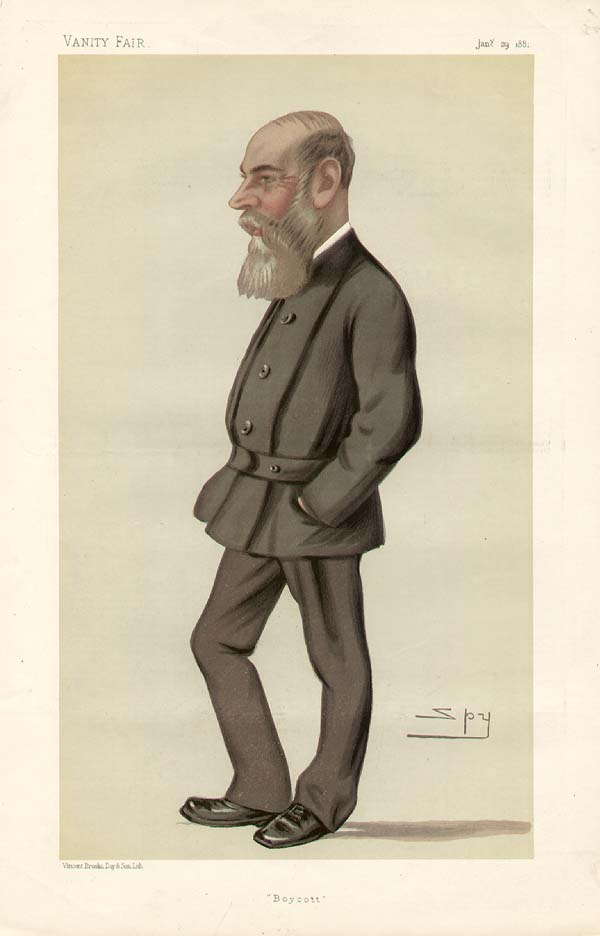
I know this is not new: plantation owners in the South used rents to create a new slave class, even after Emancipation, which we call sharecroppers; I have not doubt that many people are still stuck in that impossible cycle. Before that, the English landowners drained all of the wealth in Ireland through exorbitant rents; they also got the IRA, a centuries-long guerrilla war, and the very first eponymous boycott, named for Captain Charles Boycott, the land agent of an absentee English landlord.

Caricature of Capt. Boycott by Leslie Ward, published in Vanity Fair.

Plus, y’know, every colony that’s ever been taxed, and every serf who has fed his lord instead of himself, and, well, pretty much all of us who aren’t at the top of the capitalist feudal food chain, have dealt with this same issue.

Don’t you think it’s time we just cut the crap?

Look: I don’t own a house. It’s not by choice, it’s because I’m a public school teacher in the United States — and there’s another issue that I wish we would just figure out; the idea that the state where I currently live had been 49th in paying teachers, and then the teachers themselves walked out in order to bring attention to the issue, and now we’re like 47th, is just — it’s exhausting. Because I don’t own a house, I need to borrow someone else’s. I get that. I am perfectly willing to pay for the privilege of living in someone else’s house.

I am not willing, however, to make someone else rich by profiting off of my willingness to pay for the privilege of living in their house.

After all, I am asking nothing from my landlord but — well, land. I am a grown person: I am perfectly capable of carrying out minor repairs and performing general upkeep; if I cannot do a necessary thing, I am happy to call in a professional to do it for me, and if I didn’t have to fork over like 40% of my monthly income in rent, I would be happy to pay for said professional. Since I do need to fork over a ridiculous proportion of my income in rent, I am consequently not willing to wipe off the wall when I sneeze on it. (I’m exaggerating. I’d wipe off the wall. Or at least try not to sneeze in an obvious place.) And in exchange, because I am turned obstinate and intransigent by the extortionate rent, my landlord turns to the modern version of Capt. Boycott: the property management company. They, of course, require a certain percentage of my rent in order to manage me; and my landlord certainly isn’t going to sacrifice that amount from his profits: so the cost gets passed on to me.

So because I am charged too much, I have to be charged more; because I am resentful of how much I have to pay, everything gets done slowly, and poorly, because my landlord and the property managers look for the lowest bidder for any required repairs, and they are generally slow and incompetent as well as cheap. And the value and overall quality of the property goes down, and everyone suffers because of it. And all because my landlord can’t just rent out the property for enough to cover his costs for the property; he’s got to squeeze me dry. Just because he can.

From there we add the ridiculous application process, where I now have to hand over $55 or more per adult applying, and the obscene “security deposit” which is really just another wad of cash we hand over to the owners, because never have I ever gotten the full deposit back after moving out, regardless of how well I have kept the place up, and even added minor improvements; doesn’t matter, because the owners want to keep my money, so they find a way to charge me for the privilege of no longer living in their home.


I’m sorry this blog wasn’t funny. I’m sorry that I have nothing insightful or valuable to add to this whole issue. All I can ever think when I go out hunting a new rental is that I wish I could be a real estate tycoon, not so I could make billions, but just so I could go ahead and rent out my properties for a reasonable rate, based on a reasonable interview with a would-be renter, and the simple fact of trust between myself and my tenants. I just want to give people a chance to not hate everything about where they live. It would make everything so much nicer.


Too bad I’m not rich.