Salute

It’s hard being a teacher.

I had a committee meeting today. (That’s right, even a deadly global pandemic can’t stop committee meetings.) And it came up, more than once, how hard the teachers at my school are working; because, you see, we’re doing distance learning. My school is — lucky? prescient? — enough to have 1:1 Chromebooks, so in theory, we should be able to reach all of our students with new curriculum.

Heh. I thought it would be easy. And in some ways it is: I don’t have to dress fancy (Though I will say, albeit without judgment of others who make different choices, that I do wear pants every day), I don’t have to drive to school and home, I don’t have to be away from my wife and my dogs and all of my creature comforts. As a lifelong struggler with bashful kidneys and public restrooms, it is a great relief to be able to use MY bathroom in between classes.

But teaching online, it turns out, is goddamn hard. It’s a mental shift, and not an easy one, and so it makes me doubt all of my choices, choices that in class I would be confident in. I’ve been doing this long enough and I have enough ability and knowledge to think that I do it well; but the signals that I’m doing it well, which I’m used to getting from my students, are completely missing. And so, for that matter, are about half of my students; because they may have access to the curriculum, but that doesn’t mean they want it, or can actually show up and take advantage of it. So I just don’t know. Is it working? Is it not? Should I change? Today, for instance: one of my usual central methods is to get input from my students. I give them options about what they want to do next when we finish a unit; I ask them if they have any questions or topics they’d like to ask about or discuss before we get to the work I want to give them. I don’t assign them due dates, I ask them how long they think they’ll need to do something, and I let them decide when they want to turn it in. Today my AP Language class finished early, and so I asked them what they wanted to do: get some new material, or end class.

They couldn’t tell me. Two students said they were fine either way; two others said if we ended early they’d be bored, but that they didn’t really want to do new work, either. And the rest of them said — nothing. Nothing at all. For fifteen minutes. I’m used to students not wanting to make decisions; they prefer when I tell them what to do. It’s a lot easier and they don’t have to take responsibility for the decisions. That’s why I make them do it, of course. But usually they come around to the fact that they have to make some kind of decision,  take some responsibility, and then they do it. But today? Nope. They just sat there. I have no idea what to do with that. It makes it very hard to keep trying to figure it out and do it.

So that’s what came up in the meeting: that the teachers are all working as hard as we can. My principal said that hopefully, after all of this, more people will have an appreciation for what teachers do, and maybe so. Though my immediate knee-jerk reaction was to scoff at the idea; teachers have always worked this hard, and people that haven’t gotten that yet aren’t going to. But hey, since there are many, many parents who are trying to fill teachers’ shoes, maybe I’m wrong; maybe they will have a better idea. I’ll tell you, though, our problem as teachers has not usually been that parents don’t appreciate our abilities and efforts: it’s the people above us that are the bigger problem, and I don’t think that’s going to change. But maybe. Hopefully.

The reason I’m not sure that things will change is because this isn’t a simple shift of teaching responsibilities onto homeschooling parents. If everything else was normal, and parents just had to step into teachers’ shoes (Or again, it’s not really parents; though it’s nice to think that there are many, many administrators and school board members and state education department bureaucrats and elected representatives who suddenly have to teach their kids, and I appreciate that thought very, very much), then maybe the sudden increase in the difficulty of dealing with their kids would help to make the point. But that’s not what’s happening here. The world is on fire: all of us are trying to do our best while also running around trying to beat out the flames with our bare, scorched hands  and feet. Parents aren’t just homeschooling their kids, they’re also dealing with working from home, or not working, and all the financial worries that come with that; along with the health worries; and they are also dealing with their kids as kids, not just as students. It’s too much. Now, teachers are doing the same, as all of us are — I’m trying to teach while also worrying about everything from my every cough, to the health and wellbeing of my loved ones, to the long term financial impact of this; because my world’s on fire, too — but the point is, the hell that we’re all going through is not likely, I believe, to translate into, “Man, that teaching thing is hard!” I think the lesson we will all learn is “EVERYTHING ABOUT THAT WAS ABSOLUTE HELL.”

I also have to say that the toughest thing about teaching is not something that homeschooling  parents have to deal with, at least not in the same way. The toughest thing about this very difficult job of mine is going through some tough situation, an ugly class, a troubled or troubling student, and you deal with that, and it takes a lot out of you: and then the bell rings, and they leave — and a new group of students comes in. And in three to five minutes, you need to put away everything you were just feeling and dealing with, and be mentally and emotionally ready to teach the new group, because of course they had nothing to do with whatever just happened; they can’t lose out on their education just because that last class was awful. That’s the hardest thing. That, and starting over again with the terrible class/student/whatever the next day — and the next, and the next, and the next, for the entire school year. I know how trying children can be, and of course they’re even worse with their parents; but you love your kids. I like my students just fine, but I don’t love them. I just have to put up with them. Day after day after day. And keep trying to teach them, regardless.

And you know what? Sometimes I get those same kids back the next year. And the next.

So no, I don’t think that people will have much of a new appreciation for teachers after this — though I genuinely hope we will have a greater appreciation for a functioning government and leaders who understand their role and who carry out their responsibilities — but that doesn’t matter. Teachers will be fine. We’ll be so happy to be back in our classrooms that for at least a year after this, we probably won’t even complain very much — and believe me, that will be a big change, because the only thing teachers love more than our job and our students is bitching about our job and our students. We’ll be okay.

But there’s someone else who is being forgotten in all of this. Someone who is struggling just as much as the rest of us, though for the most part, we aren’t noticing. Some people notice, of course, and some even acknowledge the difficulty; but mostly, we’re treating them more like game pieces that we move around the board. Or maybe livestock, which we feed and water, groom and shelter; but never ask how they’re feeling about all of this.

The students.

As I said, teachers are struggling, but so is everyone else, and with the same things; parents are struggling, workers are struggling, everyone is struggling: and so are our kids. They have all the same worries, all the same fears, all the same guilts and frustrations. They also have no idea how to handle any of this. They don’t know if anything they’re doing is the right thing, and they have no idea who to ask, or what to do with the answers even if they got them. They may not understand all of the financial implications, depending on their age and awareness; but they certainly understand that their parents are worried about things, and that there’s danger, and while they may have the shelter of ignorance and innocence, they have absolutely no power to affect anything, no control, no opportunity to even try and make things better for themselves and the people they love.

As much as I may be struggling with online learning, my students are having an even harder time of it: and just like me, they are afraid for their health, and for their loved ones, and for the world around them that is on fire, and they can’t escape and they can’t put it out.

And yet they’re trying. Just as hard as me, and probably harder, in most cases. Sure, half of my students are not coming to my online discussions or doing the readings I’m sending them; but half of them are. Despite all of their worries and troubles. They’re still showing up, and still trying to pay attention, and learn. Think about that. Think about trying to follow along with a literary novel right now. I don’t know about you, but I can’t pay attention to anything for longer than about 45 minutes, let alone six weeks. And math? Freaking math?! People are supposed to be learning calculus right now? Now?! It’s insane. It’s impossible. I could barely get past my own problems to learn anything when I was in high school, and I had a comfortable, sheltered, privileged life, with a complete lack of the world being on fire.

And yet they’re trying. I have students writing essays. Good ones. Listening to me reading a novel, and asking questions, and raising points of interest, making observations. Good ones. They’re showing up every day — and when they can’t, they email me and apologize because their internet was down, or because their parents needed their help at the family business that day, or because they slept until noon because they were up worrying until 5am.

Sure, they had trouble today making a decision about whether they wanted to end class or keep going, but that’s because making a decision when your entire soul is one giant Rube Goldberg anxiety machine is almost impossible: I shouldn’t even have asked them to do it. I should have known how hard it would be for them to take responsibility for even a small choice like that, when they have so much to worry about already. They couldn’t do it. Not their fault. Just showing up today was enough. I want them to know that I am pleased with them for that, and proud of them for what they have done over the last four weeks.

My students are amazing. They are hard working  and dedicated, and they are talented and brilliant. All of in spite of what they have lost, and what they are losing, and what they are risking, and what burdens they are having to shoulder, right alongside the rest of us: helping with childcare, and with paying bills, and with taking care of their loved ones and keeping people’s spirits up, and trying to figure out what the hell they can do, what they should do, to make things better, now or in the future. They are doing all of that: and they are doing their assignments. They are inspiring. I am so very grateful to them, and so very proud to know them.

That’s what I want people to learn from this, and to remember after this is all over. That as hard  as it is and has been on us, it is as hard if not harder on these kids, who have fewer defenses and adaptations to difficulties, but who are still, still, doing their best. Let’s try to do our best for them, too.
Around Tucson

I’ve been walking my dogs extra, lately. And also looking around a little bit more.

Here’s some of what I’ve seen.

24FA040B-0AAD-4D7E-BF47-49712B0CF838

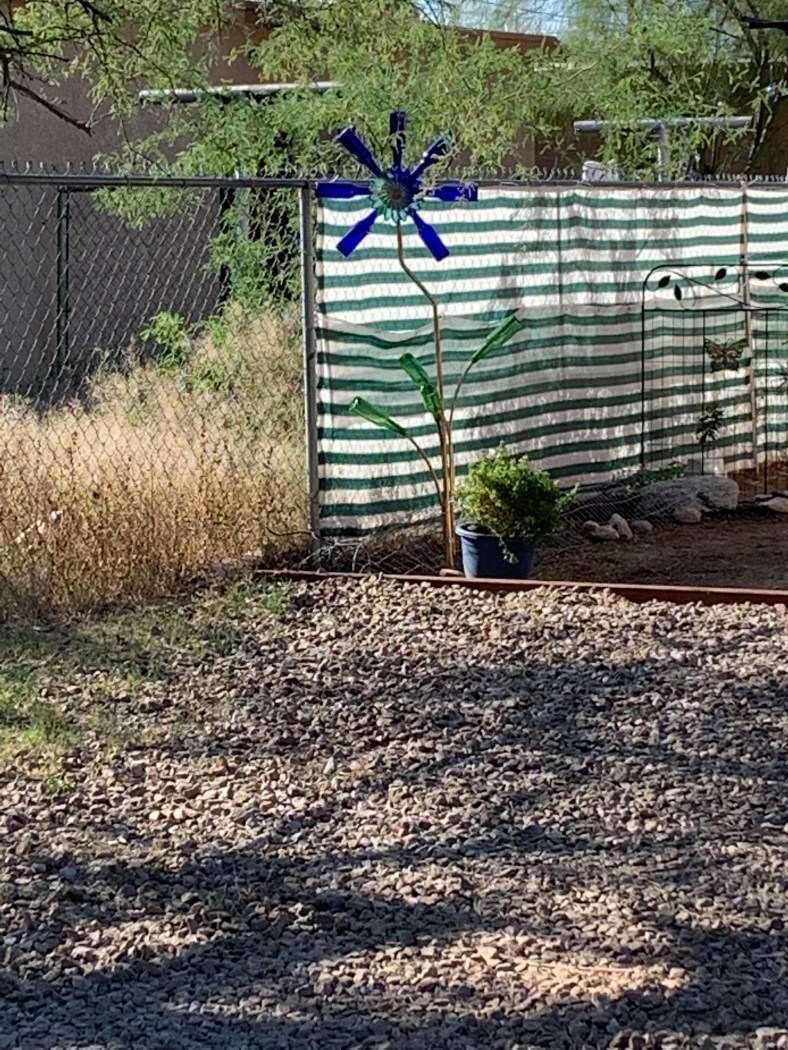
Glass bottle flower

DA92B8A3-D500-481A-8113-97C7B312CFA7

Three metal butterflies on the stanchions around a butterfly mosaic on a roundabout

DB20589A-17AB-49A9-B764-0E4EDB3A7671

Street Monarchs

720298FF-0D94-4D03-947D-87A306F810F8

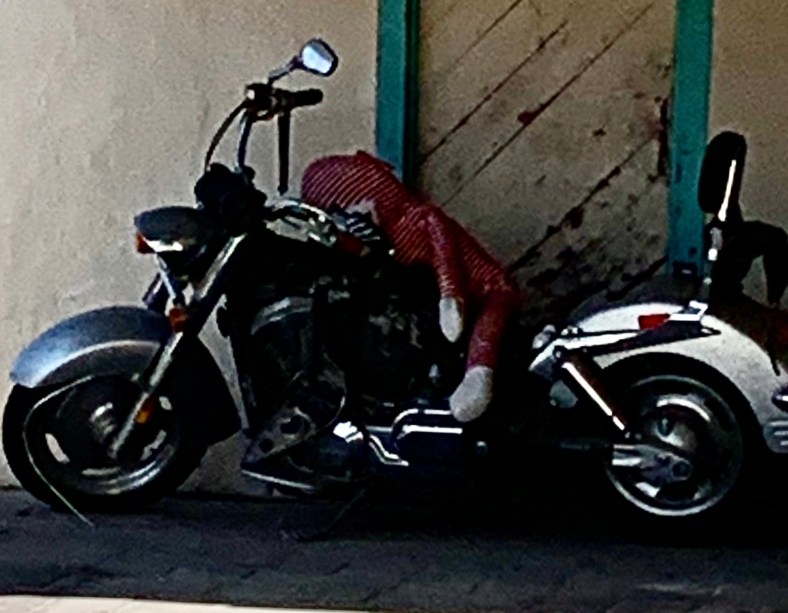
Beautiful motorcycle (Sorry about the picture) with a sock monkey on it

554EDC45-D681-44F1-9132-163A7BF76500

These negative mosaic metal grates (Zoom in)

F14AF77F-8F6A-4C46-BA86-C96E2E1B4A5F

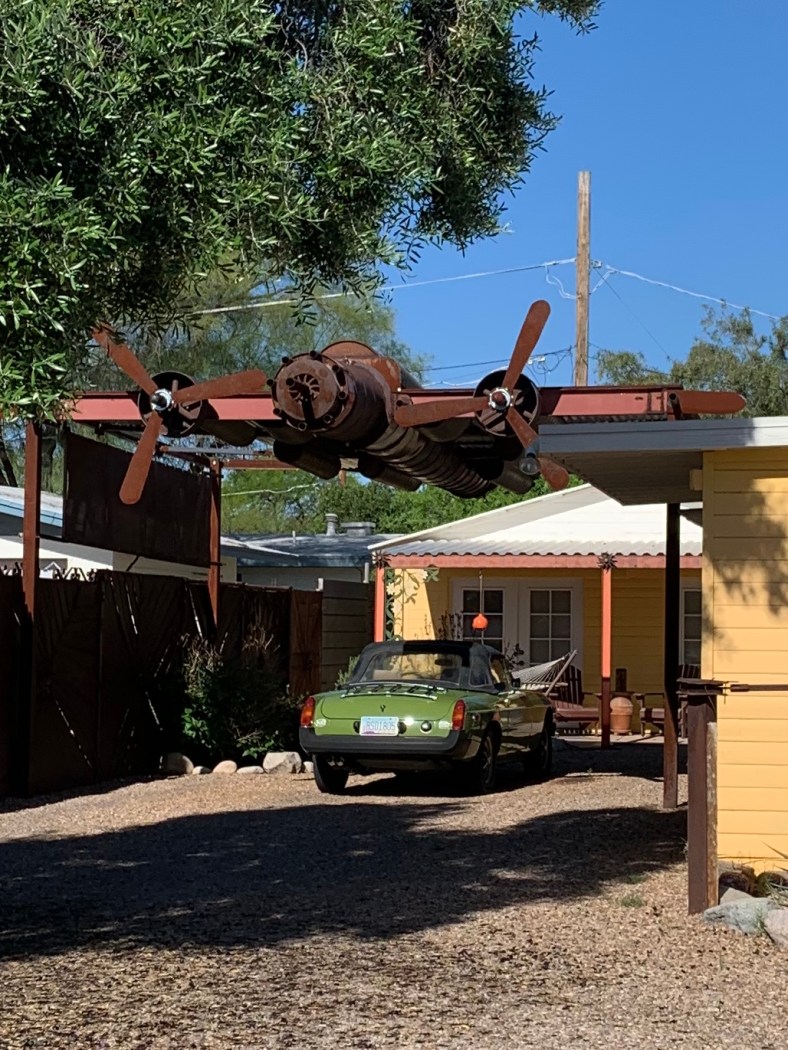
Ironwork airplane sculpture carport (And a cool car under it)

43DCBD7A-F96C-448F-890D-054106A4D2C4

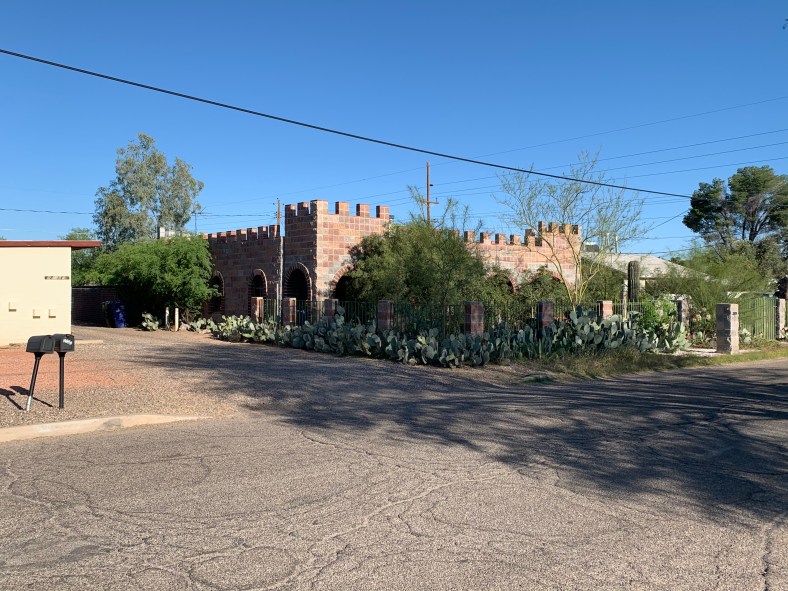
And, of course, this castle. Round turrets in back

7CBFD827-2B0F-4D37-B798-914F6B4505C0

Front and south side

76E72850-3F68-45C2-BE16-7E7FCEC160CF

Front. You can see the turret straight back.

722DCAAF-AACF-4E21-AE9A-F31C89EB586A

Front and north side

Losing Spoons

Sorry I haven’t been posting regularly. See, writing a blog, even a short one about happy things, costs me some number of productivity spoons; and I find that I have fewer productivity spoons left to me these days.

(By the way: if you’re not aware of spoon theory, here’s a visual. Read more here.)

This has been a shift for me, because I don’t normally run out of spoons. Well, I do, but I have a lot to spend, most days. I spend a lot of them at work, but I can still usually do a few things in the evening; I can go to the gym; I can go to the grocery store and make dinner; I can sometimes do a task for school, like set up a lesson for the next day. I can almost always get something written even on a school night, if it’s not one of the times in the school year when I’m burnt and exhausted and hate everything. And on the weekends, I can usually spend the entire time working, on grading, or chores, or my writing.

Life’s a lot easier when you don’t have a chronic disease or the weight of mental health concerns.

But my usual easy productivity has not been with me for the last month. Now I have to count my spoons.

It’s remarkable, and I wasn’t prepared for it. I really thought I would be able to do extra things: I thought I would be able to get extra writing done, since I don’t have to spend as much time at work; I thought I would be able to provide extra emotional support to my friends and family — and my students. The first week or two I was throwing around offers to help in any way I could; I suppose I’m lucky that nobody really took me up on it, because if I had had to spend my energy doing extra tasks for others, I’m not sure what I would have had to drop. I was angry with myself for the first couple of weeks: why was I so tired? And if I was so tired, why wasn’t I sleeping? Why wasn’t I getting more things done?

It didn’t really dawn on me at first that the answers were in some of the questions, and all I had to do was put the pieces together: I am tired because I’m not sleeping, and because everything I do — everything — is harder. I’m not sleeping for the same reason that everything is harder: because I am constantly afraid, constantly anxious, constantly trying to find something to do to solve the problem — and constantly aware that I cannot solve this problem. And of course, the more I worry, the less I sleep, and then I have less energy to do things, including worry, but worrying is never the thing I let go of in order to do other stuff: I worry first, and then whatever energy I have left over goes to my job and my daily tasks. I spend more energy getting mad at myself for not getting more done during the day, and because I’m tired and on edge, and I struggle with my temper, I am constantly getting mad at anything and everything around me. And then I feel bad because my family has to walk on eggshells around me so that I don’t snap at them. And there’s some more energy spent, and even less accomplished.

I get it now, I understand; I’m still not dealing with it well, though. I still get angry with myself for not doing more. It’s weird: somehow I still feel pressure to use this extra free time before it runs out, like I find myself thinking that I should do more writing or record more podcasts before the quarantine is over and I have to start going out and doing things more. Like this is a vacation.

But that’s not what this is. This is a natural disaster.

I’ve been through a few of those: a hurricane and more than one blizzard in Massachusetts; a wildfire in California; a flood in Oregon. None of them on the scale of Hurricane Katrina or Maria, or the Loma Prieta or Northridge earthquakes. But they were bad enough to show me what a natural disaster feels like: you watch things fall apart that you had always counted on; you watch danger arise from a direction and in a way that you never expected; you watch that danger come for you, or for those you love: and there’s nothing you can do. Except realize what you are about to lose. And realize you have no idea what to do if and when you lose it, how you will get it back, how you will live without it.

That’s what this is. Covid-19 has taken away things we never expected to lose, and we are in danger of losing even more, if we haven’t already lost everything. And I am aware of how lucky I am to be able to say that I have not lost everything. I see people on social media who have, and I can’t — no, I was going to say I can’t imagine what that would feel like; but I can imagine. That’s a lot of what I do during the day. I imagine what I could lose, and how it would feel, and what I would do about it. And every time I think about, what if I lose someone I love, or what if I lose my job and my home, I realize: there’s nothing I could do about it. I assume I’d adapt and survive, I assume I’d be able to ask for and receive some help; but I don’t know. I just don’t know. I know I couldn’t fix the problem, couldn’t recover the loss. I know I’d be devastated. I don’t know how I’d deal with it. Maybe I wouldn’t be able to. I worry about all of it.

That’s why I can’t get much writing done. Not even happy little blogs: because it turns out that I need to feel happy before I can post happy things; or at least, I need to be close enough to happy to recognize what would be a good happy thing to post. I can write things that  I’m not actually feeling in the moment, but when I try to think up a good topic, or when I try to pick a good link to share, if I’m feeling down or exhausted or angry or afraid, nothing seems like a good idea. Which I also get mad at myself for, by the way. So that’s fun.

This is what it feels like to have to count your spoons. To have a chronic illness, or a mental health condition like anxiety or depression. It feels like nothing works right. And I suspect that you always feel like it’s your fault, like if you could only deal with it better, be smarter, more thoughtful and aware and organized, then everything would be better. Though maybe people who deal with this all the time are smarter about it than I am, maybe they know that they can’t blame themselves for something that’s outside of their control. All I know is that that thought doesn’t help me. Knowing that I can’t do anything about it doesn’t keep me from worrying about it. About anything. Knowing that it’s not my fault doesn’t keep me from getting angry at myself.

I even have that little annoying thing that clearly isn’t the main issue, but keeps popping up and irritating me, because it’s kind of a pain and it’s clearly connected to the larger problems, so when the little irritation pops into my consciousness, it makes me think of the bigger issues, which sets me on edge; at the same time, I can’t believe I also have to deal with that little fucking thing that just won’t go away. I have eczema, you see. On my hands. They itch. And then the skin dries out, and splits, and hurts. And itches more. It’s made worse by repeated hand washing, and by stress, so. Fucking annoying. I feel bad bitching about it, because people are dealing with things that are a thousand times worse, but that only makes it more irritating, because goddammit, my hands itch, and maybe I should be Zen enough to rise above it, but I can’t, and I feel lame and I wish I could just make it stop but I can’t control anything but I can still worry about it.

And around and around we go. Using up our spoons. And getting nothing done.

This wasn’t even the blog I was going to write; I was going to write about my students. And part of me thinks I should add that right here, right now, make the point I was actually going to make; but you know what? I don’t want to spend the spoons. I need to call my dad, and I want to maybe record a chapter of the book I’m reading to my students for their distance learning English class. So I think I will stop here, and write about my students tomorrow. Or maybe the next day.

I’m grateful, honestly, that I’ve had this experience, because I think I get it now, what it is like to have to count your spoons. I’ve been able to sympathize with the people I know who have to do it, but I could never empathize. Now I think I can. But I also realize: if this disaster, and the weight of the worry that I’ve been carrying around for a month now, have reduced my formerly unlimited number of spoons to some number I have to count: what has it done to people who had to count their spoons in the first place?

And the scariest thing of all is: what if this doesn’t stop? I mean, that’s what it’s like to have a chronic illness: you have to recognize that the situation will, or at least may, be permanent. You’ll always have to count your spoons, forever. I  won’t have to face that, at least not with the current pandemic; it may take a year for things to get back to normal-ish, but there will be a vaccine, and things will improve; I don’t know how long the economic damage will last, but I know it won’t be forever. But for some people, the changes  wrought by this disaster will be permanent. And maybe they will be for me, too. Or if that doesn’t happen with this disaster, maybe it will happen with a future one. At some point, I will have to face and deal with a permanent loss, a reduction in my capacities and abilities, a change in my life, that will never get better. And then another one, and then another one.

I think, between now and then, and using what I have learned and what I am going through now, I have to learn to accept that loss, that reduction, that change, and keep going forward with what I have left to me. I’m sure I can do it; I know everybody does. We deal with loss for as long as we live. I hope I am learning how. I hope the learning helps.

Seasoning

My students are arguing again, as we do every spring — even if we’re doing it on Zoom and Google Docs. Today we had a (very capable and funny) argument in favor of winter as the better season over summer. I didn’t get a volunteer  to respond to it, so I challenged all of them to write their own response. Here’s mine.


What’s the best season?

Hmm. Tough call. Because there’s something in every season that is good: winter is the best because cold is better than hot, because fresh snowfall is pristinely, sparklingly beautiful, because the clothes are more fun to wear, and because the holidays are better. But spring is the best because everything comes to life and bursts in bright colors as the last gray, crusty snow melts away, because the new music and new books start to come out hoping to be the big summer thing, because the sports world is exploding with NBA and NHL finals and the start of the baseball and soccer seasons and NFL Draft Day, and because Easter has the best candy (because Cadbury is the best candy in all the world AND I WILL DIE ON THIS HILL AND TAKE ALL OF YOU WITH ME). But summer is clearly better than any other season for one simple reason: no school. Vacations and long lazy days, ice cream and iced coffee and watermelon and swimming to break the heat, summer concerts and blockbuster movies – and, while we’re talking about this stuff, let me point out that scientists expect summer will help break the Covid-19 pandemic, because viruses tend to spread more in winter as people are trapped inside in close quarters with each other, so summer is the healthiest time, and I think we could all use that right now. But then autumn comes in with fall foliage and crisp winds, monsoons and rainy days indoors and the return of cool nights, Thanksgiving and Halloween, the World Series and the World Cup and the start of all the other sports, and the final death of allergy season, hurricane season, and wildfire season.

You know what? I can’t choose. I could make an argument for, or against, any season. I’ve lived in four major regions in my life, and they all had their best season: here in Tucson it’s clearly winter that shines, because the weather is perfect; in California spring is the greenest and best time; in Oregon summer is the only time that doesn’t suck; and in Massachusetts, autumn is the most beautiful season of all. And also, Tucson summers are sun-baked hell, Oregon winters are gray-skied muddy hell, Massachusetts springtime is schizophrenic weather hell where I’ve literally worn a t-shirt one day and had school canceled for snow the next, and California fall is – actually, it’s still not that bad. Though autumn is usually when the whole state catches on fire.

I’ve loved every season, and dreaded every season. In fact, every season has something to look forward to, and something we can’t wait to escape. Every season has something we hope to cut short and something we hope to stretch out. Every season has good weather and bad weather, good events and bad events, improvements and declines…

I got it. I know what the answer is.

The best season is – change.

Every season is best when it’s new. And every one gets terrible before it finally gets dragged away, kicking and screaming, by the heroic arrival of the new season. The seasons, all of them, are too long, and give us too much of a good thing. (Even Cadbury crème eggs. I fully admit I have too many of them. Though the answer there is to stock up while they’re available, and then space them out as long as possible. I’ve made them last until the New Year.) Every season is made better by its contrast to the other seasons.

And this is true no matter where you are. Here in Tucson, summer is best right when it starts, right when school gets out and the real death heat hasn’t started yet; and it’s best then because we’re so sick of school, and we’re not yet tired of the heat. Autumn is best when the rains wash the pollen and dust out of the air, and the death heat finally breaks; and before psychopaths make us want to set the world on fire before we have to listen to ONE MORE CHRISTMAS CAROL or HEAR ONE MORE ARGUMENT ABOUT HOW HALLOWEEN IS THE BEST HOLIDAY or see ONE MORE MEME ABOUT GODDAMN PUMPKIN SPICE. (You know who you are, all of you.) Winter is best because we’re ready for the holidays and the cool weather, which comes right at the start of winter; but by February, we’re tired of being cold, and of having the flu, and we’re ready for spring and t-shirt time. Spring is – well, this has not been a good spring, so it doesn’t work too well to argue for the positive aspects of spring right now; spring is clearly Coronavirus season, and there ain’t nothing good about that. But normally spring is a relief, until it gets to be too much, and we just can’t wait for summer to start. I could do the same thing with every place that I have lived: I have longed for every new season to start, been relieved and happy when it finally gets here – and then grown tired of it and hoped for yet another new season to save me from the current one.

I think the real answer is this: the future is better than the past, and change is better than stasis. Even if we are traditionalists – and I love watching the same Christmas movies every year, and every last day of school I blast “School’s Out” by Alice Cooper as I drive away from work for the last time, and I will dress as a pirate for every Halloween for the rest of my life if I can – we still prefer looking forward to when that happy tradition can come around again, and we are sad when it passes and we have to look back on it. So the best thing we can do is look forward to what is coming, and the worst thing we can do is look back on what has hung around too long.

The best season is the next one. And I can’t wait.

PETS!

Here are all the videos I couldn’t share before.

This is Roxie wagging her tail. Unfortunately, her snoot gets in the way.

Here’s Toni giving Neo his watermelon:

This is Neo yawning (With a cameo by Samwise)

This is Samwise having puppy dreams:

Duncan getting a nice skritchy — and then biting me a little.

Is it weird that this actually makes me want a strawberry? And a napkin for the tortoise?

Finally, here’s Roxie again, snoozing away.


What Should Be Saved

I’ve seen this piece making the rounds today. It is worth reading.

Prepare for the Ultimate Gaslighting

Prepare for the Ultimate Gaslighting

After reading this, I started thinking about what I’ve experienced over the last month or so. I tried to decide if there was anything that I would want to keep in my life, and changes that I would want to make permanent, after things — “go back to normal.” It’s not so much about keeping, because everything right now is honestly pretty hideous; I don’t want to keep anything to do with this pandemic once the coronavirus goes back to lurking in the shadows. But the author makes the point that we have a unique opportunity now to step outside of our daily lives and regular routines, and observe,and make decisions about what we really want, what we need, what we want our new normal to look like. Everything will change, we all agree: so the question is, what do we want to keep in the new world after Covid-19, and what do we want to discard?

The first thing that came to mind is something I do not want to keep after the quarantine ends: teaching remotely. When it started, I joked that this was the dream: teaching without actually having to see and interact with students — and also, largely, teaching without grading. I’ve joked for years that teaching would be 1000% better if I just didn’t have any students. Well, now I sort of don’t have any; and since we can’t guarantee access to online material for all students, the school’s policy is that no grades can be applied that would lower the students’  grades from what they were before the quarantine started; so there’s not much grading to be done.

And I hate it. I miss my students. I miss talking to them personally, about their lives and their joys and sadnesses; I miss answering their random-ass questions; I miss being able to interact them while I teach them, because, it turns out, teaching people who aren’t there in front of you is not good. It’s hard enough to get teenagers to participate voluntarily; take them out of the room and put them at home behind a video camera, and participation essentially stops dead. I run a discussion class because that is both the most effective and the most interesting way to teach literature, and now I’m forced to do little more than lecture to a silent room. And it sucks. I miss being good at my job.

However: while I’ve been doing the distance learning online, I’ve been reading The God of Small Things to my AP Literature class; it’s an incredible novel  that I’ve written about before, and reading it to them has so far been worth the time. It works fairly well online, because they can relax and listen to me read; I like that it is helping them reduce stress while also helping them experience the story. It may be somewhat different in the classroom, but also, students need to reduce stress pretty much all the time; that’s not going to change by next spring. So I think I will do it again next year, when I have them in front of me. I think it will be worth it to shift other parts of the class to homework and independent study, and really use the time in class to understand and appreciate this work. So I guess I’ll — keep — that. Also, I am pretty happy to not be grading anything. Sadly, I won’t be allowed to keep that aspect. Ah, well. C’est la guerre.

I miss my coworkers, too. I talk to them pretty regularly through social media and texts, and we’ve been having weekly video chats; but it’s made me realize that I like having them around more than I thought I did. I’d like to spend a bit more time being a bit more social. I think I’ve probably focused too much on my introversion, using that as an excuse to not spend more time talking to people I like talking to; I should stop that. I am an introvert, and there are definitely days, especially as a teacher surrounded by teenagers who demand far more attention than I could give, let alone am willing to give, when I just want to go home and not talk to another human (My wife of course does not count: she is a goddess.); but most days, I think I should stop in to my friends’ classrooms and say Hi.

The dogs and I have been taking extra long morning walks, which I’d love to keep; but that’s more to do with the amount of time I have in the morning before work, rather than because of my preferences. I would like to keep longer, slower mornings; but, c’est la guerre. I’ve always done longer slower mornings on weekends, including extra long walks, so that will stay. I have also been taking short evening walks with my wife: that I would definitely like to keep, at least until the Tucson summer clamps down. It’s less fun to walk around the block in 100-degree heat. I’ve been seeing more of my neighbors out and about on the walks, both in the morning and the evening; I’d love to keep that even after we can all go back to driving everywhere all the time.

My wife and I have been good about doing our long-term meal planning, so we can minimize trips to the store (Don’t give me that look: Tucson has not been a hot spot, and once  I stopped going to school every day, back on March 13, we were entirely within the social distancing guidelines. So no, I have not been locking down and sheltering in place, I’ve been still buying groceries. If it helps, I need to buy fresh produce to feed my tortoise. So it’s not just for me.); we’ve gone up and down on this in the past, because in Oregon the grocery store was a pain to get to, so we shopped large once a week and then bought small items as needed, but here in Tucson shopping is much easier and so we have tended to decide what we want for dinner on the day of, and then do our shopping on the spot. But this is better. We’ve always known it, we just haven’t pushed it; I think we will keep that one.

I’m definitely keeping the podcast. I’m pleased with how it’s going, and how it’s been received; I like doing it and I think I do it well. I’m certainly at a stage in my life where I want to stop wasting time on idle pursuits and I want to be more productive; I don’t know that I can always find it in me to write serious fiction, so I think it will be good to keep different projects going, to use different skills and make different kinds of content. I’ve avoided doing things like this in the past because I think of it as taking time away from my main pursuits: the days I spend making podcasts are days I am not writing. But you know what? I don’t spend all of those days writing, anyway. I spend more of them just taking it easy. Which is good, but not the thing I think I need to do. I’d rather work a bit harder and be more proud of myself; that will be easier if I have more ways I can work, and more things to be proud of.

I think I may keep the daily blogging. I did it for a while last year, and it was great, though it was hard sometimes. It’s been the same this last week: sometimes I have no idea what to say, and sometimes it feels like I don’t have the time to dedicate to writing something serious, and sometimes when I have something to write it takes more time and energy than I thought it would, and so other things don’t get done; but it’s good for me to write. I don’t know how it is for you all to read my ramblings, but it seems like some of you like it, and the rest of you don’t do it, so. I will try. I will also not be too obsessive about doing it EVERY day.

That’s probably the big one. I’ve been working on forgiving myself for not being productive, for not always having the energy to do something “useful” or “valuable.” Because right now, the most important thing we can do with each day we have is — get through it. Stay alive, stay sane, stay ourselves: just keep going, every day, on to the next day. Because each day is a new chance to do something more than that — but if you don’t do that, then you won’t do anything. We have to keep our minds on the main goal, on the most important thing we do: keep going. I’ve learned that, and I’m being better to myself on the days when I don’t have the strength to do more than make it through: because I’m aware that that’s the only strength I really need to make sure of. Just enough to keep going. So long as I have that strength, the other strength will come back. I will be able to do more on another day, and I will still want to. I’ve never believed the conservative  argument that people on welfare want to stay on welfare because they’d rather be lazy; I don’t know why I thought it about myself, but I always have. It’s not true, though: I’ve been lazy, and I’ve been productive; I would rather be productive. So after I rest, I work.I want to work. I look forward to it.

But sometimes I need to rest. It’s okay to not be productive sometimes, even a lot of the time. When I can be, I will; and when I can’t, I don’t have to be mad at myself about it. I can relax about relaxing. I have been letting myself do that, and that one, I’m definitely going to keep.

Did, Didn’t — whatever. Enough.

What I Didn’t Do Today:

I didn’t grade any student work. Even though my students are asking about their grades, even though my school’s Educational Learning Opportunities Plan includes this:

Recognizing that quality feedback is required for highly effective learning environments and students’ success, teachers should provide relevant, timely, and specific feedback to students on any new instructional content.

I also didn’t include the required

Articulation of specific learning objectives that students will “know and be able to do”.

Didn’t do any of that. I also didn’t point out “educational learning” is offensively redundant, and I didn’t argue that there’s no way this could ever be considered a “highly effective learning environment,” and I didn’t raise one eyebrow snobbishly and sneer at the period outside the quotation marks.

I also didn’t teach three of my classes. I have provided work for them for the week, but today I did nothing. Didn’t look at their Google Classroom, didn’t reach out and contact those who haven’t turned in work, didn’t schedule individual video chats for those students who might need extra help. I didn’t even worry about them today. Not even the ones who are genuinely struggling. I am consciously avoiding worrying about them right now.

Because I can’t do anything to help. Today I didn’t feel bad about the fact that I can’t do anything to help. Well. Not much, at least.

I didn’t exercise today. I mean, I walked my dogs, so I guess that counts; but I’ve been trying to do sit-ups and push-ups and stuff, and I didn’t do that today.

I didn’t eat healthy, didn’t watch my food intake, didn’t limit my portions, didn’t avoid sugar or caffeine. I didn’t watch my cholesterol even though the doctor said it was too high. I didn’t take any fish oil, either. I did wonder whether the fish oil is harvested, or rendered. Like, do they squeeze the oil out some part of the fish, some oil sac? Or do they grind the fish up and then squeeze the oil out of the resulting mush?

None of this is making it more likely I will take my fish oil. Which means I probably won’t be keeping that follow-up doctor appointment. Maybe I can tell myself I’m keeping them from using up PPE for a routine visit.

I did not listen to or watch the news today. On my walk with the dogs, when I usually listen to NPR, I listened to a podcast (Bundyville, which was recommended to me and I will recommend to you: because it’s the story of  Cliven Bundy and his family, and their standoff with the BLM over ranching fees in Nevada and their takeover of the Malheur Bird Sanctuary in Oregon. And it’s a trip.) and music on Pandora. I don’t know what the current numbers are, nor what Trump fucked up today.

I didn’t clean today. No vacuuming, no dusting, no mopping, no laundry. I haven’t washed the dinner dishes yet.

I did make dinner. I’m proud of that. Ziti with roasted vegetables. It was delicious. I ate too much of it.

I did not read a book today. I  haven’t read any books, not all the way through, since the quarantine started. I haven’t worked on my books, haven’t written anything other than these quick little blogs, in, well, a long time. I’m now posting this too late for it even to be worth it. But at least I wrote it. I did that.

I got in a political debate on Facebook, and avoided another one. I said things I probably shouldn’t, but I said things that needed saying. I thought about writing about the issue for this blog, but I didn’t; I asked my wife what I should write about, and she said this. Well. Sort of this. She said I should write about how we’re all doing our best, and the situation is incredibly hard, every second, every minute, every hour, every day, and just making it through is enough. So I’m trying.

I haven’t played guitar. Haven’t watched the movies I meant to watch. I haven’t sent my book to an agent, and I haven’t inquired about getting my podcast picked up by an online education system. I haven’t checked in with the College Board about my would-be summer job grading AP essays — actually, let me do that right now.

Okay, now I did that last one.

But I haven’t done the rest. I haven’t done a hundred things I meant to do, I mean to do, a hundred things I think are important.

But you know what I have done?

I’ve survived. I’ve made it through another day doing what I needed to do. I’ve slept, and woke, and eaten; I showered, I worked. I kept going under a weight of anxiety that is unlike anything I’ve ever experienced  before, and tried to support people trying to lift and carry the same weight. I tried to do the right thing, and to remember that the key is just to keep going. That this will take a long time. A very long time. It’s a marathon. The whole point is to outlast, to make it through, and to keep pushing. Doing that is enough. Surviving is enough. It’s hard, and it’s draining, and it’s depressing and scary and frustrating, and it feels like it will never end: but it will. We just have to keep doing it. If we keep going, keep trying, that’s enough.

I haven’t done everything I wanted to, haven’t done everything I should.

I’ve done enough.