This is NSFW. And Trump is a POS.

So I wrote a blog, 2000 words, about how I’m unhappy with the way things are going because some things are going well, and I don’t want Trump to get credit for that because he isn’t the reason things are going well, but if we give him credit, we may end up with more people like him doing the things he’s done, because they’ll point at Trump as a success story. And I do think that’s a problem.

But you know what? That’s not what I want to say right now. That’s not the blog I want to post.

What I want to say right now is

Fuck Trump.


Fuck him all the way out the door and down the steps, fuck him rolling down the street and around the corner, fuck him all the way to the sewage treatment plant: then fuck Trump into the collection tanks, and fuck him step by step through the process, with the rest of the chunky liquified shit until he has been treated, emulsified, centrifuged, disinfected, milled, filtered, diluted, and sprayed onto his own fucking golf course to make the greens grow. And then let a blind man tee off over and over until he has turned the entire green, watered with Liquid Trump, into broken divots. Then mulch those, feed them to free-range farm pigs, let them turn the grass into chunky liquid pig-shit: and then run him through the process all over again. Keep doing that until there aren’t any more Trump golf courses. If at any point we feel there isn’t enough Trump-taint in the gray water, then throw in his fucking kids. (The grown ones; I got no problem with Barron. Or Tiffany.)

I’ve tried so hard. I’ve realized in the past couple of years that my loyalty to liberal, progressive politics, and especially to the Democratic Party, has been unthinking and in some cases counter to my actual desires and values. Not a lot; I still agree with most liberal progressive ideas. But I think political correctness is a blight on the language and the culture; and honestly, while I love animals, passing laws and regulations to limit human progress or achievement in order to save a rare form of tadpole that lives in one stream in Wyoming is stupid – the world will not be a lesser place if the Greater Wyoming red-speckled spiral-tailed hovering-footed tadpole goes extinct. Mainly, though, there’s one thing – and only one thing – that Trump was right about: Washington is a swamp. Both parties are corrupt, incompetent, filled with narcissistic sociopaths who serve themselves and their cronies and not the American people. I’m not too far away from saying that all of our government should go into the sewage with the President.

I am still trying to decide where I should land politically. I want to remain an idealist, which would throw me all the way to the left; but I also want to be practical and realistic, and that pushes me towards the center. Choosing either one seems like a betrayal of the other: and that’s a result of our political morass, as well, that there are purity tests, that people on the same side turn on each other in a heartbeat if they can find a tender place to sink their claws. We saw it with Sanders supporters versus the DNC and the Clinton campaign, and we’ve seen it for years with the Tea Party and how it has destroyed what used to be the Republican party, resulting in – President Shit-spray. Part of me wants everyone to agree, so we can all move in one direction; but I realize – and this is my big epiphany of the last couple of years of learning how to think more about my politics – that when everyone agrees, it doesn’t lead to good results. We get the best ideas, the best policies, the best country out of a constant and honest debate. The worst thing that our two political parties have done is surrender that ideal in favor of winning. That’s why we have legal partisan gerrymandering, inculcated for decades by both sides; that’s why we haven’t gotten rid of Citizens United, or passed campaign finance reform or term limits or strict controls on lobbyists and corporate influence of politicians. They all stopped trying to do a good job, and focused on just keeping the job. I know that’s always been a factor, but it seems to have become the only factor. One of my biggest surprises of the last two years of the Feces Administration was the sudden onrush of respect for Jeff freaking Flake, a cardboard cutout of a Republican who nonetheless resigned rather than suck up to Trump. (I suspect that he is going to continue on in politics, using his resignation from the Senate as a stepping stone for his next ambition; but he hasn’t done so yet, so as of now, I still respect the man for his decision. Integrity over politics. When was the last time that happened?)

So how do I reconcile that? Practically speaking, the way forward is with a party; because I am not a piece of shit, that means I have to support the Democratic party.

I’m sorry for those that offends. I have actually gained quite a lot of respect for the GOP and the conservative ideals they have historically espoused; the attraction of the moderate political position for me is it allows for that honest debate I mentioned which leads to the best possible outcome, that pull between two poles, both with merit, but both improved by being pulled towards the other – liberal ideas are better with a strong inner structure of conservative reality, and conservative ideas are better with a leavening of liberal idealism. The Republican party has served that role, and for a long time, and in a lot of ways, it has done so honorably, and therefore made our country better. But right now, and for the immediately foreseeable future, the Republican party is the party of Trump. Which means it’s the party of shit. You can’t hold up a 300-pound piece of shit and not get your hands dirty, you just can’t. And I don’t even care if he’s having a positive effect, if the economy grows and North Korea disarms and all that jazz: shit makes flowers grow, which is lovely: but it’s still shit. The best thing I can say about the current state of the union is that I hope it makes the land fertile again. Actually, the metaphor might hold true, because confronting the truth of Trump has made us all look much more closely at our political situation, and it is possible that we will get some genuinely good results after this shit-storm has passed. But now is not the future, and now, Trump is shit, and that means the Republicans are shit, because they back Trump. Period.

Where was I? Oh, right. So, if I want to get results, I have to support Democrats. I mean, sure, I could try to become an anarchist, or a pure Socialist, or something along those lines; there’s an attraction in that, in the purity of the ideas. But in reality, there’s no chance of changing the political situation in any way without one of the two major parties. Ignoring reality means people get hurt. I don’t want to hurt people: it’s kind of my main thing. (Note: I recognize the seeming irony of my rant about grinding our President into gray water while saying I don’t want people to get hurt, but you see, shit isn’t people. I don’t mind if shit gets hurt. [Second note: I’m kidding. I don’t want any harm to come to Mr. Trump. I want him out of office and living in the disgrace that he deserves. I’d like him to live like that for a long, long time.]) I want practical solutions to our immediate problems, all of them chosen and thought out with a positive ideal in constant sight; for that, I need to be involved in actual practical politics with real people in this country. A perfect example of this is Bernie Sanders: who was a Socialist, and then an Independent (Which he only got away with because he represented Vermont, even though he’s from New York), and then ran for the Democratic party nomination for President. That’s an idealist working with practical reality, and that’s why he would have had my vote if I could have voted for him. Another perfect example of someone who creates practical solutions while keeping an ideal firmly in mind is Elizabeth Warren, who I would vote for over any other potential candidate in 2020 with the possible exception of Stephen King or J.K. Rowling. On the other hand, the Democratic party is also the party of Chuck Schumer and Nancy Pelosi and Harry Reid, and they, from what I have seen, either  stick to the ideals, but give very little in the way of practical solutions – this is how Schumer has handled Trump, and it’s honorable, but it’s not slowing down the spray of shit – or else they surrender the ideals for the sake of practicality, as happened with the ACA when they removed the public option, which was the whole freaking point of the thing, the loss of which has made it useless, and, eventually, a political liability.

Sorry if that got muddy: it’s hard to stay clear when talking about politics. My point is that the idealism is necessary: purely practical compromise ends up losing its way and accomplishing nothing of lasting value; at the same time, practicality is necessary, because pure idealism doesn’t accomplish anything in the first place. Everyone already has their own ideals, and they’re mostly not mine. It’s too hard to get everyone to agree with the same ideals – impossible, in truth, unless you go full Big Brother and set up the Thought Police. This is what upsets me about the struggles within the Democratic/progressive wing, that we are all fighting each other over our ideas, refusing to accept or support people who don’t have all – and I mean ALL – of the right ideas. The fact that the big criticism of Bernie Sanders during the primary campaign was that he didn’t have a lot of support from minorities shows two things: the important one is that the Democratic party has given up its ideals, which means it has ceased to do good work for minorities in this country, which has left them smothered under the shit this country has piled atop them for centuries (Though fortunately, they seem to have found their own power and are clawing their own way out of the shit of history) and therefore Sanders could not simply pull in minority support by virtue of running as a Democrat; the entirely unimportant one is that Bernie Sanders is a white guy from a white state, and therefore has not had a lot of connection with, or influence on, the situation facing minority Americans. And if that made anyone refuse to vote for Sanders, then it helped give rise to the Shitpile-in-Chief; and that is a travesty. (I’m not saying that Democratic infighting led to Trump’s election, just that any vote that was lost because of the infighting is a specific, individual travesty. People that don’t support the Democrats at all, who are Greens or Libertarians or Socialists and so voted according to their conscience, that isn’t a travesty. But it may not have been practical.) A travesty that happened because people hung too much on the power of their ideals, and ignored practicality; ideally, a President should have a strong connection with all of their constituents; practically speaking, Bernie Sanders was the best candidate in 2016.

So here I am. I can support my ideals, and allow the shit to continue polluting this wonderful country; or I can support a party that keeps electing poor leaders: and I do think, in retrospect, that Clinton would have been one of those bad leaders. She’s not a piece of shit, and so would have been a VAST improvement; but I think she has very little personal connection to the ideals of progressivism. She’s too practical to be really great. I still wish she had won. Man, wouldn’t it be nice if all we were dealing with was a president who wasn’t progressive enough?

But all right, here we are with the shit. And no matter who you are or what your ideals, accept this as gospel truth: Trump is shit. The way he attacks everyone he disagrees with, the way he lies about everything, the way every single issue becomes a reflection only and always of him personally – the man is a piece of shit vaguely in the shape of a human. The most recent outrage is the separation of families at the border – intentional and callous and unforgivably cruel, and we all know it – and his attempt to defend it by holding an Exploit-a-thon, where he paraded out the family members of people murdered by immigrants, like that changes the statistics (which clearly show that immigrants are less likely to commit crimes despite some terrible exceptions), like that has anything to do with the family separation policy, like that’s anything other than cheap, heartless sensationalism intended to stir up racist fears in Middle America.

He signed the pictures. Did you see that? He signed the blown-up photos of the goddamn murder victims. Look.

And look, another Trump signature.

Clear as day: Trump's signature.

[Source]

Think what your brain has to be like to let you make that conscious decision to do that. Repeatedly, because he seems to have signed all of them, and at no point did he think, “Jesus, what am I doing? Who the fuck would want my autograph on the picture of their dead loved one? Is this really a memento they want? Will they want to remember this hoopla at all?” No, I’ll tell you what he thought: he thought, “These people want to use their grief to win political points, just like I do; I should thank them for letting me use them. Then they can frame this picture and tell their friends how they volunteered to become ghouls for the sake of bolstering up a racist piece of shit.”

So that’s where we are, and the cold, hard truth is this: it isn’t over. Trump is still President. And he’s just going to get worse. And I think the Republicans are going to keep supporting him, because too many of the heartless conservative bastards in charge, the ones who have no connection to the ideals they claim to serve but think only of practicality – the counterparts to Pelosi and Schumer and Clinton and Reid, namely McConnell and Ryan and Lindsey Graham, and Sean Hannity and Rush Limbaugh, and the Koch Brothers and Sheldon Adelson and the rest of them – are willing to use Trump as their dancing monkey to distract us all while they pull the country all the way over to their side, strap us all to their pole, and whip us with a leather crop made from the tanned hide of Ayn Rand. (That is to say: break the federal government, give all of the money to the rich and let the poor die – unless they’re in the military. No, wait; they still die, then.) And the closer we get to that pole, to that extreme end of the spectrum where there is nothing but a red so deep it looks black, the faster Trump will have to dance and the louder he’ll have to scream and the more shit he’ll have to fling to draw our attention away from the straps being tied around us and the crack of the Rand-whip. I think that his final act will be a terribly protracted fight over his impeachment, which will probably finish breaking the political system – it will be a miracle, by the way, if the last pieces of the filibuster rule make it through this administration; and it is truly worth noting that the first attacks on the filibuster rule came from the Democrats – and which may end in Trump’s removal from office, but will also end with the final slate of conservative goals being checked off, one by one.

Not only do I want to get rid of the piece of shit, but I also want to stop the heartless money-zombies from fucking everything up that Trump doesn’t shit on. And therefore, I will be supporting the Democratic party, and voting for Democratic candidates, even if they choose the wrong ones. I hope they choose the right ones – but whoever they are, they won’t be pieces of shit, and therefore they get my vote.

Join me in voting against shit this November, and in every election until the final collapse of Trump.

And then after we finally manage that, we’ll have a lot of work to do. And a lot of thinking, as well. We have work to do now, but it doesn’t take any thought. Shit is bad. Let’s flush it away, and wash our hands.

Please.

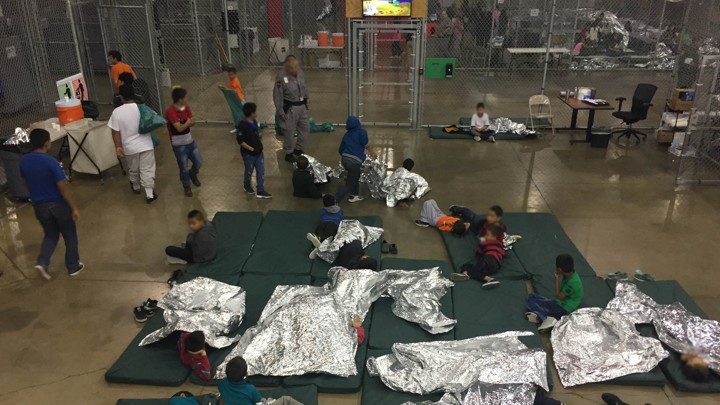
Children in Cages

People arrested for allegedly trying to enter the US illegally wait in cages inside a warehouse in McAllen, Texas. Picture: AP

People arrested for allegedly trying to enter the US illegally wait in cages inside a warehouse in McAllen, Texas. Picture: AP


CUSTOMS AND BORDER PATROL VIA REUTERS


Did you know we’re keeping children in cages?


I actually wrote a different blog yesterday, about how I fear that Trump’s success – or at least the positive things that are happening around him, even if they’re not because of him, like the unemployment rate going down – will encourage a cultural shift towards bullying. But I can’t post that one until I write and post this. Because this is the first thing that needs to be discussed. In fact, we should start every conversation with this until the answer can genuinely be, “No, we’re not; they stopped that.” Walk into Starbucks, and the barrista should say, “Hi, there are children in cages, but can I take your order?” And you should say, “Unnecessary family separation as a deterrent policy is a crime against humanity, and I’ll have a latte.”

So. Because of the attack on the media from Trump and the right (And because the corporate media has been sliding down into the muck for a generation at least), let’s establish facts.

First fact: when you type “children” into the Google search box, the first option is “Children in cages.” This is America. Childish Gambino released that video a month early.

Second fact: is this actually happening? Yes.

Federal officials said Tuesday that since May, they have separated 2,342 children from their families, rendering them unaccompanied minors in the government’s care.

(Source)


Third fact: are these children being kept in cages? Here’s a good explanation of the semantic argument.  If I may, the answer is: Yes. They are detention facilities, they do provide for the basic needs of the children, with the exception of the most obvious one: their parents aren’t there. But the essential point is: the children are held in enclosures made of chain-link fencing on concrete floors, and they are not allowed out of those enclosures. They are not able to see or communicate with their parents unless they can wend their way through an enormous bureaucracy.

Fourth fact: The children separated from their parents include infants and toddlers. Being kept in “Tender age shelters.”


Fifth fact: this is not, despite the administration’s stance, required by law, nor is it the fault of the Democrats. Unless we stop believing in free will. The administration has claimed – I heard White House spokesman Hogan Gidley reference all three of these elements during an interview with NPR – that the separation of families and the detention of children is the result of three things: the Flores Agreement from 1997, the William Wilberforce Trafficking Victims Protection Reauthorization Act of 2008, and the 2016 decision by the 9th Circuit Court which included accompanied minors in the previous laws regarding unaccompanied minors.

Here’s a good article from PolitiFact about this argument

If I may quote Inigo Montoya: “Lemme ‘splain. No, is too much: lemme sum up.”

The Flores Settlement agreement (Which settled a class-action lawsuit actually going back to the Reagan Administration) says that aliens in the custody of INS (now ICE) who are unaccompanied minors must be held in the “least restrictive setting” possible. Specifically, it says,

“The INS shall place each detained minor in the least restrictive setting appropriate to the minor’s age and special needs, provided that such setting is consistent with its interests to ensure the minor’s timely appearance before the INS and the immigration courts and to protect the minor’s well-being and that of others.”

Source

This means, to the Trump administration, that children can’t be jailed, and if their parents have to be, then the children must be separated from the jailed parents. I’ve seen various sources say that the settlement requires unaccompanied minors be released within 20 days, but I can’t find that passage in the agreement. If you’d like to try, look here.

The 2008 law applies because it says:

Except in the case of exceptional circumstances, any department or agency of the Federal Government that has an unaccompanied alien child in custody shall transfer the custody of such child to the Secretary of Health and Human Services not later than 72 hours after determining that such child is an unaccompanied alien child.

Source

This means that, once the children are separated from their parents (and therefore, according to the Trump administration, they are unaccompanied minors), they cannot be held by either INS, if the parents are being held pending an immigration hearing, nor by the U.S. Marshals, who hold the parents if they are being accused of a federal crime – which, under this administration, they are; that’s the “Zero Tolerance” policy that Jeff Sessions announced in April. Sessions’s memo to the state attorneys general is here,  and the law that he cites, the law against unlawful entry, is here.

Please note that the maximum penalty for a first offense is six months in jail, which makes this crime a misdemeanor. Most adult immigrants, once they reach a hearing, are released with time served.

Finally, the 2016 decision from the 9th Circuit Court of Appeals broadened the Flores Settlement to include accompanied minors, meaning that they, too, had to be held in the least restrictive setting available, and, as with the 1997 settlement, the government had to prioritize release of children in custody to family members over any other solution; the decision says that this was also the case with minors detained with their parents, though it does also make clear that this does not require the government to release the parents in order to provide a custodial parent for the children. It does require, as the Flores Settlement did, that parents be released with their children if they are not a legal or flight risk. 

Text of the Decision


So what does all this mean? It means that the Trump administration is arguing that they must uphold the law, and they must do something drastic to reduce the crisis of immigration across the southern U.S. border. They claim that those who cross the border have committed a crime, and therefore they must be prosecuted. If those people brought their minor children with them in the commission of this crime, those children have to be separated from their parents as they cannot be held in a prison with their parents, but must be remanded to the custody of Health and Human Services, as per the Flores Settlement, the 2016 decision by the 9th Circuit, and the 2008 Wilberforce Reauthorization Act. HHS then places those kids into tents and warehouses, wherever they have facilities that meet the standard of the Flores Settlement (Which says that they have to have the basic needs, and also opportunities for exercise, entertainment, education, and contact with their parents. Well.). This, they say, is all required by law, and at various times, various members of the administration from President Trump on down have all claimed that this is the fault of the Democrats: first they claimed that Democrats passed the laws (They didn’t), then they claimed that this has been going on since either the Obama administration or the Clinton administration (Neither is true; both administrations detained unaccompanied minors in similar settings, but neither intentionally separated accompanied minors from their parents and then treated them as unaccompanied minors. Generally they released families. It should also be noted that there were not nearly as many families trying to immigrate with their minor children in the past. Source), and then they claimed that the Democrats could end this any time by passing legislation to change the laws or the policies – their preference, apparently, is for the alteration of the Flores Settlement, so that they can detain children, accompanied and unaccompanied, for as long as necessary. This is also untrue in that the Republicans control all branches of government; it is true that they need Democrat votes to pass a law through the Senate, but the first obstruction to any legislation is and has been the President, who just will not say what he is willing to support; the two bills currently being debated in the House, one more conservative without a path to citizenship for the DACA recipients, one more moderate (but still Republican/conservative) with a path to citizenship (along with limiting legal immigration and funding the Trump border wall) have BOTH got his support, whatever the hell that means.

But please, in this era of lies and exaggeration and political spin, let’s just get down to brass tacks. This policy of family separation is. Fucking. WRONG. It is vile and appalling and inhumane and cruel and everything that this country is not supposed to be. Regardless of whether the parents of those children have committed crimes (and in the case of asylum seekers, some of whom have also reportedly been separated from their children because the asylum seekers stay in the custody of ICE while awaiting their hearings and the children have to be remanded to HHS according to Wilberforce, literally no crime has been committed, as seeking asylum is legal.), the children have not, and the children have rights. They have the right to be with their parents, and they have the right to not be jailed. That doesn’t imply that you put them into chainlink-partition-spaces in tents in Texas; it implies that you find a way to ensure that the parents can be released from custody without violating the laws you are trying to enforce.

Now let’s talk about that. Because there really is an obvious solution here, even though it is one that Trump finds untenable because it makes his base froth at the mouth: he calls it “Catch and Release.” This is the policy that previous administrations have used with most families (Not, as Obama’s Department of Homeland Security Secretary Jeh Johnson said, in cases where there might be some doubt as to the child’s familial relationship to the adult; thereby rebutting current DHS Secretary Kirstjen Nielsen’s argument that children must be separated in all cases because the families have no documentary evidence of familial relationship and therefore ICE has to assume the adults are human traffickers) and with many other immigrants seeking asylum or going through legal processes. You set up a court date, and then you release the people on their own recognizance, with the understanding that they will show up for their court date.

Here’s the thing. This is how our system works. Our Constitution requires the provision of bail that is not excessive, and that everyone receive a fair and speedy trial, and that anyone accused of any crime is innocent until proven guilty. Unlawful entry is a misdemeanor. The maximum fine is $250. Reasonable bail for that crime would be, what, maybe $100? Public intoxication, also a misdemeanor punishable by a maximum of 6 months (Varies by state – I’m using Indiana because it came up first on Google) and a fine of a whopping $1000, has a bail around $200-$500, according to the Bail Bonds Network. So I would think that bail for the parents should be something that most of them should have access to, especially if they have friends or family in the U.S. Once bail has been granted, then the question is whether or not the accused will show up for court; President Trump, of course, argues that they won’t, that the illegal immigrants are intending exactly this: showing up with their kids so that if they get caught, they will be released and then they will vanish into the Heart of Darkness inside the U.S. and never be seen again until they get arrested for rape or murder.

But here’s the thing. Immigrants show up. They don’t miss their court dates.

Moreover, studies show that asylum seekers—like many of the thousands of Central American families fleeing violence and arriving to the U.S.—are likely to appear for proceedings, because they have such a strong incentive to avoid returning to persecution. Indeed, as United Nations High Commissioner for Refugees (UNHCR) researchers found in 2013, asylum seekers have a natural “inclination towards law-abidingness,” and view making a refugee claim as “a manifestation of faith in legal process.” U.S. research bears this out. A Vera Institute study, from 1997 to 2000, of asylum seekers in expedited removal proceedings found to have credible fear, found that 93 percent with intensive supervision complied with all court proceedings; 84 percent complied with minimal supervision; and 78 percent complied even if simply released without supervision. These compliance rates were so high that Vera concluded that “[a]sylum seekers do not need to be detained to appear…. They also do not seem to need intensive supervision.”

Source

And if that rate doesn’t appeal, there are certainly ways to improve it. Immigrants with legal representation, for instance, attend hearings at an even higher rate. Solutions like allowing immigrants to check in via phone call or smartphone location apps create higher response rates. Even ankle bracelets (like the two that Paul Manafort has to wear ) would allow a tough-on-crime sort of stance, while allowing families to stay together, and reducing the burden on government resources to house all of these people.

In other words: there are alternatives. Even if you accept the claim that the administration is enforcing immigration law, it has to be pointed out that there are also 11 million illegal immigrants currently residing in the U.S., who are not currently being rounded up, separated from their children, and housed in federal lockup. So apparently the Trump administration is actually choosing and prioritizing which laws it enforces to what extent. Which is, indeed, the whole goddamn point of an executive branch. And this executive is choosing to prosecute people accused of first time illegal entry – a misdemeanor with a lesser penalty than some states impose for jaywalking – and therefore choosing, as a matter of intentional, proactive, object-oriented policy, to separate families and put children in cages. This is our government, and our country. It is us, unless we do something about it.

It is fucking wrong. It has to stop. It has to be the first thing we say, and the first thing we act on, in our current opposition to the abuses of our government. And I don’t care if you are a progressive liberal or a libertarian anarchist: this is what you should be talking about. This is what you should be fighting. Call your representative, call the White House, write letters, march, protest, donate, do anything and everything you can. Fight this. Fight it now.

We are keeping children in cages.

Walking Out

[Read Part One: Money Talks]

[Read Part Two: But You Get Summers Off]


It is fascinating how America views teachers.

In the last week I’ve been told, repeatedly and stridently, that parents support teachers. I’ve also been told that we should be grateful for that support, and we shouldn’t do anything to risk its continuance. That as long as parents support us, everything will be fine.

But I don’t think that’s true. I don’t think it’s really true that teachers have parents’ support, and I certainly don’t think that the support of parents is the most important thing teachers could ever, ever have.

I don’t think everything’s going to be fine. Not unless we are willing to do what is necessary to make things right, right now.

I don’t mean to complain. I want that to be clear. I’m writing this series because I want people to understand, not because I want you to pity me. There are things about my job that I love, and that’s why I still do it; that’s why I defend it as vigorously as I can, because I want to be able to continue doing the things I love, hopefully without also having to do the things I hate, like enforce sexist dress codes and assign meaningless and misleading grades, or give hours and hours of pointless, mind-breaking tests. Or survive on insufficient money, with insufficient funds available for my classroom and my school to allow me to do an adequate job.

If I cannot get the things I need to be happy here in this job, I will quit and move on; I will find another state that pays teachers better, and I will get a job there. But while that solves my problem, there will still be a million students in Arizona who need teachers: and if not me, then who? Shall I give them the same advice that I keep getting thrown in my face, namely, “If you don’t like it, go somewhere else?” Shall all one million Arizona students move with me to California and find school districts there with adequate resources, who pay their teachers a reasonable wage and so don’t have 40-50% turnover and hundreds of unfilled positions? That sounds like a solution, right?

It’s not. Of course not. Just like the other things that get spat at me and my colleagues on Twitter that are not solutions. But they do show how America views teachers: and it is fascinating.

So what should we do? What should teachers do about this funding crisis in Arizona, this decades-long slide into poverty and a broken, underfunded school system? To be specific, for those who haven’t been a part of this conversation up until now, Arizona cut more funding from schools than any other state during the Great Recession: funding went down 36.6% from 2008 to 2015. Some progress was made in the last three years, but the state is still spending almost 20% less now than ten years ago. About half of the new money since 2015 was mandated by a lawsuit brought against the state government by teachers, [NB: If you go to that link, Prop. 123 is the referendum I mention below. Please note where the lawsuit requires $300 million spent on capital improvements annually, and Governor Ducey promised $17 million.] because the legislature failed to follow through with an earlier state supreme court decision in another lawsuit; the first decision was that the state actually needed to fund schools, which apparently they did not want to. They were required to fund capital improvements to sites and facilities, and to provide funding for textbooks and supplies. They were also instructed to increase the funding yearly for inflation. That last part, they stopped doing; and so the teachers sued the second time, and the courts again decided that, according to the state constitution, Arizona does need to actually fund education. Rather than simply increase revenue to cover that expense, the state passed a referendum settling the lawsuit for 70% of what was owed; that money came from sales of state-owned land (Land which is already supposed to be used to fund education, a fact which made a judge rule the Proposition was illegal.). This is the source of the increased funding that our governor, Doug Ducey, has been crowing about for four years; and it still falls short of where we were a decade ago.

So essentially, the state of Arizona is a deadbeat dad: they do anything they can to get out of paying what they owe for their own children; up to and including just not handing over the money, refusing to pay the bill until the courts force the issue – and then grudgingly paying part of it, and demanding credit for what they did pay.

As I said: what should we teachers do about this problem? We are on the front lines, but though we do suffer because of this, in the form of absurdly low pay (Arizona ranks 48th in pay for high school teachers, 50th for elementary school) and insufficient resources to do the job properly, we are not the main victims: that would be the students themselves, who have to make do with not enough, not as much as other states, not as much as they deserve, in everything from school buildings to programs to textbooks to computer resources to good, stable teachers who stick around for more than a few years. We teachers see this, every day; we live this, every day; we try to make up for it, every day.

What should we do to fix it?

According to one fellow I talked with on Twitter, we should talk about walking out, but not actually do it.

“I support the need for more money in education,”

he said.

“I do not support the manner in which teachers are trying to get it. This hurts, kids and families. There is a much better way to accomplish this goal.”

So I asked, “How?” And because I’m a teacher, I added, “Please be specific.”

He replied,

“Here is how. Use this momentum from #RedforEd to force the Governor and legislators to the negotiating table with the threat of a walkout to start the 2018 – 19 school year. Parents will support you, Ducey will be motivated due to election. Kids and families not affected.”

We went back and forth a little more, but this was the gist. I did not say, though it is true, that the #RedforEd movement has been active since February, and so far the governor has refused to negotiate directly with the main group, Arizona Educators United. (By the way: that is not a union. It’s just a group of teachers who decided to do something more than try to make do with what we’re handed by the state.) I did say that I don’t understand why Ducey would feel more pressure to negotiate after the teachers decided to do nothing for four months; my Twitter friend didn’t have an answer other than he wanted us to wait. He wanted teachers to make sure that kids and families were not affected, because that way we would keep parents’ support. (Because his son is a high school junior, and apparently it would be catastrophic if he didn’t have school now.)

I’ve heard this from more than one person: they support the teachers, but not the walkout that the Arizona teachers have planned. They think we should continue threatening the walkout, but not actually do it, because that will hurt students and parents.

That’s right. It will. And that’s the idea.

I don’t want to do that. I want to believe that Americans like their teachers enough to understand what we’re asking for, and why. I’ve tried to make it clear with these blogs, but in case I haven’t, let me say it outright: we want to be able to do our jobs. That’s it. We don’t want to get rich: as everyone under the sun knows, teachers don’t become teachers to get rich. No one expects that. We don’t want someone else to do our job for us, and we don’t want to find a way out of work: that’s not the reason for the walkout. I think, actually, that parents sometimes forget that teachers are not their teenaged children; after all, we spend all of our time together, and the kids often tell their parents how much they like some of us, and how much they hate some of us; I’m sure in their anecdotes, teachers sound like – other teenagers. “My English teacher is so cool, all laid back and stuff. But my science teacher is a total loser. He thinks he’s funny, but he’s so lame!” And teenagers want a day off. Several days off, if possible. Because they’re teenagers: I had one of my students, very sweet girl, when someone mentioned a school district that was canceling classes because of the teacher walkout, say, “I’m so jealous!”

I’m not. I’d rather not be one of those people who have to take the risk, who have to dig in their heels and fight the entire community, simply because the community has ignored and neglected our needs for years and years, and a few years more. I’d really rather be one of the self-righteous people arguing against me, than me.

We don’t want days off, don’t want to get out of work; we want to be able to be successful in the work we are already doing. Teachers aren’t striking for fewer students (though we should) or lighter requirements in terms of preparation or training or testing or evaluations, or anything else related to working conditions: all we want is more money. And not just for ourselves: because Governor Ducey offered teachers a 19% raise over the next three years, and the teachers’ overwhelming response was to vote for the walkout.

Why did the teachers turn down the pay increase? Three reasons: one, we don’t trust the governor and the legislature, who have failed for years to provide legally mandated funding; two, the pay increases extended past the gubernatorial election this fall, and so who knows if the next governor will feel any need to keep Ducey’s promises (And I include the possibility that Ducey will get re-elected and then feel no need to keep his own promises afterwards); and three – and most important – the pay increase was only for teachers, according to the governor’s definition of “teacher.” It did not include teacher’s aides, or secretaries, or counselors, or janitors, or anyone else who is just as vital to education as the teachers are. It didn’t even include those who teach enrichment classes, like elementary school music and PE, because it was only for teachers who had their own roster. It did not include necessary increases to capital spending, where Arizona has cut 84% of funds compared to 2008, money that is needed for facilities and resources. The governor tried to throw money at the teachers – some of us – but he refused to fund education. And the teachers refused to accept the deal.

And yet we get called greedy. We are accused of taking extreme actions that will hurt children, because teachers are walking out across the state today, and classes are being canceled and schools are being closed, and parents have to find something to do with their kids. Wouldn’t it have been more greedy if we ignored what was best for students and schools and just took the payoff?

So let’s talk about the walkout, because I’ve been hearing a lot about it from people on Twitter. Comments like this:

I never said I don’t support the teachers, I do…but this is the wrong way to go about it. The community and parents have been very supportive of our teachers but this walk out only hurts the students and the community. For many students, they’ll have no where to go.

This particular person is insistent that she supports the teachers, in all things, in all ways, except in this one way: she says the walkout will hurt students and families. Because parents will have to take off work in order to watch their kids. That, apparently, is insupportably, unspeakably evil of the teachers to do. She also wants us to do nothing but wait, and know that we have the support of the parents. So long as we don’t walk out, that is.

I’ve also gotten comments like this:

Great example for your students, teachers. Akin to taking ball and going home.

#redforedaz is an evil movement founded by clowns WHO SIGNED CONTRACTS!! And your children are being left without an education! #MondayMotivaton

(Honestly, I’m curious about the hashtag at the end of that one. I’m supposed to be motivated by this? Also, the sheer number of typos in the anti-teacher tweets is both 100% amusing, and 1000% unsurprising. This is my favorite:

#redforedaz is another entitlement programme. Teachers are WELL PAID considering they work only 9 months. Average teachers salary is 35, 000 a year. Teachers are on a 45, 000 a year course! Wow!!! To think, these teachers are teaching you’re kids! #appalling

At least he spelled “appalling” correctly. He made it a thread, too:

Stop making teachers look like the victims. They are still paid whiner!

I believe this man has made his point.)

All right. First, the contract. Teachers do sign contracts, and those contracts determine our pay. It generally doesn’t change over the year, so we know what we’re signing up for – though there are performance bonuses and incentives, also known as merit pay; if my students’ test scores are high enough, my pay goes up, if they are lower, it goes down. If I’m a coach or I spend extra time helping students enter competitions, then I get paid more the better my students do and the more time I spend helping them. And sure, I suppose a teacher working hard and teaching well would be able to earn more thereby; but when my students intentionally tank the test because the schools have tested them to death and they just can’t care any more, or when the students this year aren’t interested in entering competitions, or this year’s volleyball team sucks, then all the good teaching or coaching in the world won’t earn me that money.

More importantly, the contract doesn’t really set working conditions: there’s nothing in there about a budget, or resources. There’s no guarantee that we will have textbooks, or enough paper to make copies for the whole year, and if we don’t, then I have to work harder: find new resources, create new resources, raise funds myself. There’s nothing in the contract about class sizes. So if I agree to take X dollars to teach for the year, and then my school doubles my student load, I have to work twice as much for the same salary. Which, of course, happens all the time. And if enrollment drops and a class loses too many students – especially if it’s an elective – then the class is canceled, and suddenly, my contract signed in the spring is worth less in the fall.

Tell me again about how contracts are binding agreements that I have a responsibility to follow through on.

No: it takes two parties living up to their agreement to make a contract binding. And if nothing else, the state of Arizona has not held up its end of the bargain, for years. I think there is no argument, legal or moral, that says that Arizona teachers can’t walk out on these contracts. I will also note that, unless the walkout lasts so long that the school year gets canceled, most school districts will extend their year for as many days as the walkout cost them; which means the same teachers who walk out will walk back into their classrooms and put in as many days of work as were agreed to, and without any increase in money, as any deal struck will not take effect until next school year at the earliest. And all of the teachers’ plans will be disrupted and delayed too, and our summer will be shorter, too.

So those who are arguing that we signed a contract and we have to live up to it, please understand: we will. We will do more to abide by the agreement than will the other side. If you want to uphold the rule of legal agreements and insist that people keep their word, then look to the state capitol.

I don’t know how much I need to address the direct ad hominem attacks; I’m sorry if the Monday Motivaton guy doesn’t like the leaders of the RedforEd movement, but it really is a grass-roots movement; thousands of teachers have joined voluntarily without any sort of pressure at all. I did, even though I was told I was being suckered by a 23-year-old Socialist, or that I had

“opted to follow a quasi-union led by DNC delivery boys. You sold freedom”

I don’t remember selling freedom. Didn’t get anything from the DNC, either. I’ve seen a couple of digs from teachers at the Republican party, but honestly, they have controlled the state government that shorted education for the last two decades, so they really do own this. But I have not seen the same calls for registering-and-then-voting-the-bums out that have characterized, say, the gun control movement led by the Marjory Stoneman Douglas students; these teachers just want our current government to fix this problem, right now, and if the government does so, I think they can wrap up the election in November, since this is a comfortably red state as it is. If they don’t help fix this problem, then they shouldn’t be re-elected, though I haven’t seen any of the RedforEd movement people agitating for replacement candidates: the election is too far away. We want this fixed now.

I also don’t feel the need to argue that we aren’t childish: childish would be throwing eggs at the governor and then trying to steal office supplies to make up for our insufficient pay. Or just quitting: for the guy who said we were taking our ball and going home, wouldn’t that be if all the teachers quit and walked off with our educations? If we’re fighting to get better working conditions so we can continue doing our job, isn’t that very much not “taking our ball and going home?” How about the bad example, is it that? Again, I don’t know how much students are going to absorb the desire to strike; I know that teachers hate the idea completely, and so I doubt many of us are talking it up to kids; I also know that it would be a worse example to set if we let ourselves get abused and devalued, and yet kept busting our asses for insufficient compensation. I have heard students say for years that they don’t ever want to be teachers, based on what they watch us deal with: so I don’t think it is the teachers who are setting a bad example.

But are we hurting them? Are we hurting our students and their families by walking out?

On some level, yes. We are. Some families will struggle to find child care during the strike (Though I know a whole state full of high school students/babysitters who are going to have a lot of free time…). There are students who are taking AP tests who will miss out on some last minute preparation before the tests, which start next week. I presume there are athletes who will lose their coaches, and performers who will miss opportunities, and some experiences that won’t happen because the teachers are not working.

But this is what has done the most harm at the school where I work: the first year I worked there, 2014-2015, there were two teachers who quit at the end of the year, our Spanish teacher and one of our best science teachers. Both because of pay. We also lost a PE teacher and a science/math teacher to budget cuts. The second year, there were six teachers who quit: science, math, art, two social studies, and English. Seven if you count the long-term sub who replaced one of the social studies teachers for half of the year; he got a job in California. They had different reasons for leaving, but pay was a factor for several of them. The school didn’t replace the science teacher. Third year, it was two math teachers and another science teacher – and one of those math teachers was the heart of our school, the best math teacher I’ve ever known, the reason why our STEM school has had such success. They didn’t replace one of the math teachers that year, either. Oh, we also lost our school psychologist. In three years, we’ve had thirteen teaching positions emptied: and I work at a small charter school with a total teaching faculty of 23. We’ve had more than 50% turnover in three years.

How many teachers are we going to lose this year? What are the chances that their replacements will be better? Who is more likely to leave to seek employment elsewhere, the good worker, the smart teacher, the capable employee — or the one who is already entrenched and doesn’t want to leave for fear they won’t be hired anywhere else? That’s not to say the teachers who have stayed at my school are like that – but our turnover rate is not unusual, so I think it’s a fair argument for the state as a whole. A lot of the best teachers are leaving. Even if good teachers replace them, then experience is lost, continuity is lost, relationships are lost. And as budgets continue to be cut, despite the funding increases touted by our governor, class sizes go up and good outcomes become less and less likely. And I don’t mean good outcomes for the teachers: I mean for the students. The students whom we are hurting by walking out.

Hurts pulling off a bandaid, too. But it’s better to do it, and better to do it quick and sudden.

I do know that the walkout will hurt people. Teachers will get fired, faculty members will get into bitter arguments and conflicts; students will lose out on education and some opportunities; parents are going to miss work and have enormous headaches dealing with child care. But when the only alternative is to go on as we’ve been doing, then it isn’t a choice. Parents who argue that their support for the teachers will be lost because of the strike have not been enough to fix the problem, despite their goodwill and support, because the problem is still here. The goal of the strike is to push other people: those who have done nothing but take advantage of the teachers willing to work and keep working without enough pay, those parents who are willing to keep sending their kids to less-than-ideal schools so long as they themselves don’t have to worry about it, and all those people who ignore the serious consequences of an inadequate education system just so long as they don’t have to pay more in taxes. Those are the ones we want to hurt. Those are the ones we want to push to take action, to inflict their ire, perhaps goaded by us, on those who actually merit it: the government, the deadbeats, the people in the state capitol who have let us sink to this level.

I am sorry it will hurt, and I have tried not to be too aggressive or insulting with this series, or with my Tweets. It helped that I am currently reading To Kill a Mockingbird with my 9th grade English class, because I got to read this scene, when Atticus Finch tells his daughter why she can’t haul off and punch anyone who insults her father because he is defending a black man accused of rape.

“Come here, Scout,” said Atticus. I crawled into his lap and tucked my head under his chin. He put his arms around me and rocked me gently. “It’s different this time,” he said. “This time we aren’t fighting the Yankees, we’re fighting our friends. But remember this, no matter how bitter things get, they’re still our friends and this is still our home.”

There are a million students in Arizona. There are tens of thousands of teachers. We all live together, and work together. After this fight is over, we will go back to teaching, and they will go back to learning. We will all go back to doing what we can, working together, supporting each other, for the sake of the children, of our students, of our future. Let’s try to remember that, and try not to let this get too vicious. We all need this resolved, in the right way, in the best way: quickly, and well. Please help make that happen. Please help us get what we need to do what we want to do: to teach. To teach as well as we can, for as long as we can.

You say you support the teachers? Are you just going to talk the talk?

Or will you walk the walk?

But You Get Summers Off!

[Read Part One: Money Talks]

[Read Part Three: Walking Out]

The day begins at 8:15. That’s when class starts.

But of course that’s not when the day begins. Students come inside at 8:05, and as soon as they do, I am teaching. That’s when the day begins.

Unless I have morning duty: then it starts at 7:45, when I have to show up, unlock the two gates, and then stand in the parking lot and make sure nobody gets run over while all the parents are dropping their kids off at school, and the high schoolers are whipping into the parking lot, trying to make sure that no one took THEIR SPACE. That’s work. 7:45 is when it starts, some days.

Although it might be fair to say that my day begins at 5:20, when my alarm goes off and I get up and take a shower; because in that shower, I am thinking about school. Always. Planning what I will teach, thinking about what I have to grade, trying to remember what meetings I have this week – is this Wednesday a faculty meeting, or grade-level teams? Do I have an IEP meeting today, or is that next week?

But if we begin with the thinking, then the day begins around 2:30 am. Because that’s when my insomnia kicks in, and I start thinking about school. Trying to go back to sleep, of course, but that isn’t always possible; it depends on whether I’ve done anything wrong. Did I lose my temper and snap at a student who asked for the fifth time if we could watch a movie? Did I have to explain a grade to a student who thinks they are a brilliant writer, but really they’re not, and I had to find a way to let them down easily while still encouraging them – but also making it crystal clear that they aren’t as good as they think they are, because otherwise they will get their parents to file an official complaint about the grade, and I’ll have to have three meetings, at least, to iron it out? Do I have a class that’s misbehaving, and I need to explain to them all, again, why they shouldn’t act that way? Because if I do, I will start working on my script at 2:30, and I won’t be done until 3:30 at the earliest. 4:30 is more common, on the days when I have a controlled-anger lecture to give.

That’s when my day begins.

Then, 5:20, alarm, and I have my morning; I have sometimes taken advantage of my early rising to get some correcting done, because I’m fresher first thing in the morning with that first coffee jolt, and I can get through eight or ten vocabulary assignments in under an hour. My vocab assignments are tougher than some, because I make them define the word and then use it in an original sentence, so I have to make sure that the definition is correct, that the sentence uses the word correctly, and that the sentence is grammatically acceptable; that’s also why I can’t let TAs grade the vocab, because they don’t know enough grammar and can’t always pick out which of several similar definitions of the word is the best one. I also give them credit for the sentence even if they got the definition wrong, but the sentence can make sense anyway; and I don’t trust teenagers to do that. So I do it. There are between ten and twenty words per assignment, so it takes me between five and ten minutes for each student to check the whole thing over – longer if I want to give feedback on why the sentence is incorrect, maybe offer a correct alternative so they can see what it looks like to use an adjective properly. 97 times, every two weeks. (I know, only 97 students? I have such small classes! At my last school I hit 180 students, some years! I’m lucky, now. Oh – and I do have more students than that, but two of my classes don’t do vocabulary assignments.) Then it’s breakfast, walking the dog, getting lunch ready, making sure I have all the papers and materials I need for the day. Then it’s off to work.

Morning duty. Usually I’m just a presence; the parents who drive badly (A good 30-40% of them) assiduously avoid eye contact. If it’s a student who speeds through the parking lot or swerves too close to a 6th grader crossing their path, I can yell at them to watch where they’re going and they’ll at least give me an apologetic shrug, but mostly my job is to scowl at the drivers and wave at the students. And watch the clock: because at 8:05 I have to unlock the school door and let the students in; and then I’m supposed to stay out there until 8:15 – but my class starts at 8:15. Do I open the classroom door while I’m outside, let my students hang out in my room until I get in there? If I leave them unsupervised they may get in a fight, or steal something, or break something valuable; I better leave the door locked. Which means they will stand in a loud, obnoxious clump outside my door, and block the hall for everyone else. Oh, well, can’t be helped.

I fudge the end of morning duty, go in about 8:13; usually my boss is coming down the hall to make sure the door is locked, so he sees me. Damn. I’ll be getting an email later about how important duty is, how we need to make sure our students are safe. Well, anyway: into the classroom, 21 freshmen for Honors English, and here we go. I need to:

*Log onto my computer, start Chrome, open the email program and make sure I don’t have any emails with subjects like “EMERGENCY: BOMB THREAT HAS BEEN RECEIVED,”

*Start the attendance program, log in, take attendance (If I don’t do this in the first three minutes, the front office will call to remind me.), mark the tardy students absent (We don’t mark them tardy during first period; if they come in late, they have to go to the front office for a note, and then we mark them Present; the front office changes their attendance to Tardy for us.), change the Absent students to Present as they walk in late with notes

*Start Internet Explorer (Because that’s where I have the Bookmark) and open the morning announcements.

*Get the students’ attention: impossible because they are too busy chatting and visiting and teasing each other.

*Stand for the Pledge of Allegiance when it comes over the PA

*Go over the morning announcements: a witty quote that is either over the students’ heads, or strange and offputting, or both; the same five announcements that have been on there for a week; a new video from the Character Education class about Inclusion, this week; God forbid a new episode from the journalism class with this week’s school news (They do a fine job, but my students love nothing more than criticizing, and so every week when the new episode is posted, I’m in for several minutes of snark and sass, and then indifference and distraction when I stop them from being crappy.); and then sports scores that none of them want to know about unless they were on the team that won, and then they want to make sure that the scores are seen and they get congratulated.

*Start class.

What am I teaching again?

Oh, right, To Kill a Mockingbird. Well, at least these students get their own books off the shelf – though I have to remember to tell them to stop throwing the books across the room to their friends, because somebody’s going to get hurt, most likely the book; I’ve been able to pick up a few used copies to replace the worst ones, but I already can’t tell the difference between the ones I bought and the ones I got from the English teacher next door when I took over this class: covers are falling off, spines are snapped, chunks of the book are falling out. Okay, so now I’ve got them on the right page (Mostly: there are four different editions, all with different page numbers, so someone is always lost), and it’s time to start reading. They’re still chatting, and I shush them. I start reading.

They’re still talking. I shush them again, louder, and add “Quiet, please!” I start reading again.

Still talking. Now the students have gotten annoyed with their peers, and one of them cries out, “SHUT UP!” I should tell her to be more respectful, but I’m on her side. Plus, it worked. So now I read. It’s a good class, the Honors class, so they pay attention, mostly; there are only three or four who are still scrolling through their phones behind their books or under their desks while I’m reading aloud; when I stop to ask a question, I get several kids willing to answer. Actually, they might be too involved: the one kid who loves to talk has his hand in the air every five minutes, often starting his comments with, “This is a little off-topic, but…” And the one precocious girl always wants to share when she has had some insight, when she has spotted a thematic connection; it’s great, but her classmates are tired of her being a know-it-all, as they see it, so as soon as she starts talking, they start making noises, having small side conversations; and the girl speaks too quietly and I can’t hear her.

But I read, enjoying every minute of it, because it’s Harper Lee and every page is brilliant. The kids like it too, and everything is going great – except now it’s 9:09, and the class is almost over (First period is longer to allow for the morning announcements.) and DAMMIT, I forgot to give them their reading project assignment, again. I’ll have to remember to change the due date on the assignment sheet and make a new set of copies. I stop reading with a minute left, they put the books back on the shelf; the precocious girl and the talkative boy both come up to my desk to talk to me, at the same time, and I try to listen to both as the bell rings and the room empties. By the time I have laughed at the boy’s joke and heard the girl’s last insight, my next class has started coming in: they are juniors, so they drop their bags on their desks and then go back out in the hallway, to the bathrooms and the water fountains. I check the email, make sure there aren’t any bomb threats; I have an email from a parent and one from the Special Ed teacher, both of which I have to open immediately. (I also have eight assignments from students, two communiques from the principal, and seven pieces of spam.) The parent email is asking about a student’s grade in their class, so I mark it Unread and try to remember to read and respond later; the special ed teacher is reminding me that we have an IEP meeting this afternoon. Crap.

The bell rings and it’s time for 2nd period: College Readiness. A required elective which the juniors all resent; it’s intended to help them succeed on SATs and ACTs and college applications; they split the week between math, college counseling, and me for English. It’s annoying to them because most of them are already in more advanced math classes than what is on the tests, and they already have me for English some other time during the day, but they still have to take this class. They are all late, either because they took too long coming from first period or because they’re in the bathroom, expecting their bags to count as attendance placeholders; sometimes I mark them absent and then change it as they trickle in, sometimes I mark them all here and forget about it. But when I do that, I always remember my college professor telling us that the attendance record is a legal document, and if I mark a student here when they’re absent, it could be used as evidence in court, say if that student is actually off robbing a Kwik-E-Mart while I said they were in my 3rd period class. And if I mark them absent while they are present, that makes the automated system call their parents and say the kid is absent from this class; then the parent texts the student to ask where the hell they are, and I get an email. And if I don’t get the attendance taken in the first three minutes of class, the front office will call and remind me.

So what were we doing in here? Oh, right, they are practicing their college application essays. So I want them to make their rough drafts twice as long, and then they will cut them down to 650 words max, the recommended max length from the Common App. So I could use one of the samples that I wrote, and show the students where I would add more details, more information, more words just to hit the target length (Even though I hate writing for length, as all that should matter is purpose and audience; this is the only class where I assign minimum and maximum lengths for essays, because college applications expect that), but I think it would be better to get one of them to tell me a story, and I’ll type it up on the projected screen while they all watch. I’m lucky; the class clown is in this group, and he always has a story, and the one today actually isn’t that bad – though it is about running off campus to buy snacks from the Circle K in between classes, which isn’t allowed and I should say something about it. But I get the story down, which takes about half of the class time; and then I start talking about where the essay thus created could be added to.

Nope: they’ve stopped listening. Well, after all, it’s not a real class; the assignment isn’t due today; the story on the board isn’t theirs, and though it was entertaining, they already heard it when the clown told it to me the first time. So they have no reason to pay attention. I give up, and let them do nothing; I sit at my computer and start answering that parent email –

Fire drill. The loudest damn siren in the world, makes me jump every time. Fortunately the students know what to do, so they head outside; if it was a lockdown drill, they’d be anxious and awkward and unsure, and I’d have to guide them where to go and what to do. I grab my attendance folder off the wall, shut off the lights, go back for my sunglasses because the sunlight makes me sneeze, and then lock the door and go out. I have to hold my hands over my ears as we pass the outside siren, because the noise is actually painful. Then we’re outside, and I have to direct the students to the right place after all, because we’ve changed protocol this year (They used to go through the locked gate, which meant they all piled up until I got there to open the lock; now they go through the parking lot to the far side), and tell them not to mess with the parked cars, and no, they can’t run down to Circle K for some snacks. Not even if they bring me some. Take attendance again outside, hold up the green card because they’re all there, and then wait for the signal to take them back inside. Still waiting. Still waiting. “Hey Student X, put Student Y down, please. Student Z, stop spitting sunflower seeds on people.” Still waiting. Okay, there we go: back inside. They file back in just in time to get their things, and then the bell rings to end the period. My third period students already left their second period, so they’re coming in even before second period ends, asking, “What are we going to do today?”

What are we – oh, crap! I need the Chromebooks. They’re doing research for their argument essays this period. Race to the computer (Unlock it because it timed out while I was outside), bring up the Staff Forms page, open the Chromebook Cart Reservation page, check the three carts – Cart #3, okay. Dammit, it’s all the way down at the other end of the school. Pick out two students and send them to get the cart. Then it’s time for attendance, and I have a minute or so to remind them of their tasks before the computer cart arrives, at which point they stop listening to me because they now get a computer to play with, and they all swarm the cart and grab Chromebooks.

Except there aren’t enough. The last teacher didn’t manage to collect them all, because of the fire drill. So I send some students down to fetch them. They do, but there still aren’t enough, because this is my big class, 26 sophomores (Well, 25 sophomores and one senior taking Sophomore English for the third time, bless her heart. She won’t pass this time, either.) and the cart only carries 24 Chromebooks. So I send two more students on a quest for random Chromebooks, which they track down in only 20 minutes of roaming the halls. But no great loss, because that same time has been spent in the classroom watching YouTube videos and finding ways to play free online video games, or else bringing up Google and then looking at a phone. The rest of the class period goes the same, and at the end, they ask if they will also have tomorrow to do research. I shake my head, unable to muster any better answer, and send them away when the bell rings. Then I have to collect all the Chromebooks they left on their desks, return them to the cart, make sure all of them are plugged in –

No, wait, that has to wait for a minute: I haven’t been to the bathroom in three hours. I race down to the teacher’s lounge, because the boy’s room across the hall is filthy and usually occupied, and I have bashful kidneys. By the time I get back to my classroom, the Chromebook cart is gone; hopefully to the right place. I don’t know: this is my prep period, the best time of the day. No students for fifty – no, forty-one glorious minutes.

I have to:

*Actually read all of the emails that came in today, and any I didn’t get to yesterday.

*Respond to all emails that need a response, in the following order of importance (most to least): parents, special ed, other teachers, administration, students.

*Check that I have the right handouts for the three classes after lunch, that I know what I’m teaching, that I know what assignments I have to collect and what due dates I have to remind them of

*Make any copies I may need this afternoon or tomorrow morning, as I won’t have time to make copies in the morning (Xerox machine is always tied up before first period) and I have an IEP meeting after school

*Make more coffee before I collapse into a stupor

*Use the bathroom at least one more time

*Do as much grading as possible. Usually not very much. Today, none: because one of my colleagues stops in to ask me if I’ve heard the latest absurdity the admin’s gotten up to, and I haven’t, so we need to discuss it. We do. It’s infuriating.


Now I have eight minutes left. Didn’t get any grading done.

But that’s okay, because the next class is lunch; not quite as satisfying as prep, because there are students in here, mostly hanging out (with their terribly smelly food) but some looking for help or to check on due dates or to ask if I’ve graded that essay they turned in late. The students who are hanging out want to talk to me, because they want to tell me what they did yesterday, or show me that meme or the video they found that was hilarious and I’ll like it because there are dogs in it, or they want to ask my advice, or for me to settle an argument (Is cheesecake a pie or a cake? Have I seen the trailer for the new Fahrenheit 451 adaptation, and what do I think of it? Should they move into the dorm for college next year, or live with their parents to save money? Should they even go to college? Don’t I think the new math teacher is an asshole?) [Answers: I say cake, because of the name, but really it’s a tart; yes, and I think it will be a good movie but not the wonder that the book is; they should move out if they can afford it; yes unless they have a different plan that is as useful as a college education would be; and no, because I like the teachers more than the students, even though I agree that math is evil. Yes, these are all things I have said to students.].

I eat my lunch, finally make my coffee while also finishing up the copies I need for class after lunch, and spend a few minutes talking to my wife. (On the phone for the first sixteen years of my career, in the next classroom for the last two years, as she has been teaching at the school where I work. It’s lovely to have her there. It makes my blood absolutely boil to see the way they treat her, the goddamned admin and the obnoxious students and the entitled parents. Drives me nuts.) Then it’s time for 6th period: Advanced Placement Literature and Composition. Today I am teaching Julius Caesar by Shakespeare, which is nice, because I’ve taught it for years and I know everything about it; I also worry that I’m not seeing it with fresh eyes for the same reason, and so there are things that I’m missing. I need to help them see through the text, because this class is struggling with the AP expectations for analysis; they write well, for the most part, but they don’t always get what they’re reading. Because with one or two exceptions in this class of twelve seniors, they don’t ever read outside of what is assigned for school. They never have. They tell me, half ashamed and half proud, how few books they’ve read this year, or the last four years, or their entire lives.

People wonder why I read books out loud to my high school students. It’s because it is literally the only way I can be sure they will read at least one book in my class.

This is one of the factors that makes English an impossible subject to teach: the students don’t read. I have to find a way to keep them interested in books, which they believe, with all of their hearts, are boring and obsolete; I have to find a way to make them want to put thought into the books, because that’s the only way they’ll see the value of literature. I have to both know everything about the books I’m teaching, so I can answer their questions and ask them good ones in return, and also improvise constantly, and use whatever I can to relate the literature to this class, these students, this point in time and place; because of that, I generally can’t re-use old lesson plans, and I have to constantly learn everything there is to know about new literature. Teaching writing is even more difficult, because it has all of the same inherent feel of being boring and obsolete to students who are never disconnected from the internet; and also because it makes the students feel inadequate, because they know they don’t write well, and they don’t want to be embarrassed, and they don’t want a bad grade – and so they try not to write, which means they don’t practice and they don’t get better. When I do ask them to write, they often put as little effort into it as possible, and then they confirm for themselves that they don’t write well.

18 years teaching, and I don’t know how to fix that. I try something new every year. Sometimes it works. With some of them. I think.

But I can’t really say that English is harder to teach than other subjects: we all have individual difficulties, and mine aren’t worse. At least I have stories, with sex and violence and beautiful language; math teachers need to constantly think of ways to keep students interested in abstractions, thinking in ways they don’t normally think; history and science teachers have to present an enormous amount of information, and somehow make it digestible; arts and technical teachers have to constantly circle the classroom, never sitting down for a second all day, looking over students’ shoulders and trying to figure out what they’re doing wrong and help them do it right, all while the students are incessantly calling out the teacher’s name – if you’ve never been in a high school arts or tech classroom, just imagine 20-30 hungry baby birds in different nests, with one bird trying to feed them all while also keep them from falling out of the tree or pecking each other to death, while they just keep crying out, crying out for attention. It’s quite the dance.

Elementary school teachers have to do all of this at once. Though with a lot fewer students, admittedly. Still: it’s not a job I’d want; the one day I subbed in an elementary school was one of my worst as a teacher. I prefer high school, and Language Arts. At least I think I do. A lot of the time, I’d rather just be a janitor.

6th period goes well; they’re great kids. Almost graduated now. I worry about some of them. Especially the one student who recently had a death in the family. I worry a lot about that one, because the death hit hard, and all plans have changed, and I don’t know if that’s a warning sign or just the normal healthy grieving process. I’ve been a teacher for eighteen years, and I’ve had three of my students commit suicide: I don’t want to have a fourth. I’ve also had to make reports to social services twice, once for an abusive parent and once for a girl who had a “boyfriend” who was twenty years older than her. Neither report led to a good outcome. I don’t need to report this one: everyone knows the whole situation, which means everyone treats this student like they’re kryptonite. I try to be normal with the student. I try to talk to them every day, to be present for anything that needs to be said, to be as honest and open as I can be, always, no matter what. I don’t know how well I do. I don’t know if it will make any difference. But it’s all I can do. So I do it.

When I have time.

We don’t get through much Julius Caesar, because they constantly distract me and the class with their jokes and their stories and their questions; I encourage that, because I think it helps make the class more meaningful and more useful, and also because there are pedagogical theories that encourage students to associate knowledge with their own lives, their own experiences, and so letting them voice all of their thoughts encourages that sort of association. Or maybe it just wastes time; I don’t really know. I know they like my class. I know we don’t cover half as much material as most other teachers. I don’t know any other way to teach.

Speaking of teaching: now it’s time for 7th period. AP Language and Composition.

What the hell was I doing in this class?

Oh right: they’re halfway through “Shooting an Elephant” by George Orwell. We’re talking about imagery. I find my copy under the pile of papers by my podium, and I tell them to get out theirs; I remember to take attendance then, and go to my computer to do it – and realize I forgot to take attendance for the senior class last period. Dammit. Huh, well, at least the front office didn’t call. I mark attendance for both classes, then hand out replacement copies to the two students who lost their packets since yesterday and one to the kid who has it but doesn’t want to dig through his backpack and find it, and then we’re off: to Burma, in the 1920’s, when a young George Orwell is about to slaughter an elephant because he doesn’t know how to let the elephant live and still be a white police officer in a British colony. He hates everything, especially himself. I can kinda relate.

I get into it, reading the piece; Orwell was such a damn good writer. I wish I could write like that. I know it’s because he was able to live his writing, almost all of it: when he wrote Homage to Catalonia, about the Spanish Civil War, it was after he went to Spain and joined the anti-fascist militias, and actually fought on the front lines. I wish I could do that. Not fight in a war, but go to where I am needed, and do what I believe needs to be done, and then write beautiful, crystal-perfect books about what I had done. Though I’d rather not die at age 48 of tuberculosis: I’m 43 now, so that’s not much time left. Still haven’t published a book. Not that much time in my day to write; certainly no time to do anything worth writing about.

I can’t get too into it, though, because this is my annoying class. This is the class with the one student who likes to irritate everyone, and so says intentionally sexist or racist things, and then says, “I’m just kidding.” He knows I’m a vegetarian, so he likes to bring up how he slaughters his own meat. He likes to make the stories as disgusting as possible, and then smile at me. And there’s that other student who can’t sit still: she will stand up and dance right in the middle of class, while I’m reading. Or she will make hand gestures and funny faces at other students in the class, laughing loudly while we’re trying to have discussion. She’s the smartest one in the room, so if I call her on it, she’ll apologize, share some insight to mollify me – and then go right back to disrupting the class, while also making some passive-aggressive statement about how limiting and controlling school is, how that’s unhealthy for a growing mind. Then she’ll stare at her phone for half an hour, turning it around to show funny memes to students across the room. And the rest of the students in here would rather be studying for their math class which they have next period, or grumbling about the history class they had last period. The class often feels like a complete waste of time.

Speaking of not much time left: class is almost over now. I cut the article off with one paragraph left; we’ll finish it tomorrow, but the mood will be ruined, because they won’t remember tomorrow what we read today, other than the bare facts: Orwell shot the elephant. Now it’s time for 8th period: the second AP Lang class, the big one – twice as many students as 7th period. Fortunately, this is the one time when I don’t have to remember what we were doing, the one time when I have the same class twice in a row; unfortunately, the two classes don’t go at the same pace, so I don’t remember where we were in the Orwell article with this class. When I remember, I mark the paper where each class stops. When I remember.

Unfortunately, fighting through 7th period has put me into a bad mood, and worn me out entirely. Well, at least I have four minutes to recover. I take deep breaths, try to shake it off, try to treat the new class fairly, not take out the last class’s misbehavior on these kids. It’s tough. Especially at the end of the day.

The class goes by in a blur, but also, because it is the end of the day and I am exhausted, it crawls by. The clock doesn’t move and doesn’t move and doesn’t move, and then suddenly there are only 20 minutes left and we haven’t finished the reading. We get through it, the whole thing (so now they’re ahead of 7th period), and I’m about to lead them into the analysis: when the bell rings. 3:30. Day’s over. They swarm out, and silence descends.

Then my classroom phone rings: I forgot the attendance again. I apologize, and take it now. I fall into my desk chair, open my email. Oh right: I have an IEP meeting. Down I go to the special ed room to talk about how well that student is doing in my class (or how poorly) despite learning disabilities or physical disabilities or autism spectrum challenges. Or all three.

An hour later, and it’s all I can do to gather my things and leave. Home, to dinner, and dog walking, and family time, and some relaxation; then, around 8:00, after dinner is done, I remember: I haven’t actually graded anything all day. I grab up the laptop, sit on the living room couch, open my email, and start grading vocab assignments that students sent to me online. If I’m lucky, I can get a whole class done before I have to go to sleep, sometime between 10:00 and 11:00.

I need to get a few hours of sleep before I wake up at 2:30. I’m worried about that kid in my 6th period class. Seemed … off today. I hope there’s nothing going on. I hope nothing happens. I hope I didn’t say or do the wrong thing. I hope.

This is no exaggeration. This is what I do, what I have done for 18 years. I don’t always have fire drills, or adventures with the Chromebook carts; sometimes it’s a lockdown drill. More than once in my career it has been a bomb threat, and an evacuation. Oftentimes I realize I don’t have the copies I need to teach the lesson I wanted to teach, and I have to do something I make up on the spot. More than once I have gone to the computer lab and found another class using the computers. Schedules change, students are out for field trips or athletic events. I don’t always grade at night; sometimes I get more done at school, and then I let myself do something else in the evening. I pretty much always grade on weekends, and during vacations; I’m an English teacher. I have essays to read. A single essay takes between 20 and 30 minutes to grade and comment on, and I have 100 students, and I assign multiple drafts.

Ask me to communicate regularly with parents. Or to stay until 7:00 or 8:00, three or four times a year, for parent conferences.

Ask me to have extra meetings with troubled students.

Ask me to plan and organize curriculum, or to discuss pedagogy with other teachers, or interventions for students who aren’t successful.

Ask me to plan, organize, and run extracurricular events, on evenings or on weekends. To coach teams, to run clubs, to offer extra tutoring to students who need it. Ask me to be the department chair, and the community liaison, and the head of the recycling program.

God forbid you ask me to raise my own children on top of all of this. I don’t know how teacher-parents do it.

Now ask me how much I get paid for the job I do. Ask me how much I should get paid.

Then ask me why teachers are going to be walking out across Arizona tomorrow.

You can ask. But I think you already know the answer.

Money Talks

Image result for red for ed

[Read Part Two: But You Get Summers Off]

[Read Part Three: Walking Out]

I don’t know how much what I’m about to say needs to be said. This blog is full of book reviews and liberal political ranting; the majority of my readers are people I know personally, which means they’re mostly teachers and liberals and readers (Oh my!), like me. I feel pretty confident that most people reading this already think that teachers should be paid more. But I want to take it one step further, because while most people seem to think that teachers should be paid more, somehow we’re not; so there does seem to be a need, here. My hope, therefore, is that people who don’t realize how vital this issue is will learn something that helps push them towards what I think is the right answer; maybe you all will even share this or some of the ideas with your own people, and then others might learn something or be pushed towards the right answer.

For myself, I need to do this. Because, you see, I teach in Arizona, and in two days, thousands of Arizona teachers are going to walk off the job and out of their schools in order to try to win the same argument I’m going to talk about here; and I won’t be walking out with them. That makes me feel terrible. So I need to do what I can to support them, and one of the things I can do is argue, and write, and then share this. So here goes.

Let’s talk first about what teachers make. I started teaching in 2000, in San Diego County in southern California; that year I made about $36,000 before taxes. I also got good health coverage, though I didn’t need it at the time, and about $4000 was contributed to a pension account in my name. However, as some of you know and the rest can imagine, San Diego County is quite an expensive place to live, and so that first year, I needed to take a second job over the summer to make ends meet: I went with the obvious one, and taught summer school. Six weeks of extra work, and I made $25 an hour, 7 hours a day. Not bad. That year I was able to purchase my very first car, a 2-year-old Chevy pick-up with 74,000 miles, and we found a decent 3-bedroom house to rent. (I should note: I am removing my wife from this almost entirely, because her income has been extremely inconsistent: some years she made a lot, some years not so much. She’s an artist. The point I’m trying to make is this: it shouldn’t matter. I’m a highly trained and capable professional. I should be able to pay for a lower-middle-class lifestyle for two people with no kids and no expensive habits. Don’t you think?) We were able to pay for most purchases, but when surprise bills came up, they went on credit cards. Luckily, not that many bills came up, and we didn’t purchase very many things. No large entertainment systems. No extra vehicles. We took one vacation, an overnight trip to Disneyland. We did buy pets, I’ll admit. The bunny cost us $20. The dog was the big ticket item: $150 for him.

We moved to Oregon in 2004, partly because we hadn’t been able to save anything substantial, despite the fact that I kept teaching summer school, and got a $1500 raise every year (Teachers generally have a salary schedule where we step up every year for some number of years, and then every couple of years, and then we top out after 15-20 steps. You can also get raises if you get more post-degree education, which shifts you up a column.), and we knew that we’d never be able to afford to buy a home in San Diego’s real estate market. When we moved, I was up to $42,000 a year pre-tax; my new position in St. Helens, Oregon paid about $35,000. Back to square one. I had to take out the retirement money because four years isn’t long enough to get vested into the California retirement system, so we rolled it over into an IRA. But there was a problem: the cost of living in Oregon wasn’t actually much less than it had been in California, and my monthly paychecks weren’t enough to cover our bills. I had to change from 12 monthly checks to 10, which meant I didn’t get paid over the summer. No problem: I would teach summer school.

They didn’t have summer school.

So we cashed out my retirement money, and that got us through the summer; about half of my total retirement savings from California was left. The next year I got a raise, but still not enough to go to 12 monthly checks (Please note: this is now my 6th year teaching, and I didn’t make enough to pay for two people with a very modest lifestyle, no kids, no expensive hobbies. When my lawnmower died, I bought a push mower.); fortunately, that year they ran a summer school, and I taught it. Allow me to point out: this was a second job. I know people make a lot of teachers getting the summers off, and we do – that’s one of the main reasons why I started teaching, because I wanted to use the summers to write my novels – but we work 50-60 hours a week during the school year. Especially the first few years, because everything is new and takes ten times as much planning (Especially when, like me, you get handed new never-before-taught classes and you have to make everything up from scratch.). You also don’t get to sleep, because everything makes you nervous or angry or both. Everything. I threw a book at a kid my first year because he was rolling around the classroom in my desk chair. (Don’t worry, I missed him.) The summer isn’t really vacation, it’s all the hours you lost over the school year, the only time you get to relax and do fun things, or spend time with family, or sleep. The average school year is 36-38 weeks long (My current school has a 40-week academic year with two extra weeks of professional development for teachers); even if we don’t count the work we usually do over summer on lesson plans and such, the hours are comparable: a regular office job is 50 weeks, 40 hours a week, which is 2000 hours a year; a teacher works around 53 hours a week, on average, for, let’s say, 38 weeks, which is 2014 hours per year. So having to teach summer school is exactly the same as having a second job right after your 40-hour-a-week job: you don’t get to take advantage of your hours off, you never really get to rest. It is not easy.

So I taught summer school that second year in Oregon, and it helped; but not enough, because we had bought our very first house, which saved money on rent and allowed us to start building equity, but it also meant we had new bills. So that we’re clear: we did not go crazy with this purchase; we bought the ugliest house in the best neighborhood, and in April of 2005, it cost us about $140,000; we didn’t have a down payment, but there was a special deal offered to teachers that covered 100% of new home mortgages. So that year we had to cash out the rest of my retirement money to make it through the summer. And I had no idea what we were going to do the third year.

The third year in Oregon, I found out that my district had been shortchanging me: they had calculated my column on the salary schedule as though my credits were quarter credits, when most of them were semester credits, which should have moved me up to the third column (Bachelor’s degree +45 graduate credits instead of +30, because I did two and a half years of graduate school after my BA. Teacher training, not a Master’s program, but it counts.). They gave me the difference in one large check: that and the new step I got that year meant we were able to cover the summer gap, with the summer school work. The following year, my fourth year teaching in Oregon, the step was just barely enough that we could shift to 12 paychecks: and for the first time, I could pay my way with just my teacher’s salary. Mostly. We still couldn’t handle a large money emergency, and we still didn’t have any appreciable savings. Two people. No kids. No expensive habits. Hadn’t taken a vacation since Disneyland. We had a second car at this point: my wife’s parents gave her their GMC Jimmy when they bought a new car for themselves.

Right about then (2007-2008), the economy collapsed. Even though we had bought the cheapest house we could, and done a lot of improvements ourselves, we went underwater on our mortgage. Teachers started getting RIFfed (Reduction In Force, the eduspeak version of layoffs), and our health insurance costs started going up, and our salaries got frozen, step raises delayed or canceled. Somewhere around there, right around when we finished paying it off, my Chevy got broken and we couldn’t afford to repair it, so it sat in our driveway for a year while I walked to work. (That was by choice. I could have taken my wife’s car, or had her drive me, but I liked the walk. The point is that I couldn’t afford to pay for a house and two cars. Eight, nine, ten years as a professional teacher. And Oregon teacher salaries are pretty good, taken as a whole.) So in 2010, I again took a second job, as a union negotiator for the contract talks we had with our district. That might have been the toughest job for the least compensation I’ve ever had; I got a one-time stipend of, I think, about $1400; in exchange, I stopped sleeping for the year and a half that I was the lead negotiator. Instead of sleep, I just hated everyone and everything. Especially myself.

Here’s the gist: by the time we moved away from Oregon, in 2014, I was earning $59,000 a year before taxes, though like everyone, our health care costs were going up every year. We sold our house in 2013 for a small profit, but only if you don’t count in the money we invested in it, or the time. We used much of that money to buy a new car – a two-year-old Kia Sportage with 25,000 miles – and a new mattress, and our first flat screen TV (Which we still have). And we moved to Arizona, where I took a job at a charter school in Tucson. That first year? My 14th as a teacher, who now had over 90 post-graduate credits, because I had to take more classes to renew my Oregon credential?

I made $36,000. Before taxes.

So now here I am, in my 18th year as a teacher. I am Highly Effective according to my last performance review, the top score you can earn. I have been one of the favorite teachers, if that matters (and since charter schools compete with public schools for students, and one of our selling points is to have students tell other students that they really like their __________ teacher, it does matter; I’ve had parents tell me the reason they came to or stayed with the school is because of the English department) every year; I was named Teacher of the Year in Oregon. This year I made about $45,000 before taxes. I only got it up that high because I teach AP (Extra work because there are more and longer essays), because I teach five different preps (Extra planning work to figure out what five different classes are going to do each day, and also tough to shift gears that many times during the day when I get four minutes in between classes), and because I teach more than a full schedule (I teach 29 periods per week instead of the usual 25) – basically, I’m teaching summer school during the year, now. And I can almost pay all of our bills. Almost. Still couldn’t handle a money emergency, nor save a lot. Won’t be buying another house any time soon. We are doing better because of my wife’s income. But shouldn’t I be able to pay for two people, no kids, no expensive habits? Isn’t that a reasonable expectation for a teacher’s salary? Especially a good teacher with almost twenty years of experience and two Master’s degrees worth of extra credits?

So here’s my question for the room. How much should a teacher make? I don’t mean a dollar figure, since that can reasonably be tied to cost of living depending on location; I mean, where should teachers fall on the scale? Are we middle class? Working class? Are we servants? Public sector workers? I’m sure you’ve seen the memes about teachers as babysitters (I have about 20 students at a time [Charter schools do have smaller class sizes, which is lovely] for seven hours a day; if parents pay babysitters $10 an hour or more, how much should I make? Sure, I’ll take $1400 a day.) or calculating all of the different tasks a teacher does during the day, or comparing teacher pay in the US to teacher pay in, say, Finland; but I’ve also seen people describing teachers as lazy and incompetent, as people who get summers off, as people who just hang out with kids all day, and therefore we are overpaid. Allow me to point out that part of the reason for low teacher pay is that teachers have always been willing to give up dollars in exchange for benefits: for good health coverage, for good retirement, for tenure, the system that makes it harder to get fired. (Not impossible: it is never impossible to get fired. Don’t believe anyone who says it is.) Allow me also to point out that, though it varies state by state, I currently have decent health coverage that is pretty expensive for me; no contribution to any retirement beyond social security; and no tenure. Those benefits are vanishing. And in exchange, we get – more work. And less pay.

You could argue that teachers know what they’re signing up for. You’d be sort of right, although – like most people, I would think – there were expectations I had that didn’t prove true, like the summers off and the tenure and such. But by now, I know what I’m signing up for. I could quit teaching, try to find something else; but I’d have to start at entry level. And also, I’m good at teaching: it seems like something I should stick with. And it seems like something I should be able to make a living doing, at least enough to pay for two people with no kids and no expensive habits. I could have turned down the job in Arizona, stayed in Oregon and made more. I could move away now and make more, especially if I moved to Massachusetts or New York, or back to California. But while that solves my problem, it doesn’t solve the whole problem: because there will still be more than a million students in Arizona, who need teachers. And if Arizona won’t pay those teachers enough, and the teachers all move away, then – what? What’s the plan? All the students follow the teachers to different states? They all get homeschooled, learn their math from Khan Academy?

I read an article this morning in the New York Times about how all public sector government jobs have been disappearing and losing pay; a couple of statements struck me. Both came from the same woman, Teresa Moore, a social worker in Oklahoma who investigates reports of abuse of both children and seniors. The first was this:

Ms. Moore’s friends and neighbors hold conflicting views of her taxpayer-funded job. “The minute they have someone in the nursing home they perceive to be mistreated, we’re the first people they come to,” she said. “They want us when they need us. And when they no longer need us again, they don’t want us.” Source, Emphasis added

The second was this:

Some are resentful that they are being asked to pay for benefits that they themselves struggle to afford.

I asked my brother, ‘How do you feel about this pay raise?’” Ms. Moore recalled. “He said: ‘I want you to have it. You deserve it. But we don’t feel like we should pay for it.’” Source

I think this is how this country sees teachers. People want teachers to care for children, and they want us to do a good job of educating them; for some people, that means a specific information set, and for others, it means a different set – but everyone wants us to do a good job. Unless, y’know, they don’t actually have kids and don’t need to think about education, in which case, they’d really like us to just go away. Or else they don’t want to pay for us personally, and they think only parents should pay for us. (This attitude, held by the many retirees who come to Arizona for the winter months – the so-called “Snowbirds” – is a large part of the reason why Arizona teachers are the worst paid in the nation.) Or, of course, they don’t know who should pay for us: so long as it isn’t them, personally. (This also may be where the Snowbirds land.) I’m sure there are some who are resentful of teachers making more money or having better benefits than they themselves have, but that’s an insupportable argument if it comes only from envy: you can argue that teachers should make less money if you have an argument why teachers are worth less money. For many people, that argument starts and stops with good benefits and summers off and “spending all day with children.”

None of which, I hope I’ve shown, are actually true. The benefits are gone; the summers off never existed; I haven’t talked about the lil angels we get to spend all day with, but I doubt most people believe that. Because of course they aren’t angels. You weren’t, were you? Neither was I.

People want us to do a good job, but they don’t want to pay us to do a good job. They want to pay us the bare minimum, and ask us to do the maximum – because it’s for the children. And while we should do the very best we can, for the sake of the children and for society, that doesn’t mean we should be paid the very least we can survive on at the same time. Because that isn’t for the children: that’s for the people who just don’t want to pay us. Who maybe think we deserve more money, but they don’t want to be the ones footing the bill.

The last month or so has shown us the new truth: teachers are done with this trade-off, our best for taxpayers’ least. There has been a long slow slide down, which has taken advantage of career teachers who don’t want to look for new jobs; and which has taken advantage of old benefit packages which have been traded for pay cuts (The time has run out on this one, since there isn’t any more pay to cut, and so those benefits have been cut, too); and which has taken advantage of teachers’ general sense of goodwill and public service to the community. A lot of us want to teach in the places we grew up, and places that pay less, like Arizona and Oklahoma and Kentucky and West Virginia, have surely taken advantage of that. One of the best teachers at my school, my department chair, is still there despite being overworked and underpaid and being treated generally shabbily, for all three of these reasons: she grew up here, she’s been a teacher here for 25 years, she’s willing to make a little less if her benefits would be a little better.

What does it say about us as a nation that we treat people like that so poorly? We liberals rant and rave about how President Trump makes us look bad: but we all let teaching get to where it is. All of us.

And then, of course, there is the biggest reason why teachers don’t make enough: we care. We usually want to do a good job. We usually care about children, and about education, and we are sympathetic to the needs of families. When I was running the union negotiations, the biggest hurdle we had to overcome wasn’t the district, or the parents: it was the other teachers. Many of them wanted to cut their own pay because that would have saved other teachers’ jobs. Many of them wanted to accept whatever was offered, just so long as they got to keep teaching; and whether or not they could afford to live on their salary didn’t matter: their students needed them. It’s the same reason why, when classroom supply budgets get cut, most teachers go right out and buy the supplies themselves, even though in many communities, the parents make more than the teachers. But we do it because the kids really need those supplies. If the kids don’t have those supplies, we can’t do that project, and that project is really effective – plus the kids love it. We’re nice people, and that makes us saps. It also makes us good at our jobs. But we only get paid like saps. And then they ask us to do a little more, to give a little more, to work a little harder. For the children.

It’s gone too far. Teachers are going on strike, even without a union to protect their jobs and pay them partial wages, as would have happened had my own negotiation broken down that far. (It didn’t. We took the deal the district offered us. We saved jobs, lost money, and kept teaching. Of course. But Oregon has farther to fall before it reaches where Arizona is now.) Despite all the reasons why we don’t want to, we’re walking out of our classrooms, walking out of our schools, walking out on our students and our careers. We’re no longer willing to do this for what America seems willing to pay us. Either we get paid more, or we stop doing this. I say, we need to get paid enough to pay for two people, with no kids and no expensive habits, to build up some savings and maybe buy a house. Not just because that would suit me, but because I think it’s reasonable based on the value of services rendered. I will endeavor to prove that in another blog, hopefully tomorrow.

We’re good at our jobs. Unless America doesn’t want us to do our jobs any more, then we say we need to be paid more. Starting right now.

And you know what? We’re right.

After all, we’re teachers.

Not Another War

You know what? I just don’t want a war.

It saddens me – no; it horrifies me that my students who are 14 and 15 and 16 years old have never lived in a United States that wasn’t at war. It’s a good swath of my adult life that this country has been at war; but almost all the years before that – I was born right around the end of the Vietnam War – I have known a country that has been relatively peaceful. We had the Cold War throughout my youth, of course – the Russians were the bad guys in pretty much every movie I saw until I was in college – and we sent troops to Panama and Grenada, Africa and Serbia; and there have been troops stationed all around the globe throughout my life; but we hadn’t invaded a country and torn down its government until I was a teacher. Until after 9/11.

I remember it well. One of my strongest memories is of hearing that we had invaded Iraq, two years later, on a pretense that I didn’t begin to understand, let alone believe; when we did, I remember writing angrily in my journal that I was afraid we would colonize the country, that Bush the Younger had brought us back because Bush the Elder hadn’t finished the job, and now we would never leave. I was almost right: we left, eventually, but because we did so, now we will never do that again. Because as soon as we left Iraq, ISIS rose, and became the new villain in every movie from now until – well, probably forever.

That’s why I don’t want a war. Because mark my words: any country we invade, from now until the end of this country’s reign as the world’s most violent nation, will become a permanent victim of this nation’s military colonialism. Because we need to “stay until the job is done.” Because we need to “ensure stability.” Because we need to “prevent the rise of terrorism.” You know: all the reasons why we still have troops in Afghanistan after seventeen goddamn years of occupation. Because something has to justify the continued expenditure of trillions of dollars to feed the military-industrial complex.

The same reason why the military wants to keep our forces in Syria. To ensure stability in the areas not controlled by Bashar al-Assad. To prevent the resurgence of ISIS.

And may I just say: god damn that group for giving our military the only justification it will ever need, forever. But I also have to say that I understand their motives. After all, we are invaders. We are colonizers. We attack governments that are not our enemies, under the thinnest of pretexts, devastating every inch of infrastructure in the country, and then we occupy and act exactly like the tyrants we are supposedly removing from power: we paint the nation black with corruption and graft, we put our cronies into positions of power regardless of their suitability for the role, we act with complete impunity while arresting hundreds if not thousands of “insurgents” and “terrorists,” many of whom are surely innocent, and plenty of whom are thrown into dark holes from which they never escape, where they are brutalized and often tortured. You know where ISIS started, right? Right: in American-run prisons.

Some country did that to my homeland, I’d fucking be a terrorist, too. Well: I wouldn’t. I’m a pacifist. But I’d probably get arrested by the CIA for the things I’d write, and the things I’d teach my students. I might even end up in Guantanamo Bay.

They’re still there, you know. 45 prisoners, some of them detained since 2002. Sixteen years in prison thousands of miles from home, many if not all of them victims of torture; none of them given due process according to our own nation’s laws, let alone the laws of their various home countries. Because we call them terrorists, and prisoners of war. A war older than my students.

I do not want another war.

It’s hard for me to say that, because the two impending wars (assuming John Bolton and Mike Pompeo don’t get their way and lead us into a war in Iran), in Syria and North Korea, would both, in some ways, be “good” wars. Both those regimes are guilty of unspeakable crimes. The North Korean dictatorship has killed millions of people, mostly through starvation, over the last seven decades; 500,000 Syrians have been killed and 100,000 more are missing under the Syrian regime and the civil war that has ravaged the country since 2011, when a dozen young men were arrested, imprisoned, tortured, and executed for painting anti-government graffiti on a wall in Damascus. Syria especially frightens me, because the steps leading to the current atrocities have all been ones that I could see our government taking in this country: it began with people talking about overthrowing the government, which led to arrests; the arrests led to protests, which led to a police and military crackdown; and then the revolution started. After that, the arrests turned to a machine: tens of thousands were detained, imprisoned in terrible conditions, beaten regularly, hung from manacles, starved and mistreated, and then executed. I have trouble thinking that American soldiers would emulate Nazis, with cattle cars and death camps and gas chambers and ovens; but I can certainly see them beating people, holding them without trial, even executing them; all of those things have happened in CIA and military prisons over the last seventeen years of this current war. Could they happen in this country, to our people, if those people were deemed enemies of the state?

I’d say yes.

That scares the hell out of me. Particularly when I listen to stories about Bashar al-Assad responding to accusations of war crimes with, essentially, “Fake news!” When he dons a suit and carries his briefcase to work the day after the U.S. targets his chemical weapons facilities, because bluster and bluff are how he has managed to hold onto power – along with his backing from Russia.

It just keeps getting scarier, doesn’t it? You know Assad’s been reelected twice? Sure. He wins around 98% of the vote, every time. Biggest electoral victory in history. And the biggest crowds at his inauguration. Huge crowds. Beautiful inauguration. The best. Believe me.

I don’t want us to go to war in Syria because if we do, we’ll never leave. We’ll keep troops there forever, the same way we’re keeping them in Afghanistan, because we somehow think that our troops are maintaining stability: even though, as a foreign invasive force, I have no doubt we are creating the same instability, the same violent resentment of our presence, that we have to stay in the country in order to suppress. See how perfect that is? As long as our troops stay there, there will always be a need for our troops to stay; and as long as our troops stay there, there will always be attacks that stoke up the dogs of war back home, so they keep supporting those troops, supporting those troops. Look at how the Republican party, the party of fiscal responsibility and small government, was happy to sign away the biggest budget and one of the biggest deficits in history, a budget which expands government in every possible way – because that same budget increased military spending. That’s it, that’s all they got: more money for the military. And did you listen to them talk about it? “We have to make sure we handle our readiness issues,” I kept hearing. Because apparently the largest and best-equipped army in the world is not quite ready enough to do violence, should they be called upon to do so. We have to be ready just in case. To protect our freedom.

I don’t want to go to war in Syria because doing so will cause some further instability somewhere else in the region: the Syrian civil war was at least partly caused by the rise of ISIS, which wanted to conquer Syria for its caliphate; and ISIS was partly created by our invasion of Iraq and Afghanistan, which broke al Qaeda and then created a power vacuum to give the remnants of al Qaeda room to grow into ISIS. Of course, al Qaeda was partly created by our support of the Mujaheddin in Afghanistan, because they resisted the Russian invasion; and also by our support of Iraq in the 80’s because Iraq opposed Iran – which was our enemy because the Ayatollah Khomeini blamed us for installing the Shah, after we overthrew the Iranian government in the 50’s. Because that government opposed our support for Israel. It never stops: it’s an unbroken chain of broken countries, broken governments, broken people turned into refugees, and then into terrorists and extremists, by us and our allies, simply because we won’t. Fucking. Leave.

I don’t want a war in Syria because if we are in another ground war when 2020 rolls around, then President Trump will get reelected just like Bush did in 2004, because Trump’s not any less popular than Bush was in 2004 (And I heard today that Joe Biden is thinking of running for the Democratic nomination, and all I could think of was John Kerry in 2004, and Al Gore in 2000, and to a lesser extent Hillary Clinton in 2016: because when we run these same kinds of Democrats, we get – Bush and Trump. And even if he won, well, Biden certainly supports the military, doesn’t he? Sure.), and because Trump will pull the same bullshit that Bush did: you can’t change commanders in the middle of a fight, and those Democrats don’t support our troops and aren’t willing to bankrupt the entire nation in order to ensure our troops are entirely, eternally, apocalyptically ready for any battle at any time in any place, including every battle at once. Just in case North Korea gets uppity while we’re suppressing Syria and Iran. Even though clearly the Democrats are just fine with bankrupting the nation in order to feed money to the military-industrial complex, because they signed that budget, too.

I can’t stand it any more. My former idealism, believing in the essential goodness of the government, especially the American government, is gone now, shattered by the eagerness with which all of our elected officials beat the war drums and spend, spend, spend, to send Americans into danger and to kill thousands upon thousands of innocent civilians in other nations, in drone strikes, in air strikes, in strikes designed to degrade the enemies’ capability to cause damage. My love for my country is gone, because what kind of country is this to love? The only nation to use nuclear weapons – also on a civilian populace. The only nation to prefer carpet bombing to putting “boots on the ground,” because we’d rather cause collateral damage (read: dead innocents) than put our precious soldiers at risk. Don’t get me wrong, our soldiers are precious – but so are the innocent people we bomb. So are the soldiers we kill, even if they aren’t innocent; they aren’t our enemies. When was the last time we fought a nation that was actually, actively, the enemy of this country? 1945, wasn’t it? Al Qaeda was an enemy and a threat, and I suppose ISIS is, as well; but the nations where they live are not. Nor was Vietnam. Nor was Korea. And look how well those worked out. And while we’re talking about Southeast Asia and incessant airstrikes: you realize our years of carpet bombing Cambodia in the 1970’s helped give rise to the Khmer Rouge? Killed 1.5 millions Cambodians, that group did.

That’s my nation. It has always been my nation, because right now I live in a city that used to be a thriving metropolis for the indigenous people of the Southwest, the Hopi and the Navajo and the Pueblo peoples. We killed them, too. And then used their desperate attempts to resist our invasion and slaughter of innocents to justify increasing the size and aggression of our military, so that we could keep our people safe while our people were stealing the lives and the land of other people.

And then people say that the military protects our freedom. Holy crap. Tell me: what threat to our freedom existed in Afghanistan in 2001? Sure, there was an existential threat to some number of our people, no doubt; but we have lost more soldiers in the war than people who died on 9/11. Afghanistan has lost – well, everything, really. And maybe that’s al Qaeda’s fault. But we were the ones who invaded. In order to protect our freedom. It amazes me that people can even say that with a straight face. I suppose now our freedom is somewhere in Aleppo, and sometime (before the election in 2020), we’ll have to put boots on the ground in order to protect it. We really should stop letting that freedom roam around like that. Especially in the Middle East.

I don’t want a war in Syria even though Bashar al-Assad is guilty of war crimes, even though he has used chemical weapons – because I can’t for the life of me understand why the chemicals sarin and chlorine are absolutely forbidden, but when the chemicals are gunpowder and lead, and TNT or phosphorus or napalm or any of the thousand other incendiaries and explosives that burn down entire nations, are no problem whatsoever. Assad has killed thousands with chemicals, and hundreds of thousands with guns and bombs and starvation; and we attack him for using the chemical weapons? It makes no sense. But even though his atrocities demand justice, I do not want a war. Because there is no possibility, none at all, that a war can create justice. It has never happened and will never happen. The “best” war I know of, World War II, which stopped the Nazi death machine, still did not create justice, because there can be no justice for 6 million victims of the Holocaust, and because the war against the Nazis gave them the cover to hide their actions for years, and because we were the ones who firebombed Dresden and used atomic weapons in Hiroshima and Nagasaki, and because our alliance with Stalin allowed him to retain power and kill 10 million of his own people, which also helped give rise to Mao and the Cultural Revolution that killed millions more. That’s not justice. That’s not a better outcome. I can’t say we shouldn’t have fought the war, because I can’t say anything other than the Nazis had to be stopped: but I can’t say that and not also say that the genocides in Rwanda and Darfur, and Cambodia, and North Korea, and China, should not also have been stopped. We didn’t fight those wars. So have we really saved people with our wars?

I don’t think we can. I don’t think that anything good can come of war. I think that we don’t really grasp the quintessential truth of the phrase “War is hell.” Especially not because we never think what that makes us, every time – every time – we start a war. We make hell. Every time.

And we call ourselves saviors. But we’re not: we’re the devils.

I don’t want another war. Not ever again. Not for any reason. Not even a good one.

Letter To My Congresswoman

I’m an American high school teacher, so as you can imagine, this last week has been a time of turmoil. And for the first time — a fact which I find shameful– this latest school shooting has actually driven me to do something. I wrote my representative in Congress, Martha McSally, who is currently running for the Arizona Senate seat that will be vacated by the retiring Jeff Flake, about gun control.

I should have done this many times in the past, and I can’t justify my own inaction. I’ve argued about this topic for years, but to say that I’ve never voiced my opinion to the people who can actually do something — well. I’ve done it now. Sent the email ten minutes ago. I will also be sending a version of this to every candidate who runs for McSally’s seat — one which will probably be hotly contested, considering the political climate in this country and the fact that this is a Democratic area with a Republican representative — and I welcome anyone who wants to use this as a framework for their own letter. Steal it, steal a paragraph, steal everything you want. Do more than I have done. Let’s see what we can make happen.

February 23, 2018

To Representative McSally:

I am an independent voter living in Tucson, in the 2nd Congressional District for Arizona. I am an educator: I have taught high school English for eighteen years, for the last four at Sonoran Science Academy, one of the premier STEM charter schools in the state – the only high school in Tucson which Governor Ducey visited this past year. I am writing to you despite knowing that you are currently very busy, seeking a new job in addition to performing the duties of your current position, because you should know that I will also be seeking a new position, and quite possibly a new profession, unless you and your fellow Congresspeople can do the right thing. Unless you bring some sense to the debate over gun control, and specifically firearms in schools, then Tucson, and Arizona, and this country will lose thousands of outstanding teachers and educators. Like me.

The sense I seek – the sense I demand – in this debate has three elements, one positive change, one negative stance, and a general direction. The positive change is simple: Congress must repeal the Dickey Amendment of 1996, which prohibits the Centers for Disease Control from performing any research into gun violence in this country if said research “may be used to advocate or promote gun control.” I find this law appalling, entirely apart from my stance on gun control, because it is nothing more than enforced ignorance: it is a law passed by our government intended solely to limit and suppress knowledge. It flies in the face of science because it presumes an outcome and refuses the research for fear of that outcome – but it is entirely possible that the outcome of that research would be evidence against gun control! There is absolutely no reason to prevent the CDC from investigating the causes of gun deaths, and 30,000 reasons to allow that research to go forward, every year. I say that as an educator, not as an advocate for gun control; the truth is always better than ignorance, and I for one would gladly change my stance on gun control if the evidence supported such a change. Congress must allow the CDC to dispel our ignorance, to teach us why this problem is unique to the United States. That knowledge, suppressed for twenty years, is why this debate is still so acrimonious: because we do not know the facts behind it. We do not know if the right to bear arms is a cause of those 30,000 annual deaths, or if it prevents even more deaths while contributing to none. We are left searching for reasons, for answers, while the body that could provide us with several of those answers sits with its hands tied. Please: make this the first action you take regarding this debate. Jay Dickey himself regrets his namesake law and argued for its repeal in 2012, after the shooting in Aurora, Colorado. Strip away the veil of ignorance, and let us know the truth. Repeal the Dickey Amendment.

The negative stance I would ask you to support has to do with a common reaction to the atrocity of school shootings. I have been a teacher since 2000, and I was in school to become a teacher when the massacre happened at Columbine; I have watched, again and again, as maniacs with firearms have devastated communities by targeting our children. Every time this happens, whether the debate remains local or expands to include the entire nation, at some point, someone will suggest arming the teachers. This time the suggestion came most clearly from our president, Mr. Trump. He Tweeted that “Highly trained, gun adept, teachers/coaches would solve the problem instantly, before police arrive. GREAT DETERRENT!” Allow me to state, unequivocally, that this is false. Highly trained teachers is what this nation already has, but we are, as we should be, highly trained in education, not in combat. I would never presume to lecture you, who have been in combat, on what that experience means and what training and preparation went into making it possible for you to fight for our country, but I am entirely and absolutely sure that I do not have what you had. I do not have the training, I do not have the preparation, I do not have the will to fight. My classroom is not a battleground, and I am not a warrior. What’s more, I will not become such. Turning me from an educator into a fighter would destroy too much of what I need to be successful in my profession: it would change my relationship to my students, it would change my view of myself and my role, it would change the priorities for my continuing professional development and the allocation of resources. It would make my position untenable for me, and if it ever becomes policy, I will quit. I will quit immediately and without reservation, and I will not be alone: please recognize that thousands and thousands of teachers feel as I do. The country already has a teacher shortage, and a longstanding problem with hiring and retaining quality educators; do not make it worse by misunderstanding who we are and what we do. I will never carry a weapon in school, and I will never fire on a student. Don’t ask me to.

Lastly, I would ask you to join me in moving the gun control debate in a general direction that I hope you will be able to support. I recognize the right to self-defense and the concomitant right to keep and bear arms. I oppose authoritarian government, and applaud the democratization of physical force through the private ownership of firearms. But the reality is that the ready availability of firearms, particularly of weapons that have uniquely destructive properties, allow for the unequal and devastating use of force in a way that reduces individual rights: one 19-year-old man’s ability to purchase an AR-15 and “countless” magazines has taken the right to life, the right to liberty, the right to pursue happiness, away from thousands of students. While of course such simple measures as a waiting period for semi-automatic rifles, or an age limit of 21 on the purchase of long guns, or a limit on magazine capacity, or a universal background check system, would not stop all massacres and would not affect the majority of gun deaths, the simple fact that such measures would stop some massacres, and would reduce gun deaths, without materially affecting the right to bear arms or the ability of Americans to defend themselves, makes these measures requisite. It makes them necessary. It makes their continued absence a failure and a dereliction of duty. I myself was inspired to write you, an action I have not taken in the past, by the political will and activity of the victims of the Parkland shooting; I consider myself to be derelict in my duty in not having taken up this cause in the past with the same vigor and determination that these teenagers are showing us now. I am a teacher; I am an adult; I should have been fighting this fight, not waiting for children to fight it for me. Had I fought for these measures in the past, had everyone who agrees with me done so, had all the congresspeople and elected leaders in this nation done what we all (I hope) know to be the right thing, then this particular massacre would not have occurred. That weighs on me, and though I don’t hope it weighs on you, I hope you can empathize with me about it. I hope you can understand the determination that I now have, that this situation not continue as it has in the past, that we not let this moment sink back into oblivion and change nothing and do nothing. I will not take up arms and fire on a student: but neither will I be silent while madmen do exactly that.

I hope you can agree with me on these three actions: to repeal the Dickey Amendment and allow the CDC to investigate the causes of gun violence; to oppose the absurd idea that our schools should encourage or require teachers to carry arms as a means of defending students from attack; and to press for some common-sense gun safety measures that would help to regulate arms without removing any citizen’s inalienable right to self-defense. Please believe that my vote, and my support, depend on that agreement.

Sincerely,

Theoden Humphrey

I said I would still rant a little.

Let’s talk.

I know I just said last night that I was going to reduce the rants and move towards a simple journal about my experience trying to be a published writer. I also said I was terrible at arguing. Both of those things are true.

But also, I think that continuing the conversation is vital to our democracy. People frequently blame our president for his continuous denigration of the media, and you can see the results in how frequently that charge is echoed by his supporters; but the free press alone is not enough to protect our country and our liberties. We all need to think about it, and talk about it. The women’s marches, last year and this, are a wonderful example of citizens participating in the conversation, and the interview I heard this morning on NPR in which a woman criticized the marches for not having a clear message was, I think, missing the point. If you are determined that the answer must be clearly known and entirely solidified before you speak up, before you take action, then you’re assuming that the answer is simple, and therefore so is the problem.

We’re talking about our country. Our democracy. It is not simple. Especially not when you also include women’s rights in our society, women’s issues within our culture, gender politics, and the culture of sexual assault and harassment in the conversation. I recognize that the woman making the comment on the radio was trying to say that we should limit the conversation to a single talking point, but then it becomes easy to discard because that single talking point doesn’t affect everyone. Sometimes a single issue should be the exclusive focus, but sometimes it should be broader. Both types of conversation are necessary: a marriage can’t be considered healthy just because the two people have figured out who does the dishes, but no marriage can go on without figuring out who does the dishes.

So here’s a conversation I came across and that I would like to participate in. Not as an argument, just a conversation. It’s a couple of days old, now, but if Fox News will let me, I will link to this blog in the comments, and see if anyone gives me a response. I welcome responses of any kind.

It’s an op-ed called The Truth About Trump’s First Year, by Allen C. Guelzo, a professor of history at Gettysburg University. The first victory for the president, according to Professor Guelzo, is simply that he is still president:


But despite the Russia investigation by Special Counsel Robert Mueller, despite the unrelenting fury of the princes of the op-ed pages, despite President Trump’s hiring of staff he was forced to fire, and despite his much-criticized tweets, the president is still in charge at the White House. And he appears to be wearing down all but his severest critics.


The last sentence is the thesis of the essay (though Guelzo goes a bit further than that by the end of the piece), that the President is convincing all and sundry that, actually, he’s doing a better job than we have given him credit for. The slant of the piece is apparent in the list of “despites:” the Mueller investigation is not over, of course, and Professor Guelzo does not list the various elements of the investigation that have already called the president’s actions and associations into question; the “unrelenting fury of the princes of the op-ed pages” is a wonderfully loaded phrase, calling into question both the rationality and impartiality of the pundits, and also implying they are undemocratic, unlike the Man of the People in the White House (I will not point out that Mr. Guelzo is himself declaiming on the opinion page, as I’m doing the same; but I will include this picture of the Man of the People.);

Image result for trump private residence the tweets are “much-criticized” not because we’re all biased against the President, but because the man should not Tweet as he does – and nearly every interview I hear with a supporter of the President says the same. You think there’s broad bipartisan support for DACA? Run a poll on whether or not Twitter should close the President’s account. So I think that Professor Guelzo is already discounting things that should not be discounted, in any assessment of the President’s first year in office.

But let’s see how the President is wearing down his critics. The first issue raised is ISIS: Guelzo refers to a New York Times op-ed that discussed the collapse of the Islamic State this past year; the author, Ross Douthat, who describes himself in the piece as focusing primarily on finding fault with the President’s actions, grudgingly gives the President some of the credit for ISIS’s collapse:

So very provisionally, credit belongs where it’s due — to our soldiers and diplomats, yes, but to our president as well.

But Douthat’s argument isn’t terribly good, either:

I mean the war against the Islamic State, whose expansion was the defining foreign policy calamity of Barack Obama’s second term, whose executions of Americans made the U.S.A. look impotent and whose utopian experiment drew volunteers drunk on world-historical ambitions and metaphysical dreams. Its defeat was begun under Obama, and the hardest fighting has been done by Iraqis — but this was an American war too, and we succeeded without massive infusions of ground troops, without accidentally getting into a war with Russia, and without inspiring a huge wave of terrorism in the West.

Right, so as Douthat himself states, the war effort began under Mr. Obama, and was fought primarily by troops from the countries involved – Iraqis in the struggle to overthrow ISIS in their country, and Kurds and Arab soldiers in Syria; at least 160,000 fighting troops, and about 2,000 U.S. advisers, plus the American personnel carrying out airstrikes and artillery support – and so I immediately have to question how much of an American war this was. Yes, we were involved; but the President changed very little about that, he didn’t send more troops, didn’t appreciably change the strategy or the resources, didn’t bring new allies into the coalition. He gave the U.S. generals more freedom in deciding strategy, but how much influence did that really have? Were our generals behind the actual strategy as carried out by the fighting men? And then the success markers Douthat lists – we DIDN’T send in thousands of American troops, we DIDN’T get into a war with Russia, we DIDN’T inspire new terrorists (Well. Not yet. Right?) – I mean, that’s a low bar. I didn’t do any of those things, either. Can I have credit for the victory? (Snark aside, this article from the Guardian makes a compelling argument that the collapse of the actual Caliphate was inevitable, and that we have not yet seen what will come of ISIS as a stateless terrorist organization, which is what we have made of al Qaeda and the Taliban – both of which we are still fighting. I think this is not much of a victory at all, let alone a victory for the President. I will also say that the collapse of the Islamic State is a good thing, and that U.S. forces do deserve some credit.)

Next in Professor Guelzo’s argument is this:

Douthat’s observation was followed by never-Trumper and fellow columnist Bret Stephens’ insistence that, despite the collapse of ISIS and other achievements, President Trump must remain beyond the pale because he lacks “character.”

What Stephens didn’t say was that the Constitution does not list “character” as a prerequisite for the presidency, nor do voters necessarily reward it – or punish a perceived lack of character.

The issue of “character” certainly did nothing to affect Bill Clinton, or, for that matter, Lyndon Johnson and John F. Kennedy. Stephens’ attack was a pout, and when pundits turn to pouting, it means they have lost faith in their own argument.

This is, unsurprisingly, a poor rendition of Stephens’s argument. Stephens, who calls himself a conservative, discusses how the conservative viewpoint was once the one that touted character as the most important criterion for political office; he describes how the President’s particular personality has had harmful effects on his own administration. He makes a dozen points to support his contention, and to dismiss them all with “Well, character’s not in the Constitution!” is a pretty ridiculous red herring. Guelzo’s other point about character not affecting Clinton or Kennedy or Johnson is obviously false: Clinton was destroyed by the Lewinsky scandal, and Gore was sunk by the same torpedo; whether or not Kennedy would have been affected by character assassination was made moot by the other assassination. Professor’s Guelzo’s argument regarding this President seems to be that if one gets elected, and does not specifically violate the requirements in the Constitution, then that shows that one is satisfactorily performing the office.

I suppose we’re not going to talk about the emoluments clause. Did you know that Trump never even set up the blind trust (which wasn’t going to be that blind since his children are not exactly disconnected from him) for his company? I didn’t know that either.

Guelzo then refers to a third New York Times columnist, David Brooks, who wrote about how people meeting the President are surprised to find that he’s not actually a lunatic in person. I suppose that’s a victory. This is followed with these critiques of the left’s response to the President’s inauguration:

[A]s we turn the page on President Trump’s first year in office, the dirigible of anti-Trumpism is assuming an amusingly deflated look. It actually began deflating in the first few weeks of the Trump presidency, after Antifa thugs gave the “resistance” a self-inflicted black eye and a “Women’s March” made the wearing of funny hats its biggest accomplishment.

All right: so “Antifa thugs” that gave the resistance a black eye is only valid from a specific point of view, one that was looking for a black eye to give the left after the largest single protest movement in the history of humankind – which, apparently, only accomplished the wearing of funny hats. I think the only response to this is to reverse it: the white supremacists in Charlottesville gave the President’s party a black eye, which they tried to cover up with their MAGA hats. No, that’s not all the Republican party and the conservative movement accomplished in the last year, and the very worst elements affiliated with the right should not taint that entire half of the political spectrum. So too with the Women’s March or Antifa, which all by itself should not be tainted by its worst members – none of whom, I will say, drove their car into protestors.

What’s next, Professor Guelzo?

President Trump succeeded in getting Neil Gorsuch confirmed to fill the seat on the Supreme Court vacated by the death of Justice Antonin Scalia. In addition to Gorsuch, the Senate has confirmed 22 Trump nominees for federal appeals and district courts, with another 43 awaiting action.

What’s more, as Jonathan Adler of the Case Western Reserve University Law School has said: “The overall intellectual caliber of Trump’s nominees has been as high, if not higher, than any recent predecessor. That’s almost the opposite of what you might have expected.”

Okay, this is certainly an accomplishment; the appointment of Justice Gorsuch was one of the most pivotal issues that swung traditional conservatives to support the rather unconventional candidate picked by the GOP’s base. Turns out that this is actually an impressive number of judicial appointments:

Trump ranks sixth of 19 presidents filling the highest number of judgeships at the Supreme, appellate and District Court levels in their first year in office, while Obama ranked tenth, according to a Los Angeles Times analysis Friday.

The president has appointed 23 judges, including Supreme Court Justice Neil Gorsuch, a dozen appellate court judges and 10 District Court judges. Obama appointed 13 judges—Supreme Court Justice Sonia Sotomayor, three appellate court judges and nine District Court judges.

Source

Of course, context is everything. You know that, Professor: you’re a teacher. You teach history, for Pete’s sake. Why would you drain all the context out of this, if not to achieve a slanted partisan talking point?

Context:

Trump’s success comes in part from the fact that the GOP holds a slim majority in the Senate, which confirms Trump’s picks. In addition, Republican senators in Obama’s first five years blocked three dozen judicial nominations, Politifact found. Democrats used a simple majority to pass most judicial confirmation votes, not a super-majority of 60.

“Nominations pretty much came to a halt until the start of the Trump administration when the Senate started quickly confirming his nominees,” University of Georgia law professor Susan Brodie Haire told the LA Times.

Source


And as to Professor Guelzo’s comments about the intellectual prowess of Trump’s nominees, this is why he went with the opinion of a single pundit using a single subjective metric:

However, the American Bar Association’s Standing Committee on the Federal Judiciary has rated four of Trump’s nominees as “not qualified,” which is close to 14 percent of his picks and a higher percentage than recent presidents.

Of the 23 confirmed judges, only nine have previous judicial experience and most have backgrounds in litigation in either private practice or government. The association bases its ratings not on candidates’ politics, but their “integrity, professional competence and judicial temperament,” its guidelines state.

And while 23 confirmed appointments and 43 awaiting processing is impressive,

There are still more than 140 vacancies in the federal judiciary.

Source


Context, Professor.

At this point in the piece, however, Professor Guelzo does take on a more fair and balanced view of the President’s first year in office.

And despite an undeniable string of misfires with Congress (especially on the “repeal and replace” of ObamaCare), there are now more grins than grimaces among Trump loyalists from the increasing number of successes the president has scored over trade deals (withdrawal from the Trans-Pacific Partnership), the repair of the crucial diplomatic relationship with Israel, the decline in illegal border crossings, and the economy.

I mean, the withdrawal from TPP may have been a victory, but I have heard nothing but negatives about the renegotiation of NAFTA, the withdrawal from the Paris Accord, the attempted scuttling of the Iran nuclear deal. I suppose we have improved our relationship with Israel, though of course there are two sides in Israel and we have pleased the hardline conservative faction while upsetting the more liberal faction, so it’s more that the President shifted our relationship with Israel than that he repaired it; the President’s decision to move the U.S. embassy has also made our relationships with Arab nations much more difficult, especially Jordan, a nation whose population is 30% naturalized Palestinians, with another 2 million Palestinian refugees living in the country.

So what’s the clear victory here? Must be this:

“It’s the economy, stupid,” was once a Democratic battle cry; it may now become President Trump’s.

The Dow Jones industrial average has soared from 18,259 on the day President Trump was elected to over 26,000, in what one analyst called “the most doubted bull market of all time.” New jobs created topped 200,000 in December, driving the unemployment rate down to 4.1 percent – the lowest in 17 years.


I mean, how can I argue with this?

Luckily for me, I don’t have to. Professor Guelzo argued it for me.


Anti-Trump diehards will argue that these are not really Trump accomplishments at all, but the last successes of the Obama years. There is probably some truth in that. The reality is, though, that it’s irrelevant.

Every president takes the credit (or assumes the blame) for what occurs on his watch, and harvests the votes afterward.


Simply put, I don’t think the truth is irrelevant. I don’t think the ability to “harvest votes” (A strange phrase, when one thinks that every vote is a person) justifies all. He’s right, of course, that every president takes credit for things that aren’t his doing; but that sucks, and we shouldn’t accept it, let alone encourage it.

So let’s tell the truth. President Obama was not the greatest president in history. Nor was President Clinton. The Democratic Party has done some really bad work in the last two decades, including the catastrophe of the 2016 primaries that led to Hillary Clinton’s nomination. (Some specifics: President Obama never dealt with Guantanamo; the continued and in some ways intensified involvement in Middle East nation building – the longest war in our history, presided over by Obama longer than any other president including Bush – has had terrible consequences; Obamacare is a travesty of a gutted compromise when what we should have had was single-payer healthcare, or nothing. President Clinton ravaged the welfare system, took down the Glass-Steagall Act and thereby was the single most important precursor of the 2007 Wall Street collapse, and yeah, really did lack character in important ways, which have continued to resonate to this day. And the 2016 primaries? Superdelegates and collusion among the DNC leadership, anyone?) I also have argued and will continue to argue that the President should not be impeached until and unless he is proven to have committed high crimes and misdemeanors against this nation, just as I argued that President Clinton should not have been impeached just because he cheated on his wife; the idea that he lied about it and therefore perjured himself was too much of the snake eating its own tail. I think the Russia investigation is important to restore some faith and credibility to a democracy that got invaded by Russian hackers; but I doubt that it will bring down the President, and unless Mueller finds evidence of high crimes and misdemeanors committed by the President, evidence that has so far been nonexistent, it should not bring him down.

And on the other hand: it’s the economy, stupid. Our current President deserves little if any credit for the unemployment rate, which has been going down steadily since its height in 2008-2009. The arguments that conservatives have been using to knock that progress, that the official unemployment rate doesn’t include those who gave up looking for work, and that the current rate doesn’t reflect the number of people who are underemployed, are still true. The bull stock market only increases wealth disparity, as it concentrates more wealth in the hands of those who had the money to invest big in the market before it went up, an issue which the tax overhaul only intensified, and no amount of short-term tax cuts for the 99% can counteract. Income inequality is the number one place where our entire government, of millionaires for millionaires, fails to act to protect our country and our citizens; I hope I don’t need to actually argue that the election of a billionaire real estate developer has not brought progress on this issue. The deficit and national debt have been increased, as it always is by the majority party when they are in control, and despite past Republican claims that they would rein in spending, despite the President’s claims that he would drain the swamp and oppose the entrenched Washington interests. Did you see, by the way, that the President has now said that he will campaign for incumbents? Or at least that he’ll avoid primaries?

At the same time, the President has launched an all-out war against immigrants, which has had the effect of scaring millions of people, and therefore both reducing border crossings and increasing tension with other countries; I can’t see it as a good thing in the final summation – though it has not yet run its course, so we’ll have to wait and see before we can judge that. He has agitated our enemies (Iran, North Korea) and insulted our allies (Germany and the EU, the Arab nations, and all of those shitholes). He has, whether Professor Guelzo wants to admit it or not, so soiled the office of the Presidency that even his staunchest allies are forced to turn hypocrite or offer weak criticisms of his Tweeting while ignoring the bullying, the accusations of sexual assault and misconduct, and the clear racism. It’s true that poor character is not the exclusive province of the President; but it’s also true that he does exhibit it to an extent that Americans should decry, regardless of their positions on policy. It’s a tired trope, but I would get fired if I did half the shit that the President does, and I’m only responsible for a hundred or so students. That’s the truth.

Conservatives may be pleased by the reduction of regulations, by the dismantling of the EPA and the Department of Education; they should be pleased by the appointment of conservative judges, particularly Justice Gorsuch. I’m sure corporations are still whooping it up over the tax cuts, and those who are seeing direct benefits, such as the increased wages and the bonuses, should be happy too. The current administration has had victories, both symbolic and practical.

But that’s not the whole story. And the conversation should continue, and continue to be as honest as we can possibly make it.

Honoring America

Listen, listen – listen.

Listen to me, okay? I know: you’re pissed off. You have every right to be.

But listen.

I’m sure that, if you know me at all, I have pissed you off personally in the past. I tend to do that: I’m pissed off, too, and I lash out. I usually regret it, and I often try to take it back. But I can’t. Also can’t stop myself. Neither can you: we’re pissed off.

But listen, anyway. Because I’ve seen people, all kinds of people, with all kinds of views all over the political spectrum, saying that THOSE PEOPLE OVER THERE are trying to divide us. THOSE PEOPLE are trying to turn us against each other, trying to ruin what has taken generations to build: this country. This amazing, beautiful, irreplaceable country. We can’t let them divide us. Can’t let them ruin this country. Not even when they are we.

But listen. Really. Because I have to say this.

The military is not my country.

WAIT WAIT WAIT. The country wouldn’t exist without the military. I know it. The military, both past and present, veterans and casualties and current service members, are and have been a vital part of the creation and maintenance of this country. They protect us, they serve us, they are the reason we became and the reason we have been able to remain a sovereign nation.

But you know who else made it possible for this country to become and remain a sovereign nation?

Parents. And grandparents, and aunts and uncles and brothers and sisters and cousins and everyone else in the family who helps to raise us. Who teach us and guide us, protect us and encourage us. We would never survive without families. (There are people who do, and they are incredibly strong and impressive; but the majority of us couldn’t live like that. I couldn’t. I needed my family to survive, and I need them now to keep me going.) Our families are just as important to this country as is the military, because while the military has kept us a sovereign nation, our families gave us life, and made it possible for us to become who we are. Without our families we wouldn’t be here, so there wouldn’t be a sovereign nation for the military to defend, and there wouldn’t be citizens who would volunteer for our military. We need our families as much as we need the military: without either one, this country wouldn’t exist.

You can’t get mad at me for that, right? Being grateful to family as much as I am to the military? Saying that families are as vital to the country as is the military?

Okay, good. Because our families aren’t the only ones who give us life, who make us into genuine, complete people, people who can understand what a nation is, what it represents, what it can be and how we must strive to make it what it should be. You know who else is a vital part of that?

Doctors and nurses and medical professionals. Let’s face it: there’s at least one time in each of our lives when we would have died had it not been for the intervention and assistance of a medical professional. Even with the military to protect us, we still get sick, we still get hurt, disasters still strike; and we could not make it on our own. Our families often save us – but they are just as often the one who dared us, the one who held the ladder so we could climb on top of that thing we just jumped off. That’s when we need doctors, nurses, EMTs. Right? Without doctors we likely would have died, and without people there isn’t any country? Right?

Okay, and right along with that, you know what we need to survive? Food. I know this one’s a little more abstract, because we all can and do produce or obtain our own food without any help; I’ve grown tomatoes and basil, both, so if there was such a thing as a pasta plant, I’d have a mean plate of spaghetti right out of my backyard. But the point is, we don’t produce the vast majority of our own food, even if we grow food, because people who live on a working wheat farm tend to eat things other than wheat. For most of us, we couldn’t produce enough food to feed ourselves, let alone the entire nation. So we should recognize that the people who make the food: farmers, ranchers, fishers; and the people who move the food: pickers, processors, truckers (And all the variations of those things); and the people who bring the food and/or cook the food, restaurants, grocery stores, and the almighty pizza delivery people – the country wouldn’t run without them. You could live without a few of them, I suppose, but – even the military has to eat.

There wouldn’t be much of a country if we didn’t have any food.

And of course, we wouldn’t want to have food if we couldn’t have something to wash it down, and also to wash the food off, and our hands, and everything else we want to keep clean – and that means we need all of the people who provide our water. The workers, the managers, the hydrologists – oh, crap. I forgot about all the scientists. Wait: I’ll get to them in a second. Point is, we need the many, many people who gather the water, store the water, clean the water, transport the water, and then take away and handle the waste water; and of course, we definitely need plumbers. I can’t tell you how grateful I am for plumbers. Honestly, now: if we had the world’s strongest military – but not a single working toilet in the entire country – would that be enough? I think not. We need plumbers.

We need electricians, too. There are millions of people going without power tonight, all over the Gulf Coast and Florida, all over the island of Puerto Rico and throughout the Caribbean – millions of Americans – and they will stay without power for weeks. Months, in some areas. Think about that. Think about the fact that it’s September, and that even where I live in Tucson, it’s still in the 80’s and 90’s every day. I went a week without functioning air conditioning this summer, and it was hell – and eleven people died in a nursing home in Florida after Hurricane Irma killed their power and they didn’t have AC. I don’t mean to say that HVAC technicians are as important as the military, but I do think that the power companies, and the linemen and electricians who make it possible for us to have light and heat and communications, that power our factories and hospitals and, yes, our military bases: I think we could not survive as we do without them. If we had the world’s strongest military but we lived in the dark ages, I do not think we would feel the same way about our country.

And since we need all of these specialized workers, we need somebody to discover all they need to know, and then somebody to make sure that people know what each of us needs to know: and that means we need scientists and researchers, and teachers and librarians and authors. Now, I know a lot of people think that scientists get a lot of things wrong, and that they waste a lot of money; but the truth is that without scientists and researchers, we wouldn’t have the power or the water or the sanitation or the modern agriculture or the medical science or the military capability that we have. And of course, there are a lot of missteps and a tremendous amount of wasted effort and spent resources involved in science; but that is true of every single aspect of modern civilization. We may not like what they use up, but we certainly like their results – he said, typing the words into his laptop before posting them on the Internet for others to see at the touch of a button.

(Pausing to take a sip of clean, clear, refreshing water.)

As for teachers, I know that many people think we are incompetent and corrupt and generally terrible. And many of us are. We’ve all had bad teachers, we’ve all known bad teachers; I am sure that there are quite a few people out there who think that I am a bad teacher. But just like everything else in society, the problems and the complications don’t change the basic necessity: our world is complex, and somebody needs to help people get ready for it. Somebody needs to train our people in the work we need done, or else it wouldn’t get done. If there are people who don’t do it well, then we should try to help them get better or replace them – not throw out the entire system. Now I certainly include everyone outside of traditional school who helps people to learn and grow: homeschoolers, and tutors, and family members and friends who help explain how things work; religious leaders and technical/vocational teachers and master craftsmen, and those who help the new guy on the job figure out what to do and how to do it. You – we – are all teachers, and all of us are necessary. A country that can’t think is no country at all – not to mention all the people who have to know how to do what we need done. Including the military, who have some of the best teachers and trainers, to get people ready for some of the toughest and most important jobs, in the world. And I’ll bet – in fact, I know – that some of those trainers, and some of the people they train, are not very good at their jobs.

That, I think, is the other thing we have to remember about the military. It is just like our own families: some of our family members are, shall we say, less helpful than others. Some have less-admirable motivations. Some actually cause more trouble than they help us out of. The military is far too large and complex an organization – nearly a civilization unto itself – to think that every single member is just as good and valuable as every other one. If that were true, there wouldn’t be dishonorable discharges, and there wouldn’t be military police, military courts, and military prisons.

Right! We can’t forget them. We must have all of the people who protect our safety against things other than disease and enemy nations and ignorance: firefighters, and police, and all of the other parts of the criminal justice and public safety system: lawyers and judges and prison guards and parole officers and social workers and crossing guards. Just like the doctors, there is at least one time, I’d bet, for everyone when we needed someone in law enforcement, and/or public safety, to save our lives or our property.

There. Is that everybody? I could go on, of course: I didn’t even talk about mental health, or the inspectors and regulators who help to protect our safety by preventing crises from occurring, or those who provide shelter by building our homes; I didn’t talk about people who make roads, and build bridges, and run airports. I didn’t talk about the people who make our economic world possible, bankers and accountants and the stock market; nor the people who make it possible for us to have our regular-people jobs, employers and entrepreneurs and everyone who makes the money that makes the world go ’round. I think there’s even an argument for people who entertain us, because at some point, we all need to do more than live and protect our liberty: we need to pursue happiness. And, depending on how fine you focus this lens, that could even bring in – professional football players. Even those who take a knee during the National Anthem.

That’s my country. Yes: the military is a vital part of it. But it isn’t the only part of it. When someone stands up and puts their hand over their heart, faces the flag and salutes, and sings along or maintains a respectful silence, during the National Anthem or the Pledge of Allegiance, they aren’t just honoring the military: they are honoring this country. All 330 million people, all 3.8 million square miles, all 240+ years of history. That’s what the flag and the anthem and the Pledge represent: they represent America.

And America is not the military.

So if you want to honor this country, this is what you do: you recognize that we don’t all have to agree. That we can even be opposed, and maybe even bitter enemies. All of that can be forgiven as long as we all have the best interests of the country at heart, and remember that the other side, too, has the best interests of the country at heart. Of course we disagree on what those interests are, and what will best serve them, whether it is a strong military or a strong social safety net; whether it is a government that represents and serves all of the people, or no government at all; whether it is equality or competition – or both. That is the point of open and honest debate, enshrined as one of the most vital of our individual rights in our First Amendment; because in talking about what we think, we figure out both what to do, and where we agree. The biggest reason for the current widening partisan divide is simply because we don’t speak to each other enough. And I’m sure that there are people, Americans on some level, who do not have the best interests of this country and its people at heart; and they should be prevented from doing harm. But they are easy to identify: because there is a world of difference between people who want to do good, but are doing it wrong, and people who want to do evil, and are doing it – right. For the rest of us, the vast, vast majority of us – and remember that that large group includes the people who are doing the wrong thing for the right reason – we have to remember that we all have the same goal. We all love our country. We all want what’s best for it, and we are all grateful to the people who have lived and died in service to this country, both in uniform and out, on the battlefield and in the cornfield, in the hospital and the school and the courthouse and everywhere in between where people live and strive to do what is right. However you choose to honor those people, that history, this country, whether it is by standing up and taking off your hat while you are watching sports on TV; or whether it is by offering your effort, your reputation, or your life in aid of the ideals this country stands for, I, for one, thank you. I will salute you as I salute and honor my country, our country: in the way that makes the most sense to me.

Even if you don’t like the way I do it.


(Postscript: Bob Costas agrees with me.)

30-Day Slump

(Alternate Title:

)

Today – Presidents’ Day – is the 30th day that President Lump has been in office. It’s the end of our free trial, our money back warranty period; now we can’t return the product any more.

So. How’s it going? Let’s check in.

I think that President Sump got elected on the back of an unlikely coalition of monied interests and angry Americans. His lack of a background in politics, which would have told us where his interests lay and where his votes have been cast, and the fact that he is a reality television star in every sense of the word (By which I mean: he purports to represent himself completely honestly, but we all know he’s edited and scripted and molded, folded, spindled, and mutilated, until he’s actually the furthest thing from reality.), have allowed various groups to color him in according to their own imagined scheme. Anti-Islamists dreamed he would eliminate radical Islam (or even better, ALL Islam); Republicans hoped he would put a stop to the Liberals taking over the country; wealthy people believed he would help make them even wealthier. They all hoped he would be a good choice, and enough (just barely enough) of them voted for him that now we get to find out what happens when people stop being polite – and start getting real.

I see Mr. Rump, then, as an experiment. It’s an experiment I wouldn’t have chosen personally, but it is one I am participating in; and I, too, had my hopes about what he would and would not be like as a President. I’m sure we’ve all seen the memes about giving him a chance, and hoping that he fails is like hoping that your pilot crashes the plane; that’s all well and good, as far as it goes. The question is: how far does it go?

That’s the point of this blog. We’ve gone 30 days. Has it been enough to see what has happened to our hopes and dreams? What do you say we give him a progress report?

The Republican establishment: The Republicans in Congress, who opposed him, waffled about him, and then supported him, had a very specific plan in mind, I think, when they decided to back Clump. And they did back him, whatever people think about Stump’s intention or capacity to oppose Washington institutions and “drain the swamp.” The standard Republican strategy is to use social wedge issues to get elected, and then completely ignore those same social issues in favor of cutting taxes and regulations as part of sweetheart deals with various industries who lobby them, and then hire them as lobbyists. (Thomas Frank’s excellent book What’s the Matter with Kansas? explains this lucidly and completely) So since they have gerrymandered a lock on the majority in Congress, what did they need Plump for? Easy: he’s a distraction. He’s the dancing clown we’re all staring at while McConnell and Ryan et al tear apart the regulatory state and the tax base.

How’s it working for them? Well, they’re tearing apart the regulatory state and the tax base, and Crump’s getting the majority of the heat. They are not forgotten, though; the curtain hiding the man in the corner of The Great and Powerful Oz’s chamber is not really covering them very well. They need Grump to allow a few more pipelines, nominate a few more paper men to head important bureaucracies. Hold a few more manic press conferences. Overall, though, they’re probably pretty satisfied. Let’s see what they do to Obamacare.

Republican voters: The vast majority of people who would identify themselves as Republicans are probably not happy with who he has become. They wanted him to champion their specific causes, and he’s not been doing much of that; he’s been championing mostly himself. But this is not news: generally speaking, candidates quickly become a disappointment to the voters who got them in there. I voted for Obama in 2008 because I wanted him to end the war, close Guantanamo, regulate Wall Street, and create an effective single-payer health care system. So I guess one out of four ain’t — fuuuuuck.

Same thing here. Two minor differences: Mr. Chump has disappointed people more quickly, I think, than most presidents do; witness the rally he felt a need to hold in Florida this past weekend, trying to stir up some excitement. 30 days and people are already drawing away, hissing in breath between their teeth. And two: most of the time, candidates who become Presidents disappoint because they moderate their stances: once they’re in and they no longer need to fire people up, they start looking to compromise with the establishment. Gump (Sorry, Forrest) hasn’t moderated at all: he’s just shown that his more extreme stances will meet resistance. I don’t know if that shows his voters that he can’t get things done, or if it shows them that the rest of the government isn’t on board the Gump-Train.

The Democratic establishment: Could not be more miserable. Lost the entire government to a Three Stooges skit. Also couldn’t be much weaker about it. I mean, Jesus: they’re already talking about approving Gorsuch for the Supreme Court? When it should have been Merrick Garland almost a year ago now, and we all know it? What kills me is they don’t want to use the filibuster against a Supreme Court nominee for fear the Republicans will change the rules and take it away. Right, because Lord knows you don’t want to lose a weapon YOU WON’T EVEN USE. That would really suck.

Hey guys: the GOP got credibility by opposing everything the Democrats did under Obama with an almost religious fervor. What you need now is an equal credibility. Peace and negotiations come later, once you discover some strength. Suck it up and do your job, okay? And don’t tell me how much it sucks: mine sucks too, and I make less than a fifth of what you make, NOT counting bribes from lobbyists.

Democratic voters: In some ways, ecstatic. I mean, heartbroken after the actual election; but then they got determined, and they have stayed that way. Since the Democrats have largely been sitting on their laurels since the Clinton who won, it’s good that they are willing to get to work. I think it’s been good for them to do it, too, to actually take to the streets, to recognize what it is to build coalitions rather than simply imposing an orthodox viewpoint and ostracizing those who don’t conform. Let’s be clear: it’s not enough to be right, you also have to get enough people to agree with you. Listen to Hamilton sometime.

Moderates: Hoo boy: you thought Republican voters were upset. Always, ALWAYS, the candidate moderates when they get into office. Compromise is the only way things ever get done in a government built on checks and balances.

But nobody told Dump that.

If anything, he’s gotten more extreme as his attempts to follow through on his campaign promises have been stymied by the courts or the Congress or the public or the media or — is there anyone still on his side? I mean, I guess the First Lady. And Bannon. So I figure moderates who voted for Slump hoping that he would be a good middle-right statesman once he got into office? Not real happy with how it’s gone.

Libertarians: Well, I mean, libertarians hate everything anyway.

People who thought he had to be better than Clinton: HAAAAAAAAAHAHAHAHAHAHAHAHAHAHAHAHAHAHAHAHAHAHAHAHAHAHAHAHAHAHAHAHAHAHAHAHAHAHAAhaaaaaa.

Start with the accusation that Clinton is a liar. Now: alternative facts. Then go to her ties to Wall Street and to billionaire donors with shady politics. Treasury Secretary Stephen Mnuchin, Education Secretary Betsy DeVos, (fortunately withdrawn) Labor Secretary Andrew Puzder, Secretary of State Rex Tillerson. Then how about that email thing? Right: I give you reading classified documents on an open air terrace at a golf resort, not to mention the Twitter Feed Heard ‘Round the World. And her apparent lack of personal charm and class?

Come on: that was shot before the election.

Frankly, I hope you people are unhappy.

People who were so angry over Bernie Sanders’s treatment that they wrote in his name or didn’t vote at all: Well, principles are important. But maybe a little less so now, hmmmm? “Voting for the lesser evil is still voting for evil.” Right: so is voting in such a way that you enable evil to win. I’m not saying that voting for Clinton wouldn’t have been evil: I mean, I don’t think it would have been, but I’m not in this group; those who are in this group may not have been able to stomach a vote for Clinton, and I get that. But when you literally throw away your vote — I don’t mean the people who voted for Stein or Johnson or another legitimate third party — you are making it more likely that either evil is going to win. Which means you’re voting for evil. And you got it.

Does it feel better to help evil when you have your back turned to it while you help?

Probably not.

Big business: 

Billionaires’ — Hold on a second — go back and watch that last one again. That video is priceless.

Right, where was I?

Billionaires’ Boy’s Club:

(By the way: did you know the last verse of that song is from the point of view of the President? Hm. Interesting.)

Speaking of presidents…

Vice President Mike Pence: Every time somebody mentions impeachment, I think his heart skips a beat. He signed onto this dog and pony show as the rational one, and that will stand him in good stead if the Mump ahead of him finally gets yanked out by the big hook. So considering how the first 30 days have gone, I assume he’s quite happy, indeed.

The Military: I assume they like how he keeps talking about increasing the military budget and buying newer, better equipment. If my job put me in harm’s way, and I could do it better with newer equipment, I’d want the same thing. Hell, if we didn’t have an unConstitutional standing army that has made us into the most war-like, invasive, intercessionist nation in history, I’d want the men and women of our military to have more money and better equipment. (Someday we will have the greatest National Guard in the world, and will offer hefty support to our allies and the UN — and nothing. Else. Think how far our military budget could go if we weren’t supporting hundreds of redundant bases around the world. But anyway.) They probably approve of his naming so many generals to his staff and cabinet. But they can’t be happy that he seems to be systematically alienating our allies and cutting off all lines of communication. I don’t believe our military wants to fight World War III, let alone start it.

The Alt-Right: I mean, Bannon, right? On the National Security Council, like Pennywise working in a daycare? And an attempted ban on Islamic immigrants? And a big ass wall?  Here y’go, fellers.

Fundamentalist Christians: So he’s not very Christian. But he’s opposing the Muslims, and he’s supporting the Israeli one-state solution. Along with all of the warmongering and hedonism, he certainly seems to be bringing about Judgment Day all the quicker.

And that’s . . . good, right? Right?

America’s Actual Enemies: If they’re crazy, then I assume they are planning to rise to the challenge, and see if they can out-loon President Grump. If they’re not crazy, surely they see how easy he will be to manipulate. Hell, any troll on Twitter can rile the guy up in 140 characters. This is, of course, lovely news for those who actually understand the importance of image politics and the cult of personality. I don’t really think that I do —  but I have no doubt that our enemies do, and they are probably doing this:

Everybody else in the world: All I can say is, I’m sorry. I don’t know if you had any hopes left in you after the election went how it did, but if you did, well — I’m sorry. I’m sorry for what my country has become.

Let me be clear: I actually still have hope. I am still hopeful that Mr. Trump (Yes, fine, sure I can use his actual name. President Donald J. Trump, okay? Bah, humbug.) will do no lasting harm to this country, and that he will satisfy a large number of people who have felt left behind by the progressive swing of the pendulum over the last few decades. That would be a good thing. In some ways, I think that’s all that can be hoped for with any president. I don’t know how much President Obama really accomplished –really — other than this: he did no harm. He didn’t hurt our international reputation, he didn’t break our government or our economy. The debt he created was already coming because of previous administrations and our Congress’s willingness to create new spending without finding ways to pay for it, and because of the financial crisis initiated by Wall Street. The wars he failed to stop, and the one he exacerbated by dealing weapons and flinging drones around like Rip Taylor chucking confetti, are all part of a quagmire that we were already in up to our tits. Jesus: do you realize that we propped up the Iranian government under the Shah, who came to power after the Allies invaded in 194-fucking-1? It goes that far back. So in the grand scheme, Obama did no harm. The problems of this country, the real ones, were not his fault, and I don’t think he made them worse, overall.

I hope I will be able to say the same for Trump. And if he makes people feel like they have a voice, like their vote counts, then that is all to the good.

And if he shows us all that what we really need to do is find a way to listen to each other so we can never, ever, EVER elect another jackass like this one — then I think his legacy will be complete.

I hope.

But that’s only good for my country, and our internal democracy. For the rest of the world? This must really be like looking down the barrel of a gun. And not because of Trump himself: but because 63 million Americans voted for him.

That’s the scary part.