It’s definitely not the worst: our house is on a multi-block stretch of single family homes, built in the 1950s, mostly owned by the people living in them. A large elementary/middle school is around the corner, and a charter school specializing in serving autistic students a block over from that. There is a very large church, and a public library. On another block in another direction is a Boys and Girls Club and a branch campus of the local community college. A lot of the people around here are very nice — our neighbors on either side are lovely — and the majority of the homes are well-maintained; there are lots of dogs, and only a couple of asshole owners who let their dogs roam around loose. We used to have a feral cat problem but it seems to have waned — though maybe they just started shitting somewhere else after we covered over our desert-dirt-sand yard (which the feral cats saw as a very large litter box) with 11 tons of pointy landscaping rocks. Either way I’m happier with less cat shit in my yard.
But about a block away is an apartment complex that seems to get very frequent visits from the police, and sometimes from the coroner. Next to it is a convenience store that appears to be mostly convenient for armed robbers. The long, straight roads to either side of us are very popular with street racers and people who want to make their engines sound VERY loud late at night, and during the daytime, we get regular fly-overs from the nearby Air Force base. Running behind all of the houses on our block (and most of the blocks in the neighborhood) are alleys where there are large communal trash cans; sometimes people drive down the alley and dump illicit trash into our shared can. Yet those trash dumpers never clean up the weeds and detritus in the alley. And nor do my neighbors. That big ol’ trash can is also directly behind our house and so sometimes gets aromatic for us. Two different houses nearby have been condemned in the last year, presumably because they were used to cook drugs; most likely meth, but I don’t know if they have fentanyl cooking sites like meth cooking sites — or hell, maybe even crack is making a comeback. One of them has been bought and is being rebuilt, which is great; but the other sits empty, windows boarded up, and some of the large and ever-growing homeless population in Tucson lives thereabouts, and so leaves large piles of broken and dirty possessions around the yard and the carport. Several members of that homeless population frequent the alleys and the streets in this area, not to mention the mentally ill drug addict who lives with — maybe his brother? — in the house on the other side of the alley from us. He climbs over the wall into the alley sometimes, goes off somewhere, and climbs back in later; sometimes we see him out on the street dancing to no music, or ranting loudly to no audience but the voices in his head. Sometimes he gets in arguments with his housemate/brother, who works and probably provides for them both. We don’t know the whole situation, but it seems very sad for all involved – including, tangentially, us, because it is difficult to have a man screaming at the top of his lungs and then jumping a wall into an alley (separated from your house only by an eminently jumpable fence), presumably to go buy drugs.
I like that even less than the cat shit.
And then there’s the trash.
There’s a lot of trash floating around. Not just in my neighborhood: one of my (many) duties at school is advising the National Honor Society chapter, which has adopted the road the school sits on; twice a year we pick up trash on that road, and there is always more trash, always enough to fill a couple of VERY large heavy duty plastic trash bags. I sometimes wish I could get the students in my NHS chapter down to pick up my neighborhood, but I have promised all of my students that if they ever come to my house, I will egg them (And if you’re one of my students and you’re reading this, I mean it. Track me down from the description of my neighborhood, and I will egg you mercilessly.), and that would just make an even bigger mess. There’s enough mess already: some of it is spillover from the large communal trashcans, and some is from the homeless folks, and much of it is from the schoolchildren, and the majority is probably just litter from passersby in cars or city buses. There’s a wash next to the church, and it has been a homeless encampment several times in the past as well as a dumping ground, mostly from people moving out of the apartments nearby who don’t want to carry all of their belongings away with them — or maybe it’s after they get evicted and it’s the landlords dumping all of their possessions in lieu of donating them to Goodwill; which is, admittedly, two blocks farther away than the wash, and therefore way less convenient. My wife and I, who frequently walk in our neighborhood, often wonder why the church never cleans up the trash in the wash: let alone taking care of the people who sometimes live in the wash, or along the levee a half-mile south of us. Wasn’t there something in the Bible about taking care of the poor?
I personally encounter most of the trash on those walks with my wife, or the other ones I take with my dogs. My dogs, luckily, are spoiled and overfed enough that they don’t eat the food refuse we come across (As long as I can pull them away quickly enough), but they always give it a nice sniff, along with the various piles of animal feces that are common all along the roads here. I know they find both the litter and the scat fascinating, but I can’t help but feel anxious and also a bit guilty: surely I shouldn’t let them sniff that awful stuff; what if it has germs? What if they do decide to sample the food, and it happens to be rotten or bacteria-ridden — or even poisoned? Or what if they just press their noses into the trash, into the feces, and then later press their noses against me, or my wife? I mean, ew. All the ew. So I keep a careful eye — a very careful eye — on them on our walks and I pull them away from anything gross.
And of course, I pick up their poop. And I make sure to bag my trash so little pieces of detritus don’t go flying away when the can gets dumped.
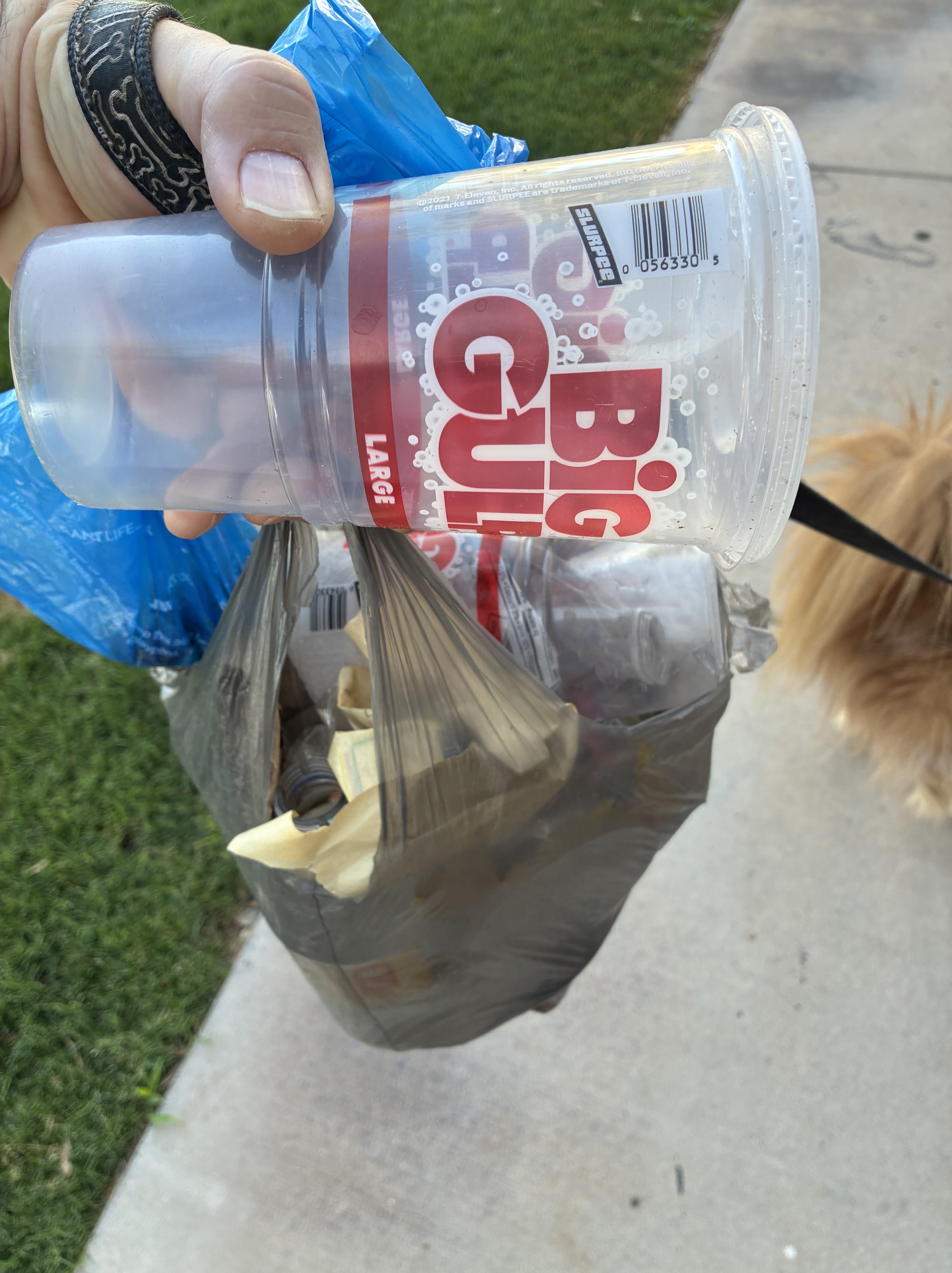
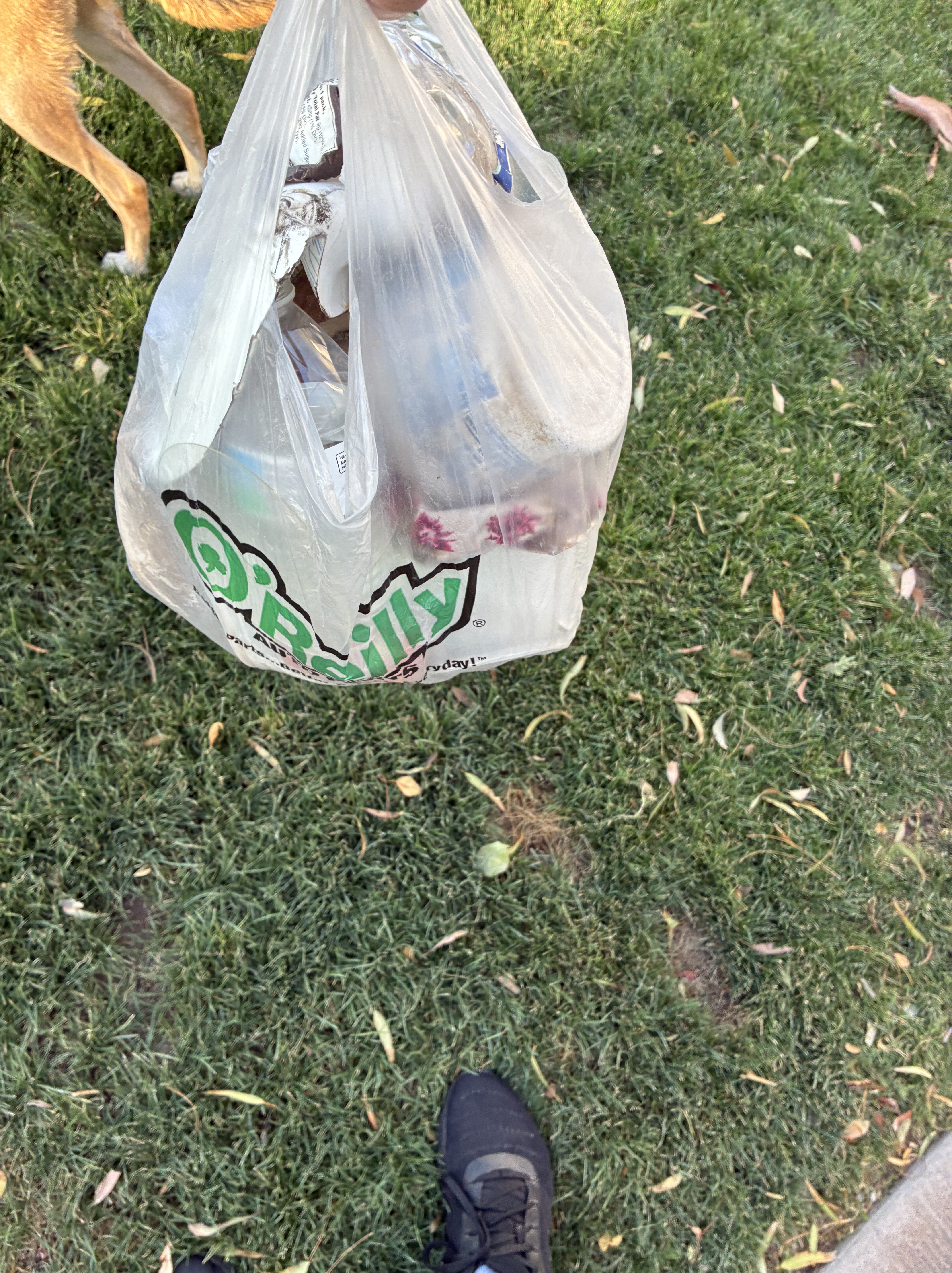
And then this past summer, I started picking up trash while I was walking the dogs.
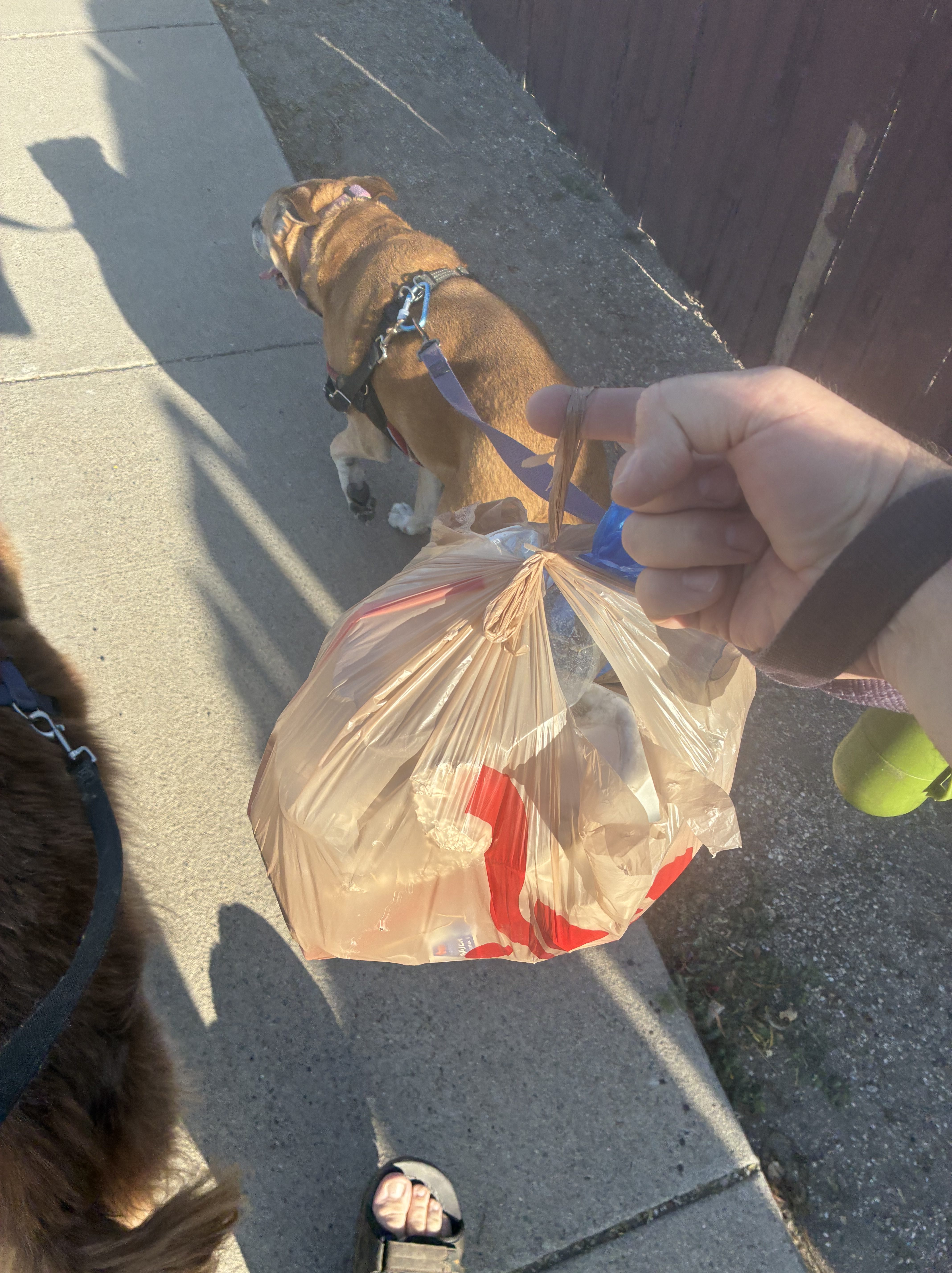
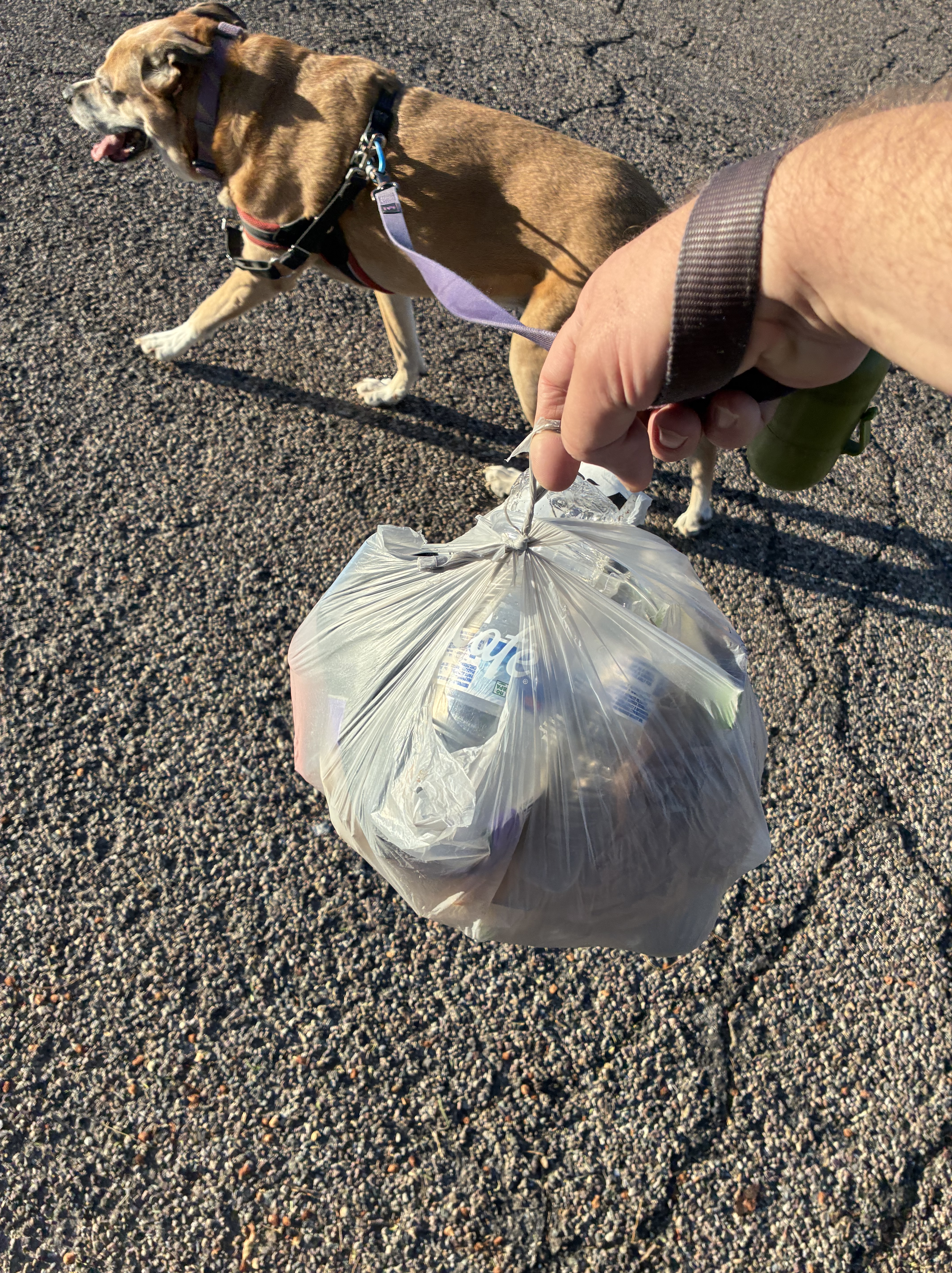
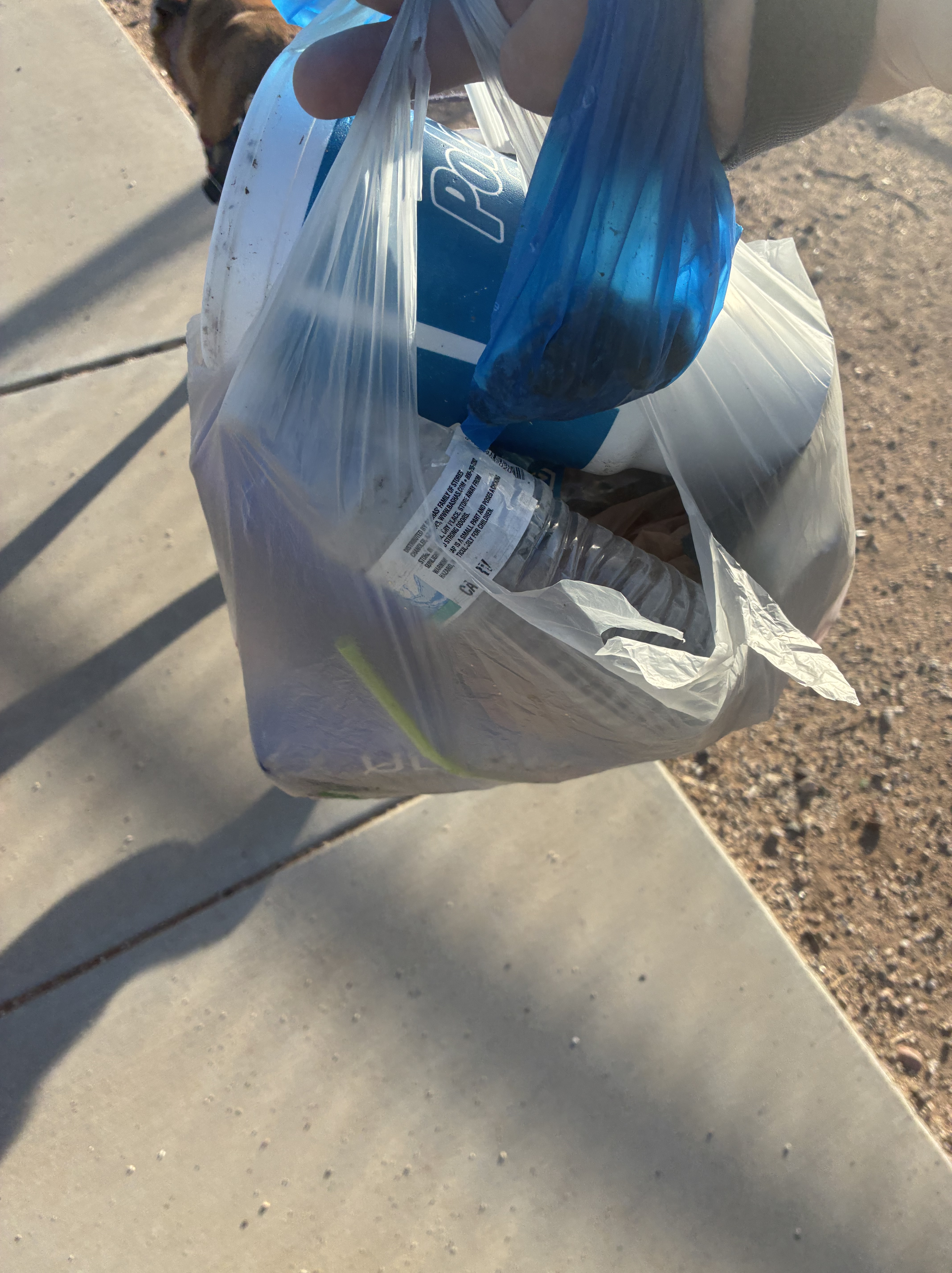
I took this photo with my phone during the walk. That’s my girl Roxie, walkin’ on sunshine.
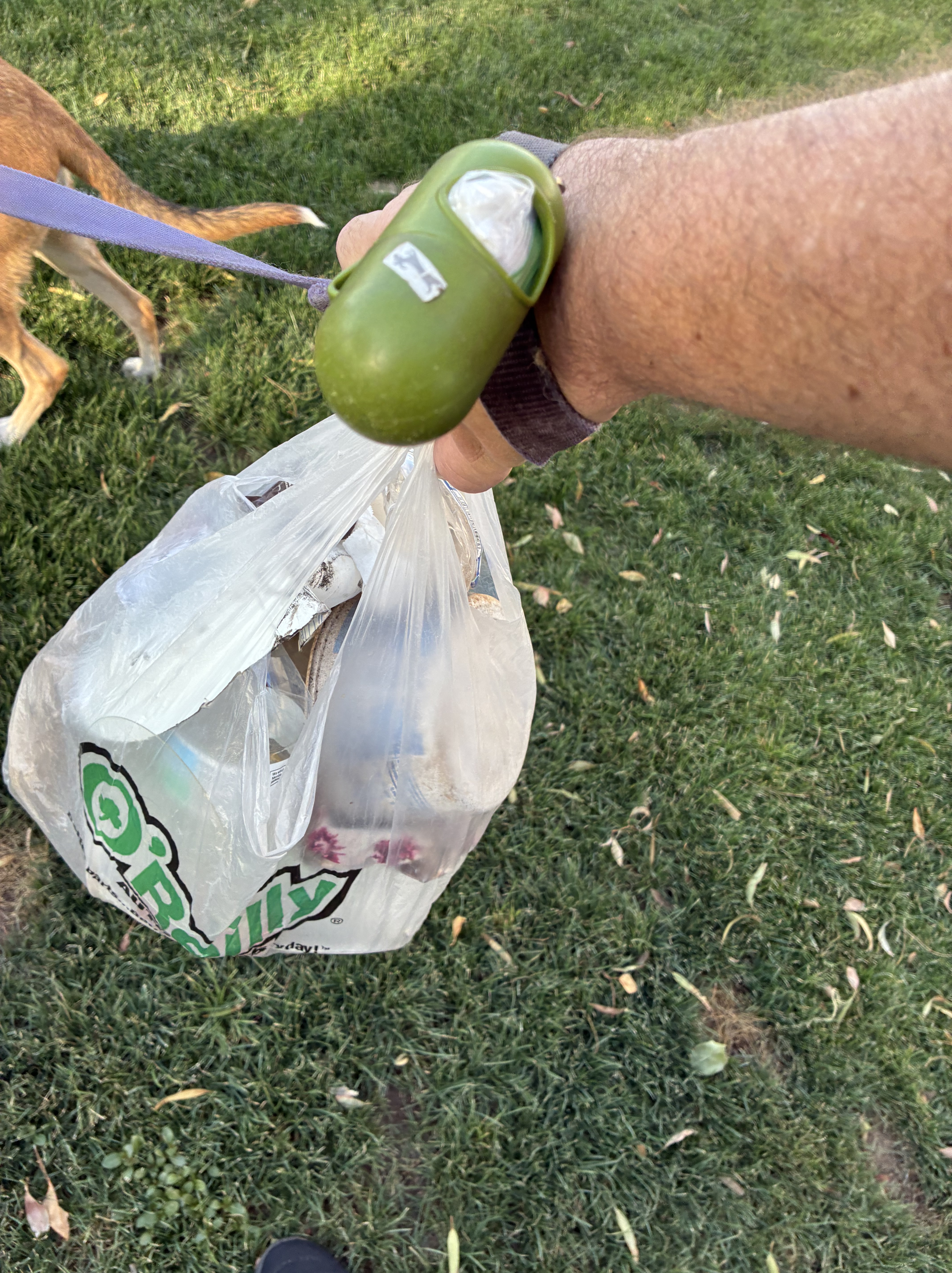
It was pretty easy, even though I walk with two dogs on two leashes, one on each wrist; I grabbed an extra plastic bag from the grocery store (Just like every other person, I have a bag filled with bags in my pantry), held it with one hand, grabbed trash with the other hand. You can see that I tied it shut and carried it with one finger; it wasn’t heavy. I had to yank on the dogs a few times when they wanted to keep going while I was pausing to grab a piece of trash; but considering how often they pause to sniff (Especially the fuzzy one in the shadows on the left), I had plenty of opportunities. Too many opportunities, in fact: I filled the bag long before I finished the walk, long before I ran out of trash to pick up. But I left the other trash where it was; I just picked up one small grocery bag worth of garbage.
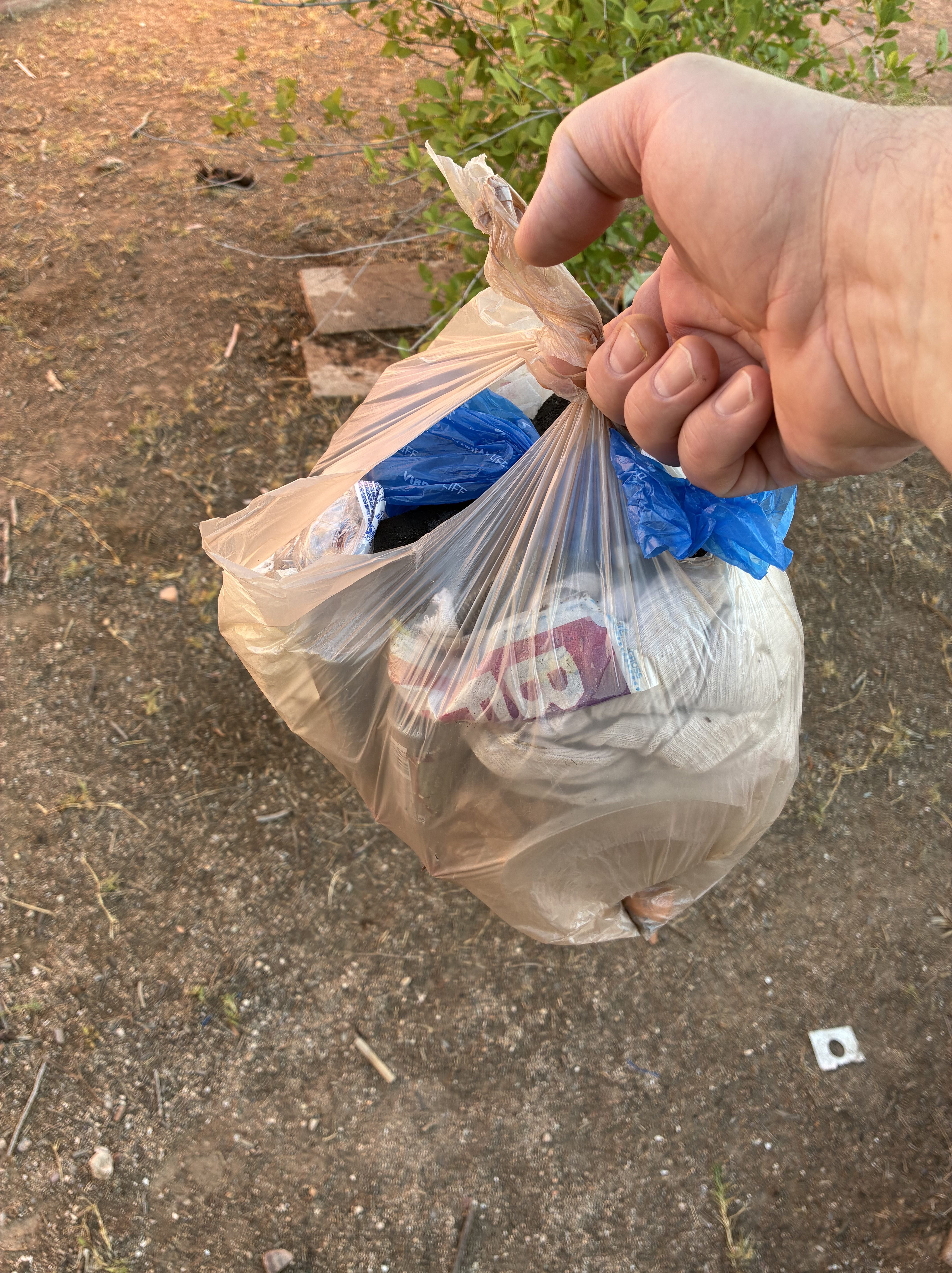
And then another, the next time we walked.
This image I took at home, before I threw out this bag. That’s Neo the tortoise. He wasn’t on the walk.
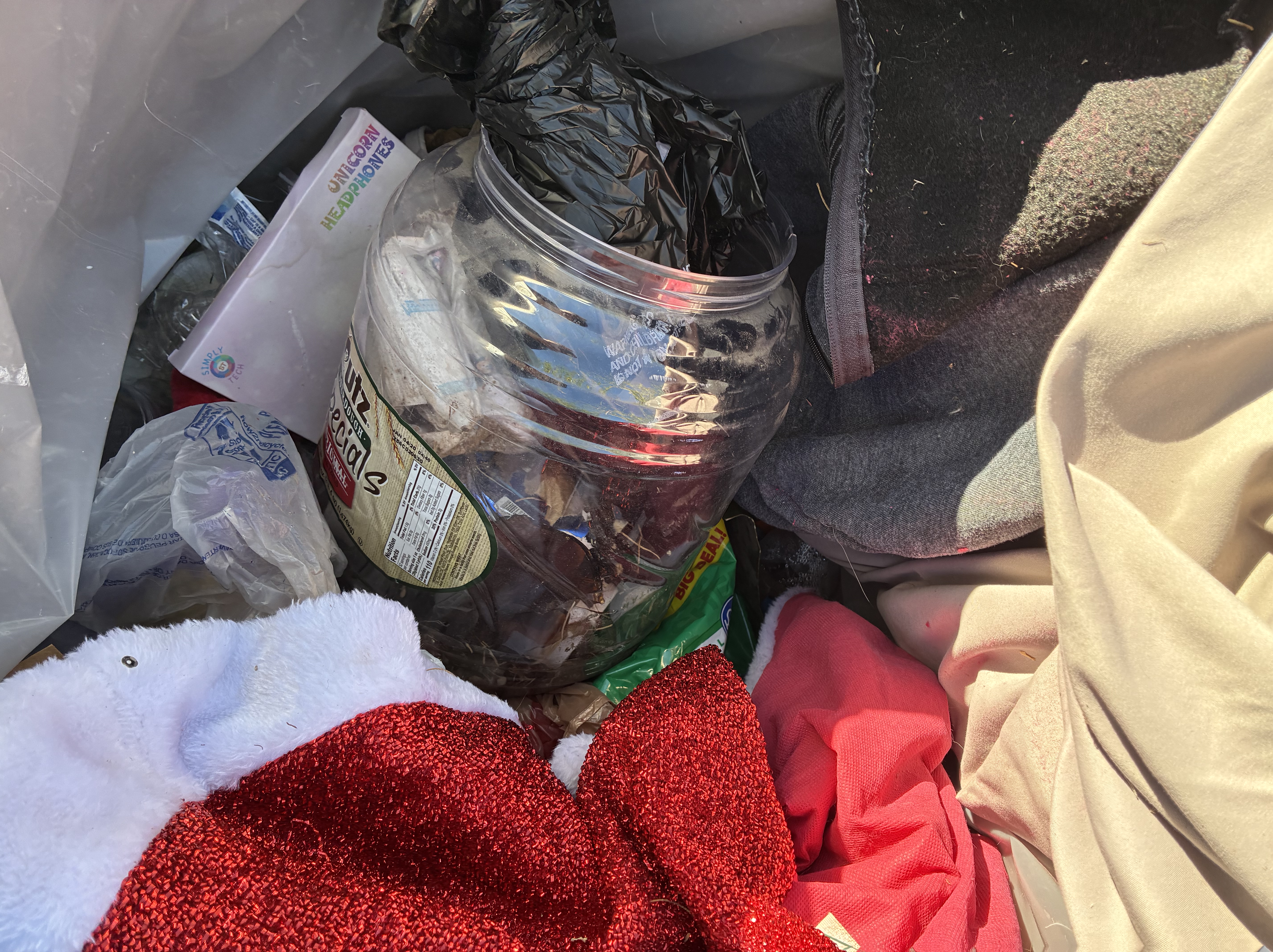
And another bag, the time after that.
That’s our Arizona Ash tree in the background. We call it… well, Ash, of course.
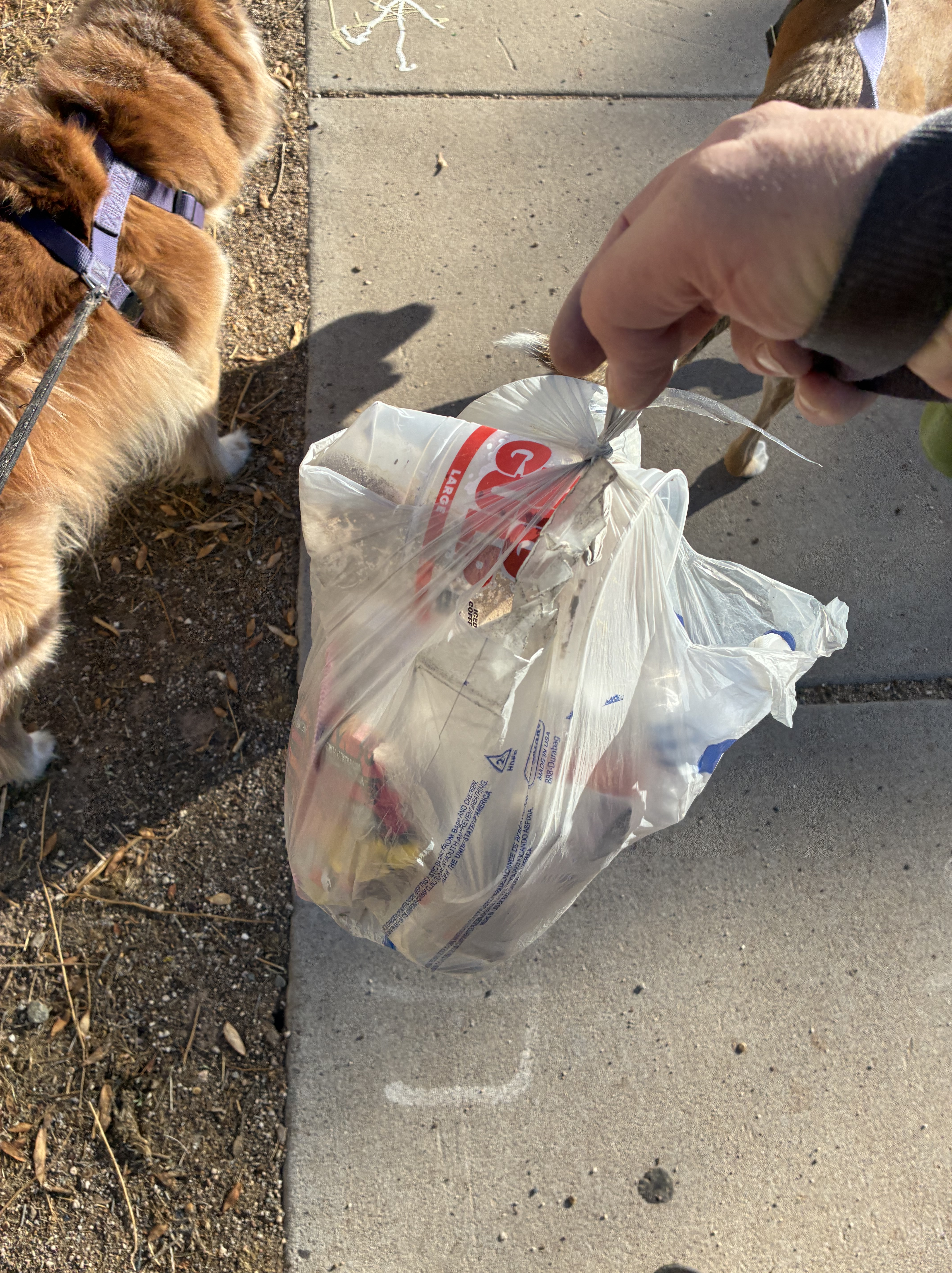
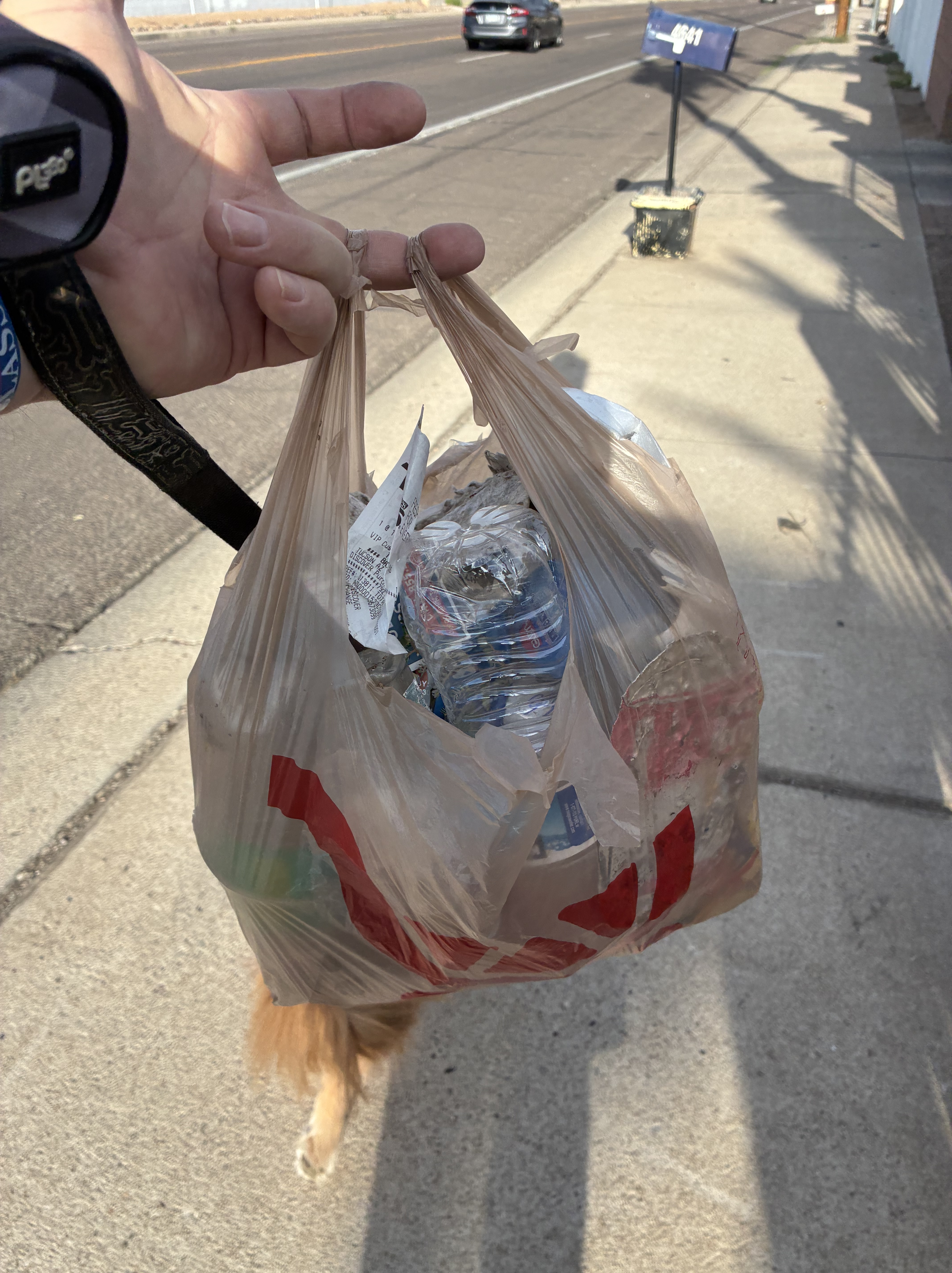
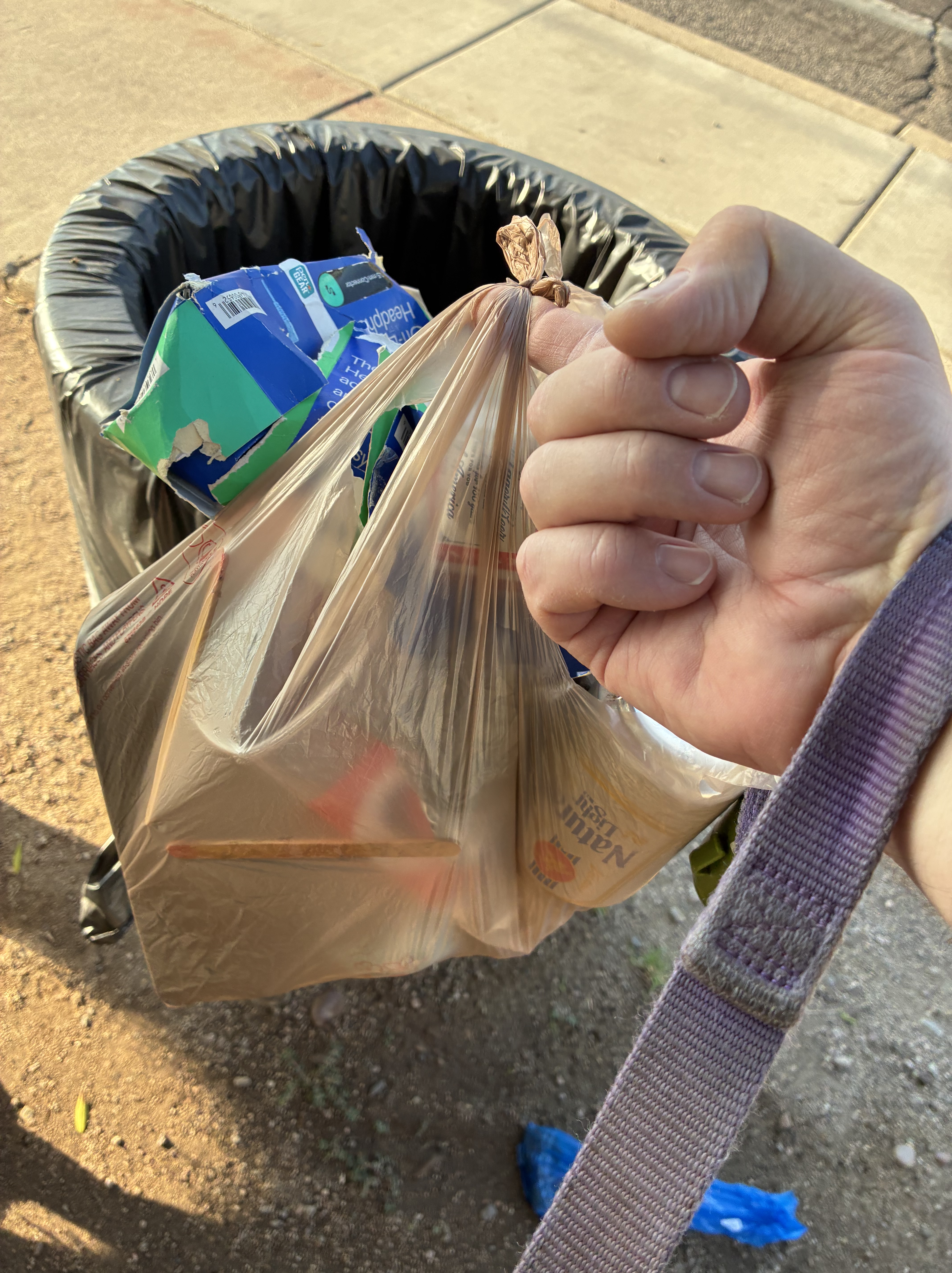
And I kept doing that. Several times I found plastic grocery bags on the walk, and kept them for the next time if they weren’t torn or dirty — so I didn’t even use up all of my bag of bags! Still got ’em! Sometimes I got ambitious and filled more than one grocery bag, and a couple of times I found bigger trashbags, the white kitchen trashbags with drawstrings, and I picked up even more trash. I walked the dogs every two or three days, just around my neighborhood, never very far (They are old — though of course they are still baby baby puppies); there was always trash to pick up. I took a photo each time because I wanted to write this post about the whole thing. Here they are:
(Sorry they’re all turned sideways; I had trouble with the editing option on WordPress here — and I refused to use the AI editor.)
So as you can see, I managed to pick up a lot of trash this summer.
And now, of course, when I take my walks, I find… a lot of trash. To no one’s surprise: I live in a city, and as I described, there are a large number of sources of the litter that is strewn across my neighborhood. I’m only one person, and I don’t walk that often, especially not once school started up again.
But this summer, at least, there was less trash in my neighborhood. My street and the streets directly around me were a bit cleaner. And, judging based on the road cleanups I have done for the last five years with NHS, my collection of trash would lead to less trash all the time: the first time we picked up our road we filled a dozen huge trashbags; the last two times, it was one or two bags. The trash collected, probably for years, before we started, and while new trash got littered in between our pickups, we reduced the backlog, and the new trash was much more manageable. And is it possible that people who live along the road we clean up noticed what we were doing and maybe got a little more careful with their trash, or even picked some up themselves? Sure: we have been thanked, several times, by residents who notice us out there in our orange hi-visibility vests, trudging along with bags of garbage and wearing rubber gloves. I’m confident that, if I keep picking up trash in my neighborhood, there will be less trash over time. The neighborhood will get better. A little cleaner, a little nicer to walk in, a little nicer to live in.
Now let me reveal the truth here: this is not a post about picking up trash. It’s a post about politics. About the upcoming election. And about doing something to make our neighborhood — in this case our country — a little better, a little cleaner. A little nicer to live in.
I’m not going to say that voting in the election is a citizen’s duty; I think it is, but I recognize that “duty” can be a heavy word, and not something that people easily accept — and that’s a good thing, because a duty is an obligation, and we shouldn’t take on obligations just because some yutz on the internet tells us we should. (Not even when the yutz in question is a splendid writer and a delightful person, with two very cute dogs and an awesome tortoise.) Obligations accrue, but generally don’t fade away — sort of like garbage in a neighborhood. I have not accepted that trash pickup is my duty; it is something I am willing to do, sometimes, but not my obligation.
So what I’m saying is that voting is something you should be willing to do. Just like my trash pickups on my dog walks, it’s not hard; sure, you can get really into it, just like I could get serious about the trash pickups (I will say that I did get serious once: there’s a little footbridge across a wash in a park down the block, and some asshat shattered several beer and liquor bottles on the cement surface. There were shards of glass EVERYWHERE, and I had to turn around and take the dogs the other way. That pissed me off: so after we finished the walk, I went back with a trashcan and a dustpan and whisk broom, and I swept up all of the glass.), and you can research every candidate and every race and every proposition and every county acquisition and every rule change and everything you are voting on. That would be amazing: the more you do, the better the result will be.
But also, there will always be more trash. It’s better to do a little often, and then relax. If you don’t exhaust yourself, don’t get burnt out, you can keep going out and doing the easy thing indefinitely. Make it a habit, and it will get even easier; it will get unconscious, and won’t feel like a chore at all. And it will make a difference, over time, because you will make things better directly, and the past buildup of garbage will be reduced: and you might inspire others to do good things as well. Maybe even the people you’re voting for.
I’m quite serious: it has become clear to me that our politicians are most interested in keeping their positions, above all other considerations. I have watched Republicans, many of them probably quite sincere in their patriotism, fall in line as Donald Trump has led this nation downhill towards a flaming junkyard built on top of a sewage pit, only because they didn’t want to get primaried by MAGA. They have violated their own morals again and again and again, accepting a liar and rapist and conman who is destroying everything that conservatives hold dear — our military dominance, our wealth, our moral standing among nations (or at least the appearance of moral standing). They passed a Russia sanction bill NAMED AFTER LINDSEY GRAHAM, and that fucking guy broke it to give Putin the gift of not only billions of dollars, but also pressuring other nations to lift sanctions on Russia, to go along with the ones he just broke himself. And though the Republicans in Congress are complaining, I guess, we all know they’re not going to do anything serious like refuse to vote for his bills or his nominees, or impeach or even censure him. Because they want to keep their positions, even as they watch their country go down into the flaming shit because of the guy they propped up in order to get his voting base to help them, too. And I don’t think most of the Democrats are any better, not in terms of their priorities: number one is keeping their seat. Period. Very few exceptions.
This means two things: first, if they want to keep their seats, then the thing they fear, the only thing they fear, is a motivated voting populace. The Republicans are worse about it, because they actively try to suppress votes; but the Democrats didn’t pass the John Lewis Voting Rights Advancement Act even when they had both houses of Congress and the White House in 2021, so I don’t think they’re doing much better at promoting a motivated voting populace. A motivated voting populace means that they need to actually work to please those voters. When nobody votes, it’s easier for them to do nothing and accomplish nothing and still keep their seats; but if we vote, if we vote consistently every election, then even if our specific votes in any given year don’t make a tangible change, the fact that numbers of us are voting makes the politicians have to pay attention to what we want, rather than what their donors want. That’s good. And secondly, voting in this country can still make a direct change. Remember that Trump has won — legitimately won — two Presidential elections, and that is the reason why he has power. The only reason, as clearly that shit-flinging gibbon couldn’t work his way into any position of authority that didn’t rest on — the choice of a motivated voting populace which he could manipulate with his cheap conman tricks. People voted: that’s how we got Trump. It’s also how we got Biden in 2020, and thank God we did: imagine if he had been doing this shit to an economy that never recovered from the pandemic.
When you vote, you help make the country better. You also help to clean up some of the shit that has built up in our political sphere. And both of those are good things. And what’s more, voting isn’t hard, and needn’t be an onerous duty: just set yourself up with an easy way to manage it, and get it done.
Help us all take out the trash, and see that it goes all the way to the dump.
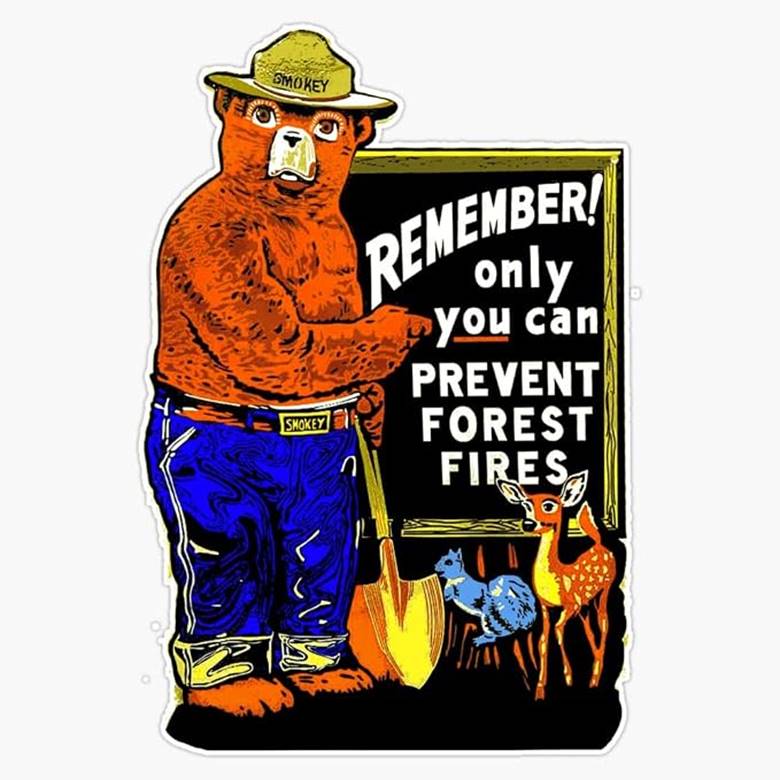
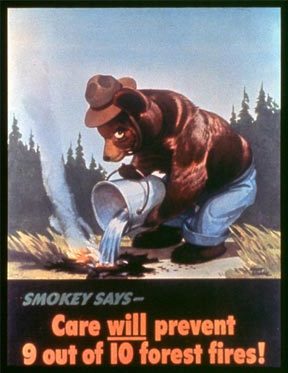
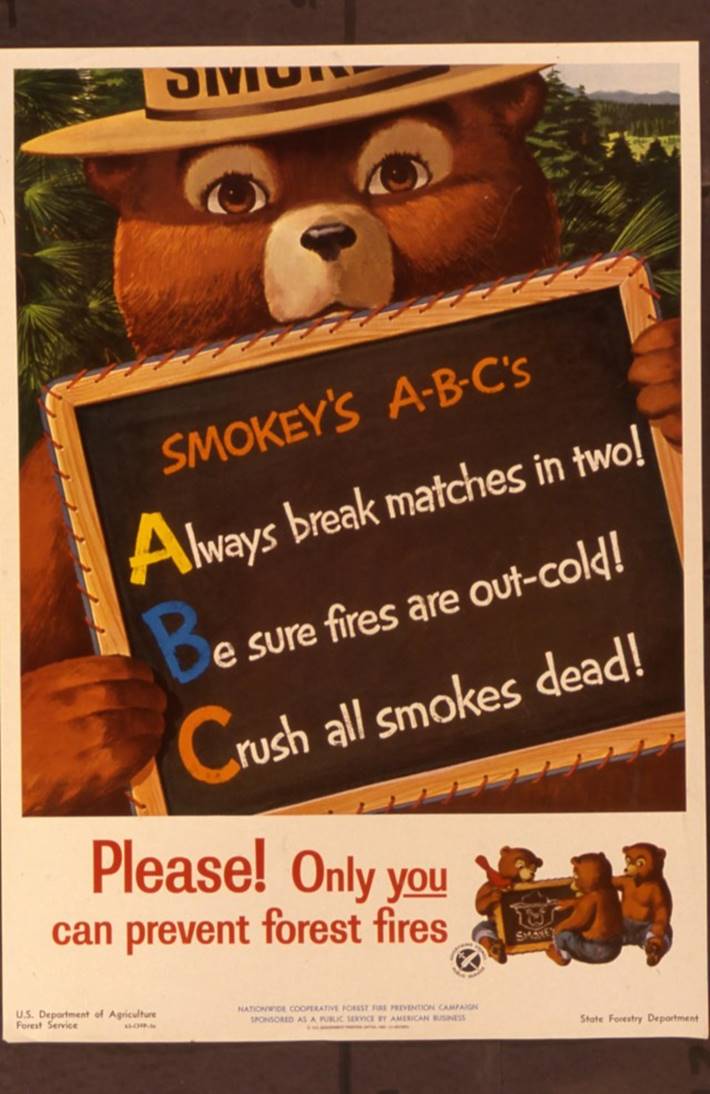
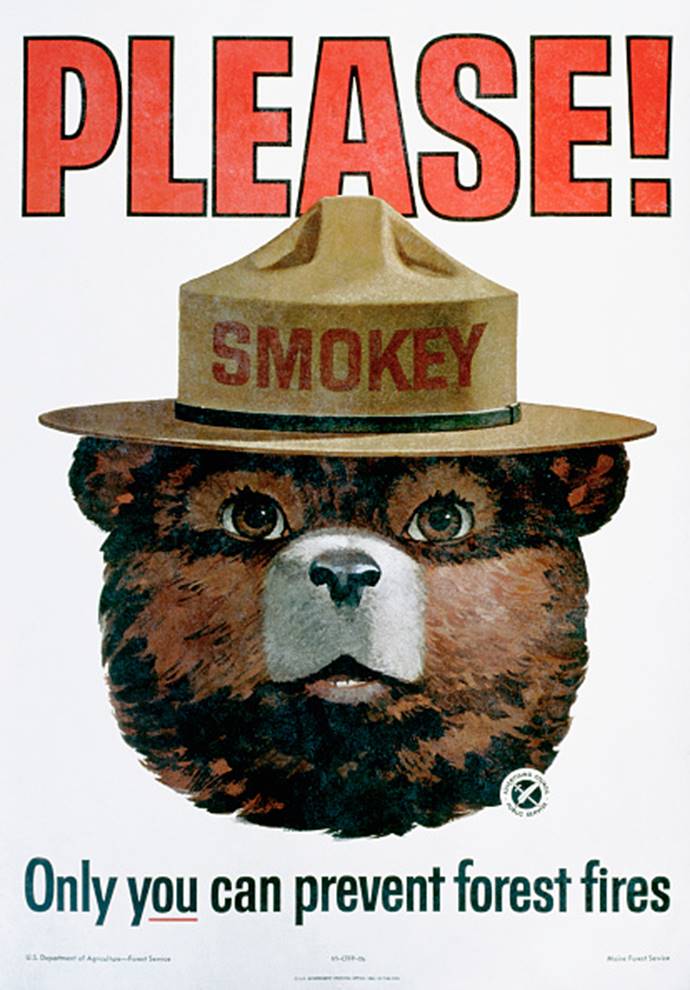
Remember Smokey the Bear? “Only YOU can prevent forest fires!”
Yeah, that’s the one. I grew up seeing Smokey commercials and signs and decals. I never thought much about it; I took it as given, as so dead obvious that it didn’t need to be said, that I would of course be careful and try not to start forest fires or wildfires. I never took it in the way it has been turned into a joke – though I do think the joke is funny.
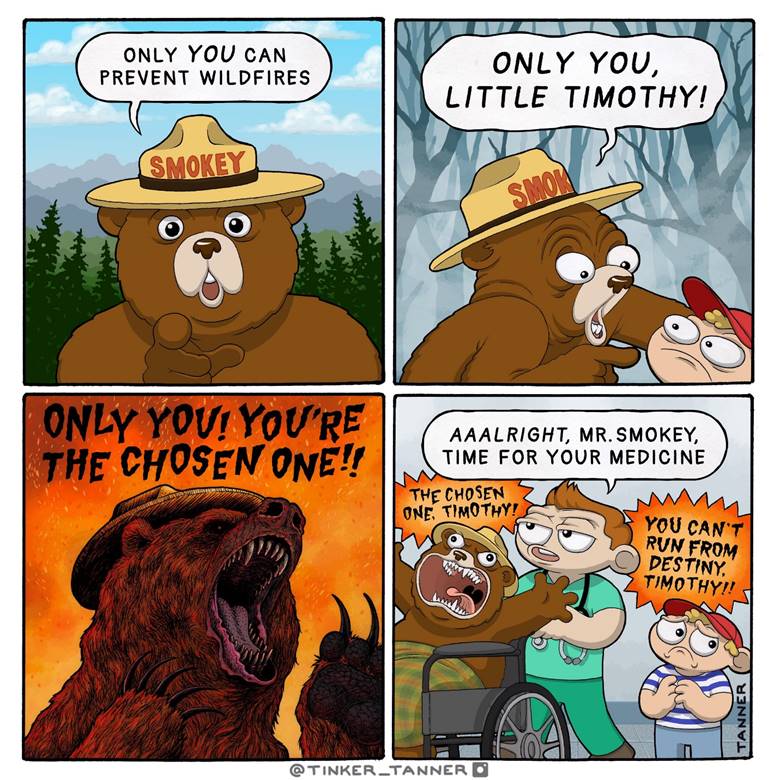
This one:
I especially like the image in the third panel, because to me it implies that Smokey has a deeper reality than the one presented in the other three panels, a far grander role in the universe – which to me implies that he is, in fact, an avatar of some greater cosmic or supernatural force, and lil Timmy would be wise to obey, even if the other people around them are telling Timmy that the bear is mad and should not be listened to; I also really like that Timmy still shows doubt in the fourth panel. Because he knows: the bear may be crazy, but that doesn’t mean he’s wrong.
I never took it that way, not really; but I have come to understand it now. It’s two things: first, English pronouns are stupid, and we should never have abandoned “Thee” and “Thou;” and second, the meme, the joke, are representative of the way we too often view our world and our role in it. It’s that second one I want to speak to, to try to debunk – though I am also happy to speak to that first one.
Sure, why don’t we start with that. You see, the problem is that we only have one second-person pronoun: you. In all instances of pronoun use (other than the possessive pronoun “yours,” but that’s a somewhat different situation), which is even dumber – because while the subjective first person is “I” or “We,” and the objective first person is “me” or “us,” and the third person gives us several options for subject and object pronouns – he/him, she/her, it/it, they/them – for second person it is only “You.” You are my friend. You are reading this post. I published it for you. I give you my thoughts. If we had retained “thee” and “thou,” then the singular second person would be easier and clearer – Thou are (art) the chosen one; the task of preventing forest fires belongs to thee – and only the plural second person would continue to be dumb – You (all) are good people, but too much weight has been placed on you (all). And it would be dumb in a way that couldn’t be fixed by the use of “y’all,” though that particular colloquialism does solve the singular/plural debacle. (Except we often use plural pronouns to represent a single person…)
So the problem with pronouns, applied to Smokey, is that we hear the singular “you” – meaning my own solitary self, just Lil Timmy – because we are reading it, because we are watching the commercials, because we are seeing the signs, all individually, in our own heads. Smokey is speaking to ME and ME alone. But he’s not: he’s speaking to all of us. Only WE can prevent forest fires. Meaning humans. All of us.
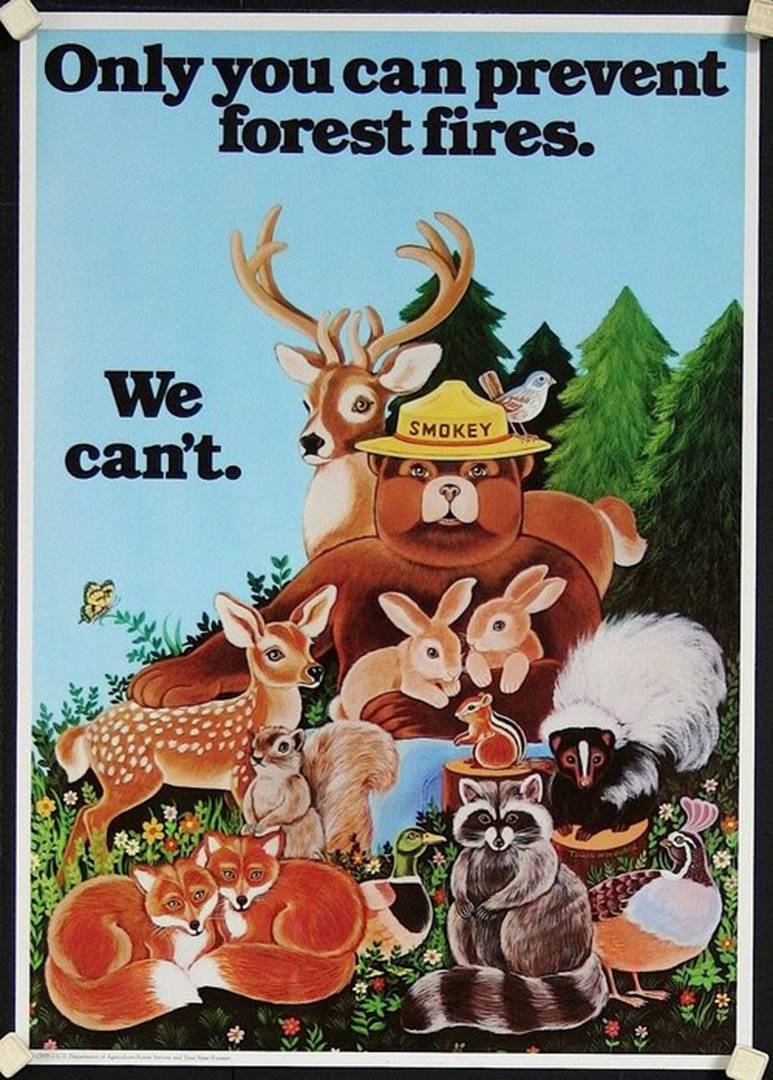
How do I know? Because here are two more Smokey ads.
See, this is the distinction that Smokey is trying to make: the animals, in their infinite cuteness (Sorry: the bunnies are infinitely cute. The foxes look concerned. Smokey believes in us, and the elk is trusting Smokey to make the call and is warning us not to let the bear down. The quail [Pheasant? Guinea fowl? What is that large round bird next to the raccoon, the one with the awesome crest and the fashionable glasses?] is already disappointed in us, and is giving up – and I’m pretty sure that all of the other animals, the squirrel, the fawn, the skunk, the raccoon, and the duck, are warning us about the chipmunk. Who, since it is sitting on a perfectly flat stump, probably has a chainsaw stashed away somewhere – and it’s just aching to break that bad boy out and start chopping us into pieces.) cannot stop forest fires: but we humans can. And here’s how:
We – all of us, all of “you” from Smokey’s perspective – can prevent forest fires simply by caring, and being careful. Because, of course, we are the ones who cause the fires, because we don’t care, because we aren’t careful. See, Smokey’s not telling us – me, and you the individual reading this right now – that we are the Chosen One(s), who must roam the forest night after night, putting out sparks, cutting firelines, flying the firefighting planes and dropping water on hotspots. He’s telling us that we simply have to care enough to not be careless when we are in a position to start a fire.
Matches, campfires, and cigarette butts. That’s what we need to do: be careful with those things, those sources of ignition. Not take on the whole task by our lonesome, not even join the fight and put out fires; just be careful with the danger that we, individually, pose. I’m not a camper, so I don’t have much to do with campfires; but I smoked cigarettes for almost twenty years, and you know how many fires I started? Well – one, which destroyed my room and my possessions and could have burned down the house. But I never started any wildfires!
And that, right there, is why Smokey had to keep reminding us, keep telling us, keep asking us – pleading with us – to just do what is obviously the absolute minimum: do not allow our own stupid, lazy indifference to our world lead to that world’s destruction. Like telling me that the best way I can prevent murder is not to commit murder, the best way I can fight rape is not to rape. (And, you know what? That’s not enough, but it would be a good minimum standard.) The first four words of the Hippocratic Oath, which I use as my first and most important classroom rule with all of my students – and I include the Latin, just to be fancy and try to impart to my students how serious and important this is: First, Do No Harm. (Primum non nocere, if you also want to be fancy, and remember Latin uses a hard “K” sound for “c.” [We won’t talk about Iulius Kaiser…]) Because as careful as I always was with the fires that I started twenty times a day, three inches from my own face, I wasn’t always careful: and once I did start a fire. And it did harm, though fortunately only to me. And I guess a little harm to my landlord – but also, fuck him, he owned like thirty properties in Santa Cruz, California, the most expensive place in the country, and he charged high rent and did exactly zero maintenance. He wasn’t as cute as those forest critters.
Other than that chipmunk. Who’s really starting to freak me out. It’s got those beady little eyes. Dead eyes.Doll’s eyes. And okay, the blue patch behind the stump is Smokey’s denim-clad legs – but do you see what looks like a curved handle on the left side of that stump? Is that the chainsaw? Is that little rodent about to rip it, scream “GROOVY!” and charge out of the picture, straight at us?
Would we deserve it if it did?
Would you?
If you do the minimum, then you don’t deserve it. I mean that: just the minimum. Just – do no harm. Care. Be careful. Put out your matches and campfires and cigarette butts, and make sure they are really out. Don’t do something stupid, like I did that one time – but will never do again. If you have made a mistake before, like I did, then learn from it, and be better. Be careful. That’s enough, even if it doesn’t feel like enough. It is enough, because the “you” in Smokey’s admonition is not only you, alone: it’s all of us.
That’s the key: and I’ll be clear in a moment what I actually mean by that. The truth is, that if we ALL do our part, do the bare minimum by keeping ourselves from doing harm, then everyone will have kept themselves from doing harm, and there won’t be any harm done. And that, in all honesty, would work with — almost everything.
If we all do the minimum, if we’re just careful, each and every one of us, then that would solve the problem: because we are the problem. All we need to do is stop being the problem. Care enough to not be the one who starts the fire.
Please.
Do you know why I’m talking about this? It’s not because I’m concerned about actual forest fires. Not because we’re deep into fire season, and with the extra rain from El Nino, it’s going to be a bad season this year (though, because I do want to avoid getting Texas Massacred by Chip/Dale there, I would like us all to be a little more careful with fires right now. Please.). But because we’re deep into another season, a different kind of dangerous season, and the climax of it is only four weeks away.
Because it’s election season.
And only we can prevent a fascist dictatorship.
We’ve been careless in the past. Several times, honestly, because while I think the worst president, the one who’s done the most damage, is this fucking guy we have now, and the second worst was ol’ Ronnie Reagan – I would argue that the third worst, and maybe the most insidious, was Bill Clinton; and without the groundwork that Reagan and Clinton laid, we wouldn’t have had half the problems we have had since the Millennium came. Fascism doesn’t come from nowhere, and it doesn’t come all of a sudden: and I will argue that nearly all of us are complicit, to some small degree, mostly by being careless – I voted for Clinton, mainly because I just didn’t know why I shouldn’t, because I wasn’t paying attention. I don’t know if voting for Bob Dole, in my case in 1996, would have been better: and that’s the issue. I don’t know. I should have known: I should have cared. But instead I was careless, and so I bear some of the shared responsibility for the destruction of the welfare state and the villainization of people receiving assistance, and for the racist attacks on black and brown people through the justice system which labeled them “superpredators,” and for the removal of the Glass-Steagall act, which set up the Great Recession and continued the march towards corporatism we are facing down now. I was careless, and I voted for what was probably the wrong candidate.
But at this moment, there is no doubt about who is the wrong party to support. I hope we all know now that voting for the party of Trump is the most careless, most dangerous thing we can do, other than actually going into the woods, to the middle of the Teddy Bears Picnic, and throwing a Molotov cocktail (January 6th would be the analogous action there, and if you think we’re immune from a new insurrection led by the same fucking guy who led the last one, then you’re being careless, and I have to ask you again: please.).
Let’s assume that the people reading this don’t want to do that. You don’t want to throw Molotovs at the Teddy Bears. You don’t want to burn the whole thing down. Some people do, of course, and whatever else we believe, we have to know that those people are wrong and dangerous. Even if you want to dismantle the system in place, and most of me wants to do that (Some of me is a coward, which on the bright side does make me careful), burning it down is not the right way to achieve reform. The civil war that would result from an actual conflict, and actual conflagration, would be far too destructive, and like any civil war would immediately rage out of control and burn everything, not just the bad things. Firefighters use controlled burns to contain wildfires, but not to stop them from starting: and within the controlled burns, inside the fire perimeter that our firefighters manage to create, everything is likely to be destroyed. We don’t want that to be our country. We really don’t. So we – you – are not going to start throwing kerosene around and then reach for the match.
So what do we do?
I’ve struggled with this for years. For better than a decade now, which obviates my usual excuse – which is not really an excuse, but it is true: I do enough already to support my community and improve my world, and I have more than enough emotional weight to lift and carry with me every day; I don’t have the wherewithal to take on large political activism. I can’t do it. I recognize that is a cop-out, but it’s the truth. I recognize, as well, that I should have done more ten years ago: I should have been more aware of how the DNC fucked up the 2016 election by cheating to remove Bernie Sanders from the ballot in order to push another Clinton presidency. I’m aware now that the DNC is not a trustworthy partner in our current fight, because they serve the same corporate and monied interests that the majority of the Republican party serves; and thus, they are trying to start the same fires the Republicans are, even if they want to hide the fires better and stand well back from the flames to distract us: because the Democrats writ large also profit from the scorched earth; and as part of the earth that would be scorched, I don’t want to let them do that.
But I also realize that, while there are surely Republican candidates who do not want to support Trumpian fascism, the majority of the GOP – the VAST majority – are carrying Tiki torches as they go down to the woods today, and every day. The ones in the red hats are also carrying Molotovs: but the Republicans who vote with Trump every time are not better than the ones in the red hats: they are still setting fires, and not because of carelessness, though carelessness is part of the reason for their actions. Not even the ones who have every reason to be better than the red hats, like Massie and Tillis and Cornyn and Cassidy, but who still fucking vote for Todd Blanche to destroy the rule of law and set fire to the Constitution. The Democrats, maybe only because they desperately want to oppose Trump and win more popularity thereby, will, for the nonce, put out the fires where they can instead of starting them.
What’s important, though, is not what the two parties will do, what the politicians on either side will do. What is important is what we do. What YOU do. And you – we – have to be careful. We have to care.
It’s the same thing here. People – perfectly good and decent people, just people who were being careless – voted for Trump, and for Republicans, in 2024. They were careless because they ignored what Trump had done before, and because they had believed all of the criticism of Joe Biden, and because they were angry at Washington and the way our political system always gives us two bad options, and then makes us choose between them. And people should be angry at that: and we should try to change that. And people are perfectly free to criticize Joe Biden; lord knows I did. More than once. But voting for Trump, no matter what the underlying reason was – fear over immigration, or rising prices, or the escalating wars in the Middle East – was careless; we were all holding a book of matches, and some people struck one and then dropped it, intentionally. Or maybe “hucked it at a Democrat” would be more appropriate, if we imagine the match tailing down, flaring orange, and then landing on a pile of dry leaves. Starting a fire: because of carelessness. Indifference. Ignorance – too much of it willing ignorance.
We can’t be that way any more. And the main point I want to make here, the reason I wrote all this starting with Smokey the Bear, is this: we don’t have to save the world by ourselves – you don’t have to save the world by yourself. All you have to do is your part.
Care. And be careful.
First of all: vote for Democrats. Vote for Independents or third party candidates, if your local Democrat is a firestarter, or a little too close to fascist (Looking at you, Fetterman.). Don’t vote Republican. Again, there are probably exceptions to that, and I won’t try to make it an absolute rule: but generally speaking, there is one side trying to set the country on fire, and one side trying to put it out, and the least we can all do is help try to put the country out. That is the Democratic side. So vote Blue.
More importantly, vote. Show up. The Republican strategy, for a long time, has been to restrict voter access, because their base are the ones who can most easily avoid the roadblocks they can put in place. Therefore the fewer people who vote, the better the Republicans do. Except the way they make that happen is by setting democracy on fire: and in order to keep their power, and now, to extract as much corrupt wealth as possible from the burning building, they have been ready and willing and even eager to set the country ablaze. So don’t help them, not even by being careless. Care. Pay attention. Vote. Talk, when and where you can, about what you see, about what is going on, about where you see embers smoldering, and where the water is. Try to put the little fires out, around you – but only as you can. If we all do just what we can, then that will be enough. Because it isn’t just you.
When in the Course of political events, it becomes necessary for one people to resolve the human bands which have connected them with each other, and to assume among the peoples of the earth, the full and equal responsibilities which the Laws of Nature and of Human Society require of them, a decent respect to the opinions of their fellows requires that they should remember the causes which impel them to the resolution and the assumption.
We hold these truths to be self-evident, that all people are created equal, that we are endowed by our humanity with certain unalienable Rights, that among these are Life, Liberty and the pursuit of Happiness. –That to secure these rights, Governments are instituted among people, deriving their just powers from the consent of all of the governed, not merely the few with money and power and influence. — That whenever any Form of Government becomes destructive of these ends, it is the Responsibility of We the People to alter or to abolish it, and to institute new Government, laying its foundation on such principles and organizing its powers in such form, as to us shall seem most likely to effect our Safety and Happiness. Uncertainty and anxiety, within us, will dictate that Governments long established and incrementally corrupted shall not be changed for light or transient causes, and that these same corrupters will divide and incite us against one another in order to increase that uncertainty and anxiety and to convince us that all causes for change of the Government shall seem light and transient; and accordingly all experience has shown that We are more disposed to suffer, while evils are sufferable, and even beyond that point, than to right ourselves by taking on responsibility ourselves for the alteration or institution of new Government. But when a long, long train of abuses and usurpations, pursuing invariably the same Object, evinces a design to reduce us under absolute Despotism, it is our right, it is our duty, to throw off such Government, and to provide new Guards for our future security. –Such has been the desperate sufferance of this People, and such is now the necessity which constrains us to alter our former Systems of Government. The history of the present Oligarchy of the United States, as embodied in the sitting President, is a history of repeated injuries and usurpations, of corruptions and divisions and incitements, all having in direct object the establishment of an absolute Tyranny over these United States. To prove this, let Facts be submitted to Us All.
The President has forbidden his legislators to pass laws of immediate and pressing importance, such as the 21st Century ROAD to Housing Act or the bipartisan border bill, unless suspended in their operation till the Oligarchs’ assent should be obtained, and when so suspended, the Oligarchs and the President have willfully neglected to attend to them.
The Supreme Court, owned by the Oligarchs, have struck down other laws for the accommodation of large districts of people, such as the Voting Rights Act of 1965, unless those people would relinquish, through such machinations as partisan gerrymandering, the right of Representation in the Legislature, a right inestimable to the people and formidable to tyrants only.
The President has assumed legislative powers through Executive Orders, and taken up imagined concerns such as the ballroom and the reflecting pool, in numbers and in forms unusual, incoherent, and distant from the system of laws of this country, for the sole purpose of fatiguing his opposition and the general public into compliance with his measures.
He has refused for a long time, after such dissolutions and dismissals, to cause others to be elected; whereby the Legislative and Executive powers, incapable of Annihilation, have returned to the People at large for their exercise; several of the States remaining in the meantime as obstacles to the exercise of such powers, leaving We the People exposed to all the dangers of exploitation from without and convulsions within.
He has endeavored to prevent the population of these States; for that purpose obstructing the Laws for Naturalization of Foreigners; refusing to pass others to encourage their migrations hither, and debasing the conditions of those residing Appropriately in these Lands.
He has affected to render the Military independent of and superior to the Civil power in carrying out a war in Iran without Congressional approval.
He has combined with other tools of the Oligarchs to subject us to a jurisdiction foreign to our Constitution, and unacknowledged by our laws, giving his Assent to their Acts of pretended Legislation and Executive Action:
For Quartering large bodies of armed troops among us and among all allied peoples of the world:
For protecting his ICE Officers, by a mock Immunity, from punishment for any Murders which they should commit on the inhabitants of these States:
For abolishing, with the Consent and Assistance of the Judiciary under this Oligarch-owned Supreme Court, the free System of American Laws in our Southern States, establishing therein an Arbitrary government, and attempting to enlarge the Boundaries of that lawless district so as to render it at once an example and fit instrument for introducing absolute rule into all of these States:
In every stage of these Oppressions We have petitioned for Redress in the most humble terms: Our repeated Petitions have been answered only by repeated injury, with the weak and ineffectual protest of our Elected officials. A President, whose character is thus marked by every act which may define a Tyrant, is unfit to be the ruler of a free people: and those of our politicians who have failed to provide any meaningful opposition must be deemed so, as well.
Nor have We been wanting in attentions to our American brethren. We have warned our fellow Americans from time to time of attempts by their government to extend an unwarrantable jurisdiction over us all. We have reminded all of our fellow Americans of the circumstances of our emigrations and settlement here. We have appealed to our native justice and magnanimity, and we have conjured us by the ties of our common kindred to disavow these usurpations, which, would inevitably interrupt our connections and correspondence. We have all been deaf, at one time or another, to the voice of justice and of consanguinity: as this division is the object and intent and victory of the Oligarchs. We must, therefore, acquiesce in the necessity, which denounces our Separation, and hold each other, as we hold the rest of mankind, Enemies in War, in Peace Friends.
We, therefore, the people of the united States of America, in general dispersal unassembled, appealing to the Supreme Reality of the world for the rectitude of our intentions, do, in the Name and by Authority of all of the good People of these United States, solemnly publish and declare, That these several States are, and of Right ought to be United and Interdependent States; that We are Absolved from all Allegiance to the Oligarchs, and that all political connection between Us and the Tools of the Oligarchs in the Government, is and ought to be totally dissolved; and that as United and Interdependent States, we have the full Responsibility to Work together, Support each other, Recognize one another, Forgive or Accept or Compromise Together, and to do all other Acts and things which Free and Sovereign citizens of a Democracy may of right and must of duty do. And for the support of this Declaration, with a firm reliance on the need to work together or else starve alone, we mutually pledge to each other our Lives, our Fortunes and our sacred Honor.
Theoden Humphrey
On this Fourth of July, this 250th Anniversary of the signing of the Declaration of Independence, it is my honest understanding and fervent belief that we, the 99%, the working class and conscripted servants of the wealthy few who own our government outright and who have molded our systems into the means whereby they control us and steal everything we could ever have, must work together and overthrow this system, these oligarchs, the corruptors who would destroy our democracy. I do not believe that all of us can get along, nor that all of us should be absolved or forgiven for our past actions and words; but if we do not find a way to work together despite our differences, then while we argue over those differences, the ruling class will eat us all alive and destroy our whole world’s future. I do not mean to ignore the importance of the conflicts that divide us: such matters as racism, sexism, xenophobia, transphobia, religiosity and anti-religiosity are fundamental conflicts. But they are not what is destroying us all. What is destroying us all is the system of corrupt control of our entire body politic by those with enough money to buy anything they want: and many if not all of those conflicts due to our differences are fomented and fanned by those same oligarchs as a means of control, conquering us by division. Before we can address our genuine divisions and differences, we first must fight to survive: and no one group of us can win alone. We need one another, because all we have is ourselves; everything else is owned by the owning class. We must use our one power, unity, and the strength of our numbers ALL of our numbers. We are and must remain interdependent, and it is my genuine hope that those who can be turned away from hatred and bigotry will be forever changed by cooperation in service of our unified need, our universal good, our fight for our freedom from the oppression of oligarchy. Those of us who cannot give up our hatred and bigotry, like those of us who cannot be forgiven for our crimes, must be dealt with justly; but the existence of those people cannot be permitted to stop the rest of us from union in our common cause.
Thus, this document. I have used the model of the Declaration because of the appropriateness of the time and the occasion, because so much of what Jefferson and the Founding Fathers said about Mad King George is still appropriate 250 years later about the government under the MAGA Congress, the Trump administration, and the Roberts court, all suborned and controlled by the oligarchs; and because Thomas Jefferson, the slaveowning rapist who wrote the original argument – and his formulation of the self-evident truths is utterly brilliant, even through the lens of his monumental hypocrisy – is the perfect embodiment of who and what we must work with in order to succeed. This is the distillation of interdependence, to me. This is what we must do. Else we are all lost.
Please, if you are willing, sign it (Add a comment with your name, or share it and attach your name to it there), and pass it on to others who may sign it and join the fight. Join me in declaring our interdependence, and our opposition to oligarchy.
I was (Still am, actually) listening to a Spotify playlist of music by The Bobs. No, you haven’t heard of them unless I have mentioned them to you in the past; this a cappella group is one of my longest-lasting musical obsessions, surpassed only by the Living Legend Weird Al Yankovic. The Bobs were great singers — especially their bass, who is amazing — but their real gift was for songwriting: they were strange, oftentimes, and they were sometimes overly cheesy or too experimental — but there are a huge number of beautiful songs, catchy songs, clever songs, impressive songs, and, most importantly, meaningful songs in their catalog.
This is one of my first favorite songs by them. And no, it is not a coincidence that one of my formative memories was having a winter hat that my mother made for me, which I wore throughout elementary school, which was fashioned to look like a space helmet. I wore that thing every cold winter day in Massachusetts; and I was mocked for it pretty much every cold winter day in Massachusetts.
I love that: first because it talks about both living as your authentic self with gusto, even when people (your own mother, for instance) think you’re strange just because you put a colander on your head; and also about being protected from the exigencies of the world, how common it is for us to put on armor — which is, of course, the opposite thing from being your true self, because armor is how we hide ourselves. The song is about someone being weird: but it is also about how so many people do the same thing in so many ways; and it asks the question — which is the path to serenity? Is it safety, partly represented by fitting in with the crowd (and the image of rows of shining hairdryers at the beauty parlor as a sort of helmet is fantastic for showing us this) and partly represented by the fact of a literal helmet, which protects your head? Or is it being who you want to be, represented by the main character’s desire to wear a helmet because his heroes were firemen and astronauts? It’s a great question, honestly; and it’s interesting (especially because it creates a theme that continues into the main song I want to discuss, below) that a possible solution the song offers is to ask other people to join in with your particular weirdness: because if other people try it, and find that they like it, then it’s not weird — and then there’s nothing wrong with wearing a helmet.
And the whole time, it’s just so freakin’ jaunty! How do you not love that??
I know, I know; not everybody loves that. But I do, so — come try it on, nothing can do you wrong.
Anyway, I was listening to a playlist (Which also let me enjoy several of their covers, which are AMAZING: here they are doing a Jimmy Cliff song, “Sitting in Limbo:” Sitting in Limbo) and their song The Deprogrammer came on. Here it is:
So this is an interesting story song, which is one of The Bobs’ specialties, and for the same reason why “Helmet” is interesting: it starts with an unusual situation — a deprogrammer, a guy who kidnaps cult members and un-brainwashes them, which is a pretty wild concept, but also it was something of a fad in the 80s when the song was written (I remember a storyline from my favorite 80s comic strip, Bloom County, in which Milo tried to deprogram — I think it was Opus?); people at the time were understandably terrified by the mass suicide of the People’s Temple, ordered by their cult leader Jim Jones, and they wanted a way to save their family members from a similar fate — but then the story takes a surprising twist. Just like “Helmet” beginning as a celebration of being strange and quirky, and then turning to an insightful criticism of society in general, “The Deprogrammer” turns into the brainwashing/kidnapper building a sort of grudging respect for the cultist he is trying to “save,” and the interesting choice of words when he says, “Maybe this time, I’ve met my Master.” Does this mean the deprogrammer is now being drawn into the brainwashing? Since he joins into the repeated chorus that closes the song, it seems so. And that repeated chorus becomes a celebration of the cult’s mantra and the power of it, and the attraction of being part of a group, which seems to be what defeats the deprogrammer. The cultist he kidnapped, whom he can’t deprogram, just keeps saying “We are the light of a beautiful world,” and the song turns into a singalong, with a crowd joining in on that refrain, along with the alternating lines “The mindless words you are repeating” and “Logical thoughts are self-defeating.” The song adds echo effects and fades out on that repetition, turning into something of a hymn, repeating what is actually a lovely thought: We are the light of a beautiful world.
Who would want to be deprogrammed of that belief? Wouldn’t we be better off with that understanding of the world implanted deep in our psyches, so deep that nothing could pull it out? And too, as “Helmet” maybe indicates, if we can get people to try, to join in and recognize the pleasure and goodness of our subjective experience, then we can all be as one, and no one will have to feel left out or ostracized or marginalized. The world could be a utopia.
Except. Except there’s not a practice, not a worldview or paradigm, with which everyone can agree. Not one. Which means there has to be conflict, when we think like this. There will always be an In-group and an Out-group, even if the Grinch does decide to join in with the Whos’ Christmas celebration. And not only because the Grinch can never be a Who, but also because sometimes the In-group, the common majority mindset, decides to cut down all of the trees: and then not only does that choice necessitate conflict with the Lorax, it needs the Lorax, to speak for the trees.
Not sure why I went full Seuss there, since I was talking about the Bobs. Mainly because most of you don’t know the Bobs: but everyone knows Seuss, especially the ones that have been movified.
But we also have all seen, firsthand, the intentional creation of an In-group and an Out-group: and it has been accompanied by incessant, and profoundly obnoxious, invitations to those of us in the Out-group (One of them; there are actually several Out-groups, with differing levels of ostracism, hatred, or persecution attached to each) to just join the In-Group, and then everything would be fine. Except the In-group was created as a means of consolidating and wielding power, apparently mainly for the prosaic but profoundly insidious goal of stealing as much wealth as possible. Donald Trump chose his In-group, his Star-Bellied Sneetches, and he has been telling them for more than ten years now that they are the bestest: that they are the real Americans, the true patriots, the good people, the only ones who use common sense. And for ten years, I have listened to those same people turn around and tell me that I should want to be a real American, a true patriot, a good person, and a person who uses common sense, and they tell me that all I have to do is: follow Donald Trump. They say it in various ways, depending on the context of the actual conversation: they tell me I should “accept” that Donald Trump is my president, which actually means I should join their group and act exactly like them, including focusing all of my fear and anger and hatred on the Out-groups; they don’t say that I am only given this opportunity because I am a white cis-het man who speaks English and possesses legal American citizenship, but we all know that that is true. I have been told that I should “support” Trump and his actions because he “wants what is best for our country;” though he actually wants to take what is best in our country, and destroy everything good that he can’t take. And, of course, we’ve all been told that we must comply with the those who use force to impose obedience on us, or else we will somehow earn the violence that will be inflicted on us, and which will get no more sympathy than a shrug and a smirk and some variation of “Fuck Around and Find Out!” from the members of Donald Trump’s gang.
This was where my mind went when I heard “The Deprogrammer” again for the first time in probably a decade. (Now I’m listening to “Dictator in a Polo Shirt,” and I want to make a Trump reference about that, but I’ll hold off until I finish my current point. I’m trying to quit tangents, and though I can’t go cold turkey, I can lower my daily consumption.) I’ve been listening to the national conversation revolve around what it will take to turn Trump’s followers against him at last — I mean, it seems like it’s been the conversation for the same ten-plus years that Trump has been in power, largely owing to his iron grip on his base, and the utter spinelessness of the Republican party when it comes to disobeying him. And I admit that I try to kick that football every single time the Lucy of the media hold it for me: they tell me that Trump’s popularity is waning, that it’s lower than it’s ever been before, that his most recent actions or policies are unpopular according to national polling, and every single time, I get excited by the possibility that, this time, at last, Trump will lose his power, and we’ll be able to rein him in, and maybe even achieve the ultimate dream of impeaching him (for a third time) and this time, removing him from office — and maybe even putting him on fucking trial for his goddamn crimes. I don’t even care if the Supreme Court voids his conviction on appeal (That’s not true, I care enormously, but there’s nothing I can do about it, so I’m trying not to care. I can’t go cold turkey on caring: but I’m trying to reduce my daily consumption of caring.), I just want him to face a jury that tells him he’s guilty, and a judge that sentences him to fucking jail time. That’s what I want. Actually, I think that’s what the country needs: because if Trump can go through that process and be held accountable to that extent, given the real and actual punishment of prison time, then it will help to show his would-be imitators and replacements that they can’t just get away with literally everything they want to do, as he has done. We need to go back to having norms, and following them, and that requires Trump to pay,
But it’s never true. Trump won his primaries just this last month: he wanted Thomas Massie out, and Massie is out; he wanted Ken Paxton to run against the Democrat, and Ken Paxton is running against the Democrat. This is terrible strategically for Trump, because he is making enemies among the current Congress (NPR is, adorably, calling them the YOLO Caucus, the ones who are leaving Congress at the end of this term and so don’t have to fear Trump ending their political careers) — but also, the courts are giving him all of the gerrymandered maps he could possibly want, and his voters are still supporting him. And I go flying and land on my back, as the football is pulled away from me. I did it again with the Anti-Weaponization fund, and the news reports that Republicans in Congress “weren’t happy” with Trump’s attempt to steal $1.776 billion in order to pay off his brownshirts from January 6th (I’m sure most of that money would go directly to the Trump family, but that’s a different conversation: all of the bribes for his violent minions would be just as bad as the direct theft of more taxpayer money by Trump himself, and maybe worse depending on how much it would embolden the next crop of rioters before the next election), because the Senate passed his fucking ICE funding without any amendments even limiting how that stolen money can be spent. Even the YOLO caucus failed to vote on amendments in alignment with the Democrats: they gave Trump the bill he wanted. 1.776 billion dollar bills. And 70 billion more dollar bills for ICE. Still no investigations of the killings of Renee Good or Alex Pretti, by the way. Because Trump doesn’t want them, and his government does what he wants.
The reason I keep thinking Trump’s control is ending is because it doesn’t make any sense to me. Not even a little bit. But see, that’s because I’m not in the In-group: I’m not in the cult. I have not been taught to obey the Master in all things, to surrender my will to the Leader. I have been given multiple offers to join, just by accepting that Trump is my master and that everything he says is true, just as I have been told many times that I can save my life if I just comply with the gun-toting thugs in masks who enforce Trump’s control. I recognize that if everyone — everyone allowed to, at least, which would not include trans people or immigrants or those who have incurred Trump’s childish, violent wrath — just joined the In-group, and if we all helped to eliminate the presence of the Out-groups within the US, then we’d all be happier, especially Trump, as he would have both the adoring fans he craves, and the opportunity to steal even more money even more openly (Though I don’t know what would be more obvious than settling a lawsuit with yourself, using your own personal attorney as the currently-un-Senate-approved Attorney General as the one “making the decision” to hand you $1.776 billion, but I’m sure there is more money that Trump could steal, and he would: and he will, because while courts are currently trying to put a stop to the “Anti-Weaponization Fund”, the Supreme Court will surely overturn those lower court decisions and let Trump have anything he wants. Because they’re in the cult, too. At least six of them.); and as long as we don’t mind our world being destroyed by this worthless sack of shit, then we could all be happy together, cheering while we comply, thanking Big Daddy Trump while we do whatever he wants.
Nope. Don’t understand it. Doesn’t make any sense to me. But it doesn’t need to: just like particle physics, which I don’t understand either, the Trump cult is a fact of our world, whether we understand it or not. And even though I won’t be joining it, I also recognize that no deprogrammer is going to be able to save us from them. I think we’ll be partly saved by the unavoidable, and likely imminent, death of Donald Trump (I’m still going to hope that it will come after his trial and conviction and sentencing, even if he never serves a day in prison: escaping a prison sentence by dying would not reassure his imitators that they could get away with the same shit he did: and that might make our country a better place. Not as good as if we managed to pass laws that prevented this from happening again, no matter who tries to do the same shit; but it’s a start.), but I don’t doubt that this madness that happened once could happen again. I don’t believe Donald Trump’s ability to create a cult was due to his unique and unmatchable skills at manipulating people; I think Trump is the result of a perfect storm of events that created a political base hungry to become a cult, and he stepped right into that role: but if that perfect storm happened once, it can happen again. [Keep an eye on Spencer Pratt.]
I don’t know how we can prevent this from happening in the future. I’m not even sure how we can change the situation from becoming as dire in the future as it is now: that is, there are a hundred ways we can fix the American political system in order to keep a future Trump-imitator from doing the same things, but I have lost pretty much all faith in our political system to solve these problems. Our political system could have, and should have, solved this problem in 2021, when they should have convicted Trump of high crimes and misdemeanors, found him responsible for participating in an insurrection, and banned him from ever running for office again: and our political system chose not to do that. Our political system chose to continue participating in this madness, presumably for the same reason the Republican senators voted to pass ICE funding without limiting the theft of $1.776 billion: because this way they can retain their power, and maybe steal some of the money themselves. I have been shocked, but not really surprised, that not a single principled Republican remains in Washington; the last principled Republicans were primaried in 2024 (I’d say it was Massie, who does stand on at least two principles in opposition to Donald Trump, but as he does agree with Trump on every other point, he is not in fact a principled man. Just like anyone who has actually turned on Trump — and I know there are voters who have, genuinely, recognized what Trump is — because of the war in Iran and the economic apocalypse he is building for us: because that means nothing before now was sufficient to turn you against him, and that makes you unprincipled. I’m glad for people who manage to break free of the cult, but their participation in the cult until now is hard to forgive, because again, I don’t think it is Trump’s genius manipulations that created this cult: I think people put themselves in it, and he took advantage. Same with Thomas Massie, who’s a MAGA asshole who just doesn’t like the war in Iran or the Epstein coverup.) I still want to think about and talk about reforms to our political system which would help make the situation better in the future; but I don’t think that’s the answer to the Trump cult, unfortunately.
But this is what I want to say: this is why I wanted to write this post, why I wanted to share the Bobs’ song. Because another way to hear “The Deprogrammer” — not one that fits in the original story the song is presenting, but a way to think of it translated into our context — is as a refrain focused in two different directions: if we imagine the song describing our attempts, as the actual rational people in this country, trying to break the Trump cult free of their absurd willful ignorance, I think the story the song tells is accurate, because I don’t think we can deprogram them. We have met our masters, in the sense that we have met a challenge we cannot overcome — one we cannot master, and which therefore might master us. Hard to say that is not the situation we have been in for the last ten years: we could not overcome the first Trump campaign, and so it took us over; and then we couldn’t actually end Trump’s threat while he was out of office, and so he has mastered this country since January of 2025. I don’t think we are falling under his spell, as I think the song depicts: but picture the ending refrain this way. Imagine it is us saying to the Trump cultists: “The mindless words you are repeating!” just as an expression of outrage and disbelief: how could anyone keep repeating this mindless nonsense? How could anyone still think that Trump is good for this country, that he is fixing our economy, that the tariffs are going to bring back American manufacturing, that the rest of the world respects Trump’s strength and therefore the country is safer with him in charge — and so on, and on and on and on. Mindless words! They are repeating! And we say this to them, and they — deny, or refuse, or curse and spit at us. Even after a concerted effort, with everything at our disposal, to deprogram them. So we take a breath, remind ourselves of who we are and what we are doing, why we are there and working to save these people from the cult that has swallowed them: We are the light of a beautiful world, we whisper to ourselves. Then we grit our teeth and try again: “Logical thoughts are self-defeating,” we say to the cultist, quoting them (Because these are the mindless words they keep repeating) and how they have responded to the clear evidence and logic we have presented to them, over and over again: but it doesn’t work this time, as it hasn’t worked before, as it won’t work the next thousand times we say it, even if we manage to continue finding the energy and the optimism to keep trying, to keep talking to them. What keeps us going, in the face of that obstinacy, that unshakeable grip that the Trump cult has on its members, even today, when he has done everything he said he wouldn’t, and nothing he said he would? We whisper the refrain again, and again, it is lovely, and inspiring, and calming.
We are the light of a beautiful world.
Even if we can’t win this fight, even if we can’t change the cultists, even if they will always be the enemy, will always be a threat.
We are the light of a beautiful world.
Even if the Republican party keeps trying to push the same agenda, in some way or other, for the next generation, because it worked this time and politicians have no actual ideas to create positive change (at least not establishment politicians), and the establishment Democrats keep letting them, because establishment politicians have no actual ideas to create positive change.
We are the light of a beautiful world.
Even if JD Vance, or Marco Rubio, or Donald Trump Jr., or Spencer Pratt, or someone we have not even thought of — like Trump himself in 2014 — manages to recapture power. Even if the Supreme Court remains controlled by rabid ideologues for the next generation.
We started with DOGE, and Liberation Day, and tariffs that were on and then off and then on and then off. We did not start with the Day One promises to end the war in Ukraine, nor the war in Gaza, nor to reduce the price of groceries and the cost of living. We have moved on to the Department of War attacking boats in the Caribbean without any evidence (so far as we know) that they even have drugs; certainly there is no evidence that they are “narco-terrorists,” as they are not, even if they are transporting narcotics, as they are not people who are using unlawful violence and intimidation, especially against civilians, in the pursuit of political aims. And, if they are transporting narcotics, they are not moving fentanyl to the US, as fentanyl comes from China through Mexico, and not through Venezuela; if they are moving drugs (and there is no evidence that has been presented which says that they are, which means, according to our own concept of justice, that they are innocent, not having been proven guilty) then they are sending cocaine to Europe. Not great, but not the justification used for their slaughter: and there is, of course, no justification for the order to kill two men on a sinking shipwreck, which was an illegal order that the military followed – even though when our elected Congresspeople made a public service announcement to encourage the military not to follow unlawful orders, the administration freaked the fuck out and acted like that was sedition: entirely ignoring the clearly unlawful order that had been issued, and followed. Now the man who followed the order is doing fine, and the man (one of them) who reminded him to follow his oath is being stripped of his rank and pension.
These guys say that THAT guy shouldn’t have his rank.
It has been a fucking year.
A year with a shutdown, and a tax cut for billionaires, and increased health insurance costs for the rest of us. A year of dissent being squashed in clear violation of freedom of speech, with university students being arrested and jailed and deported for their speech, even while the administration promotes the same genocide the students were speaking out against: it’s almost like we have traded the right to speak our minds, for the opportunity to slaughter innocents, and then steal their homeland and make money from it. A year of our National Guard being weaponized against us in order to stop peaceful protests, while actual insurrectionists were pardoned en masse: almost like our right to assemble and petition the government for redress of grievances has been traded for the freedom of loyal brownshirts. A year of deportations: starting with sending innocent people, both legal immigrants and US citizens, to torture prisons in El Salvador (along with millions of dollars in recompense for the considerate acquiescence and collaboration of the Salvadoran administration), continuing through shocking raids on homes and assaults on children, finally culminating in the recorded murder of an innocent American citizen, and the subsequent shielding of the murderer by the federal government, which continues to lie and accuse everyone who is not one of their murderous thugs. And again, the administration is cracking down on free speech, sending federal troops, and cruelly assaulting anyone and everyone they can.
It’s been a year, now, that we still have not gotten the Epstein files. Only about 1% has been released, and that 1% includes absurd redactions and previously-released information.
Happy Anniversary, President Trump. One year ago you took the oath of office for a second time: and you immediately set about destroying the country that elected you, in every way that matters: most often to increase your own wealth and power, sometimes for no good reason that I can discern – why, for instance, do you want to remove the ACA? You don’t give a shit; you don’t have that many employees. You do not profit directly from health care costs going up for individual citizens. I recognize that the likely reason is you have some billionaire whispering in your ear, like fucking Wormtongue only slimier, telling you that the ACA is unAmerican and that removing it will make America great again, and just as you expect your followers to do, you are absolutely willing to get on board without a single second of questioning “Wait – why is government-subsidized health care bad?” I also recognize that there is a certain amount of traditional Republican posturing in your political stances as well; like, you also don’t give a shit about abortion, or about gun rights, but your base expects you to remove the one and protect the other, so you do, because you are yourself entirely indifferent to anything that doesn’t affect you directly; and I know that the right hates all things resembling socialized health care (Except for the Medicaid and Medicare that they and their families use; but I’m not going to get into the hypocrisies of Americans: that blade always cuts both ways, and I’m not interested in yet another round of Whataboutism, which is rapidly becoming our national pastime): but why have you decided that this is the thing you’re so set on destroying? Your congressional delegation is clearly not on your side with this one, not all of them; so why didn’t you give up and let people keep their goddamn subsidies, and just take credit for it like you do with everything else? Why do you feel this burning need to destroy people’s lives?
Is it really just because Barack Obama got the ACA passed into law? And you hate him so much, and you are so profoundly jealous of all of the ways that he is better than you (which is, in fact, every single way imaginable except in the Shithead Championships, which you win walking away), that you want to do everything you can to destroy his signature accomplishments? I mean, that would certainly explain you destroying the JCPOA and fucking up our actually effective strategy in Iran, but I assume another benefit there for you is the potential war, which you’d clearly love to have because then you could claim Iran’s oil to go with Venezuela’s; but the ACA and the subsidies that keep people insured have nothing to do with oil. I honestly don’t get it. I get the drug price thing, because you intend to force the drug companies into making sweetheart deals with you so you can sell medications to Americans through your new Trump Rx company; but again, that has nothing to do with insurance or the cost or health care in general.
Haters gonna hate, I guess
Are you really just that much of an asshole? Based on how you respond to questions from reporters with insults like “Quiet piggy,” and criticism from random passersby by saying “Fuck you” and flipping them off, it might just be that. But while I can easily accept that you do so much damage to my country and my fellow Americans because you are an evil, greedy fuck, I still struggle with you doing this much harm just because you’re a fucking prick. Maybe in honor of this august occasion, I will make this my gift to you: I will accept that your vile nastiness is on its own enough to explain your actions. Though really, that’s a gift to me. It will make it easier.
And I need to make this easier: because the actual task is going to be very, very hard. And the longer we focus on the wrong thing, the more harm will be done, and the harder it will be to solve the problem and complete the actual task that lies before us.
Here’s the truth, which I want to put before you all now, on this anniversary of the second inauguration of this vile warthog of a man: Trump is not the right thing to focus on. He is not the problem. I don’t say that to delegitimize or devalue everything that we have all done to oppose the slimeball: it was necessary, and to some extent it still is. The thing is, Trump could have been the problem, and to some extent he still can be the problem: because it is still possible that Trump could actually destroy this country. He could do it in two ways: he can start a nuclear war, and he can overthrow the legitimate government based on the Constitution and become an actual dictator. The nuclear war option remains, and will for as long as Trump is in power; the best we can hope for there is that his own self-interest will not be served by the death of the planet. We can also hope that the military will not follow an arbitrary and capricious order to launch nuclear death at the world; this hope that the military will not obey Trump’s most deranged and destructive orders is also what we can count on for the second threat, that of a coup and Trump’s elevation to Emperor – and frankly, I had a lot more confidence in that bulwark keeping us safe before Pete Hegseth told soldiers to murder drowning men, and they fucking did it. And then invaded a sovereign nation to kidnap their president. And they’re proud of it. So I dunno any more if this is something we can feel safe and secure about: would the military actually rise up and betray their oaths, and destroy their own way of life, in order to put Trump onto a throne? I really want to say no. But I can’t be sure.
So: Trump is still an existential threat, and so everything we can do to remove him, personally, specifically, from office is a good thing to do. His actions are doing real harm to real people, so everything we can do to oppose the specific actions of this administration are genuinely good things to do, whether the intent is to prevent the harm, ameliorate the harm, or provide a balancing benefit to offset the harm: all good. All righteous, all positive, all beneficial. Keep doing all those things.
But recognize, too, that so long as Trump doesn’t overthrow the government or set the world on fire, he will have to leave office. And we will still have to live in this country that he fucked up. And the real issue, of course, is that Trump isn’t the one who fucked it up: we did. Because we voted him in.
Okay, not “We.” I don’t think the people reading this mostly voted for Trump, and I don’t believe we are all equally to blame for his election, including those who didn’t vote for him. So “They” did vote him in. But we still have to live with them, in the same country; and if we don’t want to make this country an evil, unjust tyranny, we still have to let them vote. That’s the fight. That’s the work we have to do. Healing.
I don’t know how to do it. I think about that a lot: how can we prevent this from happening again? I think about it most often in specific terms of trying to rebuild the international alliances and cooperations that Trump is setting on fire; like, if he really does break NATO by making more and more absurd demands for Greenland or what have you – I will not assume that owning Greenland is the last or the stupidest idea he will have; this is only the FIRST year of FOUR – how could we convince the other members of the treaty organization that, after Trump is gone, we will never allow another piece of shit like him to take over our country and fuck it up the same way?
What laws could we put in place? What safeguards to ensure that this shit won’t happen again? I mean, we can certainly (in theory) pass a law to rescind the Supreme Court’s absurd decision that presidents are not criminally liable for their actions in office; that would require a congress that were not members of a cult, and a President willing to hold himself or herself to an actual moral and ethical standard; but I can imagine that happening. But so long as the President retains the immunity of the office, which I don’t think should or could be removed, we can’t really guarantee our allies (soon to be our former allies) that they can trust this country: this country that was willing to elect this fucking guy.
Twice.
Honestly, I don’t think we can; I don’t think we will ever be able to heal the rift that we are creating, that Trump is creating, right now. Partly because it is our fault, as a nation: we have never actually healed our own racist and biased culture and institutions, and so this could quite easily happen again. It would look different, but to think that there would never be another Republican demagogue who could tap into the resentment on the right, or a liberal demagogue who could create even worse conflict by actually persecuting the right the way they like to pretend they have been persecuted, is to ignore what gave rise to Trump’s initial success. It was not his brilliance. It was not his charisma. It was not Trump at all, though he did bring enough to the table to make it happen. He was the match, and he started the fire: but the fuel was already there, and it will remain after this match is snuffed out.
I think we have made progress, over time, towards healing the wounds that underlie this country’s dysfunctions. I think that because a hundred years ago, I would not have thought I was racist at all, and today I know that I harbor some prejudices, mostly unconscious, and that I once had some quite serious biases. I know that I live a privileged life, largely built on the privilege of my upbringing, which was at least partly due to my race and my socially-accepted gender identity. A hundred years ago, I would have just thought I was – normal. Natural. So: progress. Now I can work to identify the problems in myself, and get better; and that, multiplied by 330 million, is how we can make this into a country and a culture we can all be proud of, from end to end, rather than only in pieces, and with exceptions and excuses. Just like the fights against Trump himself, all of the work we have done and are doing towards being better people in a better world is all good work, and should continue.
But it’s slow work, and as long as it continues unfinished – and resisted and denied by millions and millions of us – there are openings for evil people to exploit. That’s how we got Trump. And it’s how we’ll get the next one. I am hopeful that this current shitshow will swing the pendulum in the correct direction, and our next few years will be better and more productive; but as long as the system stays the same, the pendulum will always keep swinging, and it will swing back this way again: and then we’ll have to do this shit all over again. And considering that Trump is worse than Bush who was (in some ways) worse than Reagan, who was (in many ways but not all) worse than Nixon, I’m afraid of who the next swing will bring us. And I’m also afraid that the swing away from Trump will not go far enough, as Biden did not go far enough, as Obama did not go far enough, as Clinton…actually, Clinton should be in the list of evil swings, because his predecessor, George HW Bush, did an honestly better job of adhering at least to the status quo and therefore not committing evil acts, though neither of them did good things. The worse the bad ones get, the lower our standards become for the “lesser evil” we are willing to accept. And that’s not good.
I’ll tell you right now, the one bright spot I can see in the fact that this administration is only one year through its four-year run is that the horror show going on in front of us, and including too many of us, is far and away the most effective mirror we could ever hold up to our own faces, our own flaws. The worse it gets, the more we recognize how bad we let it get, how deep and how dark the problems are that gave rise to this.
Please. I beg you. Recognize that the first problem is the determination not to fix the real issues, but rather to slap a bandaid on them and pretend that everything is fine. If you think that electing a moderate centrist who will do the same things Biden did – sign new executive orders that rescind Trump’s, pass a different kind of budget – that may have good things in it, as the Inflation Reduction Act did, and all the rest of Biden’s quite real and positive accomplishments – but that does not change any of the underlying structural problems (Just as Obama’s ACA did not solve any of the larger issues with health care in this country, even though it was genuinely good to make insurance more widely available and to end lifetime maximums and denial of coverage due to pre-existing conditions – and I would be much more interested in the Republican congress’s claims to want to fix the problems instead of just extending subsidies that mainly enrich insurance companies if they weren’t currently in a cult enthralled to the guy who released the Great Health Care “Plan”), then I guarantee you that the pendulum will swing back sooner than you like, and maybe go farther than you can stand.
Just imagine, for a moment, President Joe Rogan. Or President Nick Fuentes.
And then think about what we can do to solve the larger problems, and to do it quicker than we currently are.
Here, just so I don’t name all these issues and sound all these warnings and offer absolutely no solutions: the two most important things I have learned in the last decade are the incredible amount of money that gets spent on politics, and the deep ignorance of so much of this country’s populace. The two are linked: because the wealthy who buy politicians are more powerful if the populace is ignorant – and that does include those who buy Democratic politicians, because while they generally don’t have the same sociocultural goals, they sure as fuck benefit from the same economic policies, which is why the Democratic party doesn’t change the basic economic structure of this country, and somehow opposes Bernie Sanders even if the other option is Donald Trump – and the more ignorant the populace is, the more effective the control mechanisms of the wealthy become. So while I don’t ever want to become a politician directly, and while I am not good at taking actual political action myself, I am exceptionally good at one of the other critical solutions to the larger underlying issues: education. I am a damn good teacher, and also a decent content creator. So that’s my task, and I am doing it, and I will continue doing it, to the best of my ability and the limits of my capacity. And that will make things better.
Especially if we can all do the same.
One year down, everybody. Look forward. Keep moving. Don’t give up.
“Congress shall make no law respecting an establishment of religion, or prohibiting the free exercise thereof; or abridging the freedom of speech, or of the press; or the right of the people peaceably to assemble, and to petition the Government for a redress of grievances.”
So all right. We’ve been hearing a lot about this lately, right? Those are the words of the First Amendment to the Constitution. But what does it mean?
What is free speech?
Does it mean anybody can say anything they want? Anything? Or are there limitations? Should there be?
Does it only apply in American? Only to citizens? Does it apply differently to public figures, to famous people?
And why the hell are we still talking about this? Do we not know what it means? Shouldn’t we know what it means by now? I mean, really?
Okay: well first, let me just address that. I do not think there is anything wrong with having a conversation again. I don’t believe that something can be talked through once, and then that’s it, and we all know everything there is to know, and there’s no need to bring it up again. I understand that people get tired of having the same conversation over and over again, but you see, I’m a high school teacher: my whole job is essentially to have the same conversation over and over and over again. From one year to the next, from one class to the next, from one student to the next, I have to continuously repeat myself, and that often means I have to continuously find new ways to say the same things I have said before. The fact that I am willing to do that, even eager to do that, is what makes me a good teacher: because if I got impatient with students who didn’t hear or didn’t understand what I said to another student, then nobody would learn after the first student. I confess that I do get tired of saying the same things to the same people over and over again, but that’s not the same thing as having the same conversation: that is stating the rules, the limits and boundaries which are necessary for us to live and work together and abide one another, and then stating them again because some childish, selfish person decided they didn’t have to follow the rules. And then I repeat myself: and then I get angry about it.
But if you didn’t understand what I said before? I will say it again. If you don’t understand it after the second time, I will say it a third time, in different words or with different examples. And I will keep repeating it until it is clear and fully understood. And then, when you have a new thought or a new experience, and that changes how you view what we talked about before, I will happily talk about it again: perhaps after I have thought about it some more, to integrate whatever new concept or perspective you brought into it today, apart from what we discussed yesterday. No problem.
We seem to still be having trouble with freedom of speech. We are still talking about it, still debating it, still disagreeing over it; and now we are doing this in the wake of Charlie Kirk’s death. In that wake, and, I suspect, pretty directly related to that terrible crime, my wife was censored by Facebook, because someone reported a post she shared about Trump, calling it spreading misinformation. It was not, it was simply a joking criticism of the administration; specifically, it was this:
My working assumption is that the person who reported her post was a Trump supporter, angered (as always) by libs and the left and so on, and recently energized by Kirk’s murder and the gaslighting from the right, convincing people to take action now to defend free speech (And please stop talking about the Epstein files and the still ongoing wars in Gaza and the Ukraine and the swiftly tanking U.S. economy), who probably reports every left-leaning or Trump-criticizing meme they see. Probably laughing while they do it. Facebook, as a private company that doesn’t want to suffer the wrath of the Trump administration, not only took down my wife’s post, but has also been monitoring and restricting her posts ever since: they are limiting her free speech. These new situations — unique neither to Charlie Kirk nor to my wife — has given people a new perspective on the issue, so: let’s talk about it again.
Here. This is where we start.
“Congress shall make no law respecting an establishment of religion, or prohibiting the free exercise thereof; or abridging the freedom of speech, or of the press; or the right of the people peaceably to assemble, and to petition the Government for a redress of grievances.”
Okay, so the First Amendment actually says a lot of things. It restricts Congress’s ability to control religion, and the press, and peaceable assembly, and the right to petition, all in addition to the freedom of speech. Let’s put those other aside for now: though it may be worth considering why all of those different, and all of those important, ideas were all packed together into a single amendment, and then the next one is only on one issue: guns. And the one after that is only about not letting soldiers sleep in your house against your will. Both important, maybe (though neither as important as freedom of speech) but both very narrow topics. Why are all these other things together in one place? Honestly, I haven’t read enough on the Founding Fathers and their choices regarding the Bill of Rights, so I could only speculate; but either way, we can ignore this topic for now, because we’re only here talking about the freedom of speech (and the others will become more clear as we focus just on speech, I think). Freedom of the press might come into it directly if we want to talk about Jimmy Kimmel, but it’s not clear to me that that discussion needs to involve anything other than free speech; that one right seems enough to cover what happened there. So let’s focus.
What is freedom of speech? Why do we have a right to it?
So hot take: freedom of speech is not actually critical. It is a roundabout way to protect the actually critical thing — or rather, two critical things: freedom of thought, and freedom to express those thoughts. Freedom of thought is absolutely critical to humanity, because in the most essential sense, we are our thoughts. I am what happens inside my skull. My body is also a critical part of me, but if I have a broken body, I am still me, because it doesn’t change what is inside my skull. It changes how well I can act out and reflect the decisions I make inside my skull — my freedom to express my thoughts — but it doesn’t change who I am. But if my brain dies, then who I am is gone, even if my body remains. My body can’t express my thoughts if I have no more thoughts: and without those thoughts, there is nothing for my body to express, no purpose for it to achieve; it can continue for a period of time, and then it will, mercifully, stop.
I wonder if my body would be sad if my brain died. Would my body grieve the loss of my mind?
Well: I would grieve the loss of my mind, so the question of my body’s reaction is academic. It is a part of me.
Now, in the ordinary way of things, there is nothing that could limit my freedom of thought. It’s one of the great things about being a sentient, thinking being; on that most essential level, we are always free. (Well, almost.) It’s because we are always essentially alone, and because there is no substance to thoughts: they can dance and flit anywhere we can imagine, always within the skull that holds the brain; and nothing will change other than the thoughts themselves — and potentially the mind having those thoughts. Nothing else is affected, and so nothing else can affect those thoughts: they can dance and flit to anywhere else, faster than anything that actually exists. Nobody else will even ever know where our thoughts are going, inside our minds. This was what Henry David Thoreau was talking about in On Civil Disobedience, when he described the inability of the state to actually punish him with a night in prison after he refused to pay his taxes:
I could not but smile to see how industriously they locked the door on my meditations, which followed them out again without let or hindrance, and they were really all that was dangerous. As they could not reach me, they had resolved to punish my body; just as boys, if they cannot come at some person against whom they have a spite, will abuse his dog. I saw that the State was half-witted, that it was timid as a lone woman with her silver spoons, and that it did not know its friends from its foes, and I lost all my remaining respect for it, and pitied it. Source
As he says, his thoughts cannot be trapped inside the cell, but can go anywhere that Thoreau wishes to send them: and the attempt to punish his body because they cannot punish his mind is just pitiable. What the State wants here is to control his thoughts, because they want to control Thoreau’s actions through his decision-making ability. Because their initial attempt to control his actions, through a threat to his body’s freedom if he made a certain decision the way the State didn’t want him to decide, didn’t work: knowing the threat, Thoreau still decided not to pay his taxes. His thoughts were uncontrolled, and his person/body/being followed along that thought decision, and didn’t pay his taxes. So then the State put him in jail: and he just kept right on deciding not to pay his taxes, regardless of what they did to his body. His thoughts were entirely unaffected, and uncontrolled, and they did the thing that the State didn’t want them to do — without any influence from the State at all. And so we all do, every thought we have that is in defiance of what our society demands of us. We are free to think whatever the fuck we want to, even the thoughts we’re not supposed to have, or not allowed to have.
Please take a moment and think a thought or two, which people outside of your head would not allow you to have, if they could tell you what to think. Any thought you like. Any thought at all.
Nice.
So because nobody can control a person’s thoughts, the laws focus on the second critical part of the process of having a free mind: the expression of our thoughts. Free speech, and in a broader context, free expression. Let me focus on that second aspect for a moment, because it shows more clearly what the point is here.
I can have my thoughts, and you can’t stop me. So far so good. But obviously, if I can’t act on those thoughts, then my thoughts cannot be complete. If, for instance, I think about spitting on the sidewalk, decide to spit on the sidewalk, but I cannot spit on the sidewalk — at the moment that is just because there is no sidewalk near me; I could spit on the floor of my office and call it a sidewalk, and to some extent I would have acted out my thought, and brought that thought to its completion, but then I would have to deal with my spittle, and also my wife would kick my ass — so I don’t spit: and thus the thought is not free, it is limited. I think, “I’m going to spit on the sidewalk!” and then I can’t do it: the thought is constrained. When the thought is constrained by reality — “I want to grow nine arms and use them to juggle chainsaws!” — then again, my thought is not free, but there’s no point in talking about our freedom to do things that we can’t do, or the need to pass laws to prevent things that are not possible. At that point, all we can do is shrug, and say, “It sucks to suck, Dusty. But you go ahead and dream of nine chainsaw-juggling arms, that’s fine, you can think about it all you want.” Freedom of thought is still protected, because I can carry the juggling arms thought as far as it can go; and as thought is still the most essential aspect of being human, that’s fine then. Thoreau can think that his taxes should not be collected by a government that supports both human chattel slavery and a war of conquest against Mexico (the reasons Thoreau didn’t pay his taxes), and if the action is not possible — if taxes didn’t exist and so he couldn’t choose to pay them or not to pay them — then he has all the freedom he could ever have.
But see, what happened is, Thoreau’s aunt paid his taxes for him, against his will. I don’t know why: I suspect she either thought he was suffering in jail and wanted to help him, or she was ashamed that her nephew was in jail, and wanted him to stop embarrassing her. (I would guess the second one, because she did not consult with him before she did it, and if she wanted to help, seems like she would at least visit and ask if he was okay.) Which then limited his free expression of his thoughts: he could think his money shouldn’t go to the government, and he could decide not to give his money to the government; but the government got his money anyway. Not because it was impossible for the government to have his money, but because someone else took his choice away. I guess it wasn’t really his money, it was his aunt’s money; but Thoreau’s idea was not to save his own pocket change, it was to refuse to participate in the government’s immoral acts, and when money went to the government in his name, it defied and negated his decision. Imagine if he talked to someone about not paying his taxes, if he argued with the government tax collector about the issue, and expressed his disagreement with the government, and said, “I will never contribute to this immorality, sir!” Can’t you just see the agent smirking and saying, “Sure, buddy. I mean, we already have your money, so you can say what you want.” Thoreau’s thought, while still free, has been constrained in its expression: and that pretty much ruins the thought; a thought which was not constrained by impossibility, it was possible, and he could have acted upon it — but then the option was taken away.
This is why, of course, jail is actually a very effective punishment for most people: because while we are all free to think our way out of jail, I would guess most people in jail want to walk out of jail: and they can’t. Which means their thoughts, while potentially free, are nonetheless really trapped along with their bodies. It is worth noting that, if you can find a way to free your thoughts, then prison wouldn’t matter so much; it would become a struggle to try to force you, through continued discomfort, to think about being in prison and how much you don’t want to be; then your thoughts are controlled, and trapped, and you are suffering for your punishment. But when Malcolm X was in prison, he found freedom in learning: and he talked in his autobiography about how prison really didn’t bother him at all, once he taught himself how to read and found things worth reading — and also once he found his faith in Islam, which also gave him something to think about that wasn’t constrained by being in a cell.
I have often reflected upon the new vistas that reading opened to me. I knew right there in prison that reading had changed forever the course of my life. As I see it today, the ability to read awoke inside me some long dormant craving to be mentally alive. I certainly wasn’t seeking any degree, the way a college confers a status symbol upon its students. My homemade education gave me, with every additional book that I read, a little bit more sensitivity to the deafness, dumbness, and blindness that was afflicting the black race in America. Not long ago, an English writer telephoned me from London, asking questions. One was, “What’s your alma mater?” I told him, “Books.” You will never catch me with a free fifteen minutes in which I’m not studying something I feel might be able to help the black man.
…
But I’m digressing. I told the Englishman that my alma mater was books, a good library. Every time I catch a plane, I have with me a book that I want to read-and that’s a lot of books these days. If! weren’t out here every day battling the white man, I could spend the rest of my life reading, just satisfying my curiosity – because you can hardly mention anything I’m not curious about. I don’t think anybody ever got more out of going to prison than I did. In fact, prison enabled me to study far more intensively than I would have if my life had gone differently and I had attended some college. I imagine that one of the biggest troubles with colleges is there are too many distractions, too much panty-raiding, fraternities, and boola-boola and all of that. Where else but in a prison could I have attacked my ignorance by being able to study intensely sometimes as much as fifteen hours a day? Source
So again: the real goal of punishment, the only kind that is possible being constraint of the body, is to control the mind; and if the mind is able to continue thinking, then the constraint of the body is essentially meaningless. But in the vast majority of cases — and also, I will point out, in these two cases I have mentioned, because I don’t doubt that at some point Thoreau would have wanted to get out of jail and therefore would have felt trapped, and therefore actually would have been trapped, and Malcolm X would have been severely constrained if he had not been released to become the leader he became — trapping the body, because it limits the expression of thoughts, is an effective way to control a person’s thoughts. And even more importantly, for the purposes of society in general, constraining someone’s actions, the expression of their thoughts, is enough, because the purpose of prison is to stop a person from affecting others, and thoughts have no effect without expression. So just like I accept that I can’t ever have those juggling arms I dreamed of, society accepts that it can’t ever control our thoughts: and it just makes do with having potentially total control over our bodies.
And that’s where the amendment comes in.
I hope it is clear that thought without expression through the body, whether through action, through communication, or through a public display of some kind, is incomplete, and more importantly, useless. A useless thought is not a bad thought: all impossible thoughts are useless in and of themselves, which includes every dream, every fantasy, and every imagined existence; but they can still have enormous impact; and even if they don’t, they can encapsulate important things about the person who thought them, and that’s good, even if that encapsulated thought never reaches outside the mind that dreamed it. But when society wants to control us, controlling the impact we can have on other people is the primary goal and thus also the primary means of controlling people and the thoughts that define us. And that’s why the Founding Fathers included an Amendment that protects free expression in several different forms, most importantly speech and press and peaceable assembly.
Let me be clear now: the Founding Fathers were not always right. You don’t have to look any further than chattel slavery to know that they and their ideas, and the documents and the nation that they built, were fundamentally flawed, right from the beginning. There were some bad thoughts in there, and we’re still dealing with the legacy of those bad thoughts. But they were right in this: government wants to control people, and that means they need to control our thoughts — but they can only control our bodies, which is what they try to do. The First Amendment is there to set a baseline protecting our thoughts, through protecting the only things the government can attack and control, which is our actions.
So that is the essence of the Amendment, and the right: we have the right to express our thoughts, freely. The government cannot control our expression of those thoughts, so long as the thoughts do not have a direct impact on others in a way the government can control, and should control. In other words, if I decide to pick up a rifle and shoot someone I disagree with, that is no longer simply the expression of my thought, now it is an attack on another person, and it can be controlled, and should be because it is harmful. Though I will point out that, to some extent, the expression of that thought can’t always be controlled; sometimes it can only be reacted to after I have already done the thing I decided to do. But insofar as it can be predicted, and thus prevented, it should be.
Do I need to talk about why I shouldn’t have the unfettered ability to inflict harm on my fellow humans? Or can I assume we’re all on board with that? Just for the sake of saying it, the issue is that I have no right to control other people’s thoughts, nor their expression of their thoughts, except in the service of preventing harm. If I do harm to another person, I am affecting their ability to express and complete their thoughts, or possibly even their ability to think thoughts in the first place. If I am the one looking to do harm, not just prevent harm, then someone should have the ability and the right to stop me before I do harm.
Should that be the government? My first thought was to say that of course it should be; that this is the reason why we create governments and cede to them the power to control us: so they can prevent us from doing harm to one another. But government is frequently bad at this, and in that case, maybe other people and other authorities should have that power, that right, that responsibility, to prevent my harmful actions. But this is where we get into a conversation about how society should work, and that’s too complicated for right now. Suffice to say that the government, as imagined by the Founding Fathers — that is, existing with the consent of the governed — is a reasonable place to invest the power to control people’s obviously harmful actions. I would like to expand on the FF’s ideas about the governed who were consenting to the government, to include all of those who are governed, which would include people they didn’t consider worthy of consideration, or even consider to be people; it would also include all those who reside within the jurisdiction of the government in question, and who would be subject to the government’s control: those people should be considered “governed,” and therefore should be asked for consent to the government over them. Yes, that means undocumented migrants as well as those who don’t have full legal status. And also suspects, convicts, prisoners and parolees, all those governed by the justice system: they, too, must consent to the government over them, or else it becomes illegitimate and tyrannical.
And to be clear, when I say “consent,” I mean continuous, affirmative, and enthusiastic consent. The only kind of consent that matters.
Also at this point, I would like to express my burning volcanic rage that the First Amendment does not include the right to vote. What the actual FUCK, Madison? Why did you leave that one out?
It was the slaves, wasn’t it.
So all right: we should give the government the power to control our actions which can be harmful (and which can be controlled): but we retain the power to consent to be governed, and also the power to abolish the government if it becomes destructive of the ends we created it for, ideally through voting in free and fair elections. Since the government exists with our consent, what one thing do we most clearly need in order to legitimize that government?
A voice. The power to say “Yes,” and the power to say “No,” and to have those words heard. The power to consent, in the simplest terms. Continuous, affirmative, enthusiastic consent. If we don’t have that power, the government has taken too much control and has lost its legitimate authority, and should then be abolished: and that is the intent of the First Amendment, to protect and enshrine, first and foremost, our power to keep or abolish our government, which would otherwise have unchecked power over us.
You know: the power to vote. But in the absence of that, the power at least to speak, and to be heard. Not just to think freely, but to actually express those thoughts. The power to spit on the sidewalk. And on fascists.
So. Now. Did Charlie Kirk have freedom of speech? He did, and he should have: he spoke, and was heard. He lost that freedom when another person caused harm to him, murdered him, in an act that our government should have done all it could to prevent. Was Charlie Kirk a promoter, and therefore a martyr, for the cause of free speech? He was not: it was not his job to protect people’s right to free thought nor to free speech as an expression of their thoughts; inasmuch as he encouraged free thought and the free exchange of ideas through debate, then he was a proponent of free speech; but watching his debates makes it very quickly clear that he was not interested in the expression and free exchange of ideas, he was interested in scoring points and (as my students would say) farming aura: trying to get famous and powerful because he was seen as a staunch defender of his political and religious views. This is no criticism of the man: I would also like to get famous and powerful using my words, though I’d probably rather write than speak; but I want the same thing. But it does mean he was not a martyr for the cause of free speech, because free speech was not his cause: it was the means by which he tried to achieve his purpose, to fight for his cause. He shouldn’t have had to defend his free speech, he should have simply been able to exercise it. And just like Charlie Kirk, as a private citizen, it is not my job to protect free speech directly: that is what the government is for. To secure these rights, to Life, Liberty, and the Pursuit of Happiness.
Let me emphasize that again, because we talk about free speech as though it is just something that needs to be protected from the infringement of the government on our rights, that the point of the First Amendment is to constrain the government from taking away our free speech; the First Amendment is that thing, that is its point — but also, the real point of the amendment is to tell the government that it should be working to protect and secure that right for all people within its jurisdiction and influence. Actively. Affirmatively. Enthusiastically. Continuously.
Which means, in practical terms, that the government should not only have done more to protect Charlie Kirk from being murdered (if we believe the government could have done more to prevent that, which I think is self-evident, but that’s not the argument I’m making here), but also, it should be doing more to ensure that all people under the jurisdiction of the U.S. government, all persons resident in this country and under its control around the world, have the opportunity to be heard, to express their thoughts freely. By publishing their opposition to the war and genocide in Gaza, without losing their legal status. To have their case heard before an immigration judge, through the due process of law. Through posting whatever the fuck you want on social media, even if other people don’t like it, so long as it is not actively, directly causing harm. Through speech, through the press, through petition, through peaceable assembly.
Which means the government should have kept the Fairness Doctrine. And in this modern era, the government should ensure that social media does not censor people’s free speech, so long as that speech does no harm. In fact, I would argue that the government should have a platform for people to be heard, to be seen, to which all people who must consent to the government over them have access. I would include NPR, PBS, and VOA among those platforms, but I would argue the government should also provide some simple form of social media, to at least offer an alternative to the private companies, which are all controlled by billionaires with agendas. I don’t think the government should seek to control the social media companies per se, but they have a responsibility to ensure our rights: including the right to speak our thoughts, online as well as through print and speech. The government should also protect protestors and ensure that they have the right to assemble and petition for redress of grievances, so long as they are peaceable in that assembly.
Yes, that last clause, as well as the earlier condition that speech should be protected as long as it does no harm, does create an opportunity for the government to limit free speech, depending on what we mean by speech that does harm, or by peaceable assembly. I think the current laws distinguishing between protest and riot, and the laws preventing libel and slander, make sense and should remain (I don’t know enough about the specific laws and so can’t speak to their current efficacy, but conceptually, I’m in favor), and where these two rights cross over, with the law preventing speech that incites to violence, is also a useful law that protects people from harm. I also think there should be a gray area around and beyond those laws (Does “Fight like hell or you won’t have a country” count as incitement to violence? I honestly can’t say, not without further evidence of intent and context. If only there had been a trial…), and that the burden of proof within that gray area should definitely be on the government, as the ones who enact the control of people’s speech, to show that someone lost their right because they were causing harm with their speech. We have a system in place to carry out that process: but we need to have people in the government who are dedicated to maintaining and using that system.
We do not currently have that. We have an authoritarian who wants to eliminate free speech because he doesn’t want anyone to have rights except himself. We have a legislature that agrees with him, completely and slavishly — they are not expressing their thoughts, they are expressing only his. (The opposition, presumably, is not expressing the authoritarian’s thoughts. We just need to find where that opposition is hiding…) We have a Supreme Court that also thinks no one should have rights other than the President, and themselves, because they think their trump card over Trump (pun obviously intended, as all puns should be — also, we should have a right to pun…No, we do have a right to pun, and it should be protected by the government.) enables them to live as exceptions to the dictatorial power they want to give him, and they like the idea that a dictator could enhance the lives of the people whom they (the “justices”) deem worthy of enhancement, and destroy the lives of those whom they deem worthy of destruction, without they themselves dirtying their lil fingies. They’re wrong, of course, because if Trump ever did become a dictator, he would end up killing or jailing the justices because they have defied him in the past, and no dictator can abide that kind of challenge to their power; but then, all of these people are wrong. They all think that the dictator would only use power the way they want him to use power, and that’s not how dictatorship works.
Please take note, all you MAGA voters who want Trump to hurt the people you hate, but not you yourself. That’s not how dictatorship works. He doesn’t dance to your tune. If the Supreme Leader is the only one with rights, then we will no longer have rights ourselves: not the right to life, not the right to liberty, not the right to the pursuit of happiness. We will then not have the right to express our thoughts through speech or writing, through assembly and protest and petition; more importantly, we will no longer have the right to consent, and though that immediately means the government will no longer be legitimate, it also means that we won’t have the ability to remove it without violence.
That is where the Second Amendment comes in. It is not, as the fools who care only about that one and not the First would have us all believe, the right which ensures all the others; that is the First Amendment. It is free speech. It is the power to consent, and to withdraw consent. The practical power that enforces the moral and intellectual power is the right to communicate, to agree, to assemble and stand together: that is what changes governments. (Also, if we don’t lose it, the right to vote. Tell me why the right to free exercise of religion usurped the place that should have gone to the ballot, I beg you.) The right to defend ourselves physically is the last resort when the first one has been lost: and every one of those gun rights advocates, from the rational ones to the chuckleheads, have been ignoring the infringement of the First Amendment while trying to protect the Second. Protecting it, I might add, through their right to free speech.
So. Free speech is not only important, it is critical, it is definitive, both to us as humans, and to our country as a free country, with government of the people, by the people, for the people. It is the most important right we have, and it is the best way to delegitimize, remove, and replace the current government, which I think we can say safely does not have our consent any longer to govern us, taking “our” and “us” in the largest collective sense, meaning the majority of people governed by this administration. The government should not only not be infringing on it, the government should be actively protecting and promoting it: that is the government’s job, the reason it exists, and the best way to ensure that the other rights are also maintained. Because free speech leads to the free exchange of ideas and information, to the shining of a light into the darkness where tyranny grows. It’s what lets us all communicate and understand each other, and then agree: and take action.
It’s hard to predict what will hit you, what will have an impact; that’s part of why I haven’t been writing as much — I don’t know what to say to have an impact on my audience (if I even have any audience left), and I can’t predict what will have an impact on me. And the hypernormalization that he talks about is definitely real, and strongly controlling of my day-to-day interactions with the world and the world of current events. I will also say that my role as a teacher is partly to encourage some of that hypernormalization, because my students freak out, often because they enjoy freaking out and more often because they are young people in a terrifying and confusing world; and whether they are freaking out for the sake of their shattered nerves, or for the sake of the meme (or freaking out for the meme as a way to disassociate from their shattered nerves) , the answer is always to remain calm and to try to pour water on the flames they are fanning. So I spend part of pretty much every working day trying to calm the tempestuous waters of teenaged souls. Then I come home, and sometimes my wife is freaking out — in that case it is never for the meme, it is only because of her shattered nerves or because the world really is a dumpster fire and sometimes we are caught in the flames (which is NOT FINE) — and then sometimes, again, my job is to make awful things seem normal and manageable and not a big deal. Sometimes my job is to freak out with her, which, sadly, I am bad at, because my freaking out usually looks like me getting really mad, and that doesn’t always make people around me feel peachy; but I do my level best anyway, Partly because my nerves are shattered, too.
But this is counterproductive for my writing, because I don’t want to write about how things are normal, how they are just fine. I want to write about how they are fucked up. I don’t want to freak out, because nobody wants to read pages and pages of AAAAAAAAAAAAAAAAAAAAAAAAAAAAAAAAAAAAAAAAAAAAAAAAAAAAAAAAAAAAAAAAAAAAAAAAAAAAAAAAAAAAAAAAAAAAAAAAAAAAAAAAAAAAAAAAAAAAAAAAAAAAAAAAAAAAAAAAAAAAAAAAAAAAAAAAAAAAAAAAAAAAAAAAAAAAAAAAAAAAAAAAAAAAAAAAAAAAAAAAAAAAAAAAAAAAAAAAAAAAAAfuckfuckfuckfuckfuckfuckfuckfuckfuckfuckfuckfuckfuckfuckfuyckfukfuyckfuckfuckfukfuckfuckfuck Hey that’s pretty fun when you get the rhythm going!
But it’s hard to write, calmly and rationally, about how things are fucked up when you are yourself freaking out. Which is, of course, what the powers that be want: they want us to draw into our individual isolated shells and hide from the horrors they have put into the world, because that makes us easier to control, and easier to eliminate; and that’s why this very nice therapist made this TikTok, in which he tells us to take a step, even a small step, towards interacting and connecting with others during this particular moment of jarring insanity; because, as he says at the close of that video, even that small step of having a conversation or connecting with a group of potentially like-minded people, is much bigger than sinking back into the hypernormalization without having done anything other than twitch bonelessly for the 1-3 business days of this moment when we can break loose.
So let’s break loose. Rationally. Without freaking out, but also without rationalizing everything into normality. Because this is not normal: a man shot Charlie Kirk in the throat. Charlie Kirk is dead — apparently assassinated, though one thing I will say is that we absolutely must stop speculating about shit we know nothing about, until we actually know what is going on. We don’t know that the murderer was an assassin in the sense that we know for sure that the killing was politically motivated, and that Kirk was murdered because he was a prominent political voice; he was a prominent political voice, so in the case that we see any such death as an assassination, then it was, but I think it is important to distinguish between John Hinckley’s attempted killing of Ronald Reagan and Lee Harvey Oswald’s successful killing of John F. Kennedy: Oswald intended to kill the US President because he disagreed with Kennedy’s political stances and actions, and maybe what Kennedy represented; Hinckley thought Jodie Foster would notice him if he shot the President. That second one is not, to me, an (attempted) assassination. If we assume that this one was an assassination, which is a reasonable assumption but not a certainty because the killer carved fucking memes into his bullet casings — “If you read this you are gay LMAO” is not a political statement — it is also not clear if it was done because Kirk was too right wing, or if he was not right wing enough, which means we may be able to label it as an assassination, but not then go on to say anything meaningful about that fact other than it was a terrible, horrible thing, like every murder, especially unnecessary ones. (Yes, there are necessary murders. Not many, and they are still terrible, but there are. Not this one, so that is not our topic.) We do not know, and I will disagree with the people saying all over the internet and TV, that Kirk was killed for his political views, or his ideological beliefs, or his past statements which the killer may have found too offensive or not offensive enough; when all of that becomes clear, then we can discuss it — though we are unlikely to come to any useful consensus about it. And that’s partly because of Charlie Kirk.
I don’t want it to be because of me, too. I like to think it never could be, because I, of course, am rational and reasonable — and also correct, which, as I like to tell my students (quoting the late great Bill Hicks), gives my argument that extra oomph — but of course we all think that about ourselves. I do certainly write divisive things, both because my arguments are aggressive and confident, sometimes even spoken in words as hard as cannonballs (to quote Ralph Waldo Emerson), and because my language and my personal statements about my opponents and enemies are frequently deeply offensive. If people who disagree with me read these posts, they probably get pretty mad at me, and at them. Though they may deny it, because of course online debaters must never admit that they are upset, that they are emotional and out of control.
I am quite emotional. I am often somewhat out of control, usually, as I said, because I have a temper, and because my nerves are shattered. Anybody who doesn’t feel the same, at least that last part, is either lying or a sociopath.
Because stuff is fucked up. Deeply, multifariously, evilly fucked up. A man was murdered, and we all flipped our shit about it: and on the same day, two children were wounded by a third, who shot them at their school and then killed himself. I don’t even know how many other people have died in the days since Kirk was killed, but if we keep up this year with last year’s average it would have been about 47 per day. The right accused the left of causing Kirk’s murder with our political rhetoric; the left accused the right of causing Kirk’s murder with their violent fascism; people posted about how saddened they were by the death, especially because his wife and children were there and saw it happen; other people posted about how they were glad Kirk had been killed because of the awful things he had said and the positions he had espoused in the past, including racism and sexism and homophobia and transphobia.
It’s all fucked up. And even the virtuoso guitar playing of Stevie Ray Vaughan (Who was only five years older than Kirk — 36 to Kirk’s 31 — when SRV died in a helicopter crash) can’t make it better, can’t make me feel calmer and more in control at this moment.
So I had a thought. A step to take, in this window (which may have closed already, because it’s been four days since he died; but I’m going to try to do this anyway because I don’t think I’ve sunk back into the hypernormalization yet) of opportunity. Not to argue for gun control, though I am doing that on social media; not to argue against hyperpartisanship because arguing against people arguing badly is a losing endeavor, no matter how you slice it; not to lament the loss of free speech in this country, because Malcolm X was assassinated sixty years ago — also in front of his wife and children — and the Alien Enemies Act signed into law by President John Adams in 1798 was used by President Donald Trump in 2025 as a legal justification for deporting both citizens and non-citizens without due process, so I would argue that we have never had fully free speech in this country.
I want to try to reverse the polarity of this moment. I want to try to speak positively. Not about Kirk’s murder, which is nothing but horrendous; I just want to use this moment to try to imagine a world in which Kirk would not have been murdered. A world that certainly could have existed, if we had made different choices as a nation and a people, and one that we can certainly bring into existence if we try. Maybe if I try to normalize hope, then we can have some when we sink back into our absurd routines.
Let’s start with a beautiful image. This one came from here, and is advertised as using no AI.
I don’t see why not. Hope is not any harder than despair: hope takes work, but we have to work to keep our despair gurgling inside of us, just as much. We have to spend time looking for more reasons to feel despair, have to keep thinking negatively about what is in our world or in ourselves — or what is not there — have to keep all of that front of mind, or else we might spot a video of a cute puppy and not be sad any more. If you’ve ever felt sorrow or despair, then you know the struggle to keep it that I am talking about. (Depression, now: depression does not require any work to maintain; that’s why it is depression. But I’m not talking about mental health, other than to say that hope and positivity in a non-toxic way might help with depression, as well. Not going to oversimplify the facts of depression, but still. Here’s that puppy.)
This is my favorite ear configuration: one up, one down. And nobody does it better than Corgis.This image is from here.
I’m not trying to slap some pretty pictures up over the horrors: that kind of forced, hollow veneer just makes things feel worse because we know how thin it is. I’m just using the images to counteract the — let’s call it the acidity of the first part of this post, the corrosiveness of horror and violence and conflict. But for the hope, I want to speak genuinely. Because I think the hope is real.
First, what am I hoping for? I’m hoping for a society that recognizes the value of all of its members, and takes all stakeholders seriously when considering what to do collectively. I’m hoping for a world where people are able to find and create joy, consistently, throughout their lives. A country where we try to find our common ground, and respect our common humanity, before we disagree about what our country should look like. A life where people recognize the liars and conmen, the gaslighters and manipulators, and see the corruption for what it is, and don’t tolerate it because it smells just like our own. A world of integrity and trust.
No. It isn’t impossible. I’m certainly speaking in broad generalities, because no, I don’t expect any world to reach a point where problems are eliminated, where there is no conflict, where liars are vanished and corruption is prevented before it taints everything. But I do know that our world, our society, our ethos, used to be different, in at least some ways and to some degree; and that means that change is possible. We talk about the pendulum swinging, and it does, and it will — though I suspect that the pendulum, like most other political machinery in this ever-so-exploitable country, has been manipulated in some way to ensure that the people in power don’t lose that power when the pendulum swings; but the power of the pendulum metaphor is that the swings are inevitable, and reactive: you can hold back the pendulum, you can even push it farther away from plumb; it’s just going to swing harder and faster when it finally goes, and swing farther in the other direction when it does. It can’t be stopped. And it can’t be stopped because people are essentially good, despite what our cynical profiteers would have us all believe — because they want us all hiding in our individual isolated shells, hiding from the horrors, easily controlled and easily exploited. No: people are essentially good. We are just — we’re really, really scared. That’s what we have to overcome.
Here’s a nice picture of individual shells:
These are Cuban snails. Image from the subReddit NatureIsFuckingLit. Hell yeah.
And it begins with trust.
That’s the message I want to share today. Hope is possible, and achieving what we hope for is possible, especially if we all hope for (essentially) the same things. It begins with trust: we need to trust each other, to believe that we all will cooperate, so far as we can, to achieve those things we hope for.
I know this because I am a high school English teacher. And I have watched my classes struggle more, in some ways, every year, as their attentions spans wane, as their interest in reading disintegrates, as they become less and less literate. I have certainly lost hope at times; I have certainly lost trust in my students, have believed that they do not want to learn what I have to teach, that they do not want to read, that they do not want to do anything other than play video games, watch TikToks, and be annoying. I have believed all of those things because there are days when they act like that. Some of my students act that way all the time, and some of those even say that they have no interest in learning to read better, no interest in ever reading as long as they live. It’s hard to keep trusting kids who say that to me, especially the ones who know the impact on me of what they are saying.
But those are only some days. And those kids? They are only kids. They don’t want to read because they don’t have any hope. They are not incapable of reading, and they are not incapable of hope. On my worst days, I don’t believe that; but on my best days, I inspire hope in them. I know it: I’ve seen it, and I’ve been told about it, both in the moment and years afterwards. I was having a rough day this last Friday: and then one of my students — now former student, because they have departed my school for online schooling — came back to thank me for being their teacher. They gave me a lovely hardback copy of To Kill a Mockingbird, the book I taught them. Because they saw it and they thought of me, and they wanted me to have it. They saw a book: and they recognized the value of that book, because I taught them that book had value. And, I mean, I’m a good teacher: but I’m no miracle worker. This was just an ordinary interaction, a regular unmotivated and difficult student, who I happened to connect with enough that they trusted me when I said that TKAM was worth reading: and then I proved it. And for the rest of their life, they will know at least one book that has value, that is something worth giving to another person as a thank-you gift.
That’s hope.
And it starts with trust.
I’m going to keep going with this idea, because I like it, and I think there is value in it. Hopefully I can get some of you (if there are any of you — but I trust that there are) to trust me enough to start hoping, as well. And if we can agree on what we should be hoping for, then we can make it happen. We’ll turn that goddamn pendulum into a wrecking ball — one made of candy.
I’m good at understanding things: especially people. I am extremely empathetic, I am a student of human personality and interactions, and I try never to underestimate the complexity of a person and their actions and the motivations. Because of my vocation, I have spent time with and communicated in fair depth with thousands of people; and because of my avocation, I have spent countless hours imagining people and creating their actions and motivations. So I think about this a lot: why do people act the way they do? And normally, I think I’m pretty good at understanding why people do what they do, and making sense of it.
But I can’t make sense of Donald Trump.
It pisses me off, and that’s part of why I call him a shit-flinging gibbon: that is my own frustrated attempt to fling that would-be dictator, that narcissistic Nazi, that Cheeto-skinned charlatan, the hell away from me, to dismiss him as nothing more than a beast, an animal without complex motivations. He tries to have sex with anyone female for the same reason he tries to eat all the cheeseburgers he can: because he is nothing but instinct, pure id. Just basic survival urges in a primate that is not currently in a survival situation, and so, just as if you imagine that great ape in a fine restaurant, for instance, he screams and climbs on the tables and the wait staff, and he chucks the table settings and steals people’s food, cramming it into his mouth while he threatens to bite anyone who gets too close to him.
I like thinking of Donald Trump as a terrified primate who is trying to bluster his way out of danger so he can hide somewhere with the bunch of bananas he just stole. And based on much of what he does, I think it’s a pretty helpful way to try to understand him.
Take his reaction, for instance, when he was first asked about the Signal group chat where his top advisors and his Vice President acted like braggadocious buffoons, while clearly violating multiple federal laws by chatting about war plans, in advance of an attack, on a non-secure, non-governmental chat app that the Russians had already targeted for hacking – the Russians who are years ahead of us in cyberwarfare.
Now imagine that’s a monkey being threatened by a reporter aggressively asking it a question that it can’t understand at all.
“I don’t know anything about it,” which he repeats several times, is the monkey first grunting and then screeching, backing away and baring its teeth; the nonsense attack thrown out at the Atlantic “I’m not a big fan of the Atlantic, to me it’s a magazine that’s going out of business” is the monkey swiping with a paw at the aggressor; the line about “Well it couldn’t have been very effective because the attack was very effective” is the monkey trying to look taller, maybe beating its chest to appear tough.
See how well it works?
But it doesn’t explain everything. It’s fun to imagine, and there are some moments when, truly, Donald Trump acts like an unthinking animal just reacting – often overreacting – to what he sees as a threat or a challenge; but it doesn’t explain everything.
My biggest problem is trying to understand Trump’s plans and strategies. Obviously this is where the primate metaphor breaks down, because while the great apes are capable of planning multi-step tasks and so on, they’re still not very good at it; and as far as I know, they are double plus ungood at understanding abstract concepts, which Trump clearly thinks about quite a lot: he wants to be famous, he wants America to be great. He may not understand what he’s actually doing and what really makes America great and what does not, but he does seem to have a grasp on the concepts “America” and “great.” So in this situation, he’s not just a shit-flinging gibbon. But it is difficult for me to think about Donald Trump as a person with a plan, and with a strategy. But I know it’s unfair to consider him as the opposite: having no plans at all, having no strategy – just the shit-flinging gibbon. That’s not right either. I genuinely don’t get it: too much of what he does makes no sense, at all. Take leaving the Paris Climate Accords: all he has to do is ignore it, as every past president has done, even the ones who sign these well-meaning but toothless treaties; somehow we’ve never managed to stop extracting and burning fossil fuels, and never managed to reduce our dependence on individual cars, and never even tried to have a national conversation about our consumption of goods and how it produces excess carbon (Here’s a wild thought: what if the tariffs are really just a four-dimensional chess strategy to reduce America’s carbon footprint by cutting us off from our international consumer goods?). Ignoring the treaty, and then making an ad about American energy production standing in front of some oil-spewing well in North Dakota, right in front of a giant oversized American penis-truck, which is parked in front of, let’s say, a single-use plastics factory which is belching out black smoke, would do all Trump wants to do to own the libs and encourage his base in their worst habits; so why make America look bad internationally by leaving the treaty? It doesn’t make sense, which makes me want to understand Trump as an idiot.
But is he?
Let’s examine the data and try to extrapolate a strategy. It makes sense to me that Trump wants the support of his base. That source of power, that he can sway his base any way he wants, has been much of the secret to his rise to the White House twice (Also twice losing the popular vote); so when he says things that make them cheer, that makes him happy. Makes perfect sense. I like saying things that make people happy with me, that make people clap for me; who doesn’t? And as that base following his lead helps keep the GOP in line, it makes even more sense that he would do things that make them happy. So because they are white supremacists, they hate DEI: thus he tries to crush DEI. Being also intolerant evangelical Christians, they hate trans people: thus he tries to ban trans people from existence. Back on the racism tip, along with the backwards-looking (and insane) patriotism, they like Confederate monuments: he tries to bring back the Confederate monuments that were removed after the murder of George Floyd. I don’t believe Donald Trump, who is a racist but also doesn’t seem to particularly care about anything that doesn’t profit him directly, and doesn’t mind spending time with people of color if they do have something to offer him, particularly cares about all of this stuff, but his base does and he likes to make them happy, so he does these things. I get that. No problem.
Another example: Trump is supported by billionaires, and considers himself aligned with billionaires and the pro-business wing of the Republican party. They do not care about DEI or the existence of trans people (Some of them do, to be sure; there are some fundamentalist Christian people who are obscenely wealthy and would really like this country to be a Christian theocracy; Betsy DeVos springs to mind. But for the most part, they just want more money and less government control over them.), but they hate government regulation: so he tries to kill the Consumer Financial Protection Bureau, and tries to shut down the EPA, and so on. Okay.
Then there is the crazy shit: renaming the Gulf of Mexico, and Mount Denali, and trying to take over Greenland and so on. Now, to some extent, that is sticking it to the libs, which his base and the billionaires love; and it’s also trying to look tough, which his base loves; and the Greenland takeover offers quite a lot of untapped mineral wealth, which the billionaires love. But also: really? I can’t imagine that he actually sees any of that as critical issues for the US to confront, and I can’t see even his base particularly caring about Greenland or any of the names of national monuments and geographic features that most of us never refer to by any name.
And then there are the things he is doing that are clearly just fucking stupid: the tariffs. I know the billionaires don’t want that to happen; they don’t want any government regulation. The regular folks in the base still love anything Trump does, and he has talked for years about how great tariffs are, so okay – but you know what he hasn’t done? Lowered the price of groceries or gasoline. Which was the most important issue that got him elected, by far, among both his base and the Republican voters in general. And if he wants to achieve anything in his term, he needs the Republican party to maintain control of the Congress, and he clearly knows it as he keeps trying to push the GOP candidates in the special elections, and he took back Elise Stefanik’s nomination so she could stay in the House. So why the hell hasn’t he tried to push the grocery stores to lower the prices of eggs? Why hasn’t he reduced or removed regulations that would make it easier to import eggs? Why hasn’t he cut deals with oil and gas companies to reduce the price at the pump – or even easier, gotten Republicans to remove gas taxes to lower the price a few cents a gallon? Anything he could do on that front would cement his popularity, and make him ironclad against any criticism. Even ineffective but well-publicized attempts, which is mostly how he gins up support from his base, would solidify his popularity.
So why hasn’t he done it?
Why is he working so hard to help Israel slaughter the people of Gaza? Sure, the conservative Jewish population supports Israeli aggression in general, and the right wing has used the Hamas attack to beat the drums of paranoia in order to sell guns to right wing Americans (who really need to be scared of military age men coming over the border, because maybe they are going to start gunning us all down just like Hamas did to the Israelis). And there’s this whole bizarre thing about evangelical Christians making Israel very important in their worldview because the apocalypse will happen there, or something. But as I understand it – I am not an evangelical Christian, which is perhaps an unnecessary disclaimer, and I am also not going to investigate their insanity too carefully – the idea is just that the Jewish people must possess the land of Israel before the Second Coming of Jesus Christ can occur. And there’s also supposed to be a bunch of war, and an antichrist (I got a candidate for you…) and a bunch of other things; but it seems to me that none of that requires the full removal of the Palestinian people from Gaza, and nothing else other than religious zealotry would even begin to explain the support for the genocide of the Palestinian people by the most famed victims of genocide in the history of the world. (I also cannot understand the desire of the Israeli government and military to literally just murder every Palestinian person. Don’t they ever get tired of revenge? Have they all just completely lost all humanity?) But there’s Trump, meeting with Bibi Netanyahu, sending all the weapons he can, threatening to rain down hell on the Gaza strip if Hamas doesn’t surrender all their leverage by giving up all the remaining hostages, authorizing (I mean, I assume he authorized it at some point, but maybe it was just Hegseth) attacks on the Houthis for their solidarity with the Palestinian cause – and talking about ethnic cleansing of the Gaza strip so that he can build the “Riviera of the Middle East.”
Okay, I get that last part. Trump is a real estate developer who specializes in gaudy, ostentatious, appalling displays of gross wealth and egotism; of course he’d see an opportunity in Gaza, which is beach front property on the Mediterranean. It probably felt like a task he could actually do well, as contrasted by everything political he can’t do, and who doesn’t like a chance to show off their actual expertise? I think he thought about it like a resort development project he was pitching, and he can’t understand why nobody else can see his vision; I bet he made at least one call to a model-maker whose services he has used in the past. And I bet he was stunned that nobody else agreed with his idea. All of which helps to show that he has the mentality of a child, and maybe he’s just pouting until everyone else decides his idea was the best and then they’ll come back and ask him to fix Gaza.
I mean, we literally did that with the Presidency of the United States. So I wouldn’t even consider it dumb for Trump to expect us all to come crawling back, asking him to do whatever he wants to do. I bet he’s counting on it. After all, when you’re a celebrity, you can do anything to them you want.
I hope all of the MAGA voters understand now what it feels like to be grabbed by a sexual predator. I’m sure the Palestinian people – everyone else in the world, really – would very much like to avoid that experience.
Now, if all of this is merely the actions of a shit-flinging gibbon, then that explains the stupidity of it all. There are some understandable motivations – power-seeking, for instance – which explains some of what Trump has done at least adequately. But I have not been able to think of an overarching goal which gets all of it to make sense. If tax cuts and regulation reduction shows a desire to help business, the tariffs fly in the face of that. If his real goal is to help (or just to please) the MAGA base, then that explains the racist culture wars, but not the lack of even attempted action on grocery prices or the cost of living. And if he really wanted to be a dictator for life, he not only wouldn’t have told the country that he was considering a third term, thereby tipping his hand, he wouldn’t have kept Hegseth and Mike Waltz after the Signal chat, because I guarantee you that what they did pissed off the military, whatever they may say in public (or not) and however they feel about Trump. Hegseth and Waltz – and Gabbard and Rubio and all the rest – actually genuinely put American pilots at serious risk of being shot down by the Houthis, who have advanced anti-aircraft weapons systems, and who have channels through Iran to Russian intelligence, which easily might have picked up the Signal chat PARTICULARLY SINCE STEVE WITKOFF WAS IN RUSSIA WHILE HE WAS PARTICIPATING IN THE CHAT.
One complaint I have about the Trump era: I don’t even know when to use all caps any more. Is that the most egregiously offensive aspect of the Signal chat? Or maybe it was the emojis? When is it time to yell? I want to yell all the time, but obviously I can’t do that. I have outrage fatigue.
Now, there is an obvious answer here, which would have pleased Trump’s base since they love when he is a heartless asshole, and it would have pleased the military, and it would have pleased the Republican party in Congress: he could have just fired everyone in that group chat. He loves firing people. It’s not even like he doesn’t want to signal that he made a mistake with his cabinet picks: he fired like 80% of his own picks during the first term, and the rabble just hooted and hollered and clapped their chapped hands and uttered such a deal of stinking breath that it choked him, and he fell down at it. (Sorry: that’s a Shakespeare reference. To The Tragedy of Julius Caesar, which I have taught often enough to have memorized some parts. I will have to write another post showing the comparisons between that play and Trump – and I better do it before he gets Et Tu’ed in the Senate, or else nobody will be impressed by my acumen.)
But no: Trump didn’t fire anyone. Which lost him (I would guess) support in the military and in congress, and indirectly with his base, who do not actually care about Pete Hegseth or Tulsi Gabbard or Mike Waltz: they care only about Trump. But they do generally support the military, so again, to shore up his own power and reputation, Trump should have fired them all, and made a big deal out of it. Tell me he couldn’t find another half-dozen nutballs to replace those “advisors” with. Are there no other alcoholic womanizing hyper-masculine douchebags in the military apart from Pete Hegseth? Seriously? And I even have a suggestion for someone to replace Gabbard as National Head of Intelligence: Maria Butina.
If Trump wants to be a dictator for real, he will never succeed without the full-throated support of the military; I don’t have to know any history at all to know that, but of course I know enough history to know that literally every single successful coup, ever, was carried off with the military’s complicity or at least tacit agreement and inaction.
So yeah, I don’t get it. Trump doesn’t make any sense to me.
But then I remembered this book I read with my book club. (By the way: I would HIGHLY recommend a book club like the one I am in. Half a dozen smart, involved people, and we read books that help us make sense of the madness of the modern world. It is – not necessarily comforting, because we read a lot of really disturbing shit; but it feels so very good to know that other people are thinking like you are and feeling like you are. Plus we get to have snacks, and the members who host our meetings make DAMN good snacks.)
This is a fascinating and deeply depressing book. It explains the economic paradigm known as neoliberalism, championed most effectively by the Nobel laureate economist Milton Friedman, and the effect that paradigm and Friedman have had not only on the United States, but on nations around the world. The title comes from another – uh, “expert” – whose ideas have had enormous influence on our world, a psychiatrist named Ewen Cameron. Cameron believed that people who had suffered terrible trauma in their lives, and who suffered the natural and inevitable consequences of that trauma, could be “cured” by replacing their traumatic memories with a tabula rasa: a blank slate. No memory of trauma, no psychological or emotional damage. He thought he could rebuild the person afterwards into a healthy and well-adjusted citizen. He experimented, therefore, with different ways that one could destroy a person’s memories, and eventually, a person’s whole personality, because the personality kept stubbornly resisting the attempts to erase the memories – almost like memory is an essential part of personality, or something. And so the process didn’t work, as any sane person could have guessed it wouldn’t; his attempts to erase a person’s memories and personality essentially just fragmented both, but never erased them. Klein doesn’t say because she doesn’t know what his real goal was, whether he wanted to help people and was just completely soulless, or if he was in fact a monster who wanted to destroy people, but when his theories didn’t pan out, he kept working on them – and ended up working for the CIA, finally creating for them a handbook on torture based on his work. The idea of it was that you could disorient someone so terribly that they would lose the ability to remember things like loyalty to their country or cause, or the consequences of revealing secrets they might have, and would therefore, in an incoherent state following the application of repeated and awful torture, be excellent sources of information because they wouldn’t even realize that they were revealing secrets, and so wouldn’t have to be coerced; and because they wouldn’t know who they were or what they were doing, they wouldn’t do things like conceal key pieces of information or lie at specific moments in order to protect whatever they were telling the CIA about.
The reason Klein talks about Cameron is because the basic system he created was what Klein calls the shock doctrine: in various tortuous and traumatic ways – frequently just literal electroshock, and frequently psychedelics administered without the knowledge and consent of his targets – Cameron would start with an incredible and overwhelmingly destructive attack on the psyche of his victims. He realized – or maybe it was the CIA that realized – that the most effective way to do this to a person was to remove anything that could be used as a solid base to stand on, mentally and emotionally speaking: Cameron is the reason why torturers now disorient their victims as much as they cause suffering, because that makes it easier and faster to eliminate any sense of self, any sense of identity: disrupt sleep, disrupt a sense of pattern or time passing, take away the victim’s knowledge of where they are, of what time it is, of what to expect, of who they are talking to, of anything and everything at all: do it all at once, as rapidly and overwhelmingly and completely as possible. This shock, either electric or psychological, was supposed to create the tabula rasa. And as I said, it didn’t, but it did effectively destroy people’s ability to resist control, and thus interrogation. And Klein’s insight was to recognize that Friedman and the neoliberals he taught and trained, and the political actors they influenced – there are several in the book, which is long and thorough, but perhaps the two most effective examples would be the George W. Bush administration, and Augusto Pinochet, the dictator of Chile from his 1973 coup through his overthrow in 1990 – used the same concept as a way to effectively short-circuit the democratic rule of law in countries they wanted to control.
Pinochet does it first, and he does it with the explicit assistance and advice of Milton Friedman himself, who advised Pinochet on how to establish a capitalist paradise after Pinochet had assassinated the democratically elected leftist president of Chile, Salvador Allende. Friedman’s advice was to take advantage of the shock of the coup and the violence that followed – Pinochet had been a general before his takeover, and so he knew very well the value of the military in overthrowing a legal government; he then used them to silence dissent by jailing political opponents, torturing them (of course) and in his own signature atrocity, having his enemies thrown out of flying helicopters – and force through the changes as rapidly as possible, before the people and any potential resistance could recover their balance and begin to push back. Pinochet did it, and it was largely effective (I’m leaving out a lot of this, of course – I recommend the book), and so it became the standard: the Shock Doctrine. Overwhelm people with something so outrageous, so devastating and unbelievable, that they won’t know up from down, day from night, or friend from foe, and then ram through your agenda before any potential resistance knows what’s happening. Exactly how Ewen Cameron taught the CIA (Who, of course, actively supported Pinochet, who replaced a leftist government with a far-right capitalist one – rule of law and liberties be damned) to overwhelm a person with a complete assault on all of their senses and touchstones, any sense of reality, so that their personality and therefore their resistance could be destroyed.
The book is a little out of date now; it was published in 2006. So of course the last use of the Shock Doctrine by neoliberal political actors that Klein talks about is the George W. Bush administration and 9/11. The terrorists created the shock: and the neoliberal Bush administration followed up with their agenda, mostly the USA PATRIOT Act and the rise of the surveillance state, along with, as Klein explains at length, the capitalist takeover of the military, pushing it through before anyone even knew what was happening, let alone how to resist. If Klein had written the book just two years later, she would have had another perfect example from the same actors: the way that the Bush White House got the TARP program passed directly after the economic collapse of 2007, which simply handed hundreds of billions of dollars to the very same corporate actors who had destroyed the global economy, as the administration enabled the Fed to purchase the “toxic assets” of companies that were, of course, “too big to fail.” If she had written the book fifteen years later, she could certainly have made much hay with the COVID-19 pandemic, though also I would argue that the incompetence of the first Trump administration, and the imperfect allegiance to neoliberalism that was held by the Biden administration, meant that less was done to change this country, and that opportunity was – uhhh, “lost.” I guess. But you can definitely see small instances of the Shock Doctrine being utilized, first in the Paycheck Protection Program that allowed anyone who wanted to get free money to apply for loan forgiveness; and then in some of the more controversial executive orders that both Trump and Biden used – such as Order 42, which kept asylum seekers in Mexico in order to quarantine them indefinitely.
But the neoliberal grip on the country, which probably peaked during Bill Clinton’s presidency if not George W. Bush’s (Every president since Reagan has been a neoliberal, regardless of party. George H.W. Bush was bad at it, possibly because he was actually concerned with helping the country; and Joe Biden moved away from his neoliberal roots, partly because he was influenced by our own Wizard of Oz, Bernie Sanders. Trump is a neoliberal, but also a shit-flinging gibbon, so not nearly as effective as Clinton or Reagan or even Obama.), has been slipping, under both Trump and Biden. So I don’t necessarily see the same unified, effective effort to achieve neoliberal goals (Complete laissez-faire economy, total free market – for details, read the book, or listen to Unfucking the Republic, who have a special, warm hatred for Milton Friedman) happening under Trump the first time, and especially not now – the tariffs are, if there is a God and any justice, making Milton Friedman flip over and over and over in his grave – but in thinking about Trump, and why anyone would want to support him in EVERYTHING that he is doing, I remembered this book.
And so now I’m wondering.
Let me also clarify: I do believe that Trump has handlers. The first term it was Steve Bannon, primarily, and maybe it still is; maybe it’s Russell Vought, the architect of Project 2025 and the director of the Office of Management and Budget. Bannon and Vought are both white supremacists who seek a theocracy, Vought including a neoliberal paradise and Bannon imagining a full-on Reich. I think anyone with more brains than morality, which includes almost everyone in Washington and certainly everyone in the administration (To be fair, Trump has, I suspect, very little in the way of functioning brain cells – but he is entirely amoral and frequently immoral, so “more brains than morality” is so low a bar it’s basically just a floor for the Donald), can manipulate Donald Trump as easily as breathing: tell him he’s a genius, make him feel like he is about to be asked to explain something but you won’t ask him if he just makes this very smart, very good decision, and then when he agrees not only that he should make that decision but it was originally his very smart idea, praise him for his intelligence and his ungodly machismo. Lather, rinse, repeat. I can’t imagine that everyone who wants to wield power in Washington would give up this golden opportunity to be the power behind the idiot.
But I can’t believe anyone would want all of what Trump is doing – or that someone who really wanted to control him would be unable to stop or blunt or reduce some of his stupid fucking ideas. If Vought wants the federal government eliminated so that white supremacy can reign again, why wouldn’t he want the dipshits in the Signal chat to be fired? (Though as I write that, I remember that incompetent government advances the agenda… so maybe this is the right guy to look at if we want to find the puppetmaster.)
So I’m wondering. What if Trump himself, and Elon Musk and DOGE, this whole administration, with its incredible stupidity and its incessant destruction of everything good, carried out entirely haphazardly and with brainless abandon – and yet ALL BAD as though it really was planned – is actually just the shock? What if the goal is to disorient us all so much, to make us all lose faith in so many things, that we don’t resist when the actual agenda is put into place, because we won’t even know who we are or where we are, let alone what is being done to our country?
I don’t know that this is true – I’m a little thrown, now, by realizing that a lot of this might fit in with Vought’s agenda – but I think it does make sense. I’ve always thought of Trump as the distraction: the gibbon flinging shit is impossible to look away from, and hey presto, tax cuts and the repeal of Obamacare. That last was stopped, finally by John McCain, who, I suspect, was not very susceptible to the disorientation of being tortured. (RIP, Senator. We miss you. Even if we don’t miss all of your policies and positions.) And maybe that’s all it is – but the problem is, if I’m right and ALL of this is the distraction, all of it part of the grand application of shock to the whole country and maybe the whole world, then either the plan is already happening while we are reeling – or it hasn’t started yet. And if it hasn’t started yet, I have to assume it is intended to be something so much worse than what we are currently dealing with, that they can’t try to put it in place until after the full shock has sent us all into a tailspin of confusion and desperation, unable to resist control.
I think I need to get my book group to read Project 2025.
I saw an opinion piece which stated that schools today don’t teach enough economics.
Fair enough. I don’t think that’s the biggest problem – I will argue, probably in future posts, that the lack of humanities education is at least partly responsible for the loss of empathy which is at least partly responsible for the rise of Trump – but it’s certainly true that schools don’t teach a whole lot of economics.
But you know what? Even though I didn’t learn economics in school – not one jot, not one tittle; I knew nothing whatsoever about macro or microeconomics by the time I finished my compulsory education – I did learn how to learn: and I have learned some of the basics of economics on my own.
I have learned enough now to correct the mistaken argument I accepted from my students in Oregon over a decade ago, which was part of the impetus for me to learn some economics, because I hate losing arguments, and I hate feeling stupid, and I thought, back then, that my students had won an argument and made me look stupid in the process. They were saying that immigration caused inflation, which I thought (without any strong factual basis, just vibes) was false; they said, “But immigration means more people buying things, which raises demand.”
“Right,” I said, waiting for them to get to the point.
“Raising demand raises prices,” they said.
“Right,” I said, still waiting for them to get to the point.
“…That’s inflation!” they said, and then chortled when I turned red and flapped my open mouth uselessly, unable to reply. I felt dumb. They won that argument.
Well, kids, it’s not that simple, and I know it now. Now I would say, “Increases in demand only raise prices when there is a restriction in supply; once the supply increases to match demand, that should level out prices unless there is some other upward pressure on the prices. So if immigration is slow over time, and spread out over an area as large as the US, it probably wouldn’t change prices at all: it might lead to a temporary spike in any given location, but once the supply chain adjusted, then all that would happen is a greater volume of sales, spurred by more customers, who also enter the supply side of the chain by getting jobs and adding to the aggregate productivity – and we call that growth. Not inflation.”
What’s that? You say the actual information, the specific content, which I gained during my primary education wasn’t nearly as useful as the skills I gained??
BUT ANYWAY.
(I don’t doubt, by the way, that I have made some errors in the above long-awaited rebuttal to students who couldn’t possibly remember the original argument; none of them will even see this post, I’m sure. My economics understanding is far from complete. But it still feels good to say that, so I’m going to leave it there.)
Here’s something I do understand, and would like to discuss now that we have some better idea of what the numbers are: the costs, and the benefits. We’re looking for a balance: and preferably greater benefits than costs. Right?
So what has Trump cost us? Compared to how we have benefitted from his election?
When Trump got into office, and I learned from at least one friend on Facebook that their vote had gone to Trump in hopes that he would bring down grocery prices and restore the (apparently) wonderful economy that we had in his first term, I decided I would keep track of the prices people wanted to elect this man for. Because I understand: I have spent most of my adult life not making quite enough to be comfortable, not enough to have it easy; things like price hikes and tax increases and wage freezes, furlough days and interest rates and insurance – I have been pinched by all of them, and slammed by some – have all caused pain and worry. Not to mention what I’ve had to go through with student debt, house debt, deferred maintenance costs, and medical bills – including medical bills for my pets. I get it, I really do, I understand why kitchen table concerns override most ideals, no matter how important those ideals may be. I understand that people are hurting: believe me, my family is too. We have debt. We have a mortgage. We have family medical costs, now. My mother, who will turn 81 this summer, is working, full time, to pay off her mortgage and her back tax bills. (I will mitigate that last one slightly by saying that my mom is a nurse, absolutely loves being a nurse, and the work she is doing now is in-home hospice care, mostly things like keeping an eye on someone overnight or while family caretakers are away. It is not heavy work, and she likes doing it. But she’s fucking 81, and she is still working. Full time.)
But now that we are two months in, almost two-thirds of the way through that “First 100 Days” marker that we like to make so much of, I think it is time to look at different prices. To be specific, I think it’s time we looked at the price we are paying for Trump: what it is costing us to have Donald J. Trump as our president, this second time around.
Ready?
First, gas and eggs:
As you can see, they have not gone down. Egg prices shot up because there has been an outbreak of avian flu, and millions of chickens have died or been put down to prevent further infection; eggs are in comparatively short supply right now. They will remain in relatively short supply until the chickens can be replaced: which means that even more of the eggs that might go to market will instead have to be used to hatch new egg layers (Not directly, of course, because the eggs we eat aren’t fertilized: but some clutches, some hens, some broods, however the egg farmers arrange and measure this, will need to lay fertilized eggs instead of unfertilized eggs, and that means fewer eggs produced for sale. And we are talking a LOT of chickens, and thus a LOT of eggs.), and then we’ll have to wait until those new chicks get big enough to lay eggs themselves. So it will be a while. And all of that assumes the bird flu which caused the problem gets resolved, the chances of which don’t look great right now. But while we are waiting on our egg prices to drop, it is also true that grocery prices in general have not dropped. Grocery price tracker: Inflation trends for eggs, bread and more during the Trump administration
It is to be noted that Trump’s constant promises to lower grocery prices starting on day one appear to have been lies: this has not been his focus since taking office.
Gas prices have also not gone down, because again Trump has done nothing to lower them. “Drill baby drill” means nothing if you are looking to drill within the continental US; our oil is the wrong kind to make gas. And Trump has proposed a 10% tariff on Canadian energy – which is where we get most of the crude oil we turn into gasoline.
“Why don’t we just start using American crude oil? Champagne oil sounds so nice!” Because oil refineries are set up to handle certain products, and changing them to other products is either too expensive, too slow, or just impossible. I mean, in theory the federal government could step in and use tax dollars to make the changes or subsidize private refineries so they could make the changes…
But that would require actual reliance on, and responsible management from, the federal government.
So: gas prices are not going down, probably will go up. Egg prices are not coming down for a long time, months if not years before all of the supply chains are back to where they were before the avian flu (and that also assumes there won’t be any other price shocks in the egg industry, or the grocery industry, or anything else – like changes in interstate commerce, or retaliatory tariffs, or hell I don’t know, a nuclear war with Russia).
How else are we paying for Mr. Trump’s return to power?
You can go look at the graph. The stock market jumped up right when Trump was inaugurated, and climbed slowly upward to a new high a month in, on February 19th – and then, tariffs. And the Dow Jones took a dive. It’s coming back up, the last couple of days, because the Fed announced they still plan to lower interest rates this year, because the overall economy is still strong and improving; but the temporary stays and exemptions Trump put on his own tariffs expire in two weeks.
So we’ll see.
The stock market is not the economy, and the market is volatile, so I don’t intend to use this as the only or even the main measurement of the cost of Trump; but it’s surely been a jolt to people with retirement savings in mutual funds.
I wonder how many of them voted for Trump?
So what else is there?
Well, there are all the people who have lost their jobs. And while I’m sure that hardcore Trump supporters will argue that these are actually benefits to the American people, because we are saving money by cutting these people off the government payroll, I’m going to look at the other side: we are losing their services.
Let’s see: the Pentagon is cutting 60,000 jobs, which is actually fine with me in terms of our military budget and activities; I would like both to be curtailed. But that sure is a lot of people to put out of work. I’d really rather see those people still working, and maybe a couple fewer aircraft carriers and whatnot.
The EPA is cutting 1,000 scientists. The Department of Education is laying off 1,300 employees – and now Trump has issued an illegal order to shut down the department entirely. 24,000 probationary employees were fired; several of them will go back to work because the administration lied about having fired them for cause – but also, by the time the cases work through the courts and these people are allowed to go back to their jobs, many of them will have found other jobs, because who wants to wait several weeks or months to go back to work for somebody who fired you with a goddamn email from Elon fucking Musk?
The IRS is cutting 20% of its workforce, 18,000 jobs – which is great if we don’t want to find waste, fraud, and abuse among billionaire tax cheats and corporations contorting through loopholes and government contracts – and the USPS is cutting 10,000 people, which is great if we don’t want to, you know, communicate and stuff. But that’s fine: nobody even wants to know what’s happening now. We don’t want to watch this shit show.
The Veterans’ Administration is cutting 80,000 workers. I have no jokes at all to make about that. I have spent the last year and a half, with my wife, trying to work a claim for her mother, who is the widow of a veteran, through the VA’s system. I tried to do it myself. I couldn’t do it: after thirteen months of trying to make it work on my own, I finally got help from a VA counselor whose expertise is in helping people finish their claims. He got it done for us in two months. Now my mother-in-law is receiving the widow’s benefit she deserves, and needs.
Was that guy cut?
He is a veteran himself, and now he helps fellow veterans and their family members get into and through the system. He is kind, and professional, and very easy to work with and to talk to. He helped us.
So you tell me: if he was cut (and I honestly don’t know if he was, but 80,000 is a big fucking number, and I have no idea how many of these counselors and account managers are going to be cut in the future even if they weren’t thrown out in this first round), was that a benefit to our country? Or a cost?
How about the Social Security Administration? There are cuts coming: they are closing regional offices, and they are reducing workforce – firing people, that is. Oh, and also they are making it impossible to verify your identity over the phone, which means people who need to talk to the SSA will have to actually go into an office and talk to someone to get help with their account.
Right when they close offices and cut the number of workers available to help people.
How about that one? Cost, or benefit?
How are those eggs looking now?
My problem with all of this, of course, is that I don’t see any benefits: I only see costs. I see our economy getting battered, and people being callously thrown out of work, and services that I know directly are incredibly important to the point of life an death being cut. I guess people who hate the government are happy, but as I understand it, people hate the government mainly because it doesn’t help people: and while I’m sure that is the experience some people have, it is not the experience that others have; and surely, we can see that ripping the whole system into tatters is not going to help people more. Trump claims that there will be benefits in the future, but Trump is a known liar; and to my knowledge, he has never explained clearly what benefits will come from all of this, or exactly how they are supposed to arrive. Are we really supposed to believe the same old trickle down economics lies? That if we cut taxes for the richest 1% then the rest of us will be better off? It didn’t work the first time Trump did it, or when George W. Bush did it, or – EVER. So I’m not going to accept it now.
So if anyone actually knows what benefits there are to all of this to offset these costs, please, write me and let me know. I would really like to know what the upside is.
Okay. Let’s talk. Honestly. Let’s get down to brass tacks.
The truth.
I’m trying to get my Freshman English students to do that. To talk honestly. They don’t – ever – but I think it’s mostly because they don’t know how.
See, what we have done in education over the last ten or twenty years is reward lying. Reward cheating. To a certain extent that is not new: I lied constantly when I was a teenager, especially to my teachers and my parents, and I would guess that most teenagers had similar experiences. And for the same reason: schools reward lying and cheating. For as long as schools have been product-focused, rather than process-focused, we have given students an opportunity to achieve all the rewards of school (All the apparent ones, at least) without doing the difficult parts. My grade in my classes was based on the work I turned in: which means that if I can find a way to cheat on those assignments, then I get the exact same grade I would if I did the work myself, the hard way. And sure, we also try to stop students from choosing to cheat, through threats of dire consequences if they get caught; but that “if” in what I just wrote is a humming, glowing, throbbing beacon of glorious light. Because teenagers are dumb: we think that we can get away with anything, even while we are actively not getting away with it. The very first time I caught students cheating – and they were cheating on a small, simple, easy assignment, a set of study questions that came after a reading, which they did with the reading in hand, in class – I realized while I was reading their responses that three young women, all friends, had given identical, word-for-word answers. They had copied. And the giveaway was they had used the word “oasis” completely out of context – something like “and the oasis of the story was the courage the characters had.” One of them – the one who had done the work and given it to the other two, the source student – had written “basis,” in cursive, and the other two had misread it. So I gave them all zeroes for copying, two for doing it and one for letting them, and when I handed the work back, I told them they had gotten zeroes. But instead of confessing, they argued with me. Vociferously. Angrily. Denying that they had ever done such a thing. I hadn’t handed back their papers, choosing to keep them as evidence, and just informed them of their grades; when they demanded I show them the evidence, I realized I had left the papers in my other classroom (Like many first-year teachers, I got the crappiest job assignment, so I floated between three different classrooms and taught two different remedial classes), and they insisted on coming with me to see the evidence; they yelled at me the whole way across campus, about how dare I accuse them, and they would never do that, and it was not fair, and so on. We got to my other classroom, I showed them their papers, pointed at where they wrote “oasis” and said, “Explain that.”
And they actually tried. They tried to come up with some bullshit on the spot about how “oasis” was meant to represent the safe space that had been created in the story by the characters… the girl who was talking trailed off in the middle of the sentence. I just shook my head and said, “No.” And they left. Grumbling. Still denying that they had done what they couldn’t actually prove that they hadn’t done – because they had done it.
But what happened? The student who had done the work had her mother complain to the administration, and I had a meeting with one of the vice principals and this mother. Who told us that her daughter was under a lot of stress, and after all, she had done the work, and then had made the poor choice to let her friends copy because they all just wanted so badly to do well. That’s not really bad, is it?? So, as per the decision my administrator made, that girl got the grade. The other two had a chance to make up the work and get a grade. They got a warning.
A few days later, one of the boys in the class told me that he had actually let the first girl, the source girl – the one who got the grade – copy his work.
So. This is the structure we have built for students. Cheating is overlooked; copying is standard; getting “help” with the answers is encouraged. Because the product is what matters, not the process by which you create that product. (It’s the perfect conceptual framework for a life cut short by working yourself to death in order to get the company more profit. But surely that’s just a coincidence…) And onto that structure we have added the internet, with all of its access to perfect information and perfect writing; and now AI, the same perfect information and perfect writing, but now both customizable – and untraceable. And we still grade students on product, not process. We still assign homework, so they can complete the assignments in privacy, without supervision, with full access to resources like AI and Google. We use the same assignments year after year, so students can pass on work they did to the next year’s class. And we tell them that what really matters in school is getting good grades, so you can get into good college, so you can have a good job and make money. Oh, we tell them they need to learn, they need to master the skills; but that’s just talking. Every single reward in school is derived directly from product. (With the exceptions of PE, the arts [which sometimes reward product, but not always – my wife’s Life Drawing class is graded only on process, her AP Art class graded largely on process… though in that last case that’s because if she graded their art work as she would grade a college student’s work, they’d all fail. She has high standards. And we don’t work at an art school.] and a few classes like foreign language, where students are graded on their conversation and pronunciation and so on: performance metrics.) And almost every product can be completed with some kind of corrupting assistance, whether it is copying from a friend, getting help from a family member, or using the online resources they have available. Even just using the excuse of “Oh no, my paper didn’t upload!” to get extra time to complete it and turn it in, with permission, a second time. Because after all, I can’t blame a student if the WiFi went down, right?
Right.
So I’m trying to get my freshmen to think about lying, and whether it is good or bad. They all, without exception, think it is good in the right circumstances, which are always two: to spare someone’s feelings – the classic “Do I look good in this outfit?” conundrum – and to save yourself from getting in trouble. They do usually offer a third circumstance: when someone threatens to kill you if you don’t tell them something, like where you hid the money, then it is acceptable to lie to save your life. Thank you for including that hypothetical, children; surely an important one. But it’s that middle one, the lying-to-get-out-of-trouble, that I want them to think about. Actually, the first one, too, because I gave them the counterargument: if you tell someone they look great when they look terrible, then you’re telling that person to walk around proudly, while they look terrible, and don’t know it. They didn’t have an answer to that. They’re not ready to admit what I think is the answer, that honesty really is the best policy, and the key to getting along is knowing how to speak truth without being harsh and insulting – you don’t have to say “Damn, you look terrible!” when someone looks terrible in an outfit, but you should not lie and say they look perfect when they look terrible – and the key to not getting in trouble is… not doing things you shouldn’t do. I don’t think they’ll all come over to my side, but I want them to think about it, because they lie to me constantly, and I’m sick of it.
But then, last night, I watched our President stand up in front of Congress, his words broadcast to the whole world, and tell lie after lie after lie. After lie. After lie. For ninety minutes. And the whole time, without exception, the Republican majority clapped and cheered for his lies. The two grinning dolts behind him, Mike Johnson and J.D. Vance, grinned and laughed – because Donald Trump didn’t just lie, he was also needlessly, gleefully cruel, and appallingly stupid, again and again and again, and clearly that stupid cruelty was even more popular than his lies. Because the cruelty won’t even get the apathetic next day fact-checking that his bullshit has gotten today; the cruelty we just let go, maybe frowning a little at how our President doesn’t show the same decorum we enjoyed so much from President Obama (When he wasn’t bombing people in the Middle East or deporting families from the US), who was always polite and well-spoken and never overtly cruel and bullying like this guy, with his goddamn shit-eating grin when he tells some joke about innocent people he’s going to harm, because it will save money, or because it will win him points with his equally cruel, stupid, bullying base. But he won’t have to suffer any consequences for his lies or his stupidity or his cruelty; he did all the same things last time, and we elected him again. Because eggs were too expensive.
(Please understand – and know that I am in the middle of writing a piece about that, about grocery prices and inflation and Trump’s broken promises regarding the issue, but I had to address this absolute horror show of a “speech” – that I recognize the genuine damage and stress that inflation and high prices inflict on those of us who are on the edge of not having enough. I am a high school teacher: I can’t afford eggs. I am also a partial vegetarian: eggs are one of my primary sources of protein. So I get it. I only mock the idea of egg prices as a reason to vote for Trump because even if we do see that as a valid reason to elect a president – and I will argue all day that presidents just don’t have that much control over prices in our system – it ignores SO MANY other things about Donald Trump. I get the need for relief from the cost of living: but that’s not the only thing that matters. That’s why I say it. If you disagree with me about the right priorities to focus on for a vote, then so be it. We’ll discuss this more another time.)
For now, let’s start with talking about what Donald Trump lied about last night in his address. This is easy to find, of course – here’s a good source FactChecking Trump’s Address to Congress – FactCheck.org, that gives a clear list followed by more careful analysis – but while they do include some of the things that sometimes slip past fact checkers, like that Trump ignored the influence of the Covid-19 pandemic on creating the economic situation that the Biden administration dealt with, they focused on the specific lies Trump told in the speech: and that means they don’t talk about the lies he has used as the justifications for his actions thus far, which he then discussed in the speech. And that’s where I want to focus.
But let me also list out, if you are not interested in following the link – if you believe, as many people do, that fact checkers are unreliable, that only independent media sources are believable, which means you have not thought a whole heck of a lot about why “independent” is more important than “part of an organization whose business model relies on truthful reporting rather than garnering attention” – some of the more egregious falsehoods that Trump spouted.
First, the savings he and Elon Musk have found through the “work” of “DOGE.” They have not found hundreds of billions in waste: they have “saved” about $20 billion, claimed $105 billion, and proved that exactly none of it was savings from eliminating fraud. It’s all “savings” from firing employees. Which, sure, that saves money – but it also eliminates work and productivity. If you have three people working for you and you fire one, you save one-third of your payroll costs – AND YOU LOSE ONE-THIRD OF YOUR PRODUCTION. Seems like this would be already known by two guys who run such huge and successful companies, but maybe not. They do both seem to believe that they personally do the work which is actually done by their employees, so, maybe they’re unclear on the concept.
Or maybe the only fraud here is the one being perpetrated by Trump and Musk and DOGE.
Next: Social Security. Trump went on and on and on about the MILLIONS of people who Social Security “believes” are over a hundred years old, including some that he said were older than the United States. So let’s be clear on this: when we say that “Social Security” “believes” these people are impossibly old… who are we talking about? Is Social Security the name of the person in charge of the organization? Is it the hive mind of all the bureaucrats who work there? Is it the AI who runs the database? Is Social Security here in the room with us now?
No: social security is the much-beloved system whereby we ensure that senior citizens don’t have to starve to death in shantytowns after they stop working. And it is also the biggest “entitlement” in the Federal budget: and therefore it is the one the Republicans most want to cut. But since so many of their voters are senior citizens, they can’t cut it without facing the wrath of their voters: so they try to turn their voters against social security. By talking about it like it’s the Avatar of bureaucrats, and that it’s stupid enough to “believe” that there are impossibly ancient people still getting social security checks.
Here’s the truth: the social security database is enormous. Tens of millions of people receive checks every month; hundreds of millions of people make payments into the fund for those checks every month. When people pass away, there is a form that one’s survivors are supposed to fill out and file with SS to let them know that someone on the roll has passed and no longer need checks. But: people don’t consider that to be an important job, especially while grieving, so they don’t always do it. Also lots of people don’t have loved ones to file the form. I would guess millions of people, over the years. The ancient people in the database are not people that Social Security “believes” are alive, they are people who were on the rolls as alive, and who have never been confirmed to be dead. See the difference?
Trump doesn’t. Well: he does, he just lied about it, and pretended these two different things are the same. They’re not. If you want to see this as a moment when Trump is monumentally stupid instead of a liar, I’m fine with that. And yes, it’s monumentally stupid: if someone told me there were people on the SS database who were over 120 years old, I would assume there was a mistake in the data, not that Social Security “believed” there were Americans living over 120 years old. Especially not the millions whom Trump gobbled about.
And while thousands of those people – thousands out of the millions, which is fractions of a percentage point – may still get checks, and some of them get checks because living people are using the name of a dead person to collect social security (Frank Gallagher does this with his dead mother in Shameless.), which is fraud, the rest of the millions of unconfirmed-dead people on the roll are just – on the roll. In the database. They don’t get checks. Money is not wasted on them, and it would not be saved by cleaning up the database. Of course cleaning up the database would be a good idea, but how many man-hours would it take to confirm that millions of people are actually dead? And if you decide to remove everyone who is over, say, 100 years old, there will be at least 80,000 people who will want to have a word with you.
Several of Trump’s other lies were of a less serious nature: claiming that 38,000 Americans were killed during the construction of the Panama Canal (5,600 workers died during construction, mostly from diseases like malaria and yellow fever. Not all of them were American. Special Wonders of the Canal – PMC), that Biden inherited a great economy and Trump inherited a terrible one twice, that Europe has given less than the US to the Ukraine and that the US has given $350 billion – these are just bad facts; they’re definitely lies, but they are small, because none of them change people’s minds, and none of them serve as the primary justification for Trump’s bad policies: he wants to take us to war over the Canal because China has an influence there, not because some number of Americans died during construction; he constantly lies about his accomplishments and, especially last night, about Biden’s failures, but that doesn’t change anyone’s opinion about either man; Trump is going to give as much of the Ukraine to Russia as he can, because he wants to be allies with Putin, not because of how much Ukraine costs to defend. And he doesn’t want to be allies with Putin to save money, it is to make himself into a strongman, in appearance if not in fact. (Though I have to note here that when I said last night that Trump wanted to be Putin, my wife’s immediate response was “Trump will never look that good with his shirt off.” Savage, she is. But: she ain’t lyin’.)
But the lies I really want to get to with Trump’s speech are the ones about people who are disenfranchised in this country. Such as people who are described, by that shit-flinging gibbon and his handlers, as representatives of DEI: like General C.Q. Brown, whom Trump fired from his position as head of the Joint Chiefs of Staff, and whose fucking resume looks like this:
EDUCATION 1984 Bachelor of Science, Civil Engineering, Texas Tech University, Lubbock 1991 U.S. Air Force Fighter Weapons School, Nellis Air Force Base, Nev. 1992 Squadron Officer School, Maxwell AFB, Ala. 1994 Master of Aeronautical Science, Embry-Riddle Aeronautical University, Daytona Beach, Fla. 1997 Distinguished graduate, Air Command and Staff College, Maxwell AFB, Ala. 2000 Air War College, Maxwell AFB, Ala. 2004 National Defense Fellow, Institute for Defense Analyses, Alexandria, Va. 2008 Air Force Senior Leadership Course, Center for Creative Leadership, Greensboro, N.C. 2012 Joint Force Air Component Commander Course, Maxwell AFB, Ala. 2014 Joint Flag Officer Warfighting Course, Maxwell AFB, Ala. 2015 Pinnacle Course, National Defense University, Fort Lesley J. McNair, Washington, D.C. 2017 Leadership at the Peak, Center for Creative Leadership, Colorado Springs, Colo.
ASSIGNMENTS 1. May 1985 – April 1986, Student, undergraduate Pilot training, 82nd Student Squadron, Williams Air Force Base, Ariz. 2. May 1986 – July 1986, Student, lead-in fighter training, 434th Tactical Fighter Training Squadron, Holloman AFB, N.M. 3. August 1986 – March 1987, Student, F-16 training, 62nd Tactical Fighter Training Squadron, MacDill AFB, Fla. 4. April 1987 – October 1988, F-16 Pilot, 35th Tactical Fighter Squadron, Kunsan Air Base, South Korea 5. November 1988 – April 1991, F-16 Instructor Pilot, wing electronic combat officer, and wing standardization and evaluation flight examiner, 307th and 308th Tactical Fighter Squadrons, Homestead AFB, Fla. 6. April 1991 – August 1991, Student, U.S. Air Force Fighter Weapons Instructor Course, Nellis AFB, Nev. 7. August 1991 – August 1992, F-16 Squadron Weapons Officer and Flight Commander, 307th Fighter Squadron, Homestead AFB, Fla. 8. September 1992 – October 1994, Weapons School Instructor, and standardization and evaluation flight examiner, F-16 Division, U.S. Air Force Weapons School, Nellis AFB, Nev. 9. October 1994 – July 1996, Aide-de-Camp to the Chief of Staff, Headquarters U.S. Air Force, Arlington, Va. 10. August 1996 – June 1997, Student, Air Command and Staff College, Maxwell AFB, Ala. 11. June 1997 – September 1997, Student, Armed Forces Staff College, National Defense University, Norfolk, Va. 12. September 1997 – November 1999, Air Operations Officer, Current Operations Division, Operations Directorate, U.S. Central Command, MacDill AFB, Fla. 13. November 1999 – June 2003, F-16CJ Instructor Pilot and assistant operations officer, 79th Fighter Squadron; Weapons and Training Flight Commander, 20th Operations Support Squadron; Operations Officer, 55th Fighter Squadron; and Commander, 78th Fighter Squadron, Shaw AFB, S.C. 14. July 2003 – June 2004, National Defense Fellow, Institute for Defense Analyses, Alexandria, Va. 15. June 2004 – June 2005, Deputy Chief, Program Integration Division, Directorate of Programs, Headquarters U.S. Air Force, Arlington, Va. 16. July 2005 – May 2007, Commandant, U.S. Air Force Weapons School, 57th Wing, Nellis AFB, Nev. 17. May 2007 – May 2008, Commander, 8th Fighter Wing, Kunsan AB, South Korea 18. June 2008 – May 2009, Director, Secretary of the Air Force and Chief of Staff Executive Action Group, Headquarters U.S. Air Force, Arlington, Va. 19. June 2009 – April 2011, Commander, 31st Fighter Wing, Aviano AB, Italy 20. May 2011 – March 2013, Deputy Director, Operations Directorate, U.S. Central Command, MacDill AFB, Fla. 21. April 2013 – February 2014, Deputy Commander, U.S. Air Forces Central Command; Deputy, Combined Force Air Component Commander, U.S. Central Command, Southwest Asia 22. March 2014 – June 2015, Director, Operations, Strategic Deterrence, and Nuclear Integration, Headquarters U.S. Air Forces in Europe – Air Forces Africa, Ramstein AB, Germany 23. June 2015 – July 2016, Commander, U.S. Air Forces Central Command, Air Combat Command, Southwest Asia 24. July 2016 – July 2018, Deputy Commander, U.S. Central Command, MacDill AFB, Fla. 25. July 2018 – July 2020, Commander, Pacific Air Forces; Air Component Commander for U.S. Indo-Pacific Command; and Executive Director, Pacific Air Combat Operations Staff, Joint Base Pearl Harbor-Hickam, Hawaii 26. August 2020 – September 2023, Chief of Staff of the U.S. Air Force, the Pentagon, Arlington, Va. 27. October 2023 – present, Chairman of the Joint Chiefs of Staff
SUMMARY OF JOINT ASSIGNMENTS 1. September 1997 – November 1999, Air Operations Officer, Current Operations Division, Operations Directorate, U.S. Central Command, MacDill AFB, Fla., as a major 2. May 2011 – March 2013, Deputy Director, Operations Directorate, U.S. Central Command, MacDill AFB, Fla., as a brigadier general 3. July 2016 – July 2018, Deputy Commander, U.S. Central Command, MacDill AFB, Fla., as a lieutenant general 4. October 2023 – present, Chairman of the Joint Chiefs of Staff
FLIGHT INFORMATION Rating: command pilot Flight hours: more than 3,100 including 130 combat hours Aircraft flown: F-16A/B/C/D and 20 additional fixed and rotary-wing aircraft
MAJOR AWARDS AND DECORATIONS Defense Distinguished Service Medal with two oak leaf clusters Distinguished Service Medal Defense Superior Service Medal Legion of Merit with three oak leaf clusters Bronze Star Medal Defense Meritorious Service Medal Meritorious Service Medal with two oak leaf clusters Aerial Achievement Medal Joint Service Commendation Medal Air and Space Commendation Medal with two oak leaf clusters Combat Readiness Medal National Defense Service Medal with bronze star Armed Forces Expeditionary Medal Global War on Terrorism Expeditionary Medal Global War on Terrorism Service Medal Korea Defense Service Medal Nuclear Deterrence Operations Service Medal NATO Medal Republic of Korea Order of National Security Merit (Tongil Medal) Republic of Singapore Pingat Jasa Gemilang (Tentera) Meritorious Service Medal Republic of Korea Order of National Security Merit (Samil Medal) Brazilian Order of Aeronautical Merit (Degree of Grand Officer)
PUBLICATIONS “Developing Doctrine for the Future Joint Force: Creating Synergy and Minimizing Seams,” Air University Press, September 2005 “No Longer the Outlier: Updating the Air Component Structure” Air University Press, Spring 2016
Yeah. That guy was a DEI hire.
People who are endangered by the anti-vaccine movement that Trump supports and promoted last night – which is all of us, but is especially those who can’t work in close proximity to others, for any of a thousand reasons (permanent disability, mental illness, inability to travel, along with being immunocompromised, again for a thousand potential reasons), but who do work, and who who now have to return to work because Trump is a cruel idiot and a liar who claims that “not coming IN to work” is evidence of laziness or fraud. It is not clear to me whether the real goal here is just to fire valuable workers for a reason that Trump’s base can stand behind, so that Trump and Musk can channel the money “saved” from payroll into tax breaks for billionaires, or if it is to undermine the very idea that a person who cannot come into an office can nonetheless, in this day of complete interconnectedness online, still be a productive worker because that idea is, I dunno, woke or some shit. Either way, it is a stupid lie that is cruel to those who need the accommodation of remote work – and also cruel to those who just like it better, because what the hell is wrong with working from home if you can do the work?
Trump is going after people with neurodivergence, in addition to attacking those who need to live in a vaccinated world, by lying about the history of autism diagnoses, in conjunction with his comments about naming the anti-vaxxer Robert F. Kennedy Jr. to a post for which he is not only unqualified, but entirely unfit. It is not true that “not long ago” 1 in 10,000 children had autism; it is true that 50 YEARS AGO we did not understand autism nor how to diagnose the entire spectrum of conditions associated with the term. It is also emphatically not true that autism is a disability that would justify removing or changing the vaccine schedule, as Trump was implying. The entire argument that parents would rather risk their children dying of measles than “becoming” autistic because of the MMR vaccine is disgusting, along with being a thoroughly debunked and incredible lie. Even where autism does present as disabling, ask a parent of an autistic child whether they would rather have their child living or dead – and then duck, before they quite rightly punch you in the face. Though I’d be really happy if all of those theoretical punches landed on Elon Musk, and also on whoever suggested that Elon’s Nazi salute was a sign of Musk’s own autism. Remember: “Always Punch Nazis” includes punching those who argue that being autistic explains away Nazism.
But I will admit that, despite all of the terrible and cruel and stupid things that Trump said in that speech, the lies that actually bothered me personally the most were the transphobic ones. Maybe because they got the loudest cheers. Maybe because he seemed proudest of his anti-trans policies like the declaration that there are only two genders in the U.S. – which is both a lie, and a cruel and stupid statement. Or his executive order keeping men from playing women’s sports, which, HOLY GOD THAT I DON’T EVEN BELIEVE IN CAN WE STOP? Can we just stop? Can we just agree to never again allow anyone to repeat the absolute and utter nonsense and poppycock that there are “men” playing “women’s” sports? There are women playing women’s sports. Nothing more. And 99.99% of those women are those who were assigned female at birth. And also, this is fucking sports we are talking about. Not something important. Sports are entertainment. They are inconsequential. They don’t matter. They matter plenty to the people who play them, both professionally and passionately, and therefore they are worth consideration for the sake of those people; but the idea that a national policy, as a focus of what is essentially a state of the union address, would make such a deal of opposing the existence of trans people, particularly in relation to sport? What the hell are we doing here?
The answer is simple: we, and by “we” I mean that orange-tinted shit-flinging gibbon and his flying monkeys and most definitely not me, are attacking and belittling and trying to destroy and torment and kill anyone whose destruction would make the stupid, cruel base of the Republican party feel stronger and meaner, which is how they want to feel. Trans people are not the danger, regardless of what nonsense some goddamn volleyball player claims (Want to know how many volleyball players get hurt every year? About 35,000. Volleyball Related Injuries in Adolescents: A Decade of Data | Published in Orthopedic Reviews How many of those injuries were caused by trans athletes? Conversely, how many trans athletes suffer injury and abuse and death because of the way they are objectified and demonized and ostracized and assaulted in every way by the entire Republican establishment of this country? I bet it’s more than the one injury Trump claimed was caused by a trans athlete.)
I don’t know why this one upsets me more than the other loathsome false accusations and attacks that Trump launched at everyone who is morally and ethically and humanistically better than he is himself. But it does. I suppose it doesn’t matter why it bothers me, any more than it matters why the base and the Republicans and the shit-flinging gibbon himself chose trans people to try to destroy: it’s just that they found someone they can harm, and I have found someone – millions of someones – whom I want to help protect from that harm, in whatever way I can assist. I don’t really need to justify which fight I choose to take on: I just need to be aware of who my real target is.
It’s not just Trump. Just like Adolf Hitler, who was a uniquely effective figurehead for the Nazi party and the apparatus that rose during the Third Reich, but neither the brains behind that apparatus nor the one in control of it, Trump himself is not the cause of the problem, he is simply the most visible pimple on the very wide flabby ass of the MAGA movement. It is possible that, after Trump is gone (Hopefully before the end of his term, though personally I’m hoping for impeachment and jail rather than the death that many others think he deserves), JD Vance or one of the other flying monkeys will take over as the chief shit-flinger; and that might even be worse. It’s not even the billionaires who back Trump and who are taking advantage of the distraction he is because of the shit he flings – shit that is flung like no one has ever seen before – because the wealthy have always been there, trying to control things, trying to take advantage of every opportunity to have wealth and power, without being in the spotlight themselves. I know it’s not Elon Musk: there’s a reason why the real power brokers don’t ever do what he is doing, and put themselves out front. It’s because when people get mad enough to pick up the torches and pitchforks – and the more effective Musk is, the sooner that will happen, as it always does when inequality gets too extreme – they look for an obvious target for their anger. We all know who Elon Musk is. Who the hell is Rebekah Mercer?
(Is it wrong of me to point out that, were she to become known to those with torches and pitchforks — or, let’s say, were she to get targeted by the next Luigi Mangione — nobody would miss the ENORMOUS target that is her head?)
Now we know what Megamind’s mom looked like
What I oppose is what Trump represents and distills. It is stupidity, chosen because it is easier than learning, and more comfortable than truth – because stupidity lies to us, even as we lie to the stupid. It is cruelty, because cruelty, also for the sake of ease and comfort, brings the displaced self-hatred of the stupid crashing down on the innocent; and not only do we then have that many more victims, some of whom will lash out at other disempowered people, but we also have those among the stupid who now cannot face enlightenment because then they would have to admit what they did to people who never deserved anything but the kindness and empathy due every one of our fellow human beings, and so those angry, cruel, stupid people will be even more incapable of changing what they are doing, no matter what truth is put before them and no matter what pleas for mercy they hear and ignore.
The worse we act, the less likely we are to stop acting badly. That’s why Donald Trump is the way he is: because he’s always been this way, he’s just been getting worse, for his entire life. And he’s an old, evil, man, now.