How Peculiar!

This is Hugh. Hugh rocks.

Miss Peregrine’s Home for Peculiar Children
Hollow City
Library of Souls

by Ransom Riggs
These three books make up one story, so I thought I’d just combine the review into one, now that I’ve read all three.

Before I say anything else, let me say this: I read all three books in a row, and didn’t get tired, or bored, or annoyed with the story or the characters or the writing. Since I generally have to space out my series reading with other books in between, this is a very good sign.

And indeed, these are very good books. It’s a type of fiction which I love: fantasy that is mixed into the modern world, like Harry Potter’s secret world of wizarding, like most urban fantasy and paranormal books, with hidden or open worlds of supernatural creatures. This particular series has sort of an X-Men flair: there are people hidden amongst us who are . . . peculiar. They have strange powers and abilities, some physical, some psychic, some essentially magical. They hide because they are often persecuted for their strangeness, and also because they are being hunted: by monsters.

The special twist in these books is that the author, whether prior to writing these or as part of writing them, dove into the world of found photographs. And believe me: it’s a good twist. I have rarely seen a better connection between images and text, other than in graphic and illustrated novels. The remarkable thing about these photographs is that they are found, some by the author himself, more by a group of collectors who shared their prizes with him.

The photos are all old, I assume at least a century or so; many of them have that solemn I-can’t-smile-because-this-image-takes-thirty-minutes-to-capture feel to them, though many others are  instants that could not have been held for that long. Most of the images chosen for this book were doctored, but not by the author; the original photos were doctored, either in the composition or in the developing process. The doctoring generally isn’t terribly realistic, a truth the main character actually comments on when he first finds some of the photos, which then appear in the book and confirm what the narrator says; but it is, I have to say, enormously fun to think that the photos are real, and that rather than camera tricks, they are depicting people who are, quite simply, peculiar. As I said, it’s a good twist, and it improves the books, overall. There are some photos that were clearly chosen because they were interesting or they spoke to the author for some reason, and some of these have to be really pretty bent and folded and spindled to fit them into the narrative; there are others that are just thrown in for the sake of including the image, and so the characters pass by these scenes while traveling, or one of them mentions somebody they knew once, whose photo then appears. It does get a wee bit cheesy at times. But the photos are unfailingly interesting, and where they are used to give visuals that play a direct or important role in the story, they really add another dimension that most novels don’t have. It’s cool. (All three cover images are these found photographs, so you can see what I’m talking about. All three of those images are part of the story.)


(Warning: Spoilers Ahead)

Book I: Miss Peregrine’s Home for Peculiar Children

This one takes too long to get to the good stuff. But taken as the first part  of a trilogy, it’s not bad at all — think of it like The Fellowship of the Ring, with a whole lot of traveling and getting to know something of the world the books are set in, and then it isn’t so bad. We are introduced to Jacob Portman, the hero and narrator of the series, and his family. The short version of his family is that his grandfather is awesome, and the rest of them kind of suck. Including Jacob, who is spoiled and self-pitying in the beginning.

But, it turns out, Jacob’s grandfather was connected to the world of the peculiar, and when he dies in strange circumstances, Jacob, after much hemming and hawing and puttering around (Too much, really; this is where the taking-too-long-to-get-to-the-good-stuff happens), finds his way to the peculiar world. Where he discovers several important things. First is that peculiars live in time loops, which are single days that repeat endlessly; time loops are difficult to get into and thus excellent protection. They are created and maintained by a special sort of peculiar called an ymbryne, in this case the titular Miss Peregrine. The second is that the peculiars live in these loops largely because they are being hunted by terrible creatures called the Hollowgast. Finally, number three: the fact that Jacob can get himself into this time loop proves that he, too, is peculiar, as his grandfather was, because this particular loop was the one that sheltered his grandfather sixty years ago when he was a young peculiar on the run.

Once we get into the peculiar world, the book takes off. There is intrigue, there is action, there is even romance, though it is more than a little creepy in this book because Emma, the young peculiar beauty who falls for Jacob, was once in love with Jacob’s grandfather. Because she has never left the time loop, she hasn’t aged, but the characters talk about how much Jacob looks like his grandfather, and that is clearly the beginning of Emma’s feelings for him. Jacob notes this, but then blows it off because Emma is really hot. And, well, okay, I was a teenaged boy once and I agree that the creepiness wouldn’t stop him; but it’s still weird to think about.

The book ends on a serious cliffhanger, which was something of a problem for me because I actually bought and read this a few years ago, and was irritated by the ending; but now that the other two are published and available, the ending of this one isn’t a problem. Because we can go straight to:


Book II: Hollow City

There are some parts of this book that are fantastic. Most of it takes place in London in 1940, during the Blitz, and those scenes and descriptions are wonderful. The characters from Miss Peregrine’s Home, now that they have left their time loop on their quest (the cause and goal of which I don’t want to give away; basically they are trying to save someone), become fully fleshed out and fascinating characters; there are several other characters  encountered along the way who are also extremely interesting, particularly Addison, the talking peculiar dog. I thought including peculiar animals was an excellent choice, though the emu-raffe was one of those uncomfortable stretches based entirely on a particularly funky photograph. The Hollowgast are very much at their scariest in this book, both the more monstrous creatures that do the actual hunting and killing of peculiars and the ones who are able to blend into human society and use it to their advantage — in this case, infiltrating the military of both England and Germany, and using the war as a cover to track down the peculiars. The action in the book is non-stop, and generally well-done; it gets perhaps a little too breathless at times, when the characters comment about how exhausted they are and yet go on to fight and run and fight and run for another few chapters; but it’s a fast read because of this.

The not-great parts are the scenes with the gypsies, who felt badly shoehorned into the story partly because the author had a whole set of photographs he wanted to use, none of which fit into the narrative very well, and partly because gypsies are awesome. And I agree, they are awesome, but they are not well done in this book.

And I hated the ending. There’s a twist, and it’s a heck of a surprise, but it isn’t a good surprise. The bad guys make out too well in this novel as a whole, and I didn’t like it.

You know, it really is a lot like The Lord of the Rings, because The Two Towers, like Hollow City, is the darkest book, where the bad guys seem to be winning pretty much all the way through.  (Though there’s a great scene when the good guys win, just like  Helm’s Deep: all I’ll say is, Hugh rules.)

But I will also say this: the development of Jacob’s peculiar gift is outstanding, both in this book and in the next. Well, at least the first half of the third book. Before it all goes weird.


Book III: Library of Souls

The ending of the second book is also a cliffhanger, but don’t worry; this book is the end, and wraps up the whole tale.

Unfortunately, it doesn’t do it very well.

Most of the book is great: the Devil’s Acre is the best setting in the whole series, and the way the characters get there and make their way through it was some of the best reading in all three books.

But then there were some real let-downs.

The characters do manage to get into the stronghold of the Hollowgast, and while getting in there is suitably difficult, as soon as they are in, it’s like the bad guys just disappear: the characters are able to roam around at will, finding their friends, freeing them, having really no trouble at all as they actually reach the goal of the quest that started in the first book. It’s a terrible anti-climax, honestly.

Then things get good again, because Jacob turns out to be a royal-class, no-holds-barred badass, and the way his power makes him a badass, and the way he discovers it, and especially the way he uses it, are all completely awesome. Best fight scene in the whole series, right there, and it’s not a short one.

But then it all goes south. Completely. We find out the reason for the Hollowgast’s attempts to wipe out all peculiars, and it’s not the reason we thought, not exactly; and the real reason is really pretty stupid. You see, the Hollowgast were once peculiars, but an experiment in which they attempted to make themselves immortal/all-powerful went wrong (And I just have to say: sci-fi/fantasy people have to stop using the Tunguska blast as a reference point. Seems like every series I read that can fit the timeline has to throw it in there. “And they tried to do some huge ritual, but it all went wrong  — and there was an explosion in Siberia in 1906 that was heard around the world!” Yeah, okay. Move on. Somebody use Krakatoa or something, please?) and turned them into monsters. Cool. I like that. But at the end of this book we find out that the experiment was actually a trick, and the real thing that was being sought by the leaders of the Hollowgast-to-be is just — well, dumb. It’s a dumb idea, and the idea that this thing still exists but isn’t in use, and the idea that Jacob is the key to making it work and that it somehow ties into his peculiar ability but how exactly is never explained, and the way the bad guys get to the final scene and what happens there? All bad. Really. None of it is good.

It’s as if Frodo and Samwise get to Mount Doom, and they find out that Sauron is actually just Gollum in a cloak and a fireproof hat, and Gollum (who has pretty much no power at all, and yet somehow they are afraid of him) shakes his fist at Frodo, who hands over the ring without even an attempt at resistance even though it’s just freaking Gollum, and then while Gollum is capering around, suddenly turned into a hugely powerful bad guy by the ring, Samwise walks right up behind him and shoves, and Gollum falls into the lava, and the good guys win. You know: all a letdown, no final tension, no real danger, no real fight; just a twist that wasn’t needed, and then boom — the good guys win.

And then, just like the final chapters when they all go back to the Shire, Jacob goes back home, leaving behind the peculiar world he has fallen in love with, and which we have too. And the home he goes back to still sucks! Just like it did in the first book! And he spends way too much time in the suck-world before things do finally work out in the end.


So how was it overall? It was — good. The peculiar world and the Hollowgast are both good ideas, generally well-realized. The action, which takes up the majority of the books, is extremely good. Jacob and his friends are good characters. The various settings, particularly the ones the author can really play with because they are time-loops, are cool. The theme of the found photographs is unique and inspired, and generally really effective and fun to read.

I just didn’t like the last third of the last book. The very end is okay, but it didn’t make up for the actual conclusion to the overall conflict between the peculiars and the Hollowgast. Really too bad.

So I’d recommend reading the first one, see how much you like the world and the found photographs; and decide if that will carry you through a bad ending. If it will, read the books and enjoy the good parts while they last. I did.

I’m With Stupid

How I Became Stupid

by Martin Page


It’s a philosophical book, a “stinging satire,” a “modern Candide.”

Yeah, it’s okay.

I like the concept: Antoine, a 25-year-old Aramaic scholar living in Paris, realizes that the reason why he isn’t happy is because he is too smart. His intelligence prevents him from ignoring the problems and flaws in society today, keeps him from doing the things that bring pleasure because he thinks too much about the costs and implications and consequences, and of course ostracizes him from the general run of society, who can’t deal with him and can’t relate to him, just as he can’t connect to them. So he decides an unhappy life isn’t worth living, and so he will find a way to fix it.

His first plan is to become an alcoholic. There’s a great scene when Antoine goes to a bar and discusses the possibility with a drunkard he finds there, who eventually agrees to become his guru of alcoholism. But it doesn’t work. (I’ll avoid the spoiler and just let you read the book to find out why.)

Next, he decides to commit suicide. He joins a society that helps people to do it – it has a new instructor, as the last guy just recently succeeded in putting his theories into practice; he gets a warm round of applause from the newbie and all of the membership – but after sitting through a session on the reasons for and the best means of offing one’s self, he decides he can’t go through with it.

So Antoine decides to become stupid. He quits his job as a translator of and sometime lecturer on obscure ancient texts; gives away all of his books; alienates his intelligent friends; and becomes – a stockbroker. He starts taking antidepressants, makes a ton of money, buys himself a sports car he can’t drive, the whole bit.

That’s where the real satire comes in, though there are certainly elements of it before then. The indictment of the “normal” life and goals of the average man is pretty devastating, leaving none of the common accepted goals unskewered. Page mocks dating, employment, wealth, housing, fashion, fame – all of it.

But I guess my problem with the book was, none of those things are me. I don’t want oodles of money and a sports car; I don’t want to take anti-depressants or drink a whole lot of liquor; I don’t want to date hot women who are after my wallet. (I have a hot wife who likes my eyes and my smile and my sense of humor.) I thought Antoine’s original life sounded pretty dang good, other than the fact that he just won’t quit worrying about it. And since that does apply to me, I got that moral right away. But I kind of already knew that, so I suppose the book wasn’t really a revelation for me. I think it probably could be for some people, and since for me it was certainly a quick and easy read, with some truly interesting pieces – his friends, for instance, were great, and there was one that I took as a genuine warning that I should give up one of my worse habits, that of questioning and criticizing everything around me, including my friends; I also really enjoyed the ending, though I thought it was a little abrupt – I think it’s worth checking out. At worst, it will be fun; at best it really might be inspiring.

The Big Short: Rage And Wall Street

The Big Short
by Michael Lewis


(*By the way: I haven’t seen the movie. This is just about the book.)

Oy.

That’s kind of all I can say. Oy. Or maybe Oof. Like I’ve been punched in the stomach.

I mean, I knew it was coming. I knew what happened in 2007 when the economy collapsed. I knew it was because commercial banks turned personal finance accounts into commodities. I knew they overextended themselves, leveraging assets 35-40 times, creating hundreds of billions of dollars of imaginary wealth, largely in order to earn commissions. I knew they made the financial system collapse, and then the government bailed them out with TARP, handing over hundreds of billions of taxpayer dollars without any stipulations, because the companies were “too big to fail.” I knew that millions of those dollars were used to pay bonuses to the brokers and executives that devastated the economy. I knew that nobody went to jail, and I’m pretty sure that Wall Street is back doing a lot of the same things again, for exactly the same reasons.

But still, having it broken down for me in even greater detail was like getting punched all over again.

Oof.

It’s a pretty good book. I think it didn’t quite go basic enough for me, though I liked the way that it was written. Essentially, Michael Lewis — who started as a Wall Street guy back in the 80’s — went out and found the people who figured out that the collapse was coming before it came, and reacted accordingly. Then he got the whole story from three of them: a hedge fund manager in California, an investment group, and a small brokerage firm. In each case, these people saw, because of their own unusual perspectives, that there was something deeply flawed about the market in the first half of the 2000’s. And they bought and sold based on what they saw, and while the economy collapsed, they made money hand over fist. But it’s not a story of capitalism, not really; the overriding impression you get is that these guys went from excited for the opportunity they saw, to deeply disturbed that nobody else could apparently see what was happening, to horrified about how bad the problem was going to get before things simply broke.

And why did all of that happen? Why did everything break? Because people were making money. Sure, doing so was ruining millions of other people; but what does that matter? As long as I get mine.

So yeah, the book made me angry, all over again. I’m sure it won’t be the last time I’m angry over the financial system in this country, nor over the collapse, nor over the way our government handled it. But this time I was definitely angry.

So I can’t say I recommend the book. It was a little hard to follow, as it assumes a certain basic understanding of bond trading, of interest rates and tranches and collateralized debt obligations, that I didn’t really have. It does explain most of the technical matters quite well, but I still had to ask my wife about some of it. And, of course, the subject won’t interest most people, and if you are interested, it will likely make you really angry. It did me.

But if you want to get angry — or if you’re already angry, and you’d like to know more about why and how — then read it. It tells the story extremely well.

Oy.

I’d read it 13 1/2 times.

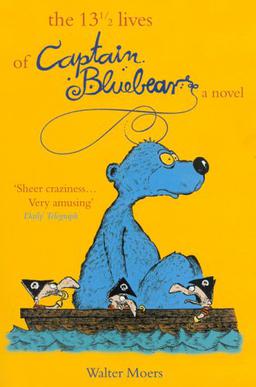
The 13 ½ Lives of Captain Bluebear

by Walter Moers

What I really want to do is spin a yarn worthy of this book. Something about how I found it rattling around inside a mandolin that was given to me by a Chupacabra who had disguised himself as a mariachi in order to hide from his family, who didn’t understand his determination to give up sucking the blood of goats and stick entirely to turnip juice, which he found much less phlegmy.

But that’s not my task. My task here is simply to tell people about this book, and how it was to read it; I have to tell you about Walter Moers’s imagination.

So here it is: this is an amazing book. Simply amazing. The cover says that it is “equal parts Douglas Adams, J.K. Rowling, and Shel Silverstein.” That’s essentially right, though it is honestly not quite as funny and improbably absurd as Douglas Adams’s books (But then, what is?). But it does have the same sort of basically shy, unobtrusive main character swept up in events larger than he, though Bluebear does come into his own more than Arthur Dent ever did, and it does have the same no-holds-barred universe, where literally anything is possible: where a character can transform into a fish in midair to save themselves from a fatal plummet off a cliff; where one can walk into the brain of a giant and have adventures accompanied by a thought; where an entire city can exist inside a tornado, and another can launch itself as a giant spaceship. Most importantly for the Adams connection, this book has an explanatory device that functions like the Hitchhiker’s Guide: Professor Nightingale’s Dictionary, which Bluebear has inside his head, after studying with the Professor himself for a time, and to which he refers whenever he is mystified by his surroundings – which is frequently. Those are some mystifying surroundings.

They are magical, too, which is how like this book is like Rowling’s work; the depth and breadth of the world is much like the magical realm of Harry Potter; and this one, too, exists within – or perhaps parallel to – our own world; I wish I could walk into Zamonia just like I wish I could visit Diagon Alley and Hogwarts.

And what’s more, this book is illustrated by the author, whose style is much like Silverstein’s. As if the wonderful story wasn’t enough, he adds these adorable cartoony drawings, just to bring it that much more to life.

There are a few other books and authors that this novel reminds me of: Alice in Wonderland springs to mind, of course, as does Winnie the Pooh, whose sweet innocence and serenity are echoed in Bluebear (Who is also, of course, a bear: one with blue fur, as the name implies). China Mieville’s UnLunDun is the most recent book I’ve read that has the same magical realm close to our world in it, which also brings me to Neil Gaiman’s Neverwhere, though that book is darker than this one. My own childhood mythology included the Moomintrolls of Tove Jansson (Also European, also translated, also illustrated by the author, as is Bluebear), and in the epic and episodic nature of this adventure, I can see just a little of Don Quixote and my favorite fantasy series, The Lord of the Rings and The Wheel of Time.

It’s got a bit of everything, and so I would recommend it to – well, everyone. Quite highly.

Pretty Rough Going

Roughing It

by Mark Twain

I’m a big fan of Mark Twain’s writing, and usually of his views and perceptions of the world. But this book, I’ll confess, was not one of my favorites.

It was bigoted, for one thing. It’s a younger Twain writing about his own life experiences, essentially in memoir form but with some exaggerations (a few stretchers) and finding humor in some places that were worth a good laugh, and some others that were not. Mormons, for instance. He’s pretty hard on the Church, accusing them of recruiting the most ignorant and degraded people, and then getting them to treat Brigham Young as an absolute monarch. He mocks Joseph Smith for his revelation, and then mocks Young harder for adding the doctrine of polygamy, which Twain claims Smith was always against. And then he tells an extended joke about Brigham Young’s hundred plus wives – so many that the man can’t remember who they are, and refers to them by numbers. Now, I’m not a Mormon; I don’t think much of organized religion, nor of polygamy, nor of men who claim to be prophets who have received the word of God inscribed on golden tablets, delivered directly by angels. But I don’t know that any of it is a good source of humor.

And then he gets going on the Indians.

There were some genuinely funny parts, particularly when he mimics the Western slang, as he did so well with Missouri slang in Huck Finn; and there are some absolutely wonderful descriptions, of the desert, the mountains, and of course rivers; he talks at length about the volcanic craters in Hawaii, which he visits in the last few chapters, and which were great fun to read about. There’s some interesting information, particularly when he describes the process of mining silver, as the book is about Twain and his older brother traveling to the territory of Nevada, where his brother was named Secretary to the Governor of the territory, and young Mark Twain tried to get rich along with everybody else off of the Comstock Lode. (Twain failed, of course – otherwise he may never have become a writer.) He’s quite self-deprecating for most of it, describing so miserably his opportunities to become rich, at least two of which he wasted or lost through his own mistakes, that it made me want to cry – or maybe to dope-slap the poor guy.

But the biggest problem I had with this book?

Actually kinda boring.

So: good if you really love Twain’s writing, especially semi-wacky humor about fools and blackguards in the Old West; good if you are interested in frontier living, and the world of silver mining in Nevada, and then life as an itinerant journalist in San Francisco; otherwise, let this one pass.

Shadows of the Dark Crystal

Shadows of the Dark Crystal

by J.M. Lee


“Ahhhhhh, Gelfling!”

Stretched out in that high-pitched screech (Supplied by the inimitable Frank Oz), that phrase has been with me since my childhood. I loved the Muppets, loved Jim Henson’s creations; The Dark Crystal most especially. It was one of the most magical fantasies I can remember, and elements of it — Aughra’s massive astrolabe, the singing of the Mystics, Fizzgig, the Landstriders, and of course, the Skeksis — have never left me, never left my imagination.

And now I got to live them all over again. In Shadows of the Dark Crystal, by J.M. Lee.

First, for fans of the movie, let me say: the book lives up to it. It has very much the same feel, that magical, soft-edged fantasy world suddenly interrupted and fractured by deeply disturbing and grotesque nightmares; going from the sweet, pastoral life of the Gelfling, to the corruption of the land by the flaw at the heart of the Dark Crystal, which creates and unleashes monsters — the book is very much in line with all of that. It keeps the same essential storyline, as well; nothing in the book veers away from the original world. So if you loved The Dark Crystal, absolutely you should read this book.

For those who are not necessarily fans of the movie, let me say: this is a genuinely good book. It’s a young adult fantasy, with the perfect heroine for the genre: Naia is the daughter of the clan leader of a tribe of Gelfling who live in the Swamp of Sog; she leaves home on a quest to seek out her twin brother, who left home to be a guard at the Castle of the Crystal, and now needs help. She is strong and brave and capable, but she is young, and so she suffers self-doubt and frequent moments where she is not sure what is the right thing to do. But her kindness and her courage carry her through, as far as those things can; what happens then, I’ll leave for the book to reveal. The action in the story is exciting without being overly gruesome or violent; the language and the writing are interesting and well-crafted without going beyond the abilities of a young adult reader; the world is vast and beautiful and wonderfully described.

All that said: the book really does follow in the footsteps of the original movie, and so I would highly recommend watching that, first. If you like what the imagination of Jim Henson and Brian Froud created, you’ll like what J.M. Lee added to it; if the movie is too dark or disturbing for you to enjoy or allow your children to watch, then you’ll probably feel the same way about the book.

If I have any criticism, it’s that I wish the storyline had started farther back: not to spoil anything, but I’d be more interested in reading about how the villains of the movie became that way, how the original problem started, rather than how the situation that exists at the beginning of the movie got to be that way, which is essentially what this book tells. However, there will be a series — the novel isn’t a cliffhanger, but the story doesn’t end with the ending of this book — and perhaps we’ll find out more.

I am, without question, going to keep reading these books. And I’m going to go watch the movie again.

Hey — You Wanna See a Dead Body?

Working Stiff
By Dr. Judy Melinek and T.J. Mitchell

This was an outstanding book. And it was extraordinarily gruesome.

It’s not the first non-fiction book I’ve read about corpses and cadavers and the like; Stiff, by Mary Roach, was another excellent book that explored the different ways that we in the modern world deal with our dead — burial, cremation, preservation, repurposing, and the like. And if you want to include fiction, forget about it: I read a pile of the Kay Scarpetta mystery novels, not to mention all the zombies. And it’s a lot of zombies.

But this book is the first memoir I’ve read by an actual medical examiner (co-authored with her husband, who is a writer), a fully trained pathologist who examines the dead in order to determine how they got that way.

And Dr. Melinek holds nothing back: she describes the procedures (Including how they remove and examine the organs), the tools (Including a butcher knife and a pair of long-handled pruning shears), and the responses: her own as well as those of the victims’ families. It is a detailed, up-close guided tour to the world of the medical examiner.

She talks about gunshot wounds, about stabbings, about poisonings; she talks about drug overdoses; she talks about heart attacks and strokes and TRALI, the incredibly rare syndrome when one receives a blood transfusion with just the wrong sorts of antibodies (Or, as in this case, one has just the wrong antibodies already in the bloodstream when that transfusion happens) and the lungs fill with fluid, causing death within hours. She talks quite a lot about falls and drownings and car accidents.

And she talks about being pregnant, and being a mother; she talks about her career and her marriage; she talks about her attempt to become a surgeon before she settled on pathology. She talks about living in several different cities in pursuit of her goals. She talks, entirely candidly and at length, about her own father’s suicide by hanging at the age of 38, when she was 13.

And yeah: she talks about 9/11. You see, Dr. Melinek began working as a medical examiner in New York City in July of 2001. She was one of the 30 medical examiners that dealt with all of the human remains recovered from the World Trade Center and the subsequent events.

So: if you don’t mind hearing about blood and guts, and perhaps most disturbingly, what happens to the blood and the guts when things go wrong, I think this is definitely a book worth reading. It is honest, it is genuine, it is clear, it is informative. It is really gross. And it is really good.

Malala

I Am Malala
by Malala Yousafzai and Patricia McCormick


I saw Malala on The Daily Show, after hearing about her, of course, when the shooting happened and she became the international cause celebre; I was impressed by her poise and her humility, as well as her courage and her dedication to her cause.

I had no idea.

After reading this book, I am more than impressed: I am amazed. Because she just doesn’t make that much of it. She talks mostly about her family and her homeland and her childhood: about fighting with her brothers, about gossiping with her best friends at school, about how disappointed she was when she didn’t win first place in her class. She talks about how close her relationship is with her parents, and her parents’ different roles in the family: her father, the idealist, pushing for change, trying to do what he thought was right; her mother the steady one, the rock that the family held onto and held itself together. She herself comes of as very much an ordinary girl: when the Taliban began invading her homeland, the Swat River valley in Pakistan, she doesn’t even mention at first when she began giving interviews and talking to community leaders about the importance of education; at one point she just says, “I had already appeared on television a few times talking about these matters.” This when she was eleven.

The shooting itself, she doesn’t remember. Understandable, considering that she got shot in the left temple, and bone splinters stabbed into her brain, and an infection led to emergency surgery that removed part of her skull, which was eventually replaced with a titanium plate. But still: her main concern when she awakes several days later in a hospital in Birmingham, England, is: How is my family going to pay for this?

It’s remarkable, really, how this young woman manages to be so incredibly courageous and dedicated, and yet see herself as nothing special. She’s just doing what she feels she has to do, what she believes God requires of us all: to speak the truth and let falsehoods wither in the face of it.

It’s an interesting story, because it shows the slow progression of the Taliban’s invasion of the Swat valley, how it began with a radio show that called for the rejection of Westernization and “modern” ideas like allowing girls to be educated. Malala’s father had founded a school, which taught both boys and girls from primary through secondary grades; so he, of course, held on to his passion for education and tried to bring attention to the plight of the area as the Taliban grew more and more powerful, first through influence and propaganda, and then through violence and terrorism. Meanwhile, beginning about age eleven, Malala took up her father’s cause, as well, keeping a diary for the BBC that showed the daily life of a Pakistani schoolgirl under the Taliban’s rule, and then giving more and more interviews and speeches fighting for the right to an education for everyone, especially young women. Until, of course, she gained the attention of the Taliban, and they tried to silence her.

Boy, did that not work.

I would highly recommend this book for everyone, but most especially for young people — of course for young women. It’s a lot like Anne Frank’s diary in that Malala really does seem like a regular school girl; she worries about her appearance, she constantly fights and makes up with her best friend; and — oh yeah, incidentally, she fights for her right to learn against violent madmen. She is both relatable and a wonderful role model, and her story should be an inspiration to all of us to focus on what is actually important, in this violent world we are all trying to live in.

Excellent book. Read it, and give it to your daughters, and your sons.

The Spice . . .

Dune
by Frank Herbert

I’ve read this one before, of course (Though I have to say: this edition had a surprising number of simple typos for a “classics of modern literature.” Bette Gesserit? Seriously?). Of course I have: I’m a reader and a fan of fantasy and science fiction; who can be those two things and not read Frank Herbert’s masterpiece?

If you’re those two things and haven’t read Dune, go read it. Right now. Seriously. There are so many remarkable things about the book: the tangled intrigues and deceptions, and the way Herbert manages to keep the protagonists essentially on the up-and-up without making them seem self-righteous or superior is impressive; I’d call it the basis for Martin’s Game of Thrones books, with the Atreides filling in for the Starks, and the Harkonnens the inspiration for the Lannisters. Hell, Dune’s even got dragons, or at least an even larger subterranean version of them, in the sandworms. The book’s a wonderful ecological allegory, similar to the heart of Tolkien’s great tale, which is really about industrialism destroying the pastoral landscape; this book is about the exploitation of natural resources and the people who survive in those exploited places, who are exploited themselves — and it was only at this reading that I saw where Herbert surely got the name for his exploited desert people, the Fremen — who are Freemen if you just add an E. And those Fremen, by the way, are nothing less than the inspiration for Robert Jordan’s Aiel; and they’re just as awesome.

Really, this is a book that must be read. But now that I’ve re-read it, I’m wondering if it’s really a book that needs to be re-read. Because this time through, I noticed a few more flaws. I liked a lot of the same things, liked the overall plot very much, liked the ending quite a lot, loved the descriptions of the desert world and enjoyed a lot of the Wise Soldier characters (Gurney Halleck, Duncan Idaho, Thufir Hawat, Liet-Kynes, Stilgar, even Paul himself), the sort of great fighters who are reluctantly taking up the blade despite wanting something else out of their lives — all just like the first time I read it. But this time, I felt like the writing fell a little short, like it wasn’t quite as good as I remembered. I wonder if that’s because I really did like the ideas so very much that the voice used to describe them made less of an impression on me. And even now, I don’t think it’s bad; when an author’s voice can disappear, and leave only impressions made by the ideas themselves, that’s good work; but it isn’t brilliant work. I would call Tolkien brilliant work. Actually, the distinction is probably clearest in the Wheel of Time series: Robert Jordan was a brilliant writer. Brandon Sanderson was good enough to disappear into the story.

I didn’t like Paul quite as much. I really didn’t like the descriptions of his developing prescience (That’s a little spoiler, but not really.), or the lack of explanation as to where it really came from. Herbert tried to make it seem scientific, like Paul was just the greatest mind the universe had ever seen — but then he has Paul able to predict things he couldn’t possibly predict based on observation and extrapolation, no matter how smart. It irked me, a bit. I agreed with Paul’s wish to prevent the jihad of his visions, but I didn’t really feel like it was clear enough why he wanted to prevent that; I’m not sure, were I in his shoes at his age, I would want to prevent it. I guess the point is that a little too much rested on this idea of, “Well, he’s the messiah!” I didn’t like that as much.

Anyway, I did enjoy reading it, I will be trying to read the next book — the first time through I got as far as the fourth book before I just couldn’t take it any more, but I was told that I should give the whole series another try, so here we are. And yeah: everyone really does have to read this book at least once. The second time I will leave up to your discretion. Just remember: fear is the mind-killer.

Roald Dahl

The Wonderful Story of Henry Sugar and Six More
by Roald Dahl
Roald Dahl is one of my favorites. How could he not be? The BFG, James and the Giant Peach, Charlie and the Chocolate Factory; “Lamb to the Slaughter” is one of my all-time favorite short stories. So of course I grabbed this one when I found it at a local thrift shop. Of course I did.

Sadly, it wasn’t quite as enjoyable as his other books that I’ve read.

Oh, it wasn’t bad. But unlike his other works, it was — well, boring. There wasn’t a whole lot of imagination in there. Three of the stories were non-fiction. One, “The Mildenhall Treasure,” was about a treasure discovered in England by two men plowing a field, which was interesting, except the ending is terribly frustrating. One, “Lucky Break,” was the story of how Dahl got started as an author, which was actually quite interesting but also a little frustrating for me as a long-time unpublished author, because here’s the story: he didn’t even know he wanted to be an author, until one day he was asked to tell the story of his experiences as an RAF pilot during WWII, and he offered to write the story down instead; the man who asked Dahl for the story? C.S. Forester, author of the Horatio Hornblower novels. A million-selling adventure writer at the time. So when he sent Dahl’s story on with his personal recommendation, guess what? Suddenly Dahl had a writing career. That is not to take anything away from Dahl’s ability and imagination, which were both prodigious, but — lucky sod. Anyway. Totally not jealous, I swear. The third non-fiction one, “A Piece of Cake,” was the best: it was the story he wrote for Forester, and it was both interesting and very imaginative, as the last half of it is essentially a long dream sequence, which took place while Dahl recovered in a hospital from an injury.

The other stories, the fictional ones, were also up and down. The Henry Sugar story is indeed wonderful. It’s also a story within a story within a story, which is pretty cool. “The Boy Who Talked With Animals” was absolutely one I wanted to live for myself. “The Hitchhiker” was okay, but it’s a bit long for only one gag; and “The Swan” was completely irritating because nothing happens to the bad guy — just like the Mildenhall Treasure story.

So overall, I still like Roald Dahl, but I didn’t think a whole lot of this book. Find another collection that has Henry Sugar, “The Boy Who Talked With Animals,” and “A Piece of Cake,” and give this one a miss.