Book Review: Darwinia

Darwinia

by Robert Charles Wilson


For the first 100, 150 pages, I really enjoyed this book.

The concept is intriguing: in an alternate history, in 1912, the continent of Europe vanishes and is replaced by a place soon dubbed Darwinia– maybe part of another planet. Wildlands, populated by plant and animal life that bears only a slight resemblance to Earth-life. No humans; no cities. France, Germany, Austria, England, Belgium – all gone. And there are, of course, many interesting repercussions from that, but perhaps most important: no World War.

The main storyline follows an American photographer, Guildford Law, who joins an expedition into the heart of the strange new continent, looking to explore and discover what lies behind the mystery. There are some good and bad parts here, honestly; the main character is a good guy, and the other explorers on the expedition are interesting, both good and bad. The new flora and fauna are very interesting, and the political turmoil that follows on the heels of the magical disappearance of every major power at the time are definitely intriguing. I was annoyed by the photographer’s wife, who struck me as a self-centered pain in the ass, and who has her own storyline, unfortunately. But that wasn’t too bad, really, because it gave me someone to dislike while I was cheering on her husband. The expedition runs into trouble, falling afoul of bandits (who may actually have hidden motivations, and surprising allies.) and harsh conditions. Then they find this abandoned city: completely empty, apparently ancient, certainly not a human artifact. It is something different, built of enormous square blocks of stone, piled together into buildings set into a perfect grid of square angles and straight lines. Cool: a mystery! There is still another story line, with a charlatan who has somehow become possessed with an actual paranormal power: he can channel a powerful spirit, which he calls a god, and maybe he’s right. He works his way into high society, where he begins living a life of debauchery at the urging of his “god.” Meanwhile Guildford Law is trying to survive the harsh winter, trying to keep his sanity despite extremely strange dreams, and his wife is off being a pain in the ass. Everything is going well.

And then Wilson went and screwed the whole thing up. In my opinion.

There’s a twist that comes around this time, between a third of the way and half way through the book. When we find out that none of this is actually true. Not only is the missing continent of Europe explained, but so is the charlatan’s “god,” and Guildford Law’s dreams, and the mysterious abandoned city. And the explanation is crap. It’s obnoxious. Sure, it explains how the European continent could vanish overnight, and what is going on, and it sets up the rest of the book, which is a struggle between Guildford Law and others like him and a terrifying and alien enemy; but it makes the whole book meaningless. It’s as if Law suddenly found out that he’s a character in a science fiction novel by some guy named Robert Charles Wilson. It’s annoying: it feels like the kind of thing that would really amuse a stoned person – though because Wilson is clearly up on his astrophysics, it would have to be a stoned astrophysicist. Unfortunately, I am not a stoned astrophysicist, and so I prefer my novels to be set in real places, with real human characters – even if the places are invented and the characters aren’t entirely human. I can take strangeness; I can’t take the revelation that everything I’m reading is a lie.

The story goes on from there, and there are some good parts; the final battle scene in the abandoned city is great, really. And there’s a wonderful poignant moment, when innocents are killed, and your heart breaks. Good stuff. Wilson’s a good writer.

But I hated this idea. And therefore didn’t really like this book.


Oh — and “Darwinia” is a stupid name.
Book Review: Cloud Atlas

Cloud Atlas
by David Mitchell


Okay, there are two possibilities here.

Possibility one is that I missed the intricate interweavings of the finest filaments of this novel’s plot. I saw some of them: there is a theme of reincarnation and rebirth that is fairly easy to spot, and also a connection based on storytelling. And maybe that’s the whole point: that we live new lives over and over again, and those lives are connected by the stories we tell, the words we write down. That’s a fairly interesting idea, but while I believe in reincarnation of a sort, I don’t believe in straightforward rebirth/transmogrification of the soul from one body to the next, so that connection was lost on me — and without it, the story connection becomes just kinda precious and clever.

Possibility two is that this novel is too precious and clever.

I am inclined, honestly, to believe possibility one. I think I’m a fairly perceptive reader, but — not always; most of my life has been spent reading genre fiction rather than seriously dense literature, which I’ve really only picked up since I’ve been a teacher. The book has a lot of blurbs by pretty impressive people, including A.S. Byatt and Michael Chabon; everyone says this is a magical, unbelievable work of magnificence. So it is entirely possible that I read right past the lyrical wonders of this novel, that this is one of the books which, as I tell my students, can’t be read, but can only be re-read.

But since the first possibility is not the only one, I’m not going to be re-reading this.

So the idea is that the book is a series of nested stories. It starts with an American traveling through the South China Sea in 1850; then it goes to a British composer in Belgium in 1931; then an investigative reporter in California in the 1970’s; then England in 2004; then a near-future Korea, and finally a post-apocalyptic Hawaii. Then it goes back: Korea, England, California, Belgium, South China Seas. Each story is in some way recorded — the first guy wrote a memoir, the second a series of letters to a friend, the third story was novelized, the fourth turned into a movie, the fifth recorded an interview. And each person in the following story encounters the recorded story of the person before; and each of them, it seems, is the reincarnation of the one before. But my trouble with this book is: that’s it. That seems to be the only logical link. I was looking for more; I was hoping that the South China Seas/Korea/Hawaii connection would be meaningful, but I don’t think it was. I was hoping that there would be a causative link, that the revolution hinted at in the Korea story leads to the apocalypse which the Hawaii story is post-. That the composer in Belgium would have something to do with the modern-day England story, in terms of the plot of one connecting to the plot of the other.

And maybe those links were there. But if they were, I missed them.

So it seems to me that the novel is a set of short stories, without a common theme, with dissimilar main characters — because they may each be the reincarnation of each other, but that’s all they have in common — and no real plotline that runs through the whole thing. They are interconnected only the way a book of short stories set in the same town might be interconnected, which is — not really at all. Though of course, with Joyce’s Dubliners (which I’ve never read) and Faulkner’s Abercrombiewhateverthehellit’scalled County novels (which I’ve never read) and Anderson’s Winesburg, Ohio (Which I did read, and liked) all having that sort of connection, I guess that’s enough to make this a tour-de-force that lives up to its blurbs. But for me, it was not terribly exciting.


I probably should have taken the hint when I mentioned to my wife that I was reading this, and she said, “Yeah, it was a movie. We watched it.” Even though I have absolutely no memory of watching this movie. I’m pretty sure I slept through it. I should have slept through the book, too.

On the Eighth Day of Blogging, Just Dusty Blogged for Me . . .

…A book review from Purgatoryyyyy!

A quick word: though I have said a lot about the uselessness of New Year’s resolutions, I’m still going to  make something akin to one. Because I’m not against promises, just against them being attached to January 1, and the promise I’m making has little to do with that, as it isn’t bounded on either end by 2017. But the promise is this: books. This year — and beyond — will be about books. I have a book to finish writing, and two books to publish, and at least 100 books to read, before another year has passed. This book is the first of this year, though I started it last year, and don’t actually care what year it is. Point is: books. Lots and lots of books.

This was a good place to start, if starting is what I’m doing.


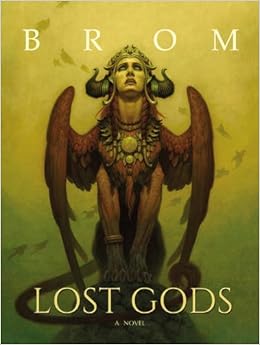
Lost Gods

by Brom

This is the fourth book I’ve read by the illustrator Brom – the other three were The Child Thief, The Devil’s Rose, and the unforgettable Plucker – and I feel about this one much as I felt about the others: Brom has an incredible imagination, a good ability to tell a story, and a thorough obsession with blood and gore and hell. I still think he should stick to the illustrated novels, though, because The Plucker is by far his best work, including this one.

This is a good book. It’s a fantastic cosmology, with Brom following in the footsteps of Jim Butcher and Kevin Hearne and others, finding a way to unify ancient mythologies with the modern monotheistic religions; in this book, set largely in Purgatory/Hades/The Underworld, the idea is that the One Gods (And maybe my favorite word play in this book is that one: the plural “gods” after the number “one”) have taken over from the ancient pagan gods and driven them into the Underworld, where all souls go. There the gods have continued their ways, trying to draw worshipers and maintain their own power and glory, but still losing out to the modern religions and to ambitious and godless men.

Enter our hero, a man with a mission: to save his wife and child. Whatever the cost.

I don’t want to give away more than that – don’t even want to tell you which character is actually the hero, because the first impressions you get, from pretty much every character, are wrong. That was the best part of the novel, for me: the underlying idea that nobody can be taken at face value, neither good nor evil. That was done extremely well in this book, and it kept me guessing all the way. Kept me reading, and enjoying it. There are characters to root for, and ones you hope will be destroyed; many of them end up exactly where you want them to, and it is satisfying. But there are also some that make you change your mind: first you want them to fail, but then you want them to succeed; some of those resolutions were actually the most satisfying.

Other than that, the world-building was great, as I said, and the visuals are brilliant at times: Brom doesn’t always have a great gift for describing things in detail, but the pictures he imagines, and then puts into words, are stunning. It’s why I wish he’d stick with illustrated novels, because when he paints those visuals, then the whole story is elevated to magic. Fortunately, this book has a set of full-color plates, illustrations of the demons and gods in the Underworld, which are beautiful. Combine that with a good fantasy world, a good story, lots of action and violence and blood and gore, and with interesting characters, and this is something worth reading. (And spend the money for the hardback: you want the illustrations full-size. Don’t know what they’ll be like if there’s a paperback. If you find it in a store, check: they’re inset about two-thirds of the way through the novel, in a group. Not necessarily the best part of the book — it is a good story — but they are a necessary part of the book.)


In his acknowledgments at the end, Brom says a wonderful thing while thanking his editor for helping him put this book together. He says,
“When I started writing this novel I never stopped to consider the logistical challenges of my idea. I, like so many creatives, don’t have time for such silliness. I needed to plunge in, chase my muse before she slipped away. I did not realize until later that in order to make my particular vision of purgatory believable, I would need not only to invent an entire history, a system of government, a political/social structure for both souls and gods, tie it into all religions, add some kind of monetary system, define magics and spells and powers, but also to invent a physiology for the dead, figure out if souls eat, drink, and if so, what. Can the dead die? If so, how? And, as with most mysteries, answering one question often leads to ten more.”

He’s never been more right. And he’s done a good job of this with Lost Gods. I recommend it.

On the Third Day of Blogging, Just Dusty Blogged for Me — A Book Review of Maguire,Gregoryyyyy!

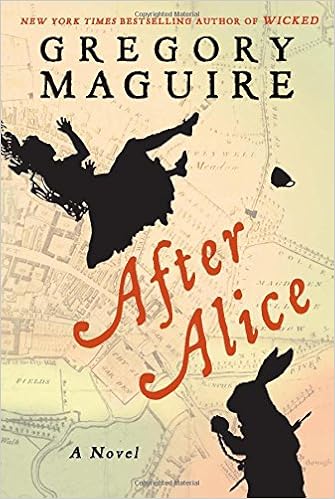
After Alice

by Gregory Maguire


(If you don’t know: Gregory Maguire writes new novels set in classic fantasy worlds — Oz, mostly, but this one is in Lewis Carroll’s Wonderland.)

So the thing with Gregory Maguire seems to be: you have to absolutely love the original.

The man writes an excellent homage. I’ve read Alice in Wonderland and Through the Looking Glass, and the style and feel of this book is remarkably similar. He has the same imaginative twists (though not as many), the same absurdist humor mixed with Victorian understatement, the same satire of upper class manners and fashions, and of everything else that the author can think of. The writer’s voice is an excellent imitation, and I mean that as sincere flattery.

But I don’t love Lewis Carroll. I think the man was brilliant, and what he wrote was a watershed that led to Douglas Adams and Monty Python and Mel Brooks and Christopher Moore, all of whom I love or have loved – honestly, more than Carroll. So while I’m grateful for the existence of an Anglican mathematician with more imagination than either of those descriptors would imply, a whole world of imagination, I’d rather read (or watch) the others than him.

Consequently, I’d rather read them than Gregory Maguire.

I think this book also suffered for being too much outside of Wonderland. I mean, really: that’s the point of Carroll’s books. That’s why they’ve survived and are still beloved enough for Maguire to turn his hand to them. And half of this book by the chapters, and more than half of it by the pages, is set in Oxfordshire in 1861, following around Alice’s and Ada’s families as they search for the missing girls: and though Darwin is present, no time at all is spent with him; all that happens is that his old man’s needs – for help to the privy, to leave early – screw the day up for everyone else. Everyone else is just as annoying: it made me understand completely why Alice would want to follow a white rabbit down a hole, and why the heroine of this book,Alice’s friend Ada, would want to do the same.

If the book was just Ada in Wonderland, maybe finding new places and people rather than just following in Alice’s footsteps, I think I would have liked it more. But the Wonderland stuff was less about imagination and more about following a path, and that made it less interesting than the original. As I said, if I dearly, deeply loved the original, I’d probably like this book just for the sake of going back there again; but I didn’t love the original, and so I didn’t really like this book.

Well done, just not interesting.

Book Review: Too Many Curses

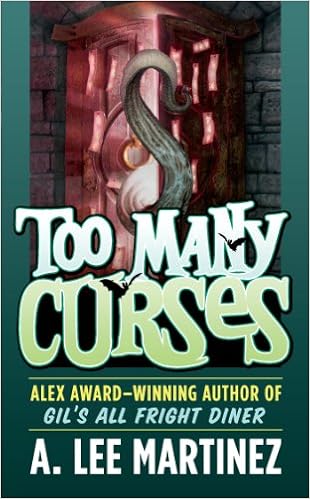
Too Many Curses
by A. Lee Martinez


This book was a surprise for me. I’ve read three or four by Martinez before, and he writes a pretty good wacky/funny fantasy. I expected this one to be the same.

And there are some elements of wacky/funny fantasy in here: it is the story of an evil wizard, one who spends his long life seeking more power for himself, which he then uses mainly to unleash his cruel vengeance on anyone who irritates him. His victims then live in his castle, transformed into mice, into decapitated animated skeletons, into nothing but an echo.Some of the curses are loony and silly and fun, and so are some of the characters living with those curses — a hero turned into a fruit bat, the wizard’s mother transformed into a clinging ivy plant while his brother occupies a small jar, reduced to nothing but a few body parts floating in goo, a banshee that can only materialize to give dire warnings, so she stretches the meaning of the word “dire” in order to materialize as often as possible, whereupon she moans hideously, “Yooooouuu’ll stub your TOOOOOOEEEEEE!” And so on.

But the main character is the very opposite of wacky. She is serious, and she is a genuinely good protagonist — both for the story, and as a person. Nessy the Kobold takes care of the evil wizard’s castle; that is her task, and she does it well. When things go wrong with the wizard, it is up to her to take care of things, simply because there is nobody else who can. Fortunately, Nessy is good at taking care of things, and she does the best she can with her limited abilities.

It’s a good story. There are some nice twists. I was a little disappointed with the revelation of what’s behind The Door That Must Not Be Opened, but the secret of the castle itself, and of Tiama the Scarred, and the final fate of the wizards in the story, was most satisfying. I loved Sir Thedeus (He’s the fruit bat), and the monster under Nessy’s bed who just wants her to read him stories every night. And I really did love Nessy, both as a character and as a protagonist; I agree with the message she presents to the reader, which is basically the same message from Tolkien’s Lord of the Rings: heroes may be small, but it is the small, good things that we do which make all the difference in the world.

Good book. Recommended.

Book Review: The Martian

The Martian

The Martian by Andy Weir

This was a fun book. A hell of a lot of fun. This is fairly unique because it’s quite definitely hard science fiction: set in the near future where we have made more advanced spacecraft, but nothing outside of our abilities, and used them to start a manned exploration program to Mars, this is the story of an astronaut who gets left behind accidentally. There is a storm on the surface of Mars, and he is hit by falling debris when the storm blows over parts of the mission’s base camp; his heart monitor is destroyed and he is thrown far out into the dust storm, so the rest of his crew think he is dead; they look for him, but have to leave in a hurry before the storm destroys their liftoff craft and strands them all on the surface to die.

So this guy, who happens to be the mission’s botanist and mechanical engineer, is not in fact killed, and he wakes up to realize they have left him behind. The book is then his attempts first to survive, and then to contact Earth so they can help him survive, until the next Mars mission lands in three years or so.

I know, I know, most people have seen the movie with Matt Damon; I haven’t, so the book was brand new for me, and therefore very exciting. I am normally not excited by hard science fiction, by talk about machines and rockets and physics and acceleration and mass and interstellar travel and such; but I have also found that most authors of hard science fiction tend to lean on science more than on storytelling or character development. (There are hundreds of sci-fi authors I have not read, so I’m sure there are plenty that do it well. No offense meant.)

Andy Weir doesn’t do that, however. He does have some very hard science: he is himself an astrophysicist who has worked for the space program; there are several characters who focus quite a bit on the math and the physics and the probabilities. But the main character is a joker, who doesn’t take anything too seriously; clearly it is something that is necessary to help him survive the ordeal — just the thought that he has been left behind on an alien planet, where he will have to be alone for years, without enough food or water or the means to save himself, would be enough to break anyone but an eternal optimist, so it makes sense that he is exactly that — and it makes his narration so much more fun to read than most sci-fi characters that I’ve hit upon. And though there are more serious scientist-characters at NASA, and some of them do take themselves too seriously, the book does not; it shows disagreements that lead up to insults sometimes, and several of the characters are described — often by themselves — as being bad with people. It makes them more human, and the science more palatable.

The last factor that made this interesting is the theme: it isn’t about the need for space exploration, or the value of science, or the future of mankind in the universe; all those things come up, but really, the book is about this: what is the value of one human life? If you could save a life, what would you do, what would you spend, what would you give up to do it? That is an interesting question, and this book provides an interesting answer. I hope it’s the same one that all of us would give.

Highly recommended. Dunno if it’s better than the movie, but it’s a damn good book.

The Soul of an Octopus: Book Review

The Soul of an Octopus
by Sy Montgomery
I got this one for my wife, for two reasons: first because we both read and loved Montgomery’s book The Good Good Pig, and second because she loves octopuses. (By the way: Montgomery makes this clear in the first pages, that the correct plural is not “octopi;” the word “octopus” is from the Greek, which doesn’t pluralize -us ending words with -i. That’s a Latin plural. The correct English plural is octopuses. The correct Greek plural, used only by painfully awkward British nerds, is “octopodes.” But we’re not talking about that. Watch this if you want more word-nerdery.) How much does she love octopuses? You tell me.

(Oh yeah — she also likes doll heads. This book isn’t about that, though.)
So I got her the book, she read it, loved it. And I put it on my To Be Read shelf so I could read it, too. And now I have. And here’s what I found out:

I don’t love octopuses.

I don’t know why. I have something of a fear of the ocean, as I am afraid of drowning; I didn’t much like reading about the octopus’s strength, how one could easily pull a human into its tank, how one two-inch sucker could lift and hold 20 pounds or so, and the average octopus has about 1600 suckers. I admit I don’t really like slime, and there is quite a bit of slime involved with octopuses. I don’t much like the idea of being tasted, and the octopus’s entire skin is a sensitive tasting/smelling organ. So there was quite a bit of creepiness in the book for me, which tended to reduce the enchantment of it, an enchantment that is obviously shared by my wife, and by the author, and by the other people who go through this octopus journey with Montgomery, mostly biologists and volunteers at the New England Aquarium, where Montgomery met and made friends with several octopuses over several years.

Now: I do find cephalopods fascinating. I am amazed by their intelligence and by their multifarious abilities — octopuses can camouflage, can change shape and color and texture in less than a second; they have these remarkable arms with remarkable suckers; they can squirt ink; they can squirt water as either a weapon or as a means of locomotion; their bite is venomous. They can squeeze through any space that can fit their beak, the only hard thing in their bodies. Octopuses are badass and incredibly interesting because of it. So in terms of the science aspect of this popular science memoir, it was great; Montgomery writes well, and obviously knows her stuff, and the information was interesting. The parts about the idea of consciousness, and how an octopus may have an intelligence no less than our own, but totally different from our own, were fascinating to me. (I want to write a story now about an ancient octopus civilization at the bottom of the ocean. Except Lovecraft beat me to it. Hey — maybe he’s why I don’t like octopuses.)

But when Montgomery waxes rhapsodic about the softness of an octopus’s head, or the peace and beauty of time spent communing with an octopus while its tentacles wrap around your arms — nope. Gave me the shivers.

If you, like my wife, love the octopuses, then get this book and read and enjoy it. If you find octopuses interesting and they don’t make you feel all squirmy, then go ahead and read it; you’ll learn a lot. (There is also a lot of information about fish, about aquariums, about raising sea cratures, about keeping them in captivity, and about scuba diving. Oh — and about octopus sex.) If eight-legged sucker-wielding boneless deep-sea creatures make your eyes wide and your mouth small, then go read The Good Good Pig.

I Hear You.

Hear Me Now: This is What I've Always Wanted to Say Poetry by [Watson, Lisa]

Hear Me Now: This Is What I’ve Always Wanted to Say Poetry

by L.S. Watson


I’ve always been amazed by poetry. (Well, once I started understanding it, that is.) I have no ability to write it, at all. For me, words come in sentences and paragraphs, not lines and stanzas; and what’s worse, they come in enormous torrents: I never use just one word when twenty or fifty will do the same job.

So when I find a poet, like L.S. Watson, who has a remarkable ability to use one word to say many things, I have to just stop and admire. And in that momentary pause, I hear what she says.

I do wish there were more words in one way: this little book, Hear Me Now, is too short. I enjoyed it and I wanted it to keep going. It hooked me right from the start; the first two poems, “Ashes” and “Dancing with Raindrops,” are on facing pages, and show two opposite sides: “Ashes” is about the ugliest side of humanity, our penchant for mindless destruction; and “Dancing with Raindrops” is about the indescribable beauty of short, sudden moments, like bursts of wonder, that come at us sometimes when we’re not expecting them and we need to pay attention, or we miss them. Putting these two against each other heightens the impact of each, as the beauty of nature makes it sadder that men destroy it – but that just means we have to look even harder for the beauty.

The book is like that: I have read it twice, and I expect to read it more, particularly “To Whom It May Concern,” “A Thought,” “The Fight,” and “America, the Free.” There are also several poems about heartbreak that I could not relate to quite as closely, and three that showed me the impact of loss on the poet, “Freddie,” “Mother and Father” and my favorite of these, “Share a Memory.” But my favorite poem in the book is “Imperfections.” I love the message and I love the last two lines especially.

The ending lines are frequently used to maximum impact. Watson’s poems are fairly short, usually one stanza, though that stanza often fills the page and runs over onto the next; the lines are short, often just one or two words. She uses rhyme frequently – which, if there is anything that I didn’t love about this book, it was that; I am less fond of rhyming couplets than Watson – and the short lines and the rhyme force maximum attention onto the specific words used, particularly at the end of the poem, which sometimes – as in “Share a Memory” – falls like a hammer, like a thunderbolt. Or like a dancing raindrop.

Suffice it to say, this is a good book of poems; short, like the poems, but strong, like the poems. I recommend it.

Book Review: Henrietta Lacks

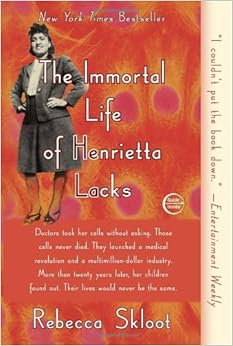
The Immortal Life of Henrietta Lacks

by Rebecca Skloot

I liked this book. I didn’t love it.

Which leaves me a little puzzled as to why this book did quite so well as it did. I mean, it’s popular science, so it makes an otherwise esoteric subject – in this case, the intertwined subjects of cellular research and medical ethics – more accessible to people; that, it does remarkably well. Skloot humanizes Henrietta Lacks, whose tissue was used to start the HeLa line of cells, which have been in constant and widespread use in medical research since the 1950’s when the cells were first collected, without Mrs. Lacks’s informed consent. The book is very good at helping us to understand the woman and her family and the impact that the medical research community had on them.

However, it doesn’t do a terribly good job of explaining the impact the Lacks family – or at least Henrietta – had on medical research. Which feels like a missed opportunity.

It’s an interesting story at the start: Mrs. Lacks had an aggressive form of cervical cancer, and was treated for free at Johns Hopkins Medical Center. The treatment, appropriate at the time, is horrifying to think of now; not much less horrifying is the idea that as part of it, doctors took tissue samples from Mrs. Lacks, one from a healthy spot on her cervix and one sample from the actual tumor, without informing Mrs. Lacks why they would be doing so. The sample from her tumor turned out to be the perfect cellular replicator, and it became a standard research tool over the next several decades; any time anyone needed some cells, they just had to order some HeLa samples from one of the several businesses that eventually made a fairly sizable profit from – well, from farming cells from Mrs. Lacks’s sample. The HeLa cells were used in all kinds of things from polio vaccine research to the Human Genome project; the science and the scientists behind it were the most interesting part of the book, at least for me. The woman herself died from her cancer, leaving behind a husband and five children; none of them had any idea that their mother had been turned into a medical experiment.

But from there, the story sort of goes off the rails. It’s understandable, because Henrietta Lacks died in the 50’s, and so cannot be a part of the current story; Skloot goes to the next best source: the Lacks family. And she tries very hard to humanize them, to allow us to understand how they feel knowing that their mother was used to supply labs with human cellular material for research, for profit, for decades after her death. The problem is that the Lacks family is kind of freaky.

I don’t mean to cast aspersions; anyone coming in to probably any family to get to know us and talk to us would likely have a strange view of the family; especially if the topic is, “So did you know that thousands of scientists have used cells grown fro your mother’s tumor in experiments?” But the Lacks family, while I sympathize with their situation, was hard to relate to. They are strangely religious, for one (At least more religious than me, which on a scale of 1-10 would be “Nuh-uh”), and have some ideas about their mother living on through her cells that I couldn’t relate to. They switch between wanting to get their share of the money made from their mother, since they all live in some level of poverty and ill health, and just wanting their mother recognized for her vital contributions to medical science, to wanting all of the doctors to pay for what they did. It made me jump around from agreeing with them to raising an eyebrow, and so it made them seem strange, to me. Then I felt guilty (still do) about finding the family strange. The biggest factor is that the family is just – kind of strange. They are entirely standoffish half of the time, and the other half of the time, they are breaking down in tears or erupting in anger, or in gales of laughter. Maybe it was just the way it was written, focusing on the most dramatic moments in what was actually a long period of research for this author, but the whole family seemed manic to me.

Then there was one other issue: I read this book because it was featured in the Engage NY curriculum, which the school where I teach has informally adopted as – well, they’re not rules so much as “guidelines.” The curriculum is online, free, and incredibly detailed and extensive. It also annoys me endlessly because it uses almost exclusively excerpts. The students don’t actually read Romeo and Juliet, for instance; they read a few key scenes and speeches, and analyze those bits. The analysis is great, but I’m a literature teacher: which means I want my students to read literature. You know, to the end of the story. One exception to the excerpt rule is – The Immortal Life of Henrietta Lacks. The students read the whole thing in 10th grade as a jumping-off point for a research project. And I saw this (I should note that I may have misunderstood the curriculum map, and this novel is also excerpted; that makes more sense, but I think it said the whole book.) and thought, “Well, if they’re not going to read all of Shakespeare, but they DO read all of Skloot, this must be the best book ever!”

It’s not. It’s pretty good. But it’s no Shakespeare. And in terms of actually teaching this book, there is some cussing and language, and a fairly graphic scene of child molestation, so I wouldn’t recommend it. If it was brilliant, the scenes could be taken out or glossed over; but it’s not brilliant enough to fight over.

All in all, I’d rather read Frankenstein.

Book Review: Japanese Steampunk

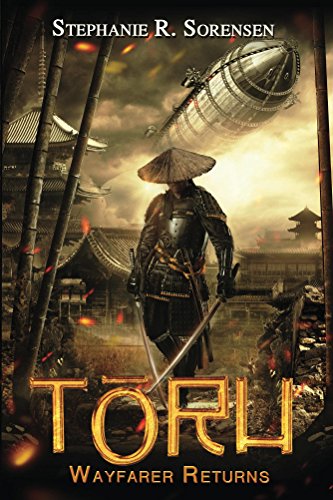
Toru Wayfarer Returns

by Stephanie R. Sorensen


(Full disclosure: I was invited to review this book and given a free copy so I could do so.)

Do you prefer ninjas, or pirates? How about history, or steampunk?

Here’s an idea: why not have both?

Okay, strictly speaking this isn’t a novel about either ninjas or pirates; it’s a story about Japan’s “opening” to the west when Commodore Perry of the U.S. Navy sailed into Edo Harbor in 1853 and threatened and insulted the Japanese into negotiating with him, or else face bombardment from his entire fleet, which he brought back in 1854. Japan was unprepared for this aggression, the country having been isolated and controlled by the Tokugawa Shogunate for the past two and a half centuries: their military was still mostly medieval, and could not fight back against modern warships, steamships, cannons, and rifle-carrying Marines.

But what if? What if Japan had found a way to be ready for that attack? What if the nation, alerted to the threat of the West by the actions of the British in opening and conquering China and India, had modernized and industrialized? What would have changed in world history if Commodore Perry had found the harbor blocked, and armed, the Japanese a growing world power, perhaps even a legitimate threat to the US?

I’ll tell you what: that would be a story worth reading.

And so it is. Stephanie Sorensen has found just what the alternate historian needs: a critical moment when world events went in this direction instead of that, and then thought of a way to make it go that way. The change is in one man (as history’s pivotal moments so often are): Himasaki Toru, a fisherman with something of a mysterious past, who is lost in a storm and rescued – by an American whaling ship. Toru spends two years in America, and while there, he realizes that the US, with its military and economic might, and its brash disregard for the slow grinding of polite diplomacy, could pose a threat to his motherland. A faithful son of Japan, Toru has only one choice: break the Shogun’s law that bans anyone from entering Japan from the West on pain of death, and find a way to convince his nation to adopt Western technology and industry so that when the US comes, Japan would be ready.

It’s an impossible task, made even more so by the fact that Toru is only a peasant, a fisherman; no nobleman, no daimyo, no samurai would ever listen to one such as he, let alone the entire nation. But only the efforts of the entire nation, working in concert, can possibly give Japan the chance to meet the West’s incursions from a position of strength. Toru works with the weapons he has: his intelligence and his passion; the books and machines he purchases in the West and tries to smuggle back into Japan; and a rebel’s greatest weapon: luck. Toru is lucky that the lord whose domain he lands in, Lord Aya, is himself unconventional, made so by his unconditional love for his unconventional only child – his beautiful daughter Masuyo. With luck, and with the help of Lord Aya and Masuyo, maybe Toru can save his country.

I liked this book. I mentioned pirates and ninjas above because this book combines some of the best features of both: Toru is a rebel, though one with a good heart and good intentions; he breaks the rules because he has to, to succeed. Like a pirate. Masuyo does this even more, as she refuses to meekly accept the role of women in her culture; she uses her brains and her courage to help Toru in his task, and takes her place in the forefront of this revolution against the status quo.

As for ninjas – well, the story is set in 19th century Japan. There are ninjas. There are samurai, and swordfights, and honor. And then, because it is steampunk, there are trains, and telegraphs, and Babbage Difference Engines, and dirigibles painted like dragons, powered by steam engines, swooping down out of the sky to awe and terrify allies and enemies alike.

Honestly, Sorensen, who has a background in Japanese and Asian culture and studies, does a better job with the Japanese aspects than the steampunk aspects; the steampunk isn’t bad, but it isn’t really the focus. The focus is on the culture of the Shogun’s Japan, and how change could come to such a rigid and traditional culture, and what would happen when that change did come. As a novel of alternate history, this is a good book. As a steampunk book? It’s okay. The dirigibles are really cool. The writing is generally good, though not spectacular. The industrialization of Japan within the timeline and despite the cultural roadblocks requires some suspension of disbelief, but I thought the political interactions were well done, both within Japan and then between Japan and the US.

But anyone interested in Japan, in samurai, in traditional cultures, or in the clash between tradition and modernity – you should read this book. And the sequels, when they arrive. And anyone who likes a well-written story of one man struggling both for and against society, anyone who is interested in the struggle to break out of a rigid class system and become more than the role created by one’s birth, you should read the book, too.

Oh – and if you like romance, there’s some of that, too.

Overall, I recommend it.