Spring Break Book Review #6

(Had a slowdown there when I had to get some work done for school, and had a family visit. But it’s still Spring Break! And I’m still reading!)

Image result for the golden age kenneth grahame

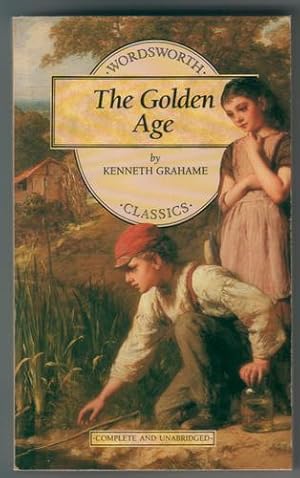
The Golden Age

by Kenneth Grahame

I think I have just read the most British book ever written.

It’s Victorian, of course. Written by the man who wrote The Wind in the Willows. It is about a family of children, three boys and two girls, who are orphaned; but that fact is, in proper British fashion, never really talked about: it is hinted at by saying that they know a long succession of aunts and uncles, none of whom they get along with too terribly well, and never talking about their mother and father. It describes their childhood in the most idyllic fashion imaginable: they scamper and run and play in the green meadows and fertile farms and darkened woods of the English countryside, never seen as anything other than glorious and, yes, golden; and the narrative is almost entirely tongue in cheek, but not in a terrible way: it’s more like a grownup playing along with children, taking their games seriously, believing what they believe, but always knowing and appreciating the innocence of those kids.

It’s nicely done, actually. Made me laugh several times. The kids have great imaginations, and they play games that sound like enormous fun, and made me want to go out and steal a rowboat and row it up a creek, pretending to be Jason and the Argonauts in search of the Golden Fleece. I like how they constantly try to dodge their lessons – provided, in very upper-class-British fashion, by a tutor and a governess; I like how they play King Arthur and fight over who gets to be Lancelot. There is a very sweet moment when they plan to throw a snarky celebration when their much-feared governess departs, but as the day grows closer, they realize they don’t really hate her, but will miss her when she is gone, and their snarky celebration turns into a genuine sadness over the leavetaking. There is a hilarious moment when they play a game at midnight, creeping through their house, and in the process scare off their new replacement tutor, who thinks they are ghosts and goblins. There are many realistic moments when they talk about their relationship with each other, which sibling is the tattle-tale, which one is the most manipulative, which one is the easiest to trick; and also when they talk about their relationships with adults, who often condescend or ignore, or – worst of all – think that everything they say is funny. So annoying, those would-be comedians.

It is a golden age: so golden it’s almost fantasy. Which is interesting, because this book is almost more fantastic, in the sense of being make-believe, than The Wind in the Willows, which has fantastic elements in a much more serious and realistic setting and plotline. This book is very much a depiction of childhood innocence, and it was a lot of fun to visit those halcyon days of yore.

Spring Break Book Review #5 (With bonus rant!): Anthem

Image result for ayn rand anthem book cover

Anthem

by Ayn Rand

This one was interesting for me. Politically, at least, which is probably the only way that Ayn Rand can be interesting to most of us. I read The Fountainhead in high school, on my (overly intellectual) brother’s recommendation; I didn’t think a whole lot of it. That was it for me and Ayn Rand, other than seeing her name and ideas associated with various smug libertarians; I didn’t think a whole lot of them, either. But recently, I’ve been involved in more serious political discussions with a fellow who has opened my eyes in several ways (Though honestly, I don’t think a whole lot of him, any more), and he has recommended Ayn Rand as the philosopher, and her Objectivism as the philosophy, for the future of this country. And so I plan to re-read The Fountainhead, and add in Atlas Shrugged, and see if I want to go forward from there. And while I was cleaning out my classroom bookshelves, I came across a copy of Anthem, which, like Willa Cather’s O! Pioneers, I have seen taught to high school lit classes in the past, though I’ve never taught it or read it myself. But heck, I’m going to be reading Ayn Rand quite a bit, soon; and this one’s short, so let’s give it a try.

Okay, Ms. Rand. I get it. The perfect man, perfect in all ways – tall, strong, handsome, ever so Aryan, dominant and masterful, intelligent, courageous, and perfectly logical and rational – exists purely out of nature, regardless of upbringing or environment. In a dystopian future, a society degraded and debased by the horrors of COLLECTIVISM, there is no hope for the ennoblement of humanity: until a noble man is born. Once born, he cannot be restrained: he will discover his own perfection, he will stand up to the forces of evil and oppression; he will choose his mate – who will, of course, offer herself up in perfect submissive surrender to the perfect man’s perfectness, because who could resist that perfect man? – and then he will forge on into the wilderness and the chaos and conquer all that lays before him. This is his destiny.

That’s the book.

I’m being a tad too critical, however, so let me pull back. Anthem is the story of a future dystopia where everyone lives for the common will of mankind, and individuality in any form is forbidden and savagely squashed. One man is born different, and he struggles against what he is taught: that there is no truth other than what the collective holds to be true; that there is no good other than what the collective holds to be good; that the purpose of his life is to serve his brothers in all things. In his rebellion, he discovers first that there is a better way to live, one found through his own individual efforts, his own individual genius; he discovers an ancient subway tunnel, and in it he performs experiments on the forgotten relics of our own time, buried and intentionally suppressed as not for the benefit of the collective, who do not want life to be easy, as it is the purpose of man’s life to toil in service of his brethren. The individual man re-discovers electricity – because he’s a genius – and tries, in the most noble and altruistic way, to share his discovery with the collective so that life can be improved for his brethren. And he is mocked, and shunned, and driven out for his crime, for discovering things that are not known to all of the collective – and so therefore, they cannot be true.

I see the point here, I do; and it is worth thinking about. Much of our society relies on shared ideals, on shared standards of truth and goodness; we still believe things because “Everybody knows it’s true.” We do think that what is good for all is good for one, and that a person who lives purely for himself is selfish, and therefore sinful and bad and wrong. We don’t believe it to the extent portrayed in this book, but that’s the point of dystopian satire: to take our flaws and magnify them in order to draw attention to them now, before they reach that terrible future point. And living purely for a collective, which destroyed Ayn Rand’s native Russia under Stalin and the communists, can surely become a great evil. I get that. I do. I see where we should keep this in mind when we attack each other for not holding to the orthodox view: the need for liberal orthodoxy leads to the movement against GMOs, which almost certainly hold no harm in and of themselves; and from there it’s a short step to the anti-vaccination movement, which has taken the distrust of Western medicine and pharmaceutical corporations to such an extreme that now it has become a hazard to the health of us all. And we liberals, with our elitist snobbery and disdain for those who are “ignorant,” as we call them – mainly those who hold other views (and not, ironically, we liberals ourselves, even in those areas where we cannot explain our positions but merely cling to them because they are the orthodox dogma, despite our own ignorance) – we are to blame for this sort of thing, to the extent it is really happening. Ray Bradbury makes a similar point in Fahrenheit 451 when he points out that the desire to remove any and all offensive material leads to the destruction of all literature and art and creative thought; another slippery slope that liberals tend to ride down in our worst moments.

And all that’s fine: but this book is not. The warning is somewhat valid, but the solution offered, the belief that one single epic hero-man-god – Harrison Bergeron, if you will – can solve all problems through his own heroic efforts, is disproved by the story itself, no less than is the pure goodness of life for the collective. This dude doesn’t save the world by himself; he re-discovers what other men already knew, using their artifacts. He doesn’t run off into the wilderness by himself; he takes a mate with him, and even though he says the only happiness he has found is what he has discovered by himself, the most happy moment in the book is when he first kisses that woman he rescues – or rather, that woman who rescues herself, as she leaves the collective and tracks him down in the wilderness. And then she submits herself entirely to his will: and while he chooses a manly individual name for himself, he then gives a name to her – and it’s a name that keeps her in a subservient position, valuable only as breeding stock for the continuation of his manly genes, as he becomes Prometheus, the Fire-Bringer, and she is – Gaea. The Mother. Of the sons (not daughters) he plans to raise to be manly men just like him. And he doesn’t forge a new life with the strength of his own arms; he discovers a house built by other men, and books written by other men. And once he has built himself a mighty army of like-minded individualists, what does he plan to do? Go back into the collective society and save those of his brethren he happens to like and wish to help.

So the idea that a single man acting alone is the only source of all good things? Nope. The idea that happiness can only come from individual action, without reliance on other people? Still nope. The idea that every man must live only for himself, that no man should impose his will on another, that violence can only be used in self-defense? Nope: he uses his will to suppress the will of his Gaea, and intends to commit violence against the collective in the name of his fellow men.

In terms of the writing, meh. She had the clever idea to write the story in the first person, but without the singular, because the collective has eliminated the concept of “I,” allowing only “we.” Watching the narrative then twist itself into knots trying to describe single individuals while only calling those individuals by “we” or “they,” that was pretty interesting. Did a better job than the actual plot of showing how vital is the individual human ego. And I believe the individual is vital: but not because Ayn Rand convinced me of it.

I realize this is only a novella, and not one of Rand’s key works; but so far, all I can see is that her philosophy is self-defeating – though certainly attractive, in that if I follow her advice and refuse to allow my individual energy and accomplishment to be taken from me for the good of others, then I get to see myself as one of these perfect epic heroes who understand the truth, that only egotism is right and good. But apart from appealing to the selfish, so far it seems like a whole lot of hooey.

Didn’t like the book, would not recommend.

Spring Break Book Review #4: The Troll Garden

Image result for troll garden signet classic

The Troll Garden

by Willa Cather


I found this one at a garage sale, put on by a former literature professor; he gave me a discount on this and the other two or three books I bought, including a nice paperback of Dracula, which I’ve never read all the way through but will be diving into soon.

I’ve never read Willa Cather, though I’ve always been surrounded by copies of O! Pioneers, a classic usually part of American literature classes, though never my own. I got this because I loved the cover, and because I held out hope that it would actually be about a garden full of trolls — I also got a copy of a Kenneth Grahame book of short stories, and if that man can write about moles and toads and badgers who own halls and motor cars, why couldn’t Willa Cather write about gardens full of trolls?

Because Willa Cather wrote about despair, that’s why.

The title actually comes from a cute little ditty:

“We must not look at Goblin men,

We must not buy their fruits;

Who knows upon what soil they fed

Their hungry thirsty roots?”

And the book is related: it is about people’s secret desires, often dark, and generally leading to bad places. These stories are about unrequited love; about poverty and working-class life and how such a daily grind wears away every noble impulse in a person; about how people want what they cannot have, and don’t recognize what they do have, and don’t want it when they do have it. It’s a book about hunger and thirst, and the darkness we turn to in order to feed that hunger and thirst, and what that darkness does to us.

The first story, Flavia and Her Artists, is about a woman who desperately wants to be chic, to run a top-shelf salon, packed with intellectuals and artists and the finest of people. But she doesn’t know how to pick the best types, and ends up with less enchanting guests, who all laugh at her behind their hands, because she herself is superficial and dim-witted, blinded to reality by her dreams of being the ultimate hostess. The story is only saved by her husband: who loves her despite knowing how pathetic she is, and who tries to do his best to protect her and make her happy, even though none of the angsty sophisticates can understand what he sees in someone so gauche.

The second story, The Sculptor’s Funeral, was my favorite: in it a great artist dies and has his body returned to the little crap town in farm country where he was born. The people there are absurd and grotesque, and the men who gather for his wake spend the evening deriding the artist as a weirdo who was clearly a failure because he didn’t stay in town and make money, as his father did, as they all did. But again, the love of one good man redeems the story: a lawyer who was a good friend, a real friend, and who understood the deceased sculptor, reams them all for their vileness. It’s a great speech, one I’d like to say myself to a few people I know.

Then we get to the Unrequited Love section: The Garden Lodge, about a woman who grew up poor, who held herself to a rigid and unbending regimen in order to get out of poverty, who married well and securely, and then — falls in love with an opera singer who stays at her home. She clings desperately to this one bit of irrational passion, but by the end, she returns to her sensible self, and has the garden lodge where she spent time with her singer torn down. A Death in the Desert is a double dose: a woman dying of tuberculosis is pining for the great composer who was her mentor; she lives vicariously through the man’s brother, who looks just like the great composer; and he keeps her company as she dies despite being in love with her himself. She dies without anyone ever being happy.

The Marriage of Phaedra is about an artist’s legacy being spoiled by his widow; A Wagner Matinee is about a woman who gave up both music and joy when she married a homesteader and then spent her life raising their children and caring for his house out on the frontier; and the last, Paul’s Case, is about a young man who dreams of a life of beauty and sophistication, but can’t find his way to it out of his lower-middle-class upbringing, other than through fantasy, which eventually destroys him.

I see glimmers of goodness in every story — Flavia’s good husband; the sculptor’s good friend; the essential goodness of the woman in The Garden Lodge and the almost inhuman humanity of the brother in A Death in the Desert, squashing his own heart, his own identity, in order to stand in for the fantasy of the woman he loves; and so on. The people longing for what they don’t have are not bad, are not at fault for their own desperation and sorrow; I see Cather’s villain as the society that pigeonholes us while showing us a dream we can’t have, telling us we can. Maybe we’re fools for believing it, but there are people who profit from our hopeless fantasizing, and then from our bereavement; they are the bad guys here, not the people who want more. Paul’s Case is not his fault. Not that that makes it better. Poor guy.

It is beautifully written. It is deeply depressing. I can’t tell if it says good things about my appreciation for fine literature that I was able to enjoy the book, or if it says bad things about my increased ability to relate to the desperation and sorrow of the characters. I want to say the first. I’m certainly going to read something more cheerful now — though more fool me, the very next thing I read after this was not cheerful at all. But at least the writing sucked. Hey, stay tuned for that review!


Spring Break Book Review #3: George Takei’s Science Fiction Ninjas.

Yeah, you read that right.

Image result


Mirror Friend, Mirror Foe

by Robert Asprin and George Takei


Of course I bought it for the authors’ sake. Of course I did. I don’t even think I read the back, and I certainly didn’t pay attention to the cheesy picture on the front (Which is too bad, because that picture is actually quite important.). But I’ve read most of Robert Asprin’s books – all the Phule’s Company books and the Myth, Inc. books – and I admire the hell out of George Takei as a humorist and activist, and not incidentally as a star of The Mighty Trek. So of course I bought the book.

Took me a while to read it, though. Because while “starstruck” may be a reason to buy a used book, it’s not really a good reason to think you will enjoy the book.

Here’s the good news: I actually enjoyed the book. Quite a lot, in fact. It is a near-future sci-fi, (Though the setting’s date, in the 23rd Century, bespeaks the same optimism that gave us the Jetsons and Buck Rogers: now I think that the next two centuries will bring us closer to The Walking Dead or The Postman [Read the book by David Brin. Screw Kevin Costner.] or Cormac McCarthy’s The Road. Maybe, if we’re really lucky, The Running Man.) and tells the story of a professional duelist who takes a job supposedly as a fencing instructor, but actually as an industrial spy and saboteur. The cool thing? He’s a ninja.

That’s right: this is the first real ninja story I’ve enjoyed. I mean, ever. And it is a sci-fi novel from George Takei. Seriously, is there anything that man can’t do?

So the story is of a ninja who goes into a robotics company seeking a way to halt their production, so he can earn a gigantic fee from their primary rival; he ends up fighting to save the world from the robot apocalypse. Everything that had to do with the characters, particularly the ninja protagonist Hosato, who grew up on the colony planet Musashi, and is part of a centuries-old clan of ninja assassins, is excellent; Hosato is not only interesting, he is well-rounded and nicely written. The other characters aren’t as fully realized, because the book is actually quite short, but they are all worth rooting for – and amusingly, Takei has no problem red-shirting several of the more minor characters, who quite frankly drop like flies.

It’s not all good: the robot apocalypse is lame-ish. They relied on Asimov’s Laws of Robotics, which they reference by name; but they never talk about why those laws exist or why they are important—they never even list them out, honestly, which is a little annoying: I can accept you taking a major plot point from another author — after all, Takei and Asprin didn’t invent ninjas – but at least explain the damn plot point. The apocalypse comes too suddenly and without enough explanation, and the explanation when it comes is lame. On the plus side, the way they fight the robot apocalypse is excellent, along with the twists at the end; and the final fight, and the point it makes – the fight in the picture, and the point in the title: that our creations are mirrors of their creators, namely us – are both splendid.

Definitely recommend if you just want a quick sci-fi read. Highly recommend if the idea of reading a book by these two men appeals to you as it did to me, because they don’t let you down.

Spring Break Book Review #2: Robert Louis Stevenson

Image result for The Body-Snatcher and other tales

The Body-Snatcher and Other Tales

by Robert Louis Stevenson

Only three stories in this one, but they were remarkable: the first two, The Body-Snatcher and The Merry Men, are both ghost stories, of a sort; certainly atmospheric and creepy, and with extremely dark endings. The third, The Bottle-Imp, isn’t as dark overall, as there is romance to leaven the creepiness — but since it’s about hell and damnation, it ain’t exactly The Poky Little Puppy.

The Body-Snatcher is about two men who purchase cadavers for use in medical school; Stevenson connects his characters directly to Edmund Burke, the famous murderer (whose method actually became eponymous, and which I found out about it when one of my Honors students brought this to the class: to burke [burked; burking] is to murder someone by sitting on their chest so that they cannot breathe, thereby creating an appearance of a non-violent death and making it easier to sell the cadaver) who sold his victims’ bodies for dissection. And I can’t help but wonder how someone could think that was a reasonable way to come into money. I mean, “reasonable” is of course relative; we’re talking about murderers, here. But how much did they make off the medical schools? This isn’t the mafia selling contracts on their enemies and paying accordingly; colleges and universities can barely pay their staff. How much was a body worth, $50 in the equivalent amounts for the time? $100? I can’t believe people murder for that little. Now, if you have another reason to murder – if you’re a knee breaker for a bookie, say, and someone owes too much and you cancel their account; I can see bringing the corpse to the medical school as a way of disposing of the body you’ve already got, and hey, $50 for your trouble? Good deal. That makes more sense to me.

It makes more sense to the men in the story, too. Stevenson explores all of the alternatives: they buy bodies from murderers; they go out and rob graves themselves; they become complicit in covering up a murder when one of the two main characters recognizes the new corpse produced and turned in by the Burke-character; and then, finally, one of them commits a murder and sells the body for dissection in order to cover it up. Ah, for the halcyon days when nobody needed a death certificate!

Stevenson turns the story rather suddenly at the end, though – a trick which he repeats in The Merry Men, and to some extent in the last story, The Bottle-Imp. The two corpse-buyers go out on an acquisition mission and suddenly find themselves in a ghost story: but only in the very last sentence of the story. That’s it: it ends with the unexpected appearance of the specter. It’s interesting; I don’t see a lot of stories that have a climax in the last sentence: and in this book there are almost three of them.

But the best thing about The Body-Snatcher? The alternate job title for grave-robbers who provide dissection cadavers: Resurrection Men. I cannot imagine why he didn’t use that for the title. If I ever write about grave robbers, you bet your sweet bippy I’ll call it that.

The second story is even more atmospheric than the first; the melancholy mood is not created by the actions of the characters, but by the environment. Stevenson, impressively, loses nothing in the change: he is as good at making the coast of Scotland creepy as he is at showing how creepy body-snatchers are. The Merry Men are not men, they are actually waves that crest and crash near the farm that is the setting for the story; Stevenson describes how the waves, which appear on stormy nights and pose a serious and deadly danger to any ship caught amongst them, seem to be laughing and shouting as they smash into each other and pummel the rocky shore. That is just chilling, and it and the rest of the shoreline and the surrrounding area are beautifully described in the story. The story concerns a series of shipwrecks along this shore: one back when the Spanish Armada tried to invade England and was scattered by a storm; one a few months before the story takes place; and the last during the story. In the process, the owner of the farm close by Shipwreck Central loses his mind entirely, despite the best efforts of his daughter and nephew, the other main characters. I loved the descriptions of this, pretty much every one of them, but especially when the narrator goes diving for the Spanish shipwreck and explores the bottom of the lagoon; and also the final sequences of storm and madness. The action and tension are good, too, though I had one problem with the downward spiral of the farmer’s mental state: he commits a murder seemingly without reason or provocation, which is not too far out there – except that it happens at the beginning of his losing his mind, not at the end. It doesn’t happen in the story, and we never hear the farmer’s side, which is too bad; I wanted to know why. Otherwise, I loved this one, even the sudden and ghastly ending sentence, even bleaker than the first story’s final words.

The third story, though: that one was tougher. I loved the concept and the setting: it actually happens in Hawaii, where Stevenson (I didn’t know this) spent the last years of his life, and the story concerns a young man who receives a magic bottle. In the bottle is an imp, an imp that will grant any wish to the bottle’s owner. The catch, however, is that if the bottle’s owner dies while the bottle is in his possession, he will spend eternity in Hell. So of course, the thing to do is get the bottle, make your wishes, and then get rid of it before you die. But here’s the second catch: the bottle must be bought, and it must be sold at a loss. So if I bought it for $100, I’d have to sell it for no more than $99. Or presumably, $99.99.

It’s a great concept for a story. Logically, though, it’s got a lot of flaws. Like, why wouldn’t you sell it for one penny less than you bought it? There’s a comment in there that the bottle has to be sold for actual coined money, I guess so I couldn’t get someone to give me a check for $99.99999999999999999 dollars; but why? Who made up that stupid rule? The bottle was first sold for millions, they tell us — because apparently inflation isn’t a thing in this world, so thousands of years ago they were selling bottle for millions of modern dollars. Sure, okay. And in the process of changing hands over the centuries, the price has gotten down to $90. But why? The guy who has it at $90 says he can’t sell it for $89, because that’s a weird price and it makes the buyers squidgy (My word, not his); but he tells the main character the whole story when he sells it to him for $50. So why not $89? The whole thing seems designed to catch only one person: whoever buys it for one cent, because they can’t sell it for less than that. (But why not? How about trading the bottle for a rock? Why does it have to be coined money? Because otherwise the story doesn’t work, that’s why.) It all just takes a lot of suspended disbelief. Of course, we are talking about imps and wishes and Hell, so…

Getting past those issues, I liked the story. The young man gets the bottle, wishes for a beautiful house and then gets it; then he gets rid of the bottle – and then he falls in love. And then he finds that he has leprosy. And so he has to get the bottle back – paying less for it than he sold it for, of course. The story goes downhill from there. It was romantic and sweet, and I would have done what these two people do. And this one also had a surprise ending: which I won’t ruin.

Surprisingly, this review has gone on almost longer than the book, which is well under 100 pages. But they were good stories, and that inspires me. I would recommend pretty much anything by Robert Louis Stevenson, including this book.

Spring Break Book Review #1: Angels and Ages

(So here’s the deal: it’s my Spring Break, and I plan to spend it reading. I will be posting as many reviews as I can. Here’s the first, for the book I finished reading Saturday, March 18 — first day of Spring Break.)

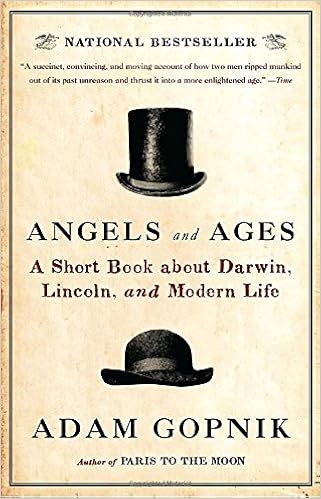
Angels and Ages: A Short Book about Darwin, Lincoln, and Modern Life

by Adam Gopnik

This was an interesting one: one of those “slow burn” sort of books. I came across it at my local used bookstore (Bookman’s in Tucson – Woo! Bookman’s!) in the discount rack, marked down to $1. I had just a day or two before read an article by Mr. Gopnik (Who is a 30-year veteran at the New Yorker) online, and so I recognized the name; even though I have been trying not to buy new books until I clear off my To Be Read shelf –or, rather, shelves – I couldn’t resist the subject matter. So I bought it, and even though I haven’t been able to find time or energy very well of late, what with school-before-Spring-Break, I decided to give it a read.

Odd phrase, that. Am I being generous with my time, granting Mr. Gopnik, and Mr. Darwin and Mr. Lincoln, a few of my hours, growing ever more precious as I age? I am acting as an audience, without which they would be forgotten (Well, at least a little bit. But then, the whole point of the Darwin half of this book is that those little bits, little bits of time and little bits of life, are all there are.). But then again, they are giving me something even better: they are inspiring me.

Mr. Lincoln, who comes off a little bit worse than his iconic status (and rightfully so) nonetheless inspires me to believe in the power of a single man to change things; particularly in the last summative chapter, this book points out how incredibly influential Lincoln was with this analogy: imagine if Boris Yeltsin had been able to maintain the Russian empire, and also install a functioning democracy obeying the rule of law. That is Lincoln’s accomplishment, and though the Civil War likely would have happened without him, and the subsequent events of Reconstruction, Jim Crow, and eventual ongoing equality, the country wouldn’t have been the same. He also inspires me because he was a freethinker, an atheist, an introvert, and a deeply literate man.

Mr. Darwin, who comes off a bit better than most depictions and associations of him (and rightfully so) inspires me with his ability to be focused on both the infinite and the infinitesimal. Gopnik shows how Darwin had extraordinary powers of concentration and observation, and these, along with a constant need to ask, “Why is this so? How did this get to be this way?” are what led him to his great world-changing theory – which he knew was world-changing, also knew was absolutely correct (as far as science can ever be absolute or correct), and sought, and found, the best way to pour this thought into the collective consciousness of the world. It is remarkable, Gopnik shows, that a theory that in most people’s hands would have been a mere footnote in biology and likely would have taken generations if not centuries to percolate up through the strata until it hit the top – like, as Gopnik says, Gregor Mendel’s work on genetics – was able to completely shift the world’s conversation from a Young Earth creationism to the truth in a single generation. I also love that Mr. Darwin was so deeply in love with his wife that he delayed publication of his work because it would upset her, and also that his own atheism was softened by the same knowledge: that his devout wife would be upset by too-vigorous protestations of what he knew to be true. Though I don’t have to make the same compromise, I appreciate that he did it for her.

I am inspired, last but not least, by Mr. Gopnik. This is a complicated book; too complicated, in some ways, because the ideas and the writing are dense, and for me, the subject matter a touch too abstract to hold me down while I work my way through it. It’s written like an essay – unsurprisingly, it started as two essays in the New Yorker, one on each great man (United in this book first by the coincidence of a shared birthday – February 12, 1809 – and second by their impact on the world) – and it’s tough to follow, because Gopnik intentionally didn’t write it as a historical/biographical book. Since I haven’t ever read a good biography of either man, some of this book was lost on me. But I appreciate the enormous effort and scholarship that went into all the thought in this book, and the basic thesis that the two men are equally important to the creation of the modern world, Lincoln in the proof of the ability of liberal democracy and the rule of law to survive, Darwin in the revolution he led that changed essentially everything in the world about how we live with science. I appreciate the effort it shows in the density and complexity and beauty of the language Gopnik uses. I appreciate that he shows how Darwin and Lincoln are Darwin and Lincoln – and not, say, Alfred Russel Wallace and Stephen Douglas – because of how extraordinarily good both men were as writers. Both masters of rhetoric. Both able to accomplish what they did because of how Lincoln spoke, and how Darwin wrote, and how both of them argued.

I like this argument. I like how it’s written. I would like to be able to do the same thing as any or all three of these, at least as a writer.

Thank you, gentlemen. I appreciate your time.

Double Book Review: Bryson and Bryson

A Walk in the Woods

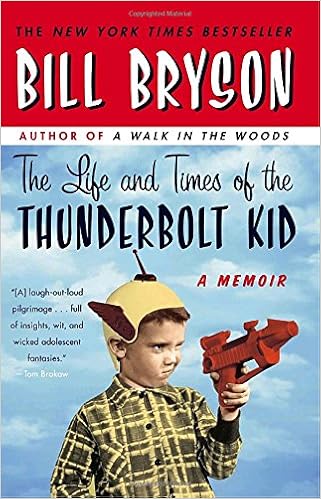
The Life and Times of the Thunderbolt Kid

by Bill Bryson


Bill Bryson and I have nothing in common.

Mr. Bryson has four children; I have three, but they have fur and feathers and shells. He moved to England after only a year in college, and spent the next twenty years or so in Europe; I haven’t been out of the United States since I was 13, and that was only for a week. He grew up in the 1950’s, when America was ostensibly at its peak; I grew up in the 70’s when America had disco. He grew up in, and has a deep nostalgic love for, the Midwest; I’m strictly coastal, and have never even driven through Iowa, where Bryson spent his entire childhood, in the same house in Des Moines. We are both the youngest, he of three and me of two, and we come from literary traditions: his parents were both journalists, his father one of the best sportswriters (Bryson the Younger tells us, but he has a valid argument) in the history of baseball; though neither of my parents are terribly literary, my grandmother and great-grandmother were both authors, teachers, and librarians. But of course, Bryson is an award-winning and best-selling author, and I just cracked 60 followers on my blog. (I thank and adore every one of you, don’t think I don’t.)

And perhaps most importantly, Bryson is a man who would, one, walk the Appalachian Trail, or at least a lengthy segment of it, and two, write a memoir about his American Heartland youth; and I am a man who would – read about both of those things.

Bryson’s writing is beautiful. This is why I keep reading his books, despite having no real common ground with him; this was never truer than with The Life and Times of the Thunderbolt Kid, when Bryson waxes poetic for nearly 300 pages about an America I know nothing about. I mean, he was the archetype: he loved baseball, did crappy in school, and had a freaking paper route, for the love of Clark Kent. Me? I played D&D and Nintendo. Hated sports. Straight A’s until I got to high school, when my grades slipped – to mostly B’s. (I did get a few D’s and F’s, and another thing Bryson and I had in common was a whole lot of truancy in high school.) He writes wonderfully about how simple and perfect was that world, a world I didn’t know and therefore don’t long for. And honestly, even Bryson’s excellent writing didn’t make me long for it. Even though the freedom of unsupervised playtime and the Golden Age of comic books do call to me, as do the unique character of a city made up entirely of local businesses, run by local people, catering to the specific needs and wants of their neighbors, whom they know personally: the department stores, the grocery stores, the restaurants, they all sound lovely indeed. But I don’t want ’em.

The same for the Appalachian Trail, the focus of A Walk in the Woods. I had two friends who walked the whole thing one college summer, and I have always envied them their experience; no more, man. No chance. I wouldn’t even do the abbreviated hike that Bryson writes about. He talks about the exhaustion, the misery, the crappy food, the monotony of the scenery, the irritating other hikers – even a little about the murders that were committed near where he was hiking while he was there, when two female hikers were killed on the trail. Never solved, at least not by the time Bryson wrote the book. It all adds up to a great big No Thanks: even with Bryson’s excellent descriptions of the glorious vistas, the fascinating (Seriously) history of the trail and the regions it meanders through, the sense of accomplishment so palpable you can feel it coming off the page.

Actually, I thought that was the best thing about both of these books: while Bryson does talk sincerely and at length about the good things about these two experiences, he doesn’t shy away from the negative side. His mother was a crappy cook, and that experience is made much worse by the total lack of culinary adventurousness of the era. His parents didn’t worry about anything, giving him great privacy and freedom – but they also painted everything with lead, asbestos, and radiation; Bryson lived through the end of the polio era, and in a time when people, who grew up in the Depression, were frequently missing limbs. In A Walk in the Woods, as I said, he goes through every painful, plodding step, making them even more vivid through the inclusion of his out-of-shape former-alcoholic friend Katz, who walks the trail with Bryson, but slower and with even more suffering. And that’s a lot of suffering.

You hear all about the bad parts, which really does serve to make the good parts seem more genuine and more warmly appreciated. It’s easy to understand how much Bryson loved his family’s unexpected road trip to a still-new Disneyland when he also talks about the usual family vacation to visit family that nobody wants to see, not even the family themselves. It’s easy to see how happy Bryson was to go home when he finished his Appalachian Trail hike when he takes you through every terrible day before that; it’s easy to see the beautiful woods he walks through when he talks about the rain and the mud and the cold.

So even though we’re nothing alike, and Bryson writes personal non-fiction, which should make it hard for me to relate to and understand his work, I am going to keep reading it: because Bryson is a hell of a writer, and he makes me like his books even if I doubt I would like him very much. Nothing personal, Bill. But thank you for everything personal you have shared with me. You keep writing it, and I’ll keep reading it.

Book Review: How to Ruin Everything

How to Ruin Everything

by George Watsky


Well, I hate to say this, because I liked this book, but it’s a lie. Watsky completely deceived me.

This didn’t show me how to ruin everything.

It did show me that George Watsky is a remarkable essayist. He is a humorist in pieces like Tusk, about smuggling a narwhal’s tusk into the U.S. from Canada (I don’t know why we’re building a wall along the Mexican border when there are over 5,000 miles of Canadian border that someone can just walk right through carrying a narwhal tusk! Sad!), and the excellent Good Hook, in which he compares a fly-fishing trip to watching a middle-aged man try to join the Mile-High club with a pneumatically pulchritudinous seatmate who is not his wife. Watsky is profoundly personal, almost uncomfortably so, when he writes about his experiences with a seizure disorder in What Year Is It? and about his father’s connection to the San Francisco Giants in Crying & Baseball. And then, in essays like Three Stories, about the run-down house where he lived with oft-appalling roommates during college, and with Concert Tickets, about tripping on mushrooms, Watsky is me.

Except he’s a better writer.

Honestly, I don’t know how to feel about this book. It’s not perfect: there were some essays I really didn’t see the point of; which may have been the point, of course, but that still left me shrugging my shoulders and souring my mouth, thinking, “Well, what now?” When the same book has these great insights and fascinating stories, why exactly am I reading about Pauly Shore? But then, Watsky is not me: my ideas of what an essay should look like or be about are not his. But the writing is so very good, and the essays that did work for me worked so astonishingly well, that the ones that didn’t work for me generally had me questioning, not what was wrong with the essay or the author, but what was wrong with me. But I’m almost certainly overthinking it.

I guess that’s how to ruin everything.

It’s a fun book, with some ice-water revelations and eye-melting poignant moments, and really splendid writing, detailed and smooth and casually lyrical. I’m going to add Watsky to my list of essayists whose work I will always check for when I hit the bookstores. Since my list includes two men who are no longer in this world (David Rakoff and David Foster Wallace), I’m happy to get a new guy into the rotation.

Batter up!

Book Review: The Last Werewolf

The Last Werewolf

by Glen Duncan


This is the third Glen Duncan book I’ve read, and probably the one I’ve liked the most. I enjoyed I, Lucifer, and I thought Death of an Ordinary Man was just too damn depressing; but I thought the concept of this one suited Duncan perfectly. In every case, I’ve been struck by the poetry of the man’s writing, and this one was no exception; but Duncan seems to be best with switching between sacred and profane, going from lyrical descriptions and philosophic ponderings to filth and dirt and blood-sex-death. And what could be better for that than a book about werewolves?

I admit I was a bit less enamored of the basic plot of this book, at least in the beginning. The idea (no spoilers – at least no big ones) is that the hero, Jake Marlowe, is the last living werewolf. It has been more than a century since a person was turned by being bitten; the theory is that a virus of some kind has arisen that makes the transformation impossible. Jake is still alive because once turned, werewolves can survive for centuries; unless they are killed by fire or silver.

Unfortunately for Jake, there is a group of humans who have been hunting down werewolves. With fire and silver. That’s why he is now the last: this group has killed every other surviving werewolf. And now they’re coming for him.

But they want to make it interesting. For the lead Hunter, Jake’s death is personal, and he wants to take him out, mano a – I guess lupo? But there’s a snag with this plan: Jake is ready to die.

That’s the part that makes this book depressing; which also seems to be a Glen Duncan specialty, because both of the others I read were equally dark and melancholy, Death of an Ordinary Man even more so. This one spends a fair amount of time going through Jake’s malaise and the reasons for it. I will say that I understand why he feels that way, which made it a little easier to take. There’s something else, though: even when he’s in the depths of it (I’ll spoil the book this much: this blue funk of Jake’s does not last. I won’t spoil it by telling you why it ends.), it feels insincere. It’s like he’s trying to force himself to believe there is no point in going on; wracked by guilt, Jake feels as though there shouldn’t be any hope for him, and so he convinces himself there’s not.

But that doesn’t work for the Hunters. And so they try to force Jake to rise to the occasion, to give them some kind of grand final fight. And that’s the story of the book: the Hunters trying to provoke Jake, and Jake responding to their provocation. And throughout, Duncan does a masterful job of blending the two sides of Jake’s personality, and matching them with his prose: there is the man who has been alive for 200 years, who has learned everything there is to know (at least everything he wants to know) and who understands far too much about the apparent futility of existence; and then there’s the Wolf, who wants to run, and hunt, and mate, and kill; kind of all at the same time.

So the book has a lot of sex (a LOT of sex), and a lot of violence and blood and death; pretty gruesome stuff, too – the violence, not the sex. Lots of foul language, too. The sex is largely unloving, mostly lusty and sometimes dirty; but it suits the character and the feel of the book. There’s good action, along with that, though much of it is brought a little low by Jake’s indifference to his own life: he doesn’t really fight very hard for a lot of it, and that makes the action, well, anticlimactic. Honestly, I didn’t much like the Hunter organization; I suppose it’s possible that such a thing could exist, in a supernatural world, and even be fairly effective – but they’re the biggest kids on the block, and in a world that has werewolves and vampires, I have some trouble accepting that. Seems like the superpowered immortal things would be able to do some real harm to a human organization. But any road, the story takes a great turn, and the second half of the book is far more interesting – and the first half is pretty damn interesting. Jake is a good character, and Duncan is a hell of a writer, even when he’s being depressing and angsty.

The ending is sad. Again, maybe a Duncan standard: the three books I’ve read all end sadly. But this one is largely redeemed by the circumstances of that sad ending, which may be why I liked this one best. It was very good. I recommend it.


And holy crap: I just found out that this is actually the first book in a trilogy. Okay, now that makes the ending even less sad, because it isn’t actually the ending! Now I have to go read the others!

Book Review: Jack London and Captain! David! Grief!

On the back is a closeup of that grimacing face.


The Adventures of Captain David Grief

by Jack London


I saw this one, by Jack London, with that unbelievable cover, and I just had to buy it.

Took me a while to get around to reading it, though. Because I don’t know how I actually feel about a character named Captain Grief. I mean, really? Captain Grief? Now, if he was a pirate, that would make sense; but he’s not. He’s a capitalist. A man’s man, taming the South China Sea with grit and pluck and stick-to-it-iveness, and sheer manneosity. Is that a word? Should be. Because with Captain David Grief, the manneosity never ends.

But I did finally read it, and it was totally worth the wait, and the $3.95 I paid for it. Because, for one thing, Jack London really was a hell of a writer. I like the way he characterizes, and the descriptions of the South China Sea are detailed and interesting. He does action very well, particularly suspense and the kind of moment where you suddenly plunge into a much more serious danger than you thought was going to happen, like wading into the ocean and suddenly hitting a dropoff and you’re over your head and sinking. It’s a short book, and it was fun to read.

It ain’t all wine and roses, though. It’s thoroughly racist, for one thing. David Grief – bearer of the White Man’s Burden – is a millionaire entrepreneur who “tames” the “wild” islands of the South China Sea, Indonesia and Polynesia and Melanesia and Micronesia (Can’t believe there’s not a Griefanesia – but there will be soon, by God!) and forces them to turn a profit. He befriends the natives – described by color, dress, and essential level of savagery in comparison to the Mighty Grief – and convinces them, through a mixture of trade, bribery, and violence, to allow him to build plantations on their islands, which he then works for MIGHTY, MANLY PROFITS. Inasmuch as money is interesting, this aspect of the book is; I admit I dreamed of being a man tearing a living from the jungle through the strength of my arms and the quickness of my wit. And being rich sounds nice, too, which Captain Grief is. So, cool.

But that’s not the main attraction here. The main attraction is the way Grief is fearless and capable in all things. The way he sails his ships better than anyone else, navigates better than anyone else, reads the seas and the skies better than anyone else (Actually, the sailing parts were really interesting. London knew a ton about ships, and sailed to Hawaii and elsewhere in this part of the world, and that knowledge shows. I liked it.). The way he assesses the value of pearls better than anyone else, and grows coconuts better than anyone else. The way he reads more books, knows more languages, and has been more places than anyone else. The way he always acts as a consummate gentleman, and gives a gentlemanly thrashing through whatever means are at hand for administering lessons, be it bare-knuckle fisticuffs, or bundles of dynamite, should that be called for – and in one case, it is – to anyone who doesn’t act as gentlemanly as he does. In one story, he beats a guy in a sailing race; in another, he beats a guy at cards; in my favorite, he just beats the guy with his fists, and then makes him spend days on end cleaning an old rusted chain until the guy knows what it is to be a man. A man who can hold his liquor, dammit. (The guy Grief beats is an alcoholic. Grief is, too, judging by the amount of drinking that goes on in the stories – but Grief, like a man, never gets drunk.) Of course it goes without saying that this sort of thing is only for the other white men; the savage islanders don’t get treated with the same respect. No thrashings for them. Grief trades them liquor and cigars and talks to them in pidgin, before sailing off with some exclusive trading contract back to the white-only country club resort island.

I was stunned that there was no torrid affair, no woman he could seduce and then sail off, leaving her pining for him on a tropical beach under the Pacific sun.

The book was goofy in a lot of ways, most definitely. But it was fun, too.

And here’s the really funny thing (Other than the cover – and London’s original title for these stories, which was “Sun of the Son.”): they made a TV show out of this.

If you like cheese and pulp and a dash of pirate, and the tropics, then I definitely recommend this.