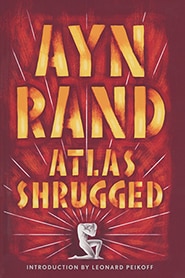
Book Review: Atlas Shrugged

Atlas Shrugged

by Ayn Rand


My god.

Now: I’m a word guy, a writer and a literature teacher, so I read quickly. I enjoy it, so I dedicate a lot of my free time to it. I’m a high school teacher and it’s summertime, so I have a lot of free time. I’ve been averaging about a book a day since school ended.

Until I hit this one.

1070 pages of some of the smallest print I’ve seen outside of User Agreements. 562,000 words, according to the Indefeasible blog. For scale, that is 25,000 words less than War and Peace by Tolstoy, and 400,000 words more than The Grapes of Wrath, the longest book I’ve ever tried to teach. It is equivalent to 12.186 Fahrenheit 451s.

This took me eight days to read. I spend at least 3-4 hours a day reading, too. It was a tough slog, too; because it is a philosophical treatise as much as it is a novel, I had to concentrate on the ideas harder than I would on, say, a book from The Wheel of Time or Harry Potter. I did it because the book was recommended as an important first step in understanding a former colleague and debate opponent’s worldview, which he describes as Aristotelian and bears a lot of resemblance to Rand’s philosophy, which she called Objectivism. I wanted to understand his worldview because his ideas are different from mine, and he is very, very sure of his positions and opinions; so I wanted to know from whence came his surety, and if I could and should be thinking along the same lines. So I read the book.

It made me think lots of interesting things. It really did: it made me realize that there are some things that I have done (like mock and castigate industrialists – in my case my favorite target was Bill Gates) that I shouldn’t have done, some things that I do that I shouldn’t do (like use words ambiguously, or symbolically, with little concern for their actual meaning), and some things that I haven’t done that I should do (like think about what my purpose in life really is, and why). There are some parts of the philosophy espoused and exemplified that I find interesting, and that I plan to investigate further and perhaps even adopt, if I can verify that they work for me.

However: reading this book was not worth it. Even with my personal interest in knowing what it has to say, I got so bloody tired of reading it that for the last three days, I had to work twice as hard to pay attention – and since I had to work twice as hard as normal to pay attention in the first place, this has been a mentally draining task. I did it, though, and now I’m here to tell you: don’t do it.

Rand was not a good writer. I’ve read three of her books now, and while this one was leagues better than Anthem, that’s like saying that shaving with a chipped-flint spearhead is better than shaving with sandpaper: you still wouldn’t want to do it. I read The Fountainhead in high school, so I don’t remember it well; once I’ve recovered sufficiently from this one, I may read that one. I dunno, though. It’s only 311,000 words, but that’s still two Grapes of Wrath.

That’s the biggest problem. She used too many words. And I say that as a wordy writer, which I am; my first book was 200,000 words. But she repeats things too many times, unnecessarily, as though using five words to describe something makes up for the fact that she is telling and not showing; and when she explains them, she uses too many synonyms and appositives. As a random sample from a page I just flipped to:

The scream of an alarm siren shattered the space beyond the window and shot like a rocket in a long, thin line to the sky. It held for an instant, then fell, then went on in rising, falling spirals of sound, as if fighting for breath against terror to scream louder. It was the shriek of agony, the call for help, the voice of the mills as of a wounded body crying to hold its soul.

So there was an alarm, then. You know, just the word “alarm” implies that it was bad, and “scream” implies fear; you could basically say this same paragraph in three words:

An alarm screamed.

Now of course repetition creates emphasis, which is presumably the point of the extended description; but there doesn’t seem to be anything in this book that Rand doesn’t want to emphasize – which means, of course, that nothing is really emphasized, because all of it seems almost like – well, like a screaming alarm siren fighting for breath, crying to hold its soul. By the end of this book I was very tired of being yelled at. I can’t imagine how fatiguing a conversation with this woman must have been.

In addition, the level of rage leveled at people like me – political liberals, that is, which means Rand saw me as a looter, a moocher, a liar, a coward, a fool, a murderer, a thug, and the destruction of humanity – was just as exhausting. I knew going in that there was a critical speech at the end, when John Galt speaks (No spoilers – that’s the name of the chapter, “This is John Galt speaking.”), which explained the whole worldview being dramatized in this book; but the problem was that most of what Galt says had already been said by the narrator or one of the other characters. I probably could have just read Galt’s speech and skipped the rest of the book. I would have been happier, too, because Galt carries the deepest anger, the most righteous condemnation of anyone who would support, you know, taxes and welfare and stuff. So I had to read that after reading another 900 pages of pretty much the same stuff, just not quite as angry as when Galt says it. I got really tired of being insulted so many times, and with such bile.

I will also say that, while the story itself is interesting (though much too long) and, I think, disturbingly realistic, the characters are not. Not that I think Rand’s idealized hero-industrialists are absurd; I mean, they are, but they are absurd the same way that Tom Brady or Michael Jordan is absurd, or William Shakespeare, or Isaac Newton, or Michelangelo or Mozart: nobody should be that good at what they do. But as all those names (Just the first few to come to mind. Of course there are many more examples.) show, people really are that good at what they do. It is possible. No, these characters are unrealistic in the way they read each others’ expressions. Like this:

The suggestion of a smile on Mrs. Hastings’ face held sadness, but the face had no imprint of tragedy, only a grave look of firmness, acceptance and quiet serenity.

Picture that face, that smile, in your mind. Okay, that’s good, just the suggestion of a smile . . . No! No imprint of tragedy. That’s better – but it needs a little more firmness in that look of quiet serenity. Got it, now? Or this:

There was the faintest coating of mockery spread, like shellac, over the smooth notes of her voice.

I mean, I like that, it’s a nice phrase – but what the hell does that sound like? And how would someone pick up on it?

These aren’t the best examples, the best examples are when someone heroic looks into the face of one of the villains and sees what they intend to show, along with what they’re hiding, and also what they are unaware they are really feeling; but I didn’t want to spend the time looking through the book to find one. It took me long enough to find these examples.

There are thoughts worth thinking in this book. I intend to spend more time thinking about those ideas. But good grief: I have already spent enough time reading this book. No more.

Book Review: My Man Jeeves

(Note: this is not the cover of the edition I read; but this one is awesome.)

My Man Jeeves

by P.G. Wodehouse

This is the second Jeeves book I’ve read. I liked it, but not as much as the first. If you don’t know P.G. Wodehouse’s Jeeves books, then here’s the basic setup: Jeeves is a butler who works for a – toff? Is that the word? – an upper-class British gentleman by the name of Bertie Wooster. Bertie is a lovable dolt who has a tremendous amount of money and even more friends; because he has all this money, he has no need to do anything with himself other than buy new clothes and attend social events, which is pretty much all that happens in these stories. Unless one of Bertie’s friends gets in trouble: then Bertie springs into action. Because Bertie has a heart of gold, which is one of the charming things about these books; as much of a dolt as Bertie is, he really is a lovable one. More important for the stories and for Bertie’s friends, Bertie has a secret weapon: Jeeves. When I say “Bertie springs into action,” I mean he turns to his butler and asks him what he thinks they should do. Jeeves is a genius, and no matter how delicate or intractable the problem is that Bertie brings to him, Jeeves inevitably finds the solution. The stories work because Bertie is more appealing than all of his doofus friends, who are dolts without the golden tickers; because Jeeves is fantastic, both in his unflappable-British-butler demeanor and in his solutions, which all rely on common sense and logic more than a Sherlock-Holmes-ian insight. They also work because Wodehouse was a fantastic writer, a splendid craftsman who writes some of the best dialogue I know, and who can use slang better than anyone I can think of – which is hilarious, because it’s Jazz Age upper-class British slang, and it’s fabulous. They’re basically the lightest-hearted mystery stories I know, with the mysteries being things like, “Jeeves, my chum Reggie has to convince his rich uncle that he is married, but not to his actual wife,” rather than “Who killed that family of four” or “Who stole the Hope Diamond?” Basically, they are adorable. They are also an amusing commentary on the worthlessness – but also the essential harmlessness – of the bourgeoisie, and the wisdom of the working class, the value of street smarts, so to speak. Though it is very clear in the books that Jeeves is the only one of these two who reads.

As for this book I read, I’m not actually sure if this is an original publication; it’s an on-demand printing, with absolutely no extraneous information; no back cover, no book jacket, no author bio, no list of other works by Wodehouse or titles in the Jeeves series. It’s possible this is like a book club knock-off collection, in some way, or one of those Hey-the-author-died-but-here-are-half-a-dozen-obscure-stories kind of “new” title in a classic series.

Because that’s what this is: a half a dozen short stories by Wodehouse. Three of them aren’t even Bertie Wooster/Jeeves stories, which was a bit disappointing. They were still Wodehouse, so they were good, and the character – one Reggie Pepper – was almost exactly like Bertie in that he was an upper class idler with a trust fund and not a whole lot of brains. But without Jeeves there to bring about resolution, the story becomes a bunch of upper-class dolts fumbling around until something happens, which is not nearly as fun. The Jeeves stories in this book were great, but I do wonder if there is some other edition or title that has these same stories out there; in which case, don’t worry about getting this particular one. But do go out and read you some P.G. Wodehouse. I highly recommend it.


**Note: Having looked at some Amazon reviews of this book, turns out these are the very first Jeeves stories, when Wodehouse was still working out his characters and style and all; Reggie Pepper was an early version of Bertie Wooster, and not nearly as cool as the final product. These stories were re-written later, and re-published in a different book. The fact that this is the first Jeeves book is, I now remember, entirely why I got this one. So I’d recommend giving this edition a miss and looking for something else. I have a few other Jeeves books; I’ll read them and figure out if it’s important to go chronologically. I doubt it.

Book Review: The Forever War

The Forever War

by Joe Haldeman


Science fiction classic – check. Hard SF/military SF – check. Rocket ships, laser beams, weird alien races – check. Human lives ruined through time dilation – double check.

The Forever War is about humanity discovering a functional method of interstellar travel, using wormholes; we begin serious space exploration and colonization – until we encounter the aliens. Then we go to war. Haldeman was pretty optimistic, really: the novel was written in the 1970’s, and set (at first) in the late 1990’s; basically he gave us 25 years to discover interplanetary travel that could bring us up close to light speed, which gives us access to the wormholes. Damn – we’re 20 years behind schedule. Better get on that, guys.

The main character is a soldier named William Mandella. He is conscripted into the war, precisely because he is a college student; I’m sure this was used as a twist for the Vietnam-era audience Haldeman wrote this one for. Mandella is drafted out of his graduate physics program and sent to be a space-soldier. The first part of the book is his training, which was interesting; it happens on an ice-planet far out in the solar system, where it is so cold the surface is frozen hydrogen. The recruits, all of them superb specimens of humanity with high intelligence and excellent physical capabilities, are trained there to use the enhanced combat space suits that will be their standard war gear, and to build and maintain a base in even harsher conditions, which will happen when they deploy. The conditions are deadly, the weapons are deadly, a fair number of the recruits die before they even engage the enemy. Then they go into their first mission, and actually battle the aliens, becoming the first humans to actually see one of the aliens in person: the first encounters were all ship-to-ship. Once they get into actual combat, they quickly find that the biggest danger they face isn’t the enemy: it is their superiors.

Once that first battle – and the battle, as well as the lead-up to it, are an excellent example of hard military science fiction – is over, then the major theme of the book comes up: as these soldiers have flown to their mission, they have approached light speed; which means that time has gone slower for them than it has for the rest of the universe. While they have spent a few weeks or months in transit on the way to their battle, the Earth has moved forward twenty or thirty years. So when they rotate back home for leave after the fight, they find a different world than the one they left: and it isn’t a good world. They quickly discover that, though they have the option to leave the military after this, they don’t have any real options for getting a job other than to re-enlist in the military.

Which they do. And they go back into combat, even farther away – which means more time spent in sub-light travel (The trip through the wormhole is instantaneous, like teleportation; but getting to the wormhole’s entrance is the issue.), which means more time dilation. Repeat this experience: combat, where the aliens are rarely the actual threat to the soldiers’ life and limb; then return to a different home than they one they left; then back into combat, because at least they feel like they belong in the military.

This was a pretty good book. Like most hard science fiction, the ideas were fascinating, the science both realistic and interesting; the writing was okay. The blurbs on the back talk about what a wonderful character Mandella is, and sure, he’s fine; but he wasn’t extraordinary to me. He’s an Everyman, which fits the novel well, because he’s essentially a grunt. So the interest in the book wasn’t in watching Mandella go through this, it was watching the crap that – anyone – would have to go through in these circumstances. Point is, the story is good, the science is good, and surprisingly enough, I really liked the ending. If you’re a science fiction fan and you haven’t read this, you should. If you’re not a science fiction fan, then don’t sweat it.

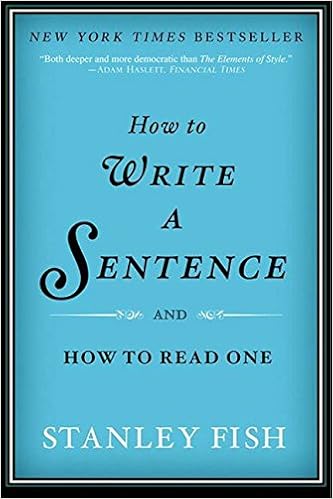
How to Read the Book “How to Write a Sentence”

How to Write a Sentence and How to Read One

by Stanley Fish

This was a good book that, for me, just missed being a great book.

I wanted to read this one because I am planning to give my AP Language and Composition class some kind of writing guide next year; I am considering Strunk and White, and William Zinsser’s On Writing Well; I went to Barnes and Noble looking for those two (Which I used to have, dammit, and I don’t know what I did with – presumably I donated them both at some point. The book-hoarder in me is righteously pissed.) and came up with this one, instead. It’s a slender book, which will appeal to my lazy-ass students, and I really liked the beginning of this, when Fish starts talking about how you have to master the basic building blocks of writing before you can really read well or write well – and the basic building block, he says, is the sentence.

Professor Fish (A title I cannot resist using) goes on to talk about what a sentence is and what a sentence does, and he does it without resorting to grammar, and he does it with some wonderful examples from literature; this was where this book was on its way to being a great book. Reading the first four chapters or so, I was getting more and more excited about giving this one to my students: it is in plain English, and it breaks down the sentence beautifully, talking about form and content both, showing how the rules of English allow for magnificence that is only magnified if you really understand what the author is doing. Professor Fish also recommends a writing exercise that I appreciate (though honestly, I don’t do it enough; I will start) that I learned in my upper-division college composition course, which is imitation of the form of beautiful sentences with original subject matter.

So I was loving it: and then I got to about the fifth or sixth chapter. This is where Professor Fish divides sentences into two basic structures: hypotaxis and parataxis. Hypotaxis is a sentence where the elements are subordinated, put into a definite structure with a basic root element and then other elements that branch off of that basic root. Parataxis is basically (I’m oversimplifying. Poorly.) stream-of-consciousness, where the pieces of the sentence are added without any particular relationship other than an additive one. This is a weird lens to view sentences through, and it isn’t one that my students will get. He spends two chapters on it, one on each structure, and while the hypotaxis (The simpler and more common sentence type, despite the complex definition I have given and failed to clarify) chapter is easy enough to follow, the parataxis one is not. The few chapters right after that don’t get any simpler, and Professor Fish lost me – which means he hasn’t a prayer of keeping my students.

I also have to say: I wish he had branched away from the classic canon of literature in finding his examples. I am not particularly enamored of Jane Austen; I prefer James Baldwin, maybe Edward Abbey, certainly Diane Ackerman. I have more recently been re-reading Douglas Adams, and I have to say: I have found my sentence examples for my students. To wit:

“The dew,” he observed, “has clearly fallen with a particularly sickening thud this morning.”

–from Life, the Universe and Everything

Now: with more effort from me, this book will likely be perfect for my students; I’ll need to explain those later chapters for them, and spend some time finding better examples of good sentences. I’m thinking I may just have them read excerpts from this book – and then buy Strunk and White.

This was a good book for me to read, as a writer and teacher of writing. Not sure it’s great for a student of writing, but I will put it to my students, in some way, and then report back.

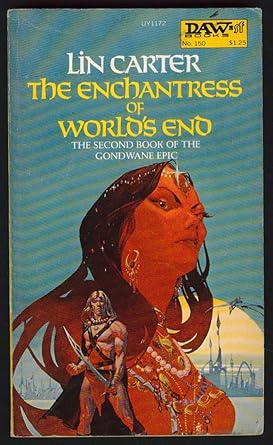
Book Review: The Enchantress at World’s End

The Enchantress at World’s End

by Lin Carter

Book 2 of the Epic of Gondwane, the tale of Ganelon Silvermane!

What ho, faithful companions! Fetch yourselves nigh to my heaving bosom, my bated breath, my excitement-tautened sinews, as I whisper the thrilling tale of the Construct, brought to quickening by the unfathomable will of the unknowable gods in the mist-shrouded halls of the future! He is Ganelon Silvermane, wielder of the Silver Sword, boon companion of the Illusionist of Nerelon and of Xarda, the Knightrix of Jemmerdy: together they will escape the mad city of Chx, defeat the grotesque Death Dwarves, the anti-life minions of the titular (pun intended) Red Enchantress, whose luxurious and tempting clutches they will slip through – only to find themselves in ever-greater peril! Zounds! What will come next?!

The best thing about this book, and the first one in the series, is that it’s all written pretty much like that. Breathless purple prose, ultimate pulp fiction. I thought there were some moments in this one where Carter slipped a little; he tried to make Xarda speak in even more archaic knight-errant language, but it didn’t really seem any different from his own narration, and so her self-conscious noticing of her own odd speech seemed – well, odd. There were also a few places where he crossed the line between fantasy and modernist fiction: he has a character, an ancient dragon who has existed (and hoarded treasure) since the dawn of time, reference some of the great swords of fantasy books past, including Orcrist and Sting and Anduril, and the twin swords Stormbringer and Mournblade; this was cool in that I know the books those swords came from – and a little weird in that the character in the book I was reading knew the books those came from, which felt off. But then the dragon also references ancient tales like Beowulf and the Ring Cycle, and the Bible’s Garden of Eden, and I thought: well, if the Bible can be part of ancient lore, why not Tolkien and Moorcock? So it wasn’t too bad. But it did jar a bit.

On the plus side: lots of action, lots of swashbuckling and derring-do, lots of bizarre names (Carter’s specialty, I think) and weird creatures and strange societies. Carter had a fertile imagination, and he chucks it all over the place in this book. There is an absolutely hilarious chapter when the Red Enchantress, a buxom seductress of the first order, attempts to tantalize Ganelon with her wiles; unfortunately, while Ganelon has the perfect physique of a god, he has the mentality of a bright 8-year-old, so the Enchantress’s wiles fail entirely to wile him, to her murderous frustration. There are definitely some silly parts – the Bazonga-bird, a goofy idea with a goofy name and a goofy character, springs nimbly to mind, and drags with her parallels to Jar-Jar Binks and, I dunno, Carol Burnett – and some moments of questionable writing; but it’s a fun book, just like the first one. I’ll read the next, too.

(Psst! Hey, want to read another time-traveling-fantasy story? Check out my serial about a 17th century Irish pirate who travels to the modern world! The Adventures of Damnation Kane)

Book Review: Homage to Catalonia

Image result for homage to catalonia

Homage to Catalonia

By George Orwell


In 1937, when he was in his mid-30’s, George Orwell decided he needed to take an active role in the fight against fascism. Orwell was already a published author and fairly well-known critic and journalist; he was even better known as a socialist. His first book, Down and Out in Paris and London, had been published by a leftist publisher, and in early 1937, he published The Road to Wigan Pier, a book about the living conditions of coal miners in the north of England. Both books describe the terrible conditions faced by the poor and working class, and both are strong indictments of the capitalist system. Orwell, deeply concerned by the rise of Hitler and Mussolini, watched closely as the Spanish civil war began and intensified; when General Franco’s fascist forces, backed by Germany and Italy, began to rise to power, Orwell went to Spain to join the other side. He had trouble finding a place that suited him; he was already growing disillusioned with the corruption of Communism in Soviet Russia by Stalin, and the weak way that European socialists knuckled under to Stalin’s will – The Road to Wigan Pier is as much a criticism of English socialists as it is of the mine owners, and the publisher added a disclaimer to the book, hoping to prevent a backlash from the left. Orwell tried to join the English Communist Party – but was refused because he wouldn’t do what he was told. He eventually connected with John Macnair, who was a member of the Independent Labour Party, and who got Orwell a spot in the militia of the Workers’ Party of Marxist Unification, the POUM in Spanish.

This is where Homage to Catalonia, the book that Orwell wrote about his experiences, begins: when he goes to boot camp as a new member of the POUM militia. It covers the next eight or ten months, which was all the time that Orwell spent in the war and in Spain before returning to England, eventually to write Animal Farm and 1984, two of the most effective criticisms of Soviet Communism ever created. This time, these experiences in this war, contributed to his disillusionment with Communism under Stalin’s influence.

Those two themes, the experience of actual warfare and the criticism of European leftists, especially the Communists, are the meat of the book. Orwell turns all of his remarkable ability as a journalist, his ability to describe and explain a scene, and his gift for clear and sharply-drawn imagery, bring the war to life: for half of the book, you could very well be in the trenches with him, or in Barcelona, where he was on leave from the front lines when fighting broke out in the streets between different factions of the Republican forces who opposed Franco’s fascists. Orwell talks about inadequate supplies, the freezing and filthy conditions, and, interestingly enough, the generally plentiful food and wine, and the overly abundant lice, which he experienced as a member of the militia. He was involved in several battles, most of them inconclusive, though he managed to escape the battle that eventually ended the POUM’s militia, a battle for the town of Huesca that killed thousands of militiamen and won nothing at all; Orwell was seriously wounded before that when he was shot through the throat by a sniper while standing in a Republican trench — targeted probably because he was quite a bit taller than most of the Spaniards in the trench with him. The bullet missed his carotid artery by a slim margin and left him unable to speak and in considerable pain.

When he is not describing life at the front, Orwell explains the convoluted situation on the leftist side of the war: Spanish Republicans included labor unions, Communists, socialists of all kinds; they had rebelled against the monarchy when Franco’s coup began, but had also led the successful resistance against the fascist general’s military forces. When Orwell was still in England, and then when he first arrived to join the militia, Spain was apparently the first successful people’s revolution: the bourgeois had fled or been eliminated, the Catholic church had been broken, churches looted and the clergy all but vanished. The POUM had attempted to create a classless militia, where the officers and the enlisted men received the same pay and lived in the same conditions, sharing tents and food and equipment regardless of rank. Members of the militia did not salute their superiors, and orders did not have to be followed if the men did not understand or agree with them; officers could not force compliance, but had to rely on persuasion, explaining to the men why the orders should be followed. (In a rather strange coincidence, the book I read two days after finishing this one, Joe Haldeman’s The Forever War, talks explicitly about this phenomenon, the POUM militia in the Spanish Civil War, where the men could refuse their superiors’ orders. I wonder if Haldeman read Homage to Catalonia.) But the POUM was a small piece of the Republican forces: much larger and more influential were the Communist Party, a different Spanish socialist party, and the two largest labor unions. And all of these groups soon took their lead from Stalin’s Russia, essentially because the Soviets supplied them with weapons and materiel for continuing their fight.

This does not sit well with Orwell. Several chapters break down the conflicts between the leftist parties, showing clearly which side Orwell himself was on; he meticulously tears apart the reporting of the war by the European Communist papers, particularly the fighting in Barcelona while he was on leave: it was begun when the police tried to take over the telephone exchange which was held by the labor unions, and led to several days of nasty fighting in the streets which eventually left something like 400 dead and over 1000 wounded (Though the numbers are reported by Orwell’s enemies and so seen as basically unreliable). After it was over, however, every major Communist and socialist media outlet blamed – the POUM. At the end of the war, after he is recovered from his wound, the Communists and socialists cracked down on the POUM, jailing hundreds of their leaders, usually without trial or even an accusation of a crime. Orwell, assuming that he would also be on the list for arrest, has to flee the country with his wife, leaving behind his friends and compatriots to die in dank prison cells, or to be shot by police and thrown into mass graves.

This war, these crimes, are what eventually create Napoleon of Animal Farm and O’Brien of Room 101 in 1984. Having read those books – several times – it was fascinating to read this book and see the seeds of what would come, a decade later. There is even a moment when Orwell expresses his visceral hatred of rats; and all I could think was, That’s why O’Brien uses them on Winston Smith.

As a description of a war experience, the book is vivid and interesting. As a political commentary, it is largely obsolete, but still fascinating if one is interested in Orwell’s fiction. This is the truth that is almost – but not quite – stranger than it. And the writing, of course, is brilliant. After all, it’s Orwell.

Book Review: The Devil’s Highway

Related image

The Devil’s Highway

by Luis Alberto Urrea


In May, 2001, 26 men tried to cross the border from Mexico into the United States. Three of them were paid guides – coyotes; the others were poor workers, mostly from the southern part of Mexico, all looking for work, hoping to make some money. They tried to walk through some of the ugliest, cruelest, deadliest desert in the world.

Twelve of them survived.

This was a rough book to read. Urrea does an incredible job of showing these people for who they were; even the coyotes, who weren’t bad people – they weren’t the heads of the ring, just flunkies; the one who led the trip, who took the wrong turn and got them lost, was a 19-year-old kid who couldn’t make enough money working in a factory that made roofing tiles, so he took on this job, instead. The men who paid for the trip were husbands and fathers; none of them wanted to emigrate, just to get a job, earn some money, and pay for something back home. Mostly they wanted to buy or build a better house for their wives and sweethearts and children and mothers. Urrea explains all of it: how the men (Plenty of these walking trips through the desert include women and children, but this particular group happened to be all men, ranging in age from 16 to 56) got approached by a friendly coyote, a fixer, someone who made all the arrangements, who talked to the poor coffee farmers, the broke factory workers, about how much money they could make in the North. Urrea talks about how Mexico, unlike the US, stretches now east-west, but north-south; El Norte is to the poor of Mexico’s southern states what the western frontier was to Huckleberry Finn and the 49ers: opportunity. But this opportunity costs money – an average of $1700 per person, not counting expenses on the way; how are these dirt-poor men supposed to pay for that? Easy, says the fixer; my boss, the head of the ring, can guarantee a loan to cover the whole amount. You can pay it off out of all that money you’ll make working in the citrus fields of Florida, or the slaughterhouses of Oklahoma. Only 15% interest. No need for collateral: miss a payment – we kill your family.

So these men took a chance. And then their lead guide, the one who really knew the route, took a powder: he vanished the day before the group was supposed to board their final bus, for the last leg before their long walk. No problem: the ring sent two more guides, to back up the second-in-command, the 19-year-old.

And then they took a wrong turn.

They spent four days in the Arizona desert, in an area known as the Devil’s Highway. Complete desolation, stuck between a national park, a reservation, and an enormous military base. Sand, rocks, cacti, unclimbable mountains; nothing else. Not a hundred miles from where I’m sitting, right now, in air-conditioned comfort, which made reading this book a bizarre experience: as Urrea went on and on about the harsh conditions, the terrors of the cacti, the rough, jagged, broken terrain, the unbelievable heat (There was a heat wave when those men went: it hit 108 degrees one day. At night it never got below 85.), I couldn’t fathom that the place where I live could be so deadly. I mean, sure, it’s too hot in the summertime, but – deadly? The book describes others who got stuck out in the desert and succumbed to the heat, tourists and daytrippers; they died in mere hours.

And I walk my dog in that heat. I mean, early in the morning, of course – but still, in July, it’s probably 80-90 when we walk. Thinking about people dying in those conditions was bizarre. Though not as bizarre, I’m sure, as actually going through it.

Urrea brings it to life. He talks extensively about what the heat of the desert does to you, which was a particularly brutal chapter to read, coming as it did in between the stories of the men walking, and then the description of those same men dying. He talks almost as much about the Border Patrol, who they are and what they do; though at first Urrea is not terribly flattering – just honest – by the end, when the story becomes just a rescue attempt, those BP agents become heroes. They saved lives by risking their own, and it was quite inspiring to read.

It’s a good book. The writing is remarkable, and it gives a far better and clearer picture of immigration and the border than anything else I’ve encountered. Highly recommended, even if you don’t live in the desert.

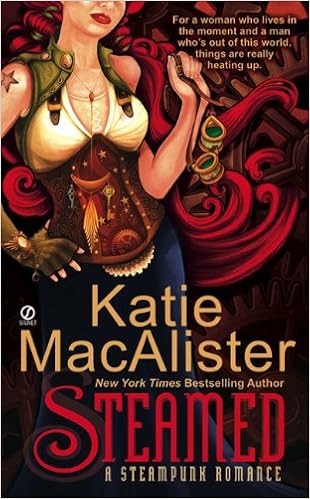
Steamed

Image result for katie macalister steamed

Steamed: A Steampunk Romance

by Katie MacAlister


Didn’t like it. Not because it was a romance, I generally like romances, especially with a fantasy twist; and I like the concept of steampunk quite a lot.

Though I have to say: does anybody know where the good steampunk is? The stuff has just exploded on the fantasy/sci-fi scene in the last ten years or so, and I have yet to find a steampunk book I really liked. Scott Westerfeld’s Leviathan book was the best I’ve hit so far – though only because Jim Butcher’s book The Aeronaut’s Windlass is pure fantasy despite it having airships, because anything Jim Butcher writes is better than almost anything else. I tried Cherie Priest and didn’t like the one book I read, though that doesn’t mean I wouldn’t like something else she wrote. But yeah: not impressed with the steampunk. I feel like authors aren’t using it to their advantage: they’re just like “Goggles and zeppelins are awesome! Yeah!” When they should be saying, “So I’ve got this fantasy idea, right? With epic heroes and a battle between good and evil that ends with good victorious? But wouldn’t it be awesome if I wrote it like H.P. Lovecraft or Arthur Conan Doyle?!?” Yeah. It would. Let me know when that happens, okay?

Maybe I’ll write it.

Anyway. The steampunk in this book was really just background, and it should have been, because MacAlister didn’t do much with it either. The steampunk background is not bad, though; the political structure is pre-World War I, with the Emperor of England and Prussia fighting with the Ottoman Empire while also dealing with a rebellion at home; the main heroine is an airship captain, which is cool, and they use steampunk aether guns, which was great; the manners and dress are Victorian, which was sometimes amusing, though that mainly just came out in discussions of bustles and corsets.

MacAlister had the somewhat interesting idea of taking her hero from the modern world and shifting him into a steampunk world; it’s a bit like the movie Kate and Leopold, but in reverse. The problem with that was she didn’t do it terribly well: the hero is a scientist who is working on a quantum something-or-other – let’s call it a flux capacitor – and his sister, joking around with her brother in his lab (because sometimes twenty-somethings act like they’re five [Though to be fair, the sister acts that way throughout the book, so it’s not an inconsistency; she’s just annoying]), drops it onto a live electricity source, and WHAM! The two of them are shifted into an alternate time stream – and 3,000 miles east of where they left, for no particular reason. I mean, okay, sure, it’s a romance; but I honestly don’t think there’s any reason to slack off on the non-romance aspects. The reason Diana Gabaldon’s Outlander series is so amazing is not just the romance; it’s because that woman is a hell of a historical novelist, almost too obsessive with her research and realistic details.

But the poor science-fiction and okay steampunk are not the issue: because this is a romance. No, the problem with this book is that the romance sucks. This guy, this Jack Fletcher, is freaking annoying. For a scientist in love with an airship captain, he is pretty much just a bro. He somehow has the idea that sexual harasssment equals flirting – and he pulls this, “Hey, I’m a man; of course I’m going to stare at your boobs and then make comments. That’s how men show appreciation!” all the damn time. And though there are some gestures towards Victorian sensibilities, which should have had either the woman herself or some of the men around her challenging this sexist oaf to a duel, really it boils down to a woman flapping her hand and saying “Oh, you!” while giggling after the guy pinches her ass.

The woman, Octavia Pye, is more interesting, because here is a good steampunk opportunity: she is a Victorian gentlewoman, but she can be an airship captain because the steampunk world is more modern and thus potentially more egalitarian; she can also be experienced romantically, and be interested in sex instead of having to swoon at the thought of a man unclothed. And MacAlister does that pretty damn well: Octavia pushes Jack away as a Victorian lady should, and then when they do get together, the sex scenes are actually quite good, both sexy and hilarious. But she puts up with too much of the bro-bullshit. There’s a point when they’re going to go into danger, and even though Octavia is a military officer, an airship captain, and Jack is a Quaker, this Bro actually says, “I grew up to believe a man must stand between a woman and danger.” And somehow the Quaker pacifism turns into, “Well, as long as I don’t kill the man, I can definitely beat the snot out of him with my mighty manly bro-fists.”

Anyway. They fall in love too quickly, as romances tend to do; the story sort of wakes up after the romantic scenes and is like, “Oh wait – wasn’t there supposed to be a plot line somewhere around here?” and then they live happily ever after, maybe setting up for a sequel which I will not be reading.

Suggestions for good steampunk are welcome.

Sir Gawain, Sir Orfeo, and a Pearl. Oh — and Tolkien.

Related image

This was the cover I had, but . . .


Image result for sir gawain and the green knight tolkien

… I like this one. It feels like those awkward medieval memes. I dig it.


Sir Gawain and the Green Knight, Pearl, and Sir Orfeo

by J.R.R. Tolkien

This was an interesting one. I’ve never been all that interested in The Silmarillion and the Lost Tales of Middle-Earth; I think The Lord of the Rings and The Hobbit are such miraculous, incredible books that they are more than enough for one great author’s lifetime. But Tolkien wasn’t just a great author; he was also a scholar of languages, Middle English and several Scandinavian languages, Old Norse, Finnish, and so on. This translation, though it has its creative elements, seeing as how Tolkien had to re-create the original intent of the text in modern English, it really falls more in his scholarship than in his fiction. And just like On Fairy-Stories from The Tolkien Reader, this is a hell of a piece of scholarship (he says in a state of blissful ignorance).

Sir Gawain and the Green Knight I have read before; taught it to my students a couple of years ago. It was fun: it’s a King Arthur story, one that has a nice supernatural element as well as one of these ridiculous tests of chivalry that the Arthurian legends seem so attached to. (Sure, you can be the High King, act noble, unite the kingdom, bring back morality – but can you keep your cool when your wife is sleeping with your best friend? How about THAT!?!) In this story, a Green Knight appears at Camelot during Christmas, and offers a bet: any knight who is willing can take the axe he’s offering and trade a single blow with him: and the knight gets first shot. At the Green Knight’s bare neck. Nobody takes the Green Knight up on it: seems like such an obvious trap, you can almost hear Admiral Akbar shouting it in the background; and besides, they’re all full of yuletide cheer, wassail and meat pies and roast beast. So the Jolly Green Giant mocks the Round Table’s chivalry and courage – and King Arthur can’t have that (So you can fight off all of your enemies – but can you stand a nameless stranger calling you a wuss? DIDN’T THINK SO!), so he jumps up to take the challenge, but Sir Gawain, Arthur’s nephew and one of like five or six knights who all get called the second-mightiest after Lancelot, takes it in his place. He takes the axe, he takes a swing, he chops off the Green Knight’s head.

At which point the Green Knight picks up his head, tells Gawain to come find him in a year and get his return stroke. Then he laughs and rides off.

So it turns out, this is actually a common legend from Middle English time; so common that scholars call it The Beheading Game. The rest of the story is Gawain riding off to meet his doom, and spending some time visiting a strange knight in a castle, where Gawain is nearly seduced by the knight’s hot wife (This is that test of chivalry I was talking about.) Then Gawain goes and finds the Green Knight, where he receives his just desserts, which I won’t spoil.

I actually really love Tolkien’s translation. It’s both readable and grandiose, the way a 800-year-old epic poem should be; and Tolkien went for a more unusual verse form, one that is truer to the original: he doesn’t use end rhyme very much (SGATGK has verses that end with a brief four-line phrase that does have rhyme, and Tolkien keeps those), but every line has as much alliteration as he can squeeze in there, often focusing on the specifically important words in the line. It’s interesting, very rhythmic, very catchy. I recommend it.

Then you get to Pearl. Pearl is another epic poem, this one 101 verses, that came from the same manuscript that held SGATGK. It’s about a man who has lost a woman he loves; maybe his sister or mother, but most likely his daughter; he calls her nearer in blood than a niece or aunt, and he doesn’t feel romantic about her, but that’s all he says about their relationship. What he talks about is the fact that she has died, and he feels awful; then he goes on at length (Creepy, creepy length) about how she and thousands of other perfectly pure young dead women have now become the Brides of Christ in Heaven; then he gets chewed out by Pearl’s ghost because he isn’t sufficiently happy that she is now in Heaven and mass-married to Jesus, which apparently is the ultimate success for these people; then he has a long vision of Heaven and how swell it is there. It’s another excellent piece of translating, as this one does have end rhyme in a very specific scheme; there’s a nice turn in every stanza that I enjoyed spotting and then looking for. Most annoying thing is that it’s set up in five-verse segments, each set of five using the same ending line or phrase for all five verses, and thus having a connected rhyme scheme – except for one frigging verse in the middle, between 70 and 76, when there are six verses. Yeah, okay, you wanted 101 total; did you need to do it THEN?!? Not the beginning, the precise middle, or the end – no, this guy was like, “I think we should change it up at the ¾ mark. Yeah, that sounds good. Bah. Pearl is a lovely translation, but I kind of hated the story,

I did like Sir Orfeo, which is essentially the Orpheus story: Sir Orfeo is a king with a world-class talent for the lute; his wife is kidnapped by the Faerie, and Orfeo goes after her and wins her back with his lute-playing (Actually, I think it’s a harp, but in my epic Medieval English poetry, every instrument is a lute.) and then tries to recapture the kingdom he left behind to seek his wife. It’s the shortest, and the only actually romantic one, in my opinion; I liked that one, too.

Overall, it’s a nice book. Tolkien impresses, and the poems give interesting insights into Ye Olden Tymes, which I have enjoyed ever since Me Youngen Tymes. Recommended for other word- and myth- nerds.

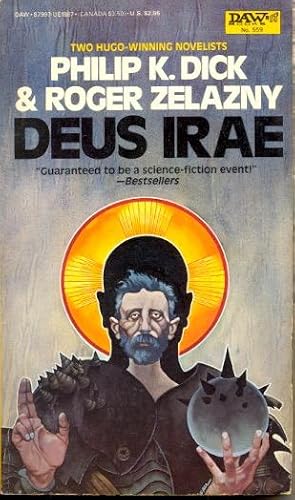
Spring Break Book Review #7 (The last one): Deus Irae

Image result for deus irae

Deus Irae

by Philip K. Dick and Roger Zelazny

What the hell did I just read?

I haven’t read a lot of Philip K. Dick; I’ve read almost everything by Zelazny. Dick was, according to everything that I’ve heard, a unique visionary when it came to science fiction: his ideas have become some of the most famous in sci-fi, among them the books that inspired the movies Total Recall, Minority Report, and Blade Runner; he was not, however, all that great a wordsmith. (He did win prestigious awards, so maybe this is not a fair description.) I would somewhat agree with this assessment based on this book, but of course the issue is clouded by the fact that it’s a collaboration. Zelazny was one of my favorite wordsmiths, and also had some fascinating ideas; but where is the line drawn in this book?

I dunno; so I suppose I can’t come to any definite judgments here. So let’s just talk about this book on its own merits, shall we?

This is a post-apocalyptic novel; the world has been destroyed by war, by the use not only of nuclear weapons, but also far more destructive devices, nerve gas, global killers that worked by changing the atmosphere and permanently altering the climate (You know, like we’re doing now, voluntarily. It’s saying something that truth not only resembles fiction, but that it also resembles science fiction. Even worse: it resembles the science fiction of Philip K. Dick. Who also wrote The Man in the High Castle, the alternate history novel about Nazis conquering the US during World War II. Just sayin’.). In the wake of this devastation you have both bizarre mutant lifeforms struggling to survive among the ruins, which still includes several artifacts of the pre-war era, and also the rise of a new religion, struggling to survive among the ruins of Christianity, several artifacts of which still exist. And though the book is somewhat about the mutants and war and survival, it’s really much more about religion. And about art.

The main character is a man named, unfortunately, Tibor McMasters, which is something I wouldn’t do to a character I hated, let alone my protagonist; but Dick and Zelazny also made this guy into an “inc,” an incomplete, because he lacks arms and legs. He is nonetheless, with the help of a mechanized cart that has extendible arms and gripping pincers, an artist. He is hired by the new religion, the Servants of Wrath, to paint a church mural depicting their God, the Deus Irae, in his human form: Carleton Lufteufel, the man who pushed the button, pulled the trigger, who started the war that destroyed everything. The Servants of Wrath see him as the manifestation of a god who is essentially evil, but evil for a potentially good purpose: by making humans suffer, the God of Wrath purifies them so that they can move up into a better existence after they escape this incarnation through the blessed relief of death. As a post-apocalyptic religious cult, it makes a whole lot of sense.

The book, unfortunately, does not. I mean, it does: Tibor goes on a quest to find the actual Carleton Lufteufel, hoping to see the man’s real face before he paints his likeness, and this quest goes through difficulties and revelations like the classic hero’s journey; they lift an element out of the Ring Cycle, when Sigurd drinks the blood of the dragon Fafnir and learns to understand the language of the birds; the same thing happens to Tibor, though it may be only a vision granted him by the God of Wrath – who may or may not be real. It’s impossible to say what is reality and what is vision and what is a lie: there seem to be miracles, but there are also some pretty funny absurdist jokes – there’s a race of sentient speaking dung beetles who worship a VW bug as their god; there’s an ancient pre-war automated mechanic that takes one character’s bicycle, turns it first into three tricycles, and then when asked to return the original bike, instead makes it rain pogo sticks. So are we to take the Deus Irae seriously? Or is that just a joke? Got me. There are some fairly straight but extremely unflattering depictions of Christianity, mainly through the Christian priest, who is a complete ass; but the priest of the Servants of Wrath is also an ass. Tibor’s a pretty good guy, and so is his opposite figure, a Christian named Pete Sands (Tibor is ostensibly a member of the SOW church, but he considers converting to Christianity – but is basically rejected by the Christian priest-ass), but these two don’t help us determine which way we should go in terms of religion, whether God is good, but perhaps too rigid in his rules; or if God is evil, but with perhaps good intentions in the end. It is possible that the point is that all religion rests on perception: both Pete and Tibor have religious visions, and maybe those give us real insights into faith and morality; but there is a critical lie that happens at the end of the book, which is never detected: and so maybe it means that all religion is a lie.

I really don’t know. I really don’t know what I just read. I enjoyed parts of it, was deeply confused by other parts, and annoyed more than once, by the setting, and by the characters, and even by the writing. Though I think I may know why: there is a point in the book when Tibor waxes poetic about the Impressionists and the quality of light they sought to capture, which he says is morning light that changes the way everything looks until it burns off around 11am; he mocks Rembrandt, who never painted in the morning light and so is unbelievably easy to imitate (sayeth Tibor), because his figures all have nothing but shadows in their eyes, because all the figures look at nothing, have nothing to see. See, the thing is, I love Rembrandt’s work, and am underwhelmed by the Impressionists; I don’t really think anyone has the skill to re-create Rembrandt, though sure, maybe it’s easier to try, and maybe people can even come close. But I think it would be a whole shitload easier to mix up some bright colors and slap them on a canvas so that they are shaped vaguely like water lilies. And I think a lot of people have been able to do that, and get famous for it, because I don’t know that there is really anything special to see in most Impressionist paintings – it just has a reputation for being something above and beyond what is actually on the canvas, and people are able to bluff their way into that same reputation. (I’m going to throw out the name Willem DeKoonig, though that’s largely an inside joke. And he wasn’t an Impressionist anyway, so I’m off topic.) Anyway: the point is that there seems to be something of a divide between people who paint what they see, and people who try to capture something unseeable. (And maybe some of them succeed. I don’t mean to denigrate the entire Impressionist movement. Or all of the authors I’m about to mention.) I would put Rembrandt in the first category, and the Impressionists in the second. And I think the same division is possible with writers: some try to describe the world exactly as it is, and some try to capture an intangible, unknowable element, try to craft their language in such a way that it creates a second impression, of a different reality, one that is wholly spiritual or intellectual, detached from the words, detached from the sensory impressions. I would put, say, Stephen King or John Steinbeck into the first category, and James Joyce and T.S. Eliot and Ezra Pound into the second.

I think Philip K. Dick would have wanted to be in the second category. And I absolutely, without doubt, would rather be in the first. I want nothing more than to be able to write like Stephen King or John Steinbeck, or Mark Twain, or even J.R.R. Tolkien, who was able to describe an entire fantastic world in humble, realistic prose, which is what makes his works so long-lasting and influential, because he started with the line “In a hole in the ground there lived a Hobbit.” I think that, like Rembrandt, the realism captured in the work of these sorts of authors is deceptively difficult to achieve, and wonderful when it is done right. I kinda think the great effects achieved in the works of Impressionists, and authors who write like the Modernists and their detachment from reality, or like the Post-Modernists and their detachment from meaning, are really just, well, bullshit.

So maybe Philip K. Dick should belong to those science fiction fans who also love James Joyce. And since I can’t stand James Joyce, you all can have them both.