Book Review: Gone Girl

Gone Girl

Gillian Flynn


I was undecided about this book. I’m not generally a mystery/thriller fan, though I have read and enjoyed several of them in the past, and this one was so popular, and so well-received, that I figured it was a good risk. I have not seen the movie, and I did not know anything about the book’s plot before I started, so I was in the perfect position to enjoy it as much as it could be enjoyed.

But I wasn’t enjoying it. The writing was quite good, and the plot was interesting; but – just like the last two books I’ve written reviews for, sadly – I did not like the characters. So I asked friends: should I continue reading this book? Is it worth it? Do the characters get better? I got a fair number of the responses you would expect from a question like that: a few people said absolutely yes, a few absolutely no; a few said “Why not?” and a few said “If you want to.” A former librarian friend said, “When in doubt, read your age: read as many pages as you have years, and then decide.”

And one friend said, “Yes. You won’t like the characters any more than you do now, but the book is worth it.” She said the characters are intentionally unlikable. She said that she believed the book will become know as a modern classic, and as an expert in literature, Gone Girl is a book I should read.

Well. She was right about the unlikable characters. (Not to be snobbish, but: based on what I have learned about fancy-pants literature as an Advanced Placement teacher, Gone Girl, like most popular fiction, will not in fact ever be considered a classic, as it isn’t complicated enough. The AP program describes their acceptable literature as those works which reward re-reading, meaning that reading the work again gives you new insights, new ideas, that you could not have grasped the first time through. And Gone Girl doesn’t have those hidden depths. Everything’s up front. Which I generally prefer, anyway, because my friend was also wrong to call me a literary expert. I’m not. I enjoyed the flattery, though.) She was also right that the book was worth putting up with the people in it, and also that the characters are intended to be unlikable.

So the basic story is about a married couple, Amy and Nick Dunne; and in the first chapter of the book, on their fifth wedding anniversary, Amy goes missing. (She’s the Gone Girl.) The question is, what happened to her? At first, you get an impression of both of these people, Amy and Nick, and one of them doesn’t come off too well. (I won’t say which one so as not to spoil it.)

But then something happens. That impression changes. You learn a few more things, and suddenly, the other one doesn’t seem too good a person, where the person you didn’t like turns out to be not that bad. That’s about where I asked about continuing, because my reaction was, The hell with both of these people.

Here’s the thing, though. That shift in allegiance for the reader: that’s Gillian Flynn’s intention. That’s the point.

The book isn’t really a mystery. There are mysterious elements, but between a third and halfway through the book, Part One ends, and when Part Two begins, the mystery is revealed. And at that point, the person you’ve been liking more turns out to be MUCH worse than the person you’ve been disliking – though that person, the not-as-bad one, is still pretty obnoxious. What the book’s really about is two things: one is the way that married couples can really destroy each other, and themselves, over the course of a marriage; and the other is the incredible way we can manipulate public opinion. Because this turns into a criminal case, related to Amy’s disappearance, and the apparent guilt is essentially worked out in the court of public opinion. It’s all about who can manipulate the public best; that is the person who will – win, I suppose, though really, you don’t want either side to win, because the entire fight is just despicable. Back to that thing I said about married couples destroying each other. It’s all ugly, it’s all bad, and nobody wins. The same for lying and manipulating appearances in order to seem more righteous: it’s all ugly. It’s all bad.

You do end up rooting for some of the characters, mostly because you want the badness to end; there are some moments of satisfying karmic justice for the ugliness. Mostly, though, my friend was right:  even though I never liked the main characters, the book was worth reading. We’re not supposed to really like them or sympathize with them: Flynn set this up to sway our allegiance back and forth, to show us, I think, that we determine our opinions too quickly on the smallest, most subjective piece of evidence; and because they are so shallow, our opinions can change completely when new information comes to light. It reminds me very much of Shakespeare’s The Tragedy of Julius Caesar, a play I’ve taught dozens of times, because that play shows the Roman public for the fickle mush-heads (Props to Diamond Joe Quimby for the phrase, because the Simpsons have also done this topic) they are: first they love Caesar, then they love Brutus, then they love Mark Antony. And I have always believed that Shakespeare isn’t really talking about the Romans: he’s talking about his own audience, the English theater crowd, the ones whose favor could be won and lost in an instant. I think Gillian Flynn is doing the same thing: she’s using this book, with its masterful manipulations, to show us how wrong we generally are when we choose sides based on what we see on TV, and what we hear from the grapevine, and especially what we all “know” to be true – like how the husband always did it; or once a liar, always a liar; or that pretty people are more trustworthy.

I don’t want to think those things are true of me, too. But I’ve spent almost a thousand words now, talking about how quickly my allegiance to these characters changed: because I made snap judgments based on poor information, and never once questioned whether I should believe what I was being told. Not even when it didn’t make sense, when I had conflicting information about the same character; I never questioned whether something was credible. It was simply that the more recent piece of information had more influence on me; I tended to believe the new information was true, and therefore I should take it more to heart.

So what have we learned? I, too, like most other people, am a fickle mush-head, and I should not credit my knee-jerk opinions about public figures or controversial issues. I should think more. Gillian Flynn is a talented writer who set out to manipulate her audience into liking a character, and then hating that character, and then going back to liking the character, before drifting somewhere into a general distaste for everyone involved — including, for me, the author, who messed with me so much. We’ve learned that this is a well-done book, and people who are interested should read it. And I’m not going to read it a second time. I do not think it will reward re-reading. And I really don’t like these people.

Book Review: The Purple Cloud

The Purple Cloud

by M.P. Shiel


I hated this book.

I did not hate everything about it, which is why I finished reading it; but while I liked the concept and the writing, I have rarely loathed a protagonist more than I hated this freaking guy. Since I recently read a trio of adventure novels by H. Rider Haggard, in which I also grew to hate the Great White Hunters who slaughter elephants for fun and mock the savage Africans, this was familiar but annoying territory. (Since I just, the same day I am writing this review, finished reading Gillian Flynn’s novel Gone Girl, in which I once more hated all of the main characters, I think I need to focus on books about likeable people for a while.)

Adam Jeffson is his name. Dr. Jeffson – for he is a medical doctor – begins the book married to a social climbing gold-digging beauty, who wishes her husband to become fabulously wealthy so that she may look down her nose at all of humanity. She pushes him to join an expedition to reach the North Pole, which no person has yet reached at the time of the story. It is unclear when the book is set; somewhere in the late 19th century, it seems, but the setting is unclear because Shiel insisted on using the now-familiar frame for science fiction stories around this time (Originally published in 1901 — H.G. Wells lauded it as brilliant!) namely that the manuscript was left mysteriously to Our Correspondent (also known as the author); this particular manuscript was created under the influence of that Mystery Science known as Mesmerism! Yes! A woman, under the influence of hypnosis, wrote out various strange manuscripts, one of which was this story. Is it true? A communication from another world? Who can say?!? The upshot of all of this humbuggery is that the book is an alternate universe story of the end of the world, which we living people can know about because of the mysterious transmission of the story, which can therefore also be a first person narrative told by someone who isn’t actually the author. But since it takes place in a world that is not quite ours, it is not clear what the timeline is, though the geopolitical world is the same as our own. Anyway.

Dr. Jeffson wishes to join the expedition to the Pole, at his wife’s behest, because there is a cash prize, an incredibly large cash prize, to be awarded to the person who first sets actual foot upon the top of the world. Unfortunately, the expedition already has a doctor signed up to go. Fortunately for Jeffson, and unfortunately for the other doctor, Jeffson’s wife – who has the absurd but suitably hideous name of Clodagh – isn’t above murder, and in fact, she poisons the other doctor (Whose name is Peter Peters. Yup.) so that Jeffson can take his place. Apparently so we can really enjoy our hatred for this couple, she does it slowly, pretending to nurse the sick man while actually dosing him with atropine. So Dr. Peters dies, Jeffson goes on the journey; but along the way, he is both frustrated and unpopular, because the ship is going to be stopped by the polar ice cap, and Jeffson is not intended to go on the final leg of the journey over the ice by dogsled; at the same time, he and his wife are suspected of putting an end to poor Pete Peters. Somehow, Jeffson is all freaking outraged by the accusations that finally get voiced, even though everyone involved knows they are true; he ultimately goes out to have a duel with one of the other members of the expedition, and even though the other guy is a better man and a better shot – and he’s right about Jeffson and Clodagh – Jeffson wins and kills the other guy, and takes his place on the final leg. So now I’m pissed that this ass is going to win the money and make his wife happy.

But wait, there’s more. The dogsled portion arrives, and the three men going don’t plan to bring enough food for the dogs. Why? Because THEY PLAN TO FEED THE DOGS TO EACH OTHER ON THE WAY. That’s right: not only does the dog die, but FORTY dogs are going to die, and be forced into cannibalism, all so these three pricks don’t have to bring more food. (Should I mention here that they originally meant to use reindeer to pull the sleds, but they didn’t bring enough fodder for the reindeer and all of them starved to death while still on the ship? Nah, I’ll leave that out.) This is all three of them, so we can’t blame Jeffson for that, but we can certainly blame Jeffson for this: he leaves the other two men to die of exposure, leaving camp early with extra supplies and dogs so that he can be the first to the Pole and claim the prize.

He makes it there first, indeed, but then a strange thing happens. How strange, we don’t yet know, but it is the titular Purple Cloud, so we know it’s got to be a big deal. Anyway, Jeffson heads back across the ice once more, and, because we don’t hate him enough, he makes it all the way back to the edge of the ice with only one surviving dog, his favorite: which he then FUCKING KILLS JUST BECAUSE HE DOESN’T WANT TO DEAL WITH GETTING THE DOG ON HIS KAYAK.

Stephen King once wrote that the fastest way to get an audience to hate a character was to have him hurt a dog. And this guy now, in my mind, has the blame for the deaths of forty dogs, a herd of starving reindeer, and several humans, as well. That’s why I hated him, and the lack of sufficient suffering in retribution is why I hated this book. Because no matter what else happens, Jeffson doesn’t die.

But here’s the thing: none of this is the actual story. The story began with the purple cloud: which was poisonous, and has killed all of humanity and pretty much all large animals. The bulk of the book is Jeffson realizing he is the last man alive on Earth. That’s right: none of this evil involved in the Polar expedition was actually the point; it was just intended to get Jeffson to be the only one alive at the north pole when the cloud hit – which, it turns out, is what saved his worthless dog-killing ass.

I won’t spoil the rest of the book, which is better than this beginning portion, though I will say that Jeffson continues to be a shithead: for the next twenty years (The book covers quite a number of years), whenever Jeffson gets bored or angsty, he goes to one of the great cities of the world, and burns it. To the ground. The whole city. (When he burns Paris, he takes 20 paintings out of the Louvre, and burns the rest.) Just for the hell of it. Just to make us hate him a little more.

The intended theme at the end of the novel is about good and evil, and how good will eventually win out in the end; in that struggle, Jeffson is the evil. And boy, is he evil. I’m not really sure why Shiel wrote it all this way, when there surely had to be an easier way to make his point. But considering his writing style, he is not a fan of making a quick and simple point. Here’s a sample sentence – one sentence.

Now I would not trudge back to the ship, but struck a match, and went lighting up girandoles, cressets, candelabra, into a confusion of lights among a multitude of pale-tinted pillars, rose and azure, with verd-antique, olive, and Portoro marble, and serpentine; the mansion large; I having to traverse a desert of brocade-hangings, slim pillars, Broussa silks, before I spied a doorway behind a Smyrna portiere at a staircase-foot, went up, and roamed some time about the house – windows with gilt grills, little furniture, but palatial spaces, hermit pieces of faience, huge, antique, and arms, my footfalls muted in the Persian carpeting; till I passed along a gallery having only one window-grating that overlooked an inner court, and by this gallery entered the harem, which declared itself by a headier luxury, bric-a-bracerie, and baroqueness of manner; from which, descending a little stair behind a portiere, I came into a species of larder paved with marble, in which grinned a negress in indigo garb, her hair still adhering, and here an infinite supply of sweetmeats, French preserved-foods, sherbets, wines, and so on: so I put a number of things into a pannier, passed up again, found in the cavity of a garnet some of those pale cigarettes which drunken, then a jewelled chibouque two yards long, and tembaki; with all I descended by another stair, deposited them on the steps of a kiosk of olive-marble in a corner of the court, passed up again, and brought down a yatag to recline on: and there by the kiosk-steps I ate and passed the night, smoking for hours in a state of lassitude, eying where, at the court’s center, the alabaster of a square well blinks out white through a rankness of wild vine, weeds, acacias in flower, jasmines, roses, which overgrow both it and the kiosk and the whole court, raging too far over the four-square arcade of Moorish arches round the court, under one of which I had hung a lantern of crimson silk; and near two in the morning I dropped to sleep, a deeper peace of gloom now brooding where so long the hobgoblin Mogul of the moon had governed.

All in all, I’d recommend reading The Stand. Randall Flagg is a lot more fun to hate. And he didn’t kill forty dogs.

Triple Review: The Great White Hunters

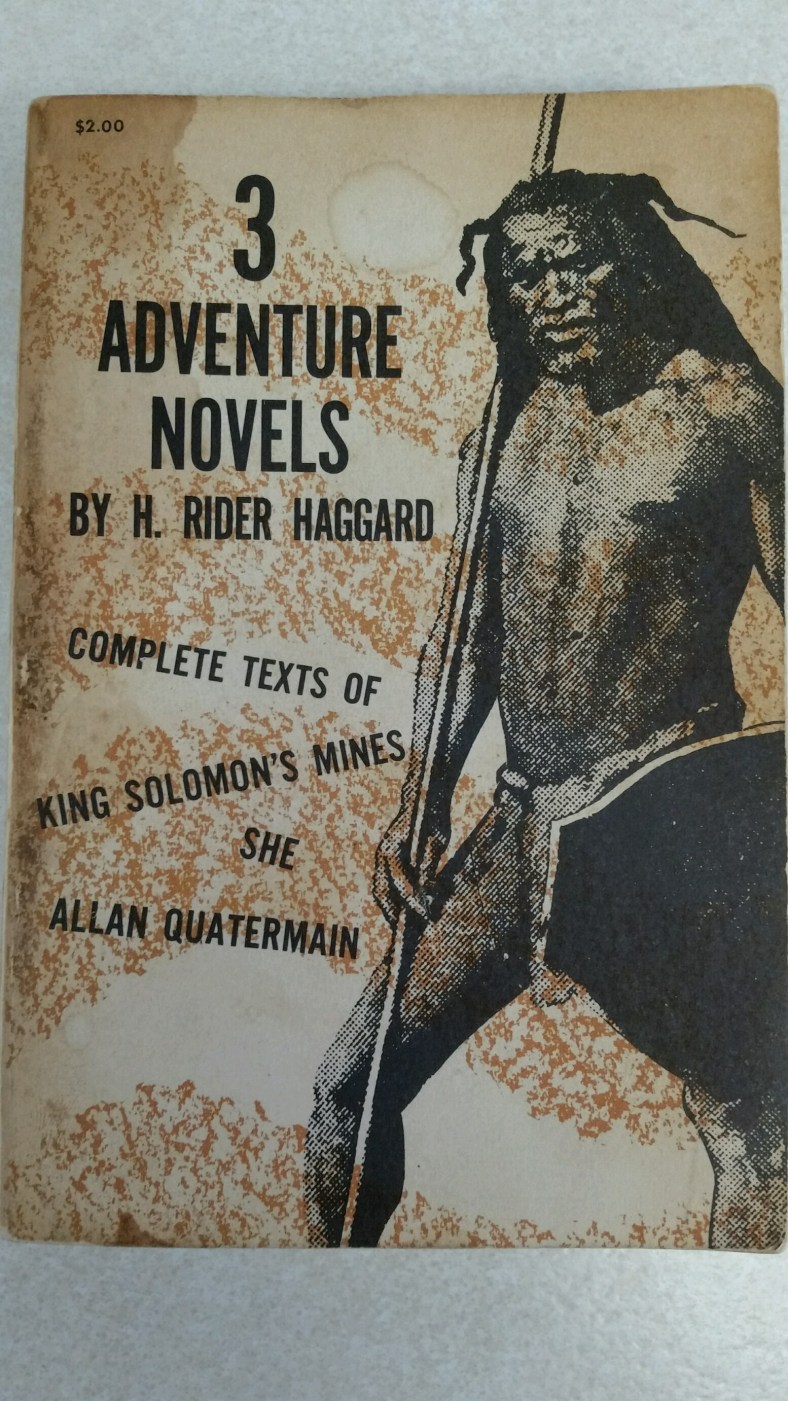
20171028_085108

Three Novels by H. Rider Haggard:

She

Allan Quatermain

King Solomon’s Mines


These books made me feel bad.

First, I had some serious white guilt issues. I don’t go in for that normally; I have read Mark Twain’s Huck Finn several times, and Ralph Ellison’s Invisible Man, as well, not to mention the uncomfortable To Kill a Mockingbird. I read them, all three of those and others, out loud to my students. I admit I skip over the N-word: because I am of the opinion that, while an ideal world would lack any racial terms, or would at least have removed from the terms all power to hurt, we don’t live in that ideal world, and that word coming out of my white face as I stand at the front of the classroom with power over my students – that is not a powerless word, that is not a word that I can be sure won’t hurt anyone. But otherwise, I don’t mind reading either the silly caricatures of minorities, or the swaggering white titans (Whitans? Or all three words, and make it Swhitans?) who bestride the world like a colossus. While I want to include people of color in the authors my students read and that I read, I am not against reading a dozen great novels by dead white men. I am comfortable with being a honky.

But this book (It was all three novels in a single collection) made me uncomfortable. It was more to do with the unquestioned superiority of the white men than the savagery of the Africans; sure, the Africans were savages, described as ignorant, violent, often childish, having outlandish costumes and going in for cannibalism (With the completely absurd description in She of the tribe’s use of a heated metal pot, clapped over the head of the intended victim who is thus both tortured and killed, and then turned into stew. And they called it the Hotpot. And the goofy white character, the servant guy who played the role of Stan Laurel or Lou Costello or Kramer or Chris Farley – the guy who panics all the time – was constantly terrified of the Hotpot. “Don’t leave me alone with the savages! They will give me the Hotpot!” How do you say that with terror in your voice? I just couldn’t take it seriously.), but the bigger problem was the way the white men took over the ancient African societies they came across, simply assuming they had greater ability to lead. And not even for the usual reason of needing to bring Jesus to the heathens; no, this was usually because they had greater knowledge of guns and of how to win a battle. Which I think is, first, no good reason to assume power, and second, nonsense, at least in terms of battle: modern warfare uses modern weapons, and when you take away said modern weapons, the idea that a group of honkies who have never been in the area could lead their men to victory simply by virtue of their whiteness is absurd. Yet that is exactly what happens in both Allan Quatermain books (and it annoys me every time I see that name, because there should be another “r”), particularly King Solomon’s Mines, where the battle includes tens of thousands of African soldiers. Led by the white men to victory, just because they were white men – because the battle plan is “Get the high ground and send our best troops against their weakest.” Boy, thank god the crackers were there to explain that! No way that African civilizations that have existed for millennia could have figured that out without help. And guess who the mightiest single warrior is: well, there is much made of a particularly hardcore Zulu chieftain who travels with them; but right by his side is the biggest, strongest white man, who is better in hand-to-hand combat than people who have spent their lives doing just that – but, after all, he is British.

And then there was the penis factor. Not only did the whites win because they were whites – and in both She and Allan Quatermain, the rulers of the hidden African kingdoms were white people, mysteriously existing in the heart of Africa – but the men were worshiped as masters of all things because they were men. In King Solomon’s Mines, the rival rulers were men, so this was less of an issue; but in Allan Quatermain, there is a pair of sisters who are co-rulers of an ancient kingdom of great wealth and sophistication; and the minute that the Englishmen get there, the two queens both fall in love with the hunkiest of the three Great White Hunters; he chooses the whiter queen – the blonde one, of course; the one with the darker hair is both sluttier and witchier than the gooder, purer, whiter sister – and she not only marries him, she immediately swears to obey him in all things, stating categorically that he is her lord and he makes her feel safe and taken care of by his mighty manly parts. The queen, this is. Lifelong ruler of a hereditary monarchy, a completely self-sufficient kingdom that has been cut off entirely from the modern world. And she’s freaking swooning and mincing and clinging. Pathetic. Meanwhile, her badass witchy sister – also clearly the sexy one, though Haggard assiduously avoids even the hint of sex in all three books – denied the personal domination of the hunky honky, settles for the other white dude (Quatermain himself is somewhere around 70 in this book, and though there’s no particular reason Haggard couldn’t give him the virility claimed by all old white dudes who pretend they can have a real relationship with a hot wife half their age [TOTALLY NOT DIRECTED AT THE PRESIDENT OF THE UNITED STATES], I thought it a sign of marginally good taste that Quatermain is never considered a love interest.) who is fat and too old for her and entirely unattractive, not to mention annoying; but hey, he’s a white Englishman, so clearly a catch, right? Even for a queen? Sure, I guess so. She dies (Sorry for the spoiler – but you knew she couldn’t win; she’s the bad sister. The not-blonde one.) impaled on a ceremonial spear, which is totally not phallic. Totally not.

I have to say, I did like She. The goddess in that book is a genuinely strong female character. There is too much focus on her love life, as she chose immortality so that she could survive to see her true love reborn, which happens after a mere 10,000 years or so; but the goddess-queen character (Named She by her subjects, essentially like She Who Must Not Be Named, out of a perfect sense of awe) is the most interesting person in the story and, I thought, the most sympathetic, as the dude who is her love reborn has some ridiculous fling where he “falls in love” with a woman who nurses him when he is sick, even though he can’t communicate with her: she is humble and subservient and loyal to him, whom she loves because, errrrrrrm, because he’s a very handsome man, I guess, and so she becomes his ideal woman and he loves her. Sure, whatever. I thought he should have gone with She, who wielded power and wrath and majesty, along with being so achingly beautiful that the misogynistic protagonist falls in love with her after a single sight of her without her usual veils on, which led to a nice conflict between the white characters. I also liked the ending, and the strong implication that human power is nothing in the face of the mysteries of the universe. And there is this unbelievably warped element: the society exists inside a mountain that was hollowed out by an Atlantean-style vanished race of supermen; they still exist inside the mountain, because they had complicated and extensive burial preparations for their dead, which included a perfect form of embalming that leaves their bodies in perfect condition apparently forever: but it also makes them highly flammable. And She, the immortal goddess-queen who inherited and still rules their kingdom – uses them as torches. Their body parts. Regularly. It was gloriously twisted.

Overall, I see the draw of Haggard’s books; he wrote outstanding adventure and action scenes, from battle scenes to suspenseful travels through mysterious caves and rivers and jungles. The characters do at least inspire a response, even when it’s irritation or outright hatred. He had some really cool ideas, and amazing descriptions; I liked reading his words, which were interesting and often lovely. But seriously: tone down the Great White Hunters, like, ten notches, okay? Sheeesh.

“Comic” Books: Two Reviews In One

Books With Pictures:

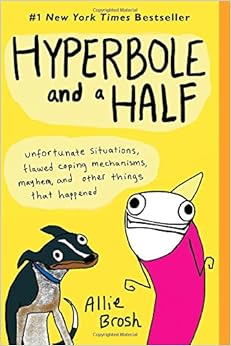
Hyperbole and a Half by Allie Brosh

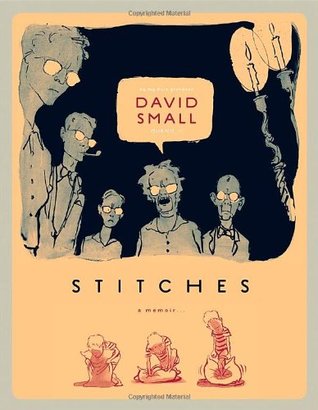
Stitches by David Small


So I’m a word guy, right? I love books, love reading; I enjoy movies and TV, but not the same way. I teach Fahrenheit 451 pretty much every year; in fact, I’m teaching it now. We’re at the point when Captain Beatty is explaining why the firemen are a good thing, because books, he claims, are a bad thing. He says, along with a mess of other interesting statements, that things started changing when photography came into its own, followed by motion pictures, radio, and TV – and, though Ray Bradbury didn’t predict it, the internet, YouTube, memes, GIFs, et cetera. Beatty says that things got simpler because they had mass: because a picture of a face is more solid than the face that one might imagine given a description. Guy Montag, the hero of the novel, is described as 30 years old, having a thin face, black hair, heavy eyebrows, and a “blue steel shaved-but-unshaved look.” So which is more solid, the face you’re imagining after reading those words, or this:


(By the way: took me twenty minutes looking through Google image search to come up with that. Searching for the description got me page after page after page of male models with swirly/spiky hair on top that was shaved on the sides. I mean, this dude

is not Guy Montag.

(Also by the way: I had to go back and re-do this search because my GODDAMN MS-WORD CLONE CAN’T SAVE PICTURES AND THEN UPLOAD THEM TO MY BLOG AND WHENEVER I TRY IT CRASHES THE THING AND THEN THE WHOLE POST IS BLANK AAARRRRRGGGGH Okay, I’m fine now. This is also why I like words more than pictures.)

Now, Beatty is the bad guy in the book, and if he is for it, I’m pretty much against it, including replacing books with visual mediums like film and television and the interwebs. But as Professor Faber (he is the Yoda to Montag’s Luke Skywalker) explains later, it is possible for books and movies and TV to all accomplish the same good things – the same things that music, and art, and conversations with good friends can all accomplish.

I think these two books, even though they are as visual and pictorial as they are literary – as many pictures as words, and the pictures essentially communicate as much as the words do – do the right things in the right way. That’s why I’m putting them together in this review. That, and the fact that both, despite the largely light-hearted genres they ostensibly belong to (Stitches is a graphic novel and Hyperbole and a Half a web comic), are actually quite somber and poignant and sad.

Hyperbole and a Half is a web comic that I discovered, as I think a lot of people did, because the author, Allie Brosh, wrote about the Alot. I hate that word; I love that comic. So I got the book that Brosh published, and read it. It’s a collection of her comics, which are about herself and her life: and though they are frequently stunningly funny, they are also profoundly sad and poignant to read. Brosh lives with fairly severe depression, according to what she depicts here, and she pulls absolutely no punches in describing what that life is like, and also allowing that condition, those feelings, to bleed into her other comics, as it no doubt bleeds into all parts of her life. Realizing how much she struggles with this turns even the more conventionally funny and wacky comics a bit more serious; because the strangeness that at first was just amusing now seems another piece of Brosh’s lifelong alienation.

But as hard as that is at times to read, it is also, simply, brilliant. I have rarely read something so honest and perceptive and brave, something that so perfectly shows a unique mind both in turmoil and in triumph.

Oh hey – know when else I read something that showed the same sort of genius and pain at once? Why, it was when I read Stitches, by David Small.

This one is a more traditional graphic novel; as such, it is in a more familiar storyboard format, and the art looks more like comic art; Small is an excellent illustrator, where Brosh’s art is intentionally simple and childish (Though still effective, and amusing as hell where it isn’t heartbreaking.). This is also a single story, told in words and images, rather than a series of shorts and vignettes like Hyperbole and a Half. It is the story of David Small’s family, particularly his violently abusive mother. The title comes from Small’s experience with cancer as a child: he had an undiagnosed tumor in his throat, which eventually led to the removal of one of his vocal chords, leaving him essentially mute, and also with a Frankensteinian line of stitches across his neck. This one is an even more terrible story. It’s maybe a little easier to live with, because it has villains and therefore heroes; Small should be considered heroic simply for surviving and growing up and getting his freedom, and then finding the strength to write this book – but the fact of his heroism makes the villains that much more terrible, and the story that much harder to get through.

But like Hyperbole and a Half, it is worth getting through. And in both of these cases – despite what Captain Beatty might think – the images don’t make the story easier to read, though I do think they give the stories mass. Almost too much of it, in fact.

I hope I haven’t made these books seem too dark or painful to read; they are both hard to read, but both are wonderfully realized, and really more moving than anything else. They are both genuine and honest memoirs written by intelligent and creative people, and I recommend them both.

Just – don’t read them one after the other. Put something more cheerful in the middle, there.

(Here: try this. I think it’s funny.)

Book Review: Zealot

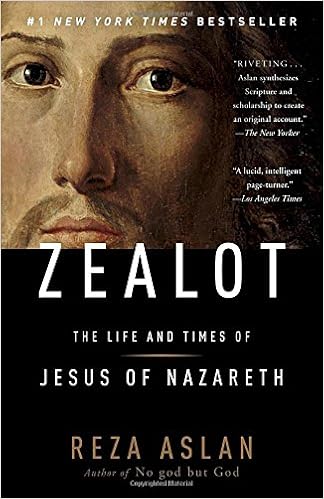
Zealot: The Life and Times of Jesus of Nazareth

by Reza Aslan

I have rarely encountered a more appropriate title on a book. This book is exactly what the title says it is: it is the life and the times of the historical figure of Jesus, who, according to the information provided, was essentially a zealot.

Two immediate points that have to be raised: the man is not the Christ, and though the Bible is the primary source of information along with the other apocrypha, Aslan never tries to talk about the risen Son of God as though that was the actual person. As a historian and religious scholar, Aslan considers the religious version of Jesus to be a matter of faith unrelated to the person who actually lived 2000 years ago in what is now Israel; the Gospels and the New Testament, Aslan explains in great detail, were all written by people who had had no contact at all with the historical figure of Jesus son of Joseph, and most of the New Testament was written by (or at least in the name of) an educated, Roman, Greek-speaking Jew who had no interest in the poor illiterate Jewish preacher from Galilee – St. Paul preferred the perfect embodiment of God that is now so familiar to modern Christians. The second point is that “zealot” is a word that meant something very specific in Jesus’s time, and the term applies quite well to Jesus himself; whether the modern meaning of the word would also apply is a different matter.

The basic idea is this: Jesus son of Mary and Joseph was a Nazarene. Right? Jesus of Nazareth, King of the Jews? Wasn’t that what the Romans wrote on the plaque over his head when they crucified him? So Nazareth is a tiny village in Galilee in northern Israel, where, like almost all of what came to be called Palestine by the Romans, the people lived in mud huts, with their livestock taking up one of the two rooms, spoke Aramaic, could not read or write, and believed that the Temple in Jerusalem was the place where God’s presence existed on Earth, but could only be approached by the High Priest. Jesus was not born in a manger in the barn outside a crowded inn in Bethlehem; his family would have had no reason to travel to Bethlehem, and certainly no Asian kings popped by with gold and frankincense and myrrh to worship at his side. So Jesus was an illiterate dirt-poor laborer – probably not even specifically a carpenter, since wood was an expensive building material that nobody in Nazareth would have been able to afford – whose mother was certainly not a virgin, who had brothers and sisters, and who lived his life under the oppressive control of the Roman empire. That life ended somewhere around 30 C.E. (Because Jesus was probably born around 4 BCE, a factoid that emblemizes absolutely all of the doublethink necessary to accept the Church’s version of this: the man was born four years before the first “year of Our Lord.”) when he was crucified for trying to incite a rebellion against the Roman control of Palestine, and against the corrupt high priests of the Temple. That’s the story told in this book.

Aslan says, and he’s right, that the historical Jesus is worth learning about. It’s a much less grandiose story; take away all of the I-am-the-son-of-THE-LORD-YOUR-GOD stuff, and Jesus had very small and comparatively humble intentions: he wanted to free Israel from the Romans, and (probably) rule the Jews as their king on Earth, the descendant (spiritually if not literally – but maybe literally) of King David, the founder of the nation. But that was plenty of ambition to be going on with, considering the fate of every other would-be messiah and king of the Jews under the Roman occupation. That fate is one of the linchpins of Aslan’s understanding of Jesus, because unlike Jesus himself, there is plenty of historical information about the Romans and crucifixion. He discards all of the standard arguments about Jesus’s trial and Crucifixion, and takes it down to what makes the most sense: the plaque over Jesus’s head was the Roman statement of his crime, not sarcastic, not ironic, but exact. The man wanted to be King of the Jews; he made a splash by gathering a large following, parading into Jerusalem exactly in the manner of an Earthly king, and then busting into the Temple and stirring up shit. The man who would later be turned into the “Prince of Peace” actually wanted the Romans, and the corrupt priests of the Temple, killed: he wanted God to smite them with a curse. (That’s the “zealot” part. The Jews believed that, if one had sufficient zeal for the lord, that God would aid them directly in winning their wars and destroying their enemies. Jesus wanted that, too. He wanted to be a warrior for God and Israel.) This is the rabble-rouser who told his disciples to make sure they brought swords to the Garden of Gethsemane, and if they didn’t have one, to sell their coats and buy two swords. He then got caught, and he got executed; that’s the end of the story – apart from what happened to his legend as it got re-created by his followers and adherents. I’d bet that one of the toughest pieces of this book to read, for a devoted believer in the literal Bible, is when Aslan lists the several would-be messiahs who were all trying to overthrow Roman control of Palestine around the same time: in that list, Jesus is one of the smaller and less impressive ones. Though really, if he was exactly what Aslan says he was, then Jesus of Nazareth had far more faith, courage, and conviction than I can imagine; I have more respect for this patriotic Jewish preacher than I do for the Christ. (I am, of course, an atheist and emphatically not Christian.)

I thought it was fascinating. This book is an outstanding piece of popular historical scholarship. Aslan gives extensive notes that show all sides of the issue, including the work of theologians who disagree entirely with the premise of this book; it is easy to read, clearly explained to a modern person like myself with no fundamental grounding at all in the history or the Bible; at the end, I’m pretty well convinced that he’s right, and I feel like I could sit down and explain the whole thing to someone else. I think that’s the best recommendation I can give.

The Fountainhead

The Fountainhead

by Ayn Rand


I don’t think I understood this book.

I understood parts of it. The hero, Howard Roark, is intended, I think, to represent the ideal man in Ayn Rand’s terms: he is self-made, dependent upon no one else, answers to no one but himself, acts for no other reason than his self-interest. He is not selfish in that he does not take things that he does not earn, does not steal from others nor hoard things that others would find valuable; he does not seek to impose his ideas on anyone else. He is a mix of what I would call an artist and what Rand would call an artist, in that she puts a higher premium on production and industry than I do, and thus Roark’s art – architecture – is seen as grander, by Rand than it is by me, because Roark erects man’s greatest achievement, in Rand’s view: the skyscraper. The city. I don’t know that I see cities as the ideal human creation, but I agree that architecture is an art with a particularly elemental aspect, in that architects build our homes, build our places, and thus have great influence on our lives. I can live with that as a sort of pinnacle of value.

(By the way: it isn’t that I would argue that architecture is a lesser art than, say, literature or music or painting; it’s just that art has to have an impact on the viewer to achieve its highest, or deepest, effect, and for me personally, a building doesn’t have the same magic as the perfect poem or song or painting. Totally subjective. Speaking of subjective, Rand keeps trying to pawn off Roark’s architectural style as the perfect ideal, and I don’t see it that way; she’s clearly a fan of Modern architecture, and I like several styles. Unimportant but kind of annoying while I was reading.)

The villain, Ellsworth Toohey, is the opposite of Roark. He lives entirely through others, but focused on himself in a purely selfish, greedy, and therefore evil manner: Toohey seeks to control others, to force them to obey his whims, for no other reason than because he desires that control (Rand hints, as she states more clearly in Atlas Shrugged, that by denying his own self-interest, what Toohey really wants both for others and for himself, is death. Okay.). He uses public opinion, which he can sway, to intimidate or extort others until they obey him; if they will not, he tries to use it to destroy them. He tries to destroy Roark because Roark can’t be controlled, because Roark doesn’t care about public opinion. (One of the best exchanges in this book is when Toohey, having used his manipulative wiles to screw up Roark’s life, catches Roark alone and says, “You can tell me what you think of me,” because he thrives on hatred and envy and bile. To which Roark responds, “But I don’t think of you.” That was a great line.) But because Roark doesn’t care about public opinion – because he lives only for his own happiness, using only his own reason to determine his value – Toohey’s attempts to destroy Roark do not work. Roark, like the honey badger, doesn’t give a shit. I appreciate that. I can even admire it.

The other character I understood was Peter Keating. Keating is not the opposite of Roark, but the negative of Roark: he cares only for public opinion. He never uses his own standards, nor even his own ability to accomplish anything; like Toohey, he excels at manipulation, and Keating uses that manipulation to worm his way into people’s trust and then take credit for their work. He is supremely successful because of that, and absolutely miserable: the opposite of Roark. (Keating too is an architect.)

I got all of that. I could appreciate that story, of Keating competing with Roark and not really understanding why he feels like he’s losing even though he wins every award, every contract, every accolade that he and Roark both try for. I could appreciate the story of the evil Ellsworth Toohey trying to destroy the good Howard Roark, and Roark essentially winning that fight even though Toohey is appallingly effective at manipulation, just because Roark doesn’t care what anyone else thinks, and because he is good enough at what he does for the quality of his work to show through despite what the critics have to say about it (Among other things, Toohey is the premiere critic of architecture in the book.).

What I didn’t get, though, was the love story. The female protagonist is named Dominique Francon: she is the daughter of Peter Keating’s boss and predecessor as most-successful-but-least-actually-talented architect, and she is, like Toohey, a critic of architecture. She is also, like Roark, a Randian ideal in that she thinks for herself and cares not at all what others think of her. She enters into relationships as a self-interested party offering value for value, which is how Rand says that love should work.

The problem is that she loves Howard Roark. It wouldn’t be a problem, because Roark is the ideal man and therefore of course she loves him, except: their relationship starts when Roark rapes her. Straight up, not simply according to my overly-sensitive interpretation; Roark breaks into her house at night and rapes her, and when she refers to it later, she says “He raped me.” And then they love each other. They love each other so much, in fact, that Dominique leaves Roark and marries Peter Keating. Who, because she does not at all love him, she does not respond to, turning into a lifeless mannequin whenever he touches her (A particularly distasteful element that Rand also played up in Atlas Shrugged, with one of the female villains in that book.). Now, Dominique does this ostensibly because she can’t stand to watch Roark go through the crap he has to deal with from Toohey and all of his allies as they try to destroy his reputation and therefore the man himself, but I really don’t get it. I don’t get why she marries Keating, I don’t get why she then leaves him and marries Gail Wynand (who I also don’t get), and I don’t get why she loves Roark after he raped her. I don’t get what Rand is trying to say with all of this. I don’t get why Dominique is the ideal woman when her major quality seems to be her unearthly beauty (Which, as an unimportant side note, I also couldn’t see simply because Rand’s idea of beauty is not mine: Dominique is tall and thin and pale and cold and has hair that is repeatedly compared to a helmet complete with metallic sheen. But that’s neither here nor there: if she had been described as my ideal imaginary woman, I still wouldn’t understand her actions or role in the book.) and her determination to leave the man she loves and marry a man she loathes. I don’t get how that’s good.

My problem with the book is that the parts I didn’t get took too much away from the parts I did get. I can’t root for Roark when he’s a rapist. I can’t root for Dominique when I don’t know why she does what she does. I can’t root for Toohey or Keating when I do understand that they’re scum. I would actually root for Gail Wynand, who is a badass and also a Randian ideal: he is self-interested, motivated, hard-working, and entirely self-made. It seems that his failing that makes him a flawed character is that he has built an empire based on public opinion rather than his own ideals and reason. Wynand sought power, and he found it along with wealth by becoming William Randolph Hearst: he owns all of the trashiest, most sensational, and most successful newspapers in the country. In the second half of the book, Toohey goes after Wynand (Because Wynand has power that Toohey wants), and Wynand is finally destroyed by Toohey, though Wynand makes it a Pyrrhic victory for Toohey. I’m not sure why Wynand loses, though. Rand shows how manipulating public opinion, and really socking home the idea that altruism is the only good and anyone who is wealthy is greedy and therefore vile and selfish, can destroy an empire; that’s how Toohey takes Wynand down. But I think Wynand is not supposed to be a victim, here: he is somehow partly responsible for his downfall. He used his papers to manipulate public opinion in order to garner power, and that is finally turned against him; I suppose that is his evil, his tragic flaw. But I feel that undercuts the message of Toohey’s villainy, and it made me unsure if I should be mad at Toohey or Wynand. And then there’s the fact that Wynand falls in love with Dominique, and she marries him and loves him on some level – but then drops him like a hot rock and goes back to her rapist. (And I feel like I’m supposed to appreciate how Dominique can look past the fact of her rape, and therefore I’m being like a stick in the mud or a prude or something by harping on this. And if so, well, bite me.) So is this more evidence that Wynand is flawed and I’m supposed to admire Roark more than Wynand? I don’t. I see Wynand’s evil side, in his abuse of power; but I see Roark’s evil side in his abuse of Dominique. And Dominique’s evil side in her betrayal of – well, everyone, in one way or another; particularly herself.

Basically, I dislike everyone in this book, and so I can’t see the ideal aspect I’m supposed to appreciate and try to emulate. I was not made happy by the happy ending.

So I figure, either I didn’t understand the book well enough to appreciate it, or I did understand it, and it’s pretty much evil crap. Either way, I can’t recommend it.

I invite anyone who feels they can explain the book to me to do so. I completely accept that I am not a fair judge of it because I didn’t really get it, and I would like to understand it even if I still don’t agree with it, should that be the case.

Book Rant — I mean, REVIEW: Dune Messiah

Dune Messiah

by Frank Herbert


What does it mean when you don’t understand a book?

This is something that has bothered me for a long time, now. Because back in grad school, I signed up for a class that was going to focus on James Joyce’s Ulysses; each student in the seminar was going to annotate one chapter of the thing. I had never read Joyce, and so I got Portrait of the Artist as a Young Man out of the library, and read it, to give myself some idea of what I was in for.

Couldn’t understand it at all.

Two weeks later, I dropped the class and dropped out of grad school.

Joyce wasn’t the only reason I did that, and that wasn’t the only book I couldn’t understand. But it’s bothered me ever since, both looking back on that period in my life, and also whenever I read books now that, like Portrait of the Artist, I just can’t really grasp. There’s a spectrum, of course: some books I get almost all of it, except for a certain section, or just a few paragraphs; some I can’t break into at all. Gabriel Garcia Marquez’s One Hundred Years of Solitude was one of the latter; Wuthering Heights, one of the former.

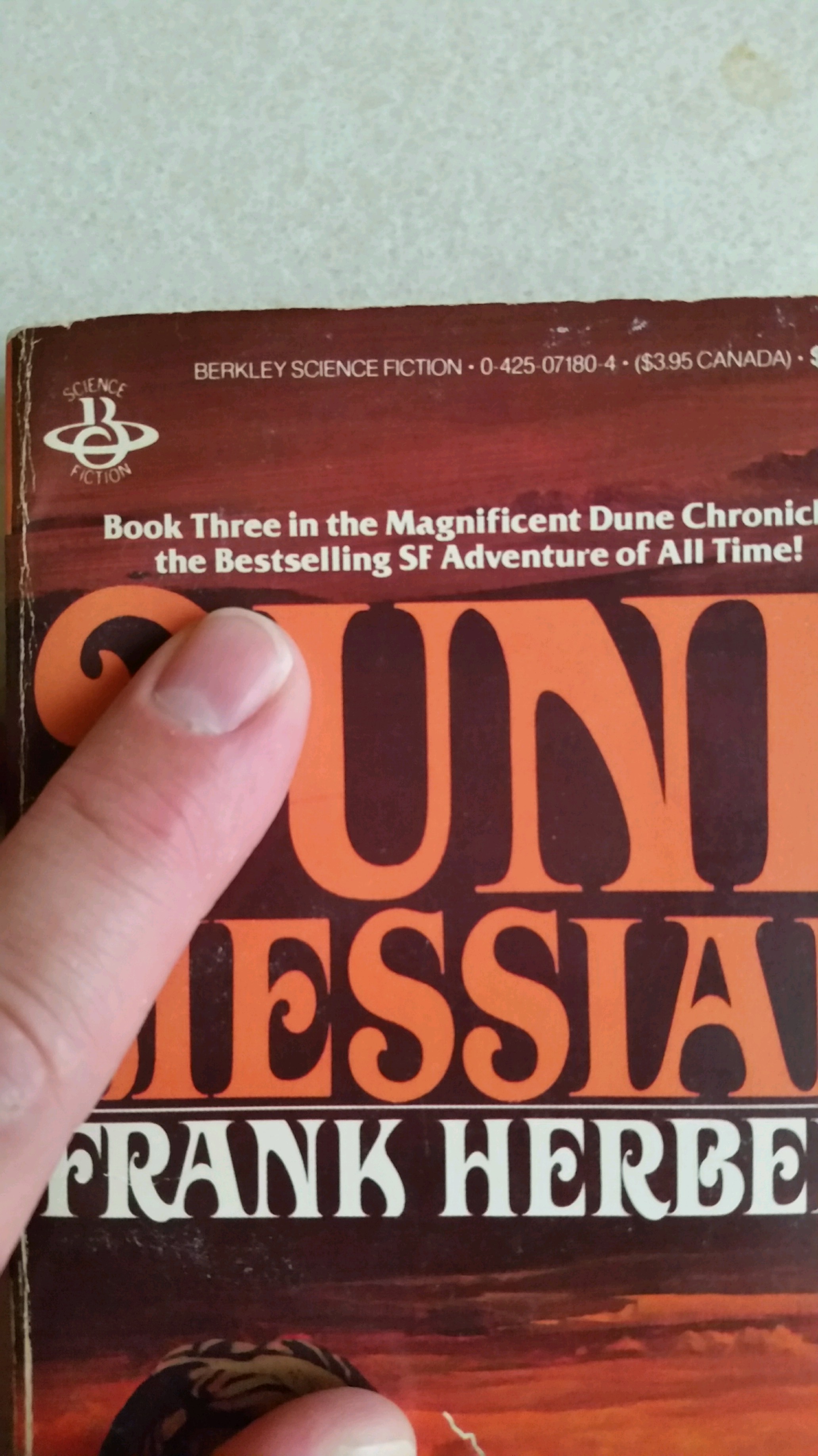
And Frank Herbert’s Dune Messiah, the sequel to the legendary classic Dune, is another one that, like Wuthering Heights, I couldn’t quite get all of it. And I’m not sure why. I don’t know if it’s because I’m not as smart as I think I am, or if Frank Herbert thought I (and the rest of his audience) was even smarter than I am, or if Frank Herbert wasn’t nearly as smart as he thought he was. All I know is, though I could follow most of the plot, and there are parts of this book that I actually really enjoyed, there were a number of sentences, paragraphs, and even chapters that I had to read over and over, and at some point, I said “Screw it,” and just skimmed those parts, thinking, “Yup, don’t get this. Don’t get this at all.”

So the general idea of the book: Dune is a story of intergalactic intrigue. There is a noble family, many millennia in the future, called the Atreides; they are put in charge of the most valuable planet in the galactic Empire, the planet Arrakis: known as Dune, because the entire planet is one huge desert. Dune is the most important planet in the galaxy because it is the sole source of melange, the spice; the spice is a drug that allows people to see into the future, which is the only way that spaceship pilots can steer through hyperspace. The spice has various other effects, too, not the least of which is that it extends human life (Unless you stop taking it, in which case, you die.). So the Atreides family gets to take over Dune, but unfortunately, they have enemies, and their enemies invade Dune and wipe the Atreides out. The wife of Duke Atreides escapes with her son Paul, and they find refuge among a group of desert nomads called the Fremen, who are, because of the incredibly harsh conditions of their life on Dune, the baddest-assed badasses in the whole galaxy. Paul and his mother are adopted by the Fremen, and over time, Paul comes to be their leader; he leads the Fremen back out of the deep desert and reconquers Dune, and from there, the entire galactic empire, because as soon as he controls Dune, he controls every powerful person who uses the spice, because if he cuts off their supply, they will all die. He threatens to do that, and he also blackmails the emperor, and hey presto, Emperor Paul Atreides. End Book One.

Now, that’s not the whole story. There is a crapton more, because Frank Herbert liked him some complicated universes, and there are various factions and issues wrapped up in the whole thing – the Landsraad and CHOAM, the Bene Gesserit, the Harkonnens, the Sardaukar, on and on it goes. There are also prophecies and religious ideas, and Paul becomes Muad’dib, and the Mahdi, and also Usul, and he’s the kwisatz haderach – it’s a lot. You wouldn’t want this guy’s life. But that’s the main plot: family gets destroyed, son comes back and takes revenge and seizes power for himself. Combination of Macbeth and Hamlet. No problem.

But then there’s Dune Messiah.

I would like to note here that my father, in discussing this series with me some years ago (This is my second time through the series; the first time I made it to Book 4, God-Emperor of Dune, before I gave up.), expressed his opinion that the first book was a fluke, that the other five books were the ones Herbert wanted to write, and the first book had somehow gone astray — and was, he said, the only book Herbert wrote that is worth reading. Just something to keep in mind.

In Dune Messiah, Paul Muad’dib has been Emperor for twelve years, and his legions of Fremen have been waging a successful jihad against the rest of the galaxy – there’s a point when Paul talks about Genghis Khan and Hitler, and the millions of people they killed; then he says that a conservative estimate would put his death toll at 90 billion humans. Paul and his sister, St. Alia of the Knife (If I ever had a daughter, that would be her name. St. Alia of the Knife Humphrey. And I wouldn’t let her shorten it, either.), have been turning themselves into religious idols, mainly because both of them are prescient: they can see the future. It doesn’t seem like this is a good idea, though, because neither of them want to be gods, and they have grown to distrust their own theocracy. Paul is also having trouble in his personal life because he has a sort of unofficial marriage with the Fremen woman he loves, Chani, but in order to become Emperor he had to officially marry the daughter of the former emperor, a woman named Irulan, whom he doesn’t care about but has to placate in order to keep his throne secure. Both of these women want to have Paul’s children. Paul only wants to have children with Chani, but he can’t cast aside Irulan; but for some reason (it isn’t an accident) he and Chani can’t conceive. Meanwhile he’s dealing with this whole issue of the Fremen turning on him, partly because they think he’s become corrupt, partly because they’ve become corrupt – it’s not clear. And then there are the Bene Tleilax, (Want to know how to pronounce all of these names? So do I. Guess. It’s what I do.) who resurrected one of Paul’s old friends and teachers, who was killed in the first book when the enemies overtook Dune, and have now sent that guy to — maybe kill Paul? Maybe help him maintain power? We don’t know. And then there’s a guy floating in a tank of orange gas, because he’s so addicted to the spice that he breathes the shit; and that makes him prescient, though not as prescient as Paul – because of the kwisatz haderach thing, in addition to the fact that Paul’s horking down spice by the bucketful; but the kwisatz haderach thing is why the Bene Gesserit are so obsessed with him, because the Bene Gesserit are a quasi-religious order who are basically eugenicists, who have been trying to breed the perfect human for like ten thousand years, and they finally did it, and it’s Paul. And now they want him to have kids and pass on his perfect genes – but Irulan, who is a Bene Gesserit, is their choice, while Paul only wants kids with Chani, but if he binds himself more closely to the Fremen then they will take the whole Messiah-Jihad thing waaay too far, and will kill Paul’s whole family and probably the universe, too. And Paul can pretty much see all of the possible futures, except for where another prescient person is involved because then they muddy up the timestream because they can see what’s coming and therefore can react to it, which changes Paul’s ability to see what comes next, and so he’s trying to pick the best future but he can’t really see which one it is, and every future kinda sucks.

And that’s not even what I couldn’t understand. Other than the Bene Tleilax, who literally make no fucking sense but are really cool anyway because they have these people called Face Dancers who can change their appearance at will and I love that name, I could follow all the political stuff. And most of the time stuff. The last ninety pages or so are the best part of the book, largely because the motivations become simple; also at one point Paul gets blinded – but it doesn’t matter because at that point he can see the future so completely clearly that he can see where everything around him is, in his visions; so he can point to people and describe their appearance, even though he has no eyes in his head, and it’s both cool and interesting.

No: the problem with this book is the way people talk. Herbert expects us to pick up on their subtleties, to understand not only what they say but what they really mean, so clearly that he never explains what the characters mean when they talk. It’s worst with two specific characters, both related to the Bene Tleilax: a Face Dancer named Scytale, and the resurrected friend of Paul’s, who was originally named Duncan Idaho and now goes by the unfortunate name of Hayt, which is much too much like a bad screamo band name. When these two guys talk, it just – it makes no sense at all. In the first chapter, Scytale is having a meeting with his other anti-Paul conspirators, and he says, “You wish to draw me into this fools’ fight? Very well. We’re dealing with a potential messiah. You don’t launch a frontal attack upon such a one. Martyrdom would defeat us.” I mean, okay, but you know what he left out? What their goal is. Kill Paul? Replace him? Take down his self-made religion, and his jihad? Bring back the old ways? We have no idea. They just – can’t have a martyr. And then one of his partners says “You think that’s the only danger?” And when Scytale doesn’t respond, and she says, “Well?” Scytale says, “I was enjoying the silence. Our hostilities are better left unvoiced.” And again: what hostilities? It’s never explained. You don’t like each other, sure, I don’t like you either, but – why not? If you don’t like each other, why are you working together? And why is it better if the hostilities are left unvoiced?

I guess we’re supposed to either figure these people and their goals out from subtle clues, or else just – know. Somehow. Herbert never explains what the Bene Tleilax want. He says that they create tools, but by the end of the book I don’t know if Paul is the tool, or if Hayt/Idaho is. Or both. Maybe neither. And it’s not just these people, though Scytale is the worst: we’re not clear what Paul wants, or what St. Alia of the Knife wants, or what the Fremen want, or anyone, really. Which made this book terribly annoying when it wasn’t talking about very simple things: by the end, Paul wants his wife Chani to live. We get that. St. Alia of the Knife wants to be loved. Sure, yes, good. Hayt wants to be Duncan Idaho again, and remember what that meant. I get that, and I approve. And if that had been what the whole book was about, I would probably like it; as I said, there were parts that I liked, and I did really like Dune.

But then there’s this kind of shit: (Note: Hayt is a ghola, a reanimated zombie, basically, who used to be Duncan Idaho; he is also a mentat, which is a human computer, like a Vulcan, pure logic, no emotion, super fast thoughts. There is no reason to think he would know the future, and yet somehow they all seem cool with him making predictions. Your guess is as good as mine. Oh – and he has steel eyeballs instead of normal ones.)

“Hayt,” Paul said, “are you the tool of my undoing?”

“If the substance of here and now is changed, the future is changed,” the ghola said.

“That is no answer!” Chani objected.

Paul raised his voice. “How will I die, Hayt?”

Light glinted from the artificial eyes. “It is said, m’lord, that you will die of money and power.”

Chani stiffened. “How dare he speak thus to you?”

“The mentat is truthful,” Paul said.

“Was Duncan Idaho a real friend?” she asked.

“He gave his life for me.”

“It is sad,” Chani whispered, “that a ghola cannot be restored to his original being.”

“Would you convert me?” the ghola asked, directing his gaze to Chani.

“What does he mean?” Chani asked.

“To be converted is to be turned around,” Paul said. “But there’s no going back.”

“Every man carries his own past with him,” Hayt said.

“And every ghola?” Paul asked.

“In a way, m’lord.”

“Then what of that past in your secret flesh?” Paul asked.

So. Dunno why Paul asked that first question when he’s the one who can see the future. Dunno what Hayt’s answer means. Dunno why Paul asks the second question, either; Chani wants to know what the hell he’s doing with this zombie thing that can’t be trusted, and Paul doesn’t fucking help at all, he just makes it more confusing – and he completely ignores Chani when she voices the same confusion that I’m feeling. Which I assume is why she changes the topic entirely in the middle of the conversation – maybe she’s offended by the money and power comment, though I can’t for the life of me understand why it’s offensive – but then Paul is the one whose answer makes no sense, but they slip right past that into this last exchange, ending with the “secret flesh” thing, which – huh? He’s no secret, you’ve known all along that he’s the reanimated zombie of your friend. Everybody knows it. What fucking secret flesh, Paul? WHY DON’T YOU MAKE SENSE, PAUL?!?

Anyway. Maybe it does all make sense, and I’m too dim to understand it. All I know is, I probably should have stopped after the first book. I don’t think I’ll read the third.


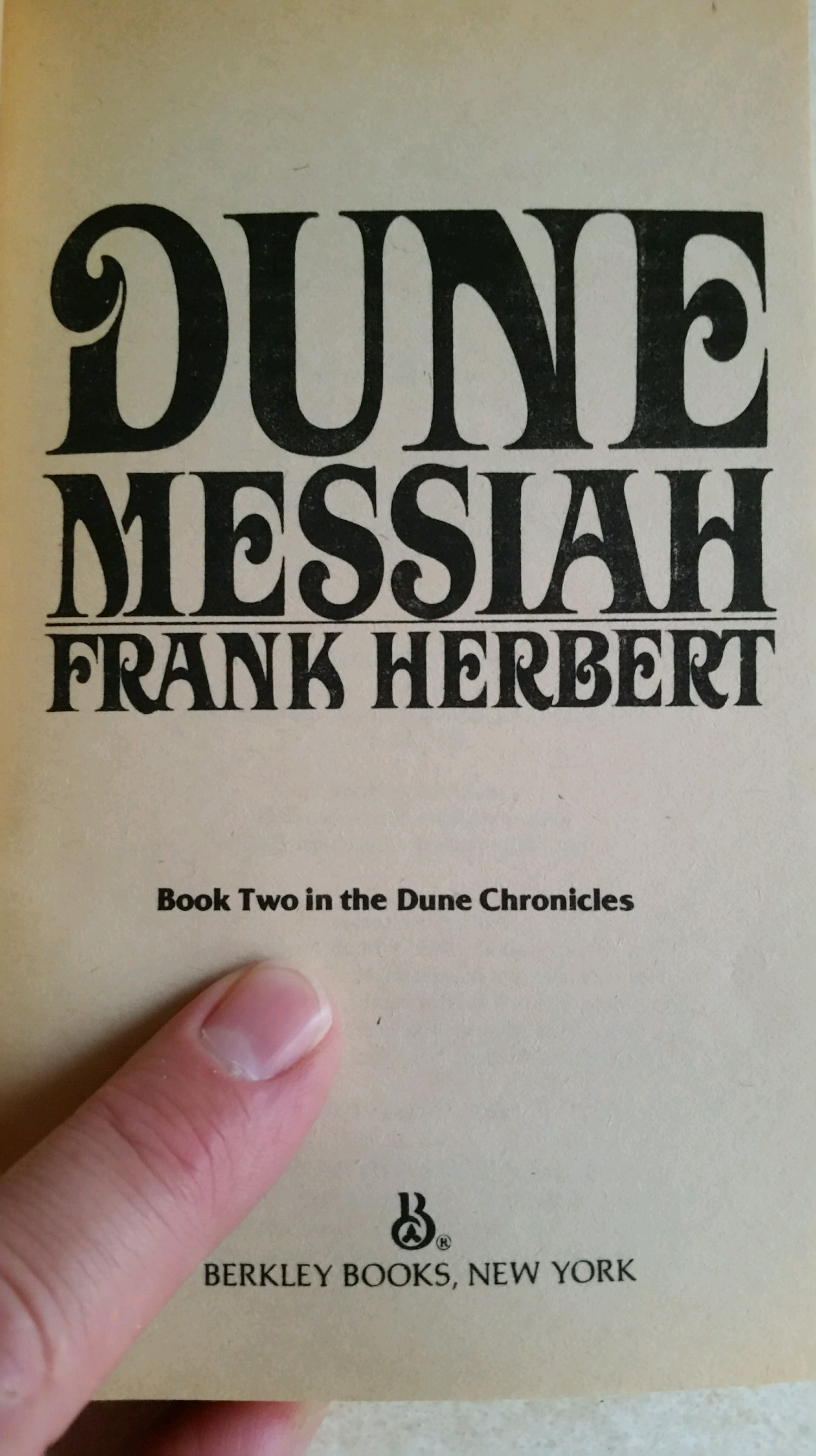
One last thing: I have a new theory why this book was so confusing for me. Here is the cover of my book (finger added for emphasis):

And here is the title page, also with emphatic finger. See the problem?

Book Review: Modoc

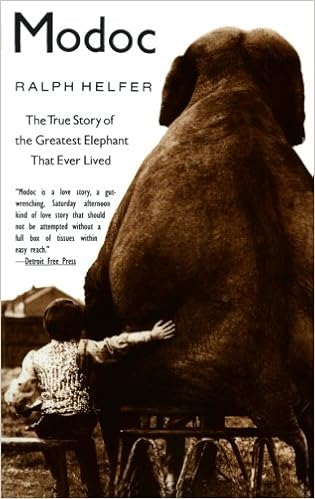
Modoc: The True Story of the Greatest Elephant That Ever Lived

by Ralph Helfer


This is a very sweet book, an amazing story about a remarkable elephant. It is also unbelievably cheesy.

That doesn’t have to be a problem, of course. Most love stories are cheesy to one extent or another, and this is, most definitely, a love story. It’s a story about a man named Bram Gunterstein and the three loves of his life: the two women he loved, Sian and Gerdie, and the elephant, a female Indian pachyderm named Modoc. He called her Mo. Mosie.

Mo and Bram were born on the same day, in the same hour, on the farm owned by Bram’s elephant-trainer father, near the Black Forest in Germany. The two grew up together, and the pastoral idyll of this portion of the book is almost painfully innocent and sweet – it did, for me, get a bit saccharine, especially when Gerdie comes into the picture and she, Bram, and Mo spend summertime frolicking through the hedgerows and splish-splashing in the lakes. Ah, Youth. But then reality catches up and the owner of the circus where Modoc performs with her elephant family sells everything to an American circus owner. Bram is to be left behind as Modoc and the other animals are moved to America.

But Bram can’t leave Mo. So instead, he leaves Gerdie – and as sad as it is, it is clearly the right choice.

Unfortunately, when Bram and Modoc leave the pastoral perfection of their childhood, frankly, the shit hits the fan. A whole lot of shit hits a whole lot of fans, and spreads far and wide. The two have incredible adventures, most of them in some way terrible. There is suffering, war and blood and death, disease and starvation and fire and misery. There is also a tremendous amount of love, and quite a lot of spirituality; Bram believed that the way to God was through communion with nature, particularly through close bonds with specific animals as he had with Modoc. If he was right, then he no doubt found his way to God, because I can’t imagine a closer bond than his with this elephant.

In the end, I liked the book. It was absolutely riveting at times, and heartbreaking at others; though the author, Helfer, who knew Bram and Modoc both towards the ends of their lives, tends heavily towards the cheese, I would say it’s because he’s an animal trainer, not an author. I will also say he’s a much better poet: there is a memorial poem he wrote included at the end of the book which is by far the best moment of writing. But even if he was a terrible writer – which he is not – this book would be worth reading just for the story, and the characters. Definitely recommended.

Book Review: Lloyd Alexander’s Westmark

Westmark

by Lloyd Alexander


I grew up reading the Chronicles of Prydain by Alexander, and I only discovered as an adult that, in fact, the man wrote several other books. It’s been a lot of fun discovering and reading those other novels, even though it makes me feel kind of dumb that I didn’t already know about them; after all, Alexander won two National Book Awards and was nominated for four more, so . . . I guess everybody but me knew about his broader legacy. I would like to blame my parents for not telling me about Alexander’s other books. And also Piers Anthony, who so captivated my youthful love of fantasy that I read every single one of his books. Including his genuinely crappy autobiography, Bio of an Ogre.

Blame and castigations aside though, this is a genuinely good book. It is more adult than the Chronicles of Prydain: it really only belongs in fantasy because it’s Lloyd Alexander. He never writes with too much magic, but this book has none; rather, it has – politics. It’s about a printer’s assistant, Theo, who goes on the run after his master Anton is killed by the military as part of an attempt to control the press. The printer’s assistant hooks up with a con man and snake oil salesman who is a mixture of Shakespeare’s Falstaff, and the King and Duke from Huck Finn; he’s a big, bombastic, lovable rogue who makes no bones about the fact that he’s in it for the money and will tell whatever lies he can in order to get it. He’s a lot of fun and he makes the book a lot of fun.

It isn’t all fun and games, though: the fear and anger over the printer’s death and the subsequent flight are quite serious. Theo eventually parts ways with the con man and joins up with a group of intellectuals leading a rebellion, who are a great set of characters; the last third of the book is a quite realistic portrayal of the beginnings of a revolution, including Theo’s efforts to print anti-royalist pamphlets as his own efforts to free the people. Yeah: definitely not a simple children’s book.

The book leans more fantasy in the royal aspect of the politics: although there is a definitely historical feel in the elements about revolution, the causes of the nation’s oppression come straight from a fairy tale. The king is bereft and despondent to the point of uselessness over the death, several years ago, of his beloved only daughter. An evil counselor – I definitely think of Jafar from Disney’s Aladdin, or Flagg from Stephen King’s The Eyes of the Dragon – has taken over running the kingdom, and is trying to consolidate power for himself, becoming a tyrant in the process. He is overcome not by the revolution, but by the direct actions of our hero, who essentially saves the day – though there is a twist I won’t give away.

It’s a good book. The characters are well-drawn, as is the setting; the plot is a little haphazard, which I think is because of the mix of fairy tale and historical novel, but it isn’t hard to follow. And the other reason for the somewhat complicated course of the story is: this is the first book of a series of three. So there are seeds planted here, paths started but not taken to their ends, because there is more story to tell.

I’m going to try to find the other two books. I recommend this one.

One last note: the biggest downside of this book, for me, was honestly the cover. I hated this image, and the way it depicted the characters, so much that I tried not looking at it while I was reading the book, and even now I can’t stop thinking bitter thoughts. Yech. But of course, don’t judge this good book by its crappy cover.

The Complete Douglas Adams

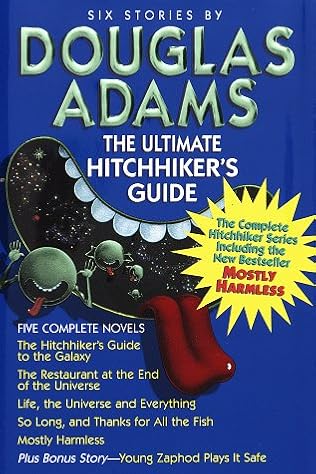
The Ultimate Hitchhiker’s Guide

by Douglas Adams


I don’t think the world needs me to say that these books are brilliant and wonderful. They are brilliant and wonderful, but I hope everyone already knows that. If anyone out there within sight of these words has not already read these books, then you absolutely must pick them up as your very next piece of reading – particularly since it is summer time, and there are no better beach reads than these.

There are a few things that I will add to the conversation.

First, this Omnibus edition is probably not the best way to read these books; it’s convenient to have them all together, but it’s much too large and unwieldy; this is the kind of book that you almost don’t want to read lying down in bed, because there’s no way to hold it up without your arms getting tired. And very little in life makes one feel more pathetic than watching your arms tremble from holding up a book. Also if you are, like me, prone to dozing off while reading, this book will do real harm if it falls on your face. I will also say that the bonus story here, Young Zaphod Plays It Safe, was almost entirely pointless. Not in a wacky Douglas Adams way, but in the way that I didn’t know why I had read it.

On the other hand, while I have seen the first three books everywhere for years in small convenient paperbacks, I have not seen the last two books, So Long and Thanks for All the Fish and Mostly Harmless in the same format with the same frequency. And just like Star Wars, while there are plenty of people who carp that the first three are the only good ones, I disagree; Mostly Harmless has some flaws, but So Long and Thanks for All the Fish not only fits in well with the others, but it has one of the best romances I have read in a light-hearted book. There aren’t a lot of comedic authors who can tell a good love story (Christopher Moore is actually the only one who comes to mind), but this book is a good love story. It is worth reading all by itself. Mostly Harmless probably is not, but it has some absolutely wonderful moments: Ford Prefect pulling a Mission: Impossible on the Guide central office; Arthur Dent as Master Sandwich Maker; the realm of The King; the planet of What Next. I hated the ending, predictably, as it is not funny; but it certainly puts a period on the series. I think fans of the books should read it, most definitely.

The second thing I would like to add is this: not only was Douglas Adams a creative genius and a hilarious man – probably the funniest author I know of – but he was, simply put, a hell of a writer. This is his description of the Vogon Constructor Fleet in the first book:

The great ships hung motionless in the sky, over every nation on Earth. Motionless they hung, huge, heavy, steady in the sky, a blasphemy against nature. Many people went straight into shock as their minds tried to encompass what they were looking at. The ships hung in the sky in much the way that bricks don’t.

That last sentence is pure genius. And for a simpler, beautifully done writerly trick, this is the way he describes the actual destruction of Earth (I can’t think that’s a spoiler: it happens at the end of the first chapter, for Pete’s sake.):

There was a terrible ghastly silence.

There was a terrible ghastly noise.

There was a terrible ghastly silence.


Some of my other favorites:

The first thing that hit their eyes was what appeared to be a coffin.

And the next four thousand nine hundred and ninety-nine things that hit their eyes were also coffins.


(Describing a paranoid military character practicing his menacing:)

Number Two’s eyes darted feverishly about the room again and then settled back on the mirror, like a pair of flies briefly distracted from their favorite piece of month-old meat.


From Life, the Universe and Everything:

“The dew,” he observed, “has clearly fallen with a particularly sickening thud this morning.”


This, from So Long…, is a description of the woman half of the romance, and this is why this book should be read and enjoyed.

She was tallish with dark hair which fell in waves around a pale and serious face. Standing still, alone, she seemed almost somber, like a statue to some important but unpopular virtue in a formal garden. She seemed to be looking at something other than what she looked as if she was looking at.

But when she smiled, as she did now, suddenly, it was as if she had just arrived from somewhere.


And what may be my favorite description of all time:

If you took a couple of David Bowies and stuck one of the David Bowies on the top of the other David Bowie, then attached another David Bowie to the end of each of the arms of the upper of the first two David Bowies and wrapped the whole business up in a dirty beach robe, you would then have something which didn’t exactly look like John Watson, but which those who knew him would find hauntingly familiar.


The last thing I will say about these books is a personal confession: when I was 12, I auditioned for a school production of Pirates of Penzance by reading the Vogon poetry from Hitchhiker’s Guide. And when the director tried to cut me off by saying, “Okay, thank you,” I held up one finger to signal that I wasn’t yet done, and went ahead and finished the piece.

I didn’t get the part.

But you should get these books.

Oh freddled gruntbuggly,
Thy micturations are to me,
As plurdled gabbleblotchits,
On a lurgid bee.
Groop, I implore thee, my foonting turlingdromes,
And hooptiously drangle me,
With crinkly bindlewurdles, mashurbitries.
Or else I shall rend thee in the gobberwarts with my blurglecruncheon,
See if I don’t!