Book Review: Norse Mythology

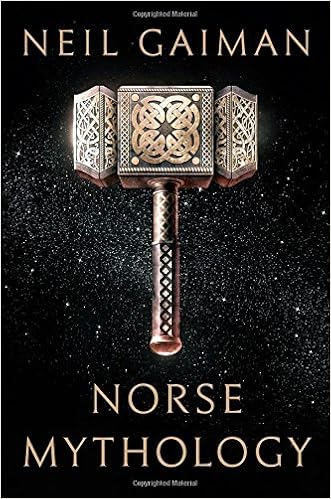
Image result for neil gaiman norse mythology cover

Norse Mythology

by Neil Gaiman


I can’t decide if Loki’s better or worse than I remembered him.

The gods are worse. No question. Not all of them: the female gods, Freya and Sif and Idunn, bearer of the golden apples of immortality, are better than I remembered them; Gaiman manages to give them an air of tender exasperation with the idiotic men who surround them. The dark gods, and especially the giants who show up in almost every story, are better, too; I was rooting for them half the time, especially when they had to deal with Thor.

I hate Thor.

He does have his moments; I like the stories about his limitless might, and especially his nigh-infinite capacity for food and drink; I love that that was a sign of his prowess, that he can eat more and drink more than any other being alive. But he keeps getting mad and attacking everything, and rather than justify his actions, or – Odin forbid – atone for his sins, he tends to just kill anyone who would take him to task for breaking things or stealing things or what have you. The fact that Loki so often targets Thor is probably his best quality.

This is a great book. The myths are so much fun to read, the characters so human and relatable even while they are doing impossible things; Gaiman has this incredible ability to layer character traits deep into the narration, so that you’re hardly aware of it, but then before the story is over you know: Tyr sacrifices his hand for love of Fenris, as much as for love of his fellow gods. Kvasir, the god of wisdom, not only knows his own doom before it comes, but he almost welcomes it, because it saves him from having to deal with bastards like the evil ones that – but I don’t want to spoil it. Odin is the Allfather, all right: and his kids annoy the crap out of him. The stories in this book aren’t familiar enough to me to make them boring; there were a few that I knew, and of course I knew the last one, the story of Ragnarok, but even that one had new aspects that made it fresh and exciting: because I love the idea that Ragnarok gives rise to the next cycle of existence, that it is not, in fact, the end, even though it is the end of the Aesir and the Vanir.

And frankly, considering what they do in the end to Loki? They deserved everything they got.

Of course I recommend this. Of course it was wonderful. I read it in small pieces, but I think it would go just as well being swallowed whole – like the sun and the moon into the maw of Fenrir. It was magical, and funny, and human, and otherworldly, all at the same time.

But you know what the best part was? Honestly, it was this. At the funeral of Balder, most beloved of all the gods, brought down by Loki’s envious plotting, Thor is mad (because the gods won’t let him kill a giantess who is present) and then this happens:

Lit, one of the dwarfs, walked in front of Thor to get a better view of the pyre, and Thor kicked him irritably into the middle of the flames, which made Thor feel slightly better and made all the dwarfs feel much worse.

From now until Ragnarok, whenever one of my teenaged students says, “This is so lit!” I will think of nothing else but Thor kicking the dwarf into the fire. And for that, Mr. Gaiman, I thank you.

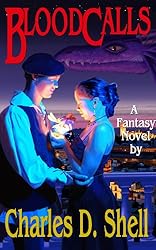
E-Book Review: Blood Calls by Charles D. Shell

Image result for blood calls charles shell

Blood Calls

by Charles D. Shell

(Please note: I was given a free copy of this e-book in return for my honest review. This is it.)


Now that was a fun book.

I haven’t read a ton of independently published e-books; but of the ones I have read, this was without a doubt the best.

It’s the story of two outcasts, a man and a dragon, both the victims of deep-seated and vicious prejudice, who find friendship and solace with each other; until they are finally forced to leave the land of their birth. The man, Corbin, who is a nobleman of his home country of Denza despite being an unwanted bastard with a mother from a despised minority, is given a minor diplomatic post in neighboring Sunal, thanks to the influence of his influential uncle. Corbin and his only friend, the dragon Blood, travel to Sunal, where, if everything goes according to plan, Corbin should be able to sink into relative obscurity, pursuing his twin passions of drinking and womanizing, and perhaps occasionally dipping his toes into diplomacy.

But world events, and Corbin’s heart, have other plans. Corbin finds that the prejudice that he has suffered under for all of his life is nonexistent in Sunal, where the Skuranese, his mother’s people, are accepted. Corbin is able to find friendships (with other men, for once) and even to pursue a woman for more than a roll in the hay. This would be enough changes in Corbin’s life: but there’s more. War is coming to Sunal. War that could threaten everything that Corbin has found there, as well as his homeland, his life and the life of his dragon, and perhaps everyone on the continent. Unless Corbin and Blood can do something about it.

The world-building in this book is top notch. The relationships between the various nations and their people are interesting, and enough historical backstory is given to make it all seem quite realistic. The magic system is done well, with different spellcasters making use of summoned spirits and creatures, or simple control of the four elements, or Frankenstein/steampunk creations made of living creatures mixed with machines. There are some unusual elements in the magic system that were very intriguing – like sonomancy, the use of sound for magic and also as a weapon; Shell was also able to reflect that form of magic in the society that makes use of it, which was a thoughtful and effective choice. The military aspects of the war – which is told not only through Corbin’s experiences, but also from the point of view of an officer of the aggressor nation of Gurein, which is trying to conquer and consolidate an empire, no matter what the cost – are as good as any military fiction I’ve read. I did wish there was a map, a visual aid that I have always found both interesting and useful in books like this; hopefully the author, with his arts background, will be able to provide one in future books.

The book isn’t perfect. I thought the romance was a bit haphazard: Corbin has never been anything but a womanizer, and though it makes sense that he’s never had an opportunity to be anything more, he jumps from that habit to a pursuit of true love a little too easily; he also settles on the object of his affection without much more inspiration than Romeo and Juliet, and though I love the Shakespeare play, I don’t really believe in love at first sight, especially not when it is turned into a chivalrous courtship, as this one basically is (though not entirely, I hasten to add). The dialogue and banter between the characters is often amusing, but much too close to our own society, using slang and colloquialisms that don’t make a lot of sense in world that isn’t ours; hearing a man from Denza call his telepathic dragon a “smart-ass” sort of took me out of the fantasy. (Also, maybe it’s me, but I want fantasy books to have fantasy names; though most of the main characters do, there are side characters with names like Jerry or Terri, which again kind of burst the bubble.) I didn’t like the character of Dante Firetongue, who is a newspaperman straight out of modern comics – he even refers to a good story as a “scoop” – and who never really settles on a personality, leaving us guessing whether he’s a shallow, selfish bastard or a good guy with a high defensive wall around his heart. I also thought Blood, the dragon, who is a good guy with a high defensive wall around his heart, was just too much of a jerk sometimes, when I wanted him to be lovable even when he was being sharp-tongued.

However, none of these things are the heart of the book. The heart of the book is the characters learning how to live together, accept each other, and protect what is truly worth protecting. That, the book does extremely well. There is good action, good suspense, and good humor throughout; and I enjoyed the ending as much as I enjoyed the beginning, which is the sign of a good novel. I’d recommend this book for fantasy fans, and I plan to see what else Mr. Shell has to offer.

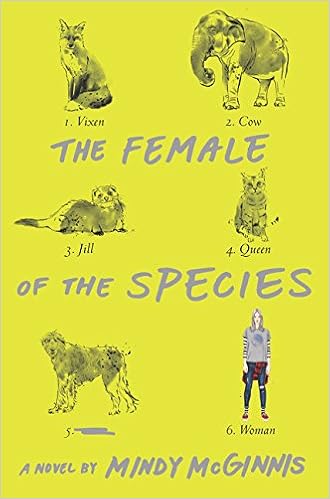
Book Review: The Female of the Species

Image result for the female of the species

The Female of the Species

by Mindy McGinnis


It is probably best, in reviewing books, to stay away from comparisons; no two authors are the same, no two books are the same, no two readers are the same, and so any attempt to compare experiences will inevitably come up short.

On the other hand, if you can’t compare two reading experiences, there’s not much point in book reviews and recommendations in the first place. So let me give this a shot.

I have two comparisons I want to make with this book. The first is to another book, probably more famous, called Thirteen Reasons Why by Jay Asher. That book is about teenagers, as this one is; it is about grief and heartbreak and mental illness, among other things, as this one is; it is an indictment of rape culture, as this one is. So there are enough points of comparison for me to say something valid, I think. Now here’s the difference: that book, compared to this one, is crap. Absolute shlock. The characters are unrealistic, the events are underwhelming and overdramatized, the ending and the book’s overall message were just obnoxious, in my opinion.

This book is none of those things. These characters are some of the most fully-realized and relatable that I have ever read. My favorite thing about this book is that none of the characters – not even the static characters, the foils for the protagonists, the minor characters who only pop into a chapter or two – none of them are permitted to be one-dimensional. The bitchy cheerleader has depths, and real kindness. The golden boy is not all golden: he has flaws, and shortcomings, and he fails, more than once. The villains are recognized as not being that different from the heroes.

And the hero is a psychopath. An entirely sympathetic and fascinating psychopath. I know there are other books that have taken that approach – Dexter, American Psycho, I Am Not a Serial Killer – but this one is by far the best, in my opinion. (Since I’ve been talking about comparisons, let’s be clear: Dexter and American Psycho are entirely different books, different stories, different characters. I Am Not a Serial Killer has some similarities in that it is also a YA book with a teenaged hero; but that book is about self-doubt, and this book is not. At least not from the psychopath’s point of view.) This psychopath, you cheer for. She’s a badass, which was a lot of fun to read. And she volunteers at an animal shelter, and is good to the dogs. I got more than a little upset with the other characters for not being able to relate to her at times, when she’s so clearly right.

But at the same time, because she’s not one-dimensional, the psychopath is not only right. Some of the things she does are terribly wrong, and we know it. This is part of the advantage of McGinnis’s use of multiple point-of-view characters: we get to see all of the major characters from multiple perspectives, both inside and outside themselves, which is part of what makes the characters, and the book (which is entirely character-driven) so good.

And that brings me to the second comparison: the writing. I am a writer. I’ve written for young adults, and I’ve written about violent, mentally ill protagonists. So though I know I shouldn’t, when I encounter a book that is in some small way similar to something that I’ve written, I tend to compare the writing to my own; particularly when it is the first time I’ve read something by a particular author. I don’t do it all the time; when I’m reading something by Steinbeck or Khaled Hosseini or something similar, I don’t even try. But I do think, “I would have done that differently,” or, “I could have written that better.”

I couldn’t have written this book better. I wouldn’t have done it differently, but: there’s no way I could write this well. I actually got a little sad for a while when I was reading it, because this book was so good, so well-written, the characters so genuine and interesting, the action so arresting, that I thought, “Well, what could I add to the literary world when it already has something like this?” I got over myself, of course, but the point is this: this is one of the best pieces of young adult fiction I’ve read. This is one of the better novels I’ve read, period.

So here’s one last comparison: me, to you. I’ve read this book. You haven’t. Which means I’m happier than you. You should fix that. Go get it.

I’m going to go try to learn to write better. And read another book by Mindy McGinnis.

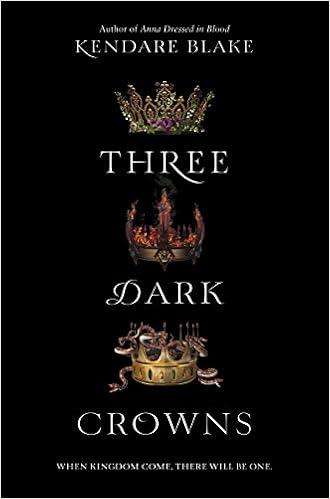
Book Review: Three Dark Crowns

Image result for three dark crowns

Three Dark Crowns

by Kendare Blake

This book got me. Got me good. If we had been fighting a duel, I would have bowed my head, said, “Touche,” and apologized for however I had given offense. And then probably applauded my honorable opponent for the impressive victory.

And then the next thing I knew, I’d be flat on my back, completely stunned, looking up at the book smirking over me, hearing the onlookers making shocked noises at how badly I had been slammed. Because just when I thought the book was done – it wasn’t done. It was just setting me up for the knockout.

All right, enough metaphor: let’s just get into it, shall we?

This is a young adult fantasy novel, one with young female protagonists and a fair amount of romance and social drama – friendships being made and broken, trusted advisors turning traitor, and so on – and so it would most likely appeal to young female fantasy fans. But I am only one of those things, and I enjoyed reading the book, so don’t let me pigeonhole it: it’s a good fantasy novel. It’s the first in a series, so it’s setting up the world and the long-haul plot; both are interesting. The world is based around a magical island, hidden by mists and guarded, so the people believe, by a goddess. This goddess creates a new group of potential rulers for the island once a generation, and that group is always the same: a set of triplets, all girls, born to the previous queen.

The difficulty is that only one of the girls can become queen.

The other two have to die.

The other key factor here – and honestly, the part of this book I had the most trouble with (Other than the portrayal of a couple of the teenaged boys, who were idiots or cads, but I’m not going to complain about that because Lord knows there have been more than enough fantasy novels where the female characters are the crappy ones, and it’s certainly not all the guys in this book who are twits; just two, one idiot and one cad. I’ll just shut up and take my lumps.), because it doesn’t work terribly well – is that each of these triplets has a magical power. There are three main magical powers on the island, grouped into houses; whichever house has the triplet who wins the crown becomes the ruling council for the length of her reign. The three powers are: elemental control, animal telepathy, and – poison.

Look, I don’t mean to be one of those comic book guy, gaming fantasy nerds who complain about a fantasy world being not as good as, say, Tolkien; but this honestly felt off to me. The animal telepathy I’ve got no problem with; there’s not an epic fantasy story in the world that hasn’t made me want to pull a Doctor Doolittle. I want to speak to the Eagles like Gandalf, and run with the wolves like Perrin Aybara, and communicate with dragons like Daenerys Targaryen. So that power was great. The elemental power seemed overbroad, because that queen can do everything: she can bring storms, she can bring earthquakes, she can dance wreathed in fire. And on the other hand, the poison-powered queen can, umm, eat poison. And not die. That’s it. Seems lame in comparison. Also not terribly useful in a magical duel to the death. So I admit, that bugged me a little, particularly because the story is about these three girls approaching the age when they are supposed to start fighting over the throne, meaning they have to kill each other; and really, what are the odds here? The animal telepath can control animals and send them to kill her sisters, and the elemental sister can bring fiery wrath from the skies; the poison sister can – not die while she eats poison. I really couldn’t make that work well in my head, and so it was a bit of a stumbling block.

But here’s the thing: apart from that, the story is great. The girls have different power levels, which means some of them expect to die and others expect to kill their own sisters; and neither is a good place to be. That tension is very well done. The desperation of the weaker sisters to find some way to make their powers sufficient to survive and even kill, that’s also well done. And all of the intrigue, the social interactions, the boys hovering around them trying to become the consort of the next queen (which also means they have to bet on who’s going to win this fight), that was very well done. I liked all of that. I liked all three of the sisters’ characters, even though they’re all entirely different. I was trying to think of a way out of the conundrum they were in, and regretting that I couldn’t; that’s a sign of a good piece of writing, when it leaves the reader looking for a solution to the conflict.

But then: then it got me. At the very end (and no spoilers), an event happened that I pretty much expected, though the means of it was a surprise. But it turned out to have a twist, which I really didn’t expect; Blake set this plot up so well that I was genuinely thrown when the twist happened.

BUT THEN THERE WAS ANOTHER TWIST! Completely unexpected, totally out of left field. And that one, hooooooo BOY – that was the one that knocked me on my ass. But it was great, because it also changed the way I saw the book I had just read: I went from thinking it was okay, to finding it much more interesting once I had this new piece of information. And the best part about it was that it set up a whole different expectation for what would happen in the second book, which means that, of course I have to read that one, now.

So this was a good one. I will want to read the sequels before I recommend it entirely, because I’m not going to recommend a fantasy series that doesn’t end as well as it starts; but this was definitely a promising beginning.

Book Review: Noir by Christopher Moore

(Been a while, I know. Even with my avowed intentions to use this blog to talk about my experiences trying to become a published writer. I didn’t want to sound like I was kvetching —  so instead, I haven’t been posting.

But I got this ARC of Christopher Moore’s newest novel, and I could not think of a better way to come back into my book reviews, at the very least. So here it is.)

Image may contain: 1 person, smiling

The product model is my birb Duncan.


Noir

by Christopher Moore

Trouble walked in, shaped like a dame.

Also shaped like a black mamba. (Though he didn’t walk in.)

Also shaped like an alien straight from the crash in Roswell, New Mexico in 1947. (He didn’t walk in, either. Also might not be a he. I mean, probably not, really.)

Also shaped like the usual suspects from a Christopher Moore novel: smartasses and dumbasses, goons and gadflies, men in drag and women in drag and a venerated Chinese uncle who runs an opium den and has a most unfortunate nickname. (It sort of translates to “cat lover.” In a non-traditional sense.)

The trouble? Noir. In San Francisco, in 1947, and it all comes down on Sammy Two-Toes and his friends and allies, and enemies and victims, and especially on that rotten little foul-mouthed kid that keeps waking Sammy up.

Hate that kid.

But I love him, too. And I loved this book.

It is hilarious: I don’t know of anyone else since Douglas Adams who writes books that can make me laugh out loud, hard enough that I have to put the book down, but Christopher Moore can do it, and he has done it again; from the description of the manly scream on the first page, to the black mamba giving a raspberry to the guy he bit on one of the last pages (Not THE last page; the book ends with one of those wrap-ups describing how everything falls out for all of the characters, and no spoilers here –well, not big ones.), I laughed all the way through this book. There are some fantastic zingers, some absolutely glorious descriptions – my favorite is the one of the whorehouse madame in her tight green dress and flaming red hair described as looking “like a tube of red paint that someone squeezed hard in the middle,” because my God, that is just incredible – and some utterly delicious dialogue, particularly when the characters get into their snappy 1940’s noir patter, which I doubt that anyone writing today could do as well as Moore can. In the afterword, he describes his own book as a cross between Damon Runyan and Bugs Bunny, and I think that’s perfect, too. There is also some slapstick, some goofy sex jokes, a bit of gross humor, as there usually is; because that’s Christopher Moore, too.

And then there is the love story (Remember that dame who walked in and brought trouble? That’s the one). It is wonderfully sweet and romantic, and also a little sad; and for me it elevated this hilarious book into something that I would recommend to anyone who doesn’t mind a little filth in their fun; it’s not the whole plot, as of course there is the wacky story line that I will leave to be discovered, but there is also a Cannery Row sort of story about the boys, the ones who live right on the edge of the skids, but who hang on, mostly because they hang together; on some level this is their story, and it’s a good one. I was rooting for them the whole way. And once again, I don’t want to spoil anything – but at least one of these plot lines turns out all right, which made me walk away with a smile, even after the laughs stopped.

This is a great book. You should read it.

Two Books by John Wyndham

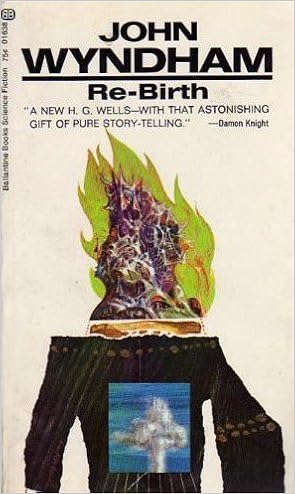
Image result for rebirth john wyndhamImage result for the secret people john wyndham

Two by John Wyndham: Re-Birth and The Secret People

I’ve gone up and down with John Wyndham. A couple of his books – The Midwich Cuckoos and Day of the Triffids – are outstanding; Chocky was just okay. Generally I like his storytelling, and his ideas are wonderful; but they can’t all be gems, no matter who the author is. No problem. Really, this fits in nicely to the Golden Age of Science Fiction, where Wyndham deserves a place, since even Heinlein and Asimov wrote some stinkers. I like Wyndham, though, and I like that I keep finding his books in cheap paperback editions from the 60’s and 70’s with interesting cover art. That cover art was what made me pick both of these.

So I had two of his novels to read, and once I read them, well – to be honest, my opinion of Wyndham went down. This has been mitigated now by the fact that one of these two, The Secret People, was one of his earliest works, written in 1935; my first book isn’t very good, either. But that’s not enough: because this book wasn’t just “not very good.” It’s a stack of crap in a cover.

We’ll start with the good one, though. (Warning: Spoilers ahead.) Re-Birth, from 1955, (Published in Wyndham’s native UK as The Chrysalids, which is a way better title but I assumed they changed it because the American public’s response was overwhelmingly, “Wut’s in tarnation’s a chrysalid?”) is a great book in two ways: it has a post-apocalyptic setting fully as interesting and disturbing as A Handmaid’s Tale, with the same kind of theocratic hypocrisy in full bloom. Told from the point of view of a young boy whose father is a pillar of the community, it has that excellent innocent perspective that makes social commentary novels genuinely effective, from The Giver to To Kill a Mockingbird. We learn how screwed up the society is as the protagonist does, and it works extremely well. There’s a nice twist, too: because we find out that the main character, David, is actually one of the forbidden people, one of the untouchables, as it were, but in a way that enables him to hide it. So we get the view of the society from both a child’s perspective and an outsider’s perspective, and it’s very well done.

The society is an agrarian theocracy after the world-shattering nuclear war; it is probably somewhere in Greenland, though that isn’t entirely clear. (That may be my poor grasp on world geography – or, honestly, it’s been a couple of months since I read it; I may just not remember.) The society has an absolute rule against genetic mutations, which are more common because of the radiation; anyone who is born with any kind of imperfection is essentially exposed to the elements. (Turns out they don’t always die, but that’s not for the society’s lack of trying.) David is a genetic mutation, but not with any physical alteration, and so he slips through the net, and eventually finds several others who are like him.

I don’t want to spoil it any more than that, because it is essentially worth reading. I didn’t really like the ending, though. We get two glimpses into other societies, one of the outcast genetic mutations who have survived on the fringes of the theocratic society, and one highly advanced society from another part of the world; and frankly, both suck. The book as a whole just made me dislike people. Which, I mean, that’s fair, but it’s not always the kind of book I want to read; I also felt that this one didn’t hold out any real hope for a better world or better people. I guess there’s a small chance that David and his friends are the hope, but they continue to be a part of the crappy societies, so I don’t really see it.

But I did like the characters a lot, and I thought the society and the central conflict over genetic “perfection,” with the underlying theme of questioning that very concept – what exactly is the “correct” genotype? Or more importantly, the correct phenotype? At what point does variation become too far from the “norm?” – all that was great. If you’re a Wyndham fan, go ahead and read this one.

Don’t read The Secret People. Not anyone, not for any reason – not even for that epically bizarre cover. Because the cover is a lie! There aren’t any weird dirt-people with mushroom horns! They’re just short! I wanted freaky gnomes and dwarves and stuff, but what I got was – crap. Racist crap.

So The Secret People, originally published in 1935, is a lot like an H. Rider Haggard novel, except Wyndham wasn’t as good a writer. And they both had crap ideas. This book starts with a couple of poorly explained technological advances to get us in the sci-fi mood; the main character is an international playboy with his own jet plane – and I mean, it’s a rocket ship with a cabin and everything, that flies in atmosphere – and at one point, he picks up his newest Bond Girl and flies over the inland sea that is being made where the Sahara used to be. Sadly, they crash into the water, and through a series of mishaps, they find themselves in an underground world peopled by strange beings! Living under the Sahara! SO WEIRD!

Except they’re not. They’re Pygmies, from Africa, who apparently wandered into underground caves centuries ago, and just kept wandering. And just like Haggard, who had a serious case of TheWhiteManIsTheRightMan-itis, Wyndham describes these “secret people” as essentially savages who have been unable to advance their civilization in any way past their original stone-tool-and-superstition society. The modern Eurotrash heroes get chucked into a prison cavern with all the other surface dwellers who have found their way underground now that the inland-sea-over-the-Sahara project has compromised the Secret People’s secrecy, and then they have to find their way out and back to the jet plane, which is their only hope of surviving. Because, you see, the inland sea has started leaking into this vast underground cavern world, and the whole place is going to drown.

But that doesn’t matter! What matters is who gets to the plane first: the heroes, our playboy and his Bond Girl, or the sinister criminal element, who were already in the cavern when our heroes arrive, and who are both rapey and swarthy – an unforgivable combination. But that’s okay, because they’re also stupid and cowardly and everything else you would expect from a swarthy criminal type, and so yes, our heroes are the ones who make it out alive before all of the Secret People drown. Which, y’know, is a happy ending.

Terrible book. Don’t read it. Go for Re-Birth/The Chrysalids – or even better, read The Midwich Cuckoos.

Book Review: Mortal Engines, Hungry City Chronicles #1

Image result for mortal engines

(Also, see that hot air balloon on the cover, with the tiny gondola the two characters are in? Not at all how the airships are described.)


Mortal Engines (Book One of the Hungry City Chronicles)

by Philip Reeve


I kind of hated this book.

Not everything about it. Some things in here are wonderful. The concept is fantastic: a future world where cities are mobile, enormous steampunk structures on wheels, rolling around in the wasteland that is all that remains of our world, destroyed (of course) by World War III and hyper-advanced war machines. These cities follow a philosophy of “municipal Darwinism” (great name), which teaches that the largest, strongest city will devour the smaller cities. It’s a “town eat town” world, and the mobile towns do exactly that: they capture the smaller, slower towns, swallow them, tear them apart and use their raw materials as fuel and building materials to maintain and expand the larger town.

That’s a cool idea.

The main town in the story is London, and London is now governed by four Guilds: the Historians, the Navigators, the Merchants, and the Engineers. The Historians, who comprise both doddering old museum relics and Indiana Jones-style explorers who search through the wreckage of ancient civilizations to find useful artifacts from the time before the wars that ended everything (This is our time, of course, and the Frankenstein We-let-our-technology-advance-too-far-and-it-destroyed-us theme is vigorous in this book), are sort of the main protagonists, and the Engineers, who care about nothing but power and control, as those engineers would, are the antagonists. There is also the Anti-Traction League (the moving cities are called “traction cities”), which have settled in parts of the world not dominated by moving towns nor devastated by ancient wars, and they oppose the traction cities as a whole.

This is fine and good. I was a bit annoyed by the stereotypes of the heartless engineer and the hapless-but-wise-and-kind historian, but I like the plotline that involves the Lord Mayor of London and his megalomaniacal schemes, and the discovery of a new doomsday weapon that allows his city to destroy any other; the weapon is actually a rediscovery from the ancient times, and I thought the book handled that well, particularly at the end. (Though there are some pretty severe plot holes, especially regarding the time lapse between the ancients and the traction city era:  it’s been like two thousand years. So really, the ancient technology? It just wouldn’t work. At all.) I like the Anti-Traction League, and I particularly like the subset of non-city-dwellers who live in the air: this being a proper steampunk novel, there are airships galore, and even a flying city, and those parts were great.

No: I hated the characters. The specific characters who play the roles of hero in this book are half crappy, and by the end, half dead. I won’t say which group is which so as not to spoil, especially since this book is now being made into a movie by Peter Jackson, who probably won’t be able to save this thing, in my opinion. However, since the book won oodles of awards, I suppose most people liked the characters a whole lot more than I did. But really, they aren’t good characters: there’s one who should hate everything London is doing and all that it stands for, but at a crucial moment, this character freaks out on those who want to stop London from destroying everything good with its doomsday device; and then later the character realizes, “Hey, wait – London sucks! I should do something about that!” But this epiphany comes at an entirely random time, and is annoying because of that; I would think that the betrayal by a Londoner whom the character worships would have changed the character’s mind, or maybe when the two main characters are tricked and enslaved by a traction city; or maybe when they are captured and abused and threatened and nearly killed by a bunch of half-insane traction city pirates. No: it’s while the character is – climbing stairs. It’s ridiculous.

The other big problem for me was the writing. Half of the characters, good and bad, are entirely unbelievable; their emotions and motivations don’t make a lot of sense. There are a ton of cliches and platitudes, and some of the descriptions and action sequences are just not well done.

And then, at the end – he killed the fucking dog. That’s right: Philip Reeve kills the dog. No reason, either; we already hate the people who do it, and the character who I suppose is intended to be inspired to murderous vengeful rage by the death of the dog WAS ALREADY AT THE POINT OF VENGEFUL RAGE. It’s an entirely gratuitous dog-killing. And I don’t mean to overstate how much this bothered me, because I was already annoyed by the plot holes and the poor characterization and the mediocre writing – but really, that moment just took the cake. And then for the next thirty pages until the very end (when almost every other sympathetic character dies, too), Reeve kept mentioning the dead dog: the dog’s owner kept looking around for the dog, kept expecting to hear the dog’s footsteps, but no, because the dog was dead.

Screw you, Reeve. Dog killing crap writer.

No, that’s too strong. But really, I didn’t think much of the book. I wish someone else had thought of this idea and done a better job writing it. I hope the movie is better, but I won’t be watching it: because they’ll probably kill the dog.

Book Review: The Bell Jar

Image result for the bell jar

The Bell Jar

by Sylvia Plath

This is one of those books that I don’t know why I’ve never read.

There are several of them, and there are several reasons why I haven’t read them. (For instance: never read most of the great Victorian novels, never read Jane Eyre or Middlemarch or anything by Dickens, though I read Oliver Twist a year or two ago and I have Hard Times on my TBR shelf; never read much of the work of Faulkner or Joyce; haven’t read much of the great Russians, never read War and Peace, never read Crime and Punishment; never read Madame Bovary nor Lolita, never read Moby Dick. I could go on. And the reasons? I skipped a year of high school English; I went to a non-traditional college to study literature, where I took a class in Hong Kong literature and another in the films of Howard Hawks, but didn’t read a single Shakespeare play as an undergrad; neither of my parents are readers of the classics, so with their encouragement I read lots and lots of fantasy and science fiction.) This one I didn’t really know anything about. I know Sylvia Plath, know her story, at least the bare bones of it; I have grown to enjoy her poetry since I’ve read it in the last couple of years. But I never read her novel.

Until now. Until a friend and colleague of mine, who told me she was going to be teaching it to her Pre-AP students (who will become my AP students next year), when I said I’d never read it, said, “Oh, you have to!” And I said, “Okay.” And I went to our local used book store and I got myself a copy, and I read it.

Now I need to read it again.

It’s a good book. I can see both why it is now considered a great book, and why it became such a sensational book. For those who do not know, the book is largely autobiographical, and describes a time in Sylvia Plath’s life when she, to use the cliché, descended into madness. She had a breakdown, she attempted suicide, she was given shock treatment (Hey, it was the 1950’s, after all), and then she was institutionalized. That’s as far as the book goes, and Plath’s life story doesn’t go much farther: she moved to England, met and married the poet Ted Hughes, had two children with him, wrote this novel and some extraordinary poetry, and then, at the age of 31, she killed herself. The Bell Jar hadn’t been on the shelves for more than a year, and since it tells of something so intimate, made so simultaneously chilling and vital by the death of the author, it was an immediate bestseller. And then there was controversy regarding its American publication (It was initially published in England, to mixed reviews), because her mother believed that Sylvia would not have wanted the book published in the U.S. because many of the characters are recognizable from Sylvia’s life, and the book is not a kind one. But it was eventually published here, and with its crystal-clear depiction of mental illness, and of mental health treatment, and of society in the 1950’s and particularly how society treated young women at the time, it became an enormous bestseller and a classic.

The book is about a young woman who goes on an internship in New York City during summer break, for a month. It’s a little strange to read about how college worked then, because college now is so solidified: you start when you’re 18, you finish after four years with a bachelor’s degree, or after six years with a Master’s, or never if you pursue a PhD; but Esther, the protagonist, is 19, has finished her first two years of college and is about to enter her senior year. But this is also a time when she is caught between her dreams, which vary widely over the course of the book – she wants to be a writer; she wants to be a professor; she wants to be a magazine editor – and the need to have something solid and steady, which means she should learn shorthand so she can be a secretary. It’s a time when young ladies take classes in deportment. When everyone is so obsessed with marriage and with chastity before marriage that the unavoidably human obsession with sex means that no social interaction has to do with anything else: the boy that Esther has developed a relationship with – though he’s a shmuck and their “relationship” consists of him inviting her up to Yale for proms and then treating her like an inconsequential decoration that also serves as an audience for his ego – is derided as a hypocrite because he’s had sex and yet insists that Esther remain a good girl if they are ever to marry (which her mother desperately wants her to do, of course), and every date she goes on, she considers as a potential husband, or else a potential sexual partner. I suppose that not much has changed on that front, but I’m sorry, this virginity shit is ridiculously stupid.

And beside the point, though it and the need to have an active social life and be seen as popular and dating quality people (like a Yale man! How exciting!) are important elements of the book and of Esther’s life. But then the point becomes something else. It isn’t clear what happens, as I think it wouldn’t be; there isn’t a single traumatic moment, though Esther has some bizarre experiences and some extraordinary pressures to deal with. It begins to come to a head when she goes on several dates and outings towards the end of her internship with another girl in the program, a young lady named Doreen; Doreen has been having a sexual relationship with a charming rock DJ, who appears to have no decent friends and therefore hooks Esther up with jackasses – the last of which assaults her. She finishes her internship without any definite plans for her next step, for her last year of school or for the career afterwards, or for her social or family life; she simply goes home. She leaves all of her clothes in New York, and she goes home in a borrowed outfit.

Once Esther is home, things get worse. Her mother pressures her to move on, to date, to marry, to succeed; and Esther is drawing inward, instead. She goes through a severe depression, which is when her mother takes her to a psychiatrist, a complete shithead who soon recommends electroshock therapy. Because, y’know, it makes you feel better. Except it isn’t done right, and Esther feels agonizing pain during it, and then feels no better. That’s when she begins to think about suicide. She makes several half-hearted attempts, to drown herself, to hang herself, to cut her wrists, and then finally, she finds a place to hide and she takes an entire bottle of sleeping pills which she got because she can’t sleep due to her depression. She survives, and goes to a mental hospital, where things go back and forth between getting better and getting worse. And though I won’t spoil the ending further, I’ll just say: that’s how it goes throughout the rest of the book. It is never entirely clear if it is getting better, or if it is getting worse; when things seem to be going better, Esther’s narrative voice is not any happier or more comfortable. It never gets happy or comfortable again, all the way to the end. Though really, I’m not sure how happy or comfortable it ever was: this is not a happy, comfortable book. I think Plath was not a happy or comfortable woman.

What she was, was entirely honest, with crystal-clear perception, even if the things she was perceiving were not real. Though this book clearly stretches the boundary of fiction: when an author fictionalizes her own life, and describes accurately sensations and experiences that are not real, hallucinations and disassociated thoughts and feelings – is that fiction? Did she make it up? The writing is occasionally beautiful, haunting, poetic; mostly, though, it is so clear and easy to read and understand that you feel very much what Esther feels. I do not myself have experience with depression or suicidal ideation, but I’ve been close to people who have, so I recognize the accuracy of this depiction; and I understand more now than I did before I read the book. As a writer, and a devoted lover of the works of many authors who have gone through what Plath depicted (Virginia Woolf and David Foster Wallace are two of my favorites, along with several others who drank or drugged themselves to death, Poe and Dylan Thomas and so on, so on.) And though I plan to re-read it and look more carefully at the writing (Because this is a book that would go very well with others that I teach, One Flew Over the Cuckoo’s Nest and Catcher in the Rye particularly), on the strength of one reading alone, I would highly recommend it.

Book Review: Ship Breaker by Paolo Bacigalupi

Image result for ship breaker

Ship Breaker

by Paolo Bacigalupi


I wish I’d written this book. And not just because I wish my last name were Bacigalupi – though I do wish that, too. This is the kind of book I wish I could write: it’s an outstanding idea, it’s a fast-paced thriller, and it has a wonderfully relatable hero that made it possible for me to feel like I was in the story, along with characters that hint of far greater depth to the world, which makes me want to read the “companion” book, The Drowned Cities. And I probably will.

On the other hand: because there are hints of depth to the world-building, and especially to the most interesting character, the half-man Tool, which are left entirely out of the story, I feel like this book was just gutted by editors who wanted to pick up the pace and cut down the word count so it would sell better. I know that if I had written this book, it would be at least twice as long, and so I’m kind of glad that I didn’t write this book because I would hate to have my book cut in half – and then have it be successful? Have it be a finalist for the National Book Award? That would drive me crazy. I realize, of course, that the success and the accolades that accrue to a book this short with this rapid pace tells me something about my own writing – it’s too wordy and slow to ever enjoy this kind of sales in the modern market – but I still hate the idea of taking out all the good stuff to pander to a readership that gets bored inside of fifteen seconds.

(There’s a lot of background to this, by the way. I’ve written four novels, all of which have been repeatedly rejected by agents and publishers; the two times I’ve gotten interest in short samples and sent in longer portions of the work, I’ve been rejected both times after a second reading because my writing is too wordy and too slow. Rather than cut out half of my stories to make a book like this one, I’m self-publishing my long works, because fuck ’em if they like their books short. Yes, I’m an idiot. But I also wish that prizes like the National Book Award didn’t go to the short fast books. Though this one is probably good enough to deserve to be a finalist even in its presumably truncated form. And maybe I’m wrong all the way, and Bacigalupi wrote it exactly like this. But I wouldn’t have, so there it is. I’m bitter, and he’s successful. Moving on.)

The story is set in this wonderfully real and timely dystopia: climate change has raised sea levels and created Category 6 “city killer” hurricanes, and corporate capitalism has so run amok that it seems to be the only basis of social organization; all else is might-makes-right anarchy. The story mainly takes place in a beach – uh, I guess it’s a “community” – in the Gulf of Mexico; the beach is strewn with the rusted remains of the old steel ships, cargo ships and oil tankers and the like. Oil has now become rare enough that it is no longer how cargo is moved: the modern cargo ships are sleek hydrofoils called “clipper ships,” and they sail with wind power – jet stream winds, that is, since they have huge sails that they launch, with cannons, several miles up into the stratosphere. And the people in the book make a living by ripping the old steel ships apart for salvage. Hence the title.

The main character, Nailer, is a teenaged boy who lives a hard and brutal life among the ship breakers. This is where the writing really shines, because Bacigalupi has created a society where environmental and economic devastation has made life a thousand times worse than it is in our world today – and yet, the problems on the human level are exactly the same. (I have no doubt, as well, that there are places in the world that are pretty much exactly like this place, and it’s only science fiction to me because I live in the sheltered part of the world. Like Lucky Girl in the book.) Nailer’s mother is dead and his father is a violent drug addict; Nailer has to work to earn his own food and possessions, and he is constantly having to prove himself or else someone else will take his job and he will starve – he can’t take time off when he gets hurt at work, for instance, or he will get replaced. Nailer lives in a dog-eat-dog world, where everyone fights everyone else for everything they have, all the time. Almost no one is willing to help anyone else, because it puts themselves at risk; we see this early in the book, when Nailer, whose job in ship breaking is to crawl through the duct work and collect copper cable, gets trapped in the depths of a derelict ship, and when he turns to another person for help, he is refused and left to die. His death would be more profitable to the other person than his life, and so that means – Nailer is left to die. (Spoiler: he doesn’t.) Because that is his world, the most important thing to him is loyalty, and the greatest virtue is – kindness. Generosity. It is the rarest quality, and so it is prized.

That leads Nailer into the main conflict, when a modern clipper ship is wrecked on their beach, and Nailer discovers it – and the survivor aboard, one of the people from the other side of the world, where wealth protects and shelters you from all of the terrible conditions that Nailer lives with on a daily basis. And again, despite everything else that is going on in the world and around them, the things that matter at that point are loyalty, and kindness. That’s the story of the book.

There’s more: but not enough more. The story ends with the resolution of the main conflict, but it ends right there; you don’t get to know what comes next, even though a number of things change, in very important ways, for the main characters. The half-man, Tool, is a great creation; the half-men are genetically altered mixtures of human and canine DNA, and they are fanatically loyal to their owners, even dying, samurai-like, when their master dies – except for Tool, who has no master but himself. He’s a remarkable character, and I desperately want to know his backstory, but I never get it; he also vanishes at a certain point in the book, and we never find out what happens to him, which also drove me batty, and is the reason I think the book got the crap cut out of it before publication. And I understand the need for a book to be fast-paced and exciting, especially when it’s YA fiction like this one; but dammit, I want to know Tool’s story. I want to know what comes next in Nailer’s story. I want more of this book!

Ah, well. This is a good book, a fast read that I enjoyed quite a lot. I definitely recommend it. Though I hope that people also look for and buy the books that go more in depth, that give a reader something to think about beyond the bare essentials, that give you a world and characters you can sink your teeth into. (Maybe buy my books, for instance. They will be available soon. Don’t worry: I won’t turn every review into a sales pitch. Just this one.)

Book Review: Essays by Virginia Woolf

A former student of mine, who graduated just this past June and is now halfway through his freshman year in college, came back to give me a gift. This was cool. It’s never happened quite this way before: he wanted to give me something to thank me for teaching him how to write. I’m not sure that I did, but I’m sure that I helped him get better at writing; I was his English teacher for three of his four years of high school at the tiny charter school where I work, so yeah, I suppose I deserve a fair amount of the credit and the blame for whatever he can do in terms of literary achievement in school. He said he did well in his English 101 class, and so he wanted to give me something. First Thank-you-for-teaching-me gift I’ve ever received. (I’ve gotten thanks, I’ve gotten several really glowing compliments, and I’ve gotten presents; never gotten one like this before.)

He got me this:

It’s a first edition of a collection of essays by Virginia Woolf. It’s awesome for a number of reasons: it’s a first edition, which is neato; it’s essays, which I love and always want to write and to read; it’s Virginia Woolf, who is one of my absolute favorite writers and strongest influences; and it’s called The Captain’s Death Bed, which has a nice pirate-y feel to it. Awesome.

So I read it, of course. It did take me two tries: not because it’s terribly complicated – Woolf is too good and too clear a writer to make her reading that hard to understand – but for two reasons: first, because this is the last of four volumes of her unpublished essays collected after her suicide in 1941, and so a number of the pieces in it are more obscure in subject; and second, because right when I started reading this book, I was finishing up my semester and grading about twenty thousand student essays, and then the day after the semester ended, I had a wisdom tooth removed, which included a half-day fast, my first 24-hour period without coffee in over 25 years, my first time under general anaesthesia, my first time taking Percocet, and of course, a whole lot of pain. So I read about a third of the way through the essays, and then stopped; and then picked it up again two days ago, when my head was a bit straighter on my neck and my brain was readier to read.

I’m glad I picked it back up. Turns out it was really the first several essays that were too obscure for me to enjoy: they are mostly responses to literature which Woolf read, and which I never have – never read Carlyle, never read Turgenev, and certainly never read the half-dozen diarists and memoirists she wrote about, mostly English pastors from the last 300 years. I also couldn’t relate at all to those kinds of books, as I am not a big reader of biography or published diaries; so the first several essays really didn’t speak to me.

But the rest of them did. Did they ever.

There’s a lot here. There’s a wonderful piece about being a good writer versus being a great writer; I don’t know that I agree with Woolf’s examples of a great writer (She includes Jane Austen, Dostoevsky, James Joyce, all of which I can take or leave – and Joyce I’d rather leave; she doesn’t include herself, who I would prefer over all of ’em. Though of course I understand not putting herself into the list of great writers in her own essay.), but her essential idea is this story she tells of getting into a train car and seeing the end of a conversation between two strangers. One of those strangers she calls Mrs. Brown, and describes her in some detail; it’s never clear if this is a real person or not, a real event or a created example. She says that the writers she considers good, who include H.G. Wells and a couple of Brits I’ve never read, would talk about everything in the world other than Mrs. Brown; they’d talk about the town where she lives, about the educational or economic system that created her, but not about her. The great writers would tell you about Mrs. Brown, and they’d do it poetically.

This gave me pause. I don’t know that I write about Mrs. Brown. I think I actually do. Though I am not and never will be a great writer, I like that I’m at least focused on the right subject: the characters. The people.

Then there’s a great piece about reviewing books, in which she ends with the conclusion that reviewers should shut the hell up except to give their honest, informed opinion to the author of the book they read. I don’t know what to do with that, either. This piece caused a conflict for me, because at the end of it, her husband and literary executor, Leonard Woolf, added a note in which he disagreed with her, and said that reviewers are necessary to give the reading public an idea of what books to buy and where to spend their time and money; I like that answer better, but I found it so incredibly distasteful that the guy would throw his two cents into the argument of HIS DEAD WIFE when she couldn’t respond back that I can’t agree with anything he said. So I’ll have to think about the way I write reviews.

Then there are the beautiful pieces: there’s one called The Sun and the Fish, one called Gas (about going under anaesthesia at the dentist; how perfect is that?), one called Reading, and my favorite, Flying over London, that are all nothing more or less than a lovely experience packed into a few pages. It’s magic, really.

I recommend reading Virginia Woolf. I haven’t read a lot of her fiction, but I’ve read a fair amount of her non-fiction, and it’s all fantastic. Especially if you’re a fan, as I am, of essayists – David Sedaris, George Orwell, Diane Ackerman, and especially David Foster Wallace, who wrote like Woolf (and died like her, too), then you should read her essays. I have no doubt there are dozens of collections of her work in various editions, and probably one that collects the good ones out of this book without the obscure ones; but it doesn’t matter, because any collection of her writing is going to be beautiful.