Cold Days

Cold Days by Jim Butcher

I wish I could write like that. I don’t know how he does it, but I wish I could write like that.

I can’t, though. I can’t weave together a mix of humor, and moral philosophy, and myth exploration, and — this phrase, though trite, is in this case quite literally true — non-stop action, and somehow make it all come out right, together. I can’t make a story that satisfying, have that many moments when the reader is nodding his head, grinning madly, even fist-pumping while saying, “YES!” Dozens of them. Dozens of moments like that: from the pitch-perfect reference; to the beautifully lucid description of how it feels to love, to hate, to fear, to howl, to weep, to suffer; to the heart-thumping adrenaline-pumping cheer as the righteous defeat the vile, again and again.

If it isn’t clear yet, I love these books. Love them. I love this book. The Dresden series has never let me down, but the remarkable thing is that — even through fifteen books, now, counting the short story collection Changes — it just keeps getting better. I don’t know how Jim Butcher does it, but I hope he never stops. I’ve read this one before, when it came out, but I didn’t remember much of it; none of the denouement. And so it had me, rapt and wild-eyed, as everything came together at the end, with just the right mix of pure victory with surprising defeat to make it seem — perfect. I read this 500-page novel in two days, just as excited about the next chapter as I was the first time I read it; that I remember.

I can’t write like this. But at least I can read like this. And I plan to keep on doing it: Skin Game was published just a couple of weeks ago, and it’s sitting on my shelf right now. I’ll bet you anything it will be even better than Cold Days, as Cold Days was better than Ghost Story. I’ll let you know as soon as I finish it.

Probably be a couple more days, though. I have to go to work tomorrow.


If you liked this book, I would recommend — reading the whole series over again.

And, I suppose, Neverwhere by Neil Gaiman, the Nightside books by Simon R. Green, and the first few Rachel Morgan books by Kim Harrison.

Written In My Own Heart’s Blood. So That’s Why It Took So Long.

Written in My Own Heart’s Blood by Diana Gabaldon

First of all, if you haven’t read these books, stop reading this review: go now and find a copy of Outlander. Seriously. Do it now.

After you’ve read Outlander, fallen in love with this author and these characters and this absolutely lovely series of books, go ahead and read all of the rest of the series, and then come back when you reach the 8th book, which this is. (And while you’re at it, be grateful you’re coming into the series now, rather than doing what my wife did, and discovering Gabaldon when Outlander was first published — 25 years ago. It’s been a long time, waiting for this series to get this close to the end. A very long time. But she still loves it: every book, every chapter. Worth the wait.)

So for those who are caught up, this is a great book. A great one. This one gets back on track, in some ways; there are more moments of joy than heartbreak, which has not felt true of the last few books, but is one of the reasons why I love the series so: because they are lovely, and loving. It’s a true romance, rather than a heartbreaker for the sake of poignancy. And because love is good and great and sublime, there is more joy than sorrow — and though I don’t want to spoil, I will say that there is much more love in this book than just Jamie and Claire.

Of course there are heartbreaking moments. There is more than one death that just tore me up inside. There are frustrating times — particularly with William. Those damned stubborn Frasers. You understand. There is more than one terrifying moment, particularly those associated with more than one life-threatening injury. But this book does the right things, and goes the right places, and I loved it. I would say I can’t wait for the next one — but I have to wait, don’t I?

If I had one complaint, it was this: I always enjoy the historical elements, and the accuracy and detail are remarkable; it’s why I’m willing to wait patiently (Well, somewhat patiently) for the next installment, unlike George R.R. Martin, on whom I gave up years ago. But I don’t think all of the historicity actually serves the story. Gabaldon went to great lengths to make a few real Revolutionary personages true to their historical selves, even quoting their personal papers for their dialogue. Why? To please the seven people in the world who would recognize a genuine Nathanael Greene quote from a false one? I appreciate the realism of the British retreat from Philadelphia, and the influence that has on the lives of our heroes; but do we need every single aspect of the Battle of Monmouth to be on the record? I’m really not reading a history book, here. I do understand that every instance when Gabaldon varies from the truth earns her a dozen irate letters from fanatics; but I personally vote she lets that go, and does more things like name Fergus’s paper The Onion. Which I just got, by the way. These books are not historically accurate: you can tell by the 20th century doctor in the middle of the Revolution. Verisimilitude is wonderful, and I appreciate all the work that goes into making the books feel and sound real; but they don’t actually need to BE real. I’ll love them anyway.
If you like the Outlander series, I would also recommend:
The Bloody Jack series by the wondrous L.A. Meyer
The Fever series by Karen Marie Moning
The Temeraire series by Naomi Novik (Who is not afraid of changing history to include dragons)
Everything by Jeffery Farnol, my favorite historical romance novelist. Check out the pirate books, especially.

Divine Misfortune Review

Divine Misfortune by A. Lee Martinez

I liked this book right from the start. From the very first chapter, when the main human character, Phil, goes looking online — on a divine version of Match.com which is one of the funniest things I’ve read in a while — for a god to worship, I knew this was the kind of thing I love to read. Funny and irreverent, but with just enough social criticism to give it some bite, and something to ground the silliness. Oh yeah: this is definitely a book about a slacker luck god who looks like a raccoon in sunglasses and a Hawaiian shirt, who crashes in your house and orders pizza with anchovies and invites his god buddies over for a party; but it’s also a book about the callous and self-serving way that people treat faith and religion. It’s a book about the way that religion exploits its own worshipers, as represented by my favorite character, Quetzalcoatl — “Just call me Quick.” It’s a book about how having the right credentials, which often includes religion, can make or break your career. And it says some interesting things about all of those topics, which alone would make it worth reading — because the writing is good, the characters are both fun and genuine, and it’s never too heavy nor too light. But when you include the fact that Martinez makes great use of the concept of a luck god, imagining all of the possible benefits of having luck on your side — you find enough spare change to buy a new microwave; should anyone (Say, the bloodthirsty cultists who worship THAT OTHER god) come by to try to shoot you, their guns will jam and then blow up in their hands; that kind of thing — as well as the ups (and downs) of serving a hideous lord of chaos, and the fact that the book includes a goodly amount of smiting, then this book becomes something not only worth reading, but worth telling other people that they should read, too.

You should read this book. It’s a lot of fun. I haven’t even mentioned most of the things that make it amusing and enjoyable: you should check them out yourself.

Are there flaws in the book? Sure. I don’t think the human characters are developed enough; they’re just “regular folks,” there to give the gods somebody to play with or fight over. The final battle was something of an anti-climax, though it does fit the plot perfectly. And as amusing as the pagan gods are walking around in modern America, I think it’s been done better, by Christopher Moore, Kevin Hearne, Neil Gaiman, probably others.

But this book was, for me, a lucky find. I’d recommend it.
If you liked this book, I would also recommend:
Good Omens by Neil Gaiman and Terry Pratchett
The Iron Druid series by Kevin Hearne
Coyote Blue, Dirty Job, Practical Demonkeeping and others by Christopher Moore

The Last of Bloody Jack

Bloody Jack

Wild Rover No More: Being the Last Recorded Account of the Life and Times of Jacky Faber
by L.A. Meyer

This was the book I wanted to read, and I loved it.

I’ve been an avid Bloody Jack fan for several years, now, along with my wife, who discovered the first book while searching for pirate-themed books for me (I have a bit of a thing for the pirate life and the yo-ho-ho.) and found that she loved these as much as I do. There are not many characters in the world like Jacky Faber: so human, so likeable, and so very, very frustrating. I have for years now felt just like Amy Trevelyne and Ezra Pickering, and I have nothing but the deepest admiration for Mr. John Higgins, the unflappable, dependable, and eternally reliable friend to our dear girl.

Jacky Faber makes me wish I had done one-hundredth of the things she has done — and at the same time, she makes me very glad that I have never suffered one-hundredth of the things she has suffered. That’s why I love these books: I love the adventures, love the chances Jacky takes (even while I keep saying to myself, “No, Jacky, no — for the love of God, why do you keep doing this?”), and I love the way reality comes crashing down on her, again and again — and yet she never gives up. And in this book, here she goes again: within the first fifty pages, she is on the run from the law (Not an uncommon occurrence) and she hides out, meeting yet another historical figure — in this case, one of my personal favorites, even though Meyer had to fudge the history a bit to make it happen. But it is subtly done, this time, possibly because of that; and I can’t blame him for taking this opportunity, because if I could write that person into my story, I’d do it in a heartbeat. (I don’t want to spoil who it is because it is subtly done, and the moment when the hints build up to the epiphany was fun for me, and I want it to be fun for everyone who hasn’t read it yet.)

Jacky also joins the circus, in this book. Because Jacky does that: Jacky takes the opportunities that the rest of us would shy away from, and she lives out the dreams that all of us cherish, up to and including running away with the circus and being, at the same time, a Russian princess. Hell, it almost made me want to be a Russian princess in the circus — though I don’t think I should do the fan dance.

And the end of this one — hoo boy, the end. It is the end, the last book, and it is the finish of Jacky’s adventures. I won’t spoil this one either. I genuinely didn’t know until the final moments which way it was going to go: Meyer managed to do it perfectly, with as much suspense as any novel I think I have read. It made it hard to put it down.

And I am truly sorry that I now have to put these down. The saddest part of this book is not within its pages: it is on the dust jacket, because now the biography of the wonderful L.A. Meyer says “was.” You are a loss to the world, sir, both the world of letters and the world of imagination. Your books were a gift to us all, and I am deeply grateful for them. I may have put them down for now, but rest assured: I will pick them up again and again. Thank you for that. Rest in peace. You and Miss Mary Jacky Faber.

Book Review: The King of Messy Potatoes by John Dashney

Messy Taters

The King of Messy Potatoes
John Dashney

You know what? I’m just happy I found this book.

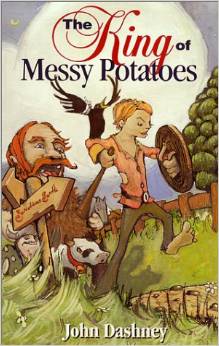
I picked it up at a library book sale. I bought it because the cover image is both sweet and, for me, evocative: a boy marching with stick in hand and shield on arm, with a line of friends and companions by his side: a cow, a giant, a viking, a crow. This is what I imagined as a child. I read Tolkien and Alexander, Lewis and Anthony, and in every case, the story really revolved around the journey: the journey, and the companions. As a fairly solitary child, that was what I wanted. So I had to get this book. Plus: how could you ignore that title? I love potatoes more than I love epic fantasy. If given the option, I would certainly pour gravy on this book and eat it. Who wouldn’t?

For even more fun, the author has written several young adult adventure books, is self-published and small-press published, and this book is signed. It’s perfect.

Now as for what was inside: that was good. I won’t say it was perfect, but it was good — far better than most small-press, self-published authors I have encountered. This book hits a beautiful balance between fantasy and reality, using a frame story about a boy and his grandfather, an aged Episcopal priest and scholar who is writing a history based on Biblical times, a book about the kings of Mesopotamia. Which the boy hears as — Messy Potatoes. (I am proud to say I actually made that connection before I started reading, when I picked up the book and considered reading it next. I am impressed that Mr. Dashney actually had this idea and saw the beauty of it.). The boy asks about it, and though the grandfather laughs, he agrees to make up a story about the King of Messy Potatoes for his grandson.

Then we get the story of Spud. Spud lives on a very special farm, though he doesn’t know it. He doesn’t know much of anything, other than how to grow good potatoes, and that his older brothers are dimwits and the local nobleman is a jerk. But then Spud meets a new friend: a crow, who, if he bites someone and tastes their blood, can speak that person’s language for a full day. This crow tells Spud the truth, and helps Spud to begin his adventures, and pursue his destiny — as the King of Messy Potatoes.

Both of these stories are successful. The frame story of the boy and his grandfather is sweet and heartfelt, and rings very true — especially to me, with my staggeringly erudite and somewhat distant (because eminently dignified) grandmother, who nevertheless loved me dearly. The story of Spud is exciting and amusing and fun to read, and you want to hear both sides of this as you go through it.

It isn’t perfect. There are parts of Spud’s story that are a bit too short, and feel like they’re there just to fill space without really adding anything; the Viking part, for one. The villain is a great idea, but isn’t really pursued completely — understandable, as this is a young book, but still: kids understand evil, and hearing about evil that is vanquished is a good story for any age. Spud is given a dialect that just doesn’t fit and doesn’t make sense, neither for the character nor for the “author,” the Episcopal scholar grandfather. And at the end, I want to hear more of the story of the King of Messy Potatoes, but I never will. Which is too bad.
But overall? I was very lucky to find this book. It made me happy.