DOUBLE REVIEW! SO MUCH SCIENCE!

Death from The Skies by Philip Plait
Guns, Germs, and Steel by Jared Diamond


I normally don’t review two books at once. There are reasons not to do it now: these two books have more in contrast than they do in common, and my reading of both was quite different: Death From the Skies I read over the course of a couple of months, a little here and a little there; Guns, Germs and Steel I tried to read straight through, and failed to complete — at least partly because that is not, for me, the best way to read popular science.

But these books do have some important things in common: they are both popular science non-fiction, DFTS in the hard science of astronomy, GGAS from the social science of anthropology. Both are about death, destruction and the end of civilization as we know it. I finished one only a few days before I gave up on the other, which proximity promptly juxtaposed them in my mind (YES! Been waiting for a chance to say “juxtaposed.” That alone is enough reason to review them both together.). Both have, for me, an interesting premise. Neither includes zombies.

Now let’s get to the more extensive and interesting list of the differences. DFTS is about future death and destruction: the book is a list of all of the ways that the universe could wipe out all life on Earth: asteroid impact, massive solar flare, black hole fly-by, gamma ray burst, supernova, even alien invasion. GGAS is about the death and destruction that has happened in the past, specifically to the human race, caused by the rest of the human race. It asks one essential question: why is it that some civilizations have been able to thrive and grow, and others have not? And when civilizations come into contact with each other, and one or the other is destroyed or subsumed, what determines which civilization survives and which dies?

It’s an interesting subject, I think. Diamond takes as his prime example the conquest of the Incan empire by the conquistador Francisco Pizarro. Why was it that the Spanish empire managed to overcome the Incan empire? Why wasn’t it the other way around — Incan ships crossing the Atlantic, Incan soldiers wiping out hordes of Spanish troops, and an Incan general capturing the Spanish king, demanding an entire room full of gold for ransom, and then executing the king anyway, as Pizarro did to Atahualpa, the Incan emperor? Or why couldn’t the Incas fight off the Spanish, and establish their own hegemony over the Americas? Diamond examines this and every other contact between civilizations that he can, and in exhaustive — and I mean exhaustive, fatiguing, meticulous, infinite as well as infinitesimal, and finally brain-numbing — detail, he explains.

Here’s the spoiler: it’s the title. The Spanish conquest of the Incas was accomplished not by Pizarro, but by smallpox, which had been dropped off on the coast of Mesoamerica ten years before, by Hernan Cortes and his troops in Mexico, along with the various explorers and traders who followed Columbus’s lead to the New World. Atahualpa wasn’t even supposed to be the Emperor of the Incas: the emperor of the Incas for thirty years before Pizarro’s attack was Huayna Capac, who led the empire to the height of its size and power — until he died of a fever, probably either smallpox or measles. Along with his successor, his eldest son Ninan Cuyochi. The empire was the divided between Atahualpa and his brother Huascar, who proceeded to wage a civil war for control which Atahualpa won after several years of fighting — right before he was captured by Pizarro. The battles that did occur between the Spanish and the Incas were won by the use of guns, steel weapons and armor, and mounted cavalry, none of which the Incas had.

Diamond actually explains every reason why the Incas didn’t have cavalry, why the Europeans had the deadlier diseases, why they had better weapons, why they had guns, why they had better ships, why they had writing; it has everything to do with the ecology, the geography, and the histories of the two areas of the world, the Americas and Eurasia. And honestly, it’s pretty interesting.

The problem is that Diamond writes sometimes like a popular science writer, but much more often like a scientist, which he is. And that’s fine. But like all scientists writing treatises about their research, his goal is to be meticulous and scrupulous in explaining how he came to his conclusions, rather than to make the book interesting. And I think he succeeds in that: because I felt like he asked the same question ten or twelve times, from different angles — why didn’t the Incas have cavalry horses? Why didn’t they have large domesticated mammals? Why didn’t they have the same agricultural productivity? Why didn’t they have the same population? Why didn’t they have the same specialization of professions within society? Why didn’t they have writing? — and every time gave a complete answer, but every time it was the same answer: geography, ecology, and history. Over and over and over again.

And then he moved on to Australia. And then Africa. And at that point, I just couldn’t take it any more, and I stopped reading it.

Now Phillip Plait: that man knows how to make a popular science book interesting for the average reader. Every chapter describes a new way that the universe could kill us all. Each chapter begins with a hypothetical description of that death, how it would arrive, how it would progress, and specifically how it would kill us (Generally speaking, Robert Frost was right: fire, or ice.); then the chapter describes the science behind the cataclysmic event; then it describes the probability of that event happening, based on our knowledge of the universe. He goes from the most concrete elements to the most abstract, and because of that, by the time you get to the abstract stuff, you’re ready for it, and you understand what he’s talking about, and you want to know more — generally because the description of the deaths is pretty horrific, but the probability of any of them happening is “Pretty danged small,” or else it’s a certainty — but not for billions of years. Like when the sun dies. Definitely going to happen; definitely going to kill us; definitely not due for about 7 billion years. It’s comforting, really.

(Not all of it. The first chapter, on asteroid impact, is actually pretty scary, as is the second, about massive solar flares wiping out our power and communications. The solar flares couldn’t kill us directly — but I’ve read enough post-apocalyptic fiction to know that if the power and communications go, Road Warrior and cannibalism are not far behind. And I would not do well in that world. The alien invasion one is much more speculative — but it’s creepy as hell. Robot spiders. That’s all I’m going to say.)

And here’s how Plait handles the science: he makes jokes — good ones, including a Spinal Tap reference. He explains the science, but he also makes it clear why we should or should not know the details. An example: before Plait gets into the chapter about the end of the universe, he takes a few pages to discuss scientific notation (And I apologize for the formatting — the exponents were superscript in my draft, I swear. Don’t know how to make it happen on WordPress.) — our planet is 4×10^9 years old, the universe 1.3×10^10. The end of the universe will come sometime around 10^70 years from now. And Plait was smart enough to know that people would think, “Wow — that’s sixty times the current age of the universe. That’s a really long time.” But the thing is, it’s not. 10^15 years is not six times as long as 10^9 years: it’s 1,000,000 times as long. That’s the age of the Earth lived over again one million times. And I’m thinking about my summer break in four months, and it seems a long way off. 10^70 years is so absurdly far into the future we can’t even fathom it. And Plait explained that, in a way I could understand. It helped.

Plus he explains all the awesome stuff about the universe. I feel like I understand black holes better now — just in time for me to watch Interstellar on Hulu. And now I know that spaghettification is a thing. My new favorite thing, in fact.

So here’s the point: I’m glad I read part of GGAS. I’m glad I didn’t spend any more time reading the rest. If you are terribly interested in prehistory and the rise and fall of civilizations, you may want to read it — it is very clear and easy to understand, and yep, it’s thorough. But for me, I’d rather read about the Milky Way colliding with Andromeda in a few tens of billions of years. GGAS just made me want to play Civilization on my computer.

Which I may just go do now.

Nightglory

Nightglory

by Mathew Babaoye

I liked this book. I just wish I could have liked it more.

There is a lot to like. The concept is good: it is about a supernatural Lady, the Queen of Night, and her struggle to consolidate her control over her world. She struggles with her subjects, with her responsibilities, with her power, and with herself; it’s a story with a lot of interest, a lot of conflict, a lot of places it could go. I like the writing style: short sentences, short paragraphs, breaks where there shouldn’t be breaks; it makes the reader consider the words more carefully, makes us notice what’s being said. There’s an element of the epic in the writing, in the way certain phrases – her blue-black hair and black dress; the old hard-bitten gold carpet in her throne room – are repeated, almost Homeric. And the name, of course, is brilliant: Goldenslaughter. I still don’t know: are the last two syllables “slaughter” – or “laughter?” I love that ambiguity, as much as I love both possibilities.

But the potential is not quite realized. The writing style is interesting, but the mechanical mastery is insufficient to allow the style to really flow; there are flaws in the writing, in the editing, that make the reader question what is intentional, what just a mistake, and that means the moments when you notice what the prose is doing, when you see it start to dance – you don’t know if it’s only stumbling. The epic phrases are too few, and too often repeated; they start to seem dull, rather than classical. The storyline gets lost in the mystery: the story begins with Goldenslaughter already having conquered her realm, gained the loyalty of her subjects, and then lost that loyalty through an attempt to gain total mastery of the Power that keeps her on the throne. Coming in to the middle of the plot can work, but there has to be a careful process of backbuilding, through flashbacks and the like, so that the audience can gain a complete understanding of how the story got to where it is; this book doesn’t do that. The best way I can put it is that the book makes the reader work too hard to understand what’s going on, rather than the writer doing all of the heavy lifting for the audience. Here: an example. There is a scene in the early going when Goldenslaughter confers with the Lady of Elements, who has had a prophetic dream; that dream gives hints of what will happen to Goldenslaughter. By the end of the book, that dream comes true, and after that happens, Goldenslaughter and the Lady mention that earlier discussion, and the warning that the Lady offered to her Queen, which the Queen did not heed. This is all fine: except the poetic language the two use in the first discussion is too abstract, and I for one had no idea what the Lady was talking about until the later scene when Goldenslaughter refers to it. So the foreshadowing of the prophecy was lost on me, as were all of the hints of what Goldenslaughter meant to do and why it would be challenging and dangerous.

The end of the book is the best part: the final climax is well-done, with a good battle scene and a really fine resolution to the central conflict, when Goldenslaughter makes her choice about who and what she is. I just couldn’t really follow most of the book leading up to that, even though I enjoyed reading it.

Zombie Spaceship Wasteland

Zombie Spaceship Wasteland

by Patton Oswalt


I can’t tell you how happy I was to unwrap this gift from my wife: not only am I a tremendous Patton Oswalt fan; not only have I been reading bad books lately; but it was Jolabokaflod, the Icelandic “Christmas Book Flood” tradition which we tried out this year – you give each other a book for Christmas Eve and then spend the rest of the evening reading. Okay, I waited until Christmas Day to read most of it, and finished it on Boxing Day – but this was an excellent present to start off the Christmas gifts with, and an excellent book to read.

In some ways, it reads like Oswalt’s standup: it’s eclectic and unexpected, shifting subject and pace and even genre with no notice at all: you read the prologue, and then the first piece, which is a personal essay about Oswalt’s youth – and then the second piece is a mock-up of movie notes on an imagined zany comedy about an amnesiac getting married. And the first piece is so interesting and insightful and intelligent that it takes you quite a while to realize that the second one is entirely – not. Well, no, it’s still interesting: but now it’s interesting because it’s a joke, not because it is a reflection on the moment when one realizes one is an artist at heart; even though that realization came to Oswalt in an amusing circumstance, the essential concept of the essay is to describe that self-realization, which, like most great insights, slipped away again almost immediately, to return only in fragments spread out over years –and, I hope, truly recovered for Oswalt in this writing.

Because Patton Oswalt is an artist, a comic artist. This book has humor in every way it is possible to have humor: it has over-the-top toilet humor (The amnesiac bride piece has it all – drunkenness, vomit, nudity, dildos falling onto sushi platters – all the classic gags.); it has subtle and ironic humor, often dark and often self-deprecating; it has one-liners and pieces that are all one long set-up for the final punchline. There are visual jokes as well as literate ones. And like any great comic artist, Oswalt has managed to include a number of genuine insights, frequently hidden as jabs thrown at the world and society’s ugliness and stupidity. Because as Oswalt tells us in the title piece – which title comes from a very effective system of dividing the nerd world, into those who prefer zombie stories, versus spaceship stories, versus wasteland stories – he is a wasteland guy, a fan of the Road Warrior: one who would, in his imagination, destroy the world and society, in order to focus on the last remaining survivors and their idealistic quest to keep their own sense of what’s important, even in a world that has gone mad around them. It’s a quest that Oswalt has stuck to, and a torch of reason and compassion that he carries still, and that carries through this book. It was a joy to read it, to laugh along with him, and even more, to think with him.

Book Review Request: The Nth Day

27815772

The Nth Day

by Jonathan Huls

I was given a free copy of this e-book and asked to provide an honest review; so here goes.

This is a terrible book.

There is almost nothing good about it. The writing is bad on every level, from grammar to logic to elegance. I have taught many teenagers who have a better grasp of English than this book shows. The mechanics are poor, making it hard to read; the overly long sentences wind and twist clumsily before snapping from the strain, making the reading even harder; and several times, the wrong word is used – “seized” instead of “ceased,” for instance, or “communal” instead of “tribunal.” This book need more than an editor: this book needs a writer.

The plot doesn’t make much sense. The basic idea is that God is born into modern times, and His coming brings mayhem and destruction; not immediately, however, as the child first must grow up like a reasonably normal human being, though his youth is filled with strange events and miracles. Around the age of ten, his father – well, his stepfather, really, as the child was born of an immaculate conception – tries to discipline the boy, for the first time, over a temper tantrum during a board game; and the young God, in a moment of even more petulant wrath, destroys his parents with a sudden tornado. He then strikes out walking across the country, leaving more destruction and inexplicable occurrences in his wake, until he reaches his destination. Unfortunately, the book ends without any actual resolution: he reaches his destination, causes some more destruction, and then vanishes. That’s it. No explanation for the journey, no reason for the mayhem he caused, no actual point to the book.

The only thing Huls does with any style is disgust the reader: the lengthy, detailed descriptions of vomit and excrement and blood and rot are the most vivid moments in the book. There are a lot of them, and they made me more nauseated than any other reading experience I can think of. And although there isn’t a lot of it, this author also made sex more distasteful than any other author I can remember reading. The sweet moments – and there are actually a few, including a loving union between two of the characters, and a father-child relationship that was somewhat heart-warming – are surrounded by so much putrescence that there was just no way to enjoy them. The father-child relationship, for instance, begins with the child saving the father-figure from choking on his own vomit in a drunken stupor; said puddle of vomit figures prominently in the next dozen pages, before the two share a laugh over a raucous belch. Hard to see a Zuzu’s petals-moment there.

If I had to give a reason for the creation of this book, I would guess that the author hates humanity. The people are almost entirely horrible, representing every deadly sin with their every word and deed; the heroes, if that word can apply to the point-of-view characters, are better, but they are also generally victimized by events, and since there is no final resolution, there seems to be no reason for their suffering other than “Life is awful, and so are human beings.” By the end of the book I was rooting for an apocalypse, but even that opportunity was missed, as the young God apparently decides to let the world continue. Until the next time someone beats him at Connect Four, that is – and then watch out.

Mr. Mercedes

Mr. Mercedes

by Stephen King

I can’t decide if this is one of King’s least frightening books – or one of the scariest.

It lacks a number of the elements that King usually includes to create fear, most notably the supernatural. There are no demons in this book, no ancient mystical objects, no magic spells or incantations; nobody is possessed, nothing comes to life, nobody comes back from the dead. There is also no raving psychotic waving a bloody knife, and – though I don’t mean to spoil anything – the dog doesn’t die. (It was King who said in an interview that the fastest way to get the audience to hate a bad guy is to have the character hurt or kill an animal; this is true, but it also makes us hate the author – I’m looking at you, Richard Matheson!)

But what this book has instead is: reality. And in some ways, that’s even more frightening. The murderer uses a car to kill people. It’s so incredibly ordinary that I can’t believe it doesn’t happen more often, with results as horrific as what King describes (Because of course there’s gore: I said nobody comes back to life, not that nobody dies, or that nobody has their arm torn off or their skull caved in. It is still Stephen King.). In the past, King has come up with some of the most unique madmen I’ve ever read – the Trashcan Man in The Stand comes immediately to mind, and the sheriff in Desperation, and the whole cast of the Dark Tower series – but the bad guy in this one, Mr. Mercedes himself, really isn’t that crazy. Oh, he’s crazy; but it’s an everyday kind of crazy. And whereas King often steals his lunatics’ sanity through some particularly appalling supernatural experience – thinking of Henry Bowers in It – this guy is crazy for a very ordinary reason, and is a largely well-controlled crazy. He’s a high-functioning lunatic, and because of that, he is able to walk among us, and plot our deaths: and that is very, very frightening.

What you have here is a bit of a mystery: not a whodunnit – King introduces the villain as a point-of-view character, as he frequently does, and then proceeds to freak us out with him, as he frequently does – but a How-did-he-do-it? The prologue shows his initial crime, the murder of several people using a Mercedes sedan as his weapon; the main plot of the book is some time later, after the lead detective on the case has retired, leaving the Mercedes Killer case unsolved. The killer has since struck again, but he has changed his modus operandi; and his new target is the retired detective himself. The detective, no easy target, begins to backtrack through the attempt on his life (And I’m giving away less than you think, here), and through the unsolved questions about the original crime, and tries to catch the one who got away during his active career. That investigation is the core of the book. Until, as so often happens in thrillers, everything falls apart and the killer moves on to a new target: then it becomes a race to see if he can be stopped – if, that is, they can even figure out what he’s planning to do. King leaves their success or failure truly in question until the very end; you really don’t know how it’s going to end until it does, and even then, it’s a surprise.

If you’re looking for a Stephen King-style gore/horror fest like It or Carrie, I’d recommend Desperation or The Dark Half. But if you want a genuine thriller, combining both mystery and suspense, by the master-of-all-dark-genres, then this one is the one to grab.

Book Review: The Patron Saint of Lost Dogs

By the way: that cute dog isn’t even in the book. So disappointing.


The Patron Saint of Lost Dogs

by Nick Trout

So it turns out the author of this book is a real vet. And it reads like it.

I don’t mean to be too critical: this was a sweet book, with a genuinely happy ending; I was rooting for several of the characters – hoping for rewards for some, and comeuppance for the others – and pretty much everybody got just what they deserved. And, not to spoil anything, but there is no terribly sad animal death, as there is in nearly every other book about pets, from Where the Red Fern Grows to Marley and Me. It was lovely to read about animals who come into a vet’s office not feeling well, and then leave feeling better. It made me smile, and if that would make you smile, the book is worth reading.

But the hero, Dr. Cyrus Mills, is just such a weenie. There are reasons for it, and he deals with them and improves; but it takes him so long to dig his way out of his weenie-ness that first the book feels annoying, and then a little unrealistic, because how could a guy who’s that deep in the ween-pit finally turn it around that quickly? And while not all of the small-town Vermont characters were obnoxious, there were several who were, and when the hero-weenie can’t deal with them beyond getting tongue-tied and scratching at the back of his head, which is quite literally how every conversation ends for the first half of the book, it makes you want to crawl into the book and start punching. Which is less sweet than the feeling you get from cured animals.

Mills is not a people-person: I get that. I’m an introvert myself, and I don’t handle confrontation well, either; but the trouble is, he’s not even good at not being a people-person. Mills is a veterinary pathologist by trade who finds himself in a small-town vet practice, trying for the first time to deal with actual living pets and their owners, rather than slides of tissue and the remains of deceased pets in a quiet, sterile lab. He is cold and clinical and tends to hide in scientific jargon. All of that makes sense. But he is also tender-hearted: being around the animals is almost instantly emotional for him, breaking through his shell; this is what makes him tongue-tied, because he is aware that he is cold and harsh-seeming, and he tries to change that for the sake of communicating successfully with the pets’ owners. I don’t buy that. If he has spent fifteen years in a basement lab with dead things, and liked it enough to do anything he can to get back to it (which is the basic conflict in the plot), then he would be indifferent to the feelings of the humans who come to see him, and probably of the animals, too. Sure, the sweet puppy faces might break through that hard exterior, but it wouldn’t happen with the first one. If, on the other hand, he’s a big softie who loves the animals – a position I fully support – how could he have been happy sitting in his basement lab for fifteen years, never even owning a pet?

All the reader is left with is the determination that this guy is a weenie who either doesn’t know what he really wants, or doesn’t have even a little of the gumption needed to go out and get it. By the end of the book, he sorts this out – but I disliked him enough in the beginning to not really care that he wins by the end. I was happy that his victory works out well for a lot of other people in the book, who I actually liked better than Cyrus himself.

Especially Frieda Fuzzypaws.

Overall, it’s not a bad book. There are probably better.

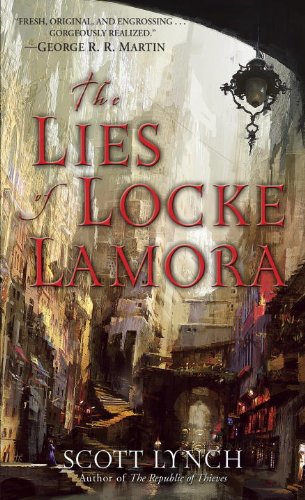
Book Review: The Lies of Locke Lamora

The Lies of Locke Lamora

by Scott Lynch

I should have loved this book: I like fantasy, particularly with intrigue and action (I would love the Song of Ice and Fire, except I’ll NEVER FORGIVE GEORGE R. R. MARTIN); I like caper stories; I am passionate about pirates – which is what drew me to this book, which definitely has a swashbuckling feel to it. The premise is really great: a thief takes in a group of orphans, and sets about making them into the first (and greatest) gang of long-con confidence men this town has ever seen; he intends to unleash them on the nobility, and see just how much they can steal. Move forward twenty years and the plan has succeeded: these thieves are the most successful in a city full of thieves, with a hidden vault full of a vast fortune. But then there is an upheaval in the underworld: a new challenger has arisen to take on the King of Thieves – and he is a threat to our heroes, as well. And not to spoil anything, but this is a revenge fantasy to make Hamlet an envious shade of green.

The setting is good: the city is an independent duchy in a crumbling empire, independent, sprawling, and wealthy; there is a vast divide between the rich and the poor, with the poor living in crowded, squalid slums while the rich dwell in ancient and mystical towers built by a race long gone. There is magic, but it is not common; there are many gods, but prayers and sacrifices to them are traditional rather than earnest. A few tweaks and this could be Venice or Algiers, New Orleans or Hong Kong. It works well for the storyline.

The concept of the characters is great: the gang of con-men are splendid black-sheep heroes; the kingpin of crime is the perfect blend of honorable man and savage; the nobles depicted are both cruel and arrogant, but also with surprising depth, shown to have as much humanity as the poor they oppress.

I should have loved this book.

But I didn’t love this book.

The problem is one that I seem to be encountering more and more these days, either because I’m getting bitter and pretentious as I age, or because books really are getting crappier: the writing just isn’t that good. The first problem with this particular book is that it’s about 200-300 pages too long: a caper story should move quickly, even one that starts with this much backstory; but this one does not. Lynch chose to sprinkle the flashbacks in between chapters, and it was a mistake; it just slows everything down, and it became annoying to get to the end of an exciting chapter, often with a cliffhanger, and have to flash back fifteen years to a training montage. And while the exploration of the thief-training was well done, the characters themselves are given only the vaguest motivation: the lead, Locke Lamora, for instance; we know he’s an orphan who becomes a thief, and quickly proves himself the most audacious thief ever. Why? What makes him this way? No clue. He just is. I’d say it’s in his blood, but we have no idea what his blood is – because orphan. Now, there are sequels, and maybe this will be a grand reveal; but for this book, it was annoying.

There’s more: the action was well-described in slow motion, but the larger scenes of combat and riot were not; overall, there is a feel of missing the forest for the trees, a poverty of grandiosity that ruins the crumbling glory of the old empire feel of the piece. If I may be forgiven some fantasy name-dropping, Lynch should have read more Michael Moorcock: a good chunk of Melnibone would have helped a lot. That combat had the nice realistic touch of pain for everyone: nobody gets out of a fight unscathed, even the ones who are good at fighting, and I like the way Lynch did that – but at the same time, he then has his characters heal real quick so they can get on to the next scene, and so in the end, the bloodshed becomes as unrealistic as an unblooded victor would have been. And though this doesn’t normally bother me, there was a whole lot of gratuitous profanity in this book. I believe in the timely use of the F-word; there’s no better way to express certain emotions. But when you use it too much, it loses that power – by the end of Scarface, you don’t even notice it any more. Same thing here. And in a writer,especially a fantasy writer who has a free hand with inventing language, it just shows a lack of imagination.

I would love to read this book if Jim Butcher or Robert Jordan had written it. But as it stands, this one is only middling good. Not worth recommending.

MERCE Review

M.E.R.C.E.
by J.P. Hart

I teach Advanced Placement English, and so I spend a fair amount of time involved in deep, close reading, of great and grand literary works, Shakespeare, Homer, Emily Bronte. I just spent a month poring over every sentence and every word of Mark Twain’s Huckleberry Finn, examining the diction, the syntax, the figurative language.

So it is a real relief when I can read a book that’s just — fun. MERCE was one of those books.

If you’re looking for a paranormal romance/thriller, this book has what you want: there is the damaged and vulnerable heroine whose pain hides her awesome power; there is the dark and brooding hero who is brought out of his shell by the heroine’s love. There is the all-consuming threat of evil that intrudes on their idyllic bliss, and there is the deadly fight over the fate of the world. There are secrets being revealed in nearly every chapter — secrets about the nature of the characters, about the nature of the world, about the nature of love and friendship and family.

There is action, both pulse-pounding and darkly frightening. There is humor, both sarcastic and absurd. There are twists, some a bit predictable, others entirely out of left field. There are some lovely details, and some excellent writing. There is an EXCELLENT dog, which is always a plus. Sure, there are flaws: some of the chapters cut off in strange places, and some of the writing needs some polish; the romance moves a bit too quickly into total trust and harmony and the heroine moves too quickly into full-on badassery; the terrible, traumatic events of the past are left behind a little too easily. But this is a fun, quick book, by a writer with talent, and as the first book in a series, it’s worth checking out: if you like these characters, you’ll like reading this book, and probably the ones that will follow. I’d give it around 3.5 to 4 stars.

The Warrior of World’s End

The Warrior of World’s End (The first book of the Gondwane Epic)
by Lin Carter

I’ve been reading some of the older pulp fantasy/sci-fi books, and this was one of those — a Daw paperback, the pages yellowed on the edges, the cover price only 95 cents. Lin Carter is one of those names I always see on rows of thin, dog-eared paperbacks in used bookstores, but not one I ever needed to read.

But that was only because I didn’t know what I was missing. And if you’re a fantasy fan, especially a fan of cheesy Robert-E.-Howard’s-Conan style fantasy, you must read Lin Carter.

This book was brilliant. I can’t wait to get back to the used store and buy the second book in the Gondwane Epic, and then keep going until I get to the end — and I hope that’s a long way off. The basic idea is this: 700 million years have passed since our current era, and the Earth’s continents have drifted into each other to form a single mega-continent — the title of the epic and name of the continent coming from the primordial Gondwanaland, the mega-continent that was the southern half of Pangaea, when all of the Earth’s land surface was in one land mass that became two and then became many — and things are, of course, very different. It’s a fantasy world-building technique that I’ve always enjoyed; my other favorite use of it was in the Wheel of Time. In this case, you have a traditional swords-and-sorcery society, with the opening narrative from the point of view of a trader riding a donkey from one great city to another, passing through the Crystal Mountains by a great desert, with his wife, who is actually a sentient plant-being. On the way through the mountains, an earthquake shakes the land, and soon they discover a Great Epic Hero wandering through the aftermath, lacking even the ability to speak intelligibly — but his thews are mighty, and his hair is glittering silver. This is Ganelon Silvermane, the hero who will save the world from doom: the star of the epic. The trader and his wife take Ganelon in and raise him like a seven-foot-tall bodybuilder/baby; they teach him to be honorable and courageous and everything a hero should be, and then off he goes a-heroin’.

It’s great. Carter uses all kinds of unnecessarily fancy words and complex sentences, but without making the book as hard to read as, say, H.P. Lovecraft’s work. There is a simplicity and childish glee in it that made me smile the whole time. It reminded me very much of Conan, or of Edgar Rice Burroughs’s John Carter of Mars series, but with a heavier tilt towards fantasy and away from SF — since there is a Red Enchantress, and an Illusionist, and Death Dwarves, and a magic flying bird-vehicle made of brass and granted intelligence and a personality, and the ability to speak. Ganelon meets a lithe Amazonian-type warrior woman, whom he saves from evil priests, and who I’m sure will be a love interest at some point, but our hero is too innocent of the ways of love as of yet; so far all he does is fight great battles and break large things with mighty swings of his flashing sword, all that kind of stuff.

It was a hoot. Highly recommended for those who like this sort of thing.

If you liked this book, you might also like:

Conan stories by Robert E. Howard or Robert Jordan

John Carter, Warlord of Mars series by Edgar Rice Burroughs

The Genius of Dogs

The Genius of Dogs
by Brian Hare and Vanessa Woods

This was a good read: it was a decent book with fascinating information in it, and not just because I love dogs. Though that certainly didn’t hurt.

The basic idea is this: dogs are geniuses in one specific area of cognition. The book carefully and precisely documents that genius, and discusses how it came about and what it means, both for dogs and for humans. Brian Hare is a cognition expert, and has made an exhaustive study of this topic, which resulted in this book; because it was exhaustive, he studied not only dogs, but also foxes, wolves, dingoes, and New Guinea Singing Dogs, along with as many different breeds of dog as he could, all in order to test the parameters of dogs’ genius.

The genius of dogs is this: dogs are better than any other species — better than dolphins, better than chimpanzees or other primates, and MUCH better than cats (Had to get that dig in there — but seriously, if you want to win every future argument about which are smarter, dogs or cats, this is the book for you) — at understanding humans. They can grasp more words, more gestures, more specifically taught abilities, than any other creature. Most interesting and most impressive is this aspect, which Hare goes into in depth, complete with cute anime-style illustrations: dogs don’t just understand what we tell them, they understand our intent. Dogs can learn to obey any gesture, from a spoken command to a pointed finger to a nod of the head or a turn of the body, so long as that gesture conveys the human’s intention. That is, if you want a dog to look underneath a box for a treat, you don’t even have to say it: you can point, or nod, or turn your body towards the thing you want the dog to do, and the dog will do it. This is actually quite remarkable, as it shows a level of empathy between species that would seem impossible for any but humans — and not even most of us.

Reading about the science and the stories of dog genius was interesting and touching for me as a dog lover. I will say that the book’s writing is not genius: Hare is a scientist trying to write a popular science book (with the help of his wife, Vanessa Woods), and he doesn’t do a great job of it. The book seems self-serving at times, with Hare giving himself credit for discovering the remarkable intelligence of dogs; he’s actually being tongue in cheek, but it doesn’t come through, and you want to roll your eyes a few times. But the man knows his science, and he loves his dogs; and that’s all you can really ask for from a book, don’t you think?