The Court of Public Opinion

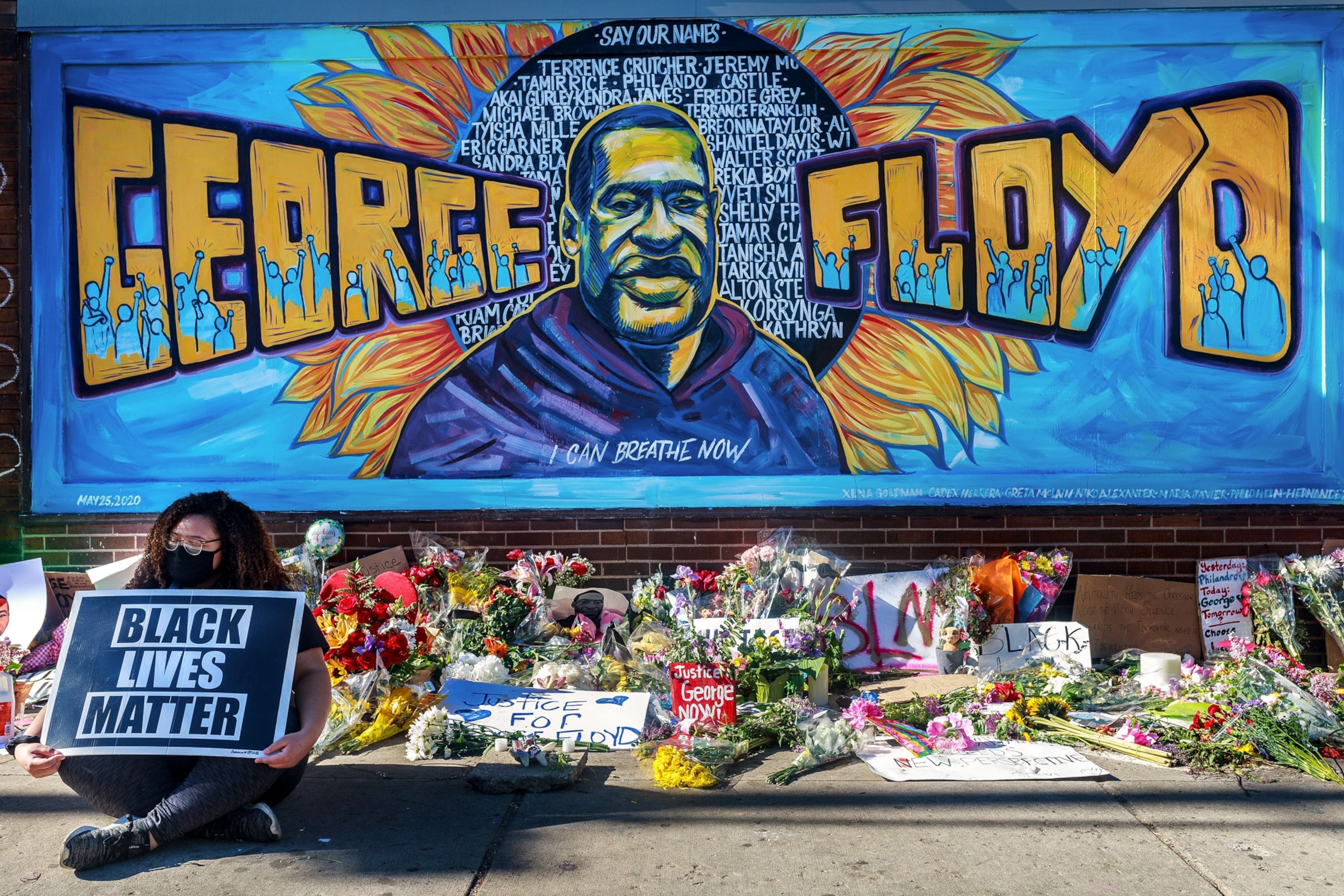
George Floyd's mother was not there, but he used her as a sacred invocation
I want to open with this because I don’t want to center the discussion on me or on my erstwhile opponent in this debate: the real focus here is on the police murder of George Floyd. Rest in peace, sir.

Let’s get this out of the way first: I don’t like Ben Shapiro.

It’s not hard to understand why: he is deeply conservative and I am liberal; I believe in the value of real argument and he’s the definition of a sophist; I strive to be honest and a rational intellectual (Meaning someone who uses reason and thought to discern and communicate truth; I’m not necessarily trying to be seen as super-smart and therefore an authority — though I admit I wouldn’t mind being seen as super-smart), and he’s a manipulative liar who hides behind the trappings of pseudo-intellectualism (meaning he is trying to be seen as super-smart and therefore an authority, regardless of the actual merits of his position — and I think he is intelligent enough to know what he’s doing and why, which implies that he is either deeply cynical or tragically self-deluded).

Basically, he’s a stinky poopoo head. Just know that going in.

As a brief aside, let me address the likely counterjab from any Shapiro fans who happen to be reading this: no, I don’t hate Shapiro because he’s a conservative; I have deep respect for many conservatives. No, I’m not simply jealous; I freely admit I would love to have Shapiro’s platform, his fame and money and success, but frankly, I could get it the same way he did, the same way Glenn Beck and Tucker Carlson and Rush Limbaugh and Steven Crowder did: I could loudly proclaim myself a prophet of outrage and amplify conservative grudges, and use my skills as a writer and a speaker to build a following. As to whether or not I dislike Ben Shapiro simply because he’s right and he proves my liberal ideas wrong, I’ll let this argument address that.

The argument I want to address specifically is this one:

I want to take this slowly: because one of Shapiro’s signature techniques is talking fast and overwhelming his opponents with words that have the appearance of sound, logical arguments. So, right from the beginning: his main claim here, as presented by the title of the video and the first 13 seconds, is that the real reason Derek Chauvin was convicted of murder in the killing of George Floyd was because he had already been convicted in the court of public opinion of being a racist. He expands this in the following 45 seconds by describing Chauvin as “emblematic of an American system of racism,” and uses as evidence the claim that if you asked Americans today if Derek Chauvin was a racist, Shapiro guarantees that a majority of Americans would say yes.

I don’t want to spend too much time exposing Shapiro’s logical failings; the fact that he is a poor debater who wins with sophistry is an issue I have with him and not the central problem with this argument. But it is necessary to identify the places where his argument shifts, because one of the most common manipulations of a discussion is changing the topic, or changing the focus, or changing the argument. We all know it: one of the classic cliches is that arguments between spouses start out with one problem, but then turn into an argument about whose turn it is to do the dishes.

Shapiro does this here. Whether or not Derek Chauvin is personally a racist has nothing at all to do with whether or not he is emblematic of an American system of racism. Whether he is a racist or an emblem of racism has nothing at all to do with whether the majority of Americans perceive him as a racist. And none of that has anything to do with whether or not he is guilty of the murder of George Floyd. Again, because Shapiro is a sophist, he doesn’t seem to argue here that Chauvin was innocent of murder; he argues that Chauvin was unfairly convicted of racism, and simply implies that this unfair conviction of Chauvin for the “crime” (Shapiro’s description) of racism was the “real” reason Chauvin was convicted of murder. He also says, between about 1:00 and 1:30, that America was convicted of being racist because of this one “data point,” Chauvin killing George Floyd; he seems to be implying that America has also been unfairly convicted of that crime of racism, because the conviction of the country was dependent on the conviction of Chauvin for racism, and that conviction was unfair, and also convicting the entire nation because of this one crime is also unfair. Not the conviction for the crime of murder, again, but Chauvin’s conviction for the crime of racism. Which was unfair because it was never brought up in court, never alleged, and never proven, as he says, strongly, several times in this video.

This is what I mean about shifting the argument, and why I call Shapiro a sophist. He’s saying that racism was the reason for Chauvin’s conviction, and in almost the same breath (I don’t know if it was the same breath because I’m not sure that Ben Shapiro breathes: it is genuinely impressive how many words he can get out in a minute, without ever seeming to pause. Sorry; off-topic.) he states that race was never brought up in the trial. How on Earth is the lack of evidence supposed to serve as evidence? It’s not: his evidence is that “we all know” that Chauvin’s conviction was for racism, not for murder. His evidence is that if you asked Americans if Chauvin is a racist, the majority would say that he is. Or at least, Shapiro says (in fact he guarantees) that the majority of Americans would say that Chauvin is a racist.

What Shapiro is really relying on here is the resentment in his audience — generally a white conservative audience — about being called a racist. His audience doesn’t like to be called racist when there is not crystal clear evidence of racist action and intention presented: evidence that would meet the standard in a court of law. That is, unless you can point to the Nazi tattoo on my forehead, and the sworn statement I signed that my Nazi tattoo represents my genuine conviction that the white race is supreme, AND my conviction in a court of law for a hate crime committed in pursuance of the achievement of those white supremacist views — then it is not fair to call me a racist. And since that is his audience’s definition of a racist, calling someone a racist who does not have all of that evidence of racism is deeply offensive. Of course it is: who would want to be accused of that kind of atrocity?

This is, by the way, one of the central conflicts in our society, and it is a subject I will keep coming back to again and again: we have never had a real national conversation about what the word “racism” means, about what it is to be racist. We have not had that conversation because too many people, like Ben Shapiro and also like a much greater number of people on the left, garner too much political power out of misusing accusations of racism, which is easier if they don’t carefully define their terms. It is also much easier to continue maintaining a racist society if the definition of racism is unclear.

Shapiro points out that the evidence of Chauvin’s racism is the death of George Floyd. He says (About 1:00) that is not evidence of racism, it is evidence of a bad cop, of bad police procedure, of recklessness; it is not evidence of racism. But what is his evidence of this claim? That racism was never brought up in the court during Chauvin’s trial. As I said, the charge of racism can only be proven with evidence presented in a court of law: not in the “court of public opinion.” And in another amazing piece of sophistry, starting about 1:45, he says “Let us be real about this,” and then goes on to describe how the presentation of evidence to the public would have shifted public opinion, and therefore the verdict. He says that if the bodycam footage had broken at the same time as the video captured by Darnella Frazier, and if all of the evidence had been presented, and there had not been “20 million people in the streets declaring that America was systemically racist and that this case was and that this case was a case of racism” then it is “highly doubtful” to Ben Shapiro that the jury would have convicted Chauvin of murder.

I honestly don’t know if Chauvin is guilty of murder. I watched the video, and I saw the bodycam footage. I recognize that Shapiro is arguing here that the bodycam footage starts earlier, and shows the struggle between Mr. Floyd and the police before the officers put Mr. Floyd on the ground and before Chauvin knelt on him, and therefore it shows justification (Shapiro is alleging) for the use of force because Mr. Floyd was resisting arrest and so on, whereas the video that helped make this case so famous just starts with Chauvin applying force without giving us the justification for that force, and therefore prejudiced people against Chauvin. I did not see the extended footage as justification. I thought it showed that the police, who probably should not have been called in the first place (I don’t think passing a counterfeit $20 is evidence of criminal action requiring a police response), should not have approached a man in his car, unaware that he had been reported for passing a counterfeit $20, from out of his line of sight, startling him, scaring him and provoking an agitated response, and then using that response to justify pointing a gun at him, scaring him further and provoking an even more agitated response, and then continuously escalating the interaction until it becomes an argument about how much force is required to restrain someone who is resisting being restrained. In fact, I think the extended footage implicated the three other officers in the murder. Not because I know in my liberal heart that Derek Chauvin is racist, but because I don’t presume that George Floyd was a threat, as the police clearly did, and I don’t think that violence is justified in ending a threat, and certainly, without a question, the use of force should end when the resistance ends. If Mr. Floyd was fighting or running away, force might have been called for — but as soon as he stopped fighting, the use of force should have ended. Period. Not gone on for nine and a half minutes. Did the police see Mr. Floyd as a threat because of his race? Was his race the reason why the store’s owner called the police on him for passing a counterfeit $20? I think the answer is definitely yes, but I can’t say for sure. What I can say is that the full footage does not clearly, undeniably sway public opinion towards vindicating Chauvin’s actions, because it doesn’t exonerate Chauvin for me. Though I recognize that other people disagree with me, and think his actions were justified. I see Shapiro’s point, that the full footage might have moved people differently than just the witness’s video did; the death of Ma’Khia Bryant seems to be showing that: but that is a question of how you can move (or manipulate) public opinion, not an argument for how you can find the truth in this case: which is why this extraordinary sophistry. Just watching the videos does not prove Chauvin’s guilt or innocence, which is why I say I can’t know for sure if he was guilty or not.

But this I can say for sure: the best evidence that I know, on either side, is that 12 American citizens, after hearing weeks of evidence and argument, found Chauvin guilty on three counts including second degree murder. Shapiro has not one single argument here that is better or more reliable than that verdict. Nor do I. So I will accept that verdict as the answer, over the doubts of one Ben Shapiro. I suspect that Shapiro, who is in fact incredibly intelligent and both educated and experienced, having graduated from Harvard Law and worked as an attorney before going full time into conservative punditry, also recognizes that he does not have one single argument that is better or more reliable than that verdict. But he doesn’t say that, because he is a sophist and a manipulative pseudo-intellectual who profits from stoking the flames of outrage and partisan division, and convincing his white conservative audience that Chauvin is not guilty of racism, and therefore neither are they, and that the accusation of racism is much worse than the actual murder of George Floyd by Derek Chauvin, because that false accusation of racism caused the wrongful conviction of Chauvin for murder, when at best he was just a bad cop following bad police procedure and acting recklessly. And why those three descriptors, Shapiro’s own, should not be sufficient to show that the killing was in fact murder is beyond me: clearly those reasons, which were presented in the trial and supported by video evidence and expert testimony, were sufficient to make the jury convict Derek Chauvin of murder.

Of course, because Ben Shapiro is a sophist and a manipulative pseudo-intellectual who profits from stoking the flames of outrage and partisan division, he builds from his claim (presented without evidence beyond his own opinion and “what we all know to be true,”) into greater assumptions and accusations, namely that this case has been entirely political, that it has been used by Democrats to build the narrative that America is racist. Again, not to get too deep into flaws in the argument and logical fallacies and such, because the focus here is simply that Ben Shapiro is wrong, but I have to revel in the towering house of cards he has built here: starting with (1) Derek Chauvin was innocent of murder; then (2) Chauvin was convicted because the public decided he was racist, along with (2B) The public would not have decided Chauvin was racist if they had seen George Floyd resisting arrest and being visibly agitated. Then you have (3) Because it was not proven in the court that Chauvin was racist, Chauvin was therefore not racist; (4) America was accused of racism because Chauvin was accused of racism, while simultaneously, (-4) Chauvin was accused of racism because America is and was and has been accused of racism; then (5) since Chauvin is not racist, America is not racist — and also (-5) since America is not racist, Chauvin is not racist — and then (6) the Democrats have taken up this issue because they use false accusations of racism for political gain. All assumptions, many of them contradictory and even absurd on their face, yet we’re just supposed to accept them as true (Because Shapiro’s audience does accept them as true, I would guess). As an example of this, Shapiro, starting at 3:28, begins talking about Philonise Floyd, George Floyd’s brother, who gave a statement about Chauvin’s conviction in which he compared his brother to Emmett Till. Shapiro gets very exercised about this, taking offense on behalf of Emmett Till’s family — and also revealing his (Shapiro’s) additional faulty reasoning for the justification of George Floyd’s death — but there are several problems with this. One is that he gets some of the details of Emmett Till’s murder wrong, but I don’t want to nitpick; I’m only pointing that out because if you want to get self-righteous about the truth, you should present the whole truth. The big problem is that he argues that the analogy is wrong because the circumstances surrounding the death of Till and the death of George Floyd were entirely different, and therefore it is a bad analogy intended to make the murder of George Floyd as tragic and abominably racist as was the murder of Emmett Till. And therefore, of course, the murder of George Floyd was not as tragic and abominably racist as the murder of Emmett Till.

But here’s the thing: that is not the analogy that is being made.

Frankly, I’m not going to speak for Philonise Floyd. His brother was killed, the murderer was convicted; Mr. Floyd is welcome to say whatever the hell he wants in the aftermath of that tragedy. He can say that his brother was the Second Coming, or the greatest American since Abraham Lincoln, or that he was cooler than Napoleon Dynamite: none of that is evidence of any of the accusations that Shapiro makes about the Democratic party using Floyd’s murder to make political hay. (I will say that Shapiro does not directly criticize Mr. Floyd: he rather goes after the more famous men standing in support of Mr. Floyd, namely Rev. Al Sharpton, Rev. Jesse Jackson, and Ben Crump — who, weirdly, I guess have to name as the head of George Floyd’s family’s legal team, which one would think could be the explanation for Mr. Crump’s presence at Philonice Floyd’s press conference, rather than the political agenda Shapiro seems to ascribe to him. Shapiro calls them all racebaiters, of course without any evidence whatsoever, allowing that ad hominem attack to support his house-of-cards assumptions about the political agenda being expressed here.)

But others have made the same connection between Emmett Till and George Floyd, so let me address that: the argument has not generally been that Floyd was murdered in the same way that Till was. Nobody has made that claim, other than Till’s cousin, Ollie Gordon, who did say that she felt the same way watching the video of Floyd’s murder as she did when her cousin was lynched. The point that has been made repeatedly is that Till’s murder, and even more importantly, his mother Mamie Till’s decision to publicize the horrifying details of her son’s murder, with an open casket funeral and published pictures of his wounds, galvanized the civil rights movement and helped bring about the changes the movement wrought over the ten years after the 14-year-old was killed; similarly, George Floyd’s murder, which was not unique but was certainly more publicized than most similar murders, galvanized the protests that happened in 2020, and may lead to some changes — potentially including the conviction of Derek Chauvin. And that is a reasonable analogy; but it does support the idea that the country is in fact racist, which is why Shapiro has to argue against it.

In the process of arguing against it, Shapiro does go after George Floyd: he describes Emmett Till with a list of negatives, all of which are points Shapiro wants to make about George Floyd. He says that Emmett Till was not someone passing counterfeit bills, that he was not a repeat drug offender, that he was not a repeat criminal who had done jail time, that Till did not hold up a pregnant woman at gun point and rob her house while her kid was in the house. And perhaps the most important point (though it is not the most emotionally manipulative point), Till did not resist arrest. Of course: none of these things matter in the slightest. George Floyd was not killed because he was a repeat drug offender, nor because he was high when the police detained him. He was not killed because he had a criminal record. He was not killed because he was passing counterfeit bills (There is no evidence, of course, that he even knew that he was passing counterfeit bills). He was, and this is the crucial point, not killed because he was resisting arrest.

George Floyd was killed because Derek Chauvin murdered him. As was proven in a court of law.

Now, I do have to point out again that Shapiro doesn’t actually say that Chauvin did not commit murder; he said that he doubted a jury would convict Chauvin of murder had it not been for the court of public opinion convicting Chauvin of racism. I don’t agree, clearly, but I will say there is some argument to be made that the jurors were swayed by the events of last summer, and by the protestors showing up in great numbers outside the courthouse throughout Chauvin’s trial. It may be that the jurors convicted because they were afraid that there would be riots if they acquitted Chauvin. That may be true, though of course it may not be; there is just as much reason to think that the jury, or at least some members of the jury, would acquit in defiance of that pressure, would even seek out the violence that may have followed an acquittal. It is extremely likely that some members of the jury would fear the consequences that might have come, that still might come, from the police because Derek Chauvin was convicted. In any case, it is not true that the jury convicted Chauvin only because of the accusation of racism. Since, as Shapiro states, race was never brought up in the trial, the only way the jury could have convicted based solely on the accusation of racism would be if they came in with that idea already in their heads, that they were prejudiced against Chauvin and no amount of evidence would ever sway them. But since 46% of Republicans and 25% of independents think it was the wrong verdict, based on the same public opinion evidence that Shapiro claims is the reason for the conviction, it’s far more likely that, if public opinion actually held such sway over the minds of the jurors, some of the jury would have voted to acquit. It’s practically impossible that the jury would be all Democrats (Also, 10% of Democrats think it was the wrong verdict, so at least one juror on an all-blue jury would have thought that, statistically speaking), and hard to believe that Republicans would overcome their prejudices while Democrats would not, based on the same evidence. One pro-police Republican voting to acquit would have led to a hung jury and a mistrial, and that has historically been exactly what happened in even the most egregious cases of police violence. Instead all twelve jurors, some of them likely sympathetic to pro-police ideas if not personally in support of them, all of them surely feeling pressure from conservative friends and neighbors as much as from liberal friends and neighbors, voted to convict. On all three counts.

Because Derek Chauvin murdered George Floyd. As was proven in a court of law. Without race being brought up once.

Now: is America racist? Was Derek Chauvin’s murder of George Floyd emblematic of that systemic racism? Might the video, the case, the public response both from 20 million people on the streets and from politicians and political pundits, all potentially have had, or will have in the future, an impact on the racism in this country?

The answer to those questions is the same as the answer to this one: Is Ben Shapiro a sophist and an annoying twerp?
Okay, Now What?

So we won.

The knowledge hasn’t trickled down yet to the sewer underneath the swamp, where Trump lurks, where he festers and spreads like an antibiotic-resistant infection (I wonder if, in classic supervillain style, he unintentionally revealed his secret weakness: what if the only way to defeat him permanently is to inject him with bleach? [NOTE TO THOSE WHO ARE UNFAMILIAR WITH MY WRITING AND PHILOSOPHY: That was ironic; I am a pacifist. Please don’t actually try, or plan, to inject the President with bleach. Not even when he is the ex-President. (NOTE TO THE SECRET SERVICE: I know, I shouldn’t suggest harming the President of the United States. I still think it’s a funny joke, so I’m leaving it. I wouldn’t worry too much about the people who read this trying to actually pull it off. And if they somehow managed it, hey, now you can relax and stop feeling all that conflicted guilt and irritation from trying to preserve the life of a pustulent boil on the ass of America. [NOTE TO THE SUPER-SECRET CABAL WITHIN THE SECRET SERVICE THAT HAS BEEN SECRETLY PLOTTING TO REMOVE TRUMP SO YOU ALL CAN PROTECT SOMEONE YOU ACTUALLY RESPECT AGAIN: Try bleach. (Note to my students and fellow grammar/syntax nerds: this is my favorite part of nesting parentheticals like this:)])]), but it’s true. We won. We got past this hurdle.

So now what?

I’ve been seeing and hearing all kinds of advice about not giving up. Continuing the fight. Now is the time, activists say, to turn that anti-Trump fervor into fervor for new causes, to keep the same energy moving forward into the next fight for change and progress. I heard it on Pod Save the People this week (If you don’t know it, this is a weekly news commentary podcast with a focus on people of color and social justice, very well done and interesting and human — sometimes a leeetle too woke for me, but I still recommend it), I saw it on this Twitter thread shared by a friend on Facebook; I feel like I’ve seen this everywhere. Now, whenever I see something like this, the bottom falls out of my stomach; so I may be noticing this sort of thing more, rather than seeing it a whole lot, but it feels like I’ve seen it a whole lot, and I don’t like it.

Because I don’t think I can do that. I am spent. I am drained. If somebody wants me to turn my anti-Trump energy towards a new focus, the bad news is that I don’t have any of it left. The good news is that I am quite willing to move to the next focus, the next fight. I don’t believe this is the end of the issue; the victory we’ve won is incredibly important, like saving the country important — but it’s not the last victory we need to win. I get that. I am with that. I am onboard.

I just don’t have it in me to fight. Not right now. I feel bad about it, but that is the truth. I’m close to my edge. I have of late had bouts of depression and despondency that I have never experienced in my life before now. I struggle with things that should be easy, my patience is gone, I can’t sleep, I’m not writing or reading much right now. Pretty much everything is wrong.

Not everything: my wife is still my perfect partner, and I love her deliriously. My pets are delightful. My friends are fun and supportive. All these things bring me at least some joy, every day and every week and every month. And though it doesn’t necessarily bring me joy, I do have a job and a reliable income, which gives me a sense of security that millions of people — billions of people — are lacking. I am grateful for all of those things. But still, pretty much everything else is wrong, and so:

I need to stop fighting.

I recognize that it is a privilege that I can talk about not fighting; because my life and my freedom is not at risk. It is somewhat at risk because we are living through a pandemic and the situation is deteriorating; I am at a bit higher risk than some because I work for a school that insists on staying open and having students and teachers in person in the classroom every day. But also, I am healthy and I have insurance — and I am not wedded either to glorified ignorance nor superstition, so I listen to the warnings and take reasonable precautions — so the risk is as minimal as I can make it. It’s easier for me to step back from fighting for police reform or environmental action or to protect reproductive rights than it is for people who are at risk from those dangers.

That makes me feel bad, that I can allow myself to step back from the fight while others can’t: but that guilt doesn’t give me the energy or the wherewithal or the resources to fight. It just makes me feel bad, which adds to my current emotional burden.

(And if anyone reading this is thinking, “Pssh, get out of your feelings, Snowflake” — I mean, considering my writing and position and my probable audience, it seems very unlikely that anyone is; but I think there may be some people who still subscribe to the image of men hitching up their gunbelts and soldiering on, because I still think that, a lot of the time — let’s recognize that all the strong silent men of the past drank and smoked themselves to death by age 65. So let’s be clear about what actually works and what we think sounds like it should work, maybe, but really doesn’t. “Sucking it up” is fine when you’ve stubbed your toe. Sucking up your looming despair just makes everything worse.)

I don’t mean to whine (And again, my probable audience probably doesn’t see this as whining, but I watched Westerns when I was a kid, so I feel the need to address this) because I also realize that there are people who are having a much harder time with the same issues I’m having right now, the stress and anxiety and depression, which for others is compounded by other and greater dangers and problems, problems that I don’t have. I want to do two things: I want to be honest about how I feel, as that is the healthiest thing for me to do for myself; and I want to let other people who may feel the same way know that they are not alone.

If you are exhausted, you are not alone.

If you want to join the fight, to keep fighting, to do the right as you see the right, you are not alone.

But if you just can’t do it right now, you are not alone.

So that’s where I am. I want to do a lot of things. I want to write to politicians and urge them to do the right thing. I want to join organizations and show up and participate — and I suspect that my writing skills could actually prove an asset to those fighting for the causes I believe in. I don’t want to join phone banks or knock on doors or fundraise, but I want to want to do those things, and if things were different I’d do them whether I really wanted to or not. I want to donate lots and lots of money to lots and lots of causes.

But instead, I’m going to stop fighting. I’m going to take care of myself.

It sounds stupid to me (Again, trying to be honest, and I grew up watching Westerns, and also wonderfully chauvinistic and hypermasculine shows like Buck Rodgers or The A-Team — and, yes, The Dukes of Hazzard, too) because I don’t fit into a category of people who have problems and need care. I’m a healthy straight white American male with an upper-middle class upbringing: I should be fine. I’m afraid to take care of myself, too, because there are others who rely on me, and it feels to me like I can’t take time for myself without leaving them hanging, and I don’t want to do that: it feels like I’m compounding my — what, my negligence? My dereliction of duty? What is it when a teacher doesn’t take care of his students, when a husband doesn’t take care of his wife, when a pet-papa doesn’t take care of his sweet little 60-pound Boxer-mix princess? When a liberal/progressive doesn’t take part in the fight for social justice and a functioning democracy? It’s my sin, right? My wrongdoing? After all, all that is necessary for evil to triumph is for good men to do nothing. If you’re not part of the problem then you’re part of the solution. All those memes about the German people allowing the rise of the Nazi Reich, the passage in Dr. Martin Luther King Jr.’s “Letter from Birmingham Jail” when he talks about how the listless superficial support of white liberals is a greater danger than the vigorous opposition of white racists; how can I stop fighting in the face of all that? How can I do nothing right now? However tired I am, surely there is something else I can do? However upset I am, however anxious and depressed, surely there is something I can do? And people are full of advice: if you can’t march in protest, then join a phone bank, write letters, donate donate donate. Take action. Don’t lose the momentum. Don’t stop.

Enough. I must stop listening to these idiotic voices in my head telling me to ignore how I feel and press on forever. They are not telling me the truth. They are not the voices that matter to me, not the people who I care about and who care about me; all of those people tell me to take care of myself, to take it easy, to not put myself under too much stress. Another moment of honest truth: my wife tells me this all the time, and my friend and fellow teacher Lisa; but they are the only ones because I never talk about how I feel to anyone else. Anyone asks me how my day is, and I say it’s — fine. Doing good, I say. Sometimes, with my students, with my parents, I will share that I am not in truth doing that great, but I also immediately get angry and defensive about it, or I breeze right through and change the subject, and don’t allow anyone else to sympathize with me or tell me that it’s okay to not be okay. It is also true that my parents make me feel bad for feeling bad, and my students respond to my sorrow with their own sorrows rather than sympathy for mine; when they do that I feel the need to sympathize with their sorrows, which is hard and draining, and just makes me feel more hopeless and helpless, and also bad for feeling that way; so there’s not a whole lot of impetus to be honest about my current state, most of the time. So I’m usually not. But I want to be, and that’s why I’m doing this, and ignoring the discomfort I feel in writing an entire blog this long about how I don’t feel very good right now.

I don’t feel very good right now, and that’s why I’m writing this, and why I’m not writing much of anything else. That’s the truth.

Here are some other truths:

I spend too much time on social media, particularly arguing on social media. I shouldn’t do it, because the people I’m arguing with are never going to change their minds because of anything I say. I do think there is value in pushing back against ignorant or dangerous or harmful ideas; and I recognize there is some audience reading those arguments on social media who may be more thoughtful and may get something out of my arguments more than my actual opponent will; but it is draining. I spend time on social media because it feels easy and it feels like relaxation — I see memes and laugh, I see videos of cute animals and smile, I see that my friends share my likes and dislikes, my passions and skepticisms, and I feel connected — but I spend a fair amount of that time trawling for arguments, and then continuously going back and arguing again and again and again. I suspect I do this because I am not doing other and more important things, but it’s not a replacement for good and useful action: it’s a waste of time and my limited resources, and a source of unnecessary and unproductive frustration. So I need to stop. That’s the truth.

Being a high school teacher is both very stressful and draining, and also very important; it feels like a copout to say I don’t spend more time fighting for the causes I want to fight for because I spend all my time fighting to make my students less ignorant, but it’s also true: it is a fight, and I fight it hard, every day. They don’t like to read, they don’t like to write, they don’t want to do work, they don’t know how to relate to and understand other people; every day I try to help them do all of those things better, and also understand why they should do all those things, and I try to find reasons that are specific and personal to them. All of that takes energy and passion, and hope and determination, and confidence and faith that what I am doing is the right thing. Meanwhile my school and my society seem bound and determined to tell me that it is not the right thing, determined to get in the way of my and my students’ success: and so I have to fight them, too, have to keep them from shifting my priorities and effort away from what matters, have to avoid the pitfalls and traps they set for me, have to discern when they are genuinely trying to help and when they are just trying to look good at the expense of the real work. All of that takes effort, too. I spend that effort every day.

I think it is vitally important that we recognize that none of us have it easy: that all of us are fighting in our own lives for our own success, every day; taking on other causes is already dipping into our reserves, taking from our reservoir of strength and hope and resolve what may not be there to take for much longer.

We all fight in our own ways, and with our own capacities. I will not be joining phone banks or door-knocking because I am an introvert, and what’s worse, I’m an introvert in an extrovert’s job, so I have to use up all of my socializing energy just to get through my day. If I was still a janitor (And I frequently ask myself why I am not still a janitor — but the reason is because what I do now is important) then maybe I could participate more; but I’m not. If I was an extrovert then I would be happy to go out and talk to people about causes I believe in; but I’m not. If I was rich I would give all kinds of money away; but good grief, I am most assuredly not. And many if not most of the people out there who tell me, who tell us, to fight and keep fighting are not in situations like mine. They may, as I said, be closer to the issues, in more danger because of the problems than I am in; but that doesn’t mean they have jobs as hard as mine is, or proclivities as unsuited to organizing and rallying as mine are. Wishing it was different, or even just pondering what it would be like if it were different, is a waste of time and energy: this is the situation. This is the truth. I’m not lying to myself, and it’s not a dodge or a copout: I am an introvert, and I work very hard at being a teacher, and I am tired. And I need to take care of myself, no matter how stupid or guilty it might make me feel to say that, because if I use up everything I have, if I fail, if I fall: then — and only then — will I be letting down those I love, and those who love me.

And my sweet little 60-pound Boxer mix princess needs her daddy.

So what’s next?

You need to think about what’s next. Think seriously, think truthfully. Think what needs to be done, yes — but also think about what you need, and what you are capable of. If you are ready to start the next round, then get in there and start fighting, keep fighting. If you have to pause to take a deep breath, then do it: breathe as deeply as you can. Keep breathing. If you have to take a few hours for a meal and a glass of wine and a bath and a nap, then do all of that. And do it again next week. If you need a few days for a vacation, or for a retreat and a rest, then do that. If you don’t know what you need or how long you need — and in my case, I do not; part of my struggle with this is that this struggle is new to me, has never been like this, has never been this hard before, and so I do not know what to do, I do not have a ready answer for what is really wrong with me or how to deal with it — then don’t try to decide in advance what you need or how long it will take to take care of yourself. Just take care of yourself until you feel better. Just do that.

Take care of yourself. For me. And I will take care of myself. For you.

Be well.

I don’t know what this means.

When I was six, I was walking through the woods on my grandparents’ property in Washington, and I stepped on a yellowjacket nest. I remember the sensation as my foot came down: pushing through the humus of dried leaves, a moment of resistance, and then I crunched through what I thought was solid ground, and fell lower than I thought I should have, on that foot. That’s when I heard the buzzing: z z z ZZZZZZZZZzzzzzzzzz It hit a fast crescendo and then lowered to a purposeful, ominous hum, as if I had prodded a sleeper who did not want to wake and who growled resistance at me.

Then the stings started. One, two, three, each more painful than the last, the infuriated insects stitched their revenge up my leg as I stood, frozen, suddenly unsure of the ground beneath me — was it more hollow still? Would I fall through again? — obeying my training that told me to stand still when bees landed on me because they didn’t want to sting me, after all.

But these weren’t bees: they were yellowjackets. And they wanted to sting me. Understandable, really, since I had just destroyed their house and maybe crushed some of their family members; but that didn’t make me feel good about the fiery needles jabbing into me.

Fortunately my mother was there, and having grown up on that place named for her family, she was familiar with the sound of angry bees and yellowjackets: and she realized this was not a good time to just stand still. She scooped me up and ran. Of course I realize now that she was running to get us both away from the yelllowjackets, but at the time, I was suddenly sure that she was running me back to the house because I was going to die: my father is allergic to bee stings, and even at that age, I knew the potential danger of those tiny packets of venom which I could feel throbbing in my shin — and maybe moving up through my bloodstream? Was this the end?

It was not. It was about to be my first encounter with witch hazel (a name that still feels mysterious and alchemical to me), the rapid soothing of the burning stings, a cookie or two to soothe my burning tears, and the disappointing reckoning of a mere six stings, none higher than my knee. Not enough damage for a good I-stepped-on-a-beehive story, though it’s a damn good indication of my mother’s reflexes and quick thinking.


That moment of stepping down onto, and then falling through the ground and into a sudden attack: that’s what 2020 feels like to me. The hollowness of the hive beneath me, incapable of holding me up, echoed in the middle of me as I realized what was going to happen, a hollowness that seemed to swell and expand even as it grew more empty and dark and cold, as if my fear were a black hole inside, swallowing more and more and growing larger with each terrified thought that fell into it: that’s what I feel like inside, right now, and for the last six months. It’s a much slower process, this time, lasting months instead of seconds; but I feel very much as though my reaction is identical: I am frozen, panicked, trying to figure out what to do and coming up with no good ideas, just standing and watching as the danger swirls up around me.

At the same time: I am not just the kid walking through the woods, this time. I’m the yelllowjackets. The hollowness inside me is the hive, and the shell around that emptiness is too weak, and can’t hold up the weight of the world that is stepping on me. And as everything going on around me crushes through me and into me, I lash out, angrily — maybe understandable, but really, useless  — and I sting, and I bite, and I attack. I have never been so short-tempered, so cranky, so bitter, so apt to strike, so apt to sting with my words and my tongue, as this year. I hate it. I can’t stop it. I can’t: I don’t have the strength. That’s what was hollowed out of me. And I can’t just set myself and bear up under the weight: because the hollowness is under my feet, too, and I am being stung even as I am stinging.

I don’t know what to do. I’m just standing here. I have been for what feels like forever.

And I’m so tired.

And this time, my mother can’t scoop me up and run me back to the house for the twin magics of herbal remedies and baked goods.

This time, I might just get stung to death.


Probably not. I’m aware that as high as the number of Covid-19 cases is, it’s still only a fraction of the population, and that while my state is not handling the pandemic well, I am taking reasonable precautions that should keep me safe; I will most likely come out of this with an unremarkable tally of suffering. I do not mind, this time. I would very much prefer a half-dozen stings, no permanent scars, no need for a doctor. Just some soothing liquid and a cookie or two.

But I’m not just standing still with my foot in the danger zone; I’m still walking forward through the woods. In fact, since school starts tomorrow and goes to in-person classes in four weeks, I may be stepping onto the hive, and then continuing on into it, like walking down into a hive the size of a subway tunnel, with yellowjackets the size of Shelob. (At the same time: those goddamn hobbits are coming into my home, fumbling and ripping through my webs, and they are goddamn well going to pay for it. Nasssty little hobbitses.)

What precautions do I take then, as I move deeper and deeper into this hive pit? My school is trying to stay on top of things, having offered fully online learning as an option, instituting new protocols — social distancing, mandatory* masks, sanitizing spray to be applied every two hours**, fever checks on arrival — intended to prevent the spread of the disease. I don’t know how well it’s all going to work, though; and I have no idea what to do about that. I can’t quit. If I raise too great a stink, they’ll fire me. I guess I just have to stand there. Maybe the small things hovering around me don’t want to sting me, this time.

*Mandatory here means just what it does everywhere: masks are required until someone raises a loud enough political objection, and/or presents a doctor’s note. Then, not. Hope the virus takes doctor’s notes, too. 

**Said sanitation to be applied by me, every two hours, in between classes. On a side note, the spray requires four minutes to take full effect. Time between classes is four minutes. Hope the virus will wait out in the hall.

The danger, though, is not what is haunting me. Perhaps it should be, but the thing that is building a growing ball of hollow darkness inside me, the thing that makes me feel as if my next step will land on an equally hollow surface that will drop me through and out of the world, while at the same time the weight on top of me punches through my thin outer layer and into the hollow within, is this:

I am tired.

The hollowness inside me is not just fear. It is exhaustion. I am so very, very tired. Tired from fighting, tired from standing watch, tired from holding up others as well as myself. I’m tired of watching the pandemic grow, and watching my country wallowing in ignorance and selfishness like a pig in shit — just as filthy and twice as proud of ourselves — as we deny science, and raise alarms for problems that aren’t real, pointing to imaginary dangers that somehow block out of our sight the very real danger of this virus. I am so tired of being angry about it. I am so tired of fighting with people who smugly ignore every fact and every reasonable thought because it doesn’t make them feel safe, or worse, it doesn’t make them feel strong and fearless. Saying they’re not afraid of Covid, that makes them feel strong and fearless.

It’s as if when my mother rushed to scoop me up out of the yellowjacket hive, I had pushed her down, spit on her (Because the people who think this way are some of the rudest, most inconsiderate, most contemptuous hooligans I’ve ever interacted with. And I teach high school.), and then stood with fists on hips, chin jutted, nostrils flaring, and said, “Don’t you tell me where I can stand, I’m an American. You run if you want to, you and all the other sheep!”

While the yellowjackets swarmed around me.

And of course it’s not only the virus. I am so very tired of racism. I am tired of being ashamed of what people who look like me have done to people who feel like me for centuries. I am tired of confronting the same angry, willful ignorance about the protests or about opposition to police violence. At the same time, I am tired of being treated like the people I look like by the people I feel like — and I am tired of knowing that I have no right to complain about any treatment I may suffer, because my world has been built to prop me up, and whatever I may have to go through pales in comparison to the ordeals of those who are less pale than I. I hate that people tell me I have no right to speak my opinion, to take a stand; that all I can do is get out of the way and let better people take what they have been denied for centuries, because people who look like me oppressed them, which has enabled me to become everything that I am — all of it tainted by centuries of crimes against humanity. Not my own gifts and efforts, but my privilege, I am told, is why I am who I am and can do what I can do: and that means I don’t deserve what I have, and using that privilege to try to help solve the problem earns me a sort of sly sneer from those who know that my actions on behalf of the cause are just white guilt, and really, I am still the enemy,still perpetuating the problem if I do anything other than get out of the way.

That’s how it feels. It’s maybe not true that people working for social justice think that way of me, but — that’s how it feels. Of course, maybe that’s just my white guilt talking. And my white privilege thinking that I should be the one to speak up and fight for the cause: because that means I am centering whiteness in a movement that is not intended for the benefit or the recognition of white people or white suffering. It’s so easy to fall into the same patterns that have existed unrecognized throughout my life; how can I tell what is genuine and what is instilled in me by institutions of oppression and privilege? Is everything about me broken and wrong because of the world I grew up in? Is there nothing that is me? No, I want to say; I am good, I am worthwhile, I want to help and I am capable of helping. It is not right that I get pushed aside and marginalized, stereotyped, included in sweeping generalizations, based only on my skin color, my nationality, my gender —

And how pathetic do I sound saying those words.

I’m so bloody tired of irony.

I want to help, is the problem. I don’t want to be like those ignorant yahoos I fight with. I don’t want to be selfish.

But so many people need so much help.

I can do a lot of it. I am happy to do a lot of it: happy to support my family, my friends, those who rely on me. They are struggling, too, because this year has not only been hard for the pandemic and the riots: it’s hard financially, and crippling politically, and my family has had a series of tribulations fall on us like Biblical plagues, one after another and each worse than the last, mostly medical and due to my parents’ generation reaching the stage of life where things go badly. And of course, I can’t do anything. I can’t go help them because I might infect them, and that would kill them — and that would kill me. I worry about them double, because I realize that, on top of everything else, the pizza delivery man might give them Covid-19, and then I wouldn’t be able to visit them in the hospital while they coughed their life away.

And I can’t talk about this, can’t complain about this: because everyone else has it harder than me. Everyone. It’s not just white privilege, not just male privilege; I am healthy, and have remained fully employed, at a job where I am respected and well-liked, and I am generally well-balanced emotionally. I’m not well-balanced this year, of course, but since I started off having an easier time than most, and we’ve all gone down together, I still have more of my head above water than others do who were half-drowning before 2020. So I have no right at all to complain, and if I open my mouth to do it, the response I get back (the response I should get back) is something along the lines of, “Yes, I know, I’m going through that too — and a dozen things that are worse.”

Part of me can’t stand myself, right now, for complaining that I have it too easy in life to complain. And normally, the fact that I do have it easier than most would keep me from complaining because it would keep me from suffering. And even when I do suffer, I don’t have such troubles that I need to vent, need to talk them out. Normally I don’t need much support.

But this year is not normal.

I need to vent. It helps, you see, even if you don’t see how it could possibly help, even if you don’t know why it helps, talking about your feelings helps. I need that help. I need to say how I feel, even if how I feel is gauche or insufficiently woke. (“See that? That’s white sensitivity right there. He needs to grow a thicker skin, learn to deal with being told what he’s doing wrong. It’s just that he’s never been criticized much before, not in this society built for people like him.” Yes. I know it. But this is still how I feel.) Because people need my support, and so long as I am this tired, and feel these hollows under my ribs and under my feet, I can’t give them what they need.

This is what I need: I need to talk. I need to write. I haven’t wanted to do it, not for months now, for all the reasons I’ve been talking about here. There is too much, and I need to figure out what the hell I’m really feeling; I hate to ramble and blunder and sound like I don’t know what the hell I’m getting at. But one of the difficult Catch-22s of being a writer is that writing is exactly how I figure out what I’m feeling; I usually don’t know what I’m getting at when I start writing, I just get there when I get there, and I have a pretty good idea of when to stop. I have no doubt that this blog is irritating and confusing for people who read it. I expect you, too, are short-tempered, unable and unwilling to put out a whole lot of effort helping someone else deal with their shit when you’re sitting there with both hands full of your own.

I’m sure you’re tired too.

It feels strange to write this, because it makes me feel better, and so maybe I want to share that; but I don’t want to be a bother, don’t want to be a burden.

Which is also how everyone else feels, too.

So I’m just going to say it. If what I’m saying is wrong, please feel free to correct me; but first, I need to say it. Actually, I take that back: if you have something you want to say about something I’m doing wrong, put a pin in it. We’ll circle back around to it later. For now, I just need to talk about how I feel. And I won’t ask people to listen to me, because I know you’re all struggling, too — but it would mean a lot if you did.

We all need help. We all need support. We need to ask for it for ourselves. Just asking makes us feel better: because it validates how we feel. Being willing to ask for help, from those whom you are willing to give help to, shows that you consider yourself as important as they are, as worth helping as they are. It shows them that they are not a burden on you, that they can help even as they ask for help for themselves. And everyone feels better when they can help.

I need help. I’m standing on unsteady ground, in a country that is tearing itself apart, and I’m about to go back to work where I will be surrounded (Virtually, for the most part, but still) by students — who all desperately need all the help they can get.

That’s what made me actually open this post and start writing. That’s really what I’m afraid of. I’m afraid of the virus, afraid of what’s going to happen in thousands of schools across the country to hundreds of thousands of teachers and millions of students; but what scares me right now is the knowledge that those students will come to me, and they will need me. They will need me to listen to them, to understand them, to take them seriously, to help them. They are bottomless abysses of need, just like I was at their age, as we all are in that terrible time of adolescence. They will need me even more now, because their world is on fire, too.

I don’t know how much I will have to give them.

I’m so very tired.

I’m just standing here: hoping I don’t get stung.

Can someone please pick me up and run me away from the swarm?

Or if not that — can I have some witch hazel and maybe a cookie or two?

Thanks.

What are we fighting for?

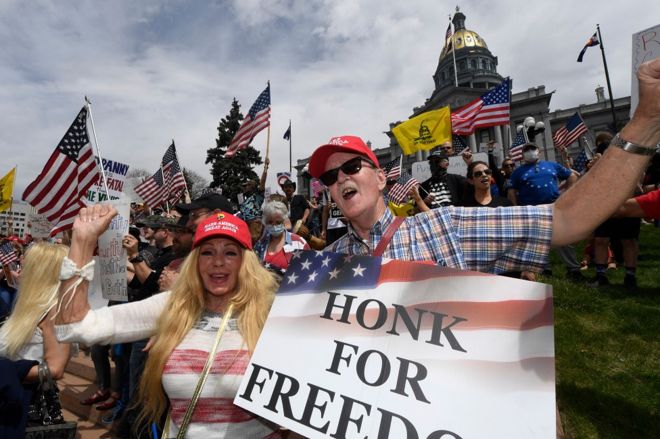
HONK FER FREEDUM

Coronavirus: the US resistance to a continued lockdown

I want to understand the argument.

I don’t. And it’s vital that we understand the argument, even if we don’t agree with it; agreement is not necessary, compromise can be reached, solutions can be found even if we don’t agree.

But if we don’t understand? Then what do we do?

“We believe that the state governor has gone beyond his constitutional authority in shutting down businesses and ordering people to stay at home,” organiser Tyler Miller tells me from the grounds of the state capitol.

In mid-March Washington Governor Jay Inslee announced an emergency proclamation mirroring many issued around the world; closing restaurants and bars and banning large gatherings.

But protestors say that was unconstitutional.

“The state constitution says that the right of the people to peaceably assemble shall never be abridged. We believe that the (emergency coronavirus) proclamations that the governor here ordered violate that,” Mr Miller says.

Mr Miller said he was not protesting against the recommendations from the public health bodies and respected the need to ‘flatten the curve’.

“I even self-quarantined for 14 days back at the very beginning of this myself, when I had an illness that mirrored some of the symptoms,” he says.

“The fact I am protesting does not mean I think it is a good idea to have gatherings, I just believe that the government has no authority to prohibit them.”

Throughout the crisis, Mr Miller has also been able to continue his work as an engineering technician with the navy.

He says the thing that has angered him is what he feels it is an un-American overreach of power by the Democratic governor of Washington.

I don’t understand that argument.

There is a simpler argument, which is just that people are getting desperate: the country has been shut down in places for more than a month now, and people are facing another rent payment, another car payment, on May 1st, this coming Friday. I understand that desperation, that anxiety; I understand and (mainly) support the desire to let government officials know that you need and demand action. I think it’s a mistake to violate social distancing guidelines, and there are people in the article above and others I have seen who say things like “I have a strong immune system, I take care of myself,” who I think are somewhere between ignorant and idiotic: ignorant if they don’t know that Covid-19 has killed young and healthy people as well as older, sicker people; idiotic if they believe unfounded statements (Mostly from conservative “news” sources) that the novel coronavirus is no worse than the flu.

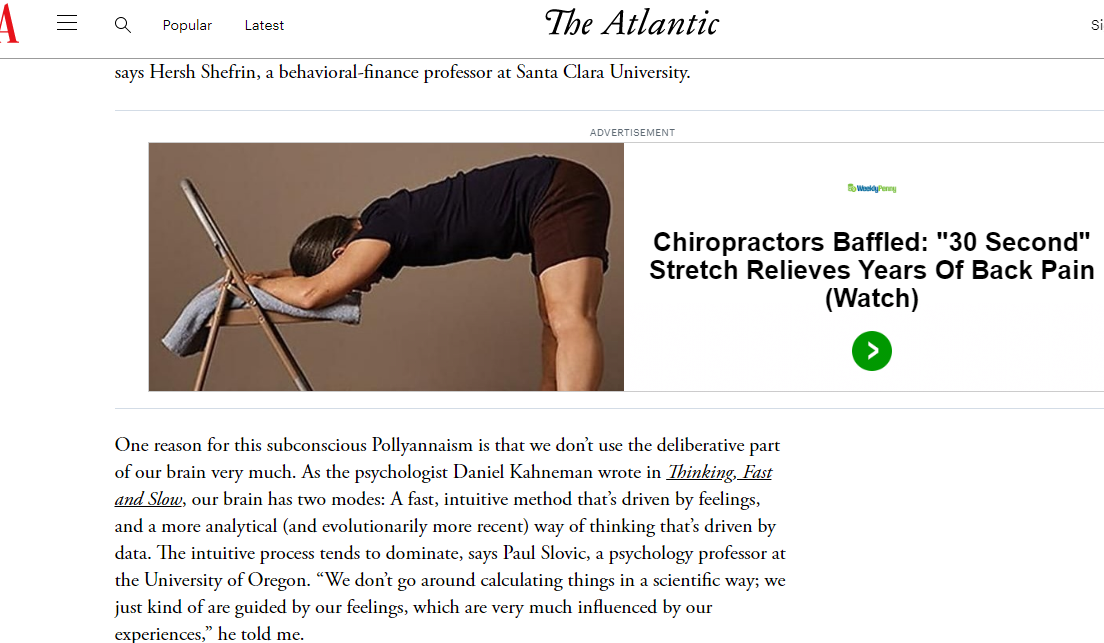
(This may be too harsh: this is an interesting article about how we are wired to be intuitive, and so underestimate the evidence that comes from outside our experience. I know I was telling my students in March that any shutdown of schools would only last a couple of weeks and would certainly not affect their graduation. On the other hand, I am not saying the same thing now, because I have learned better; I’m not sure why these people haven’t, but my two options above are certainly possibilities.

(Also, this ad popped up in that same article about people being too optimistic. Lol.

Screenshot (6)

(If you believe not only that a miracle stretch relieves years of back pain, but also that chiropractors are stunned by it, AND that chiropractors are the authority whose stunning represents a medical breakthrough, then you are unquestionably in this overly-optimistic bunch.)

But while I understand and sympathize with people who are desperate to get back to work and pay their bills, and I believe (and am infuriated) that the federal government has once again bailed out large corporations with deep political donation pockets and left average citizens to twist in the wind, I don’t understand the other argument. The freedom argument.

I don’t think it’s a reasonable argument.

Listen. I worry about government overreach. I won’t say I’m learned in history, but I know about the Japanese internment camps during World War II, and I know some things about the rise of the various authoritarian dictatorships that plagued the 20th century. I have hated the USA PATRIOT Act since it was imposed on us, during the paranoid jingoist nationalist fervor that swept the country after 9/11 and swept us into a neverending war. I know that it gets renewed every time it comes up because the government doesn’t like to give away power that it has seized. Because of that experience, I have been pointing out to my friends who argue against the lockdowns that the thing we need to worry about is the powers the government arrogates to itself after the crisis: the new regulations and limitations, and invasions of citizens’ rights, that follow a partial return to normalcy, and that are intended to prevent this kind of thing from ever happening again. We have to watch out for the permanent changes, or for the attempts, often subtle and underhanded, to make temporary changes permanent.

I don’t doubt those will happen. I think the first attempt will be by President Trump, when he decides to make his temporary limit on immigration permanent.

But see, I think that because Mr. Trump has a long history of a clearly established position to end immigration. I think that because I have read reports that Trump’s anti-immigration advisors have talked about this pause into something more long lasting. Because this article quotes DHS acting secretary, Chad Wolf, as saying to Fox News that

his agency will soon recommend a move to limit temporary work visas as well.

“That is something that the department has been looking at for the past several months, so we are well underway and look forward to presenting to the President those recommendations for additional steps,” said Wolf.

So there’s your government overreach, as part of an established pattern of behavior, aiming at known long-term targets. After the fact. Once the danger has passed. The current actions are not government overreach: they are government responding as government should to a crisis. The stay-at-home orders were issued during a crisis, and in line with scientific facts and the advice of experts. This is exactly when, and exactly why, people’s rights can and should be limited. We have the right to protest, but if you decided to walk into a burning building in order to protest the fire, people would stop you: and they would be right to. We have the right to freedom of speech, and of assembly, but you cannot gather with an army and plan the destruction of the United States: the right is to peaceably assemble, and free speech does not include sedition or criminal conspiracy. Individual rights are not limitless, not under any circumstances; even the most libertarian of us would state clearly that one person’s rights cannot be permitted to infringe on another’s, that your right to swing your fist stops where my nose begins. And of course individual rights are limited in an emergency, because the free exercise of one’s rights puts others into danger.

This is what government is for: to protect people from danger. Now, if you want to argue that the coronavirus is not that dangerous, then you’re in the wrong place. Start with this.

Then read this.

Then read this.

Then read this. 

(Especially that last one; it’s about the infectiousness of the coronavirus. And lest you think that the infectiousness of Covid-19 is lower than SARS or MERS, both of which caused fewer problems and killed fewer people, go back and read those other articles again, and then also pay attention to this quote from that last article:

“An R0 value of 1 means the average person who gets that disease will transmit it to one other person; in that case, the disease is spreading at a stable rate. An R0 of more than 1 means the disease spreads exponentially.”

And then read this essay about exponential growth.

Okay? Okay.

As I said, the government has the right and the responsibility to limit individual freedoms in response to a crisis, in order to protect the people from that crisis. (I’m aware that some people don’t agree with this: some because they don’t think the coronavirus is a crisis, and if you still think that, go back and read the above articles, but this time with your eyes open; and some because they think that nothing should ever limit individual rights under any circumstances: my above examples of protesting inside a burning building, or convening an army to overthrow the US government, are just fine, for them. I will be writing another blog about that. I’ll let you know when it’s done. The important thing is that, while I don’t agree with that argument, I understand it.) I think, though, that the basic argument behind the protests, the reason that President Trump tweeted support for people trying to “liberate” the states that have both lockdown orders and Democratic governors, is that the government is not trying to protect people from the crisis: the government is trying to control people. To take away their freedom. that’s the argument I don’t understand.

(I am also not going to write here about the elephant in the room, namely the upcoming election and the similarities — remarked on in the BBC article I linked first — between the anti-lockdown protests and Trump rallies. People who are going to the rallies just to support President Trump are certainly not reading this, and are not worth the time to put forward an argument. President Trump is probably trying to use the rallies as a way to hype his base up for the election, but he also said that he thinks Georgia Governor Brian Kemp is opening his state too soon, so I’m not going to jump on Trump today. We’ll see what happens tomorrow. Also: I understand this argument.)

But here’s the thing with tyranny: it makes sense. There is reason behind it.

That’s what’s missing from the freedom argument of the protests.

Break it down. Think it through. Okay, the government — pardon me, the govment (Read this article that I wish I wrote) — limits people’s rights to assemble and move freely, to run a business and participate in the free market economy. Because they want to establish tyrannical control over the free people of these United States.

Why?

I understand that the government has taken on, for most of the people who support these protests, the aura of Darth Sidious and the Sith: evil just for the sake of evil; power hungry just for the sake of power. But, see, that’s a character from a movie franchise, and it’s not a realistic one. I admit, if the Democratic governors were trying to raise a clone army from a mysterious source; or they were trying to corrupt a Jedi knight with incredible power but terrible self-control, then I would see the danger.

Why would the Democrats, or the government in general, want to lock people inside? I saw someone argue that the Democrats exaggerated the danger of Covid-19 in order to justify the lockdown expressly so they could destroy Trump’s economy, because that’s the only way they could beat him in the next election.

Come on.

(An argument I have seen but will not be rebutting is that Andrew Cuomo of New York exaggerated the need for ventilators so he could get…a huge excess of ventilators. Sure. As you do. He’s going to put them in one huge room and then go swimming in them like Scrooge McDuck. Swimming through the ventilators.)

First of all, there’s no way that an economy ruined by Democrats would be pinned on Trump. Trump is already positioning himself to argue that it was the Democrats who did the harm in this crisis. (Elephant in the room…) If this is provably true, if Covid-19 is really not that bad and the Democrats have exaggerated the danger, we’ll know it before November, and this Dem gambit will fail. Secondly, and more important, if they ruin the economy, they not only have no hope of winning the next election, but they lose access to the money. If  the Democrats, or the government in general, are corrupt,  they want money. Money does not come from enforcing a stay-at-home order. We are all losing money, including the government. I know they are flinging money around like it’s meaningless paper (…), but there is a limit to that because at some point the economy will actually collapse, and the more they spend now the closer that outcome gets: and why would anyone in power want that? To destroy the economy that underpins the entire system they are ostensibly seeking to control? Nonsense. There are people who want the government and the entire society to collapse, but they are not the ones in power: they are the ones without power. That’s why they want the system to collapse, because they don’t currently gain from it. The ones in the system, the Democrats in Washington and the state capitals, very much want this current system to survive, even if they are corrupt, because this system is how those corrupt people get what they want. The corrupt actions the Democrats take (And yes, many Democrats are corrupt; not all of them or only them, but yes they are.) are clearly intended to increase their wealth and their ability to stay in their current positions so they can continue increasing their wealth. That’s why we still don’t have term limits or meaningful campaign finance reform. Nobody wants to make the money go away, least of all corrupt Washington politicians.

So what’s the reasoning? Because the Democrats are secretly anti-American communists? Okay, let me try to address the idea of Dems seeking power for power’s sake; I still think that sounds like the Sith, but sure, let’s imagine that they are simply evil and that’s their reasoning. Communists, or anyone trying to overthrow the government, would be trying to seize the reins of power. They would be going after the sources of power, trying to control those so they could then get the next source of power, and so on; it’s like Risk. You conquer territory that lets you conquer more territory. You don’t just act arbitrarily, you seek the means of control. In this country, the means of control are (in no particular order): violence and force; the ballot; information; and money.

Which of those things are the Sith-Democrats gaining through the lockdown? Not money; I already talked about that. (Sure, the government is giving money to corporations, who paid the politicians. But those corporations make more money in an open economy. The same goes for people arguing that the government is trying to make people dependent on government handouts rather than their own paychecks: the money will run out if the economy doesn’t open. then the system collapses and the people in power lose.) Greater control over information? If there are secret things going on that we can’t see because we’re all staying home, then I take all of this back and apologize; let me know if the clone army executes order 66, or the Final Order fleet rises from Exegol. Otherwise the press has not seemed limited by the lockdown, and I don’t really see how it would be; limiting reporters’ physical movements seems a loser’s gamble in a world of the Internet and drones with cameras. The ballot? I mean, we’ll see when the election comes, but at the moment, the lockdown seems to play more into Republican hands because it limits voters’ access to the ballot box, which tends to favor conservative politicians.

Does the lockdown give the government more ability to commit violence, more ability to use force against the people? I honestly can’t see how. I mean, I guess they could be trying to force us to obey so we get more used to obeying, so that the next time they give us an irrational and arbitrary order, we’ll obey just because that’s what we do now. But if that were the case, they wouldn’t be using Covid-19 as their cover. Because that gives us a reason, and that means they’ll need to have another reason, as good as this one, to support their next attempt to tell us to stay home: that progression only works with weaker and weaker justifications. Using a global pandemic is not a weak justification; quite the opposite. (And notice that even this one isn’t working…)  Read 1984: O’Brien wants Winston to not only tell him he sees five fingers, he wants him to actually see five fingers; and that’s the only reason Winston gets for the months of torture he undergoes. He is very intentionally not given a reason to obey Big Brother: he just has to do it, or else he suffers. In this case, if we don’t obey, it’s not that we suffer the wrath of the government — it’s that we get sick. (And this is true.) If you want to create a totalitarian state, you need to create loyalty to the state without reason: loyalty to the state based on an emergency doesn’t cut it. Because the loyalty ends when the emergency does.

Now: if this lockdown turns out to continue past when the virus disappears. Or if the virus doesn’t disappear, either because the press is controlled and doesn’t report the true numbers of the disease (And I know people think that is happening, but I’m talking about the press saying there are thousands of cases when there are none, not the medical authorities miscounting the thousands of cases that are in existence; if anything we are undercounting the actual cases, and we all know it.), or because the government takes actions that continue the spread of the coronavirus (I mean, maybe tweeting support for protests that seem to be increasing the chances of the disease spreading would qualify as that?). Then I will agree that this is an attempt to establish tyranny. But you see what the actually despotic actions are there? Enforcing control over freedom of movement when there is no crisis. Controlling the press. Actually using biological warfare, directly or indirectly, against the people. Those are tyrannical actions.

Asking people to stay home is not tyranny. It’s concern. Even if you think it is unfounded concern, I don’t see any reasonable way to argue that it is anything other than concern.

But you know what really concerns me?

People are acting based on this argument. This argument that doesn’t seem to have any real rational basis. It honestly seems to be just “You can’t tell us what to do. Not even if it’s in my best interest.” Rebellion for rebellion’s sake. Cowboy shit. Cowboy shit that has no particular goal, no particular target; it’s just people wanting to act like cowboys. Rebels. March and wave flags. That doesn’t make any sense: but people are still doing it.

The fact that I can’t figure out the argument doesn’t concern me as much as the fact that people seem willing to act even though they don’t understand why they are acting. That’s irrational.

I don’t know how to argue with irrational people.

Even worse, I don’t know how to live in the same country with them.

People say this country is founded on the rule of law, or on the Constitution, or even on the will of God; none of that is true. It was founded on reason. The argument for the Constitution and the rule of law is reasonable, it is rational; it makes sense. The way the Constitution sets up our government is rational, every aspect of it. Hundreds of reasonable people argued — argued! Gave reasons and explanations! Appealing to the intellect of their opponents! — for years to write it. Some of the arguments were wrong, and some of the beliefs were wrong; the people making the Constitution were imperfect, and had some bad reasons, which should give way to better reasons over time — but that’s the system they set up, one in which better arguments, better reasons, will win out over worse ones. It’s all founded on reason.

The country can live through any danger, even the coronavirus. But it can’t live through the death of reason.

That’s what scares me. That’s why I want to understand, because if I can understand, I know that my opponents, even if they are wrong, are still listening to reason, and that means there’s hope.

I hope I can understand.

Full Offense Meant.

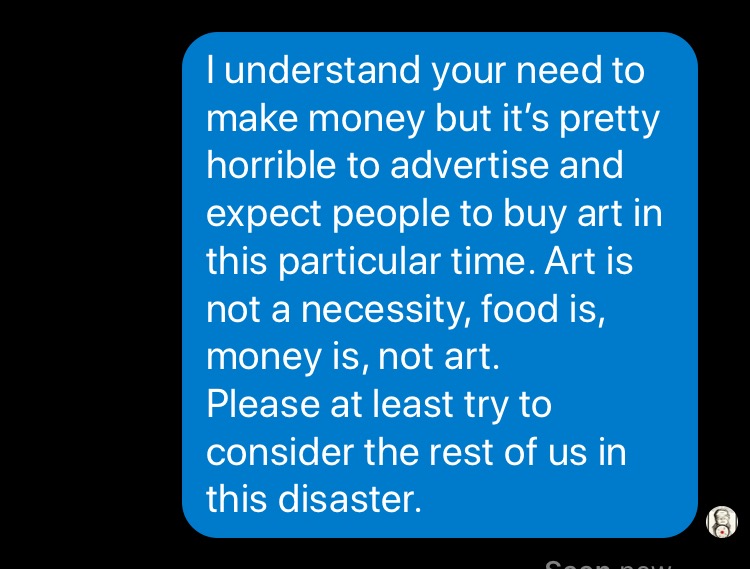
(Warning: this blog is upsettingly, egregiously offensive. I got very exercised by what happened here, particularly because it concerns my wife. The language here is not safe for work, and not appropriate for innocent eyes. But I will not lighten up.)

My wife had a thought.

“I would like to put out a thought that I had today.
Our economy as a country, as a world is going to suffer from this pandemic. Hopefully the government will come through on some kind of relief for business but we all know that most of us small businesses will not be offered the same kind of relief, if any, that the larger companies will get so I propose this: let’s start a movement of sorts.
Let’s as a country, hopefully as a world, make a pact to buy gifts only from small businesses this year, birthdays Christmas, anniversaries, weddings, etc. Buy in person from a local small business or online from one farther away. Let’s not forget the entrepreneurs who create everyday without the safety net of a regular paycheck in this time of crisis.

We’re all in this together.

Thank you.”

It’s a good thought. There are pretty clearly two stages to this whole crisis: the first stage, the one we are in now, is when we focus on mitigating the pandemic, limiting the spread of the disease, flattening the curve. Here is where we sacrifice for the greater good: we stay home, we distance ourselves from one another and limit contact with other humans. We do what we can.

We lose our jobs. We can’t pay our bills, and we have to borrow money or beg for help. We might lose our homes, and our businesses.

All of us are at risk. (Of course the very wealthy are not at risk as they are never at risk; I don’t include them in “us.”) All of us are feeling some of the same fears, and the same pressures: we feel the need to do something, anything; but we also know that the best thing we can do is  — nothing. Stay home. Stay away.

It’s terrible. I want to go to school, if you can believe that. I actually want to teach. I want to talk to my students, reassure them that everything will be fine. I’m good at that; they like and respect me, and they listen to me, at least partly because I listen to them, and partly because I am honest with them. And that is the honest truth: everything will be fine. In the grand scheme of things, that is, because of course some people will suffer mightily as a direct result of this disease, some people will lose their lives, others will lose their loves. But that is inevitable, and even in the face of the greatest loss, everything will, so much as it can, be fine. I feel comfortable saying that, and I wish I could say it to my students. I wish I could give them some normalcy.

There’s an old regret of mine: I was teaching on 9/11, in 2001. It was my second year as a teacher, only a few weeks in; the students barely knew me, most of them, but they already generally liked me and trusted me. The planes had already hit both towers and the Pentagon by the time I got to school, 7:15 California time; I was watching in the office, open-mouthed, as the first tower collapsed. The next four classes I spent watching news updates on the classroom TV, talking to students, telling them what we knew (not much) and reassuring them as much as I could (even less). They kept asking me if we were going to be sent home, if the district would close schools; the news kept showing other school districts doing just that, and I was waiting for the same thing, without any answer as to why they didn’t; I had no idea what the district was expecting us to do, other than watch news updates and talk about what little we knew.

My last class, though, as soon as they came in, they asked me if we could turn off the TV, and not talk about what had happened; I said, “No problem,” and turned it off. “”What do you want to talk about?” I asked. The same student, speaking for the class, said, “Can we just do English?”

So I taught English. I taught Antigone, Sophocles’s third play in the Oedipus cycle, about family and death and respect and the law. It was awkward and terrible, and I hated it. I hated that I did that: it felt disrespectful to those who had died, and those who were dying, right then, the first responders in New York who were being buried in rubble and dying in fires.

But now I’m realizing that teaching Antigone was the best thing I could have done. I showed at least one class of students that things could still be, if not normal, at least nodding towards normal. It didn’t change the situation, but it did show them that the situation would change: that no tragedy, no crisis, howsoever devastating and all-encompassing, could last forever or take over every  part of their lives.

I wish I could do that now, for my students first, but also for everyone else.

But I can’t. I can’t fix this problem, and I can’t make it seem less than it is: because here I am at home, instead of at work, and instead of talking to my classes, I’m writing this blog. And the worst part about this is that we don’t know how long it will go on– and we don’t know how much it will help. I hope we all know by now that we’re doing the right thing, but we don’t have any idea how much of a difference it will make. Especially for those who are harming themselves through staying at home — losing income, losing business, suffering the emotional effects of the crisis and of the quarantine — not knowing how much good it’s doing and not knowing how long it will last is absolutely devastating. Because we can’t do the usual calculation necessary with altruism: how much good can I do with this sacrifice, and how much will it cost me? We just don’t know. Because the disease is new and unknown, and also because our government is still scrambling to figure out its response, we just don’t know.

And that’s just the first stage of the crisis.

The second stage is the aftermath.

There’s some indication that things may be improving: China, after instituting serious quarantine measures, has reported no new cases in the last 24 hours. (Yeah, yeah, I know — if we believe them. And they should not have covered up the beginnings of the epidemic. But if you for one second think that our government, that any government, wouldn’t have done precisely the same thing for precisely the same reason, you weren’t paying attention when our government did precisely the same thing for precisely the same reason. Or that other time our government did precisely the same thing for precisely the same reason. Or that other time our government — you get the point.) People are, in fact, making this sacrifice for the greater good (Most of us. For the people who are ignoring the greater good because they still want to get drunk for Spring Break, or because they don’t want to miss out on the father-daughter dance, and especially this douchebag, may I tip my hat with a hearty Fuck You.) despite the pain and uncertainty I’ve been talking about. And though this hurts, and though the benefits are uncertain, it is absolutely true that as a group, we are making a difference, we are doing the right thing. We are saving lives.

But what happens once that ends? Once the disease slows down or stops (It’ll never go away, I know, but it will hopefully join the ranks of SARS and MERS once this pandemic spread stops and we have successful treatments and reliable tests and, especially, a vaccine), and people can go out again — then what?

Our president says that the economy will come roaring back, and be quickly stronger than ever; but our president is a lying fucking idiot, so that prediction can safely be ignored. The truth is that some people may still be generating income, and will have built up plenty of money and be desperate to consume; but for the most part, people are going to be either more cautious, or broke. Many of us will be looking for jobs, and will have accrued pretty serious debt while having been out of work. And since many of those jobs existed because of the demand created by the booming economy and the low unemployment and the high consumer spending that resulted, it’s going to be slow to recover — and the federal government having completely shot their wad in emergency measures to stanch the bleeding during this quarantine (It was the right thing to do and I’m glad they did it, but still) will be unable to do much of anything to make it better after we all get to go out again.

Which is where we come back to my wife’s good idea. Because as she says, the small businesses, the ones without large cash reserves or the potential to create savings by cutting costs without closing the company down entirely, are the ones that will suffer most during this. They are the businesses that will be slowest to recover because their profit margins are smaller. And they are the ones that are most critical, because somewhere around 50% of Americans work for small businesses. Even more difficult in terms of survival through the quarantine and then recovery afterward, 16 million Americans are self-employed, and self-employed workers and those working for them account for 30% of the workforce. At the same time, of course, the rest of us (mostly) will not have a lot of money or a whole lot of confidence about spending everything we’ve got in supporting small businesses once we get to the second stage of this, the long, difficult economic recovery period.

So this is why this is a great idea. Not “SPEND EVERYTHING YOU HAVE AT SMALL BUSINESSES!” Not, “GIVE ALL OF YOUR MONEY TO SELF-EMPLOYED ARTISANS!” Just — gifts. Occasional, special purchases, when you generally want to get something more unique, better made, more thoughtful and meaningful. When you might be willing to spend a little more money to show you care. Not every time, not every gift, of course not; but when you are looking to spend a little bit more, be conscious of where you spend it: make an effort — not “FEEL A MORAL OBLIGATION” — to give something nice to two people, both the person receiving the gift, the small business or individual creator who would love to sell you the gift. Do what we can, when we can; not the primary focus, not our personal responsibility — just a little more thoughtfulness, that’s all. And not, of course, right now (Though honestly, if you are one of those people who has some extra money right now, even though most of us are not in that situation, if you could send a little of that extra  money an artist’s way, help them pay their bills and eat while they are giving up the markets and sales opportunities currently cut off by quarantine, that would be wonderful), but mainly going forward, once we are into the second stage of the crisis.

Which is why it pisses me off so much that someone out there  felt the need to send my wife this message on Facebook:

3265DAA1-2DE5-4AEE-987E-852BEBB3160F

This was actually the middling-worst of the three negative responses she got: one dude that I know commented, on my post sharing my wife’s thought, that he saw no reason to spend more money at small businesses when he can get everything cheaper at Walmart. Okay, sure, fine; that’s your choice, even if I don’t agree, but I’m not sure why you need to share that, so I just pointed out that gifts often cost a little more and we are willing to spend a little more, but if individuals are happy with the cheap shit they get at Walmart, go off, king. And there was another guy who was much more accusatory and insulting to my wife in a separate message, calling her selfish for asking that people spend money at small businesses instead of large businesses that employ more people and (in his view) do more for the economy.

To both of those anonymous commenters accusing my wife of being selfish, I have this to say:

(Warning: this is going to get profane. And considering how much I swear casually, please take that warning seriously.)

Fuck you. FUCK you. Fuck you for being as stupid as a shit-stuffed carcass of a dead fucking tapeworm, and fuck you for being so fucking callous and devoid of human feeling that you somehow fucking think that an artist asking for people to buy art is fucking selfish. Fucking what? Motherfucking selfish, to advertise one’s craft? Even apart from the effort — no, fucking wait, I will not put that aside: you shit-stupid fuckbrain, do you have any fucking concept of how hard it is to make art, how much of a person’s (That’s a human fucking being I’m speaking of, not the syphilitic wart on a baboon’s dick, like you) soul has to be put just into generating the work? How much time and effort and confidence an actual fucking artist needs to put in to make actual fucking art? Not only in the crafting of a single piece, but in the years, the DECADES, the MOTHERFUCKING LIFETIMES that go into the training of the mind and eye and hand and heart, the sensitivity and altered perception required to conceive of art  in this bleak, heartless world — made even more bleak and heartless by diarrheal hemmorhoids like you, you fucking twat — and then the discipline needed to turn that concept into an actual piece of craft? Of course you don’t: your skull is too full of that bullshit you’ve been lapping out of your own ass. But even though you couldn’t ever understand what it takes to be an artist, you dick-shitting fuckbucket, maybe, considering how appallingly, grotesquely self-centered and insensitive you are, you could potentially grasp how vital it is in a capitalist, individualistic society, for everyone to promote their work, their company, their source of income? Did you somehow miss that advertising and public relations are the heart of our society, in every single aspect? Are you so fucking blind (Must be the fucking syphilis — or else the shit in your head is leaking out of your eyesockets) that you didn’t see that literally the only way the free market could ever function is if people are aware of the products for sale? That our entire goddamn society, our way of life, is reliant on people holding up signs that say “BUY THIS HERE?”

And then, because this is a free society, a free market economy, allowing people — people, not you, you pus-blooded vomit-eating whoremonkey — to make their own free choice of what to buy and what not to buy?

Apparently you also missed that this was a GODDAMN MOTHERFUCKING POST ON FUCKING FACEBOOK AND IF YOU DON’T FUCKING LIKE IT YOU FUCKING KEEP FUCKING SCROLLING, YOU GANGRENOUS YAK-SCROTUM!Dory

Just fucking move on. You can fucking smile when you do it, too.

Kermit

If the fucking message doesn’t speak to you, how fucking manically arrogant do you have to be to think that you need to respond to it? Fucking walk, you fucking mook.

Thinker

I expect you not to think, but that you would take extra time and effort to hurt someone who clearly wasn’t speaking to you, clearly wasn’t someone you care about or agree with — who the fuck are you?

Noharmdone

I mean it. Fuck off. The bunny hates you too.

Deniro


Because not only am I an artist who will defend other artists, I am a human being who understands the need to both support our fellow human beings and also the vital necessity of allowing other humans to be humans themselves, to allow them to put forward their ideas, their opinions, and their art, AND their business, without being criticized for simply speaking out — especially when they, like my wife

*DEEP BREATH*

ARE NOT EVEN FUCKING ADVERTISING THEIR OWN FUCKING ART BUT ARE JUST BRINGING UP A THOUGHT THAT PEOPLE SHOULD CONSIDER AS A WAY TO SUPPORT AN INCREDIBLY IMPORTANT PART OF OUR ECONOMY AND OUR CULTURE IN ADDITION TO JUST BEING PEOPLE, SMALL BUSINESSES AND INDIVIDUAL CREATORS ARE FUCKING PEOPLE AND IF YOU’RE TRYING TO BE KIND TO PEOPLE YOU SHOULD FUCKING BE KIND TO THEM, AND MY WIFE, WHO IS THE BEST AND MOST KIND-HEARTED PERSON I KNOW, WAS JUST TRYING TO SUPPORT OTHER PEOPLE DIDN’T EVEN MENTION HER OWN ART EVEN THOUGH SHE IS A BRILLIANT ARTIST AND SHE IS SUFFERING IN THIS QUARANTINE JUST LIKE EVERYONE ELSE BUT SHE DIDN’T FUCKING MENTION THAT DID SHE, NO, SHE DIDN’T EVEN DO WHAT I WOULD HAVE DONE AND THROWN IN A LITTLE “LIKE MY ART, MAYBE” SOMEWHERE IN THAT REQUEST, THERE’S LITERALLY NOTHING HERE THAT COULD EVEN BE CONSTRUED AS FUCKING SELFISH BUT THEN YOU HAVE TO COME ALONG AND SHIT ALL OVER IT AND HER AND FUUUUUUUUUCCCKKKKKK YYOOOOOUUUUUUUUUUUUUUU.


So. Like my wife said. We are all in this together. I want to thank everyone who is sacrificing for the sake of others’ health and survival, and express my sympathy and my support for people who are being hurt by that sacrifice. I will do whatever I can to help you, both now and in the second stage of this crisis — and even after that.

But if you are the kind of person who would say this shit to my wife, get the fuck off of my world.

Bro, Do You Even Socia-Lift?

I’ve been seeing these memes and similarly-themed posts on social media:

DA00C2D6-D752-4E53-AE82-539C7A0F9CA3

I also saw (but cannot now find) a response meme that was exactly right: This isn’t a test run of a Sanders presidency, it is an ACTUAL situation under the TRUMP administration.

It is the TRUMP administration that was so lax, so apathetic, so inefficient and corrupt and broken that they could not prepare properly for a crisis even with MONTHS of lead time. It was January when we all knew about this outbreak, because that was when the Chinese New Year was canceled; and then we all knew that it was something serious. January. And what did the Trump administration do to get ready for the inevitable, when the disease came to the United States? As all diseases do, because there is no realistic way to quarantine any nation in this globally-connected world? As SARS did, as MERS did, as swine flu and avian flu did, as even goddamn Ebola did?

Nothing. They did nothing.

Okay, not nothing. They restricted travel by limiting visas, and quarantined people returning from China where the outbreak started in December; and these tactics have some positive effect, because they slow the spread of infection and give the medical community time to react and plan and prepare. Except the Trump administration did not allocate additional resources: did not stockpile test kits or obvious useful supplies like masks and gloves and sanitation materials; did not rapidly begin increasing capacity in intensive care units or even start planning for a possible rapid increase. No: the president tweeted, and his cronies repeated, that the border was locked “airtight” and everything was fine.

And then, when the shit started to hit the fan, and people responded entirely predictably, with panic-buying things they thought they would need, the administration did — absolutely nothing. This is also entirely predictable, because it is a tenet of free market capitalism: let the markets determine supply and demand, price and availability. The market determined that, at the current price, the supply of toilet paper and sanitation supplies was insufficient to meet the demand.

So be it. Sometimes things go sideways, and while there are some fucked up people who do fucked up things, and who should be stopped from pulling that crap  — like these guys, who were stopped, and who now just get to sit on their hoard while they are investigated for criminal price-gouging; or these women who fought each other over toilet paper (I will note this happened in Australia) — for the most part, it’s manageable. I mean, some people may run out of toilet paper, but they can still poop.

In the end, as long as we are alive, we can all still poop.

That’s clearly the larger point, here. As maddening as it is that people are panicking, and while it’s certainly true that some people will suffer because they cannot get supplies they need, those things will almost certainly not be life-threatening. (I have not heard that medicines are being hoarded to the point of shortages; if that is happening, then it is life-threatening. I hope not. The novel coronavirus is bad enough without us killing each other.) I don’t believe that life is always the only thing that matters; but certainly it always matters more than toilet paper.

As important as that point is (And as much fun as it is to say it), it was not the point I wanted to make here. The point I wanted to make here comes back to that meme about Bernie Sanders: it has to do with the biggest issue that voters seem to have with Bernie Sanders, and is apparently the reason why Joe Biden is currently winning the race for the Democratic nomination despite being the worst available candidate: it’s because Bernie Sanders is associated with…

Image result for scary socialism

Image result for scary socialism

Look at it! LOOK AT ALL THAT SOCIALISM!

Image result for scary socialismImage result for scary socialism

Image result for scary socialism

(That last one is my wife’s favorite. Because skulls. Though she also likes the hammer and chain image. By the way, my wife is the amazing artist found here.)

That’s right, socialism. Scary, spooky socialism. You know: the

 politicalsocial and economic philosophy encompassing a range of economic and social systems characterised by social ownership[1][2][3] of the means of production[4][5][6][7] and workers’ self-management of enterprises.[8][9] It includes the political theories and movements associated with such systems.[10] Social ownership can be publiccollectivecooperative or of equity.[11] While no single definition encapsulates many types of socialism,[12] social ownership is the one common element.[1][13][14] It aims to circumvent the inefficiencies and crises traditionally associated with capital accumulation and the profit system in capitalism.[15][16][17][18]

Come on, guys. Come on. Even Wikipedia knows that there are different kinds and layers of socialism. Democratic socialism, which is what Bernie Sanders espouses, is not Marxist state-controlled socialism. The argument that Sanders’s socialism will lead to Castro’s socialism is an absurdly precipitous slippery slope argument — and anyone who has ever got caught drinking or smoking pot, and who then had to listen to their parents tell them that they were going to be shooting heroin within a matter of hours, knows the problem with the slippery slope argument.

Pot is not a gateway to heroin. Neither is alcohol. There is no logical reason to assume that one thing will inevitably lead to another related thing, particularly not when the guy you are accusing of pushing us down that slope has a very clear record of fighting the centralized authoritarianism that is the actual threat in full-blown Marxist socialism; even his opposition to gun control is evidence of his desire to spread power among the people, to reduce the ability of the central government to control its citzens.

Sanders is not a gateway to Mao Zedong.

I know this has been pounded on again and again; I’m sure that people are tired of hearing it, and me saying this is probably not going to change any minds, or any votes. But this current situation seemed like too good of an opportunity for me to let it go by without making this point.

The things that people are doing right now that are driving all of us up the wall? Perfect nutshell depiction of capitalism. Resources are allocated not according to what is most practical or necessary, but according to demand, which is influenced by, among other things, perception and emotion. There are booms and busts, surplus and scarcity; and we just have to roll with the punches in every case. Which is made harder by the assholes doing asshole things, driven by greed, by the profit motive.

The things that people are doing right now that are showing us that we can still have faith in humanity? That’s socialism. People are sharing. Helping one another. Trying to intentionally ration so that other people can get what they need — particularly those who are less independent, who are in greater need. People are sacrificing for the greater good — you know, acting against their own economic self-interest. We are still, to some extent, acting out of self-interest; but the profit we seek is not money: it is perhaps reputation in our community, but most likely, it is simple altruism. Kindness. Our profit is in feeling good about ourselves and our world, because we were able to help someone in need.

I don’t think that this kind of community spirit should become the organizing principle of the country. It wouldn’t work on a national scale, because we can’t always give, but people in need can always take. I don’t think the country should become a classic Marxist state: central planning is deeply inefficient, as has been amply shown by every nation that has tried to pursue it, all of which have turned back to some kind of market economy — which is dangerous in its own right, because individual people can manipulate the market in a hundred terrible ways, and do harm to everyone else in order to profit themselves. And the centralization of power does create opportunities for the rise of authoritarian autocrats like Stalin and Castro. Where capitalism creates opportunities for Jeffrey Epstein, for El Chapo, who could buy the ability to cause enormous suffering with impunity, simply because they were very good at collecting money  and then spreading it around.

Clearly, clearly, the answer lies in between: in moderation. In some blend of a market economy, with shared resources managed by some collective body, particularly to create a social safety net for when the market goes ker-blooey. Like now.

There’s no way the free market could handle the coronavirus. Quarantine would never be organized enough to limit the spread; the best a capitalist could do in a pandemic would be to Red Death it: lock themselves away in a castellated abbey and die when the clock strikes midnight on their revels. Any company that could create and charge for the various necessities, particularly tests and vaccines, would charge so much that the rest of the economy would be devastated. Without some kind of central government organization looking after things, there would be so much rampant fraud and exploitation, because  everyone is desperate and panicky, that again, the economy would be devastated, and the death toll would be astronomical as people relied on whatever snake oil was offered to them in a compelling way — like the crap being pulled by this shithead, who hasn’t committed a crime (Not this time, at least), but who is at least getting sued by Missouri.

This isn’t even an argument: nobody seriously thinks we should do away with the CDC, with the FDA, with the national guard, with the entire government. So since we are all willing to accept that there are some things that can only be done reasonably by a nationwide government, can we please, please stop pretending that socialism will be the downfall of America? When right now, capitalism and capitalists are clearly the bigger threat?

AS THE NEW CORONAVIRUS spreads illness, death, and catastrophe around the world, virtually no economic sector has been spared from harm. Yet amid the mayhem from the global pandemic, one industry is not only surviving, it is profiting handsomely.

“Pharmaceutical companies view Covid-19 as a once-in-a-lifetime business opportunity,” said Gerald Posner, author of “Pharma: Greed, Lies, and the Poisoning of America.” The world needs pharmaceutical products, of course. For the new coronavirus outbreak, in particular, we need treatments and vaccines and, in the U.S., tests. Dozens of companies are now vying to make them.

“They’re all in that race,” said Posner, who described the potential payoffs for winning the race as huge. The global crisis “will potentially be a blockbuster for the industry in terms of sales and profits,” he said, adding that “the worse the pandemic gets, the higher their eventual profit.”

Source


Now if you’ll excuse me, my school has been closed temporarily, even though most of my students aren’t in any real danger, so that Covid-19 won’t spread to vulnerable populations. And though I could therefore take a nice, long, paid vacation, I’m going to try to figure out how I can deliver the best possible education I can through remote distance learning to my students. Even though it will take extra work, for which I won’t earn any more money. I’m not in it for the profits — though I am in it for the paycheck. Isn’t that remarkable: a mix of profit motive, and altruism. Sounds pretty American, to me.

Oh– and I’m also going to vote, on Tuesday.  For a Democratic Socialist who I know would have handled this crisis better in every way than the billionaire currently sweating on the toilet in the White House.

Do the right thing, everybody. Both with the coronavirus, and your ballot.

Just because it’s the right thing.

Image result for vote for bernie sanders

(D)Electable

First: let me be clear.

Elizabeth Warren is the best candidate.

Image result for elizabeth warren

She’s the smartest, the most practical, the best prepared, and the strongest speaker and debater. It’s true: Pete Buttigieg is a Rhodes scholar who speaks seven languages, but Warren is a former law professor who taught at nearly as many universities as Buttigieg speaks languages, including Rutgers, Michigan, Penn and Harvard (And if you count that she taught Sunday School… no, kidding.), and was one of the most-cited experts in bankruptcy and commercial law, who created the Consumer Financial Protection Bureau when she wasn’t even in politics. Senator Klobuchar is a fighter from a Midwest state who grew up in difficult circumstances, became a county attorney and has been successful in the Senate; Warren has much the same resume, and I think Warren’s policy proposals are more extensive, detailed, and considered. Sanders, Warren, and Biden have the best campaign infrastructure and the broadest support, and I would argue that Warren is the best prepared of those three to get to work after the election. And if you’ve watched the debates, you’ve seen the same things I’ve seen: Biden wavering between foggy and yelling at kids to get off his lawn, Sanders giving a lot of pat answers (No shame; he’s been campaigning on the same arguments for five years now, and fighting for them in Washington for thirty), Buttigieg sounding good but not saying a whole lot, Klobuchar saying a whole lot but not sounding good — and Warren answering every question immediately, directly, Yes or No, and then going into a specific and detailed explanation of her clear answer.

I realize this is my perception only, and that others have vastly differing impressions of these candidates. Senator Warren is struggling right now, having placed third in Iowa and fourth in New Hampshire. This is a good article about her current situation, which also looks to her future — which is what her campaign is doing.

But my perceptions of Elizabeth Warren, and your perceptions of other candidates, are not what I am here to talk about. I want to talk about the curse that seems to have descended on every genuinely good candidate, and which has pushed far too much credibility into two candidacies that are complete nonsense: Joe Biden and Mike Bloomberg. That curse is — ELECTABILITY.

I’ve heard that Sanders isn’t electable because he’s a socialist, that Buttigieg isn’t electable because he’s gay, that Klobuchar isn’t electable because she’s a woman — and of course that Elizabeth Warren isn’t electable because she’s a socialist, and a woman, and she fails various purity tests for progressives because she used to be a Republican and she has this weird pseudo-scandal regarding Native American heritage. (Let me be clear: claiming a heritage you haven’t lived in order to claim privilege, taking opportunities away from those who genuinely need them, is wrong and appalling. Claiming a heritage you haven’t lived just for the sake of, I don’t know, cocktail conversation, is weird and offputting. Holding someone’s past against them in clear defiance of their current character is all four: wrong, appalling, weird and offputting. All of it. The left needs to get over this shit. Trump’s past is disqualifying, because he’s not any different now. Know the difference.) I would prefer to hear that Biden isn’t electable because he’s a doofy former sidekick who has far too much history in Washington, far too much of it questionable; and that Bloomberg isn’t electable because he’s a billionaire trying to buy an election from another billionaire, not to mention his own history of racist politics with the Stop-and-Frisk policy from his tenure as mayor of New York City. But even that isn’t what I really want to hear.

What I really want to hear is that Donald Trump is not electable because he’s an absolute mound of shit. Dung mountain. Poop’s Peak. I want to hear that every single other candidate is more electable than Donald Trump: because they are. Even the ones I dislike. Even Marianne goddamn Williams– no, that’s too far. But everybody else is more electable. What I really want to hear is that the voters of this country have woken up to the danger of having this man in office, and are determined to find the very best replacement: not that we’re so goddamned worried about the opinions of sexist, homophobic dipshits in half a dozen states that we’re going to throw away the best candidates for Trump’s replacement in favor of some rich fucking old white guy.

That’s not to say that the next president shouldn’t be a rich old white fucking guy. Personally I think the next 45 presidents should be women, just as the next 109 Supreme Court Justices should be women (Can you believe there have only been 113 justices on the Court total? TOTAL?! In 211 years?!? Also: can you believe that the Senate Judiciary Committee’s own website actually doesn’t list Brett Kavanaugh as one of them? HA! Suck it, Fratboy!) and ditto for not-white people, but I’m open to literally anyone, so long as they will do the job. My problem with Donald Trump is not that he is a rich old fucking white guy, it’s that’s he’s a colossus of crap, an edifice of excrement, who is destroying the country because he doesn’t care about doing the job. I would happily vote for Mike Bloomberg or Joe Biden if I believed they could do the job. (I don’t think they can. Yes, I will still vote for them if they are the nominee.)

But it’s clear to me, and it should be clear to all of us, that of the best candidates currently running (And I think that Cory Booker and Andrew Yang, and maybe Julian Castro and Kamala Harris, and probably some older whiter guys like Michael Bennet or Jay Inslee or et cetera, should still be in this race over Biden and Bloomberg and Steyer, and that all of them would far surpass Trump), only one good one is an old white guy, and he ain’t rich. So the argument about electability, a euphemism for “pleasing to the swing voters in the battleground states,” a circumlocution for “fucking rich old white  guy,” should be dropped in the face of the facts: our best candidates for president, with one exception, are not old white men. (If we make it old Christian white men, then I can make the statement without exception; I’m not ignoring the fact that there is a young white man in the group, but the fact of his sexual orientation puts him into the Unelectable column as well. It is telling, however, that he is doing better than both the  viable women candidates despite his youth and inexperience and gayosity; apparently “white” and “male” have more to do with it than age and sexuality. And I thought of such a good dick joke to make here, but I’m not making it. Out of respect. For America. You’re welcome.)

The electable argument is nonsense. Not only that, but it is damaging nonsense. So not only should we ignore it, we should actively cast it aside. “But Dusty, what about 2016??” Right, when Clinton, who was by far the better candidate, won the popular vote by 3,000,000 but still lost the election because of a few swing voters in battleground states? Thereby proving that only fucking rich old white guys can win the Presidency?

What about 2012, when the quintessential rich old fucking white guy lost? To a comparatively young, comparatively not-rich, clearly not white guy? Who won Wisconsin, Michigan, Pennsylvania, and Florida? Won the popular vote by 5,000,000?

But Obama was the incumbent. Surely that doesn’t count.

Okay: 2008, then, when Obama defeated a rich old white FUCKING WAR HERO guy (Who is still the epitome of an honorable Republican, who is still mourned  and memorialized and held essentially sacred — except they didn’t fucking vote for him, did they?) by 10,000,000 votes, carrying 28 states to McCain’s 22?

I’ll tell you who’s electable. The person who wins, that’s who’s electable.

We who oppose the Turd-Berg’s re-election need to understand that the difference is not going to be made by wooing the swing voters in the battleground states. The difference is going to be made by new voters. Here: look at this. And realize that

He [Data  scientist Hamdan Azhar concluded, with help from The Cook Political Report, that the election hinged not on Clinton’s large 2.8 million overall vote margin over Trump, but rather on about 78,000 votes from only three counties in Wisconsin, Pennsylvania, and Michigan.[387][388]

[From Wikipedia]

And then realize that the —

Hold up.

I was going to point out that the electorate in all three of those battleground states has grown by more than the number of critical swing voters.

But all three states have fewer registered voters now than they did in 2016. Wisconsin breaks it down by age group, and every age group is smaller — except for 65+. (Notice that this shit is still going on)

I don’t — I don’t know what to say about this now.

No. I know.  And you know, too.

It’s this: it doesn’t matter who the Democratic candidate is in the general election. Donald Trump will call every single one of them a socialist. He will have stupid nicknames for every single one of them. Every single one of them will make him look like an ass in any debate — Hillary Clinton certainly did.

But unless we get to work, Trump will win the same way he did last time: by squeezing every last old white vote out of the battleground states, by making everyone feel hopeless and despondent, as if their vote doesn’t matter, so why bother, and by suppressing every single vote he possibly can, particularly votes from young people and people of color. Which is also how the Republicans plan to keep hold of the Senate and keep Mitch McConnell in control.

So I hope that every single candidate will do their utmost to appeal to every voter they can. (I still hope it’s Elizabeth Warren, and so long as it is primary season, I’m still going to support her, and I’m going to vote for her next month when my state’s primary comes along. And if she drops out  — which she probably won’t — then I’m voting for Bernie.). But my job, and your job, is to support the organizations that are going to be working to register voters and then get them to the polls. Join phone banks, knock on doors, give every dollar you can to every group trying to do those things. Take Election Day off of work and drive people to the polls. Go stand outside sensitive polling places and call the cops on every MAGA-hat wearing asshole who tries to intimidate voters. Bring water and food to people in line to vote.

The voice of the American people will, I absolutely believe, shout down Donald Trump. We have to make sure that voice actually gets heard.

The electable candidate is every candidate: so long as we do the work to elect them.

The Year Of Women (Which Should Be Every Year)

I was having an argument on Twitter the other night.

Okay. It was New Year’s Eve. Okay? That’s right. I spent part of my Greatest Party Night of the Year arguing with trollbots on the biggest dumpster fire in all of social media.

Maybe your New Year’s resolution should be to STOP JUDGING ME!

(I’m probably being a little sensitive. It’s fine. Everything’s fine.)

The argument was mainly about how there should be more women in politics; it started with this Tweet:

I went through this thread, started by Sen. Kirsten Gillibrand saying that 2020 should see more women elected into office, and I replied to every shmuck I saw who felt the need to say, “Voting for women just because they’re women? That’s sexist! You should support the best candidate whoever it is.”

Like this dude:

And this one:

And, of course, from the Trump Camp:

Each of these replies led to a mini-argument, because both I and my interlocutors are men: we feel the need to always get the last word. (See, that was sexist. Trying to offer helpful illustrations here.) Several of these little tiffs followed the same course. I replied:

Let me be clear about this, so that if anyone reading this blog finds themselves in a similar pit full of vipers, you have something handy to throw at them (Sorry it’s not a brick.). The argument that every single attempt to focus on sex is by definition sexism — like this, which I got several times:

— is a false equivalency. Sexism is not “by definition” any attempt to consider sex as a fact, and as an important fact; sexism is an attempt to oppress or denigrate someone on the basis of sex. When you’re using sex as an important consideration in how you relate to or deal with a person, that is only sexist if your consideration does harm and if your consideration is based on stereotyping or prejudice. If I were considering whether I wanted to date a person, I would consider their sex as an important factor in their dateability as I am a heterosexual male and thus would prefer to date women (A much more important factor is that I am ecstatically and joyfully married to the greatest woman alive, but this is just a f’rinstance); this is not a sexist consideration. If I were an OBGYN, I would certainly consider sex as an important factor in determining which patient I would take on, and how to treat them; this also is not a sexist consideration, even if it means I refuse to treat a man solely on the basis of his sex.

It’s not sexist because it isn’t doing harm: my refusing to date a man doesn’t hurt him (Believe me: he’s better off. I am not a catch. Look at how I spent New Year’s.), and an OBGYN refusing to take on a male patient is a recognition of specialized knowledge on the part of the doctor, and a lack of need of that knowledge on the part of the patient; that would be saving harm, or at least inefficiency as the OBGYN wastes their valuable time trying to help a patient who could just as easily be treated by a general practitioner, thus taking time away from someone who could only be treated by that OBGYN. Now, if it was a medical emergency and the OBGYN was the only doctor available, then it would be more questionable if the doctor refused to treat the man, but it would depend on what the reason was. If it was prejudice or stereotyping– that is, that doctor has already made a determination of the worth or character of this man because he is a man (pre-judging him), or if the doctor refuses because this man is like all other men and all men are scum because of their mannishness (stereotyping) —  and the refusal to treat did harm, then that would be sexist.

Let me also note here that transgendered people negate this example I’m giving here: because there are trans men who do, in fact, need the specialized services of an OBGYN since they are men with uteruses; and of course there are many women who have no particular need for an OBGYN because they are women without uteruses (There are other reasons to see an OBGYN. Forgive my reductionism; I think it necessary.). I do not mean to ignore trans people, who should not be simply considered an addendum, an asterisk, a qualification to the usual or norm or standard; but on the other hand, it is impossible to have a discussion of sexism in this society without talking about men and women, and since I’m advocating for building equity, I can’t talk about moving away from gender entirely, which would also solve this problem. I’m going to write a full post about trans people tomorrow, but I want to finish the point I’m making now, today.

I realize I’m overexplaining; it’s not because I think my readers — who, I have no doubt, are people of taste and discrimination and brilliant erudition — need to be taught the meaning of prejudice or stereotyping, or even sexism; it’s because these words are being misused, usually intentionally, and I think the best way to combat that is with absolute pedantic clarity: i.e., overexplaining. Mansplaining. Which, when you do it to fellow men, is just kinda funny.

Which is what I did with my fellow Twits.

All right, I was also sarcastic there with the “more than one thought at a time” comment. But at this point I was realizing that I was arguing with at least a couple of bots or trolls, and ideally those shouldn’t be engaged with — certainly not in an incendiary way, as that will only piss off the people who agree with the bot’s statements, and I believe quite strongly that, while we should stand up for what is right and argue our points clearly, we also should not try to anger our opponents; good argument leads more often to compromise, but angry diatriabes lead to division and more conflict. So I shouldn’t have said this, but hey, I’m on Twitter too: so I’m either trash or fire. Or both.

The main point is my last sentence there. Seeking equity is not sexist. I typed that half a dozen times in response to half a dozen accusations of sexism. (I would have typed out this entire blog, instead, but there’s a 280 character limit. Sometimes I find Twitter very frustrating. But I consider it my penance: mortification of the verbosity.) That’s the real point I want to make here.

Here’s the deal: when men have created a situation where we inherently, by nature of our sex, have an easier time running for and winning elected office — and we have done that, starting most clearly in this country with a Constitution which did not recognize a woman’s right to vote or hold office but only white men’s — then the best way to combat that is to write laws that specifically include women as equal to men, and eliminate laws that make women unequal to men. In both cases, women will benefit more than men, because in the first case women will gain more than men will, and in the second, men will lose a perquisite they have had up until now. But this is not harming men: it is taking away something we have no right to, unequal privileges, in order to create equity, and justice. It is returning what was stolen. It is balancing the scales.

And while it is entirely true that male elected officials are capable of doing that, and historically some have done so, this is also true:

Lamentably, it is an historical fact that privileged groups seldom give up their privileges voluntarily. Individuals may see the moral light and voluntarily give up their unjust posture; but, as Reinhold Niebuhr has reminded us, groups tend to be more immoral than individuals.

We know through painful experience that freedom is never voluntarily given by the oppressor; it must be demanded by the oppressed.

–Rev. Dr. Martin Luther King, Jr., “Letter from a Birmingham Jail”

That means the best way to address the institutional inequalities and injustices in our society is not to beg those in power to do the right thing; it is to empower those who have something to gain from doing the right thing. That way we all gain justice and equality, and, quite simply, a better society.

And that means electing more women.

Let’s make it happen in 2020.