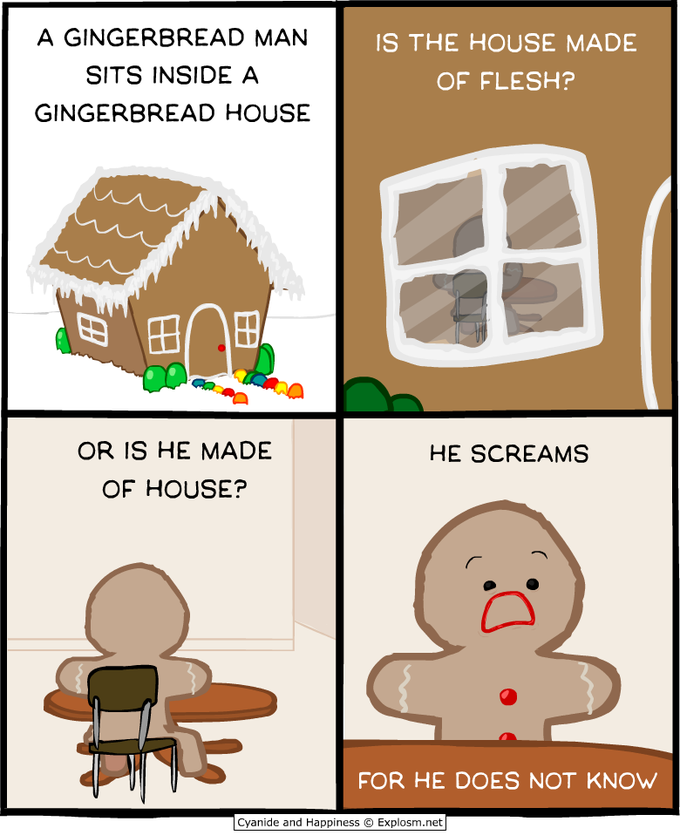
Pride Goeth Before… Something Something

I got stopped by a fellow teacher this past week and asked a question I had never thought about before: between the two most common science fiction future predictions, that is, that humanity will evolve and transcend in some way, or that humanity will destroy itself, which did I think was the most likely? And although I had never thought about that before, I have read enough sci-fi to have encountered both of these predictions — actually, in my new elective class on fantasy and science-fiction literature, we have read both a dystopian novel (Feed by M.T. Anderson — HIGHLY recommend) that predicts that humanity will destroy itself and the Earth’s ecosystem along with us; and a short story by Isaac Asimov called “The Last Question” (Asimov said this was his best story. It’s probably not — but it’s a cool idea, and it’s very well realized. Also recommend. But not as highly as Feed.) which depicts humanity evolving and transcending. Along with our computer intelligences, I might add; which is a nice element to include in this unusually hopeful story. So I was able to formulate an answer, quickly; one that responded to the question but also considered some of the complexities in the topic: I said, immediately, that the doom option is far more likely — but I also pointed out that said doom is certainly not going to be the actual end of the human race, because we are enormously adaptable and incredibly good at surviving, so some people would live through the end of the rest of us, and those people would end up being very different from the people who came before the doom; and therefore those people may be said to transcend. But also, I asked what was meant by “evolve” and by “transcend?” Humanity has largely stopped evolving physically, because we now evolve societally; our greater height and longevity, our now-selective fecundity but also our incredibly improved survival rate — all these are changes that have been wrought by society, and not by physical evolution through natural selection. So is evolution to be defined as something that happens naturally through the same process of environmental pressure which differentiated us from the other great apes? Then hell no, humans will not evolve. But is evolution simply about the changes wrought on the species by their — our — continued survival and our steady adaptation to differing circumstances? Then yes, we will continue to evolve. Also, does “transcend” mean changing who we are as a species? Being born different, as the kids say? Or is it about changing individuals after birth? That is, if I am born as a normal weak-ass human, but then I add machine elements to my body, and end by uploading my consciousness into a robot body: have I transcended? Have I evolved?

Is this an evolved human? I mean, other than because it is Patrick Stewart…

Anyway, the point is I talk too damn much. But also (And this is more the point): I’m very smart. I was able to start answering the question, and then think about both the question and my answer, while making my initial point. I thought of these two works I have named, and thought about how they fit into the spectrum of future possibilities. I could have kept going. I could have turned this into a lesson, or even a unit, without thinking too hard. (We should also include “Harrison Bergeron” by Kurt Vonnegut. Great story about evolution, and also dystopian doom. And “By the Waters of Babylon” by Stephen Vincent Benet is a nice example of people surviving past the cataclysm, and maybe becoming better? Maybe stronger?) I could have put this to students, and maybe helped them to recognize the importance of trying to become better, rather than worse, even though worse is MUCH easier. I have used it as an example here, but I could have turned this into a whole essay; it might have been a good one.

I am proud that I can do that. I am proud of my abilities. I read well and remember what I read; I think well and speak well and write well. Over the last 20+ years of teaching, I have actually learned to think like a teacher: surprising, considering that I didn’t even think like a student when I was growing up. Part of why I do that, why I think like a teacher? I’m proud of being a teacher. I’m proud of what I have done as a teacher. Not as proud as what I have done as a writer; I still think art is more important than education, because education has been co-opted and commodified, and also to some extent Balkanized (Meaning it has been broken up into small pieces, as the Balkan states were broken off of the Soviet Union; now there are lots of them, but they are individually much less than they used to be, partly because they are hostile to each other. Huh. I actually didn’t know that last part was in the definition. Now I have to think about whether that applies to teaching. Yeah, probably; I have often had conflict — beef, as the kids say [By the way: I do that “As the kids say” thing precisely because it is “cringe,” which is hilarious. I can actually make my students shiver with loathing when I say something like “No cap, for real for real.” I love it.] — with other teachers, and that probably is a result of the system, at least in part.); while that has definitely happened to art on the internet (which was where and how I discovered the term Balkanization, in a description of how the internet has affected art), art is able to — well, to transcend that process, and remain valuable, which education has struggled to do. So when asked what I have accomplished that I am proud of, the immediate answer is always: my books. I have written books. They are good books. I am proud of them. Only after I have said all of that — and probably much more — do I maybe add — “Oh, and I’m proud of teaching, I guess.”

And that’s why I’m writing this: because two weeks ago I wrote about value and worth and price, and I recommended that people stop buying stuff, which theme I wanted to expand on lest I be too holier-than-thou; and both that piece and this one are in response to the number of my friends who question their value and their worth: particularly in terms of their art and their accomplishments as artists. I do it too, and for some of the same reasons; but I do it less. Because I’m a proud man.

And Pride goeth before a fall.

Okay: so what is pride? What does it mean to be proud of something, or of someone? What does it mean to be proud of yourself — and is that the same as being proud as a person? Of having pride? Is pride good, or bad?

According to Christian values, pride is bad. We should instead be humble. But okay, what does that mean? My immediate thought is that humble means “Not proud;” so I should define “pride” first, and then “humility” in relation to it. I suspect we are more familiar with and have a better understanding of pride, especially we Americans. So we’ll start there.

I think of pride in two contexts: pride in one’s accomplishments, and the pride a parent feels about their child. That’s not to limit it to those: I am proud of my wife, I am proud of my brother, I am proud of my father (Maybe even more so than he is proud of me…), I am proud of my friends. I am proud (in a way) of things about me that I wouldn’t label as accomplishments, like my intelligence and my empathy. But the first things that come to mind are the first two I stated. When I talk about being proud of my accomplishments, I think that feeling is a sense that what I have done is good, is important, and is something I think is defining for me. I’ve done stuff that I’m not proud of (Which should be a simple statement describing things like “I drove to the post office today” but has a strong negative connotation, implying things that I have done which I am not only not proud of, but that I am ashamed of; those things also exist), and some of it is good and important — like food. I make dinner sometimes. I made dinner last night. Sandwiches. Pesto, tomatoes, mozzarella cheese. Potato chips on the side. (I didn’t make those.) Delicious. Food is good and important, the fact that I make the food sometimes so my wife doesn’t have to is good and important — but I’m not proud of that. Because I don’t see it as defining.

That’s another aspect of this we struggle with, I would guess. It’s hard for us to define ourselves. It’s particularly hard for artists to define ourselves, because most of us — almost all of us — have other jobs. Almost no one makes their living exclusively from their art. And here in our capitalist society, we define ourselves first and foremost by our jobs; that is, by our income-earning vocations. Even that word is misused: it means a career or occupation (One regarded as particularly worthy and requiring great dedication, the Google tells me, so the definition is closer to what I want it to be, and I’ve just been misusing it. But I wonder how many people who use the word use it to that full definition.), but it comes from the Latin word for “to call,” vocare, so it is a calling. Something we are summoned to, something we are compelled to do — no, even that doesn’t have the right feel, because honestly, I am summoned and compelled to earn a paycheck because I have a mortgage and because I need to buy tomatoes and pesto and mozzarella for my sandwiches. A vocation should be something that thrums the iron string of our soul that Emerson wrote about in On Self-Reliance. Something that makes sense of us, and by which we make sense of ourselves and our world. My father spent five years or so working as human resources director for a tech company in Boston; but his vocation was always particle physics, and when he went back to that, he made sense to himself. So he is proud of his work at SLAC [Stanford Linear Accelerator Center], and not as proud of his work at the tech company. Similarly, I am proud of my writing, and proud of my teaching — and I mean, I guess it’s cool that I have put a lot of work into home renovation projects over the years.

I’m quite proud of this image of me, which I captured after I spent several hours installing that floor. I guess I’m proud of the floor.

So that’s the first part of pride. When you do something that is good and important and defining, then you are (or should be) proud of that. “Important” is a word in there that probably needs defining too, though it is definitely subjective for me: there’s no real reason to think that my writing is important, as I have not been groundbreaking or influential or even particularly successful with my writing; but I think it is important. And I see a distinction between my important writing, like this blog I keep trying to keep up, and my books; and my unimportant writing, like my journal or the emails I send, stuff like that.

So if that is pride, I’m not sure why it’s a thing that Christianity would be against. Other than, of course, the cynical assumption that the faith wants to put all goodness into God so that people need to rely on the church; if God is the source of all good things, then there isn’t anything for any human to be proud of, because we didn’t do that stuff, God did; he just let us borrow it. Personally I don’t like that. But then I’m not a Christian. That may be exactly the mindset they’re going for.

But I don’t think that’s the source of the idea that “Pride goeth before a fall.” (Hang on, let me check on that, because I used “Spare the rod and spoil the child” in an essay I wrote once for school and claimed it was from the Bible, and later on I looked it up and it does not in fact come from the Bible at all. I am actually proud of that essay in a particularly perverse way: I think it’s one of the worst things I’ve ever written, which it was meant to be, and it has been an effective example for my classes because it is so bad. Okay, so this one is from the Bible but I’m misquoting: it is “Pride goeth before destruction, and an haughty spirit before a fall.” Proverbs 16:18, King James Version) I think — though I agree that my understanding of Christian ideology is a pretty laughable foundation for a discussion — that the pride spoken of there is a different kind of pride: and now that I have actually found the correct quote, I feel pretty well confirmed in that.

It’s the haughty spirit. That’s the point. That’s the bad pride, the one that leads to karmic justice in some way.

See, there are plenty of people who take enormous pride in things that they didn’t even do. So it’s one thing to take pride in something that isn’t good; I’m pretty damn proud of my longstanding hobby (One might even call it a vocation?) of stapling papers in the wrong corners in order to mess with my students:

Trigger warning: if you like things being done just so and being done right, you will not like what I did to these papers.

But there’s nothing good about that.

And then there are plenty of things I am proud of which are not important — like the video games I have beaten, that sort of thing. And I already spoke of things that aren’t defining, like cooking dinner for my family. Those things may not really deserve pride — and because of that it does make me question whether I feel proud about them — but regardless, there is no harm in being proud of things that don’t really matter much.

But then there are people who are proud of things they didn’t even do: like being American. Or male. Or tall. Or white. Don’t get me wrong, you can like those things, you can appreciate being those things (I’m not really sure why you would, but to each their own): but what on Earth would make someone proud of being born in this country? What did you do to make that happen? What time and effort did you put into it? Now, if you emigrated here, went through the enormous upheaval of moving to a whole new country; if you made a life and a home here, and created a place for yourself: that would be something to be proud of. But if you are proud of the fact that were born here, well. Bill Hicks has something to say about that: (**Please note: this clip is not safe for work.)

In To Kill a Mockingbird, Miss Maudie talks about Atticus’s shooting ability, once it is revealed that he was called One-Shot Finch, after he shoots the rabid dog. The kids can’t understand why Atticus never talked about how he was a dead shot, and why he never goes shooting if he is so good at it. Miss Maudie theorizes (Falsely, in a way, because he later says what he wanted his kids to think — that courage is not a man with a gun — but this point of Maudie’s also makes sense and might be part of his reasoning) that it is because Atticus recognizes that there’s no sense in taking pride in what she calls a God-given talent. She says that being born with a good eye and a steady hand is nothing that comes from hard work and dedication; it’s just a thing that is true about Atticus, like being tall.

I don’t entirely agree with Miss Maudie — I think that shooting a gun accurately would take a hell of a lot of practice, and therefore would be something to be proud of; but also, you would need to shoot in a good way, and also in an important way, for it to earn pride in my definition — but I see her point and I agree with the idea that taking pride in something you didn’t do, something you aren’t responsible for, is silly. That’s the idea of the Bible verse, too, I think.

See, if you put in the effort on something, if you really do the work, then it’s damn difficult to be proud of it. Because first of all, you’ve seen alllllll the mistakes you made in the process of learning; and if it is something hard to do, then you made a lot of mistakes. You also know, better than anyone, how much effort you have spent, and also you should know the difference that effort made: and that should pretty clearly show you that anyone else who put in the same effort would probably make the same progress — unless you were born with a gift of some kind that contributed to your ability, like having a sharp eye and a steady hand. But if it is something really difficult, then you also recognize that your sharp eye and your steady hand are not the things that make you good, or that make you great: they make it easier for you to be good or great — but only effort and dedication makes you good, or makes you great. The physical gifts are not something you did, so not something you should be proud of: the pride comes from what you put into making yourself into someone you can be proud of. Michael Jordan certainly has physical gifts that make him a great basketball player: but he’s Michael Jordan because he had the will and the drive, and he put in the effort. Therefore, I think he should be proud of what he accomplished. Shaquille O’Neal, on the other hand — well, he should be proud that he is apparently a very nice person. And then, of course, if you do what most of us do with our passions, and you look around at other people who do the same thing, what you are bound to find is people who do it better than you. Because nobody, not even Michael Jordan, is actually the greatest: there’s always somebody better. Knowing that keeps us humble, even if we have accomplished something to be proud of.

But even though it is difficult to take pride in what do, if that thing we do is a calling, if that thing is very difficult, if that thing takes years of dedication and effort to accomplish: then we have to take pride in it. We have to. Because there’s another aspect of pride.

The pride a parent takes in a child, that I take in my wife, my friends, my family, is not the pride of accomplishment. I mean, I’m proud that I support my wife in her art (and I’m proud I make her delicious sandwiches for dinner, without which she could not continue to make art), but otherwise? Her art isn’t my accomplishment. I did nothing to make her into the artist she is, not really. My support and sandwiches were helpful, but she could have done it without them, of course. But I am so incredibly proud of what she can do. So is that like the pride that dumb people take in being born between Canada and Mexico?

No: it’s something else.

The quality of an accomplishment that makes it pride-worthy, the aspects of it that make it (to one’s subjective viewpoint) good, and important, and defining, can be boiled down to one simple emotion: the most powerful emotion. Love. I write because I love what writing can do, and I love what writing is; and therefore I love writers — and therefore, when I write, I love myself. I love when I am able to create the effects that make me love writing. I am so very proud of those moments, of those effects, of what I did, and of myself for achieving them. And yes, it is entirely subjective: but then, often, so is pride. That doesn’t make it bad.

Pride is bad when it is not based on love. That’s the second half of the proverb, the “haughty spirit.” When one bases their pride on their contempt for others, then pride is bad. When one sets oneself above others, and is proud as a corollary to that, that is bad. That leads, in a righteous universe, to destruction: to a fall. (I know it doesn’t always. This is not a righteous universe.)

So really, it’s not that it’s dumb to be proud of being an American; it’s dumb to think that other people are lesser for not being Americans. (I knew that, actually. I am proud of my country. But also, I am humbled by it, because I can never do enough to make it the country that it should be, which means I am not fully worthy of it: so my pride does not create in me an haughty spirit. What a phrase that is. Don’t you just love the KJV?) It’s not that bad to be proud of being tall, or of being white; it’s bad to think that short people are worse off, or that people who aren’t white are somehow worse or less than white people. That’s where pride goeth before destruction: at least it is to be hoped that it does goeth before destruction. Because that kind of pride should be destroyed.

That’s not the pride that people have in their children, unless those people are really damn awful. Parents who put in a lot of work helping their kids to achieve something can take pride in their accomplishment, too, but mainly, parents are proud of their kids because they love their kids. And that love is pride; that pride is really just love.

I think that pride is love turned outwards. Love is generally directed into the person, or the pursuit, or the object, for whom/for which you feel the love; or it is turned into ourselves, as we enjoy the loved thing or the loved one being around us and bringing us joy. When we are proud of someone, as when we are proud of our accomplishments, we want to share that love with others: we want to express it, we want others to see it, we want everyone to know about it. That’s pride. I am proud of my books because I love my books. I am proud of my wife because I love my wife. I want to show off my books, I want to show off my wife, because I want other people to know of my love, and I want other people to understand how much I love, and why I love, and how lucky I am to have these loves in my life: both my accomplishments, and my incredible, incomparable wife.

Also: I am sometimes not proud of being an American. Because I do not always love my country. I am always proud of my wife.

But please remember this, whoever is reading this: if you work on something hard; if you think that thing is good; if you think it is important; if you think it defines a part of you: then be proud of it. Be proud of it like a parent is proud of their child. Notice that I have not spoken of the value or the worth or the price of the thing you do of which you are proud: love has no price, and so neither, therefore, should pride. You just feel it, and want to share it: and you should. Always. And if you are a parent: be proud of your child, especially when that child is proud of themselves. Love them for who they are and for what they do: and love yourself the same way. Don’t talk yourself out of it because you could have done better, or someone else could have done better, or it wasn’t exactly what you thought it would be: just love what you did, and love yourself for doing it. Be proud.

You deserve it.
That Costs HOW MUCH??

A Twitterer (Tweeter? Just Twit?) I follow posted an observation about English:

“Price” and “Worth” mean the same thing, yet “Priceless” and “Worthless” are opposites.

They followed this with the usual metatags, you know, #DeepThought, #Philosophizin, #MindBlown, the identifiers that are much more “tag” than “meta,” in the sense that they are markers used to track things, clunky lumps sutured to one’s ear out in the wild; or perhaps they are a children’s game that seems designed to frustrate all the players but one. But just as those tags are really more prosaic, more obvious, and more concrete and direct than they are meta, so this conundrum of English is not that difficult to untangle: it’s a paradox like any other in English, meaning it is only contradictory, only interesting, if seen from one particular angle. Change the angle and it becomes clear. The answer, I posted in a reply to this Twitterer, is that “price” and “worth” are not actually the same thing at all: “worth” is something’s inherent value, its qualities that make it precious and/or coveted; and “price” is a measurement of what someone is willing to pay to acquire that value. So “worth” is set by the thing itself, and by the perceptions of the owner or coveter; “price” is set by the market, and determined much more by one’s available assets and one’s eagerness to possess: the depth of one’s coveting, that is. “Worth” is internal (though externally perceived), and “Price” is external (Though to some extent internally determined). In recognition of this, we use the antonyms, priceless and worthless, to name two different qualities: one describes an object you would never sell, and the other describes an object you would never buy.

This is why I don’t have more followers on Twitter. Because my posts, while free for all, are not valued by many, and are not coveted by any. So I don’t earn much of the modern currency of social media: attention. I could, of course; I could post nothing but #HotTakes, and maybe some #FunnyJokes, and throw some #Shade at some #Influencer; that would earn me more currency, more attention, and that could eventually translate into value for me: especially insofar as I would be able to sell copies of my books, and raise my #Profile by #EngagementFarming — and I don’t mean to mock or belittle the people who do that, because they do, as I said, find value in it: usually through price, because they market their products successfully to their circle of engaged followers, but sometimes through genuine connections made with people who reach out to them personally and build relationships, which I would consider worthwhile. Either way, more power to them, whether they draw in attention currency through the worth of what they create, or through using the market to raise the price (The key to engagement farming is not only to capture attention, it is too demand attention and receive it; since attention is the currency of the social media market, when an engagement farmer [If you’re unfamiliar with the term, this means one of those accounts that posts things intentionally for likes and follows and responses of any kind: either platitudes or intentional irritation are the most common paths] demands more of your attention and receives it, they are raising the price of their product, and you, the consumer, are paying it.) of what they offer. Either way, it is creating value, and it’s a fine thing.

But it’s not my thing. I’m bad at price. You can tell because I am a fantasy author, married to an artist, and both of us are public school teachers: nowhere in there did we find a way to get rich. And we’re not, subsequently. The things I do with my time have a low price: at least partly because I love doing them. But that doesn’t mean, at all, that they have a low worth: my writing, my wife’s art, and both of our teaching, are extremely worthy pursuits, and ones that are generally valued in our society: just not by the market. This is because markets value scarcity, not worth. Which is why, again, the comparison of “price” and “worth” is not good: not only are they not equal, but they are almost unrelated in the modern world.

Not entirely: I make a living, a decent living, through teaching, and I have for more than 20 years; this last week, I went to speak to my principal about something, and as I was leaving after saying my piece, he stopped me because he wanted to ask why I hadn’t signed my contract for next year: he wanted to know if there was a problem, or if, in the worst case scenario for him, I hadn’t signed it because I was leaving. I am not leaving, I assured him: I had actually just signed the contract the day before, he just hadn’t seen the notice yet. (I hadn’t signed it earlier not because I refused to sign it, but because when I looked at the online document awaiting my signature, it said that the contract start date was — my salary. I don’t know when “63,810” is, but I’m pretty sure it’s not this coming August, which is when I have to start teaching, so I thought I should double check that the contract was correct before I signed it. But when I went back to check again, it had resolved, and the correct start date was there, so I signed it. Or at least I typed my name into the text box and clicked on the blue button, a process that will never not be weird to me. At any rate, on hearing that I had signed and would be returning, my principal literally did this:

Phew GIFs - Get the best gif on GIFER

So that tells me my work has worth. Last week I Twitterered that I was struggling, on evening; I felt like my students didn’t value my teaching, and I didn’t want to stand in front of them and be ignored; it feels not only like a waste of my time and a waste of their opportunity, but also, it’s just damn insulting: first because my teaching is valuable, whether students recognize it or not; and second because their idea of value is so skewed that they would rather watch a video of someone falling down than listen to me teach them about reading and writing and literature. But one of my former students replied that I was her favorite teacher, the one who had the greatest impact on her; that I was damn good at teaching and she would always be grateful that she had been in my class. That, even more than my principal, tells me that my work has worth.

But it is not valued in our society as much as it is worth: and that is why my price is low, compared to, say, an engineer or a doctor or a professional athlete. When people talk about the teacher shortage, and how to fix it, this is how: we have to value teachers according to their worth; not according to their price. Teachers should not be paid at what the market will bear: partly because the market has intentionally been jiggered to keep all wages artificially low; and partly because teachers are generally passionate about our work, and therefore we are willing to do more work than we are paid to do. So we get exploited as workers, and we get exploited as people who care about children.

And then they call us indoctrinators. And fucking groomers.

And you wonder why there’s a teacher shortage.

There’s another issue going on today in our society regarding a disparity between value and worth; it’s inflation. Actually, it’s consumerism in general, but we’re seeing the making of the sausage right now, in a way we haven’t really seen for a long time: there’s been inflation, but not this much and not this quickly.

Inflation occurs when the worth of something is greater than its price: sometimes because of supply and demand, sometimes because of changes and innovation, but for whatever reason, if something is worth more than we are paying for it, as sure as sunshine in summer, that price is going to go up, until the price is equal to the value: which is generally above the worth. (By the way: I’m definitely not using the economics terms for these things correctly; but then, I’m not a trained economist. You can tell because I’m not evil.[#FMF]) It’s above the worth because we have always equated price with value: whenever something is expensive, we think it is a good thing, surely a better thing that that cheap knockoff, or that discount brand, or — God forbid — that used version. And so because expensive things automatically have more value, in order to increase both sales and profits, we mark up the high price even more: that draws more people in, and more people want to pay more for something they have to pay more for, even though it has no more value than it would if it were priced more reasonably. This is why there is premium gasoline. Or gasoline at all, for that matter.

The problem with inflation right now is that it is no longer being driven by the worth of the products being more than their price. It was initially: because during the pandemic, people needed something that could cheer us up. We also needed to adapt to our new circumstances. And we needed to stop putting things off for later, because we didn’t know if we would have a later. All of these things increased demand, which also increases the worth of something: if I need it more now than I would have last year, because I’m having an ongoing existential crisis right now, then the thing that will cheer my up out of my crisis is more valuable now than it would have been before, because it will have a better and more powerful impact on me. The same with equipment that will allow me to work from home, in a time when people are losing their jobs and their businesses left and right: I am more desperate to keep my job, and so I am more desperate for what I need to do my job in these trying times. In addition, as people lost jobs and businesses closed, the supply chain for our goods and services simply disintegrated. Which increased the scarcity of things we wanted just as we started really desperately wanting them. And although scarcity doesn’t actually increase worth, it does increase price, because people grow more desperate to get something they want when that thing is hard to get. (I suppose in some way it increases worth because if we want something very rare and we get it, then our satisfaction is greater than what we feel getting something common: but also, a root beer and a good tuna sandwich would make me happier than a limited edition copy of a novel by my favorite author.)

So when inflation started, it was because of that: people really, really wanted to buy stuff, and there was less stuff to buy: so prices went up. No, it was not the government giveaway of money: because prices went up around the world, and the US government only gave money to American households. U.S. inflation increased fourfold between 2020 and 2021, which put us — 19th out of the 44 most industrialized economies.

The problem since then has been that inflation has continued to rise: and there are two reasons for that. One is that the people who sell things to us very quickly realized that our desperation to buy things meant that they could charge us more, while the supply chain issues and the fanatical belief propelled by neoliberal economists that increases in the monetary supply are the only and inevitable cause of inflation (I mean, other than the many, many times this government has increased the money supply without affecting inflation; but those other times don’t count. This time was the one that proved their thesis. Certainly not the first stimulus checks that came to us in the middle of the quarantine shutdown, which affected inflation not at all. It was the other ones. You know: the Democrat ones. Damn those tax and spend Democrats. Totally their fault that a change in the monetary supply had a greater effect than any other similar change in the last four decades. Totally not other causes.) gave those companies cover. Because normally, if a company just raises prices because they can, there is a backlash: people get pissed that the stuff they want is more expensive now, and so they don’t buy it. This is why I don’t go to Starbucks any more, because their coffee is too damned expensive, without giving me any greater happiness from buying it.

But if companies are raising prices because they’re struggling, too, then it’s not their fault: and we grumble — but then we pay the higher prices. And somehow, we ignore the unbelievable increases in corporate profits for the last two years: and we just get madder and madder at — Joe Biden. (Please follow that link: not only is it a very reasonable explanation of what has actually driven inflation, but also it includes this AMAZING statement: “It is unlikely that either the extent of corporate greed or even the power of corporations generally has increased during the past two years. Instead, the already-excessive power of corporations has been channeled into raising prices rather than the more traditional form it has taken in recent decades: suppressing wages.” #DAMN.) So now, the price of goods and services is higher than the value we gain from them, and MUCH higher than the actual worth of those goods and services: which I’m going to say is lower than the value because the things we buy make us happy, which we need, but they aren’t actually making our lives better, which should be part of calculating something’s worth. Because the corporations and megacorporations that make the world economy move find value and worth in only one thing: money.

Money Gif - IceGif

So okay: here we are, watching prices go up and up, and still paying them, partly because we are still in need of comfort (And it’s getting even worse as our financial positions get harder thanks to how expensive everything is now! DAMN JOE BIDEN!), and partly because we don’t want to deal with the difficulties that would arise if we went looking for alternatives. I’m not sure I want to encourage everyone to look for alternatives: because that seems to me like accepting the prices and the inflation and the reasons for the prices and inflation. That is what the Fed is doing: having accepted without comment that corporations had started gouging Americans, the Fed did the only thing they can do: raise interest rates, fuck up the economy, and throw people out of work. If enough people are poor enough, they stop buying things, and that should make prices stop going up. But since the prices are going up out of alignment with the actual situation, simply because corporations decided to take all the money they could, it’s nearly impossible to say when enough will be enough, and people will stop buying things. Take cars, for instance. At what price point do people stop buying cars? New car prices will easily drive people to buy used cars, of course; but when used car prices are nearly at new car prices? Will people stop driving?

Of course not: not only are cars necessary for productive work across this bigass car-centric nation, but we see our car as part of our identity: it’s not even about buying a car to make ourselves happy, it’s about being utterly miserable without one. Nobody could abide that. My students still see getting a license and a car as more important than getting an education, which is why they let their work and grades slip so they can get an afterschool job: so they can buy a car. And they, and their families, will go into deeper and deeper debt in order to get a car. And then, if the Fed keeps raising interest rates, those car loans will become unsustainable: and they will lose their cars, and have to buy older used cars, which they will still be barely able to afford, but won’t be able to live without. So they’ll have to cut back on other things, or they’ll have to get a second job in order to afford their car in order to get to their first job — and probably their second job.

Hey, isn’t it a blessing that we’ve moved into a gig economy? It’s so much easier to get a second job!

So Easy GIFs | Tenor

Now let’s talk about rent, shall we? It’s the same thing, but worse: at what point can people stop paying rent? They can’t. They have to get second jobs. They have to cut back on everything else. Or else they have to live on the street. Which, of course, people are doing. In record numbers. (That is to say: people are struggling with rent more, not necessarily becoming homeless more often. This report gives the current state of affairs, which isn’t all bad — veteran homelessness, teen homelessness, and family homelessness are all down. But the most chilling bullet point here? This one:

This stability belies more serious issues among those most at risk of falling into homelessness, at
the time of the 2022 PIT Count roughly 50% of renters making less than $25,000 a year reported
being behind on rent.

So what do we do?

Honestly, I came into this intending to say that we should stop trying to find comfort in the act of purchasing material things. And I do believe that: I want to encourage more people to read, because reading is comparatively free and can take up literally every free hour of your life. The same with taking walks, or playing games with friends and family. I think there are wonderful things we can all do that will make us happier, and which don’t cost money; and I think that our society would be better off if we did more of those things. Not only because we’d be happier — and for a longer time because the joy we get from shopping is ephemeral and superficial — but also because it would be better for our planet to stop consuming everything available, and better for our economy to simply stop paying the prices that corporations are demanding of us: because if we stop buying, they won’t stop selling: they’ll start selling for less. It will happen, it will work; the Fed is doing the same thing, just by coercion and with a whole lot less choice and a whole lot more pain in the bargain.

But. I don’t mean to sound like a Boomer telling millennials to stop buying lattes and avocado toast, because the real problem is the system, specifically the way it is intended and designed to reward greed. The whole point is to push the exploitation of the masses as far as they possibly can, because that is how they extract wealth from us. That’s how it is supposed to work: and it does. Here we are, being pushed farther than ever before, while the wealthy capitalists get richer faster than ever before. I think we should try to escape consumerist culture for our own well-being and the well-being of the planet: but for the plutocrats who are destroying not only our world, but also us, in their pursuit of ever greater wealth? The ones who would drive people to live on the streets? Who would exploit people’s joy, and expand and then exploit people’s suffering, for the sake of profits?

I have a different answer. And I think it will certainly improve our moods — and probably help to bring prices down, pretty damn quickly. Because it will increase the cost to those who would increase the prices without increasing the value: and who would discard our worth as human beings in the process. Because whatever worth we can find in consumer goods, and whatever worth we can find in non-consumer goods, and whatever value our exploiters find in the wealth they hoard, it is nothing to the worth of people, nothing compared to the cost of people suffering so that other people can have money.

Here it is. Ready?

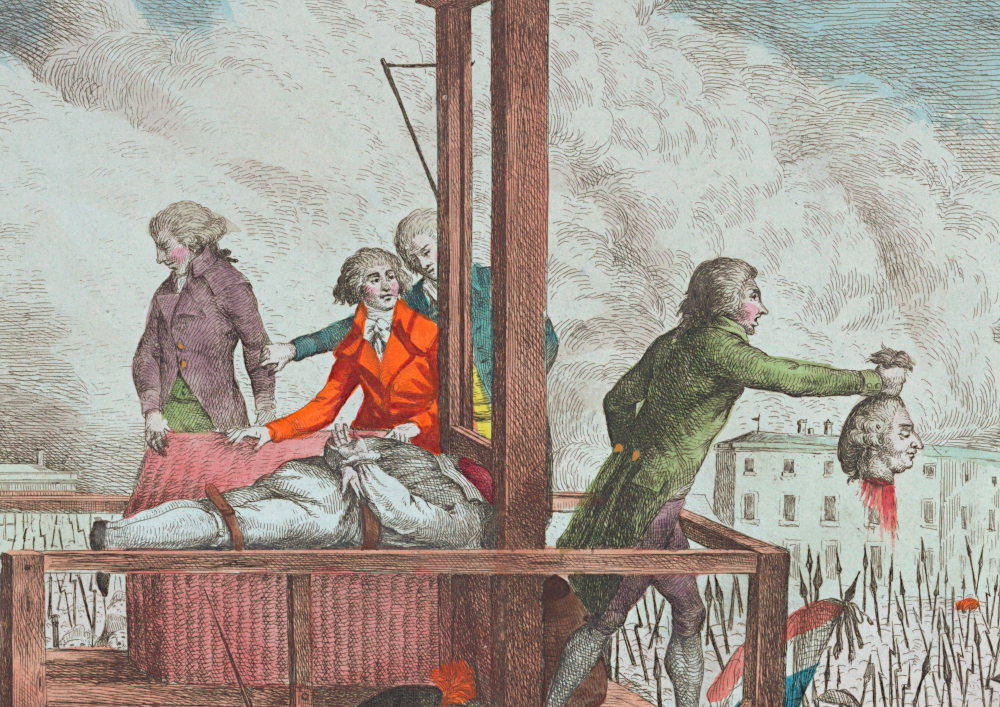
A Slight Freshness on the Neck”: Prints Depicting the Execution of Louis  XVI (ca. 1793) – The Public Domain Review
Please be aware: this video is good because it shows the lyrics of the (honestly terrible) audio of this unfinished recording, but it also shows EXTREMELY graphic footage of protests, specifically suicidal self-immolations, in Vietnam and in Czechoslovakia.

It’s Not Soup, It’s a Sandwich.

With many layers. Like an onion. (I’d say “Or an ogre,” but I love Shrek and I won’t bring him down to this level. [Spoiler: I am absolutely going to bring Shrek down to my level. And then sit on him.] But here’s the clip anyway:)

Because everybody likes parfait.

I love Shrek because I relate to everything about him, from his introversion, to his grudging love of humanity, to his deep love for his wife, to his lack of self-esteem combined with an awareness of his strengths and abilities. I appreciate Shrek because he’s a Republican. Honestly. At least, he’s what Republicans should be. (And I don’t mean to ruin Shrek for anyone with this comment, but also, if more Republicans were like Shrek, we wouldn’t have the partisan problems we have now. But noooo, we get the other, uglier, eviler ogre. Ah, well. This isn’t the point.) Shrek is definitely a conservative: he dislikes and distrusts big government, he doesn’t like change, and he wants to be left alone. He’s the NIMBY in all of us. Though that should be NIMS, No’ In Ma Swamp, of course; and I mean that for all cases and circumstances (Though again, the other ogre has sort of ruined the rhetorical use of “swamp.” What an ass. He’s like the anti-Shrek. He doesn’t even have any layers.), because if I ever go to a city council meeting to object to them building a prison in my neighborhood, I’m definitely going to channel Shrek defending his swamp.

I also have to note that Shrek takes action when his home is invaded by refugees: but he doesn’t go after the refugees, he goes after the evil people who took their homes and drove them to his swamp, namely Lord Farquaad. See what I mean? Anti-Shrek.

But if anything is likely to turn me from a progressive into a Shrekian conservative (Definitely not going to become a Republican right now: the party is just too toxic. But also, if Shrek ran for office, I’d vote for him over most mainstream Democrats I know of.), it’s the layers in the sandwich of modern education. The layers in the onion.

Definitely not a parfait.

See, here’s the thing. I’m a teacher, right? We all know this by now; I talk about little else on this blog but books and teaching. But what does that mean, being a teacher? I’ve fulminated and pontificated over this many a time, because if there’s one thing that is clear about teaching, it is that it isn’t clear what teaching is; but the basic concept is pretty simple: it’s right there in the name. I teach stuff. I stand in front of a bunch of people who don’t know some stuff, and I help them learn that stuff. In my case, the stuff is literature, which is another complicated, amorphous concept that isn’t easy to define; but once more, the basic idea is really quite simple: written stuff, words and stuff. So basically, I help people who don’t know word stuff to learn more about word stuff.

Gonna need that on a business card, please.

(I bitch about it a lot, but right now? I thank all the gods there ever were for the internet. Because check this out. I made this on an instant business card generator on the internet, and I love it.)

Eighty or a hundred years ago, this could basically have been my card. It wouldn’t have had Shrek, so it would have been much less awesome, and the font would be much more calligraphic; but basically, it could have said this, and everyone would have nodded and doffed their bowler hats respectfully.

But then in the last fifty or sixty years, things started changing.

Obviously I am taking too broad a view of the history of pedagogy and education to be able to clearly identify causes and effects; there have been far too many influences and impacts on the education system in that time for any one to stand out. But I’m still speaking simply, broadly, in fundamental ways: and sometime over the last two to three generations, educators realized something: education wasn’t working for everyone. And also, that that was a problem.

So they tried to fix the problem.

It makes perfect sense: prior to about the WWII era, the problem was that not everyone had access to education; so the major push in the country was to build schools and hire teachers and buy books and such. But in the war years and the post-war boom, most of that got accomplished; and so the focus changed, from spreading education, to improving education.1954 saw the Brown v. Board of Education of Topeka, Kansas decision from the Supreme Court, and that threw into stark relief the clear truth that not all schools were equal, and also that people who did not have access to an equal education were in trouble. Title IX in 1972, and the Education for All Handicapped Children Act of 1975, which then became the Individuals with Disabilities Education Act, along with the Americans with Disabilities Act, in 1990, helped to show that race was not the only reason why some people were denied equal access to education. And somewhere in there, we reached a point where everyone had access to school (Though obviously as this is still not true, particularly in rural areas and especially affecting indigenous and Native American children, I’m not covering the whole story: but I’m not covering the whole story.), and so at that point, where broadening inclusion into education became less of a concern, people started looking more at the quality of education that everyone in this country now had some sort of access to — part of that fight being the specific issues I have named, making sure that people of all races, genders, and abilities had equal access to education. Because once everyone gets something, which is always the first fight, then you try to make that thing better for everyone. Hence, reform.

In 1955, Rudolf Flesch published Why Johnny Can’t Read — and What You Can Do About It.

It was a bestseller for — no kidding — 37 weeks. In my own shallow understanding of the history of education in the U.S., I’m going to identify this as one of several flashpoints, points when people started looking seriously at the deficiencies in the education system, and started trying to plug the holes, fill the gaps, bandage the wounds. If you look at that image, you see one example of what I’m talking about: the top banner text there calls this “The classic book on phonics.” There: that’s one thing, one example of what I’m talking about. Not the first, I’m sure; if this isn’t the right era and the right flashpoint to identify, I should probably go back to John Dewey, who singlehandedly broke down and then rebuilt American education in the first half of the 20th century. But I think for quite a long time after that, people were still just — helping people who didn’t know word stuff to learn more word stuff. I don’t think they were doing as much to discover the gaps in some people’s learning of word stuff, and trying to figure out how to fill those gaps, or at least stop the wound from bleeding any more.

I’m using the wound metaphor because there’s a metaphor that I and all of my fellow teachers use all the time for this kind of stuff: bandaids. Which is actually where I came up with the metaphor that started this whole mess, this idea of layers, of a sandwich, or an onion. Or an ogre. (Sorry, Shrek.)

Not a parfait.

You see, the issue is, once someone identifies a problem, and then tries to diagnose it, and then proposes a solution to the problem, that leads to — repetition of the same process. Partly, I think, because most solutions proposed for most problems in education are bandaids only: they are a failure to understand the real underlying problem, along with two things: a refusal to admit that the underlying problem can’t be solved — and a refusal to throw up one’s hands and do nothing, since the problem has been identified. That last part is particularly insidious in education: because teachers, who are the ones most likely to become reformers, are used to attacking problems when we see them: and we’re also used to being right. (Look at me, spouting all this “history” without any source or evidence that my account is right. Forget about it: I know I’m right. Because I’m a teacher. So my idea for solving all of this is the right one. Now sit down and start taking notes.) So when we become aware of a problem, we immediately have a solution: and we are immediately going to put it into practice, even if we are running entirely on assumptions. I think that urge, to take action always, and that (generally misplaced — certainly true in my case) overconfidence in our abilities and ideas, means that education gets waaaaayyy more bandaids than other aspects of society that need fixing. Medicine, for instance (since I’m using the bandaid metaphor) is much more likely to investigate and analyze, using the scientific method to find real solutions, and to make change happen slowly, but effectively; schools are just like “That didn’t work? Oh well — here, I have another idea. No no, this is a good one!”

Flesch, an education theorist, had a pretty reasonable proposal here about reading instruction: having recognized that Dick and Jane books were a crap way to learn word stuff, he suggested an expansion of the use of phonics for reading instruction, rather than the “Look-Say” method that had been in common use prior to the publication of his book (Look at the word; now Say the word. “See Dick run. Run, Dick, run!”). Now, I haven’t read the book, but I’m confident that Flesch noted that there was a problem with literacy in this country, that too many people didn’t know how to read, or didn’t know how to read well enough. He identified that problem, and then after examining the education system, he diagnosed a cause for the problem, and suggested a solution. Phonics instead of Dick and Jane. Awesome.

And I bet it worked. Pretty well. In some cases. Maybe even a lot of cases. Which is wonderful, because it meant more students learned more word stuff, and of course that’s always good. Of course, it meant that teachers who had been teaching Dick and Jane for generations had to change: they had to learn better how to use phonics, how to teach phonics, how to explain to confused parents why their kids weren’t learning from Dick and Jane the way the parents had; but I bet it worked.

For a while.

But then they realized that people still didn’t know how to read. Not enough of them, or not well enough. Because then Flesch published this:

Why Johnny Still Can't Read by Rudolf Flesch | Goodreads

That one came out in 1981: because the problem persisted. And why did the problem persist, despite the gains that might have been made — that probably were made — in the area of child literacy, at least partly because of Flesch’s promotion of phonics, which is in truth a pretty good way to learn reading?

Because the problem wasn’t simply a lack of phonics training. It wasn’t just a problem with Dick and Jane. That was surely part of it — which I know because Dick and Jane are gone now, and have been gone for a long time; I don’t specifically recall learning to read with phonics, but I know I never read a Dick and Jane book when I was a child. And I was in 2nd grade in 1981; I could have been that kid on the cover of the sequel, with its “new look at the SCANDAL in our schools.”

I haven’t read this book, either, but I bet I know what the scandal was: it was that some people still couldn’t read, or couldn’t read well enough. And I bet this book has a new proposal for helping those people learn more and better word stuff; whole language instruction, maybe, which was one example of a backlash against phonics teaching. Flesch might have still been flogging phonics in this second book, but plenty of educational theorists have completely reversed their field and gone back on their own pedagogical theories when faced with new evidence that says their old theories were garbage. And that’s good, because you should be willing to change your ideas in the face of new contradictory evidence: but if you just make the same errors in trying to understand and address the problem, rushing ahead with your new idea (“No no, this one’s a good one! Seriously!”) you’re still not going to actually solve the problem, no matter how innovative the idea is you end up on: it’s just going to be a much more innovative bandaid, slapped on top of the other bandaid. And as bandaids are wont to do, it might slow the bleeding for a while: at least for as long as it takes for the blood to soak through the new bandaid just like it soaked through the last one.

But education gaps, and problems that real people face in trying to learn, are not like bleeding wounds, because problems in education don’t clot. They don’t have mechanisms to solve themselves. They do eventually disappear, but that’s because the people who have trouble learning leave school, and don’t show up on our graphs and charts any more. They are replaced by other people who have the same sorts of issues, often because of the same underlying problems.

But the people trying to fix education, trying to fill gaps and stop the bleeding — and also heal the wounds — never recognize the actual underlying cause of the gap, of the bleeding; or they recognize it, but can’t or won’t face the truth and try to at least name the problem, if not address it: which they avoid because they can’t address the problem. Teachers hate when we can’t fix the problem: and what we generally do is address the symptoms, just so we can do something. Like if students come to school hungry, rather than deal with whatever the home life issue is that leaves kids coming to school hungry — lots of teachers just buy and distribute snacks. So when education reformers, largely teachers and ex-teachers, can’t deal with the real issues, instead they find something else they can point to, and some other new bandaid program they can slap on top of the issue, to make it look like it’s going away.

Like this:

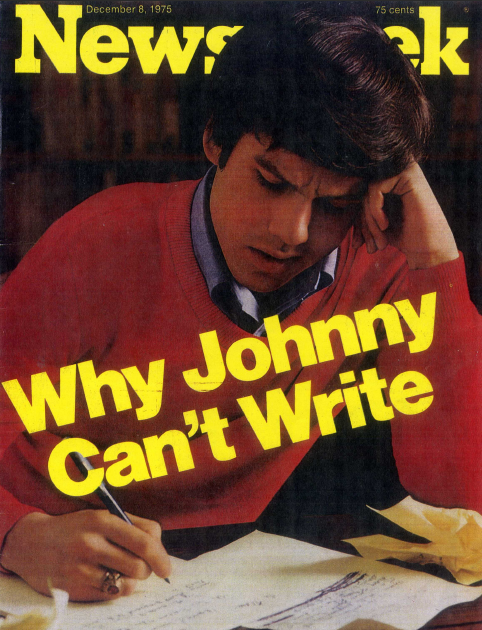
Writing in a Nation of Testing: Why Johnny Can't Write

I mean, my first theory is that Johnny can’t write because Johnny can’t read.

And please notice that we’re still not really talking about why Johnny can’t read, beyond the idea of More Phonics Training: which is only trying to address one symptom, and ignoring entirely the underlying cause of the gaps in literacy in this country.

Then that leads to this:

Why Johnny Can't Sit Still: Straight Talk about Attention  Deficit/Hyperactivity Disorder: Amazon.com: Books

Oof. That’s a big one. We still deal with this today. Still not well: I have many students with ADD or ADHD; many of them have had their issues addressed in a dozen different ways. But you know what?

They still have problems.

Because we’re not addressing the underlying issue. Just slapping on bandaids.

And that leads to this:

Why Johnny Can't Tell Right from Wrong | Book by William Kilpatrick |  Official Publisher Page | Simon & Schuster

And eventually, to this.

Thomas Sowell quote: The problem isn't that Johnny can't read. The problem  isn't...

And here we are, today. With conservative assholes like Sowell (Who, I must say, is clearly a brilliant man and an influential thinker and writer and teacher; but his mentor, when he studied economics at the University of Chicago, was Milton Friedman. The Fountainhead [In the Howard Roark sense] of assholes. And this quote here is an asshole quote.) making asshole pronouncements about what’s wrong with kids these days. And still not looking at the real, underlying problems. Just trying to find another way to slap a bandaid on the problem, and hope that it isn’t visible for a little while: long enough for the person who put forward the bandaid to get paid, or to win an award, or to get a cherry position in one thinktank or institution or another.

Okay: but I’ve strung this along too long without actually making my point. (There’s a reason for that.) So let me make the point, and then I’ll explain why I have done it this way — and also why I mentioned soup in the title of this post. (No, I haven’t forgotten that. It’s okay if you did. I know I am frequently confusing, and you kind people who read my nonsense are willing to put up with me, God bless you all.)

Again, I’m not versed enough on the history of education and education reform to have a strong argument about where this process I’m describing came from, how it got started, and how it came to dominate my profession. I just know what the actual answer is, which nobody ever seems willing to address: and because of that, for the last 23 years that I’ve been a teacher, I have had to deal with unending nonsense, while knowing it was nonsense. It is for this reason that I hate inservice: because I have to spend days being told how we are going to address the problems in education, and every single time, they don’t address the actual problem which is the cause of every difficulty in schools.

Here it is. Ready?

The actual answer is this: the problem is with school itself. And more broadly, with the human race.

You want to know why some people struggle in school? Because school is incapable of addressing everyone’s needs. The whole idea of it is to increase the efficiency of learning, through the use of specialization: that is, since I know a lot about word stuff, I can provide word stuff-centered learning to a large number of children, thereby sparing their parents or extended family members from having to teach their kids word stuff. In the past, those parents or family members did just fine, and better than me in a lot of cases, at teaching kids to read and write; but it’s more efficient if they can send their kids to school, and I can teach 100 or them at a time how to do word stuff. Or 200 at a time, at my last school. Those parents and family members of my 100-200 students can now spend their time and energy doing other things — in this country, mostly struggling to make ends meet while also providing a lavish lifestyle to the parasitic capitalist class who extract wealth from their labor. (I know a fair amount about Marxist stuff, too. I learned it in a class on word stuff in college. But since it was a word stuff class and not an economics stuff class, I can only give a basic overview of the economics stuff. You should find an expert in economics stuff to learn from instead of me. Specialization.)

Is this a better way to learn word stuff, in a classroom with several other students being taught by a word stuff expert? In some cases, yes. In some cases, no. Two of the best students I’ve ever taught were homeschooled up until 9th grade. But the advantage that public school has over homeschooling in whatever form is efficiency: parents can only teach their own kids, and that only at the cost of much of their time and energy. But I can teach a hundred kids all at once. See? Efficiency.

But the only way I can efficiently teach a whole bunch of people word stuff is if those people all learn word stuff in basically the same way, and all of them can learn it from me and the way I teach word stuff.

And of course they can’t.

Some of my students have obstacles to learning reading and writing, such as language disabilities, or simply language barriers because their first language isn’t English, which is the only language I teach word stuff in. I am an auditory learner, and an auditory teacher; and some of my students — many of my students, in fact — struggle with learning that way. But honestly, there isn’t a whole lot that can be done to help a kinesthetic learner, that is one who learns by moving and doing things, to learn word stuff, which is inherently a non-moving and non-doing kind of system. These days, the biggest obstacle to learning word stuff for my students? They don’t care about reading. They like watching videos and playing games. They like livestreams and YouTube and TikTok. They don’t see the point in reading and writing, which means they don’t want to learn word stuff.

What do I do with that?

Nothing, is the answer. It’s just going to get in the way of my students learning my specific subject. Which may not, of course, have any serious negative impact on their lives (Though I will always maintain that a person who cannot read well enough to enjoy reading is always going to be a disadvantage: doubly because they may never realize what they are missing); but it certainly creates a gap in their learning progress according to the measurements we use in this country, which focus on math and English. My students’ test scores will be lower than in past years, because these kids don’t really care. (Also, they don’t care about testing. Or grades, really. Or, well — education.) Also, because I have taught Fahrenheit 451 for decades, I have to restate the thesis of that book, which is: a society that doesn’t read is a society that doesn’t have empathy, and is therefore a dying society. There is truth there. Want to talk about the empathy crisis in this country? (I will write a whole post about this, I think. It will be depressing.)

Which leads me to the other half of the problem, as I stated above, that isn’t caused by the inherent nature of the school system: the human race in general. Not all of us want to learn. Not all of us can learn. That’s just the way we are: we are different, we have different capacities and interests, different wants and needs. When we, as educators ALWAYS do, act as though one size fits all, that one set of goals will work for every single individual and one system of achieving those goals is the best path for every single individual (Specifically, the one that I choose, as I am the expert here. Now sit down and take notes.), our measurements are always going to show gaps and holes and flaws and even bleeding wounds: because not everyone can learn. Not everyone wants to learn. Not everyone can learn or — here’s the big one — wants to learn from me, or from my fellow teachers, in a school setting.

And then there are the other problems that get in the way of people who can learn and want to learn, but can’t do it at a particular time in a particular set of circumstances, and so also show up on our measurements as an issue to be solved, a wound to be bandaged: problems like poverty. Hunger. Illness. Trauma. Abuse. A lack of physical safety or security. Institutional racism or other forms of discrimination. And on, and on.

All of which get in the way of someone’s learning. None of which can be addressed by increasing my use of phonics.

You can see, maybe, why people don’t want to talk about the real problems, or the real solutions to those problems: because often, the real problems don’t have solutions. At least not ones we can implement.

There are people we can’t help. There are people who don’t want help.

That is not to say we shouldn’t try to help. We should always try. If for no other reason, then simply to show people who need help that someone cares enough to try. To show people who don’t want help that, if their wants or their needs change, someone will care enough to try, and help might be available someday which will do some good.

But we have to accept that we can’t fix every problem, and especially not in education. There will always be disparities. There will always be gaps, and failures. It’s inevitable. That’s the truth.

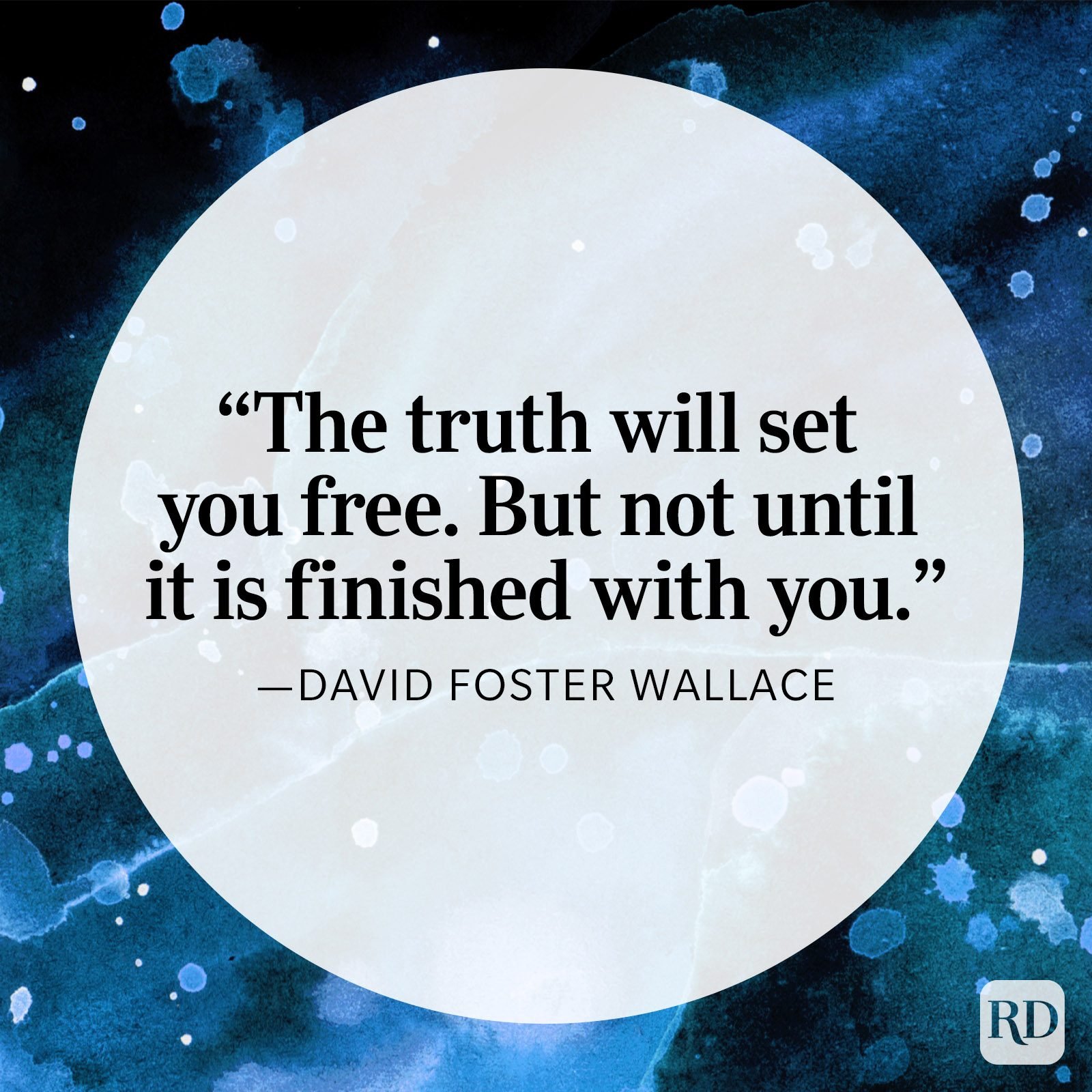
75 Inspiring and Eye-Opening Truth Quotes | Reader's Digest

So what’s the soup?

It’s the alphabet soup. Though as my title states, it’s not soup: it’s a sandwich. It’s not soup because the old layers don’t go away: we just slap a new layer on top of it. If it were soup, all the layers would mix together in one thick broth, and that’s not how it goes: the individual layers tend to have enough cohesion to avoid mixing with other layers. So, a sandwich. Or an onion. Or an ogre.

Not a parfait.

Though that is the reason I put that title above, and held off on explaining it until here and now: because now you have been through the layers. And maybe, if you have been confused by my wandering through half a dozen layers that touch on entirely different perspectives and different paradigms and different strategies about different aspects, maybe you will understand what it is like, as a teacher, to try to work through all of these layers — to try to master and implement all of these layers — when I just want to teach word stuff, man. That’s all I want. But they have all these layers stuck on top of that word stuff I want to teach. Layer on top of layer.

Those layers are often called “alphabet soup” because the snake oil salesmen who put them forward in an attempt to enrich themselves by treating symptoms instead of addressing the real underlying conditions are inordinately, eternally fond of acronyms. Everybody in education loves a good acronym: nobody more than the people who imagine they have created a brand-new system whereby schools can solve the problems in education.

See, that’s why I’m not just a teacher who helps people learn word stuff. Because snake oil salesmen are very good at convincing one particularly vulnerable group, who themselves don’t ever want to address the insoluble underlying conditions (Which, to be fair, are so large and so insoluble that it would be like a doctor saying, “Well, the problem is that you’re mortal, and so you’re going to die. Here’s your bill.” On some level it’s worth looking at treating the symptoms. But that’s not what the layers are about. That’s what teachers and other adults in schools trying to help is about. I don’t think it’s a bad idea for teachers to buy snacks and give them to hungry students. I do it, too.), that this new program that the snake oilers have cooked up is the best way to address the problems in education.

Those vulnerable people? Adminstrators.

It’s not their fault; they don’t know any better. They are simple people. They don’t understand. They just want to make a difference and fix things (And also improve their own reputation as people who get results), and when they hear about this new program, with its new acronym, which will treat these symptoms with these provable results as presented in this bar graph? Well hell, sign us up! they say. And here, take this large sum of money, which of course is not the administrators’ money; it’s taxpayer money. It’s so easy to spend taxpayers’ money. After all, we’re just trying to address these learning gaps, these holes in our data, and the blood that just keeps flowing out of them. (Like I said, if anything would ever drive me to become a conservative, it’s this. Bureaucrats spending taxpayer money for no good purpose, with no real understanding of what they’re doing or why: that’s enough to make any liberal go crazy. And here we go.)

So: I’m not just a teacher. I’m also an expert in PLCs (That’s Professional Learning Communities.). And in AVID (Advancement Via Individual Determination — I’m going to a conference this summer to learn more about it!). And in PBIS (Positive Behavior Interventions and Supports — I was on the schoolwide committee for implementing that one.), which I insist on pronouncing “Peebis,” which makes everyone uncomfortable while it makes me laugh. And in SEL (Social-Emotional Learning). And in RTI, Response to Intervention. Naturally I’m an expert in ELA (English Language Arts) and in ELD (English Language Development — what used to be called ESL and then ESOL [English as a Second or Other Language]) and in SPED, which is now becoming ESS as SPecial EDucation becomes Exceptional Student Services (Which some places call ESE, Exceptional Student Education, but I wouldn’t be able to stop myself from saying “Orale, ese!” every time I thought about it. So it’s good my school uses ESS.). I won’t say I’m an expert in ADD and ADHD and ASD and ED (That’s Emotional Disturbance, not Erectile Dysfunction — these are kids, after all) and ODD (Oppositional Defiance Disorder — and while I’m not a Boomer bitching about how we used to walk to school through three miles of driving snow every day, I will say that when I was a kid, ODD was just called “Being an asshole.”), but I’ve been in enough IEPs and 504s and dealt with enough SLDs that I know as much about all of those as most, and more than many. Naturally I can’t get more specific, because I’ve been well trained in FERPA.

This is the result of all of this: I have been given so many additional duties, so many new processes to learn and programs to implement, that I don’t have enough time and energy left any longer to just — help people learn more word stuff. My specialization — the whole reason for a public school system — has been smothered under layers of new generalized knowledge that I have had to master and implement. Because people keep identifying problems, and then prescribing solutions that aren’t really solutions, but maybe have enough of an impact, or at least are convincing enough to make an administrator think the program will have an impact that they spend money on it and implement — which means telling me I have to become an expert in this, and I have to be trained in it and then implement it, and then follow up by collecting data to show how effective this new program is, in order to justify the administrator’s decision to implement it, and the money they spent on licensing it and hiring a trainer to teach me how to do it and a data processing firm to confirm how well it works: provided I can implement it with fidelity and then collect the data on implementation to show how effective that program is. And guess who gets blamed if I can’t do all that on my end: not the snake oil salesman who got my administrator to buy the program, and not the administrator who bought the program — and not the students who spend my whole class scrolling through TikTok.

And if I do manage to do all of that successfully, the snake oil salesman who sold it to my school will then use my example as proof of their program’s efficacy, and go on to sell it to a hundred more schools. And the administrator will either squat in their job for decades, buying new programs EVERY GODDAMN YEAR but never taking away the old ones, because it worked so well that one time and that success ensured the administrator’s retention in their position (Meanwhile my retention depends on my ability to keep up with each new year’s new layer on the onion…), or else the administrator will move up the ranks, and be replaced by a new administrator who will have to buy all new programs so they can make their own individual impact on the problems in school (Also, since most administrators are ex-teachers, they also believe they have diagnosed exactly what the problem is and how to solve it, with this new acronym they bought with taxpayer money).

And my students, and the students at all those other schools, will learn a little bit less word stuff. And other stuff. Which will just convince the students that school isn’t really useful, after all; they’d be better off learning how to make their own Twitch livestream and making a living off of that. Which means they won’t try as hard to succeed in school.

And there will be new learning gaps.

Fortunately, I just heard about this new program to address it.

It’s called GET OUT OF MA SWAMP.

The Rest of the Words

I keep not doing this: but I need to do this. Now, because there are always other things which I can write about, which I want to write about; this week I got into an incredibly stupid argument on Twitter, which is crying out for me to write a full-length takedown of my opponent; also, we had parent conferences, which opens up a couple of good discussions about students in general; also, I agreed to go to an AVID conference this summer, which means I can talk about AVID and conferences and so on; also, we had to pay money in taxes this year AND IT’S MY SCHOOL’S FAULT —

So there’s a lot I could write about.

But I need to write about this.

I already wrote about the beginning of Dr. Martin Luther King Jr.’s “Letter from Birmingham Jail,” but I didn’t write about the whole piece. Intentionally, because my essay was already too long, and the place where I stopped is important enough and valuable enough to receive the final emphasis of closing that piece with it; but now we need to talk about the rest of the piece, not least because it is still brilliant, nor only because it is still relevant to our society today, and the discourses we have around race and prejudice and equality and so on. Also because I said I would do this: and I need to keep my word.

So here we go again.

(One quick note: I have put some jokes in here, particularly in a couple of the links; I hope that doesn’t come across as too irreverent. Dr. King is and will always be one of my most idolized heroes. I just think that a little humor helps to get through an essay this long, with this much heavy subject matter. But I do apologize if any of the jokes hit a sour note.)

The First Essay

So the section I covered there goes to the end of the second page; I wonder how much of that length is intentional in that it seems like a piece that long and no longer could easily be reprinted in newspapers, but I don’t know. It also builds beautifully as an argument, leading to that conclusion. In any case, the next paragraph opens a new line of argument — though it is related, of course. This link shows another iteration of the letter, this one with a clear transition at this point, which I like.

YOU express a great deal of anxiety over our willingness to break laws. This is certainly a legitimate concern. Since we so diligently urge people to obey the Supreme Court’s decision of 1954 outlawing segregation in the public schools, it is rather strange and paradoxical to find us consciously breaking laws. One may well ask, “How can you advocate breaking some laws and obeying others?” The answer is found in the fact that there are two types of laws: there are just laws, and there are unjust laws. I would agree with St. Augustine that “An unjust law is no law at all.”

Notice that Dr. King continues the same tone and structure of argument, even after he has had this incredible cri de coeur about the African-American experience in the U.S.: he states their objection, and then turns it around on them. Willingness to break laws is a concern, you say? By gum, you’re right! You all should obey the Supreme Court’s decision to desegregate schools, shouldn’t you? But again, he offers this point about their hypocrisy in the politest possible way: by saying that it might be strange to see the civil rights activists doing the same apparently hypocritical thing, defending the law while breaking the law. But then he explains why the civil rights activists are not, in fact, doing anything hypocritical — and note that he uses “paradoxical” rather than the term “hypocritical:” because a paradox is only seemingly contradictory, generally from one perspective; there is another perspective by which it makes perfect sense (For instance, the paradox “To preserve peace, you must prepare for war.” It only seems like a contradiction; it actually makes perfect sense in a world where not everyone shares a desire for peace.): because there are two types of laws. King separates here the concept of “legal” from the concept of “just” — a distinction we point out again and again in our society.

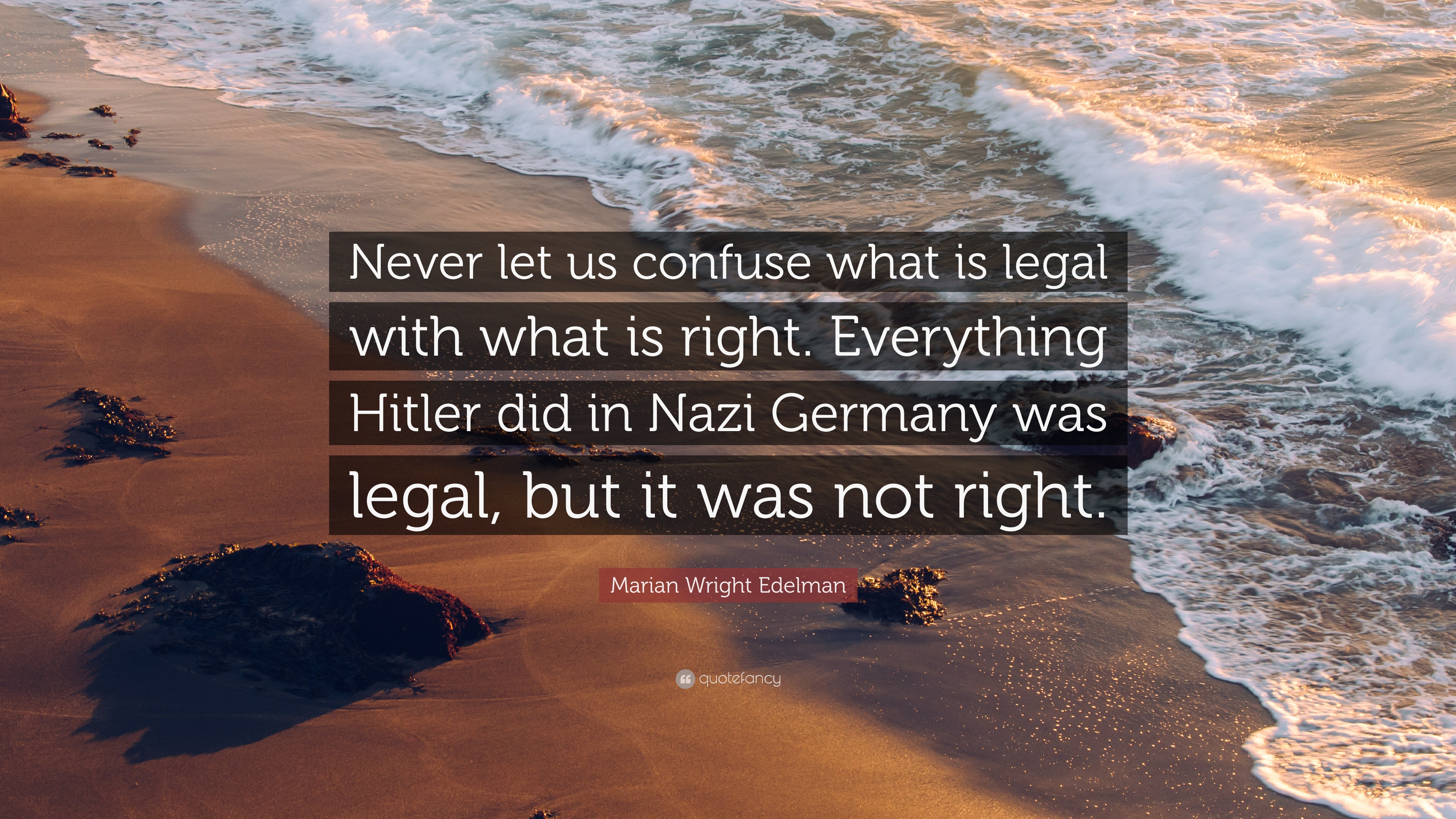
Marian Wright Edelman Quote: “Never let us confuse what is legal with what  is right. Everything Hitler did in Nazi Germany was legal, but it was not  r...”
By the way: Mrs. Edelman was referring to Dr. King’s Letter when she said this. It’s on p. 8 of this speech, for one example.

And where does Dr. King get the justification for his distinction? Why from Saint Augustine: one of the most important and influential of all Christian thinkers. How you like them apples, Clergymen?

Continuing his explanation of the distinction between law and justice, Dr. King refers to the other most influential and important Christian thinker, St. Thomas Aquinas:

Now, what is the difference between the two? How does one determine when a law is just or unjust? A just law is a man-made code that squares with the moral law, or the law of God. An unjust law is a code that is out of harmony with the moral law. To put it in the terms of St. Thomas Aquinas, an unjust law is a human law that is not rooted in eternal and natural law. Any law that uplifts human personality is just. Any law that degrades human personality is unjust. All segregation statutes are unjust because segregation distorts the soul and damages the personality. It gives the segregator a false sense of superiority and the segregated a false sense of inferiority. To use the words of Martin Buber, the great Jewish philosopher, segregation substitutes an “I – it” relationship for the “I – thou” relationship and ends up relegating persons to the status of things. So segregation is not only politically, economically, and sociologically unsound, but it is morally wrong and sinful. Paul Tillich has said that sin is separation. Isn’t segregation an existential expression of man’s tragic separation, an expression of his awful estrangement, his terrible sinfulness? So I can urge men to obey the 1954 decision of the Supreme Court because it is morally right, and I can urge them to disobey segregation ordinances because they are morally wrong.

And yes: he also referred to Paul Tillich, one of the most influential Christian philosophers of the 20th century; and to Martin Buber, “the great Jewish philosopher.” (How you like them apples, Rabbi?) Let me emphasize here, if I didn’t do it enough before, that Dr. King wrote this letter in jail: without reference materials. He just knew all this stuff. (I mean, he did have a doctorate in systematic theology; and his dissertation was partly about Tillich’s work, so.) The only way to improve an ethos argument this strong, with references to authorities this relevant to both your point and your audience, is to show that you yourself are an authority to be reckoned with.

The argument itself is remarkable. He provides three different definitions of his distinction between just and unjust laws: first, a religious one — just laws square with the law of God (and note he includes non-religious people by also calling it “the moral law”, and then brings it back to religion and Aquinas by referring to the idea of laws “not rooted in eternal and natural law”); second, a psychological definition, saying that just laws uplift human personality and unjust laws degrade it; and third, Buber’s philosophical concept of the “I-it” relationship replacing the “I-thou” relationship, turning people into objects. Into things. And look at the use of parallelism here: three reasons why segregation is unsound, followed by another way that it is wrong (and adding the idea that segregation is sinful”; three different ways that segregation is an expression of man’s evil; and a juxtaposition of two antithetical examples that match King’s categories: one just law, and one unjust law.

Then, if that isn’t enough ways to help his audience understand this concept , King gives us this next paragraph:

Let us turn to a more concrete example of just and unjust laws. An unjust law is a code that a majority inflicts on a minority that is not binding on itself. This is difference made legal. On the other hand, a just law is a code that a majority compels a minority to follow, and that it is willing to follow itself. This is sameness made legal.

That’s right, a more concrete definition, with another simple summative way to understand it: difference made legal, and sameness made legal. He’s right: this is more concrete, and has none of the religious overtones of the last paragraph — but it makes just as much sense, and is just as sound. Have we got enough ways to understand this now? Of course we do.

And then he adds another one:

Let me give another explanation. An unjust law is a code inflicted upon a minority which that minority had no part in enacting or creating because it did not have the unhampered right to vote. Who can say that the legislature of Alabama which set up the segregation laws was democratically elected? Throughout the state of Alabama all types of conniving methods are used to prevent Negroes from becoming registered voters, and there are some counties without a single Negro registered to vote, despite the fact that the Negroes constitute a majority of the population. Can any law set up in such a state be considered democratically structured?

Here Dr. King brings in another issue: voting rights. How can a law be democratic when the people were not capable of opposing nor supporting its passage, because of the suppression of their rights and their franchise? The argument is so plain and irrefutable that he doesn’t even bother to answer his rhetorical question. Instead, perhaps feeling understandably bitter as he sits in a jail cell writing about justice and injustice, Dr. King moves to one other complexity in the distinction between legal and just: when the application of a law makes it unjust. And I say he might have been bitter because his example is once again his own, talking about the city of Birmingham’s use of a parade permit ordinance to remove the civil rights activists’ First Amendment rights.

These are just a few examples of unjust and just laws. There are some instances when a law is just on its face and unjust in its application. For instance, I was arrested Friday on a charge of parading without a permit. Now, there is nothing wrong with an ordinance which requires a permit for a parade, but when the ordinance is used to preserve segregation and to deny citizens the First Amendment privilege of peaceful assembly and peaceful protest, then it becomes unjust.

Then he goes on to compare Birmingham first to three villains from history, and himself and his allies to the heroes who were suppressed by the villains — and then Dr. King confirms Godwin’s Law (Within a different context), while breaking the corollary to Godwin’s Law. Because Dr. King brings up Adolf Hitler. And THEN he throws in Stalin and Communism: it’s like the perfect American argument, here. Note that the three villains and heroes he mentions before going to the Nazis are both religious and political: Nebuchadnezzar, the Babylonian king who tried to kill the three Jewish prophets Shadrach, Meshach, and Abednego (I’M SORRY DR. KING I HAVE TO) in the Old Testament; the Romans, who tried to suppress Christianity with various atrocities; and the elite of Athens, who executed Socrates for teaching the truth. Note also that all three villains lost these fights.

Which side is Dr. King’s? Which side would you rather be on?

Of course, there is nothing new about this kind of civil disobedience. It was seen sublimely in the refusal of Shadrach, Meshach, and Abednego to obey the laws of Nebuchadnezzar because a higher moral law was involved. It was practiced superbly by the early Christians, who were willing to face hungry lions and the excruciating pain of chopping blocks before submitting to certain unjust laws of the Roman Empire. To a degree, academic freedom is a reality today because Socrates practiced civil disobedience.


We can never forget that everything Hitler did in Germany was “legal” and everything the Hungarian freedom fighters did in Hungary was “illegal.” It was “illegal” to aid and comfort a Jew in Hitler’s Germany. But I am sure that if I had lived in Germany during that time, I would have aided and comforted my Jewish brothers even though it was illegal. If I lived in a Communist country today where certain principles dear to the Christian faith are suppressed, I believe I would openly advocate disobeying these anti-religious laws.

Once again, Dr. King has made an argument so strong, so irrefutable at this point, after he has given so many different ways to understand it, and so many different reasons to accept it, that I really can’t fathom why people still don’t agree with this argument. Except for those who haven’t read it, of course.

The next part of King’s letter brings up the element that my brother, when I mentioned that I had written an essay about Dr. King, used to identify the Letter from Birmingham Jail as distinct from Dr. King’s other masterworks: “Ohhh,” he said to me on the phone when I was trying to tell him which piece I had analyzed, “is that the one with the white moderates?”

Yes it is.

I MUST make two honest confessions to you, my Christian and Jewish brothers. First, I must confess that over the last few years I have been gravely disappointed with the white moderate. I have almost reached the regrettable conclusion that the Negro’s great stumbling block in the stride toward freedom is not the White Citizens Councillor or the Ku Klux Klanner but the white moderate who is more devoted to order than to justice; who prefers a negative peace which is the absence of tension to a positive peace which is the presence of justice; who constantly says, “I agree with you in the goal you seek, but I can’t agree with your methods of direct action”; who paternalistically feels that he can set the timetable for another man’s freedom; who lives by the myth of time; and who constantly advises the Negro to wait until a “more convenient season.” Shallow understanding from people of good will is more frustrating than absolute misunderstanding from people of ill will. Lukewarm acceptance is much more bewildering than outright rejection.

He confesses: and then he destroys us with his disappointment. This part of the essay I have trouble reading and teaching; not because it’s too complicated, or too upsetting in its language and images (as some of my students find the Perfect Sentence I wrote about in the first post) — but because it’s true, and it’s me. I am a White moderate. I mean, I’m pretty goddamn liberal — but also, I don’t act in order to achieve a more just society; I simply support the cause. It’s not entirely me, because I don’t object to the methods used by those who are more active in pursuing our common goal; but it’s me because I don’t participate in those methods.

King here juxtaposes this critique of people who support the cause but not enough, with those who oppose the cause though they claim to be understanding of it: the Clergymen. No White moderates, those Alabamians; they seem like pretty rock-ribbed conservatives, fitting perfectly into the mold of paternalistic White leaders whom King refers to above, as they compliment “their” [“our”] Negro community for keeping the peace, which is exactly what King is taking issue with. But he does it in such an incredible way:

In your statement you asserted that our actions, even though peaceful, must be condemned because they precipitate violence. But can this assertion be logically made? Isn’t this like condemning the robbed man because his possession of money precipitated the evil act of robbery? Isn’t this like condemning Socrates because his unswerving commitment to truth and his philosophical delvings precipitated the misguided popular mind to make him drink the hemlock? Isn’t this like condemning Jesus because His unique God-consciousness and never-ceasing devotion to His will precipitated the evil act of crucifixion? We must come to see, as federal courts have consistently affirmed, that it is immoral to urge an individual to withdraw his efforts to gain his basic constitutional rights because the quest precipitates violence. Society must protect the robbed and punish the robber.

That’s right: not only does King compare himself, for the third time, to Socrates — now he actually compares himself to Jesus. And, of course, he’s right: blaming the victims of oppression for inciting the violence of the oppressors is precisely like blaming Jesus for making the Romans crucify him. And who does that in the story of the Passion?

Why, this guy, of course.

(I know, this is probably the wrong thing to use for this reference. But I love rock opera. Please ignore the ridiculous whiteness of the Jews in the crowd, and especially of Jesus — but DON’T ignore the AMAZING homoeroticism of the flogging performed by what appears to be The Village People, while a sunburned Disco hedonist looks on and cackles.)

In the next paragraph, King jumps back to the White moderates, connecting the two not only with their half-hearted support or opposition to King’s cause, but with a parallel to the teachings and goals of the Church:

I had also hoped that the white moderate would reject the myth of time. I received a letter this morning from a white brother in Texas which said, “All Christians know that the colored people will receive equal rights eventually, but is it possible that you are in too great of a religious hurry? It has taken Christianity almost 2000 years to accomplish what it has. The teachings of Christ take time to come to earth.” All that is said here grows out of a tragic misconception of time. It is the strangely irrational notion that there is something in the very flow of time that will inevitably cure all ills. Actually, time is neutral. It can be used either destructively or constructively. I am coming to feel that the people of ill will have used time much more effectively than the people of good will. We will have to repent in this generation not merely for the vitriolic words and actions of the bad people but for the appalling silence of the good people. We must come to see that human progress never rolls in on wheels of inevitability. It comes through the tireless efforts and persistent work of men willing to be coworkers with God, and without this hard work time itself becomes an ally of the forces of social stagnation.

By putting these two groups, White moderates who say they support civil rights but oppose the methods used by the activists, and the Alabama clergymen who say they understand the desires of African-Americans for freedom but show they really would rather maintain the status quo of segregation and oppression, in such close parallel, switching back and forth with what almost seems a complete lack of connecting transitions between subjects, King achieves his goal: he shows that these groups are essentially the same. There is what they say, and then there is what they do: and their actions speak louder than their words. He is thus chastising both groups, by comparison to each other: the clergymen are no better than Northern White moderates, synonymous in the South with lying hypocrisy; and the White moderates are no better than White Southerners: synonymous with racist oppressors. Neither group is willing to be coworkers with God: they are the forces of social stagnation which the coworkers with God oppose.

(Okay, I don’t think that’s me any more. Though I still worry that I would disappoint Dr. King.)

Dr. King’s next argument has to do with “extremism.”

YOU spoke of our activity in Birmingham as extreme. At first I was rather disappointed that fellow clergymen would see my nonviolent efforts as those of an extremist. I started thinking about the fact that I stand in the middle of two opposing forces in the Negro community. One is a force of complacency made up of Negroes who, as a result of long years of oppression, have been so completely drained of self-respect and a sense of “somebodyness” that they have adjusted to segregation, and, on the other hand, of a few Negroes in the middle class who, because of a degree of academic and economic security and because at points they profit by segregation, have unconsciously become insensitive to the problems of the masses. The other force is one of bitterness and hatred and comes perilously close to advocating violence. It is expressed in the various black nationalist groups that are springing up over the nation, the largest and best known being Elijah Muhammad’s Muslim movement. This movement is nourished by the contemporary frustration over the continued existence of racial discrimination. It is made up of people who have lost faith in America, who have absolutely repudiated Christianity, and who have concluded that the white man is an incurable devil. I have tried to stand between these two forces, saying that we need not follow the do-nothingism of the complacent or the hatred and despair of the black nationalist. There is a more excellent way, of love and nonviolent protest. I’m grateful to God that, through the Negro church, the dimension of nonviolence entered our struggle. If this philosophy had not emerged, I am convinced that by now many streets of the South would be flowing with floods of blood. And I am further convinced that if our white brothers dismiss as “rabble-rousers” and “outside agitators” those of us who are working through the channels of nonviolent direct action and refuse to support our nonviolent efforts, millions of Negroes, out of frustration and despair, will seek solace and security in black nationalist ideologies, a development that will lead inevitably to a frightening racial nightmare.

Specifically, King is replying to this sentence in the Statement: “We do not believe that these days of new hope are days when extreme measures are justified in Birmingham.” (Blogger’s Note: Since I did that to them, I’m going to do this to Dr. King’s words: “We must come to see that human progress never rolls in on wheels of inevitability.“) This line clearly pissed King off: but more important, it’s an idea that he can’t allow to shape the narrative. So as he does with so many other parts of the Statement’s argument, he smashes this again, and again, and again. He shows the two extremes in the African-American community: one extreme is those African-Americans who have been worn down by the oppression that has defined their lives; and the other is — Malcolm X. King doesn’t name the other man, with whom he was so often presented in juxtaposition as two opposites, the moderate and the extremist; but he doesn’t have to. Elijah Muhammad (Himself no moderate) and his Nation of Islam are synonymous with Malcolm X, and though King and X were a hell of a lot closer in a lot of ways than most people thought or said, it is exactly these kinds of people, these southern Clergymen, who would have used King as an example of a better leader, a more reasonable leader, than X, because King used non-violence while Malcolm X talked about violence. I suspect this comparison and the implication that King was softer and more accommodating to the oppressors’ status quo, made the man angry: and so the description at the end of this paragraph — a fine example of Dr. King showing that he did not believe that non-violence was the only way to achieve freedom: just that it was the best way, as it would not lead to “floods of blood.” If the warning is not clear, he reiterates it in the next paragraph:

Oppressed people cannot remain oppressed forever. The urge for freedom will eventually come. This is what has happened to the American Negro. Something within has reminded him of his birthright of freedom; something without has reminded him that he can gain it. Consciously and unconsciously, he has been swept in by what the Germans call the Zeitgeist, and with his black brothers of Africa and his brown and yellow brothers of Asia, South America, and the Caribbean, he is moving with a sense of cosmic urgency toward the promised land of racial justice. Recognizing this vital urge that has engulfed the Negro community, one should readily understand public demonstrations. The Negro has many pent-up resentments and latent frustrations. He has to get them out. So let him march sometime; let him have his prayer pilgrimages to the city hall; understand why he must have sit-ins and freedom rides. If his repressed emotions do not come out in these nonviolent ways, they will come out in ominous expressions of violence. This is not a threat; it is a fact of history. So I have not said to my people, “Get rid of your discontent.” But I have tried to say that this normal and healthy discontent can be channeled through the creative outlet of nonviolent direct action. Now this approach is being dismissed as extremist. I must admit that I was initially disappointed in being so categorized.

But as I continued to think about the matter, I gradually gained a bit of satisfaction from being considered an extremist. Was not Jesus an extremist in love? — “Love your enemies, bless them that curse you, pray for them that despitefully use you.” Was not Amos an extremist for justice? — “Let justice roll down like waters and righteousness like a mighty stream.” Was not Paul an extremist for the gospel of Jesus Christ? — “I bear in my body the marks of the Lord Jesus.” Was not Martin Luther an extremist?– “Here I stand; I can do no other so help me God.” Was not John Bunyan an extremist? — “I will stay in jail to the end of my days before I make a mockery of my conscience.” Was not Abraham Lincoln an extremist? — “This nation cannot survive half slave and half free.” Was not Thomas Jefferson an extremist? — “We hold these truths to be self-evident, that all men are created equal.” So the question is not whether we will be extremist, but what kind of extremists we will be. Will we be extremists for hate, or will we be extremists for love? Will we be extremists for the preservation of injustice, or will we be extremists for the cause of justice?

(Note on the text: the iteration of the Letter I have been pulling from separates this into two paragraphs. This one doesn’t. I think it should be one paragraph.)

This is another of my favorite arguments, and not least because King again compares himself to Jesus Christ — and also to Abraham Lincoln and Thomas Jefferson, along with the Jewish and Christian luminaries Amos, St. Paul, Martin Luther, and John Bunyan. (Also I love that he drops his namesake in there without even batting an eye — and don’t forget that the vast majority of Southern White Christian racists were of Protestant denominations). I also love the rapid-fire call-and-response of rhetorical questions with direct quotations that serve both as answers and as proof, while making use of all of the poetry in these various wonderful statements, and also showing off, again, King’s own erudition and understanding of the power of the right word at the right time for the right reason. And then those final rhetorical questions, with the explicit use of “we” inviting the audience — the White moderate, the White Southern clergyman, and every single person who ever reads this letter, including me and including you — to come up with our own perfect words, our own response to this call. What will we do? What kind of extremist will we be?

After this King closes his criticism of White moderates with the most terrible form of the guilt-imposing “I’m not mad, I’m just disappointed” position that he is using here: the “Maybe I expected too much of you.”

I had hoped that the white moderate would see this. Maybe I was too optimistic. Maybe I expected too much. I guess I should have realized that few members of a race that has oppressed another race can understand or appreciate the deep groans and passionate yearnings of those that have been oppressed, and still fewer have the vision to see that injustice must be rooted out by strong, persistent, and determined action.

Look at that. Look at it! “I guess I should have realized?” GodDAMN, sir. I would like to personally apologize for everyone and everything, ever. He does lighten the load slightly by naming a number of White activists, primarily reporters who had given fair or even favorable coverage to the Civil Rights movement, and thanking them for their contribution. Which makes me feel a tiny bit better because I’m writing this. But I’m still sorry, sir. I have eaten the plums that were in the icebox, the ones you were saving.

This next part, though? I got nothing but smiles for this. Because then he goes after the church.

Honestly, I’m going to skip over this, because this is not my area. I have not attended church since around about 1986, and my personal animus for religion would color my analysis of this too much. I want to pick out every single detail where King tells his fellow clergymen that the White church has let him down, and highlight every one, like some kind of manic hybrid of a mother-in-law and Vanna White, finding every single possible fault and holding it up for the audience to observe, while I smile from ear to ear. But I won’t do that. I will just point out that he specifically mentions one of the Eight Clergymen, Reverend Earl Stallings, for his action in allowing Black worshippers into his church without segregating them; this seems to me like a direct response and even challenge to the passive aggressive way the Clergymen never name Dr. King, even though EVERYBODY FUCKING KNOWS THAT’S WHO THEY MEANT. “Outside agitators,” my ass. I still recommend reading the entire letter, including this section; but here I’m just going to post his conclusion, because it’s so damn beautiful.

I hope the church as a whole will meet the challenge of this decisive hour. But even if the church does not come to the aid of justice, I have no despair about the future. I have no fear about the outcome of our struggle in Birmingham, even if our motives are presently misunderstood. We will reach the goal of freedom in Birmingham and all over the nation, because the goal of America is freedom. Abused and scorned though we may be, our destiny is tied up with the destiny of America. Before the Pilgrims landed at Plymouth, we were here. Before the pen of Jefferson scratched across the pages of history the majestic word of the Declaration of Independence, we were here. For more than two centuries our foreparents labored here without wages; they made cotton king; and they built the homes of their masters in the midst of brutal injustice and shameful humiliation — and yet out of a bottomless vitality our people continue to thrive and develop. If the inexpressible cruelties of slavery could not stop us, the opposition we now face will surely fail. We will win our freedom because the sacred heritage of our nation and the eternal will of God are embodied in our echoing demands.

“We were here.” I love that. “Our destiny is tied up with the destiny of America.” Just incredible.

At this point, having made all of his arguments, he’s almost — no, wait, he’s not done. He has one more thing to say.

I must close now. But before closing I am impelled to mention one other point in your statement that troubled me profoundly. You warmly commended the Birmingham police force for keeping “order” and “preventing violence.” I don’t believe you would have so warmly commended the police force if you had seen its angry violent dogs literally biting six unarmed, nonviolent Negroes. I don’t believe you would so quickly commend the policemen if you would observe their ugly and inhuman treatment of Negroes here in the city jail; if you would watch them push and curse old Negro women and young Negro girls; if you would see them slap and kick old Negro men and young boys, if you would observe them, as they did on two occasions, refusing to give us food because we wanted to sing our grace together. I’m sorry that I can’t join you in your praise for the police department. It is true that they have been rather disciplined in their public handling of the demonstrators. In this sense they have been publicly “nonviolent.” But for what purpose? To preserve the evil system of segregation. Over the last few years I have consistently preached that nonviolence demands that the means we use must be as pure as the ends we seek. So I have tried to make it clear that it is wrong to use immoral means to attain moral ends. But now I must affirm that it is just as wrong, or even more, to use moral means to preserve immoral ends.


I wish you had commended the Negro demonstrators of Birmingham for their sublime courage, their willingness to suffer, and their amazing discipline in the midst of the most inhuman provocation. One day the South will recognize its real heroes. They will be the James Merediths, courageously and with a majestic sense of purpose facing jeering and hostile mobs and the agonizing loneliness that characterizes the life of the pioneer. They will be old, oppressed, battered Negro women, symbolized in a seventy-two-year-old woman of Montgomery, Alabama, who rose up with a sense of dignity and with her people decided not to ride the segregated buses, and responded to one who inquired about her tiredness with ungrammatical profundity, “My feets is tired, but my soul is rested.” They will be young high school and college students, young ministers of the gospel and a host of their elders courageously and nonviolently sitting in at lunch counters and willingly going to jail for conscience’s sake. One day the South will know that when these disinherited children of God sat down at lunch counters they were in reality standing up for the best in the American dream and the most sacred values in our Judeo-Christian heritage.

He leaves this until the end. He knows that this is the one part of this letter most likely to anger his readers, because he is here criticizing the police — and even now, 60 years later (And please note that this April will be the 60th anniversary of this whole ordeal), I think we all know what happens to people who criticize the police. But he can’t not say this. He doesn’t have proof, not that the Clergymen or the White readership at large will accept — it is only the word of the arrested activists; nobody was there with a cell phone to record this scene — and you can see his bitter acknowledgement of the superficial truth of what the Clergymen said, that the police have been “rather disciplined in their public handling of the demonstrators.” Though even there, look at the use of the phrase “rather disciplined,” instead of the words “calm” and “restraint” which the Clergymen used. Notice the emphasis on “public,” immediately contradicted by the word “handling,” with its implication of manhandling, echoed in the word “disciplined,” with its sense of harsh control and even physical punishment. But of course, because he is Dr. Martin Luther King, he immediately shows how this example is the precise opposite of the “nonviolent” label the police might claim: because they are pursuing immoral ends. And they are contrasted against the truly nonviolent protestors and pioneers, who use genuine nonviolence to promote moral ends of justice — “the best in the American dream and the most sacred values in our Judeo-Christian heritage.” And since this comes here, at the very end, it has extra weight — I do think the overall length of this letter does make this seem more like a postscript than a strong conclusion; I think the passage I quoted above, at the end of the section about the church, is the real conclusion — but this is one final blow that is impossible to ignore. But of course, the police do not get the last word: that goes to the real heroes of the South, James Meredith, and Rosa Parks, and all of the people who fought alongside Dr. King for freedom. I, for one, would like to thank them all for their courage and their honor and their sacrifice.

Speaking of postscripts — and of too-lengthy writings, which need to finally be brought to a close — let me just end with the saltiest “Yours truly” in the history of letters:

If I have said anything in this letter that is an understatement of the truth and is indicative of an unreasonable impatience, I beg you to forgive me. If I have said anything in this letter that is an overstatement of the truth and is indicative of my having a patience that makes me patient with anything less than brotherhood, I beg God to forgive me.

Because in the end, even though the accusation that the civil rights movement and Dr. King were “impatient,” were “unwise and untimely,” was entirely false and absurd — it would be much, much worse if Dr. King were too patient.

And now, Dr. King’s actual “Yours truly,” which I would humbly like to echo myself, to everyone who reads this.

Yours for the cause of Peace and Brotherhood

Wallingford prepares for MLK Day ceremony

Good Art, Bad Artists

Judith Beheading Holofernes, by Caravaggio: a scoundrel and murderer. The artist, that is: Judith was a warrior fighting an oppressor. And a badass.

I had a difficult conversation with a student this week.

Actually, I had several: and yes, I still need to write about how teachers have too many expectations put on us, because I acted this week as a counselor and a confidante, a corrector and a — a conspirator is too strong; but “co-worker” is not strong enough. Ah, well. Even without the perfect alliteration, I still talked to a student about cheating, and to another student about old relationships, and another student about aging family, and another student about old relationships that won’t go away; and I discussed abortion with two different classes, and the dress code with three, and racism with my co-workers…

And then there was this difficult conversation that came up with one of my favorite students.

I start every day with “Has anyone got any questions or concerns or issues you’d like to raise to the class?” And in some of my classes, there are specific students who respond to that invitation every single day: two of them ask about me and how I’m doing, which is very sweet but also invites dishonesty, because I don’t usually want to start the class with “I’m terrible and right at this second talking to all of you people is the last thing on Earth I want to be doing;” so instead I say something more neutral, even though I don’t like lying. But that’s an acceptable lie, because the class isn’t about me, even though students are happy to delay work by discussing me and my life; my job is to move them into the learning, so I do that, and it’s not a big deal.

But I have this one student who always brings something up. It’s usually something philosophical: this young person is extremely bright, extraordinarily curious, and has a deep love of learning, and so all of his free time is spent learning things or discussing things that he has learned; and all of his time in class is spent — well, the same way, really. I have shown him that I’m also interested in philosophy and enjoy talking about topics both random and profound, and so he has grown more comfortable over the school year with talking about whatever happens to be on his mind.

For perspective, he responded to my invitation Friday morning by talking about the deep anxiety he feels when he thinks about death: because, as he said, swaying in his seat and throwing his arms and head about like a wild-eyed symphony conductor, leading the orchestra of his body in playing the song of his opinion (which is the way he always talks when he gets excited about something), he loves life so much, and wants to experience everything, and the human lifespan is just not long enough! And while I was trying to disagree with him, because I am of the opinion that years are actually very, very long, and while there is never enough time to do and see everything we want to do and see, there is so very much time to do and see most things, he explained that in a few months’ time he will have a birthday and at that point he will be older than his older brother: and that comment made some things very clear to me. This is why he knows, in his bones, that life can end, suddenly, without warning, and far too early; and so of course he is anxious about it, and of course it seems to him like it is far too short. Because sometimes it is: and he knows it much better than I.

And that wasn’t the difficult conversation we had.

No, the difficult conversation came on Thursday: when he asked if it is possible to separate the art from the artist, and enjoy content created by a person you could not personally enjoy, or agree with, or even abide. And if it is possible, how could it be done?

That’s a tough conversation.

It was made worse by the fact that we disagreed on at least one prominent example of this issue, the author J.K. Rowling; and then, as we were getting into the weeds with this, I realized that I was speaking only to this one student, while the rest of the class was off on their own; so I had to cut it off. I hate cutting conversations off: particularly when they are important, as this one is, and when they are meaningful to those involved, as this topic was both to me and to this young man. And to be clear, if this had been one of my English 10 classes, which are currently studying argument, or my AP Lang class, which is just about ready to move into argument, then I would have opened the discussion up to the whole class, formalized it into a specific topic with a specific claim, and then solicited points pro and con, and counterarguments to those points, and then spent the whole class period on this if necessary; but it was College Readiness, which never studies argument, and I needed to move on. I tried to write more of my opinions on this for the young man to read, while they were working on their application essays, because part of what I had said had hit him in the feelings; but I didn’t have the time or the mental acuity to make my point clear enough.

I knew I had to write about this for this week’s blog.

(Yes, I know I am again procrastinating the analysis of the rest of the Letter from Birmingham Jail. I’ll get there. But I asked my class if I should write about what I said I was going to, or if I should procrastinate that topic and write about the one that had captured my thoughts; and they all said I should procrastinate. Who am I to dispute with a class full of honors students? At least, when they say something I want to agree with anyway. So. Here goes.)

“Tehemana Has Many Parents” by Paul Gauguin, who abandoned his wife and children to move to Tahiti and make art. Amusingly, I got this image from a New York Times article titled “Is It Time Gauguin Got Canceled?”

So the question is, if something is created by somebody who has something terrible about them personally, can we enjoy the thing that terrible person created? Or is it tainted by the terribleness of the creator? Is it possible to separate entirely the art from the artist, and enjoy content from problematic people? This question is made more difficult, of course — particularly for my students’ generation, though also for all of us older more jaded people, too — by the recent rise of the social standard which says anything associated with, for lack of a better word, evil, is also evil, and taints everyone and everything who touches it. This is the standard by which people have been cancelled online — again, like J.K. Rowling.

And that’s where this gets complicated. Because I am a liberal, and I want to promote liberal ideas like equal rights and privileges for all, and a safe, supportive community for those who are marginalized and discriminated against. And because I am a white man, and I recognize that I am not a good judge of what is hateful and hurtful, as essentially none of the hate in the world is directed at me, and even that which is doesn’t have much impact on me, as white men like me have built a society that privileges and protects us, I know that I should listen to others who say the work is offensive more than I should dismiss those claims based on the useless fact that I was not offended by the work. But I am also an artist, and a teacher, and therefore a passionate believer in the value of art, and in the defiant opposition to what I see as the unforgivable act of censorship. So my liberal side wants to support those who tell me that artists with evil ideas or acts or intentions are harmful; and my artist/teacher/free speech side refuses to even consider the idea of cancelling anyone.

That is, at least in part, what we are talking about: cancel culture. But see, the second I type that, and start to think about opposing the idea of cancelling someone like J.K. Rowling, I start to sound like what I look like: a privileged middle aged white man who has never had to deal with oppression, and is therefore too quick to protect other such privileged white people, and maintain the status quo that continues the oppression and marginalization of people who don’t look or live like me. I start to sound like a Republican, and particularly like the worst of them. I sound like Trump.

Okay. Not really. I’ll never sound like Trump, not least because I can put together a goddamn sentence; much more because I’m not a heartless, shameless narcissist. But still: it’s uncomfortable to side with the bad guys. I want to stay on the side of the angels, as I see them.

But on this? The angels are kinda wrong.

Okay, so let’s lay out the basic premise. If an artist has a bias, it is likely, but not inevitable, for it to show up in their work. This is particularly true of artists from the past, because as time goes on, and society progresses away from the oppressive past, we recognize more about what we do and have done that is wrong — not least because we are finally paying attention to what marginalized and oppressed people have been saying all along. This means that the biases of past artists were not as obvious to them as they are to us, and were also frequently more socially acceptable. Shakespeare, for instance, was atrociously anti-semitic; but that’s partly because Edward I expelled all Jews from England in 1290, and the persecution of Jews continued through Shakespeare’s time: so for Shakespeare, he was likely unaware of how the stereotypes of Jews that he knew were false and offensive. For him, simply having the character of Shylock was very progressive; he wrote a caricature of Jews (And a nasty one — a bloodthirsty moneylender), because that’s all he knew; but then he gave that Jewish caricature an important role in the play — albeit as the antagonist — and a genuinely wonderful speech that argued eloquently for the essential humanity of Jews. And then, of course, he has Shylock saved at the end of The Merchant of Venice by converting to Christianity: so yeah, pretty gross. But my point is that Shakespeare wouldn’t have recognized that as offensive in the same way that we do: he likely would have seen it as open-minded. It’s the same, though on a different scale, with Harper Lee’s novel To Kill a Mockingbird: the work is consciously and intentionally anti-racist, with the portrayal of an African-American man, Tom Robinson, as an innocent victim of the corrupt Alabama courts and jails, who are clearly in the wrong; and with Atticus Finch’s insistence that people be judged by their actions and not their appearance or reputation. But at the same time, there aren’t many better examples of the “White savior complex,” the idea that African-Americans are incapable of fighting for their rights, defending their own against racism and racists, just generally incapable of solving their own problems — and thus in need of rescue by high-minded White heroes. Atticus rides in on his white horse to save the day, and the Black population of Maycomb are immensely grateful and also extremely deferential, standing for him as he passes from the courtroom, and even doing the same for his children when Scout and Jem go to Calpurnia’s church. The book centers the White experience of racism, with the Black characters serving as background. But again, considering the 1960 publication date, and the author’s upbringing in Alabama in the 1930’s, it’s a damn progressive novel — which we can now see is problematic. I hate reading the scene where the people at Calpurnia’s church line up and take off their hats for the kids, and though Atticus’s closing argument is one of my favorite speeches in all American literature, there’s a part there where Atticus offers something of an apologetic for Bob Ewell, the appalling villain of the book:

“…We do know in part what Mr. Ewell did; he did what any God-fearing, persevering, respectable white man would do under the circumstances—he swore out a warrant, no doubt signing it with his left hand, and Tom Robinson now sits before you, having taken the oath with the only good hand he possesses—his right hand.
“And so a quiet, respectable, humble Negro who had the unmitigated temerity to ‘feel sorry’ for a white woman has had to put his word against two white people’s.”

Because yes, that line about “God-fearing, persevering, respectable white man” is sarcastic; but it’s sarcastic because Bob Ewell is none of those things other than a White man, and therefore it’s ironic and even absurd that he is playing the role of such a White man: but that argument relies on the idea that swearing out a warrant to arrest the innocent Black man, who was definitely not raping his daughter, is precisely what an actual God-fearing, persevering, respectable White man (Henceforth a GFPRWM) would in fact do. And that’s gross. As is Atticus’s complimentary description of Tom which focuses on him being “quiet” and “respectful,” rather than, say, dignified and respectable.

So in both of these cases, as in countless others, the bias of the artist is clearly and indelibly represented in the work. And that, I have no disagreement, degrades the work and takes away from any positive impact the work may have. The fact that neither author would necessarily have seen their art as racist or even insulting is beside the fact: we now recognize these works as such — and we’re right, because the authors were blinded by bias and cultural ignorance.

But does that bias, and that degradation it causes, mean that the work should be eliminated from our culture? Forgotten, put aside, replaced with something more current and aware?

Maybe. In some cases. In these two cases, no.

I think that, while the work shows bias and is offensive, these two examples (and others, like Mark Twain’s The Adventures of Huckleberry Finn) are also of such high quality and such important influence on our society, that the negative aspects do not entirely negate and disqualify the positive aspects. There are cases (like Mark Twain’s The Adventures of Tom Sawyer, which is both deeply racist and also pretty dang stupid as a book, even though Twain’s writing craft is always brilliant) where the negative aspects do override the positive aspects, because the positive aspects are smaller, or the negative aspects are worse; another fine example would probably be Adolf Hitler’s Mein Kampf, interesting for historical study but otherwise definitely worth being consigned to the ash heap of history. (Clarification: I’ve never read Mein Kampf. It may be better than how I am describing it. But I doubt it. And there the author is SO bad that even work of Shakespeare’s quality should probably be discarded. I mean, it’s Hitler.)

But the important point is this: the negative aspects of the author and the work do detract, yes. But the positive aspects of the author and the work should be seen as pushing the needle back the other way, weighing in on the good side and thus counterbalancing some or even all of the negative aspects. Which means that we can’t simply discard every work by every artist we disagree with, even if that would be easy and feel nice. These decisions need to be made, even though they are hard; there isn’t a simple, fast, obvious rule. Each case should be decided individually, on its own merits — and as individual pieces, not merely one decision about the artist’s entire body of work. I would argue that the work, and our society, gains something positive by the simple process of having those conversations, even if they are difficult.

This is where I part ways with many of my fellow liberals who participate in or support what is often called “cancel culture.” The label “cancel culture” is itself biased and offensive; it is a sarcastic label, applied by the right to people on the left, which has come to be taken seriously by those on the right without any sense of humor or proportion; saying that people were cancelled because of their misdeeds and misstatements and bad personal ideologies or habits was originally a joke, though a biting one that was sometimes serious; and it gained initial popularity on “Black Twitter” — though I’m sure that’s a coincidence, and the opposition to cancelling and cancel culture from the right is in no way related. (More detail here.)

Cancelling someone often means a total separation, a total refusal to have anything to do with the person or their work; and I don’t agree with that. As I said, I think artistic work has to be taken on its merits as well as its demerits: and it has to be done on a case-by-case basis. Because if a piece of work does not reflect the creator’s biases or negative ideologies, then the only reason to cancel or refuse to engage with that piece is a moralistic judgment of the person and a sort of self-righteous attempt to remain pure and untainted by association with the offender.

And that’s bullshit.

That is not to say that I support people who have nasty opinions or who are nasty people; and that is where this argument gets even more complicated — with the idea of support. If I subscribe to Andrew Tate’s How To Be A Manly Man videos (Again, I have never actually watched Tate’s content; and I ain’t gonna), then I’m giving him money and adding to his follower count. If I share or promote them, then I am extending his reach and influence. Though, if I subscribe because I want to make fun of him and have specific evidence of what makes him a cripplingly ridiculous shitnozzle, I tend to think that counterbalances the money and the notoriety I add in his favor. Mentioning his name in this here blog is in some ways promoting him, because now people may look him up out of curiosity (Word to the wise: don’t. That is, don’t watch his videos or subscribe to his content. Feel free to read about how Greta Thunberg broke his little man-heart.), but I don’t believe that I am going to gain him followers. I recognize there is some risk of this, because somebody who reads this may look him up out of curiosity, and end up being influenced by his worldview; but I don’t really think that people who read this blog are liable to fall in line with a toxically masculine fucksack like Andrew Tate. I think the same thing about the movement in recent years to never mention the name of a mass-murderer, because some of them have said that they carry out their massacres in order to achieve notoriety; first, I call bullshit on that, because murderous psychopaths are murderous psychopaths, and if you take away one motivation, they’ll find another one; and second, which murderous psychopaths are going to read this blog, or someone’s social media post, and then get a frisson of pleasure at seeing their name? Does that really happen? I don’t buy it.

On the other hand: there is not much lost which is positive if I use general epithets instead of a specific name, like if I mention the school shooter at Sandy Hook without naming him. I don’t lose anything; I guess the phrase “school shooter at Sandy Hook” is longer and a little more unwieldy than his actual name, and one could argue that a murderer who was an attention hound would get just as much pleasure from the notoriety of his actions even if his name weren’t actually included, so naming Sandy Hook takes away the point of leaving out his name (It was Adam Lanza, by the way, and he certainly can’t benefit from me writing his name since he is dead; and the argument that giving him notoriety might inspire other shooters is too unlikely for me to accept); but generally speaking, there isn’t much harm in not writing out a killer’s name. So even if I don’t think it matters, I’m willing to follow the trend there, because it doesn’t cost me anything other than a few extra keystrokes — and considering how many extra words I put in any particular post, well.

You’re a vile one, Dr. Seuss! You have termites in your smile! You have all the tender sweetness of a seasick crocodile, Dr. Seuss…

There is, however, a cost in discarding great art, and particularly in cancelling an artist and all of their work entirely. Dr. Seuss did indeed create a number of deeply racist cartoons when he was illustrating for magazines before becoming the world’s most famous (and in my opinion, best) children’s author and illustrator; and those things are genuinely bad, and do taint his legacy because they change our view of him. But Dr. Seuss’s books are an absolute wonder, and a gift to children as well as to the world. It is not worth losing all of Seuss in order to send a message about people being racist in the 1940s. Similarly, while Mahatma Gandhi was a terrible husband and father, the incredible influence he had on the world should not be thrown aside in order to avoid “promoting” bad behavior by talking about a man who committed such bad behavior. I don’t think simply speaking about a person promotes everything they ever said or did or thought: I think promoting those particular bad works, those bad actions, those bad words, specifically, maybe promotes those negative words and deeds and thoughts — though even then, the context matters, and how you speak of the artist’s work or the politician’s words or the historical figure’s personal life, matters.

As a teacher, I also think that presenting the issues of bias and offensive material in art honestly and fully, with an understanding of the context of the artist and the art, and a clear recognition of both positive and negative impacts of the work, helps to detract from the potential negative influence of art produced by nasty people. H.P. Lovecraft, who created the Cthulhu mythos and the genre of cosmic horror, was a disgusting racist, and you can see that bias in the fact that every one of his protagonists is a white-collar white man, like Lovecraft himself; and frequently in his books, the monstrous demon or god is summoned by a group of non-white people who are frequently described as “sub-human” and shit like that. Again, the author’s bias is clear, and present in his work, and it definitely detracts. But I think if I go in as a teacher of fantasy and science fiction, and choose a story that doesn’t have the same problems (Say, “The Shadow Over Innsmouth,” in which the evil human minions of the evil god are, in fact, not really human — and not because they are not white [they are white New Englanders, just like Lovecraft and the story’s protagonist], but because they are part fish [And another thing that might help to prevent Lovecraft from negatively influencing my students might be pointing out that while he hated non-white people, he actually hated fish even more, which is why so many of his monsters are subaquatic and have fishy characteristics like scales and tentacles and cold blood and slimy skin. He also hated and feared air conditioners. Just sayin’.]), and in teaching it I bring up and show the negative sides of Lovecraft in a negative light for my students — I think that makes the experience overall positive, and creates a positive influence for my students, even though I’d be talking about and teaching something from a racist.

Image by Matthew Childers: who may or may not be a bad person. Or an eldritch monster. Prints available here.

Which is why I teach To Kill a Mockingbird even though it shows the biases of its author; because despite those biases, there is not another work I know of which attacks the same issues with the same brilliant prose and the same ability to captivate teenagers, even 60 years after it was written. When I find a work which does that but without the problems that come with Harper Lee’s book, I will stop teaching To Kill a Mockingbird. But I still won’t tell people not to read it or say its author’s name.

The conversation with my student got difficult because he brought up J.K. Rowling, and also Lewis Carroll. (I’m not going to talk about Lewis Carroll here: because although he is another prime example of my argument, that the vile nature of the artist does not necessarily disqualify the full value of the art, the specifics with Carroll are too toxic and taboo to discuss fairly — because Carroll was a pedophile, which we understandably see as literally the worst kind of person. I understand my student’s point that the fact of Carroll’s attraction to the actual Alice, because it is so closely connected to the work, taints the reading experience for him; I respect that, though I don’t agree. Rowling’s example is better for my overall argument, even though her opinion is also vile.) J.K. Rowling is a TERF: a Trans-Exclusionary Radical Feminist. She believes that people who have lived their entire lives with the full biological apparatus of a female person, meaning a womb and ovaries and menstruation — and who have, therefore, suffered from living under an oppressive male patriarchy which commits violence against women without hesitation — are more deserving of the name “woman” than someone who is trans. (Read this for the whole story in detail.) There’s no question for me that this bias is terrible and wrong — because trans women are women, and while the experience of cis women and trans women is different and you can certainly discuss those differences, there’s no good reason at all to argue that one or the other is a “better” or “worse” experience, or more “deserving” of anything — and also that it is a strongly-held part of Rowling’s specific worldview; but I don’t believe that it is a bias which is reflected in the Harry Potter books. Gender, and especially transgenderism, are simply not anything that matters particularly in Harry Potter. The work reflects the author’s biases in that there are more male heroes and villains than female heroes and villains; the Headmaster of Hogwarts is apparently always a man, or an evil woman (Dolores Umbridge) who is fanatically loyal to a man despite the man’s incompetence. But there’s just nothing in there about transgenderism, neither positive nor negative. It’s not a factor. The closest I’ve seen to the issue being present in the works is the idea that Rowling’s prejudices make the books, which are about an outsider who faces constant rejection, but eventually finds a place where he belongs, less wonderful for those, such as people who are trans, who found inspiration in them; and I can see that, and sympathize with those who may feel that way about the books — but that is a subjective response, which may certainly make a person discard the books: but it doesn’t mean that everyone should discard the books.

I do not think we should discard the books. I am a fan and lover and teacher and author of fantasy literature: and in the history of fantasy literature, the most influential and significant author is Tolkien — and the second most influential and significant is Rowling. Her opinions are, to me, nasty and unreasonable; but the books are wonderful, and largely untainted by those disgusting opinions. I recognize the desire to refuse to support Rowling by buying her books, or paying to see movies or other content based on her characters, all of which makes her more money — but I have to call bullshit on the value of a boycott of Rowling: she is the richest goddamn woman in Britain, and one of the richest women in the world. No boycott is ever going to touch her. No boycott, therefore, is ever going to change her opinion. Part of the issue here is her pride, her arrogance, in refusing to back down over this argument; she’s decided this is the hill she will die on, and that’s it. So let her die on it: don’t think that you can starve her out. Now, the article I linked above says that her last two books, written under the pen name Robert Galbraith, are much more connected to the issues of transgenderism and social media; though I haven’t read them, I’ll bet those are much more tainted by Rowling’s biases: and so I’m fine with cancelling those.

But not Harry Potter. Not over this.

There have been a number of commentators on the internet, it seems, who have gone back and looked at Rowling’s masterwork in order to find problems with it; but I am going to call bullshit on those, too. My student, in trying to argue that Rowling was too toxic to accept Harry Potter in our culture, said that the books are anti-Semitic, because Rowling created a race of beings who are short, ugly, deformed, big-nosed, cruel, and deceptive, and who run the banks. No: she gave goblins, who have ALWAYS been all of the descriptors I listed, a place in her magical world. Not a good place, granted, but then goblins have always been evil, as well. Reading that as an intentional negative portrayal of Jewish stereotypes is nonsense. I’ll accept it as a biased depiction of goblins, but I don’t see that as much of a concern. (Also, Griphook, while not really good, shows that the goblins have many positive qualities, and are also deserving of dignity and respect and equal treatment by wizards even if we don’t like them. So for a bigoted screed, it sorta doesn’t hold up.) The next shot was at the House Elves, and how Hermione is seen as ridiculous and stupid for standing up for this enslaved race, while all of the other wizards are entirely fine with slavery; this was described (by my student, again, who probably saw a video explaining this issue, but I have not done the research into it and did not ask for more details during the conversation, so it may have a source I am unaware of.) as supportive of or promoting slavery of a specific race. Probably supposedly an apologetic for slavery, though again, I don’t have the primary source for this. This is also nonsense, because Hermione — who is not alone in her objection to the enslavement of house elves; Harry agrees with her and eventually frees and befriends Dobby — is clearly the one in the right here; the plotline about the house elves is a criticism of the wizard world, and all of the wizards who scoff at Hermione are the ones falling in line with their society’s biases rather than engaging with them and questioning them, even when prompted to by Hermione. And those biases are wrong: even if the house-elves enjoy their situation, as many of them do, they are not seen as in the right, they are not benefiting from their slavery, as actual slavery apologists have argued for centuries. Nobody in Harry Potter says that the elves are better off for being enslaved by the wizards. They, the wizards who support slavery (And let’s note that, other than the elves who work for Hogwarts, the only two family house elves we see directly are both owned by evil families, the Malfoys and the Blacks), are the ones being critiqued, just as Voldemort, who is expressly linked to Nazi ideas and paradigms including racial purity and fascist dictatorships, is certainly not putting forward ideas Rowling agrees with, at least not in the books’ depiction of them. Rowling is certainly not promoting the idea that enslaving the house elves is right: Dobby is one of the best characters in the series, and his death one of the saddest moments in the books.

Frankly, he makes all the other characters look bad.

This, for me, shows the problem with the argument for cancelling someone: people have to go looking for reasons to do it. If the argument for discarding someone entirely stands on its own merits — as I would argue that Hitler’s work as an artist can be discarded summarily and entirely — then you don’t have to go making up shit to make them look bad, or to make the books look bad. But in trying to find something new to say, in a world where a million voices are all shouting at once, people find bad reasons to criticize people who are perfectly deserving of honest criticisms, because the honest criticisms don’t make the people look bad enough for the desired conclusion, that nobody should ever again interact with anything those bad people create. (Or because the people who make up criticisms and pile onto someone who has been singled out for attack online want to say something unique and different to promote their own brand. I’m not in favor of that shit, either. Don’t make your name throwing shit at someone else’s.) And they do the same to the art: Harry Potter is certainly male-dominated, and certainly largely monocultural, owing to the cultural experiences and biases of the author; that’s a fair criticism.

But it ain’t anti-semitic. And it’s not transphobic, either.

What Harry Potter is, is one of the most important and wonderful pieces of art created in the last half century, which has spawned other wonderful pieces of art, like the movies. (Not as good as the books, but then, they never are; the Potter movies are still excellent.) And the value of that art, the fact that in my 23 years of teaching English I have never seen books that inspired readers like Harry Potter did and still does, the fact that these books transformed our culture and gave us a dozen touchstones we can all connect to (Muggles! Dumbledore! Hagrid! He Who Must Not Be Named! Expelliarmus! Avada Kedavra! And on and on and on,), shows that the value of the art far outweighs the failures of the artist.

At least in this case.

The last thing I have to say is to speak up for the value of the right to free speech. It’s become such a political football, tossed around to try to score points in the unending nonsense debates that we use as a way to keep from having to actually understand one another and work together, that it’s maybe hard to consider it honestly for what it is: but this is perhaps the most fundamental right that humans have. Because those are our most fundamental abilities. We are social animals; we are rational animals. We therefore have ideas: and we give life to those ideas by expressing them to others who can understand them. By giving life to our own individual ideas, we give life to ourselves: we give ourselves reason to live. While I don’t think that people whose ideas tend towards removing life, or reason, or freedom, from other people, should be allowed to put their ideas into practice, or to express their ideas without rebuttal, I do believe that they must have their right to try to express their awful thoughts protected; or else we will lose our ability to respond to those terrible ideas. And when only one person is speaking, their words become truth: and that’s when you get genocide. Not as a simple “If A, then B” cause and effect; but limiting freedom of thought and freedom of communication does lead pretty directly to oppressive regimes, which are the ones who actually destroy people and their lives. And there is no communication, no speech and expression, more at risk than art: because so much of our society believes we can always do without it. We can always buy a nice poster instead, of a kitten, maybe. We can always read the poem in a Hallmark card, if we can’t read the poem about oppression. People don’t like those troubling art works: and artists are not and have never been good advocates for themselves (ourselves) or for their work. But when we lose the art, the rest of our speech is not far behind: and with the loss of free speech goes everything else we should care about.

Art is precious. Art is what defines us as a species, along with truth. Art that speaks the truth, even if that truth is mixed with lies and false beliefs, is something we desperately need, always, and often. It can’t be separated from the artist, and it shouldn’t be; we should grapple with it, and with the flawed human who created it, even more closely when it can serve as a way to learn how to be better than we are.

That’s the best we can do.

Pablo Picasso was an arrogant, womanizing son of a bitch. Who created Guernica.

The Greatest Words

I just realized that I’ve never written about Dr. Martin Luther King, Jr.

This weekend seems the right time to fill that gap.

I haven’t written about the man for obvious reasons: I am not qualified to do it. I don’t know enough about his legacy or his impact on the US or on the fight for civil rights; I know what everybody else knows, and not much more. I don’t know enough of his philosophy or his writing to speak informatively and usefully about either; I know something, but not enough — and there are books out there about all of this, so I have not enough to add to that.

But there is one thing I can write about (and therefore should: because all that any of us can do is add our own unique perspectives on things to the conversation. Even if my insights are not the greatest insights, still they are mine; bringing them up can help inform or influence other people, or inform or influence the conversation, in positive ways. If we want people to stop talking about nonsense like which kind of stove we are allowed to use, then we need to make an effort to shift the conversation away from nonsense, and onto things that matter more.): and that is Dr. King’s rhetoric. (I should maybe make this a podcast episode. I don’t know if I’m ever going to continue my podcast, or if I should, but if I do, this would be a good subject.)

I don’t know that I studied his rhetoric very carefully in high school. I remember hearing the “I Have a Dream” speech. I remember that my high school choir sang what our director told us was Dr. King’s favorite spiritual, “Precious Lord.” (Can’t do it better than Mahalia Jackson.) I remember being shocked when I heard that the state where I currently live — which thought never not once crossed my mind, that I would eventually become a goddamn high school teacher in Arizona — was the only one in the country not to recognize Dr. King’s birthday as a national holiday. (Can’t do it better than Public Enemy.) I mean, who would refuse a Monday off? And who wouldn’t want to celebrate the life and work of Dr. King? But I don’t remember reading “Letter from Birmingham Jail.” Not until I got to Arizona, and found out it was part of the standard curriculum at my school, and also that an excerpt from it was in the packet on syntax as a rhetorical strategy which I got as part of my training to become an AP English teacher.

So now I’ve been teaching the Letter from Birmingham Jail as part of two of my classes, Sophomore English, when we study argument, and AP Language, when we study rhetoric — specifically, syntax, the arrangement of words into sentences and sentences into paragraphs, and how that arrangement affects meaning. And as with everything I teach, the more I teach it, the more I learn about it: and in the case of Dr. King’s essay, the more I grow to revere the man who was capable of writing it.

So let me explain why.

First: context. This is the information I give to my students when we study the piece. There is some historical information; then two pieces written by white clergymen in Birmingham in the 1960s: “An Appeal for Law and Order and Common Sense,” which I include because the open letter written by the eight clergymen references it — and because it is a fascinating piece — and then the Public Statement by Eight Alabama Clergymen, which was the precipitating event for Dr. King’s masterwork, as the background explains. Remember that, although the Public Statement doesn’t name Dr. King, he is the target of it: he is that “outside agitator” they mention.

BACKGROUND INFORMATION FOR “LETTER FROM BIRMINGHAM JAIL” BY THE REVEREND DR. MARTIN LUTHER KING, JR.

King’s Letter from Birmingham Jail, 50 Years Later

APR 16, 2013

On its 50th anniversary, take a look back at a seminal text On April 12, King and nearly 50 other protestors and civil rights leaders (including Ralph Abernathy and Fred Shuttlesworth) had been arrested after leading a Good Friday demonstration as part of the Birmingham Campaign, designed to bring national attention to the brutal, racist treatment suffered by blacks in one of the most segregated cities in America—Birmingham, Alabama. For months, an organized boycott of the city’s white-owned-and-operated businesses had failed to achieve any substantive results, leaving King and others convinced they had no other options but more direct actions, ignoring a recently passed ordinance that prohibited public gathering without an official permit. For King, this arrest—his 13th—would become one of the most important of his career. Thrown into solitary confinement, King was initially denied access to his lawyers or allowed to contact his wife, until President John F. Kennedy was urged to intervene on his behalf. As previously agreed upon, King was not immediately bailed out of jail by his supporters, having instead agreed to a longer stay in jail to draw additional attention to the plight of black Americans.

Shortly after King’s arrest, a friend smuggled in a copy of an April 12 Birmingham newspaper which included an open letter, written by eight local Christian and Jewish religious leaders, which criticized both the demonstrations and King himself, whom they considered an outside agitator. Isolated in his cell, King began working on a response. Without notes or research materials, King drafted an impassioned defense of his use of nonviolent, but direct, actions. Over the course of the letter’s 7,000 words, he turned the criticism back upon both the nation’s religious leaders and more moderate-minded white Americans, castigating them for sitting passively on the sidelines while King and others risked everything agitating for change. King drew inspiration for his words from a long line of religious and political philosophers, quoting everyone from St. Augustine and Socrates to Thomas Jefferson and then-Chief Justice of the United States Earl Warren, who had overseen the Supreme Court’s landmark civil rights ruling in Brown v. Board of Education. For those, including the Birmingham religious leaders, who urged caution and remained convinced that time would solve the country’s racial issues, King reminded them of Warren’s own words on the need for desegregation, “justice too long delayed is justice denied.” And for those who thought the Atlanta-based King had no right to interfere with issues in Alabama, King argued, in one of his most famous phrases, that he could not sit “idly by in Atlanta” because “injustice anywhere is a threat to justice everywhere.” Without writing papers, King initially began by jotting down notes in the margin of the newspaper itself, before writing out portions of the work on scraps of paper he gave his attorneys, allowing a King ally, Wyatt Walker, to begin compiling the letter, which eventually ran to 21 double-spaced, typed pages. Curiously, King never sent a copy to any of the eight Birmingham clergy who he had “responded” to, leaving many to believe that he had intended it to have a much broader, national, audience all along.

King was finally released from jail on April 20, four days after penning the letter. Despite the harsh treatment he and his fellow protestors had received, King’s work in Birmingham continued. Just two weeks later, more than 1,000 schoolchildren took part in the famed “Children’s Crusade,” skipping school to march through the city streets advocating for integration and racial equality. Birmingham’s Commissioner of Public Safety Eugene “Bull” Connor, who King had repeatedly criticized in his letter for his harsh treatment, ordered fire hoses and police dogs be turned on the young protestors; more than 600 of them were jailed on the first day alone. The brutal and cruel police tactics on display in Alabama were broadcast on televisions around the world, horrifying many Americans. With Birmingham in chaos and businesses shuttered, local officials were forced to meet with King and agree to some, but not all, of his demands. On June 11, with the horrific events in Birmingham still seared on the American consciousness, and following Governor George Wallace’s refusal to integrate the University of Alabama until the arrival of the U.S. National Guard, President Kennedy addressed the nation, announcing his plans to present sweeping civil rights legislation to the U.S. Congress. Kennedy’s announcement, however, did little to quell the unrest in Birmingham and on September 15, 1963, a Ku Klux Klan bombing at the Sixteenth Street Baptist Church left four young African-American girls dead.

By this time, King’s Letter from Birmingham Jail had begun to appear in publications across the country. Months earlier, Harvey Shapiro, an editor at The New York Times, had urged King to use his frequent jailing as an opportunity to write a longer defense of his use of nonviolent tactics, and though King did so, The New York Times chose not to publish it. Others did, including the Atlantic Monthly and The Christian Century, one of the most prominent Protestant magazines in the nation. In the weeks leading up to the March on Washington, King’s Southern Christian Leadership Conference used the letter as part of its fundraising efforts, and King himself used it as a basis for a book, “Why We Can’t Wait,” which looked back upon the successes and failures of the Birmingham Campaign. The book was released in July 1964, the same month that the landmark Civil Rights Act was signed into law by President Lyndon Johnson.

Today, 50 years after it was written, King’s powerful message continues to resonate around the world–the letter is part of many American school curriculums, has been included in more than 50 published anthologies and has been translated into more than 40 languages. In April 2013, a group of Protestant clergy released an official—albeit considerably delayed—response to King’s letter. Published in The Christian Century, one of the first publications to carry King’s own words, the letter continues King’s call to religious leaders around the world to intervene in matters of racial, social and economic justice.

An Appeal for Law and Order and Common Sense

In these times of tremendous tensions, and change in cherished patterns of life in our beloved Southland, it is essential that men who occupy places of responsibility and leadership shall speak concerning their honest convictions.

We the undersigned clergymen have been chosen to carry heavy responsibility in our religious groups. We speak in a spirit of humility, and only for ourselves. We do not pretend to know all the answers, for the issues are not simple. Nevertheless, we believe our people expect and deserve leadership from us, and we speak with firm conviction for we do know the ultimate spirit in which all problems of human relations must be solved.

It is clear that a series of court decisions will soon bring about desegregation of certain schools and colleges in Alabama. Many sincere people oppose this change and are deeply troubled by it. As southerners, we understand this. We nevertheless feel that defiance is neither the right answer nor the solution. And we feel that inflammatory and rebellious statements can lead only to violence, discord, confusion, and disgrace for our beloved state.

We therefore affirm, and commend to our people:
1. That hatred and violence have no sanction in our religious and political traditions.
2. That there may be disagreement concerning laws and social change without advocating defiance, anarchy, and subversion.
3. That laws may be tested in courts or changed by legislatures, but not ignored by whims of individuals.
4. That constitutions may be amended or judges impeached by proper action, but our American way of life depends upon obedience to the decisions of courts of competent jurisdiction in the meantime.
5. That no person’s freedom is safe unless every person’s freedom is equally protected.
6. That freedom of speech must at all costs be preserved and exercised without fear of recrimination or harassment.
7. That every human being is created in the image of God and is entitled to respect as a fellow human being with all basic rights, privileges, and responsibilities which belong to humanity.

We respectfully urge those who strongly oppose desegregation to pursue their convictions in the courts, and in the meantime peacefully to abide by the decisions of those same courts. We recognize that our problems cannot be solved in our strength or on the basis of human wisdom alone. The situation that confronts us calls for earnest prayer, for clear thought, for understanding love, and For courageous action. Thus we call on all people of goodwill to join us in seeking divine guidance as we make our appeal for law and order and common sense.

PUBLIC STATEMENT BY EIGHT ALABAMA CLERGYMEN

April 12, 1963

We the undersigned clergymen are among those who, in January, issued “An Appeal for Law and Order and Common Sense,” in dealing with racial problems in Alabama. We expressed understanding that honest convictions in racial matters could properly be pursued in the courts, but urged that decisions of those courts should in the meantime be peacefully obeyed.

Since that time there had been some evidence of increased forbearance and a willingness to face facts. Responsible citizens have undertaken to work on various problems which cause racial friction and unrest. In Birmingham, recent public events have given indication that we all have opportunity for a new constructive and realistic approach to racial problems.

However, we are now confronted by a series of demonstrations by some of our Negro citizens, directed and led in part by outsiders. We recognize the natural impatience of people who feel that their hopes are slow in being realized. But we are convinced that these demonstrations are unwise and untimely.

We agree rather with certain local Negro leadership which has called for honest and open negotiation of racial issues in our area. And we believe this kind of facing of issues can best be accomplished by citizens of our own metropolitan area, white and Negro, meeting with their knowledge and experience of the local situation. All of us need to face that responsibility and find proper channels for its accomplishment.

Just as we formerly pointed out that “hatred and violence have no sanction in our religious and political traditions,” we also point out that such actions as incite to hatred and violence, however technically peaceful those actions may be, have not contributed to the resolution of our local problems. We do not believe that these days of new hope are days when extreme measures are justified in Birmingham.

We commend the community as a whole, and the local news media and law enforcement in particular, on the calm manner in which these demonstrations have been handled. We urge the public to continue to show restraint should the demonstrations continue, and the law enforcement official to remain calm and continue to protect our city from violence.

We further strongly urge our own Negro community to withdraw support from these demonstrations, and to unite locally in working peacefully for a better Birmingham. When rights are consistently denied, a cause should be pressed in the courts and in negotiations among local leaders, and not in the streets. We appeal to both our white and Negro citizenry to observe the principles of law and order and common sense.

C. C. J. Carpenter, D.D., LL.D. Bishop of Alabama

Joseph A. Durick, D.D., Auxiliary Bishop, Diocese of Mobile, Birmingham

Rabbi Hilton L. Grafman, Temple Emanu-El, Birmingham, Alabama

Bishop Paul Hardin, Bishop of the Alabama-West Florida Conference

Bishop Nolan B. Harmon, Bishop of the North Alabama Conference of the Methodist Church

George M. Murray, D.D., LL.D., Bishop Coadjutor, Episcopal Diocese of Alabama

Edward V. Ramage, Moderator, Synod of the Alabama Presbyterian Church in the United States

Earl Stallings, Pastor, First Baptist Church, Birmingham, Alabama

So that’s why Dr. King wrote the letter. And I appreciate the irritation that made him do it — even though, as was described above, he had been looking for an opportunity to explain his understanding of his actions more fully; still, the decision to do this while he was in jail was surely due to his irritation at this particular statement by these particular men, because this would have been much easier to do when he was at his home, in his office, where he was comfortable writing. (Though he was probably able to focus better while he was in jail; similar to Malcolm X, who was able to teach himself to read and write and think while in prison because he had nothing else to do — I think I’ve said before that boredom can be useful) The fact that he was capable of producing this incredible work while in a jail cell says, better than any words I could come up with, how amazing Dr. King was.

Let me show you.

(I’m not going through the whole letter: it’s almost 20 pages long. I struggle with the decision to read the whole thing in class; I know the students completely lose focus before the end of it, but it’s just so damn good, I hate to stop reading it before the finish. Generally I read the whole thing and then only teach to a certain point: I’ll cover the same section now. And put a link to the whole letter, if anyone wants to read that. It is all good.)

Letter From Birmingham Jail

Here’s how he starts:

My Dear Fellow Clergymen:
While confined here in the Birmingham city jail, I came across your recent statement calling my present activities “unwise and untimely.” Seldom do I pause to answer criticism of my work and ideas. If I sought to answer all the criticisms that cross my desk, my secretaries would have little time for anything other than such correspondence in the course of the day, and I would have no time for constructive work. But since I feel that you are men of genuine good will and that your criticisms are sincerely set forth, I want to try to answer your statement in what I hope will be patient and reasonable terms.

See why I say he was driven to write this because of irritation? Look at the subtle shade he throws here: starting with the matter-of-fact description of coming across the Public Statement while he happened to be in jail, which conflicts with the address to My Dear Fellow Clergymen, the contrast showing the difference between them, that though they are all clergymen, only one of them is in jail; then the not-very-subtle flex about how he seldom answers criticism: because of course he gets more criticism than these men could even dream of, and theirs is hardly the worst or the most significant of Dr. King’s critiques; he is a national figure, after all. And then the comment about his secretaries, plural, who would not have time to do constructive work — clearly putting this whole exchange into the realm of non-constructive work, along with showing how much more busy and important Dr. King is, with his large staff and his extensive constructive correspondence: all of which has come to a halt because he is currently confined in jail. So, hey, why not write back to these gentlemen? Who, he feels (but does not know, because it is not clear that they are, based on the two statements essentially in support of segregation and racism) are sincere men of goodwill? So he will try to show that he can be “patient and reasonable,” a direct reply to their criticism which he quoted, calling his actions “unwise and untimely.” And what follows is a perfectly crafted, 7,000-word shellacking of these jerks, their state, their government, their churches, their very souls, published only a week after their shallow little gripe.

So he begins:

I think I should indicate why I am here in Birmingham, since you have been influenced by the view which argues against “outsiders coming in.” I have the honor of serving as president of the Southern Christian Leadership Conference, an organization operating in every southern state, with headquarters in Atlanta, Georgia. We have some eighty five affiliated organizations across the South, and one of them is the Alabama Christian Movement for Human Rights. Frequently we share staff, educational and financial resources with our affiliates. Several months ago the affiliate here in Birmingham asked us to be on call to engage in a nonviolent direct action program if such were deemed necessary. We readily consented, and when the hour came we lived up to our promise. So I, along with several members of my staff, am here because I was invited here. I am here because I have organizational ties here.

Notice the polite way he pretends that their argument is not their thought, but only that they were influenced by others who held the view that he is an outsider. Notice also how he quotes that phrase, in order to refuse it legitimacy; these aren’t his words, these are the words that were thrown at him, and which these good men have unfortunately repeated. Why is here, in Birmingham? (And though he doesn’t say it, the corollary “Why am I in your jail?” echoes through this entire section, leaving them to answer that question themselves) Because he was invited here by members of his larger organization; the very same people they addressed in their own letter to the people of Birmingham, the “Negro community” and its leadership.

And that’s enough reason, of course. Hard to call someone an outsider when they were invited by insiders. And let’s note, as Dr. King points out, that his organization is headquartered in Atlanta, Georgia. Which is in the next state. It’s 147 miles away. Google Maps says the drive would take about two hours. Boston to NYC is 211 miles. San Francisco to LA (both in the same state) is 383.

But Dr. King doesn’t stop there: having made a reasonable response to the accusation — which is lame, anyway; calling Dr. King an outsider in order to delegitimize his argument is a logical fallacy called Poisoning the Well; the source of the argument is bad, so the argument must be bad, which of course doesn’t follow, because the dumbest person in the world can say the smartest thing — he makes a second rebuttal to the claim, one that is more directed at his specific opponents here:

But more basically, I am in Birmingham because injustice is here. Just as the prophets of the eighth century B.C. left their villages and carried their “thus saith the Lord” far beyond the boundaries of their home towns, and just as the Apostle Paul left his village of Tarsus and carried the gospel of Jesus Christ to the far corners of the Greco Roman world, so am I compelled to carry the gospel of freedom beyond my own home town. Like Paul, I must constantly respond to the Macedonian call for aid.

This is a more abstract argument, because the first is very plain and straightforward; this one uses a religious allusion to make an analogy. It’s a damn fine religious allusion — and actually, it’s two, because one of the eight clergymen who signed the Public Statement was a rabbi, so first he refers to the Jewish prophets of the Old Testament, and then he refers to the Apostle Paul, for the seven Christian ministers who signed the statement: but in both cases, he equates himself with the carriers of the Gospel, those spreading the word of God: which would make those who oppose him the Babylonians, or the Romans: basically the enemies of God. Neither is a good association for a clergyman to accept. But if you accept that there is injustice in Birmingham, then his intent to oppose the injustice has to be seen as a good thing, which obviously has to put him in line with the will of God. What clergyman could oppose the “gospel of freedom?”

This should be enough to shut them up — and it might have been; I don’t know how much the eight clergymen shrunk when they read Dr. King’s letter. (Imagine that, though. If a nationally recognized figure wrote directly to you. To tell you why you’re wrong. For almost 20 pages.) But he’s STILL not done. Think about that. Think about how hard it is to come up with one good response to an argument that somebody makes to you. Think how much we all struggle in forming actual, reasonable replies, particularly to unreasonable people, who do stupid things like call us carpetbaggers, which is the association the Birmingham clergymen were probably trying to make in calling Dr. King an “outside agitator.” Just one clapback is really all we can ask of ourselves. But Dr. King? He has three.

Moreover, I am cognizant of the interrelatedness of all communities and states. I cannot sit idly by in Atlanta and not be concerned about what happens in Birmingham. Injustice anywhere is a threat to justice everywhere. We are caught in an inescapable network of mutuality, tied in a single garment of destiny. Whatever affects one directly, affects all indirectly. Never again can we afford to live with the narrow, provincial “outside agitator” idea. Anyone who lives inside the United States can never be considered an outsider anywhere within its bounds.

I mean, “moreover” is just kinda mean. How do you argue with people who talk like that, and do it right? “I am cognizant” implies both that you are not, and that you should be. And then Dr. King shows that he was one of the greatest wordsmiths since Abraham Lincoln: he creates not one, not two, but three different phrases that became legendary: “Injustice anywhere is a threat to justice everywhere.” “We are caught in an inescapable network of mutuality, tied in a single garment of destiny.” “Whatever affects one directly, affects all indirectly.”

They’re all beautiful phrases: two of them perfect examples of parallel structure, putting similar phrases next to each other in order to create echoes and emphasis through repetition, combined with discernible differences made clearer by the juxtaposition; and in between a beautiful and powerful metaphor that makes clear an abstract but inspiring idea of humanity, a vast network of mutuality. It’s amazing writing. And while King’s opponents are reeling from that — again, imagine if a national figure, an international figure to be if he wasn’t yet (this was all prior to the March on Washington, but King was certainly already extremely well known; let me point out that the goddamn president of the United States intervened on King’s behalf to get him access to his attorneys while he was in jail) — he closes down the argument, by pointing out that we are all Americans, and the idea of an “outside agitator” from the same country is narrow, provincial thinking (read: stupid) that just doesn’t make any sense.

All right: having trashed the eight clergymen’s first claim, King moves on to his main argument: that his actions were neither “unwise” nor “untimely.” He introduces his argument here:

You deplore the demonstrations taking place in Birmingham. But your statement, I am sorry to say, fails to express a similar concern for the conditions that brought about the demonstrations. I am sure that none of you would want to rest content with the superficial kind of social analysis that deals merely with effects and does not grapple with underlying causes. It is unfortunate that demonstrations are taking place in Birmingham, but it is even more unfortunate that the city’s white power structure left the Negro community with no alternative.

Look at how polite he is: he is disappointed that they failed to recognize the real problem, which is the root cause of the demonstrations rather than the demonstrations themselves — but he doesn’t say he’s disappointed in the clergymen; it’s only their statement that “fails.” He is sure that none of those good, sincere men would be satisfied with “the superficial kind of social analysis” that doesn’t focus on root causes. He knows, as they know, as we all know, that they are indeed focused only on the superficial symptoms of the problem rather than the root causes; their entire argument is that everyone should calm down, not that anyone should try to solve the problem. And then he imitates their passive voice, their passive-aggressive tone, by stating “it is unfortunate” that bad things are happening — but it’s much worse (sorry, “even more unfortunate”) that the white people caused those bad things. Isn’t it?

Of course it is.

So then King gives the description of the four steps of a nonviolent campaign: “collection of the facts to determine whether injustices exist; negotiation; self purification; and direct action.” And then slowly, painstakingly, he goes through all of these steps in the letter. He refers to the city’s history of not only segregation but also violence — which his opponents have to stipulate, since that same violence was the root cause of their statements, and their first statement clearly asks the white people of Birmingham to stop causing problems and let the issues be worked out by the courts. (And please note that all of this exchange happened before the Children’s Crusade, which led to the famous and terrible footage of the Birmingham police using firehoses and police dogs to attack children peacefully protesting, and also before the KKK bombing of the Sixteenth Street Baptist Church which murdered four young girls. So yes, I think we can fucking well stipulate that Birmingham was a violent and racist place.) He then explains how the local community tried to negotiate, and the white people in Birmingham were the reason the negotiations failed. He talks about their attempts at self purification, and then he talks about their decision to move to direct action.

Then he talks about how the delayed their direct action. For the mayoral election. Which, one would think, would be a perfect opportunity for an agitator — perhaps a secret Communist, as King was absurdly accused of being several times — to cause as much disruption as possible, and have a large impact on the community. But they didn’t do that. And then when there was a runoff — even though one of the candidates in the runoff was Eugene “Bull” Connor, the Commissioner of Public Safety who would later order the firehoses turned on children — they delayed their protest march again.

What were those guys saying about “unwise and untimely?”

Right.

He ends this portion of the argument following the same pattern he established in the beginning, with the rebuttal of the “outside agitator” accusation: first a straightforward, concrete refutation based on facts (“I was invited here,” in that first instance), and then he expands the discussion into larger, more abstract, but also more important ideas. (“Injustice anywhere is a threat to justice everywhere.”) In this case he says this:

You may well ask: “Why direct action? Why sit ins, marches and so forth? Isn’t negotiation a better path?” You are quite right in calling for negotiation. Indeed, this is the very purpose of direct action. Nonviolent direct action seeks to create such a crisis and foster such a tension that a community which has constantly refused to negotiate is forced to confront the issue. It seeks so to dramatize the issue that it can no longer be ignored. My citing the creation of tension as part of the work of the nonviolent resister may sound rather shocking. But I must confess that I am not afraid of the word “tension.” I have earnestly opposed violent tension, but there is a type of constructive, nonviolent tension which is necessary for growth. Just as Socrates felt that it was necessary to create a tension in the mind so that individuals could rise from the bondage of myths and half truths to the unfettered realm of creative analysis and objective appraisal, so must we see the need for nonviolent gadflies to create the kind of tension in society that will help men rise from the dark depths of prejudice and racism to the majestic heights of understanding and brotherhood.

I love this because he points out the hypocrisy of the White community in Birmingham asking for peaceful negotiations, and thus turns the argument around on them. It’s like he’s saying, “Negotiation? We would love to negotiate! Let’s negotiate!” And by so doing he calls their bluff, because of course, it is not the Black community that refused to talk about these issues. And then he gives us this amazing, dry, sarcastic discussion of “tension,” which I love because I love knowing that Dr. Martin Luther King, Jr., was a smartass: “I confess that I am not afraid of the word ‘tension.'” The idea that he is confessing to something that should be plainly, easily, universally true: because what the hell is scary about the word “tension?” In fact, “tension” is necessary and important for change; and he then refers to Socrates, equating himself to the father of philosophy, the man famously convicted wrongly by his city’s establishment, and executed when he had committed no real crime other than creating “tension.” And his magnificent gift with words shows in the ultimate goal of that creation of tension: “the kind of tension in society that will help men rise from the dark depths of prejudice and racism to the majestic heights of understanding and brotherhood.” Beautiful. And, what, are you saying you would be against that? You wouldn’t want that? Because you’re afraid of tension?

Eye Loewe GIFs - Get the best GIF on GIPHY

Not satisfied with simply having shown that the protestors were not impatient or “untimely” in their marching, King takes this chance to explain to everyone everywhere why the civil rights movement isn’t willing to wait. And this is where my AP Lang class picks up this thread. First, King says this:

We know through painful experience that freedom is never voluntarily given by the oppressor; it must be demanded by the oppressed. Frankly, I have yet to engage in a direct action campaign that was “well timed” in the view of those who have not suffered unduly from the disease of segregation. For years now I have heard the word “Wait!” It rings in the ear of every Negro with piercing familiarity. This “Wait” has almost always meant “Never.” We must come to see, with one of our distinguished jurists, that “justice too long delayed is justice denied.”

Here King is not speaking to the clergymen. The language is too aggressive: oppressor and oppressed, while absolutely the accurate terms here, are not words that will appeal to the nice churchmen who want peace and quiet. Here King is speaking to everyone who has said the civil rights movement is pushing too hard, and going too fast; and the man is tired of talking about this. And again, he makes the same point successfully, several times, which just shows the pathetic weakness of the initial claim, that the civil rights movement is going too fast and should instead just wait for things to work out. His first statement makes an entirely valid point: oppressors do not give away power, they do not simply let people go. Which makes the claim ridiculous, because why wait for something that will never happen on its own? Then his second comment, starting with “Frankly,” in which you can hear his irritation with this whole discussion, points out that people who stand to lose power are not the ones who should get to decide when the oppressed should demand their freedom. Then he raises this to an eternal, universal experience that every oppressed African-American in the US has had to deal with, has been pierced by the ring of, this word “Wait.” And he refers to Supreme Court Chief Justice Earl Warren, writing in the Brown v. Board of Education decision, that “justice too long delayed is justice denied,” the Chief Justice’s own poetic truism.

That’s three reasons why “Wait” is a stupid argument to apply to the civil rights movement. But then, King does this:

We have waited for more than 340 years for our constitutional and God given rights. The nations of Asia and Africa are moving with jetlike speed toward gaining political independence, but we still creep at horse and buggy pace toward gaining a cup of coffee at a lunch counter. Perhaps it is easy for those who have never felt the stinging darts of segregation to say, “Wait.” But when you have seen vicious mobs lynch your mothers and fathers at will and drown your sisters and brothers at whim; when you have seen hate filled policemen curse, kick and even kill your black brothers and sisters; when you see the vast majority of your twenty million Negro brothers smothering in an airtight cage of poverty in the midst of an affluent society; when you suddenly find your tongue twisted and your speech stammering as you seek to explain to your six year old daughter why she can’t go to the public amusement park that has just been advertised on television, and see tears welling up in her eyes when she is told that Funtown is closed to colored children, and see ominous clouds of inferiority beginning to form in her little mental sky, and see her beginning to distort her personality by developing an unconscious bitterness toward white people; when you have to concoct an answer for a five year old son who is asking: “Daddy, why do white people treat colored people so mean?”; when you take a cross county drive and find it necessary to sleep night after night in the uncomfortable corners of your automobile because no motel will accept you; when you are humiliated day in and day out by nagging signs reading “white” and “colored”; when your first name becomes “nigger,” your middle name becomes “boy” (however old you are) and your last name becomes “John,” and your wife and mother are never given the respected title “Mrs.”; when you are harried by day and haunted by night by the fact that you are a Negro, living constantly at tiptoe stance, never quite knowing what to expect next, and are plagued with inner fears and outer resentments; when you are forever fighting a degenerating sense of “nobodiness”–then you will understand why we find it difficult to wait. There comes a time when the cup of endurance runs over, and men are no longer willing to be plunged into the abyss of despair. I hope, sirs, you can understand our legitimate and unavoidable impatience.

He puts a number on it, to show that people have waited long enough for justice: 340 years, which hearkens back to the founding of the European colonies at Jamestown and Plymouth: in other words, the very beginning of what the US claims as its history as a nation. It has always been like this here. He makes a comparison between countries the US considers both less developed, and less dedicated to the ideals of freedom and equality, the nations in the “Third World” that were at this time throwing off their colonizers and beginning to build new nations, with varying degrees of success — but all with a faster pace of change than the US, for all of our vaunted modern innovative, creative spirit and love of freedom, and he uses a fantastic metaphor to show how sad and simple this all is, that African-Americans have to fight this hard just to get a goddamn cup of goddamn coffee (Cusswords added for emphasis, because Dr. King was much too polite to say it himself).

And then Dr. King writes what may be the best sentence I’ve ever read.

Do you see that? It’s all one sentence, from after “Perhaps it is easy for those who have never felt the stinging darts of segregation to say, “Wait.” up until he says, “then you will understand why we find it difficult to wait.” He uses full sentences inside it, when he quotes his son asking why white people are so mean; but it’s still only one sentence. 316 words.

And it’s unbelievable: everything in it, from the way he describes the different experiences of African-Americans in the US, to the way he starts with the most active and deadliest threats, and then ends with the most personally and emotionally troubling and dehumanizing, going through all the different ways one is affected, in every single aspect of one’s life, through all of one’s identities, not only as a civil rights leader and a member of an oppressed people, but also as a husband, as a father, and as a man; everything he does in this sentence is amazing. The way he uses the second person “you” to include his — mostly White — audience, so that maybe the White people can understand some of what King and every other African-American understands, and uses “father,” “mother,” “brother,” “sister,” and every other family relationship to show that everyone, every human, are our brothers and sisters, our family. The way he names lynching and murder, and equates violent mobs with policemen, as both groups have savagely brutalized African-Americans in this country. The way he appeals to parents by including not one but two heartbreaking scenes with a father having to explain to his children why they must suffer in an oppressive and unjust society. The incredible metaphor he uses, about the people smothering in an airtight cage of poverty, in the midst of an affluent society: because the airtight cage is a paradox, a cage is only bars, so it should not be able to smother anyone; just as poverty should not be suffocating people in this society: and it in the midst of this society, because affluent people are all around those who are suffering and dying, are watching them die, and doing nothing about it. The cage itself makes this seem like a zoo: an exhibition put on for the amusement of the crowd. The poetic way he uses phrases like “your tongue twisted and your speech stammering,” and then throws the harsh, crude word “n*gger” at us as it has been thrown at him, casually, frequently, like it’s his first name.

The way this periodic sentence — a term for a sentence that has the main clause, the most important subject and verb, closer to the end than the beginning of the sentence — ends with the final statement, “then you will understand why we find it difficult to wait.” Making the audience wait, through 316 words, for that final statement of the sentence’s purpose. Ending with the word “wait,” that same word that set all of this off. With the incredible understatement of “we find it difficult to wait,” through lynching, through drowning, through beating, through suffocating, through the tears of children, through one’s own dehumanization: it would indeed be difficult. But it is cause and effect, if-then: when we have gone through what King and other African-Americans have gone through in this country, then we will understand. And the corollary, of course, that until we have gone through it, we cannot understand it: but at least now we have a description of it.

It’s the most amazing single sentence I know. It’s one of the best arguments I’ve ever read, in a piece that continues after this to build up his argument for another 30 paragraphs, point by point explaining why the actions of the protestors in Birmingham, and King’s movement’s actions more generally, are right and good, and should get the support that the White community denies them. I have never been capable of teaching it fully to my students: I can’t make them understand how remarkable King’s achievement is in this essay, because it’s so far beyond their usual argument that it’s like another language. I doubt I’ve done it justice here today; but I felt like I had to try.

Happy Birthday, sir. And thank you for all that you gave this society.

Home | Martin Luther King Jr: An extraordinary life

Happy Freakin Holidays

I bet you’re thinking that I forgot, aren’t you?

Or worse: that I remembered, but decided to just blow you off, to ignore the promise I made that I would be on time with the next blog.

It would make sense if you thought either of those things: since here I am, not only a few days late, but two full weeks. I broke my promise. Missed a post. Missed a deadline. Twice. (Almost three times, but as this is Monday, and a new year, I’m giving myself enough slack to consider this one on time.) I flaked, I slacked, I failed.

Nope. I broke my house. And I had to deal with the holidays.

I don’t want to get into too much detail, partly because it isn’t just my house, it is also my wife’s, and I don’t mean to take away her privacy by talking about things that concern her as if they are only my issue; and also because the insurance is still considering our claim, and I don’t want to do something like claim fault that could potentially screw up that claim. I am clearly going to have to write about insurance at some point in the near future.

And to be clear: it was not my fault. But it is the reason why I have missed now two deadlines for posts, on the last two Sundays.

Friday the 16th was a rough day. It was the workday after the end of the fall semester, and so I had grading to do. Because I believe in grading students based on their work rather than their adherence to deadlines, I always have extra late work to grade; because I teach AP, which are supposed to be rigorous classes designed to prepare students for a rigorous test, I give final exams in the last week. And because this has been a tough month, I fell behind on my grading. All of which meant that I had a ton of work to do on the last workday of the semester before grades were due — and I am still planning to write about how teachers have too much responsibility and too much work. And then my administration raised the difficulty level for me: because they set the grade deadline at midnight on Friday the 16th, at the end of the last week of classes, at the end of one teacher workday for grading and finishing up the semester’s paperwork.

To be clear: the grade deadline is arbitrary. There is no requirement from the state Department of Education, or any other regulatory body, as to when grades must be finalized. Schools are required to provide grades or something equivalent in a timely manner, of course; but what does that mean? Does that mean the final grades must be complete within 36 hours of the last bell releasing students? Of course not. In comparison to other local districts, we got out of school a week early — Tucson Unified, the largest public district in the county, had classes up to the 22nd — and even if you want grades completed by the next business day, which for us would have been Monday the 19th, is there any reason why those grades couldn’t be collected by midnight on Sunday? Of course not.

But for no good reason, the person in charge decided it had to be midnight Friday. So I tried, as hard as I could, to get everything graded by midnight Friday — to be clear, not to please the administration, but because after the grading deadline, the window to update and post grades would close, and I wouldn’t be able to add anything else to my students’ semester grades. They did the work, they deserve the grade (Or they didn’t do the work, and they deserve that grade [Caveat here: anyone “deserving” a grade is pretty antithetical to my view of education, but hold off on that for now. You get my point.]): so I had to get everything done before the deadline. I started grading when I got up at 6am on Friday, and other than breaks for meals (and a VERY valuable hour-plus spent commuting to school and back home, because the same administration (Not the same specific administrator, but it might as well be) insists that we go into work even on days without students, and also wanted to have a VERY valuable staff meeting in person, at which they introduced us to new staff members [Totally different subject, but my school lost four staff members mid-year, for various reasons, which almost never happens in schools because contracts are for the whole school year and we generally strive for continuity — but this is the second year in a row in which we have gone through this mid-year staffing issue. Four staff members is roughly 10%. Second full year we’ve had this 10% staff turnover midyear, after the pandemic shutdown — but surely that’s just coincidence.] and bid farewell to those leaving. Then they wished us a happy and restful vacation. As my students say: LOL.) I continued grading for the next 16 hours. At 10:45pm, I received the email which informed me that the grading deadline had been moved to midnight Sunday. And I went to bed.

Saturday morning I was back to grading; fortunately, there really wasn’t much left, and I soon had it all done, including the last-minute stragglers. And then, to start off my vacation, I headed over to a friend’s house to help him string Christmas lights and drain his reservoir of available beer. But partway there, I got a text message from my wife: the kitchen faucet, which had been leaking, had suddenly gotten worse, actually spraying water when she turned it on. So I turned around and came home to fix the leak. No problem: I have changed kitchen faucets before. My wife and I headed out to Home Depot, bought a faucet that seemed reasonable, and I went to work.

And when I tried to turn off the water under the sink, the hot water valve broke off in my hand.

The next segment of time seemed like forever, though it was not very long. Hot water was spurting out of the pipe end, spraying me, spraying the kitchen; fortunately it wasn’t scalding hot, but it was a LOT of water. I ran outside to turn the water off where it comes into the house — only to find that this house doesn’t have a cutoff valve at that usual spot. I ran to the driveway to turn off the water to the whole house — only to find that what I thought was the main water valve was only a junction for a defunct sprinkler system. I ran around literally yelling “I don’t know what to do!” along with the loudest profanity I think has ever come out of me, while my wife and I tried desperately to catch the water, to use a hose to redirect the water that was soaking our kitchen and puddling in the living room. My wife ran to our neighbor’s house, asked him if he knew where the water cutoff was — and he did! It was in back of the house, in the alley. So I ran back there, to meet him because he had the tool to open the cover and turn the valve if it was stuck.

It wasn’t stuck. It wasn’t there.

This wonderful neighbor did eventually find the main water cutoff: it was in the alley, where he said; it was just buried under a good two inches of dirt. He unburied it, turned off the water, and ended the crisis.

Then we started the cleanup. A plumber came out that night, on Saturday, and told us the pipe couldn’t be fixed without tearing out the wall; he recommended that we contact a restorationist to deal with the water damage, and said we could either fix the pipes when the restorationist tore the kitchen apart — or we could repipe the entire house. (If there’s been good news in this, it is that we do not need to repipe the house.) Because he couldn’t even get the replacement parts, it being Saturday evening after the hardware stores closed, he left without fixing the hot water pipe. Though also without charging us, so I don’t have any complaints about that. I did have complaints about not having working hot water, and a flooded house. In December. Over the holidays.

My amazing friend Tim (The one I had been headed to help string lights and drink beer) came over that evening with a shop vac and helped us clean up the water; he also showed me how to turn off the hot water at the water heater, so we could have cold water, at least. Which let us stay in the house for the night, which was good for our pets, if not necessarily for us. He and his wife also gave us lasagna and invited us over in the morning to get a hot shower. And then the next day, Tim came over and fixed the broken pipe, thereby saving us hundreds or thousands of dollars in plumbing bills. I can’t thank him enough. I am doing my best to thank him as much as I can. (By the way, Tim, if you read this, my dad said he’s proud of you.)

The issue of the water damage to the house is the focus of the insurance claim, which as I said is ongoing; suffice it to say that insurance claims are never fun, not even when they pay out. There are investigations and reports and deductibles, and worst of all for my introverted little family (My dogs are both extroverts: but they didn’t like this either, because they are also territorial), there have been people coming into our house essentially every day since it happened. As I write this, it’s been five days since people were here — but there’s another coming over on Friday. And who knows how many more, over how much longer, after that.

So. That was the first Sunday I missed a deadline. I was too busy trying to unbreak my house (I do apologize for the reference, but the words came out and I had no choice but to link it) and deal with my what I can only describe as trauma. I don’t mean to exaggerate it, or minimize what other people have gone through that is so much worse than just a broken water pipe; but honestly, I have never felt so much anxiety and so much guilt so intensely in one period.

And then for the next week, while we were trying to handle the fallout from the damage, my wife and I also tried to deal with the holidays.

Which is what I want to talk about now, today, when they are finally fucking over — and I am almost as relieved about that as I am about the house. Though of course, the house issue is still ongoing: and those goddamn holidays aren’t finished yet, because I still have to go back to work and answer every single person who asks me how my vacation was. And since I teach high school, that’s going to be a lot of people asking about that. And since I try to foster an atmosphere of open dialogue, and I model that by trying to be open and honest about myself and what I’m doing at the moment, I try to answer all of their questions honestly and completely; so I can’t just write on my board “Don’t ask me about the vacation” or something similar. I am just going to have to relive it in every single class period.

The thing that made the house problem so difficult for me was guilt. I felt responsible for the broken pipe — even though, again, I am definitely not responsible for it — because it broke off in my hand, so I keep telling myself it wouldn’t have happened if I hadn’t tried to turn off the water to the sink. But much worse than that is the guilt I feel because I didn’t know what to do afterwards. For years, I have been telling myself that I am good in a crisis, that I keep my head and take the correct steps when the shit hits the fan; and that has, generally, been true. I have been through two housefires, and have extinguished both; I have dealt with medical emergencies in my classroom; I have stopped student fights, including a potential knife fight (They were just posturing, but they did both have knives.) without anyone getting hurt. It’s a minor list compared to what, say, emergency personnel deal with; but still, I have handled those situations and others — I am particularly good at handling emotional crises, considering what I do and the kind of person I am, and I still think I’m good in those emergencies — and done it well.

But this time, I was completely useless. I had no idea what to do, and I didn’t even know who to ask for help. If my wife hadn’t gone to the neighbor, who knew where the water cutoff valve was, I honestly have no idea what I would have done. Called the city water? Asked them to cut off the whole block? I don’t know. Which fact just makes it worse: I didn’t know what to do, and I didn’t handle it well. And I feel guilty about that.

And that same stupid, useless feeling of guilt is how I and my wife and countless other people feel about the holidays.

Because Christmas and New Year’s, and Hanukkah and Kwanzaa and the Winter Solstice (and Festivus), are supposed to be happy times. Joy to the World, and we’ll take a cup of kindness yet, for Auld Lang Syne. My wife and I had had a rough fall, because of school and family and everything else that makes life difficult; and we were really looking forward to this break. We needed the vacation, and we needed the happy times. We were going to decorate the house, go shopping for interesting presents for each other, send out Christmas cards to everyone; we were going to spend some time exploring Tucson, going to various holiday events and so on. So it wasn’t just the expectations from others: we had the expectations ourselves, and they were pretty intense.

But of course, we didn’t do any of that. I did put up lights outside the house, which I’m happy about; and we did manage to do a little shopping for gifts for each other and for our pets. But that was it. We watched a couple of Christmas movies, hiding in our bedroom because our house was full of large, loud machines trying to dry out the water damage. We did not have the time, energy, money, or mental space to live up to all of ours and others’ expectations this year.

Which is why I missed the second post deadline: I tried to write this post on Christmas morning, I did; but I couldn’t handle it, and I had to stop. I would have posted it the next day, on Boxing Day, but the house crisis heated up that morning, and instead I had what was pretty close to a panic attack. I cried, which is unusual for me. Not a good day for blogging.

It was not a merry Christmas.

But the point is, that isn’t just this year, and it wasn’t just because our house was broken.

Christmas and the holiday season are always fraught with expectations: and really, we never live up to them. The holidays never live up to their own hype, and neither do any of us. The decorations are never as cool as we want them to be; the presents are never quite as wonderful and inspiring as we hope they will be. If we see relatives, it’s not as much fun as we want it to be; if we get to spend the time alone, it’s never as long or as peaceful and relaxing as it should be. Pretty much all of that is because our expectations of the holidays are simply too high.

That’s probably why my favorite Christmas movie is A Christmas Story: because Ralphie gets his Red Ryder BB Gun at last — and immediately hurts himself. He has literally no fun with that thing, at least not as far as we see in the movie. The family loses their Christmas dinner, the lamp gets broken but repaired so that both parents are upset about it: basically, their holiday sucks. I relate to that.

But much of the issue is that we don’t only put those expectations on ourselves: we do, and that’s a problem; but at least when I look at my Christmas lights and think they are lame, I can also tell myself, “But come on, you’re no electrical engineer. What did you expect, the Las Vegas strip? This?” Of course not: and so I am able to talk myself out of those unreasonable expectations. But I can’t stop other people from looking at my lights and thinking, “Wow those are lame.” I can’t stop people from asking about our holiday plans: and then being disappointed in whatever we say. I can’t stop my family from calling me over the holidays and asking about what activities we did, what food we ate, what gifts we gave and received; and then being disappointed in everything we say.

I can’t solve the ever-present issue I face as a teacher, which all of us face in our own workplaces but is somewhat intensified for teachers because we work with children: do I decorate for Christmas? Do I wear festive holiday clothes? Do I participate in Secret Santa and holiday potlucks? It’s a little more intense with teachers because people have more intense expectations around children and the holidays — and I realize my wife and I are lucky that we don’t have kids to carry through all this shit, this year (But also, that wasn’t luck, it was an intentional choice on our part, and right now, it was a good one and I’m quite happy with it) — and so they put those expectations on teachers since we are around their children. This isn’t new, of course, and it isn’t unique to the holidays: but again, it is more intense during the holiday season. I am expected to be jolly for THE CHILDREN, and to dress up in my ugly Christmas sweater — but also, to value and celebrate all of their diversity as people (as CHILDREN) of different cultures and traditions, so not to go too hard on the Christmas music in my classroom, for instance. (I generally play Heavy Metal Christmas music in school when I have the chance. I think it strikes a nice balance between living up to the expectations of those who want traditional Christmas trappings, and those who want to subvert them.)

And the big issue, for us this year and for too many people every year: what if you just don’t fucking feel like Christmas? What if you’re sad? What if your house is broken? What if you don’t want to be around people? What if you’re broke and you can’t afford Christmas presents? What if you don’t like Christmas movies or Christmas music or Christmas decorations? What if you’re a vegetarian and you don’t eat turkey? What if you have troubled relationships with your family — or no relationships? Or no family?

Do you really need to explain that to every single person who asks what you plan to do for Christmas this year? Or to every single person who asks how your holidays were this year? Should you really have to listen to the Hallmark movies, and the commercials, and the newscasters, and the random passersby in life or on social media, telling us that the holidays always bring people together, for a time of celebration and joy with our loved ones?

No. Fuck that. Fuck — and I say this with nothing but kindness in my heart — all of you people who ask about how the holidays were. Wish me a merry Christmas, or happy holidays; that’s lovely, thank you for the pleasant wishes. Hopefully you do the same when it isn’t holiday season, and you wish people a good day often and sincerely; but regardless, I accept and appreciate kind wishes. But don’t fucking ask me about my holiday, neither before nor after. And not just this year, but every year. Stop expecting me to have a big story to tell about my holiday plans, stop angling for a way to tell your big story if I didn’t ask about it; if we’re friends, go ahead and tell me — and if we’re not, go find a friend to tell it to. Stop expecting anything of me for the holidays. Then maybe I can stop expecting big happiness and joy for my entire world, every year.

And maybe I can just relax.

Thank you, if you didn’t give up on me over the last couple of weeks; and I do, sincerely, wish you a happy New Year and a wonderful 2023. But if it doesn’t work out that way, I won’t be disappointed. I promise. And either way: I won’t ask.

Sourpuss Sunday

Holiday season is too long, which makes it too complicated. My answer? NEW HOLIDAY!

Okay so: the truth is I’m far too deep in NaNoWriMo to pull out of it in order to write a proper blog post. I’d apologize, but I’m not going to say I’m sorry for not writing, when the reason I’m not writing is that I’m writing too much. Instead, I’m going to take this time to do some better, more constructive destressing, by writing something that doesn’t mean too much. Writing just for fun. Which I don’t do nearly enough of.

So this weekend is the big turn. The month of October starts with Bitching Season (Though of course, Bitch-Creep has moved back into September, partly because September has no damn holidays. Labor Day. Bah!), when everyone gets mad at everyone else for either A) obsessing too much about Halloween, B) interrupting Halloween season with creeping Christmas cheer (this is mainly the stores that start stocking Santa before Satan has left the building), or C) buying pumpkin spice lattes and pumpkin spice donuts and pumpkin spice toothpaste. (You think I’m kidding. I’m not.) Not to mention the CONTINUING fight over Indigenous People’s Day, which used to be named after a genocidal slaver and rapist who “discovered” a continent 15,000 years after people migrated there from Asia, by “finding” an island that was already populated. But that all passes as we get closer to Halloween, and the Bitching Season becomes the Witching Season (I really want to point out that’s taking a big W for Halloween, because I enjoy making teenagers cringe), and we all enjoy at least a week or so of spookiness and silliness. Then Halloween ends (Here in the Southwest it turns into the Day of the Dead, but I just feel bad for the people who celebrate Dia de Muertos in the US, because it’s gotta be hard to go from the absurdity of Halloween to a genuine, solemn remembrance of those we have lost. Though respect for the cognitive dissonance required to hold a genuine solemn remembrance of those who have passed — with sugar skulls. [Though also please note that calaveras are an inheritance of the Spanish invasion of the Aztec empire, and thus have a whole lot more history than my joke gives credit for]) and — we don’t know what to do.

Do we start celebrating Christmas? On November 1? Or is that too early? Do we need time to wind down from Halloween? Do we start putting up pictures of turkeys? Almost four weeks before the holiday with the weakest iconography of all?

Seriously. Turkeys? I mean, turkey is delicious, don’t get me wrong — it’s one of the few things I genuinely miss since my wife and I became vegetarians (Though to be precise, we are ovolactopescatarians, so there) — but can we all just admit that making cute images of the things we plan to kill and eat is creepy as fuck? Befriending your cows while naming them “Hamburger” and “Sirloin” is terrible. People talking to giant anthropomorphic M&Ms is terrible, especially when they’re talking about eating M&Ms.

This is terrible:

(But this meme is amazing:)

I think the reasonable compromise is to focus more on the autumnal theme, now that it’s actually cold and the leaves have turned and are falling, now that we don’t have the confusion around Halloween. But I realize that’s not terribly exciting. How many times can you sing “Over the River and Through the Woods?” (You knew that was a Thanksgiving song, right?)

So November is a continually awkward part of the holiday season. Once again, but this time nationally, we try to be serious and solemn for once on Veteran’s Day; but in this country (or maybe it’s just me), anything celebrating the military is just so tangled and fraught and therefore just hard to deal with. Awkward, like the rest of the month.

But then Thanksgiving comes. And the week leading up to it is a madhouse of planning and preparation; then the day itself is halfway between madness and celebration — but I think that’s sort of as it should be. Thanksgiving is a harvest festival: and that means we celebrating having busted our asses for the weeks prior trying to get everything harvested before winter comes. Harvest festivals are supposed to be the final relaxation after a time of incredible hard work, bringing in the crops. Which is part of why it’s weird, because we have moved away from the agricultural society that once celebrated the harvest; we are in a state of constant abundance and even overabundance as a society. Our issue with food is not how hard we have to work for it and how rarely we get a surplus of it: it’s how badly we adulterate it, how foolishly we consume it, and why in the name of all that’s good and holy we still can’t manage to get everyone enough of it. Which means, of course, that we shouldn’t celebrate Thanksgiving until we actually manage a victory in one of those fights: we should have Thanksgiving whenever this country passes a law that provides free lunch at school for kids. We should have Thanksgiving whenever we manage to improve SNAP benefits, and feed hungry families. After that difficult work has been accomplished successfully: that’s when we should be giving thanks.

But one thing is for sure: Thanksgiving is not the time for feeling bad about the problems in the world. That is the real gift of the season: it’s time to actually focus on the good things, for once. And yes, that’s hard: the bad things are still around us, and keep happening, and if we are at all aware and sensitive to the suffering of others, it’s so very hard to be happy with and thankful for what we have without also feeling guilty for having what others don’t. But it’s useless to compare lives. We all try to live the best lives we can, and the fact that some of us live happier lives than others is, first, not a safe assumption, considering that anthropologists have shown that hunting, gathering, and foraging is generally a better and happier life; and secondly, usually not our fault. If we actively fuck up others’ lives for our own profit, then yes, we should feel guilty about that. But most of us are not corporate robber barons or exploiters of child labor or the like. So the point is, it’s important to remember that there are good things in our lives. And Thanksgiving, for all the cheesiness of being thankful and whatnot, is a perfect time to remember some of those good things. Family. Food. Celebrations with games and decorations and all that.

And then, of course, we move straight into unbridled consumerism: Black Friday. I don’t think I need to add my screed to the copious outpouring of bile about how terrible this day is conceptually; the truth is, I don’t buy a lot of stuff, and I sometimes like buying stuff: that being the case, sometimes I like buying stuff for cheap. So I usually buy something on Black Friday. And yes, I feel kind of bad about that; I’m aware that makes me a supporter of the consumerist culture that is killing everything. But since Thanksgiving is a time for focusing on the good side of things, and Christmas is the same, I’m going to focus on being happy that I got a new Blu-Ray/DVD player for $60, and so I can stop playing movies on my tired old PS3. (Also, that means I can move my PS3 into my office, along with the old TV we just replaced, and I can actually have my dream gaming setup. Please note that this is the first time I have ever had this — a dedicated gaming TV not in the living room — and I’m fucking 48. Like I said, I don’t buy a lot of stuff. Not gonna feel bad about buying this stuff.)

Suffice it to say that riots on Black Friday, and the excessive spending and consuming, and the commodification of the good parts of the holidays, are all terrible and disgusting and should be opposed.

So after Black Friday, we have the newest attempts to commodify and exploit the consumerist culture during the holiday season: one for a good cause, and one for the worst. Small Business Saturday, and Cyber Monday. Small Business Saturday is a lovely idea, and a wonderful cause: I would like to take this opportunity to point out that I am a self-published novelist, and I would love to sell you copies of my books; you can buy them from Lulu.com — which is not a small business, but also is not Amazon — or from Barnes and Noble — again, not an independent bookseller, but certainly not Amazon — or you can contact me directly (Comment here or find me on Facebook or Twitter) and I will sell it to you myself. Also my wife is a brilliant artist who sells her work through Facebook and Instagram.

And then on the other side is Cyber Monday, the brainchild of Jeff Bezos, who felt that one day buying shit was not enough of corporations exploiting American consumers, and so he made up a new shopping day that focused on his business, and intentionally took time away from productive work, because the idea of using Monday was that was the day everyone went back to work and had computer access: at work. To go holiday shopping, instead of working. Look at capitalism at its finest! However: while I detest Bezos and Amazon, I recognize two things: one, there are lots of places — I used to live in one — where shopping access is limited, and Amazon frequently is the only and usually is the cheapest way for people to get things they want and need; and also, while Amazon is grossly exploitative of content creators, still they do furnish something of a marketplace; so I will, once again, look at the bright side: sometimes it’s good to buy things, and buying things online is not inherently bad, so people can do a good thing on Cyber Monday by shopping. I do not believe that the toxicity of the seller transfers entirely to the buyer, unless the buyer is actively propping up the evil done by the seller.

After this whole weekend, spent recovering from the preparations and celebrations of Thanksgiving, and with three days dedicated to shopping — what is supposedly holiday gift shopping, but really is just shopping — as I said, there is a turn. The Christmas radio stations start broadcasting. The decorations start coming out. I put antlers and a red nose on our car. ChristmaHanuKwanzaakkah time is now in full swing. We teachers are counting the days (Fourteen school days!!) until Winter Break. We all start asking — “Wait, what do you mean it’s almost 2023?!?” Christmas cheer, and Christmas melancholy as well, kick it into high gear. After this weekend, the long awkward time is over, and we can all focus: so this, then, is the good time, the next month or so.

But there’s a hole there. Thanksgiving Thursday, Black Friday, Small Business Saturday, Cyber Monday — see what’s missing?

It’s today.

So I have a suggestion. Since tomorrow begins the Happy Holiday season in earnest (It started earlier, of course, but tomorrow we all have to see each other again, and the Christmas cheer will be inescapable — and also, for the most part, genuinely nice), we should take one last chance to be in a bad mood. To be crappy, and to complain about anything and everything.

I would like to suggest Sourpuss Sunday.

As with all holidays, the existence of a special day in celebration of a specific idea or situation does not mean we can’t celebrate that thing any or every other day; there are people for whom every day is Veteran’s Day, and people for whom every day is the 4th of July. I do not tell my wife I love her only on Valentine’s Day, and for many people, Earth Day is all year. There is already something of this sort in the Festivus celebrations, which I support wholeheartedly, in the Airing of Grievances. But that comes too close to Christmas for me: I get happier as we get closer to the actual day, as the school season ends and I get to spend all my time pounding eggnog and looking at Christmas decorations. I think now, as part of the farewell to the awkward time, as a last hurrah for the darkness of Halloween, as a bit of relief after the stress of family on Thanksgiving, and well before the stress of family on Christmas: we should have a day when we bitch.

YARN | The tradition of Festivus begins with the airing of grievances. |  Seinfeld (1993) - S09E10 The Strike | Video clips by quotes | 6e01524c | 紗
Frank Costanza Seinfeld GIF by MOODMAN - Find & Share on GIPHY

So let me start things off, and then invite you all to continue it in your own way.

I’m sick. Not very sick: not too sick to stay home from work, or to avoid obligations; just sick enough, with a cough and a stuffy runny nose, to feel miserable whenever I lay down to sleep, and then again first thing in the morning when I get up. So basically, I’m just sick enough to make every day kind of awful. I hate snot.

I don’t know if I have a cold or the flu or Covid; it’s most likely that I’ve gone from one to another, and maybe through all three, and so has my wife. I HATE that we’ve added Covid to the usual collection of germs that come flying in for the winter: I hate that it makes the already dangerous flu season that much more deadly, and also that it means all the right-wing assholes in this country have to avoid vaccinations and masks and social distancing on principle. Fuck the politicization of disease: it’s a fucking disease, you shitheads. Just go to the damn doctor and do what the damn doctor says.

Speaking of right-wing assholes (And please don’t get me wrong: the operative term there is “assholes.” That is who I’m complaining about. Not people who are conservatives, or Republicans, or people who are generally right of me politically, all the way to the end of the spectrum: just the assholes among them.), FUCK Elon Musk and every single person on Twitter right now. I used to enjoy Twitter. It was fun, and funny. I spent an entire year tweeting out the lyrics of “Bohemian Rhapsody,” one letter at a time, backwards, so it could be read by scrolling through my timeline. (Yes, I’m serious. Every Tweet I twitted in 2021 was part of that project. I am proud of it. I will always be.) But then, a couple of months ago, they changed the algorithm so that I had to start seeing more right-wing troll accounts in my Twitter feed. I assume it was because they wanted to increase interaction. And even though I knew I was being manipulated, it still worked: because I have a deep-seated need to reply to people who speak lies and falsehoods, and that was basically every single one of the Twitterati on the right. (Again: it’s not about being on the right, it’s about these particular fucktoads, who would be just as obnoxious if they were on the left. Also, I had one of the most annoying exchanges I’ve had in the last month or two with a leftist who failed to understand that I was on her side, and who kept giving me shit until she finally blocked me.) And ever since Elon took it over, the wave of masturbatory celebration, all founded on complete bullshit (“Elon fired everyone at Twitter and it’s working fine! Clearly all those overpaid leftist Twitter execs did nothing!” Right. Until there actually is a problem, and the whole fucking thing collapses because there’s not enough people to fix the problem. But since it’s been going fine for like two weeks, CLEARLY THERE WILL NEVER BE A PROBLEM EVER AND WE ALL SHOULD HIGH FIVE ABOUT IT), is just getting to be too much to take.

I’m also bitter about my inability to let things go. I don’t even like social media, in concept. But here I am, fighting pointlessly to save a platform that I am not enjoying, just because I can’t let things go. Sigh.

I would also like to complain about obligatory family phone calls on the holidays. I love my parents. I like talking to them. But the requirement that, every year, I have to call my dad and tell him what I’m eating, and listen to what he’s eating, well — it’s a little too much. It’s certainly not the worst thing: there are people who have much harder family obligations, and much harder holidays because of family, than me. But really. I’m tired of hearing about how big the turkey is.

And speaking of having the same conversation over and over again, I would like to propose that every single time a student in my classes says “Can we just do nothing today? It’s a half day,” a full day gets added to that student’s school year. I would also like to propose that every time a student says “Can we do nothing today? It’s Friday” that student loses a weekend. And every time a student says “Can we do nothing today? It’s Monday,” I would like to propose that Garfield pop up out of the ground and slap them.

I am so bloody tired of being the only one in the room who wants to do the work, and who has to fight with everyone else just to do what we’re all there to do. So tired of it.

OH AND ALSO

We bought this new TV, right? And it’s very nice. It’s a Smart TV. Which means it has internet capability, and can stream our digital services without the need for our Roku receiver. Cool. Except that requires that I create an account for the TV, which is an LG, and then sign into that account on the TV in order to do things like “install” the Netflix app directly on the Smart TV.

It won’t let me log in.

I spent two hours fucking around with that thing last night. I made an account, registered it, confirmed it with the email address, and then tried to log in on the TV — nothing happened. I tried a dozen times: still nothing. I changed the password, even though I was using the right password: no change. Still wouldn’t log in. It didn’t say “Login failed,” didn’t tell me that the username or password was wrong; just every time I clicked “Log In,” the loading icon appeared, and then disappeared, and I was still not logged in. I tried to use a different method of logging in — using a QR code on my phone, and then logging in through the website that came up — and the phone logged in, but then the TV said “Verifying login information” and didn’t do anything after that. Over and over, trying to log in to the “Smart” TV we bought, so that I could make our streaming more convenient. That’s all.

And let me note: I was logging in using the remote to move a cursor across a keyboard on the screen, to enter all the letters and numbers and special characters in my email address and the password. Said password, of course, had to be at least 8 characters long, including upper and lower case, a numeral and a special character. Right right right right up up click, left left left left left left down click. Over and over.

Still didn’t work.

I JUST WANT TO LOG IN! TO USE YOUR FUCKING SERVICE!

Okay. There.

Twitch Sigh GIF by Hyper RPG - Find & Share on GIPHY

That’s better.

Now. How about you?

Justice

Once again, I found myself faced with an opportunity to write an essay in response to a student. One of my AP Language students argued against the death penalty. The assignment asks someone in the class to respond with a different perspective, generally but not necessarily in direct opposition to the original argument — so in this case, someone needed to argue for the death penalty, in some way. Now this should not have been a hard one to get: there is a ton of evidence and resources out there on this subject, many of my students are in favor of the death penalty, and as I have told them many times, you don’t have to believe in an argument to present a case for it. But this time, no one volunteered.

So I wrote it.

Here it is.

The death penalty? 

That’s all? Just death? Weak sauce. Pathetic. Unimaginative. I bet you want it to be painless, too. Or, well — apparently painless. Like lethal injection, right? Give them a sedative first, so they don’t show their suffering and you can pretend it’s not cruel or unusual. Right?

Wrong.

That’s not justice.

Justice is giving serial killers what they deserve. We (Because we are the best people) all know what the worst people – the worst people –  in all of human history deserve: they deserve the worst suffering we can impose. Every time I talk about this subject, people have to suggest the most awful punishments they have been able to dream up, often apparently trying for extra style points awarded both for savagery and for originality. This, then, is clearly what we think serial killers deserve: to be the canvas on which we paint our very best, most aesthetic, most barbaric cruelty. 

You know. Justice.

I have heard that we should bring back hanging. Or the guillotine. Or the rack. A very kind-hearted friend of mine said they should be put, naked, into a full suit of metal plate armor, and then sent out to wander in the desert. I’ve heard that we should abandon murderers on a desert island so they can turn cannibal. Or that we should bring back the Colosseum and gladiator combat, or even better, the Hunger Games. A fine idea, I say. Murderers deserve it. They deserve to be raped and murdered and then brought back to life and raped and murdered again. They deserve to be tortured by a specialized cadre of CIA waterboarding experts (I’m confident we have these people working for the US government. We should be proud of that. We should make use of them.), deranged sadists personally descended from Spanish Inquisitors, who also learned from the torturers in the deepest dungeons of every brutal dictatorship in history how to cause the most inconceivable pain. MURDERERS DESERVE TO BE SLOWLY DIPPED INTO BOILING OIL AND THEN BREADED AND CUT INTO PIECES OF KENTUCKY FRIED MURDERER SO WE CAN EAT THEM AND THEN PUKE THEM BACK UP AND THEN RECONSTITUTE THEM AND REBREAD THEM AND REFRY THEM INTO MURDERER NUGGETS SO WE CAN FEED THEM TO OTHER MURDERERS WHO WILL THEN BE EXECUTED BECAUSE YOU ARE WHAT YOU EAT AND THAT WAY THE FRIED NUGGET MURDERERS WILL BE EXECUTED AGAIN WHEN THE NUGGET-EATING MURDERERS ARE THEMSELVES DIPPED INTO BOILING OIL.
Because the goal of the justice system is justice. And we know what justice is: it’s vengeance. It’s blood. Rivers of blood pouring down our collective throats, and symphonies of screams, resounding in our collective ears. Slaking our thirst. Thrilling our nerves, raising goosebumps of rapture. We long to be filled with their suffering. We hunger for it. We need it: need to see them die, and to see them wracked with pain before they die, arching their backs until their spines snap, pulling with all their strength at their limbs, until they gnaw off their own hands and feet in a futile attempt to escape the pain that we inflict. We want them to feel it, and we want to see them feel it. And when we watch the spark fade from their eyes, we will laugh and laugh, for we will be righteous, and strong, and we will have won. We will have shown that we are better than them, because we are stronger, and so we don’t have to be afraid of them. They’ll be afraid of us.

That’s why it should be televised. Also performed live in front of a large audience. We should bring our children, and have picnics. That way, not only can we all shiver ecstatically as we watch the blood pour down – the red, red blood, so hot and sticky, so delicious – but also it can serve as a lesson to everyone else who would be a murderer, everyone else who wants to end a human life, everyone who wants to make someone suffer and die, that murder is wrong. The lesson will be clearest when we all cheer as their heads are at last lopped off and the blood inside them geysers out, heated by the boiling oil that they are immersed chest-deep in, a steaming blood fountain of vengeance and joy and savagery.

And justice, of course.

There are some people out there – weak people. Soft people. – who think that justice is “restoring balance.” Not imposing more suffering on a perpetrator in response to the suffering that perpetrator imposed on their victims: that moves us farther away from balance. These people actually think – if you can believe it – that the right thing to do is to reduce suffering: which, while it should definitely include some kind of reparation or restoration for the victims, including when society itself is the victim, will also most likely include some measure of restoration or reparation for the perpetrator: who is, most likely, also a victim of suffering, prior to their crime. Now, it is certainly clear to all of us that the first task of society is to ensure that the imbalance doesn’t continue and worsen, which means the perpetrator must be prevented from committing crimes again; which likely means something like incarceration: but if we consider the case of a drug addict, suffering from the disease of addiction and all of the terrible consequences of that disease, committing a crime, then while incarceration may prevent that addict from committing a crime in the short term, if the addiction is not addressed during that incarceration, then after the criminal’s release, they will almost certainly re-offend. Because the original source of the imbalance – the drug addiction – was not addressed. Address the source of the imbalance, and alleviate suffering on all sides, and not only will crime be actually reduced in the long term, but also, justice will be restored, because balance will be restored; and let’s also be clear that a former offender who has been made whole is very much the most likely to then feel remorse and to try to atone for their crimes, which may help to reduce the suffering and restore the balance for their former victims. 

There are people who think that is the best possible outcome of the criminal justice system, that a mindset of restoring balance and reducing suffering, reducing harm, will lead to a better outcome for all, and only requires a cool head not inflamed with ideas of payback and vengeance and just desserts examining the facts to arrive at this paradigm.

But that’s just ridiculous. That’s no way to show that we are tough on crime. Being tough on crime is the only way to prevent future crime. We know that because it’s always worked in the past. Back when the only penalty for pretty much any crime was death – back in the Middle Ages – there was no crime. It worked perfectly. QED.

Also, that “restoration of balance” stuff is hard. Payback is easy. It’s so much easier to think of someone “guilty” as “someone who deserves punishment.” Right? And there’s nothing wrong with us as regular, fallible, ignorant people deciding what someone deserves. Especially when we decide that someone deserves an irrevocable and terrible punishment. Surely we are qualified to decide that.

Because murderers definitely deserve it. Most murderers on death row are people who committed murder in combination with other crimes, like robbery, because that’s the most common “aggravating factor” to a murder, that it is committed in the process of committing another felony. In fact, 
Historically, the death penalty was widely used for rape, particularly against black defendants with white victims. When the death penalty was reinstated in 1976, the Supreme Court left open the possibility of imposing the death penalty for offenses other than murder, such as rape or even armed robbery…

Many states allow all those who participated in a felony in which a death occurred to be charged with murder and possibly face the death penalty, even though they may not have directly killed anyone. The case of unarmed accomplices in a bank robbery in which an employee is killed is a typical example of felony murder. Since the death penalty is supposed to be reserved for the “worst of the worst” cases, legislatures or the courts could restrict its use only to those who directly participated in killing the victim. Prisoners have also raised claims that the aggravating circumstances that make a crime eligible for the death penalty are too broad, with some state death-penalty laws encompassing nearly all murders, rather than reserving the death penalty for a small subset of murders.

(Death Penalty Information Center, https://deathpenaltyinfo.org/facts-and-research/crimes-punishable-by-death)

But we don’t talk about those cases: we talk about the famous ones. The most interesting ones, the ones whose crimes we make movies and books and TV shows and podcasts about, the ones we discuss endlessly, the ones who fascinate us: serial killers. Mass murderers. Psychopathic sexual sadists. There’s nothing we love more than examining their crimes in minute detail, looking at graphic photos, where you can see the blood, so you can imagine the screams…

Sorry, I got lost in my fantasies there. Oops — little drool. Excuse me. Where was I?

Anyway, surely the worst people imaginable in all of history – the ones who are portrayed by Zac Efron in Netflix movies (And definitely not cases like the Scottsboro Boys) – deserve to suffer as much as they made their victims suffer. It’s only fair, right? That’s sort of what justice is, isn’t it? Fairness? It sure feels like making the perpetrator suffer exactly what their victims suffered would be “fair.” And sure, the innocent victim of a serial killer experiences something unimaginable, something impossible to recreate (And maybe it’s true that the suffering caused by violent and terrible people should not ever be the model for our own behavior, that to do what they did requires us to be much too much like them); the victims of crime suffer fear and shock and regret, and a serial killer being bludgeoned to death by men wielding spiked clubs soaked in acid as part of a sentence imposed by the courts and carried out legally wouldn’t feel any of those same emotions, often because those serial killers are suffering from some form of psychopathy that limits or eliminates their ability to feel normal human emotions: but forget all that.  Emotions are hard. Hard to understand and hard to create. Pain, we can understand. We can see the pain on their faces. And we can see the blood. And the death. And we can understand the power inherent in watching another person die at our hands. We can experience that. We can enjoy it. We wants it. 

That’s how we get justice on serial killers: by becoming them. 

It’s totally different, of course. The victims of serial killers are innocent, and serial killers are guilty. Which is what makes it okay to make them suffer as much as possible: guilt. We are, of course, entirely confident in our determination of who is guilty and who is innocent. We know that people convicted of capital crimes are guilty. You just know, you know? You can just look at them, and you can see how guilty they are. Especially if there’s a documentary about their crimes. Sure, there have been hundreds of cases of people on Death Row who were innocent, and several executions in the modern era of people who were possibly innocent; and since the death penalty goes back for millennia, back to when humans were little more than animals clubbing each other to death so we could steal their food, there have been countless examples of innocent people killed by a judge and jury; but as long as we don’t talk about those, as long as we talk only about the most extreme, unusual outliers like serial killers, we won’t have to think about abstract ideas like “guilt” and “innocence” in “specific cases.” We can totally trust the justice system, which is in no way “prejudiced” nor “biased,” and never makes “mistakes.” We can just remember that someone who is on Death Row surely deserves the same punishment as the worst people in history: people who have been executed for crimes against the state. 

Like Jesus.

Hey, there’s a thought: crucifixion. 

But anyway, they deserve it because they are guilty. And we are righteous. Plus, this is how you prevent murder. You show everyone that you are the absolute worst murderer that will ever exist. Then you win. And that’s what justice means: winning. Killing them worse than they could ever kill any of us.

That’s what the death penalty is for. 

Justice.

No Pizza For You

One of the best things about being a teacher who is really a writer is this: my students and my school and my profession frequently inspire me to write. Usually essays. Usually angry.

This is one of those essays.

Some background on this one: my AP Language class studies argument, and the project that culminates that unit is a class display of dueling arguments. A student volunteers to write an argument, which is due the next day, on any topic they want (that is school appropriate, of course); I project it on the board, read it aloud, and then we critique the argument as a class. Then someone volunteers to argue back, taking a different side of the same topic, with their essay due the next day, and going through the same process. Then if someone wants to argue a third perspective on the same topic, they may; if not, someone volunteers to start a new pair of arguments the next day. Everyone who completes the essay gets a 100% grade; if anyone volunteers to write an essay, but doesn’t turn it in, then the whole class takes a test — that way the peer pressure will overcome the nerves, and I know I’ll get the essays: so long as I can get them to volunteer. If someone starts an argument on a bad topic and nobody wants to argue back, then the first student has to write the second essay, as well, taking a different perspective snd arguing against themself. If no one wants to argue and it’s a good topic, then usually I will argue back against them.

This year I have had some trouble with all this. Students are not interested in volunteering. I got the first four essays, two pairs, all from the students who generally speak up most in class discussions; then I had to struggle to get the next essay. Finally I got one student to volunteer to write about corporal punishment: but then he decided not to argue that. He didn’t want to sound weird, for arguing that kids should be spanked, and so on. This student generally has strong political opinions, so much so that other students roll their eyes when he starts in on them; but he didn’t write about politics, either. No, for this project, he chose to write about — pineapple pizza. He argued that pineapple is just fine on pizza. He wrote a good essay; he just picked a terrible topic, because he didn’t want to be too controversial or weird. Which then required someone else to argue that pineapple does not belong on pizza. Unsurprisingly, nobody did it, so he reluctantly argued back against himself.

That was the essay we got yesterday. it was much too short, because he’d already written a full essay so this one didn’t matter; but it was long enough to show that even with a bad topic, one can write a good essay, or at least an amusing one.

Then I asked for volunteers to write for the next day. I got nothing.

So I read them this.

“Speak what you think to-day in words as hard as cannon balls, and to-morrow speak what tomorrow thinks in hard words again, though it contradict every thing you said to-day.”

–Ralph Waldo Emerson

Okay, here’s the truth. Pineapple on pizza is amazing. If you’ve had it, and you have taste buds with even a minimum of function, then you know. If you’ve never had it, you’re missing out. But in either case, you should never get to have it again. 

Because you don’t deserve it. 
You don’t want pineapple on pizza? That’s fine, to each their own. You’re wrong, but you’re welcome to feel that way.

But you don’t deserve your preferred pizza, either. None of you are pizzaworthy.

Because you won’t fight for it. 

This doesn’t apply to some of you – though I am tempted to use this to label your entire generation, the No Pizza Generation, because Lord knows I have enough students in other classes to whom this does apply, in addition to most of you – because some of you are willing to fight. More specifically, you are willing to argue. You have the courage of your convictions, and sufficient passion to draw the words from within you. Believe me, I know how hard that is, especially now: I haven’t written a word worth reading in a month, and barely any real words this entire school year. But I think I’ve done enough in the past to give me the standing to write this to all of you who have not tried to put down your real feelings, to say what you really believe.

Until you stand up and speak, you’re a coward. A chicken. A lily-livered milquetoast. Heartless. Gutless.

And you don’t deserve pizza.

If you want good things in life, whether it is pineapple on pizza, good grades, the respect of your peers, or a country that isn’t a burning dumpster fire sinking slowly into the rising oceans, then you have to fight for it. And no, I’m not talking about fighting with guns and bombs and sticks and stones: I’m talking about real fighting, the kind that makes a difference, that changes things because it changes minds: fighting with words. Arguing. People talk about democracy, about the value of freedom and equality, of a state where everyone has a voice, where everyone can be heard – and rightfully so; history overflows with the stories of tyrants and megalomaniacs whose voices drowned out, and eventually smothered entirely, the voices of millions of people: people who had something to say, people whose words could have affected someone, people who could have won the argument. But they weren’t allowed to make it. They were not allowed to speak. And they died silent. And the world went on, a little bit worse for the loss of the person, a little bit worse for the loss of their ideas. Want to know how we got to this place, where everything is screwed up? Because too many people have not been permitted to say something that could have made the world a little bit better. We lost too many good ideas because people were not allowed to talk, to speak their truth. To argue. To fight.

But you all are not only allowed to speak your truth, you’re not only encouraged to speak your truth, you are required to speak your truth. But you won’t. It doesn’t even have to be your deepest truth, you are welcome to write about something ridiculous like pineapple on pizza; that was a pretty good argument we saw yesterday. 

But you won’t even do that. 

Democracy only works when people talk. When people argue. Argument is inevitable when people talk, because no two people see the world the same way. Ever. Hell, even one person doesn’t see the world the same way as themselves: sometimes I hate pineapple on pizza. Sometimes the taste of that sickly-sweet/sharply-acidic fruit is overwhelming, and I can’t taste the rest of the pizza, and that sucks. 

That’s what happens when one voice dominates the room. Even a sweet voice. Even my voice: when I’m the only one talking, the sense of my words, my voice, my understanding, my truth, overwhelms the senses of everyone else, the truths of everyone else. It ruins the flavor. It ruins the pizza. 

Most of the time, that doesn’t happen here: but also, most of the time, the other flavors that appear on this AP Lang pizza, the other voices that speak up in this room – they’re the same voices. Over and over again. The same ones who have already spoken, for the most part, on this assignment. I know some of you are working on your arguments, are preparing your truths to share, and good for you, please continue doing that. I’m not speaking to you: there’s nothing wrong with trying to take your time and do a good job, with trying to find the energy, at the end of this very long school year, to say what you really want to say in words that are worthy of your feelings. I have no problem with that: in fact, I appreciate it. I applaud it.

It’s the rest of you I’m speaking to. The ones who just keep saying “Nah. I don’t wanna.” 

The ones who can’t be bothered.

The ones who are too bored, who think that everything, everywhere, always, is too boring. Not because the world is boring: but because you don’t want to deal with it. Having an opinion means being willing to defend that opinion, and sometimes, that’s hard: so you’d rather just not do it. Even if it means you suffer through things you don’t like. You’re the ones I’m speaking to.

The ones who don’t like pineapple on pizza not because you don’t like pineapple, or because you don’t like how the taste overwhelms: but only because you don’t want to deal with it. Don’t want to speak up and say what you like on pizza. The ones whose vocabulary starts and ends with “I don’t know, whatever.” 

The ones who are hoping for a way out of this assignment, as you hope for a way out of everything challenging. Who will let opportunities pass you by simply because catching them is too much work, and you’re busy looking at your phone. Not looking at anything in particular, of course; just scrolling mindlessly, laughing at people being lame. Isn’t it nice? How there are so many losers on the internet? People who you can feel better than? It’s hard, sometimes, to feel good about yourself when you don’t do anything worth feeling good about, because you avoid all challenges, avoid all risks, when you can’t be bothered to care about anything. And because those people snoring loudly on TikTok are so ridiculous, so terribly pathetic, you don’t even have to do — anything. You just get to laugh at them. And do nothing. Or if not that, you can play video games endlessly: because there, you can win, without even trying. No challenge, no risk – just “winning.” It’s so easy to feel good about yourself when you don’t have to put out any effort, when you don’t have to take any risks, but you can still win. Isn’t it?

“What do you want for dinner?” “I don’t know, whatever.” 

“What do you want to do this weekend?” “I don’t know, whatever.” 

“Does anyone want to present the next argument for the class?”

“Does anyone have a topic they want to argue about?”

“Does anyone have any opinions?”

“Does anyone care about anything?”

That’s the last place where you hide: behind opinions. It feels magnanimous, it feels open-minded, to say that people can have their own opinions, and that’s fine. To say, “Well, you said how you feel, but I feel how I feel, so we’ll just agree to disagree.” To use that cliche in all situations: because that way, you can avoid argument. It feels smart to avoid the difficult subjects, to talk about how politics are boring, or how stupid it is that people get all upset about things; it doesn’t matter, you say, Who cares anyway, it’s not like anything’s going to change. I don’t know. Whatever.

That’s not magnanimous. That’s not smart. It’s cowardly. Chicken. Gutless.

That’s how we end up with two days of arguments about pineapple on pizza. It’s how we ended up with a half-dead stooge in the White House. It’s how we will act as we watch all of humanity slide slowly into a grave we are digging for ourselves. Without speaking up. Without arguing. Without fighting.

“It doesn’t matter, nobody ever wins arguments anyway.” 

Have you ever tried?

“Nobody can change anyone’s mind.”

Have you ever changed yours? Then why would you think that nobody’s mind can change? And if you’ve never seriously tried, how do you know you can’t?

Do you agree with everything other people – people in this classroom – with everything they do? With everything they think? Do you think everyone here is right, except you? If any of us are wrong about something: why aren’t you telling us? Why aren’t you calling us out on it?

It’s entirely possible that you all are burning with topics, absolutely bursting with words, that you have a thousand things you want to say, shout, scream at us, or at the world. All I know is that when I ask for volunteers, I get crickets. I get people avoiding eye contact. But why? Are you afraid that you’ll fail? Literally, with this assignment, that will only happen if you don’t try. Are you afraid that people will mock you? Maybe you didn’t notice (maybe you were too wrapped up in video games or TikTok), but we had an argument about pineapple on pizza: and yet no one made fun of that essay. Nobody said it was garbage. It helped that it was well-written, but still, it was about pineapple on pizza. And yet, nobody insulted the author. As far as I know, none of you thought less of him. And let me point out that you all mock and insult and criticize each other all the time: why is this any different? 

People asked the author why he didn’t talk about something he was passionate about, why he didn’t talk about politics. Maybe it was because all the rest of you not only fail to meet his enthusiasm about politics, but you mock him for it. Because it’s easier to mock someone else’s passion than it is to share your own. Isn’t it?

“I don’t know. Whatever.”

Maybe you’re afraid that you’ll do a bad job. I understand that. But I’ve read all of your writing. All of you, everyone in this class: you all write well. More important, you all think well. The only thing missing is the passion to say what you really think, and the single moment of courage to say “I’ll go.” 

That’s all it takes. Making a decision, having an opinion, being willing to fight.

If you aren’t going to take advantage of this opportunity, to argue about essentially anything you want, in this class where everyone is respectful and generous in their critiques: when will it be better? When will it be easier?

Never? 

Are you really never going to fight for anything? Even something small? Even something silly, but that matters to you?

Then it means that you will never get anything that matters to you. Because unless you fight for it, you’ll never get it.

Unless you fight, you don’t deserve pizza.