Vote No

Okay. Let’s talk about it.

I understand if you don’t want to discuss the election that will take place later this year. I sympathize, I absolutely do.

But I’m going to talk about it. And I’m going to ask you to listen, even if you don’t want to — or really, to read, even if you don’t want to. I’m going to ask that you take a deep breath, let it out, say out loud — as loudly as you can — “I don’t want to think about this” (and if you are so inclined, add “shit” at the end of that sentence).

And then read what I have to say. Because it’s important. Not because I’m saying it: I’m just a regular guy, smarter than some and not as smart as others; good with words but far from the best; aware and knowledgeable in some ways and deeply ignorant in others. Just a regular guy. But the topic is important, which is why I’m writing about it — even though I don’t really want to. I want to take a break from writing: I just finished editing my book. I want to take a break from politics: I’ve been much too closely involved in the subject for way too long now.

But this election, this November? It’s a big one. That’s not to say it is the only important election; all elections are important, to some people, for some reason. But this one is important to all of us. And I mean ALL of us: this one has literal global implications, pretty serious ones. It’s our responsibility as people to be decent to each other, to try not to harm each other, to try to help each other; and in this case, that means we need to talk about the election in November, and we need to think about it, and then we need to do the right thing. Or else we are not living up to our responsibilities as human beings. I don’t want to be that person, and I presume you don’t, either — or else you’ve already clicked away from this, and you’re not reading these words right now.

(By the way: if you clicked away, it doesn’t mean you’re not a decent person; but if you’re not a decent person, you’ve definitely clicked away. Because I’m gonna get all woke and try to shame you, and you don’t put up with that kind of shit. But getting all bunched up about being woke-shamed? That means you’re an asshole. Not to say that woke-shaming is good; I have people who try to woke-shame me, and it’s obnoxious; but I put up with it because I’m not an asshole. If you’re still here, you’re at least tolerant, and therefore not an asshole.)

I’m not actually going to woke-shame you, by the way. Because I don’t need to. You don’t need to be a woke liberal snowflake to recognize the right thing to do in this election. That’s the point of this post: I’m not even talking about my opinions about what is best for this country, or the best choice to make in November; I may talk about that some — I plan to get into the best choice in the next post. But for this one, it is simple, it is stark, it is clear: it is black and white.

Vote No on Donald J. Trump for President of the United States.

Now, I get it: I’m tired, too. I’m tired of the political game the two parties play, where you have to vote for OUR candidate because THEIR candidate is SO MUCH WORSE. We have to vote for the lesser of two evils, and it’s exhausting and depressing to never vote for anyone with some actual hope in our hearts. Honestly, that’s why the last two presidents — not the current one — got elected: because people felt hopeful about their candidacies. Obama was inspiring; Trump was energizing — for different sections of the society, of course. People who were inspired by Obama did not find Trump energizing. But in both cases, Obama and Trump offered something different from the usual kind of political candidate, and that newness had a lot to do with how they won. And I hate, I loathe, that the Democratic party, rather than taking an opportunity to back a candidate who had some new ideas, who had some integrity and consistency, and who inspired some of the same energy in their electorate — Bernie Sanders — went sprinting straight back to a 50-year Washington insider, an old white male politician who has literally never inspired anyone to do anything.

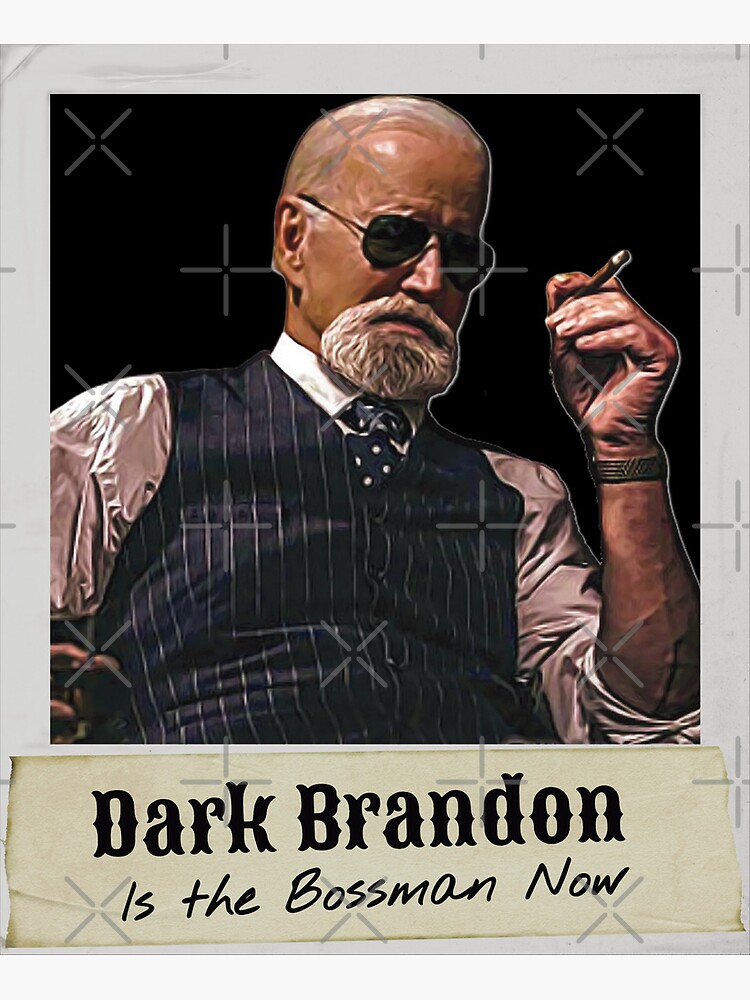
But we’ll talk about ol’ Sleepy Joe next time. This time we have to talk about the other old white male politician running for this election. The dangerous one.

This guy.

Trump will only be a dictator on Day One

No, no, I know he was kidding. Of course he was; he says that he has two intentions on day one, for which he claims he would use power dictatorially: to close the border, and to drill, drill, drill (for oil). “After that,” he says, “I’m not a dictator.” Totally harmless. I shouldn’t take things so seriously, especially not when Trump says them, right? He’s just kidding around. Just a lil funnin’.

But let’s be clear. First of all, in terms of the joke, Sean Hannity set that up as a serious question, saying “Under no circumstances, you are promising America tonight, you would never abuse power as retribution against anybody.” When Trump drops his joke, there is a clear moment of horror, because he didn’t say “Absolutely.” He didn’t say “Of course I would never do that.” He didn’t say “In America we believe in the rule of law and in democracy, so I would never act like a dictator in any way.” He said “Except on day one.” In a moment when he was asked for sincerity, for honesty, for a promise to the American people: he made a joke. A joke about being a dictator.

And considering it realistically, it seems perfectly reasonable to assume that he is sincere in his two intentions to use power dictatorially: to close the border, which would mean violating dozens of laws and international treaties and disrupting the lives of millions (because I assume by “close the border” he means stop allowing people to cross the border, including innocent legal travelers; or else he means send overwhelming military force to stop all illegal crossings at the southern border, while also defying due process in order to build some ridiculous wall covered in electrified barbed wire and anti-personnel mines filled with Sarin gas and anthrax: either way he would be breaking the law and disrupting the lives of millions.), and defying all science in order to destroy the environment while feeding money into the bottomless maw of the fossil fuel industry: also in violation of who knows how many laws and policies of our own government. Of course he is serious about that: those are two of the “policies” (To be clear, he has no policy positions or plans at all; he’s running purely on hate and lies) he is running on, which are both very popular: fuck everyone who isn’t already American (by which we all know he means “white”), and fuck the environment and everyone who cares about it.

I refuse to then believe, subsequent to misusing presidential power for these two issues, that he would not immediately misuse presidential power to do what he does not tell Sean Hannity, what he does not promise the American people, that he would never do: seek retribution against his perceived enemies. Because of course he would do that: it’s all he ever does. He did it while he was in office, he has tried to do it since; he ran on the promise that he would lock up Hillary Clinton, and he is running now on the promise that he will weaponize the DOJ and FBI and go after all of his enemies, while filling the government with people loyal to him.

You know all this, right? I mean, I know we’re all tired of listening to him speak, and we’re exhausted by the constant news cycle of the whatever is the most recent travesty he said aloud — a news cycle that has gone on uninterrupted for the last nine years, since Trump declared himself a candidate for the Presidency — but still, the information is everywhere, the facts are unavoidable.

So why is he leading in the polls?

I’ve been avoiding writing this post because I can’t think of anything new to say. Every time I think, “I need to write that post about why people should vote against Trump, why people should fight Trump’s reelection,” I then think, “But what will I say?”

What can I tell you that you don’t already know?

What insight can I offer into the threat that Trump poses that you’re not already aware of?

What point can I make that hasn’t already been made? Here, this piece from The New Republic literally says everything I want to say about why Trump is dangerous and why we need to stop him from getting reelected: read this, if by some chance you don’t already know everything it is going to say.

But if you know everything that I know about Trump, why the fuck is he leading in the polls???

Seriously, I cannot fathom this. It has been driving me nuts. I keep telling people my opinion: Trump hasn’t done anything to make himself more popular, so he can’t possibly be more successful in this election than he was in the last — which he lost, as I hope everyone reading this is painfully, exhaustively aware. But every time I say that, smart people around me say, “I dunno, man. He’s leading in the polls.” Every time I open a newsletter or listen to an episode of my favorite political podcast, Unfucking the Republic, the host is saying he expects Trump to win this next election. Trump. To win. Not cheat his way into the White House like he already did in 2016, not lead an insurrection to take control of the country like he tried to do in 2021, but win. The election. With votes. From Americans.

I know you have to sign in to watch this, but do it. For me. And for America.
This is about something else, but the lyrics are apropos. Plus it slaps.

I honestly don’t know how to deal with this. I know I’m not alone: listen to Jonathan Capeheart coming a hair’s breadth away from just losing his shit in this interview with Presidential historian Michael Beschloss, about 2:45:

(The Black, gay, liberal MSNBC host clearly has reason to lose his shit, as he expresses later in the clip.)

Okay, I understand some of the issue here. I get that if 44,000 votes, out of 150,000,000, had gone the other way, then Trump would have won reelection. And actually, I get that if he had, a number of people think things would have gone better, or at least not much worse, over the last three years; they’re wrong, but I can’t disprove a hypothetical any more than they can prove it, so I can accept that people believe it. It pisses me off that people mock the opposition to Trump by saying the only reason we don’t like him is because he was too mean on Twitter, like there aren’t a thousand reasons to despise Donald Trump and what happened during his administration (Top ten: insurrection; impeachment; second impeachment; The Big Lie; 6-3 Conservative SCOTUS; COVID non-response; tax cut for the rich and $8 TRILLION added to the deficit; “Very fine people on both sides” and also the trans ban for the military; pulling out of the JCPOA and Paris Treaty and shit-talking NATO and all other treaties; and it wasn’t part of his presidency, but I’m not going to ignore all of his sexual assaults) — but I understand that people believe lies about all of those things, or those things at least align with things they do believe. And I mock the other side for their stupidity, so I can accept that they mock me for what they perceive as mine.

I know that, in conjunction with what I’ve just been saying, the country is so divided along partisan lines that people would generally vote for a disease-carrying mosquito rather than cross party lines; and that means any GOP nominee can count on 200 or so electoral votes, just as any Democratic nominee can count on 200 or so different electoral votes, and while Trump has only gotten worse over the last four years, so has inflation, which people blame Biden for. They shouldn’t, but again, I don’t know how to prove that, either. If you don’t know that corporate profits and supply chain issues were responsible for the inflation of the last three years, then you’re not paying attention — or you’re paying attention to the wrong things. (Best line from the article at that last link: “It is unlikely that either the extent of corporate greed or even the power of corporations generally has increased during the past two years. Instead, the already-excessive power of corporations has been channeled into raising prices rather than the more traditional form it has taken in recent decades: suppressing wages.”) I know that our country is awash in lies about socialism and government takeovers. I know, also, that there are people who vehemently believe in Great Replacement theory, the conspiracy theory which claims Democrats (Or even better, the “global elite” led by Jewish people) are bringing dark-skinned people into this country to replace white people, because one of them yelled at me on Facebook not too long ago.

I know that people are not excited about voting for Biden. I hoped he wouldn’t run, too — but come on. Let’s not pretend that anyone who decides to be President doesn’t already have an ego that needs its own West Wing. You can’t be an ordinary person and believe that you would be the right individual, the only right individual, to lead this entire country. You have to think you are the greatest ever. That’s why we have term limits in the first place: because after FDR, who clearly believed himself to be the only person who could ever run this country, believed it strongly enough to run FOUR TIMES, we recognized that it was genuinely unlikely that a modern President would give up power. And look at how they all run for that second term. All of them. (Quick tip of the hat to LBJ for backing out of a second run because he thought the country was too divided over his war in Vietnam) So we all knew he would try for the nomination again — and if the DNC backed him over Bernie in 2020, why would they stop backing him now?

I want to talk more about voting for Biden, because he’s actually done an outstanding job as president; but that’s not the topic for today.

The topic for today is voting No on the question of whether Donald J. Trump should once again be President of the United States.

This is our duty. It is our responsibility, both for the sake of our country and our democracy, but also for the sake of the world. Everybody, literally, is counting on us to stop this asshole from fucking up everything in this country that he hasn’t already fucked up.

I know we don’t like voting for the lesser of two evils, so let me put it this way: I’m not asking you to vote for the lesser of two evils. I’m asking you to vote against evil.

I don’t actually care how you do that. I think the safest course is to vote for Biden, because in our winner-take-all electoral college system, voting third party is potentially dangerous; but if you want to vote for Jill Stein or Cornell West, please do so. I’d love to see the Green Party gain more national attention, and I think Dr. West is far and away the best candidate running right now. (Oh — don’t vote for Robert F. Kennedy, Jr. Libertarians are dangerous, particularly when they are also anti-vax. And he is the worst kind of anti-vax. Don’t give him a platform, please.) But what matters is taking away votes from Donald Trump, so if you were going to vote for the Democrat and you don’t want to vote for Biden, be aware that taking your vote away from Biden is not voting No on Trump. It is voting No on Biden. You are welcome to do that, as I said, especially if you live in a safely blue state like New York or California; but you first need to vote No on Trump.

Vote No on Trump by giving a political donation to the Democratic party. Vote No on Trump by volunteering to help the Democrats get voters out and registered and to the polls — which is still what I plan to do, now that MY BOOK IS FINISHED and now I have time to do that. Vote No on Trump by convincing a would-be Trump voter to change and vote for someone else (They can even vote for RFK, because if he pulls votes from the GOP he’ll never get conservative backing again, and that would be swell.). Vote No on Trumpism, as well, by supporting those who oppose him: vote Democratic or Green or Progressive or left-leaning Independent on all of the downticket races; pay for and consume media that does not support the Trumpiverse view of things.

Or vote No on Trump by voting for Biden, even if you don’t like or agree with him, because in our system, Joe Biden has far and away the best chance to stop Trump from becoming President again.

This isn’t a matter of picking between two identical puppets run by the same political machine. It’s certainly true that the moderates of both parties are frequently indistinguishable in their actual governance, even if their rhetoric has contrasts; but the Republican party has had to fall in line behind Trump — and they have done it. They are obedient acolytes, they are foot soldiers, drones, servants of their Beloved Leader. Trump knows it, and he pushes them around at will; he will, of course, continue doing it as President — because while he may be a lame duck president, he will continue to apply pressure to the members of his party; he will anoint the chosen and castigate the insufficiently loyal: and all of them, it seems, will dance to his tune. Biden may be a puppet of the powers-that-be, and that is dangerous; but he’s not the puppet master, and Trump is. (Even though Trump himself may be controlled by others, either autocrats like Putin and Netanyahu and Kim, whom he somehow needs to impress, or anyone with power enough to gain access, and brains enough to manipulate that goddamn idiot.) If we retain Biden and those who have influence over him, it won’t lead to the collapse of this country’s democracy. Trump’s election might. I won’t say he definitely will turn himself into a dictator and end American democracy entirely — but I also won’t definitely say he won’t do that. He is a danger to this country, and because we are the richest, most powerful, and also the most toxic country in the world, Trump is therefore a danger to everyone — look no further than Avdiivka for that.

We all know that all that is necessary for evil to triumph is for good men to do nothing. Donald Trump is evil. Whatever else you think of him or about him, his intentions, his corruption, and his ability to do harm through the office of the Presidency are far too great for any of us to ignore. So please: do something. \

Vote No on Donald J. Trump for President of the United States.

Okay, Now What?

Arguing has gotten me nowhere.


That’s not entirely true. I have had a metric fuck-ton of arguments in my life. It’s been a whole thing for me: it is a strong aspect of my teaching, mainly because it is a required essay format that all students have to learn, and so I always teach; it is largely what brought me online in a meaningful way, along with books, because my first two serious website interactions were with a book club and an argument site; it has taken up probably the majority of my online time (Though I don’t know how to measure that, really, so “majority” may be an exaggeration. But a lot of the time I have spent online, I have spent arguing.). I also argue with my students, but since they suck at arguing, that is closer to modeling good language use than it is an attempt to convince anyone of the truth. The online arguing is the larger issue. It has become a way I define myself, a point of pride; I tell my students, when I first introduce myself to them, that I am a pacifist — but I argue online all the time.


I mean that to be ironic. Why would someone who believes in peace and nonviolence and being nonconfrontational also go after people online?


And now I am thinking: maybe I should stop being ironic. Maybe I should just be who I think I should be, who I want to be. Someone who believes in peace, and nonviolence, and being nonconfrontational.
It’s not that simple, of course. Because one of the paradoxes of being a pacifist is that I have to live in a world in which people are violent and confrontational, and love fighting; so if I maintain my belief in being nonconfrontational and noncombative, all that happens is I get railroaded, and squashed flat, and violent people take advantage of me. The only way I can be a pacifist is, sometimes, to fight back against those who would create conflict, in order to maintain a larger peace. I believe that; I have accepted it. So I fight: I try to fight against those whose opinions would promote conflict and violence and abuse, both those who are bullies and those who work, intentionally or not, on creating a world where it is easier to bully.


So for the last few years, that has been my intent. I have fought against those whose political stance promotes the supremacist and fascist stances of the Republican party, particularly those who promote Trump and claim to oppose Covid-19 vaccines and climate change policies, because those three things — the devastation of the global climate, the suppression of medicine which prevents the spread of a deadly pandemic, and one orange-skinned motherfucker who wants to take over the world and make it dance for him and him alone — are the greatest threats we face, in my opinion. Trump is largely symptomatic, not causative, but the movement he represents is unquestionably an existential threat, particularly for marginalized and endangered communities. I do also argue against censorship, particularly in schools, and against the attempt to destroy public schools (both largely promoted by that same Trumpian movement), and I try to argue whenever I can for trans rights because I see trans people as the population currently suffering the most virulent and vituperative attacks, at least in my proximity.
I think it is a good thing that I have stood up for those causes, for those groups and those people, and against those groups and those people who would attack and do harm. It has not been good for me: that’s for damn sure. I get mad almost every time I get into an argument, and that is not healthy, neither mentally and emotionally, nor physically; it disrupts my sleep, spikes my blood pressure, distracts me from other things I want to do so that I am more often frustrated and unproductive, and therefore I take away from other things — like sleep, or relaxing downtime — so that I can accomplish my productive tasks. Because I already burned up my productive time arguing with some choad about how women’s sports do not need to be protected from trans women because trans women are women, goddammit.


But how much good have I actually done in all those years and years of arguments?


Probably none.


I hate that. But it is probably the truth.


I said last week that I have been persuaded, that I have read an essay by A.R. Moxon which showed me that my habit of fighting online is not only unproductive, but even damaging to the causes I believe in. Moxon pointed out that when someone — like me — says the same points that conservatives and fascists and transphobes and whoever have already heard before, it only shows those people that liberals and progressives have nothing new to say, all think the same things, only echo what we have been taught by our progressive liberal media sources.


The same things I believe about conservatives.


The more I argue, the harder this conviction sets in for my opponents. The more they believe that people on my side are fools, or liars, or mere puppets. I’ve seen this: I’ve seen people take my arguments as signs that I don’t understand the truth, or that I believe lies, or that I don’t care about truth because I have a political agenda; and even as I steadily disprove their points and prove mine, they simply become more strident in hollering that I am a liar and a fool and a sucker. Sometimes they do this while proving some of their points and disproving some of mine (Because while my stances are always right, my arguments are not always perfect, and sometimes I am mistaken), but whether they are right or wrong about their arguments, the point is that they become more adamant about never accepting my arguments, the more I argue with them.


My arguments, in other words, make people less persuadable.


This means that my arguing is bad for everyone. That cut out the last string that was holding up my need to argue. I already knew it was bad for me. I already knew I didn’t like it any more. I already knew I’m not actually as good at it as I thought I was, or told myself I was, in the past. But I still thought it was the right thing to do because I had to stand up for my causes: but not if I’m harming the cause by agitating the opposition, by making them harder to convince, not least because I almost always get mad and take that out by insulting my opponents, even though I know, and have taught my students for years, that insults lost arguments, that the second I mock my opponent, they stop listening to anything I have to say, even if everything else I say is deeply persuasive. All they focus on is the insult.


And rightfully so: because when my opponent insults me, I get so pissed off at that audacity that I no longer care about the argument: I care about showing that sonuvabitch that he’s not only wrong, he’s an idiot. I frequently prove that when I set out to do it – but it never helps. Of course. It just makes them madder and more smug, even while I keep getting madder and more smug. And of course, that leads to my worst habit: I am terrible about needing to get the last word. Even if it keeps me going back to a terrible argument, I keep doing it as long as the other person keeps replying to me. Even though I mock people for arguing simply to satisfy their need to win points and one-up people they disagree with.


Like I said. I need to stop being ironic.


It wasn’t just this essay that convinced me I need to stop. For one thing, I have walked away from arguing in the past – first when I finally escaped from the debate websites I started on, where I did the most harm to myself, wasting the most time, destroying the most sleep, wrecking my own mental health just because some asshat said something shitty about gay people or about public education in this country – or, God forbid, about gun control.


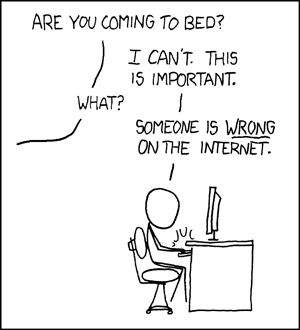
This was me. Of course.

Duty Calls


Also this. My wife, who has been trying to gently persuade me to stop hurting myself with this stupidity for just about fifteen years, has always been able to tell when I am arguing because I type harder and faster and with an angrier expression on my face.

Rage Keyboard GIF - Rage Keyboard Angry - Discover & Share GIFs

Though I’ve never actually shed blood on the keyboard.

So I’ve known for years that I should stop. I’ve had my wife telling me so, and she’s always right. (I never argue with her, by the way. I know my limits. Sort of.) I have also, in the last few years, recognized that my teaching of argument has not actually helped my students learn how to write better arguments: they write terrible arguments, both before and after my instruction. And I suspect that some of that is because I go into the teaching of argument mainly looking to win arguments, which is one of my favorite things to do in the classroom. But it has definitely struck me that my students still make the same terrible arguments now that they did five, ten years ago. And I can’t take all the blame for that: much of it is because of the inherent problem with arguments, and the problems with social media, which is where they learn to argue, and where they find the topics they want to argue about.


I’ve recognized the problem with arguing on Twitter as Twitter has descended into the depths of Hell. I don’t even want to be on the site any more. Even worse, the more I interact with assholes on Twitter, the more money I make for them, because Musk pays them for their number of interactions. So why do I still go there to argue?


Okay, I tell myself that I am fighting the good fight: but a week or so ago, I was arguing about who was the greatest tennis player of all time. Which is – you may be surprised to hear – not one of the important arguments I need to take a stand on. I mean, it was related, because the original post had the pictures of four candidates for GOAT, and they were, as might be presumed, all white men – Pete Sampras, Roger Federer, Rafael Nidal, and Novak Djokovic. But the correct answer, of course, is Serena Williams. So I commented that, and like a few other comments that had made the same argument; and then I found this thread where someone had posted Serena’s unmatched statistics – better by far than any of those four losers – and someone else had replied that Serena would lost a head-to-head match to any of them.
But that’s dumb. Because that’s not how you decide who the best of all time is. Nobody arguing about Michael Jordan vs. Lebron James talks about which of them would win a 1v1. You talk about their impact on the game, on their team; their championships, their individual statistics.


So I joined the thread and fought for my side. I made a joke (It was a stupid joke, but I thought it was funny) in order to mock the guy who had said Serena would lose head-to-head. And another guy started arguing with me: saying that I was wrong and dumb, because the way you decide who is the best of all time is exactly to debate who would win head-to-head, and even Serena has said she would lose against a male champion.


We went back and forth. For less time than some of my arguments about more serious topics, but still, this went on too long. And somewhere in there I realized: who decided how you debate the GOAT of a sport? Who says it isn’t about a head-to-head matchup? Did I have some special knowledge? Of course not: because actually, half the fight about who is the GOAT is arguing over which methods of comparison make the most sense. And in lots of these arguments, none of which is ever meaningful, the key point is indeed head-to-head. Boxing, for instance (which I had even referred to, because I’m a dummy), is almost always about head-to-head matchups, not statistics. So I had a bad argument, and was arguing in bad faith. And the worst part was that the other guy was funnier than me with his insults and comebacks. Which just pissed me off more – but since it didn’t make my argument better, I finally just quit.


He got the last word. And it was funnier. (Not really funny, to be clear. It was still a sexist argument, which I have problems with. But I tried to end with a barb, and he threw one back, and his was better than mine. Dammit.) Now, I still believe that Serena Williams is the best tennis player of all time – because she was more dominant in her specific competitive circumstance than Sampras or Federer or Nidal or Djokovic – but what did I gain by arguing for it?


Nothing. I just wasted my time. And I’m still wasting it, because I’m still arguing my point here, now, with you.


This is why I need to stop arguing online. And also why I need to stop arguing with my students.
But then that brings me around to the title of this piece. What do I do now? If I’m not going to argue (And to be fair, I doubt I will ever stop arguing entirely; I still exist in this world, and people say some appallingly stupid shit; and also, I do think there is value in standing up for my beliefs and for the particular people I advocate for – but I have lately been stopping myself before I post, and deleting the comment, and scrolling away from the initial post that made me want to reply; so I’m getting better), what do I do? Nothing?


I don’t want to do nothing. I think there are fights that need to be fought. Even if I am a pacifist, because as I said at the top of this, even we pacifists need to fight bullies, or else we allow suffering and oppression and violence to grow and spread in the world. And I can’t abide that.


The obvious things I can do are: I can try to persuade people, without arguing; and I can take actual action, to try to create political change around the causes I believe in, to try to limit the power of fascists and bullies.


I plan to do both. The political action is going to wait, for now, because I have too much other shit going on; I’m writing a book, dammit. And one of the other facts that makes it easier for me to give up arguing now than it has been in the past is the fact that I have been fighting the good fight – victoriously or not – for a long time now. It’s like teaching: I still want to do it as well as I can, because my students today matter as much as those I taught twenty years ago; but in terms of my own sense of self-worth, I have already accomplished every good thing I could ever hope to accomplish as a teacher. I could retire now and feel satisfied with what I have done. (I can not retire now and continue eating and having electricity and so on.) So even if I don’t take action right away, I don’t feel bad, because I’ve done a lot of good things in my life. But causes today matter, so I do want to take an active role, in some small way; specifically, I hope to volunteer for the Democratic party, or simply for my local jurisdiction, to help with the 2024 election. Because make no mistake: the only way Trump and the Republicans can win is to cheat. Which doesn’t mean they will give up: it means they will cheat. And that means we need to stop them from getting away with it. I live in a battleground state with a strong pro-Trump Republican power structure; so my help is needed and important. I’m going to give it.


But right now, in my classes and on this blog and wherever I can, I’m going to try to do what I should have done a long time ago: I’m going to try harder to persuade people. Not to argue with them, not to prove them wrong and me right; not to get the best dig or the last word. To persuade them. A.R. Moxon persuaded me that persuasion is this:

“Preaching to the choir” is simply giving voice to an existing desire for truth, in a way that helps people see things in a way they already know to be true, but gives them the language, the pictures, the words, to keep knowing it. It brings the message to those receptive, rather than falling into the supremacist trap of viewing persuasion as proselytization, a competitive sport of one mind’s victory over another. It honors unpersuadable supremacists minds by leaving them eating the salad they’ve shat on, free to be persuaded any time they want to become persuadable.

I actually don’t think there’s much that is more persuasive than giving people language to understand things they already know are true, to help them in the real work of individual persuasion—new language, new frames, new pictures.

Having that picture helps to more clearly understand the things we already know.

Understanding it more clearly helps us believe it is possible.

Believing it is possible helps us expect it to happen, and understand that we can do it.

A.R. Moxon, Preaching to the Choir

That is my new goal.


It’s not entirely new: I think I’ve been doing that for a long time. I think I have sometimes done it effectively. But I also think I could be a lot better at it, and a lot more thoughtful in my attempts to do it well. After all, I study and teach rhetoric – the effective use of language to achieve a goal – and I teach my students to examine the relationship between speaker and audience and subject, and the context, in order to determine what makes a piece of text effective. So why don’t I do that with my own writing?
Because I’m busy telling that asshole that Serena Williams is a better tennis player than Novak Djokovic, who is just taller and stronger. Like that determines who’s better. Please. If that mattered, then Shaquille O’Neal would be a great basketball player, instead of the overlarge stooge I’ve been arguing he is for years.


Enough of that. Enough arguing. Enough fighting.


It’s time to try harder, and to think more. It’s time to do good.


At least it’s time to try.

There Are No Rules

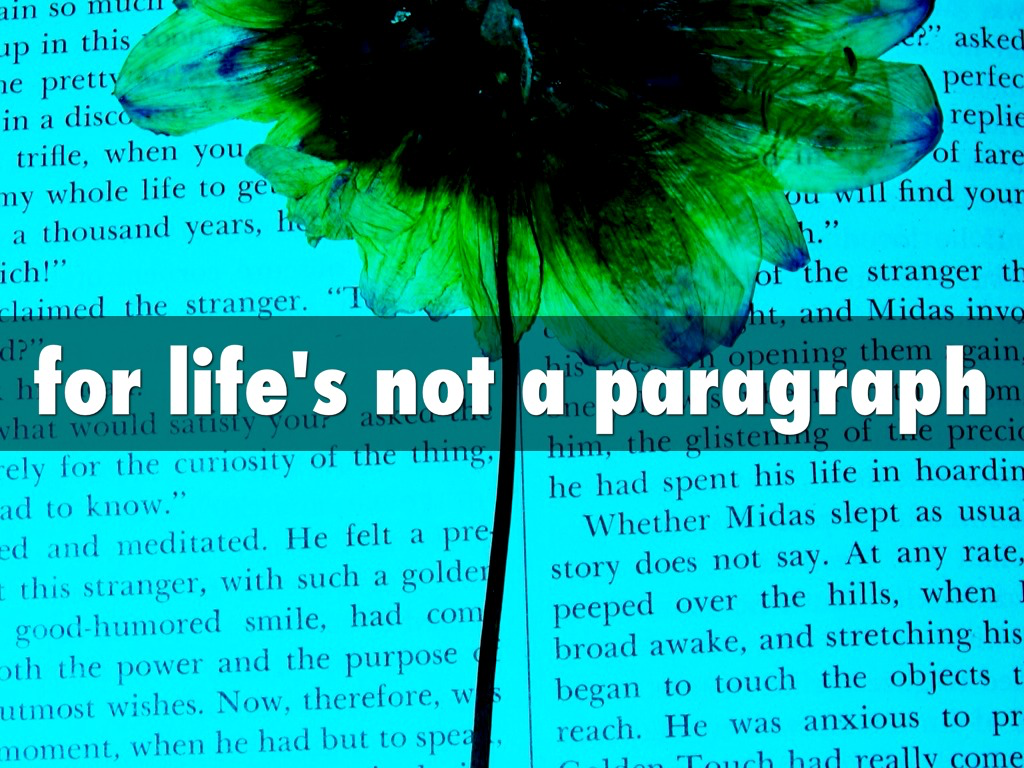
for life’s not a paragraph

And death i think is no parenthesis

One of the difficult things about teaching English is the number of bad ideas that students have about the rules of writing. 

And one of the things I find most upsetting about teaching English is the number of bad ideas that students have about the rules of writing which they learned from past English teachers. For instance: one should never start a sentence with “and” or “but.” One should never use the pronoun “I” in a formal essay, one should only refer obliquely to one’s self, preferably in the third person. One should use transitions for every paragraph in an essay, because they help the flow; and one cannot go wrong with the transitions “First,” “Second,” “Third,” and “In conclusion.” And, of course, every essay should be five paragraphs, and every paragraph should consist of at least five sentences, and every sentence should be at least — but actually, I don’t know what the drones tell students the proper minimum length for a sentence is; I would guess about 10 words. Also one should never use fragments or run-ons.

Ridiculous. All of it.

There are no rules.

One of my favorite days as an AP teacher is when I mention to my new students that they can now ignore these rules, for the rest of their writing lives, and that, in fact, if they should never use “In conclusion” again, nor limit themselves to five paragraphs as a structure for an essay, they will make me very happy. The relief is palpable — and sad. We constrain young writers so much: and it helps to crush their creativity and desire to use words, and that is an awful thing to do both to young people and to this language. 

There are, I think, two reasons why teachers present these rules to their students as rules; and one of them is understandable, if not valid. The bad reason, the invalid one that is not understandable, is that teachers were taught these things themselves as rules, and they were never allowed to deviate from them, and so now these things are unbreakable rules: sacred cows, taboos never to be questioned, just like the prohibition on the use of the word “Fuck” (And all I really have to say about that is this). I was taught at least some of those things, too — though to be honest, I don’t remember learning them, so either I had genuinely good English teachers, or I spaced out at just the right time and never heard or cared about these rules — but come on. We grow up. We learn to think for ourselves. We see countless sentences that begin with “and” or “but.” We read countless pieces by authors who use “I” in even the most formal of essays. We stop counting words and sentences and paragraphs, and just — read. (I confess I still count pages. This, too, is a bad habit; but if we’re at the page-counting stage, at least the work is long enough that word counts and sentence counts and paragraph counts become moot.) WE FUCKING USE THE WORD “FUCK” WHEN IT IS APPROPRIATE: and we recognize that there are, in fact, many times, many times, when it is appropriate. 

So why don’t teachers teach their students that all of these things are bad rules? For one (And damn me, I first wrote this sentence starting with “Well,” and I HATE when my students do that, answer their own rhetorical question starting with “Well.” I caught it, though. Also, that’s not a rule.), teachers do not always question authority. Teachers come from all groups and kinds and flavors of people, but the majority are those who loved school, who were the top students, and who want to pass those wonderful learning experiences on to other people; those people never challenged a teacher in their lives, they were the ones who argued back against the students who did challenge the teacher, the ones who said “Shut up, he’s the teacher, don’t argue with him!” in class when someone else said “That doesn’t seem like the best way to do that.” And then they become teachers, and they don’t want to be questioned by students — who, to be fair, are completely freaking annoying when they argue, because they are used to having their points of view denied, their arguments summarily contradicted, usually by adults who say “Because I said so, that’s why,” or some permutation of that (Like “Because I’m the teacher, so don’t argue with me.”), and so all they have left is making one irritating point and getting a reaction from the authorities who squash them into molds, every single day. But this all means that when an English teacher says that a paragraph has to have a minimum of five sentences, and a student asks, “Why five?” The teacher wants to respond with “BECAUSE I TOLD YOU SO AND I’M THE TEACHER AND MY TEACHER TOLD ME SO WHICH MEANS IT IS A TEACHER’S RULE SQUARED!

I am not one of those teachers. I did not like school. I questioned authority as a teenager (and I was annoying about it) and I continue to do so now, three full decades out of my teens. So I expect my authority to be questioned; in fact, I invite it. I never say “Because I’m the teacher, that’s why.” (Though I do jokingly argue with students who question my spelling, “How dare you question your English teacher on spelling?!?”) So when I tell students that an essay needs to be longer, or that a sentence is incomplete, and they question me, I tell them why. But then, I’m weird; I like arguing. I like explaining. I like helping people understand why something needs to be changed, why it is incorrect. I think doing that makes the world more comprehensible, and therefore more manageable. I think making the world more manageable for my students is my job, a lot more than making them write five-paragraph essays. 

The more understandable reason why teachers don’t tell students that these foolish rules for writing are not ironclad is more to do with arguments. Students like asking “Why?” Not always because they want an answer, either; but because they want to catch the teacher looking foolish, and they love to waste time and thereby avoid work. Sometimes, then, when they get the real answer, they’re not ready for it; so they don’t understand it, because they weren’t really listening — they asked the question only to make the teacher talk instead of assigning work, so when a teacher answers their question, the only response is “Huh?” So when you present one of these writing rules as they should be presented, as something that is entirely dependent on context and writing intention; that, for instance, the use of the word “fuck” in a formal essay, though not entirely forbidden (If you are quoting a character in a Martin Scorsese film, for instance, you have probably a 90% chance that any given quote will include “fuck,” and any form of censoring the word has a poor effect on the serious treatment of the film because it makes you seem too prudish to deal seriously with a movie that has profanity in it) does tend to contradict the tone of a serious essay, and is therefore jarring for the audience to come across in a context that doesn’t require the word be used; then you are going to get argument. Or stupid questions. Mostly stupid questions. (“Can we say it in class? Can I say it right now? Can I change my name to Fuckface McGee, and then you have to call me Fuckface all the time? Would you still say “fuck” if the principal was in the room?”)

So teachers, who deal with enough stupid questions as it is (And yes, by the way, there are stupid questions — see above), will often state an ambiguity as though it were in fact ironclad, just so they don’t have to argue with students. And since the argument won’t bear weight for the thing it is, we have to rely on even more annoying arguments which do have the advantage of shutting down debate: namely, “Because I’m the teacher and I said so.”

This is why, when I was in 3rd grade, the teacher told me that you could not take a larger number away from a smaller number, that 3-7=x didn’t make sense. Not because that was true, but because the teacher didn’t want to explain negative numbers to me right then. The same reason my mother, when I was 4 or so, told me, when I asked where babies came from and where specifically I had come from, that half of me was in my father and half of me was in her. And I assumed that meant that the bottom half of my body was inside one of them and the top half was in the other and they sort of stuck me together like a Gumby figurine (Don’t get that reference, kid? Look it up.), but also, the answer shut me up at the time, which was my mother’s goal.

I understand how annoying students are, so I understand teachers giving guidelines for good writing (It is a good idea to avoid saying “I” in formal essays for two reasons: first because talking about yourself personally is a way to connect emotionally with your audience, which is informal communication, not formal; and secondly because most of our desire as writers to use “I” is in phrases like “I think” and “I believe,” which we are tempted to use in arguments and statements of truth so that we don’t seem too arrogant, and so that we don’t seem dumb if we should be wrong. It’s safer to say “I think Martin Scorsese’s films say ‘fuck’ too often,” than it is to say, boldly, “Martin Scorsese’s films say ‘fuck’ too often.”) as if they were ironclad rules. It’s just that teaching these things as rules takes away all the nuance, all the flavor, from writing; it makes writing boring, which makes students not want to do it. It’s better to tell the truth, and deal with the consequences: there are no rules in writing that cannot be broken, it’s just a matter of what is the best use of language in a specific context.

And no, Jimmy, that doesn’t mean you can say “fuck” in your essay about Sacagawea.

So this went on much longer than I meant it to: this was meant only as an illustrative example, not as the heart of the essay. I really just wanted to talk about how we try to apply rules when there aren’t any rules, and shouldn’t be any rules, and that that is a problem. My main point wasn’t even about English: it was about life. Where there also aren’t any ironclad rules. That’s why I quoted the poem to start:

since feeling is first

by ee cummings

since feeling is first
who pays any attention 
to the syntax of things
will never wholly kiss you;

wholly to be a fool
while Spring is in the world

my blood approves,
and kisses are a better fate 
than wisdom
lady i swear by all flowers. Don’t cry
—the best gesture of my brain is less than
your eyelids’ flutter which says

we are for each other: then
laugh, leaning back in my arms
for life’s not a paragraph

And death i think is no parenthesis

I love that poem. I did a podcast episode on it if you are interested in the whole breakdown of what it’s about and what cummings meant to say in this; but for now, I just want to focus on his first stanza and his last two lines — sort of his introduction and conclusion, one might say. (Though please note he does not use transitions between his — err — paragraphs. Especially not “in conclusion” before the last one.)

So the first stanza: since feeling is first, he starts with, which means either that feelings occur first, before thoughts or actions or understanding or anything else, or else that feelings are more important than anything else, probably with both thoughts connected; but clearly, feeling is better: because he who pays attention to the syntax of things will never wholly kiss you. I love that, because “syntax” is such a nerdy English writing/grammar thing to talk about; it means the way things are organized to create meaning (words, specifically, but you can have a syntax of almost anything that is organized to create meaning), so word order in sentences and sentence order in paragraphs, and aspects like word length and the use ofpunctuation and so on; all of that is syntax. For the lines about the syntax of things and kissing, I think specifically of this scene from the movie Hitch, where Will Smith’s character tries to teach Kevin James’s character how to kiss: but in this scene, it’s not only about the syntax of kissing and of relationships, but it’s about math: and so though Smith tries to get James to think about the passion of the moment, he focuses so hard on the proper methodology that he does not show any passion at all — and then he loses control and flubs it. 

The point is, there are not rules to kissing, and there is not math. And the more you think about rules and math and methodology for kissing, the less you are focusing on what you are feeling for the person you are kissing: and that means you are not kissing wholly. Because feeling is first. 

So with that in mind, let’s talk about the last two lines, and what I originally set down to write about today. 

for life’s not a paragraph

And death i think is no parenthesis

I love this because it can mean a bunch of different things, and that’s what I like best about poetry: in order to distill the language down to its absolute minimum, just the essence, poets take out much of what is usually there to provide meaning to the audience; this leaves the audience having to fill in gaps, make guesses — bring their own understanding to the conversation. Because of that, poetry does a better job, in my mind, of presenting what literature is supposed to be: a conversation, not a monologue. An author is talking about things they have observed or experienced or imagined, and the audience is listening and then agreeing or disagreeing — and adding to what the author says. A poet leaves more silence for the audience to speak, so though the poet may say the same thing in every conversation, the audience always has something new and different to say — and so one monologue can turn into almost infinite dialogues. I love that.

(And because I am pedantic and wordy, I don’t write poetry, I write novels. Heh.)

But because these last two lines use the names of two syntactical structures — paragraph and parenthesis — these two lines connect to the opening stanza: it is telling us that there is no clear structure to a life, and there is not a simple punctuation mark at the end of life that tells us exactly how a life is to be thought of — and maybe my favorite idea present here when I read this is the idea that death makes life silent, makes it unimportant, like a parenthesis makes the words that it contains, turning them from a main thought into supplemental but unnecessary additions. We treat death too often like it is the most important factor in a person’s life. It is not. The life that precedes it is far more important than death. 

But in either case, life is not a paragraph: it does not have a definite way that it is supposed to go, with a topic sentence to start (After a transition, of course), and then an illustration of the topic, and then two (or more) pieces of evidence or commentary on that topic, followed by a concluding sentence that shows the meaning or importance of this topic in the broader theme.

And then a parenthesis.

We think this way about life far too often. What actually set this whole discussion in motion for me was a conversation I had with my wife, in which she was railing against people who made decisions about how old other people should be to act certain ways, and how people should act based on what is appropriate for their age. 

I am certain you have all had these conversations. Most if not all of you have also made these prescriptions for other people, and probably for yourselves as well. Right? I mean, we all know it: we know that 8-year-olds are too young for R-rated movies with sexual content, and we know that 11-year-olds are too young to drive — and teenagers are mostly too old for dolls and stuffed animals. 

We know that 17 is too young to get married and have children, and that 50 is too old for those things. We know that 18 is old enough to make decisions for yourself, and 25 is when everything starts to go downhill. 40 is too old to buy a new sports car, because then it’s nothing but a midlife crisis; and the same with a second marriage to a younger person. And while we’re on that: 5 years is too much of an age difference when you are under 20, and 10 years is too much of an age difference when you are under 40, and two months is too much of an age difference when one of you is under 18 and the other is over 18 BECAUSE THEN THAT OLDER ONE IS A SEXUAL PREDATOR AND A PEDO AND SHOULD BE CASTRATED AND THEN FED TO WOLVES.

That last one is challenging: because I don’t mean to disagree that people under the age of consent should not have relationships with people who are older and may be taking advantage of them. But I do want to point out that the idea that the second someone hits 18 they are capable of taking care of themselves, and the second before that they are not, is absurd. 

This goes for all of this. There are certainly stages of life and development, and some of them are appropriate for some things and some are not; I do not think that teenagers should be running the country. I know lots of teenagers. They would not be good at the job. But also, the idea that octogenarians are exactly the right people to be running the country is not more reasonable, based on my experience of octogenarians. Especially those running the country right now (and the septuagenarians who want to run the country right now. Not better.) But at the same time, almost every stereotype and bias we have based on age is belied by not just one exception, but by a whole slew of them. Ten years is a big age difference for a romantic relationship, especially in one’s 20s — except my wife and I met when I was 20 and she was just about to turn 30, and we’ve been together now for the same 29 years that she had lived before she met me. I think it’s worked out pretty well. My father and his wife had a ten-year age difference, but since they met when he was 50 and she was 40 (or thereabouts), and since the man was the older one, nobody thought anything of it. And then, although everyone assumed that she would take care of my father at the end of his life, that went exactly the other way, and he was her caretaker until she passed this last February.

Now my dad is 82, and alone. Should he find someone else to love? Or at least have a partnership with, if not a romantic connection? Or is there not enough time left for him to enjoy a relationship? Would it be too much of a burden for him to put on somebody else, to love him for only the few years he has left? Would it be inappropriate for him to date? To date someone younger? Someone older? How much older? How much younger? How much life left is enough to fall in love?

It this is too much of a dark theme, let me ask a few others ones: should my dad have a sports car? Should he have a fun car, like a bright orange VW bug? Should he get a pet, if he wants one? Should he wear a bathing suit in public? Should he dye his hair, if he wants to? Get a tattoo, or a piercing? Or is he too old for that now?

It struck me in thinking about this that we make exactly the same decisions about the very young and the very old: just as most people would see my dad, at 82, as being too old for a fast car or a fast woman, or a new career or a new hobby or a style change that included something hip and modern, so people would think the same about, say, a ten-year-old: that a ten-year-old should not be in a romantic relationship (I agree with that one) and should not have a car (Less certain on that one) and should not have a career path picked out (Don’t agree with that one: if a kid knows that young what they want to do, then mazel tov: my wife knew she wanted to be an artist before she was ten) and should not get their hair dyed or their body pierced (Other than the earlobes, which apparently are fine for stabbing — hey, does that mean a child could get their earlobes tattooed? Or is that shocking and inappropriate?) or wear makeup, or wear clothing that is hip and modern and stylish. 

The way we bracket our lives, with the greatest constraints on the young and the old, turn those two stages of life, the beginning and the end, into — parentheses. We freeze both those times in our lives into immovable requirements: just like kids can’t wear makeup, and can’t possibly make decisions about their sexuality or their gender identity, women must get their hair cut short when they are older, and men have to start playing golf, and men and women both have to retire and may not begin a new job. Kids have to be cheerful and energetic, and old people have to be slow-moving and cranky. And anyone who doesn’t follow these rules, these iron-clad, unquestionable sacred cows, these taboos that are never allowed to change without disapproving frowns and pearl-clutching gasps, is deemed not only unusual or eccentric: but wrong. The butt of jokes, the target of angry stares and social ostracism. Because those are the rules: don’t question society, just do what you’re told. 

But no. Because there are no rules. Look at ee cummings’s poem: there are no rules. None that he follows. And yet: it makes sense, even more sense than what most of us write, even though we may follow the rules in order to make our words make sense. The fact that some people are better off following the supposed rules doesn’t mean those rules have to make sense in that way for everyone. Like I said, there are certainly stages of life and development, and children should not be romantic and should not be required to be responsible and adult before they are ready to be; but beyond the most obvious age distinctions around puberty and adolescence, there is no rule that actually encompasses everyone. And there shouldn’t be. Some kids can handle driving a car. Some could write books or create musical masterpieces. Some can know just what they want to do with their lives. Some can wear makeup and have pierced ears, and make it look stylish and cool. And just the same, while older folk are physically more frail and should take that into consideration when picking new extreme sport hobbies (And let me note: kids should be careful about extreme sports, too — because they are also frail, or at least small and fragile.), there too, there are no rules that encompass everyone. If Tony Hawk gets on a skateboard when he’s 80 (if he lives that long — and let’s hope so, because he’s one of those people who is awesome on the Betty White end of the scale) then I’ll watch him drop into the halfpipe, and cheer when he pulls off a trick. Because he could: and even if he can’t, I’d be happy to let him try, if that’s what he wants to do. It’s his choice. It’s all of our individual choices, and none of society’s business as long as other people aren’t getting hurt. Sure, Tony Hawk at 80 would be in danger of hurting himself on the skateboard: but do you know how often he has hurt himself on a skateboard while he has been young? And then adult? And then middle aged? Right. We let him do it. Because it’s his choice. People should be allowed to do what they want, without the weight of social disapprobation because of their calendar age. It’s stupid. 

Feeling is first. Life is not a paragraph.

Death is not a parenthesis. 

Suffer The Little Children

Fostering a Better Community for Children and Youth | City of Boulder

On Children

Kahlil Gibran

And a woman who held a babe against her bosom said, Speak to us of Children.
     And he said:
     Your children are not your children.
     They are the sons and daughters of Life’s longing for itself.
     They come through you but not from you,
     And though they are with you yet they belong not to you.

     You may give them your love but not your thoughts,
     For they have their own thoughts.
     You may house their bodies but not their souls,
     For their souls dwell in the house of tomorrow, which you cannot visit, not even in your dreams.
     You may strive to be like them, but seek not to make them like you.
     For life goes not backward nor tarries with yesterday.
     You are the bows from which your children as living arrows are sent forth.
     The archer sees the mark upon the path of the infinite, and He bends you with His might that His arrows may go swift and far.
     Let your bending in the archer’s hand be for gladness;
     For even as He loves the arrow that flies, so He loves also the bow that is stable.

https://poets.org/poem/children-1


[Content warning: because people accuse liberals/teachers/LGBTQ+ people of committing sexual assault against children, I talk about that issue and those accusations.]

They keep saying it’s for the children. That’s why.

That’s why they’re censoring books, and harassing librarians, and persecuting teachers, and trying to outlaw the teaching of specific ideas and topics.

Because they want to protect the children.

I can’t tell you how many times I’ve seen it on the dumpster fire that used to be called Twitter and is now (sort of) called X: some conservative putz of a commentator says something like “You know, I didn’t really care about [CRT or racial equity/LGBTQ people/sex education] UNTIL THEY STARTED COMING AFTER OUR CHILDREN. BUT THEN I HAD TO SAY ‘HELL NAW!’” See, that’s where we liberals crossed the line, they say: we went after their children.

And they want to protect the children. So they say. Over and over and over again, generally growing louder every time.

Now, I understand this. I want to protect children too: I want children to be free to exist as themselves without being hated or abused or ostracized. I want children to be happy. I want to help them create opportunities to achieve their goals in life, to be who they want to be; that’s most of the reason why I became a teacher and why I still do it, even after 23 years, even despite the ways that others (mostly conservatives) have tried to stop me from teaching. I want children to live: I won’t say that I would put my life on the line to save a child’s life, because I also want to live; but I would fight to save a child’s life. And I am a pacifist: I wouldn’t otherwise fight for anything. But I’d fight to protect a kid.

(Also I would fight to protect my wife or our pets. I’d lose, but I’d fight. Just sayin’.)

The truth is that liberals, along with schools, and Democrats, and LGBTQ+ people, are not “after” their children. Inasmuch as most of those groups of people want to help educate children, we are actually seeking to make children happier and stronger: not to take them, and not to harm them. Personally, I REALLY don’t want to take anyone’s children: I don’t want children. Not at my house.

But I’m being disingenuous here. They don’t think I’m after their children because I intend to kidnap them and take them home with me; that would be absurd. No: they think — at least they say, and yell, and scream — that I and everyone on the left, in schools, involved in LGBTQ+ issues, or even just someone in drag reading stories to their kids, are sexual predators. Pedophiles, who are grooming their children by exposing them to inappropriate material.

Let me be very, very clear here. Democrats and liberals and schools and LGBTQ+ people and those who fight for racial equity and all the rest are not in any way groomers or pedophiles. Of course there are pedophiles and abusers among every group, but there’s no particular reason to claim that they are more common on the left, and to say that any teacher who talks about gender or sex is grooming children in order to rape them means that I will punch you in the fucking face. Even though I’m a pacifist. Because fuck you if you think that, or you make that accusation. How fucking dare you? The one time I got a conservative to agree with me immediately was when, during a Twitter argument about something in education, some asshat called me a groomer and I blocked him; another conservative commenter asked, as conservatives are wont to do, why I had blocked him, saying something about how I was hiding from the argument; I said “No, I’ll argue with anyone all day about these issues — but if you break out that disgusting fucking pedophile/groomer slander about me, you can fuck right off forever.” He liked the comment and let the subject drop. Because fuck you if you actually think that. And I expect that rational people would see my point on this.

I recognize, of course, that all of you reading this are rational people who see my point on this. None of you reading this think that I or teachers in general are groomers; none of you reading this believe that, because I teach novels and short stories that relate to sexual activity or gender identity or anything along those lines, I am intending to make the students in my class easier to rape; but the whole disgusting fucking slander makes me just foam at the mouth with rage. I hope that’s understandable. That is, naturally, the goal; it’s hard to debate the issues when someone is accusing you of raping children, and it’s harder when their evidence is a gross and appalling and absurd misinterpretation — an intentional misinterpretation — of what you actually do. Because then I feel like I have to start justifying the things I do, like teaching a book that might have a sex scene in it or might talk about gender roles, to show unequivocally how wrong they are: as if there’s any justice in claiming, for instance, that To Kill a Mockingbird (which does have a “romantic” [actually it’s sexual assault] scene involving sexual touching, and also accusations of rape and hints of incestuous sexual abuse, and does question gender roles pretty extensively through the character of the ‘tomboy’ Scout) is actually intended as a way to make it easier to rape children; and it’s even harder to walk away and refuse to dignify their slander with a response, which is the right thing to do, but then that fucking asshole is back there still calling me a groomer and I have to ignore him rather than punching him in the fucking face.

But their goal is to make me lose the argument, or even better, walk away, leaving them alone on the soapbox, because I’m so pissed off about what they said to me that I can no longer address the argument they are making. And it’s effective: because here I am dignifying this bullshit with a response, and speaking to people who know better. But I can’t help it. It upsets me.

It’s upsetting to be someone who spends so much of my time and energy, so much of my life, trying to help and also protect children, and then to have people, generally for crass political gain, use my own dedication against me by claiming that my very desire to help children implies that I want to rape them. And for them to justify these attacks, these various attempts to take apart our democracy and our education system, along with that disgusting slander, by saying they are — protecting the children.

It’s been happening a lot. It’s very upsetting to me.

So I wanted to talk about it some. Because I don’t want to leave conservatives alone talking on the issues here because I’m too mad to speak.

(Another caveat: I do know that not all conservatives support these arguments, and certainly not all conservatives make those disgusting accusations. All I can say is: it sucks to be stereotyped, doesn’t it?)

But let’s focus for now on the actual arguments. 

So first, the argument that CRT and similar (intentionally misinterpreted) ideas are taught in schools and that this is damaging to children hearing about these ideas. We all know, I hope, that CRT, Critical Race Theory, which is a framework used to describe TO LAW STUDENTS IN GRAD SCHOOL how the historical institutions of racism in this country have made it harder for equitable outcomes to exist in the modern era, is not taught in any K-12 public school in this country. But that’s not the main point, just like arguing over whether the AR in AR-15 stands for “Assault Rifle” is not the main point in a gun control debate, is only in fact a red herring. (By the way, if you ever are arguing about gun control with someone who cares about this particular nonsense, it stands for Armalite Rifle. ArmaLite was the company that originally designed the weapon.)

The real objection is not to CRT, it is to teaching the idea that the US is a racist nation, and that historical racism has impacts on the world today. Conservatives don’t like hearing people say that this nation is a bad place, or that it has done bad things to people, or especially that it continues to do bad things to people. They think that we are united in our love for our country, and that’s how it should be. 

But the problem is, we’re not united in our love for our country, we are united in our love for the ideals our country represents for us. And we should all be appalled by the corruption of those ideals in our country’s actual actions and impact on the world. We are supposed to be a country that stands for liberty: and instead we promote the oppression of billions of people around the world, in various ways — from subsidizing economic slavery in every poor nation that makes our shoes and electronics, to allowing climate change to devastate people’s homes and livelihoods because we won’t fucking stop driving Ram 35000s, to directly overthrowing democratic governments because they stand in the way of our economic exploitation, or because they are, in our sordid little fanatic-minds, associated with the greatest enemy of the corruption of our actual ideals: Communism/Marxism/socialism.

Speaking of red herrings. This one is the reddest: and it has thrown us completely off the rails for coming up on a century now. We have, literally, assassinated political leaders, and overthrown governments, and blocked democratic elections, because we thought they would create a stable Communist/Marxist/socialist state, and for some goddamn reason, we can’t let that happen. We’re supposed to be about liberty? Us? We’re supposed to believe in free expression, and live and let live, and the free marketplace of ideas — and yet we have to stamp out Communism/Marxism/socialism wherever it exists, both in our “free” nation and in other nations? Somehow that became our most important ideal, around the world: the nation that supposedly stands for liberty actually stands for taking it away from anyone who uses that liberty to freely choose Communism/Marxism/socialism. And why? Because we don’t defend liberty: we defend capitalism. 

Sorry: I got off the topic of racial equality, and historical racism and institutional racism. So feel free to go back over everything I just said, and wherever I talked about Communism/Marxism/socialism, go ahead and replace those words with “racial equity,” and the word “capitalism” at the end with “institutional racism.” All still true. We have contributed to the oppression of free people, and overthrown governments, and blocked democratic elections, and assassinated leaders, because those situations and people promoted racial equity in some form; and this country defends institutional racism, and always has. Almost every evil and disgusting thing we have ever done as a nation also has a racist element to it. 

One of the more amazing examples I know of how appalling and unrepentant we are about our racist culture is the running argument in modern partisan bullshit about which political party is more racist: is it the Republicans, who support racist policies? Or the Democrats, who used to support even more overt racist policies? Or both parties, who participate in institutional racism even while either decrying it or claiming it doesn’t exist? 

You know what? FUCK WHO IS MORE RACIST, LET’S JUST STOP BEING RACIST! What do you say? How would that be? And you know who that would help?

The children. Who really shouldn’t have to grow up in a racist world, and who shouldn’t be taught to believe racist ideas. Like the idea that the United States, which is unequivocally guilty of countless racist acts including multiple genocides, is not actually a racist nation. Do we not see how pretending that this country is innocent of harm is one of the most harmful racist things we could do? That that pretense not only allows the harm to continue, but also states clearly that the past harms don’t matter? Which could only be true if the people who were harmed did not matter?

The problem with trying not to teach these ideas in school — that the US is a nation with racist institutions that came from a historically racist past and foundation — means we can’t teach the truth. And as Fox Mulder (not the Fox News Channel; Mulder is the reliable one) told us, the truth is out there: which means kids are going to learn it eventually. And that’s when they’ll realize that not only has this country been racist in the past, it still is now: because the people now tried to cover up that racist past.

Trust me. I had that experience. I grew up in Newton, a wealthy suburb of Boston; and not until college did I learn that Boston was where the last and worst riots — actual fucking riots, that is — [https://en.wikipedia.org/wiki/Boston_desegregation_busing_crisis] over desegregation of schools occurred in the 1970s. 40 riots. Carried out by white people, in the place where I grew up.

Gee, I wonder if they were as bad as the BLM riots of 2020. They certainly were not precipitated by the police murder of an innocent man like the BLM riots were. They were caused by a bunch of racist people who didn’t want people of other races in their kids’ schools.

Nobody in my schools told me that. Which is — let’s use the word “interesting,” because a lot of my teachers had been teaching, in Newton, for 20 or 30 or 40 years. I graduated in 1992, which means my teachers? They were there. Not all of them, of course, but some of them were. And nobody told me about it. So when I learned about the Boston bussing riots, how do you think I felt about my teachers?

I lost faith in them, a little. I realized that some of them were racists. 

Shall I mention here that nobody in my high school was LGBTQ+? 1600 students, and not a one of them was gay or bisexual. 

To be clear, literally hundreds of them were gay or bisexual or in some way queer; but none of them were out, none of them were open about it: because they would have had the shit beaten out of them, if they were not actually murdered. My hometown was not welcoming to LGBTQ+ people. I wasn’t, either: one of my most distasteful moments is when, in the middle of the hilarious and silly home movies my friends and I made in high school, we burst casually into multiple homophobic slurs and jokes. Just a stream of them, many coming directly from my mouth. I hate it. 

But that’s how I was raised: not thinking that any of these issues were real, that the people who lived them were real people; or at least that they didn’t involve ME or MY town or the people I knew. All of that was, y’know, somewhere else, and in the past, racism in the South before the 60s and homosexuality and so on in San Francisco. 

Never heard of Stonewall, either. Not until after college, even. And before I lived in Newton, I lived on Long Island. A suburb of New York City. Though of course, I wouldn’t have heard about the Stonewall riots then; I moved when I was in 3rd grade, and you can’t tell a 3rd grader about race riots.

You sure can tell him about war, though. The Shot Heard Round the World, and the Minutemen plugging away at the Redcoats. Cowboys shooting Indians. Allies fighting the Nazis. Cops fighting robbers. Pretty sure I heard about some of that before I was 8.

So the point is, when you conceal the truth, you open yourself up to the righteous and deserved accusation of — being someone who lies to hide the truth. And what reason could you have for hiding the truth other than — something nefarious that probably includes a continuation of the problem that led to the truth you concealed? Only racists would want to hide the truth about racism, because they want to minimize the reality in order to maintain it, or because they think the victims are not deserving of consideration — which is a racist idea. I never heard about the Japanese internment during World War II, either. 

I mean, maybe my high school education just kinda sucked. I admit I didn’t pay all that much attention.

But the point is that I did learn the truth later, and it made me lose faith. And rightfully so.

But on the other hand: my dad told me, when I was a kid, that his mother, my grandmother, had been an alcoholic, and it had caused my father a lot of pain and a lot of problems in his life. He told me that he was attending AlAnon meetings — actually they were mainly meetings of a group called Adult Children of Alcoholics, which was the heart of the issue; but he had also, at one point, gotten concerned about his own drinking, so he went to some AlAnon meetings, too. And he told me about it. Which gave me great and abiding faith in my father: in his honesty, in his courage, in his respect and concern for me, for our family, for himself. I was inspired by his willingness to tell me the truth of the problems that he faced, and by his willingness to try to address them. I still am. 

The same goes for issues not of race, but of sexuality: and here, as with race, let me point out that many children have an experience I did not have, which is recognizing that they themselves are the secret that is being concealed, that is being ignored. I learned that my nation’s history was concealed from me — or whitewashed; I graduated in the same year as the 500th anniversary of Columbus’s voyage, in a city that has strong Italian roots, and so as you may imagine, my understanding of Columbus was… incomplete — but I never had to recognize that the person telling me that racism wasn’t really an issue was ignoring my own lived experience of racism, or that the person telling me that men should only love women was denying my own right to exist and be myself. But the larger point is the same: if we pretend that LGBTQ+ people don’t exist, or that they are somehow less real than cis-het people (because queerness is contagious, is taught, is socially constructed and influenced; not like the “natural” and “normal” sexuality of the dominant paradigm [NB: I am writing bullshit to represent what other people think; that statement I just wrote is not true.]), then the LGBTQ+ people who are listening — anywhere between 3% and 10%, or up to 20% if you recognize the more different aspects of sexuality we have been recognizing and learning about for the last few decades, which means in my high school of 1600 people there were anywhere between 50 and 300+ people who were LGBTQ+, only in one year of the four I was there — will recognize that we are lying. And the only reason why we would lie is because we want to do LGBTQ+ people harm, or we deny their right to know the truth about themselves and their world. And both of those are, to be clear, very, very, bad. Telling people they don’t exist or don’t matter is not how you protect the children. Lying to children in order to convince them that LGBTQ+ people don’t exist: that’s where I’m not sure how we can even conceive that we are protecting them. What exactly is the danger to children in the existence of LGBTQ+ people?

And here, exactly right here, is where we get to that disgusting fucking slander: because they have to invent a danger in order to conceal the truth: that there is no danger to protect children from, it’s just that the people who don’t want children to learn about gender or sexuality are bigots and homophobes, and they want to continue and promote their hate. That’s all.

By the way: my school, 1600 students? I think about 20 of them were Black. They all rode a bus to Newton North from Boston. I never heard about why. I just remember thinking that they were being given an opportunity for a better education in the rich white school in the rich white suburb. A thought I never confronted or analyzed. Because my racist environment tried to put racist ideas into me. I am thankful that my parents were not racist, and so did not encourage the growth of those ideas in me, and that I was later educated in a more open-minded and free environment, where I did learn the truth. 

You know what’s another thought that bothers me, now? My parents unquestionably chose a town to live in because it had a good school district, and good property values, and a low crime rate, and all of the other proxies by which people in this country choose predominantly white-skinned, white-collar neighborhoods. And though I don’t for a moment think they thought about sticking with a white community, I don’t think they confronted or analyzed those thoughts, or the reasons why that town was the safest and richest and best educated. They just picked Newton, even though my dad’s job which brought us to Massachusetts from Long Island (Also an extremely white enclave on the edge of a more racially diverse city) was based in Cambridge. 

To be fair, Cambridge is pretty close to Newton. I’m just saying: they fitted us comfortably into a privileged environment, and that’s how I grew up. Oblivious to the truth. Sheltered. Safe. And, if I had not learned the truth, I suspect I would have ended up racist. I surely had enough bigoted ideas and behaviors when I lived in Newton. 

So. Keeping these issues, these truths, out of schools is not about protecting the children: it is about protecting racism. I’m not saying that people who try to protect children are aware of what they are doing to protect and promote racism, any more than my parents were aware of the consequences of putting me in such a sheltered white enclave; but the proof is in the pudding, so to speak: the result of these policies is bigotry, not safer children. As proven, I hope, by the fact that people have to invent slanderous attacks on teachers in order to justify their crusade. 

The same is true of all the other crusades that are ostensibly taken on to protect children: the attempt to eliminate gender-affirming health care, which helps save the lives of trans children, and the concurrent attempt to deny the existence of trans children by keeping them from playing games with other children (Because calling those games “sports” doesn’t make them not games. They are children’s games. And people in this country are trying as hard as they can to stop some children from playing the game. Because that’s how much we suck. And then we crow about being the land of the free? And the home of the brave? Where we’re afraid of a trans kid?), are not intended to protect children, and they do not protect children: they help to destroy children, their happiness and their complete understanding of themselves and their world, if not their actual lives. The attempt to keep children from getting free lunch, which isn’t even supposed to help children other than the vague “protect them from drowning in debt” while we continue to pay nearly a trillion dollars a year for the military that is not currently fighting any wars, and we cut taxes for billionaires and subsidize toxic industries, while we ignore climate change and don’t talk about how that will lead to the world’s children literally drowning in rising ocean waters, is not even deserving of refutation. The attempt to keep parents in absolute control of their children’s education is not actually protecting children either: it is protecting those parents from having children who might disagree with them, or who might ask questions the parents don’t want to answer. And it is creating the danger for those children of living in a country that is less safe and less open, because it would be less educated — since “school choice” is just the choice to choose worse schools. If you want to make schools better, then make schools better: don’t make it easier to leave them and go somewhere else. I work for a charter school. It isn’t better than a traditional public school. Trust me.

And then there’s the big one: the most important and dominant wedge issue, the one that has made people pick sides, and plot and plan and center their entire lives, political and otherwise, around this one single topic: abortion. Because conservatives want to ban abortion, in all cases, whatever compromise they may temporarily accept about the life of the mother or cases of rape or incest; whatever lies they tell about states’ rights and judicial activism while they try to impose federal , national, judicial injunctions on birth control and chemical abortifacients — and they say they are doing it to protect the children. The children who their mothers murder, they say. Innocent children. It’s all for the children.

Except it’s not.

Never mind the points that have been raised for fifty years, about how the same conservatives who argue for saving children’s lives by banning abortion, also argue against those children having free lunch at school, or even a school to have a free lunch at. Never mind the very clear truth that the best way — the only way — to lower abortion rates is to improve both sex education and access to birth control, both of which conservatives oppose because they think, somehow, by keeping children from a knowledge of sex, they will stop those kids from having sex. Which doesn’t work any better than protecting children by keeping them shielded from knowing the truth about history, or about sexuality and gender, and which does just as much harm as all such lies do. Personally I am grateful that my mother, saying clearly, “Well, I don’t want to tell you about that stuff, so I’m glad they will” while signing my permission form to get sex ed in my elementary school, understood that I needed to learn about sex, even though she didn’t want to talk to me about it; if she hadn’t done that, I might have been left with the knowledge of how sex worked which I gained from my friend Benjy when we were 9 — and suffice it to say, Benjy did not have the straight dope about how sex worked. I will also say, that several years later when I understood how sex worked physically but not the harm it could do emotionally, it was a story my mother shared about her past experiences that showed me why I shouldn’t have been doing what I was doing — so even though she was uncomfortable with it, my mother had the honesty and the honor to tell me the truth, and the courage, as well; and that gave me even greater respect for my mother. 

But never mind all of that. Here is how we know it is not about the children. Because when Judge James Ho wrote his opinion in the recent Fifth Circuit Court of Appeals decision regarding the limitation of mifepristone, he showed us that the abortion arguments of the right are not about the children. We always knew they were not about the women, not about the mothers, that the entire argument showed a callous and wanton disregard for the rights, the sovereignty, the simple human value of the women whom conservatives want to force to bear those precious children to term: but Judge Ho showed us that it’s really all about — the men.

Judge James Ho, who was sworn into office by Supreme Court Justice Clarence Thomas in his billionaire benefactor Harlan Crow’s library in 2018 (Texas Republican senator Ted Cruz was also there), wrote his own opinion in the case in order to expand on what he sees as “the historical pedigree of Plaintiffs’ conscience injury, and to explore how Plaintiffs suffer aesthetic injury as well.” 

Antiabortion doctors suffer a moral injury when they are forced to help patients who have complications from the use of mifepristone, Ho wrote, because they are forced to participate in an abortion against their principles. 

Those doctors also experience an aesthetic injury when patients choose abortion because, as one said, “When my patients have chemical abortions, I lose the opportunity…to care for the woman and child through pregnancy and bring about a successful delivery of new life.” Indeed, Ho wrote, “It’s well established that, if a plaintiff has ‘concrete plans’ to visit an animal’s habitat and view that animal, that plaintiff suffers aesthetic injury when an agency has approved a project that threatens the animal.”

In cases where the government “approved some action—such as developing land or using pesticides—that threatens to destroy…animal or plant life that plaintiffs wish to enjoy,” that injury “is redressable by a court order holding unlawful and setting aside the agency approval. And so too here. The FDA has approved the use of a drug that threatens to destroy the unborn children in whom Plaintiffs [that is, the antiabortion doctors] have an interest.” 

“Unborn babies are a source of profound joy for those who view them,” Ho wrote. “Expectant parents eagerly share ultrasound photos with loved ones. Friends and family cheer at the sight of an unborn child. Doctors delight in working with their unborn patients—and experience an aesthetic injury when they are aborted.” 

https://heathercoxrichardson.substack.com/p/august-16-2023

So. Now we know. Conservatives don’t want to protect the children. They want to protect their right to possess those children. To treat them as spectacles, as attractions; as something that exists for the adults to admire, to appreciate, to enjoy. To use. To own. 

That’s what all of this is about. Control: treating children as the property of their parents, of the conservative leaders. I’ve seen the point made, in regards to the abortion debate, that the unborn are the perfect special interest to fight for: because they have literally no demands, no requirements, no arguments of their own: they don’t even exist as separate human beings. Conservatives never have to confront them, never have to talk to them, never have to treat them as their own people who might disagree with the politicians who work so hard to “protect” them. Using children, conservatives can promote their own agenda, and always, always, claim the moral high ground — because they are protecting children. Closing down and militarizing the border isn’t because we are racist and want to deny entry to people who aren’t white; we’re protecting children from fentanyl. Shutting down schools isn’t because we recognize that educated people tend to lean liberal politically (almost as if the truth pushes people in that direction); it’s because we’re protecting the children. Destroying the lives of women isn’t because we are essentially misogynist and supremacist: it’s because we want to protect — okay, actually, that one really is all about us; it’s because we like seeing the little pink babies. We think they’re cute. And so we feel that women should be enslaved in order to produce more of them for us to make goo-goo noises at.

So say the conservatives. And again, I realize and admit that not all conservatives feel this way — but those who don’t agree with the policies and arguments I have described here, also don’t separate themselves from those policies and arguments. Do they?

And me?

I make my job much, much harder than it has to be because I honestly do not like telling children what to do. It might be different if I taught the younger children: but the children I teach are nearly adults. I know that they have minds of their own, and wills of their own, and desires and dreams of their own: because they tell me about those things, they show them to me, on a daily basis. And I cannot stand the thought that I would take away any of that, their dreams or their abilities or their thoughts or their wills, simply to replicate my own thoughts or my own desires through them. I hate that thought. Even when it would be a good idea, I hate it. 

Because they are not my children. They are themselves.

That is the message I want to give to conservatives, in the end. You do not own children. You can try to protect them — preferably from actual threats — but you cannot control them. They are not yours to do with as you will, not even when you want to guide and shape and mold them into people you think they should be. It is not up to you who they should be. It is up to them. If they cannot decide for themselves now, then you still do not have a right to decide for them: all you can and should do is help them get to the stage where they can decide for themselves. You cannot, and should not, keep the future decision hidden from them, even if you hold back all the details until they are ready for them.

And you know who decides when they are ready to hear all the details? They do. 

Your children are not your children. They are their own. 

Treat them with respect.

Looking Up

Still one of the best movie songs ever.

You know what?

Things are actually looking up.

No, really: I mean it. 

Tomorrow is the beginning of classes, which means I now have to deal with students — but as always, though teenagers are frustrating, they are the reason why my job exists, and the aspect of it I actually enjoy. Teaching is hard — but it’s better than inservice. And since classes start tomorrow, that means inservice is over. (My district tried to extend it, pushing a two-day training on how to teach ACT prep — actually there are somehow three two-day trainings for English, one in reading, one in writing, and one in…English… but when I said I didn’t want to go, my direct supervisor said I didn’t have to go, in contrast to his supervisor who said he “strongly recommended” that ACT prep teachers be SENT to this training. But my boss said I didn’t have to go. Which means that inservice is over. And also that my boss is on my side, which is — well, it’s lovely.) My students make me laugh as often as they make me grit my teeth in rage; and they sometimes tell me that I helped them, that I taught them, even that I inspired them. And I like that.

I am typing this on my brand-new MacBook Air, which I got for my birthday as a present from my brother. Which means not only that I have this sweet new machine (Which, admittedly, I am having trouble adjusting to, but that’s only because it doesn’t have a ten-key pad on the right side of the keyboard, and because the Command key I have to use to copy and paste and so on is in a different place than it has been on the last two laptops I’ve had, both Windows machines — and because I didn’t know that you ran two fingers together over the touchpad to make the screen scroll BUT IT TURNS OUT YOU DO THAT ON THE GODDAMN WINDOWS MACHINES TOO I JUST DIDN’T KNOW IT BECAUSE I MOSTLY USE A PLUG-IN MOUSE AND TRYING TO DEAL WITH THE WINDOW ON THIS LOVELY NEW MACHINE WITHOUT BEING ABLE TO SCROLL WAS A TRIAL, BELIEVE ME but then I figured this out, and now it’s easy. And now I know this new thing, so that means I’ll never have this struggle again.

That’s amazing, isn’t it? That there can be single pieces of knowledge that you don’t have, and without them things are hard or confusing or even frightening; but then you find out that one thing — and the problem is gone. Gone entirely. Never going to be a problem again. Things can actually get solved. Not everything, certainly, but there are situations that are like that: you find the answer, and then you have it. The answer. The solution.

But also, anyway, the other thing about getting this beautiful new (EXPENSIVE) computer as a gift from my brother is this: my brother gave it to me. He and I haven’t always gotten along, sometimes even emphatically not; but that, too, has gotten better. I don’t think the relationship has been solved by a single answer that suddenly came clear, because relationships aren’t really like that; but definitely things have gotten better, and they will stay that way as long as we keep working on them — and he got me this absolutely lovely and generous gift, which I think was a very nice thing for him to do.

Thank you, Marv. I love the laptop. Though I feel dumb about the touchpad scrolling thing. Also it just autocorrected your name to Marc, so. Something to think about. And I’ll make you a deal: if you go by Marc (Or Marcin, in full), I’ll go by Dussy. Which was recently given me as an interpretation of my name at my optometrist’s office. It’s a new one.

Though to be honest, I’m not sure how it would benefit you for me to go by Dussy. Or how it would help me if you went by Marc. Nah, forget the whole thing. I’m still grateful for the gift, and glad that we’re doing well with each other.

And speaking of family, I finally mailed away my spit, in the tube my wife bought for me, to ancestry.com (That was a Christmas present, if you weren’t aware of how bad I am at following through on some things in a timely manner), and so I found out a little bit more about my family: mostly German and Scottish and English and French, all of which I knew — but also, about 3% African. Which I did not know. 1% each from Ivory Coast and Ghana, Benin and Togo, and Cameroon, Congo, and Western Bantu peoples. Obviously it is not a significant amount of my heritage — but it is significant that it is there, that I am that much of a mutt, that I have a little bit of African DNA in me. I think that’s wonderful and fascinating. I can relate even more closely to my dogs now, as they are both mutts.Which are obviously the best kind of dog.

So thank you, Toni. It was a very cool gift, and I’m sorry it took me so long to use it. 

Oh — and speaking of white people with just a tiny bit of Africa in them, and also speaking of  things I would spit on: Elon Musk is now not only a goddamn idiot, but he’s a goddamn idiot that has shown himself to be a goddamn idiot, and therefore proof positive that there is no meritocracy in capitalism, that even complete dipshits like Musk — who, I’m sure, would prefer to be called Xxxx Xxxx, so that’s what I’m going to be calling him from now on. Or maybe just Muxx? (Or Marc?) — have too much money and absolutely do not deserve it, and do not deserve our respect for their ridiculous hoarding of wealth. Because their wealth does not show their brilliance.

So the guy buys Twitter, right, and it isn’t really clear why. It seems mostly like he wanted to prove to everyone that he could do it, because Xxxx obviously believes his own hype to a truly epic degree, like Trumpian level delusion here: and literally every choice he’s made in running this company has been a bad one: first he let all the extremists and slanderers and liars and shitbags back onto the platform, which made the platform not only actively worse for everyone but also genuinely dangerous for some; and then he destroyed the verification system, which reduced the value of being a name on Twitter and of following names on Twitter, which reduced the value of the site and of the company; then he introduced a bad subscription model, which is still a cheap gag for everyone on the site who doesn’t have a blue check; and then he expanded the length of the Tweets; and then he limited the number of Tweets that someone could see in a day; and somewhere in there he also threatened to remove (and did remove) a number of people and a number of tweets that he disliked or disagreed with, thus proving to everyone but his legion of sycophants (Also suffering from Trumpian levels of delusion) that he as not actually interested in protecting free speech like he pretended do be doing when he bought the site; and now the crowning glory, his most recent conversion of Twitter to — X. Twitter is a household name, with Tweet a known slang verb used across the internet; and he threw all of that away. Because he thinks X is cool. And X, in actuality, is a shit name for a company, and a shit name for an app, and he picked a shit logo, and the rollout has been absolutely terrible — mine just switched over today, and it still says Tweet and Twitter all over the site. I mean, even I could do a rebranding better than this, and not because of my business acumen or my marketing skills — but just because I’m not a goddamn idiot. I can tell you that I am already filled with a visceral loathing for the X app, and am really just hopeful that it will go ahead and finally die so I can stop looking at it. 

Just look at that garbage.

It’s possible that that’s what Musk wants, too. There is profit to be made in breaking a company up and selling off the pieces; but it doesn’t really seem like Musk is doing that, because everything he’s done, other than fire all the workers and refuse to pay bills (In the short term, dumping salary and holding onto cash would be profitable if you meant to destroy the company and sell the pieces — but he hasn’t done that yet.), everything has reduced the value of the company: which would seem to really reduce the potential profit he could be making as a vulture capitalist. On the other hand, if he planned on keeping the company and building something bigger out of it, which is what he has claimed to want to do, then firing half the staff and refusing to pay bills is a shit-stupid way to handle a company that does an incredibly difficult and complicated thing like maintain a free marketplace of ideas on the internet — let alone grow it into an all-inclusive financial network where people can handle literally all of their business interactions. I saw an article that said this:

Expanding the platform’s reach to include things like shopping and paid subscription content could actually help it flourish in the long term by creating several revenue streams and making it less reliant on large companies’ willingness to spend money, analysts said. 

In the short term, building out those capabilities would require a massive investment in staff and infrastructure. It’s far from clear if a company that slashed about three-quarters of its staff and is now embroiled in multiple lawsuits over unpaid bills can deliver that.  

“The investment is a lot in terms of cloud infrastructure — we’re talking about $40 billion, $50 billion in upfront investments,” Singh said. “Twitter as a standalone app doesn’t have the infrastructure to become an everything app.”

https://www.cbsnews.com/news/twitter-rebrand-x-name-change-elon-musk-what-it-means/

And also this:

But the name change suggests Musk is likely to keep control of the company for the near future, said Bloomberg Intelligence analyst Mandeep Singh. After Musk’s takeover in April of 2022, some observers believed the billionaire could make some changes to Twitter and quickly flip it to a different owner, Singh said.

“That option is off the table now given the name change — I don’t think there’s any other prospective buyer who will take it now,” he said.

So maybe Xxxx is shit-stupid.

I will note that his new sign got turned off because it was too bright.

There is also a profit to be made in being a corrupt oligarch who opposes and helps to suppress free speech and the free exchange of ideas; and one of the ways you could achieve that, as a corrupt oligarch, would be to buy the marketplace of ideas and just set the whole thing on fire. And it very well could be that this is really want Xxxx wants, and if so, on this front, he’s doing a bang-up job.

I will definitely say that that is a sad thing. Communication is one of the highest forms of human endeavor and accomplishment: our ability to share ideas and spark new ideas in each other is unmatched in the natural world, so far as we know. And the internet and social media have made that possible on a scale unheard of before now; Twitter was part of that. But now it’s not. Because now it’s X.

Speaking of corrupt oligarchs fucking up things that were once worthwhile: Trump is another example of something that actually seems to be going right. I don’t want to count my chickens before they’re hatched, because I, like most of us rational, thinking people, was deeply overconfident in 2016, and I just could not believe it when TFG won the election. But it does really seem like he is facing a whooooooole lot of serious legal trouble, and at least in the Mar a Lago documents case, he’s clearly as guilty as sin: and when you put that shithead in front of a jury (Not that he’ll show up for his own trial, if he can possibly avoid it), he’s not going to get a pass like he did in both impeachments under a corrupt senate. 

Oh right — and let me take a moment to wish Mitch McConnell ill. Forgive my schadenfreude, but that fucking no-neck piece of shit has ruined untold numbers of lives with his power mongering, so fuck him. I hope he did have a stroke, and I hope he suffers in his declining years.

Anyway, the court system is not as easily bought as Congress: so Trump will likely go to jail. And while that doesn’t mean he can’t run for president, it surely does mean that most Republicans will not vote for him, and his base still will, or they won’t vote at all; and that likely means a runaway victory for the Democratic Party — which, if Biden is the nominee (And I personally hope he will withdraw from the race and let someone younger take it over), and wins a second term, I will say that he has actually been doing a goddamn good job so far at restoring the American government to what it should be, and we could do a whole lot worse than the guy who has re-established NATO even while supporting Ukraine in the war, and who is establishing new alliances across Asia, and who has passed the Inflation Reduction Act and the Build Back Better Infrastructure Act, and who has therefore done more for American manufacturing and industry and for fighting climate change than literally any other American president. We could do a whole lot worse.

So let me just say that, too: this time we all have to try to do our part to make sure we don’t do a whole lot worse. Joe Biden is old, yes. I do not want an octogenarian President. But he’s actually doing a good job. And if Trump goes to jail, the democrats might just win both houses of Congress — and then maybe we can name a couple of new Supreme Court justices, too. But if we’re too overconfident going in, we might get another TFG presidency, and that might just turn all of this back around, and send us all spiraling down until we crash. Let’s try to make sure it doesn’t go that way. Let’s keep our eyes on the prize, and keep things looking up, okay?

So okay, this wasn’t exactly the most cheerful blog, because things have been pretty bad for a while. But hey. School starts tomorrow.

Let’s make this a good year.

Actually just found this. The band is donating proceeds to the ACLU. Plus a player piano!

Time For My Annual Tradition

It’s Inservice Time again!

That means it is back to work for me.

It is Icebreaker time.

It is time to travel to Phoenix, 120 miles away and approximately 120° Fahrenheit, because my school district wants to pretend that we are all one community — even one family.

It’s time for gratitude ponchos.

This is the time of year when a professional pedagogist who makes ten, twenty times my annual salary (sometimes for each appearance) comes to my school, and tells me why everything I’ve ever even thought about doing in a classroom is wrong, and therefore, if I don’t want my students to fail utterly at everything in life, and if I want to even dream about maybe keeping my job, I will need to change every single thing that I do: because all of it is wrong.

Essentially, this is the time of year when I get mad. Frequently. Vociferously.

And my wife is now tired of listening to me rant about this issue.

So now, Dear Reader, it is your turn.

So this year, when we drove from Tucson to Phoenix to spend time with our beloved school family (Which, if that were the case, seems like icebreakers wouldn’t really be necessary? You have icebreakers at family reunions? Or Thanksgiving?), after we had the icebreaker, we listened to a motivational-speaker-sort-of-pedagogist who wanted us to think of teaching in a new way.

She said that our minds are wired to consider certain weighty moments in our lives as what she called “temporal markers” (Or was it milestones? I didn’t listen too closely.), and said we take these moments — milestone birthdays, the start of a new year, the anniversary of some important occasion — as signals to move away from the past and orient towards the future. She said we give ourselves a chance, at these times, to start over with a blank slate: and that our minds actually promote this, by taking a new perspective, examining what has gone before, and then considering new aspirations. We see ourselves as having closed a chapter, and started a new one; and this gives us new energy, it clears away old thoughts and feelings and gives us room for new ones. She talked about this like it was a very positive thing.

She asked us, as pegagogists and motivational speakers are wont to do, to share with our table partners (Oh — we were assigned tables with random teachers from the other schools, so that nobody was sitting with anyone they knew well, because Lord knows the last thing teachers need to be at an inservice is “comfortable.”) how we marked these moments of change, from past to future, in our classes, in our daily lives. And I thought about it, and I realized: I don’t really do this. I mean, okay, sure, when I had my birthday three weeks ago, I thought, “I’d like to spend today doing the things I want to do for this whole year, so I can start a trend or a habit right now and continue it all the way until my next birthday.” But I didn’t follow through with it. I don’t make New Year’s resolutions — I quit smoking on December 28th, as I recall, five months after I turned 35. I started going to the gym more regularly last May, and stopped around November, and picked it up again in February. I don’t celebrate things happening in multiples of 5 and 10; in fact, the two numbers I think I notice most (Other than 420 and 69, which I always have to notice because I am a high school teacher and I know those are going to get a response) are 42, because of Hitchhiker’s Guide to the Galaxy, and 37, because that’s how old Dennis is.

There’s some lovely filth down here…

And in terms of my teaching, I don’t have any kind of clean breaks: when one class ends, I almost always have students who stay after the bell to talk to me for a couple of minutes, which leads directly to students in the next class coming in a couple of minutes early to talk to me. They stay into lunch, they stay after school; some of them contact me outside of school hours. I frequently give extra time for tests, letting them run into the next day’s class; I have been known, even, to continue reading a novel even after the end of the semester when we started reading it.

I don’t tend to break my time up: I tend to blend it together.

This also represents my teaching style: because I think my primary purpose, as a higher-level literature teacher, is to connect things: I want to connect my students to other people, and to the feelings of other people as well as their own. I want them to recognize that historical events and epochs are connected to the lives of people, and also connected to the present, and to our own lives. I want them to see the web of relationships that spans all of our world, and all of our history. I want them to connect art to life, and life to art, themselves to the greatest authors of all time, who were, after all, only human, and were once themselves depressed and horny teenagers.

Nobody more so than William Shakespeare.

So then, when the motivational pedagogist told us that we should create this sort of temporal mind marker with EVERY SINGLE CLASS, so that EVERY SINGLE CLASS was an opportunity for a fresh start, for a clean slate, for a new beginning with new hope and new energy, a chance to CHANGE THE WORLD, I felt — well, a little sad. Obviously I was doing this wrong. Here I am, thinking of every class as connected to every other class, and wanting to get deeper into longer learning experiences, that bleed from day into day, from week into week, from month into month. I like that I have students for multiple years — though I also think they should get a chance to have different teachers, too; I did actually teach one student for all four years of high school, so that essentially everything that young person gained from high school ELA instruction was all from me, but I think that is definitely not the ideal. But I like connecting year to year, idea to idea. I think that’s much of what is missing in our culture and society — connection — and I want to promote it.

But that’s wrong, I guess.

I should be starting every new class fresh, completely discarding what happened in the past and looking only to the future. I guess.

I also thought: My god, how much energy do you have to have to infuse that much new optimism into EVERY SINGLE CLASS?? I work hard enough trying to keep my bad moods from bleeding into the next class, and to change from one specific topic into a new one for the new class; I’m not sure I can close my eyes, ball my fists, and think, “Okay, Dusty: here we go READY TO CHANGE THE WORLD AGAIN!”

But I should be doing that, I guess. Just like I should be at the door greeting every new student who comes into my room with their own special signature handshake, so they know that they are special and individual to me. (Though, for someone to be special to you, doesn’t that mean you have to build a relationship? And remember it, from one day to the next? Would it be better to discard the past every day and treat every day as a new chance to succeed?) I guess.

Who Are You Again GIFs | Tenor
Also, who is that person you’re sitting next to?

So then, after a brief break for a brain wake-up call (We played Rock-Paper-Scissors! With our non-dominant hand! Which was way better than just sitting quietly by myself for a few minutes!), the motivational pedagogist moved on to her next topic: direction. And destination.

Where before the center of the analogy had been milestone birthdays — her husband had just turned 50, and I bet you’ll NEVER GUESS what he did for his 50th birthday! (And if you guessed this, you were right!) — this time the metaphor was flying airplanes. And she talked about compass headings, and how if you were off even one degree, out of 360 degrees on the compass, it would, over time, take you quite far away from your destination — in fact, her example was of an airplane that was two degrees off on their heading, and they CRASHED INTO A MOUNTAIN.

SO OKAY.

THAT’S COMFORTABLE.

I’M FEELING GREAT RIGHT NOW.

And how did she analogize this back to teaching and education? Well you see, if you — or rather I, since I was the target here — I focus in my planning and curriculum design too much on what I am teaching, rather than on what students are learning — that’s a bad compass heading. It may be close, it may only be off by a couple of degrees — but over time, those few degrees’ worth of difference will — well, you know.

Plane Crash GIFs | Tenor
Crashed-airplane GIFs - Get the best GIF on GIPHY
Burning Plane Crash GIF by South Park - Find & Share on GIPHY

Okay: so now, not only am I failing my students because I am not treating every single class like it’s New Year’s Eve and I only get one wish AND IT’S FOR YOU KIDS TO LEARN THIS SONNET!, but also, I am failing because, it’s true, I do often think first, “Okay, what am I doing next class/tomorrow/next week?” I do often think about what I am teaching, rather than what my students are learning.

And my failure? It’s right here:

Plane Crash Plane Crashing GIF - Plane Crash Plane Crashing Crashing Plane  - Discover & Share GIFs

But here’s the thing.

I don’t buy this.

Not only do I not believe that starting fresh every single period is the best relationship to have with students, or the best perspective to have of school, or the best way to CHANGE THE WORLD; but I also don’t believe that student learning has to be the center — the course heading — for every single lesson I teach. I don’t believe, at all, that there is a single destination in education that can only be reached by adhering to a specific course heading. Partly that’s because I think of my lesson objectives in a similar way to how I think of classes ending and starting: I like to make connections. Or more precisely, I like the students to make connections. So there is never a single destination for me, it is always connected to other destinations — and since I want the students to do that part of the thinking, rather than having me prescribe exactly what connection they should make and what it should mean to them, I don’t think my lessons have only one possible (connected) destination.

For instance:

I teach this poem sometimes. Mostly as a joke, but also, because it has a useful point in it that I can make about poetry.

Candy is dandy, but liquor is quicker.

This is actually a poem titled “Reflections on Icebreaking,” by the comedic poet Ogden Nash, one of my favorite poets. When I teach this, most of my students connect it to Willy Wonka (Johnny Depp says it, too, in the remake), and they chortle and chuckle over the scandalous idea of their English teacher promoting drinking! Alcohol! The very idea!

We’ll leave out the facts about how steeped our society is in alcohol, and the fact that I teach high school students who have very little innocence left and certainly none about the existence of intoxicating beverages: and just look at the poem. It’s very short, obviously; Nash’s original only has four lines (Candy/Is Dandy/But liquor/Is quicker), but in those four lines, there are two rhymes, and one of them — liquor/quicker — is really quite clever.

But beyond that, between the title, which in this case provides vital information about the message of the poem, and the specific word choice that Nash gives us, there actually is an interesting point to be made by this poem. First, while my students always think the point is that liquor will get you wasted faster than candy will, I only have to challenge them once on whether or not they think of candy as a way to get wasted before they realize that probably isn’t what the poem is about. Then I focus them on the title, ask what ice breaking is (Most of them don’t really know, those sweet, sweet summer children), and get them to recognize that these are two ways to “break the ice,” to loosen up awkward social occasions. I ask them how candy can do this, and when it is used; they always think of Halloween parties and such, where candy is put out in dishes — but nobody thinks of the doctor’s office, where the child is given a lollipop to ameliorate the pain of the injection; or smokers who chew gum to alleviate their cravings for nicotine. There are countless places where candy is offered, or consumed, in order to help people relax: but Nash has, most likely, a specific social situation in mind, which we can tell because of the second ice breaker he names: liquor. Now, liquor is used to ease awkwardness and uncomfortable politeness in many situations, as well (Though hopefully not the doctor’s office); when I met my new boss this past summer, I made sure to go out with him for tacos and margaritas, even though I didn’t feel like being social, because I wanted him to get to know me better, because he’s my new boss. But there is only one social situation, traditionally, where both candy and liquor are frequently used to reduce awkwardness: it’s dating. For breaking the ice on a first date, a gift of candy is dandy — but liquor is quicker.

And that’s when I make what I think is the real point here: Nash does not say that liquor is better. He simply says it breaks the ice quicker. And it does: it lowers inhibitions, which obviously would reduce awkward tension. But because it does this fast, probably too fast, it can also lead to regret: which might be why your better choice would be candy. Which is dandy. Everybody likes candy.

So okay, that’s a lesson I teach. I think it shows the importance of specific word choice, and of important phrases like titles, and that every poem can have something genuine to say, even if it isn’t anything terribly deep.

So am I off target here?

Have I got the wrong compass heading? Will I miss my destination?

Am I headed for the mountainside?

Crash-into-plane GIFs - Get the best GIF on GIPHY

See, I don’t think so. I think there are, in truth, many possible destinations. If I can get a student to understand that poems have messages, that’s a victory — that’s a destination I want to reach, and which is worth reaching. If I can get a student to appreciate that poetry uses specific words to create specific meanings, that’s a destination worth reaching. If I can get a student to recognize that references in movies and TV shows can have much more depth and meaning than you would think, that’s a destination worth reaching. And if I can get a student to laugh, and enjoy either English class or poetry or both, just a little more, that’s the best destination of all.

So which course heading is that?

If I’m off by one or two degrees – will I miss my destination?

Do I need, as the pedagogical motivationist went on to say, a sharp focus on every tiny detail of the lesson, always keeping the destination in mind, because a mistake of only one degree would mean that I miss the destination and crash into the mountainside?

No. No to all of it. It’s not true, and in fact it is dangerous and damaging to what education should be.

The purpose of the metaphor, and of the pedavational motigogist in general, was to get us to focus on standards. On learning objectives. On SMART goals – Specific, Measurable, Achievable, Relevant, and Time-Bound – because that’s how you aim at a specific target, and hit it every time: when the target is tiny, and close by, and simple to recognize, to name, to teach, and to assess whether or not it was hit. And when education focuses, as education so often does, on students reaching the standards, and nothing else, then sure, the only way to teach is to focus exclusively on those tiny little learning targets. And I guess taking your eyes off the next inch you need to crawl might make it harder to reach that target in a timely manner. 

But honestly: if you are flying a plane, shouldn’t you look a little higher up, a little farther out, than the next inch? You may want to keep the compass heading locked on specifically – but don’t you also want to watch the horizon? Don’t you want to keep an eye out for, I dunno, MOUNTAINS YOU MIGHT NOT WANT TO CRASH INTO???

Wouldn’t it be a better metaphor to think of teaching and learning as flying a plane, and looking around, observing the situation around you, considering what might be a good place to land – gauging, judging, using experience to guide your assessment of the circumstances based on observations – and then bringing the plane in safely? Or flying wherever the hell you want to go, following your dreams to anywhere in the world they might lead you? Wouldn’t those be good ways to think of the school-plane we’re flying?

I think so. Though I guess it wouldn’t be proper pedamotive gogyvation.

Sebastian Maniscalco Maniscalco GIF - Sebastian Maniscalco Maniscalco Wth -  Discover & Share GIFs

So here’s my new plan. I’ve thought for a long time that I would be an excellent inservice presenter. I’m good in front of a group of people, I speak well, I have a good sense of humor; and I think I know a fair amount about teaching, and could have some useful things to say to help make people improve as teachers and educators. 

But I would never get hired. Because no administration would want to buy my inservice program of “Let The Teachers Teach Whatever The Hell They Want To Because They Know Better Than You.” That system is not guaranteed to raise test scores, which is really the only reason why administrators bring in inservice presenters.

So this is what I’m going to do. I’m going to make the slickest presentation imaginable, about how I’m going to strip teachers of every shred they are clinging to of self-esteem or confidence, so that they will only do what they are told, and will never, ever, argue with their administrators ever again, no matter how inane or nonsensical are the programs and innovations those administrators come up with. And when I get hired to train a staff, I will get the administrators to leave me alone with the teachers – and then I will do nothing but praise those teachers, and honor them for the work they do and the dedication they put into it. I will thank them for everything they sacrifice to try to help their students. I will point out – because I think it’s important to remember – that students are the ones actually doing the work of learning, and that it is goddamn hard work; they deserve praise and honor as well, for every one of their victories large or small. I will help my audience of teachers see that the job of a teacher is to help students find the strength and the courage to keep working, even though the potential rewards of all of their very hard work are very far away and very abstract – and not always guaranteed, or even likely. I would encourage those teachers to talk to each other, and to their students, before they talk to any administrator, or any damn pedagogical expert, when looking for inspiration and guidance about how to create a new and better lesson for helping students get what they need. I would try to give the teachers the self-confidence to try new things, and to experiment, and to be honest with themselves and their students when they don’t know what the right answer is, or if the new thing they’re trying is the best thing: but they should try it anyway, and let students see them trying it, and thus encourage innovation and creativity and problem solving, along with honest reflection and assessment of one’s success. And I will tell those teachers to ignore every single test result, and every administrator who focuses on test results; and I will say that, if they do use standards, to remember that standards are only one small piece of a whole system of education, and they cannot ever be the most important one: because standards are not people. And education is people. Really, it is nothing but people.

And then, I will ask all of those teachers to go on Yelp or Google Reviews or whatever is the Google Pedagogy website (PedaGooglogy? We’ll workshop it.), and give me a five-star review, and lie and say that I helped them realize that they need to focus on nothing but standards in order to raise test scores, and they’ve never been so excited to do just that. 

And then I’ll use those reviews, and my slick sales pitch of a presentation, to go to another school, and do the same thing over again. 

Until I crash into the mountainside.

More Like POO-Preme Court, Amirite?

Ha! POO-Preme.

Neener-neener-neener GIFs - Get the best GIF on GIPHY

I will definitely change that title.

But there’s nothing I can do to change the Supreme Court.

Let me start with the reasons why the Supreme Court should be changed.

First and foremost, it has been captured by one political party, in defiance of all of the ideas they claim to hold dear: in defiance of democracy, in defiance of the ideals in the Constitution and the will of the Founders, in defiance of our nation’s proud traditions.

Should I use the word “captured?” Yes: if it wouldn’t be better to use the word “corrupted.”

Captured because Mitch “Fucking Turtle-Necked Chinless Redneck Powerhungry Asshole” McConnell (Am I the only one who uses that nickname for him? I shouldn’t be.) delayed a Supreme Court nomination for a damn year, after Antonin Scalia died in 2015, with some absolute bullshit about how it wasn’t appropriate to name a new Justice during an election year — and then he turned right around and named a new Justice during an election year, only a month before the Presidential election, when Ruth Bader Ginsburg died in 2020. What McConnell did wasn’t illegal, which is why those two Justices he stole for the GOP — or to be fair, one or the other of them was stolen: if we want to accept that Justices shouldn’t be named in an election year, then Neil Gorsuch’s nomination was legit and Amy Coney-Barrett’s was not; if we think the Justices should be named whenever the seat is empty, then Barrett is legit and Gorsuch is not — are both still Justices on the Court, making bullshit decisions according to their political ideology; but it’s clear that what McConnell and the GOP did was in defiance of all honor and decency, and intended only to swing the nation’s highest court over to their side so they could achieve their ideological goals. He did the same thing with the lower courts, holding up nominations through Obama’s second term in hopes of getting a Republican President to go with his Senate majority: which of course he did, and that’s why hundreds of federal judges were named by Trump instead of Obama. Which is bullshit — but it’s bullshit as usual. The Supreme Court nominations were not. That was blowing through precedent and decency for political gain. That, along with a hundred other examples of same, are why I will never accept criticism from the Republicans about Democrats playing politics. You don’t get to criticize when you do worse shit with more terrible consequences.

But hey, let’s pretend that all is fair in politics. (It’s not, as all is not fair in love nor war, whatever the old cliches say.) Because I certainly won’t pretend that the GOP’s justification for all of their shenanigans — that they are protecting the country from Marxism — has any merit at all, whatsoever. But sure, let’s pretend that as long as it’s legal to pull BS, you can go ahead and pull it. So then the 6-3 Conservative majority is permissible, even if it’s shitty.

So now let’s talk about corruption.

Let’s talk about Clarence Thomas accepting hundreds of thousands of dollars in gifts from a Republican mega-donor with interest in cases before the Court, from which Thomas never recused himself. Nor did he report the gifts on his disclosure forms. Also never disclosed that Crow paid his great-nephew’s tuition in expensive private schools. Or that Crow bought Thomas’s mother’s house. (My favorite counter-example, by the way, is that Justice Elena Kagan turned down a gift basket of bagels and lox from old high school friends because she wasn’t certain how it would look in terms of the ethics of accepting gifts.)

Let’s talk about Samuel Alito doing the same thing — accepting lavish vacation “gifts” from a conservative billionaire with cases before the Court.

Let’s talk about Neil Gorsuch selling a house to a law firm that has had several cases decided by the Supreme Court, from which Gorsuch never recused himself.

Let’s talk about Chief Justice John Roberts’s wife, who recruits lawyers for high-end firms that are frequently before the Supreme Court, making $10 million in commissions, which Justice Roberts described as “salary” on his disclosure forms. Also never recused himself.

Makes Kavanaugh and Coney-Barrett seem almost righteous.

I mean, unless you believe Christine Blasey Ford. Which of course I do. So that makes four conservative justices guilty of some questionable connections to wealthy Republicans with business before the court — and one credibly accused of sexual assault.

Wait, no, sorry — two. Because I fucking well believe Anita Hill, too.

And while we’re at it, let’s give that crapstack Thomas the trifecta, and include his wife, Ginni Thomas, who has frequently been closely connected to cases before the Court, from which her arrogant asshole of a husband has never recused himself. Not to mention her involvement in the Insurrection of January 6, 2021.

That’s the majority on the Court. To be fair, all of the Justices, including the liberal ones, accept travel as gifts from donors; mostly it is for appearances and speeches and so on, but sometimes it is for vacations. It’s just that they declare those vacations.

So yes: I consider the Court to be captured. To be corrupted. And that’s without even talking about the questionable decisions they have made over the last decade — going back to the Citizens United and Shelby County decisions, whose implications are still affecting us and our election processes, most intensely.

So let’s talk about those decisions.

First of all, as background, we should discuss the doctrine of originalism, which is a crock of fewmets to begin with. Created most actively by Robert Bork (80s kids will remember) as a reaction to the Warren court, which ended segregation, to the chagrin and outrage of every White supremacist then and since, originalism is the doctrine that the Constitution should be interpreted according to the original intent of the Framers who wrote it, and not adapted to meet the changing needs of the society they tried to shape into a democracy — pardon me, a Constitutionally limited Republic; Lord knows I don’t want to be accused of using the wrong term to describe this country, and therefore not knowing what the hell I’m talking about.

(Also, “AR” in “AR-15” doesn’t stand for “Assault Rifle.” It stands for “Armalite Rifle.” Don’t let anybody mock you for that one, which is quite literally the stupidest argument in the history of the gun control debate.)

There are several problems with originalism. For one, it’s impossible to know for sure what the Framers intended. We have their language in the actual Constitution, and we have in some cases writings they left behind explaining their intent. But — and please, take it from me, since this is literally all I do — all writing requires interpretation. And no author’s intent is purely apparent from their writing. Please see my last post for more on this.

Now, it’s fine to interpret the wording of the Constitution; that’s what the Supreme Court is for. The problem with originalism is they claim there is only one legitimate way to interpret that wording, and it’s their way. Why does one interpretive model always win when another must always be wrong? Go ahead, you try and justify it; I can’t. The objection against the more liberal decisions of the Supreme Court is that they interpreted the Constitution instead of following what it says; but since everybody interprets the Constitution, as everybody interprets all language and communication, it’s simply absurd to claim that THE OTHER GUYS are interpreting, and you’re going straight to the true essence. It’s bullshit.

The second problem with originalism is that, even when you get it right, the Framers were a bunch of racist sexist elitist shitheads. Sure, they had some incredible progressive ideas, especially for their time; and they had incredible intellects and great powers of reasoning, remarkable political acumen and voluminous knowledge of history and philosophy and so on, and, yes, wonderful rhetorical skill: but they still thought that only White men of means should be in control of this “free” nation they were creating. So it seems to me like their intent is not always the best guiding light for this modern nation descended from theirs. It is also ridiculous, by the way, to claim that this nation’s success is itself proof that the Framers had everything exactly right: that would require that everything in this nation’s history happened exactly as the Framers intended, and surely that whole Civil-War-Emancipation thing, not to mention women’s suffrage, was definitely not their intent.

Third problem with originalism: just like the Framers’ intent, the application of originalist doctrine is — malleable. It’s reasonable to interpret the Framers’ intent with firearms; while the form and function of firearms has changed in several ways, the essential concept of guns then and now is the same: it is a force multiplier that gives one person the ability to kill another from a distance with minimal risk to the shooter. So if we think that all of the Framers’ thoughts on guns were the best ever (and they probably weren’t — but actually, I think the problem is that we misinterpret the Second Amendment, not that the Second Amendment is a terrible piece of law), we can maybe apply those thoughts to modern gun control laws. Probably not a good idea still, but not absurd. But to say that “free speech” and “free press” and “free assembly” actually define the internet is to misunderstand the internet entirely. There is not any way you could print a thing, in any sense of “print,” that could reach 5 billion people around the world in mere seconds; but the internet can do that, in theory. There is no speech that could ever reach 5 billion people, period; but one YouTube video can. There is no sense of assembly that includes the ability to link FIVE BILLION PEOPLE in real time, but in different locations — but the internet can do that. The internet is a new thing. It is not a thing the Framers could have predicted, and therefore it is not a thing for which we can find the Framers’ intent. We have to make that shit up. Which means that, according to originalist doctrine, there should be no regulation of the internet at the federal level at all, because the Tenth Amendment reserves that power to the states. The same as the bullshit justification for the Dobbs decision overturning Roe v. Wade. Yet, strangely, the originalists do not claim that all internet regulation in any form should be done at the state level. Why? Because originalism is not a solid doctrine, it is all and only interpretation — opinion. It just has a particularly convincing, albeit specious, justification for why this opinion is better than other opinions.

The fourth problem with originalism (What, did you think three was enough? You thought I was done? AU CONTRAIRE, MON FRERE.) is, following the same logic, we should examine the intent of the original framers of the doctrine of originalism, Robert Bork being the main one. Robert Bork was an asshole. He was also one of the most influential people behind movement conservatism and trickle-down economics, which means we can also blame this crapstack for income inequality and our current plutocracy. It makes perfect sense that Bork would create originalism, and look to the 18th century Framers for guidance: he, like them, was a sexist, racist, elitist shithead. Which means that his doctrine should also not be a guiding light for a modern enlightened society.

The fifth and final problem with originalism? There are five originalist justices on the Supreme Court. Want to guess which five? Well, the easier way is to guess the one who isn’t: it’s Roberts, who strongly believes in stare decisis and respect for precedent. Roberts was the one who agreed with the Dobbs decision in favor of the state of Mississippi’s specific statute limiting abortion access; Roberts did not agree that Roe should be overturned. Because Roberts, while a conservative, is not an originalist. Alito, Barrett, Gorsuch, Kavanaugh, and Thomas are, and those five votes overturned 50 years of precedent, and removed a Constitutionally protected right from American citizens.

And then, when they struck down affirmative action, and the right for LGBTQ people to receive equal treatment in the free marketplace, they did it again — overturning 50 years of precedent in the affirmative action case, and removing Constitutional protections of the rights of Americans in the 303 Creative case, the decision that gave a Colorado web designer the right to refuse her services to (hypothetical) gay clients, as it would somehow violate her First Amendment rights. This time with Roberts joining in. Because he’s still a prick.

Okay: I was going to go through the decisions that I think the Court has decided wrongly, but I think this thing has gotten too long already; turns out I have a lot of beefs with the current Supreme Court. This is a good list from Truthdig of the bad decisions of the Roberts court; it doesn’t include the most recent ones.

YARN | I got a lot of problems with you people... | Seinfeld (1993) -  S09E10 The Strike | Video clips by quotes | 0f8e26b9 | 紗

Okay. So we all agree the current Supreme Court sucks. (MY title, by the way, was inspired by a Tweet I saw that called it the SUCK-preme Court. And mine’s better than that. But I will change it before I post this, I promise.) What do we do about it?

No, we can’t expand the court. Sure, it’s tempting, and there are both precedents and logical reasons for doing it — the best I’ve heard is that there are 13 Appeals Courts (12 districts and the Federal Appellate Court) and so there should be one Supreme Court justice per Appellate court, which would allow Biden and the current Democratic Senate to name four new justices and win a 7-6 majority going forward — but that only starts a game of back and forth: if the conservatives get a majority after liberals expand the court and add four seats, then the Republicans would add at least another two seats and take the majority back. And so on.

By the same token, we can’t impeach all the Justices. They haven’t committed high crimes and misdemeanors. (Thomas probably has.) They did say under oath that they would hold to established law in regards to abortion rights, but it’s not perjury if you changed your mind after you answered the question; and who could prove that the Justices were lying when they said something that wasn’t true? The free gifts from Republican donors, and the money taken in by Roberts’s wife, did not provably change a decision made by the Court; the law firm that bought Gorsuch’s house, for instance, received his vote eight times, but he voted against them four times — and honestly, it’s a pretty good bet that Gorsuch would agree with a conservative law firm two times out of three without anyone buying a log cabin. As we all learned with that other corrupt piece of shit Trump, it’s about the quid pro quo.

Though I learned it from Hannibal Lector.

Quid Pro Quo Qpq GIF - Quid Pro Quo Qpq Hannibal Lecter - Discover & Share  GIFs

No, the truth is, there isn’t anything we can do about this current court, except suffer.

But there is something we can do about the situation in this country, which the Supreme Court is making worse.

We can pass laws.

We can elect Democrats who can win a majority in both houses of Congress, and win the White House. It wouldn’t even be that hard, honestly, because so much of the country is blue; I know we’re fighting GOP gerrymandering and election tampering, but surprisingly, those were two of the decisions the Court made that went the right way, so neener neener.

neener Neener* GIF | Gfycat

But really: the Court can only toss out legal protections if they are not enshrined in law. They can toss Biden’s student debt relief plan (EVEN THOUGH THE PLAINTIFF HAD NO STANDING, GODDAMMIT), but they can’t tell Congress not to cancel student debt.

And the better we do at electing Democrats, the better off we will be in terms of election maps and rules going forward: and that will snowball in the future — until we can properly nominate new Justices to replace these assholes.

This court’s biggest mistake is in overturning precedent in order to appease their personal biases. We should not make the same mistake, and so compound the problem, by expanding the court or by impeaching Justices for being assholes. Not to be morbid or anything, but Clarence Thomas is 75 and Samuel Alito is 73; I think we can expect to name two new Justices in the next ten years — and so if the Democrats can maintain control of the White House and the Senate, or at least one or the other, then those can be liberal nominees, and that will swing the Court back to a better balance.

And then the liberal justices can just overturn all of the fucked up decisions that this court is making. Which is what happens when you throw out precedent: the next guy also gets to throw out your precedent, and reverse all of your decisions.

You know who pointed that out to me? My dad.

And that’s how we come full circle and start this blog off the right way.

Much better than that awful title.

I promise I’ll change that.

Okay, no I won’t.

I Thought It Was Funny GIFs | Tenor

Happy 4th of July, everyone.

Where Is This Going?

Last week, I had no words; it was the end of the school year: when I have to grade everything, when I am not sleeping, when I am frustrated with my students every damn day, when I have to say goodbye to people I like and appreciate, either for the summer or forever. So I posted pictures instead.

The week before that, I was sad; so I wrote about being sad — and I got some…reactions. I’m glad that my writing reached people, and affected people, so that is overall a good thing; and talking about being sad led to more conversations about sadness, which is also a good thing. But it was hard to write that post, and hard to have the conversations afterwards; this shows why it’s important to talk about emotions, particularly negative emotions, so those conversations can get easier for all of us — but I didn’t (and don’t) want to write about all of that again, which was also why I didn’t post last week. The end of the school year is depressing, and that’s not what I wanted to write about.

But now? Now it’s summertime. At last. I have been work-free for two days (Almost. I had one student write to ask why they had not gotten a grade on a paper they claimed to have turned in, and one student whom I have been asking to turn things in so I can give them a passing grade. But both of those are minor tasks, both resolved in a matter of minutes — and both finished, now.), and so I have read my book, and I have walked my dogs, and I have played Minecraft. I have napped. It has been lovely.

So now I feel like I can find some time to put together some words that aren’t just a cri de coeur, or packaged a thousand at a time into a picture. Some of those words are definitely going to go into my book: because by God I am going to finish my third pirate novel, and wrap up the Damnation Kane series — the first series I will complete in my writing career. But some of the words can come here, I think.

So. What shall I write about?

Part of me wants to write about how much nicer it is to be relaxed and happy than to be stressed and sad; but that’s really pretty stupid. Because of course it is nicer. Nobody needs to hear that from me. And some people would probably be bothered hearing that from me, because they might have to think about how they are not relaxed and happy, and then they might feel bad for not being relaxed and happy. Also, I’m not simply nor entirely relaxed and happy. So we won’t be talking about that.

Part of me thinks I should review the political book that I read, which I said I would be reviewing; but I’m not sure that’s important. I have noticed, in looking at the stats for this blog, that my old book reviews and essays are by far the most popular posts over time; that some of my personal weekly essays get a lot of views, but the book reviews (like this one) and essays about books (like this one) are the ones that people keep coming back for, month after month; but those are about popular books, not political books — and not political books that are almost two decades out of date, which didn’t change the power of the book’s message, but did leave me wishing it was more current. Which probably means that fewer people will want to read this particular book with each passing year. So I don’t know how many people want to read my thoughts on that book; and I don’t think I could have fun with the review, as I did with the two linked above. So I think I will probably let it go, and maybe write a review of the next book I’m going to read — Slaughterhouse Five, which I am re-reading for the first time in a decade or two, as part of a book swap with my former student, the one who got me to re-read and actually appreciate John Knowles’s A Separate Peace.

But that’s later. For now, right now, what have I got to write about?

I’ve got it. Let’s review this past school year.

This Should Be Good GIFs | Tenor

Now, I haven’t moved far enough past this school year to be able to judge it fairly and logically; also, I don’t think it a good idea to take an entire segment of either life or education and boil it down to a simple rating out of five. (Because grades are garbage…) I just want to give some of my thoughts and impressions of this past year.

First of all, some of the good things: my wife came back to work at my school again this year. That is one of the best things that could ever happen, because my wife is my favorite person in the world; every time I get to see her at work, it makes my day better. This year I got to ride in to work with her every single day. I got to walk her to her classroom. I got to help her with tasks at school. When she left (Early in the day, because she only worked part time, exactly as she wanted to), she would usually stop by my classroom to say goodbye; it made my morning better, every single time. It’s also good because my wife is an excellent teacher, and I’m happy for the students who got to take her classes; even though not all of them appreciated it. She’s coming back next year, but with an even better schedule, because for the first time in her five years of teaching (Not counting her years of work as a sub, or her summer school experience, or the internship program she helped run and the computer skills class she taught as part of that program — want to know why she’s an excellent teacher? Because in addition to being a brilliant and sensitive and honest person, and in addition to knowing every single little thing about her subject, she has a ton of actual experience teaching. Unlike the administrators who give us our performance evaluations every year. BUT ANYWAY.) she will not be teaching middle school students who are all shoved into a mandatory art class that most of them don’t want. It’s awful to try to teach a subject to someone who doesn’t care about it and so doesn’t care if they learn or not, or if they pass or not; it’s especially tough when you love the subject and know the great value it can bring to lives, as my wife loves art, and as I love English.

Another good thing: in addition to the mandatory English classes I’ve always taught to students who don’t always want to learn English (It’s not as bad for me as it is for her: because I teach high school, not middle school. Middle schoolers are demons. My students are just annoying.), I got to teach my first elective this past year. It was a class in fantasy and science fiction literature, and though there were definitely some missteps, overall it went wonderfully well. It was fantastic to be able to select books because they mean something to my world as a nerd and a writer, rather than because they have lessons I think are important for students to learn; and the books I chose, though something of a mixed bag, generally went over quite well. I actually got a whole class full of students to read four complete novels this year, something I haven’t been able to do in the last two decades. They wrote short stories, and they participated in both discussions and in reading — and I didn’t give a single test. For the whole year. It was wonderful. It was also outstanding to feel vindicated in my choice of M.T. Anderson’s fantastic dystopian novel Feed, which I wanted to teach to my regular classes but was told I could not (Because the book uses dirty words, though with a clear and effective purpose), so I taught it to this class — and they loved it. And were deeply affected by it. One of my better teaching experiences.

(Lessons learned, by the way, from my missteps: The War of the Worlds is a seminal science fiction classic, but it is also as boring as snail snot. And Octavia Butler’s Kindred is a fantastic book, and an important book: but it is not much of a science fiction book. And it’s damn hard to read, because it does such a good job of depicting American chattel slavery. I think next year I will teach The Time Machine, and maybe Fahrenheit 451, and maybe Alice’s Adventures in Wonderland.)

Another good thing: all of my best teacher friends were all around me this year, and they all helped support me; and they’re all coming back next year. I have an excellent group of teacher friends at the school, and that makes a world of difference in the teaching experience. As important as it was to me to have my wife there every day, these wonderful people are critical to my survival and stability as a teacher and a person. Thank you Lisa, Aleksandra, Danielle, Scott, and Toni (whom all the teachers refer to as “Not your Toni”) — and let’s add Carrie and Anasazi to the group, shall we? Thank you all for your friendship.

I also had a number of wonderful students this year, both academically and personally, and I think, despite my constant self-doubts, that I was able to help most of them to get better, to learn and improve, to grow as people and as readers and writers. Even though I teach because I need the income, it means quite a lot to me that I can teach well, that I can have an impact on my students, that I can make their futures better, their lives fuller, by imparting to them curiosity and insight and some of my passion for language and literature. That happened this year — it doesn’t always — and I am grateful that it did.

All right, so those are the good things.

YARN | you're still thinking about the bad news, aren't you. | The Office  (UK) (2001) - S01E06 Drama | Video clips by quotes | 7e789b6c | 紗

The main thing that went badly this year was something I’ve hinted at in the good news: my friends, my wife, and I are all returning to the same school next year. Which is remarkable (as in something about which I can remark) because there are so many others who are not returning. Out of a staff of 38, there are TEN people who are not returning. More than 25%. I don’t want to get into too much detail about this, about the reasons for people leaving, because it would cross a line I don’t want to cross, in that I would end up criticizing my school for things I think they have done wrong, and I would have to do it in a specific and even personal way; but the real essential reason for everyone who is leaving is the same: teachers are not valued commensurate with our effort and our worth. We are not paid enough, not supported enough, not cared for enough. Some of my fellow staff members are being actively devalued, and some have simply grown fed up with not being valued enough; but the result is clear: the school is going to change. Maybe in some cases the replacements will be better, sure — but not in all cases. In the years I have been at this school, and more broadly in the years that I have been a teacher, I have watched teachers and staff members come and go; and it seems to me that in all cases, over time, the staff replacements have been for the worse. Partly that’s because teachers who care get better with experience, all the way up to the point where we get so bitter and jaded that we give up, and then we become much worse; so improvement generally happens with teachers who stay, not teachers who leave and are replaced; but part of that is because good teachers quit when they aren’t valued, and new people coming into the profession are not always good teachers, just by the law of averages. Now they’re not even coming into the profession: we had one position that just never really got filled this year, instead being temporarily patched by a string of substitutes; maybe they’ll fill that spot with a full-time teacher next year. Or maybe they won’t, and the students will suffer again with subs. Maybe, if they find someone, that teacher will even be a good teacher, or someone who may become a good teacher over time.

And maybe they won’t.

It’s hard to watch your school get worse. I feel bad for the students who come here. Not because they get a bad education; I think we still provide what we always have, a generally good and useful education with some definite holes. Partly that’s because there are still teachers who are staying, and who have gotten better over their years of teaching — and yes, I am one of those — and partly it’s because there have always been holes, always been areas where we lack (Arts, along with CTE and practical skills classes, have always been the most glaring lack at my small charter school, and it is the reason why probably 10% of our students leave the school every year to go to larger schools with more programs. Our graduating class every year is half the size of our incoming class.), so the holes are shifting more than they are growing. When I came to the school, they had an incredibly strong math department; now we have an incredibly strong English department. I don’t think one or the other of those is better or worse: they’re just different strengths. (Okay, the strong English department is better. Because math sucks.)

But though we still do our jobs, it’s getting harder. Because the problems exist which are driving teachers away. Every year it gets more and more tempting to follow them, and that means that every year, it gets more strenuous to stay where I am. I’m getting tired of fighting to survive at my school, fighting to overcome the bad policies, the bad atmosphere, the bad personalities that all contribute to the decision so many people have made to leave. I hope things start to get better, at some point. I really do. But in the meantime, I feel bad for the students because their school is in a constant state of flux. It makes them uncertain, of course, and it takes away their relationships and replaces the familiar teachers with a string of new faces. It strikes me that, every year, the students ask me if I will be there next year. Even the seniors ask this, so it’s not only because they want to take my class, or even to see me in the hall; they just want to know that I will still be there, because I am part of their school as they understand it.

The second thing that was difficult this school year was the students. Hold on, hold on: I’m not going to complain about how the students are getting worse; they’re not. I’m also not going to complain about how the students are the root cause of every problem with education — though they are, of course; I say all the time that this job would be a breeze if it weren’t for the students.

Schools See Big Drop in Attendance as Students Stay Away, Citing Covid-19 -  WSJ
See how neat that room looks? How peaceful? Just a teacher by themselves, working on a computer. Bliss.

No, the trouble with students this year was that the students were troubled. I think I have to write about this in more depth, and before I do that I need to talk to a couple of my former students, and get their opinions on how school has been for them; but I think we don’t really know the harm that was done by the pandemic and the quarantine. I do also recognize that it’s too easy to point to that enormous black cloud, the crater that it left in our landscape, and blame it for all the problems we face; I don’t think the pandemic experience is the only factor influencing students today, or the root of all the problems in education, any more than I think students themselves are the root of all the problems in education today.

But it happened. And it happened to these kids. And I think for them, it changed — everything.

All students are different. I tend to think that the trends my fellow teachers always see in the students are generally false. For instance, it has frequently been observed to me that this class or that class is a “bad” class, or a tough class; and my experience has rarely been the same as what my colleagues have told me it would be, based on their experience. I’m sure it goes the other way, too: I have in the past warned my fellow teachers about students and classes I’ve had trouble with, and frequently those students and classes have been great for my colleagues. Because the problem is not that the students are bad: it’s that not every student works well with every teacher, and not every teacher handles everything the best way, nor does every student. Bad circumstances can sour a working relationship very quickly, and often it never really sweetens.

But see, I think that’s part of what happened with the pandemic and the quarantine. The schools didn’t handle it properly. I’m not sure there was a way to handle it properly: my Republican countrymen would argue that schools should have stayed open, but I think there’s no reasonable argument that such a policy would not have led to a hell of a lot more sickness, and that would have had a negative impact on students as well. So I don’t mean to find fault with what we did or how we did it; we did our best. But the reality is that it didn’t work. Teaching a class on Zoom is simply not effective: not when the teachers and students are familiar and comfortable with in-person learning. It’s a separate question whether Zoom made the situation better or worse; it seems to me that simply cancelling school entirely for six months or a year would have been worse — but there’s an argument to be made that giving everyone a break would have been better, and the students could have come back to where they left off, and simply graduated a year later, and so what? I’m a fan of gap years. If I could have used that year to prepare, on my own, for the next year’s classes, my God, what I would have achieved. On the other hand, in that scenario, social isolation would have been much, much worse; I can largely ignore that because I live with my best friend and my four favorite animal friends; but I recognize that many of my students would have suffered even more without being able to hear friendly voices and see friendly faces every day, even if it was just on a screen.

But the gap year, or bulling ahead through sickness, is not what we did. What we did was try our best to pretend that nothing was wrong: when everything was wrong. The students were miserable; the teachers were miserable; the entire world was miserable. The transmission of education online did not work: students were bored and constantly distracted. Teachers were frustrated and floundering. So the result is that teachers lost confidence, because we watched ourselves suck at our jobs for an entire year; students lost faith in schools, because they watched schools fail them for an entire year, and they also lost faith in themselves, because when they were entrusted with the responsibility of being at school while they weren’t at school, they pretty much all failed to live up to it. That is not an insult: there’s not a doubt in my mind that I would have spent the entire school year at home stoned and playing video games while pretending to do my work, if there had been a quarantine while I was a student. The point is that students should never have been given that responsibility. They weren’t ready for it, and so they were set up for failure: and they failed. At the same time, the schools failed: and the students were shown what was behind the curtain of the schools. They saw that their teachers are not wizards, but, too often, traveling salesmen trying desperately to maintain a facade. The advantage we teachers have always had is that, frequently, just like the Wizard of Oz, the facade is enough: students are able to learn enormous amounts on their own, so if I can give them a poem which I myself don’t understand, and then just seem wise when I say, “Well what do YOU think it means?” Students have been able to pull real knowledge and improvement out of that — which knowledge they frequently then teach me. So as long as students had faith that we were really guiding them in the right direction, we were able to move them in the right direction even if we didn’t actually know the path ourselves. Because students could find the way.

But students saw that we couldn’t always get it right, that we didn’t always know the answer: and I think they don’t trust us any more. Combine that with their knowledge, gained from a year so far out in the wilderness that a path forward didn’t exist, and so they couldn’t get anywhere no matter how fast they ran in circles, that they themselves can’t always come up to snuff (This is not true, by the way — but there’s a certain amount of faith, which requires a certain amount of innocence, and these kids don’t have it, for the same reason: they realized that their ruby slippers are just shoes, with no magic at all, and that means they don’t have the ability to make the magic happen. The magic is still there, where it always has been, inside them; but if they don’t believe in it, they’ll never achieve it.), and the constant drumbeat all around in our society these days about how school is maybe not necessary and maybe even bad, how college is maybe not necessary and definitely too expensive — and who could blame them for giving up a little? Or a lot?

So what we have, what we had this year, is a school full of students who maybe don’t see the point of school, and so maybe they don’t do their part. They don’t do their assignments. They don’t pay attention in school. What’s more — what’s made this year much harder — they don’t really care about their grades, or about passing and graduating, no matter what their teachers say. They maybe don’t care as much about what their teachers say, either about the subject matter or about what’s important in life. Because they lost faith in us, and in schools, and in themselves. This is not true of all of them, I have to say; we always have students who are successful, and those show that the school system is not lost, is not entirely broken; but there are a lot of students now who don’t seem to see the point. And as a teacher, there’s nothing harder to deal with than students who don’t see the point.

I would like to apologize to all of my former teachers for what I put them through: because I was one of those kids. I must have been hell to deal with, for a lot of them. I’m sorry for that. Believe me, I’m getting my just desserts now.

Payback GIFs | Tenor

So that has been this past year. It should be no wonder that I had a tough time with it. It should also be no wonder that so many of my colleagues are leaving now, that so many teaching jobs are hard to fill, and getting harder. I don’t mean to excuse my school, to put all the blame for the departures on the bad situation with the students; my school has made the problem much, much worse. But what’s more important is that the schools, and the teachers, and everyone else involved — including themselves — we all have to try not to make the situation worse for the students. Because they don’t have a lot of options. They don’t have a lot of opportunities to learn what they need to learn. If they can’t do it now, they may never get it right. And the more years they go through without succeeding, by their standards or ours, the harder it will get to actually succeed. If we keep failing them, we fail.

And then what?

How bad could it actually get?

Boy, good thing I didn’t write about sad things this week, huh?

It-will-be-fine GIFs - Get the best GIF on GIPHY

I Suck

I had a crisis of confidence yesterday.

Right now, I feel like it’s not worth getting into; I did a (kinda) stupid thing, I reacted to it (kinda a little more) stupidly. I had a bit of a tailspin. I got out of it, but it colored my day, my night, and then this morning, too.

So all told, I don’t have it in me to write.

It doesn’t help that it’s the end of the school year, but mainly, it was yesterday.

So: I am going to give myself the grace and the space to have a bad day, and to skip, therefore, writing about anything this week. Instead, I am going to share two links with you all.

The first is an open essay from the author A.R. Moxon. I haven’t read his book yet (I will) but he is one of my favorite commentators, and I love both the way he writes and the thoughts he has. And this thought is a doozy. I also love the way he talks in this about the purpose of persuasion. So let me persuade you to read this.

And then, I want to share an audio file from my favorite podcast, Unfucking the Republic. I think this one has a somewhat similar theme, and a similar purpose: and a second persuasive suggestion. I would like to propose the first link, the Moxon essay, as a thought-provoking read, and this link, this 20-minute podcast episode, as a path forward.

Let me know what you think. And I’ll try to write something next week. Assuming I don’t do anything else stupid.

Pride Goeth Before… Something Something

I got stopped by a fellow teacher this past week and asked a question I had never thought about before: between the two most common science fiction future predictions, that is, that humanity will evolve and transcend in some way, or that humanity will destroy itself, which did I think was the most likely? And although I had never thought about that before, I have read enough sci-fi to have encountered both of these predictions — actually, in my new elective class on fantasy and science-fiction literature, we have read both a dystopian novel (Feed by M.T. Anderson — HIGHLY recommend) that predicts that humanity will destroy itself and the Earth’s ecosystem along with us; and a short story by Isaac Asimov called “The Last Question” (Asimov said this was his best story. It’s probably not — but it’s a cool idea, and it’s very well realized. Also recommend. But not as highly as Feed.) which depicts humanity evolving and transcending. Along with our computer intelligences, I might add; which is a nice element to include in this unusually hopeful story. So I was able to formulate an answer, quickly; one that responded to the question but also considered some of the complexities in the topic: I said, immediately, that the doom option is far more likely — but I also pointed out that said doom is certainly not going to be the actual end of the human race, because we are enormously adaptable and incredibly good at surviving, so some people would live through the end of the rest of us, and those people would end up being very different from the people who came before the doom; and therefore those people may be said to transcend. But also, I asked what was meant by “evolve” and by “transcend?” Humanity has largely stopped evolving physically, because we now evolve societally; our greater height and longevity, our now-selective fecundity but also our incredibly improved survival rate — all these are changes that have been wrought by society, and not by physical evolution through natural selection. So is evolution to be defined as something that happens naturally through the same process of environmental pressure which differentiated us from the other great apes? Then hell no, humans will not evolve. But is evolution simply about the changes wrought on the species by their — our — continued survival and our steady adaptation to differing circumstances? Then yes, we will continue to evolve. Also, does “transcend” mean changing who we are as a species? Being born different, as the kids say? Or is it about changing individuals after birth? That is, if I am born as a normal weak-ass human, but then I add machine elements to my body, and end by uploading my consciousness into a robot body: have I transcended? Have I evolved?

Is this an evolved human? I mean, other than because it is Patrick Stewart…

Anyway, the point is I talk too damn much. But also (And this is more the point): I’m very smart. I was able to start answering the question, and then think about both the question and my answer, while making my initial point. I thought of these two works I have named, and thought about how they fit into the spectrum of future possibilities. I could have kept going. I could have turned this into a lesson, or even a unit, without thinking too hard. (We should also include “Harrison Bergeron” by Kurt Vonnegut. Great story about evolution, and also dystopian doom. And “By the Waters of Babylon” by Stephen Vincent Benet is a nice example of people surviving past the cataclysm, and maybe becoming better? Maybe stronger?) I could have put this to students, and maybe helped them to recognize the importance of trying to become better, rather than worse, even though worse is MUCH easier. I have used it as an example here, but I could have turned this into a whole essay; it might have been a good one.

I am proud that I can do that. I am proud of my abilities. I read well and remember what I read; I think well and speak well and write well. Over the last 20+ years of teaching, I have actually learned to think like a teacher: surprising, considering that I didn’t even think like a student when I was growing up. Part of why I do that, why I think like a teacher? I’m proud of being a teacher. I’m proud of what I have done as a teacher. Not as proud as what I have done as a writer; I still think art is more important than education, because education has been co-opted and commodified, and also to some extent Balkanized (Meaning it has been broken up into small pieces, as the Balkan states were broken off of the Soviet Union; now there are lots of them, but they are individually much less than they used to be, partly because they are hostile to each other. Huh. I actually didn’t know that last part was in the definition. Now I have to think about whether that applies to teaching. Yeah, probably; I have often had conflict — beef, as the kids say [By the way: I do that “As the kids say” thing precisely because it is “cringe,” which is hilarious. I can actually make my students shiver with loathing when I say something like “No cap, for real for real.” I love it.] — with other teachers, and that probably is a result of the system, at least in part.); while that has definitely happened to art on the internet (which was where and how I discovered the term Balkanization, in a description of how the internet has affected art), art is able to — well, to transcend that process, and remain valuable, which education has struggled to do. So when asked what I have accomplished that I am proud of, the immediate answer is always: my books. I have written books. They are good books. I am proud of them. Only after I have said all of that — and probably much more — do I maybe add — “Oh, and I’m proud of teaching, I guess.”

And that’s why I’m writing this: because two weeks ago I wrote about value and worth and price, and I recommended that people stop buying stuff, which theme I wanted to expand on lest I be too holier-than-thou; and both that piece and this one are in response to the number of my friends who question their value and their worth: particularly in terms of their art and their accomplishments as artists. I do it too, and for some of the same reasons; but I do it less. Because I’m a proud man.

And Pride goeth before a fall.

Okay: so what is pride? What does it mean to be proud of something, or of someone? What does it mean to be proud of yourself — and is that the same as being proud as a person? Of having pride? Is pride good, or bad?

According to Christian values, pride is bad. We should instead be humble. But okay, what does that mean? My immediate thought is that humble means “Not proud;” so I should define “pride” first, and then “humility” in relation to it. I suspect we are more familiar with and have a better understanding of pride, especially we Americans. So we’ll start there.

I think of pride in two contexts: pride in one’s accomplishments, and the pride a parent feels about their child. That’s not to limit it to those: I am proud of my wife, I am proud of my brother, I am proud of my father (Maybe even more so than he is proud of me…), I am proud of my friends. I am proud (in a way) of things about me that I wouldn’t label as accomplishments, like my intelligence and my empathy. But the first things that come to mind are the first two I stated. When I talk about being proud of my accomplishments, I think that feeling is a sense that what I have done is good, is important, and is something I think is defining for me. I’ve done stuff that I’m not proud of (Which should be a simple statement describing things like “I drove to the post office today” but has a strong negative connotation, implying things that I have done which I am not only not proud of, but that I am ashamed of; those things also exist), and some of it is good and important — like food. I make dinner sometimes. I made dinner last night. Sandwiches. Pesto, tomatoes, mozzarella cheese. Potato chips on the side. (I didn’t make those.) Delicious. Food is good and important, the fact that I make the food sometimes so my wife doesn’t have to is good and important — but I’m not proud of that. Because I don’t see it as defining.

That’s another aspect of this we struggle with, I would guess. It’s hard for us to define ourselves. It’s particularly hard for artists to define ourselves, because most of us — almost all of us — have other jobs. Almost no one makes their living exclusively from their art. And here in our capitalist society, we define ourselves first and foremost by our jobs; that is, by our income-earning vocations. Even that word is misused: it means a career or occupation (One regarded as particularly worthy and requiring great dedication, the Google tells me, so the definition is closer to what I want it to be, and I’ve just been misusing it. But I wonder how many people who use the word use it to that full definition.), but it comes from the Latin word for “to call,” vocare, so it is a calling. Something we are summoned to, something we are compelled to do — no, even that doesn’t have the right feel, because honestly, I am summoned and compelled to earn a paycheck because I have a mortgage and because I need to buy tomatoes and pesto and mozzarella for my sandwiches. A vocation should be something that thrums the iron string of our soul that Emerson wrote about in On Self-Reliance. Something that makes sense of us, and by which we make sense of ourselves and our world. My father spent five years or so working as human resources director for a tech company in Boston; but his vocation was always particle physics, and when he went back to that, he made sense to himself. So he is proud of his work at SLAC [Stanford Linear Accelerator Center], and not as proud of his work at the tech company. Similarly, I am proud of my writing, and proud of my teaching — and I mean, I guess it’s cool that I have put a lot of work into home renovation projects over the years.

I’m quite proud of this image of me, which I captured after I spent several hours installing that floor. I guess I’m proud of the floor.

So that’s the first part of pride. When you do something that is good and important and defining, then you are (or should be) proud of that. “Important” is a word in there that probably needs defining too, though it is definitely subjective for me: there’s no real reason to think that my writing is important, as I have not been groundbreaking or influential or even particularly successful with my writing; but I think it is important. And I see a distinction between my important writing, like this blog I keep trying to keep up, and my books; and my unimportant writing, like my journal or the emails I send, stuff like that.

So if that is pride, I’m not sure why it’s a thing that Christianity would be against. Other than, of course, the cynical assumption that the faith wants to put all goodness into God so that people need to rely on the church; if God is the source of all good things, then there isn’t anything for any human to be proud of, because we didn’t do that stuff, God did; he just let us borrow it. Personally I don’t like that. But then I’m not a Christian. That may be exactly the mindset they’re going for.

But I don’t think that’s the source of the idea that “Pride goeth before a fall.” (Hang on, let me check on that, because I used “Spare the rod and spoil the child” in an essay I wrote once for school and claimed it was from the Bible, and later on I looked it up and it does not in fact come from the Bible at all. I am actually proud of that essay in a particularly perverse way: I think it’s one of the worst things I’ve ever written, which it was meant to be, and it has been an effective example for my classes because it is so bad. Okay, so this one is from the Bible but I’m misquoting: it is “Pride goeth before destruction, and an haughty spirit before a fall.” Proverbs 16:18, King James Version) I think — though I agree that my understanding of Christian ideology is a pretty laughable foundation for a discussion — that the pride spoken of there is a different kind of pride: and now that I have actually found the correct quote, I feel pretty well confirmed in that.

It’s the haughty spirit. That’s the point. That’s the bad pride, the one that leads to karmic justice in some way.

See, there are plenty of people who take enormous pride in things that they didn’t even do. So it’s one thing to take pride in something that isn’t good; I’m pretty damn proud of my longstanding hobby (One might even call it a vocation?) of stapling papers in the wrong corners in order to mess with my students:

Trigger warning: if you like things being done just so and being done right, you will not like what I did to these papers.

But there’s nothing good about that.

And then there are plenty of things I am proud of which are not important — like the video games I have beaten, that sort of thing. And I already spoke of things that aren’t defining, like cooking dinner for my family. Those things may not really deserve pride — and because of that it does make me question whether I feel proud about them — but regardless, there is no harm in being proud of things that don’t really matter much.

But then there are people who are proud of things they didn’t even do: like being American. Or male. Or tall. Or white. Don’t get me wrong, you can like those things, you can appreciate being those things (I’m not really sure why you would, but to each their own): but what on Earth would make someone proud of being born in this country? What did you do to make that happen? What time and effort did you put into it? Now, if you emigrated here, went through the enormous upheaval of moving to a whole new country; if you made a life and a home here, and created a place for yourself: that would be something to be proud of. But if you are proud of the fact that were born here, well. Bill Hicks has something to say about that: (**Please note: this clip is not safe for work.)

In To Kill a Mockingbird, Miss Maudie talks about Atticus’s shooting ability, once it is revealed that he was called One-Shot Finch, after he shoots the rabid dog. The kids can’t understand why Atticus never talked about how he was a dead shot, and why he never goes shooting if he is so good at it. Miss Maudie theorizes (Falsely, in a way, because he later says what he wanted his kids to think — that courage is not a man with a gun — but this point of Maudie’s also makes sense and might be part of his reasoning) that it is because Atticus recognizes that there’s no sense in taking pride in what she calls a God-given talent. She says that being born with a good eye and a steady hand is nothing that comes from hard work and dedication; it’s just a thing that is true about Atticus, like being tall.

I don’t entirely agree with Miss Maudie — I think that shooting a gun accurately would take a hell of a lot of practice, and therefore would be something to be proud of; but also, you would need to shoot in a good way, and also in an important way, for it to earn pride in my definition — but I see her point and I agree with the idea that taking pride in something you didn’t do, something you aren’t responsible for, is silly. That’s the idea of the Bible verse, too, I think.

See, if you put in the effort on something, if you really do the work, then it’s damn difficult to be proud of it. Because first of all, you’ve seen alllllll the mistakes you made in the process of learning; and if it is something hard to do, then you made a lot of mistakes. You also know, better than anyone, how much effort you have spent, and also you should know the difference that effort made: and that should pretty clearly show you that anyone else who put in the same effort would probably make the same progress — unless you were born with a gift of some kind that contributed to your ability, like having a sharp eye and a steady hand. But if it is something really difficult, then you also recognize that your sharp eye and your steady hand are not the things that make you good, or that make you great: they make it easier for you to be good or great — but only effort and dedication makes you good, or makes you great. The physical gifts are not something you did, so not something you should be proud of: the pride comes from what you put into making yourself into someone you can be proud of. Michael Jordan certainly has physical gifts that make him a great basketball player: but he’s Michael Jordan because he had the will and the drive, and he put in the effort. Therefore, I think he should be proud of what he accomplished. Shaquille O’Neal, on the other hand — well, he should be proud that he is apparently a very nice person. And then, of course, if you do what most of us do with our passions, and you look around at other people who do the same thing, what you are bound to find is people who do it better than you. Because nobody, not even Michael Jordan, is actually the greatest: there’s always somebody better. Knowing that keeps us humble, even if we have accomplished something to be proud of.

But even though it is difficult to take pride in what do, if that thing we do is a calling, if that thing is very difficult, if that thing takes years of dedication and effort to accomplish: then we have to take pride in it. We have to. Because there’s another aspect of pride.

The pride a parent takes in a child, that I take in my wife, my friends, my family, is not the pride of accomplishment. I mean, I’m proud that I support my wife in her art (and I’m proud I make her delicious sandwiches for dinner, without which she could not continue to make art), but otherwise? Her art isn’t my accomplishment. I did nothing to make her into the artist she is, not really. My support and sandwiches were helpful, but she could have done it without them, of course. But I am so incredibly proud of what she can do. So is that like the pride that dumb people take in being born between Canada and Mexico?

No: it’s something else.

The quality of an accomplishment that makes it pride-worthy, the aspects of it that make it (to one’s subjective viewpoint) good, and important, and defining, can be boiled down to one simple emotion: the most powerful emotion. Love. I write because I love what writing can do, and I love what writing is; and therefore I love writers — and therefore, when I write, I love myself. I love when I am able to create the effects that make me love writing. I am so very proud of those moments, of those effects, of what I did, and of myself for achieving them. And yes, it is entirely subjective: but then, often, so is pride. That doesn’t make it bad.

Pride is bad when it is not based on love. That’s the second half of the proverb, the “haughty spirit.” When one bases their pride on their contempt for others, then pride is bad. When one sets oneself above others, and is proud as a corollary to that, that is bad. That leads, in a righteous universe, to destruction: to a fall. (I know it doesn’t always. This is not a righteous universe.)

So really, it’s not that it’s dumb to be proud of being an American; it’s dumb to think that other people are lesser for not being Americans. (I knew that, actually. I am proud of my country. But also, I am humbled by it, because I can never do enough to make it the country that it should be, which means I am not fully worthy of it: so my pride does not create in me an haughty spirit. What a phrase that is. Don’t you just love the KJV?) It’s not that bad to be proud of being tall, or of being white; it’s bad to think that short people are worse off, or that people who aren’t white are somehow worse or less than white people. That’s where pride goeth before destruction: at least it is to be hoped that it does goeth before destruction. Because that kind of pride should be destroyed.

That’s not the pride that people have in their children, unless those people are really damn awful. Parents who put in a lot of work helping their kids to achieve something can take pride in their accomplishment, too, but mainly, parents are proud of their kids because they love their kids. And that love is pride; that pride is really just love.

I think that pride is love turned outwards. Love is generally directed into the person, or the pursuit, or the object, for whom/for which you feel the love; or it is turned into ourselves, as we enjoy the loved thing or the loved one being around us and bringing us joy. When we are proud of someone, as when we are proud of our accomplishments, we want to share that love with others: we want to express it, we want others to see it, we want everyone to know about it. That’s pride. I am proud of my books because I love my books. I am proud of my wife because I love my wife. I want to show off my books, I want to show off my wife, because I want other people to know of my love, and I want other people to understand how much I love, and why I love, and how lucky I am to have these loves in my life: both my accomplishments, and my incredible, incomparable wife.

Also: I am sometimes not proud of being an American. Because I do not always love my country. I am always proud of my wife.

But please remember this, whoever is reading this: if you work on something hard; if you think that thing is good; if you think it is important; if you think it defines a part of you: then be proud of it. Be proud of it like a parent is proud of their child. Notice that I have not spoken of the value or the worth or the price of the thing you do of which you are proud: love has no price, and so neither, therefore, should pride. You just feel it, and want to share it: and you should. Always. And if you are a parent: be proud of your child, especially when that child is proud of themselves. Love them for who they are and for what they do: and love yourself the same way. Don’t talk yourself out of it because you could have done better, or someone else could have done better, or it wasn’t exactly what you thought it would be: just love what you did, and love yourself for doing it. Be proud.

You deserve it.