The Greatest Words

I just realized that I’ve never written about Dr. Martin Luther King, Jr.

This weekend seems the right time to fill that gap.

I haven’t written about the man for obvious reasons: I am not qualified to do it. I don’t know enough about his legacy or his impact on the US or on the fight for civil rights; I know what everybody else knows, and not much more. I don’t know enough of his philosophy or his writing to speak informatively and usefully about either; I know something, but not enough — and there are books out there about all of this, so I have not enough to add to that.

But there is one thing I can write about (and therefore should: because all that any of us can do is add our own unique perspectives on things to the conversation. Even if my insights are not the greatest insights, still they are mine; bringing them up can help inform or influence other people, or inform or influence the conversation, in positive ways. If we want people to stop talking about nonsense like which kind of stove we are allowed to use, then we need to make an effort to shift the conversation away from nonsense, and onto things that matter more.): and that is Dr. King’s rhetoric. (I should maybe make this a podcast episode. I don’t know if I’m ever going to continue my podcast, or if I should, but if I do, this would be a good subject.)

I don’t know that I studied his rhetoric very carefully in high school. I remember hearing the “I Have a Dream” speech. I remember that my high school choir sang what our director told us was Dr. King’s favorite spiritual, “Precious Lord.” (Can’t do it better than Mahalia Jackson.) I remember being shocked when I heard that the state where I currently live — which thought never not once crossed my mind, that I would eventually become a goddamn high school teacher in Arizona — was the only one in the country not to recognize Dr. King’s birthday as a national holiday. (Can’t do it better than Public Enemy.) I mean, who would refuse a Monday off? And who wouldn’t want to celebrate the life and work of Dr. King? But I don’t remember reading “Letter from Birmingham Jail.” Not until I got to Arizona, and found out it was part of the standard curriculum at my school, and also that an excerpt from it was in the packet on syntax as a rhetorical strategy which I got as part of my training to become an AP English teacher.

So now I’ve been teaching the Letter from Birmingham Jail as part of two of my classes, Sophomore English, when we study argument, and AP Language, when we study rhetoric — specifically, syntax, the arrangement of words into sentences and sentences into paragraphs, and how that arrangement affects meaning. And as with everything I teach, the more I teach it, the more I learn about it: and in the case of Dr. King’s essay, the more I grow to revere the man who was capable of writing it.

So let me explain why.

First: context. This is the information I give to my students when we study the piece. There is some historical information; then two pieces written by white clergymen in Birmingham in the 1960s: “An Appeal for Law and Order and Common Sense,” which I include because the open letter written by the eight clergymen references it — and because it is a fascinating piece — and then the Public Statement by Eight Alabama Clergymen, which was the precipitating event for Dr. King’s masterwork, as the background explains. Remember that, although the Public Statement doesn’t name Dr. King, he is the target of it: he is that “outside agitator” they mention.

BACKGROUND INFORMATION FOR “LETTER FROM BIRMINGHAM JAIL” BY THE REVEREND DR. MARTIN LUTHER KING, JR.

King’s Letter from Birmingham Jail, 50 Years Later

APR 16, 2013

On its 50th anniversary, take a look back at a seminal text On April 12, King and nearly 50 other protestors and civil rights leaders (including Ralph Abernathy and Fred Shuttlesworth) had been arrested after leading a Good Friday demonstration as part of the Birmingham Campaign, designed to bring national attention to the brutal, racist treatment suffered by blacks in one of the most segregated cities in America—Birmingham, Alabama. For months, an organized boycott of the city’s white-owned-and-operated businesses had failed to achieve any substantive results, leaving King and others convinced they had no other options but more direct actions, ignoring a recently passed ordinance that prohibited public gathering without an official permit. For King, this arrest—his 13th—would become one of the most important of his career. Thrown into solitary confinement, King was initially denied access to his lawyers or allowed to contact his wife, until President John F. Kennedy was urged to intervene on his behalf. As previously agreed upon, King was not immediately bailed out of jail by his supporters, having instead agreed to a longer stay in jail to draw additional attention to the plight of black Americans.

Shortly after King’s arrest, a friend smuggled in a copy of an April 12 Birmingham newspaper which included an open letter, written by eight local Christian and Jewish religious leaders, which criticized both the demonstrations and King himself, whom they considered an outside agitator. Isolated in his cell, King began working on a response. Without notes or research materials, King drafted an impassioned defense of his use of nonviolent, but direct, actions. Over the course of the letter’s 7,000 words, he turned the criticism back upon both the nation’s religious leaders and more moderate-minded white Americans, castigating them for sitting passively on the sidelines while King and others risked everything agitating for change. King drew inspiration for his words from a long line of religious and political philosophers, quoting everyone from St. Augustine and Socrates to Thomas Jefferson and then-Chief Justice of the United States Earl Warren, who had overseen the Supreme Court’s landmark civil rights ruling in Brown v. Board of Education. For those, including the Birmingham religious leaders, who urged caution and remained convinced that time would solve the country’s racial issues, King reminded them of Warren’s own words on the need for desegregation, “justice too long delayed is justice denied.” And for those who thought the Atlanta-based King had no right to interfere with issues in Alabama, King argued, in one of his most famous phrases, that he could not sit “idly by in Atlanta” because “injustice anywhere is a threat to justice everywhere.” Without writing papers, King initially began by jotting down notes in the margin of the newspaper itself, before writing out portions of the work on scraps of paper he gave his attorneys, allowing a King ally, Wyatt Walker, to begin compiling the letter, which eventually ran to 21 double-spaced, typed pages. Curiously, King never sent a copy to any of the eight Birmingham clergy who he had “responded” to, leaving many to believe that he had intended it to have a much broader, national, audience all along.

King was finally released from jail on April 20, four days after penning the letter. Despite the harsh treatment he and his fellow protestors had received, King’s work in Birmingham continued. Just two weeks later, more than 1,000 schoolchildren took part in the famed “Children’s Crusade,” skipping school to march through the city streets advocating for integration and racial equality. Birmingham’s Commissioner of Public Safety Eugene “Bull” Connor, who King had repeatedly criticized in his letter for his harsh treatment, ordered fire hoses and police dogs be turned on the young protestors; more than 600 of them were jailed on the first day alone. The brutal and cruel police tactics on display in Alabama were broadcast on televisions around the world, horrifying many Americans. With Birmingham in chaos and businesses shuttered, local officials were forced to meet with King and agree to some, but not all, of his demands. On June 11, with the horrific events in Birmingham still seared on the American consciousness, and following Governor George Wallace’s refusal to integrate the University of Alabama until the arrival of the U.S. National Guard, President Kennedy addressed the nation, announcing his plans to present sweeping civil rights legislation to the U.S. Congress. Kennedy’s announcement, however, did little to quell the unrest in Birmingham and on September 15, 1963, a Ku Klux Klan bombing at the Sixteenth Street Baptist Church left four young African-American girls dead.

By this time, King’s Letter from Birmingham Jail had begun to appear in publications across the country. Months earlier, Harvey Shapiro, an editor at The New York Times, had urged King to use his frequent jailing as an opportunity to write a longer defense of his use of nonviolent tactics, and though King did so, The New York Times chose not to publish it. Others did, including the Atlantic Monthly and The Christian Century, one of the most prominent Protestant magazines in the nation. In the weeks leading up to the March on Washington, King’s Southern Christian Leadership Conference used the letter as part of its fundraising efforts, and King himself used it as a basis for a book, “Why We Can’t Wait,” which looked back upon the successes and failures of the Birmingham Campaign. The book was released in July 1964, the same month that the landmark Civil Rights Act was signed into law by President Lyndon Johnson.

Today, 50 years after it was written, King’s powerful message continues to resonate around the world–the letter is part of many American school curriculums, has been included in more than 50 published anthologies and has been translated into more than 40 languages. In April 2013, a group of Protestant clergy released an official—albeit considerably delayed—response to King’s letter. Published in The Christian Century, one of the first publications to carry King’s own words, the letter continues King’s call to religious leaders around the world to intervene in matters of racial, social and economic justice.

An Appeal for Law and Order and Common Sense

In these times of tremendous tensions, and change in cherished patterns of life in our beloved Southland, it is essential that men who occupy places of responsibility and leadership shall speak concerning their honest convictions.

We the undersigned clergymen have been chosen to carry heavy responsibility in our religious groups. We speak in a spirit of humility, and only for ourselves. We do not pretend to know all the answers, for the issues are not simple. Nevertheless, we believe our people expect and deserve leadership from us, and we speak with firm conviction for we do know the ultimate spirit in which all problems of human relations must be solved.

It is clear that a series of court decisions will soon bring about desegregation of certain schools and colleges in Alabama. Many sincere people oppose this change and are deeply troubled by it. As southerners, we understand this. We nevertheless feel that defiance is neither the right answer nor the solution. And we feel that inflammatory and rebellious statements can lead only to violence, discord, confusion, and disgrace for our beloved state.

We therefore affirm, and commend to our people:
1. That hatred and violence have no sanction in our religious and political traditions.
2. That there may be disagreement concerning laws and social change without advocating defiance, anarchy, and subversion.
3. That laws may be tested in courts or changed by legislatures, but not ignored by whims of individuals.
4. That constitutions may be amended or judges impeached by proper action, but our American way of life depends upon obedience to the decisions of courts of competent jurisdiction in the meantime.
5. That no person’s freedom is safe unless every person’s freedom is equally protected.
6. That freedom of speech must at all costs be preserved and exercised without fear of recrimination or harassment.
7. That every human being is created in the image of God and is entitled to respect as a fellow human being with all basic rights, privileges, and responsibilities which belong to humanity.

We respectfully urge those who strongly oppose desegregation to pursue their convictions in the courts, and in the meantime peacefully to abide by the decisions of those same courts. We recognize that our problems cannot be solved in our strength or on the basis of human wisdom alone. The situation that confronts us calls for earnest prayer, for clear thought, for understanding love, and For courageous action. Thus we call on all people of goodwill to join us in seeking divine guidance as we make our appeal for law and order and common sense.

PUBLIC STATEMENT BY EIGHT ALABAMA CLERGYMEN

April 12, 1963

We the undersigned clergymen are among those who, in January, issued “An Appeal for Law and Order and Common Sense,” in dealing with racial problems in Alabama. We expressed understanding that honest convictions in racial matters could properly be pursued in the courts, but urged that decisions of those courts should in the meantime be peacefully obeyed.

Since that time there had been some evidence of increased forbearance and a willingness to face facts. Responsible citizens have undertaken to work on various problems which cause racial friction and unrest. In Birmingham, recent public events have given indication that we all have opportunity for a new constructive and realistic approach to racial problems.

However, we are now confronted by a series of demonstrations by some of our Negro citizens, directed and led in part by outsiders. We recognize the natural impatience of people who feel that their hopes are slow in being realized. But we are convinced that these demonstrations are unwise and untimely.

We agree rather with certain local Negro leadership which has called for honest and open negotiation of racial issues in our area. And we believe this kind of facing of issues can best be accomplished by citizens of our own metropolitan area, white and Negro, meeting with their knowledge and experience of the local situation. All of us need to face that responsibility and find proper channels for its accomplishment.

Just as we formerly pointed out that “hatred and violence have no sanction in our religious and political traditions,” we also point out that such actions as incite to hatred and violence, however technically peaceful those actions may be, have not contributed to the resolution of our local problems. We do not believe that these days of new hope are days when extreme measures are justified in Birmingham.

We commend the community as a whole, and the local news media and law enforcement in particular, on the calm manner in which these demonstrations have been handled. We urge the public to continue to show restraint should the demonstrations continue, and the law enforcement official to remain calm and continue to protect our city from violence.

We further strongly urge our own Negro community to withdraw support from these demonstrations, and to unite locally in working peacefully for a better Birmingham. When rights are consistently denied, a cause should be pressed in the courts and in negotiations among local leaders, and not in the streets. We appeal to both our white and Negro citizenry to observe the principles of law and order and common sense.

C. C. J. Carpenter, D.D., LL.D. Bishop of Alabama

Joseph A. Durick, D.D., Auxiliary Bishop, Diocese of Mobile, Birmingham

Rabbi Hilton L. Grafman, Temple Emanu-El, Birmingham, Alabama

Bishop Paul Hardin, Bishop of the Alabama-West Florida Conference

Bishop Nolan B. Harmon, Bishop of the North Alabama Conference of the Methodist Church

George M. Murray, D.D., LL.D., Bishop Coadjutor, Episcopal Diocese of Alabama

Edward V. Ramage, Moderator, Synod of the Alabama Presbyterian Church in the United States

Earl Stallings, Pastor, First Baptist Church, Birmingham, Alabama

So that’s why Dr. King wrote the letter. And I appreciate the irritation that made him do it — even though, as was described above, he had been looking for an opportunity to explain his understanding of his actions more fully; still, the decision to do this while he was in jail was surely due to his irritation at this particular statement by these particular men, because this would have been much easier to do when he was at his home, in his office, where he was comfortable writing. (Though he was probably able to focus better while he was in jail; similar to Malcolm X, who was able to teach himself to read and write and think while in prison because he had nothing else to do — I think I’ve said before that boredom can be useful) The fact that he was capable of producing this incredible work while in a jail cell says, better than any words I could come up with, how amazing Dr. King was.

Let me show you.

(I’m not going through the whole letter: it’s almost 20 pages long. I struggle with the decision to read the whole thing in class; I know the students completely lose focus before the end of it, but it’s just so damn good, I hate to stop reading it before the finish. Generally I read the whole thing and then only teach to a certain point: I’ll cover the same section now. And put a link to the whole letter, if anyone wants to read that. It is all good.)

Letter From Birmingham Jail

Here’s how he starts:

My Dear Fellow Clergymen:
While confined here in the Birmingham city jail, I came across your recent statement calling my present activities “unwise and untimely.” Seldom do I pause to answer criticism of my work and ideas. If I sought to answer all the criticisms that cross my desk, my secretaries would have little time for anything other than such correspondence in the course of the day, and I would have no time for constructive work. But since I feel that you are men of genuine good will and that your criticisms are sincerely set forth, I want to try to answer your statement in what I hope will be patient and reasonable terms.

See why I say he was driven to write this because of irritation? Look at the subtle shade he throws here: starting with the matter-of-fact description of coming across the Public Statement while he happened to be in jail, which conflicts with the address to My Dear Fellow Clergymen, the contrast showing the difference between them, that though they are all clergymen, only one of them is in jail; then the not-very-subtle flex about how he seldom answers criticism: because of course he gets more criticism than these men could even dream of, and theirs is hardly the worst or the most significant of Dr. King’s critiques; he is a national figure, after all. And then the comment about his secretaries, plural, who would not have time to do constructive work — clearly putting this whole exchange into the realm of non-constructive work, along with showing how much more busy and important Dr. King is, with his large staff and his extensive constructive correspondence: all of which has come to a halt because he is currently confined in jail. So, hey, why not write back to these gentlemen? Who, he feels (but does not know, because it is not clear that they are, based on the two statements essentially in support of segregation and racism) are sincere men of goodwill? So he will try to show that he can be “patient and reasonable,” a direct reply to their criticism which he quoted, calling his actions “unwise and untimely.” And what follows is a perfectly crafted, 7,000-word shellacking of these jerks, their state, their government, their churches, their very souls, published only a week after their shallow little gripe.

So he begins:

I think I should indicate why I am here in Birmingham, since you have been influenced by the view which argues against “outsiders coming in.” I have the honor of serving as president of the Southern Christian Leadership Conference, an organization operating in every southern state, with headquarters in Atlanta, Georgia. We have some eighty five affiliated organizations across the South, and one of them is the Alabama Christian Movement for Human Rights. Frequently we share staff, educational and financial resources with our affiliates. Several months ago the affiliate here in Birmingham asked us to be on call to engage in a nonviolent direct action program if such were deemed necessary. We readily consented, and when the hour came we lived up to our promise. So I, along with several members of my staff, am here because I was invited here. I am here because I have organizational ties here.

Notice the polite way he pretends that their argument is not their thought, but only that they were influenced by others who held the view that he is an outsider. Notice also how he quotes that phrase, in order to refuse it legitimacy; these aren’t his words, these are the words that were thrown at him, and which these good men have unfortunately repeated. Why is here, in Birmingham? (And though he doesn’t say it, the corollary “Why am I in your jail?” echoes through this entire section, leaving them to answer that question themselves) Because he was invited here by members of his larger organization; the very same people they addressed in their own letter to the people of Birmingham, the “Negro community” and its leadership.

And that’s enough reason, of course. Hard to call someone an outsider when they were invited by insiders. And let’s note, as Dr. King points out, that his organization is headquartered in Atlanta, Georgia. Which is in the next state. It’s 147 miles away. Google Maps says the drive would take about two hours. Boston to NYC is 211 miles. San Francisco to LA (both in the same state) is 383.

But Dr. King doesn’t stop there: having made a reasonable response to the accusation — which is lame, anyway; calling Dr. King an outsider in order to delegitimize his argument is a logical fallacy called Poisoning the Well; the source of the argument is bad, so the argument must be bad, which of course doesn’t follow, because the dumbest person in the world can say the smartest thing — he makes a second rebuttal to the claim, one that is more directed at his specific opponents here:

But more basically, I am in Birmingham because injustice is here. Just as the prophets of the eighth century B.C. left their villages and carried their “thus saith the Lord” far beyond the boundaries of their home towns, and just as the Apostle Paul left his village of Tarsus and carried the gospel of Jesus Christ to the far corners of the Greco Roman world, so am I compelled to carry the gospel of freedom beyond my own home town. Like Paul, I must constantly respond to the Macedonian call for aid.

This is a more abstract argument, because the first is very plain and straightforward; this one uses a religious allusion to make an analogy. It’s a damn fine religious allusion — and actually, it’s two, because one of the eight clergymen who signed the Public Statement was a rabbi, so first he refers to the Jewish prophets of the Old Testament, and then he refers to the Apostle Paul, for the seven Christian ministers who signed the statement: but in both cases, he equates himself with the carriers of the Gospel, those spreading the word of God: which would make those who oppose him the Babylonians, or the Romans: basically the enemies of God. Neither is a good association for a clergyman to accept. But if you accept that there is injustice in Birmingham, then his intent to oppose the injustice has to be seen as a good thing, which obviously has to put him in line with the will of God. What clergyman could oppose the “gospel of freedom?”

This should be enough to shut them up — and it might have been; I don’t know how much the eight clergymen shrunk when they read Dr. King’s letter. (Imagine that, though. If a nationally recognized figure wrote directly to you. To tell you why you’re wrong. For almost 20 pages.) But he’s STILL not done. Think about that. Think about how hard it is to come up with one good response to an argument that somebody makes to you. Think how much we all struggle in forming actual, reasonable replies, particularly to unreasonable people, who do stupid things like call us carpetbaggers, which is the association the Birmingham clergymen were probably trying to make in calling Dr. King an “outside agitator.” Just one clapback is really all we can ask of ourselves. But Dr. King? He has three.

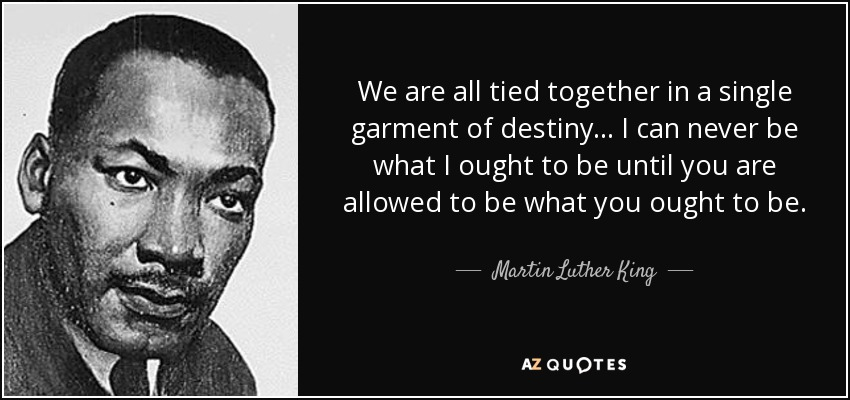
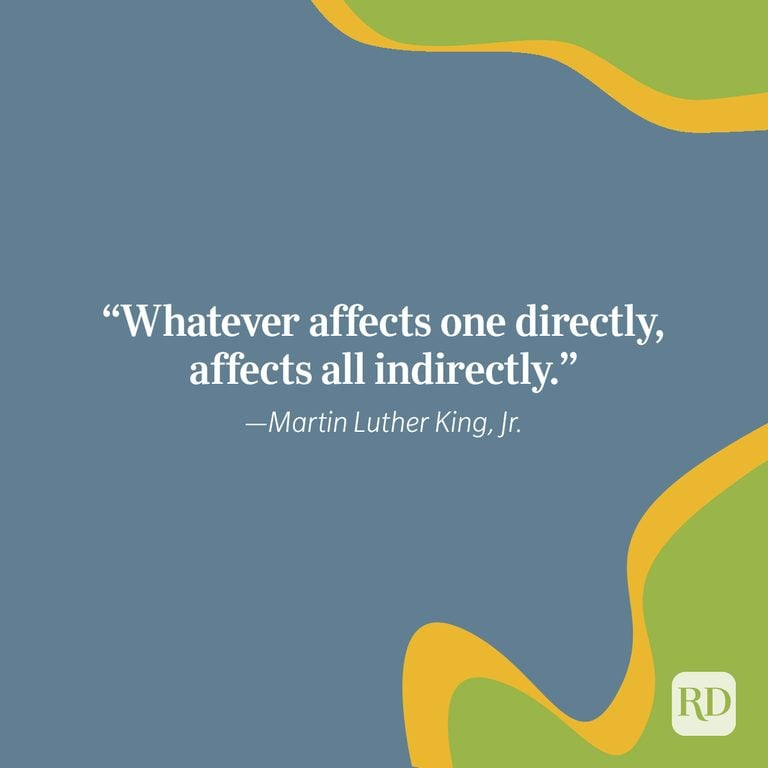
Moreover, I am cognizant of the interrelatedness of all communities and states. I cannot sit idly by in Atlanta and not be concerned about what happens in Birmingham. Injustice anywhere is a threat to justice everywhere. We are caught in an inescapable network of mutuality, tied in a single garment of destiny. Whatever affects one directly, affects all indirectly. Never again can we afford to live with the narrow, provincial “outside agitator” idea. Anyone who lives inside the United States can never be considered an outsider anywhere within its bounds.

I mean, “moreover” is just kinda mean. How do you argue with people who talk like that, and do it right? “I am cognizant” implies both that you are not, and that you should be. And then Dr. King shows that he was one of the greatest wordsmiths since Abraham Lincoln: he creates not one, not two, but three different phrases that became legendary: “Injustice anywhere is a threat to justice everywhere.” “We are caught in an inescapable network of mutuality, tied in a single garment of destiny.” “Whatever affects one directly, affects all indirectly.”

They’re all beautiful phrases: two of them perfect examples of parallel structure, putting similar phrases next to each other in order to create echoes and emphasis through repetition, combined with discernible differences made clearer by the juxtaposition; and in between a beautiful and powerful metaphor that makes clear an abstract but inspiring idea of humanity, a vast network of mutuality. It’s amazing writing. And while King’s opponents are reeling from that — again, imagine if a national figure, an international figure to be if he wasn’t yet (this was all prior to the March on Washington, but King was certainly already extremely well known; let me point out that the goddamn president of the United States intervened on King’s behalf to get him access to his attorneys while he was in jail) — he closes down the argument, by pointing out that we are all Americans, and the idea of an “outside agitator” from the same country is narrow, provincial thinking (read: stupid) that just doesn’t make any sense.

All right: having trashed the eight clergymen’s first claim, King moves on to his main argument: that his actions were neither “unwise” nor “untimely.” He introduces his argument here:

You deplore the demonstrations taking place in Birmingham. But your statement, I am sorry to say, fails to express a similar concern for the conditions that brought about the demonstrations. I am sure that none of you would want to rest content with the superficial kind of social analysis that deals merely with effects and does not grapple with underlying causes. It is unfortunate that demonstrations are taking place in Birmingham, but it is even more unfortunate that the city’s white power structure left the Negro community with no alternative.

Look at how polite he is: he is disappointed that they failed to recognize the real problem, which is the root cause of the demonstrations rather than the demonstrations themselves — but he doesn’t say he’s disappointed in the clergymen; it’s only their statement that “fails.” He is sure that none of those good, sincere men would be satisfied with “the superficial kind of social analysis” that doesn’t focus on root causes. He knows, as they know, as we all know, that they are indeed focused only on the superficial symptoms of the problem rather than the root causes; their entire argument is that everyone should calm down, not that anyone should try to solve the problem. And then he imitates their passive voice, their passive-aggressive tone, by stating “it is unfortunate” that bad things are happening — but it’s much worse (sorry, “even more unfortunate”) that the white people caused those bad things. Isn’t it?

Of course it is.

So then King gives the description of the four steps of a nonviolent campaign: “collection of the facts to determine whether injustices exist; negotiation; self purification; and direct action.” And then slowly, painstakingly, he goes through all of these steps in the letter. He refers to the city’s history of not only segregation but also violence — which his opponents have to stipulate, since that same violence was the root cause of their statements, and their first statement clearly asks the white people of Birmingham to stop causing problems and let the issues be worked out by the courts. (And please note that all of this exchange happened before the Children’s Crusade, which led to the famous and terrible footage of the Birmingham police using firehoses and police dogs to attack children peacefully protesting, and also before the KKK bombing of the Sixteenth Street Baptist Church which murdered four young girls. So yes, I think we can fucking well stipulate that Birmingham was a violent and racist place.) He then explains how the local community tried to negotiate, and the white people in Birmingham were the reason the negotiations failed. He talks about their attempts at self purification, and then he talks about their decision to move to direct action.

Then he talks about how the delayed their direct action. For the mayoral election. Which, one would think, would be a perfect opportunity for an agitator — perhaps a secret Communist, as King was absurdly accused of being several times — to cause as much disruption as possible, and have a large impact on the community. But they didn’t do that. And then when there was a runoff — even though one of the candidates in the runoff was Eugene “Bull” Connor, the Commissioner of Public Safety who would later order the firehoses turned on children — they delayed their protest march again.

What were those guys saying about “unwise and untimely?”

Right.

He ends this portion of the argument following the same pattern he established in the beginning, with the rebuttal of the “outside agitator” accusation: first a straightforward, concrete refutation based on facts (“I was invited here,” in that first instance), and then he expands the discussion into larger, more abstract, but also more important ideas. (“Injustice anywhere is a threat to justice everywhere.”) In this case he says this:

You may well ask: “Why direct action? Why sit ins, marches and so forth? Isn’t negotiation a better path?” You are quite right in calling for negotiation. Indeed, this is the very purpose of direct action. Nonviolent direct action seeks to create such a crisis and foster such a tension that a community which has constantly refused to negotiate is forced to confront the issue. It seeks so to dramatize the issue that it can no longer be ignored. My citing the creation of tension as part of the work of the nonviolent resister may sound rather shocking. But I must confess that I am not afraid of the word “tension.” I have earnestly opposed violent tension, but there is a type of constructive, nonviolent tension which is necessary for growth. Just as Socrates felt that it was necessary to create a tension in the mind so that individuals could rise from the bondage of myths and half truths to the unfettered realm of creative analysis and objective appraisal, so must we see the need for nonviolent gadflies to create the kind of tension in society that will help men rise from the dark depths of prejudice and racism to the majestic heights of understanding and brotherhood.

I love this because he points out the hypocrisy of the White community in Birmingham asking for peaceful negotiations, and thus turns the argument around on them. It’s like he’s saying, “Negotiation? We would love to negotiate! Let’s negotiate!” And by so doing he calls their bluff, because of course, it is not the Black community that refused to talk about these issues. And then he gives us this amazing, dry, sarcastic discussion of “tension,” which I love because I love knowing that Dr. Martin Luther King, Jr., was a smartass: “I confess that I am not afraid of the word ‘tension.'” The idea that he is confessing to something that should be plainly, easily, universally true: because what the hell is scary about the word “tension?” In fact, “tension” is necessary and important for change; and he then refers to Socrates, equating himself to the father of philosophy, the man famously convicted wrongly by his city’s establishment, and executed when he had committed no real crime other than creating “tension.” And his magnificent gift with words shows in the ultimate goal of that creation of tension: “the kind of tension in society that will help men rise from the dark depths of prejudice and racism to the majestic heights of understanding and brotherhood.” Beautiful. And, what, are you saying you would be against that? You wouldn’t want that? Because you’re afraid of tension?

Eye Loewe GIFs - Get the best GIF on GIPHY

Not satisfied with simply having shown that the protestors were not impatient or “untimely” in their marching, King takes this chance to explain to everyone everywhere why the civil rights movement isn’t willing to wait. And this is where my AP Lang class picks up this thread. First, King says this:

We know through painful experience that freedom is never voluntarily given by the oppressor; it must be demanded by the oppressed. Frankly, I have yet to engage in a direct action campaign that was “well timed” in the view of those who have not suffered unduly from the disease of segregation. For years now I have heard the word “Wait!” It rings in the ear of every Negro with piercing familiarity. This “Wait” has almost always meant “Never.” We must come to see, with one of our distinguished jurists, that “justice too long delayed is justice denied.”

Here King is not speaking to the clergymen. The language is too aggressive: oppressor and oppressed, while absolutely the accurate terms here, are not words that will appeal to the nice churchmen who want peace and quiet. Here King is speaking to everyone who has said the civil rights movement is pushing too hard, and going too fast; and the man is tired of talking about this. And again, he makes the same point successfully, several times, which just shows the pathetic weakness of the initial claim, that the civil rights movement is going too fast and should instead just wait for things to work out. His first statement makes an entirely valid point: oppressors do not give away power, they do not simply let people go. Which makes the claim ridiculous, because why wait for something that will never happen on its own? Then his second comment, starting with “Frankly,” in which you can hear his irritation with this whole discussion, points out that people who stand to lose power are not the ones who should get to decide when the oppressed should demand their freedom. Then he raises this to an eternal, universal experience that every oppressed African-American in the US has had to deal with, has been pierced by the ring of, this word “Wait.” And he refers to Supreme Court Chief Justice Earl Warren, writing in the Brown v. Board of Education decision, that “justice too long delayed is justice denied,” the Chief Justice’s own poetic truism.

That’s three reasons why “Wait” is a stupid argument to apply to the civil rights movement. But then, King does this:

We have waited for more than 340 years for our constitutional and God given rights. The nations of Asia and Africa are moving with jetlike speed toward gaining political independence, but we still creep at horse and buggy pace toward gaining a cup of coffee at a lunch counter. Perhaps it is easy for those who have never felt the stinging darts of segregation to say, “Wait.” But when you have seen vicious mobs lynch your mothers and fathers at will and drown your sisters and brothers at whim; when you have seen hate filled policemen curse, kick and even kill your black brothers and sisters; when you see the vast majority of your twenty million Negro brothers smothering in an airtight cage of poverty in the midst of an affluent society; when you suddenly find your tongue twisted and your speech stammering as you seek to explain to your six year old daughter why she can’t go to the public amusement park that has just been advertised on television, and see tears welling up in her eyes when she is told that Funtown is closed to colored children, and see ominous clouds of inferiority beginning to form in her little mental sky, and see her beginning to distort her personality by developing an unconscious bitterness toward white people; when you have to concoct an answer for a five year old son who is asking: “Daddy, why do white people treat colored people so mean?”; when you take a cross county drive and find it necessary to sleep night after night in the uncomfortable corners of your automobile because no motel will accept you; when you are humiliated day in and day out by nagging signs reading “white” and “colored”; when your first name becomes “nigger,” your middle name becomes “boy” (however old you are) and your last name becomes “John,” and your wife and mother are never given the respected title “Mrs.”; when you are harried by day and haunted by night by the fact that you are a Negro, living constantly at tiptoe stance, never quite knowing what to expect next, and are plagued with inner fears and outer resentments; when you are forever fighting a degenerating sense of “nobodiness”–then you will understand why we find it difficult to wait. There comes a time when the cup of endurance runs over, and men are no longer willing to be plunged into the abyss of despair. I hope, sirs, you can understand our legitimate and unavoidable impatience.

He puts a number on it, to show that people have waited long enough for justice: 340 years, which hearkens back to the founding of the European colonies at Jamestown and Plymouth: in other words, the very beginning of what the US claims as its history as a nation. It has always been like this here. He makes a comparison between countries the US considers both less developed, and less dedicated to the ideals of freedom and equality, the nations in the “Third World” that were at this time throwing off their colonizers and beginning to build new nations, with varying degrees of success — but all with a faster pace of change than the US, for all of our vaunted modern innovative, creative spirit and love of freedom, and he uses a fantastic metaphor to show how sad and simple this all is, that African-Americans have to fight this hard just to get a goddamn cup of goddamn coffee (Cusswords added for emphasis, because Dr. King was much too polite to say it himself).

And then Dr. King writes what may be the best sentence I’ve ever read.

Do you see that? It’s all one sentence, from after “Perhaps it is easy for those who have never felt the stinging darts of segregation to say, “Wait.” up until he says, “then you will understand why we find it difficult to wait.” He uses full sentences inside it, when he quotes his son asking why white people are so mean; but it’s still only one sentence. 316 words.

And it’s unbelievable: everything in it, from the way he describes the different experiences of African-Americans in the US, to the way he starts with the most active and deadliest threats, and then ends with the most personally and emotionally troubling and dehumanizing, going through all the different ways one is affected, in every single aspect of one’s life, through all of one’s identities, not only as a civil rights leader and a member of an oppressed people, but also as a husband, as a father, and as a man; everything he does in this sentence is amazing. The way he uses the second person “you” to include his — mostly White — audience, so that maybe the White people can understand some of what King and every other African-American understands, and uses “father,” “mother,” “brother,” “sister,” and every other family relationship to show that everyone, every human, are our brothers and sisters, our family. The way he names lynching and murder, and equates violent mobs with policemen, as both groups have savagely brutalized African-Americans in this country. The way he appeals to parents by including not one but two heartbreaking scenes with a father having to explain to his children why they must suffer in an oppressive and unjust society. The incredible metaphor he uses, about the people smothering in an airtight cage of poverty, in the midst of an affluent society: because the airtight cage is a paradox, a cage is only bars, so it should not be able to smother anyone; just as poverty should not be suffocating people in this society: and it in the midst of this society, because affluent people are all around those who are suffering and dying, are watching them die, and doing nothing about it. The cage itself makes this seem like a zoo: an exhibition put on for the amusement of the crowd. The poetic way he uses phrases like “your tongue twisted and your speech stammering,” and then throws the harsh, crude word “n*gger” at us as it has been thrown at him, casually, frequently, like it’s his first name.

The way this periodic sentence — a term for a sentence that has the main clause, the most important subject and verb, closer to the end than the beginning of the sentence — ends with the final statement, “then you will understand why we find it difficult to wait.” Making the audience wait, through 316 words, for that final statement of the sentence’s purpose. Ending with the word “wait,” that same word that set all of this off. With the incredible understatement of “we find it difficult to wait,” through lynching, through drowning, through beating, through suffocating, through the tears of children, through one’s own dehumanization: it would indeed be difficult. But it is cause and effect, if-then: when we have gone through what King and other African-Americans have gone through in this country, then we will understand. And the corollary, of course, that until we have gone through it, we cannot understand it: but at least now we have a description of it.

It’s the most amazing single sentence I know. It’s one of the best arguments I’ve ever read, in a piece that continues after this to build up his argument for another 30 paragraphs, point by point explaining why the actions of the protestors in Birmingham, and King’s movement’s actions more generally, are right and good, and should get the support that the White community denies them. I have never been capable of teaching it fully to my students: I can’t make them understand how remarkable King’s achievement is in this essay, because it’s so far beyond their usual argument that it’s like another language. I doubt I’ve done it justice here today; but I felt like I had to try.

Happy Birthday, sir. And thank you for all that you gave this society.

Home | Martin Luther King Jr: An extraordinary life

Thrill Time

I’m excited about this.

I’m nervous about it, too: and also somewhat conflicted. But mainly, I’m excited.

I’m going to publish a new book.

Part of the conflict in me is that it isn’t the book I intended to publish. I regret to inform those who are waiting, patiently or impatiently, that I am not going to be publishing the final volume of The Adventures of Damnation Kane this spring. I won’t have the book finished in time for the Tucson Festival of Books, which was the immediate deadline I was trying to hit; I worked on it all through the end of 2022, but I realized that I wasn’t going to be able to get it done AND make it good in time for the Festival. I’m not going to bring out a book that isn’t good: but I very much wanted to bring out a book for the Festival. I spent a bunch of money on a booth, and I didn’t want to be there with only the same two books I had last time.

So instead, I am going to publish a different book.

It’s a book I wrote some time ago, and I think it’s one of my best pieces of work — honestly, better than Damnation Kane, though there are lots of things about my pirate story that I love unreservedly. But there are limitations in the Damnation books, and this one really captures the kind of writing I want to do, the kind of writer I want to be. It’s an urban fantasy novel, dark almost to the point of horror, with a total smartass for a main character; I think it captures the same tone that one of my fantasy writer heroes, Jim Butcher, has mastered with the Harry Dresden books, which I think is one of the best series and one of the best characters since Tolkien.

And that’s the other conflict for me in publishing it. See, this book got closer than anything else I’ve written and submitted to actually getting picked up by an agent, and then (presumably) by a publisher. Jim Butcher’s agent read the first chapter, and then asked to see the first 50 pages of the novel — the only time in fifteen years of writing and trying that I have not simply been rejected by an agent. She then turned it down, but still: I thought this was my best shot at getting an agent, and getting published by a traditional publishing house. And I’ve been holding the book back, refusing to self-publish it, because I still dream of finding representation and a legacy publisher to produce my work. That, along with winning awards and worldwide fame and wealth, is the last ambition I have as a writer. I’ve already done the main things, the big things: I’ve written books, good books, and had people buy them, read them, and tell me they are good books. That, for me, is success. I am enormously proud of my accomplishments as a writer.

But there was still that one remaining ambition: and this was the book I meant to use to achieve it. (There’s another book I’ve never published, but that’s because I don’t think I can publish it under my name unless I quit teaching first. That’s a whole other thing.)

But I realized: first of all, though I think this is a good book, I don’t think it’s the best book I’ll ever write. I wasn’t one of those flash-in-the-pan literary prodigies who created my one good work before I was 25; I think I’ve gotten better with every book. I’m hopeful that the last Damnation Kane book will be even better than this book, and the one I write after that will be even better than both of them. I think my last book will be my best book, and I’m a long, long way from my last book. And secondly. just because I publish these books myself doesn’t mean they can’t be picked up by agents or legacy publishers; at this point, honestly, my publication of my books is also my best advertising for them, so making this book available is the best way for me to get it noticed.

And finally, you know what? Even more than I want to use this book to get published, I want to share it with people. I want people to read it. I want you all to like it. Maybe even love it. That’s really why I write, after all: because it’s fun, and inspiring, and meaningful; and I want other people to find the same fun and inspiration and meaning that I find in the words.

So to that end, I’m going to post the first chapter of the book, which captures the spirit of it, and which gives a good idea of what the book is about. Sometime soon I will be able to post the cover of the book, and sometime soon after that I will be able to make copies available for purchase: and I hope that you all will be willing to buy it, and read it, and — I hope — enjoy it.

Let’s start with this.

The novel is called BRUTE.

(Content trigger warning: this scene includes violent death and, well, nasty stuff.)

BRUTE

Prologue

I see him, though he doesn’t know it. I see him watching. Watching me.

            He leans against the wall, shadows draped across one side of his face, the other side glowing in the harsh light from the halogens above. There’s a bored expression on his face as he sips Coke through a thin red straw, like blood through a tiny vein. His head turns from far left across to far right, then down to grab the straw with lips and tongue and drink another sip.

            He is too young to be here in this club, so I doubt there is rum in the glass, but I am too far away to smell it and know for sure in this air, crowded with the scents of too many. He looks soft and well-fed, his clothes wrinkled, torn, savagely black; but they are soft, too, and nothing to do with work. His soft hair is dyed black, as well. To me, he looks wealthy. Spoiled. Probably the neglected child of a powerful parent. I bet he got into the club with a last name instead of an ID.

            He went straight to that wall when he arrived, and his eyes immediately began roving, searching for someone cool. But since he saw me, his gaze has hurried over the rest of the club so it can linger on me, concealed by his lashes as he sips his drink.

            He wants to be nonchalant, so he keeps his distance. That all-important distance. Nothing can be allowed to break that shell of cultivated boredom, the complete alienation which separates him from the unwashed masses, who can’t possibly understand his pain. Maybe – maybe – I can.

            I might be what he wants me to be. What he hopes I am, the thing he has hoped to find. But I also might be a freak, a loser; and if I am, he can’t be seen showing any interest in me. I am wearing a dark fedora forty years out of style, and a dark overcoat, dark leather gloves, and heavy sunglasses – at night, in a bar, on a warm spring night in San Francisco. I sit alone in the bar and sip my drink, and nobody talks to me and nobody looks at me. These things have intrigued him. So he watches.

            Of course, he might simply be gay. I do look pretty damn hot in this hat. Either way, I don’t want him to approach me in here. I am curious about the pickup lines he might use: maybe something like, “Pardon me, but you look like someone who understands the cosmic loneliness that envelops us all in a cloud of neverending night. Can I buy you a drink to drown our sorrows in as we wait for the inevitable curtain to fall?”

            Actually, that’s not bad.

            I take a deep breath, enjoying the harsh antiseptic smell of my gin and tonic, and then I down the last swallow in the glass, tasting nothing. I drop money on the table, enough to cover the tab and a generous tip for the waitress, a pale, pretty redhead who had served my drink without trying to see what was behind the sunglasses. If she had tried, and succeeded, then she would have gotten much more than money for her gratuity. She would not have wanted it.

            I walk out past the bouncers, through the short maze of corridors that once connected the office spaces to the open central area, back in the 70’s when this was a warehouse. A sweatshop, actually: three hundred and fifty Vietnamese women stuffed behind ancient sewing machines dangerous with exposed gears and needles that punched through fingers as easily as cloth. They spent sixteen hours a day in here, making those tiny American flags – the ones that people would wave on Memorial Day to honor the men who died in Vietnam.

Sometimes the world paints the irony with a heavy hand.

            The sweatshop had been closed down thirty years ago amid headlines and indictments, and the warehouse had sat empty for fifteen years before it had been bought and converted. But very little had changed. The doors were scarred steel on rollers, the walls were ugly exposed brick, the lights were harsh and unpleasant. The lights were not supposed to make you relax, they were supposed to make you feel watched. Seen.

            The corridors, once intended to slow down any government officials who happened to come in the front so the workers (or at least the owners) could slip out the back, now served as a sound baffle, dulling the edge of the industrial music that rattled the club during drinking hours. Not that the people in this neighborhood would complain about the noise. The warehouse was the last stop on the way out of a depressed and crumbling industrial zone and into the dead and rotting tenements that had once housed the workers, who were now dead and rotting themselves. The tenements now held nothing but the fear and pain and desperation the people had left behind, smeared on the walls like soot, blowing in the wind like cold, greasy ashes. That wilderness of old pain is what draws us here to this club, both me and that kid – who watches my every step as I leave – though we come for different reasons. He and others like him come here because the surroundings confirm what he always suspected about the uselessness of it all.

            My reason’s easier. I love the night life. I love to boogie.

            I grin as I walk out into the night and take a deep breath of the clammy air. I can smell the Bay, of course, because that’s what you do when you breathe in San Francisco, but I can also smell the heat and the sweat oozing out of the club. I can smell the musky scent of those who come here to hunt, and the quivering eagerness of those who know they are prey and come here because they wish to be hunted, to be taken, and devoured, and freed. I smell beating hearts and moist palms, clenched stomachs and lungs shivering like a new butterfly’s wings. A line of slaver runs down my chin and I wipe it away with one gloved hand. My grin widens into a smile I couldn’t wipe away if I wanted to.

            Quickly now: into the darkness. He’ll know where I’ve gone. It will make him follow all the faster.

            But before I make it to the corner and turn into the deep shadows there, I am impressed. He steps out from an alley that runs between the warehouse and the moldering brick building beside it. He is in front of me. He used a back door and made a good guess about which way I would turn – a good guess if I am not predictable. I hope I am not predictable. He plants himself boldly in my path and he smiles.

            His eyes widen when he sees my teeth, which are now grown too large and numerous to cover with my inadequate lips. They are not a human being’s teeth. But they are also not the teeth he expected.

            He falters back, just a little, and I quicken my step. I shove past him, hard. I hate being surprised. I do not like to be seen, like this. As I shoulder past him, I can smell – everything: he is afraid, and both excited and angered by his fear; his cologne is good, understated and expensive; his clothes smell rich, clean; his fingers smell of tobacco, his wrists and chin of the filet mignon he had for dinner; his lips and tongue smell of Coke and dark rum – he is older than I thought, or else he snuck a bottle past the bouncers.

            The hunger wakes up and roars inside of me, making my head spin as it drives iron spikes into my spine. But that doesn’t matter. He has seen. I’ll kill him for that. But later; not tonight. I wasn’t ready for him to see me, and that makes it all wrong, ruins the whole deal. I’ll find a wino, an alley crawler as usual. I quicken my step, lean away from him into the night.

            “Master, wait!”

            Around the corner and into the dark, I pause. He stumbles after me, stuttering to a halt ten feet behind my back. I close my eyes. I don’t want this. Fear is good, fear is fine, but horror and disgust are not. I have learned this. But then his scent trickles into my nose, and brings the truth, for scents cannot lie. He is not disgusted. He is – eager. And still afraid. He smells of sweat and adrenaline, and dry eyes opened wide.

            “Master. Please.” He takes a hesitant step toward me and holds out his hand, the thread of tobacco and tender meat rising in the tapestry of his scent. The spikes drive deeper, into my neck and the base of my skull and the hinges of my jaw.

            Very well. I cannot fight it. I have nothing left to fight it with. I have learned this, too.

            I take off my sunglasses, slowly, though I do not turn to face him. “Who dares to speak to me?” I ask. I growl to hide the slight lisp from my teeth. My part doesn’t call for a lisp.

            I know this role, this scene, quite well. I have read the same books he has, I have seen the same movies. I know why he was hanging in the darkest, most depressing nightclub in town, and I know why he picked me out and followed me away from there, to this place, which is even worse. He has convinced himself that what he saw of my teeth, what he saw when my human mask slipped, is false. A trick of the light, no more. Surely I have only two oversized teeth, instead of a mouthful. And now that I have spoken, in a dark voice full of menace and arrogance, now he is sure he is right. He is sure that I am a Childe of Darkness, One Who Walks With The Night, a godlike immortal who drinks the precious nectar of life, the blood of the innocent.

A vampire.

            He takes another step toward me. “I am nothing compared to you, my lord – uhhh, Master.” He pauses, probably mortified that he stumbled over the proper honorific. Does Miss Manners prescribe a form of address for someone who is about to kill and eat you? He goes on. “I am one who seeks to serve you. Who wishes to become like you. Who wishes to receive the gift of immortality.”
            I almost ruin the scene again, by laughing. That’s the second biggest lie in the books and the movies: that you can “earn” the gift, that it is given for love or as a reward for services. If you catch their attention and impress them enough, we are told, you will be made one of them. What a crock.

            The biggest lie, of course, is that it is any kind of a gift at all.

            I haven’t responded, haven’t moved an inch, but he starts smelling encouraged. Probably because I haven’t laughed at him. He expects to be laughed at.

            “Why would you serve?” I ask in a low voice, just a murmur.

            He takes another step, and now I can hear his heartbeat, the racing blood that stains his pale cheeks red and brings the heady scent of warm flesh closer, closer. “Because. Because I want to show them. I’m going to show everybody.” He sniffs, and I can smell just a trace of tears, tears and anger. “I’m going to show them why they shouldn’t laugh.”
            I understand, though I wish I didn’t. It would be easier for me if I didn’t understand. Or if, like my masters, I understood but simply didn’t care. If I didn’t understand I could walk away, despite the pounding steel hunger. If I didn’t care I wouldn’t want to walk away. But then, if I didn’t care, I would be something I don’t want to be, something I have not yet become.

            Not yet.

            He takes another step. “Master, please. Take me. Take me with you.”

            The smell of eagerness rises, like an electric current running through musk. The smell of his adrenaline, coursing, rings through me like a bell in my ear. The hunger drives all else out of my mind.

            He is three steps, then two steps behind me now, close enough to hear me as I whisper. “Do you know what you ask? Are you sure you want what I offer?”

            One step. “Yes, Master.”

            I give him what he wants.

            When he is dead, I sling him over one shoulder and start running. His weight is nothing to me. I wish I could fly. They can fly. That’s one thing the movies got right. But thinking of them reminds me of what else I’d have to do if I could fly, if I was like them, and then I don’t want to fly any more. Running is fine. I never really get tired, after all – just hungry. Like now.

            I get him away from the streets, down by the edge of the water, and then I throw him down. His head flops on his broken neck, and his eyes look up at me, glazed in death but still somehow accusing. He expected me to embrace him, to plunge my fangs into his throat – not to kill him quickly, simply, with a single twist of my hands. His face is the face of thousands just like him, thousands who haunt the dark places, who dream of dark things. If he had been less desperate or less determined, if he had let me leave without seizing the moment and chasing after me, then he might have lived out his life as the rest of them do: never catching more than a passing glance at the things that live in the dark places. Things like me.

            I take a deep breath to make sure nobody is nearby. I smell only death: the dead fish in the Bay, the body someone buried over there several months ago – smells like a wino, curdled and rotten before he even died – and, of course, the dead man at my feet. My stomach rumbles then, and it takes a lot of willpower to resist it. But I like this coat. I close my eyes as I strip off my clothes, and again I inhale deeply, filtering out all the scents but his: again I smell the meat and the liquor on his tongue, and the fear and the pain that are ripe on his flesh. And I hate that he smells that way, because I love it.

            And when I am naked and ready, I dive in. I tear his clothes from him because they would stick in my teeth, and then I feed. It is not the beautiful moment he expected, that essentially erotic coupling that is the vampire’s kiss. I am a predator, and he is prey. That is all.

            I eat his tongue first. Fear makes the flesh salty, and pain makes it bitter, and both are good. But it is only when I eat their tongues that I can taste what I really want, what I haven’t had for thirty years now: the taste of food. Cooked food, the food a man would eat, instead of this dog’s dinner that I get now, the raw flesh and cooling blood of the kill. I tear the meat apart with my teeth: the jagged, cutting teeth of a shark, rather than the graceful fangs he expected. He wanted them to be fangs, he wanted me to use them to take his blood, just as he wanted me to make him my slave. He had that part wrong, too. I’m the slave. I’m not the master, because I’m not a vampire. He wasn’t the beloved vessel that holds the stuff of life which the vampire craves; the red blood, the passion, the warmth of life, the caress of the soul that runs through it.

            He’s nothing but meat for a ghoul.

Happy Freakin Holidays

I bet you’re thinking that I forgot, aren’t you?

Or worse: that I remembered, but decided to just blow you off, to ignore the promise I made that I would be on time with the next blog.

It would make sense if you thought either of those things: since here I am, not only a few days late, but two full weeks. I broke my promise. Missed a post. Missed a deadline. Twice. (Almost three times, but as this is Monday, and a new year, I’m giving myself enough slack to consider this one on time.) I flaked, I slacked, I failed.

Nope. I broke my house. And I had to deal with the holidays.

I don’t want to get into too much detail, partly because it isn’t just my house, it is also my wife’s, and I don’t mean to take away her privacy by talking about things that concern her as if they are only my issue; and also because the insurance is still considering our claim, and I don’t want to do something like claim fault that could potentially screw up that claim. I am clearly going to have to write about insurance at some point in the near future.

And to be clear: it was not my fault. But it is the reason why I have missed now two deadlines for posts, on the last two Sundays.

Friday the 16th was a rough day. It was the workday after the end of the fall semester, and so I had grading to do. Because I believe in grading students based on their work rather than their adherence to deadlines, I always have extra late work to grade; because I teach AP, which are supposed to be rigorous classes designed to prepare students for a rigorous test, I give final exams in the last week. And because this has been a tough month, I fell behind on my grading. All of which meant that I had a ton of work to do on the last workday of the semester before grades were due — and I am still planning to write about how teachers have too much responsibility and too much work. And then my administration raised the difficulty level for me: because they set the grade deadline at midnight on Friday the 16th, at the end of the last week of classes, at the end of one teacher workday for grading and finishing up the semester’s paperwork.

To be clear: the grade deadline is arbitrary. There is no requirement from the state Department of Education, or any other regulatory body, as to when grades must be finalized. Schools are required to provide grades or something equivalent in a timely manner, of course; but what does that mean? Does that mean the final grades must be complete within 36 hours of the last bell releasing students? Of course not. In comparison to other local districts, we got out of school a week early — Tucson Unified, the largest public district in the county, had classes up to the 22nd — and even if you want grades completed by the next business day, which for us would have been Monday the 19th, is there any reason why those grades couldn’t be collected by midnight on Sunday? Of course not.

But for no good reason, the person in charge decided it had to be midnight Friday. So I tried, as hard as I could, to get everything graded by midnight Friday — to be clear, not to please the administration, but because after the grading deadline, the window to update and post grades would close, and I wouldn’t be able to add anything else to my students’ semester grades. They did the work, they deserve the grade (Or they didn’t do the work, and they deserve that grade [Caveat here: anyone “deserving” a grade is pretty antithetical to my view of education, but hold off on that for now. You get my point.]): so I had to get everything done before the deadline. I started grading when I got up at 6am on Friday, and other than breaks for meals (and a VERY valuable hour-plus spent commuting to school and back home, because the same administration (Not the same specific administrator, but it might as well be) insists that we go into work even on days without students, and also wanted to have a VERY valuable staff meeting in person, at which they introduced us to new staff members [Totally different subject, but my school lost four staff members mid-year, for various reasons, which almost never happens in schools because contracts are for the whole school year and we generally strive for continuity — but this is the second year in a row in which we have gone through this mid-year staffing issue. Four staff members is roughly 10%. Second full year we’ve had this 10% staff turnover midyear, after the pandemic shutdown — but surely that’s just coincidence.] and bid farewell to those leaving. Then they wished us a happy and restful vacation. As my students say: LOL.) I continued grading for the next 16 hours. At 10:45pm, I received the email which informed me that the grading deadline had been moved to midnight Sunday. And I went to bed.

Saturday morning I was back to grading; fortunately, there really wasn’t much left, and I soon had it all done, including the last-minute stragglers. And then, to start off my vacation, I headed over to a friend’s house to help him string Christmas lights and drain his reservoir of available beer. But partway there, I got a text message from my wife: the kitchen faucet, which had been leaking, had suddenly gotten worse, actually spraying water when she turned it on. So I turned around and came home to fix the leak. No problem: I have changed kitchen faucets before. My wife and I headed out to Home Depot, bought a faucet that seemed reasonable, and I went to work.

And when I tried to turn off the water under the sink, the hot water valve broke off in my hand.

The next segment of time seemed like forever, though it was not very long. Hot water was spurting out of the pipe end, spraying me, spraying the kitchen; fortunately it wasn’t scalding hot, but it was a LOT of water. I ran outside to turn the water off where it comes into the house — only to find that this house doesn’t have a cutoff valve at that usual spot. I ran to the driveway to turn off the water to the whole house — only to find that what I thought was the main water valve was only a junction for a defunct sprinkler system. I ran around literally yelling “I don’t know what to do!” along with the loudest profanity I think has ever come out of me, while my wife and I tried desperately to catch the water, to use a hose to redirect the water that was soaking our kitchen and puddling in the living room. My wife ran to our neighbor’s house, asked him if he knew where the water cutoff was — and he did! It was in back of the house, in the alley. So I ran back there, to meet him because he had the tool to open the cover and turn the valve if it was stuck.

It wasn’t stuck. It wasn’t there.

This wonderful neighbor did eventually find the main water cutoff: it was in the alley, where he said; it was just buried under a good two inches of dirt. He unburied it, turned off the water, and ended the crisis.

Then we started the cleanup. A plumber came out that night, on Saturday, and told us the pipe couldn’t be fixed without tearing out the wall; he recommended that we contact a restorationist to deal with the water damage, and said we could either fix the pipes when the restorationist tore the kitchen apart — or we could repipe the entire house. (If there’s been good news in this, it is that we do not need to repipe the house.) Because he couldn’t even get the replacement parts, it being Saturday evening after the hardware stores closed, he left without fixing the hot water pipe. Though also without charging us, so I don’t have any complaints about that. I did have complaints about not having working hot water, and a flooded house. In December. Over the holidays.

My amazing friend Tim (The one I had been headed to help string lights and drink beer) came over that evening with a shop vac and helped us clean up the water; he also showed me how to turn off the hot water at the water heater, so we could have cold water, at least. Which let us stay in the house for the night, which was good for our pets, if not necessarily for us. He and his wife also gave us lasagna and invited us over in the morning to get a hot shower. And then the next day, Tim came over and fixed the broken pipe, thereby saving us hundreds or thousands of dollars in plumbing bills. I can’t thank him enough. I am doing my best to thank him as much as I can. (By the way, Tim, if you read this, my dad said he’s proud of you.)

The issue of the water damage to the house is the focus of the insurance claim, which as I said is ongoing; suffice it to say that insurance claims are never fun, not even when they pay out. There are investigations and reports and deductibles, and worst of all for my introverted little family (My dogs are both extroverts: but they didn’t like this either, because they are also territorial), there have been people coming into our house essentially every day since it happened. As I write this, it’s been five days since people were here — but there’s another coming over on Friday. And who knows how many more, over how much longer, after that.

So. That was the first Sunday I missed a deadline. I was too busy trying to unbreak my house (I do apologize for the reference, but the words came out and I had no choice but to link it) and deal with my what I can only describe as trauma. I don’t mean to exaggerate it, or minimize what other people have gone through that is so much worse than just a broken water pipe; but honestly, I have never felt so much anxiety and so much guilt so intensely in one period.

And then for the next week, while we were trying to handle the fallout from the damage, my wife and I also tried to deal with the holidays.

Which is what I want to talk about now, today, when they are finally fucking over — and I am almost as relieved about that as I am about the house. Though of course, the house issue is still ongoing: and those goddamn holidays aren’t finished yet, because I still have to go back to work and answer every single person who asks me how my vacation was. And since I teach high school, that’s going to be a lot of people asking about that. And since I try to foster an atmosphere of open dialogue, and I model that by trying to be open and honest about myself and what I’m doing at the moment, I try to answer all of their questions honestly and completely; so I can’t just write on my board “Don’t ask me about the vacation” or something similar. I am just going to have to relive it in every single class period.

The thing that made the house problem so difficult for me was guilt. I felt responsible for the broken pipe — even though, again, I am definitely not responsible for it — because it broke off in my hand, so I keep telling myself it wouldn’t have happened if I hadn’t tried to turn off the water to the sink. But much worse than that is the guilt I feel because I didn’t know what to do afterwards. For years, I have been telling myself that I am good in a crisis, that I keep my head and take the correct steps when the shit hits the fan; and that has, generally, been true. I have been through two housefires, and have extinguished both; I have dealt with medical emergencies in my classroom; I have stopped student fights, including a potential knife fight (They were just posturing, but they did both have knives.) without anyone getting hurt. It’s a minor list compared to what, say, emergency personnel deal with; but still, I have handled those situations and others — I am particularly good at handling emotional crises, considering what I do and the kind of person I am, and I still think I’m good in those emergencies — and done it well.

But this time, I was completely useless. I had no idea what to do, and I didn’t even know who to ask for help. If my wife hadn’t gone to the neighbor, who knew where the water cutoff valve was, I honestly have no idea what I would have done. Called the city water? Asked them to cut off the whole block? I don’t know. Which fact just makes it worse: I didn’t know what to do, and I didn’t handle it well. And I feel guilty about that.

And that same stupid, useless feeling of guilt is how I and my wife and countless other people feel about the holidays.

Because Christmas and New Year’s, and Hanukkah and Kwanzaa and the Winter Solstice (and Festivus), are supposed to be happy times. Joy to the World, and we’ll take a cup of kindness yet, for Auld Lang Syne. My wife and I had had a rough fall, because of school and family and everything else that makes life difficult; and we were really looking forward to this break. We needed the vacation, and we needed the happy times. We were going to decorate the house, go shopping for interesting presents for each other, send out Christmas cards to everyone; we were going to spend some time exploring Tucson, going to various holiday events and so on. So it wasn’t just the expectations from others: we had the expectations ourselves, and they were pretty intense.

But of course, we didn’t do any of that. I did put up lights outside the house, which I’m happy about; and we did manage to do a little shopping for gifts for each other and for our pets. But that was it. We watched a couple of Christmas movies, hiding in our bedroom because our house was full of large, loud machines trying to dry out the water damage. We did not have the time, energy, money, or mental space to live up to all of ours and others’ expectations this year.

Which is why I missed the second post deadline: I tried to write this post on Christmas morning, I did; but I couldn’t handle it, and I had to stop. I would have posted it the next day, on Boxing Day, but the house crisis heated up that morning, and instead I had what was pretty close to a panic attack. I cried, which is unusual for me. Not a good day for blogging.

It was not a merry Christmas.

But the point is, that isn’t just this year, and it wasn’t just because our house was broken.

Christmas and the holiday season are always fraught with expectations: and really, we never live up to them. The holidays never live up to their own hype, and neither do any of us. The decorations are never as cool as we want them to be; the presents are never quite as wonderful and inspiring as we hope they will be. If we see relatives, it’s not as much fun as we want it to be; if we get to spend the time alone, it’s never as long or as peaceful and relaxing as it should be. Pretty much all of that is because our expectations of the holidays are simply too high.

That’s probably why my favorite Christmas movie is A Christmas Story: because Ralphie gets his Red Ryder BB Gun at last — and immediately hurts himself. He has literally no fun with that thing, at least not as far as we see in the movie. The family loses their Christmas dinner, the lamp gets broken but repaired so that both parents are upset about it: basically, their holiday sucks. I relate to that.

But much of the issue is that we don’t only put those expectations on ourselves: we do, and that’s a problem; but at least when I look at my Christmas lights and think they are lame, I can also tell myself, “But come on, you’re no electrical engineer. What did you expect, the Las Vegas strip? This?” Of course not: and so I am able to talk myself out of those unreasonable expectations. But I can’t stop other people from looking at my lights and thinking, “Wow those are lame.” I can’t stop people from asking about our holiday plans: and then being disappointed in whatever we say. I can’t stop my family from calling me over the holidays and asking about what activities we did, what food we ate, what gifts we gave and received; and then being disappointed in everything we say.

I can’t solve the ever-present issue I face as a teacher, which all of us face in our own workplaces but is somewhat intensified for teachers because we work with children: do I decorate for Christmas? Do I wear festive holiday clothes? Do I participate in Secret Santa and holiday potlucks? It’s a little more intense with teachers because people have more intense expectations around children and the holidays — and I realize my wife and I are lucky that we don’t have kids to carry through all this shit, this year (But also, that wasn’t luck, it was an intentional choice on our part, and right now, it was a good one and I’m quite happy with it) — and so they put those expectations on teachers since we are around their children. This isn’t new, of course, and it isn’t unique to the holidays: but again, it is more intense during the holiday season. I am expected to be jolly for THE CHILDREN, and to dress up in my ugly Christmas sweater — but also, to value and celebrate all of their diversity as people (as CHILDREN) of different cultures and traditions, so not to go too hard on the Christmas music in my classroom, for instance. (I generally play Heavy Metal Christmas music in school when I have the chance. I think it strikes a nice balance between living up to the expectations of those who want traditional Christmas trappings, and those who want to subvert them.)

And the big issue, for us this year and for too many people every year: what if you just don’t fucking feel like Christmas? What if you’re sad? What if your house is broken? What if you don’t want to be around people? What if you’re broke and you can’t afford Christmas presents? What if you don’t like Christmas movies or Christmas music or Christmas decorations? What if you’re a vegetarian and you don’t eat turkey? What if you have troubled relationships with your family — or no relationships? Or no family?

Do you really need to explain that to every single person who asks what you plan to do for Christmas this year? Or to every single person who asks how your holidays were this year? Should you really have to listen to the Hallmark movies, and the commercials, and the newscasters, and the random passersby in life or on social media, telling us that the holidays always bring people together, for a time of celebration and joy with our loved ones?

No. Fuck that. Fuck — and I say this with nothing but kindness in my heart — all of you people who ask about how the holidays were. Wish me a merry Christmas, or happy holidays; that’s lovely, thank you for the pleasant wishes. Hopefully you do the same when it isn’t holiday season, and you wish people a good day often and sincerely; but regardless, I accept and appreciate kind wishes. But don’t fucking ask me about my holiday, neither before nor after. And not just this year, but every year. Stop expecting me to have a big story to tell about my holiday plans, stop angling for a way to tell your big story if I didn’t ask about it; if we’re friends, go ahead and tell me — and if we’re not, go find a friend to tell it to. Stop expecting anything of me for the holidays. Then maybe I can stop expecting big happiness and joy for my entire world, every year.

And maybe I can just relax.

Thank you, if you didn’t give up on me over the last couple of weeks; and I do, sincerely, wish you a happy New Year and a wonderful 2023. But if it doesn’t work out that way, I won’t be disappointed. I promise. And either way: I won’t ask.

Another Bad Week

No photo description available.
This was a gift I just got, and I love it — and if you listen to UNFTR, you will understand why. Thanks, Jasmine!

I did it again: had a full and difficult weekend, mainly because this week is the end of the semester and grades are due; but still found a way to put up a meaningful post for the blog — and then failed to actually do it until two days too late.

So once again, my apologies. Though as I say to my students when they apologize, again, for talking while I’m teaching or for not turning in work, again: “I don’t want you to be sorry, I want you to be better.” I will be better. For one thing, the semester is almost over, and I’ll have time and space to breathe, and think, and write.

This week, however, I’m deep in the weeds. So here: my favorite podcast, the brilliant and engaging Unfucking the Republic, has just finished a three-part series on education in America. As you might expect, the series is ambitious, but doesn’t come close to covering everything there is to talk about in education: but hey, that’s what this blog is for. What this series does do is give an amazing, detailed picture of the history of education and education policy in this country (Do you know why education is not a fundamental, Constitutional right? You’re about to.), and dissect some of the most serious issues in education, particularly the inequality across racial lines, and the current push to privatize the whole shebang — in order to shut it down. UNFTR is unparalleled in their ability to distill enormous amounts of carefully researched information into about 45 minutes per episode (Each episode also has Show Notes at the end, which are more casual; anything over about 45 minutes is that. Nice, but not required listening.), and in addition, the website has sources and links, and also the full script in essay form, if you like reading more than listening.

So give this a listen, and if you like it, listen to the other two episodes. And then keep coming back here in future weeks: and I’ll fill in the rest of the picture, over time.

Here, for simplicity’s sake, are Parts II and III — though I really do recommend going to the website. There’s a lot to see.

See you next week.

I promise.

The Skinny Poem

My apologies; I have had a hell of a few days, and though I wrote this on Saturday (Partly: part of it I wrote a week ago), I completely forgot to post it both Sunday and Monday.

So here it is, my Tuesday post: this is an analysis of the poem “I Was a Skinny Tomboy Kid” by Alma Luz Villanueva. I wrote this because my wife told me that I needed to do a better job of using my essays as models for my class; that when I wrote an essay for them, rather than my usual self-conscious method of reading it fast and then moving on, I needed to actually go through it, explain what I did, and get feedback from the students about what worked and what didn’t, and why. So I did that. My AP class had to write an analysis of this poem, and most of them didn’t do it, so I gave them this to show what it should look like. I think it helped.

I hope it gives you something worth reading. If nothing else, the poem is amazing; read that, and then go about your day, and you won’t have lost anything.

I Was a Skinny Tomboy Kid

[My apologies for the link; the poem is written a specific way on the page, and I can’t capture it in this post format. YOU MUST GO AND LOOK AT THE POEM THE WAY IT IS MEANT TO BE READ.]

Literary Analysis of Alma Luz Villanueva’s “I Was a Skinny Tomboy Kid”


When do we grow up? What makes it happen? When we say someone grew up too young, or too fast – what does that mean? Is it possible to grow up before you grow up? If that happens, is it bad? And then, once someone has grown up – is that it? Is childhood gone? Is innocence gone? Can we never be childlike, if not actually be a child, ever again?

In Alma Luz Villanueva’s narrative poem, “I Was a Skinny Tomboy Kid,” the speaker seems to grow up over the course of the piece; and it seems to be positive that she does so, not least because she realizes the truth about some important things in her life. But then at the end, she seems simultaneously to regress and progress, and so the overall message is unclear. But perhaps that is intentional: after all, how many of us know the actual clear, definitive answers to any of these questions about life?

The poem starts with the title line: since the word “tomboy” clearly associates with a female child – because who would call a boy a tomboy? Boys are just boys – and since the author is female, it’s tempting to assume that the piece is autobiographical and accurate. But whether the speaker is the author or not, she is fierce in that opening: her “fists [are] clenched into tight balls.” So she is angry, and defensive – maybe even offensive, maybe even looking for a fight. But at the same time, while she is a tomboy, which connotes overtly stereotypical masculine traits like aggression and risk-taking, she is also, in the title and the first lines, a skinny kid. Which connotes weakness, and fragility, and youth and innocence, because “skinny” seems to say a child who hasn’t grown a lot yet, who hasn’t yet reached her potential. This makes her fists seem much less intimidating: as does the use of the phrase “tight balls,” which don’t make her fists sound terribly frightening. And since she is a skinny kid, they’re probably not very frightening at all.

From that first image, we go into a different view of being a tomboy kid: because she isn’t fighting, she is avoiding people. “I knew all the roofs/And backyard fences,” we are told: places where other people would not be, would not see her. She goes on:

I liked traveling that way

            sometimes

      not touching

the sidewalks

            for blocks and blocks

it made

      me feel

victorious

somehow

over the streets.

So she is avoiding. She is hiding, trying not to be seen, trying not to touch the places where other people are. Only sometimes. And only, we are told, because she liked traveling that way: but the desire to feel victorious over the streets is telling. It implies that the streets are not something she could normally be victorious over, so she has to seek this way of doing it. And as another author pointed out, that pause between “feel” and “victorious somehow” pretty clearly shows some doubt or some question in that wording, doubt created both by the pause and by the uncertainty in “somehow.” So “victorious” maybe isn’t the right word, here. Maybe the streets aren’t her enemy? Maybe the streets can’t be conquered? What does it even mean to conquer the streets? Based on her description of achieving victory here, it seems to mean escaping them, rising above them – becoming more, grander. Learning to fly. Gaining freedom.

I liked to fly

         from roof

  to roof

      the gravel

falling

away

beneath my feet,

      I liked

          the edge

        of almost

not making it.

And the freedom

of riding

                  my bike

  to the ocean

and smelling it

    long before

I could see it,

We can see here one of Villanueva’s stylistic choices, in the line breaks and the formatting of the poem, with some lines jutting out beyond the others – particularly appropriate when describing the edges the speaker jumps off of, the edge of almost not making it. The gravel falling away, the words almost sliding across the page under our eyes as the gravel slid away under her feet. So here we see the risk-taking, which may be what the speaker does to be considered a tomboy – also climbing up on buildings and jumping across alleys is not a traditional “female” activity (Though it should be, because women usually have better balance than men): but now, separate from the issue of tomboyhood and so on, we have to ask the question: why does she do this? Why is she jumping from rooftop to rooftop? On some level she enjoys the freedom of flying, as she calls it; but then she clearly wants the risk, she liked the edge of almost not making it. Gravel falling away beneath her feet, which scares me just thinking about it. 

Why would someone want that? 

But the thought cuts off there, almost as if she shies away from it, changing the subject to something less shocking, less disturbing: she likes riding her bike to the ocean! How lovely! She likes smelling the ocean before she could see it – which may have some small meaning about the usual smells around her, the smells of city streets, which are generally awful and that’s why she revels first in smelling the ocean; this is emphasized by the fact that she can jump from roof to roof, and along or over backyard fences, for “blocks and blocks:” which shows the size of the urban area and how densely crowded the houses and buildings are there. But enough of the streets this speaker wants to defeat: now we’re going to the ocean.

Disguised as a boy, she thought. In an old army jacket. 

Why does she want to be disguised as a boy? Why did she think wearing an old army jacket would disguise her as a boy? Because women aren’t in the army? Don’t wear army jackets? She does continue the thought in the same stanza:

and I traveled disguised

as a boy

      (I thought)

          in an old army jacket

  carrying my

fishing tackle

    to the piers, and

        bumming bait

        and a couple of cokes

Fishing, bumming bait and a couple of cokes: these are all boy things, right? Sure, I don’t really understand why myself; I grew up as a boy and never carried fishing tackle down to the piers, never bummed bait or a couple of cokes – or caught crabs, as she goes on to say in the next stanza. But because the speaker says “I thought,” this is no longer about actual gender roles or expectations: this is about her perception of them. She thought wearing an old army jacket, carrying fishing tackle and so on, disguised her as a boy. So the more interesting question is not whether that disguise would work, what society would think of what she is wearing; it’s why she wanted to wear it. Why she thought it would work. 

The next stanza – though it isn’t clear that it is a new stanza; there is a large line break between “and a couple of cokes” and the next line, “and catching crabs,” but that is clearly continuing the same action, the same thought, and the new stanza doesn’t start with a capital as the last one doesn’t end with a period – goes on with this fishing expedition, with no particularly interesting images or ideas – until all of a sudden, after a dash, but without changing sentence or stanza, the speaker shifts from apparently fond memories of the seashore to this:

I didn’t like fish

       I just liked to fish—

and I vowed

                     to never

    grow up

    to be a woman

      and be helpless

  like my mother,

but then I didn’t realize

         the kind of guts

it often took

              for her to just keep

       standing 

where she was.

I’m sorry, what? How did we get from talking about fishing to talking about the speaker’s mother, and the speaker’s apparent contempt for her?

The answer is that we have been talking about this all along: it was just disguised in an old army jacket, with fishing tackle, jumping from roof to roof and almost falling. 

The speaker wants to not be female. “To never grow up to be a woman and be helpless like my mother.” That’s a sharp intrusion, a sudden juxtaposition, and a hard one to take in. The associations: growing up, being a woman, being helpless, like my mother; three of them are all neutral if not positive – but all changed entirely by the idea of helplessness. To this girl, her mother is helpless. Women are helpless. Perhaps adults are helpless, though it seems likely that her mother’s womanhood is the real culprit, not her maturity (On the other hand, the speaker is apparently not helpless yet, and the thing she wants to avoid is growing up, along with being a woman like her mother. So maybe it is age.). What kind of terrible situation makes this girl connect these ideas this way? To think that her mother’s helplessness – a word that describes both total vulnerability, and also complete isolation, because she is in need of help and has none – is inherent in womanhood? Is inevitable for her mother? 

My first thought is that her mother is abused. The victim of domestic violence. If this is what the poem implies, then I also suspect that this is a common situation in this girl’s world, because while she uses her mother as the example, she does associate this helplessness with womanhood, so perhaps she’s seen other women, perhaps all other women she has ever seen, in the same situation. But it is also possible that the trouble here is that her mother is trapped: perhaps by responsibility – perhaps by the girl herself, as the trap for the mother might be the fact of her motherhood – and can’t escape. Maybe that’s why the speaker escapes into freedom, and feels victorious by doing so. The rest of the stanza, while it changes the girl’s perception of her mother, doesn’t resolve this for us: it simply tells us that the girl later recognizes the kind of guts, the kind of strength and courage, that it took for her mother to “just keep standing where she was.” The courage to remain, standing and static, “where she was” might imply the mother is trapped; but the “just keep standing,” and the “kind of guts it took,” might imply the violence.  Either way, it makes us pity this poor woman, and understand, if not necessarily empathize, with the girl’s desire to escape – empathy being potentially held back because: why doesn’t she help her mother? Although the fact that she doesn’t, that she sees this situation as inherent in womanhood, and the fact that the poem opens (and closes) with the speaker’s fists, all maybe implies that the mother is the victim of violence, and there is simply nothing the daughter can do about it, being just a skinny kid. Other than to escape it, and spend quite a long time outside of her home, pretending to be a boy.

The last quarter of the poem brings in some new ideas. Partly because this depiction of the speaker’s mother shows her transition from childhood to adulthood:

I grew like a thin, stubborn weed

watering myself whatever way I could

believing in my own myth

transforming my reality

and creating a

legendary/self

She grew: she became an adult. She stayed skinny, though – though now it turns into “thin,” with a connection to “stubborn” and “weed,” which for me implies a certain strength, though it feels like a somewhat desperate strength; but I think that fits. It takes strength to be one’s own support, to water one’s self and produce one’s own growth; it takes resourcefulness for the kid to find “whatever way I could” to provide for herself. It also shows trauma: because it shows neglect, and the “whatever way I could” implies that the ways she did find were insufficient, or problematic. I have to wonder if something happened to this growing kid’s mother, that prevented her from watering the weed-kid, forcing the child to take care of herself: to grow up too fast. The last part of this section of lines (Not the end of the stanza, which goes on without a line break) shows the more positive view of that experience: the child grows up too fast, abandoned or neglected in some way – but that makes her powerful, in some ways. “Believing in my own myth” is a beautiful way to depict this: the idea of a child finding her own strength and her own way to support herself has a real pull-yourself-up-by-your-own-bootstraps  paradoxical impossibility to it; and believing in one’s own myth has the same. Myths are false, of course, but they do provide something useful to people, in that they create a story, an explanation that makes sense of the universe and of the human condition, which is then useful to help us to move forward and not get stuck in existential despair. Faith creates strength and confidence, even if the faith is in nothing tangible or even real. It’s a house built on sand: but sometimes it can be enough for someone to grow strong and move on to a more solid foundation. As this kid did: she transformed her reality, and created a legendary/self. 

I’m not sure what to make of that slash; my first thought is that it creates two equal alternatives, like using “he/she” as a pronoun, meaning either option is equally likely and valid. Which means that this kid’s adult self is legendary, and I can’t see that as anything but positive. But that’s not right, because I can see it as something other than positive: legends also, like myths, are not real – though in my understanding, they are based on real life. There was a King Arthur, after all; he just didn’t pull the sword from the stone or preside over chivalrous knights seated at a round table. He united Angles and Saxons in the vacuum created by the departure of the Romans; and then his kingdom crumbled after his death, and was turned into something much more idyllic by romantic authors writing five or more centuries after him. So a legendary self might be a false self, an illusion: still just that myth, even if she believes it herself.

Reading on, I think that may be the answer: that the self she creates is legendary, both in that the facade she creates for herself is amazing and strong and capable, and also in that it is false. Because the next section of the poem says this:

every once in a while

late at night

      in the deep

       darkness of my sleep

  I wake

        with a tenseness

in my arms

       and I follow

it from my elbow to

      my wrist

and realize

       my fists are tightly clenched

and the streets come grinning

and I forget who I’m protecting

This is a clear and effective description, for me, of childhood trauma coming back to haunt the former skinny kid. The return to the clenched fists and the streets from the beginning of the poem show me the echo from her childhood; the fact that it comes at night, when she relaxes her control, and that it is associated with darkness, with tenseness, all makes me think she has never entirely recovered from what she went through as a child. But then: none of us really do, ever, “recover.” We assimilate the pain and the sadness, we perhaps find a way to accept it; but it never heals. It never goes away. This shows the hollowness, in a way, of the myth, the legend, of the adult who was once the skinny kid: I think she created a new self, which for me sounds like a victory; but I think inside that newly created skin, there is still that same little kid, trying to escape and unable to, trying to win and really just running away. There is a detachment in the description of her waking, feeling tension in her arms, and following it to the clenched fists: she doesn’t immediately realize that her fists are clenched, she has to discover them after following the feeling; that numbness and alienation from the actual fists seems like they are still her child’s fists, still representing the same anger and fear that she tried to fight in the past – and still, even now, small and ineffective, unintimidating: because look, the streets come grinning. They don’t fear her. They laugh at her attempt to fight back. Perhaps at her attempt to escape, because they come back, even now, even when she is presumably far away from where she grew up; they still come back, and when they do, she forgets where and who she is now (Now because these last lines are in the present tense for the first time in the poem).

I don’t know what to make of the last line in this section. “I forget who I’m protecting.” Who is she protecting, and why does she forget? If she is protecting herself, which seems likely – how could anyone forget that? And if not herself, who? Her child self? How does a present adult self protect a former child self? Is she protecting someone else entirely? Who, then, is she protecting them from? 

The last hints come in the final four lines of the poem; though to interpret those hints, we have to look back at the rest of the poem. The last lines are:

and I coil up

          in a self-mothering fashion

and tell myself

it’s o.k.

These have several possible meanings. This is intentional, of course, because there’s no doubt that part of the author’s purpose here is to create doubt, or rather to show the speaker’s doubt. One thing that is lost in the absence of strong, present parental figures is surety and confidence: it takes someone telling you that you are right before you can start believing you are right, and the first one whose word we take as gospel is always our parent. It’s a trope, sometimes even a joke – Milhouse, the nerdy best friend of Bart Simpson, confidently tells us that “My mom says I’m the handsomest guy at the school.” What a dork: but also, what a good mom. The doubt throughout this poem, and particularly at the end, is certainly representing the absence of that early guiding light, which leaves our speaker without any real way to know what is right and what is wrong, except to figure it out for herself: which in the case of something as abstract as morality, means she has to believe her own myth, find her own truth and believe it just because.

One way to read these final lines is positive: the kid has grown up, and in the absence of a mother figure, she has become her own mother figure, and now she can offer herself comfort. It’s another possible depiction of real strength and a successful adaptation; the same as in the legendary/self that transformed her own reality. And this isn’t wrong: the last words of the poem are “it’s o.k.” She is self-mothering as she is a legendary/self: she has become what she herself didn’t have, and that is both impressive and comforting, that in the absence of something we truly need, we can be enough for ourselves. 

But also, the idea that “it’s o.k.” is enough to dispel night terrors – and maybe it’s just me, but that line “the streets come grinning” is genuinely terrifying; the streets are, we all know, a place and source of danger, and grinning danger is the worst kind, both supremely confident that we can’t protect ourselves from it, and happy about what harm it is about to do to us – that’s not right. If the streets are coming for me in the deep darkness, I don’t want someone to tell me it’s o.k., I want someone to tell me they will protect me, and they have a shotgun. “It’s o.k.” is a weak sort of comfort. And the fact that the speaker has to be self-mothering, while it could be a sign of great strength, is also paradoxical: one cannot be one’s own mother, and so self-mothering seems as impossible as a weed watering itself, as a myth becoming real by believing in itself. That impossibility creates doubt as to the truth of this description. Is she mothering herself? Or is she just pretending? I think the phrase “I coil up” also shows this, because it sounds tense: not relaxed, not sweet and comforting, but desperate; and that makes that final statement sound like a lie. I also note she doesn’t simply state a truth that it is o.k.; she tells herself that, and then it is up to her to believe it. And it’s minor, but – “o.k.” is lower case. Unimportant. A whisper, not a confident shout. Put it all together, and it seems like this woman is not any better off than she was when she was a kid, and she was trying to escape but could not. She’s still the same kid: maybe a little taller – but still skinny.

However: all of this leaves out one unresolved question. Who is she protecting? Who did she forget she was protecting, when her past terrors resurface during her deep darknesses?

I don’t believe it is herself. The reaction when threatened, especially when threatened by a terrifying figure from one’s childhood, is to draw inward, to become more selfish, to protect one’s self instead of someone else. It’s a shameful response, maybe, but a wholly human one. I can’t see how she could forget to protect herself – in order to protect herself. I’ve tried to wrap my head around the idea that she was protecting her child self, but that doesn’t make sense either: what does it mean to protect one’s child self, once one has grown up? To preserve an illusory memory, to refuse to accept the ugly truth? It doesn’t fit. The only other person talked about in this is her mother: and if she was protecting her mother, and the streets came grinning and then she forgot and tried to defend herself – that doesn’t fit with the first part of the poem, when she leaves her mother behind while she runs off to be free. Now, maybe, there is some memory here of a time she did protect her mother, and stood up to a threat (maybe one from the streets) and the memory of that dangerous situation comes out in her dreams, and she forgets that she fought to defend her mother, and in her night terror, only thinks of herself. That’s not terrible.

Except “I forget who I’m protecting” is in the present tense. She’s protecting someone now, not in the past. 

And now this talking about her mother, and protecting, and the past to the present brings up another question: how did she finally learn that her mother was actually strong? The implication is that she has learned it in the years since her childhood, because the lines say 

but then I didn’t realize

         the kind of guts

it often took

              for her to just keep

       standing 

where she was.

Then she didn’t realize means now she does. So what is different about now? Is it just that she is an adult? A woman?

Or is it that she is a mother?

What if she realized her mother’s strength when she had to use the same strength herself? What if that’s when she realized that her mother needed to be strong for her, her mother’s child – and maybe her mother couldn’t do it, couldn’t provide the structure and the safety and the support that her child needed, leaving our speaker to grow as she could, on her own: but maybe the mother had to use all her strength just to shield the skinny kid from the danger the mother dealt with every day. Maybe the reason the skinny kid could be a tomboy was because her mother had the guts to keep standing where she was: between the skinny kid and the danger – maybe, again, the danger from the streets. And maybe the kid thought she was helpless, but really she was standing, strong, as a shield, sacrificing herself to defend her child. 

And maybe now the skinny kid, no longer a tomboy or a kid, is herself standing and trying to be strong for her own child: protecting her own child. And now, when she has to find her strength to be a mother, to be strong for her child, in nothing more than believing her own myth, because she never got the support from her mother that would have let her grow up with the strength to be strong when she became a mother, maybe now she understands that her mother had to do the same, find strength somewhere within herself, because her mother also didn’t strength from the generation before. Maybe the tomboy’s mother also swore not to grow up to be a woman and be helpless – until she became a mother to a skinny tomboy kid. And then somehow found the strength to protect her kid, who grew up, if not confident, at least safer; and then maybe that kid, grown up into a legendary/self, could find the strength to give her child both safety and confidence.

Even if sometimes, in the deep darkness of sleep, she wakes up scared – a relic left from her difficult childhood, which wasn’t all bad, really, since she got to ride her bike to the ocean and go fishing, got to fly from roof to roof for blocks, thanks to the freedom her mother won for her, even if she had enough pain and fear to not understand what a gift that freedom was – and she has to stand in for mother, now gone, and for a moment, mother herself.

Until she can get up and mother her child. 

Sourpuss Sunday

Holiday season is too long, which makes it too complicated. My answer? NEW HOLIDAY!

Okay so: the truth is I’m far too deep in NaNoWriMo to pull out of it in order to write a proper blog post. I’d apologize, but I’m not going to say I’m sorry for not writing, when the reason I’m not writing is that I’m writing too much. Instead, I’m going to take this time to do some better, more constructive destressing, by writing something that doesn’t mean too much. Writing just for fun. Which I don’t do nearly enough of.

So this weekend is the big turn. The month of October starts with Bitching Season (Though of course, Bitch-Creep has moved back into September, partly because September has no damn holidays. Labor Day. Bah!), when everyone gets mad at everyone else for either A) obsessing too much about Halloween, B) interrupting Halloween season with creeping Christmas cheer (this is mainly the stores that start stocking Santa before Satan has left the building), or C) buying pumpkin spice lattes and pumpkin spice donuts and pumpkin spice toothpaste. (You think I’m kidding. I’m not.) Not to mention the CONTINUING fight over Indigenous People’s Day, which used to be named after a genocidal slaver and rapist who “discovered” a continent 15,000 years after people migrated there from Asia, by “finding” an island that was already populated. But that all passes as we get closer to Halloween, and the Bitching Season becomes the Witching Season (I really want to point out that’s taking a big W for Halloween, because I enjoy making teenagers cringe), and we all enjoy at least a week or so of spookiness and silliness. Then Halloween ends (Here in the Southwest it turns into the Day of the Dead, but I just feel bad for the people who celebrate Dia de Muertos in the US, because it’s gotta be hard to go from the absurdity of Halloween to a genuine, solemn remembrance of those we have lost. Though respect for the cognitive dissonance required to hold a genuine solemn remembrance of those who have passed — with sugar skulls. [Though also please note that calaveras are an inheritance of the Spanish invasion of the Aztec empire, and thus have a whole lot more history than my joke gives credit for]) and — we don’t know what to do.

Do we start celebrating Christmas? On November 1? Or is that too early? Do we need time to wind down from Halloween? Do we start putting up pictures of turkeys? Almost four weeks before the holiday with the weakest iconography of all?

Seriously. Turkeys? I mean, turkey is delicious, don’t get me wrong — it’s one of the few things I genuinely miss since my wife and I became vegetarians (Though to be precise, we are ovolactopescatarians, so there) — but can we all just admit that making cute images of the things we plan to kill and eat is creepy as fuck? Befriending your cows while naming them “Hamburger” and “Sirloin” is terrible. People talking to giant anthropomorphic M&Ms is terrible, especially when they’re talking about eating M&Ms.

This is terrible:

(But this meme is amazing:)

I think the reasonable compromise is to focus more on the autumnal theme, now that it’s actually cold and the leaves have turned and are falling, now that we don’t have the confusion around Halloween. But I realize that’s not terribly exciting. How many times can you sing “Over the River and Through the Woods?” (You knew that was a Thanksgiving song, right?)

So November is a continually awkward part of the holiday season. Once again, but this time nationally, we try to be serious and solemn for once on Veteran’s Day; but in this country (or maybe it’s just me), anything celebrating the military is just so tangled and fraught and therefore just hard to deal with. Awkward, like the rest of the month.

But then Thanksgiving comes. And the week leading up to it is a madhouse of planning and preparation; then the day itself is halfway between madness and celebration — but I think that’s sort of as it should be. Thanksgiving is a harvest festival: and that means we celebrating having busted our asses for the weeks prior trying to get everything harvested before winter comes. Harvest festivals are supposed to be the final relaxation after a time of incredible hard work, bringing in the crops. Which is part of why it’s weird, because we have moved away from the agricultural society that once celebrated the harvest; we are in a state of constant abundance and even overabundance as a society. Our issue with food is not how hard we have to work for it and how rarely we get a surplus of it: it’s how badly we adulterate it, how foolishly we consume it, and why in the name of all that’s good and holy we still can’t manage to get everyone enough of it. Which means, of course, that we shouldn’t celebrate Thanksgiving until we actually manage a victory in one of those fights: we should have Thanksgiving whenever this country passes a law that provides free lunch at school for kids. We should have Thanksgiving whenever we manage to improve SNAP benefits, and feed hungry families. After that difficult work has been accomplished successfully: that’s when we should be giving thanks.

But one thing is for sure: Thanksgiving is not the time for feeling bad about the problems in the world. That is the real gift of the season: it’s time to actually focus on the good things, for once. And yes, that’s hard: the bad things are still around us, and keep happening, and if we are at all aware and sensitive to the suffering of others, it’s so very hard to be happy with and thankful for what we have without also feeling guilty for having what others don’t. But it’s useless to compare lives. We all try to live the best lives we can, and the fact that some of us live happier lives than others is, first, not a safe assumption, considering that anthropologists have shown that hunting, gathering, and foraging is generally a better and happier life; and secondly, usually not our fault. If we actively fuck up others’ lives for our own profit, then yes, we should feel guilty about that. But most of us are not corporate robber barons or exploiters of child labor or the like. So the point is, it’s important to remember that there are good things in our lives. And Thanksgiving, for all the cheesiness of being thankful and whatnot, is a perfect time to remember some of those good things. Family. Food. Celebrations with games and decorations and all that.

And then, of course, we move straight into unbridled consumerism: Black Friday. I don’t think I need to add my screed to the copious outpouring of bile about how terrible this day is conceptually; the truth is, I don’t buy a lot of stuff, and I sometimes like buying stuff: that being the case, sometimes I like buying stuff for cheap. So I usually buy something on Black Friday. And yes, I feel kind of bad about that; I’m aware that makes me a supporter of the consumerist culture that is killing everything. But since Thanksgiving is a time for focusing on the good side of things, and Christmas is the same, I’m going to focus on being happy that I got a new Blu-Ray/DVD player for $60, and so I can stop playing movies on my tired old PS3. (Also, that means I can move my PS3 into my office, along with the old TV we just replaced, and I can actually have my dream gaming setup. Please note that this is the first time I have ever had this — a dedicated gaming TV not in the living room — and I’m fucking 48. Like I said, I don’t buy a lot of stuff. Not gonna feel bad about buying this stuff.)

Suffice it to say that riots on Black Friday, and the excessive spending and consuming, and the commodification of the good parts of the holidays, are all terrible and disgusting and should be opposed.

So after Black Friday, we have the newest attempts to commodify and exploit the consumerist culture during the holiday season: one for a good cause, and one for the worst. Small Business Saturday, and Cyber Monday. Small Business Saturday is a lovely idea, and a wonderful cause: I would like to take this opportunity to point out that I am a self-published novelist, and I would love to sell you copies of my books; you can buy them from Lulu.com — which is not a small business, but also is not Amazon — or from Barnes and Noble — again, not an independent bookseller, but certainly not Amazon — or you can contact me directly (Comment here or find me on Facebook or Twitter) and I will sell it to you myself. Also my wife is a brilliant artist who sells her work through Facebook and Instagram.

And then on the other side is Cyber Monday, the brainchild of Jeff Bezos, who felt that one day buying shit was not enough of corporations exploiting American consumers, and so he made up a new shopping day that focused on his business, and intentionally took time away from productive work, because the idea of using Monday was that was the day everyone went back to work and had computer access: at work. To go holiday shopping, instead of working. Look at capitalism at its finest! However: while I detest Bezos and Amazon, I recognize two things: one, there are lots of places — I used to live in one — where shopping access is limited, and Amazon frequently is the only and usually is the cheapest way for people to get things they want and need; and also, while Amazon is grossly exploitative of content creators, still they do furnish something of a marketplace; so I will, once again, look at the bright side: sometimes it’s good to buy things, and buying things online is not inherently bad, so people can do a good thing on Cyber Monday by shopping. I do not believe that the toxicity of the seller transfers entirely to the buyer, unless the buyer is actively propping up the evil done by the seller.

After this whole weekend, spent recovering from the preparations and celebrations of Thanksgiving, and with three days dedicated to shopping — what is supposedly holiday gift shopping, but really is just shopping — as I said, there is a turn. The Christmas radio stations start broadcasting. The decorations start coming out. I put antlers and a red nose on our car. ChristmaHanuKwanzaakkah time is now in full swing. We teachers are counting the days (Fourteen school days!!) until Winter Break. We all start asking — “Wait, what do you mean it’s almost 2023?!?” Christmas cheer, and Christmas melancholy as well, kick it into high gear. After this weekend, the long awkward time is over, and we can all focus: so this, then, is the good time, the next month or so.

But there’s a hole there. Thanksgiving Thursday, Black Friday, Small Business Saturday, Cyber Monday — see what’s missing?

It’s today.

So I have a suggestion. Since tomorrow begins the Happy Holiday season in earnest (It started earlier, of course, but tomorrow we all have to see each other again, and the Christmas cheer will be inescapable — and also, for the most part, genuinely nice), we should take one last chance to be in a bad mood. To be crappy, and to complain about anything and everything.

I would like to suggest Sourpuss Sunday.

As with all holidays, the existence of a special day in celebration of a specific idea or situation does not mean we can’t celebrate that thing any or every other day; there are people for whom every day is Veteran’s Day, and people for whom every day is the 4th of July. I do not tell my wife I love her only on Valentine’s Day, and for many people, Earth Day is all year. There is already something of this sort in the Festivus celebrations, which I support wholeheartedly, in the Airing of Grievances. But that comes too close to Christmas for me: I get happier as we get closer to the actual day, as the school season ends and I get to spend all my time pounding eggnog and looking at Christmas decorations. I think now, as part of the farewell to the awkward time, as a last hurrah for the darkness of Halloween, as a bit of relief after the stress of family on Thanksgiving, and well before the stress of family on Christmas: we should have a day when we bitch.

YARN | The tradition of Festivus begins with the airing of grievances. |  Seinfeld (1993) - S09E10 The Strike | Video clips by quotes | 6e01524c | 紗
Frank Costanza Seinfeld GIF by MOODMAN - Find & Share on GIPHY

So let me start things off, and then invite you all to continue it in your own way.

I’m sick. Not very sick: not too sick to stay home from work, or to avoid obligations; just sick enough, with a cough and a stuffy runny nose, to feel miserable whenever I lay down to sleep, and then again first thing in the morning when I get up. So basically, I’m just sick enough to make every day kind of awful. I hate snot.

I don’t know if I have a cold or the flu or Covid; it’s most likely that I’ve gone from one to another, and maybe through all three, and so has my wife. I HATE that we’ve added Covid to the usual collection of germs that come flying in for the winter: I hate that it makes the already dangerous flu season that much more deadly, and also that it means all the right-wing assholes in this country have to avoid vaccinations and masks and social distancing on principle. Fuck the politicization of disease: it’s a fucking disease, you shitheads. Just go to the damn doctor and do what the damn doctor says.

Speaking of right-wing assholes (And please don’t get me wrong: the operative term there is “assholes.” That is who I’m complaining about. Not people who are conservatives, or Republicans, or people who are generally right of me politically, all the way to the end of the spectrum: just the assholes among them.), FUCK Elon Musk and every single person on Twitter right now. I used to enjoy Twitter. It was fun, and funny. I spent an entire year tweeting out the lyrics of “Bohemian Rhapsody,” one letter at a time, backwards, so it could be read by scrolling through my timeline. (Yes, I’m serious. Every Tweet I twitted in 2021 was part of that project. I am proud of it. I will always be.) But then, a couple of months ago, they changed the algorithm so that I had to start seeing more right-wing troll accounts in my Twitter feed. I assume it was because they wanted to increase interaction. And even though I knew I was being manipulated, it still worked: because I have a deep-seated need to reply to people who speak lies and falsehoods, and that was basically every single one of the Twitterati on the right. (Again: it’s not about being on the right, it’s about these particular fucktoads, who would be just as obnoxious if they were on the left. Also, I had one of the most annoying exchanges I’ve had in the last month or two with a leftist who failed to understand that I was on her side, and who kept giving me shit until she finally blocked me.) And ever since Elon took it over, the wave of masturbatory celebration, all founded on complete bullshit (“Elon fired everyone at Twitter and it’s working fine! Clearly all those overpaid leftist Twitter execs did nothing!” Right. Until there actually is a problem, and the whole fucking thing collapses because there’s not enough people to fix the problem. But since it’s been going fine for like two weeks, CLEARLY THERE WILL NEVER BE A PROBLEM EVER AND WE ALL SHOULD HIGH FIVE ABOUT IT), is just getting to be too much to take.

I’m also bitter about my inability to let things go. I don’t even like social media, in concept. But here I am, fighting pointlessly to save a platform that I am not enjoying, just because I can’t let things go. Sigh.

I would also like to complain about obligatory family phone calls on the holidays. I love my parents. I like talking to them. But the requirement that, every year, I have to call my dad and tell him what I’m eating, and listen to what he’s eating, well — it’s a little too much. It’s certainly not the worst thing: there are people who have much harder family obligations, and much harder holidays because of family, than me. But really. I’m tired of hearing about how big the turkey is.

And speaking of having the same conversation over and over again, I would like to propose that every single time a student in my classes says “Can we just do nothing today? It’s a half day,” a full day gets added to that student’s school year. I would also like to propose that every time a student says “Can we do nothing today? It’s Friday” that student loses a weekend. And every time a student says “Can we do nothing today? It’s Monday,” I would like to propose that Garfield pop up out of the ground and slap them.

I am so bloody tired of being the only one in the room who wants to do the work, and who has to fight with everyone else just to do what we’re all there to do. So tired of it.

OH AND ALSO

We bought this new TV, right? And it’s very nice. It’s a Smart TV. Which means it has internet capability, and can stream our digital services without the need for our Roku receiver. Cool. Except that requires that I create an account for the TV, which is an LG, and then sign into that account on the TV in order to do things like “install” the Netflix app directly on the Smart TV.

It won’t let me log in.

I spent two hours fucking around with that thing last night. I made an account, registered it, confirmed it with the email address, and then tried to log in on the TV — nothing happened. I tried a dozen times: still nothing. I changed the password, even though I was using the right password: no change. Still wouldn’t log in. It didn’t say “Login failed,” didn’t tell me that the username or password was wrong; just every time I clicked “Log In,” the loading icon appeared, and then disappeared, and I was still not logged in. I tried to use a different method of logging in — using a QR code on my phone, and then logging in through the website that came up — and the phone logged in, but then the TV said “Verifying login information” and didn’t do anything after that. Over and over, trying to log in to the “Smart” TV we bought, so that I could make our streaming more convenient. That’s all.

And let me note: I was logging in using the remote to move a cursor across a keyboard on the screen, to enter all the letters and numbers and special characters in my email address and the password. Said password, of course, had to be at least 8 characters long, including upper and lower case, a numeral and a special character. Right right right right up up click, left left left left left left down click. Over and over.

Still didn’t work.

I JUST WANT TO LOG IN! TO USE YOUR FUCKING SERVICE!

Okay. There.

Twitch Sigh GIF by Hyper RPG - Find & Share on GIPHY

That’s better.

Now. How about you?

And a One, and a Two, and a Trivium, and a Quadrivium…

As I am wont to do, I assigned my students an essay. As I am also wont to do, I wrote the essay myself. 

The essay topic was free choice within parameters. This was for my College Readiness class: a tangled web, that one is, since it is, first of all, not much about readying the students for college; more about readying them for the college application process, primarily the ACT – which just happens to be the standardized test used to determine the school’s success rate and overall quality rating. Which is, understandably, more important to the school than it is to the students. Also, the class has two sections, and three teachers; so I have one group only on Tuesdays and Wednesdays, and the other group Thursdays and Fridays; they also have math two days a week, and “college and career counseling” on the fifth day, with the school counselor. In addition, the class is required, but it doesn’t fit into the usual categories, so the students get elective credit: making it a required elective, an amusing little oxymoron. Also, it is not required for everyone, because in theory all Juniors have to take the class – but if there happens to be a conflict with a “more important” class, such as math or science, then the student is excused from College Readiness: but if the class is a mere elective, such as life drawing, which happened to be scheduled for the same period as College Readiness this year, then the students who want to take the art class are instead forced into College Readiness.

But all that is beside the point. (Actually, it’s not, which is why I said all of it. But hold on.) The point is, I assigned my class an essay, and then gave them free choice in the topic of the essay. I love doing that, because they SUCK at picking topics. Completely terrible at it. There are some with interests of their own, and enough capacity for words to have something to say about their interests; they have a very easy time of choosing a subject and then writing about it, and good for them. But for the most part? Yikes. Free choice is the worst kind of essay.

YARN | don't make me choose, | Twilight: New Moon (2009) | Video gifs by  quotes | 2605222e | 紗

So to help them out a little, I gave them a resource. My part of the CR course has two elements: first, yes, I do try to prepare them for the ACT, and the SAT if they want to take that one; college application tests are valuable and difficult, even though we make far too much of their ability to predict success, which is limited at best. But in my part of the class, we do practice the test, work on process of elimination and strategies for finding information in a reading passage, and so on. The second element is application essays: if they are planning on going to college, then next year, when they are Seniors, they will need to write an application essay; so we work on that now, in Junior year, in this class. I use the Common App, a website that creates a single set of application materials which the students can use to apply to any number of colleges around the world; it’s a useful efficiency, and also a good generic application format, for practice. For those who aren’t going to college or who aren’t sure, I see these essays as simply good writing practice: also, I want them to get better at speaking well of themselves, and advocating for themselves, which are both useful skills in all walks of life, and both things most teenagers suck at, because they think talking about themselves is cringey, and bragging about themselves is appallingly arrogant. So we practice essays.

For the first three, I insist they choose a topic from the Common App, which has seven generic topics – things like “What is a problem you overcame and how did you learn from it?” “What is a part of your background or identity that isn’t on your application, but which you think we should know?” – but then for this last one, I show them the University of Chicago supplemental questions.

You see, U. Chicago has, for the last several years, offered a specific question as part of their application. The first question they ask is of the usual type: How does the University of Chicago, as you know it now, satisfy your desire for a particular kind of learning, community, and future? Please address with some specificity your own wishes and how they relate to UChicago.

But then for the second essay, they do this:

Each year we email newly admitted and current College students and ask them for essay topics. We receive several hundred responses, many of which are eloquent, intriguing, or downright wacky.

Those essay topics, which can be found here, are everything they say they are. They include topics like this:

What advice would a wisdom tooth have?

–Inspired by Melody Dias, Class of 2025

And

You are on an expedition to found a colony on Mars, when from a nearby crater, a group of Martians suddenly emerges. They seem eager to communicate, but they’re the impatient kind and demand you represent the human race in one song, image, memory, proof, or other idea. What do you share with them to show that humanity is worth their time?

—Inspired by Alexander Hastings, Class of 2023, and Olivia Okun-Dubitsky, Class of 2026

And

UChicago has been affiliated with over 90 Nobel laureates. But, why should economics, physics, and peace get all the glory? You are tasked with creating a new category for the Nobel Prize. Explain what it would be, why you chose your specific category, and the criteria necessary to achieve this accomplishment.

—Inspired by Isabel Alvarez, Class of 2026

And

Genghis Khan with an F1 racecar. George Washington with a SuperSoaker. Emperor Nero with a toaster. Leonardo da Vinci with a Furby. If you could give any historical figure any piece of technology, who and what would it be, and why do you think they’d work so well together?

-Inspired by Braden Hajer, Class of 2025

And so on. 

Last year, my students challenged me to write an essay to this prompt:

Find x.

—Inspired by Benjamin Nuzzo, an admitted student from Eton College, UK

Because they were hoping to force me to talk about math, which I frequently and loudly say I dislike. (I don’t, but the whole school community where I work promotes STEM and talks smack about the arts – why do you think the math and science students get out of College Readiness, but not the art students? – and I want to push back a little bit. Also, I do have some issues with math, but that’s not important right now.) So I wrote about a pirate finding treasure where X marks the spot. 

Checkmate, Math Nerds. 

This year they didn’t want to choose a topic for me: so I chose one for myself. Here it is:

 The seven liberal arts in antiquity consisted of the Quadrivium — astronomy, mathematics, geometry, and music — and the Trivium — rhetoric, grammar, and logic. Describe your own take on the Quadrivium or the Trivium. What do you think is essential for everyone to know?

And here is the essay I wrote about it.

Understanding the Trivium and Quadrivium

Dr. Jeffrey Lehman Explains the “Arts of the Word” and the “Arts of Number”

Written by Finn Cleary

The trivium consists of grammar, logic, and rhetoric, while the quadrivium consists of arithmetic, astronomy, music, and geometry. Together, Dr. Lehman says they lead students to see a “unified idea of reality.”

“The trivium was always pursued first,” Dr. Lehman says. “It’s commonly called the ‘Arts of the Word’ and focuses on different ways you can attend to words. Grammar is used in logic, which is used in rhetoric, for example. All of them move toward a proper presentation of the truth, which speaks to the mind and to the passions.”

Next, students of the liberal arts traditionally move to the quadrivium, or the ‘Arts of Number or Quantity.’

“Humans communicate with each other using words. Humans communicate with the natural order in numbers and in quantities. By discerning those natural relationships, we come to better understand the cosmos. It speaks to us, and we can talk to the greater universe. “

Source

This, by the way, is the image of me teaching that my students took. And altered.

I have often thought that I was born in the wrong century. I would like to exist a hundred years earlier than I do; because my professions and my passions would be, I think, more valuable then; I would still be able to teach, perhaps at a college instead of a high school (but also, I think I would make a decent one-room-schoolhouse teacher) and my writing would be more marketable, and would perhaps furnish me a non-teaching career, which would be lovely. 

But there is an attraction with going back even further in time: perhaps to a time when universities taught the quadrivium and the trivium, the two sections of what are bafflingly called the liberal arts, even though they were at the time pretty much all sciences. I appreciate that there is a professor at a small liberal arts college in southern Michigan who teaches about the quadrivium and the trivium, which I quoted above, but I’m not sure I agree with his explanation of them and how they work and why they are important. 

Math is how we interact with the natural order? Is it really? I guess we quantify and measure and compare natural things, all of which are math-adjacent if not actually math; but is that all we do? What about living in the natural order in the natural world, of which we are a part? But okay, we’re not talking about life, we’re talking about academia and education. Still: what about art inspired by the natural world; is that not how humans communicate with the world around us? It seems to me like it is. Of course, the classic quadrivium did include music, which I appreciate; but I’m leery of music being the one art when someone starts speaking about mathematics (and when two of the other subjects are math, and the last of the four is a math-heavy science), because there is a strong correlation between music and math. I don’t think that’s all of music, by any means; but I suspect that studying the quadrivium in a program that thinks math is the key to the universe would not teach me so much about improvisational jazz.

(Somewhere right now there’s a math/music geek just revving up a lecture on how there is many maths in jazz. The silences and the spaces between the notes on the scale, the rhythms and repetitions and so on. I get it, sir. Keep your beret on.)

I also take some issue with the trivium, as Dr. Lehman describes it and as ancient universities taught it: grammar to logic to rhetoric as the “arts of the word” is a good way to study language, I agree. But the idea that you could even consider the arts of the word and not talk about poetry? About the great works of literature, past and present and future? That doesn’t even make any sense to me. And “logic” as part of the art of language is a little too close to the math of language, as well: logic is important, both to life and to the proper use of language; but it’s also just about the only place where language can be turned into formulae and equations and functions. 

The other place is grammar. Or word problems, but I think we can all agree that those are abominations.

Doug Maclean Mac GIF - Doug Maclean Mac Kyper GIFs

However: I do think the study of language as a foundation for further learning makes perfect sense. I don’t know that I would split it out in that manner, though. I don’t know that studying grammar would be as effective now as it was in the long-ago past; partly because people are far more grammar-savvy now (assuming that they actually read) when they get to university than they would have been in the illiterate ages where nobody had access to books or very much printed media at all; and partly because I don’t think that studying grammar really helps appreciate and understand language all that much. It helps you to understand grammar. And that enables you to write correctly, but writing correctly does not mean writing well, and I think writing well is far more important. 

So I have some suggestions for an update of the trivium and quadrivium. 

If we consider the trivium to be the stage when we learn how to understand things, instruction in the processes rather than the actual content, I consider that both a reasonable lens to look at the curriculum through, and also a reflection of how we do most school: elementary and middle school are largely about learning how to learn, learning the basic processes and systems of thought, including learning how to read and write, learning how to do math, learning how to think scientifically. Basically for the first seven or eight years of school, we are learning how to think. Then high school, and even more so college, is where we learn things to think about: this is where the serious content appears, and gives us something to understand, which then allows us to build what should be the final goal of all education: our own understanding of the world and our place in it. Every individual should find and create that understanding for themselves, and since that understanding shapes all of one’s life afterwards, it seems like the right goal to see as the pinnacle of education: as the final project before graduation.

So the trivium in university should be the fundamental ways that we think: Language. Mathematics. Art. (“What?!” I hear you cry. “You’re including math?!?!” Sure, I don’t like it, but I respect what it is and what it can do for people.) I think there is room in these to allow for some individual course selection, meaning that the “art” umbrella can comprise visual arts, music, dance, and even poetry, though that might focus too much attention on language when combined with the other strand of study. Definitely we need to learn more about language and how language works and how to manipulate it: too many people focus on too few aspects of language, and that leaves most of us open to manipulation in various ways, and whenever we are manipulated, we don’t learn something we should learn – and that makes it easier to manipulate us next time, and the next thing you know, Donald Trump is president. The same is true for mathematics, and I’d like the university trivium study of mathematics to be more in applied mathematics: probability, statistics, and probably economics, though I’m certainly open to a stronger statement from a more mathy perspective on the specifics there. The language study in the trivium should include some study of grammar in the sense of learning how language is constructed and how we construct meaning with it; I tend to think of that as rhetoric. It should also, without a doubt, include the learning of a foreign language, and I’d like to see that be a different language than the one people “learned” in high school, and I’d like to see the study of that language include study abroad. 

But I’m getting a bit far afield here. The point is that the trivium should be about the ways that we can interact with the world, the ways we can construct thought, the ways we can create meaning: it’s the modes of thought that we can control, that we can manipulate. It’s how we think and how we learn, not necessarily the content, yet.

That’s where the quadrivium comes in. That’s when we learn the material that we are now ready to understand better, to chew and digest, to manipulate and shape, to make something out of. The raw material for building, after the trivium shows us how to build. Where the trivium focused inward, on the ways we think and the ways we communicate – communication with others would be outward, of course, but we also communicate with ourselves, through language and math and art, all three – the quadrivium should focus outward. It should show us about the world we live in, and the people we live with, and how we all, world and people, fit into the larger universe. My first quadrivium subject, then, would be history, as that would give us some understanding of who we are as a people, as a human race. (I would also start with that because I think of “liberal arts” as being the humanities, so science can wait its turn.) I think we need to learn history, but I think we struggle with it in school because we don’t follow the thought process of the trivium and quadrivium, first learn how to learn and then learn things worth learning; learning history when one is still mastering how to read is too difficult, because there is so very much information to take in. Learning the impact of history without having a grasp on the mathematical concepts of probability and statistics means we miss the scale, we fail to understand the interactions between events. Recognizing here how important it is to understand causation, I suppose I should include some focus on logic in the trivium: though I think that would happen best as an interaction between language and mathematics; I also think art wouldn’t be lessened by some connection to logic.

So history (And again, opportunity for individual courses here such as sociology or anthropology, along with the study of civilizations and recorded events), and then, I suppose, it’s time for science. Just like with history, I think we need an understanding of both language and applied mathematics before we can really appreciate science: my science study in high school was just a set of difficult courses to master, where my science study in college was eye-opening. Not that my science teachers in high school were sub-par compared to my college teachers; quite the opposite, in fact. But I wasn’t ready for science, I didn’t understand the full implications of chemistry and physics and biology. I think that’s the best argument for college and university education coming at the end of thirteen years of compulsory education: we’re not ready to really learn until we reach college age and college-level mastery of the fundamentals. (I do also think there’s a great argument for having a break in schooling somewhere between 6th grade and 9th grade, but that’s a whole other topic.)

The quadrivium should include a study of biology and ecology. We need to understand where we fit in with the rest of life on this planet and in this universe, if for no other reason than just so we don’t kill it all. Almost all of the problems we face in our future are related to biology and ecology, so if there is material in our world of knowledge which we need to be chewing and digesting once we learn how to chew and digest, it’s biology and ecology. I also think we should study astronomy: because just as humanity is one race of beings in an almost infinitely complex web of life, so the Earth is one tiny planet orbiting one tiny star – but also intricately connected to the rest of the universe, affecting and affected by it all. And if we do ever manage to solve the problems we face as a race (And I should also point out that the problems which are not covered by biology and ecology will be covered by history: though not solved by it), then astronomy will show us where we need to look in the future, to find our next set of challenges to face and adapt to: the stars.

Best Stars GIFs | Gfycat

So that’s three of the four (and please note, two sciences, one a lab and one a theoretical science; I’m a little disappointed in myself that my education plan is so similar to high school curriculum; but also, I think that shows the curriculum we have now is not bad) – and that’s where I got stuck. I think there is probably value in studying the world of computers and the internet, but I’m not convinced that’s a good subject for university study. I don’t know that a whole lot of overarching theoretical work has been done, that a body of knowledge about the internet and computers has been created; that is, several different bodies of knowledge have been created – and then made obsolete. Are there theories and concepts that can teach students about both the personal computer revolution and Tik-Tok? I don’t know. If there are, if there is a reasonable course of study that would be general enough to include most of the important themes, but also specific enough to be useful, then computer science would be a good choice for the fourth part of the quadrivium. Certainly the digital age is well begun, and understanding and navigating it will be critical. 

If that’s not a reasonable course – or, if like many other things in life, the study of related subjects makes us sufficiently well-prepared to deal with the computer world (which is the same reason we don’t really need to study how to do our taxes in high school, and all those smarmy memes about the Pythagorean theorem can shut it), and personal experience fills in the gaps – then the fourth subject had me stymied for a bit. I think philosophy would be useful: but I don’t know that it needs to be its own study separate from the logic and language of the trivium and the history of the quadrivium. Physics might be a good science to work with, as it enables so many other applied sciences like engineering; but I don’t know that it is applicable enough outside of that, if physics is actually how we solve the problems in our world (And my physicist father is cringing right now, as I write this. Sorry, Dad. I think physics is cool.).

But I did have a thought. As I said, there is a gap in the original trivium of grammar, logic, and rhetoric: the study of actual literature. I do recognize that in the Medieval period, when the trivium and the quadrivium were being codified and then taught, there wasn’t quite the wealth of material that we have today; there was Chaucer, and Sir Gawain and the Green Knight, and a whole ton of stuff about Christianity – and I guess a couple of Greek plays – but it was more limited. Still: I don’t think you can say you understand language unless you understand the art of the language. The same goes for music and visual arts and all of it; you have to know the history of it, have to study the past masters, to know what is possible and how to build for the future. 

So it seems like a good idea for the fourth quadrivium subject would be the history of the subjects in the trivium. Literature, as the history of language that has already been created; the history of mathematics, both the people who built it and how it got built; and the history of art and music and whatever other elements were included in the trivium – and more, if possible, because I don’t really think you can learn too much art. All of that seems to me like good material to chew and digest, and then use to make something new. 

And isn’t that what education is all about?

(Also, this is in no way connected to this topic, but I couldn’t stop thinking about the band Trivium every time I wrote it for this, and this is my favorite song of theirs. So enjoy.)

A Day of No Need

So, as I frequently do, I assigned my AP students an essay. They weren’t happy with it. Most of them didn’t do it. So I wrote an example for them. The assignment was to describe, with imagery and details, your perfect day: and this would be mine.

I think this says more about me and my life than it does about my writing or about my students and this assignment.

A Day of No Need

My perfect day is in the autumn. Probably November: there is no longer any pressure over getting Halloween exactly right; Thanksgiving is coming, but thankfully, I will never host any gathering larger than myself and my wife and our pets, so there’s no pressure there. But thinking about what food we will eat on that day, and about the four-day weekend, blocks any worries about Black Friday or holiday shopping; this is the time of year when, if you see something you think someone on your list would like, you pick it up and buy it, and feel good about yourself for getting ahead of the game.

The weather is perfect: the sun is out, and bright, but not hot; the breeze is cool, sometimes becoming a wind that bites and makes you want to tuck yourself into your jacket like a turtle pulling into his shell. Jackets are a must: which is great because it means more pockets, and also a layer that you are almost required to take off when you go inside, which means you can be warm outside and not too hot inside. If there are leaves on the trees, they are turning into beautiful colors; if they have already fallen, they are turning into beautiful sounds with every step through them, every stride leaving a wake behind, a surging wave of leaves leaping ahead. The smell of warm, spiced apples rises from the cup of cider in my hand.

But in truth, all of that is negotiable. Almost any weather can be perfect: there is such a thing as too hot, and another such thing as too cold; but hot and cold between those extremes are both fine, and warm is as good as cool. Green leaves on trees are almost as lovely as fall colors, and the bright blooms of spring and summer break up any monotony in the foliage. I like rain, and snow, and clouds, and blue sky – and night, for that matter. I don’t need any weather for my perfect day.

I need there to be no need.

On my perfect day, nobody needs me. My parents don’t need to call, my in-laws don’t need to call me to tell me to tell my wife to call them, like some bizarre game of phone foursquare. I don’t need to get up, I don’t need to walk my dogs (though if I feel like it, it would be fine; I like walking with them, as long as I don’t need to), I don’t need to shower, I don’t need to pick out and put on my teacher clothes; if I shower, it will be only when I feel like it, and if I get dressed beyond my pajamas, it will be in whatever I feel like wearing. If I eat breakfast I won’t need to cook. I don’t need to make the coffee for my wife, I don’t need to get her up for work, I don’t need to feel bad for waking her up to go to a job she mostly doesn’t like. I don’t need to find or make lunch, don’t need to fill a water bottle, don’t need to make my coffee just right, because if it’s not sweet enough I can just go into my kitchen and add more sweetener, any time I want to. I don’t need to go to the bathroom before I leave, because there will be time to go whenever I need to. I don’t need to check and double check that I have everything before getting into the car, and I don’t need to drive through traffic for 30 minutes to get to school. I don’t need to change the radio 65 times over that 30 minutes just to find some goddamn music instead of radio DJ blathering or used car salesmen yelling (LOOKING AT YOU SCOTT LEHMAN).

I might go to work, because I like seeing my coworkers, and even some of my students sometimes; but I won’t have duty, and I won’t have to period sub, and I won’t have to run a lunch meeting, and I won’t have to have meetings after school where I have to report on a student’s progress, or even worse on my progress, and I won’t have to listen to somebody or other telling me that I’m not doing my job well enough. I won’t have to stay to watch a sportsing event, or to watch my NHS students sell snacks at a sportsing event.

And most of all: I won’t have to teach. My students will be ready to learn on their own: I won’t have to drag them behind me, or drive them before me, to force them to gain an education for their own good. I won’t have to argue with them about learning, or about what we are learning, and I won’t have to listen to them complain about and criticize everything I do, over and over and over again, even though they probably won’t do it regardless of how they actually feel about it, which is only rarely the same way they say they feel about it. I won’t have to listen to students lie to me about how hard the class or the assignment is, because they want to lower the bar so they don’t have to work as hard. I won’t have dozens of different people trying to wear me down so they can have a day off, even though they have ten times the down time that I have: after all, I don’t have PE, or study halls; and while they have to write the essays, I have to read them – and you figure if I assign an AP essay to my 40 AP students, and they average 2-3 pages per response, that’s somewhere around 100 pages of writing I have to read and respond to, while they ask me if I’ve graded that essay yet.

But not today. Today they don’t fight me, and they don’t argue with me, and they don’t complain at me about what I do to help make them and their lives better. Most of all they don’t need me: they do the work on their own, without the need for me to pressure them. I don’t have to walk around the room and check on them, don’t have to make sure that none of them are cheating or sleeping or skipping, I don’t have to monitor their bathroom visit duration, or make sure they are signing out like they know they have to. I don’t have to tell them to put away their phones or close their Chromebooks. Because today, on my perfect day, my students do what they know they should do, what they know they are expected to do, what is entirely rational and reasonable for them to do: learn the material without being cajoled or coerced, and without disrupting the learning for themselves or others, and without being rude to anyone involved. They act like young adults, today, and so, they don’t need me. If they ask me any questions, it’s only because they’re curious what I think, not because they want my answer so they can write it down so they don’t have to come up with one themselves. None of them will have a test or missing assignments for another class, so they have to ask me, once again, to let them ignore my subject because the other class is more important than mine.

Today none of my students, and also none of my friends, are in crisis, and so nobody needs me to listen to them tell me what’s wrong. It’s not that I don’t want to listen when someone needs me: I just want nobody to need me, for nobody to be having a panic attack, or an explosion or righteous anger, or a bout of severe depression. I want to not need to find a way that I can help even though there’s not really much I can do: because the one thing I can do is listen, and empathize, and I don’t want to have to do that. I want nobody to need that, today. I don’t want to have my own bout of righteous anger or an explosion of panic or a depression attack. I just want to be okay, and for everyone else to be okay. Just for one day.

I want none of my students to need me to grade that one assignment, or to help them figure out how to do that one assignment, or need me to find another copy of that other assignment. Nobody should have a field trip form, or a grade check for their parents, or a failing grade the day of the big game, or a letter of recommendation they need, or advice and editing help on an application essay.

Nobody thinks they need to take advantage of me. Nobody does things they know they shouldn’t do just because they know I won’t get them in trouble for it. Nobody says “Oh, Humphrey doesn’t care if we do nothing.” Nobody lies to me. Nobody cheats on my assignments. Nobody insults me or my subject, calling school useless or saying that reading is boring. Nobody even thinks that the only reason people need to read is so they can learn more vocabulary words. Nobody asks if they can re-read a book they read before, or if they can just watch the movie, or if watching subtitles on an anime counts as “reading.” Nobody asks if we can watch a video on YouTube instead of reading today. Nobody forgets what I taught them the day before. Nobody asks if we can just do nothing today. Nobody even mentions the word “chill.”

Nobody asks if we can play Head’s Up Seven Up.

At the end of the day, I don’t need to drive home, don’t need to go to the grocery store, don’t need to make dinner. I don’t need to make or keep any appointments, and I don’t need to pay any bills, or do anything for extra money. If I write, it’s only because I want to. My bird doesn’t scream at me, and my tortoise doesn’t try to eat my foot, and my dogs don’t whine at me when I’m petting the other one and not them.

The only one who needs me is my wife. Because I need her, and I need her to need me. She will need me to hug and kiss her, and tell her I love her, and she will need to tell me she loves me. We will need to eat together, and share stories about our day together, and then unwind in front of the TV or in our office/studios making art. Though I won’t need to make art, and I won’t need to write an angry rant about anything, and I won’t need to tell all the idiots on Twitter that they are idiots: if I want to play Minecraft, then I can. I would not mind if my dogs needed to greet me when I come home, or need to lie next to me so I can pet them while I eat or while I relax.

And when I go to sleep, I won’t need to take Advil to get rid of my headache, and I won’t need to take melatonin to help fight off my insomnia. I won’t need to lay awake for an hour in the middle of the night, worrying about what happened in school today, or what’s going to happen tomorrow. Nobody will send me late night messages, or early morning messages, because they need an extension on an assignment, or because they are having a crisis and need to vent to me, or because they need me to cover their first period class in the morning. And I won’t have to worry about how I’m getting older, and things about my health are starting to scare me, and how my life has not been everything I want it to be: and I will not need to be more than I am, because I will, the whole day, just. Be. Happy.

That would be perfect.

Standards (De)Based Education

All right. It’s time.

Let’s talk about standards.

I won’t say I appreciate or admire the people who picked the word “standards” to describe their prescription for education in this country. But I will acknowledge an absolute masterstroke of rhetoric, which is what that was. “We have high standards,” they could say. “Don’t you think schools should have standards? Don’t you have any standards for your students?” they could ask teachers who objected.

What can I do but hang my head in shame, and agree to teach THE STANDARDS?

I’ll tell you what I can do: I can, and do, object to the standards as they are written. I object, too, to the very idea of standards: but let’s take one thing at a time. And the less radical, first.

It’s not too far out there to object to the standards, at least in one way: pretty quickly after the Common Core were adopted in most states, they received the approval of the Obama administration – and therefore the whole-hearted hatred of the Republican side of the country, particularly during the Tea Party boondoggle. So if I say I hate the Common Core, I at least have allies – though they’re not necessarily the allies I want to have. But I’ll take them, because they are correct in essence, if not in attribution of causation.

Backing up. First, what are the standards? According to the Arizona Department of Education, they are this:

These standards define the knowledge and skills students should have within their K-12 education careers so that they will graduate high school able to succeed in entry-level, credit-bearing academic college courses and in workforce training programs. The standards:

  • Are aligned with college and work expectations;
  • Are clear, understandable and consistent;
  • Include rigorous content and application of knowledge through high-order skills;
  • Build upon strengths and lessons of current state standards;
  • Are informed by other top performing countries, so that all students are prepared to succeed in our global economy and society; and
  • Are evidence-based.

Standards are a list of skills and knowledges that students should have when they graduate high school. Jim dandy. Seems useful to know what a student should know.

Quick question: who decides what a student “should” know? And how do we decide that? What is the basis for picking a specific skill and saying a student “should” know that before graduating high school? That knowledge of X, Y, and Z is necessary to “earn” a high school diploma?

Hang on: first let’s look at the sales pitch for the standards.

Critical Message about Arizona’s College and Career Ready Standards – English Language Arts/Literacy and Mathematics

· The purpose of the new standards is to provide a consistent set of English Language Arts (ELA)/Literacy and Mathematics expectations that prepare all students for college and career options.

· The standards are designed to ensure that our students remain competitive in the global market of the 21st century.

· Arizona’s College and Career Ready Standards – English Language Arts/Literacy and Mathematics standards include Arizona additions. Arizona’s adoption of these standards ensures a more seamless education for high mobility students since grade level standards and expectations are consistent across 46 participating states.

· The creation of the English Language Arts/Literacy and Mathematics standards was a state-led effort coordinated by the National Governor’s Association (NGA) and the Council of Chief State School Officers (CCSSO).

Okay: a consistent set of expectations that prepare all students for college and career options. Cool. Equity of access and opportunity is important, it is a fundamental promise of this country, and it is also one of the best ways to assure the general welfare of our people; so yes, all students should have access to the same preparation for college and career options.

I mean: they don’t. There are several other factors involved in educational outcomes, primarily the students’ socioeconomic status and family educational levels (which are also, of course, socioeconomically influenced if not determined). And because education funding in this country is primarily a factor of local district tax base, it ensures that students in the richest schools have access to the best educational opportunities and resources, and students in the poorest schools do not, and that system will survive that way as long as we keep the same archaic, institutionally-racist and classist funding structure.

But yes, surely all students should meet a certain minimum set of expectations. I’m with that. Standards, right? We have standards, and students have to live up to our standards, or we won’t accept them.

Umm…not sure what that means. I mean, if someone I go on a blind date with doesn’t meet my standards, then they go off to find someone else whose standards they do meet, and I go home alone, But what does it mean when a child – when a fellow citizen – doesn’t meet our standard? Does it mean they don’t get to live in this country? Don’t get to be citizens? Does it mean they have to struggle for the rest of their lives, because they weren’t good enough according to our standard?

You ever think about what it says about a student – a child, that is, since I’m talking about K-12 education, and the majority of students are still under 18 when they graduate high school – when we say that student doesn’t deserve a diploma? Hasn’t earned an education? Didn’t prove themselves to be good enough? If all education meant was the achievement of a specific set of skills and knowledges, then it would be appropriate to say those things (though the implication of merit in words like “deserve” and “good enough” is questionable if not outright wrong); but it doesn’t just mean that. We attach quite a number of value judgments to people who “earn” a diploma, and withhold them from people who “fail” to “earn” one. Those who don’t meet our standards, that is. Those children, we determine and decree, will suffer and struggle, because they’re not good enough. Never mind that there are countless ways to live, and live successfully, without ever mastering the skills and knowledges that “earn” one a high school diploma. Never mind that high school diplomas don’t necessarily show that one has or has not mastered the skills and knowledges: a diploma shows that one was able to prove one’s mastery of skills and knowledges to the satisfaction of those who decide who earns that diploma – me, in other words, as a teacher who gives grades, who determines who passes and who fails my classes. Me and all of my fellow educators. We decide who gets a diploma, who has shown to our satisfaction that they have mastered the skills and knowledges we chose for them to master, to our standard, on our assessments.

I think about my wife, who is one of the smartest and most capable people I have ever known (And I’ve known a hell of a lot of smart people), who was not allowed to earn a diploma because she called her principal an asshole. After he told her that she wasn’t good enough to graduate from his school, because he thought she was lazy and disrespectful. She was expelled from the school. She got a GED, a Graduation Equivalency Diploma – hang on; that’s not it. I just looked it up, and it actually stands for General Educational Development test. Huh. Did you know that’s what it was? Maybe I’m the only one who didn’t. Anyway, she earned her GED certificate, and also a high school proficiency certificate, by acing those two tests (because she is incredibly intelligent, if I didn’t already make that clear – they wanted to skip her two grades in elementary school. TWO GRADES. Nobody ever suggested I skip any grades. I’m not jealous, though.) and then went to work: but she couldn’t get a job, because she wasn’t yet 18 and so wasn’t allowed to work in most places in California during the regular school day. She was also told that the GED wasn’t as good as a diploma because she hadn’t shown she had the work ethic to complete the normal schooling program.

So I guess it isn’t just about showing mastery of the skills and knowledges required for college and career readiness. Huh? It’s also about showing oneself to be the kind of person our society approves of. It’s about winning the good regard of teachers, who are by nature and training judgmental. I mean, I’m a swell guy, and surely all of my judgments of my students’ characters are right on the money, and totally should have a significant impact on the lives of all of the students who pass through my classes. Some of those other teachers, though… pretty sketchy.

My wife’s story – this point I’m making about teachers and our generally subjective judgments of students – is one of the arguments behind standards, of course. Because CHUDs like the guy who told her she wasn’t “Aptos High material,” and she’d never amount to anything in her life, shouldn’t be the ones keeping the gates and refusing entry to our citizens. If students can show that they possess the skills and knowledges we expect them to have, then that should be enough: and no individual with their own biases and prejudices should be able to torpedo any person’s progress into productive citizenship.

I agree with that. It’s the one argument for standards, and for standardized testing, which I agree with and support whole-heartedly. My wife got the shit end of this stick because she was what this guy saw as a “troublemaker;” maybe because she is a woman, maybe because she was not in the same socioeconomic class as many students at that school (Though not all the students at the school were wealthy, not by any means), maybe for any of several other reasons. But there are millions of kids who suffer this same sort of fate, being prevented from achieving not because they lack the skills, but because someone in charge doesn’t think they’re good enough: and the most common reason, of course, is racism. I have heard people who know better than me point out that standardized tests, while imperfectly anti-racist themselves, are at least objective and colorblind in their allocation of success or failure: which means a student with racist teachers can still pass the test, can still prove they have met the standards, and therefore should be able to earn a diploma no matter what their racist teachers think. I appreciate that argument, and I therefore wouldn’t want to argue that all standardized tests and grades and so on should be removed, at least not until we can ensure no bias in the people acting as gatekeepers.

I will argue that we should remove the idea of gates, and specific standards of achievement.

But hold on: before I argue against standards entirely – before I show that I do not, in fact, have any standards – I want to finish my point about the standards we all have right now. They are no longer the Common Core standards, which became politically tainted during the 2010’s; though if you think they are appreciably different from those Common Core standards, you don’t know education: we don’t like changing things, we like keeping the old things – or even better, resurrecting the older things – and giving them a new name. The Common Core State Standards look like this: “By the end of grade 10, read and comprehend literature [informational texts, history/social studies texts, science/technical texts] at the high end of the grades 9–10 text complexity band independently and proficiently.” And the all-new, all-improved Arizona College and Career Readiness Standards look like this: “By the end of grade 10, read and comprehend informational and functional text, including history/social studies, science, and technical texts, at the high end of the grades 9–10 text complexity band independently and proficiently. (AZ.9‐10.RI.10)” You can see for yourself how Arizona is independent, and not still following along with that whole socialist Common Core mandate. WOO! States’ rights!

So my question is, still: who decided what were the skills and knowledges required to graduate high school? Who determined what students “should” know?

It’s not actually a simple question to answer – neither the one about what students should know, nor the one about who decided it. The issue with deciding what students should know is deciding what we think students should be ready to do. Do we think they should be ready to go to work? Do we think they should be ready to go to college? Do we think they should be capable of teaching themselves? Or do we think they should already know everything they will ever need to know? What mixture of those four things is correct, job/college/already know/can learn? But then there are more questions: what should students know to be ready to go to work? What kinds of jobs are we talking about? And what does “ready” mean? I haven’t ever been “ready” for any job, if “ready” means “already capable of every aspect of the job required.” I have always had to learn on the job. Do we want them ready for entry level, or ready to move up to the top echelons of management? Do we want them ready for local jobs, or do we want them to be ready for any jobs? Please note that if we decide to make our students ready for any jobs, then they’re going to be learning a whole lot of things that seem like they aren’t important, because those students will look around their part of the world, look at the people they know, and they will think, “Nobody in my town knows physics, or needs to know physics. Why do I need to know physics?” If our only answer is, “You might find a job somewhere else that requires a knowledge of physics,” we’re not going to convince a lot of students to try very hard in physics class. But also, if we decide that nobody who goes to school in this town needs to know physics, then we are sentencing those students to live only in places and have only careers that do not require any knowledge of physics. Maybe that’s fine: we decided, pretty unanimously, that none of the students in American schools need to be familiar with Mongolian folk dancing; we therefore cut them all off from careers involving Mongolian folk dancing.

Pretty fucked up, guys. Denying our children that avenue in life? Who were we to decide that for them?

But also: how much time and energy do we want to dedicate to teaching Mongolian folk dancing, on the expectation that some number of our students will pursue a life that involves Mongolian folk dancing?

And before you scoff too hard at that: recognize that almost all American students were, at some point in the last several decades, taught how to square dance. We thought that was a valuable use of time and resources. And I, for one, would rather know Mongolian folk dancing than how to do-si-do.

This is amazing.

(Let me also point out, though this is off topic and too large a subject, THAT WE SHOULD NOT FOCUS EDUCATION ENTIRELY ON THE ABILITY TO MAKE STUDENTS PRODUCTIVE AND CAREER-READY. LIFE IS NOT JUST ABOUT YOUR JOB. STOP TELLING STUDENTS THAT EVERYTHING THEY LEARN AND EVERYTHING THEY DO IS GETTING THEM READY FOR “THE REAL WORLD OF WORK.”)

But okay, we’re really only talking about English/Language Arts and Mathematics. (Hey: who decided those two were the most fundamental skills? I agree that communication is vital in essentially everything; but is English the only way to learn to communicate? What if we decided instead to teach every student to be fluent conversationally in three different languages other than English? Or what if we decided that proper communication required an understanding of our context, including our cultural context and the context of our interlocutors, and therefore all students must master 12 years of social studies including sociology and psychology? AND DON’T GET ME STARTED ON MATH.) So surely the expectations of what should be mastered in those subjects is more straightforward. Right?

It may be. I object to a number of the standards – for instance, I am supposed to dedicate considerable time and energy to this one: “Analyze various accounts of a subject told in different mediums (e.g., a person’s life story in both print and multimedia), determining which details are emphasized in each account.” (AZELA Standard 9-10.RI.7) – but I can’t argue against the ones which say students should be able to read proficiently and independently, or that students should cite evidence for their claims, or that students should know how to analyze complex characters. And all of the different sets of standards were all written with input from various teachers and teacher groups and other educators.

But not only teachers.

Common Core, for one example (And there are lots of examples, of course. Education is a very profitable business. Lots of companies get involved in trying to create educational resources, and then trying to sell them to the very large market of schools and teachers flush with all that gummint porkbarrel money), was written by the Council of Chief State School Officers, which is essentially all of the various Superintendents of Instruction from each of the 50 states. They took input from the National Council of Teachers of English, the Association of Mathematics Teacher Educators, the NEA and the AFT (the two largest national teachers’ unions), and various other teachers and educators. I suppose I should point out that most of the chief state school officers have education backgrounds, though not all of them; but more importantly, I think, is that the CCSSO was not the only organization involved: it was also the National Governors’ Association, which certainly has a stake in education at the state level, but generally includes a whole lot fewer educators; and also, a certain non-profit group founded in 1996 called Achieve. (Don’t be too impressed, by the way, by this group being non-profit; the College Board is non-profit, and they’re the ones who make all of the AP tests, and the ACT, and the SAT. And then charge millions of students hundreds of millions of dollars every year to take their tests. But they’re not profiting from it.)

That last one is the interesting one. Because you figure the CCSSO and the teachers’ unions are going to represent what the educational establishment wants: what is best for the current school structure, and for the teachers. And the Governors’ association will represent the will of, if not the people, at least the constituents who have the ear of the governors; which surely includes parents’ groups and the larger constituency special interests. I think it’s safe to say that both groups, the CCSSO and the NGA, of politicians would represent the interests of the monied class in this country: since that is who commands the attention if not the obedience of politicians.

So who did Achieve represent? Maybe the students? The ones who have the most skin in this game, so to speak, the ones most affected by all of this wrangling, and the ones who, as lacking votes and money in general, do not have the attention and obedience of the politicians?

Of course not.

Alice In Wonderland Disney GIF - Alice In Wonderland Disney Mad Hatter GIFs

Achieve’s website tells us this: “Achieve is an independent, nonpartisan, nonprofit education reform organization dedicated to working with states to raise academic standards and graduation requirements, improve assessments, and strengthen accountability.”

Very nice! That sounds great. But…who are you?

I couldn’t actually find a list of the board of directors on their website (I admit I didn’t look too hard, as I expected to have to go outside of the organization to find what I wanted to know), but I found one on Ballotpedia, interestingly enough; seems like Achieve has some involvement in politics, as well as in education. Well, they said they work with the states, right?

Here are their directors, according to Ballotpedia (Which got the list from the Achieve website, accessed in 2016; unfortunately when you follow the same link to the current list of the board of directors, you get this:

Achieve is led by governors, business leaders, and influential national leaders committed to improving K-12 educational outcomes for all students.

Created in 1996 by a bipartisan group of governors and business leaders, Achieve is leading the effort to make college and career readiness a priority across the country so that students graduating from high school are academically prepared for postsecondary success.

Cool, thanks.)

Here’s the list from 2016:

  • Mark B. GrierVice chair
  • Michael CohenPresident
  • Craig R. BarrettChair
  • S. James Gates Jr.
  • Governor Bill Haslam (R-Tenn.)
  • Governor Jay Nixon (D-Mo.)
  • Governor Maggie Hassan (D-N.H.)
  • Former Governor John McKernan Jr. (R-Maine)
  • Louis V. Gerstner Jr.Chairman Emeritus

Sorry to use out of date information, but also: Mark B. Grier is listed by Ballotpedia as the current top executive at Achieve, and while he has also moved on to a director position at Freddie Mac, his profile there still lists him as a board member at Achieve, so I’ll take this list as representative if not current.

Who are these people? Glad you asked.

Dr. Sylvester James Gates, Jr., is a badass. An award-winning and influential theoretical physicist, professor, author, and documentarian, his involvement with Achieve could only improve their work. Not sure how much sway he actually has, but his presence on the board is the best thing I found. (He’s also the only African-American on the board, but surely that’s neither here nor there.)

Michael Cohen, president (Not THAT Michael Cohen) is actually an educator (Though he worked for Bill Clinton, so he’s a neoliberal educator). He is also the only one with a page readily available on the Achieve website – though to be fair, their Search function is not currently available, and the website hasn’t been updated since 2021. Craig R. Barrett, chairman, is the former CEO of Intel. Mark B. Grier, vice chair (and maybe current chair) is the former CFO at Prudential. (Also: “Grier’s leadership on the board continues Prudential Financial’s longstanding commitment to improving education outcomes.  Former Prudential Chairman Art Ryan served on the Achieve board from 1999 to 2008, and as the chairman from 2005 to 2008.” So again, if the list isn’t current, it’s at least representative. Mark Grier to Lead Achieve Board | Achieve) Louis V. Gerstner Jr., Chairman Emeritus, is the former CEO of IBM, and the former chairman of the Carlyle Group, a private equity firm. Gov. Bill Haslam of Tennessee  is also the former president of Pilot Corp, a petroleum company that owns the Flying J rest stops. Former Gov. Jay Nixon of Missouri is one of the Democrats on the “nonpartisan” board, and is a lawyer turned politician rather than a corporate overlord, so he wasn’t too bad – but did hand control of Ferguson over to the state highway patrol and later called in the National Guard to put down riots after Michael Brown was shot and killed. Maggie Hassan (The only woman on the board, but surely that’s neither here nor there) and Jock McKernan are also former lawyers turned politicians, Hassan the current embattled Democratic senator from New Hampshire, McKernan the Republican governor of Maine in the late 80s and early 90s (And the husband of Senator Olympia Snowe, if that matters), and are generally not offensive.

So that’s who wrote the Common Core. Teachers – but also politicians, and business executives. And who do we think had the most influence, the final say? Probably not the teachers. And definitely not the students.

But is that so terrible? I think I hear you ask. What’s wrong with business executives promoting the standards? Well, inasmuch as they were simply people who understood complicated systems and processes, and who live in this society and therefore may have a stake in its success, nothing. But that’s not all they are. Businessmen, especially executives of these sorts of large, international corporations, are not particularly loyal to any one society; they are loyal to the bottom line: shareholder value. I cannot believe that these men created Achieve, and pushed for the Common Core standards to be accepted nationwide, for any reason other than they knew it would be good for business.

From what I can see of the standards, and the intent of those who wrote them, they are very good at producing exactly what businesspeople seem to want: conformist rule-followers who don’t think very originally, and who don’t question authority, but who are very good at mindless, repetitive tedium, and who seek simple entertainment and satisfaction at the end of the very long work week. Good workers (Remember how the work ethic is as important if not more important than mastery of the skills?) who are also good consumers. Good employees, and good customers.

How do standards do that? In a number of ways. Partly because they are standard: the goal is to make every student the same as every other student, capable of all the same things. If we see those things as a baseline, and give schools room and resources to reach beyond that, then there’s no problem; but that’s not how the school system works – and again, that is because of the same people wielding the same influences. Because the other part of the push for common standards is – the push for accountability. It’s right there in the Achieve mission statement. “Achieve is an independent, nonpartisan, nonprofit education reform organization dedicated to working with states to raise academic standards and graduation requirements, improve assessments, and strengthen accountability.(Emphasis added)

See, we can’t have universal standards unless we can be sure they are adhered to. Right? We have to make sure these schools, and those wacky tree-huggin’ hippie teachers, are doing what they’ve been told to do. So in addition to creating new standards that will define what is taught, we will create and implement test after test after test after test, to make sure that the teaching is – well, meeting the standard.

Do you know what happens when you create an entirely new system of curriculum, and a new set of assessments? Particularly during a global recession, when state education budgets are being slashed and burned like virgin forests in logging country? (By the way, Jay Nixon of Missouri was also called the “cutter-in-chief” for all the cuts he imposed on the Missouri state budget. But he did also support investment in education when things started turning around, so. Good and bad, I suppose.)

The schools fail, that’s what. New curriculum takes time to figure out and make functional. New assessments take time for students to get used to them. Even in the ideal testing situation, the whole idea is that you take the results of the test and use it to inform the next year’s instruction in order to raise the scores: which pretty much requires that the first year’s scores are going to suck.

And so they did. And do.

Which opens up a lot of options for those who want to control the education system in this country, say, in order to produce better worker drones and more consumers to buy products.

Any time the school does not meet the standard, any assessment that shows the students are not showing the specific evidence asked for which proves they have mastered the chosen skills and knowledges to the extent and in the manner determined by the people in charge, then the school is failing, the teachers are failing, the students are failing. And when a school is failing, we will sanction it in some way, and follow one of a number of alternative courses: we could use that  failing school as evidence that a current politician has failed their constituents, and thus push for the candidates we like; we could use that failing school to argue that the school system in general is failing and therefore we should promote vouchers for private schools; or to argue that the school system is failing and therefore the state needs to loosen the requirements for charter schools; or to argue that the school system is failing and it is the fault of those damn teachers’ unions. So many options!

We could also argue that the school system is failing, so there needs to be greater emphasis on achieving the standards. Now that we have these lovely standards written, we can push to have them adopted across the country (Maybe in conjunction with a huge federal mandate, which rhymes with Moe Wild Heft Refined, which also mandates accountability…), and then use that to impose more expectations that schools will adhere to the standards, so that every child in every state can have the same results! Won’t that be wonderful? If … Moe wild is heft refined?

(Sorry.)

Once we decide that the school is failing and the most important thing is to make sure that students MEET THE STANDARD, the stage is set for the process we have watched play out across this country: we start teaching to the test; and more devastating, we eliminate everything that is not teaching to the test. Electives are cut, because the students need more remedial instruction in math and English. Which frustrates the students, and makes them feel like the system is not helping them but is instead out to crush their spirits (because it is), and of course they resent it, and so of course they rebel against it: they don’t try as hard as they could on the tests, because fuck the tests, man!

That Test You Didnt Study For GIF - Fuck This Shit Give Up Unprepared GIFs

Which means the school does not meet the standard: and so we can go through another round of whatever-flavor-of-damage-we-want-to-inflict-on-the-system.

My school knows that I’m a good teacher. It’s hard not to: my students generally like me, their parents generally like me; the surveys the school does of parents and students always reward me with sterling reviews. I was even named in a Google review of the whole school as one of the reasons why my school is worth going to. And, if I may presume, I think that anybody who comes and watches me teach will see that I am good at it. (I mean, I’m not always sure I’m good at it, but that’s because I have imposter syndrome and a certain amount of anxiety over my abilities. Never mind. It’s not important.)

But what the school tells me, every single time they evaluate me, (Which in this environment of hyper assessment, is every goddamn year; also I live in a “Right to Work” state, for a charter school, which means there is no teacher’s union to represent me, and therefore no tenure. Can’t let them lazy goddamn teachers just relax and teach! They need to worry about losing their jobs all the time! That’ll keep ‘em in line!) is that I need to provide documentation that I am teaching the standards. I need to write objectives on the board. I need to review those objectives with my students, every class. I need to align my instruction and my assessments, and now my grades, with those standards. I need to write daily lesson plans that show I’m focusing on the standards. I need to give common formative assessments, five times a quarter, to show that my students are progressing in their mastery of the standards.

We-need-to-have-some-standards-here GIFs - Get the best GIF on GIPHY

That’s what my job has become. Standards-based instruction, with (eventually) standards-based grading. Everything standardized. Which makes the businesspeople happy: and since my charter school is run by a corporation, and therefore by businesspeople, they will be happy, too. They’re pretty dang sure that creating a laser focus on the standards will achieve the results they want: proof that all of our students are meeting and exceeding all the standards, because all our teachers do all day long is try to get them to learn and master the standards. Because, we are told, that is how the school is assessed and graded by the state: according to our ability to make our students meet the standard of mastering the standards on standardized tests.

Yeah, it stopped meaning anything to me, too. Quite a while ago now.

You know what might be the most insidious part? There’s still an argument to be made for standards. As I said, there is nothing wrong with a baseline of ability that all students should be provided an opportunity to reach. I still think we should not tell a child that they are “failing” just because they can’t pass fucking Algebra or whatever, but I do think that a general education is a good idea, and that there are things that should be included in everyone’s education. Yes to that. Assessment of student achievement and ability is an important part of education (Though there are YEARS worth of caveats and qualifications in that. Most of which I’ve already written about, and I’ll get to the rest.), so assessment of a student’s mastery of a standard is a valid pursuit.

Here’s the thing that kills me about standards-based education: you get what you measure. You find what you are looking for. If what you want is to see if students have mastered a standard, and you teach to the standard and then assess the standard, then students will show that they achieved mastery. If you focus harder on the standard and teach it more, they will generally do better. If you point out to the students, by writing it on the board and going over it with them every day, exactly what they are supposed to learn and which standard they have to master, then they will do as they are told: they will focus on that idea, that knowledge, that skill, and they will master it. Which means the student data in that class will improve when you do things like write the objectives on the board and go over them in class every day. It works. And, as I have also written about for years, teachers are so hungry for proof that what we spend our lives doing is worth something, when we see those results, see those data points march upwards, know that students are passing the assessments: we like it. We want more of it.

So we do it. We teach to the standards. We use standards-based curriculum, and standards-based grading. It works, after all; and it’s what’s expected of us.

We stop questioning where the standards came from: they’re just the standards, and we have to teach them, so we do. We stop thinking about how dumb those standards are. We forget about the things we used to teach that weren’t measured by the standards – those things are long gone, and after all, they’re not part of the test, not part of the assessment of the students or the teachers or the school. They can’t be that important.

But they are important. All the things that aren’t in the standards are the things that matter most. The things that inspire people, that make them love learning, that make them grow and change. Things like real literature, poetry and novels and plays. Things like learning, for the first time, the history of the oppressed people and the non-dominant cultures – especially important if you happen to be part of one of those cultures, one of those people. Things like relating to and empathizing with other people. Things like school spirit, and community service, and even sports, goddamn it. These things still exist: but they are fading. Students are losing access to sports because they have to spend their after-school time in tutoring, because they haven’t mastered all the standards. Clubs and service organizations are less active, less involved, because there’s not enough time for all of that: students have to study for tests. Teachers can’t give the lessons and assign the projects that become part of a student’s life and personality, because we have to focus on the standards. All of that gets lost by the focus on the standards. Not least because the standards are, by design, simple, measurable nuggets of information. There’s no standard for the intangibles.

You get what you measure. And you lose everything that can’t be measured.

There’s a guy I used to teach with who I think is wrong about almost everything he’s ever said: but there was one thing he said which I thought was 100% accurate. He said that there should only be one standard, one expectation, one guiding goal that drove all of education: Students will learn to think critically. I would actually add to that something more human, like “Students will learn to love their world and themselves,” but I don’t know that schools should consider that a definite and intentional goal, so I’m willing to keep mine as an unspoken purpose, and focus only on the one.

What else is there? There are a dozen ways to learn to think critically, and all of them are valuable. Every subject, every class, can help students to do that. That one skill, with all of the myriad aspects that contribute to it, is the most important thing that people today should have – and that too many of us today can’t do.

And the best part of all? It can’t be measured. And it can’t be standardized.

That’s something that meets my standards.

Best Your Loner GIFs | Gfycat

You Have Been Weighed, You Have Been Measured.

My apologies, everyone: I have come down with a very nasty cold, and I don’t think it would be a good idea for me to write a post this week. So instead, here is an older post I’m still pleased with and which addresses one of the major issues with education: grading. Here is part of my prescription for removing the problem as much as possible.

Dusty's avatarJust Dusty

I spent a large part of last weekend grading. Not unusual, really; I’m a teacher. I generally spend part of every weekend grading, along with every free moment in between classes during the school day (and the former because there aren’t many of the latter, between teaching and planning and corresponding); and that’s even after my student count was cut in half when I changed from the comprehensive public school to the STEM charter school where I am now. Grading is something I have ranted and raved about far too often in the past; because it is, quite simply, the worst thing about teaching. Well, maybe the second worst thing: being treated like a criminal is no frosty chocolate milkshake.

But enough of ranting about grades: I need to be more positive. I need to spend less time being angry, and more time trying to see the light and share…

View original post 3,902 more words