I teach Advanced Placement English, and so I spend a fair amount of time involved in deep, close reading, of great and grand literary works, Shakespeare, Homer, Emily Bronte. I just spent a month poring over every sentence and every word of Mark Twain’s Huckleberry Finn, examining the diction, the syntax, the figurative language.
So it is a real relief when I can read a book that’s just — fun. MERCE was one of those books.
If you’re looking for a paranormal romance/thriller, this book has what you want: there is the damaged and vulnerable heroine whose pain hides her awesome power; there is the dark and brooding hero who is brought out of his shell by the heroine’s love. There is the all-consuming threat of evil that intrudes on their idyllic bliss, and there is the deadly fight over the fate of the world. There are secrets being revealed in nearly every chapter — secrets about the nature of the characters, about the nature of the world, about the nature of love and friendship and family.
There is action, both pulse-pounding and darkly frightening. There is humor, both sarcastic and absurd. There are twists, some a bit predictable, others entirely out of left field. There are some lovely details, and some excellent writing. There is an EXCELLENT dog, which is always a plus. Sure, there are flaws: some of the chapters cut off in strange places, and some of the writing needs some polish; the romance moves a bit too quickly into total trust and harmony and the heroine moves too quickly into full-on badassery; the terrible, traumatic events of the past are left behind a little too easily. But this is a fun, quick book, by a writer with talent, and as the first book in a series, it’s worth checking out: if you like these characters, you’ll like reading this book, and probably the ones that will follow. I’d give it around 3.5 to 4 stars.
I came this close to throwing in the towel: I actually posted a blog entitled “I Surrender.” And in it, I did so. I said there was no hope, no chance, no point. I accepted defeat. I ceded the field of battle to the enemy. I walked away.
But then I thought about it. I thought about how, even in my acceptance of defeat, I acknowledged that I have had some success in this fight. I thought about how important this argument is: quite literally, it is about life and death. I thought about how the last piece I wrote focused on the importance of never giving up: never give up your dreams, I said. Try, try again, I said.
I took down the white-flag-blog-post. I thought about this argument, and I realized, first, there is another aspect of it that should be examined, which I could examine, so that I wouldn’t just be saying the same old things over again, and expecting different results. I realized, second, that even if I don’t have anything new to say, I should still say the same things, say them again and again, say them loudly and repeatedly and, above all, reasonably; make it harder for the other side to shout me down with their inanities and their absurdities and their lies. Maybe it won’t work. But I should try.
And I thought: the hell with it. No retreat, no surrender. You can have my argument when you pry it from my cold, dead fingers.
So, once more, no matter how futile it may feel at times, because it is a fight worth fighting, because it is as important as life and death, let’s talk about guns.
First: for all of the people who, after this latest tragedy (If you’ve already lost track, or if there has been another shooting that I have not heard about yet, I am speaking about the ten deaths in Roseburg, Oregon.), are claiming that we should be talking about anything other than guns, you’re wrong. You’re just feeling what I was feeling, that there is no way to get this country free from its addiction to guns. But doing anything other than confronting the problem head-on is just enabling the continued destructive behavior. Praying for those who lost their lives, while admirable and surely comforting, does nothing to prevent the next atrocity. Focusing on mental health is ineffective, partly because those who commit atrocities are not consistently identifiable as mentally or emotionally unstable beforehand (though they surely are identifiable after the fact, which is what makes this such an effective distraction from the underlying issue), and partly because the key to changing the effectiveness of mental health treatment in this country is to stop thinking of mental illness as an illness, which goal will not be achieved through looking at mental health through the lens of atrocity. Examining the underlying callousness, or lack of empathy, or unconcern for human life, that plays a part in atrocities, although it certainly is a reasonable target at which to aim, is not a short-term solution, and so shouldn’t be the only target. While we are considering what may cause a man’s indifference to the suffering of his fellow man, let’s also do the obvious: let’s make sure that those who are indifferent to the suffering of their fellow men cannot shoot those men.
All right: one thing at a time. Let’s look first at my description of this country’s attitude about guns as an addiction. Definition, please, O Almighty Google?
“Addiction is characterized by inability to consistently abstain, impairment in behavioral control, craving, diminished recognition of significant problems with one’s behaviors and interpersonal relationships, and a dysfunctional emotional response. Like other chronic diseases, addiction often involves cycles of relapse and remission. Without treatment or engagement in recovery activities, addiction is progressive and can result in disability or premature death.”
That sounds about right. Our country is unable to consistently abstain from guns: no matter how many atrocities, no matter how many data sets show that guns are not safe to own, we still own more than any other country, per capita and total. We show impairment in behavioral control — certainly true; between accident, intentional homicide, and suicide, guns caused almost 34,000 deaths in 2013 alone. Craving? 300 million guns are owned by about 50 million households. When you already have a gun for each hand, a gun for each foot, and one for your mouth, and you think, “I should really have one more,” that’s a craving. Diminished recognition of significant problems with one’s behaviors and interpersonal relationships? And does this behavior result in disability or premature death? Of course it does. That’s the point.
How does one deal with addiction? First, we have to recognize the problem. We need to talk about it, and keep talking about it. We have to keep paying attention to gun deaths, both in specific and in general. We have to confront gun owners with statistics and facts. We have to treat guns as what they are: murder machines. We can’t shy away from it, we can’t ignore it and hope it goes away — and we can never give up. I will try to remember that.
We do also need to examine the underlying factors that cause the problem. In this case, here in America, I think the reason for gun ownership is fear. We fear our government, and we fear crime. It would be great if we could address the causes of that fear — eliminate crime through drug legalization and the reduction of income equality; reduce the fear of government through reducing the military, increasing government transparency, and improving political education — but what we need to do first is recognize our fear, and recognize that our reaction to it is irrational and harmful. Just as alcohol doesn’t fix the problems that drive people to drink, guns do not fix the problems that drive people to shoot. Good people with guns do not stop bad people with guns. Columbine had armed law enforcement personnel on campus. The Navy Yard shooting and the Fort Hood shooting were both on military bases. There were armed civilians at Umpqua College, and yet they did not stop the atrocity — and neither, for all of his genuinely admirable heroism, did the army veteran who tried to stop the shooter. Chris Mintz was shot seven times trying to keep the killer out of the classroom, and yet the killer got past him into the classroom, and murdered several other people inside. Is there a better argument for the particular deadliness of firearms than this? People say that, if guns were banned, killers would use knives. Do you think a murderer with a knife would have gotten past that guy? Neither do I. The shooter did, because guns are murder machines, and they are very efficient and effective. That’s why people use them. It stands to reason, then, that removing those murder machines would make murder less efficient and less effective, and therefore rarer. Isn’t that a good thing? Isn’t that the goal of everyone, including, in theory, those who want everyone to carry guns everywhere? Isn’t the argument against “Gun Free Zones” exactly this, that those places increase the likelihood of murder? So how can the removal of the murder machines do anything other than reduce murder? I know, I know: if we ban guns, only criminals would have guns, and if a criminal wants a gun, he’s going to get a gun. Gun bans in other countries have proven both of these tropes to be false. People make the same claim about easy access to illegal drugs, but that isn’t true either: right now, sitting here, I have no idea where I could safely buy crack. I know exactly where I can buy a firearm. The same goes for 99% of the population of this country. As sincerely as I oppose the war on drugs, I have to admit that it has made it harder to get those drugs than it would be if they were legal; can’t gun owners admit the same thing about a comprehensive ban on firearms? Just so we know we’re all on the same page, thinking rationally, and dealing with reality? Here, I will concede this: a comprehensive ban on firearms would violate the Constitution as it has been interpreted by the Supreme Court, and it would infringe on the rights of responsible, law-abiding gun owners. I’m not suggesting a comprehensive gun ban for those reasons. Can’t we all admit that, even if it is illegal and probably immoral, a ban on firearms would at least be effective in making guns harder to get, regardless of what other problems it would cause? Let’s at least face reality, okay?
Here’s some more reality people don’t want to face: even apart from atrocities, people do not use firearms to protect themselves from crime. Every claim of how often they do is based on one — one — thoroughly discredited random phone survey, performed by Gary Kleck and Marc Gertz. (See here) It’s exactly like the link between vaccinations and autism, except the people who accept pseudoscience as reality in this case are more numerous. And armed.
Here’s the thing I’d like to address. It’s this notion of self-defense. I want to know what, exactly, gives someone the right to kill another human being. Why do we have the right, morally and legally, to use lethal force in the name of preventing the use of lethal force? Or even worse, the right to use lethal force to prevent non-lethal force? Even to prevent property crimes? I can legally shoot someone who is breaking into my house in order to steal my stapler. Can anyone defend that rationally?
I recognize that we have the right to defend ourselves, or another human being. But do we have the right to kill? If I can stop someone from killing me without killing them, isn’t that the extent of my right? Even if murder is necessary to prevent murder, how do we know that someone is intending our death? How can it be that I have the right to shoot someone simply because he breaks into my house? Someone breaking a lock or prying open a window does not put my life in danger. Even someone attacking me does not necessarily put my life in danger. People do not want to take the chance that an intruder is not an attacker, or that an attacker is not intending to kill; but that is a matter of convenience and egotism: it is only more convenient to assume that an attacker is intending lethal harm and therefore lethal force should be applied in stopping him; and it is mere egotism to say that my life is more important than an attacker’s just because he’s the attacker. I mean, seriously? Our moral argument is “He started it?”
Someone intending harm should be prevented from doing harm. But it seems to me that using lethal force to prevent that harm is, quite literally, overkill. If there are non-lethal means of preventing harm, aren’t those means the extent of what is justified? As soon as the attacker is no longer intending to kill me, I am no longer defending myself. Right? So if I punch him in the face, and he decides, “Never mind, I don’t want to kill this guy,” I am done defending myself. And if I punch him again, now I am the attacker. Now he should have the right to defend himself against me. The scenario as I describe it is absurd, yes — but how absurd is it to assume that anyone who breaks into my house is intending to inflict lethal harm on me? And without that intent, what is the justification for using lethal force to stop him?
The fact that I have a gun shouldn’t mean I am right in using it when I could use a Taser just as easily. Aren’t non-lethal means of prevention of harm available to citizens? Things like good locks, alarm systems, access to police? Self-defense weapons like pepper spray and stunguns? Martial arts training? Guard dogs? Neighborhood watch? How about a bat?
As far as I know, the only argument against these things is that they are less effective and/or less efficient (meaning “slower”) than guns in stopping an attacker. No: I suppose there is also the argument that “bad guys” deserve death. We Americans relish playing Dirty Harry and Wyatt Earp, blowing away the “bad guys,” thus making the world safer by ensuring that they won’t attack anyone else ever again, and putting a notch in our gunbelts. But apart from our comic-book-vigilante fetish, it is just this point: stunguns and pepper spray are not as effective as guns, partly because they require someone to get close enough for the attacker to fight back, and they do not cause as much harm as quickly as does a gun, and so the attacker may still harm the defender.
I refuse to accept that someone threatening me, or even worse, threatening to take my stuff, is deserving of the death penalty. If we believe that, why don’t we kill everyone who commits any crime? The best indicator of future crime is past crime; the best indicator of future violence is past violence. Shouldn’t we be lining schoolyard bullies up against the wall and putting a bullet in the back of every head? Ditto for every kid who shoplifts, or tags a wall, or smokes a joint? I also refuse to accept that the simple fact that I own a gun, but not an effective non-lethal means of self-defense, justifies my using the gun; when my explanation is “Well, it’s what I had in my hand,” I lose the argument. “Honey, why did you give me a ball of pocket lint and a used wad of gum for an anniversary present?” “Well, it wasn’t like I could just go to the store and buy flowers! You said, ‘Happy Anniversary,’ and I had to react in a split-second!” Or maybe this: “Sir, I’m afraid I’m going to have to insist you pay for your purchases with actual money, not this piece of paper with your grocery list written on it.” “Hey, man — you can’t expect me to get out my wallet, find the money, pull it out, count it, and then reach all the way over there to hand it to you! You could have given away my purchases half a dozen times by then!”
Self-defense should be limited to what is required to end the threat. Not the easiest means of ending the threat, not the fastest, not the most viscerally satisfying of my bloodlust; only what is necessary. Anything beyond what is necessary now makes me a greater threat to my attacker than he is to me. If I shoot an unarmed man, or even a man armed with a weapon less dangerous than my gun, then I am become the attacker, not the defender. Anyone who uses a gun to kill when it is not necessary is a murderer; isn’t that the standard we use for police? Aren’t we enraged to the point of riot when that standard is not upheld? And yet we think nothing of a homeowner with a gun safe full of weapons unloading on an unarmed burglar who was trying to score drug money?
Of course, those who own the guns almost certainly disagree with me; they probably think that police are justified and right in killing unarmed civilians who merely seem to pose a threat. (Though those gun owners should consider this issue when arguing that our government is a threat, as well; isn’t it this very standard that allows them to be such a threat? Maybe there is a solution to both problems . . . ) But here’s the thing I have to keep in mind: I have to remember that argument, particularly in a debate like this one, is not simply intended to sway the zealots of the opposition. It is intended to provide points of consideration for the rational, regardless of their initial position in the debate. So for those of you who are rational, consider this. How much offense is necessary for defense? How much harm can one do in the name of preventing harm?
How much harm must we do to each other, and ourselves, for the sake of clinging to our prejudices? How many people have to die before we recognize that we have a problem, and we need to deal with it?
Addicts must change their lives: they have to change their way of thinking, their understanding of themselves and their behavior, their concept of their addiction and what it does for them. They must avoid the people and the places and the activities that served in the past as triggers for their addictions. They need to work, and keep working; they can never ease up, not ever. We are addicted to guns. There are a lot of things that need to change before we can quit the guns; we can’t go cold turkey, that I will concede. But just because it’s hard to accomplish doesn’t mean it isn’t the right thing to do, nor that it shouldn’t be attempted. 34,000 deaths a year beg us to do what must be done. Think of how many people you know. Think how much it hurts when one of them dies. Recognize how many orders of magnitude that is away from 34,000 deaths. Recognize that that number occurs in this country every year.
Let’s take the first step: admit that we have a problem. And let’s do the work.
My student told me the other day that he had had a dream about me. Fortunately, the dream wasn’t as creepy as that statement: he was in my classroom, and I was teaching a “lesson” on the Twenty Worst Things to Fail At (Ending a sentence with a preposition? Apparently Dream-Me has a crappy sense of grammar.). He said I went through the list, and #2 was “Life,” and #1 was “THIS CLASS!”
It seems Dream-Me is also one of those teachers who talks about his class like it’s the only thing standing between students and a roaring tsunami of doom and destruction and disappointed parents who don’t love their children quite as much if they go to a state school. Apparently Dream-Me also enjoys a nice soupcon of anti-climactic irony. I mean, really, Dream-Me? Failing at your class is worse than failing at life? Isn’t the idea supposed to be that failing the class leads to failing in life? You blew your own point, pal. Don’t you know anything about rhetoric?
Though I have to add that I often act like a jerk in my wife’s dreams, where I tell her that she’s unattractive and ignore her when she’s scared or in pain. So maybe I have an evil Dream-Twin.
After telling the class about his dream, the student asked me to come up with my own version of the twenty things. I didn’t have a ready answer for him, but I said that I would think about it. Here’s what I thought. I could only come up with nineteen that needed to be on the list. Because I don’t live my life by other people’s rules.
Nineteen Potentially Terrible Failures
19. Starting the coffee in the morning, as I failed to do today. It’s an unforgivable sin.
18. Realizing that not everything is a competition, or that not everything needs a grade. Life is not a game, capitalism and competition do not make people better, sports are not the basis of human culture. There’s little that’s more annoying than when you reach the end of a difficult obstacle and then someone turns to you and says, “Ha! I beat you.” Or asking someone how you did with a difficult task, and having them say, “I give you a C+.” (By the way: no, it isn’t ironic that I said that and I’m a teacher. I know this to be true because I’m a teacher. Because I know it to be true, I hate grades, and tell my students so as often as I can.) One should not try to decide if this one thing is better or worse than this other thing – especially not with people – and one should never use a single and generally insignificant criterion to make that judgment, as in, “My class is more important than the rest of your life because my class has me in it,” or “Sports are better than reading because sports are more exciting to watch on TV.” It is reasonable, within a narrow scope, to consider, “Is this thing/person/event good or bad in this specific way in this specific instance?” because you can choose criteria and then decide if the thing matches them — and if your scope is narrow, you can have enough information to be reasonably sure of a valid appraisal. When trying to decide if I should eat an item of food, for instance, I ask myself two questions: one, Am I hungry? And two, Is it a doughnut? If either of those answers is Yes, then I eat. I don’t ask: Will eating this make me a winner? or, Is this the best thing to eat? or, Which doughnut is better?
Eat all the doughnuts. Then they’re all winners. And so are you.
17. Avoiding the use of memes and Vines. Memes and Vines are two things: they are amusing, and they are fast. But that’s it. They have no practical purpose. And yet, people post memes and Vines all over social media, attempting to lay claim to positions or to express opinions or preferences/allegiances (“Share this meme if you remember what this is!” “This Vine shows what it means to grow up in the 90’s!”) And I don’t mean there are good memes and bad memes, or good Vines and bad Vines; there are, but the point here is that they have no particular use: memes should never be used to argue, and Vines should never be used to communicate. Memes are never the best form of the argument; they are always oversimplified, generally exaggerated, and always mocking if not directly insulting. Vines are too short to have any poetry in them: six seconds is not long enough to set up a punchline, or build up expectation and suspense, or to create irony. Vines are just one big pratfall, everything bang, boff, and wow! It relies on an aesthetic of contempt, of laughing at the fool, of pointing at the freak. Of course there is a millennia-old tradition of this, but any other medium has at least the potential to grow past shock value. What serious thing are you going to say in six seconds? Would you even have time to ask that question?
16. Remembering what you thought of in the shower after you get out of the shower. Godddamnit. I know I had something else that should be on this list. What was it? Too late. It’s gone. I really need to get some waterproof whiteboard or something, so I can take notes in the shower; that’s one of the best places for thinking. It’s one of the only places in the world where there is, usually, nothing but silence: the white noise of the water, and the sound of your own thoughts.
And speaking of silence . . .
15. Silence. Ray Bradbury, in Fahrenheit 451, put this as “leisure” and said it was one of the three critical elements that would keep our society from turning into the dystopia he imagined. He said that we need real information – denied the people in the novel by the burning of all books – and quiet time to think about it. Time without televisions or radios, without people talking, without cars rushing around or sirens blaring. (Just for the sake of completeness: the third thing we need is the right to act on decisions made with the use of the first two.)
This society has plenty of information. Too much, in fact. What we don’t have is a quiet moment to sit and think about that information. My students generally don’t like silence: they start feeling awkward, and then they make noise in order to block out the silence. When asked to work quietly, many of them insist on listening to music, saying that it helps them concentrate. It doesn’t: music asks for, and receives, some kind of attention, especially when the other task is not entertaining; the evidence is overwhelming that people cannot actually multitask, and doing two things at once means you pay less attention to both. But music in one’s ears does eliminate that awful, shuddering, heaving beast, Silence; and for them, that’s the goal.
But the thing is, silence allows us to dive deeper into our own minds. Of course this is what teenagers are trying to avoid; they don’t want to think about what’s inside themselves or why, or what it means, and so they build a wall of noise and hide behind it. But that doesn’t make what’s inside us go away, and someday, we must confront it, work through it, and then turn it into strength. We take things in and make them a part of ourselves, turning difficulties and sorrows and any powerful experience into the foundation on which we build the temple of our Self: grief becomes courage, anger becomes determination, heartbreak becomes wisdom. But it’s a process, and it requires thought, and thought requires silence.
Maybe we should all just take a whole lot more showers.
14. Doing your job. We live in a society, and people depend on other people. For me to be a good teacher, I need someone else to produce my food, to build my house, to maintain my car. For the mechanic to do a good job maintaining my car, he needs someone else to make the parts and the tools, and the auto manufacturer to maintain quality standards. For the auto manufacturer to maintain standards, he needs to understand science and math: engineering and physics, and measurement and data management; and for that, he needs a good teacher. When any of us fails to do our job, the others are put at a disadvantage. Now I have to install washer/dryer hookups in my new rental because the property management company failed to inspect the connections properly: and that’s time I can’t spend teaching. “United we stand” is always true, not just when we are at war.
And speaking of war . . .
13. Peace. I should probably make this #1, but I’m not trying to create a hierarchy here (See #18). But in truth, there is no greater travesty, no greater horror than war. War is hell. That doesn’t mean war is uncomfortable, or unfortunate but necessary, or kinda bad but at least it helps the economy. War is hell. War is the worst thing imaginable, the home of all sins and all evil, the farthest point from goodness. It is one of my deepest discomforts to know that my country, my homeland and my family’s for at least three generations back, has failed at peace for nearly its entire existence. This fact puts the lie to all claims of American exceptionalism: we are not the greatest country in the world, everyone else does not envy us, we are not even a good country, because we have built this country on war. War is the source of our economic and scientific advancements, war is the foundation of our international relations. We are war. We are hell.
12. Putting down the phone. This is the other reason for America’s failure to achieve real greatness: because we are so very bad at this. It’s not just the phone, though, and it’s not just this generation; twenty years ago, I would have said “Turning off the TV.” The only difference is that now we can take the TV with us everywhere we go; it’s an increase in quantity, not a change in quality.
Don’t get me wrong: smartphones are wonderful things. The convenience and quantity of available information is staggering. If you added a phaser, it would be every gadget the away team uses on Star Trek: it’s already a communicator and a tricorder. (They should add a phaser. And it should go off automatically if you subscribe to Donald Trump’s Twitter feed.) Smartphones are fine and useful, as were televisions and radios before them.
But the phone, and the TV, are substitutes for real experience. With a phone you never have to look in someone’s eyes when you tell them you love them, or hate them. With a phone you never have to get up and go outside to see how the weather is. With a phone you never have to find something to do to occupy your mind. In other words, a phone allows you to avoid thinking, feeling, and doing. It allows you to avoid life. So the key with a smartphone is to put it down as often as possible, to use it only when it is convenient. One should never need it.
And speaking of Donald Trump . . .
11. Not being Donald Trump. Which means that every single person on Earth is successful in avoiding this failure, with one notable exception. Think of it that way and you almost pity him.
A corollary to this is: not voting for Donald Trump. Our country is already hell. Let’s not put an idiot in charge.
10. Honesty and avoiding hypocrisy. Yeah, telling the truth is hard. Yeah, living up to your own standards and sticking to your own principles is hard. But when you fail to do this, when you fail at honesty, you destroy yourself: when other people know you for a liar, as inevitably follows being a liar, people stop trusting anything that you say. You essentially silence yourself; you make all of your opinions, everything you say, into nothing but hot air and bull puckey. You take away your own ability to contribute to and participate in human society. Which makes it a terrible travesty that we lie so much, and even worse, accept that people lie and say that they should lie. The idea of a “little white lie,” which says that it is better to tell someone they look good in that dress and their hair is pretty and their rear end isn’t at all enormous, is a terrible foundation for a society. It makes us liars. Little white lies are just gateway lies that lead to adultery, embezzlement, and Watergate.
But the truth is: you can’t live a lie. You can keep piling more lies on top of it, but eventually, the weight grows too great, and your lie-pile collapses in on itself. And then you find yourself in court.
9. Keeping your dreams alive. This is something, I think, that we often lie to ourselves about: we tell ourselves we are happy with things the way they are, when really, things the way they are are okay for now – but we want something different. We want more. We want to achieve, to accomplish, to become. And that thing we want, that dream, is difficult and scary and risky, and so we tell ourselves that we really don’t want that, really don’t need that; this is enough. We say it enough that we let that dream die.
(A secondary point: if people tell us little white lies about our ability, tell us that we’re really good singers when in truth we’re not, it holds us back from accomplishing our dreams and makes those dreams more frustrating: because the truth may push us to work harder, or to change dreams – an acceptable choice, and one that shouldn’t be construed as failure; the point is to have a dream, not only one dream – where the lie makes us just keep trying to make it work, and not know why it isn’t working. If I wanted to be a professional singer, I would hope that someone would tell me that I need to work on my singing more, so that I could get good enough, instead of giving me false confidence which will lead to failure because I’m genuinely not good enough. Tell me again that little white lies are a good thing.)
It does take courage and fortitude to hold onto hope, to keep working towards something without realizing success in it, or even worse, to keep waiting for your moment to come when you can try, or try again. But this is who we are: fish gotta swim, birds gotta fly, and humans aspire. My dreams are me: I am who I am, and I do what I do, because it will lead me to accomplishing my dreams, to becoming the me I want to become. Giving up your dreams is giving up humanity, identity, self. If you do that, if you fail at hope, what’s left?
8. Naming your children. I cannot, for the life of me, understand why people name their children the way they do. I don’t understand why people want their children to have unique and different names. It doesn’t make the child unique and different: it makes the person who named the child unique and different, because that’s who came up with the name. It’s a selfish, narcissistic act. How do we not see this? The child may like its name, but how could you possibly know at birth what the child will like? You can’t.
Your child’s name is not the appropriate place to show your creativity.
So here are the rules. A person’s name should be a name. You shouldn’t name a child after an object – Apple Paltrow – nor after a profession – Pilot Lee – nor after a character trait – Moxie Jillette. Some of these sorts of names have a long enough history that they have become acceptable, have become names, like Prudence or Hunter; but it takes history and tradition to make that happen. You cannot start a new one just because you want your child named Upholsterer. (Upholstery Jones has a nice ring to it, doesn’t it?)
Most important of all: a person’s name should be spelled correctly. If you like the way a name sounds, then focus on the sound, and give the child that name. If you want your child to have a different name, THEN GIVE IT A DIFFERENT NAME. This is not hard: there are millions of names out there. Millions. Many of them are lovely and unique: in all my years of teaching and meeting people, I have only met one Ambrose. I am the only Theoden I know. I have never met a Gwendolyn, or a Marguerite. And despite knowing dozens of them, I still think the name Sarah is beautiful. I still like the names Jacob, and Thomas. A good name is a good name, even if there are five of them in the class; and if there are five Dylans in the class, it doesn’t help that one of them is Dillon, and one is Dylin, and one is Dillan, and one is Dyl’lyn. If I call out “Dylan,” they all look up at once. If you want your child to have an uncommon name, then give it an uncommon name. But for the love of all that’s good and pure, give your child a name worthy of the human being it will be attached to.
Speaking of children . . .
7. Raising children / Raising pets. First, let’s be clear: neither of these is more important, or more fulfilling, than the other. Either or both are, in my opinion, necessary elements of life, because everyone should know what it is to experience unconditional love and absolute dependence. Everyone should know that another being exists because you provide that existence. Everyone should have the chance to know that you gave a being the opportunity to live and love and have fun and be strong and be sad and give joy and give comfort. Everyone should be part of a family, and at some point, everyone should have their own family, should take care of their own family. What that family looks like is entirely up to each individual: I wouldn’t necessarily tell people they should have pets instead of children, or children instead of pets, or both, or neither. Everyone should have a family. That’s it.
And as part of that, everyone should do a good job taking care of and raising their family. Pets should be raised to be loving and polite, and so should children. All needs should be provided for, and neither expense nor inconvenience should keep a need from being met. Not all wants should be given, because kids should not be spoiled – the idea that all children should be spoiled is simply an outgrowth of our obsession with youth, and the absurd idea that childhood is the best time in life, and therefore children should be given everything they want and prevented from ever experiencing anything sad or painful. Let’s be clear: childhood is life, and life sometimes sucks. Life never gives you everything you want, and the same should be true for childhood. A good childhood is one where all the necessities are provided, and there is love. The same goes for a good puppyhood, or cathood, or birdhood, fishhood, iguanahood. The adult’s job is to create that life: all necessities, and love. Do that, and you’ve succeeded.
And speaking of love . . .
6. Love and compassion. I don’t think I need to explain this. Again, if I was making a hierarchy, this one would vie with “Peace” for the top spot. If you don’t understand what these are, and you don’t understand why they’re important, then you probably wouldn’t have made it this far in my list anyway. So all I’ll say is this:
5. Cleaning, specifically washing dishes. Why is this on the list, and why did it come directly after love? Because this is the key to a happy marriage. Of course you don’t want to clean everything. Nobody wants to clean everything. Even people that love cleaning want someone else to help, because they want someone to share in the joy of cleaning. Most people that insist on cleaning everything do so because other people do a crappy job. But everyone wants help cleaning. So learn how to do it, and then do it. And doing the dishes is most important because A, even if you have a housekeeper/cleaning person, you’re going to make an occasional dish late at night, and it’s uncouth and/or unsanitary to leave it until the next day, and B, the worst thing to find unclean is a dish. Nothing worse than coming across a fork that still has dried egg yolk between the tines. So wash your own dishes, people.
Speaking of doing things yourself . . .
4. Local TV and radio advertising. It is possible to do this right. What you do is show scenes of your place of business, if it’s TV, and in either case, have some pleasant, non-offensive background music and hire a professional to speak over the background music and describe your business and what makes your business special.
Here’s how to fail at this:
3. Tattoos. First, don’t get one unless you mean it. There are very few things that are forever. One of them is tattoos. This means that the subject matter of the tattoo should be forever, as well. Tattoos that represent unchanging values, or aspects of your personality? Fine. Tattoos that represent loved ones, or things you wish never to forget? Excellent choice. Spongebob? No. Even if he was your favorite cartoon character, he won’t always be. Believe me: I used to love the Gummi Bears cartoon. (Still do, actually.) But if I had a Gummi Bears character tattooed on me, it would lead to sheepish explanations every time someone saw it. Sheepish explanations should not be forever.
And second: location, location, location. Don’t tattoo your face. There’s just no reason for it. The same goes for your neck. There is not, and never has been, a neck tattoo that doesn’t tell the world “I look like a neo-Nazi meth head.” I don’t care if it’s your child’s name in Old English script, if it’s on your neck it looks like it says “More Meth, Please.” There’s lots of skin on the body. Pick somewhere else. And if there is no other blank skin on your body, STOP GETTING TATTOOS. Find a new hobby. Knit a scarf that says “More Meth, Please!”
2. Sunglasses. There are only two rules, and they are very simple: first, no white frames. Ever. Second, sunglasses belong on your face or on top of your head. If they are not on your face or on top of your head, TAKE THEM OFF. Hold them in your hand, put them in your pocket, hang them from a handy clothes-hole – neckline, pocket, belt, whatever. Do not put them on the back of your head. Do not hang them under your chin, like a plastic Lincoln beard. Do not put them around your neck. Do not hang them from a string unless you are a lifeguard.
Just take them off.
Like you can never do with that tattoo of Rick Astley saying “Never gonna give you up, never gonna let you down.” Someday, even Rick-Rolling someone with your bare biceps will lose its charm. Even Rick Astley isn’t forever.
1. Trying again. Here’s a quotation that would actually be worthy of a tattoo somewhere.
Success [is] never final and failure never fatal. It [is] courage that [counts].
(The quote, amusingly enough, doesn’t come from Winston Churchill or Joe Paterno or John Wooden, as the Interwebs and The Almighty Google would have you think. It’s from a 1938 Budweiser advertisement. Quote Investigator )
To be honest, this list should be one item long, and this is it. The only thing that makes you a failure is giving up. That is not to say that giving up is always failure: sometimes it’s the right thing to do, and then it is a success, as it allows you to put your time and energy where they belong, rather than in the wrong place. But if it’s a thing that you want to do, that you should do, the only way to fail is to stop trying. Be brave. Try one more time.
There’s never enough time. Everything you have to do takes you away from where you should be: working, sleeping, bathing, cleaning, eating, exercising, relaxing, dressing, smiling. It always has: you started too late in life, you didn’t work hard enough, you spent all those years in math class, working at Carvel Ice Cream, hanging out with friends. So much time wasted: and wouldn’t a real artist have spent that time making art? You know those artists you read about who ignore food and sleep and companionship when they’re working? Those are artists. You’re not an artist.
When there is time to spend on art, you spend it the wrong way doing the wrong things. Everything’s the wrong thing: you have too many ideas, and no idea which idea is the right idea. There’s supposed to be a click in your head when the right idea comes and settles into its place in your brain, and then the art will just flow out of you like milk and honey. But there’s no click. So you just pick something, something that seems interesting, maybe the most recent idea, because it’s often exciting when it’s new. Then as soon as you pick an idea and start working on it, something clicks in your brain, and you realize: this is the wrong idea. That other idea would be better, that old idea, the one you’ve had enough time to think about and really develop. What were you thinking, working on a just-born idea like that? So you change, and work on the other idea. It’s not the right idea either. But you know better than to change again, because you tried that thing once, working like that artist you read about who kept nineteen different projects going at the same time, gamboling about his studio adding a dash of color here, a touch of spice there, probably singing operatic arias and feeding the birds from his hand, like Cinderella, as he did so. But that never works for you. You have to do one thing at a time. So you keep working on this idea. Even though it’s the wrong idea. Because you need to do art, and if you don’t use the time you decided on and set aside for it, the time you clawed away from work and from sleep, you’re not an artist.
So you work. And it’s lovely. The world falls away: you don’t feel thirst or hunger, none of the needling of need, and your thoughts, blessedly, turn off. There is a glorious silence. Heaven forbid you have somewhere else to be and a time to depart, because you’ll miss it. Then again, if you don’t have a reason to stop, you may surrender all the light of the day, all the peace of the night, to your work. You arise from your working space with pins, needles, cricks, stiffenings, aches; now you’re hungry, now you’re thirsty. Now you’re an artist.
And it is to be hoped that you finished what you were working on. Because coming back to it after a stop, it never feels quite right. Time away from it gives you time to think about how wrong this idea is, and how it’s not coming out the way it’s supposed to come out (like milk and honey, it’s supposed to flow like milk and honey, to fall magically from your unconscious to your hand to the paper), and how you can’t quite make it feel the way it felt in your head when it was just an idea, and looking at it now you can’t remember what you were going to do next, and now you realize that you did that thing wrong — what were you thinking? That is terrible. You’re not an artist.
It’s only right when it’s finished. When something’s finished — and long finished, not ink-still-wet finished — then you sometimes look back at it and think, “Damn. That is good.” And then you think, “How the hell did I do that?” But right then, it doesn’t matter how: you did do that. That was you. That makes it all worthwhile. Because you’re an artist.
Except nobody else sees it. Nobody else cares about it. You send your work away to the people who buy and sell art, and they never even look at it, because they’re not concerned with art, they’re concerned with buying and selling. And you and your art won’t make them any money. You read of famous artists who were rejected over and over, twenty times, thirty times, before they were accepted, and they say “Never give up! Ignore rejection!” So you keep trying — twenty times, thirty, fifty. A hundred. Maybe you’re not as good as you thought you were. Maybe you’re not an artist.
But never mind: it’s art. It’s right there, and you made it, and it’s good art, you think. So you ignore the chorus of twenty, thirty, fifty, a hundred small voices in your head that say, “No, that’s not what we want. That’s no good. You’re doing it wrong.” It helps now if you have loved ones who support you; they can drown out those voices. Mostly. Though their voices come with one other, a little one, dry and creaky and quiet like Jiminy Cricket and the Cryptkeeper rolled into one, and this voice says, “They’re only saying that because they love you.” But it’s only one voice. It’s easy to ignore. For a time.
But never mind: it’s art. It’s right there, and you made it, and it’s good art, you think. Maybe you just have to do something a little different. Maybe that other idea would be better. This one doesn’t feel right. That’s why it was rejected. It’s no problem, adding this piece to your collection of finished and unpublished pieces; someday they will write books about these, have displays in museums and galleries of your early work. This will be known, someday. It’s art, and you think it’s good. You’re an artist.
You do it again, and again, and again: lose yourself, finish a piece; let some time go by so you can see your work instead of seeing only a collaboration of flaws you couldn’t fix. No: this one’s good (“No good,” shout the fifty, the hundred.). And now you have a new plan: you’ll put it on the Internet. The hell with those fifty businessmen, those hundred empty suits, those Philistine fat cats; you’ll take your work in front of an audience yourself, take your message straight to the people, no middlemen. This is the digital age: you don’t need some corporate shill passing judgment on your work; all you need is a blog. You’re an artist.
You start a blog, maybe an online shop. You post your work. You wait.
One Like. Thanks, Mom.
Hey — now there are two Likes! Oh — never mind. It’s a spam bot.
Where are all those people? The ones who told you they loved your work? Who said you were great and talented? Who said they’d buy your work if it was published?
They’re buying other things. T-shirts and new shoes. SUVs. Vacations. Coffee. Beer. Concert tickets.
Not art.
Nobody buys art.
You try not to count the years. Sometimes you look at what you’ve done and you’re proud, you think, “Look at that. That’s a legacy.” Sometimes you look at the same work and you think, “How much time have I spent on this?” How much of my life have I given to this?” You think, “This isn’t right. I can’t be doing this right. Maybe I shouldn’t do this at all. I’m not an artist.”
But what else can you do? What are you, if you’re not an artist?
You think about why you became an artist. Obviously not for the money, you laugh — though it would have been nice to have made a lot of money. Or even some. Enough to buy something you could point to and say, “I paid for that with my art.” You can’t do that with a cup of coffee or an extra donut.
So why did you become an artist? Was it wrong? Has it all been a mistake? Is that why nobody buys your work? Why you’re only up to twelve followers on your blog, even though you have one hundred, two hundred, five hundred friends on Facebook? Share your art, get six Likes; share that kitten video, though, or that status about losing weight. Hell, asking for support in your choice to be an artist gets you a bigger response than your actual art does.
Now you feel a little bitter. A little mad at the world. We don’t live in a time or a place that values art. We should: art brings beauty and truth into our lives in a way we can abide, with just enough joy, just enough mercy to allow it to settle to our souls and become a part of us, making us larger, fuller, more whole. All the memes on the internet can’t match one genuine piece of art — which is why so many of those same memes are built on stolen art.
Yeah: that happens to you. Someone takes your idea, or takes the whole thing, your work, your art, and sells it themselves. You find out; you’re pissed; you look into the law — there’s nothing you can do. It’s the digital age, and nobody buys art. Everybody steals it. The laws protect those who make enough money to buy the laws.
You get a little more bitter.
Your art gets angrier. Sadder. It’s not as good, any more. People certainly aren’t going to buy it now, now that you’re ranting at them.
Now you face it. The end. You’ve tried long enough, done everything you could, you’ve done your best.
Do you give up? Surrender to the inevitable? There are too many good artists out there, and not enough people who buy art; the supply exceeds the demand. You’re just not good enough. Or is it lucky enough? Are you better than those who are making money doing what you do? Is there a secret to their success which you don’t know? You read the blogs of people who tell you they can give you the secret to making a living as an artist, but here’s the secret: you have to convince people that you know the secret to making a living as an artist, and then you get them to buy that secret — which is that you have to convince people that you know the secret to making a living as an artist, and then get them to buy that secret. Art is no longer a scene; now it’s a scheme.
So what do you do?
Do you give up?
If you give up, you’re not an artist, and you never were: everybody says that artists never give up, that artists are compelled to make art, that that compulsion is the only reason to be an artist: because you have no choice.
But it’s artists who sell art who say that. Just like the ones who say “Never give up! Ignore rejection!” are the ones who eventually got past the rejection to acceptance.
I want to add a caveat: Caveat Magister. Let the teacher beware.
There are a lot of problems and difficulties, even hazards, in being a teacher; someday I’ll write about all of them, and why people should — or, more likely, why you should not — go into teaching. But right now, I want to focus on only one problem. It’s tempting to say it’s the worst or the most serious, but it may not be; what it is, though, is the source of a great number of difficulties that teachers face, on a great number of fronts.
It is this: very few people understand what we do.
Please don’t add a new misunderstanding: I am not complaining “Nobody unnerSTANDS me!”; I am not feeling a black, absinthe-scented drizzle of angst slipping icily down my spine; I am not currently pouting. (All right, I’m pouting a little. But it’s because I’m hungry and yet I have to wait for my lunch to cook. Where the hell is my Star Trek replicator? Or maybe those instant food-pills they had on the Jetsons? Hell, right now I’d take the fat-making shakes from Wall-E.) The issue is not that being misunderstood makes us sad. The issue is that being misunderstood, because of the way we are misunderstood, means that our job, the task of teaching, becomes impossible, if one means to do it in any meaningful way.
The issue is this: at some point in the past fifty years (I’m looking at you, 1980’s) this country decided that all that mattered in life was income. Now, we are a democracy and a capitalist society, which means that we have always focused on money as motive: because in a free society, anyone can improve their lot in life; and in a capitalist society, one rises through wealth. Put these together, and you have a country where cash is the key to the kingdom, and here we are: in a world where we teach our children that they can be anything they want to be — and what they want to be, we tell them, is rich. But looking at our social institutions, particularly education, one sees the pervasive and controlling belief that education was good for people: good for the mind, good for the soul; not just good for the wallet. People used to fight for education; now they just fight it. College cost less, and taught more; K-12 schooling was more difficult, more challenging, more effective, more reasonable. Teachers were more respected, seen as experts, because what they offered was valuable in a larger, holistic sense — the way that religious leaders are respected, the way that doctors and law enforcement and firefighters are respected, because they offer something more than a simple exchange of goods and services for money: they give something that means something. Teachers used to be seen that way, I would argue. It is possible I am wearing rose-colored glasses.
But we certainly don’t think that way now. The predominant (though not the only) view of school is as a means to one very specific end. The progression goes like this: elementary school gets you ready for high school; high school gets you ready for college; college gets you a job. The goal is the job. We have a somewhat broader view of that end, because we want our children to have a job that is satisfying, and valuable, in addition to financially rewarding; but the crux of the biscuit is the number of zeroes in front of the decimal point at the end of the year.
My students think this, universally and uncritically. Whenever I ask them, “Why are you here?”, which I do with some regularity (Because I am fascinated by this and terrified, too), they joke that they’re here because they are forced to be (They’re not joking.). But then the serious answer, the one they think I want to hear and the one they parrot with eerily similar language, year after year, is this one. High school gets you ready for college, college gets you a job. They even have a similar cutoff of the pragmatic value of education: they all tell me that you learn skills and knowledge that are directly applicable and necessary in life until around 8th grade; then, once you know all the math and literacy you will need to get through your day, it’s all about the college-job-paycheck.
They think this because their parents think this. Their parents want them to do well, but mainly, they want them to be made ready for college, and to get into a good college, because a good college means you get a good job — a mediocre college means you get a mediocre job. Or at least, a good college means a better job.
And because the parents think this — or perhaps this is the reason the parents think this — the administration and the political system behind schools all think this. Our success is determined by our graduation rate, and inasmuch as we can follow it, the rate at which our students go on to successful (meaning well-paid) careers.
These aren’t bad goals, of course. The job you do matters, both to you and to society; and in this society, money talks. I do this job because I get paid to do it, and though there are times when I wish I could leave it, I don’t because I don’t know what I would do that I would enjoy more and get paid as much. And college was a prerequisite for doing this job. I even agree that most people get by on what they learned before 9th grade. That’s why they have so many problems spelling text messages. (Please note the meme above.)
But there’s a problem when you focus on the financial side to the exclusion of all else. When money is the only thing that talks. We see that in our national politics these days, when the wealthy get elected to represent the interests of the wealthy, and the rest of us just shuffle along behind hoping we don’t get trampled on by the sudden changes in direction. The problem in the predominance of money in education is this: when we keep our eyes on that particular prize, we blind ourselves to all else.
When elementary school is only intended to prepare one for high school, then all that matters is promotion through the grades. Parents pressure administrators, administrators pressure teachers, and students who aren’t ready get promoted, when twenty years ago, they would have been held back until they learned what they needed to learn — back when the goal was education and improvement, a goal that takes some people longer than others. Parents don’t care now if their kid is learning everything; they care if their kid gets promoted. Because elementary school isn’t what matters: high school matters. Because high school gets you into college and college gets you a good job, and nowhere in that equation does a child need to master the multiplication table. If a kid has trouble with math, well, he’ll go into a career that doesn’t need math. He’ll be a lawyer. He likes to argue. Besides, his brother is good at math. Can’t read, but he’s good at math. That one’s going to be an engineer. Probably with computers. Computers magically make something a good job, did you know? Yes: that’s why we have to have computers in school, now. Because kids need to learn the skills that are necessary in today’s economy. That’s why they’re in school.
So the children are promoted to high school. Now it’s time to get serious. Serious about grades, that is. Because the purpose of high school is to get into a good college, and so all that matters is the GPA. Sure, sure, they need to learn how to do the things they’ll do in college — and that’s the magical argument, by the way, which we all use, including me: they need to read this book because it’s the sort of thing they will do in college — but really, the focus is the grades. We trust the grades to tell us that the child is progressing properly, learning what he needs to succeed: the grades are all we need to worry about. And the same thing for the administration and the politicians, except you can replace “grades” with “test scores.”
I’ve never taught at the college level, but I have no doubt it is the same thing there: the second a child is accepted to a school, he is expected to know what his career after graduation will be — preferably down to the exact position he wants and the exact company where he wants that position, but at the least, a field of endeavor and a job class. And I am sure that everyone grumbles about the classes they are forced to take but don’t need for their career, just like they did in high school, just like they do in elementary school about the stuff they won’t need in high school or college, like learning cursive. And I am sure this myopic view of college as nothing but a series of hoops to jump through until you make lots of money has all the same deleterious effects as it does in K-12.
And what are those, exactly? What are the problems with focusing on promotion — grades — career? Only this: you learn what you set out to learn, gain what you intend to gain, from everything in life. And if all you mean to gain from school is getting out of school — then that’s all you get. I know: that’s what I got from high school. All I wanted was to be left alone. So I was left alone. It was college where I found that learning could expand my mind and make me into a person I liked more with every new thing I learned. College made me who I am. High school didn’t even make me ready for college, because I didn’t try to make it do that for me. I had friends who went to the same high school I did, who went on to far more intellectually challenging college experiences than mine, and into more — well, maybe not “challenging,” but I think probably more cognitively difficult careers than mine, and I’m sure that our high school prepared them better than it did me. Because they went there trying to do that. They focused on learning, and they learned. Garbage in, garbage out: and so with nothing.
There are other problems. The focus on promotion — grades — career moves resources and support into those areas, and not into others. If we need our students to learn more math in order to increase promotion rates, then we will focus on math, and drop art and music. Because after all, they don’t need art and music to succeed in high school or in college or in their careers. If students are having trouble in high school English, then we don’t add classes or more teachers to reduce class size: we dumb down the curriculum, restrict it to basic skill drilling. It doesn’t matter if they learn less, because as long as the curriculum focuses on easily mastered skills, they will inevitably get good grades, and that means they will get into college and we win. And thus we have Common Core, where the focus is on easily mastered skills, and which has been and continues to be pushed onto teachers so that students can get good grades and good test scores, and our graduation rates go up and our college attendance rates go up. Sure, our college graduation rates suffer; but that doesn’t matter to us here at the high school level, just as high school failure based on students coming in with below-grade reading skills doesn’t matter to the elementary schools that focused on promoting students no matter what the cost, because that is the only thing that matters to the administrators, because it is the only thing that matters to the parents, because all that matters in life is a good job with a big paycheck.
It’s not true. Of course future failure bothers teachers, but we have little control over this. I am, for the first time in sixteen years, teaching Common Core this year. Because that is what my administration told me to do, and because I now work in a school that has no tenure — because teacher’s unions are essentially non-existent in this Republican-controlled Right-to-Work state (A state of affairs that exists largely because teachers are not respected like they used to be, because all we do is give kids good grades and get them ready for college so they can get a good job, and then, when the child does eventually fail, because the entire system is broken, teachers make a handy scapegoat. And if it doesn’t sit right with your conscience to talk about teachers like they are all incompetent pinko hellspawn, because you remember your own teachers being good to you, well, you can always blame the teachers’ unions.) — and therefore I have to do what I am told if I want to continue earning a living. And so because my school focuses on grades and test scores and graduation and college acceptance to the exclusion of all else, I am told to teach a canned curriculum that focuses on improving basic skills in order to improve grades and test scores and graduation rates and college acceptance. And I do it.
And here’s what gets lost: novels. There aren’t any in my Common Core curriculum. Because the focus is on easily mastered skills, and because the tests that create the test scores do not require the completion of any full-length texts, just comprehension of short passages. Unless I change the curriculum in some way, I will not teach any full-length novels to my classes this year. No Shakespeare plays, except in excerpts. These students will not have the patience or the perseverance to finish anything that can’t be finished in one setting. I hope that they will learn it somewhere else, because they won’t learn it from me. But I know they won’t. (One quick note: I am allowed to change the curriculum. They will by god read To Kill a Mockingbird. And all of one Shakespeare play. But if I wasn’t the age that I am, with the experience that I have, and the curmudgeonly attitude, I wouldn’t change that curriculum. So what happens when a kid who wasn’t raised reading novels takes my place?)
Here’s what gets lost: our culture. I know it seems like America doesn’t have any beyond Disney and organized sports and bacon, but we do: we have Mark Twain and John Steinbeck and Emily Dickinson and Robert Frost and Toni Morrison and Maya Angelou and Ernest Hemingway and F. Scott Fitzgerald. People in this country read To Kill a Mockingbird and Catcher in the Rye and The Call of the Wild. Our schools have always taught those works, and that gives us something important, along with all of the wonderful gifts that come from making literature like that a part of you: it gives us something in common. It’s books like these, learned in school, for no other reason than because they are worth learning, that make us who we are and that keep us as human as we are, because they are the ones that teach us it’s a sin to kill something that doesn’t do any harm to us, and that we should stand on the edge of the cliff and catch those kids running through the rye, and that every life counts, even a dog’s. And I’m only focusing on the literature because it’s what I know, but you could do the same thing with art, with Norman Rockwell and Andy Warhol and Jackson Pollock and Frederick Sackrider Remington (No — I’m not making up that middle name.); you could easily do the same thing with music, or with film.
None of these things are part of the promotion — grades — career path. All of them are our culture. And if we don’t teach any of these things in school — and we don’t, because they don’t relate to our one overriding purpose for education — then we’ll have no culture left except for organized sports and bacon. And perpetual war, of course.
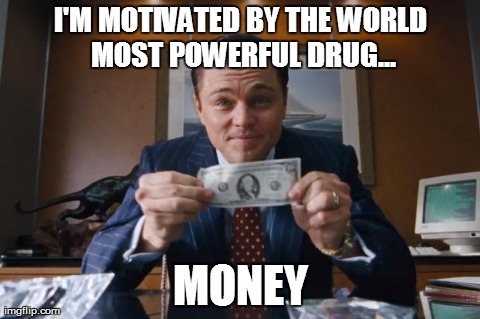
Toni and I just watched The Wolf of Wall Street last night. It’s about a guy who cared about nothing but money, and did whatever it took to get as much of it as possible, and then went about living the most worthless, hollow excuse for a human life I can think of outside of serial killers and the Inquisition. And the movie focused on that, for three hours, in excruciating detail. I have never seen that many scenes with hookers in my life. It’s a true story, based on an autobiography of the same name; the reviews online of the book (which I will not be reading myself) make the guy sound just as he was portrayed in the movie: as a guy who would lie and cheat and steal as much as he had to just to get more money to put on the pile, so that he could spend it on drugs and prostitutes and midget-throwing parties at work. (Not making that up, by the way.) Who would not regret anything in his life, because, in my opinion, he lacked sufficient humanity to know regret. All he knew was money. All he cared about was money. Now, because the movie was made by Martin Scorsese, it was not actually a celebratory movie: it was an expose of the emptiness of this kind of existence. And I have never felt happier about my life and my choices than I felt while I was watching this epic debauch. I am so proud of myself and everyone who helped me to become what I am — my parents, my wife, my teachers, my culture — that I care about things other than money, that I see money only as a means of survival and not of any source of self-worth or identity definition. I am so happy to be me instead of that shit-heel who called himself “Wolf.” I hope that was Scorsese’s intent, because if so, it was a masterful piece of work that was completely successful.
But I couldn’t help but think: if my students watched this movie, they would want to be this guy. Because he made money. And if I asked them, the next day, why they were in school, they would tell me “Because I want to be like the Wolf of Wall Street.” (I’ve heard similar sentiments in the past, but using Hugh Hefner as an example, or Bill Gates.) And that scares the hell out of me.
The Warrior of World’s End (The first book of the Gondwane Epic)
by Lin Carter
I’ve been reading some of the older pulp fantasy/sci-fi books, and this was one of those — a Daw paperback, the pages yellowed on the edges, the cover price only 95 cents. Lin Carter is one of those names I always see on rows of thin, dog-eared paperbacks in used bookstores, but not one I ever needed to read.
But that was only because I didn’t know what I was missing. And if you’re a fantasy fan, especially a fan of cheesy Robert-E.-Howard’s-Conan style fantasy, you must read Lin Carter.
This book was brilliant. I can’t wait to get back to the used store and buy the second book in the Gondwane Epic, and then keep going until I get to the end — and I hope that’s a long way off. The basic idea is this: 700 million years have passed since our current era, and the Earth’s continents have drifted into each other to form a single mega-continent — the title of the epic and name of the continent coming from the primordial Gondwanaland, the mega-continent that was the southern half of Pangaea, when all of the Earth’s land surface was in one land mass that became two and then became many — and things are, of course, very different. It’s a fantasy world-building technique that I’ve always enjoyed; my other favorite use of it was in the Wheel of Time. In this case, you have a traditional swords-and-sorcery society, with the opening narrative from the point of view of a trader riding a donkey from one great city to another, passing through the Crystal Mountains by a great desert, with his wife, who is actually a sentient plant-being. On the way through the mountains, an earthquake shakes the land, and soon they discover a Great Epic Hero wandering through the aftermath, lacking even the ability to speak intelligibly — but his thews are mighty, and his hair is glittering silver. This is Ganelon Silvermane, the hero who will save the world from doom: the star of the epic. The trader and his wife take Ganelon in and raise him like a seven-foot-tall bodybuilder/baby; they teach him to be honorable and courageous and everything a hero should be, and then off he goes a-heroin’.
It’s great. Carter uses all kinds of unnecessarily fancy words and complex sentences, but without making the book as hard to read as, say, H.P. Lovecraft’s work. There is a simplicity and childish glee in it that made me smile the whole time. It reminded me very much of Conan, or of Edgar Rice Burroughs’s John Carter of Mars series, but with a heavier tilt towards fantasy and away from SF — since there is a Red Enchantress, and an Illusionist, and Death Dwarves, and a magic flying bird-vehicle made of brass and granted intelligence and a personality, and the ability to speak. Ganelon meets a lithe Amazonian-type warrior woman, whom he saves from evil priests, and who I’m sure will be a love interest at some point, but our hero is too innocent of the ways of love as of yet; so far all he does is fight great battles and break large things with mighty swings of his flashing sword, all that kind of stuff.
It was a hoot. Highly recommended for those who like this sort of thing.
If you liked this book, you might also like:
Conan stories by Robert E. Howard or Robert Jordan
John Carter, Warlord of Mars series by Edgar Rice Burroughs
The Genius of Dogs
by Brian Hare and Vanessa Woods
This was a good read: it was a decent book with fascinating information in it, and not just because I love dogs. Though that certainly didn’t hurt.
The basic idea is this: dogs are geniuses in one specific area of cognition. The book carefully and precisely documents that genius, and discusses how it came about and what it means, both for dogs and for humans. Brian Hare is a cognition expert, and has made an exhaustive study of this topic, which resulted in this book; because it was exhaustive, he studied not only dogs, but also foxes, wolves, dingoes, and New Guinea Singing Dogs, along with as many different breeds of dog as he could, all in order to test the parameters of dogs’ genius.
The genius of dogs is this: dogs are better than any other species — better than dolphins, better than chimpanzees or other primates, and MUCH better than cats (Had to get that dig in there — but seriously, if you want to win every future argument about which are smarter, dogs or cats, this is the book for you) — at understanding humans. They can grasp more words, more gestures, more specifically taught abilities, than any other creature. Most interesting and most impressive is this aspect, which Hare goes into in depth, complete with cute anime-style illustrations: dogs don’t just understand what we tell them, they understand our intent. Dogs can learn to obey any gesture, from a spoken command to a pointed finger to a nod of the head or a turn of the body, so long as that gesture conveys the human’s intention. That is, if you want a dog to look underneath a box for a treat, you don’t even have to say it: you can point, or nod, or turn your body towards the thing you want the dog to do, and the dog will do it. This is actually quite remarkable, as it shows a level of empathy between species that would seem impossible for any but humans — and not even most of us.
Reading about the science and the stories of dog genius was interesting and touching for me as a dog lover. I will say that the book’s writing is not genius: Hare is a scientist trying to write a popular science book (with the help of his wife, Vanessa Woods), and he doesn’t do a great job of it. The book seems self-serving at times, with Hare giving himself credit for discovering the remarkable intelligence of dogs; he’s actually being tongue in cheek, but it doesn’t come through, and you want to roll your eyes a few times. But the man knows his science, and he loves his dogs; and that’s all you can really ask for from a book, don’t you think?
Renting a home. It makes no sense at all. The basic concept of the capitalist exchange doesn’t work, here, because you’re not exchanging money for goods or services: the tenant does not own the home, and the landlord is not doing anything for the tenant. Yes yes of course, the landlord is selling the right to live on his property; but he’s not really selling it, because there are stipulations. (And how does one sell the right to live, anyway? I swear I read something once about inalienable, or some such.) Stipulations are only possible when ownership is not exchanged: a landlord telling a tenant he can’t have a dog is like someone selling you a car and saying, “But you’re not allowed to use Reverse. You can only drive forward.” That would make sense if someone was borrowing your car (and you had a pathological fear of moving backwards, or of mirrors, or of the letter R), because you still own it, and you can tell the borrower how to drive it. But that isn’t analogous to renting a home, either: because borrowing is done on a single-use basis, and only with people who know and trust the owner. I have lived in many homes whose owners I have never met, not even seen or in some cases known their names. Nobody would lend things like that. You’re giving someone a valuable thing (Because if it isn’t valuable enough to give back, then it isn’t borrowing — as we all remember from that guy in school who used to ask to “borrow” a sheet of paper every class, and who used to get crap for that verb. “Sure, Tad-Biff — you gonna give it back when you’re done?”) with the expectation that you will get it back after it has been used — generally used once. The borrower reads the book and gives it back; watches the movie and gives it back; makes punch and serves it in the bowl and then gives the bowl back. Unless you’re Ned Flanders and you’re giving your stuff to Homer Simpson, that is. But that just proves my point, because the Simpsons is a satire of modern life, with Homer as the man who does not ever abide by the social contract.
What does it say about landlords when their basic transaction makes them like Homer Simpson?
The real divergence, though, is in the money: if you let someone borrow your car, that person should certainly be responsible for the gas they use and any damage they do; but what kind of full-bore jackass would you be if you charged money just for the simple use, on top?
“Sure, you can use my car while yours is in the shop. Cost you $20 a day.”
You’d be a landlord kind of jackass.
Of course I’m oversimplifying in some ways. There are plenty of businesses that lend use-without-ownership of something valuable in exchange for money — cars, power tools, DVDs, electronics, furniture, even money; but a home isn’t a thing you “use.” Living somewhere is not using the home; we don’t say “Last year I used outside of Denver, but now I use in Colorado Springs.” It’s much more than that. A home is the place where we live: a home is where we spends time with our family; a home holds and protects all of our possessions, which shape and define our time, and therefore our lives, in all the spaces our families don’t. A home becomes a touchstone for almost everything — it’s where people find us, where they send things to us, where they bring us when we’re too drunk to get there ourselves. A home defines a person, in many ways, because it allows you to do the thing that defines you — you can’t be a gearhead without a garage, or a cook without a kitchen, or a gardener without a garden. You also can’t survive at all without shelter or safety or sleep, all of which become extremely difficult to acquire without a home — and therefore a home makes you human. Home is where the heart is, where life is.
How can I live in a place that doesn’t belong to me?
The answer is, I can’t; that’s why the laws defend the resident, the tenant, and even the squatter much more than the owner. Possession is nine-tenths, and our society recognizes that — though that last tenth, in the hands of the 1%, means that our government has done quite a lot to protect the landlord, too. But in essence, we know, deep down, that the person who lives in a place has some right to it, has some claim of ownership on it. It’s just too bad that we don’t actually live according to what we know to be right.
All right, enough: let’s pretend the basic concept is sound, and discuss the jagged little pieces of insanity that come with renting a home. First, landlords lie. The photos online do not in any way resemble the actual property; at best, they choose the one flattering angle and then stand on the garbage can in order to crop out the broken fence, the tumbleweeds, and the rusty nails and shattered beer-bottle glass spread across the yard like tinsel on the world’s worst Christmas tree. Why do they try to change the way the house looks in the pictures? Do they think we’re not going to see the place when we show up to look at the inside, or to rent it, or to take possession? Are they going to stand directly in our line of sight, holding up an enlarged copy of the photo from Craig’s List, saying, “Here, see? Here’s the house, you can see it right here. NO! Don’t turn your head. Close your eyes for a second and I’ll show you the other rooms, one at a time.” Or do they think that we’ll show up, see the reality, and think, “Well, it sure looked better in the pictures. Maybe this is just an off-day. Maybe the light is bad here. I’m sure once I’ve given the landlord money, it’ll look like it did online!”
Maybe landlords just do a lot of internet dating, and got into the habit of using fake pictures and hoping the other person doesn’t bolt when they see the truth.
Now, Toni and I have in fact rented two different properties from a distance, once when we moved to Oregon and then again when we came to Tucson; but for the second one, we had a local connection, a good friend of mine from high school who lives in Tucson, who went around and scouted out our prospects for us. This means that out of the times that we have rented a house, there is exactly one time that deceptive photos online would have taken us in. So then why?
It’s not just the photos, either. “Single-family home” in the ad becomes “Broken-down dirt-crusted center unit in a triplex” when you drive by. “Fenced yard?” Sure, if you think the row of old bent croquet wickets lining the dirt patch qualifies. “Great neighborhood” if you intend to get jumped into the local Crips — is it called a lodge? A chapter? Crips Country Clubhouse? Anyway. “Off-Street Parking” means you can park on the sidewalk between the dumpsters and the rats’ nests. “Cooling system” means you can open the windows and hope for a breeze. We all know the buzz words: “cute” and “quaint” and “cozy” all mean “small;” “character” means “old,” as does “traditional;” “easy maintenance” means “it’s already broken.” Sometimes things just vanish: the included washer and dryer, the recessed lighting, the covered patio “great for entertaining.” And in every case, I wonder: did they think we wouldn’t notice? It’s one thing if you sell a kid a toy in a cardboard box, and it’s only when he gets it home that he discovers that his new G.I. Joe Attack Helicopter doesn’t actually fly by itself — thanks for that emotional scar, Hasbro — but this is a home. The customer is going to live in it, for a very long time. They will notice that the front door is missing, and they will say something about it to the person who still legally owns the home.
But let’s say you find a place. The ad looks great, you drive by and the neighborhood seems acceptable — you know, drug deals happen in a BMW instead of a burnt-out Toyota shell, the graffiti is aesthetic, the local hoarders keep their piles inside instead of in the yard — the place has what you need. So you call: Sorry, that was rented seven years ago last July. Yeah, I need to remember to take down that Craig’s List post.
A moment about Craig’s List: all websites have their problems; some don’t filter well, some have too many ads or not enough information, some don’t have a good map or the photos are too small; but Craig’s List is special. Only there can a month-old listing be automatically renewed and then get labeled as “Posted six hours ago.” Only there can one person list the same property seventy-nine times, so that your search for a place turns up just that one freaking condo. Only there can people post an email address as their sole contact information, and then fail to return any and all correspondence. I’m glad that Craig’s List exists, because I prefer renting from individuals rather than property management companies with their own professional, polished websites; but I really wish someone could keep some individuals from using it.
But as I said, all websites have their problems. No pictures is one. That’s just absurd. Am I supposed to fall in love with the place based on your turgid prose? What is this, the nineteenth century? At least show me an etching. Another problem is failing to give particularly vital information — like the cooling system, here in Tucson. I don’t mean to be single-minded in my housing criteria, but you better believe I want to know about the air conditioning when the summer days regularly reach 110. (Side note: why the hell do all these houses have no air conditioning? Are you aware you live in the desert? And that extreme heat is uncomfortable? What is this, the nineteenth century? Shall I just sweat into my waistcoat and then bathe after a fortnight?) Another problem is when they don’t give the address unless and until you contact them and listen to a spiel about the place. It’s the same thing as the lies: you can say what you want, but I’m still going to drive by, and then insist on seeing the inside, before I give you a dime.
That brings me to a new problem we encountered on this search, but not in the past. There is a company here in Tucson that has two businesses related to rentals: they manage some properties, and they also offer a listing service — meaning they will sift through the dozens of websites and find listings that match your criteria and then send them to you, for a $60 fee for three months of emails. Fine and good. I don’t want to use the service, but I can see the value of it, particularly for very busy people, or those with the time and inclination to look for that one perfect needle in the haystack. The issue I have with them is that their listings, the properties they actually manage, are used as bait: they set the rents low, post listings on all of the regular sites, and conceal the addresses, offering their phone number for more information. Then you call and ask about that one place you saw online, and what do you get? A sales pitch for their listing service, which you need to sign up for before they will tell you a single thing about that one place you called for. Most annoying business model since the Jehovah’s Witnesses.
And by the way: did someone say rent? Did someone say the rent is too damn high?
I can’t go into numbers, because they vary too widely from place to place, but the fact is, the amounts we are expected to pay for housing are just absurd.
A recent report from the Joint Center for Housing Studies (JCHS) at Harvard, puts some numbers on just how bad this problem is: About half of all renters in the U.S. are using more than 30 percent of their income to cover housing costs, and about 25 percent have rent that exceeds 50 percent of their monthly pay.
How some of these people can stand to demand this much money for the broken-down shacks they offer is beyond me. I am extremely happy that we have moved to a place where there is enough inventory, and enough vacancy, to enable us to find a place for a decent price — which occurred partly because it was empty long enough for the landlord to bring the rent down — but sadly, the state where we live is one of the worst for paying teachers, so even with reasonable rents, the rent is still too large a piece of our income. But I know I am saying nothing that people don’t already know, and already bewail. Allow me just to point out that in Jonathan Swift’s famous essay A Modest Proposal, the one about eating Irish babies, the villains he names specifically are the landlords who take every penny that the poor Irish could earn or beg, leaving them no choice but to starve:
I grant this food will be somewhat dear, and therefore very proper for landlords, who, as they have already devoured most of the parents, seem to have the best title to the children.
Let me move on to something that not everybody will know about: renting with pets. The first problem is that this cuts your choices in half, if not by two-thirds — although (and this is even more annoying than the number of landlords who won’t allow pets) several of those just don’t have it listed as an option, but if you call them, they don’t mind pets at all. Jerks. The second problem is the types of pets that are allowed: cats OK, but not dogs. Dogs OK, but not cats. Dogs and cats OK, but not over 25 pounds. I had a landlady turn us down once when I told her I had an iguana in a terrarium. The biggest problem, though, is that owning pets seems to be seen as a license for landlords to demand stuff: additional clauses in the agreement. Pet deposits. Pet rent. I mean, pet rent? Are you assuming that my pet has an income, and therefore you deserve a piece of it? Let me tell you: he doesn’t. Nobody pays him to be cute. He gives it away for free. Which is what makes him a better person than you. Let me also note that this whole scheme is bunk: would you charge me different rent based on the number of people living in the place? What if I had two jobs — would I pay two rents? The whole thing is ridiculous. An additional pet deposit on top of the security deposit presumes not only that my pet will do damage to the home, but also that said pet damage will be on top of the damage that I will do to the home, which will consume the entire security deposit. Same thing with additional pet clauses in the agreement: can’t you just leave it at “Don’t mess the place up?” Do we need to describe the ways I am not to mess the place up? Thank you for your trust. Here is all of my money.
All of it, and not just for rent. I’ve seen places that want first and last and a security deposit and a cleaning deposit and a deposit for each pet. A new one this search was a place that actually said the deposit was non-refundable. So does that mean they’re just going to keep it when you move out? Not surprising, that happens more often than not, but to just say it like that takes a lot of brass. Then they want fees: application fees, up to $80 per adult (And again: why do you need both of us? If I can pay the rent with my income, aren’t we done talking?). Just to apply for the opportunity to give you all the rest of my money. They want a credit check, a background check, proof of income (which must be three times the monthly rent), proof of employment, rental history going back five years, references from your last landlord and from three trustworthy individuals who know your character. It’s insane.
Look. I just want a house. Not a big house. It doesn’t have to be brand new, and it doesn’t have to be in perfect condition, and it doesn’t need to have nine bathrooms and a spa and all chrome-and-platinum appliances. I just want a place where my family can sleep at night, and then get up in the morning and go about our day. A place where I can write, and my wife can paint, and our dog can play with his Wubba. Somewhere that has rooms that fit our furniture, with enough space left to walk around and between things. Somewhere I can put my books on shelves, instead of in plastic tubs in the storage shed in the backyard. A cute place would be nice, but I’ll take a place with potential. Somewhere we can feel safe. Somewhere to live.
I am an atheist: start from there. There is no God, no higher power, no consciousness directing the universe. Everything that happens, happens because of random chance, multiplied by time. The essential symbol of my worldview is the Big Bang: everything that exists came from an explosion.
So then how do things make sense?
How does an explosion create a stable planet, in a stable solar system, at the Goldilocks distance from the sun, with liquid water and an oxygen-nitrogen atmosphere? With a tilted axis and an oversized moon allowing for seasons and tides? How does an explosion, nothing more than energy added to matter, create life? How does that life continue to exist long enough for evolution to take place, which eventually leads to – me? How can I be sitting in my air-conditioned living room, next to my dog (who is lying on his back waiting for tum rubs [He gets a good skritch every time I pause. Like now.]), typing these words in English on my laptop computer, drinking coffee with half-and-half and stevia and and cinnamon-flavored honey – because of an explosion?
People of faith see the answer to these questions clearly: the answer is God. We are surrounded by miracles, and there is no clearer evidence of the existence of a benevolent creator. People have been reaching that same conclusion independently for tens of thousands of years, all the way back to the people who were buried with Earth Mother figurines, and those who raised Stonehenge or made the heads on Easter Island. We look at the amazing world we live in, and we assume it had to come from someone or something divine.
But there is no God: that is the starting assumption. So then how?
I hear people say, “Let go, and let God.” I mock it, because I find the idea of surrendering free will, of one’s own free will, inconceivable. I hate being told what to do. I hate trusting someone else to figure things out for me. If I could, I would grow my own food, fix my own car, whittle my own furniture. I have been struggling recently because in the upcoming school year, I have been instructed to use a pre-determined curriculum, one detailed and prescribed down to two-minute intervals, scripted and designed and carefully laid out in every way. Oh, I’ve been told that I can, and should, adapt it to my own preferences; but my preference is to chuck the entire thing out of a moving car, preferably into the midst of a brawl between switchblade-wielding badgers. I don’t want to teach what someone else tells me to to teach. I have never liked that, and I have never done it: other than some small things here and there, an idea for a lesson, a single handout, I have never followed anyone else’s plan for a class (Except for one: I taught David Schmor’s Speech class, pretty much start to finish; his assignments, his lectures, his grading methods. But that says more about how well David designs a class than it does about my predilections. We’ll call it the exception that proves the rule.). Whenever problems arise in my life, I handle them, either by myself or with my wife by my side: two of us against the world. I don’t like the idea of relying on anyone else: certainly not on God, whom I don’t believe in and wouldn’t trust if I did.
But how can I do that? How can I create everything I do as a teacher out of my own head? I was a terrible high school student – skipped or slept through many of my classes, never did the work, passed because of a good memory and a love of reading, and with the mercy of more than one teacher. I didn’t learn anything in my teacher-preparation program, except from the time I spent student teaching – which I largely did on my own; that is to say, I got advice and feedback from my master teachers, but I designed the lessons, I taught the material, I graded the work. I read pedagogical textbooks with an eye so jaundiced it’s nearly blind; whenever I take any teacher training workshop, I either don’t pay attention or I don’t do what I’m told. So how on Earth am I a good high school teacher? Where did that come from?
It’s nearly the same thing when I write. I have never really studied writing, other than as literature I have read; I’ve never had a writing mentor. I don’t edit: the first draft is pretty much the final draft. I don’t think much about what I’m writing in advance; I plan out my novels pretty extensively, but my blogs? I just pick a theme, think of an opening, and go. When I hit the last sentence, I post it On top of that, I’m generally pretty damned lazy, and unfocused: I am one of those people who pick up new hobbies and put them down again right away, because I’d rather be playing video games. How did I get to be a good writer? Where did this ability come from? Not from my parents, who are both intelligent but non-creative. I have writers in my family tree, but are creativity and writing acumen really genetic?
The miracles that surround us aren’t just natural: this morning as I stood in my shower, hot water streaming over me, sluicing away the shampoo and soap, looking at the tile walls, glass window, wood and brick house, electric lights, municipal water supply and sewers, I thought about: how could people possibly create all this? Particularly what has been added to our world, in terms of capability, of convenience, of complexity, all in the last century? A hundred years ago, if I had the running water (Never happen on a teacher’s salary then – but would I have been a teacher 100 years ago?), it wouldn’t have been hot, and I wouldn’t have had the electric lights, the coffeemaker, the refrigerator (Maybe an icebox), the computer, the dog adopted from the animal shelter. Just 100 years ago. My grandparents were there. How have human beings been capable of creating all of this? Did we have guidance? Divine inspiration? Can we create because we were made in the image of a creator? And if not (Not, indeed), how?
When one of the millions of the faithful “lets go and lets God –” what happens? Who goes there? Things don’t stop happening, and the lives of those who put their faith in God do not fall apart in a spectacular collapse; things often work out just fine. It’s like someone’s guiding them, making things work out. So if it isn’t God (And it isn’t. Spoiler alert: this writing is not leading to my spontaneous conversion.), then who is steering the ship? Starting from my basic assumption of atheism, of a universe without a creator; who or what makes things work out for the best?
My wife and I have adopted two dogs from shelters, one in California and the second here in Tucson. Both of our dogs have been absolutely lovely: very smart, very loving, almost no trouble to train and care for. In neither case could we possibly have predicted, when we chose them and brought them home, that those dogs could have been the sweet, wonderful companions they both proved to be. And we frequently ask ourselves: How did we get so lucky?
I’ve been reading The Watchmen, and one of my favorite moments in the book is when Dr. Manhattan, a man-turned-divine being who is trying to decide if he should save corrupt and fallible humanity, tells his former (and very human) sweetheart that he longs to see a thermodynamic miracle: an event so unlikely that is is effectively impossible, like oxygen spontaneously turning into gold. He says that he has realized, in talking to her, that he is in the presence of one such event: her. The chances of her parents coming together to make a child; of one particular sperm out of hundreds of millions uniting with one specific egg; of that zygote’s survival to become a child; of her upbringing and life experience turning her into the woman she is, and of her meeting and loving (and being loved by) Dr. Manhattan, a blue-skinned superbeing who can see neutrinos – that’s a miracle. Every human being is a miracle, Manhattan says; and he decides he will save humanity because of that.
I’ve used a similar example with my students. I met my wife Toni at Cabrillo Community College in Santa Cruz, California. She worked in the bookstore for her workstudy, and I had a job one semester taking ID photos, in the cafeteria upstairs from the bookstore. The IDs were $8, and so I always had to get change; I went down to the bookstore to get it. That’s how we met.
But look at the probabilities involved. Toni didn’t go to college right out of high school; like me, her academic transcript was spotty at best. She chose to enter the world of employment, where she did quite well for several years. She decided to leave a perfectly acceptable middle-class lifestyle, one that would have satisfied millions of Americans, and go back to school to study art. She decided to start her education at the community college; she decided to go full-time, and leave her job, which is how she ended up working in the bookstore. If she had gone to school earlier, or later, or if she’d kept her full-time job or gone to work in the registrar’s office instead of the bookstore, we’d never have met. Me, I wanted to go to UCSC because I wanted to study creative writing, and because my father, who worked at Stanford at the time, had a friend who taught physics at UCSC, who told my father, who told me, that they had a good creative writing program. He showed me the town on one visit, and so I decided to go there. But my grades were terrible, and so I couldn’t get in to UCSC. But rather than choose one of the thousands of other schools – rather than stay in Massachusetts, where I grew up – rather than join the Peace Corps or start a grunge-rock garage band, I decided to go to the community college in Santa Cruz, 3,000 miles away from the place where I lived, with no better recommendation for the university I had decided on than the word of my dad’s friend, for two years before transferring to UCSC. Except then my Cabrillo counselor screwed up, and my general ed. program turned into three years, instead of two.
I met Toni during that third year.
How did this absurd chain of events (And it goes farther: I had just ended a relationship about a month before meeting her. What if I hadn’t? Our first conversation ever featured me acting like an idiot, mumbling and stumbling through every sentence; what if she hadn’t wanted to speak to me again? What if, what if, what if?) come to pass, and lead eventually to my finding the love of my life, my soulmate? It’s no wonder people decide that fate is real, or karma, or God. What other explanation makes sense?
When people pray, and then hear the voice of God tell them the answer, what voice is that? Something tells them what to do, where to go, how to act; something gives them the solution to their problems, the inspiration they need to create something new and revolutionary, or the comfort to survive the slings and arrows of outrageous fortune. If it’s not God, then what is it?
It’s not God. That I’m sure of. So you know what I’ve decided it is? What is responsible for humanity’s incredible accomplishments, and our unbelievable resilience, and adaptability? The reason we can handle anything put before us? The force that makes our world full of wonders, that brings long chains of coincidences into some kind of order?
It’s us. We do these things ourselves. Because we’re fucking awesome.
How can I teach well, without any resources other than my own brain? Because I’m just that good. How do I write well? Because I’m a genius, and because I read the writing of other geniuses, and I pay attention. I am standing on the shoulders of giants, but they are tall because they stand on others’ shoulders – not because God raised them up. Human beings made the miracles, not the other way around.
How did Toni and I get to be the couple we are? The actual meeting had some dumb luck to it, but mostly, we made it happen because we wanted to. She chose to speak to me, and then she chose to speak to me again; eventually, I broke through my awkward shell, and she saw how awesome I am.
How did we get awesome dogs? Because dogs are awesome, and we treat them well and appreciate them for what they are.
How can people handle whatever terrible trials that life throws at us? By being absolutely incredible, strong and determined and intelligent and resilient.
We are incredible. We can do anything. There is no God: we need no God. We are enough, and more. We are.
So the next time your life seems about to overwhelm and drown, remember: remember what humans have done, remember what humans can do. You can do it. You’re human. You’re awesome.
No better way to close this than with the collaborative work of several of my all-time favorite creative humans.
I’ve tried to read Mieville’s books before. Twice. Couldn’t do it either time. (Same thing with Mervyn Peake’s Gormenghast trilogy. Two strikes. There won’t be a third pitch with that bloated sack of wood pulp.) Admitting that makes me feel like less of a fantasy reader, as everyone seems to just love China Mieville’s work. He”s one of the stars of fantasy fiction of the last ten years. What kind of a twerp can’t appreciate his writing?
So that feeling of inferiority, that niggling voice that tells me that everyone else is right, and I’m just not reading this stuff the right way (Must be because I’m not smart enough?), made me go back a third time to try Mieville’s work. I tried to read Perdido Street Station and couldn’t; I tried to read King Rat and couldn’t — maybe this one will be better.
UnLunDun.
You know what? This one was better.
In fact, I loved this book. I loved the two heroines, the pair of school-age tween girls from the council flats (British version of the projects) who find their way to UnLunDun; I loved the Wonderland feel of the anti-city that these two girls go to; I loved the characters they meet there, particularly the bus conductor, the strong man in the diving suit, and the rooftop Parkour gypsies. I loved the humor of the book, the sheer joyful whimsy of it. I loved the bad guy, the patsies, the thugs and monsters on both sides. I loved the ladder-tower of books — and I know what my UnLunDun job would be. I loved the morals tucked away here and there between the puns, and how they didn’t rise up and slap you in the face, but just sat there, quietly, waiting for you to notice them: books are a path to wonder. Destiny doesn’t matter as much as choice. Courage and loyalty can win the day — sometimes. Corruption is everywhere — but it can be fought.
This is a book I would strongly recommend. I would recommend it to people who love fantasy, to people who love humor, to people who want to see the world in a new light. I would highly recommend it to young women looking for fantasy books with female heroes, as this may be one of the best examples I’ve read of that particular under-represented character in the fantasy/sci-fi world: girls who kick ass.
And I’d recommend it to people who want to read China Mieville but just can’t get into his books. This one worked for me.


 And does this behavior result in disability or premature death? Of course it does. That’s the point.