Book Review: Dork Compendium

Dork Covenant: Dork Tower Compendium #1

by John Kovalic


I bought this comic collection used from Powell’s books, well over a year ago; I was saving it for the right moment to read – and after getting bogged down in a lengthy non-fiction book, and while reading a disturbing Stephen King book, this was the right time to read this.

I can’t believe I didn’t know about John Kovalic. I can’t believe I didn’t know about this comic that he has been writing and publishing for almost twenty years. I can’t believe I didn’t know that he is still publishing it on the web (www.dorktower.com), or that he has illustrated a number of games, including Munchkin. I can’t believe I didn’t know all this stuff because John Kovalic knows everything about me.

I am this comic.

I have lived these arguments, these experiences. I had the D&D rulebook that inspired the cover art for this. I have both been and known the min-max gamers like Igor, who find ways to twist the system and overpower their characters – I remember an old Champions character (Anyone remember Champions? Superhero RPG from the 80’s? I bet Carson the Muskrat would!) who took the “disadvantage” of being incorporeal, which allowed him to purchase massive amounts of power, and also, coincidentally (not coincidentally), made him impossible to defeat physically – and I have run games, as Matt does, in which my players ruin my carefully crafted storyline within moments, generally through killing innocent and helpful characters just for the hell of it. I still get into arguments with my dork friends about Star Wars Episodes 1-3.

And, God help me, I have LARPed. I was LARPing the very same vampire game that Dork Tower satirizes when I met my wife, who resembles Dork Tower‘s Perky Goth, at least a little. I am thankful that meeting my wife pulled me a reasonable way out of the gamer dork world, because I don’t doubt that without her, I would have finished my transformation into these characters, and continued living this life, all the way through the conventions that they go to but I never did, and the E-Bay purchasing frenzy, and the burning hatred of the rise of Pokemon. (I can completely relate to the strip set in the game shop that shows grown gamers surrounded by just the very tops of children’s heads, the rest hidden by the frame, as the children mill around saying “Pokemon? Pokemon? Pokemon?” like some kind of zombie lemming horde. I saw this when I tried to start a gaming club at school and was inundated with freshmen playing Pokemon, while I and a few seniors tried to run a proper D&D game. Damn that game.) I can picture myself going through the pathetic attempts to date, always ruined by the fact that the woman would inevitably ask me, “So, what do you do for fun?” And I would have to say, “I’m a gamer.” And then watch as she leaves.

John Kovalic wrote that strip. I read it, and I laughed. I laughed a lot reading this compendium, and knowing now that there is a whole world of this comic for me to read makes me extremely happy and grateful. As happy and grateful as I am that I found my wife, and that she was able to ignore the LARPing and the violent rage at my Magic the Gathering games, and stay with me, and save me.

This whole strip is highly recommended for anyone who knows or lives La Vida Dorka, as Kovalic calls it. And this seems like the best place to start, with the first compendium. Available for purchase on the website.

The Sims Update: Calm Before the Storm

The Colossus of Belladonna Cove

There is a storm a-brewin’ in Sims country. We are still in the calm before it, but there are squalls. So before it comes down on us like the vengeance of Thor, let’s look around and see how the land lies.

We’ll start at the top.

Bella Donna: When I decided to run this Sims game, where I played an entire neighborhood of created characters, I picked Belladonna Cove, one of the standard neighborhoods that come with The Sims 2 on PC. I played it the last time I had a long-running Sims game – in which I tried to build an entire village of polygamists, guys who had multiple loves each in their own home with their own children, and the guy would support his secondary wives while living with his First Wife – and I like the look of it. Plus it has a large statue of a woman holding a Sim spindle, and that was perfect for this aspect. See, I wanted there to be a benevolent overlord, one who kept the peace; so I made a good witch. I named her Bella Donna, because she rules the Cove, maintaining the peace. She looks like Glenda the Good Witch, blonde and blue-eyed and wearing all white witch garb. She has a cat, which I named Elphaba, and she is the only Sim who does not age. Once I made her, I worked hard to have her meet all of the people in the neighborhood, make friends with them all, and then I had them pay her tribute – they bought various interesting and expensive items, invited Bella over, and then Gave Gift and handed her the TV, or the computer, or the nice stove, or the roller rink. If they needed more lifetime, I wouldn’t have them buy the green juice; I had Bella give it to them. Youth was the witch’s gift. Bella went into the Political career, and was rapidly elected Mayor of Belladonna Cove.

It worked great, but eventually I felt like Bella was getting bored. So I had her fall in love: with Contessa Lisa Raymond, one of the vampires in the Downtown expansion to my neighborhood. Then the Contessa – who appreciates the finer things, and couldn’t understand why Bella lived in a simple single-family home near the shore – convinced Bella to move into the biggest house available, the haunted mansion on top of the highest hill. She did so, and Lisa moved in with her and they wed.

But the happy couple’s time is limited. Because Bella has become distracted, and evil has arisen in her Cove.

Carlos Contender

The Mrs.

Carlos and Jessica Contender: Carlos is one of the fun characters: he started as an Elder Sim, but he had oodles of money, and he had the Romance aspiration and the Massive Attraction trait, so he was still a player, which was the character description set up for him. I found it was incredibly easy for Carlos to seduce women he met out on the town, take them on dates and WooHoo, and so he rapidly seduced three of the available ladies. But Carlos had a target on his back: he was old, he was wealthy; and Jessica Peterson started out living in a trailer park, and wishing she could meet a man who would take care of her. As soon as she connected with Carlos, it was no contest: although she had a fling or two while the two of them were dating, he soon fell in love and proposed. They wed, and Jessica moved in with her new wealthy husband, and began waiting for him to die. But Jessica was soon surprised to find that Carlos had lost none of his virility: she soon became pregnant, and then gave birth to twins, which the Hall-of-Fame boxer Carlos named Cassius and Clay Contender. And after that, Carlos just would not die. Seriously: that Sim got to be 100 “days” old, then 105, and every time I played the family, as the kids grew to toddlers and then children and then started approaching their teens, and Jessica got older and older – I gave her a jar of green juice, because my original intent was to have her play the field once she inherited Carlos’s money – I just kept waiting for him to croak.

Finally, at the ripe old age of 108, Carlos’s lifebar looked pretty full. So I had him have his last day (I hoped): he hung out with his kids, and since he is the brother of one of the other characters, I had him invite that whole family over and reconcile with all of them, bringing back up friendships that I had let lapse. And indeed: I could not have coordinated it better, because that same day, while his family surrounded him and exactly at the moment that his two boys grew to be teenagers, the Reaper came for Carlos. His sons grew, celebrated their happy youth – and then immediately started mourning their father’s death.

Gabriel and Chastity: These two, Gabriel Green and Chastity Gere, were roommates in this awesome converted garage in the “downtown” looking area of the Cove. And the story that came with them was this: Gabriel was in love with Chastity, but she was still playing the field. So yeah: Gabriel worked longer hours than she did, and while he was gone, she would Greet any guys who walked by the house, build a relationship, take them on a date, and then bring them home and WooHoo them. Then the guy would leave, and Gabriel would come home none the wiser. I decided to hook the two of them up, because I liked Gabriel and I figured Chastity-of-the-ironic-name wouldn’t pass up a sure thing, so they had a home-date and a WooHoo. But then the inevitable happened, and Gabriel came home early and caught her. Heartbroken, he threw her out, met a nice game-generated girl named Vanessa, settled down, and now they have two kids and a dog named Wilbur. Chastity I moved into her own home and tried to turn into the town pump, but something glitched and every time I played her the game crashed, so she was relegated to the limbo of the Family Bin.

The Clevelands: Jason and Melissa are both Money oriented, and he wanted to be Captain Hero of the police force, while she wanted to be a Criminal Mastermind. And this struck me as so odd that I decided they would have to be very strange. So I decided I would warp their children. They already had a teenaged son, and that was fine; Melissa wasn’t actually employed as a criminal yet, so young Justin escaped to college before things got weird. But Melissa wanted another baby, and so the two of them had Mason: and Mason has lived a very strange childhood. His parents taught him nothing as a toddler – not how to speak, not how to walk, and they never potty-trained him; instead, they Lectured him every chance they got, starting as an infant, every time he soiled himself. Then they would give him baths. That kid got dozens of baths, daily baths, in between being alternatively chewed out and neglected. So now, Mason really loves water, and both hates and loves his parents. And he is still a child, but at some point, he is going to kill first Jason and then Melissa, and then embark on a career as a serial killer who will invite people over, get them into his pool, and then remove the ladder and watch them drown.

As I said, my darker Sims urges proved impossible to suppress.

Image result for geoff rutherford and Connor Weir sims 2Image result for geoff rutherford and Connor Weir sims 2

Geoff Rutherford and Connor Weir: These two bros started as friends living together so they could afford the nice house, said their storyline; so I decided they would be swingers. They would meet and marry, have children – still living in the same house together – and then wife swap and have two more children. I loved this plan (and thought of it as adding fuel to Mason Cleveland’s madness-fire, because Geoff is Mason’s uncle, Melissa Cleveland’s brother). But two things went wrong: after Geoff started fooling around with Connor’s wife, and they fell in love, Geoff’s own wife came home and Geoff made out with her – which sent Connor’s wife into a jealous rage. That shit never goes away, not when they’re all living in the same house. And even worse: Geoff and his wife had twins. And only after playing them up to toddlers did I realize: there were now seven Sims in the house. I could not make two new wife-swapped babies until one of the kids moved out. So I scrapped this whole family into the bin, and replaced them with . . .

Trent, Trisha, and Tina Traveller. Not my fault.

And their dear friends, the Gavigans

The Travelers and Gavigans: Two families, each with a young child, that I put into the same household once I moved Geoff and Connor out to limbo. I was more careful this time, and I got Trent Traveller to woo, seduce, and impregnate Mary Gavigan, and then Nathan Gavigan got it on with Trisha Traveller. Now there are two babies in the household, a Gavigan who is half Traveller, and a Traveller who is half Gavigan. (This, by the way, is the family I was talking about when I got the weird look from the passing jogger, when I said, “I got my swingers to impregnate each others’ wives!”) I also had the two pre-made kids, who rapidly became teenagers, fall in love with each other; they will be a couple for life, a strange twist I liked so much I’m going to do it again with the two new children – who also don’t share any blood, though the father of each is actually married to the mother of the other. My plan at this point is to make this the strangest family tree I can think of – I want to move the two teens out and then have both women WooHoo and conceive by the same guy, and then I will move a new young woman into the house and have her bear children by both of the men. I do not know how I will be able to manage all of that – but I’m going to try.

Samantha on the left, Kim on the right.

The DeBateaus and Cordials: So this was the last family set that I went a little strange with. Though I blame the game for giving me the storyline in the first place. Two sisters, Samantha and Kim Cordial, who were, according to their bio, so fiercely competitive they didn’t know if they could live together. So Kim was one of the early – well, contenders – for the hand of the wealthy Carlos; thus I sent Samantha after the richest guy in town, Armand DeBateau. Kim lost Carlos to the trailer-trash, but Samantha won Armand, married him and moved into the penthouse he shared with his adopted teenaged daughter Tara. She got pregnant on their wedding night, and then I sent them on a honeymoon, my first attempt at a Sims vacation. It was fun, except I found something out: you can’t have children on vacation, so Samantha’s pregnancy didn’t develop at all over the two days they were there – but she was already feeling the misery of pregnancy, the rapid decline of comfort and energy and bladder and hunger, and the morning sickness that leads to vomiting and green stinky toilets. So yeah: never take a pregnant woman on a beach vacation. A lesson from the Sims.

But of course, this situation made Kim mad. So Kim did two things: first, she became an evil witch – it was perfect because the Cordial house had a secret room behind a turning bookcase, which was the ideal place for her cauldron and spellbook – and second, she went after her sister’s husband. And she got him, too, because there is no loyalty in the Simverse. He dated her, WooHooed with her, and impregnated her. After she gave birth to her daughter Hecate, she invited her sister and brother-in-law over, presented the child, kissed Armand in front of Samantha, and we had ourselves a good old blow-up.

After that, I decided to make Kim the town WooHoo-machine, since Chastity wasn’t working. And so she’s been raising her child and WooHooing with every guy she can – including Armand, who came back for reconciliation. And that’s all been fine – but Kim is an evil witch, as well. A powerful one.

And there’s a storm coming.

Ready Player One

Ready Player One

by Ernest Cline

I confess: I wish I’d written this book. I’m just a little bit too young – my brother, three years my senior, was the one who rode his bike down to the corner drugstore to play the new Pac-Man game when it arrived; I remember him telling the family about it, and being confused: so you eat the ghosts? – and not quite geeky enough, especially when it comes to Japanese anime and robot/monster shows, which I never got into. I watched Voltron (Both versions – everybody remembers the lions, but does anyone else remember the Voltron made of cars? Much cooler.) and StarBlazers and G-Force, but that’s about it. Fast forward a few years to Transformers and G.I. Joe, to Captain Power and the Soldiers of the Future, which featured a light gun shaped like a jet fighter that you could shoot at the TV screen and score hits on the bad guys, and I’m all in. I did play the role-playing games, and I watched the movies – War Games and Monty Python and the Holy Grail are also two of my favorites – but I never had an Atari 2600, so I never played Adventure seriously – just a few times at a friend’s house, where I got stomped by the dragons and opted for Pitfall or Centipede or Missile Command instead – and I never found the Easter egg in that pixellated dungeon.

So I couldn’t really have written this book, which explores geek culture from the 1980’s to a depth that I could not hope to plumb. But I am so very glad that Ernest Cline wrote this book, because I loved it. Absolutely loved it.

The book is about a video game challenge. It is set about 40 years into our future, when the internet has become a single enormous virtual reality environment, built by a Bill Gates-like figure who focused on video game design rather than operating systems and world domination. When this gaming guru dies, he creates a challenge for everyone in the system he created (which is essentially everyone around the world, in one way or another): find the secret challenges he left, conquer them, and you inherit his entire vast fortune, and control of the virtual world. And because this man grew up in the 1980’s, the entire thing is one enormous trip through the world of reminiscence: a kind of “I Love the 80’s” that focuses exclusively on geek culture and touches every part of life.

This is the first book in a long time that I actually didn’t want to put down, and at the same time, didn’t regret reading straight through: the excitement is excellent, but it isn’t constant, and so it didn’t feel exhausting. The dystopian elements were highly disturbing to me, particularly the mobile home “stacks” and the indentured servitude that came as a result of credit card debt, but they were wonderfully well done – and I especially liked that Cline also included some positive aspects: the idea of virtual school, with the improvements and limits that Cline describes, would be a dream come true for me, as an introvert who teaches high school English but would really like to spend lots of time playing video games and living through role playing adventures. I also loved that Cline managed to create realistic and genuine human interactions both within and apart from the virtual world; by the end, I wasn’t really sure if the hero would win the game, but I was really just hoping that he’d win the girl.

I identified with the characters, loved the plot and the adventure, and was completely enchanted by both the setting and the nostalgia. This is a geek masterpiece. You have my gratitude, Mr. Cline. Excelsior!

Ladies and Gentlemen: My Wife.

My wife picks me up from work every day. Yesterday, on the way home, I was telling her about an unfortunate consequence of one of my examples in class.

I gave one of my classes a Voice Lesson (If any teachers read this blog, I highly recommend this book for close reading/literary analysis practice — it’s here on Amazon.) which gives them a quotation and asks them a series of questions about it, and then has them imitate it in some way. Today’s quotation was:

Whenever he was so fortunate as to have him near him a hare that had been kept too long, or a meat pie made with rancid butter, he gorged himself with such violence that his veins swelled, and the moisture broke out on his forehead.
– Thomas Babington Macaulay, “Samuel Johnson”

The students then had to write an original sentence describing someone with disgusting eating habits, using at least three vivid details. Now, I answer all of these myself; but I don’t want to point the finger at anyone else and call them disgusting. So I described my own disgusting eating habits.

You see, when I was in high school, I ate, as many teens do, really appalling amounts of junk food. I picked three of the worst examples, and — even though I never combined these in real life — I put them all into one sentence. The three eating habits were: once I brought a can of Betty Crocker frosting to school for lunch, which I ate with a tiny spoon intended for stirring espresso; I used to eat beef jerky that came in an eight-foot rope form (With the unimaginative product name of “8-Foot Beef Rope.” Picture a coiled Slim Jim. And yes: I did try to make a lariat out of it. Didn’t work.); and as I was not picky about my throat-searing, stomach-churning soda consumption, I used to drink Caffeine-Free Diet Coke at room temperature, from two-liter bottles.

I told my students about this. And two of them, in a classic example of Why Mr. Humphrey Doesn’t Talk About The Stupid Crap That He Did In His Youth, decided that they would eat the same thing, and do it within a time limit — half an hour was what they were bandying about during class. This, apparently, was to be called The Humphrey Challenge.

I told this to Toni as she was driving me home. I said to her what I said to them: I do not want my name associated with this. I do not endorse these eating habits, particularly not all at once. This is not the thing I want named after me.

Toni said, her tone completely deadpan: “Everyone’s gotta have a legacy.”

I don’t think she even noticed the death glare I gave her for the following thirty seconds. If she did, it didn’t have any effect.


And then today: today on the way home I told her about the question I got today, which certainly ranks at the top of the list of Most Awkward Questions I’ve ever been asked by a high school student. One of my freshmen, who admittedly lives a very sheltered life — she made “Eeewww!” noises and faces throughout Romeo and Juliet, and left the room whenever Mercutio started making pornographic jokes — came in to my room today before the class started, and in a conversational tone she asked — in all sincerity — “Mr. Humphrey, what’s a boner?”

My first thought was, “How do I answer this?” My second thought was, “Don’t answer this.” I went with option two, telling the young lady she didn’t want to know. She was suspicious she was being played, but several other students — who are less innocent — agreed with me.

So Toni and I were talking about this, and she asked, “So that isn’t part of your curriculum, then?”

I said, “No, we don’t have a boner standard.” Though I admit I haven’t read all of the Common Core.

Giggling furiously, she managed to get out, “How about a rubric?”

Death stare one day, peals of laughter the next. She always keeps me guessing, and usually laughing.

“Teachers” Teaching Teachers

The trouble with education in America today is this: the teachers that are teaching teachers how to teach can’t teach.

I have a friend who is going through teacher training right now. (My friend has requested anonymity, and so I am going to leave out everything including gender.) I have been a teacher for a long time, and I know this friend very well, and here’s the truth: my friend is going to be an excellent teacher. My friend knows the subject matter, knows how to deal with teenagers – the intent is to teach at the high school level. Most importantly, my friend, like me, had a tumultuous personal experience in high school, and has been both a good student and a crappy student, both a model citizen and a juvenile delinquent; my friend will be able to speak with students, relate to students, understand students. My friend will teach students, and for some of those students, my friend will be their favorite teacher, the one they remember for years afterwards. Though they won’t come back to visit, just like they don’t come back to visit me. It’s okay – they don’t come back because most of the students who really bond with me do so because they are having a spectacularly miserable high school experience, the kind that beat poems and punk rock songs are written about. And if they came back to visit me, they’d have to relive what I hope was the worst time in their lives – and what I hope I helped them through. I don’t need to shake their hand to know they needed me to be who I am.

My friend will be the same. I know it. I try to be convincing and confident when we talk about the future teaching career, but my friend is also humble enough to have doubts, doubts that have taken me fifteen years to dispel, doubts I haven’t completely dispelled even now. It’s okay. Doubt combined with ideals makes us try to improve. It’s a useful tension.

You know what’s not a useful tension? Having a class that is half the duration of the usual college level course, and going almost half of it without getting any feedback from the professor. No grades, no comments, nothing for three and a half weeks, which covered ten graded assignments. No grades on any of them. That is not useful tension: that is a teacher not doing her job. And it drives me nuts, hearing about this, because I’m a slow grader, for two legitimate reasons: I don’t assign my students busy work during class, which means I never get to get grading done while my students are working on their new worksheet (Yeah, math teachers, I’m looking at you, you lazy punks); and two, I read everything my students write, and I try to give substantive feedback on everything I can. So it takes me a while. Except for two times during the year: the end of the semester, when I have to kill myself getting the grades in on time, and the beginning of the year, when I realize that my students are not familiar with what I want from them, what I am like as a grader, what is really important to me. They need to get a grade and feedback from me before they can feel comfortable doing assignments for me. So I try to grade the first serious assignment as quickly and thoroughly as I can – generally I can pound it out in a weekend, though I tell them it will never happen that quickly again. From that assignment, they learn the following: I don’t really care much about deadlines. Don’t care much about spelling, unless it is a formal essay. I don’t care at all about format, font, handwritten-versus-CG, or those little frilly edges that come from ripping pages out of a notebook. I care about what they think and how well they can express it to me. That’s what their grades are based on: and I make sure they know that before they have to turn in their second assignment.

My friend’s classes are all online. Which means there is no lecture, and there is no class prep; the teacher’s only job is to grade the work and monitor discussions. And yet the teacher – who had in her instructions dire warnings against even the thought of turning work in late – took three and a half weeks to return the first grades.

That’s not all: not by a long shot. The assignments come fast and furious: every week, the students in these classes – all of whom have degrees already, and so most of whom are already working, some full-time – need to read at least two chapters from the text, post a discussion topic that is thoughtful and thought-provoking and that cites sources; respond to at least four others students’ posts or responses to posts; and read at least 75% of the posts and replies in the discussion forums. For extra fun, the other students, eager little gold-star-seeking chipmunks that they are, try to post on every single topic and reply to every single response, sometimes at 11:00pm on the due date. And the more responses there are, the more each student has to read in order to hit the 75% of responses read mark. Thanks, guys. Way to throw your classmates under the bus in order to suck up. (But I also have to say: how American.) And each week culminates in a quiz, an essay, or a PowerPoint presentation on the week’s topic. Times two classes, times eight weeks. And even though both classes have large final projects due in the last week, which are weighted more heavily in the final grade, the discussions and responses and reading are still assigned for that last week. Nothing like giving people large projects and not giving them time to get them done!

The grades – now that my friend has gotten some (To be fair: in the other of the two classes my friend is currently taking, the professor, a former high school English teacher, responded within a week with the first set of grades, with reasonable comments. It’s only one of the two professors who can’t keep up with her own class’s pace.) – are sort of based on the content; but every assignment, my friend has lost some points not because of what the essay or presentation said – but rather because of the formatting of PowerPoint slides, or, more commonly, the lack of correct APA (That’s the American Psychological Association. Why are we using their format? Who knows?) citation formatting. This despite both professors letting some elements of APA formatting slide – the APA says, for instance, that every paper must have a title page and an abstract; neither professor has required that. But God forbid you fail to use hanging indents on your references page!!!

The textbooks are absurdly poorly written: they drag on and on and on, repeating the same information in a slightly different format, with ridiculous and unrealistic examples that don’t actually illustrate the concepts. For example, one chapter, on constructivist cognitive theory, explained the need for self-directed learners thusly: because change occurs rapidly, and certain innovations – like smartphones and green energy – have a large impact on society, it is vital that our students learn to become problem solvers. Now I agree that it is important that students become problem solvers, but the reason is because there are quite a number of problems that need solving, and the solutions will need to come from new minds that understand the problems and the possible solutions in new ways; traditional methods will not be effective. And the speed of change in society has precisely fuck-all to do with that. Thanks for the explanation, Mr. Textbook Guy. (Note: that is not a correctly formatted APA citation.)

The essays have minimum and maximum page assignments; this is common practice, I know, but as with every essay that has ever been assigned with a length requirement, the students focus first on the length, and only afterwards on the content. This aids in both creative editing and bombastic word-fluffing; not in learning content.

The short, informal discussion topics are worth 30 points and the essays are worth 35 points. That would be fine, except the essays are far more difficult and take at least three times as long to complete. For five more points. Way to prioritize. And here’s the best part: if you don’t earn a B on the final project, you cannot pass the class. That’s right: you can bust ass for seven weeks, run at 100% over 20 or so assignments; get a C on the final project – and fail the class. Really makes all that earlier effort seem worthwhile.

The quizzes, which are multiple choice and allow for multiple correct responses on one question, draw from different chapters that give different answers to the question, and require contradicting responses both marked as correct responses (I.e., the question was something like “Which are elements of how students learn?” and the responses had both “Through information processing” and “Through behavioral training,” which are opposing theories of learning – and both were correct answers.).


Here’s my point, in case I’m being unclear. Every single thing I’ve described here is terrible teaching practice. Good teachers build personal relationships with their students: these teachers are only online, and only contact their students indirectly, late, and in the vaguest possible terms. (And one of them uses Comic Sans. In multiple colors. With large amounts of capital letters and exclamation points. Reading her e-mails is like looking at Doge memes. But without the cute dog in the middle.) Content assessment should evaluate mastery of content, above all else if not to the exclusion of all else. Focusing on the minutiae like deadlines and formatting ruins the actual instruction of content. It’s fine to teach study habits that way, but not actual subject matter. Tests should never be tricky or obtuse, and the content resources should be clear and easy to understand, no matter how complex the subject – in fact, the more complex the subject, the easier the text should be to read.

And these are the people who are teaching new teachers how to teach.

My only hope is that the people in the class, including my friend, will learn nothing from these people. The last thing we need is a bunch of new teachers who don’t talk to their students, who give warnings but not grades, who give their students failing grades because they didn’t use one-inch margins and twelve-point font, and fail to help their students learn what they actually need to know.

Martin Luther King said that we have an obligation to disobey unjust and immoral laws. I would like to add that we have an obligation to ignore teachers who model bad teaching.

DOUBLE REVIEW! SO MUCH SCIENCE!

Death from The Skies by Philip Plait
Guns, Germs, and Steel by Jared Diamond


I normally don’t review two books at once. There are reasons not to do it now: these two books have more in contrast than they do in common, and my reading of both was quite different: Death From the Skies I read over the course of a couple of months, a little here and a little there; Guns, Germs and Steel I tried to read straight through, and failed to complete — at least partly because that is not, for me, the best way to read popular science.

But these books do have some important things in common: they are both popular science non-fiction, DFTS in the hard science of astronomy, GGAS from the social science of anthropology. Both are about death, destruction and the end of civilization as we know it. I finished one only a few days before I gave up on the other, which proximity promptly juxtaposed them in my mind (YES! Been waiting for a chance to say “juxtaposed.” That alone is enough reason to review them both together.). Both have, for me, an interesting premise. Neither includes zombies.

Now let’s get to the more extensive and interesting list of the differences. DFTS is about future death and destruction: the book is a list of all of the ways that the universe could wipe out all life on Earth: asteroid impact, massive solar flare, black hole fly-by, gamma ray burst, supernova, even alien invasion. GGAS is about the death and destruction that has happened in the past, specifically to the human race, caused by the rest of the human race. It asks one essential question: why is it that some civilizations have been able to thrive and grow, and others have not? And when civilizations come into contact with each other, and one or the other is destroyed or subsumed, what determines which civilization survives and which dies?

It’s an interesting subject, I think. Diamond takes as his prime example the conquest of the Incan empire by the conquistador Francisco Pizarro. Why was it that the Spanish empire managed to overcome the Incan empire? Why wasn’t it the other way around — Incan ships crossing the Atlantic, Incan soldiers wiping out hordes of Spanish troops, and an Incan general capturing the Spanish king, demanding an entire room full of gold for ransom, and then executing the king anyway, as Pizarro did to Atahualpa, the Incan emperor? Or why couldn’t the Incas fight off the Spanish, and establish their own hegemony over the Americas? Diamond examines this and every other contact between civilizations that he can, and in exhaustive — and I mean exhaustive, fatiguing, meticulous, infinite as well as infinitesimal, and finally brain-numbing — detail, he explains.

Here’s the spoiler: it’s the title. The Spanish conquest of the Incas was accomplished not by Pizarro, but by smallpox, which had been dropped off on the coast of Mesoamerica ten years before, by Hernan Cortes and his troops in Mexico, along with the various explorers and traders who followed Columbus’s lead to the New World. Atahualpa wasn’t even supposed to be the Emperor of the Incas: the emperor of the Incas for thirty years before Pizarro’s attack was Huayna Capac, who led the empire to the height of its size and power — until he died of a fever, probably either smallpox or measles. Along with his successor, his eldest son Ninan Cuyochi. The empire was the divided between Atahualpa and his brother Huascar, who proceeded to wage a civil war for control which Atahualpa won after several years of fighting — right before he was captured by Pizarro. The battles that did occur between the Spanish and the Incas were won by the use of guns, steel weapons and armor, and mounted cavalry, none of which the Incas had.

Diamond actually explains every reason why the Incas didn’t have cavalry, why the Europeans had the deadlier diseases, why they had better weapons, why they had guns, why they had better ships, why they had writing; it has everything to do with the ecology, the geography, and the histories of the two areas of the world, the Americas and Eurasia. And honestly, it’s pretty interesting.

The problem is that Diamond writes sometimes like a popular science writer, but much more often like a scientist, which he is. And that’s fine. But like all scientists writing treatises about their research, his goal is to be meticulous and scrupulous in explaining how he came to his conclusions, rather than to make the book interesting. And I think he succeeds in that: because I felt like he asked the same question ten or twelve times, from different angles — why didn’t the Incas have cavalry horses? Why didn’t they have large domesticated mammals? Why didn’t they have the same agricultural productivity? Why didn’t they have the same population? Why didn’t they have the same specialization of professions within society? Why didn’t they have writing? — and every time gave a complete answer, but every time it was the same answer: geography, ecology, and history. Over and over and over again.

And then he moved on to Australia. And then Africa. And at that point, I just couldn’t take it any more, and I stopped reading it.

Now Phillip Plait: that man knows how to make a popular science book interesting for the average reader. Every chapter describes a new way that the universe could kill us all. Each chapter begins with a hypothetical description of that death, how it would arrive, how it would progress, and specifically how it would kill us (Generally speaking, Robert Frost was right: fire, or ice.); then the chapter describes the science behind the cataclysmic event; then it describes the probability of that event happening, based on our knowledge of the universe. He goes from the most concrete elements to the most abstract, and because of that, by the time you get to the abstract stuff, you’re ready for it, and you understand what he’s talking about, and you want to know more — generally because the description of the deaths is pretty horrific, but the probability of any of them happening is “Pretty danged small,” or else it’s a certainty — but not for billions of years. Like when the sun dies. Definitely going to happen; definitely going to kill us; definitely not due for about 7 billion years. It’s comforting, really.

(Not all of it. The first chapter, on asteroid impact, is actually pretty scary, as is the second, about massive solar flares wiping out our power and communications. The solar flares couldn’t kill us directly — but I’ve read enough post-apocalyptic fiction to know that if the power and communications go, Road Warrior and cannibalism are not far behind. And I would not do well in that world. The alien invasion one is much more speculative — but it’s creepy as hell. Robot spiders. That’s all I’m going to say.)

And here’s how Plait handles the science: he makes jokes — good ones, including a Spinal Tap reference. He explains the science, but he also makes it clear why we should or should not know the details. An example: before Plait gets into the chapter about the end of the universe, he takes a few pages to discuss scientific notation (And I apologize for the formatting — the exponents were superscript in my draft, I swear. Don’t know how to make it happen on WordPress.) — our planet is 4×10^9 years old, the universe 1.3×10^10. The end of the universe will come sometime around 10^70 years from now. And Plait was smart enough to know that people would think, “Wow — that’s sixty times the current age of the universe. That’s a really long time.” But the thing is, it’s not. 10^15 years is not six times as long as 10^9 years: it’s 1,000,000 times as long. That’s the age of the Earth lived over again one million times. And I’m thinking about my summer break in four months, and it seems a long way off. 10^70 years is so absurdly far into the future we can’t even fathom it. And Plait explained that, in a way I could understand. It helped.

Plus he explains all the awesome stuff about the universe. I feel like I understand black holes better now — just in time for me to watch Interstellar on Hulu. And now I know that spaghettification is a thing. My new favorite thing, in fact.

So here’s the point: I’m glad I read part of GGAS. I’m glad I didn’t spend any more time reading the rest. If you are terribly interested in prehistory and the rise and fall of civilizations, you may want to read it — it is very clear and easy to understand, and yep, it’s thorough. But for me, I’d rather read about the Milky Way colliding with Andromeda in a few tens of billions of years. GGAS just made me want to play Civilization on my computer.

Which I may just go do now.

Welcome To The Sims Update

The Sims Update

I don’t know about you people: but I still play The Sims. In fact, I still play The Sims 2. We have The Sims 4, but only on the laptop; the desktop only has Sims 2. We don’t have Sims 3 at all. Because Sims 3 sucked.

A couple of years ago, I read an article about unusual topics for college application essays; the one that spoke to me most clearly was a young woman who had applied to college and used The Sims to explain herself to the admissions officers: because you see, she had been playing the same game of The Sims for four years, and she had carried her Sims through twenty-seven generations.

That blew my mind. Just imagine that: if the average Sim takes 30 years to reproduce (If you’ve never played the Sims, they generally take one full day, 24 hours, of Sim time to be equivalent to a year of life; you have three days as an infant, then four as a toddler, then eight as a child, ten as a teenager, and 28 as an adult before you become a senior; how long you live as a senior is dependent on how happy and fulfilling your life has been up to that point. So yeah, about 30 Sim days before they can reproduce), 27 generations is coming up on a millennium of Sims. A Simillennium. I’ve never even played my Sims through three generations — though that’s usually because I kill them.

I’m something of an afficionado of Sim murder. Simicide.

But I was inspired. I was going to start a new game of Sims, I decided; and this time, I wasn’t going to do what I usually do, and make up the wackiest Sim I could think of — wasn’t going to make a pirate who lived in a house shaped like a ship, wasn’t going to make a family of Cthulhu worshipers, or mafiosos, or a sweatshop where imprisoned Sims paint pictures all day for their abusive and tyrannical overlord. This time I was going to play the Sim families that came in the pre-generated neighborhood, play them straight, and see if I could run them through many generations.

So I’ve been working on that. It’s hard, honestly: because there are a lot of families, and I can only play for a little while each day. I’m afraid the whole endeavor is now doomed, because this desktop, as it nears a decade of life, is breaking down; and I don’t know what will happen to my Sims when the computer dies. Will I re-install this game, now over a decade old, onto my new desktop? Will the neighborhood be saved with the files from this computer, and transferred onto the new one? Or will their universe collapse into oblivion, and I will need to start over again? Will I be willing to start over again, or will I just play more Diablo III?

Plus my penchant for strange Sims has proven inescapable: already in this neighborhood I’m planning my next serial Sim killer. I already have a witch in a lesbian relationship with a vampire. Another witch, this one evil, who seduced her sister’s husband and bore him a child. A trailer trash gold-digger who married an old man for his money.

Here’s the thing: I love The Sims because it invites story-telling. You can create a whole new person, and for me, that’s an opportunity to build a character with a backstory, and then run that person through conflict and resolution, conflict and resolution. And I love story-telling. It’s kind of what I do.

So here’s the new plan. I’m going to post updates on my Sims on this here blog. Not every week — I know not everyone finds The Sims as interesting as I do. But whenever I have something particularly interesting and wacky happen, I’ll tell you all about it. That way, even if the game ends when the computer does, at least I’ll have gotten something out of it. I’ll have told some stories. Hopefully they’ll be good ones.

Here’s the first story, though it’s actually corollary to The Sims. This morning, when I was floating this idea, of occasional Sims updates on the blog, past my wife, we were out walking our dog. And she was skeptical at first, questioning whether this would be terribly boring — because I generally play every day, for a little while, and the thought of daily updates was enervating: “I got my Sim a promotion today! Now he’s ninth level in the Medical career!” No no no, I told her. I would post less frequently, and just about the amusing and strange things that my Sims do.

“Like, ‘Today I got my swingers to impregnate each others’ wives!'” I said. Loudly.

And just then, a man out speed-walking for exercise walked past us, and heard just that last statement, without context. That was the strangest look I’ve received in a long time.

I think now that my Sims are strange because they take after me.

Magic Bus

Here, the background music first:


Okay, so when I was young, I wanted to own my own bus. I had this great idea: I was going to buy an old tour bus, take out all of the seats — maybe leave a row or two up front, for passengers — and fill the rest with custom furniture, specifically hammocks and beanbags and TVs and video game consoles.

Then I owned a home, and found out what a pain in the rear it is to convert or customize or upgrade anything. I also found that I have no knowledge of, nor interest in, automotive repair or mechanics. So I let this fantasy go, along with being an astronaut and out-selling Stephen King.

But then I saw this beauty parked in my neighborhood. And now I want a bus again.

IMG_0192IMG_0188 IMG_0189 IMG_0190 IMG_0191

Coffee Day (Hail the 42! Hail the Blessed Beverage!) is coming up next week, on February 11. I hope to have a story written by then, about driving this bus, with its beautiful restored retro style, and its utterly cool coffee theme, down to Belize to find the perfect coffee bean. But if I don’t get it done — at least I have this bus indelibly imprinted in my imagination.

And I choose to think there are hammocks inside. And beanbags in front of the flatscreen TVs and the Playstations.

Groundhog Day: Short and Pointless

I was thinking this morning that, because of this wonderful movie (though it’s too bad about Andie McDowell, who also screwed up Michael for me), Groundhog Day is the perfect day to examine your path and see if it’s become a rut. Are you learning from your mistakes? Are you improving? Or are you doing the same things you have always done?

But I only thought of it this morning, and I didn’t have enough time to write it out properly so I was going to save it and try to write it next year.

But here’s the thing I am doing that I should change: my blog posts are too long, and too infrequent/irregular.

I need to write/post more often, and shorter stuff. So here’s a nice, short post about this fairly simple thought.

We don’t live the very same day over and over again — but generally speaking, a lot of our days are very similar, one to another. And there are frequently things that bother us about our days — and they frequently repeat.

Where we can change those things, we should. Because at some point, if we keep changing the things that aren’t quite right — someday our very lives will be different.

It’s worth a try.

I’ll be back tomorrow.

The Party’s Over

“Your guilty conscience may force you to vote Democratic, but deep down inside you secretly long for a cold-hearted Republican to lower taxes, brutalize criminals, and rule you like a king. That’s why I did this: to protect you from yourselves. –Sideshow Bob, “Sideshow Bob Roberts”

(This is the third installment of my political corruption series, and the last. For now.)

Let’s be clear (If you read my stuff, it’s probably already clear): I am a lifelong Democrat. I am the child of two lifelong Democrats: my parents voted for John F. Kennedy, for William McGovern, for Walter Mondale, for Michael Dukakis; I voted for Clinton, for Gore, for Kerry, and for Barack Obama, twice. I don’t understand why people can vote Republican: the wealthy, for whom it makes personal sense, have to be callous, I feel, in order to refuse to maintain the social safety net for those less fortunate than they, or unbelievably greedy in order to agree to destroy the regulatory state so that they can make even more money at the expense of our very world; the poor and middle class are voting for social causes, not for personal gain (Unless they believe in trickle-down economics, but in that case they are deluded), but I see two problems with that: first, they are on the wrong side of most social issues – anti-choice, anti-equality, xenophobic, and parochial – and their candidates don’t ever deliver on their promises. So if you’re wealthy, how can you stand to vote Republican? And if you’re not, why would you ever think to vote Republican?

I read an excellent book by Thomas Frank, What’s the Matter With Kansas, in which Frank examines how Kansas, his home state and, through the 1800’s and early 1900’s, one of the most radical and progressive states, became so very staunchly, unflaggingly, self-destructively conservative. What happened was that Republican candidates around the early 90’s started pushing a pro-life agenda as the only issue that mattered – you know, the usual “40,000,000 murders,” “Culture of life” stuff – and when elected, every Republican proceeded to lower taxes, kill social services, remove regulations on business, make sweetheart deals with corporations, and basically ruin life for the average person; and then go back to election yelling “We have to end the scourge of abortion!” Which got them re-elected, into majority after majority — and yet they continued to fail to do anything about abortion, simply pushing their pro-business agenda on the state to its steadily growing detriment. But the pro-life agenda, whipped into a frenzy every new election cycle, was so compelling that nothing else seemed to matter to the voters, who kept voting Republican until it put their state where it is now – essentially hollowed out, unable to provide even the most basic elements we expect of our governments, like schools – not that Kansas schools teach anything other than creationism and abstinence, according to the campaign promises of the Republican candidates.

That’s how I see Republicans: selfish, deluded, misguided, and absurdly optimistic– or, less kindly, willfully blind to the fact that their politicians don’t ever deliver on the things they promise that won their constituents’ votes: on the national scene, we still have Obamacare, we are still giving foreign aid to dozens of other countries, our veterans are still dying on the streets, abortion is still legal, gay marriage is now legal as well, and there still isn’t a wall between the US and Mexico. So why would anyone vote Republican?

Here’s the thing, though: why do I continue to vote Democratic? It was Clinton who ended the Glass-Steagall Act, which, more than anything else, precipitated the economic crash that happened ten years later, under George Bush but not – I repeat, not — because of him. It was Bush’s fault that our government wasn’t in a better position to help after the crash, because he gave away Clinton’s surplus in tax breaks and war spending; but the crash was because of the Democrats. Democrats who I voted for. And of all of my other causes, the most important to me is the reduction of violence and misery, and the improvement of equal opportunity for everyone; the largest obstacle to all of that is income inequality. Which Democrats conveniently ignore, not wishing to appear – gasp – Socialist. (I know, I know – Bernie Sanders. But he’s also pro-gun.) We have Obamacare, but without the public option, it is more of a burden than anything useful; my costs for health care are still going up, every year, while my wages are going down: I make less now than I did ten years ago. Unions are still dying, and women still don’t make the same wages that men do, and Guantanamo is still open and still incarcerating prisoners of war who have never been to trial, and guns remain unregulated, and schools remain unfunded, and everyone is still driving Hummers while we drill for oil in the Gulf of Mexico.

So who’s really the fool, here?

I think the answer’s pretty obvious: we all are. We have all been sold a bill of goods that doesn’t match what the grinning faces behind the counter are putting into our baskets.

This is the last form of political corruption I want to write about, and that I think I have a solution for: this one is the corruption of the entire system, through partisanship and self-serving deception. This political corruption is the two-party system.

I would love to go back now to when the two-party system made sense and worked well for Americans; but in all honesty, the two-party system has always been about helping itself. Having a clearly defined and well-known political party makes it easier for candidates affiliated with that party to get elected: the party label offers a certain legitimacy, and even loyalty, in that people often vote the “straight ticket,” picking the candidates affiliated with their party without knowing anything about them. The party also offers a political apparatus that makes it easier to get heard and therefore elected; you need staff, you need volunteers, you need access to media and to debates and the like, you need a platform that people can hear and understand and support. The political party that exists before and beyond one’s own candidacy offers all of that; unless you’re a billionaire loon like H. Ross Perot, bless his wrinkly, big-eared heart, you wouldn’t want to form your own party just for your candidacy, and you almost certainly couldn’t afford to. So political parties are useful, and they aren’t going away – more’s the pity; because by far the easiest solution here is just to ban them entirely. But then it would be too hard for anyone not an incumbent to mount a national political campaign, or even a serious state-wide one, and that would not be any better, as those in power – who already have political staff, legitimacy, and access to media – would get re-elected even more often than they do now. So okay, we’ll keep political parties.

Now, if that party represents a certain set of values that the voter supports, then well and good: but because there are only two parties with any real legitimacy in this country, those two parties become too large and unwieldy, their umbrellas too wide and encompassing such extremes, that voting for the party doesn’t really mean supporting one’s specific causes: is this Republican candidate an evangelical Christian who wants to put the Ten Commandments on the American flag and mandate both creationism and prayer in schools? Or is he a Libertarian seeking the end of the income tax and government reduced to only two services, international commerce and the military? Is this Democrat in favor of a path to citizenship, but also supports private prisons, or is she looking to legalize marijuana and strengthen the Second Amendment at the same time? We can’t tell based on party affiliation.

Now, the two-party system theoretically serves the middle: because the two parties have to have such broad appeal, they tend towards the center. And thirty or forty years ago, I think that was probably true: but it isn’t now. And before that – say, eighty or a hundred years ago – it also wasn’t true. Way back when it was formed, the Republican party was single-mindedly abolitionist, which was an extreme (albeit correct) position; the Democratic party, in response, was for decades staunchly segregationist and pro-states’-rights. Also not moderate positions. Today, we have one party – I’ll let the reader guess which one – that has discovered that it can motivate its base through extreme and inflexible positions on social issues; in other words, the more extreme and zealous and inflammatory the party gets, the more votes they turn out. The entire party is moving away from the center, and at the same time, becoming more successful, because of it. More successful, that is, at winning elections: they are certainly not more successful at governing, a profession they seem to have cast aside in favor of demogoguery. Meanwhile, the opposition party is trying to maintain its foothold in the middle; but as the other party keeps going farther and farther to one side, the middle drags in that direction – and rather than hold their ground and make the extremists come back, the moderate party is moving with them, and thus also becoming less moderate: while surrendering entirely the side of the political spectrum they were supposed to be watching. I feel like, any minute now, the Democrats are going to turn around and see that a Republican has captured their flag while they were all on the other side, trying to keep an eye on the Republican team – who were having a dance party around their own flag, completely ignoring the Democrats and the entire game, but subtly distracting their whole team so that no one was left to play defense. And somehow, Vince Lombardi was behind it all. Or Ronald Reagan.

The two-party system is also supposed to provide stability: because the parties are predictable, and centrist, and inclusive, and effectively share the electorate, they are forced to compromise, which isn’t terribly hard because their positions aren’t far apart, and so they can respect and agree with each other on most things; any one politician also realizes that his opposition is not going away, and so he has to work with them. Except our parties aren’t providing that, either: instead we get hatred and bile and petty partisanship that blocks everything useful, even stuff that shouldn’t ever be a question, like raising the debt ceiling, or providing for the 9/11 First Responders. Honestly, any government that can’t give those guys health care and a pension that would choke a horse is no kind of government at all.

So that’s what we have: no kind of government at all. The parties have lost their way: rather than improving our democracy, they are hurting it; because their goal is no longer to represent the will of the people, but rather to maintain and expand the power of their party. As long as their party wins, nothing else matters. Politics is become a team sport. The propagandists (You know – the cheerleaders. Though I can’t think of anyone on this Earth who looks less like a cheerleader than Rush Limbaugh and Karl Rove.) have taken over, and they have realized that they don’t need to steer their parties towards what the people want; they can make the tail wag the dog, and the party can tell the people what they want. As long as they say they are in favor of what the people are in favor of – this side will ban abortion, that side will close Guantanamo and ensure that women make equal pay for equal work – they don’t actually have to do those things in order to maintain power. And as long as the person says they are a Democrat or a Republican, that’s a win, even if they don’t actually act like it: and so the Republican party will support Donald Trump if he wins the nomination, and the Democratic party will support Bernie Sanders, even though he is a Socialist independent.

I don’t even have to argue that the political system is broken: the race for President – which has already been going on for a full year – will likely come down to Hillary Clinton and Donald Trump or Ted Cruz. Bernie Sanders will likely not be in the running. (And I have to say: in that scenario, I almost wish that Ted Cruz would win, so that Mitch McConnell could stand up in the Senate and say that his first goal is to ensure that Ted Cruz is a one-term president. I want to see how well Mr. Cruz can do when he can’t blame things on Obama. Although of course he’d keep blaming Obama for everything, anyway.) If the system worked, then Sanders would run as a Socialist, Trump as the head of the shiny new Trump-Solid-Gold Party, Hillary Clinton as a Democrat, Ted Cruz as a member of the Inquisition, and probably Marco Rubio as the Republican. And then we’d have a race, by God. You’d have two actual centrists, Rubio and Clinton, one on the left in Sanders, one on the far right in Cruz, and Trump off on a tangent, somewhere far out in Nutsville.

So how do we change things to achieve that glorious outcome in the future? Well, there are a couple of ways. The first thing is we can bring back the Fairness Doctrine, which required opposing viewpoints to be presented on any television station that aired political views; that, with a certain minimum percentage of votes – say, 5% of the popular vote in any one election cycle – required to gain status as an opposing viewpoint, would allow alternate parties to gain media access, publicity, and a voice in the system. That would be the best thing: allow parties a chance to gain their own foothold, and stop this nonsense where everyone other than a Democrat or Republican is a “third-party candidate,” which is seen almost universally as a wasted vote.

We could also eliminate the one-winner-takes-all election system, and the single-representative system with it. Depending on whether we want more representatives in Congress, it could look like this: the Congress members from a certain state would all run in one general election, with up to as many candidates as there are seats from each party – so in a state with ten Congress seats, there would be ten Republicans, ten Democrats, ten Socialists, etc. – and the popular vote would be divided by percentage. So if 50% of the state voted Republican, 30% Democrat and 20% Socialist, then the state would get five Republican congresspeople, three Democrats, and two Socialists; you could either have the parties choose their reps by caucus, or have a run-off within the party for which candidates get the slots. Alternately, you could run the same system but with multiple candidates from the various parties winning a single “seat,” that is made up of several actual members; though that would greatly increase the number of Congresspeople, and still allow for districts to be gerrymandered. I like the state-by-state bloc voting, personally.

And one other thing is critical: term limits. It is absurd that we don’t already have these in Congress when we have them almost everywhere else, including the Presidency. I’d suggest about a decade for each seat: four two-year terms in Congress, two six-year terms in the Senate. Maximum twenty years in the legislature. And anyone currently past that is out at the next election.

All of us are unhappy with the partisan politics. I have seen this meme several times of late, and I expect to see it even more between now and November.
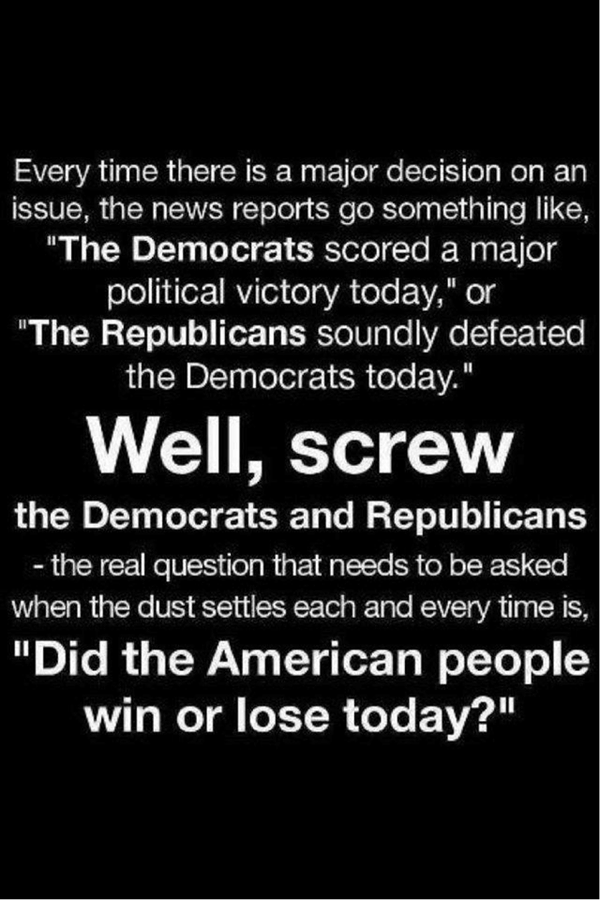
Screw  the Demopublicrats

We need to fix the system, because the people who are breaking it aren’t going to turn around and fix it, and breaking it even further is not going to magically bring it back around to a good place. Too be specific: Donald Trump will not make America great again. No Republican and no Democrat will.

We the people can. We will. We just have to do it. Now, please.