Spring Break Book Review #5 (With bonus rant!): Anthem

Image result for ayn rand anthem book cover

Anthem

by Ayn Rand

This one was interesting for me. Politically, at least, which is probably the only way that Ayn Rand can be interesting to most of us. I read The Fountainhead in high school, on my (overly intellectual) brother’s recommendation; I didn’t think a whole lot of it. That was it for me and Ayn Rand, other than seeing her name and ideas associated with various smug libertarians; I didn’t think a whole lot of them, either. But recently, I’ve been involved in more serious political discussions with a fellow who has opened my eyes in several ways (Though honestly, I don’t think a whole lot of him, any more), and he has recommended Ayn Rand as the philosopher, and her Objectivism as the philosophy, for the future of this country. And so I plan to re-read The Fountainhead, and add in Atlas Shrugged, and see if I want to go forward from there. And while I was cleaning out my classroom bookshelves, I came across a copy of Anthem, which, like Willa Cather’s O! Pioneers, I have seen taught to high school lit classes in the past, though I’ve never taught it or read it myself. But heck, I’m going to be reading Ayn Rand quite a bit, soon; and this one’s short, so let’s give it a try.

Okay, Ms. Rand. I get it. The perfect man, perfect in all ways – tall, strong, handsome, ever so Aryan, dominant and masterful, intelligent, courageous, and perfectly logical and rational – exists purely out of nature, regardless of upbringing or environment. In a dystopian future, a society degraded and debased by the horrors of COLLECTIVISM, there is no hope for the ennoblement of humanity: until a noble man is born. Once born, he cannot be restrained: he will discover his own perfection, he will stand up to the forces of evil and oppression; he will choose his mate – who will, of course, offer herself up in perfect submissive surrender to the perfect man’s perfectness, because who could resist that perfect man? – and then he will forge on into the wilderness and the chaos and conquer all that lays before him. This is his destiny.

That’s the book.

I’m being a tad too critical, however, so let me pull back. Anthem is the story of a future dystopia where everyone lives for the common will of mankind, and individuality in any form is forbidden and savagely squashed. One man is born different, and he struggles against what he is taught: that there is no truth other than what the collective holds to be true; that there is no good other than what the collective holds to be good; that the purpose of his life is to serve his brothers in all things. In his rebellion, he discovers first that there is a better way to live, one found through his own individual efforts, his own individual genius; he discovers an ancient subway tunnel, and in it he performs experiments on the forgotten relics of our own time, buried and intentionally suppressed as not for the benefit of the collective, who do not want life to be easy, as it is the purpose of man’s life to toil in service of his brethren. The individual man re-discovers electricity – because he’s a genius – and tries, in the most noble and altruistic way, to share his discovery with the collective so that life can be improved for his brethren. And he is mocked, and shunned, and driven out for his crime, for discovering things that are not known to all of the collective – and so therefore, they cannot be true.

I see the point here, I do; and it is worth thinking about. Much of our society relies on shared ideals, on shared standards of truth and goodness; we still believe things because “Everybody knows it’s true.” We do think that what is good for all is good for one, and that a person who lives purely for himself is selfish, and therefore sinful and bad and wrong. We don’t believe it to the extent portrayed in this book, but that’s the point of dystopian satire: to take our flaws and magnify them in order to draw attention to them now, before they reach that terrible future point. And living purely for a collective, which destroyed Ayn Rand’s native Russia under Stalin and the communists, can surely become a great evil. I get that. I do. I see where we should keep this in mind when we attack each other for not holding to the orthodox view: the need for liberal orthodoxy leads to the movement against GMOs, which almost certainly hold no harm in and of themselves; and from there it’s a short step to the anti-vaccination movement, which has taken the distrust of Western medicine and pharmaceutical corporations to such an extreme that now it has become a hazard to the health of us all. And we liberals, with our elitist snobbery and disdain for those who are “ignorant,” as we call them – mainly those who hold other views (and not, ironically, we liberals ourselves, even in those areas where we cannot explain our positions but merely cling to them because they are the orthodox dogma, despite our own ignorance) – we are to blame for this sort of thing, to the extent it is really happening. Ray Bradbury makes a similar point in Fahrenheit 451 when he points out that the desire to remove any and all offensive material leads to the destruction of all literature and art and creative thought; another slippery slope that liberals tend to ride down in our worst moments.

And all that’s fine: but this book is not. The warning is somewhat valid, but the solution offered, the belief that one single epic hero-man-god – Harrison Bergeron, if you will – can solve all problems through his own heroic efforts, is disproved by the story itself, no less than is the pure goodness of life for the collective. This dude doesn’t save the world by himself; he re-discovers what other men already knew, using their artifacts. He doesn’t run off into the wilderness by himself; he takes a mate with him, and even though he says the only happiness he has found is what he has discovered by himself, the most happy moment in the book is when he first kisses that woman he rescues – or rather, that woman who rescues herself, as she leaves the collective and tracks him down in the wilderness. And then she submits herself entirely to his will: and while he chooses a manly individual name for himself, he then gives a name to her – and it’s a name that keeps her in a subservient position, valuable only as breeding stock for the continuation of his manly genes, as he becomes Prometheus, the Fire-Bringer, and she is – Gaea. The Mother. Of the sons (not daughters) he plans to raise to be manly men just like him. And he doesn’t forge a new life with the strength of his own arms; he discovers a house built by other men, and books written by other men. And once he has built himself a mighty army of like-minded individualists, what does he plan to do? Go back into the collective society and save those of his brethren he happens to like and wish to help.

So the idea that a single man acting alone is the only source of all good things? Nope. The idea that happiness can only come from individual action, without reliance on other people? Still nope. The idea that every man must live only for himself, that no man should impose his will on another, that violence can only be used in self-defense? Nope: he uses his will to suppress the will of his Gaea, and intends to commit violence against the collective in the name of his fellow men.

In terms of the writing, meh. She had the clever idea to write the story in the first person, but without the singular, because the collective has eliminated the concept of “I,” allowing only “we.” Watching the narrative then twist itself into knots trying to describe single individuals while only calling those individuals by “we” or “they,” that was pretty interesting. Did a better job than the actual plot of showing how vital is the individual human ego. And I believe the individual is vital: but not because Ayn Rand convinced me of it.

I realize this is only a novella, and not one of Rand’s key works; but so far, all I can see is that her philosophy is self-defeating – though certainly attractive, in that if I follow her advice and refuse to allow my individual energy and accomplishment to be taken from me for the good of others, then I get to see myself as one of these perfect epic heroes who understand the truth, that only egotism is right and good. But apart from appealing to the selfish, so far it seems like a whole lot of hooey.

Didn’t like the book, would not recommend.

Spring Break Book Review #4: The Troll Garden

Image result for troll garden signet classic

The Troll Garden

by Willa Cather


I found this one at a garage sale, put on by a former literature professor; he gave me a discount on this and the other two or three books I bought, including a nice paperback of Dracula, which I’ve never read all the way through but will be diving into soon.

I’ve never read Willa Cather, though I’ve always been surrounded by copies of O! Pioneers, a classic usually part of American literature classes, though never my own. I got this because I loved the cover, and because I held out hope that it would actually be about a garden full of trolls — I also got a copy of a Kenneth Grahame book of short stories, and if that man can write about moles and toads and badgers who own halls and motor cars, why couldn’t Willa Cather write about gardens full of trolls?

Because Willa Cather wrote about despair, that’s why.

The title actually comes from a cute little ditty:

“We must not look at Goblin men,

We must not buy their fruits;

Who knows upon what soil they fed

Their hungry thirsty roots?”

And the book is related: it is about people’s secret desires, often dark, and generally leading to bad places. These stories are about unrequited love; about poverty and working-class life and how such a daily grind wears away every noble impulse in a person; about how people want what they cannot have, and don’t recognize what they do have, and don’t want it when they do have it. It’s a book about hunger and thirst, and the darkness we turn to in order to feed that hunger and thirst, and what that darkness does to us.

The first story, Flavia and Her Artists, is about a woman who desperately wants to be chic, to run a top-shelf salon, packed with intellectuals and artists and the finest of people. But she doesn’t know how to pick the best types, and ends up with less enchanting guests, who all laugh at her behind their hands, because she herself is superficial and dim-witted, blinded to reality by her dreams of being the ultimate hostess. The story is only saved by her husband: who loves her despite knowing how pathetic she is, and who tries to do his best to protect her and make her happy, even though none of the angsty sophisticates can understand what he sees in someone so gauche.

The second story, The Sculptor’s Funeral, was my favorite: in it a great artist dies and has his body returned to the little crap town in farm country where he was born. The people there are absurd and grotesque, and the men who gather for his wake spend the evening deriding the artist as a weirdo who was clearly a failure because he didn’t stay in town and make money, as his father did, as they all did. But again, the love of one good man redeems the story: a lawyer who was a good friend, a real friend, and who understood the deceased sculptor, reams them all for their vileness. It’s a great speech, one I’d like to say myself to a few people I know.

Then we get to the Unrequited Love section: The Garden Lodge, about a woman who grew up poor, who held herself to a rigid and unbending regimen in order to get out of poverty, who married well and securely, and then — falls in love with an opera singer who stays at her home. She clings desperately to this one bit of irrational passion, but by the end, she returns to her sensible self, and has the garden lodge where she spent time with her singer torn down. A Death in the Desert is a double dose: a woman dying of tuberculosis is pining for the great composer who was her mentor; she lives vicariously through the man’s brother, who looks just like the great composer; and he keeps her company as she dies despite being in love with her himself. She dies without anyone ever being happy.

The Marriage of Phaedra is about an artist’s legacy being spoiled by his widow; A Wagner Matinee is about a woman who gave up both music and joy when she married a homesteader and then spent her life raising their children and caring for his house out on the frontier; and the last, Paul’s Case, is about a young man who dreams of a life of beauty and sophistication, but can’t find his way to it out of his lower-middle-class upbringing, other than through fantasy, which eventually destroys him.

I see glimmers of goodness in every story — Flavia’s good husband; the sculptor’s good friend; the essential goodness of the woman in The Garden Lodge and the almost inhuman humanity of the brother in A Death in the Desert, squashing his own heart, his own identity, in order to stand in for the fantasy of the woman he loves; and so on. The people longing for what they don’t have are not bad, are not at fault for their own desperation and sorrow; I see Cather’s villain as the society that pigeonholes us while showing us a dream we can’t have, telling us we can. Maybe we’re fools for believing it, but there are people who profit from our hopeless fantasizing, and then from our bereavement; they are the bad guys here, not the people who want more. Paul’s Case is not his fault. Not that that makes it better. Poor guy.

It is beautifully written. It is deeply depressing. I can’t tell if it says good things about my appreciation for fine literature that I was able to enjoy the book, or if it says bad things about my increased ability to relate to the desperation and sorrow of the characters. I want to say the first. I’m certainly going to read something more cheerful now — though more fool me, the very next thing I read after this was not cheerful at all. But at least the writing sucked. Hey, stay tuned for that review!


Spring Break Book Review #3: George Takei’s Science Fiction Ninjas.

Yeah, you read that right.

Image result


Mirror Friend, Mirror Foe

by Robert Asprin and George Takei


Of course I bought it for the authors’ sake. Of course I did. I don’t even think I read the back, and I certainly didn’t pay attention to the cheesy picture on the front (Which is too bad, because that picture is actually quite important.). But I’ve read most of Robert Asprin’s books – all the Phule’s Company books and the Myth, Inc. books – and I admire the hell out of George Takei as a humorist and activist, and not incidentally as a star of The Mighty Trek. So of course I bought the book.

Took me a while to read it, though. Because while “starstruck” may be a reason to buy a used book, it’s not really a good reason to think you will enjoy the book.

Here’s the good news: I actually enjoyed the book. Quite a lot, in fact. It is a near-future sci-fi, (Though the setting’s date, in the 23rd Century, bespeaks the same optimism that gave us the Jetsons and Buck Rogers: now I think that the next two centuries will bring us closer to The Walking Dead or The Postman [Read the book by David Brin. Screw Kevin Costner.] or Cormac McCarthy’s The Road. Maybe, if we’re really lucky, The Running Man.) and tells the story of a professional duelist who takes a job supposedly as a fencing instructor, but actually as an industrial spy and saboteur. The cool thing? He’s a ninja.

That’s right: this is the first real ninja story I’ve enjoyed. I mean, ever. And it is a sci-fi novel from George Takei. Seriously, is there anything that man can’t do?

So the story is of a ninja who goes into a robotics company seeking a way to halt their production, so he can earn a gigantic fee from their primary rival; he ends up fighting to save the world from the robot apocalypse. Everything that had to do with the characters, particularly the ninja protagonist Hosato, who grew up on the colony planet Musashi, and is part of a centuries-old clan of ninja assassins, is excellent; Hosato is not only interesting, he is well-rounded and nicely written. The other characters aren’t as fully realized, because the book is actually quite short, but they are all worth rooting for – and amusingly, Takei has no problem red-shirting several of the more minor characters, who quite frankly drop like flies.

It’s not all good: the robot apocalypse is lame-ish. They relied on Asimov’s Laws of Robotics, which they reference by name; but they never talk about why those laws exist or why they are important—they never even list them out, honestly, which is a little annoying: I can accept you taking a major plot point from another author — after all, Takei and Asprin didn’t invent ninjas – but at least explain the damn plot point. The apocalypse comes too suddenly and without enough explanation, and the explanation when it comes is lame. On the plus side, the way they fight the robot apocalypse is excellent, along with the twists at the end; and the final fight, and the point it makes – the fight in the picture, and the point in the title: that our creations are mirrors of their creators, namely us – are both splendid.

Definitely recommend if you just want a quick sci-fi read. Highly recommend if the idea of reading a book by these two men appeals to you as it did to me, because they don’t let you down.

Spring Break Book Review #2: Robert Louis Stevenson

Image result for The Body-Snatcher and other tales

The Body-Snatcher and Other Tales

by Robert Louis Stevenson

Only three stories in this one, but they were remarkable: the first two, The Body-Snatcher and The Merry Men, are both ghost stories, of a sort; certainly atmospheric and creepy, and with extremely dark endings. The third, The Bottle-Imp, isn’t as dark overall, as there is romance to leaven the creepiness — but since it’s about hell and damnation, it ain’t exactly The Poky Little Puppy.

The Body-Snatcher is about two men who purchase cadavers for use in medical school; Stevenson connects his characters directly to Edmund Burke, the famous murderer (whose method actually became eponymous, and which I found out about it when one of my Honors students brought this to the class: to burke [burked; burking] is to murder someone by sitting on their chest so that they cannot breathe, thereby creating an appearance of a non-violent death and making it easier to sell the cadaver) who sold his victims’ bodies for dissection. And I can’t help but wonder how someone could think that was a reasonable way to come into money. I mean, “reasonable” is of course relative; we’re talking about murderers, here. But how much did they make off the medical schools? This isn’t the mafia selling contracts on their enemies and paying accordingly; colleges and universities can barely pay their staff. How much was a body worth, $50 in the equivalent amounts for the time? $100? I can’t believe people murder for that little. Now, if you have another reason to murder – if you’re a knee breaker for a bookie, say, and someone owes too much and you cancel their account; I can see bringing the corpse to the medical school as a way of disposing of the body you’ve already got, and hey, $50 for your trouble? Good deal. That makes more sense to me.

It makes more sense to the men in the story, too. Stevenson explores all of the alternatives: they buy bodies from murderers; they go out and rob graves themselves; they become complicit in covering up a murder when one of the two main characters recognizes the new corpse produced and turned in by the Burke-character; and then, finally, one of them commits a murder and sells the body for dissection in order to cover it up. Ah, for the halcyon days when nobody needed a death certificate!

Stevenson turns the story rather suddenly at the end, though – a trick which he repeats in The Merry Men, and to some extent in the last story, The Bottle-Imp. The two corpse-buyers go out on an acquisition mission and suddenly find themselves in a ghost story: but only in the very last sentence of the story. That’s it: it ends with the unexpected appearance of the specter. It’s interesting; I don’t see a lot of stories that have a climax in the last sentence: and in this book there are almost three of them.

But the best thing about The Body-Snatcher? The alternate job title for grave-robbers who provide dissection cadavers: Resurrection Men. I cannot imagine why he didn’t use that for the title. If I ever write about grave robbers, you bet your sweet bippy I’ll call it that.

The second story is even more atmospheric than the first; the melancholy mood is not created by the actions of the characters, but by the environment. Stevenson, impressively, loses nothing in the change: he is as good at making the coast of Scotland creepy as he is at showing how creepy body-snatchers are. The Merry Men are not men, they are actually waves that crest and crash near the farm that is the setting for the story; Stevenson describes how the waves, which appear on stormy nights and pose a serious and deadly danger to any ship caught amongst them, seem to be laughing and shouting as they smash into each other and pummel the rocky shore. That is just chilling, and it and the rest of the shoreline and the surrrounding area are beautifully described in the story. The story concerns a series of shipwrecks along this shore: one back when the Spanish Armada tried to invade England and was scattered by a storm; one a few months before the story takes place; and the last during the story. In the process, the owner of the farm close by Shipwreck Central loses his mind entirely, despite the best efforts of his daughter and nephew, the other main characters. I loved the descriptions of this, pretty much every one of them, but especially when the narrator goes diving for the Spanish shipwreck and explores the bottom of the lagoon; and also the final sequences of storm and madness. The action and tension are good, too, though I had one problem with the downward spiral of the farmer’s mental state: he commits a murder seemingly without reason or provocation, which is not too far out there – except that it happens at the beginning of his losing his mind, not at the end. It doesn’t happen in the story, and we never hear the farmer’s side, which is too bad; I wanted to know why. Otherwise, I loved this one, even the sudden and ghastly ending sentence, even bleaker than the first story’s final words.

The third story, though: that one was tougher. I loved the concept and the setting: it actually happens in Hawaii, where Stevenson (I didn’t know this) spent the last years of his life, and the story concerns a young man who receives a magic bottle. In the bottle is an imp, an imp that will grant any wish to the bottle’s owner. The catch, however, is that if the bottle’s owner dies while the bottle is in his possession, he will spend eternity in Hell. So of course, the thing to do is get the bottle, make your wishes, and then get rid of it before you die. But here’s the second catch: the bottle must be bought, and it must be sold at a loss. So if I bought it for $100, I’d have to sell it for no more than $99. Or presumably, $99.99.

It’s a great concept for a story. Logically, though, it’s got a lot of flaws. Like, why wouldn’t you sell it for one penny less than you bought it? There’s a comment in there that the bottle has to be sold for actual coined money, I guess so I couldn’t get someone to give me a check for $99.99999999999999999 dollars; but why? Who made up that stupid rule? The bottle was first sold for millions, they tell us — because apparently inflation isn’t a thing in this world, so thousands of years ago they were selling bottle for millions of modern dollars. Sure, okay. And in the process of changing hands over the centuries, the price has gotten down to $90. But why? The guy who has it at $90 says he can’t sell it for $89, because that’s a weird price and it makes the buyers squidgy (My word, not his); but he tells the main character the whole story when he sells it to him for $50. So why not $89? The whole thing seems designed to catch only one person: whoever buys it for one cent, because they can’t sell it for less than that. (But why not? How about trading the bottle for a rock? Why does it have to be coined money? Because otherwise the story doesn’t work, that’s why.) It all just takes a lot of suspended disbelief. Of course, we are talking about imps and wishes and Hell, so…

Getting past those issues, I liked the story. The young man gets the bottle, wishes for a beautiful house and then gets it; then he gets rid of the bottle – and then he falls in love. And then he finds that he has leprosy. And so he has to get the bottle back – paying less for it than he sold it for, of course. The story goes downhill from there. It was romantic and sweet, and I would have done what these two people do. And this one also had a surprise ending: which I won’t ruin.

Surprisingly, this review has gone on almost longer than the book, which is well under 100 pages. But they were good stories, and that inspires me. I would recommend pretty much anything by Robert Louis Stevenson, including this book.

Spring Break Book Review #1: Angels and Ages

(So here’s the deal: it’s my Spring Break, and I plan to spend it reading. I will be posting as many reviews as I can. Here’s the first, for the book I finished reading Saturday, March 18 — first day of Spring Break.)

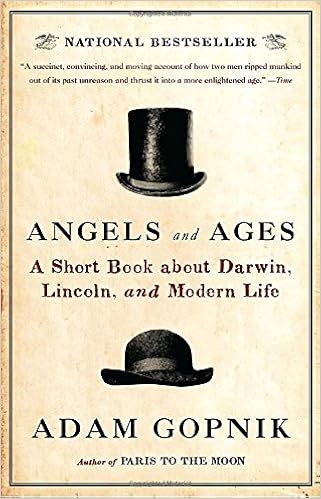
Angels and Ages: A Short Book about Darwin, Lincoln, and Modern Life

by Adam Gopnik

This was an interesting one: one of those “slow burn” sort of books. I came across it at my local used bookstore (Bookman’s in Tucson – Woo! Bookman’s!) in the discount rack, marked down to $1. I had just a day or two before read an article by Mr. Gopnik (Who is a 30-year veteran at the New Yorker) online, and so I recognized the name; even though I have been trying not to buy new books until I clear off my To Be Read shelf –or, rather, shelves – I couldn’t resist the subject matter. So I bought it, and even though I haven’t been able to find time or energy very well of late, what with school-before-Spring-Break, I decided to give it a read.

Odd phrase, that. Am I being generous with my time, granting Mr. Gopnik, and Mr. Darwin and Mr. Lincoln, a few of my hours, growing ever more precious as I age? I am acting as an audience, without which they would be forgotten (Well, at least a little bit. But then, the whole point of the Darwin half of this book is that those little bits, little bits of time and little bits of life, are all there are.). But then again, they are giving me something even better: they are inspiring me.

Mr. Lincoln, who comes off a little bit worse than his iconic status (and rightfully so) nonetheless inspires me to believe in the power of a single man to change things; particularly in the last summative chapter, this book points out how incredibly influential Lincoln was with this analogy: imagine if Boris Yeltsin had been able to maintain the Russian empire, and also install a functioning democracy obeying the rule of law. That is Lincoln’s accomplishment, and though the Civil War likely would have happened without him, and the subsequent events of Reconstruction, Jim Crow, and eventual ongoing equality, the country wouldn’t have been the same. He also inspires me because he was a freethinker, an atheist, an introvert, and a deeply literate man.

Mr. Darwin, who comes off a bit better than most depictions and associations of him (and rightfully so) inspires me with his ability to be focused on both the infinite and the infinitesimal. Gopnik shows how Darwin had extraordinary powers of concentration and observation, and these, along with a constant need to ask, “Why is this so? How did this get to be this way?” are what led him to his great world-changing theory – which he knew was world-changing, also knew was absolutely correct (as far as science can ever be absolute or correct), and sought, and found, the best way to pour this thought into the collective consciousness of the world. It is remarkable, Gopnik shows, that a theory that in most people’s hands would have been a mere footnote in biology and likely would have taken generations if not centuries to percolate up through the strata until it hit the top – like, as Gopnik says, Gregor Mendel’s work on genetics – was able to completely shift the world’s conversation from a Young Earth creationism to the truth in a single generation. I also love that Mr. Darwin was so deeply in love with his wife that he delayed publication of his work because it would upset her, and also that his own atheism was softened by the same knowledge: that his devout wife would be upset by too-vigorous protestations of what he knew to be true. Though I don’t have to make the same compromise, I appreciate that he did it for her.

I am inspired, last but not least, by Mr. Gopnik. This is a complicated book; too complicated, in some ways, because the ideas and the writing are dense, and for me, the subject matter a touch too abstract to hold me down while I work my way through it. It’s written like an essay – unsurprisingly, it started as two essays in the New Yorker, one on each great man (United in this book first by the coincidence of a shared birthday – February 12, 1809 – and second by their impact on the world) – and it’s tough to follow, because Gopnik intentionally didn’t write it as a historical/biographical book. Since I haven’t ever read a good biography of either man, some of this book was lost on me. But I appreciate the enormous effort and scholarship that went into all the thought in this book, and the basic thesis that the two men are equally important to the creation of the modern world, Lincoln in the proof of the ability of liberal democracy and the rule of law to survive, Darwin in the revolution he led that changed essentially everything in the world about how we live with science. I appreciate the effort it shows in the density and complexity and beauty of the language Gopnik uses. I appreciate that he shows how Darwin and Lincoln are Darwin and Lincoln – and not, say, Alfred Russel Wallace and Stephen Douglas – because of how extraordinarily good both men were as writers. Both masters of rhetoric. Both able to accomplish what they did because of how Lincoln spoke, and how Darwin wrote, and how both of them argued.

I like this argument. I like how it’s written. I would like to be able to do the same thing as any or all three of these, at least as a writer.

Thank you, gentlemen. I appreciate your time.

New Rule: Right To Bitch

I’m seeing positive feedback on my post from Wednesday: that’s good. I was worried about it. Worried that I might be accused of whining.

Is that ridiculous? The piece was intended to show the flaws in the teaching profession, by comparing it (It was also intended as an example of a compare/contrast essay, which my AP students recently wrote) to a profession that most people would rank far below teaching in terms of, say, desirability, or prestige; but I genuinely liked being a custodian, and if I didn’t need the money I make now, I would go back to being a custodian in a heartbeat. I’ve always harbored a secret wish that the custodians at the schools where I’ve worked would quit or retire while I was there, and I could slip into that position permanently. Maybe teach one class, or be available as an emergency substitutes; I want to think that my repertoire of teaching skills would make up for my lack of knowledge about things like plumbing and electrical.

Of course it wouldn’t.

But in criticizing the job I have now, I run a risk, a real risk, of being called a whiner. I know that doesn’t matter much, if other people sling that particular glob of mud at me; but I don’t want to get spattered with that. I was called a whiner a few days ago after I posted a Facebook status Sunday morning that said, “Can’t tell you how much I don’t want to grade essays.” Now, most of my friends — a large proportion of whom are English teachers, unsurprisingly — agreed with me, and sympathized. But one of my friends (A math teacher — so, y’know: evil. And heartless.) called me a whiner and sympathized with my wife for having to put up with my bitching all the time.

He was kidding. Of course he was. I don’t actually complain that much, at least not on Facebook — and he complains all the damn time, frequently to me; and I do complain back. I knew he was kidding. But it still hurt. Genuinely, though not that intensely.

See? There I go again. Complaining about a slight emotional pain, like it’s anything that matters when there are people out there in the world, people no less important than I am, starving while they die of ebola. This is the point where a conservative would call me a special snowflake and ask if I need a safe place to hide from the trigger warnings. (Or if not a conservative, then an asshole.) He might tell me to suck it up, to man up, to be the strong, silent type. To grow a pair and stop being a pussy. At which point one of the several feminists whom I am friends with — most likely my wife — would chew him out; and this asshole (And yes, I am friends with assholes, too, though not very many) might ask what is wrong with feminists, because what do women have to complain about? They have it easier than men! If anyone has a right to bitch, it’s got to be men.

This is why I wanted to write about this: because this seems to have become a trend these days, and a pervasive and pernicious one. We seem to have the idea — and maybe we always have, and I’m only now noticing it for some reason — that people generally shouldn’t complain, shouldn’t bitch, shouldn’t speak up when something bothers them: either because you have to earn a right to complain, usually by being worse off than anyone else who could hear you complain; or because speaking up about being perturbed is seen as weakness: either it’s showing fear, which will make the wolves attack you (Or the sharks, or the Guinea pigs, or what have you), or it’s letting them see you sweat, which just encourages the bastards, because they know they can get to you.

We’re supposed to take  it in silence, preferably with call0us indifference; my students say all the time that mean things or bad things don’t bother them because they just don’t care — “I don’t care what those girls over there say about me, because I don’t care what they think, it doesn’t bother me at all.” And somewhere in there is the idea that you should never tell those mean girls that what they’re saying is hurtful, or else they’ll say it more (Though really, if you aren’t bothered by it, it shouldn’t matter if they keep saying mean things, because those mean things don’t bother you. Right?).

But see, I don’t think that. I think you should tell someone that something they said is hurtful. I think that you are encouraging them with silence: because if you don’t complain, that’s when they believe they can get away with anything. Complainers get left alone, it seems to me; because nobody wants the hassle.

There is more, however. This isn’t just an issue of calling obnoxious people on their nonsense. It’s also about whether one has to earn the right to bitch.

My wife gets caught in this trap. She complains to me about teaching, about the many, many problems she has as a first-year teacher — and not only a first-year teacher, but an art teacher at a STEM school. But whenever she complains to me, when she really gets going, then once she finishes and pauses for breath she — apologizes. Every time. And not because I’ve started complaining about her complaining, not because I’m sitting there rolling my eyes and saying, ‘Oh my GOD, will you PLEASE stop that?!?” No: she apologizes for the same reason that I didn’t like being called a whiner on Facebook: because we know whiners, and we don’t like them. We don’t want to be seen as that kind of querulous, egocentric person. She also, I think, apologizes when she complains because I’ve been a teacher longer, and there are problems that are unique to my job that she doesn’t have to deal with — the essays, mainly. Those damn essays and all their need for grading. So much grading. Of course, she has problems that I don’t have, mainly being a department of one, and having been screwed by her predecessor who didn’t leave anything useful behind — no teaching materials, no lesson plans, none of the good quality art supplies — so she has to create everything she does from scratch, and stay on top of inventory and all, in addition to being overworked like every new teacher is, and undervalued as the one art teacher in a STEM school.

But see, that’s just it: why must she have it harder than me before she feels like she has a right to complain to me? (This is all mitigated, of course, by the fact that I am her husband, and so she has every right to complain to me about anything that is bothering her, no matter how small, no matter how large, forever and always.) Why do I feel like she has more right to complain to me because I think she has it harder?

Why is it that the only person who gets to complain without guilt is the most miserable person on the planet, and all the other 7 billion-plus of us have to say, “Well, this bugs me, but — other people have it worse. At least I’m not a leper in a Turkish prison or something.” And the leper in the Turkish prison is saying, “Well, they knock some of my toes off every time they beat the soles of my feet with the bastinado, but at least I’m not living in a country run by Donald Trump.”

So I’d like to propose a new rule. The new rule is this: everyone has the right to complain, any time, to anybody, depending on what their goal is for that complaint.

If your goal is to vent, to simply let off steam; if your audience needs do nothing more than nod every once in a while and make sympathetic noises somewhere between, “Mmmmhm” and “I hear you, man, totally,” then you have the absolute right to complain. I suppose somebody who isn’t in the mood to listen could ignore you or walk away, but generally speaking, we should listen to each other. Venting is healthy. It is valuable, because talking through your problems can often help you come to a solution. And the listener needs to be nothing more than a slightly more human version of a brick wall.

Okay? You don’t have to earn your complaining time, you don’t have to be the most miserable one in the room. You are a person; you have the right to feel, and to express how you feel; and it is reasonable to ask someone to listen to you, particularly your friend or your family. And I will stop feeling bad about describing my trials and tribulations on this blog; because if you don’t want to read what I write, if you feel I am too whiny, then you don’t have to read it. Feel free to walk away, and no hard feelings.

If your goal in complaining is to call attention to a problem, to let a jerk know that you recognize his jerkishness, then you have the same unlimited right to speak up. If you choose to be silent instead, okay — but I think it valuable for jerks to be called on their jerkery. No, it probably won’t stop them from continuing to jerkify all over the place, especially if all you do is call them out and point out the jerkage, without also punishing them in some way; but it does at least let them know that they have lost, or risk losing, whatever trust and faith and goodwill you harbor for them. Letting a jerk know you don’t trust him may not stop him from being a jerk — but he’ll know that he can’t count on your trust to pull him out of any truly deep hole he digs with his jerkosity.

And the same goes for political complaining: I don’t give a fuck if conservatives didn’t march in protest of Obama’s political stances or actions (Even though they did), if people — say, millions and millions of American women, and women all around the world — want to bring attention to a danger they see, actual or potential, they have every right to stand up and speak out about that danger, about that problem, about that issue. It isn’t weakness if all you’re seeking is to call attention to it. Standing up to say something is rotten in the state of Denmark? That would be strength, thank you very much. That would be determination, and courage.

If your goal is to gain sympathy for your troubles, well — that is different. That requires you to have some awareness and sensitivity about the relationship you have with the person whose sympathy you seek. Which means you probably shouldn’t seek sympathy, overt protestations of sympathy, from random strangers. That might be a genuine imposition. Because sympathy takes work: it puts an emotional strain, even if not a terribly large one, on the sympathizer, which is why it’s generally so nice for the sympathizee. So there, I can see a need for consideration — and someone getting pissed off when asked to sympathize one too many times, or when they themselves are in greater need of sympathy than the person doing the complaining.

If your goal is to gain something even more valuable, and even more onerous for your listener to give you — like money, or help moving into your new house, or a bite of their ice cream sandwich — then you may need to shut up. I’m sorry, I don’t mean to be callous nor to contradict myself: but I’m talking about the right to vent, not the right to pout while staring at my Klondike bar. Nobody has the right to do that. Okay, my wife does, but none of the rest — right, and my dog. But that’s it!

Stay the hell away from my ice cream. I need it. Wait’ll I tell you about my day…

So Much Crap.

Ron Barnett's portrait.

I haven’t had a lot of different jobs in my life: only two, really. Sure, I worked for two months in a library, and another two months in a discount bookstore. I was a residential care provider in a group home for developmentally disabled adults for a while, a job I absolutely loathed; and I took photos for college IDs, a job I am forever grateful for, because that’s how I met my wife.

But none of those mattered; you might as well count the money I made mowing my parents’ lawn, or the change I’ve found on the street over the years. I never cared about what I was doing, never thought of it as a part of my identity. But work is, at least in this society, an indispensable part of a person’s identity: it is the first question one asks after “What’s your name?” and the source, after family, of our greatest pride, and of our greatest distress. Nobody asks, “What are your hobbies?” or “What is your favorite meal?” No, we want to know what people do. Our job is how we make a living: what a telling phrase.

The two jobs I’ve had in my life are polar opposites in many ways: the first was blue collar, the second white collar; the first had irregular hours, the second a schedule set for me down to the minute; the first was done almost entirely alone, the second could not be performed without other people involved – or, well, it could, but it would be pretty pointless. It would be nice, though: I often joke about how much better the job would be if it was just me alone in a room.

My first job was often just me, alone in a room.

But there are also aspects that are nearly identical: in both cases, I have worked for the government. In both cases I have usually worked early in the morning and been done by midafternoon, and I have always worked on weekends. Both jobs have tried my patience. Both jobs have given me good coworkers and bad, clients I liked and those I couldn’t stand, bosses who made my job(s) easier and ones who made it much, much harder. And both jobs have, on occasion, revolved around crap.

From 1995-2000, I was a custodian and maintenance worker. Since then, I have been a high school English teacher. I have often found it hard to know, for sure, which job I would rather have.

Being a custodian was great. The daily work was never too bad: the facility where I worked, the Civic Auditorium in Santa Cruz, was a public building; so every day the bathrooms needed cleaning and the various offices needed to be vacuumed, dusted, and have their trash and recycling emptied. That was my most frequent task for the first half of my standard five-hour shift. The second half was more general maintenance: I would sweep and mop the hallways, vacuum the mats in front of the doors, touch up paint, restock the concession stand, organize supplies and storage, and clean windows. If we had an event, I would set up for it; if we had just finished an event, I would break down equipment and clean up the main hall and the seating area – 1100 fixed theater-style seats. I dumped a lot of garbage cans and I swept a lot of floors.

Image result for santa cruz civic auditorium

I had that custodial job all the way through college. But I finished college in December of 1999, and so in June of the next year – in time for the summer hiring season for new teachers – I quit, and my wife and I moved to San Diego County, where I started applying for full-time teaching positions. And found one, at San Pasqual High School.

I did not like being a teacher right away. The daily work that first year was brutal: I got hired in late July for a school year that started in mid-August; this was not a lot of time to prepare. I had three different classes, none of which I had ever taught before, and so I had to make up, every day, what I was going to teach. I had to write all of my tests, all of my assignments. I had to make up vocab lists, after I made up a system for teaching vocab. I had to lecture, and lead discussions; I had to create group projects; I had to grade. The grading never stopped, never ended. It still hasn’t, 17 years later. In addition, I didn’t have my own room, and so I traveled that year, going from room to room and building to building during every five-minute passing period, pushing a cart full of books and papers and my coffee cup. I worked 60-hour weeks, spending hours every day after school grading papers and creating curriculum, sleeping only a few hours a night because I spent most of my time worrying about whether or not what I was doing was having any positive effect on my students, and pretty sure that it wasn’t.

I never worried about being a custodian. There were certainly days I didn’t want to go to work: we used to have certain events that were particularly long or difficult, such as whenever the Pickle Family Circus came to town, since they would do two shows a day, which meant we had to clean the hall in between the two shows. The summer Wine and Music Festival meant twelve- and sixteen-hour days, mostly outside in the California summer heat hauling equipment and supplies and garbage up and down the street. The hemp show people were a nightmare, as were the Gem and Mineral show vendors. And then there were the raves. They used to have raves at the Civic, once our manager realized he could sell 2000 tickets at $20 apiece, and then trap all 2000 people inside for twelve hours with no food except what they bought from our concession stand. The Civic made huge amounts of money on those things. And then we maintenance staff had to clean the place up. Imagine 2000 sweaty people, dancing for twelve hours, throwing around food and drinks the whole time, and – to judge from what they left behind – taking lots of drugs, taking off their clothes, and having way more sex than seems appropriate in a crowded concert hall. We had to mop the whole building, including the walls, and that was after we had swept out an entire dumpster worth of waste.

I’m not even going to talk about the bathrooms.

After my first year at the Civic, I got – well, sort of a promotion. They realized, first, that I was responsible and reliable; second, that I was particularly good at fine details and spending hours and hours on one tedious task; and third, that as a college student, I was totally willing to be exploited. So they made me a shift supervisor – but, you know, not really. I didn’t get any more pay, or any promotion or anything. They just gave me more responsibility. They had me lead crews for setup or cleanup, and they had me supervise alone for some of the smaller, quieter weekend events. And they gave me The Binder. The Binder was pages and pages of maintenance tasks that only needed to be done three or four times a year, like clean out the furnace room, or sweep the attic catwalks, or polish the brass door handles. I was now responsible for everything in the binder. In addition to everything else I did.

That didn’t happen after my first year teaching. No, it would take six or seven years before I got extra responsibilities – but then they came all at once, just as the actual teaching part was getting easier. I still got exploited, though. I was made the Chair of the English department – only a year before the school cut the stipend that came with the position. I was asked to be the “guru” for our new grading and attendance program, which was fine the first year when they paid me for it – but then after that, everybody just came to me for help, though the school didn’t pay me any more. I ran a Gaming Club, and then an Argument Club, and then a Philosophy Club, and then a Gaming Club again – along with a lunchtime talent show I co-hosted, when I wasn’t singing in the staff band.

But that was okay; I liked the musical tasks, and the clubs, for the most part. Serving as the head of negotiations for the teacher’s union was less pleasant, since we had a contract dispute that almost led to a strike that year. So along with teaching all of my classes, grading and planning and preparing, and all of the conferences and meetings and trainings that come with the job, I also had to have meetings with my union team, and contract negotiations sessions; I had to give updates to the other teachers, and lead union activities like marches and such. I slept even less that year, as any minute not spent thinking about my classes was spent thinking about how every teacher in the district was counting on me to do a good job.

Amusingly enough, that was also the year when I was waiting to see if the state would strip my license to teach, after I got busted for writing mean things about my students and my job on a public blog, which was a violation of the computer use policy as well as – well, let’s call it the honor code. That was a little stressful, too, since I knew I might be looking at the end of my teaching career. But here’s how that all ended up: we got a contract; I was named Teacher of the Year for the district; and then I got suspended for thirty days without pay. That was when I quit and moved to Arizona. Where I had to appear before an ethics committee to explain my suspension. They called me “morally reprehensible.”

It’s funny: I used to steal stuff from the Civic all the time. I mean ALL the time. Toilet paper, paper towels, these thick cleaning cloths that my wife used for cleaning her paintbrushes; Windex, bleach, hand soap, light bulbs; we used to borrow tools, painting supplies, even the carpet cleaner when we needed it. And that’s not even getting into the food I used to take from the concession stand. I can’t tell you how much coffee I got for free over the five years I worked there. And the candy: every time I brought candy to the stand from the storeroom, some of it disappeared into me. So did all the leftover popcorn. If ever I have been morally reprehensible at work, it was while I was a custodian. And yet I never got in trouble for it there.

The best part of working as a custodian was that I got to work alone. I almost never had to speak to people; when I did, it was always very brief and businesslike. Then I would put on my headphones and listen to music while I vacuumed and mopped and dusted. Even when I led shifts, I would assign the tasks, and usually take the worst for myself – which was generally the bathrooms. But I didn’t really mind: turns out bathrooms have great acoustics if you’re the type who likes to sing along with music. My pay eventually caught up with my promotion, and I made decent money, had benefits and a guaranteed twenty hours a week, on a schedule I could pretty much pick and choose. I also got into any concert I wanted, free.

The best part of working as a teacher is the fact that I’m a teacher. I do love literature, even more than singing; I like my students more than my mop and broom – well, mostly. I certainly like them more than the brass polish: that stuff was nasty. I believe in what I do, as much as I’m actually allowed to do what I believe in, which is not all the time. I have much better pay and benefits, and summers off, which I love. And I never have to scrape gum off of the bottom of 1100 fixed theater-style seats.

That was a lot of gum. People who put gum on the bottom of their seats are morally reprehensible.

I still cannot say, though, which job I would rather have.

The nastiest thing I ever had to do at the Civic was clean up the lobby after an elderly man had a bathroom accident, not in the bathroom, during the Symphony. Or maybe it was the several times I had to clean up what the homeless people left in the bushes outside. No – no, it was the bathrooms after the raves. Definitely that. Let me just say this: people stopped using the actual toilets, figuring that anywhere in the room was good enough. The nastiest thing I ever had to do as a teacher was when I had to report a sex crime. I would rather clean the bathrooms than do that again.

The worst I was ever treated at the Civic was when the Brazilian Jiu-jitsu people kept me there for four hours longer than they were supposed to, just because they were hanging out instead of cleaning up, and every time I said something, they Bro’d me out of the room. (Bro, chill out, bro! We’re working on it, bro! We’ll be done real soon, bro. Hey, do you lift?) The worst I ever got treated as a teacher was when seventeen of my Honors students cheated on the same essay because they didn’t read the book. Or maybe when I caught three girls cheating, and they yelled in my ear for ten minutes while I had to walk across the campus (That was when I was traveling, remember?) to find the proof – which did finally shut them up: because even though they kept shouting at me that I was wrong and they were offended that I would ever insult them with that accusation, I wasn’t wrong.

But being right doesn’t stop people from arguing with me, questioning me, telling me how to do my job, which seems to be everyone’s favorite pastime: students, parents, administrators, random people I meet on the street, they all want to give me ideas for how to teach. That might be the worst treatment I get. Or maybe it is every single day when my students, who talk about how much they (generally) like me and like my class, spend most of that same class ignoring me while they are talking, sleeping, doing math homework, or staring at their phones.

No – no, it was that morally reprehensible thing. That was truly the worst thing that has ever happened to me at work. Ever. I would rather clean those bathrooms with my bare hands than deal with all of that again: the meetings with superintendents, the consultations with my lawyer, the threats from the state’s lawyer, the fact that I will always have that black mark on my record, for something that isn’t half as bad as the things that have been said online about me – and sometimes, to my face.

Working at the Civic meant cleaning up a lot of crap. Working as a teacher means taking it.

So I suppose that’s really the answer: I would rather clean bathrooms. I wonder if anyone is hiring.

Trilogy Trials and Trilogy Tribulations


Okay. Let’s get real here. I think this calls for going full nerd. (Original was here, by the way. Good page if you’re a Facebooker and a geek.)


Let’s start with the most egregious, shall we? Listen closely: THE LORD OF THE RINGS IS THE GREATEST MOVIE OF ALL TIME. Those goddamn columns should be blue all the way to the top. They should be overflowing the top of the boxes. They should be spraying like fountains, cerulean waterspouts just painting everything in sight with blue glory. More like this:

lotr-adjusted

Also, it isn’t really a trilogy, like the books aren’t really a trilogy; it’s one story split into three volumes, and the movie is one story split into three chapters. One movie. Not a trilogy. But it came out in three subsequent years, so I get it being on this list. But it is the best movie ever made, from the greatest fantasy series ever written. Show some respect.


Next let’s just dispose of the ones they got right. Godfather: bang on. 100%. You could argue that #1 is a little better than #2, because Marlon Brando — but #2 has DeNiro, so yeah. Star Wars: yup. Pretty much perfect. I think they overestimated Jaws 2 and 3, but sure, they have some moments. Indiana Jones is mostly right, though I like Last Crusade more than Temple of Doom (And they rightfully don’t include Crystal Skull. Which, I admit, I kind of liked. but I liked Gymkata.), but that is subjective and open to debate. Back to the Future, yes; Star Trek, yes — though that should be more than a trilogy. Star Trek IV is a dork classic. Spider-Man and Superman, honestly, I don’t have too much of an opinion on; I liked the movies, but none of them are inspiring to me, so I’ll bow to the greater geeks there.


Okay, then. Rocky. Rocky III is as good as II? Are you freaking kidding me? Did you guys get punched in the head by Mr.T? Because, you do realize, the bad guy in III is Mr. T. “I pity the fool” -B.A.-Baracus-Mr.-Freaking-T.

Mr. T: Film Fame Can't Alter His Status (1982)

Rocky is an Oscar winning movie and just about the only actually good movie Stallone ever made; II is a nice continuation of I with the redemption of Rocky winning this time. But Rocky III, and every movie after it, is a horror show. Now, if you want to enjoy it on a cheesy level, great; hell, it has Mr. T. in a starring role — it doesn’t get cheesier (Unless it’s this guy.

Hulk Hogan back to WWE

Look at how freaking oily he is. Ewwwwww.).

But you can’t include Rocky in that cheese-fest. You’re changing the metric partway through, and that doesn’t work.


Speaking of cheese, I can respect dropping Beneath the Planet of the Apes and Escape from the Planet of the Apes waaaaay down from the first movie, because neither of the sequels (Nor the two others they don’t list here) had Charlton Heston. He appears briefly in Beneath, but he only agreed to do it if his character got killed, so bada boom bada bing, no more Taylor with his gorgeous overacting and his apparently congenital refusal to wear pants. I mean, come on: the apes wear pants. You got nice legs, sure — but you couldn’t steal a pair of ape pants? But without Heston to do wonderful things like this:

(Though really, the highlight of this is that reaction shot.)

…or this,

…the movies lose something. But honestly: these are cheesy pieces of crap, and we all know it. The makeup is amazing, and the concept is intriguing; but these are cheesy pieces of crap. So it seems to me that if you’re going to put so much love on the first movie, then you should show some love for the later ones, too. After all, they all had Roddy McDowall, right?

Planet of the Apes' over the years: Know before you go – San Gabriel Valley  Tribune


While we’re on humans being surpassed as the dominant race on the planet, let’s hit Jurassic Park. The problem with this rating isn’t the sequels, which really are giant piles of triceratops dung;

Image result for jurassic park 2 = 

the problem is with the rating of the first movie. The original Jurassic Park movie is a fantastic film, a game-changer, with everything good: good direction, good acting, a great script, absolutely wonderful action and effects. That one should top out the column.


It’s the reverse problem with the Blade and Terminator movies. Blade III is not good, nor is Terminator III — but come on, they aren’t THAT bad. Nor is X-Men III. I feel like these guys can swallow a second movie whole, despite obvious flaws (I mean, Terminator II has freaking Edward Furlong in the lead role.

That kid has the most annoying voice in the history of movies. There’s a reason he never hit superstardom again, and it wasn’t drug abuse. And Blade II has Norman Reedus, yes — but he’s not Darryl, he’s — Scud.

Nowhere near as cool. Plus, the Reapers are too horrible to look at, and the BloodPack are  just as silly as the human hunters in Blade III. And I like Ryan Reynolds in III, and also Jessica Biel.), but when the third movie comes out, they’re just like, “Okay, NOW they’ve sold out. This is crap.” But that’s not fair. Sometimes the second movie is far worse; sometimes the third movie is the best of all (If you HAVE to divide LOTR, then ROTK is the best piece.). There’s nothing to say that a movie franchise can only carry one or two but not three movies; you have to take each franchise on its own merits. Or its own crap.


And speaking of crap. Let’s talk about the three that are the most off-base, the most skewed, the most ridiculous. First terrible graph: Mad Max. Honestly, I hate the first movie. Road Warrior is by far my favorite. Mad Max reminds me much too much of Death Wish on motorcycles, and if I’m going to watch Death Wish, I want me some damn Charles Bronson. I like Mel Gibson, but he’s no Charles Bronson. And the motorcycles aren’t enough to sell me on the movie. I also hate the homophobic element that is clearly intended to make the bad guys more vile, like I’m supposed to think, “Wow, they’re not just outlaw bikers — they’re HOMOS! I hope Mad Max wastes them all!!” This is something of a theme, of course, this leather-biker-gay-man-villain element, but it bothers me most in the first movie. The first movie’s bar is lower than the second, but I don’t know that it’s low enough.

But that isn’t the real problem here. The real problem is the third movie. Beyond Thunderdome. That bar should actually be split in half vertically: the first half of the movie, with Bartertown and the fabulous Tina Turner and Master Blaster and Thunderdome

(Two men enter! One man leaves!) —

that can all be pretty high up, maybe on par with the Road Warrior, though Thunderdome does overdo the cheese a bit. But then as soon as that movie follows its title BEYOND Thunderdome, it becomes one of the worst pieces of film I have ever seen. Ever. That colony of idiot children whom Mad Max — MAD MAX — decides he must protect and serve? Oh, please. PUH-LEEEEZE. This is one of the only movies that I will watch the first half and then turn it off. Most of the time, if I hate the ending that much, I just don’t watch the movie; and if I like the beginning that much, I will sit through the end. But this one? Nope. That movie ends for me with Mel Gibson in that big clown head staggering off into the desert. It would have been better for everybody if Max had just died right then. Fin.

Terrible graph #2: Die Hard. The first movie is iconic, no question: it is Alan Rickman, it is Nakatomi Plaza, it is Ode to Joy when the vault spins open, it is Yippee-ki-yay, motherfucker. The third movie has Jeremy Irons and Samuel L. Jackson, a good plot line, and some fantastic action sequences. But Die Hard II?! The one in the airport. At Christmas. That thing is absolutely terrible. It is an abomination. It is the shame of the family, the black sheep (And it’s not even as good a movie as Black Sheep, and that’s saying something.), the pariah, the one they send away before they serve Thanksgiving dinner. This is one graph where the middle bar should be white, with maybe just the thinnest line of blue imaginable — just enough to put Die Hard II above, say, Mother, May I Sleep With Danger, or that time they tried to make a movie out of American Idol, with Justin Guarini and Kelly Clarkson. Or Breaking Dawn Part II. But yeah: that graph should look like a blue Oreo. With the whitest of Creme filling.

And last  — but genuinely, seriously not least — The Matrix. Okay. I get it. The second and third movies are not as good as the first: granted. Almost nothing is as good as the first Matrix movie. But I am as sick to death of people ripping the Reloaded and Revolution as I am hearing about how Jar Jar Binks ruins Phantom Menace. (Jar Jar Binks is no more or less annoying than C3PO. We just had lower expectations of him. That’s it. And freaking Anakin Skywalker is a bigger problem than Jar Jar, and not just because of the bad acting: because Lucas made him into Jesus, complete with Immaculate Conception, and it’s the stupidest thing in science fiction. Anyway.) Matrix Reloaded and Revolution have some amazing elements: AMAZING. The Sentinel assault on Zion is one of the best science fiction battle sequences ever. The freeway fight is one of the most beautiful pieces of action cinematography I’ve seen. The Architect is fascinating, as is the Merovingian.  And Agent Smith is one of the best villains of all time. Sure, yes, Keanu Reeves is a dolt, and Carrie-Anne Moss isn’t a whole lot better; her outstanding character turns into a wet rag draped over Neo’s shoulder, and it’s a shame. (Wouldn’t it have been much better if, when Neo saved Trinity’s life by reaching into her chest to get out the bullet, he actually turned her into the One? And she was the one who went to the Machine City, fought Agent Smith in the last fight, and saved the world? Too bad, right? Anyway.) But the arguments about sexism I have heard — which is certainly all too common in science fiction and fantasy — don’t take into account that Morpheus, my other favorite character from the first movie (Along with Smith, of course — you can really just take Reeves out of those movies and I would be just fine), turns into a wet blanket under the feet of Jada Pinkett-Smith, which is also too bad. Plus I really hate his Zion outfit, that sleeveless robe thing he wears at the rave. I hate this speech.


And yeah, I hate the rave scene.

But those are good movies. All three of them. They certainly do not deserve bars that low.


All right, nerds: I invite comment. Come at me.

Double Book Review: Bryson and Bryson

A Walk in the Woods

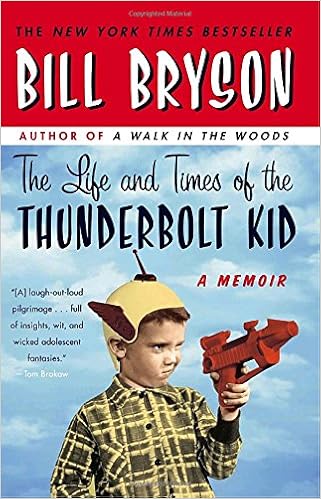
The Life and Times of the Thunderbolt Kid

by Bill Bryson


Bill Bryson and I have nothing in common.

Mr. Bryson has four children; I have three, but they have fur and feathers and shells. He moved to England after only a year in college, and spent the next twenty years or so in Europe; I haven’t been out of the United States since I was 13, and that was only for a week. He grew up in the 1950’s, when America was ostensibly at its peak; I grew up in the 70’s when America had disco. He grew up in, and has a deep nostalgic love for, the Midwest; I’m strictly coastal, and have never even driven through Iowa, where Bryson spent his entire childhood, in the same house in Des Moines. We are both the youngest, he of three and me of two, and we come from literary traditions: his parents were both journalists, his father one of the best sportswriters (Bryson the Younger tells us, but he has a valid argument) in the history of baseball; though neither of my parents are terribly literary, my grandmother and great-grandmother were both authors, teachers, and librarians. But of course, Bryson is an award-winning and best-selling author, and I just cracked 60 followers on my blog. (I thank and adore every one of you, don’t think I don’t.)

And perhaps most importantly, Bryson is a man who would, one, walk the Appalachian Trail, or at least a lengthy segment of it, and two, write a memoir about his American Heartland youth; and I am a man who would – read about both of those things.

Bryson’s writing is beautiful. This is why I keep reading his books, despite having no real common ground with him; this was never truer than with The Life and Times of the Thunderbolt Kid, when Bryson waxes poetic for nearly 300 pages about an America I know nothing about. I mean, he was the archetype: he loved baseball, did crappy in school, and had a freaking paper route, for the love of Clark Kent. Me? I played D&D and Nintendo. Hated sports. Straight A’s until I got to high school, when my grades slipped – to mostly B’s. (I did get a few D’s and F’s, and another thing Bryson and I had in common was a whole lot of truancy in high school.) He writes wonderfully about how simple and perfect was that world, a world I didn’t know and therefore don’t long for. And honestly, even Bryson’s excellent writing didn’t make me long for it. Even though the freedom of unsupervised playtime and the Golden Age of comic books do call to me, as do the unique character of a city made up entirely of local businesses, run by local people, catering to the specific needs and wants of their neighbors, whom they know personally: the department stores, the grocery stores, the restaurants, they all sound lovely indeed. But I don’t want ’em.

The same for the Appalachian Trail, the focus of A Walk in the Woods. I had two friends who walked the whole thing one college summer, and I have always envied them their experience; no more, man. No chance. I wouldn’t even do the abbreviated hike that Bryson writes about. He talks about the exhaustion, the misery, the crappy food, the monotony of the scenery, the irritating other hikers – even a little about the murders that were committed near where he was hiking while he was there, when two female hikers were killed on the trail. Never solved, at least not by the time Bryson wrote the book. It all adds up to a great big No Thanks: even with Bryson’s excellent descriptions of the glorious vistas, the fascinating (Seriously) history of the trail and the regions it meanders through, the sense of accomplishment so palpable you can feel it coming off the page.

Actually, I thought that was the best thing about both of these books: while Bryson does talk sincerely and at length about the good things about these two experiences, he doesn’t shy away from the negative side. His mother was a crappy cook, and that experience is made much worse by the total lack of culinary adventurousness of the era. His parents didn’t worry about anything, giving him great privacy and freedom – but they also painted everything with lead, asbestos, and radiation; Bryson lived through the end of the polio era, and in a time when people, who grew up in the Depression, were frequently missing limbs. In A Walk in the Woods, as I said, he goes through every painful, plodding step, making them even more vivid through the inclusion of his out-of-shape former-alcoholic friend Katz, who walks the trail with Bryson, but slower and with even more suffering. And that’s a lot of suffering.

You hear all about the bad parts, which really does serve to make the good parts seem more genuine and more warmly appreciated. It’s easy to understand how much Bryson loved his family’s unexpected road trip to a still-new Disneyland when he also talks about the usual family vacation to visit family that nobody wants to see, not even the family themselves. It’s easy to see how happy Bryson was to go home when he finished his Appalachian Trail hike when he takes you through every terrible day before that; it’s easy to see the beautiful woods he walks through when he talks about the rain and the mud and the cold.

So even though we’re nothing alike, and Bryson writes personal non-fiction, which should make it hard for me to relate to and understand his work, I am going to keep reading it: because Bryson is a hell of a writer, and he makes me like his books even if I doubt I would like him very much. Nothing personal, Bill. But thank you for everything personal you have shared with me. You keep writing it, and I’ll keep reading it.