Book Review: City of Bones

Image result for City of Bones martha wells

City of Bones

by Martha Wells


I don’t know why I’ve never heard of Martha Wells.

It’s clearly my problem; she’s written more than a dozen novels since the mid-90s, been nominated for Hugos and won a Nebula, along with several other awards. I mean, I’m not THAT deeply involved in the F/SF world; I don’t go to ComicCons, I don’t really belong to any fandom, I don’t dress up as any characters (Other than my generic pirate costume, which is the only costume I will ever wear for any appropriate occasion), I don’t obsess over Star Wars or Star Trek (And that might have been a way for me to learn about Ms. Wells, as she has written a Star Wars universe novel. But I haven’t read it.), I read things other than genre fiction. There’s a lot I don’t know.

The surprising thing is not so much that I’ve never heard of a fairly well-known and successful SF/fantasy author; the surprising thing is that I’ve never heard of her despite the fact that she’s so damn good. I guess I need more reader friends to recommend books and authors to me. Maybe I should go to some Cons. Get a new costume.

This book surprised me. I got it entirely at random; I found it in a local thrift shop when I was looking for fantasy and sci-fi books I did not know to give to a former student. The former student ended up not wanting the books, so I kept them and have been reading them slowly, and happily, it was this book’s turn. And what do you know: this is a damn good book.

It’s sorta post-apocalyptic in the sense that there were Ancients who might have been us, who destroyed the world but left relics and mysteries behind. Those relics and mysteries are magical more than technological, so it might be an alternate world entirely; it’s left unknown. Reminded me of the Wheel of Time, which of course means I liked it. The society that has managed to survive the cataclysms of the past is essentially city-states on the edge of a giant wasteland that is the result of a supervolcano eruption caused by the Ancients in some way. The book takes place in one of those city-states, and the society that Wells creates, as well as the world she builds, are excellent: detailed and complex, as well as believable and realistic. It’s a sort of a caste city; built in eight tiers, each of which is separated from the others by gates and guards, and mainly by social rules and expectations, the people range from the desperate beggars of the Eighth (bottom) tier to the hereditary monarchs and powerful government officials of the First Tier. The book ranges all the way from top to bottom. It also goes out into the Waste, where the largest relics of the Ancients are: buildings called Remnants, it is unclear what their purpose is, and since they are surrounded by deadly terrain filled with venomous predators and roving bands of cannibal pirates, most people leave them alone.

But not the characters in this book, which was the other great strength here: these are good characters. The main three are two sort of Indiana Jones-type adventurers, dealers in ancient relics, experts in identifying and valuing the objects that have survived since the cataclysm (They are also badasses, though Wells doesn’t go overboard with that, which I liked.), and a young woman from the First Tier, the daughter of a wealthy family who is also a newly trained wizard/guard for the city, called a Warder. She hires the two relics dealers to help her solve a mystery involving three ancient relics, along with a book, written apparently by the ancients, which explains the use of the relics and gives both a tantalizing hint of power, and also a dire warning. Guess which one the power elite of the city pays attention to, and which they ignore.

The book follows the quest of these three to solve the Ancient mystery, while also delving into the daily lives, the trials and tribulations, of the two relics dealers, who live on the Sixth tier – high enough to avoid beggary, but low enough to have to deal with thieves and gangs and organized crime, which touches them because there is a black market for relics, and they have to deal with it. The characters are well-developed, and are both sympathetic and also not, in a proportion that makes them seem very much like genuine people: the main character, the relics dealer Khat, is often sullen and secretive and obnoxious; but of course he is, because he lives a hard life surrounded by people he can’t trust, and he is also a member of a racial minority (A non-human race, that is, because this is a fantasy novel) and so he deals with constant prejudice, as well. His partner, Sagai, is a husband with four children, and so has to take fewer risks and also be assured of making enough money to support his family. The noble Warder, Elen, is somewhat sheltered and therefore naive, but has also put her trust in the wrong people, and suffers for it.

Overall, the book was great. Good characters, good world, good plot. It goes from feeling more like a historical novel, maybe set in Egypt or Baghdad in Biblical times; to feeling like a full fantasy novel with magic users and relics and magical creatures, as well. It’s impressive, and I highly recommend it.

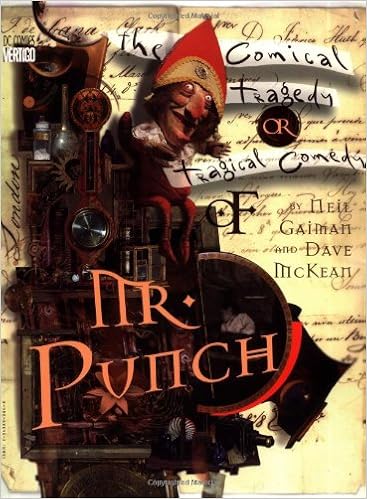
Book Review (Graphic Novel) Mr. Punch by Neil Gaiman and Dave McKean

Image result for neil gaiman mr. punch

The Comical Tragedy or The Tragical Comedy of Mr. Punch

by Neil Gaiman and Dave McKean


This is the second book I’ve read (Riddley Walker by Russell Hoban was the first) that focused on the traditional Punch and Judy show. That one was disturbing because it’s post-apocalyptic, and written in a language that is not quite English and is very difficult; this one is disturbing because it’s Neil Gaiman and Dave McKean. Both are disturbing because Punch and Judy? That’s one messed up story.

So the basic plotline, if you can call it that, of the traditional Punch and Judy puppet show follows the story of Punch. Punch is a sinner: a violent, horny, drunken lout who is clever enough and evil enough to get the better of everyone else in the show – if by “get the better” we mean “beat to death with a stick,” which is basically what Punch ends up doing to everyone, including Judy, who attacks Punch after he throws their baby off the stage to its presumed puppety death. Punch also murders a doctor, a police officer, a crocodile, and the Devil himself; I assume there are variations performed by different people, but both novels tell the same basic story about the murderous Mr. Punch.

Both also describe the traditional puppeteers who tell the story. They are strange people, with an unhealthy and almost religious, even zealous, respect and devotion to the show, especially to Mr. Punch himself. In Russell Hoban’s book, the Punch puppeteer is still doing the same story from medieval England, even though the book is set hundreds of years after the nuclear holocaust that wiped out our civilization; all that remains are some broken fragments of language (the book is written in a very strange invented patois), some relics and buildings and such, and the Punch and Judy show, which is retained in exactly the same form.

In this one, the puppeteer seems to be mystical, in that he talks about an old man, one of the other characters, as having been his apprentice long ago, which would make the puppeteer unnaturally long-lived, it seems. Though it’s hard to say, because the story is told from the point of view of a young boy with a strong imagination, and there are other elements of almost magic realism: the main setting is in a carnival at the seashore in England, and the narrator’s grandfather (the one who used to be the puppeteer’s apprentice) has employed a woman to perform as a mermaid, sitting in a costume on a rock in an indoor pond, brushing her hair and singing. The boy takes her as a real mermaid, so maybe the longevity of the puppeteer is imagined, too.

But there’s also the puppets. The puppeteer talks to the boy and tells him about the Punch show, and he seems to imply that once you put the puppets on your hand, then you gain secret knowledge – and lose something, as well, mainly the ability to take the puppets off again, metaphorically, at least. The boy puts on the crocodile puppet and comments on how magical it is that a puppet can come to life once your hand is inside it; the puppeteer offers him the Punch puppet – the one that is the key to the show, and the only puppet that never comes off the hand, as the Punch and Judy show is a one-man act, so there are never more than two puppets on stage at a time (And the narrator points out that this helps to explain all the murders, as the puppeteer has to keep getting rid of the left-hand characters so he can introduce a new one), and one of them is always Mr. Punch. Who, after he kills another puppet, says, “That’s the way you do it!” Freaking weird. And this is a children’s entertainment. I think knowing that he grew up watching Punch shows helps to explain Neil Gaiman, and maybe a lot of other English authors and creatives.

To add to the weirdness, the book is not only about the Punch puppet show; the boy’s grandfather is losing the last vestiges of his sanity, and also about to lose his carnival house, since nobody goes to the seashore to go inside and see a sad mermaid or a weirdass Punch show. The boy is shy and awkward, and not treated well by his maddening grandfather; there is also some tension between the grandfather and his brother, who helps out with the show and who has a hunchback, though the reason for his deformity is a bit of a mystery commented on by the narrator. There is also an unfortunate love affair involving the mermaid girl, though the boy doesn’t understand it and so neither do we, since the story is told from his point of view.

Overall, it is strange and depressing, but also utterly fascinating, like most Neil Gaiman books. And if there were no other reason to read this graphic novel, it would be worth it just for the art: because Dave McKean is a freaking genius, and the way he mixes painting and drawing and collage and photography in the images of this book make the entire experience twice as fascinating as it would be without him; and it’s fascinating enough already.

Highly recommend, though with a warning about the creepiness and the sadness, which is not resolved neatly at the end. Like life.

That’s the way you do it.

Book Review: The Alchemist of Souls

Image result for the alchemist of souls

The Alchemist of Souls

by Anne Lyle

First, the things about this book that I appreciate.

I appreciate, first and foremost, that Lyle was inspired (as she describes in her author’s note) by a name she came across in her research; she said that as soon as she saw the name Maliverny Catlyn, a minor but genuine historical personage, she had to use that name in her book. She’s completely right; the name belongs on the hero she created for this book; and since my own book was also inspired partly by a name, I approve of this wholeheartedly.

I appreciate that the book is exhaustively researched and detailed; that it covers quite a number of aspects of Elizabethan English life; I appreciate that it focuses on the theatre of the time but barely mentions Shakespeare. I appreciate that she made subtle changes, such as making Elizabeth I marry and bear two sons to succeed her, while keeping so many other things historically accurate (As far as I know, that is): that’s a fine line to walk, and she does it well. I really appreciated the religious and political tension she was able to capture; the intrigues were excellent.

I appreciate the skraylings as a theme: this is the major change that turns this into fantasy instead of a historical novel, that when the European explorers traveled to the New World, they discovered not merely the Native American populations, but also a humanoid race with an advanced civilization and apparent control over magic. So now Europe has a new ally to woo and also plot against in their wars between Catholic France and Spain, and Protestant England. It’s a good theme, and it’s done well.

I appreciated that there are strong gay characters and nobody really thinks too much about it. They get some grief for being all sinful and stuff, even from one of the other characters, which Lyle takes advantage of to create a great scene where the bigot gets called out for her hypocrisy. It’s extremely well done, and the most romantic aspect of the book, which does have a variety of romantic entanglements between the several characters.


What I did not appreciate about the book:

It’s too long. I don’t like to say that, since I’m a wordy writer myself, and I love 1000-page epic fantasies like the work of Robert Jordan and GRRM and the like. But this one dragged. There were a few too many characters and a few too many plotlines, and those plotlines went on for too long. While the two main gay characters were interesting in and of themselves, they could have been removed from the story entirely without any real loss to the plot, and the same goes for the weeks of buildup to the theatrical competition. There’s a lot of life in the book, which also has its own attraction, but isn’t necessary for this story. It’s a bit bothersome because this is the first in a series, and it’s like Lyle couldn’t stand to hold back and put some of the interesting things into later books, so she packed it all into this one – and it’s too much.

Though I liked them thematically, I didn’t really care for the skraylings. There were some really interesting tidbits that showed excellent thought and planning from Lyle – like the linguistic nugget that has the skrayling/English pidgin avoiding the letters p, b, and m, because skraylings find them effeminate; and the reason for this is that the skraylings show their canines as a gesture of assertiveness and dominance, and those three letters are the only sounds that require you to close your mouth entirely. That is cool as hell. (Though in the actual writing of the pidgin, Lyle uses normal English, essentially leaving the pidgin implied; so what the hell? I mean, that’s just lazy. There was a guy wrote an entire novel without the letter E, and you can’t write a few lines of dialogue without those three letters? THAT LAST SENTENCE DID IT AND IT WASN’T EVEN HARD! THERE, I DID IT AGAIN!) But the ambassador is a weak character, and none of the other skraylings are given a chance to stand out; I don’t understand the ambassador’s particular personal situation, nor the connection to Mal Catlyn; I don’t like the way Mal just keeps running away, and the ambassador passively lets him go. I just didn’t think much of them.

I hate the ending. At the end of this longish slowish book is a rapid-fire explosion of events that suddenly introduce a new bad guy, have a surprise twist regarding the main character and his family, grant magical powers where they haven’t been before, throw the characters into a search-and-rescue and also a duel to the death, and then end with the bad guys sort of winning. It’s clearly a set-up for the next book(s), and I doubt the bad guys will win in the end; but it made this particular book freaking annoying. Which makes me not want to read the next books.

It’s too bad about this book, because it does have some good elements; but the plotting and pace make it not worth the time. Don’t recommend.

Book Review: The Demon-Haunted World

Image result for the demon-haunted world

The Demon-Haunted World

by Carl Sagan

Published the year he died, Sagan’s The Demon-Haunted World is a haunted book. I haven’t read his other work (Though now I plan to), but this one seems darker than what I had imagined his work would be like. It’s not hopeless or despairing; it’s a serious warning about a serious problem, and what seemed to me like a fairly frustrated attempt to cut through a thick layer of hogwash on a specific issue that obviously bothered Sagan quite a lot: namely the idea of alien abduction.

The general warning about the serious problem is the overall thrust of the book, and it is about the need for a free people to think skeptically. Sagan being who he was, he came at the idea from a scientist’s perspective; he describes at length the need for scientists to be skeptical, to be willing to question anything, most particularly their own most cherished beliefs. He gives example after example of scientists describing the need to build beautiful, elegant theories that explain great answers to great questions – and then tear them down completely when those theories are contradicted by the evidence. He talks about the shift from Newton to Einstein to quantum mechanics, and he talks about how astrophysicist Fred Hoyle was able to contribute as much to the field of astronomy when he was wrong as he was when he was right (and in both cases his contributions were prodigious, Sagan says).

Because Sagan is not only talking about science, and because he practiced what he preached, he makes a concerted effort in this book to talk about the flawed nature of scientists, the scientists who did more harm than good, the ones who told themselves they could ignore the ethical responsibility of considering the potential uses of their discoveries – a deception, Sagan argues, as he states unequivocally that the extraordinary power of modern scientific discoveries and the technology that comes from them imposes a greater responsibility than ever before for scientists to act as ethically as possible in considering what potential harm could be done by their work, and taking action to minimize that harm. He talks about the various ways that science can be manipulated and used to do harm; though he is also clear that none of that harm tells us that science is itself harmful or bad or should be feared or avoided. Knowledge is power, and power can be used to do – well, anything; but ignoring the power doesn’t protect us from it, it simply makes it easier for someone else to use it harmfully.

What else is Sagan talking about other than science itself, than the beauty and power of the scientific mindset, of skeptical thinking and a reliance on repeatable experiment and observable data? He’s talking about everything, really. There isn’t an aspect of life or modern society where a skeptical mindset would be inappropriate. The book covers a lot of aspects of society and culture; the exploration of the alien abduction myth, rather than simply being a screed against a continuing falsehood that Sagan, as an astrophysicist, took personally; he goes back through history and connects the alien abduction myth to past myths, of fairy abductions, of divine intervention in the lives of mortals. In addition to showing how a skeptical mindset quickly takes the alien abduction story apart, he also shows how it could be used to remove a dozen other pernicious ideas in our culture, including racism, sexism, and nationalism.

It’s beautifully done. This is a lovely book, fascinating in its ideas and easily digestible in the presentation of them. And as I said, it isn’t hopeless: Sagan also makes sure to express to the reader his unquenchable curiosity and his enormous capacity for wonder, which he also says must be fostered and encouraged along with the skeptical mindset; because when our cherished ideas are disproven by the evidence, when the flaws in our reasoning are found by our own penetrating, skeptical questions, it is our sense of wonder and our need to feel awe that makes us look again for a new answer to replace the one we just discarded. Wonder makes us get up and try again, after we knock ourselves down; and the combination of those two qualities is what gives this book its hope.

The thing that makes it scary is that Sagan wrote it twenty years ago. And on the first page – the first damn page – he said this:

Science is more than a body of knowledge; it is a way of thinking. I have a foreboding of an America in children’s or grandchildren’s time – when the United States is a service and information economy; when nearly all the key manufacturing industries have slipped away to other countries; when awesome technological powers are in the hands of a very few, and no one representing the public interest can even grasp the issues; when the people have lost the ability to set their own agendas or knowledgeably question those in authority; when, clutching our crystals and nervously consulting our horoscopes, our critical faculties in decline, unable to distinguish between what feels good and what’s true, we slide, almost without noticing, back into superstition and darkness.

[…]

The candle flame gutters. Its little pool of light trembles. Darkness gathers. The demons begin to stir.

Yeah. This book scared me, all right. I hope it also inspired me. I do intend to use one entire chapter/essay in my classes this coming school year, to try to make that candle burn a little brighter, if I can; and I would like to recommend that everyone read this book when you get the chance, because after Sagan finishes talking about alien abduction, he talks about democracy, and the need for scientific skeptical thinking and also scientific wonder and awe, to save our democracy, to save our country. And I for one think he was right.

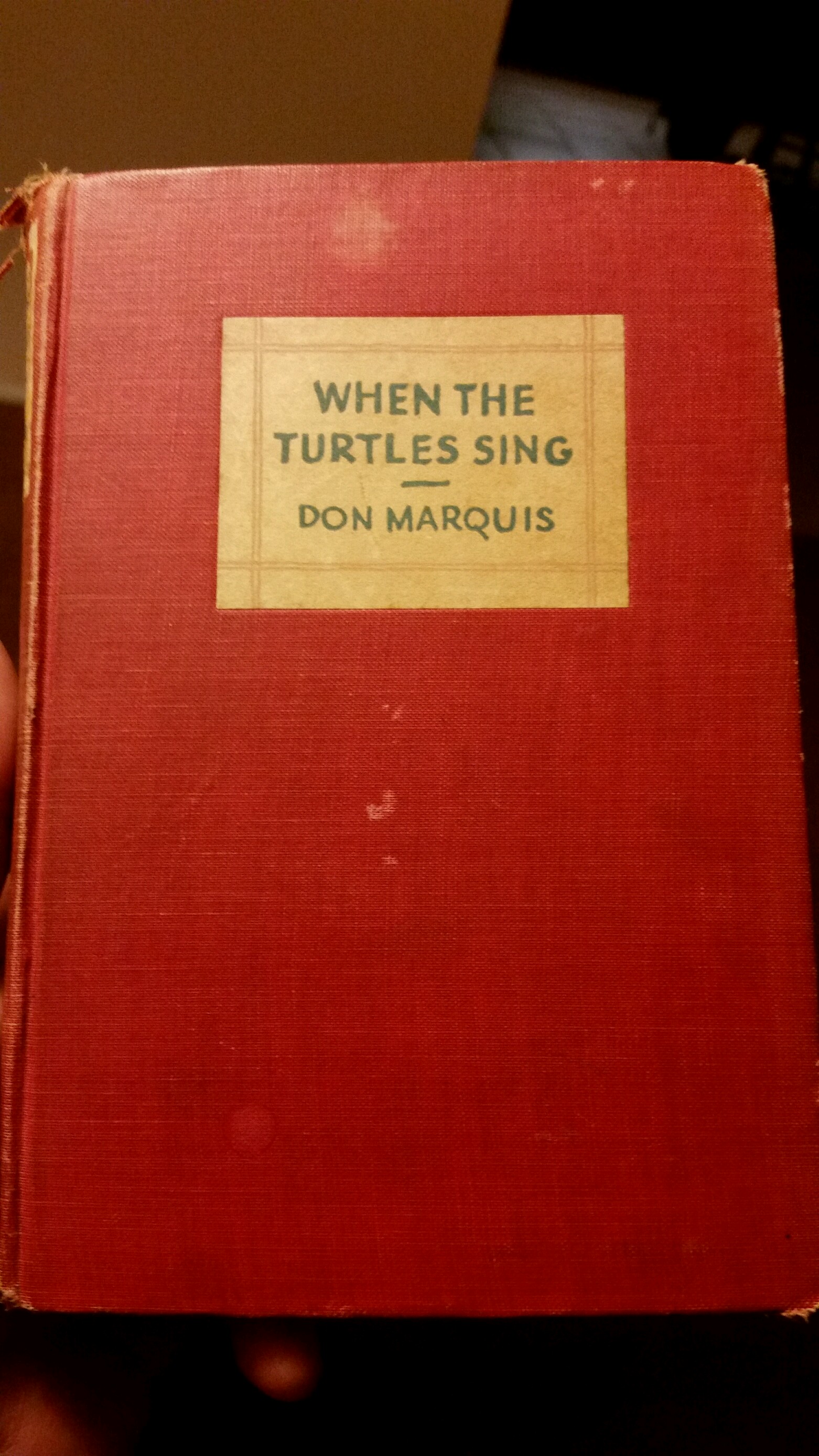
Book Review: When the Turtles Sing

When the Turtles Sing

by Don Marquis


This was a sweet book.

It’s ten short stories, published in 1928, by Don Marquis, a humorist and poet that I have been long acquainted with because my parents read and shared with the family Marquis’s collection Archy and Mehitabel, about a cat and a cockroach who are both reincarnated spirits; the cockroach was a poet, and he sneaks out at night and types poems on Marquis’s typewriter, one key at a time, without any capital letters because he can’t hold down the Shift key. I loved that book, and got my dad’s old copy of it a few years ago, whereupon I read it to my wife, who also loved it. So when I was at the Friends of the Library Book Sale, and I saw this lovely old hardback with a great title and a familiar author, I had to get it.

I’m glad I did. Marquis had a hell of a sense of humor, and more important, he had a hell of a sense of fun: these stories are mostly just fun. They’re good ideas, and they’re actually well-realized; a couple of them take really surprising dark turns, which fits the characters and plots, even if it doesn’t seem to fit the book. But it was an interesting choice, because you have what seems a parody, a caricature of human beings, who get into absurd situations – and then, for some of them at least, you have a fairly serious result, one which follows logically from the story’s events; but I didn’t think we were speaking logically.

The humorous stories are in two sets, one a trio of stories recounted to us by the Old Soak, an elderly gentleman who tells us stories about the strange residents of his small town, particularly the ones who live in a nearby swamp. One of the stories, the title one about the turtles singing (which is actually a quote from the Bible), has a mixed-up comic romance worthy of Shakespeare; but another of the Old Soak’s stories tells about a love triangle that might include a murder, as one man dies accidentally while in the presence of the second man. That story might get wacky, except it was much more about the woman’s attempts to become a full and complete version of herself despite the town’s bias against her, as she comes from the swamp and is therefore unclean and unacceptable. Her story is something of a triumph, as she finds a way to go to college and complete the education she had to begin herself, and then travels to Europe, unencumbered by marriage (She does marry both guys, but the second marriage is more open and free companionship than the sort of ownership that would have been common at the time) and child-rearing; all fine and good – except the story ends with her husband going mad with guilt over the death of the first man, and at the end he shoots himself. So, y’know – not funny.

The other funny ones are much funnier: a pair of tall tales told by an Irish father to his two sons; Marquis gives in to the temptation to write in Irish dialect, which isn’t my favorite thing to read, but he does it well and not too excessively. He does it with the Old Soak stories, too, which have a Twain-esque hillbilly style to them, with a number of malapropisms and strange spelling/pronunciations from a Southern American English dialect. More important, he doesn’t rely on the accent for humor: the stories are funny, and the narrator is hilarious, in both cases.

So I enjoyed the book, which was generally light-hearted and well-written. But now I’m sort of stuck: you see, I liked it, but I wasn’t inspired by it, so normally, I’d sell this book back into circulation so someone else could enjoy it. But this copy is actually from 1928, and it’s falling apart; the binding is broken, and the pages are coming loose from the spine. So I can’t sell it, and if I give it away, it will just get trashed. I can’t let Don Marquis get trashed. Not a book about singing turtles, either. I think that this book will get to sit on my shelf, hanging around like the Old Soak, just waiting for someone to sit for a spell and listen to his stories.

I like that.

Book Review: Christopher Moore’s (Alas!) Bad Book

Image result for the griff

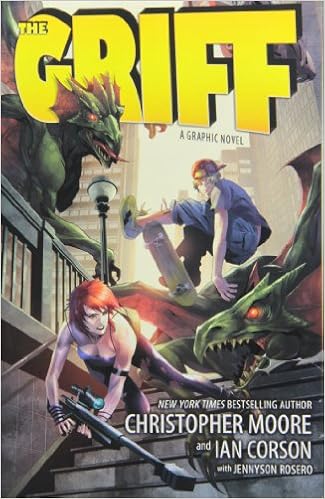
The Griff

by Christopher Moore and Ian Corson


I hate this. I hate it!

I love Christopher Moore. He is one of my all-time favorite authors, one of my heroes. I’ve read everything he’s written, and I’ve loved everything he’s written.

Except this.

This is a crappy book.

Well, I suppose it had to happen sometime; there have been some of his books (Island of the Sequined Love Nun, Lust Lizard of Melancholy Cove) that I haven’t liked nearly as much as his best works, like Lamb and Fool and Sacre Bleu. It’s reasonable to think that one of them could sink down low enough to actually be unenjoyable. It is not surprising to me that the one that did so was a collaboration, which none of his novels are; and that it was a graphic novel, which is not Moore’s usual medium. I would guess that Moore had little to do with the actual illustrations – which, unless I’m reading the credits in the book wrongly, seem to have been sort of mass-produced? They are all owned by Harper-Collins, and though a half-dozen people are thanked, no one is listed as the actual artist, other than the person who did the cover, Jennyson Rosero – and the illustrations are a fair piece of the problem with this. But really, there isn’t much here that’s good, so I can’t cover Moore on this one. He made a stinker.

All right: details. So this is an apocalypse story. The Griff are, quite literally, monsters from outer space. They are called The Griff because they look something like griffins: four legged beasts with claws, wings, and lizard/dragon like heads with sharp beaks. They arrive in large space ships, much like Independence Day, and immediately fall to wiping out humanity. (Reminded me of Footfall, if any of you are as deep into sci-fi nerdery as I am. Also, they seem to be summoned by an accidental signal sent into space by guys who uncover a mysterious artifact from the sea-bottom, which made me think of Star Trek IV. Woo! Nerdiverse!) So far so good: but that’s where the first problem appears. The design of the book is so poor that there are a couple of pages that literally can’t be deciphered; the rapid transitions between scenes of slaughter and ineffective human resistance to the invasion are just a jumbled mess. But that doesn’t really matter, because the majority of this story is about the survivors of the initial onslaught.

Which is where the larger problems come in.

First, the character development and much of the plot leans heavily on people being comic book hot, and endlessly horny. Now, Moore uses a lot of humor around sex; but this isn’t funny, this is just lame. The two female characters are in absurdly revealing outfits – one woman wears a wetsuit for the entire story, which seems to be the only reason she is a trainer at SeaWorld – and the male characters do nothing but make horndog remarks, which the women shoot down. Then the one woman – not the one in the wetsuit, the one with absurdly large breasts in a skin-tight spaghetti-strap crop-top, which is generally what one wears as the world ends – has a ridiculous sexualized response to finding a BFG, a Big Fucking Gun, with which she’s gonna go Griff-hunting. Because that woman is a gamer, a master programmer and a genius; therefore, somehow, she is capable of using an actual .50-caliber military rifle, since she’s used them in video games. Suuuuuure. I mean, she’s played all the video games, even created some of them, so she’s badass, right? But hey, none of that matters: what matters is that she’s hot. And, as the book goes on, horny. Her character is mostly depicted as a pinup. Who does finally sleep with the goofy nerd horndog who’s been coming on to her, because comics are all about nerd wish fulfillment.

Image result for the griff graphic novel

Then, at the end of the story, though there is a good twist regarding the Griff, it turns out that the Griff are the minions of – the little gray men. Yes, them. Scrawny bodies, large heads, huge featureless black eyes. Them. Just like every other alien story for the last 20 goddamn years. And the humans finally win, because that’s what humans do: we fight, and we kill, and we win. WOO! USA! USA! I mean – Earth! Earth! Earth!

Anyway. Characters are lame, design is poor, the art is too CGI-crisp for my taste (though to each their own) and the climax and ending of the plot were cliché and anti-climactic and annoying.

I hate that Christopher Moore wrote this, but not that much; everyone throws out a pile of crud every once in a while. Much more than that, I hated this book. Do not recommend.

Book Review: Redwall Book — is it #6?

Image result for Salamandastron

Salamandastron

by Brian Jacques

(*Note: it’s #5, actually.)


Now this is a good Redwall book.

There are some things that come close to my complaints in the past: the books in this series, while all well-written and sweet and fun, have tended towards a formula, to the detriment of a couple of the installments. And there are pieces here that are also part of the formula, to wit: a young male member of the Redwall community finds the sword of Martin the Warrior (How the hell could these people lose a sword this many times? I mean, come on! Every book they find that dang sword! Somebody needs to give these guys a pad of sticky notes.); a hare of the Long Patrol who can eat more than three other animals combined; the vermin army that attacks is led by a vicious evil beastie who rules them with fear and violence; said vermin army (spoiler – but not really) is defeated in the end; there are cute baby animals and playful pranksterish adolescent animals and kindly but staid elderly animals; and there’s a lot of food.

Goddamn, there’s a lot of food in these books. It’s like their one way to celebrate both their general happiness in life and also their victories over their enemies: some massive feast, with detailed descriptions of the dishes and the animals eating as much as they can.

But in this book, Jacques was able to add enough newness that the familiar elements felt familiar, rather than stale. Like the animal who finds and wields the sword (A squirrel this time, named Samkim) is not really the big hero: he does some good things, but mainly, he loses the sword and spends most of the book trying to chase it down; a different creature is actually the one who saves the day. While the vermin army was familiar, it doesn’t actually attack Redwall, and so there wasn’t the usual depiction of a siege. There was a siege, but it had an entirely different character because it takes place at the hollow volcano stronghold of the Badger lords and the hare Long Patrol: Salamandastron. And it is the badger lords who save the day. Also, the cute baby animal goes out on a quest, as do the pranksterish adolescents; this made both familiar character types more sympathetic, and minimized their cuteness and pranksterishness, which I really liked. This book had more to do with the badgers of Salamandastron, and also the shrews of the GUOSSIM (“Logalogalog!” has to be one of the best battle cries I’ve ever known. Along with the Tick’s immortal “SPOOOOOOON!”), than it had to do with Redwall itself, though Redwall is still a prominent part of the story; so this one felt like it expanded the world, rather than walked the same old paths.

There was also, though I don’t want to spoil the story any more than I already have (Come on, you knew the bad guys weren’t going to win. This is a children’s fantasy series. No way the bad guys actually win.), some real tension and suspense: because there is death in this book, and it isn’t just minor characters. The battle for Salamandastron has casualties on both sides, and indeed, goes against the badgers in several ways, for much of the book; creatures that seem set up to play major roles end up dying; there is a sad but realistic depiction of a serious contagious disease, and the way such a thing could rip through a community during the medieval times that these books are essentially set in. It meant that when some characters that I liked managed to survive, I was genuinely happy, because I knew there was a real chance they might not, so it was a victory when they did.

Other fantasy authors, take note. Except for you, George R. R. Martin. You already know more than enough about killing off your own characters.

This was a really good book, one of the best so far. Looking forward to more.

Book Review: The Metaphysical Club

Image result for the metaphysical club

The Metaphysical Club

by Louis Menand

I’m not smart enough for this book.

But I want to be, and I think that means I have to keep trying to read books like this, and think about what they say while I’m reading them.

So this book traces the influence of four American intellectuals on the general mindset of the United States. The four are Oliver Wendell Holmes, Jr., the Supreme Court Justice; William James, philosopher and psychologist (And older brother of the writer Henry James); Charles S. Peirce, whom nobody has heard of but was an influential thinker and writer; and John Dewey, the philosopher who had more influence on American education than anyone else. The wonderful thing about the book is that the sheer volume of information is staggering, and yet it is told in a generally simple and straightforward narrative style, well-written, and with a deft human touch; Menand delves into the men’s youth, their childhoods and upbringings, their parents, particularly their fathers, and the influence those men had on these four men, and builds a fuller picture than I have seen in most histories – and he does it for all four of them, while also pursuing a history of a set of ideas. So for instance, we read about Charles S. Peirce, whose father, Benjamin Peirce, was a mathematician, author, and Harvard professor; we see how the elder Peirce’s ideas reflected and interwove with the dominant ideas of the time – since the book focuses on men who came of age in America in the second half of the 19th century, the most important event was the Civil War and the most important idea Darwin’s theory of evolution through natural selection – and how his father’s ideas influenced Charles’s thinking, and how Charles’s thinking was affected by Darwin and by the Civil War; and then lastly, how Charles’s thought influenced and was influenced by the thought of the other three men. Along with the philosophy of Emerson and Kant and Hegel and umpteen other pieces that go into an exploration of a whole set of ideas.

It’s a complicated web. That’s why I’m not smart enough: because I knew none of this, knew nothing about these men – had never heard of two of them, and could never remember whether Holmes Jr. or Sr. was the jurist – I could not keep all of the facts and names and such straight. By the end of the book I was having to look back to the beginning of the book to remember who people were; this was made easier by the extensive index in the back, but still, that’s not my favorite way to read. And while I enjoyed the book, it was hard enough to get through that I don’t want to read it again, which is obviously the best way to handle this much information.

But: while the book is a history of four important men (The details of whose lives, while interesting, are not things I really need to retain), it is more an exploration of a set of ideas. And those, I found fascinating, and do want to spend more time thinking about. The basic ideas that stuck with me, after this first reading and without doing more research and thought (I just finished the book fifteen minutes ago), are: truth is socially constructed. We don’t know if what we know corresponds in any way to an external reality, but we can know if it corresponds with what other people know – which, unless we are born with certain ideas already implanted in our brains and our DNA, is the only way we can learn anything. Identity also may be socially constructed, meaning that we only learn who we are in relation to who other people are, and thus who we are not. Conflict is always and only the result of a misunderstanding, which, depending on how optimistic one is, may naturally get worked out on the way to a common understanding. There are no rules that can be formulated that can trump the specific context of an individual case (though I’m probably misstating or overstating that one), meaning that the historicity and specific application of an idea are necessary parts of understanding it.

That’s where this book really shines. Because Menand gives context. To everything. Everything he talks about is grounded in the specific events of the day and of these men’s lives. He has a wonderful habit, too, of giving brief synopses of the end of the story; Charles Peirce divorced his first wife as part of a large scandal in the late 1800’s that cost him his academic career, and before this book is over, we know not only what happened to Charles afterwards, but also what happened to both his first wife and the woman he left her for. It’s great. Even somewhat minor characters, people that move quickly in and out of the lives of the four main subjects, get parenthetical descriptions, like, “Joe Smith (who would go on to international fame as the Ambassador-at-large for chickens), had an encounter that struck our hero in an interesting way.” That was my favorite part of the book as history.

My favorite part of the book as philosophy and thought-provocation? I’ll let you know when I’m done thinking about it.

This is NSFW. And Trump is a POS.

So I wrote a blog, 2000 words, about how I’m unhappy with the way things are going because some things are going well, and I don’t want Trump to get credit for that because he isn’t the reason things are going well, but if we give him credit, we may end up with more people like him doing the things he’s done, because they’ll point at Trump as a success story. And I do think that’s a problem.

But you know what? That’s not what I want to say right now. That’s not the blog I want to post.

What I want to say right now is

Fuck Trump.


Fuck him all the way out the door and down the steps, fuck him rolling down the street and around the corner, fuck him all the way to the sewage treatment plant: then fuck Trump into the collection tanks, and fuck him step by step through the process, with the rest of the chunky liquified shit until he has been treated, emulsified, centrifuged, disinfected, milled, filtered, diluted, and sprayed onto his own fucking golf course to make the greens grow. And then let a blind man tee off over and over until he has turned the entire green, watered with Liquid Trump, into broken divots. Then mulch those, feed them to free-range farm pigs, let them turn the grass into chunky liquid pig-shit: and then run him through the process all over again. Keep doing that until there aren’t any more Trump golf courses. If at any point we feel there isn’t enough Trump-taint in the gray water, then throw in his fucking kids. (The grown ones; I got no problem with Barron. Or Tiffany.)

I’ve tried so hard. I’ve realized in the past couple of years that my loyalty to liberal, progressive politics, and especially to the Democratic Party, has been unthinking and in some cases counter to my actual desires and values. Not a lot; I still agree with most liberal progressive ideas. But I think political correctness is a blight on the language and the culture; and honestly, while I love animals, passing laws and regulations to limit human progress or achievement in order to save a rare form of tadpole that lives in one stream in Wyoming is stupid – the world will not be a lesser place if the Greater Wyoming red-speckled spiral-tailed hovering-footed tadpole goes extinct. Mainly, though, there’s one thing – and only one thing – that Trump was right about: Washington is a swamp. Both parties are corrupt, incompetent, filled with narcissistic sociopaths who serve themselves and their cronies and not the American people. I’m not too far away from saying that all of our government should go into the sewage with the President.

I am still trying to decide where I should land politically. I want to remain an idealist, which would throw me all the way to the left; but I also want to be practical and realistic, and that pushes me towards the center. Choosing either one seems like a betrayal of the other: and that’s a result of our political morass, as well, that there are purity tests, that people on the same side turn on each other in a heartbeat if they can find a tender place to sink their claws. We saw it with Sanders supporters versus the DNC and the Clinton campaign, and we’ve seen it for years with the Tea Party and how it has destroyed what used to be the Republican party, resulting in – President Shit-spray. Part of me wants everyone to agree, so we can all move in one direction; but I realize – and this is my big epiphany of the last couple of years of learning how to think more about my politics – that when everyone agrees, it doesn’t lead to good results. We get the best ideas, the best policies, the best country out of a constant and honest debate. The worst thing that our two political parties have done is surrender that ideal in favor of winning. That’s why we have legal partisan gerrymandering, inculcated for decades by both sides; that’s why we haven’t gotten rid of Citizens United, or passed campaign finance reform or term limits or strict controls on lobbyists and corporate influence of politicians. They all stopped trying to do a good job, and focused on just keeping the job. I know that’s always been a factor, but it seems to have become the only factor. One of my biggest surprises of the last two years of the Feces Administration was the sudden onrush of respect for Jeff freaking Flake, a cardboard cutout of a Republican who nonetheless resigned rather than suck up to Trump. (I suspect that he is going to continue on in politics, using his resignation from the Senate as a stepping stone for his next ambition; but he hasn’t done so yet, so as of now, I still respect the man for his decision. Integrity over politics. When was the last time that happened?)

So how do I reconcile that? Practically speaking, the way forward is with a party; because I am not a piece of shit, that means I have to support the Democratic party.

I’m sorry for those that offends. I have actually gained quite a lot of respect for the GOP and the conservative ideals they have historically espoused; the attraction of the moderate political position for me is it allows for that honest debate I mentioned which leads to the best possible outcome, that pull between two poles, both with merit, but both improved by being pulled towards the other – liberal ideas are better with a strong inner structure of conservative reality, and conservative ideas are better with a leavening of liberal idealism. The Republican party has served that role, and for a long time, and in a lot of ways, it has done so honorably, and therefore made our country better. But right now, and for the immediately foreseeable future, the Republican party is the party of Trump. Which means it’s the party of shit. You can’t hold up a 300-pound piece of shit and not get your hands dirty, you just can’t. And I don’t even care if he’s having a positive effect, if the economy grows and North Korea disarms and all that jazz: shit makes flowers grow, which is lovely: but it’s still shit. The best thing I can say about the current state of the union is that I hope it makes the land fertile again. Actually, the metaphor might hold true, because confronting the truth of Trump has made us all look much more closely at our political situation, and it is possible that we will get some genuinely good results after this shit-storm has passed. But now is not the future, and now, Trump is shit, and that means the Republicans are shit, because they back Trump. Period.

Where was I? Oh, right. So, if I want to get results, I have to support Democrats. I mean, sure, I could try to become an anarchist, or a pure Socialist, or something along those lines; there’s an attraction in that, in the purity of the ideas. But in reality, there’s no chance of changing the political situation in any way without one of the two major parties. Ignoring reality means people get hurt. I don’t want to hurt people: it’s kind of my main thing. (Note: I recognize the seeming irony of my rant about grinding our President into gray water while saying I don’t want people to get hurt, but you see, shit isn’t people. I don’t mind if shit gets hurt. [Second note: I’m kidding. I don’t want any harm to come to Mr. Trump. I want him out of office and living in the disgrace that he deserves. I’d like him to live like that for a long, long time.]) I want practical solutions to our immediate problems, all of them chosen and thought out with a positive ideal in constant sight; for that, I need to be involved in actual practical politics with real people in this country. A perfect example of this is Bernie Sanders: who was a Socialist, and then an Independent (Which he only got away with because he represented Vermont, even though he’s from New York), and then ran for the Democratic party nomination for President. That’s an idealist working with practical reality, and that’s why he would have had my vote if I could have voted for him. Another perfect example of someone who creates practical solutions while keeping an ideal firmly in mind is Elizabeth Warren, who I would vote for over any other potential candidate in 2020 with the possible exception of Stephen King or J.K. Rowling. On the other hand, the Democratic party is also the party of Chuck Schumer and Nancy Pelosi and Harry Reid, and they, from what I have seen, either  stick to the ideals, but give very little in the way of practical solutions – this is how Schumer has handled Trump, and it’s honorable, but it’s not slowing down the spray of shit – or else they surrender the ideals for the sake of practicality, as happened with the ACA when they removed the public option, which was the whole freaking point of the thing, the loss of which has made it useless, and, eventually, a political liability.

Sorry if that got muddy: it’s hard to stay clear when talking about politics. My point is that the idealism is necessary: purely practical compromise ends up losing its way and accomplishing nothing of lasting value; at the same time, practicality is necessary, because pure idealism doesn’t accomplish anything in the first place. Everyone already has their own ideals, and they’re mostly not mine. It’s too hard to get everyone to agree with the same ideals – impossible, in truth, unless you go full Big Brother and set up the Thought Police. This is what upsets me about the struggles within the Democratic/progressive wing, that we are all fighting each other over our ideas, refusing to accept or support people who don’t have all – and I mean ALL – of the right ideas. The fact that the big criticism of Bernie Sanders during the primary campaign was that he didn’t have a lot of support from minorities shows two things: the important one is that the Democratic party has given up its ideals, which means it has ceased to do good work for minorities in this country, which has left them smothered under the shit this country has piled atop them for centuries (Though fortunately, they seem to have found their own power and are clawing their own way out of the shit of history) and therefore Sanders could not simply pull in minority support by virtue of running as a Democrat; the entirely unimportant one is that Bernie Sanders is a white guy from a white state, and therefore has not had a lot of connection with, or influence on, the situation facing minority Americans. And if that made anyone refuse to vote for Sanders, then it helped give rise to the Shitpile-in-Chief; and that is a travesty. (I’m not saying that Democratic infighting led to Trump’s election, just that any vote that was lost because of the infighting is a specific, individual travesty. People that don’t support the Democrats at all, who are Greens or Libertarians or Socialists and so voted according to their conscience, that isn’t a travesty. But it may not have been practical.) A travesty that happened because people hung too much on the power of their ideals, and ignored practicality; ideally, a President should have a strong connection with all of their constituents; practically speaking, Bernie Sanders was the best candidate in 2016.

So here I am. I can support my ideals, and allow the shit to continue polluting this wonderful country; or I can support a party that keeps electing poor leaders: and I do think, in retrospect, that Clinton would have been one of those bad leaders. She’s not a piece of shit, and so would have been a VAST improvement; but I think she has very little personal connection to the ideals of progressivism. She’s too practical to be really great. I still wish she had won. Man, wouldn’t it be nice if all we were dealing with was a president who wasn’t progressive enough?

But all right, here we are with the shit. And no matter who you are or what your ideals, accept this as gospel truth: Trump is shit. The way he attacks everyone he disagrees with, the way he lies about everything, the way every single issue becomes a reflection only and always of him personally – the man is a piece of shit vaguely in the shape of a human. The most recent outrage is the separation of families at the border – intentional and callous and unforgivably cruel, and we all know it – and his attempt to defend it by holding an Exploit-a-thon, where he paraded out the family members of people murdered by immigrants, like that changes the statistics (which clearly show that immigrants are less likely to commit crimes despite some terrible exceptions), like that has anything to do with the family separation policy, like that’s anything other than cheap, heartless sensationalism intended to stir up racist fears in Middle America.

He signed the pictures. Did you see that? He signed the blown-up photos of the goddamn murder victims. Look.

And look, another Trump signature.

Clear as day: Trump's signature.

[Source]

Think what your brain has to be like to let you make that conscious decision to do that. Repeatedly, because he seems to have signed all of them, and at no point did he think, “Jesus, what am I doing? Who the fuck would want my autograph on the picture of their dead loved one? Is this really a memento they want? Will they want to remember this hoopla at all?” No, I’ll tell you what he thought: he thought, “These people want to use their grief to win political points, just like I do; I should thank them for letting me use them. Then they can frame this picture and tell their friends how they volunteered to become ghouls for the sake of bolstering up a racist piece of shit.”

So that’s where we are, and the cold, hard truth is this: it isn’t over. Trump is still President. And he’s just going to get worse. And I think the Republicans are going to keep supporting him, because too many of the heartless conservative bastards in charge, the ones who have no connection to the ideals they claim to serve but think only of practicality – the counterparts to Pelosi and Schumer and Clinton and Reid, namely McConnell and Ryan and Lindsey Graham, and Sean Hannity and Rush Limbaugh, and the Koch Brothers and Sheldon Adelson and the rest of them – are willing to use Trump as their dancing monkey to distract us all while they pull the country all the way over to their side, strap us all to their pole, and whip us with a leather crop made from the tanned hide of Ayn Rand. (That is to say: break the federal government, give all of the money to the rich and let the poor die – unless they’re in the military. No, wait; they still die, then.) And the closer we get to that pole, to that extreme end of the spectrum where there is nothing but a red so deep it looks black, the faster Trump will have to dance and the louder he’ll have to scream and the more shit he’ll have to fling to draw our attention away from the straps being tied around us and the crack of the Rand-whip. I think that his final act will be a terribly protracted fight over his impeachment, which will probably finish breaking the political system – it will be a miracle, by the way, if the last pieces of the filibuster rule make it through this administration; and it is truly worth noting that the first attacks on the filibuster rule came from the Democrats – and which may end in Trump’s removal from office, but will also end with the final slate of conservative goals being checked off, one by one.

Not only do I want to get rid of the piece of shit, but I also want to stop the heartless money-zombies from fucking everything up that Trump doesn’t shit on. And therefore, I will be supporting the Democratic party, and voting for Democratic candidates, even if they choose the wrong ones. I hope they choose the right ones – but whoever they are, they won’t be pieces of shit, and therefore they get my vote.

Join me in voting against shit this November, and in every election until the final collapse of Trump.

And then after we finally manage that, we’ll have a lot of work to do. And a lot of thinking, as well. We have work to do now, but it doesn’t take any thought. Shit is bad. Let’s flush it away, and wash our hands.

Please.

Children in Cages

People arrested for allegedly trying to enter the US illegally wait in cages inside a warehouse in McAllen, Texas. Picture: AP

People arrested for allegedly trying to enter the US illegally wait in cages inside a warehouse in McAllen, Texas. Picture: AP


CUSTOMS AND BORDER PATROL VIA REUTERS


Did you know we’re keeping children in cages?


I actually wrote a different blog yesterday, about how I fear that Trump’s success – or at least the positive things that are happening around him, even if they’re not because of him, like the unemployment rate going down – will encourage a cultural shift towards bullying. But I can’t post that one until I write and post this. Because this is the first thing that needs to be discussed. In fact, we should start every conversation with this until the answer can genuinely be, “No, we’re not; they stopped that.” Walk into Starbucks, and the barrista should say, “Hi, there are children in cages, but can I take your order?” And you should say, “Unnecessary family separation as a deterrent policy is a crime against humanity, and I’ll have a latte.”

So. Because of the attack on the media from Trump and the right (And because the corporate media has been sliding down into the muck for a generation at least), let’s establish facts.

First fact: when you type “children” into the Google search box, the first option is “Children in cages.” This is America. Childish Gambino released that video a month early.

Second fact: is this actually happening? Yes.

Federal officials said Tuesday that since May, they have separated 2,342 children from their families, rendering them unaccompanied minors in the government’s care.

(Source)


Third fact: are these children being kept in cages? Here’s a good explanation of the semantic argument.  If I may, the answer is: Yes. They are detention facilities, they do provide for the basic needs of the children, with the exception of the most obvious one: their parents aren’t there. But the essential point is: the children are held in enclosures made of chain-link fencing on concrete floors, and they are not allowed out of those enclosures. They are not able to see or communicate with their parents unless they can wend their way through an enormous bureaucracy.

Fourth fact: The children separated from their parents include infants and toddlers. Being kept in “Tender age shelters.”


Fifth fact: this is not, despite the administration’s stance, required by law, nor is it the fault of the Democrats. Unless we stop believing in free will. The administration has claimed – I heard White House spokesman Hogan Gidley reference all three of these elements during an interview with NPR – that the separation of families and the detention of children is the result of three things: the Flores Agreement from 1997, the William Wilberforce Trafficking Victims Protection Reauthorization Act of 2008, and the 2016 decision by the 9th Circuit Court which included accompanied minors in the previous laws regarding unaccompanied minors.

Here’s a good article from PolitiFact about this argument

If I may quote Inigo Montoya: “Lemme ‘splain. No, is too much: lemme sum up.”

The Flores Settlement agreement (Which settled a class-action lawsuit actually going back to the Reagan Administration) says that aliens in the custody of INS (now ICE) who are unaccompanied minors must be held in the “least restrictive setting” possible. Specifically, it says,

“The INS shall place each detained minor in the least restrictive setting appropriate to the minor’s age and special needs, provided that such setting is consistent with its interests to ensure the minor’s timely appearance before the INS and the immigration courts and to protect the minor’s well-being and that of others.”

Source

This means, to the Trump administration, that children can’t be jailed, and if their parents have to be, then the children must be separated from the jailed parents. I’ve seen various sources say that the settlement requires unaccompanied minors be released within 20 days, but I can’t find that passage in the agreement. If you’d like to try, look here.

The 2008 law applies because it says:

Except in the case of exceptional circumstances, any department or agency of the Federal Government that has an unaccompanied alien child in custody shall transfer the custody of such child to the Secretary of Health and Human Services not later than 72 hours after determining that such child is an unaccompanied alien child.

Source

This means that, once the children are separated from their parents (and therefore, according to the Trump administration, they are unaccompanied minors), they cannot be held by either INS, if the parents are being held pending an immigration hearing, nor by the U.S. Marshals, who hold the parents if they are being accused of a federal crime – which, under this administration, they are; that’s the “Zero Tolerance” policy that Jeff Sessions announced in April. Sessions’s memo to the state attorneys general is here,  and the law that he cites, the law against unlawful entry, is here.

Please note that the maximum penalty for a first offense is six months in jail, which makes this crime a misdemeanor. Most adult immigrants, once they reach a hearing, are released with time served.

Finally, the 2016 decision from the 9th Circuit Court of Appeals broadened the Flores Settlement to include accompanied minors, meaning that they, too, had to be held in the least restrictive setting available, and, as with the 1997 settlement, the government had to prioritize release of children in custody to family members over any other solution; the decision says that this was also the case with minors detained with their parents, though it does also make clear that this does not require the government to release the parents in order to provide a custodial parent for the children. It does require, as the Flores Settlement did, that parents be released with their children if they are not a legal or flight risk. 

Text of the Decision


So what does all this mean? It means that the Trump administration is arguing that they must uphold the law, and they must do something drastic to reduce the crisis of immigration across the southern U.S. border. They claim that those who cross the border have committed a crime, and therefore they must be prosecuted. If those people brought their minor children with them in the commission of this crime, those children have to be separated from their parents as they cannot be held in a prison with their parents, but must be remanded to the custody of Health and Human Services, as per the Flores Settlement, the 2016 decision by the 9th Circuit, and the 2008 Wilberforce Reauthorization Act. HHS then places those kids into tents and warehouses, wherever they have facilities that meet the standard of the Flores Settlement (Which says that they have to have the basic needs, and also opportunities for exercise, entertainment, education, and contact with their parents. Well.). This, they say, is all required by law, and at various times, various members of the administration from President Trump on down have all claimed that this is the fault of the Democrats: first they claimed that Democrats passed the laws (They didn’t), then they claimed that this has been going on since either the Obama administration or the Clinton administration (Neither is true; both administrations detained unaccompanied minors in similar settings, but neither intentionally separated accompanied minors from their parents and then treated them as unaccompanied minors. Generally they released families. It should also be noted that there were not nearly as many families trying to immigrate with their minor children in the past. Source), and then they claimed that the Democrats could end this any time by passing legislation to change the laws or the policies – their preference, apparently, is for the alteration of the Flores Settlement, so that they can detain children, accompanied and unaccompanied, for as long as necessary. This is also untrue in that the Republicans control all branches of government; it is true that they need Democrat votes to pass a law through the Senate, but the first obstruction to any legislation is and has been the President, who just will not say what he is willing to support; the two bills currently being debated in the House, one more conservative without a path to citizenship for the DACA recipients, one more moderate (but still Republican/conservative) with a path to citizenship (along with limiting legal immigration and funding the Trump border wall) have BOTH got his support, whatever the hell that means.

But please, in this era of lies and exaggeration and political spin, let’s just get down to brass tacks. This policy of family separation is. Fucking. WRONG. It is vile and appalling and inhumane and cruel and everything that this country is not supposed to be. Regardless of whether the parents of those children have committed crimes (and in the case of asylum seekers, some of whom have also reportedly been separated from their children because the asylum seekers stay in the custody of ICE while awaiting their hearings and the children have to be remanded to HHS according to Wilberforce, literally no crime has been committed, as seeking asylum is legal.), the children have not, and the children have rights. They have the right to be with their parents, and they have the right to not be jailed. That doesn’t imply that you put them into chainlink-partition-spaces in tents in Texas; it implies that you find a way to ensure that the parents can be released from custody without violating the laws you are trying to enforce.

Now let’s talk about that. Because there really is an obvious solution here, even though it is one that Trump finds untenable because it makes his base froth at the mouth: he calls it “Catch and Release.” This is the policy that previous administrations have used with most families (Not, as Obama’s Department of Homeland Security Secretary Jeh Johnson said, in cases where there might be some doubt as to the child’s familial relationship to the adult; thereby rebutting current DHS Secretary Kirstjen Nielsen’s argument that children must be separated in all cases because the families have no documentary evidence of familial relationship and therefore ICE has to assume the adults are human traffickers) and with many other immigrants seeking asylum or going through legal processes. You set up a court date, and then you release the people on their own recognizance, with the understanding that they will show up for their court date.

Here’s the thing. This is how our system works. Our Constitution requires the provision of bail that is not excessive, and that everyone receive a fair and speedy trial, and that anyone accused of any crime is innocent until proven guilty. Unlawful entry is a misdemeanor. The maximum fine is $250. Reasonable bail for that crime would be, what, maybe $100? Public intoxication, also a misdemeanor punishable by a maximum of 6 months (Varies by state – I’m using Indiana because it came up first on Google) and a fine of a whopping $1000, has a bail around $200-$500, according to the Bail Bonds Network. So I would think that bail for the parents should be something that most of them should have access to, especially if they have friends or family in the U.S. Once bail has been granted, then the question is whether or not the accused will show up for court; President Trump, of course, argues that they won’t, that the illegal immigrants are intending exactly this: showing up with their kids so that if they get caught, they will be released and then they will vanish into the Heart of Darkness inside the U.S. and never be seen again until they get arrested for rape or murder.

But here’s the thing. Immigrants show up. They don’t miss their court dates.

Moreover, studies show that asylum seekers—like many of the thousands of Central American families fleeing violence and arriving to the U.S.—are likely to appear for proceedings, because they have such a strong incentive to avoid returning to persecution. Indeed, as United Nations High Commissioner for Refugees (UNHCR) researchers found in 2013, asylum seekers have a natural “inclination towards law-abidingness,” and view making a refugee claim as “a manifestation of faith in legal process.” U.S. research bears this out. A Vera Institute study, from 1997 to 2000, of asylum seekers in expedited removal proceedings found to have credible fear, found that 93 percent with intensive supervision complied with all court proceedings; 84 percent complied with minimal supervision; and 78 percent complied even if simply released without supervision. These compliance rates were so high that Vera concluded that “[a]sylum seekers do not need to be detained to appear…. They also do not seem to need intensive supervision.”

Source

And if that rate doesn’t appeal, there are certainly ways to improve it. Immigrants with legal representation, for instance, attend hearings at an even higher rate. Solutions like allowing immigrants to check in via phone call or smartphone location apps create higher response rates. Even ankle bracelets (like the two that Paul Manafort has to wear ) would allow a tough-on-crime sort of stance, while allowing families to stay together, and reducing the burden on government resources to house all of these people.

In other words: there are alternatives. Even if you accept the claim that the administration is enforcing immigration law, it has to be pointed out that there are also 11 million illegal immigrants currently residing in the U.S., who are not currently being rounded up, separated from their children, and housed in federal lockup. So apparently the Trump administration is actually choosing and prioritizing which laws it enforces to what extent. Which is, indeed, the whole goddamn point of an executive branch. And this executive is choosing to prosecute people accused of first time illegal entry – a misdemeanor with a lesser penalty than some states impose for jaywalking – and therefore choosing, as a matter of intentional, proactive, object-oriented policy, to separate families and put children in cages. This is our government, and our country. It is us, unless we do something about it.

It is fucking wrong. It has to stop. It has to be the first thing we say, and the first thing we act on, in our current opposition to the abuses of our government. And I don’t care if you are a progressive liberal or a libertarian anarchist: this is what you should be talking about. This is what you should be fighting. Call your representative, call the White House, write letters, march, protest, donate, do anything and everything you can. Fight this. Fight it now.

We are keeping children in cages.