This Morning

This morning I am thinking about what makes me a good teacher. I think it is because I would be a terrible boss.

I’ve given an assignment to two of my classes. It’s an evil assignment, in my favorite tradition of assignments that make my students uncomfortable in what I think are productive ways; I like it because they whine and I don’t have to care about their suffering, because it is productive suffering. I just get to laugh at them. This assignment is a group project — that’s the evil part; group projects are the worst thing about school, in my opinion: and this time the group is the entire class. (They’ve handled it admirably, I have to say. They’ve divided the work in a rational way, and they have assigned themselves exactly the roles I would have assigned them: the best writers are writing, the most outgoing and entertaining students are presenting, and so on. My second class has had a rougher time, but largely because the strongest personalities have been out for sickness; they were all present yesterday, and — with a little prompting from me — they came to a good solution.)

I pitched the assignment like a work project. I said they were a department, and I was their boss, and I called them up and said, “I want background on this subject. Get it done.” Then I left everything else to them. But because I don’t want to make this harder on them than it has to be, I told them that I would let them pick the subject they researched — I suggested it relate to the literature in the class, but I didn’t insist; one class is doing the history of India because we’re reading The God of Small Things, and the other class is doing insane and dangerous monarchs throughout history because next month we’ll read Macbeth — and also the due date. I also told them that they could ask me for an extension if they couldn’t hit their due date, and I would give it to them, as sometimes bosses do that.

While we were discussing it Monday, one of my students said, “You’re being much nicer than most bosses.”

And she was right. Because I’d be a terrible boss.

I don’t like forcing my opinions and decisions onto other people. I am happy and flattered to be asked for and to offer my opinion, but I don’t see why mine has to be THE opinion. Especially not with decisions such as due dates. When I do pick them, they’re essentially arbitrary, and based solely on my schedule, my convenience; but since I’m not the one doing the work before the due date, shouldn’t the people who have to complete that work be the ones to decide on a good time frame? Since they know what else they have to accomplish in the same time frame? I do all the work after the due date, but that’s where I don’t let them estimate how long it should take me or when it will be finished: I take as long as I need to grade work, and they can wait until I’m done. Shouldn’t I offer them the same courtesy? I usually estimate how long it would take me to do something (and then I double or triple it, because I’m better at this stuff than my students are) when figuring how far out the deadline should be; but don’t they have a better idea of how long it will take them to do the task? The same for subject matter, or the form of the product; I pick some of that — I told them I wanted both a written product and a presentation — but why should I pick the actual thing that is being researched? Based on what I think they need to know? What I think is interesting?

Yes: that is precisely what bosses do, what people in charge do. We have a staff meeting today in which our bosses, who are not teachers, and 2/3s of whom have never been teachers, have decided what the teachers need to learn; they have picked the materials, and they will be presenting to us in the manner that they think is best. And every one of those decisions, historically, has been wrong. We don’t need to learn what they’re trying to teach us, and both the materials and the delivery are a textbook example of what NOT to do. This year our training sessions have been on pedagogy, and watching an administrator with no classroom experience do everything wrong — PowerPoint slides that are all text, which are then read to us directly; handouts that are the same as the slides; videos that are hard to see and hear, which often feature elementary school teachers (I teach at a 6-12 middle/high school), and which never give clear examples of the concepts being discussed, and by “discussed” I mean very much the opposite as none of the audience ever talk apart from offering short Yes/No type answers to their simple factual question — it’s pretty agonizing. It is wonderful irony, though. If only that were the lesson.

I couldn’t do that to my staff. I ask my students all the time for their input: what they want to work on, what they want to do next, if they have any alternate subjects or suggestions; I ask them how long they need to do work, when they want it due, when they want the test to be, and so on. I just don’t like demanding that people do what I think they should do. I think it is essentially immoral to impose my will on another human being; if I can convince them I am right, then they will agree to my proposal, and I think those outcomes are  always better. I also hate keeping secrets, which is important in many ways for those in charge of information, as information is power and also potentially harmful; and I cannot bear to inflict harm on those under my authority, which means I would be terrible at firing or disciplining employees, just as I am terrible at disciplining students.

I’m a very good facilitator. I am an awful authority. That’s why I’m a good teacher — and why I should never try to run a serious company, nor become a politician.

Or maybe I should be a politician, for exactly that reason?

Nah. I wouldn’t want the job.


(I should probably start numbering these.)
This Morning

This morning I am thinking about my coffeepot at school. My coffeepot is unsafe. 

This isn’t the first time I’ve heard this: at my last school, coffee pots were unsafe unless they were industrial or restaurant grade, which basically means they have better safety features, automatic shutoff in case of a power surge or a short circuit, and whatnot. Don’t want my coffeepot starting a fire. Sure, whatever — but they overlooked those ancient overhead projectors, which, if you’ve ever stood in front of one, you know heat up to at least 836.9 degrees Fahrenheit, so. Maybe the coffee wasn’t the biggest risk.

Anyway, I heard that my coffeepot was unsafe a few months ago when the health inspector said I couldn’t sell coffee to students, which I had been doing as a fundraiser for the English department so I could buy extra copies of books and such. I don’t have a food handler’s license, so I cannot prepare and serve foodstuffs to the public. Don’t want to get any salmonella in their coffee. I also heard that coffeepots needed to be secured so that the students couldn’t spill hot coffee on themselves as they walked by, nor pick up the glass carafe and smash it over their own heads in a fit of teenage pique.

So I stopped selling coffee to students (Some of whom are still heartbroken, and still ask wistfully if I will sell them coffee) and moved my coffeepot behind my desk, where students never go. For two months, it’s been sitting on the floor, where, presumably, nobody will spill the hot coffee on themselves, nor easily fall onto the carafe and get glass shards embedded in their innards.

Yesterday I got an email informing me that my coffeepot was unsafe on the floor, that it needed to be on a desk to minimize the risk of hot spills and “electrical” risks. Apparently the chances that coffee will pool under the machine and work its way into the insulated power cord are greater when it’s on the floor. (By the way: it sits on a carpet. I suppose that increases the risk of toxic mold.) I just wish they had told me that when it was on the desk.

Actually, I wish they would just come and tell me, “You can’t have a coffeepot in your room.” They wouldn’t really have to explain; the health inspector didn’t explain, he just said, “You can’t do that.” The fire marshal at my last school who informed us that coffeepots in the classrooms had to be industrial grade didn’t explain; he just told the school that that was the law, and the school told the staff, since there were four or five of us who had personal coffeepots. Actually, they wouldn’t even have to speak to me directly: I’m an introvert, I’m a writer, I prefer email. Love it. It’s the best thing to happen to teaching since tenure.

But they didn’t do that. The email I got informing me yesterday? It was actually a general warning to all the staff that they can’t have coffeepots on the floor. For all of us who are making that same mistake, so that we know this is not an acceptable situation, because of hot spill hazards and electrical hazards.

Want to guess how many teachers in the school have coffeepots on the floor? Scratch that: want to guess how many teachers have coffeepots?

Yup. Me. Just me. Worst part is that I walked into the room while the two administrators who did the safety inspection were walking out, and I asked if they were looking for me, if they needed me for any reason, and they said, “No, just doing a safety inspection.” Two weeks later, general email about floor coffee.

So this morning I am annoyed. I am extremely careful with my coffeepot, simply because it is precious to me: it makes the coffee. That’s the only thing that keeps me going. The coffeepot in the teacher’s lounge is a Keurig, which means I can’t make a pot and then run down there between classes and fill up my cup; I have to make a fresh cup, and with four minute passing periods and a hall full of students to navigate, I just don’t have time. It also means huge amounts of waste, and the genuine risk of toxic mold and just disgusting nastiness inside the machine, which is impossible to clean out properly. I am honestly not sure now what the answer is, what will make my school happy other than me simply getting rid of the coffeepot, which is clearly what they would prefer.

But I’m not going to do it. Not until they come speak to me directly and tell me to do that.

If they do, I will offer them a nice cup of coffee. And then smash the carafe over my own head.**


**Because I once nearly got in serious hot water (HA! Get it???) for making the apparent threat that I would “shove a desk down a student’s earhole,” I would like to make clear that this comment about the carafe-smashing is no more than a poetic way to end the post. I do not in any way intend to commit violence against myself or any other person, or my coffeepot. Though I will absolutely be putting salmonella in the coffee from now on.


**!! UPDATE TO ADD: There was a new email this morning.

“Hi All

Sorry, a correction from district from my previous message:
There are to be no coffee pots in any rooms at all. Any liquid that is in a room that has electricity must have a GFCI (Ground fault circut interrupter) plug.”
Good thing they let ALL of the teachers know about this.

This Morning

This morning I am proud.

I am proud of myself, for my writing, for my ideas, for my determination to see this through. I am proud of myself for thinking up Damnation Kane, for making the story and the character what they are: interesting enough to draw people in, good enough to keep them reading. I am proud of myself for giving myself writing deadlines and sticking to them. I am proud that I wrote this book. I am proud of myself for not pushing it aside when it wasn’t immediately successful. I am proud that I rewrote the book, added another 25% of new content, and then re-edited, re-formatted, and did everything else needed to make it publishable. I’m proud I looked into getting a booth at the festival, did the paperwork, paid the fee, and got everything set up so that I would have a good display and a good pitch. I’m proud that I was there both days, that I advertised to friends and coworkers and students, I’m proud that I sold out of books when there was only 40 minutes left on the second day, so I know I brought a good amount. I’m proud that I set a price that didn’t drive people away, that did make them pause for a moment (so I know it wasn’t too low), but that covered all of my expenses and even made me a profit.

I’m SO proud of my friend and colleague, Lisa Watson, for doing everything with me, especially when the books she was sharing are so much more personal: they are her lifetime of poetry, back to when she was a high school student, and they are as vulnerable and revealing as poetry always is, and she sold them to strangers, again and again and again. And then when she ran out of books to sell, she stayed in the booth just to support me while I kept selling. Even more than all of that, I’m proud of her for writing, for writing poetry, for writing beautiful poetry, for writing for all of her life, and for still writing.

I’m proud of our friend and fellow teacher Adriana King, for being the unstoppable force of organization and salesmanship, for creating a new business entirely herself, for putting together incredible, wonderfully professional materials, for working that fair for two days through sunburn and backache, for connecting with every author she could, for making contacts and getting leads, for being an inspiring entrepreneur. And for mastering the art of subtle business card handoffs. And for bringing a red Swingline stapler.

I am proud that I have done enough to win and deserve and keep the love of a woman like my wife. The only feeling deeper and larger than my pride is my gratitude to her for all that she gave me and all that she did for me that made all of this possible, every step of it. And the only feeling deeper and stronger than my gratitude to her is my love for her.

We won. And I am proud.

Now we have to do it again.

This Morning

This morning I am thinking about how much fun I am having. About how good I am at this.

I was in a booth at the Tucson Festival of Books yesterday. Selling my book.

I was worried on Friday that nobody would stop by the booth. But dozens of people did. Though we had some lulls, we were busy pretty much all day. We had a good spot, for one thing, which might have been because I was early to reserve the space, so we ended up near the food court on one of the main walkways, which was great. The name of the booth helped (We called it A Pirate and A Poet, and only a few people mistook that to say “A Pirate Poet” or “Pirate Poetry.” Though I don’t know why you wouldn’t stop to talk to a pirate poet; that sounds awesome.), as did the fact that I had two of my fellow teachers sharing the booth with me, my friend Lisa Watson — the Poet — and our friend and co-worker Adriana King, who was looking for clients for her editing and book-doctoring business. (I highly recommend them both, by the way. Lisa’s poetry has a lovely sweet tenderness to it, except when she’s writing ferociously, as she often does, and Adriana is one of the most organized, capable, hard-working and knowledgeable people I know.) Lots of people paused when they saw my display, and came over to talk to me, specifically.

I was worried that no one would show any interest in my book. I’ve been worried about that, that my premise is lame, that my fascination with pirates and my choice to write an entire book (an entire trilogy!) about one was too precious, or affected, or just focused on too narrow an audience. But I had people all day coming up with the words, “I love pirates!” To which I got to respond, “Me too!” And more than one person said that they read everything they can find about pirates. Most of those people took one of my bookmarks, which have my website address on them, so it’s entirely possible that some or several of those people will go on to buy the book from home.

I was worried that no one would buy the book. But I sold twelve copies. My wife overheard some other authors talking in the Indie Authors tent, where you could rent a single table space for cheaper than the whole booth cost (And I have to say, that booth was pricey. We all three did well, but I don’t know that we’ll actually make back the cost, not in direct sales at least.), and they were saying that they sold three or four books, and that the big seller had sold seven. I sold twelve. Several of those —  half, I think? — were to students of mine, past and present, which is cool all by itself, because it shows that my students were willing to shell out $25 for a book largely because I wrote it; but even cooler for me was the half a dozen people or so who bought the book because I sold it to them. Because I told them the story, the character, the origin of the idea, how I wrote it, anything else I could; and people bought it. People bought my book.

I did this well. I spoke casually and pleasantly, I addressed people as they came up to the booth but didn’t give a hard sell — I generally asked, “Can I tell you all about my pirate book?”  — my promotional materials were eye-catching and useful. And, most importantly, I wrote a good book. Two people took the time to actually open the book and read some of my writing, and both of them bought it.

Today’s the second day. And I don’t want to jinx it, but I hope it goes as well or even better. I’m pretty sure (Though I am tired; it was a long day yesterday, and I woke up early this morning)  that I will do well again. And then I’m going to have to start looking for other opportunities to do this, because — I did this well.

This Morning

This morning I am thinking about words.

I’ve written about 700,000 words worth of books, over five (longish) novels. I’ve no doubt I’ve written twice that in blogs and essays and book reviews, and probably its equal again in journals and diaries, notes and letters and the various ephemeral thoughts that find their way onto paper. That means I’ve written somewhere above 3,000,000 words in my lifetime.

How many of them were the right word? The best word? Twain said that the difference between the right word and the almost-right word is the difference between lightning and a lightning-bug, and nobody has said it better. Not all of mine are the best words, not by any stretch; but I think some of them have been. Sometimes. and even where they weren’t the perfect word, the best word, quite a few of them have been good words. And when the total is 3,000,000 words, “quite a few” — well, that’s something. It’s something.

I wonder how many people have read my words. I’ve read my essays to students for as long as I’ve been teaching, and sometimes my short stories or even an excerpt from one of my books; that’s around 3,000 students over the last twenty years. Three thousand people. And of course, I’ve written notes and comments and such on their work, and answered their questions and concerns in emails now to the tune of thousands of words, tens of thousands of words. I’ve never sold a lot of books, but I have sold some, and I’ve had blogs, with some number of readers, for more than a decade.

How many times have my words made people smile? Made them widen their eyes? Made them feel angry, or sad, or touched? How many times have my thoughts made someone else think something truly powerful, a sky-shattering inspiration, a ground-shaking memory, a tidal wave of thoughts?

I think those things have already happened. I think I’ve done them several times. I have. With my words.

This morning, I’m proud of that.

This morning, I hope I get to do it more, and more, and more.

This Morning

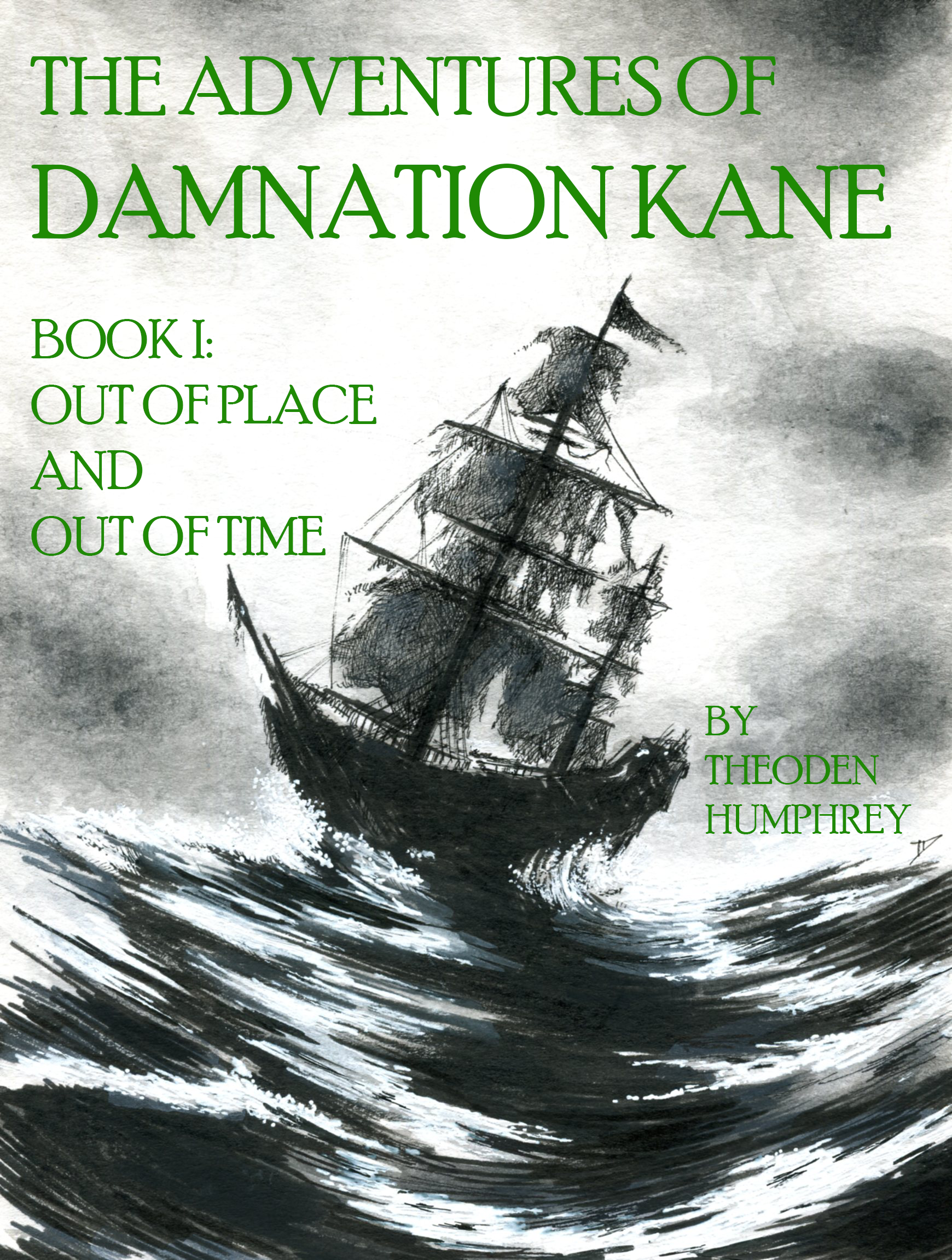
Image result for damnation kane

This morning I’m thinking about selling books.

I’m going to be at the Tucson Festival of Books this weekend, March 2nd and 3rd, in a booth with my friend Lisa Watson. We call ourselves the Pirate and the Poet. (I’m the pirate. Did I mention that I wrote a book? Here it is.) I’m going to be trying to sell my book, in person, to random passersby.

I have no idea how to do that.

I know how to write. I know how to talk about writing.  I know how to describe the book quickly — it’s about an Irish pirate who travels through time from the 1600s to 2011, and ends up in Florida —  and how to do it more extensively. I have some comparable authors for my writing style, and some comparable books and movies for the themes and ideas of it.

But I don’t know how to sell it.

This is an ongoing problem, and I know it’s not just my problem. I’ve written four novels, and tried to get all of them published, tried to get all of them picked up by agents, and it’s never worked. I’ve never been able to sell my own stories well enough to get disinterested people to want them. Oh, I can sell books to people who know me; that’s always been my audience. But I can’t make the jump from friends  and family, to general public. I’ve been trying for fifteen years, and so far, pretty much nothin’.

So this weekend, I’m going to try again. I’ve got a booth, I’ve got a big sign, I’ve got bookmarks with my name and the book title printed on them. I’ve got 30 copies of my book ready to go. I’ve got a Square for my phone so I can take credit cards, and I’ve applied for both a sales tax reporting code and a business license (which it turns out I didn’t need– but I applied for it anyway!). I’ve even got a pirate hat and a decent pirate accent that I’m going to bust out for the people who come up to the booth and say, “Where’s the pirate?”

I am looking forward to this. My wife and my friends have told me that the worst that could happen is I spend time at a book festival, with my friends, surrounded by hundreds of thousands of people who love books. They’re right, and I want to do that  — though the introvert in me wants to hide, hates the thought of spending my whole weekend out among people, wants to prepare every possible convenience to take with me so I have almost all of the comforts of home. But they’re also wrong, because the worst that could happen is that nothing even remotely hopeful comes of this: that nobody stops at my booth, that nobody asks about the book, that nobody buys it (other than my students, whom I appreciate for their support, but they’re still in my regular audience of “People who buy my books because they know me.), that this is yet another dead end in a career of them.

I don’t think that’s likely. But I can’t say it’s not possible.

Wish me luck.

This Morning

This morning I am thinking about my wife.

Today is her birthday.

I have presents for her, and I have a card, and I have my excited “Happy Birthday!” all ready to go. I’m going to take her out to dinner tonight, and I’m going to buy her something delicious for dessert, and I’m not going to tell the waitstaff that it’s her birthday because she hates when the waiters sing the song to her. Even if she gets a free dessert.

But I can’t possibly say all the things I want to say about her. I don’t have the time, and I don’t have the words: even me, even with all the words that I’ve written over the years, I still don’t have enough words to say how perfect she is. I want to use all the cliches, because (as good cliches do) they all fit: she is my everything. She is my queen, my angel, and my goddess. She is my better half, and my partner in crime. She completes me. She carries my heart.

None of that is enough.

But that doesn’t matter.

It doesn’t matter what I call her, what goes in the blank of “She is my ____________.”

That matters is the three words before the blank.

She is mine. And I am hers, but today I am thinking about the fact that she is mine.

There is nothing and nobody that I am happier to say that about, on this entire Earth, in this whole universe, in all of time forwards and backwards from this moment, this day that is her day. She is mine.

Happy birthday, my love.

Image may contain: 1 person, phone and eyeglasses

This Morning

This morning, I want to be half as fascinated by anything as my dogs are by the smell of old shit.

And this morning, I’m wondering: why can’t I be?

When we go on walks (For those who don’t know, I have two dogs, Roxie and Samwise. Here’s a video of them going out in the snow.) my dogs will often stop to investigate interesting sniffs. Roxie prefers checking out holes, looking for small critters who will be her friends; Samwise is looking for markings from other dogs so he can understand them better and have meaningful dialogue. So it’s mostly  Sam who stands over old feces and sniffs it carefully, meticulously; I suspect he either has a very sensitive nose (even for a dog), which allows him to discover more interesting bits of smell than Roxie can, or a very sensitive mind, one that allows him to think more interesting thoughts about the smells he detects, and so he must take longer to think those thoughts through.

Now I don’t have an acute sense of smell; I don’t have any particularly acute senses, actually. I used to have remarkable hearing, but I’m 44 now, and it’s fading a bit. But I do have a very sensitive mind, and it allows me to think more interesting thoughts. Certainly more interesting than Roxie. (That’s okay, she is sweeter and more exuberant and funnier than I’ll ever be.) So while I don’t care much for the smell of old dog crap — or even new dog crap — or any crap, really — the things I do care for, I can take time with, time to think through my more interesting thoughts. I just have to let myself have them: have to pay attention to what is in front of me, and let my mind take it where it will, think whatever I can think.

I wonder where my mind will take me.

This Morning

This morning I am thinking about pride. Where pride comes from, what makes it valuable and what makes it problematic. My central thought is this:

The price of pride is pain.

Christianity says that pride is a sin; I don’t agree, though I certainly recognize that pride can lead to sin —  arrogant dismissal of others’ value, nationalism, racial divides and conflicts, a hundred other ways that pride “goeth before a fall,” as they say. I also see where pride is strength: pride in my accomplishments, as a writer, as a teacher, as a human being, is often what keeps me going in the face of continued struggle and defeat. Pride lifts up the downtrodden and helps  them to fight back against oppression, often in the face of overwhelming odds. There is value in pride. It also may be that pride is essentially inevitable, that in a culture that constantly appraises the value of everything as good or bad, better or worse than everything else, there is no way a rational person could not see which of their traits are on the approved list, and feel a bump, or a jump, in their worth.

But like everything else that has value, pride has a cost. I think that pride has to be earned. I say it is pain, but I include painstaking effort in that; anyone who has fought hard for a skill or an ability or to overcome a prodigious obstacle knows that pain is not only limited to sharp injuries. There’s a great scene in To Kill a Mockingbird when Scout and Jem are trying to find anything in their father Atticus Finch to be proud of, and then they find that he is a crack shot with a rifle; when they ask their neighbor Miss Maudie why Atticus never bragged or showed off his ability, she says that Atticus knows better than to take pride in something that is a gift from God. His ability, the steady eye and steady hand that lets him hit everything he aims at, was not earned: it was inborn. (There’s an argument to be made that practice and training made him better, but this is both a simplification and a speculation on Maudie’s part. The point remains.) I am an American, but I did not work for that: it was an accident of my birth. I take no pride in accidents. I do take pride in the actions I have taken, the burdens I have carried, for the sake of my society, and which have made that society better; I vote, I pay taxes, I participate in the cultural and political conversations, and probably most importantly, I teach. I think that those who serve, both in civil society and in the military and public safety, have earned and deserve their pride in themselves and the country they helped to build and maintain. They (we, if I may be bold) have paid for it in effort and sacrifice, and often (they, not me) in suffering and loss.

I want to say that those who do not earn their pride before they hold it, flaunt it, and press eagerly forward to show it, chins out and hands balled into fists, will pay for their pride in suffering afterwards: that the fall will come, that they will be humbled and humiliated. But of course that doesn’t always happen. The universe is not just. There is an easy way that people with unearned pride can avoid the pain themselves, and that is simply to move the suffering off of themselves and onto others, and thus you have the Ku Klux Klan, and domestic abuse, and bullies. And Donald Trump.

But for those who are not that, who are not victimizers and warmongers, the point I want to make is that pride must be earned.

And the price of pride is pain.

This Morning

This morning, honestly, I’m thinking about how much I have to teach my students still, and how little time I have to do it. I’m thinking about whether or not literature can be parceled  into discrete packets called “reading assignments,” and whether there is any point to assigning reading homework to people who don’t read. I’m thinking about whether it’s better to comment extensively on essay drafts, or to hand them right back and just say, “Make it better.” Independence or guidance?

On the one hand I have the pedagogical establishment in this country, which wants me to differentiate and scaffold and make all learning student-centered, preferably student-generated project-based collaborative group multimedia discovery projects. I honestly have no idea how to do this, but I suspect it is both transient and unsustainable: that too much effort would go into planning and organizing the perfect project units, and in pre-teaching protocols for students to follow in generating their own discovery learning projects, and in trying to make the groups work fairly, particularly with low-interest students; and within five years, pedagogists will have discovered a new element that should be added — though nothing will ever be taken away. The new element will not make this more practical.

And on the other hand I have Eugen Herrigel’s Zen and the Art of Archery Herrigel was a German philosophy professor who studied traditional Japanese archery in Japan, and his book is credited with helping to popularize Zen in the west. His archery master has the perfect system: he shows the students how to do the thing — how to draw the bow, aim, and fire at a target (Also, most importantly, how to breathe) — and then he has the students do it, and he points  out their mistakes. Then he does it again. And again. That’s it: modeling and expert critique. There is no explicit  instruction at all.

There is precisely one reason why I have to rush, why I have to assign reading packets rather than whole novels, or better yet, just read whole novels with my students and discuss them as we go, and it is time. The determination that one class lasts for fifty minutes, that one week is five classes, that one semester is eighteen weeks, that one year is two semesters, that an education is thirteen years. We are in a hurry, all the time, forever, particularly with our children. That’s what ruins everything.

If I could teach anything, I would teach this world to take its time.