This Morning

This morning, I don’t get paid enough.

I know that’s not a complaint unique to me, and it’s not one unique to teachers. But it’s the truth: I don’t get paid enough. The job is appallingly stressful, and also poorly paid compared to other careers with similar requirements as to education and credentials. 11.1% less than comparable careers, according to this article. In the past, this was compensated for by the benefits, which were better than most other careers offered; now, of course, that is no longer true. Teacher benefits are not any better than most other careers, or not much; and it still doesn’t make up for the pay  gap — that article actually shows that teacher pay is 18.7% less than other careers; the 7% boost in benefits that teachers average is what brings us to almost ten percent lower pay.

Almost.

But none of this is news, neither to you nor to me.

What was news, though, was this. Turns out, I’m paid WAY better than I thought.

I got this — letter — in the mail. It describes my compensation.

This is strange for a few reasons.

First, because why is this in the mail? Why wouldn’t it be an email?

Second, because — I already know my compensation? I signed a contract for the year with a number on it; that number doesn’t change. It’s a year-long contract. That’s what I get paid. There isn’t any change to my compensation in the letter. (There is a single notification that they will be increasing their 401k contribution. But that’s buried in the 5th paragraph, and doesn’t apply to me since I don’t donate to a 401k so they don’t match.) So why send it?

The letter says (And I would include a picture, but I don’t actually want to throw the school I work for under the bus; even for those who know what school I work for, this post should not and will not have their name on it, so as not to make this inappropriate for an employee to post. I thought about redacting names and addresses and such and then posting an image, but the company logo is in the background of the compensation chart. Is that why they used letterhead? To prevent me from doing exactly this? Whatever: the letter is addressed to me, it’s my property; I’m going to share its contents, at least in  part. Consider it part of my compensation.) “The leadership is pleased to provide you with your annual, personalized total compensation statement.”

Notice it doesn’t say why they’re pleased to share this with me. I’ve worked there for five years, my wife has worked for the same school for three years; we’ve never gotten these letters until this year, when we both got one.

It goes on to say that my compensation package includes a benefit program “designed to furnish you with protection against financial devastation due to illness, disability, loss of work, retirement, or death.” As a rhetoric teacher, I find the order of the items on that list fascinating. The letter also says that my compensation package includes the contributions made directly by my employer. A strange statement: contributions to me? Of course. Contributions to a third party? How is that my compensation? Is this like one of those deals where you donate to a charity in someone’s name and call it a Christmas gift?

The letter says that some of these benefits are mandated by state and federal law, but “most” are provided by the company because “your wellbeing is important to us.” Then they encourage me to review the statement and share it with my family, so that they are aware of the benefits that apply to them. Seriously? You think my family doesn’t know what benefits I have? You think if my family doesn’t know, it’s because I forgot to tell them? They do, actually, because it says, “Often our day-to-day responsibilities distract us from truly knowing and understanding what protections we have and the value of that protection for our loved ones.”

So they think I don’t actually know what my compensation is. Not my TOTAL compensation. Including contributions made by the company. Well, let’s turn this bad boy over and look at the graph on the back!

Here’s what we see: a header that reads “Cash Compensation and Benefits Summary,” over a passage that reads: “The amount of your total compensation is much more than what is indicated in your yearly earnings statement. In addition to direct pay, your total compensation includes the value of your health care insurance, disability, life insurance, retirement benefits, and government mandated benefits.”

Oh it does, does it?  See, I was under the impression that my compensation was what you paid me. Money that goes to the government doesn’t seem like my money, somehow. I also like how they’re taking credit for what the government mandates. “And also, we didn’t murder you. Not once. That’s 365 days  of no murder, every year. You’re welcome.”

Regardless, here’s where the breakdown starts. And it’s immediately weird, because it has my salary (That would be the “direct pay,” which all other compensation is in addition to) as $48,585. Then it adds the $2,200 I earned for being Highly Effective on my last evaluation, to hit $50,785. But the odd thing is, my contract salary is actually $46,785. And that includes the $2200.

Well, they must be including some of the value of my insurance and so on.

But no, because the next row is where we hit the insurance: my contribution ($6,557.98 annually for employee+spouse for medical, $609.96 for dental, $67.08 for vision) next to the company contribution, which is $7,386.02, apparently. Now interestingly, when you add up my three contributions,  which this form does not do, you get $7235.02. That is a lot closer to their number than the single number that theirs is listed next to, which is just my medical contribution. Why, if I were the suspicious sort, I might think they intentionally put their largest possible number next to a number that is not as large as it could be, so that  their number seems relatively higher.

Good thing I’m not the suspicious sort.

We drop down a few rows of zeroes, because I don’t have life insurance listed on here (Which is also odd, because in fact, I do have life insurance  through the company, as does my wife. Maybe the value of that explains the discrepancy in my salary. But you’d think that value would go here, and also, since the life insurance policy is, if I recall correctly, for $50,000, I’d think they’d stack all $50K onto my total compensation. Maybe they could offer a murder program so I could collect on those benefits. Anyhoo.) or long term disability or HSA contributions. Then we hit the Social Security and Medicare contributions. Mine are $3885.05, and the company’s are the same.

See, here’s that Charitable-Gift-In-Your-Name thing. It’s real nice that the company gives money to the government — also known as “taxes” — but I don’t see how that’s my compensation. It’s not money that I owed the government. I paid the government what I owed them. You could argue that I will get that money back from the government in my SS and Medicare benefits, but we all know that’s not necessarily true. So I question this being part of my “total compensation.”

Hey — it must because this is a government of the people, for the people, and by the people, so really, the taxes the government collects? That’s my money. My compensation.

Then we hit a subtotal line, where they put my contributions at $11,120.07, and my employer’s at $11,271.07. (I’m really just curious now about that extra $151.) And then comes the final math and the grand total. Ready?

“Cash compensation,” $50,785. Benefits, $11,271.07. Total, $62,056.07.

Hold on. So not only are we including the company’s contributions to Medicare and Social Security — you know, paying their own payroll taxes — but also, we are NOT subtracting MY contributions to the same government funds? Nor my payments for my medical insurance? So the money I pay to the government, and to the insurance company, which I never get to spend, is somehow still my money? And the money the company pays to the government, which I also never get to spend, is also my money?

Here’s what I really want to know. I want to know why the administration can’t comprehend debits and credits, first of all; but really, I want to know why they sent me this paper. To make me think that they pay me better than they do? Even though I see what’s on my check and what’s in my bank account? Is this so that if anyone questions their budget numbers, they can claim this is what they actually pay me — are they hiding money somewhere, and using this letter to blur the numbers? Is this so that teachers will think that we already get a big enough piece of the pie, and thus we won’t demand more money? Because they’ve magicked another $15,000 into my compensation? I can accept their contribution to my medical insurance as my compensation; I gain a benefit from that, namely medical insurance. But that still only puts me at $54,171.02 (The actual $46,785 on the contract I signed plus their somewhat dubious number for company contribution to my medical insurance).Where’s my other eight grand, homey? DUSTY NEEDS A NEW PAIR OF SHOES.

This upsets me. Partly because they think I’ll believe this nonsense. Partly because they seem to be imagining me not only buying this wholesale, but then proudly sitting down to share this with my family so they can see just how much bacon Daddy brings home. Partly because this is the kind of shit that gets out into the world and gives dumbass anti-teacher conservatives their ridiculous arguments about how well-compensated teachers are. “Hey, I wish I made $60,000 a year!!!” I’m just surprised this paper doesn’t also say, “And look, you get summers off! And you only work until 3 in the afternoon, and most of your job is just playing with kids, right? Am I right?”

No. You’re not right.  You already pay me less than what I’m worth: don’t try to dazzle me with this malarkey. It just gives you one more reason why you should be apologizing to me.

You already have enough of those.


This Morning

This morning, I hope I’m not getting boring. (I know I’m already pretty boring.) In order to prevent that from getting worse, I’m going to try to wrap up this school idea and get back to the business of ranting.

The last major distinction for this school is: hours. Or OURS. I haven’t thought of a clever acronym yet, but I want to call it that anyway. This is where the students are going to take ownership of their school, by doing the necessary work to keep it running — hopefully under the tutelage of the teachers, if they are willing to take on the extra task, and if not, then with experts who are brought in from the community.

So the bell schedule I envision is five periods a day, each an hour long. Between first and second period is an Activity Break: this will, for students, take the place of PE. They will be required to participate in some form of physical activity: anything from walking around the block to lifting weights to playing a pickup game of whatever sport they wish, for 30 minutes. More strenuous exercise would need time to change before and shower after, but 20 minutes of lifting weights is a decent thing to do, and 30 minutes of kickball is more than enough — and would also burn off some of that demonic energy that small children have, so they could focus on their next class. Then periods 2 and 3 are back to back, with a 5-minute passing period  in between; I envision some classes, some units, requiring a block schedule, and this is where that block would be. Then lunch, for 55 minutes to include plenty of time to digest or do homework and for teachers to relax; then 4th and 5th periods after lunch with another 30-minute activity period in between.

Teachers will teach either five periods, and have the activity periods and lunch off as their prep, or they will teach four periods and also run some physical activity during the 30-minute periods. (Teachers have all kinds of useful knowledge, including of sports, of exercise, of all kinds of interesting things like dance, or yoga, or zumba. What the hell do we need a PE teacher for? And even as non-jock as I am, I’m pretty sure I could teach kids to play kickball.) And of course, teachers will only work four days a week.

So what about that extra period? The one day a week that teachers don’t work, but students are in school? That’s when the students do OURS. So the idea is that basic maintenance, cleaning, landscaping, small repairs like paint and new hinges on doors and the like, could easily be performed by students with adult supervision. I suspect students could also be used to do office filing, make copies, and cook food for lunch. I would hope to be able to use teacher expertise for most of that: there would be a full-time supervising janitor, of course, but then a teacher could take a group of students out to mop floors, or wash windows, or mow the grass with non-dangerous tools. (I’m not sure my school would have grass, but it would depend where it was; if there’s grass, the students could mow it with hand trimmers or push mowers.) I’m sure that teachers could show students how to paint a wall, or maybe install a new pencil sharpener. None of the serious mechanical stuff, but all the tedious day-to-day things could be handled by students. This way, students get experience with the basic tasks of life, and they also learn to take pride in those simple tasks and the clean, well-functioning school they would be able to produce and maintain. I’d hope it would at least keep them from sticking gum on the desks, after they’d spent a few OURS cleaning the gum off. That’s also why I’d like teachers to run the work groups, even if it’s only sweeping the halls; that way the teachers can get to know the students, which would help ease the multiple transitions between two-week units.

I imagine a kitchen expert in charge of the food, with students to do the grunt work of chopping and mixing and washing and such, and maybe teachers could bring in and supervise recipes. After lunch there would be dishes to wash.

I imagine the younger kids participating in some of the cleaning chores, and maybe weeding and watering plants, raking rock gardens, things like that. I also imagine them emptying garbage cans and picking up recycling and litter. They could run messages back and forth from the office, so we could minimize THE GODDAMN P.A. SYSTEM COMING ON DURING CLASS AND DISRUPTING THE WHOLE SCHOOL TO CALL FOR ONE FREAKING STUDENT. And then maybe some beautification projects, some arts and crafts to decorate the school; why should teachers spend time making interesting bulletin boards when students could be forced to do it? Another activity that could be supervised by older students, of course.

I imagine this, as well, would serve as the basic discipline system for the school. When a student is disruptive in class, a teacher could send that student out of class to OURS for the remainder of the period. I suspect that class clownery would be reduced when it led to cleaning toilets for the last half of class.

If there’s not work (and I have no doubt that the amount of work available in maintaining a school is limitless) enough for the students, then OURS could be spent doing homework or studying; the advantage there would be that older, more proficient students could tutor younger ones, also improving community feeling. Teachers could also agree to supervise these work sessions on their days off for extra money.

I’d also think that older students could find ways to improve the school: like writing grants. Running work projects. Bake sales and fund raisers. Advertising campaigns to bring new students into the school. Teenagers are  smart, and when there is a reason to be, motivated as well. They could do quite a lot to make our schools better if we’d just let them. I propose to let them.


I think that’s everything. Thank you for letting me dream of a school that will never, ever exist.

This Morning

This morning, I’m embarrassed: apparently my groundbreaking new idea for a school is — a Montessori school. And here I thought I was so clever. I guess it’s true that there are no new ideas, that everything’s already been thought of, and all we can do is change the wording or add a digital clock to it. (That’s an old joke now, of course. Who even has clocks any more?)

Well, this morning, I’m going to say the same thing I said when I realized that my first novel was strongly based on other books I’d read: So what? So what if the idea isn’t mine: I make it mine by spending my time and thought on it. I shape it, convert it, change it, even if it’s only a little bit — whoever first put digital clocks into stoves and coffeepots is responsible for making me aware of the time more than any damn clockmaker — and then it is no longer the story it was, it is the story I made it. Shakespeare didn’t come up with his stories, either — but he told them better than anyone else ever has, before or since.

(In case you’re wondering, my first novel was intentionally based on Harry Potter — 11-year-old boy with a sad home life finds out he’s one of a group of magical people — but about a third of the way into writing it, I also realized that it was a multi-layered narrative about a lonely kid, with a father but no mother, who reads books and tells stories and has vivid dreams of himself being a hero in a magical land called Illusia. Ever read The Neverending Story? Yeah, me too.)

So let’s get back to the matter at hand: my Montessori-rip-off dream school. In Sunday’s post I described how the school would work: students take individual units from subject-matter teachers, advancing to the next unit only when they master this unit, but able to schedule their units in any order and at any pace they like; and they graduate when they complete a set number of units. There will be more to graduation, because school is not (or should not be) solely about classwork, but today let’s focus on the most important part of this school of mine: the teachers.

That’s right: the teachers are the most important part of school. They’re not the only necessary part, because without students, a teacher is just a crazy person talking to desks and walls and making PowerPoint presentations in the darkest hours of the morning; but teachers are more important than students because one of us can provide for dozens and scores of them, and because one student is more easily replaceable than one  teacher. And if you are a student  and your feelings are hurt by that, deal with it; I said you were necessary. In an abstract sense, you are the heart of the school, because without you there is no reason to have a school; but the teachers are the bones of the school, because without them the whole thing falls apart into a puddle of inert goo. With a big beating heart in the middle of it, flopping around like a dying fish. Hope you like that image, students. (We need each other. I hope we all know it.)(I also hope that anyone my age clicks on that link and knows instantly why I picked it.)

So teachers: here’s the most important thing. At my school you will work only four days a week. There’ll be a full salary for those four days, and no required duties beyond them — though I will ask the teachers if they are willing to work more in exchange for more money, any extra duties will be entirely voluntary, and entirely compensated. I don’t know anything about school budgets, and where all the money goes; but I do know that every penny I could scrape together beyond the necessities like utility bills and rent and upkeep and insurance, every penny goes to the teachers. We’ll fund-raise for new books; teachers already do that, anyway. But the salary will be as high as I can possibly make it, partly because you deserve it, and partly because I need good teachers to handle this gig, because they’ll need to deal with a mixed-age class that changes every two weeks or so, and that sounds pretty nightmarish. (I also have a plan to make that easier, I hope.)

I’m a bit torn on salary increases: because I kind of want all teachers to be paid the same. There would be cost of living increases, of course, and like I said, there would be extra duties available; but I’m not sure that paying teachers more for experience is the best way to go. New teachers have a much harder time, so I would want them to be compensated well, and I know that paying experienced teachers more tends to push for more teacher turnover, which I don’t want. At the same time, I know that experienced teachers tend to be better teachers, and I would  want to reward that and retain them. I’m open to suggestions. For now, I think there’s one high, flat rate for all teachers.

I expect the teachers to teach within a single subject area. I think that’s better, because  we all have preferences and areas of expertise, and that’s what I want the students to have access to. The younger grades may get confused by multiple teachers, and they may miss the chance to bond with a single loving adult; but I want them focused on learning, not on how much they love Miss Johnson from first grade. Ever notice that? When my students talk about upper  grade teachers they’ve had, it almost always focuses on the subject, did that person teach them, did they learn anything; but elementary teachers, it always seems to be, “Oh, I loved Mr. Braunschweiger!” “Mrs. Colgate? I couldn’t stand her!” It’s the person, not the subject. I don’t like that. Now, I don’t expect first graders to plan their units and select their new schedules; I’ve got no problem with the units for the younger grades being directly prescribed by the teachers. But I want them to get used to seeing individual teachers as the experts of specific fields.

Within those fields, I would want the teachers to design their own units; some administrator (And all of my administrators will be former teachers, in genuine content areas, with several years of experience, preferably at different levels) will make sure all the standards are being touched upon, but I want the teachers to design the curriculum.

The curriculum will include English, social studies and humanities, science, math, languages, art, and Career and Technical Education. That’s right: no PE. I plan for there to be physical activity, but I see no need whatsoever for an ex-jock to yell at kids who don’t like playing baseball. THAT’S RIGHT, GYM TEACHERS, I’M LOOKING AT YOU. AND SAYING “NO.”

There will be no inservice. There will be no required professional development: I want teachers who love their subjects, and will learn more about the subject because they want to. I want teachers who will get better over time because they believe in the value of education and want to do it well; I don’t think that I need to stand over them and watch them do what I tell them to do, and then check a box. There will be observations in the classroom, but they will be frequent and always informal; basically just me coming to watch people teach well. If I see someone doing something I think is poor teaching, I’ll either talk to the teacher about it, or I will ask the department to look into it, and they can decide if the teacher needs help fixing a problem. Otherwise there will be no formal evaluations, no rating system, and good Lord, no merit pay.

I think that’s everything; the extra duties, and the bell schedule, and my PE replacement, and all the specifics about classes and graduation requirements, will all come in future posts.

How am I doing so far? Any teachers want to come work in my school?

This Morning

This morning, I feel a bit like ranting. About this:

April Fool’s!

You can stop looking for the gag: there isn’t one. I mean what I said: I feel like ranting about the tooth-grindingly annoying “tradition” of April Fool’s Day. I hate this goddamn “holiday” and everything about it.

First of all, I hate practical jokes. I hate pranks, I hate stunts, I hate making people look and feel stupid and then laughing about it. There’s a scale, of course, and there are plenty of harmless pranks and stunts; I’ve been known to jump out and scare people, and also to give gag gifts, and to trick people into believing something that isn’t true; for years I had the word “gullible” written on an index card stuck to my classroom ceiling and I would tell students it was written up there just so they would think they caught the gag, and then I would get up on a desk and pull down the card and show it to them. But see, the difference is that that was so absurd that it didn’t make the “sucker” feel like a sucker: it made me look like a crazy person. That kind of joke I have no problem with.

But the kind of joke where the punchline is “You should have seen the look on your face! BWAHAHAHAHAHAAAAAAaaaaa.” Not my kind of thing. Which leaves me out of the April Fool’s fun. Alas. I don’t get to victimize my friends and coworkers for the sake of a cheap laugh. I don’t get to practice my mendacity (Sorry, it was a vocabulary word last week) by keeping a straight face while I tell everyone that I need a new pancreas or I’m quitting to go raise sloths in Costa Rica. (Believe me, if I ever say that, it will be because it is true.) Again, if the setup is elaborate enough to make the humor more about the lengths the pranker went to to pull the prank, then the laughs are directed at the pranker, not the victim, and that’s fine and generally pretty funny. But otherwise, the hell with April Fool’s Day.

Even the name is bad. Not just the holiday name, but “practical joke.” What the hell does that even mean? It’s a joke with a more real-world application than those abstract Knock Knock numbers? It’s not quite a joke, but almost — “That was practically funny, Irv!” I hate that we use phrases that we don’t even understand. Like April Fool’s: why is it even a day? Where does it come from, this idea that April 1 is the day to fuck with people? WE DON’T EVEN KNOW!  Yet somehow, doing something that on any other day would get you punched, on this day, as long as you say the magic phrase “April Fool’s,” then it’s all fine. Of course, since everyone knows about April Fool’s Day, what you’re really trying to do is prove that someone never looks at a calendar.

People get hurt on this day. Pranks go wrong, people pull tricks they don’t think through, like the “classic” I’m-Pregnant!-No-I’m-Not,-April-Fool’s! gag, which is actually terrible for people who are trying to have children, or who have faced miscarriages or lost their children. Funny shit, Brenda. People go out of their way to comfort those facing a fake loss, or to offer help to those in fake trouble; people run around panicked because they’ve been told that something terrible has happened, their car has been towed, their house has burned down, whatever. And then we laugh, and say, “You fool! You believed my lies? Ha ha, joke’s on you!”

I think we should rename the holiday April Fuck You, and just suckerpunch people randomly. If we’re going to be assholes, let’s get it out in the open.

I’m going to start with the first person who pranks me.

No, of course I won’t! April Fool’s!

Go on. Try it.

This Morning

This morning I am thinking about school. More specifically, I am thinking about the school I would create if I was the kind of person who wanted to set myself on fire by becoming an administrator and dealing with all of the very worst of American bureaucracy: the public education system.

(N.B: can confirm that melancholy leads to creativity; I was blue again this morning, mainly because I am deeply tired because I did not sleep well, and I was cranky and logy until I thought of this idea, and then I was happily off on the tracks of the idea. I got distracted frequently, because neither exhaustion nor creativity are necessarily good for focus; but it was great fun to think about this and to try to problem-solve. So much fun, in fact, that I think this will end up being more than one blog.)

All right, let’s start with the basic structure, and the most fundamental changes I would make to the current education system (while still trying to work within it, which is why this is not something I would ever pursue.). Personally I’d want it to be high school, because I like teenagers more than littluns, and middle schoolers are demons in human skin; but it makes much more sense for it to be K-12, so we’ll go with that, and I’ll just pretend I’d have a partner who would handle the lower grades, and an exorcist for the middle grades. We would follow the traditional schedule with summers and weekends off, and the school day would be 8-3.

But here’s the big difference: there are no grades. (Anyone who knows me saw that  coming from the first sentence of this post.) And I don’t just mean abstract letter rewards for paperwork filled out, I mean there aren’t grade levels: no first grade, second grade, tenth grade, fourth grade, eighth grade. That’s why it should be K-12, because my students should not be divided by their birthdays. It’s just about the stupidest possible way to group people, and it NEVER HAPPENS ANYWHERE EVER outside of education and then, like, bowling leagues. Students at my school will advance through subjects as they master the subjects: regardless of what age they are. When I was in the sixth grade, I was reading at something higher, let’s say the tenth grade level because I don’t actually remember my own lexile scores: that means I should have been in a tenth grade reading class. Or even better, in a class with anyone else who read at a tenth grade level regardless of their ages.

So that’s how it works. The basic idea is this: the classes will be run by unit, not by grade level. You can attach the units to standards, if that makes your ears wiggle, but I think of it like a novel unit, a sonnet unit, an argumentative essay unit, and then those can be repeated at different difficulty levels, Easy, Medium, Hard, Brainmelting, etc. Short pieces, a few weeks to a few months, though that would also depend on subject, like if a math unit on fractions takes a year, then so be it: year long unit. Students sign up for units they need and ones they are ready for, according to what the teachers are offering at any given time.

I realize this would be a logistical nightmare. I imagine it as a series of two-week units, so that every two weeks, students re-register for classes. I think on some level it would straighten itself out because most students would want to continue with a single subject, especially if they liked the teacher, so my units, for instance, could go through my usual “tenth grade English” class in sequence, and students at about that skill level could just keep signing up for my class every two weeks or so, and that would cover the school year. On the other hand, if students are the type who get bored with subjects quickly, they could bounce around more; take more English one month, and then more math the next month, and then nothing but art the month after that. This way, while it would be difficult to arrange the master schedule as it would be changing all the time (And I would need at least one full-time registrar just to track where everyone is at any given time, and presumably more depending on how many students and teachers are at the school and how much technology can fill this need. Though I also have a plan for getting help to the people running the basic functions of the school, which I’ll get into later.), it would eliminate entirely the bored pain-in-the-ass students who disrupt classes constantly just because they’re tired of English and would rather be in science. Fine: go take a science class this month. Come back to English when you’re tired of science.

It would also allow students to re-take single units they didn’t master without having to re-take an entire year of a subject. Depending on how well you could stagger math units, it would solve the problem of students getting lost halfway through Algebra and then never recovering: because they don’t understand everything that comes after that point in their Algebra class, and then in most schools, they either take a second trip through the same class, or move on to a new class they’re not ready for, or take both the repeat class and the new class, and have a horrible time in both. None of those are good solutions, and all of them lead to students hating math and believing they are bad at math, through no fault or actual lack of their own. If a kid can’t get a math concept, they should stick with that math concept until they get it right, and only then move on to the next part.

The ideal with math, then, since math is so sequential (Though I question that; I would guess that at least some of the sequential nature of math instruction is because we’ve always done it that way. I’d guess that some algebraic concepts could be taught much earlier than others, and would be helpful in mastering other mathematical areas.), would be for a math teacher to focus on, say, the first half of what is now geometry, divided into month-long units — say five of them, though we’ll get into the class schedule later — so Geometry Month 1, Geometry Month 2, Month 3, Month 4, and Month 5. If that teacher taught five classes, they could teach all five months, one period a day each, all year long, and students could advance through the months or repeat the months as needed by shifting what period they took math each month. (If the teacher got bored with that, the math department could rotate the months through several teachers. Point is, all five months of the first half of Geometry are constantly available.)

Each unit would be basically pass/fail, with whatever final assessment product the teacher wanted to use. After the unit and the assessment, the teacher would approve the student to move on to the next unit, or say the student had to repeat the unit. I imagine that each student would collect stamps or stickers, essentially, each stamp saying that they had completed and mastered a single unit; graduation would come after the students collected all of their stickers.


I’ve got much more to say about this school, but I think I’m going to break this imagined school system up into several posts, so it doesn’t get too ponderous. What do you think so far? Is this clear, what I’m proposing here? If not, please comment and ask questions, and I’ll try to clarify. There will be more to come.

This Morning

This morning I’m thinking about sadness.

I woke up feeling blue. Not too sad, really; it’s Saturday, which is lovely, and though I had a long and difficult week, there were some excellent moments with friends, with writing, with my wife and our pets. But I was down; melancholy. I slogged around the house for a half an hour while the coffee cooked, and then I took my dogs for a long, slow walk. (Though they wanted to go for a long, fast walk, with many sudden stops for sniffies. I wouldn’t let ’em. Misery loves company. [Actually, I let  them have their sniffies. We just didn’t walk that fast. They didn’t seem to mind too much.])

While I was walking, I was thinking. Why do we get sad? I’m an atheist, so anything to do with metaphysics or God’s will or sin isn’t a good enough answer for me. I know the Buddhist answer is that suffering is a consequence of desire; I get that for anger, or grief, and certainly envy or jealousy; but melancholy? I don’t think I was desiring anything this morning other than not being sad — and being sad because I wish I wasn’t sad seems like much too cruel a cosmic Catch-22 to be reasonable. I suppose there could be an argument that the particular melancholy this morning was the result of an unfocused desire, that I wish my life was different in some ways and so when I woke up into the same life, as a steadily aging public school teacher who still hasn’t achieved success as a writer, it made me sad. Maybe so, but I wasn’t really thinking about any of those things; I was just — blue.

What about modern science and pyschology? As far as I know (And that bummed me out, too, because I realized that even though I don’t know what role sadness plays in our psyche or our evolution, somebody out there does; so this whole chain  of thought isn’t because I’m deep, it’s because I’m ignorant. I feel like that is pretty much always true: that any question I have, someone out there knows the answer, and if I just took the time to look, I’d learn the truth. Sometimes that makes me hopeful, and sometimes it makes me hopeless.) the model of emotions is that they are nothing but chemical reactions, hormones released in the brain and limbic system in response to stimuli. I think as well that the idea is that all aspects of human existence evolved as the result of some kind of survival pressure, because in some way it gives us an advantage. Anger makes us strong and aggressive; love helps us pair-bond for mutual cooperation and procreation; fear is a warning of danger. Even when those emotions are not targeted in an evolutionarily advantageous way, like when we get angry at video games, or fall in love with our cars, or when we’re afraid of moths (Don’t look at me like that: they are Satan’s butterflies.)

Image result for moth

Know what that is? That’s a moth DRINKING TEARS FROM A BIRD’S EYE. Fucking tell me they’re harmless. Bullshit.

But what evolutionary advantage does sadness give us? How does being blue help me to find food or evade predators on the savannah?

It’s possible that sadness is a misdirected emotional cue. Like modern food and eating habits make us fat because our bodies are geared towards craving sugar, salt, and fat, as all three of those have definite survival advantages if you’re living out on the savannah: sugar gives you quick energy to run away from lions, fat contains vitamins and gives long term energy storage, salt helps us BECAUSE ELECTROLYTES ARE WHAT A BODY CRAVES. It’s just that food today can be manufactured with so much fat, salt, and sugar, where foragers or hunter-gatherers on the savannah had a much harder time collecting them, that our reward system, geared  to give strong rewards for tiny amounts gained after strenuous work, overrewards us for just sitting around and horking down Cheez-Its. It’s a misdirected survival mechanism, because we didn’t evolve with 2019 in mind.

But sadness, I would argue, doesn’t always have a trigger. (As I’m writing this, though, I’m getting more and more tired, and curling up with a blanket and going back to sleep sounds absolutely wonderful, so suddenly I’m wondering if melancholy is simply a signal to slow down and have a snooze. Maybe so. I’m still going to finish my point.) Even when it does, when you see someone hurt, or hear about suffering and despair in the world, how does it help me to deal with that if I feel depressed because of it? What possible adaptive value could being in a funk present?

So there I am, walking my dogs, dragging my feet and hanging my head, and thinking about the value of sadness, and what it could possibly be good for. What could sadness do for us. What power does sadness have. Power. And then I thought: imagine if someone gained power from being sad. Like Samson and his hair, but with angst. Imagine if the Hulk  got stronger when he was sad, instead of when he was angry. Imagine if someone had to make themselves sad in order to be strong, and the sadder they got, the stronger they were. Imagine if someone was a sorceror, say, and instead of sacrificing a virgin to Baal, they had to break their favorite childhood toy, or watch a hurt animal try to walk.

Hmmm. Just imagine.

And just like that, I came up with an idea for a book  I’d like to try to write. I still need to flesh it out, work on the characters and build the world, and come up with a plot and all; but I really love the concept. Which  I came up with because I was feeling down.

So that, I think, is the value of sadness. It does help us to slow down and take it easy, too, because when we’re sad I think we don’t want to do anything but curl up and sleep, and particularly in our overworked overstressed world, that is very important and very, very good for us. But mainly, I think that sadness, by the simple fact that we generally don’t like it, makes us want to do something to change the way we feel. This is the same argument I make with my students about learning: they need to feel uncomfortable, they need to feel like they’re missing something, in order for them to learn; if they are perfectly content, then their brains don’t seek out a solution to the problem, because there’s no problem. So the brain just closes its eyes and takes a nap, so to speak, if the person is too comfortable. It’s when we are uncomfortable that the brain seeks out a new equilibrium, by observing and processing what is around ; that is how we learn best.

Maybe sadness does the same. Maybe sadness is an inspiration, a impetus, to get off our butts and do something to take the sadness away.

Or else it’s my brain and body telling me I really need to nap. I’m going to go lie down, now. And maybe think about my new idea.

This Morning

This morning I am thinking about procrastinating.

Not for myself — though I’m not entirely against procrastinating — but because my students were assigned an essay about challenges they’ve faced, problems they’ve solved, and several of them wrote about their struggle with procrastination. My seniors are far worse about it: they take pride in their refusal to get anything done in any kind of timely manner. “Senioritis!” they cry.

Bullshit, I say.

Sure, seniors suddenly get several notches lazier in the second semester. They’ve gotten into college, they know they won’t fail their classes — they’re not that lazy — and so they will definitely graduate and go on to the next stage of their lives. That being the case, it’s hard to see the need to complete vocabulary assignments just like the ones they’ve been doing for years, now, and which, in a few months, they’ll never have to do again. (Not that they like thinking about graduating in a few months and being done with high school forever. It’s a tempting prospect, but also terrifying, because that, they know, is when they get sent out into the Real World, which they have been taught to fear throughout their time in high school.) And sure, I get that. But “senioritis” implies first that it is something out of their control, an inevitability, a condition that afflicts people in their situation; and second that they haven’t been pulling the same crap for years now.

There are exceptions, of course. A few students get all their work done on time regardless of the relative value of the work; in fact, they take pride in completing both the large difficult assignments and the measly, mindless ones, because that way they show that their work ethic knows no bounds, that no grade is too big, and no grade is too small. There are students who were slackers, but who pick it up in their senior year, though even they tend to fall back into old habits as graduation day approaches. There are, of course, seniors who really do get lazy only at this final stage of their high school career, who go from diligent to dilettante once February rolls around.

But for the most part, it’s not senioritis, it’s studentitis. And it’s not that: it’s just procrastination. But here’s the thing: procrastination doesn’t have to be bad. It usually isn’t. It can be, of course, but for the most part, it’s simply — prioritizing. A student has an assignment due on Friday, and that student knows they can get it done in two hours; there’s no particular reason to do it Wednesday night instead of Thursday night. They may get a surprise assignment on Thursday and have to do two things Thursday night, but usually not, and if they do, they simply give up some sleep, which they don’t mind at all. (Students are divided into two groups: those who do nothing but sleep — the sloths — and those who only sleep a few hours a night — the squirrels. Sloths mind giving up sleep, but they make up for it by sleeping 18 hours the next day; squirrels are already awake until two or three in the morning every night.) The assignment that isn’t due tomorrow is a low priority, so it doesn’t get done until it is a high priority; it’s not lazy, not irrational, it’s nothing more than what we all do all the time. This last Sunday I had time for one chore, and I had to pick between cleaning out the birdcage or vacuuming the floors; I cleaned the birdcage because the floors weren’t that dirty. Because unlike the bird, we don’t crap on the floor. Priorities.

It’s more troubling when the work is daunting, and they have time to do it, but they put it off anyway because they’d rather not do it. Not managing their time, perhaps short-sightedly but reasonably; this procrastination just keeps going, past when they have a reasonable chance of doing the work, sometimes past the due date entirely. This is the kind of procrastination my students wrote about in their essays, as a problem to be overcome, a challenge they have to face. Because now the procrastination causes stress, and makes them miss out on things they don’t want to miss out on, things they care about more than sleep. This procrastination is especially troubling because often, the activity they choose over completing their work is — nothing. Watching Netflix or YouTube. Laying on their bed and staring at the wall. Saying to themselves, “Wow, I really should do that thing I have to do.” And then not doing it. Over and over.

But even this, I would argue, is prioritizing: something in that lack of activity, that laying on the bed, that video watching, is more important than getting their work done at that moment when they make that choice. I think the two best possibilities for their reasons are, one, that they are so completely stressed and anxious that they are desperate for anything that can help them calm down — more common among today’s youth than you would like to think, but if you knew how many of my students are in therapy and on mood-altering drugs to handle their anxiety, you would know this is not an unlikely reason for procrastination — and two, the work is so unimportant that they refuse to do it, because doing it feels almost demeaning, almost insulting.

This is how I felt about high school when I was in it. It was beneath me. It was a waste of my time. I thought the teachers, who weren’t any smarter than me, were giving me homework just to push me around, and by God, I wasn’t going to let them get away with that. I would show them: I wouldn’t do the work! I’d take that F! That’s right, teacher, I’ve called your bluff: what are you going to do now? Huh?

Nothing. That’s what I thought.

Exactly what I do when my students don’t do the work. Because I don’t actually assign work to push my students around. And if they don’t want to do the work I assign, that’s their choice. Hell, if they don’t do it, that’s one less paper for me to grade. Win-win.

In either of those cases, crippling anxiety or petulant rebellion, procrastination is not laziness. It’s prioritizing. They may not be doing a good job of making those decisions, but they are making decisions, not just blowing things off for no reason. Because of that, I think that a student who procrastinates should be allowed to make that choice, and then face the consequences of that choice, of their own free will, which is why I don’t hound them, asking if they finished their work yet. They’ll finish it eventually, or they won’t; either way is their choice.

Just so long as they don’t call it senioritis.

This Morning

This morning I’m thinking about words.

I’ve got lots of word-nerd books. A dictionary of 2000 Obscure and Challenging Words; a History of the English Language; a Pirate Primer on how to talk like a pirate. And I have this book:

Image result for the book of random oddities

My copy of this has a different trivial fact on the cover: and the one above just BLEW MY MIND!

This book is excellent, because while it has some interesting trivia, it’s mostly word play and word games, quotations and riddles and interesting factoids about — language.

And while reading, I found out some things.

A “dignotion” is a tattoo, birthmark, or other distinguishing mark.

“Bucculent” means wide-mouthed.

“Illecebrous” means pretty or attractive.

“Bathycolpian” means having large bosoms and deep cleavage.

“Imberb” means beardless.

“Leptodactylic” means having long, slender toes.

“Lentiginous” means freckled.

“Kalopsia” is the overestimation of beauty.

“Circumbendibus” is a roundabout process or method, especially a circumlocution: and so is “circumbilivagination.”


The collective nouns for these animals are:

A sloth of bears, a singular of boars, a business of ferrets, a peep of chickens, a deceit of lapwings, a tittering of magpies, a mumble of moles, a cast of hawks, a siege of herons, a kindle of kittens, a crash of rhinoceroses, a mutation of thrushes, and an unkindness of ravens.

An unkindness of ravens! And I’ve only been hearing about that “murder of crows” thing, for years!


Allodoxophobia is the fear of other people’s opinions, catagelophobia is the fear of being ridiculed, didaskaleinophobia is the fear of going to school, scolionophobia is the fear of school, sophophobia is the fear of learning, gnosiophobia is the fear of knowledge, and kakorrhaphiophobia is the fear of failure. So Allodoxocatagelodidaskaleinoscolionosophognosiokakorrhaphiophobia is the fear of being a high school student.


To cabobble is to confuse, blutterbunged means confused or surprised or taken aback, inaniloquent means saying silly things, to jargogle is to mix up or garble something, a phlyarologist is one who constantly speaks nonsense, and to winx is to speak foolishly.


Blatherskite?  Foolish person.

Dandisprat? Insignificant person.

Dowfart? Stupid, dull person.

Hoddypeak? Blockhead.

Jackeen? Worthless person who thinks himself important. (This gives me a new nickname for someone at work.)

Ninnyhammer? Simpleton.

Quakebuttock? Coward.

Shabbaroon? Mean-spirited person.

Slubberdegullion? Contemptible person, a wretch.

Wallydraigle? Feeble, slovenly person.


And I’m only halfway through the book.

this morning

Image result for leaning back in my arms


In honor of yesterday’s post, which was more stream of consciousness than is usual for me, and therefore also less coherent, I give you by way of explanation my very favorite poet: ee cummings.


since feeling is first
who pays any attention
to the syntax of things
will never wholly kiss you;

wholly to be a fool
while Spring is in the world

my blood approves,
and kisses are a better fate
than wisdom
lady I swear by all flowers. Don’t cry
-the best gesture of my brain is less than
your eyelids’ flutter which says

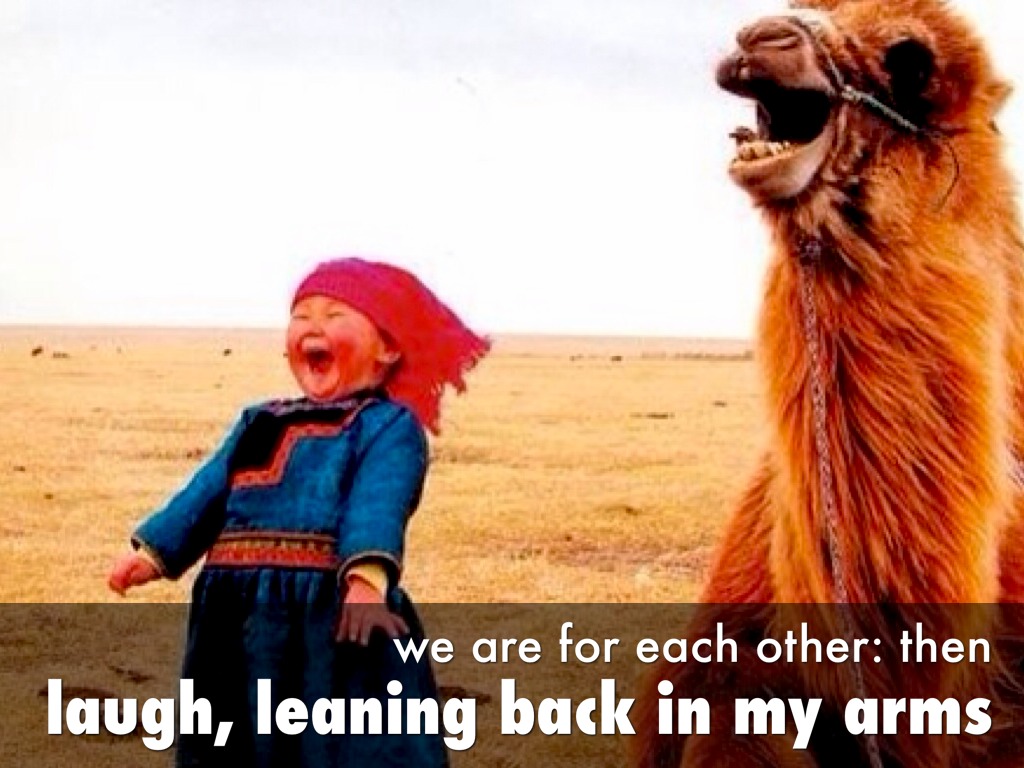
we are for each other: then
laugh, leaning back in my arms
for life’s not a paragraph

And death i think is no parenthesis

And look what I found.


(Seriously, go look. It’s beautiful.)