This Night

This night I am thinking about why I forgot to write this morning.

It’s because we’re looking for a place to live. It’s complicated, because there are several factors to consider and more than one possible way this could all shake out; but regardless, we will be moving out of our current rental within a few months. And that means we’re looking for a new place to live.

I hate looking for a place to live.

I hate renting.

I know this is not new: plantation owners in the South used rents to create a new slave class, even after Emancipation, which we call sharecroppers; I have not doubt that many people are still stuck in that impossible cycle. Before that, the English landowners drained all of the wealth in Ireland through exorbitant rents; they also got the IRA, a centuries-long guerrilla war, and the very first eponymous boycott, named for Captain Charles Boycott, the land agent of an absentee English landlord.
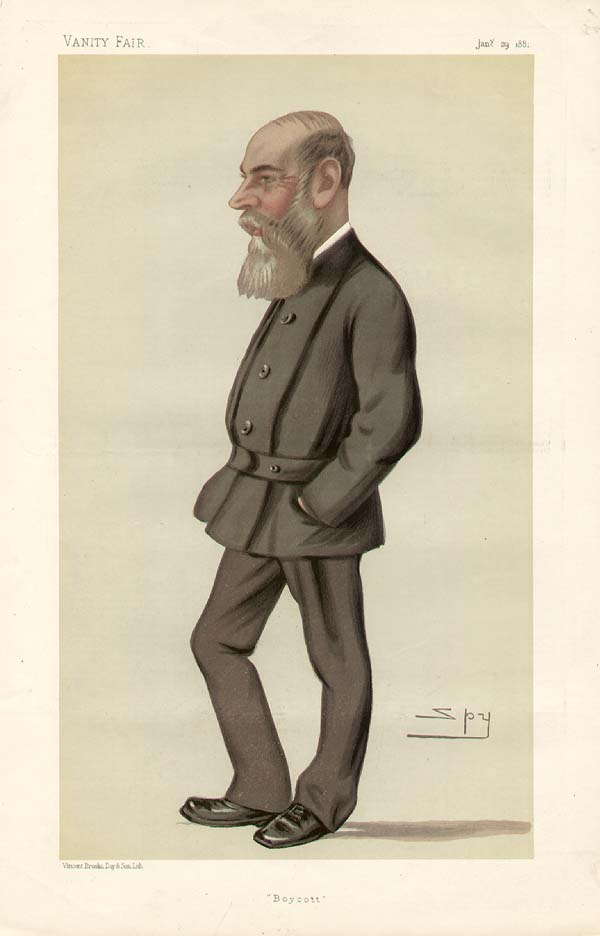
Caricature of Capt. Boycott by Leslie Ward, published in Vanity Fair.

Plus, y’know, every colony that’s ever been taxed, and every serf who has fed his lord instead of himself, and, well, pretty much all of us who aren’t at the top of the capitalist feudal food chain, have dealt with this same issue.

Don’t you think it’s time we just cut the crap?

Look: I don’t own a house. It’s not by choice, it’s because I’m a public school teacher in the United States — and there’s another issue that I wish we would just figure out; the idea that the state where I currently live had been 49th in paying teachers, and then the teachers themselves walked out in order to bring attention to the issue, and now we’re like 47th, is just — it’s exhausting. Because I don’t own a house, I need to borrow someone else’s. I get that. I am perfectly willing to pay for the privilege of living in someone else’s house.

I am not willing, however, to make someone else rich by profiting off of my willingness to pay for the privilege of living in their house.

After all, I am asking nothing from my landlord but — well, land. I am a grown person: I am perfectly capable of carrying out minor repairs and performing general upkeep; if I cannot do a necessary thing, I am happy to call in a professional to do it for me, and if I didn’t have to fork over like 40% of my monthly income in rent, I would be happy to pay for said professional. Since I do need to fork over a ridiculous proportion of my income in rent, I am consequently not willing to wipe off the wall when I sneeze on it. (I’m exaggerating. I’d wipe off the wall. Or at least try not to sneeze in an obvious place.) And in exchange, because I am turned obstinate and intransigent by the extortionate rent, my landlord turns to the modern version of Capt. Boycott: the property management company. They, of course, require a certain percentage of my rent in order to manage me; and my landlord certainly isn’t going to sacrifice that amount from his profits: so the cost gets passed on to me.

So because I am charged too much, I have to be charged more; because I am resentful of how much I have to pay, everything gets done slowly, and poorly, because my landlord and the property managers look for the lowest bidder for any required repairs, and they are generally slow and incompetent as well as cheap. And the value and overall quality of the property goes down, and everyone suffers because of it. And all because my landlord can’t just rent out the property for enough to cover his costs for the property; he’s got to squeeze me dry. Just because he can.

From there we add the ridiculous application process, where I now have to hand over $55 or more per adult applying, and the obscene “security deposit” which is really just another wad of cash we hand over to the owners, because never have I ever gotten the full deposit back after moving out, regardless of how well I have kept the place up, and even added minor improvements; doesn’t matter, because the owners want to keep my money, so they find a way to charge me for the privilege of no longer living in their home.


I’m sorry this blog wasn’t funny. I’m sorry that I have nothing insightful or valuable to add to this whole issue. All I can ever think when I go out hunting a new rental is that I wish I could be a real estate tycoon, not so I could make billions, but just so I could go ahead and rent out my properties for a reasonable rate, based on a reasonable interview with a would-be renter, and the simple fact of trust between myself and my tenants. I just want to give people a chance to not hate everything about where they live. It would make everything so much nicer.


Too bad I’m not rich.

This Morning

This morning I  am thinking: what the fuck, China?

Scientists added human brain genes to monkeys. Yes, it’s as scary as it sounds.

Okay. Let’s be clear. I am in favor of science. Scientific advancements save lives and improve the quality of our lives. I am also of the opinion that our highest calling as human beings is to create beauty, and to discover truth.

But this? This is not beautiful.

Of the 11 transgenic macaque monkeys they generated, six died. The five survivors went through a series of tests, including MRI brain scans and memory tests. It turned out they didn’t have bigger brains than a control group of macaques, but they did perform better on short-term memory tasks. Their brains also developed over a longer period of time, which is typical of human brains.

I am, of course, generally not in favor of animal experimentation, nor human experimentation —  I say “Of course” not because I presume my audience knows that I am a humanist, a pacifist, a vegetarian and an animal lover, but because I am a thinking, feeling human, and thinking feeling humans should all generally oppose experimentation on sentient creatures. I understand that sometimes animal experimentation is necessary. Medical advancements, for instance: when those experiments move forward, lives are saved and lives are improved, and that is probably worth the cost. It is sometimes impossible to move a project forward without live subjects, and animals are probably better subjects than humans, ethically speaking.

But this is not a medical advancement. This does not help humans live longer, nor better. This was done entirely, completely, because they could.

Although the sample size was very small, the scientists excitedly described the study as “the first attempt to experimentally interrogate the genetic basis of human brain origin using a transgenic monkey model.” In other words, part of the point of the study was to help tackle a question about evolution: How did we humans develop our unique brand of intelligence, which has allowed us to innovate in ways other primates can’t?

They excitedly described the study as the first attempt to do BIG FANCY SCIENCE WORDS. The attempt to answer that question is nonsense: how a macaque is affected by people injecting weird DNA into its genome has nothing whatsoever to do with human evolution, and anyone with a high school education knows it. There’s no possible way to isolate the variables and find specific information. I’m sure this would give hints that could lead to new knowledge — but six dead animals and five fucked-up ones seems a very high price for hints.

And of course, though I do not like slippery slope arguments, there’s no need to speculate about this experiment leading to more like it, coming faster and going farther: that’s already happening.

The Chinese researchers suspect the MCPH1 gene is part of the answer. But they’re not stopping there. One of them, Bing Su, a geneticist at the Kunming Institute of Zoology, told MIT Technology Review that he’s already testing other genes involved in brain evolution:

One that he has his eye on is SRGAP2C, a DNA variant that arose about two million years ago, just when Australopithecus was ceding the African savannah to early humans. That gene has been dubbed the “humanity switch” and the “missing genetic link” for its likely role in the emergence of human intelligence. Su says he’s been adding it to monkeys, but that it’s too soon to say what the results are.

Su has also had his eye on another human gene, FOXP2, which is believed to have graced us with our language abilities. Pondering the possibility of adding that gene to monkeys, Su toldNature in 2016, “I don’t think the monkey will all of a sudden start speaking, but will have some behavioral change.” He would not be breaking any laws.

Ohhh, he would NOT be breaking any laws! Well, shit, I guess that’s fine, then.

The article goes on to make a fairly obscure point, which is that monkeys made to be more like humans will suffer even more in a constricted lab environment; it also points out that “normal” monkeys suffer enough as it is, that macaques have intricate and important social lives that they can’t experience in a lab. This is all true, and makes this experiment unethical — or it would, if there was any ethical argument to be made for this experiment.

Look, I understand that science does not always have clear connections to a practical use. My father, a nuclear physicist, spent his career working on multi-billion dollar projects that had no direct application in the world. But of course practical application was not the point: expanding knowledge leads to better understanding, which leads to both greater expansion of knowledge and, at some point, practical applications, which is where longer and better human lives come in. But we can’t just focus on the eventual positive outcome: we have to consider the cost right now, and the benefit right now, with the potential benefit considered only after that. And the cost of this experiment is much too high, while the benefit from it is — little more than bragging rights. This doesn’t change our understanding of human evolution, it confirms, slightly, something we already thought was true. It can’t confirm it too conclusively, because again, macaques infected with human DNA are not the same thing as  Australopithecines evolving under natural selection. Not even close.

Last two things I want to point out about this: one, Chinese geneticists have already altered human DNA, entirely against any standard of scientific ethics. (They may have arrested the scientist who did it, but really, what does that even mean in China?)

And two, China is not the only nation involved. Of course not.

When it comes to studying monkeys, a researcher gets much more bang for their buck in China, as the Atlantic’s Sarah Zhang reported last year:

A standard monkey in China costs about $1,500, compared to roughly $6,000 in the United States. The daily costs of food and care are an order of magnitude lower as well.

In the past few years, China has seen a miniature explosion of genetic engineering in monkeys. In Kunming, Shanghai, and Guangzhou, scientists have created monkeys engineered to show signs of Parkinson’s, Duchenne muscular dystrophy, autism, and more.

Because of the relative ease of conducting primate research there, some researchers regularly travel from the US to China for scientific work on monkeys. As Zhang pointed out, researchers at Emory University recently collaborated with scientists in China who work on genetically modified monkeys. And Su’s study involved University of North Carolina computer scientist Martin Styner. Styner, who told MIT Tech Review that his participation was minimal, said he considered pulling his name from the study and has come to believe such research is not “a good direction.”

Although the US is not green-lighting studies like Su’s, American universities that collaborate with Chinese scientists on such studies may still be complicit in any ethical harm they cause.

I hope we’re all ready for what comes next.


This Morning

This morning I am thinking about thieves.

My wife and I are looking for housing; we’re trying to downsize and save money, so we are in the market for a new rental — but we don’t want to move into a dump, nor a nice place in a dumpy area, nor something too small to hold our family. So we have to be fairly selective about our options, and we keep our eyes open for a stroke of luck. We’ve had them before: we found our best rental in our college town when my wife drove by and saw a For Rent sign in a second story window; we found a short-term rental, necessitated by a crappy landlord who sold the rental we were living in just two months before we moved out of state, when our realtor let us stay in a  rental she owned. Twice we have moved long distance and found a place to move into from several states away, and while neither place was great, both were sufficient for our needs, even sight unseen.

So we’re hoping for a good, cheap place that has everything we need and is also in the right area. And we’re scouring the internet looking for just that place. We look on Zillow, of course, because they have many listings and they are reliable; but the rental market in Tucson is not good, and there aren’t a lot of good options — and no lucky ones. Thus, in the name of scouring, we try Craig’s List. We know, we know; that’s where the murderers go to connect with victims, and all. But it’s worked out before: I found my current job through a Craig’s List listing. So it’s worth a shot, right?

Pretty quickly, we found two strokes of luck: two rental houses, large enough for our needs, in the right areas, with enclosed back yards for our dogs and our tortoise, and both VERY cheap. Both listings were new, and so we jumped on them: because we know being first in line can make all the difference with getting a rental. I contacted one through text message, as the listing requested; my wife sent an email to the other one.

And you know what? Both were bullshit. Both listings were scams. The one I contacted is a house for sale, and someone scooped the listing and put it up on Craig’s List for rent; the one my wife contacted is a real rental, but it is being managed by a small local realtor, who was only using a sign in front of the house, and who already had two applications in, as we discovered when we found the real For Rent listing when we found the actual house. (The local realtor was also pretty short and bitchy to us, but maybe that’s because she’s gotten many weird phone calls based on the scam listing in the internet.)

How did we know they were scams? Well! The text message I sent got this reply:

(I blacked out the name they used because it’s the real owner’s  name, but that phone number is not the real owner’s, so fuck ’em. I presume it was one of those online websites that imitate a phone number, like I saw on Catfish.)

So let’s count the red flags, shall we? First for me is bad grammar and spelling, like of course people make mistakes in their text messages, but this is obviously not a on-demand message, this is lengthy, and since the owner is apparently a deaf man (Red flag #2 — not impossible, of course, but awfully convenient in that it means we can’t actually talk to a person on the phone regarding this rental) I would expect he’d be able to type the message correctly, not say “he cheat on the tenant by getting higher rent from them” and “You do not need to contact any Agent when you get by the house cos if you do they will tell you sort of rubbish.” (Red flag #3 and #4: don’t contact the agent at all, and also the agent is not named. Also, turns out the agent is a woman, but anyhoo.) Now I am reading this in a foreign accent somewhere between Russian and Turkish.  So when I see that the rent, already too low for a house of this size in this area, includes all utilities; and the “owner” doesn’t mind not meeting us but we can’t see the inside, and we can send them the deposit and the rent either “monthly or upfront mode of payment,” and then we’ll discuss how to get the key sent to me from where they have it in OHIO(OH) — and I love that they decided to include the postal code in case I was more familiar with that than the name “Ohio” — well. Now I can’t even see the house for all the red flags.

The one my wife contacted sent her this:

Thanks for your time and response to our advert. Please it is important you read this carefully! Our available house is a lovely one for rent in Tucson, AZ. You can drive by to view it from the outside at PROBABLY DOESN’T MATTER BUT I’M CENSORING THIS JUST IN CASE. If you know you’re not serious please i beg you don’t bother replying, don’t waste your time and mine. We are looking for a God fearing and a neat family that can occupy it as you can see our home is more decent and well kept. Please note that your rent starts counting from move in date so we want you to be sincere to us and always remember to pay your rent when it is due. I am Bishop Douglas P. Campbell and First Lady Sue A. Campbell happens to be my wife. Due to my quick missionary movement as a parish Bishop, my family and I had to leave the house that was posted on Craigslist at Tucson AZ, to give it out for rent and now we are in Africa to spread the word of God and also to build a new parish, where people can worship. We’re currently in west Africa reaching out to the underprivileged ones here, it has become our lifestyle to see people happy. I had my number roamed so you can still reach me through my number REDACTED. We have been finding it difficult to rent it, due to the fact that we won’t be able to see the tenant in person until we come for check up, but we prayed about it and believed in our heart that we’ll find someone with a good heart and good intention. You should count yourself lucky to meet with this offer, because we decided to offer a price below standard of $800 per month(rent already include utilities) in order to make it affordable. An agent was to handle this for us at a high price, but due to the fact we are not originally from the area and also because of commission issues, we decided it is best to handle it ourselves and we would appreciate anyone who understands our situation and will be willing to work with us.
Note: We did not authorized any agent for our property anymore. The keys are with us but we have no problems as far as getting it to whoever we feel is potential to rent the house. Please understand my situation and consider me. I am married with three(3) kids. Am only trying to help someone here and in return I hope the person takes care of my property.
Property Basics; Rent
Bedroom: 4.
Bathroom: 2. (2 full Bathroom)
Sq footage: 1,50500sqft
Rent: $800
Security deposit: $300
Pets Allowed (hopefully trained ones)
Lease Term: A year or More.
Please if you are ready now to occupy the house kindly provide the information below for your paper work and i will be happy to give you a call, because it is best we speak over the phone.
LEASE APPLICATION FORM
FULL CONTACT NAME?
OCCUPATION?
RESIDENTIAL HOME ADDRESS?
YOUR CELLPHONE NUMBER?
YOUR HOME PHONE NUMBER?
YOUR WORKPLACE NUMBER?
BEST TIME TO REACH YOU?
AGE & MARITAL STATUS?
OWN A PET?
OWN A CAR?
HOW MANY PEOPLE SHALL RESIDE IN THE PREMISES?
HOW LONG DO YOU INTEND TO RENT?
ANTICIPATED MOVE IN DATE?
HOW SOON CAN YOU MAKE THE PAYMENT?
REFERENCE?
FAMILY PICTURES IF ANY?
Best of regards,
Bishop Douglas P. Campbell.

So again: bad grammar (I especially like the line “and First Lady Sue A. Campbell happens to be my wife”), owner is out of reach but has the key but has no problem getting it to us, owner has apparently no standards for tenants (there’s no discussion of credit checks, rental history,  or background checks, and even if the owner were in Africa —  and a Bishop? Seriously?  — surely His Grace would have friends or allies or parishioners or SOMEONE in this area, where he owns a home, who would manage the rental process for him. That “lease application form” at the end was just like that, all caps in the body of the email.), rent is far too low already and includes all utilities and a ridiculously low deposit in this era of first, last, and something extra for your pets, et cetera. I like that in both cases they do the old confidence-man trick of offering me their trust so that I will in return trust them, because after all, why would a deaf man lie? Why would a God-fearing Bishop, who only wants to make it his lifestyle to bring happiness, be a lying sack of crap who wants to steal your money?

Why do these goddamn people want to steal my money? I mean, I get it, stealing is easier than working; but I really don’t get how people can have so little empathy that they are so willing to fuck someone else over just so they themselves don’t have to work as hard. (I do have enough empathy to recognize that many people who do shit like this are truly desperate, and on some level, I feel bad for them. But also, fuck them.) It bothers me particularly in that this scam is not directed at people who can afford to lose money: this one hits people who are looking for housing, for cheap housing, and who are likely moving towards desperate, and so are willing to take a chance on someone who says they can help, even with all the red flags in the advert. (I like “advert,” too. Very British. Or perhaps an African bishop, hmmmmm??? By the way: why does an African bishop own a rental property in Tucson? I know, he’s not from Africa, he’s a missionary, but I have no idea where he [and I’m speaking of the character, here, not the scammer; that dude I still imagine as Russian or Turkish] is actually from, so I’m going with Africa.) I’ve thought about stealing stuff before, when I was a kid and reading comic books; you know who I planned to rob? The rich. Corporations. Drug dealers, once I had read The Punisher. Seemed like stealing from those people wouldn’t be as bad. Of course that’s a foolish rationalization of a crime, but also, it’s true that that crime would cause less harm.

Why are people okay with hurting others just so they can steal money? I honestly don’t understand.

I hope someone can understand my situation and consider me. I am married with four (4) pets. Am only wondering why people do fucked up things to other people.

Piss Whorening

This morning I am thinking about profanity, and auto-correct. (This morning will not be appropriate to read aloud.)

I was talking to a friend of mine yesterday, and it came up how her phone wants to change “fuck” into “duck,” or “Huck,” or “guck.” And I know this is a common complaint — I usually get “ducking” on my phone, as in the well known phrase, “Are you ducking with me?” of “What the duck is wrong with that guy?” — but I said, what if you had a phone that actually changed innocent words into similarly-spelled curse words?

“I went to the fuck pond in Central Park yesterday, but all the fucks were gone. Not a fuck to be seen. It’s too bad: I like feeding the fucks.”

“I like those paper bitch trees, you know? The ones with the top layer you can just peel off?” “Oh, the white bitches? Yeah!” (*Special note: I would include this in the actual blog, but it’s a travesty and an offense against one of my favorite poets, so I’ll just tell you: read Robert Frost’s poem “Birches” and change that R to a T  throughout it. Here.)

“Dammit, I just spilled coffee [cockee?] all over my dress shit! I just ruined my favorite shit!”


My two favorites, which came out of the conversation with my friend, are:

“I got my shirt stuck in my belt fuckle!”

and

The Adventures of Fuckleberry Finn. By Mark Twat.


As I should always do, I’ll end with the words of the master:

This Morning

This morning I’m thinking about choices. And about fate.

And about these two.

Image may contain: dog

These are my babies. The fluffy one on the left is Samwise, and the little girl with the house-elf ears is Roxie.


Image may contain: dog and indoor

A better picture of Roxie

Image may contain: dog

Samwise’s close-up

They both came from PACC, the county animal shelter near here. Samwise was first; we brought him home in 2014, just a few months after our first dog Charlie died.

Image may contain: 1 person

This is me and Charlie, holding paws while we pursue our favorite hobbies.

Samwise was not our first choice. We’d been walking dogs at the shelter for a few months, partly as therapy and partly to keep an eye out for a good boy or girl to bring home. We had just decided that we were ready for another dog, and we found a different dog, a Whippet mix named Henry, if I remember right, and took him out for a nice long walk with his kennel buddy. Henry was great: he was happy and energetic, and smaller and less dominant than Charlie had been — he was part Chow-Chow, and was so alpha he made other dogs pee just by looking at them. We went home and thought about it, and then back to the shelter the next day to get Henry. But first we took him for another walk: and he freaked out. Completely. He was making a strange whining noise, walking erratically, and he kept jumping on his kennel buddy and trying to sort of play, sort of bite his ear. He wasn’t sick or anything, just acting entirely different from how he had acted the day before. And far more aggressive/invasive to another dog; the kennel buddy, who was bigger and more dominant, almost started to fight a couple of times, and we had to walk them separately.

So we decided not to bring Henry home. I’m sure somebody else took him, and I’m sure he’s a great dog; but we were still recovering from losing Charlie, and we weren’t  ready for that much of a challenge.

Somewhat despondently, we split up and walked around the kennels, looking at the other dogs, wondering if there was anyone else we might like. And when I looked down the row, there was this little face, resting on the bottom of the cage door, looking out at me.


No photo description available.

It may be hard to tell from the picture, but he didn’t look well: he was far too thin, his fur was thin and patchy. And he looked sad. And scared. I went over and said hello, and then I went and got my wife, and we took him out for a walk. We went to a bench outside the shelter, and he came up to us and put his paws on our hands, one on each.

So we took him home. Really, what choice did we have?

Turns out that he was a special needs adoption: his first owner had apparently abandoned him onto the streets of Tucson, and he had spent some number of — days? Weeks? Months? — living on whatever he could find, which is how he got so thin and why his fur was short and patchy: they had had to cut off tangled mats of fur, and he had scratches and was malnourished. He was also plagued by fleas and ticks, and in the time he spent on the street, he had developed tick fever, a parasite infection that produces anemia. Tick fever requires fairly expensive blood tests (About $300 every six months to a year) and a long run of antibiotics to treat, and so Sam (He was named Benny, then, but that was a moniker picked by the shelter; whatever motherfucker had him and then threw him out onto the street didn’t have any right to pick a name for him.) had been adopted and returned, twice, by people who balked at the expense. He was basically on his last strike when we took him; if we hadn’t, he probably would have been put to sleep, because of his illness.

The tick fever is chronic, it turns out, but also, Sam is now so happy and healthy that his blood count is essentially normal and he lives without symptoms. It also turns out that he’s fluffy as hell, and the best, sweetest, smartest, calmest boy I have ever known. We call him our Goodwill Ambassador, because he’s far friendlier and more outgoing than his introverted parents, and he never fails to be upbeat and pleasant; we’ve taken him to school, to farmer’s markets, to California, and he has been swarmed by children looking to pet him, and he always sits calmly and lets them. He’s very soft.

But then, after Sam had lived with us for almost two years, my wife went back to work full-time outside of the house, and Samwise was left alone all day. We worried that he was lonely — and I wanted a second dog, I admit; Charlie was my first dog, Sammy is my second, and I’ve never had two. And so we went back to the shelter to find him a sister.

And we did.

No photo description available.

Image may contain: dog and indoor

Image may contain: dog and indoor

Roxie was also not our first choice. They had puppies at the shelter, and we planned to get one of them, because we wanted to be sure that the new dog would not crowd Sam. We figured it would be fine because Sam is so calm and friendly, but you never know how two dogs are going to react to each other. The puppy would have been ideal, because then Sam could have been the big brother from day one. But after the puppies had been there for a couple of days, and we had gotten to know them a little, their owner turned up and claimed them. So that was out.

But there was this other dog, a tall dog, who every time she saw us, wagged her tail so hard it shook her entire body. She’d whack it against the bars of the cage loud enough to be heard across the room.

That was Roxie.

Image may contain: dog and indoor

Roxie was also found on the street; we don’t know if she was abandoned intentionally, or if she got out and her owners never went looking for her. She wasn’t alone for long, because she was basically healthy when we adopted her, though she was  clearly traumatized and had not been taken care of well. She was unsure about coming in the house, unsure about getting up on the furniture even when invited; she has no idea how to play with toys, and she shrinks away from objects held in the hand, which tells us that she was either hit, or had things thrown at her, or both.

But, as it turns out, she is also the sweetest dog in the world. She is even friendlier than Sam: she wants to meet everyone, and pulls on the leash towards anything that moves within her sight line: people, other dogs, wild rabbits, coyotes, cats, anything. If she meets anyone she tries to lick their hands or faces, and jumps up on people no matter how we try to break her of the habit. She never growls, never threatens or bristles; and always, always, she is wagging her tail.

If her first jackass owner had claimed her, we wouldn’t have been able to take her. If the puppies’ owner hadn’t come forward, we’d probably have one of them instead. If Henry hadn’t freaked out, or if I hadn’t noticed Samwise, or even if Charlie had lived for another year or more, we wouldn’t have these dogs, we wouldn’t have this family.

That’s what I’m thinking about this morning.

Image may contain: dog and indoor

This Morning

This morning I’m thinking about deadlines.

I’m a little afraid I’m going to miss this one, because I woke up this morning without a definite idea of what I was going to write about, and then in trying to think about a topic in the shower (one of my most productive thinking times), I thought of too many topics, and I couldn’t focus on one and follow a line of thought to a conclusion. That’s okay, I often don’t know where these written thoughts will end up when I start them; that is, I know what my opinion is when I start — I’m against deadlines — but I don’t know exactly what I’m going to say about them. Will I end up affirming my opinion? Will I find some compromise? Who knows?

This comes up most often at school, of course. I try not to use deadlines. I don’t quite believe in standards-based grading — which means that the only grade a student should really get is whether or not they have met the standard, and it’s a large topic that I will write about another time (Note to self: SBG.) — but I do agree with a component idea of it, which is that grades should be based on the work a student does, not on a student’s behavior. I think schools have taken on too much of the responsibility for raising our students, and I don’t think it’s good, and personally I don’t want to do it; therefore I don’t want to use the school’s (theoretical) focus, education and achievement, to bully students into doing what they’re told. Giving students a deadline, and then imposing grade penalties when they miss that deadline, is not educating them in a subject; it is an effort to instill a work habit. It’s a good work habit, but that’s more akin to character building than it is to education, and therefore I’m pretty much against it.

Now: I am not against being a model, as a teacher, of good work habits. Good any habits, really; I think it’s important that I be visibly and clearly respectful of others and their opinions, that I be kind and generous, that I explicitly oppose sexism and racism and intolerance and injustice. Without doubt. I think that everyone should do those things all the time with everyone they know: I think I should model good behavior with my wife as well as with my students, though for an entirely different reason: I don’t need to show my wife what good behavior looks like, I need to show her that I know what good behavior looks like so she knows I’m not an asshole. And if that sounds, by the way, like a lot of work, if it sounds like I always have to be performing and therefore I always have to be focused on doing certain things and not others, that’s true, but it also assumes that my relaxed, default state is being an asshole, and it takes extra effort to resist being one when I’m at home; I don’t think that’s true, and if it is, I don’t want it to be.

So I am in favor of meeting deadlines as a teacher. I try. I try to get their work back to them before grades come due. I try to have materials ready in time to use them. I try to have lessons planned well enough in advance that I’m not giving them what they keep asking for, a “work day” or a “free day.”  I do miss all of those deadlines sometimes, especially the grading ones; the most common response I get from my students when I give work back is, “Oh, I forgot about this!” And I give them work days, and I have had to change lesson plans in the moment because I don’t have handouts ready or I couldn’t get the reading done myself the night before.

But that’s the point: things come up. Things don’t work out. I get insomnia, or I have to deal with a sick dog, or my car gets a flat tire. The copy machine breaks, or is full of multi-page math jobs. A student stops me to ask for help, or even worse, comes to me in tears in a crisis. Things happen, and stuff doesn’t get done on time. We all know it: we all live with it constantly. I hate being late for appointments, but sometimes there’s traffic. And sometimes I get to the doctor or the dentist or the hair salon and they’re running late, and they ask me to wait for a little while before they can get to me. I complain all the time about the thousand little tasks that are incessantly assigned to me as a teacher (A colleague of mine refers to this as “death by a thousand cuts.”), and what bothers me most is that they are given artificial and unreasonable deadlines, often without sufficient notice: this year we were asked to contribute to our own evaluations (which is its own travesty — note to self; personal evaluations) and were told we needed to collect “artifacts” (which does have a nice Indiana Jones feel to it, which I like; I kind of want to burst into my principal’s office, sweaty and covered with cobwebs and maybe a couple of blowdarts, and drop a golden idol on his desk and say, “I GOT THE ARTIFACT!”) as evidence of our expertise; but we weren’t told of this in advance, simply given a deadline about a month out, during our busiest time of year. I am not ashamed to say I didn’t make that deadline.

So when I impose deadlines on my students, what am I teaching them? That they are held to a higher standard than me. That I have the power to boss them around, but they can’t return the favor — after all, they never get to tell me when I need to have something graded by, and if they even try, I bristle and get self-righteous about it. On some level, I tell them that their behavior, adhering to a deadline, is more important than their work, because if a student writes an A paper and turns it in late, they don’t get the A; the quality of the work never overrides the lateness of it.

So what priorities am I modeling? When they see their parents missing appointments, running late to work, turning in their taxes on April 16th, and not really suffering very serious penalties, if any; and then I cut their grade in half if they’re a day late, or even a few hours? What does that say?

You know perfectly well what that says. It says the thing we pretty much all said when we were in high school: it’s a joke. It doesn’t prepare us for the real world, because the system in high school is exclusive to high school. It is self-contained. It mimics the real world in a number of ways, but there are a number of things we do in high school because we have traditionally told ourselves that they are preparation for the real world: and then we just do them, without really thinking about them. At some point they become self-sustaining, because we keep trying to think of better ways to make this artificial system work for us; until we stop thinking about why we do it in the first place.

I take it back: that is preparation for the real world. It’s just preparation for the very worst parts of it.


Wow, that was longer than I thought it was going to be. But most important: DID I GET IT DONE ON TIME???

This Morning

This morning, I think I have an answer to my question from yesterday morning.

Yesterday, I was wondering what I could say to my wife, to my students, to myself, that would help comfort us in the face of inevitable suffering, and I wished that I could rely on God as that answer, because then I could at least stop thinking about it — and I should have said worrying about it and fretting about it, because that’s the point; it’s not the idea of not thinking, it’s the idea of “let go and let God.” Which I can’t do, but I appreciate that people can.

But I have another cliche that I have gleaned from outside of the fields of the Lord (And that enormously obscure reference is brought to you by the podcast I’ve been listening to, Sunday School Dropouts. Probably also why God has shown up in this atheist’s morning ramblings.), that as I understand it, many churches focus on as the heart of their message (and others may sprinkle in, in between railing against homosexuals and abortion and Democrats in Washington), which is this: God is love.

Once again, that doesn’t work for me. But it comes with another way of looking at it, that I think does fit in nicely with what I’ve been looking for:

Love is God.

That is to say, love is everything. Everything that matters. It is the alpha and the omega, it is the answer to all questions, all doubts and fears. Love. And love, I think, can offer an answer precisely as satisfying  — and not any more satisfying — as can the answer “God.”

What should I tell my students when the future looms ominously over them? Love. Look for love in your life, look for love in what you do; if you don’t find any love in your life, then change it, and if you don’t find any love in what you do, then stop doing it. Don’t work for money, work for love: and I don’t mean to be flippant there, because I am a person who works for money precisely because he cannot live on what he loves; but for me, the money I earn is spent on those I love, and used to give me an opportunity to do what I love, which I am doing right now. So I never mind my job very much, because it is done for love, if not always in love. And yes, sometimes I love my job: I do love books and poetry, and I love writing, and I guess I don’t entirely loathe my students. (No, I love some of them. More, I love the people they become, and the potential I see in them when they are young.)

What do I tell myself when I am in my darkest, foulest, most hopeless moods? Love. I have lost some of my liberal idealism in these last few years, and I have begun to lean a wee bit more conservative; it has made me worry, because I know that this is a common pattern, especially among aging white men, as we start to get a taste of power and become greedy and start worrying about people taking away what we have. And I do not want to be that guy. But I think that so long as I focus on love, so long as my actions and intentions are begun with love in mind, then I won’t turn into someone I would hate. At least some of my shifting to the right is based on the consideration that people on the right can’t be bad people, can’t be evil people, not all of them. (Trump is.) Not any more than there are evil people on the left. It’s not reasonable to take a person’s political leanings as the sole evidence of their morality or their value, or anything else apart from their political leanings; evil people are conservatives, conservatives aren’t evil people. Thinking that makes me give some conservative ideas (like the free market and lower regulation, the independence of states and, perhaps most shocking to me and those who know me, the value of the Second Amendment) the benefit of the doubt, and that makes me move away from my liberal roots.

But that doesn’t matter. It doesn’t matter if I’m a liberal or a libertarian or a moderate or an anarchist: so long as I consider what is best for my fellow men, and treat them always with respect and with love, then my ideas will never be bad, even if they are wrong.

I also need to remember this for myself when I am disappointed in my writing career. When I think about how old I am compared to other writers, and when I realize how good I am compared to some other writers — and then when I think about how entirely devoid of success I am compared to most other writers; I need to remember: love. I do this because I love it, because I love the me who does this. And so long as I write for love, with love, and out of love, then I can’t be a failure. I am a writer.

What do I tell my wife when she worries about our future, about what we’ll do for money, about where we’ll live, about how we’ll see the world and how we’ll live in it? I will tell her, as I do as often as I possibly can, that I love her, without limits and without end, and that I always will, and that love will see us through, no matter what else happens. Always. Love.

It doesn’t solve the problems we all face. But then, neither does God. I hope that it brings you some comfort, as it brings me some. I hope that it gives us all the strength to keep fighting towards our goals, and I hope it keeps us from hating those who fight against us, or at least in the opposite direction. I hope that the love in your life is enough to make you smile, as it is for me, even on a Monday morning.

Thank you for reading what I write. I won’t say I love you, because I don’t know you, but I love the fact of you and the existence of you, and what you give to me. Thank you.

Now go love!

This Morning

This morning I understand why people talk about God.

Not why they believe in a god; that is, I think, an entirely personal choice, based on individual feelings, and it’s a choice I haven’t made and feelings I haven’t felt.

But I think I see why people use God in arguments, why they rely on God as an explanation, why they write books and sermons and songs that describe God as the answer. It’s because doing so is comforting. I don’t think it’s easy, because relying on God as the answer means you have to accept some stupid and disturbing answers — like killing is bad unless God does it, war is hell unless it is a holy war in God’s name, the suffering of innocents helps others to recognize the horror of sin — that’s a lot to swallow right there, and you need a whole lot of soul butter to get it down.

Okay, I only said that last  metaphor so I could use the phrase “soul butter.” One of my absolute favorite phrases. Mark Twain. So good. Really, though, it takes a lot of faith to accept those answers, and faith is generally hard to maintain. So I don’t think that God as an answer is easy. But I do think it’s comforting.

The world is large. It is large, and it is inevitable: things happen that are terrible, and they keep happening, and will always keep happening, because even if we conquer the world, the universe is larger still. Disease and disaster and death, disappointment and despair and devastation. And the worst part of all of this is that the world is not only large, but it comes into our small lives and crushes us and those around us intently, intensely, instantly. It would be one thing if the profound absurdity that is the U.S. government affected only those in Washington, only those who wanted to be movers and shakers; I could sit here in my living room, with my dogs beside me and my wife sleeping in the next room, and write my tiny blogs for my few dozen readers (if that), and work with my teacher-friends at my little school teaching literature to my young students, and everything would be fine. But it’s not like that: the government in Washington has a direct and substantial impact on me personally, on my wife, on my friends, on my students. Hell, it has an impact on my dogs: it has an impact on my literature. I keep seeing references to our current political situation in things I read; last night I was re-reading The Eye of the World by Robert Jordan, one of my absolute favorite fantasy epics, and I got to the chapter about  Aridhol, the city that had been great, one of the allied nations that fought back the tide of evil, until they grew too desperate, and a man came who whispered poison in the ear of the king, and the city grew dark and evil, paranoid and cold and harsh, until the people turned in on themselves and destroyed themselves out of fear and anger and mistrust, and now the city was Shadar Logoth, Where the Shadow Waits, and the evil is palpable and visible and able to kill anyone who comes inside its borders; and if that isn’t precisely what is happening in this country, right now, then I’m a devout Christian  and a Republican.

The world is large, and because it is large, the things that happen are beyond our control: we can’t stop the world from turning, I can’t stop famine and cancer and drug addiction and rape and death. But those things affect me and those around me directly, all the time. Even when I am insulated from the worst suffering because I am a white middle-class American. Famine, along with other terrible travails in Central America, makes people come to this country; the government cracks down, and one of my students loses his mother because she is deported. Another of my students, one of the smartest kids at the school, can’t get his visa for a month because he needs to be extremely vetted. Cancer and drug addiction are in my family. Rape culture and the violence in our society means that people cannot be vulnerable, they must be on guard at all times — and even then we are not safe from violation, from degradation. And death? How do we deal with death?

How do I tell my wife that things will be all right? How do I tell my students that their lives won’t be devastated by circumstances beyond their control? How do I tell myself those things?

That’s why it must be comforting to be able to say, in all of those difficulties: “God.” God is the answer. God is the reason, and God has a plan. It doesn’t change those terrible things, but it means you at least don’t have to think about them. God is a replacement for thinking, and though that clearly isn’t a good thing, it does sound relaxing, particularly when all the thinking in the world isn’t going to change the fact that we’re all going to die, and we’re not going to die at the same time, and that means all of us will be devastated by loss, one by one, until we are lost ourselves.

And wouldn’t it be nice to think that there is another place where we all get to go hang out together, forever, where everything is nice and nothing is inevitable because nothing changes.

Yes. I understand.

You know what, though? I still don’t wish I believed.

This Morning

This morning, I am going to read.

This morning, I am going to take care of myself.

This morning, I am not going to make excuses.

This morning, I wish you the same.


(Also, please note this is my 42nd This Morning post. Hallelujah.)

This Morning

This morning, I’m wondering why people are in such a hurry.

I saw a twit yesterday (You know, on Twitter? They’re called twits, right? I mean, if it were Tweeter they’d be tweets, but since it’s Twitter…) expressing anger at people who “drive slow” in the left lane on the highway. Okay, if someone’s going 10 mph, that’s dangerous; the people driving fast could smash into you. But otherwise: if someone is driving, say, the speed limit in the fast lane, and you want to go 10 or 20 mph over the speed limit, what this means is — you have to slow down. Or you have to change lanes. In the process of which, you might need to slow down a little. But really: if you’re going 75 and you have to come down to 65, how much more time does that trip take you? If you’re going, say, 15 miles, then the time difference is — about three minutes, by my calculations.

Really? Three minutes slower gets an angry twit? How tight are your timeframes that three minutes makes a substantial and important difference to you? Three minutes? And that’s only if your overall speed for the entire trip is curtailed that 10 mph; if it’s only for, what, 30 seconds or a minute until you go around the person or they get out of your way? What does that cost you, maybe 30 extra seconds of driving? Total?

This isn’t about the actual time it takes to commute: it’s about people refusing to slow down at all, for any reason. Refusing to wait.

I had a bad habit at one point, when I started teaching; there was a back road that I took to get to school, and some of my students took it, too, a pleasant little two-lane country road that curved and pirouetted up into the hills. And sometimes when driving to or from school, I would look in my rearview mirror and see students who I recognized, and I would — slow down. A lot. The limit on the road was 25, but I would go down to 10 or 15 mph. Grinning impishly and humming pleasant tunes. I wouldn’t do it for long, and if there were any other cars on the road I’d come back up to regular speed; but I thought it was funny. Then one of my students one morning, stuck behind my ultra-slow-moving blockade, crossed the double yellow line and whipped around me. When I got to school I confronted him:

“You broke the law.”

“You were going so slow!”

“You could have caused a head-on collision!”

“It was taking too long!”

“We weren’t late, why did you have to get here, what, 30 seconds faster? A minute?”

“I didn’t want to wait.”

That’s all. He didn’t have a good reason;  he just didn’t want to drive that slowly. Again, I was messing with him, and I shouldn’t have been, especially not if it was going to precipitate genuinely dangerous driving like that; and I’m aware that there are people reading this who are also thinking, “10 mph?!? I would have crossed into oncoming traffic too!” But I can’t understand that. What the hell is the big deal with going a little slower? With taking a little longer? It’s not like getting to school sooner meant he got extra time in the ice cream dance party extravaganza; he sat around for an extra minute or two before the bell rang and class started. Whenever people speed, whenever you speed — what do you do with that extra time you save? How does that time improve your life?

When I went to get dinner tonight — we had burritos from Chipotle — I had to wait for the food. I ordered online, because I am always going to take the opportunity not to talk to people; I also hate ordering multiple meals all by myself, because I worry I’ll screw the order up, and also I’m afraid the people behind me are mad because I’m only one guy but suddenly I’m ordering TWO meals? That takes twice as long! WHAT THE HELL! But the Chipotle was slammed tonight: when I got there, there were three other people waiting for online orders, and an in-person ordering line that had to be twenty people long. So it took a while. That was fine; I went on  Twitter and wrote a long twit-thread about how much time it takes to be a teacher. I had fun, actually. (And I have to brag: the person who set me off by claiming that teachers don’t have a demanding job, we’re just bitter and don’t manage our time well, has now blocked me. That’s my first angry blocking on Twitter! What a milestone!)

But the people ahead of me? They bitched the entire time. “I’ve been waiting for 30 minutes! Why is this taking so long!” And I thought, I’ve been here for 10, and that whole time the line hasn’t gotten any shorter. “I don’t understand why it takes this long just to make one burrito bowl. It should only take five minutes tops for one bowl.” Uh . . . because they’re not making one bowl? They’re making like fifty? Finally the woman who had been there the longest gave up and walked out: and not five minutes later, they brought out her food. Which then sat there, unclaimed, on the Online Orders shelf. I’m sure they eventually threw it out. And she went home hungry, after 45 minutes of waiting, because she couldn’t wait 50.

I just don’t understand why people can’t wait.