Separate Has A Rat In It

All right: so I have two classes of College Readiness, and they both had to write a UChicago essay — and they both picked a prompt for me to write. (If you don’t know what I’m talking about, read this. If you want to see all the prompts, go here.)

The other class chose this one:

People often think of language as a connector, something that brings people together by helping them share experiences, feelings, ideas, etc. We, however, are interested in how language sets people apart. Start with the peculiarities of your own personal language—the voice you use when speaking most intimately to yourself, the vocabulary that spills out when you’re startled, or special phrases and gestures that no one else seems to use or even understand—and tell us how your language makes you unique. You may want to think about subtle riffs or idiosyncrasies based on cadence, rhythm, rhyme, or (mis)pronunciation.

Here is my response.

Language Separator

See the rat?

I am a dull man. 

I am utterly unspecial, solidly in the mainstream: I am a white American male, cis/het, raised vaguely Christian but now a non-practicing atheist. I am married. I am 49 years old. I own a car and a house, with a mortgage on the house. I have a Bachelor’s degree, more debt than savings, and I vote Democratic. All completely “normal,” in that people who look and live like I do have made sure that our culture believes that people who look and live like I do are the norm, the standard, the expectation – and therefore everyone else is a little weird, a little off, a little less than what they are “supposed” to be. Like most people who look and live like me, I am aware of my privilege, I oppose the unfair societal structures and institutions that promote it – but I don’t really do too much to change them, because after all, I do benefit from them. I feel guilty when I think about that, so I try not to think about it.

Sorry: that went too political. (I am keenly aware that some people find it awkward and uncomfortable – challenging – when I speak of political matters. I do not want to offend them, so I usually do not speak of political matters.) My real point is that there is very little about me that is, according to our society’s generally understood and accepted standards, abnormal.

Until I open my mouth.

My mouth itself is pretty normal (Though I have WAY more fillings than is normal, I think – over 40, with 5 crowns. I have abnormally bad teeth.), it’s what comes out that is abnormal. First of all, I have a weird accent: my parents (The most important influence on a person’s accent and dialect) are from the West Coast, Washington and California, so I speak somewhat in their accents; but I was raised first on Long Island, which has a distinct accent, and then in a suburb of Boston, which has a STRONG accent. I didn’t acquire or keep either of those accents in their entireties, but I did pick up a few pronunciations; and more, Boston’s speech patterns were strongly influential: I speak too fast, as Bostonians do, and I talk faster the more excited I get; and I cuss intemperately. So I sound like a mishmash of two coasts and four states.

It’s more than my accent and my speech patterns, though: it’s what I say.

Don’t get me wrong: I am a student and an artisan — a wright. A smith. — of language. I study literature and rhetoric, and have mastered them to a degree that allows me to teach, generally successfully. I possess linguistic capacity more than sufficient to enable the utilization of language both fanciful and ornate, drawing from the recondite and recherche realm of jargon as well as splashing through the filigree fountain of poetry.

I talk good, is what I’m saying.

 And, as you can see, because I can use language well: I can also abuse it.

My favorite form is mispronunciation. I enjoy completely destroying the actual sounds of words, especially foreign ones. Especially French. Because if any language has worse pronunciation than English, it’s French. That word I used between “recondite” and “realm?” I would enjoy saying that “ruh-churchy.” So I feel that we should pronounce La petite fromage, the little cheese, the way it is spelled: lah puh-teet froh-midge. I draw from classic influences to pronounce the K and the G in “knight,” and to describe for my students when they put the emPHAsis on the wrong syLLAble.

But mispronunciation alone is too simple; a little tame, really. Much more funner is improper forms of words, particularily when the wordination is constructicated of rootages and suffixery (Holy crap, autocorrect accepted that one!  Is that really a word?! Mmmmno, it’s redlined. I think I stunned the autocorrect.) that are close, almost recognizable — but also completely wrong. That’s the besterest. Though one step higher here is when I can corrupt a common usage of a modern slang term in order to make it seem more grammatical while also being deeply annoying: when I was on Twitter, for instance, I made a point of saying I twitted a twit, not tweeted a tweet – because after all, it wasn’t called “Tweeter,” was it? (Now it should be xitted a xit on Xitter, not xeeted a xeet on Xeeter. Though either one would presumably make Elon Musk apoplectic, and that’s a good use of language.)

I admit it’s a touch upsetting that I say these kinds of things and play these kinds of games with my students, because for some reason, they trust me to steer them right with their usage of English, the poor innocent fools; I’m sure I’ve given more than one a bad idea about words from some joke or other — though I will further admit that that’s funny. I do teach them the real insane trivia hidden deep in the pockets of the English language: the word floccinaucinihilipilification (WHICH I TYPED RIGHT THE FIRST TIME) and the sentence “Buffalo buffalo Buffalo buffalo buffalo buffalo Buffalo buffalo.” Both of which are real. And “Y’all’d’nt’ve,” which is not real, but should be. These all show actual facets of this mad and madcap and maddening language that I love, so they are all lessons, on some level, at some point. And I’ll bet you dollars to donuts that most English teachers do not teach those lessons.

Then there are the foreign accents (Or as I am fond of saying, the furrin accents, which we don’t talk here in ‘Murrica.). A number of them show up when I read aloud, when there is some identifiable speech pattern in the dialogue, or a clear setting in an accentish area. I’ll read British stories in my best London fog, and I’ve read ev’ry danged word of Huck Finn by that Mark Twain feller in my best countrified speechery. I do sometimes use my past exposure to New York and Boston accents to play those characters when reading, especially if someone needs to be a tough guy; but I don’t put on my Pepe Le Pew when I read Guy de Maupassant’s “The Necklace.” And I never use Apu Nahasapeemapetilon’s accent, not even when I read The God of Small Things. On the other hand, I will neither confirm nor deny that Neil Gaiman’s story “Truth is a Cave in the Black Mountains” retains a place in my Fantasy Literature elective specifically because I get to use my Scottish brogue.

Of course, none of these accents have the same color, force or frequency as my pirate accent. Not only because I dress up like a pirate for every Halloween, and dress up my voice like one on every September 19th (International Talk Like a Pirate Day, if ye be of the uninitiated). Also because I love doing that accent, and so it shows up whenever anyone makes a pirate reference around me, which is fairly frequent given my reputation and the assorted pirate paraphernalia which I have acquired over the years. If anyone tells me a pirate joke, I am honor-bound to respond in the appropriate manner: “AYE LAD, THAT WERE A FINE SALLY — I’LL SHARE IT WITH ME OWN CREW, THE NEXT TIME I WANT THEM ALL TO FALL ILL OF VILE PUN-ISHMENT! HAR HAAARRRRRRR!!”

Even this list, though, is not exhaustive, because it doesn’t include the character voices I use. In class there are a few definite ones; I am very fond of the voice of Gollum from The Lord of the Rings, as performed by Andy Serkis; it’s a bit rough on the throat, but so very taassssstttyy, precioussssss… And just to one side of that, almost two sides of the same coin, is the voice of Edna Mode from The Incredibles, which I also love using, as long as it is attached to the right character (NO! CAPES!). Those two are my favorites, though also I am not above talking like a Goodfella (“Do I amuse you? What am I, some kinda clown to you?”) or the Lennie of the cartoons (“And I will hug him and pet him and love him and squeeze him and call him George!”) though never when I read Of Mice and Men because that book makes me cry and I can’t make fun of it that way. 

And it goes on from there. When I am reading test directions aloud and I get to a portion that is capitalized or in bold print, I will shout those words at the top of my lungs (“DO NOT WRITE IN THE MARGINS OF THE ANSWER SHEET”), without any warning at all; partly because I like to make my students jump (and laugh, because breaking the tension is part of my job), and partly because I want to make fun of the directions, which are universally terrible. I can actually sing reasonably well, but when I sing in class I usually make my voice sound as awful as I possibly can, intentionally breaking and scratchy and missing all of the notes. I sometimes read as fast as I can, which thanks to my Bostonian upbringing is pretty damn fast, so that all the words run together into a completely indistinguishable fog of sounds.

So the question is: why? Why do I do this? Why am I like this? Especially given my responsibility as a teacher, and my deep and abiding love for my language, and for speech both written and spoken?

Honestly? I don’t know.

It might be because I don’t want to conform. I have to follow the rules in too many ways already; even worse, I have to fight for the rules, have to make other people obey them, have to get them in trouble when they break them: and I hate that. I also can’t stand it when people turn up their noses – or even worse, break into that violent, assaultive cackle that people put on – when they catch someone saying something “wrong,” and they take advantage to say, “It’s ‘wrongly,’ you pathetic dolt!” I hate the arrogance of that, the contempt of it. I hate the hard-edged insistence on rules: when we all know that in English, the rules don’t apply. Tell me the “I before E rule.” Go on. I dare you. 

There are no rules in English, other than the only rule that matters in any language, in any form of communication: if communication was successful among all parties, then the language was effective. That’s it. That’s the whole point. We speak and we write in order to communicate something. Sometimes there is a secondary purpose (or even a primary one) such as intimidation or seduction or persuasion; but in those cases, the goal of the intimidator or seducer or persuader is still a goal that must be communicated, even if only by achieving it. But if my audience can understand what I want them to understand, then nothing else matters: that’s the truth. That’s what I want people to understand, to absorb and believe. That’s why I tell my students (sometimes to the chagrin of my fellow English teachers) that you may start a sentence with “and” or “but,” and you may use “I” in a formal writing context, and you may use contractions, as well. And you may cuss: because sometimes the only word that properly communicates one’s message is “FUCK!!”

Oops. Got too offensive there. Now this document’s going to get flagged. A much worse F-word.

I love playing with English. That’s why I love ee cummings (Even though much of his poetry is political, and even more of it is offensive: but all of it is fun.), who wrote like this:

love is more thicker than forget

more thinner than recall

more seldom than a wave is wet

more frequent than to fail

it is most mad and moonly

and less it shall unbe

than all the sea which only

is deeper than the sea

love is less always than to win

less never than alive

less bigger than the least begin

less littler than forgive

it is most sane and sunly

and more it cannot die

than all the sky which only

is higher than the sky

 and why I admire and enjoy the novel Riddley Walker by Russell Hoban (Even though it is very political, and therefore quite offensive… but it’s okay, because Russell Hoban also wrote this), which looks like this:

Looking at the moon all col and wite and oansome. Lorna said to me, ‘You know Riddley theres some thing in us it dont have no name.’ 

I said, ‘What thing is that?’ 

She said, ‘Its some kynd of thing it aint us but yet its in us. Its looking out thru our eye hoals. May be you dont take no noatis of it only some times. Say you get woak up suddn in the middl of the nite. 1 minim youre a sleap and the nex youre on your feet with a spear in your han. Wel it wernt you put that spear in your han it wer that other thing whats looking out thru your eye hoals. It aint you nor it dont even know your name. Its in us lorn and loan and sheltering how it can.’ 

 and A Clockwork Orange by Anthony Burgess (Which is both extremely political and EXTREMELY offensive, so…maybe we shouldn’t talk about it.), which looks like this:

“What’s it going to be then, eh?” 

There was me, that is Alex, and my three droogs, that is Pete, Georgie, and Dim. Dim being really dim, and we sat in the Korova Milkbar making up our rassoodocks what to do with the evening, a flip dark chill winter bastard though dry. The Korova Milkbar was a milk-plus mesto, and you may, O my brothers, have forgotten what these mestos were like, things changing so skorry these days and everybody very quick to forget, newspapers not being read much neither. Well, what they sold there was milk plus something else. They had no licence for selling liquor, but there was no law yet against prodding some of the new veshches which they used to put into the old moloko, so you could peet it with vellocet or synthemesc or drencrom or one or two other veshches which would give you a nice quiet horrorshow fifteen minutes admiring Bog And All His Holy Angels and Saints in your left shoe with lights bursting all over your mozg. Or you could peet milk with knives in it, as we used to say, and this would sharpen you up and make you ready for a bit of dirty twenty-to-one, and that was what we were peeting this evening I’m starting off the story with.

and all the fantasy novels and science fiction movies and so on that make up entirely new languages, and then translate them into English: because language is fun. The more fun you have, the better it works. The more fun it is, the more you want to use it: and that makes more communication, which means more connection, which means more peace, love, and understanding.

And that would be the besteresterest.

The point of this essay was meant to be what in my language use sets me apart, divides me from other people; I do think it is the degree to which I mess with language, the number of games I play with it, the variety of ways I push the bounds of what is acceptable and what is normal. I do all those things more than most people; and that’s what sets me apart. What I don’t try to do, ever, is make my language harder to understand, to make communication fail: it is maybe my worst habit as a writer that I always try, over and over, to make my communication more clear, to explain further, to give another example, another synonym. As you can see. It makes me much too wordy in my writing. But it also makes me a good (if talkative and boring) teacher. It makes me a good friend, and a good husband, because I always try to explain what I am thinking and what I am feeling; I always try to communicate (And I realize that communication also requires listening, if you were thinking that I do all the talking. I don’t. It’s just that my turn takes three or four times as long.). My wife and I rarely fight because of that, and our fights usually end in compromise and agreement: because we communicate. (I don’t deserve all the credit for that. My wife is exceptionally good at understanding me, and herself, and she listens too. She is also very patient with me, which I appreciate forever.) I think it’s good that I am able to use humor to break up those long, repetitive speeches in which I try to explain everything I am thinking, over and over again.

I just wish other people enjoyed my portmanteaus as much as I do.

Oo! That’s one I forgot to mention! Portmanteaus: when you put two words together into a single word, like breakfast+lunch=brunch, or smoke+fog=smog. I love those things. I think of them constantly, and I bring them up all the time – here, wait, I have a list of my favorite ones.

What’s that? Oh – you have to leave? No time to discuss word nerdery with me? I understand. 

Maybe next time.

And then again: maybe not. 

Just know that I’ll always be here, ready to talk about words, ready to play word games – and ready to communicate. And whether that makes me different, or makes me just like everyone else, I don’t actually care. As long as we’re having fun. And not being … too offensive.

Oh and — fun being offensive? That’s offunsive. And that is a portmanteau.

What A Piece Of Work

Meeting Alien Astronaut On Mysterious Planet Stock Illustration 1796849164  | Shutterstock

So every year, I teach a class called College Readiness. It is intended, among other things, to help students apply to college and win admission; since I am an English teacher, that means helping them write application essays. I generally use the Common App prompts — which I recommend, if you’re looking for college admission essay topics — and they write several drafts over the year, with revisions and feedback about how to make their essays more interesting and more effective.

And then, for their last essay draft of the year, I have them pick one of the topics from the University of Chicago’s list of topics. They have two essay questions for their applicants: the first is a very standard, straightforward essay, about why you want to attend UChicago and what you are looking for there; and then the second — well.

They asked prior students and graduates for ideas for essay topics. And those students and alumni delivered.

You should go take a look at them — but here are some highlights.

Essay Option 1

Exponents and square roots, pencils and erasers, beta decay and electron capture. Name two things that undo each other and explain why both are necessary.
– Inspired by Emmett Cho, Class of 2027

Essay Option 2

“Where have all the flowers gone?” – Pete Seeger. Pick a question from a song title or lyric and give it your best answer.
– Inspired by Ryan Murphy, AB’21

Essay Option 3

“Vlog,” “Labradoodle,” and “Fauxmage.” Language is filled with portmanteaus. Create a new portmanteau and explain why those two things are a “patch” (perfect match).
– Inspired by Garrett Chalfin, Class of 2027

Essay Option 4

A jellyfish is not a fish. Cat burglars don’t burgle cats. Rhode Island is not an island. Write an essay about some other misnomer, and either come up with and defend a new name for it or explain why its inaccurate name should be kept.
– Inspired by Sonia Chang, Class of 2025, and Mirabella Blair, Class of 2027

Essay Option 5

Despite their origins in the Gupta Empire of India or Ancient Egypt, games like chess or bowling remain widely enjoyed today. What modern game do you believe will withstand the test of time, and why?
– Inspired by Adam Heiba, Class of 2027

Essay Option 6

There are unwritten rules that everyone follows or has heard at least once in their life. But of course, some rules should be broken or updated. What is an unwritten rule that you wish didn’t exist? (Our custom is to have five new prompts each year, but this year we decided to break with tradition. Enjoy!)
– Inspired by Maryam Abdella, Class of 2026

Essay Option 7

And, as always… the classic choose your own adventure option! In the spirit of adventurous inquiry, choose one of our past prompts (or create a question of your own). Be original, creative, thought provoking. Draw on your best qualities as a writer, thinker, visionary, social critic, sage, citizen of the world, or future citizen of the University of Chicago; take a little risk, and have fun!

So I require my students to choose one of the topics — there are over 40 others after these six — and write an essay on it. And I ask them if there is one topic they would like me to write an essay about.

This was their choice for this year:

You are on an expedition to found a colony on Mars, when from a nearby crater, a group of Martians suddenly emerges. They seem eager to communicate, but they’re the impatient kind and demand you represent the human race in one song, image, memory, proof, or other idea. What do you share with them to show that humanity is worth their time?

And here is my response.

Okay look. There are a bunch of assumptions in this question. First it assumes that I want to communicate with the Martians, when in reality I might just want to atomize them with my Blastotron 5,000,0000X Destructothunderation Disintegratorianator. And that does seem like a poor assumption since I am an American, after all. When have we ever talked first and slaughtered after? Then it assumes – even more strangely – that the Martians have the same senses we do, and would be able to appreciate something I could present to them at all, let alone having the same aesthetic senses or interest in what I would have to present. It assumes that I would have this thing on me at the moment I met them, or access to it (which probably shows an assumption based on the existence and ubiquity of smartphones, which is fine, I would no doubt have my phone with me on the Martian surface – but also, I bet the wifi signal there sucks.), and that I wouldn’t just be limited to what I would normally be able to produce on the spot – which now relies on my performance skills. (Which are, I grant, stellar. Out of this world, even. Especially my punnery.)

And worst of all: the question assumes I believe humanity is worth the Martians’ time. 

So, considering all these considerations, I have several answers, the specific choice between being reliant on the specific situation. 

First, I would not immediately blast the Martians, because of course it would be better to lull them into complacency and then carry out a sneak attack later, preferably on their home territory; that’s the proper American way.

Second, we’ll take it as a given that the Martians would have at least similar senses to mine – though I will say, if they do have a different set of senses, I would absolutely play to that, because a society focused on smell would be far more impressed by our greatest olfactory achievements than any symphony or art work or whatever I could present. (And in that case, the smell would be a Thanksgiving feast: the scents of turkey and gravy, fresh bread, and apple pie, with a delicate touch of the smell of candle wax burning, hickory wood burning in the fireplace, and a whiff of my wife’s perfume.) But for the sake of argument, we’ll accept that they would use primarily sight and sound to interact with their environment, otherwise they wouldn’t be able to communicate their intentions to me, and if they just came at me waving their tentacles or whatever, it’s Blastotron time. On sight.

So what would I show them to prove that humanity is worthwhile – or, in a more moralistic sense, that we are good? See, now we get into questions of aesthetics, for art, or into questions of values in general, and it becomes almost impossible to answer. I recognize that the goal of the prompt is to examine my aesthetics, my values, to find out what I think is the highest achievement of humanity; but since my area of interest and expertise is actually rhetoric, and that means I choose my communication with my audience in mind, I know better than to decide something like this only using my own criteria and nothing else. If you seriously just want me to pick the best thing in the world according to me with no other considerations at all, I’m going to go with the poetry of ee cummings, particularly “anyone lived in a pretty how town.” But see, much of the beauty in that poem comes from understanding both human society and the history of human poetry, and it wouldn’t translate quickly enough to the Martians; so that can’t be my answer.

If we imagine that the Martians have been watching us through Martioscopes for centuries – and why wouldn’t they? Don’t we watch fail videos constantly on YouTube? And what is human history if not one giant fail video? – then the background knowledge necessary to understand the context could actually be assumed; and in that case, I might go with something like cummings’s poetry. Or for visual art, I would probably select Michelangelo’s Pieta, or the Sistine Chapel ceiling. Or, for the sake of including multiple senses in my appeal for the value of humanity, I might go with a performance of an opera or a musical, because that can include singing, dancing, music and literature, all at once. In that case I would pick Hamilton, which I think is utterly brilliant  dramatically, musically, and poetically — though that thought process does lead me to consider movies as a way to include visual and auditory art, and to include many different kinds of aesthetic appeal: and in that case I would choose either Pleasantville, partly because it includes quite a bit of very beautiful art; or Fantasia, because it includes so much beautiful music.

But this all assumes that art is the highest achievement of humanity. I think there is an argument for that, because what is important for humanity, specifically, has to be the things that are unique to humanity; and the only things I believe are unique to humanity are the search for truth, and the creation of beauty, both for no reason apart from the intrinsic value of truth, and of beauty. Other creatures seek and discover truth – the best way to pull termites out of a mound, for instance – but they do it in pursuit of survival, not for the joy of discovery and the goal of understanding. Not that survival is less valuable than art for art’s sake and truth for understanding’s sake; but survival for survival’s sake is less human. So I do think that beauty is one of the crowning achievements of humanity: but I would have a much more difficult time arguing that it is the only, or the best, achievement of humanity, rather than truth.

So I have to also consider: what is our greatest truth?

Is it science? Perhaps; but the creation of the scientific method as a formula is pretty well associated with only one man – and I have a hard time accepting that a dude who died trying to freeze chicken is literally the one best person in the history of humanity. Especially when his name was Francis Bacon. But then, if it’s not science, what is it? What is the one greatest truth that humanity has ever known, which I could then speak to an alien race and show them what we have accomplished?

I can’t think of one. (Take it as a given that it is not math.) Mainly because so much of our truth-seeking has to do with ourselves: and we still don’t know jack about ourselves, not really. I could go with “The only thing that I know is that I know nothing,” from Socrates, or “Existence is suffering, and suffering is caused by desire” from the Buddha; but honestly, I think “All you need is love” by Sir Paul McCartney is just about as profound and valuable as either of those. 

That’s why I turn to art. But that’s not fair: because I’m biased. So my biased answer suits the intent of the essay prompt, as my choice says something about me; but it wouldn’t actually present the pinnacle of human achievement unless I assume that I am qualified to judge that – which implies that I am the pinnacle of human judgment. And I’m not: I ate Peeps dipped in salsa. That was not sound judgment on my part. This, of course, also implies that I should not be choosing the pinnacle of human artistic achievement (though I sure did that without hesitation, didn’t I?), as that too requires judgment.

So I think the best answer is this: I would not choose.

Because I know nothing, because I have great respect for humanity (And much respect for myself, don’t get me wrong; but more for humanity), and because I don’t actually accept the premise of this question, I think that what I would choose to present to show the worth of humanity is – humanity. 

All of it. All of us. Because part of the glory of humanity is how incredibly different we all are, how various, how multifarious; and yet at the same time, how similar: because my mom is nothing like your mom, and yet somehow, the way my mother used to kiss my head when she tucked me in is exactly how your mother kissed you when she tucked you in. Or maybe how your father did, or your grandparent. The way I look up into warm raindrops and smile is exactly the same way you do it, when we are dancing in the rain. The incredible pride I feel when I finish the project I’ve been working on – whether it’s a novel about vampires or pirates, or a bookshelf I built, or the successful sale of my mother-in-law’s house after her husband died – is the same as the incredible pride you feel when you finish what you’ve been working on, whether that is a sales presentation, a complete re-watch of every episode of Supernatural, or helping your child master their dance for the Christmas recital. And yet how much does your child’s dance recital routine resemble my pirate novel?

It depends: does your kid dance the hornpipe?

If I want to show humanity’s greatest achievement, I think I have to show humanity’s greatest strength: our diversity, our individuality, and our unique and personal ability to take almost anything and turn it into a work of art, a magnificent accomplishment, just because one human being – and often, no one else on the whole damn planet – saw that activity, that pursuit, that project, that idea, as worth all of one human being’s time and energy and focus: and thus that one human being accomplished something incredible.

Now, this would likely encounter some resistance from the Martians. Because, as the prompt says, these beings are impatient: they are the ones who asked me for one single piece of work to present to them to represent all of humanity.

But really? That’s just a request for a sales pitch. They’re asking me to convince them that one thing is the best thing in all of human history. (I would prove this by asking them to show me, first, the one thing that represents all of Martian culture. And by the way, if they could do so, then I would have an excellent idea of what their aesthetics or values are, and I could think of one wonderful example to show them in return. But I bet I’m right: because this seems like an absurd request with any race. I mean, show me the best cat of all time. The best horse. The greatest star. You see? There are too many criteria, too many options, in almost any collection of items as large as everything accomplished in an entire race’s history.) So I would first show them this:

And then express that here we have an example of nearly perfect writing, combined with – I wouldn’t necessarily call it nearly perfect acting, because I don’t want to judge; but it’s not only one artist, you see? The words have to be brought to life by the actor, and the end result – is that the accomplishment of one human? Or two? Or many, since directors and acting coaches and everyone else who contributed to these performances also participated in the creation of this moment. And since there are so many interpretations and versions of this particular speech written by William Shakespeare, it’s hard to say if this one is the best version of it – or maybe this one.

Or this one.

Or no. It’s this one.

(Actually, I can’t find a clip of my favorite version of this speech, which was my first encounter with it: when Nick Nolte gives the monologue in the movie Down and Out in Beverly Hills. Other than that one, I think I actually like Cumberbatch the best out of these.)

But the point is, I would argue, that because of the individual ability of humans to interpret reality, and to translate it, inculcating our own ideas and feelings into what we take in, blending what we learn with what we are – to understand one great accomplishment of one human, one also has to appreciate the other versions of the same idea, the same art, the same achievement. When I was young, I was deeply impressed by Thomas Edison – and then when I learned about Nikola Tesla, I was even more impressed by him, because of what I had felt about Edison; and then, honestly, I was once again impressed by Edison (Though I know that isn’t the popular interpretation, as the memes nowadays would have us believe that Tesla was all of the genius and Edison only stole it: but no, Edison was more than that. But this isn’t the argument I want to have with these Martians.).

If I got them listening with my versions of this speech as presented by different actors, I would then point out that every one of Shakespeare’s plays was based on a story written by someone else. That the Bard himself, whom I still consider the greatest wordsmith in the history of the English language, wrote adapted rather than original screenplays – and who knows, maybe the Boccaccio version was better. 

(Okay, that pun might be the greatest accomplishment of humanity. But probably not.)

So then, once I had them on the hook with this idea that different humans can create different versions of the same masterpiece and make it into entirely new and different masterpieces – then I would show them all of humanity that they could ever want to see.

I would show them the internet.

I would hand over my phone, and starting with the items that I have mentioned here – the poetry of ee cummings, and the art of Michelangelo, and the work of Shakespeare and of Lin-Manuel Miranda, and of Pleasantville and Fantasia, and also Mozart’s Requiem and the album In the Court of the Crimson King and Tolkien’s The Lord of the Rings and Arundhati Roy’s The God of Small Things and everything else that is perfect – I would show them everything that can be found on the internet that shows what humanity is and what humanity can do.

Including the wars. And the genocides. The atrocities and the errors and the destructions. The atomic bombs. The Holocaust. The history of holy wars around the world. Because those, the perfect masterpieces of evil that we have created: those are humanity too.

And the Martians should have some warning, at least.

And then, once they were all completely riveted by what they saw on the screen?

Blastotron.

Whoa There Buddy

Confused by This Anti–Joe Biden Meme? The Creator Says You Just Don't Get  the Joke. – Mother Jones
I mean, leaning into the insults is one thing, but… really?

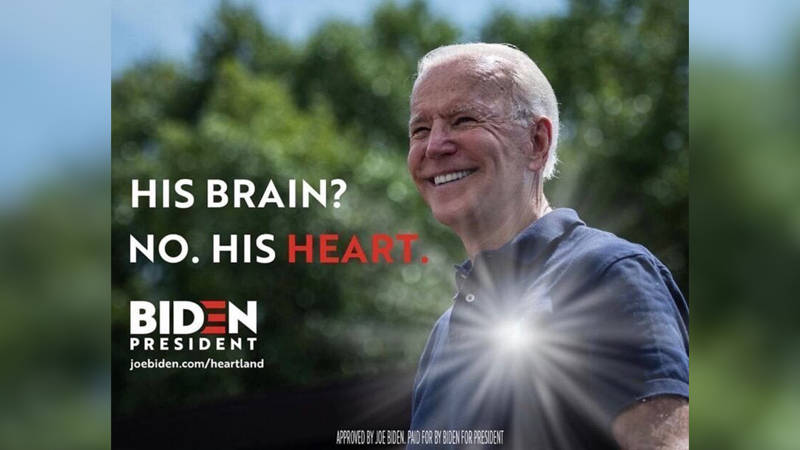
After my last post about my buddy Joe Biden, I was challenged. I was challenged from both sides: by a liberal friend who focused on my point that Biden was the lesser of two evils, and couldn’t get beyond that to my points about how, really, the election of Joe Biden is about preventing actual evil which would result from the election of Donald J. Trump, and that by comparison, Joey B. is not evil at all; and by a conservative friend who pointed out that I was far more forgiving of certain of Biden’s traits than I would be if Trump, who shares many of those traits, were to win the next election. (It is possible that both of these friends would object to my characterization of their objections [and the one for my use of the descriptors “conservative” and “friend”]; if so, I apologize now for what I am about to say regarding both of these positions as I have characterized them. Please feel free to challenge me again, and I may add a third post about this issue — or if you wish, feel free to post a comment directly on this post which expresses your objections to everyone who reads this.)

Regarding the idea that Biden is the lesser of two evils: granted. He is. Does it make any difference if I point out that every single election ever can be characterized as being between the lesser of two evils? That Abraham Lincoln was the lesser of two evils? That George Washington running unopposed was the lesser of two evils, because the other option was the collapse of this particular democratic nation, which would have been a much worse outcome than electing Washington — an appalling elitist snob and a lifelong slave owner who wore dentures made from the teeth of human beings he bought and sold?

What if I point out that every politician is evil in one way or another? That every human is evil? We all have our bad qualities. We all have our wrong-headed opinions. We all make mistakes, and even worse, we all do the wrong thing and do it proudly, and determine to repeat the same wrong action if we are given another chance to do it. All of us.

I understand the desire to have a candidate for president that matches what we really want, that has the right opinions and the right history and the right qualities and the right intentions. I understand the frustration and exhaustion that comes from a lifetime of never getting that candidate. I think it’s the same frustration that comes from never finding the right person to love, especially if one has several failed attempts at finding that person, or if one has the terrible experience of being with entirely the wrong person, and suffering because of it. And as someone who has actually found the right person for me to love for the whole of my life — and who found her early on, when I was only 20 — I can’t blame someone for wanting the same thing that I have. I suspect a lot of people who feel this way about the President are those who feel like they maybe had that person in the past; for a lot of people of a certain generation, it was John Kennedy, and when he was assassinated, Lee Harvey Oswald stole that perfect President from them.

But here’s the thing: John Kennedy wasn’t the perfect president. Neither was Ronald Reagan, or Jimmy Carter, or Barack Obama. Franklin Roosevelt interned hundreds of thousands of Japanese-American citizens. Abraham Lincoln wanted to repatriate the freed slaves to Africa. Bernie Sanders would not be the perfect president: he has a tendency to yell at people, which would not go over well in diplomatic circles. My love is not the perfect love: she is not always easy to live with, as she would be the first to tell you. I am also difficult to live with, as I will be the first to tell you. Nobody is perfect. Every relationship — romantic, Platonic, professional, political — is a compromise. Which means every relationship, always, can be characterized as the lesser of two evils.

Or it can be characterized as the best of all possible options.

There’s a saying which I am particularly fond of: Don’t let perfect be the enemy of good. The intent of the saying is to prevent a bad choice that a number of my students — especially my Honors students, my Gifted and Talented students — tend to make: they work on an assignment, create something they are not very proud of, that they don’t love, and they know they could do better — so they never turn it in. And they get a 0, rather than the less-than-perfect grade they could have gotten if they just turned in the thing they completed but didn’t love, because they would rather have nothing than accept something that is less than perfect: and so they suffer an even worse consequence. They lost the good, because they were only willing to accept the perfect, which then got in the way of the good. We all do this kind of thing all the time: knowing we can’t do something perfectly, we never share what we can do, so we never sing karaoke or bake a dessert treat for the holidays or share that poem or short story. Or that blog about politics: which I frequently stop myself from writing or sharing, because I’m not nearly as smart as the writers I read, as the pundits I pay attention to — so who the hell am I to post my opinions? I’m certainly not perfect, so often, I tell myself I shouldn’t write or post anything at all.

And it’s a mistake. We should do those things, because we can do a good job of them, even if not a perfect job. But the goal of any attempt is not perfection: it is a positive result. You don’t have to hit every note to sound good and entertain the people at the karaoke bar; you don’t have to have perfectly shaped latticework crust on your apple pie for people to enjoy it; you don’t have to have every word just right to be able to communicate your thoughts in a creative way. As I can attest to, and I hope many of you will agree with.

You don’t need to find the perfect person to find love. Just someone who is good for you.

Or, of course, accept that you don’t need someone to love at all, and just love yourself.

For the President, you don’t need to love him, or even like him. You just have to pick one who will do you good. And while Joe Biden could be a lot better than he is, and Bernie Sanders would be better than Biden could ever be, still Biden has done and will do good for this country. I think that’s what this argument against Biden boils down to: we can easily imagine the perfect candidate (though I suspect that when we do so, we are ignoring some aspects of the perfect person which would actually make them less perfect, more human; more evil.), and JRB sure as hell ain’t it. So we don’t want him, because he’s not perfect — some of us would rather have nobody. And I do fully recognize that nobody expects a politician to be perfect; people arguing this position just think Biden isn’t good enough to deserve a vote, no matter how bad they may agree that Trump is. Not that he’s imperfect: it’s that they think Biden sucks. If it isn’t clear, I don’t think that’s true, but if you do think that, then please, feel free not to vote for him; you can always choose to not accept any of the choices you don’t like.

Let me say it as clearly as I can: I am not saying that every individual reading this — including my friend who is sick of choosing the lesser of two evils in every election — needs to vote for Biden. You do not. I think voting third party is an excellent choice. I do think that Robert F. Kennedy Jr. is a vile candidate — much closer to the greatest of three evils than the least — but if that’s the way your vote needs to go, then do it. We should break the two-party duopoly, and voting for a third party candidate is an important step along the way to accomplishing that.

However. If you do choose not to vote for Biden because he is not someone you can support, but you recognize Trump is a serious problem, then I would like to make two requests of you. The first is that you do actually vote. Staying home out of frustration with the system is an emotionally appealing choice, but it does simply lump you into the great ignorant masses who don’t vote for no good reason. The parties, aware that you’re not voting, will consider you “Uninformed” or “Unmotivated,” rather than “Protesting the neverending stream of bullshit we call U.S. politics.” That means they will use their favorite strategy to reach you in the future: advertising. Lots and lots and lots of paid targeted advertising. If you choose not to vote, you are lining yourself up for even more ads in the future, I guarantee it: and that means even more politicians stumping for money, and compromising with the wealthy donors rather than trying to work with voters. Whereas if you show up and vote, and vote for a third party candidate, especially the one closer to the “traditional” party you might otherwise vote for (so if you’re a Democrat, vote for Cornel West or Dr. Jill Stein; if you’re a Republican, vote for the Libertarian or Constitution Party candidate; and if you’re an anti-vax conspiracy theorist who wants to use your family name to shill for corporate lobbyists, vote for RFK. Or actually no: if you’re in that last group, go ahead and skip voting.), you will be one of the voters that trouble them: and their strategic response might be to move closer to that third party in the future, to change their candidates or their policies to ones that you can support. I want that to happen, so if you do vote third party, thank you. Also don’t listen to people (including me in 2016, before I was corrected) who blame you for the outcome of the election. If Biden and the Democrats lose, it will be because of Biden and the Democrats, not because of the people who voted their conscience and picked third party.

What I want to do here is get people who want to vote for Biden to be excited about that vote. Because it is a good vote. For all the reasons I posted two weeks ago, with the main one being that Joe Biden has far and away the best chance of preventing a second Trump presidency: and that is something we very much need to prevent.

Which brings me to the second thing I would like to ask third party voters to do. Try to do something, other than casting your own vote for Joe Biden, which will help to defeat Donald Trump. If you are willing to vote for Democrats down ticket, do that, and try to help them get elected — because honestly, if Trump won the White House but the Democrats picked up majorities in the House and Senate, I’d almost enjoy watching TFG get stymied at every turn (Almost. Except for the Supreme Court, which will obviously back DJT even to the extent of slow-walking his criminal trial until after the election because they need to hear some absolute bullshit immunity argument. And that’s why I intend to vote for Biden, and encourage you to do the same. Even if he did fail to increase the Supreme Court to 13 members, or to work to impose term limits and ethics requirements on those corrupt assholes.). But if you want to vote third party for President and then vote for Democrats after that (And again, vote your conscience in local and state elections; third parties need to start with the grass roots, and that means getting elected to local school boards and county commissions and so on), that would be great. If you want to volunteer for the Democratic party, to help get other people out to vote for Democrats downticket — especially if you can swallow your ire and let those people vote for Biden, if they want to — then that would be wonderful. And if you can do something to impede Trump: if, for instance, you could find someone like you, too disgusted with the two-party system to vote for either of these shitheads, but who would lean towards voting for Trump because they hate Biden that much, and you could then convince that person to join you in voting third party? Well, you have just taken a vote away from Trump, and you have helped to stop a possible dictator from doing everything he can to tear down this democracy we live in and the rule of law that keeps us all whole and alive. So thank you for that, and for voting your conscience. Those are my two requests, if you can’t vote for Biden but you know that Trump is a danger.

And if you can join me in voting for Biden in November, thank you.

Okay. Now let’s turn to Objector #2, who pointed out, and maintained in the face of my rebuttals, that I had soft-pedalled certain objections to Biden’s qualifications for the presidency, which, he said, were reasonable objections that had been leveled reasonably against Trump as well; and he opined that, if Trump were to win this upcoming election, I would feel much too hypocritical because I would be making the argument that these qualities of Biden’s which I am ignoring or apologizing for now are disqualifying attributes of Donald Trump’s.

Specifically, the arguments that Joe Biden and Donald Trump are old white men who speak badly and suffer from some level of mental deterioration from age.

Whatever - GIPHY Clips

If I sound dismissive of these arguments, I sort of am. I did not claim that Trump was too old or too white or too bad a speaker or too far down the path of mental decline to be President; I maintain that he is a dangerous narcissistic conman who wants to profit from the destruction of this country as a modern democracy that obeys the rule of law, and who sees racist, sexist, xenophobic fascism as the best means to accomplish that and profit thereby. So I don’t agree that I will feel hypocritical if Trump wins, because I still won’t argue that he is too old and too white and too bad at speaking and too mentally incompetent to be President. I will certainly admit that I might level some insults at that shitbag, because I hate him and everything about him, and in among those insults might be comments about what a dumbass he is or how much of a fumble-mouthed fool he is; but that will be me being shitty to Trump because I hate him, not leveling the same arguments against him which I drew back from in regards to Biden. My criticism of his presidency, if he wins again, will be that he is a dangerous narcissistic conman who wants to profit from the destruction of the rule of law in this country, and sees fascism as a convenient way to achieve that destruction. If there was a young Black woman with a high IQ and a silver tongue running as a dangerous narcisstic conman who wanted to profit from the destruction of the rule of law through the implementation of fascism, I would not support them either. Honest.

Candace Owens Exits Daily Wire Amid Fights With Ben Shapiro Over Israel
In other words, she doesn’t get my vote, either.

But okay, let me address these specific claims. Because I did state that these things are unimportant for Biden, and that may seem inconsistent for me as I have argued in the past that we should have better, younger, and less white leaders, even if I didn’t make those arguments about Trump specifically. In 2020 my first choice was Elizabeth Warren, who I would still vote for if she ran right now; and part of the reason is because she is younger (though not enough younger) than Biden, and smarter and a better speaker, and a woman — though still too white. So how, if I argue that Warren would be better because of her speaking and her mental acuity, can I turn around and say that Biden is a good choice despite his failings in those areas?

For a couple of reasons. First of all, I do not personally believe in the power of identity in politics. For my own self, and what I see as important in a politician, I would happily say “I don’t give a shit who the person is, what race or gender or sexuality or age or any other subgroup they belong to, as long as they do a good job.” The reason I don’t say that is because I understand that the subgroup that someone belongs to is important to millions of people, and I don’t get to tell them how to feel, and because I understand the power of a symbol. Barack Obama did not serve better because of his race: but the fact of his race was important to millions and millions of my fellow citizens, and therefore the fact that he was our only non-white President is important. The thing is, our national politicians need to represent everyone in the country, and so no matter who they are, they need to look beyond their own identity; that includes politicians who are not old white men, because even they need to represent old white men with whom they do not personally identify. Biden won’t do a worse job just because he is an old white man, and if he weren’t an old white man, he wouldn’t do a better job simply because he wasn’t an old white man. Symbolically, he would be LEAGUES better as a candidate if he weren’t an old white man. But anyone who gets the job and does the job well will never get my criticism just for being an old white man.

Donald Trump, on the other hand, wants to make life better for old white men and worse for everyone who is not an old white man. (And actually, inasmuch as he is willing to let his asshole party eliminate Social Security and Medicare, he’s only serving rich white men and not old white men. Biden is largely doing the same because he is indebted to Wall Street and corporate donors. But that also has nothing to do with race and gender on Biden’s part, any more than it has to do with Trump’s identity.) He wants to do that by implementing fascism in order to break down the rule of law in this country, so that he can profit thereby. That is a much bigger problem.

So that’s the first reason: I don’t think identity in and of itself is salient in national politics. I do think socio-economic status is salient, because money insulates people from real life and that does make them less able to empathize with other people, in a way that being old or white or male does not necessarily do; and since Trump has always been insulated by wealth, and Biden has not always been insulated by wealth, I think that’s a mark in Biden’s favor. But he is certainly not in the right place policy-wise when it comes to economics. A good place, but not the right place.

The second reason I will argue that Biden’s qualities are not marks against him as a President is because I have realized, since this whole Trump debacle began, and since I have started learning more about politics and looking back on the Presidents in my lifetime, that a strong single Executive is not in the best interests of the country. The people elected to the post are not reliable. And more to the point, they change at least every eight years, and this country is now so evenly divided that half of the time, that election is likely to reverse the results of the last one — and hand that strong executive power right back over the bad guy. It’s like if Thor defeated the enemy — and then picked them up, handed them Mjolnir, and said, “Here, your turn.”

This is why I argued in my last post that Biden’s general weakness would actually be a benefit, as it would force him to surround himself with good people who would help him do a better job than he can do on his own; I think we are largely seeing that, and seeing the benefit of it compared to Trump’s administration. Trump tended to fire everyone who pissed him off, and then he was left with not enough people to do the work of government; this worked just fine for him because he wants to break government, which will then prove his case that government doesn’t work — a fine and long-established conservative strategy. Biden, however, not looking to do everything himself, but rather trying to show that government can do important work to help people, has done plenty to strengthen the federal bureaucracy, and the result has been a more efficient government that has managed to get more shit done to help people: and that’s a good thing — and it is a result of Biden being willing to delegate authority and work with other people, which Trump is not.

A simple example of this is student loan forgiveness. Biden tried to do it all on his own through executive order, and he was stopped by the Supreme Court. That pissed me off because student loans should be forgiven, and I would love to just see it done with the stroke of a pen; but also, because I do believe more in the rule of law than in student loan forgiveness, I can see the point that Biden’s argument for how he wanted to do it was flawed. I will also argue that the Supreme Court never should have heard the case because the determination of standing on behalf of the plaintiffs was fucking nonsense — “You shouldn’t get your student loans forgiven because I can’t get mine forgiven” is a neener-neener argument, not a real one — but I recognize, again, that some Court cases don’t come from good standing, because the Justices want to put their foot down for one reason or another. I can accept that. So I can accept Biden’s initial plan being struck down as part of the rule of law, and therefore a successful action by government, to stop Biden from taking too much executive power, even if he was in fact doing the right thing and we’d be better off if he had been able to do it.

But Biden then went ahead and started finding small ways, legal ways, acceptable ways, that he could forgive student loans. And it’s slower, and it’s not enough, and that leaves a lot of people out in the cold — but it’s progress.

And because I don’t want a dictator, I am more willing to accept slow progress through compromise within the rule of law than I am fast action by a strongman.

Did I always feel this way? Of course not. When I was a kid, I read Piers Anthony’s series Bio of a Space Tyrant, about a charismatic man who becomes the dictator of a planetary nation-state, and who imposes his will — all for the good of the people. He’s a benevolent dictator, and when I was young, I thought he was both cool and brilliant, and I thought his system was the right one. But see, then I grew up and stuff? And realized that democracy, while it is impossibly frustrating and also slow, and requires compromise with awful people, which then causes harm to good people — is also the best system of government possible, because it disseminates and dilutes power. And power corrupts. (I kinda want to go back and re-read the series now, because I wonder if Anthony’s intent was to show that power corrupts, and that his character was actually an anti-hero like Paul Atreides from Dune — or if Anthony was just playing out his personal fantasies of godlike power and authority, all for the good of the nation, of course. Since he named his character Hope Hubris, I think it was probably the former. But also, Hope gets laid a lot, like a lot a lot; so it might be the latter. Anyway.)

Also let me just say, out loud, that anarchy would be better than any government at all. But as long as we believe we need government, we do need it; and we should have a democratic government. You want to talk about actually eliminating government, I’m interested in chatting about it.

So okay. I realized that Barack Obama, for all of his charisma and intelligence, was an ineffective president — unless you happen to be a Wall Street banker/trader/mogul, in which case he did wonders for you. (It said a lot to me when I found out that Obama had trouble with Mitch McConnell because Obama wanted to argue and debate issues on the merits, and McConnell just wanted to cut a political deal. I hate that McConnell’s stance is more realistic, because I relate to Obama’s desire to convince the other side of his rightness with every ounce of my soul; but I get that McConnell’s stance is more realistic. This is also when I realized for sure that I would be an awful politician.) I realized that Biden, for all of his stupid-ass gaffes and his inability to give a good speech, has done more for the 99% in four years than Obama ever did in eight — and more than that charming amoral shitbag Clinton did in eight, too. I realized, as I’ve said, that a stronger executive, while it does potentially achieve more of my goals because it means someone can actually implement progressive ideas over the objections of Congress and the courts, is bad for democracy, even if those ideas are good — because I’ve watched Trump do shit that he shouldn’t have gotten away with, but he was able to because past Presidents created an atmosphere where he could do it. Like using executive orders to incarcerate migrants, for instance.

Which Barack Obama did as well.

And Joe Biden, too.

So: the fact that Biden is a weak leader? Not a terrible thing. It would be great if he was a better, stronger, smarter man — IF he also had the right ideas. And he doesn’t have enough of them, and that’s a problem; but since he doesn’t have all the right ideas, it makes it better that he’s not strong enough to implement all of his bad ideas over the objections of everyone else in the government.

The real problem in his weakness is how he deals with strongmen, which is — not well. He has been incapable of suppressing Putin or Xi Jinping, he has not been able to handle Iran, and he has given bombs to Bibi Netanyahu. I don’t know how many of those things could have been different if he had been stronger, but I do see his personal weakness as an issue with all of that.

But also? Trump would be actively worse in every single way, and we all know it.

Okay, my friend who raised this objection doesn’t seem to know it, as he said that he doesn’t see much difference between Biden’s foreign policy and Trump’s; but that’s whataboutism, and it’s nonsense –same as when he also tried to equate Biden lying about his past (Specifically this: “He lied about his attendance in a black church as an adolescent in Delaware, his work for desegregation, and his role in the civil rights movement? He has simultaneously claimed to have, and to not have marched.”) with Trump’s lies. Trump lied about winning the 2020 election, which he lost; and his continued attempts to maintain his lie about that election have severely damaged this nation in a way that Biden making himself look better than he actually is never, ever will. The two are not the same. Trump would, so far as we can tell, actively support Putin, and Netanyahu, and also obviously Viktor Orban, and Kim Jong Un, and probably several other authoritarians; because that’s who he wants to be. Because Trump is a narcisstic conman who wants to profit from the destruction of the rule of law through the implementation of fascism.

I don’t give a shit that he’s an old white man. If that means a younger, past version of me would be upset by my failure to maintain the party line regarding race and gender and age, sure, that’s fine. I’ll own that. And I would still like to see someone younger, less male, and less white running the country, because I believe in the power of symbols; I would even more like to see anyone at all in power actually doing everything that should be done to help people who are not white, not male, not old — and not wealthy, most of all.

Biden is doing more of that than Trump ever would.

So Joe Biden has my vote. And, I hope, yours too.

Why We Are Voting for Joe Biden And Kamala Harris | Features | Roger Ebert