Looking Up

Still one of the best movie songs ever.

You know what?

Things are actually looking up.

No, really: I mean it. 

Tomorrow is the beginning of classes, which means I now have to deal with students — but as always, though teenagers are frustrating, they are the reason why my job exists, and the aspect of it I actually enjoy. Teaching is hard — but it’s better than inservice. And since classes start tomorrow, that means inservice is over. (My district tried to extend it, pushing a two-day training on how to teach ACT prep — actually there are somehow three two-day trainings for English, one in reading, one in writing, and one in…English… but when I said I didn’t want to go, my direct supervisor said I didn’t have to go, in contrast to his supervisor who said he “strongly recommended” that ACT prep teachers be SENT to this training. But my boss said I didn’t have to go. Which means that inservice is over. And also that my boss is on my side, which is — well, it’s lovely.) My students make me laugh as often as they make me grit my teeth in rage; and they sometimes tell me that I helped them, that I taught them, even that I inspired them. And I like that.

I am typing this on my brand-new MacBook Air, which I got for my birthday as a present from my brother. Which means not only that I have this sweet new machine (Which, admittedly, I am having trouble adjusting to, but that’s only because it doesn’t have a ten-key pad on the right side of the keyboard, and because the Command key I have to use to copy and paste and so on is in a different place than it has been on the last two laptops I’ve had, both Windows machines — and because I didn’t know that you ran two fingers together over the touchpad to make the screen scroll BUT IT TURNS OUT YOU DO THAT ON THE GODDAMN WINDOWS MACHINES TOO I JUST DIDN’T KNOW IT BECAUSE I MOSTLY USE A PLUG-IN MOUSE AND TRYING TO DEAL WITH THE WINDOW ON THIS LOVELY NEW MACHINE WITHOUT BEING ABLE TO SCROLL WAS A TRIAL, BELIEVE ME but then I figured this out, and now it’s easy. And now I know this new thing, so that means I’ll never have this struggle again.

That’s amazing, isn’t it? That there can be single pieces of knowledge that you don’t have, and without them things are hard or confusing or even frightening; but then you find out that one thing — and the problem is gone. Gone entirely. Never going to be a problem again. Things can actually get solved. Not everything, certainly, but there are situations that are like that: you find the answer, and then you have it. The answer. The solution.

But also, anyway, the other thing about getting this beautiful new (EXPENSIVE) computer as a gift from my brother is this: my brother gave it to me. He and I haven’t always gotten along, sometimes even emphatically not; but that, too, has gotten better. I don’t think the relationship has been solved by a single answer that suddenly came clear, because relationships aren’t really like that; but definitely things have gotten better, and they will stay that way as long as we keep working on them — and he got me this absolutely lovely and generous gift, which I think was a very nice thing for him to do.

Thank you, Marv. I love the laptop. Though I feel dumb about the touchpad scrolling thing. Also it just autocorrected your name to Marc, so. Something to think about. And I’ll make you a deal: if you go by Marc (Or Marcin, in full), I’ll go by Dussy. Which was recently given me as an interpretation of my name at my optometrist’s office. It’s a new one.

Though to be honest, I’m not sure how it would benefit you for me to go by Dussy. Or how it would help me if you went by Marc. Nah, forget the whole thing. I’m still grateful for the gift, and glad that we’re doing well with each other.

And speaking of family, I finally mailed away my spit, in the tube my wife bought for me, to ancestry.com (That was a Christmas present, if you weren’t aware of how bad I am at following through on some things in a timely manner), and so I found out a little bit more about my family: mostly German and Scottish and English and French, all of which I knew — but also, about 3% African. Which I did not know. 1% each from Ivory Coast and Ghana, Benin and Togo, and Cameroon, Congo, and Western Bantu peoples. Obviously it is not a significant amount of my heritage — but it is significant that it is there, that I am that much of a mutt, that I have a little bit of African DNA in me. I think that’s wonderful and fascinating. I can relate even more closely to my dogs now, as they are both mutts.Which are obviously the best kind of dog.

So thank you, Toni. It was a very cool gift, and I’m sorry it took me so long to use it. 

Oh — and speaking of white people with just a tiny bit of Africa in them, and also speaking of  things I would spit on: Elon Musk is now not only a goddamn idiot, but he’s a goddamn idiot that has shown himself to be a goddamn idiot, and therefore proof positive that there is no meritocracy in capitalism, that even complete dipshits like Musk — who, I’m sure, would prefer to be called Xxxx Xxxx, so that’s what I’m going to be calling him from now on. Or maybe just Muxx? (Or Marc?) — have too much money and absolutely do not deserve it, and do not deserve our respect for their ridiculous hoarding of wealth. Because their wealth does not show their brilliance.

So the guy buys Twitter, right, and it isn’t really clear why. It seems mostly like he wanted to prove to everyone that he could do it, because Xxxx obviously believes his own hype to a truly epic degree, like Trumpian level delusion here: and literally every choice he’s made in running this company has been a bad one: first he let all the extremists and slanderers and liars and shitbags back onto the platform, which made the platform not only actively worse for everyone but also genuinely dangerous for some; and then he destroyed the verification system, which reduced the value of being a name on Twitter and of following names on Twitter, which reduced the value of the site and of the company; then he introduced a bad subscription model, which is still a cheap gag for everyone on the site who doesn’t have a blue check; and then he expanded the length of the Tweets; and then he limited the number of Tweets that someone could see in a day; and somewhere in there he also threatened to remove (and did remove) a number of people and a number of tweets that he disliked or disagreed with, thus proving to everyone but his legion of sycophants (Also suffering from Trumpian levels of delusion) that he as not actually interested in protecting free speech like he pretended do be doing when he bought the site; and now the crowning glory, his most recent conversion of Twitter to — X. Twitter is a household name, with Tweet a known slang verb used across the internet; and he threw all of that away. Because he thinks X is cool. And X, in actuality, is a shit name for a company, and a shit name for an app, and he picked a shit logo, and the rollout has been absolutely terrible — mine just switched over today, and it still says Tweet and Twitter all over the site. I mean, even I could do a rebranding better than this, and not because of my business acumen or my marketing skills — but just because I’m not a goddamn idiot. I can tell you that I am already filled with a visceral loathing for the X app, and am really just hopeful that it will go ahead and finally die so I can stop looking at it. 

Just look at that garbage.

It’s possible that that’s what Musk wants, too. There is profit to be made in breaking a company up and selling off the pieces; but it doesn’t really seem like Musk is doing that, because everything he’s done, other than fire all the workers and refuse to pay bills (In the short term, dumping salary and holding onto cash would be profitable if you meant to destroy the company and sell the pieces — but he hasn’t done that yet.), everything has reduced the value of the company: which would seem to really reduce the potential profit he could be making as a vulture capitalist. On the other hand, if he planned on keeping the company and building something bigger out of it, which is what he has claimed to want to do, then firing half the staff and refusing to pay bills is a shit-stupid way to handle a company that does an incredibly difficult and complicated thing like maintain a free marketplace of ideas on the internet — let alone grow it into an all-inclusive financial network where people can handle literally all of their business interactions. I saw an article that said this:

Expanding the platform’s reach to include things like shopping and paid subscription content could actually help it flourish in the long term by creating several revenue streams and making it less reliant on large companies’ willingness to spend money, analysts said. 

In the short term, building out those capabilities would require a massive investment in staff and infrastructure. It’s far from clear if a company that slashed about three-quarters of its staff and is now embroiled in multiple lawsuits over unpaid bills can deliver that.  

“The investment is a lot in terms of cloud infrastructure — we’re talking about $40 billion, $50 billion in upfront investments,” Singh said. “Twitter as a standalone app doesn’t have the infrastructure to become an everything app.”

https://www.cbsnews.com/news/twitter-rebrand-x-name-change-elon-musk-what-it-means/

And also this:

But the name change suggests Musk is likely to keep control of the company for the near future, said Bloomberg Intelligence analyst Mandeep Singh. After Musk’s takeover in April of 2022, some observers believed the billionaire could make some changes to Twitter and quickly flip it to a different owner, Singh said.

“That option is off the table now given the name change — I don’t think there’s any other prospective buyer who will take it now,” he said.

So maybe Xxxx is shit-stupid.

I will note that his new sign got turned off because it was too bright.

There is also a profit to be made in being a corrupt oligarch who opposes and helps to suppress free speech and the free exchange of ideas; and one of the ways you could achieve that, as a corrupt oligarch, would be to buy the marketplace of ideas and just set the whole thing on fire. And it very well could be that this is really want Xxxx wants, and if so, on this front, he’s doing a bang-up job.

I will definitely say that that is a sad thing. Communication is one of the highest forms of human endeavor and accomplishment: our ability to share ideas and spark new ideas in each other is unmatched in the natural world, so far as we know. And the internet and social media have made that possible on a scale unheard of before now; Twitter was part of that. But now it’s not. Because now it’s X.

Speaking of corrupt oligarchs fucking up things that were once worthwhile: Trump is another example of something that actually seems to be going right. I don’t want to count my chickens before they’re hatched, because I, like most of us rational, thinking people, was deeply overconfident in 2016, and I just could not believe it when TFG won the election. But it does really seem like he is facing a whooooooole lot of serious legal trouble, and at least in the Mar a Lago documents case, he’s clearly as guilty as sin: and when you put that shithead in front of a jury (Not that he’ll show up for his own trial, if he can possibly avoid it), he’s not going to get a pass like he did in both impeachments under a corrupt senate. 

Oh right — and let me take a moment to wish Mitch McConnell ill. Forgive my schadenfreude, but that fucking no-neck piece of shit has ruined untold numbers of lives with his power mongering, so fuck him. I hope he did have a stroke, and I hope he suffers in his declining years.

Anyway, the court system is not as easily bought as Congress: so Trump will likely go to jail. And while that doesn’t mean he can’t run for president, it surely does mean that most Republicans will not vote for him, and his base still will, or they won’t vote at all; and that likely means a runaway victory for the Democratic Party — which, if Biden is the nominee (And I personally hope he will withdraw from the race and let someone younger take it over), and wins a second term, I will say that he has actually been doing a goddamn good job so far at restoring the American government to what it should be, and we could do a whole lot worse than the guy who has re-established NATO even while supporting Ukraine in the war, and who is establishing new alliances across Asia, and who has passed the Inflation Reduction Act and the Build Back Better Infrastructure Act, and who has therefore done more for American manufacturing and industry and for fighting climate change than literally any other American president. We could do a whole lot worse.

So let me just say that, too: this time we all have to try to do our part to make sure we don’t do a whole lot worse. Joe Biden is old, yes. I do not want an octogenarian President. But he’s actually doing a good job. And if Trump goes to jail, the democrats might just win both houses of Congress — and then maybe we can name a couple of new Supreme Court justices, too. But if we’re too overconfident going in, we might get another TFG presidency, and that might just turn all of this back around, and send us all spiraling down until we crash. Let’s try to make sure it doesn’t go that way. Let’s keep our eyes on the prize, and keep things looking up, okay?

So okay, this wasn’t exactly the most cheerful blog, because things have been pretty bad for a while. But hey. School starts tomorrow.

Let’s make this a good year.

Actually just found this. The band is donating proceeds to the ACLU. Plus a player piano!

Time For My Annual Tradition

It’s Inservice Time again!

That means it is back to work for me.

It is Icebreaker time.

It is time to travel to Phoenix, 120 miles away and approximately 120° Fahrenheit, because my school district wants to pretend that we are all one community — even one family.

It’s time for gratitude ponchos.

This is the time of year when a professional pedagogist who makes ten, twenty times my annual salary (sometimes for each appearance) comes to my school, and tells me why everything I’ve ever even thought about doing in a classroom is wrong, and therefore, if I don’t want my students to fail utterly at everything in life, and if I want to even dream about maybe keeping my job, I will need to change every single thing that I do: because all of it is wrong.

Essentially, this is the time of year when I get mad. Frequently. Vociferously.

And my wife is now tired of listening to me rant about this issue.

So now, Dear Reader, it is your turn.

So this year, when we drove from Tucson to Phoenix to spend time with our beloved school family (Which, if that were the case, seems like icebreakers wouldn’t really be necessary? You have icebreakers at family reunions? Or Thanksgiving?), after we had the icebreaker, we listened to a motivational-speaker-sort-of-pedagogist who wanted us to think of teaching in a new way.

She said that our minds are wired to consider certain weighty moments in our lives as what she called “temporal markers” (Or was it milestones? I didn’t listen too closely.), and said we take these moments — milestone birthdays, the start of a new year, the anniversary of some important occasion — as signals to move away from the past and orient towards the future. She said we give ourselves a chance, at these times, to start over with a blank slate: and that our minds actually promote this, by taking a new perspective, examining what has gone before, and then considering new aspirations. We see ourselves as having closed a chapter, and started a new one; and this gives us new energy, it clears away old thoughts and feelings and gives us room for new ones. She talked about this like it was a very positive thing.

She asked us, as pegagogists and motivational speakers are wont to do, to share with our table partners (Oh — we were assigned tables with random teachers from the other schools, so that nobody was sitting with anyone they knew well, because Lord knows the last thing teachers need to be at an inservice is “comfortable.”) how we marked these moments of change, from past to future, in our classes, in our daily lives. And I thought about it, and I realized: I don’t really do this. I mean, okay, sure, when I had my birthday three weeks ago, I thought, “I’d like to spend today doing the things I want to do for this whole year, so I can start a trend or a habit right now and continue it all the way until my next birthday.” But I didn’t follow through with it. I don’t make New Year’s resolutions — I quit smoking on December 28th, as I recall, five months after I turned 35. I started going to the gym more regularly last May, and stopped around November, and picked it up again in February. I don’t celebrate things happening in multiples of 5 and 10; in fact, the two numbers I think I notice most (Other than 420 and 69, which I always have to notice because I am a high school teacher and I know those are going to get a response) are 42, because of Hitchhiker’s Guide to the Galaxy, and 37, because that’s how old Dennis is.

There’s some lovely filth down here…

And in terms of my teaching, I don’t have any kind of clean breaks: when one class ends, I almost always have students who stay after the bell to talk to me for a couple of minutes, which leads directly to students in the next class coming in a couple of minutes early to talk to me. They stay into lunch, they stay after school; some of them contact me outside of school hours. I frequently give extra time for tests, letting them run into the next day’s class; I have been known, even, to continue reading a novel even after the end of the semester when we started reading it.

I don’t tend to break my time up: I tend to blend it together.

This also represents my teaching style: because I think my primary purpose, as a higher-level literature teacher, is to connect things: I want to connect my students to other people, and to the feelings of other people as well as their own. I want them to recognize that historical events and epochs are connected to the lives of people, and also connected to the present, and to our own lives. I want them to see the web of relationships that spans all of our world, and all of our history. I want them to connect art to life, and life to art, themselves to the greatest authors of all time, who were, after all, only human, and were once themselves depressed and horny teenagers.

Nobody more so than William Shakespeare.

So then, when the motivational pedagogist told us that we should create this sort of temporal mind marker with EVERY SINGLE CLASS, so that EVERY SINGLE CLASS was an opportunity for a fresh start, for a clean slate, for a new beginning with new hope and new energy, a chance to CHANGE THE WORLD, I felt — well, a little sad. Obviously I was doing this wrong. Here I am, thinking of every class as connected to every other class, and wanting to get deeper into longer learning experiences, that bleed from day into day, from week into week, from month into month. I like that I have students for multiple years — though I also think they should get a chance to have different teachers, too; I did actually teach one student for all four years of high school, so that essentially everything that young person gained from high school ELA instruction was all from me, but I think that is definitely not the ideal. But I like connecting year to year, idea to idea. I think that’s much of what is missing in our culture and society — connection — and I want to promote it.

But that’s wrong, I guess.

I should be starting every new class fresh, completely discarding what happened in the past and looking only to the future. I guess.

I also thought: My god, how much energy do you have to have to infuse that much new optimism into EVERY SINGLE CLASS?? I work hard enough trying to keep my bad moods from bleeding into the next class, and to change from one specific topic into a new one for the new class; I’m not sure I can close my eyes, ball my fists, and think, “Okay, Dusty: here we go READY TO CHANGE THE WORLD AGAIN!”

But I should be doing that, I guess. Just like I should be at the door greeting every new student who comes into my room with their own special signature handshake, so they know that they are special and individual to me. (Though, for someone to be special to you, doesn’t that mean you have to build a relationship? And remember it, from one day to the next? Would it be better to discard the past every day and treat every day as a new chance to succeed?) I guess.

Who Are You Again GIFs | Tenor
Also, who is that person you’re sitting next to?

So then, after a brief break for a brain wake-up call (We played Rock-Paper-Scissors! With our non-dominant hand! Which was way better than just sitting quietly by myself for a few minutes!), the motivational pedagogist moved on to her next topic: direction. And destination.

Where before the center of the analogy had been milestone birthdays — her husband had just turned 50, and I bet you’ll NEVER GUESS what he did for his 50th birthday! (And if you guessed this, you were right!) — this time the metaphor was flying airplanes. And she talked about compass headings, and how if you were off even one degree, out of 360 degrees on the compass, it would, over time, take you quite far away from your destination — in fact, her example was of an airplane that was two degrees off on their heading, and they CRASHED INTO A MOUNTAIN.

SO OKAY.

THAT’S COMFORTABLE.

I’M FEELING GREAT RIGHT NOW.

And how did she analogize this back to teaching and education? Well you see, if you — or rather I, since I was the target here — I focus in my planning and curriculum design too much on what I am teaching, rather than on what students are learning — that’s a bad compass heading. It may be close, it may only be off by a couple of degrees — but over time, those few degrees’ worth of difference will — well, you know.

Plane Crash GIFs | Tenor
Crashed-airplane GIFs - Get the best GIF on GIPHY
Burning Plane Crash GIF by South Park - Find & Share on GIPHY

Okay: so now, not only am I failing my students because I am not treating every single class like it’s New Year’s Eve and I only get one wish AND IT’S FOR YOU KIDS TO LEARN THIS SONNET!, but also, I am failing because, it’s true, I do often think first, “Okay, what am I doing next class/tomorrow/next week?” I do often think about what I am teaching, rather than what my students are learning.

And my failure? It’s right here:

Plane Crash Plane Crashing GIF - Plane Crash Plane Crashing Crashing Plane  - Discover & Share GIFs

But here’s the thing.

I don’t buy this.

Not only do I not believe that starting fresh every single period is the best relationship to have with students, or the best perspective to have of school, or the best way to CHANGE THE WORLD; but I also don’t believe that student learning has to be the center — the course heading — for every single lesson I teach. I don’t believe, at all, that there is a single destination in education that can only be reached by adhering to a specific course heading. Partly that’s because I think of my lesson objectives in a similar way to how I think of classes ending and starting: I like to make connections. Or more precisely, I like the students to make connections. So there is never a single destination for me, it is always connected to other destinations — and since I want the students to do that part of the thinking, rather than having me prescribe exactly what connection they should make and what it should mean to them, I don’t think my lessons have only one possible (connected) destination.

For instance:

I teach this poem sometimes. Mostly as a joke, but also, because it has a useful point in it that I can make about poetry.

Candy is dandy, but liquor is quicker.

This is actually a poem titled “Reflections on Icebreaking,” by the comedic poet Ogden Nash, one of my favorite poets. When I teach this, most of my students connect it to Willy Wonka (Johnny Depp says it, too, in the remake), and they chortle and chuckle over the scandalous idea of their English teacher promoting drinking! Alcohol! The very idea!

We’ll leave out the facts about how steeped our society is in alcohol, and the fact that I teach high school students who have very little innocence left and certainly none about the existence of intoxicating beverages: and just look at the poem. It’s very short, obviously; Nash’s original only has four lines (Candy/Is Dandy/But liquor/Is quicker), but in those four lines, there are two rhymes, and one of them — liquor/quicker — is really quite clever.

But beyond that, between the title, which in this case provides vital information about the message of the poem, and the specific word choice that Nash gives us, there actually is an interesting point to be made by this poem. First, while my students always think the point is that liquor will get you wasted faster than candy will, I only have to challenge them once on whether or not they think of candy as a way to get wasted before they realize that probably isn’t what the poem is about. Then I focus them on the title, ask what ice breaking is (Most of them don’t really know, those sweet, sweet summer children), and get them to recognize that these are two ways to “break the ice,” to loosen up awkward social occasions. I ask them how candy can do this, and when it is used; they always think of Halloween parties and such, where candy is put out in dishes — but nobody thinks of the doctor’s office, where the child is given a lollipop to ameliorate the pain of the injection; or smokers who chew gum to alleviate their cravings for nicotine. There are countless places where candy is offered, or consumed, in order to help people relax: but Nash has, most likely, a specific social situation in mind, which we can tell because of the second ice breaker he names: liquor. Now, liquor is used to ease awkwardness and uncomfortable politeness in many situations, as well (Though hopefully not the doctor’s office); when I met my new boss this past summer, I made sure to go out with him for tacos and margaritas, even though I didn’t feel like being social, because I wanted him to get to know me better, because he’s my new boss. But there is only one social situation, traditionally, where both candy and liquor are frequently used to reduce awkwardness: it’s dating. For breaking the ice on a first date, a gift of candy is dandy — but liquor is quicker.

And that’s when I make what I think is the real point here: Nash does not say that liquor is better. He simply says it breaks the ice quicker. And it does: it lowers inhibitions, which obviously would reduce awkward tension. But because it does this fast, probably too fast, it can also lead to regret: which might be why your better choice would be candy. Which is dandy. Everybody likes candy.

So okay, that’s a lesson I teach. I think it shows the importance of specific word choice, and of important phrases like titles, and that every poem can have something genuine to say, even if it isn’t anything terribly deep.

So am I off target here?

Have I got the wrong compass heading? Will I miss my destination?

Am I headed for the mountainside?

Crash-into-plane GIFs - Get the best GIF on GIPHY

See, I don’t think so. I think there are, in truth, many possible destinations. If I can get a student to understand that poems have messages, that’s a victory — that’s a destination I want to reach, and which is worth reaching. If I can get a student to appreciate that poetry uses specific words to create specific meanings, that’s a destination worth reaching. If I can get a student to recognize that references in movies and TV shows can have much more depth and meaning than you would think, that’s a destination worth reaching. And if I can get a student to laugh, and enjoy either English class or poetry or both, just a little more, that’s the best destination of all.

So which course heading is that?

If I’m off by one or two degrees – will I miss my destination?

Do I need, as the pedagogical motivationist went on to say, a sharp focus on every tiny detail of the lesson, always keeping the destination in mind, because a mistake of only one degree would mean that I miss the destination and crash into the mountainside?

No. No to all of it. It’s not true, and in fact it is dangerous and damaging to what education should be.

The purpose of the metaphor, and of the pedavational motigogist in general, was to get us to focus on standards. On learning objectives. On SMART goals – Specific, Measurable, Achievable, Relevant, and Time-Bound – because that’s how you aim at a specific target, and hit it every time: when the target is tiny, and close by, and simple to recognize, to name, to teach, and to assess whether or not it was hit. And when education focuses, as education so often does, on students reaching the standards, and nothing else, then sure, the only way to teach is to focus exclusively on those tiny little learning targets. And I guess taking your eyes off the next inch you need to crawl might make it harder to reach that target in a timely manner. 

But honestly: if you are flying a plane, shouldn’t you look a little higher up, a little farther out, than the next inch? You may want to keep the compass heading locked on specifically – but don’t you also want to watch the horizon? Don’t you want to keep an eye out for, I dunno, MOUNTAINS YOU MIGHT NOT WANT TO CRASH INTO???

Wouldn’t it be a better metaphor to think of teaching and learning as flying a plane, and looking around, observing the situation around you, considering what might be a good place to land – gauging, judging, using experience to guide your assessment of the circumstances based on observations – and then bringing the plane in safely? Or flying wherever the hell you want to go, following your dreams to anywhere in the world they might lead you? Wouldn’t those be good ways to think of the school-plane we’re flying?

I think so. Though I guess it wouldn’t be proper pedamotive gogyvation.

Sebastian Maniscalco Maniscalco GIF - Sebastian Maniscalco Maniscalco Wth -  Discover & Share GIFs

So here’s my new plan. I’ve thought for a long time that I would be an excellent inservice presenter. I’m good in front of a group of people, I speak well, I have a good sense of humor; and I think I know a fair amount about teaching, and could have some useful things to say to help make people improve as teachers and educators. 

But I would never get hired. Because no administration would want to buy my inservice program of “Let The Teachers Teach Whatever The Hell They Want To Because They Know Better Than You.” That system is not guaranteed to raise test scores, which is really the only reason why administrators bring in inservice presenters.

So this is what I’m going to do. I’m going to make the slickest presentation imaginable, about how I’m going to strip teachers of every shred they are clinging to of self-esteem or confidence, so that they will only do what they are told, and will never, ever, argue with their administrators ever again, no matter how inane or nonsensical are the programs and innovations those administrators come up with. And when I get hired to train a staff, I will get the administrators to leave me alone with the teachers – and then I will do nothing but praise those teachers, and honor them for the work they do and the dedication they put into it. I will thank them for everything they sacrifice to try to help their students. I will point out – because I think it’s important to remember – that students are the ones actually doing the work of learning, and that it is goddamn hard work; they deserve praise and honor as well, for every one of their victories large or small. I will help my audience of teachers see that the job of a teacher is to help students find the strength and the courage to keep working, even though the potential rewards of all of their very hard work are very far away and very abstract – and not always guaranteed, or even likely. I would encourage those teachers to talk to each other, and to their students, before they talk to any administrator, or any damn pedagogical expert, when looking for inspiration and guidance about how to create a new and better lesson for helping students get what they need. I would try to give the teachers the self-confidence to try new things, and to experiment, and to be honest with themselves and their students when they don’t know what the right answer is, or if the new thing they’re trying is the best thing: but they should try it anyway, and let students see them trying it, and thus encourage innovation and creativity and problem solving, along with honest reflection and assessment of one’s success. And I will tell those teachers to ignore every single test result, and every administrator who focuses on test results; and I will say that, if they do use standards, to remember that standards are only one small piece of a whole system of education, and they cannot ever be the most important one: because standards are not people. And education is people. Really, it is nothing but people.

And then, I will ask all of those teachers to go on Yelp or Google Reviews or whatever is the Google Pedagogy website (PedaGooglogy? We’ll workshop it.), and give me a five-star review, and lie and say that I helped them realize that they need to focus on nothing but standards in order to raise test scores, and they’ve never been so excited to do just that. 

And then I’ll use those reviews, and my slick sales pitch of a presentation, to go to another school, and do the same thing over again. 

Until I crash into the mountainside.

Changes

Yesterday was sad.

Not because it was the first day of school inservice season, starting earlier this year than ever before. Actually, that was part of it, because this is WAY too early. I hate being back in the work mindset already: I was having a fantastic summer (though with ups and downs as always), and I very much want to it continue; but now I have to spend my time and energy teaching instead of all the other things I want to do, which I do over the summer. It’s never enough time, because there are a lot of things I want to do; but this year was especially not enough time, which sucks because I was doing really well on my other projects and purposes.

But that wasn’t the real reason why yesterday was sad. (Although the fact that I had to go to school yesterday was the reason why this post is now late. Sorry.)

And it wasn’t because I had to do what I always have to do in the early days of inservice season, which is move a bunch of furniture and run around a lot looking for things. I did that, and it really was crappy because it was about 110° yesterday here in Tucson (Climate change? What climate change?), so I spent much of the day sweating, which is less than enjoyable. It’s also one of those things that makes me feel like I’m wasting my time, you know? Maybe it’s just my job (though I REAAAAALLLLLLYYYY doubt it) but there are activities and tasks I have to complete that don’t feel like the important activities and tasks, and so whenever I spend time doing those, it feels like I’m not doing the things I really should be doing, and so I regret the time spent. Every summer, the school gets a deep cleaning, which is good and necessary: but it then requires me to rearrange my classroom, every year, because the lovely and hardworking cleaning people take everything out of my room, clean it, wax the floors, and then put everything back — but they just sort of put everything inside, not paying much attention to where it belongs. Which is entirely fine (Though the custodian in me remembers VERY carefully keeping track of where things were so I could move them, clean, and then put them back precisely where they were — but also, teachers always change their room configurations, so there’s not much point in being that precise with classrooms), but it means that every year, I have to put my desks back where they belong, and get all my stuff out of the places where I stored it for the summer. And then there are teachers who move rooms, and new teachers, and that means desks have to move, and bookcases have to move; and my wife is an art teacher at my school, and that means I have to help her move her furniture and equipment — and art has a fair amount of equipment involved.

So yesterday was sweaty, is my point. And difficult. And yet I didn’t do the dozen other tasks I have to get to before classes actually start, which makes me feel like I didn’t do much, even though I did.

It wasn’t even sad because on the way home, Toni and I got caught in a raging monsoon: more rain coming down at one time than I have ever seen from inside a car. We literally could not see the road or anything ahead of us, because the windshield was simply a gray screen of water: and at the same time, hail was pelting the car, and the wind was shaking it. It was nuts. But actually, though it was scary, it was also really cool.

And our home didn’t suffer any damage, and our pets were fine. So that’s not why yesterday was sad.

Yesterday was sad because of this.

This is the classroom next to mine. It is the room where my excellent friend and colleague and collaborator and ELA sister, Lisa Watson, has worked with me for the last nine years.

And now she is gone. Because Lisa quit.

It isn’t only sad: Lisa moved from being a teacher and ELA department head to being a principal at another charter school.

It’s a definite step up, and a wonderful role for her: she is an amazing person, kind and caring, determined and perceptive, empathetic and wise; and thus an outstanding leader. She’s going to have a tremendous, and tremendously positive, impact on that school, and on the teachers and students who work there. The school that got her is lucky to have her — and my school is stupid as hell for letting her go, and for not putting her into a similar role for us. The fact that my school has been stupid as hell in not recognizing how excellent Lisa is, is the main reason why she’s leaving, and she’s right to, and I’m glad she is going. So the move is good for Lisa, and great for the school she is going to lead.

But for me? It’s sad.

Lisa hired me. Nine years ago, she and two administrators (one of whom was competent) interviewed me over Skype (That is the MySpace of Zoom, for all you Gen Z’ers out there. Who are definitely not reading this blog. And don’t know what the hell MySpace was. Look it up, punks.) from Oregon, and hired me based on that interview, which is what brought me to Tucson. I don’t doubt that Lisa’s voice was the main one in choosing me, because while I was clearly competent as an English teacher, and she knew right away that she and I would get along well and I would fit into the department, I was also, while I was being interviewed, suspended from teaching because of my blog-blowback. I don’t think I would be any administrator’s first choice — but I was Lisa’s. And while there are certainly things about Tucson which I don’t love, this city has become home, and has been very good for my wife and I: and Lisa made that possible. When people ask me what I think of Tucson, my usual answer is that there is poetry on the rocks here: and Lisa is a poet, as well as a teacher, so she is part of that Tucson poetry, for me. But she didn’t just hire me: she also made sure that I got the Advanced Placement classes, which usually go to the current staff when a teacher leaves, because those are usually the most coveted classes and we distribute classes through seniority; it’s very unusual for a new hire to get AP classes. (I will admit that I was an unusual new hire, because 14-year veteran teachers don’t usually look for new jobs.) I got them. I love them. And Lisa gave them to me.

No photo description available.
Lisa and another wonderful teacher she hired, our friend and colleague Aleksandra — who fortunately is still at the school.

Once I got here, Lisa was immediately and enthusiastically supportive. She gave me ideas and materials, but she let me create my own curriculum for all of my classes. She observed me, complimented me, and put her trust in me. She listened to my thoughts, gave me feedback, and encouraged me to keep doing what I was doing, no matter how often I worried about how my teaching was ineffective or misguided; my anxiety and self-doubt and imposter syndrome were no match for Lisa’s loving and generous guidance. Over the last nine years she has defended me from administrative interference, helped me focus on the real goal — helping students improve their language skills — and taught me an enormous amount about teaching. I am ten times the teacher I was before I met her, and it’s because of her, more than anything else. All of my students who appreciate me and my class have Lisa to thank, because I wouldn’t be here in Tucson and I wouldn’t be the teacher I am if it weren’t for her.

Do I need to say that she’s incredible?

As if that weren’t enough, Lisa is also an author: a poet, first and foremost, she also writes essays and short stories and novels. I’ve known a fair number of people over the years with aspirations of writing, but Lisa is one of the only ones to accomplish writing, real writing, good writing, I’ve ever known. Her poetry, especially, is incredible to me: of the several volumes of poetry she has published — and I think I have every one — my favorite is the first one I read, Hear Me Now, which starts with these two poems:

Ashes

The embers of the fire

Glowed in the night sky

Smoke filled cloud

Reigned overhead

Sweltering head from

A

Careless human

Drops a match

Flames dance

Before our eyes. Demolish the wrong

As the mirror sees nothing

You see the dark places

Of humanity

Burn

And burn

Until we all fall down

Dancing with Raindrops

The gray clouds overhead

Have everything to dread

That little spot of sunshine

Is dancing

And she won’t stop

Dancing with the raindrops

She smiles up at the skies

As drops fall carefully

On her eyes

The drops against her skin

Makes her start dancing again.

What beauty does she exude?

What moves does she make?

Her dancing breaks the clouds apart

And her smile heals my broken heart.

I love those. I love the contrast between sky and Earth, between fire and water, sunshine and clouds. That one pun in “Ashes,” “Smoke filled cloud/ Reigned overhead” just gives me chills. I admire the way Lisa can go from despairingly despising humanity for setting fire to everything, to filled with joy because of a child’s dance (which is also the dance of a spot of sunlight under clouds). I love the way one image, one thought, blends into the next, giving more meaning to both — in “Ashes,” is it the dark places of humanity that are themselves burning? Or is it that you see the dark places in humanity commit the acts of arson which burn everything down? And either way, the mirror sees nothing.

It’s amazing work. She is an incredible poet. And what I love most about her poetry is that it is almost entirely instinctive and unconscious: she will not write a word for months, and then suddenly have an outpouring of dozens of poems in one night, when inspiration strikes, and those tiny bits and pieces, the stems and seeds of poems, that have all been germinating inside her, all blossom at once. But then, she is so capable and knowledgeable about language and poetry and the craft of writing, that even her instinctive, unconscious poetry carries incredible meaning, incredible perceptiveness.

And this wonderful writer has taken me as her writing partner. She encourages me, she pushes me to write and keep writing. She has helped me to realize my own dream, of publishing and selling the books I have written, which were just languishing in my files until Lisa (And my wife, who has always encouraged me as well) got me to make a booth at the Tucson Festival of Books, where I have learned that my fears were not true: I am not a bad writer, or even worse, not a writer at all; and I learned that my hopes were true: people like reading my books. Once I started getting my books into people’s hands, the positive feedback has only grown, and that has been a magical gift for me. I might have reached that one without her, because my wife has given me the same gifts of encouragement and confidence; but I needed Lisa to help create that booth, to create that success, and to push me to keep writing. (I will say that I have given her the same gift of support and encouragement with her writing, and she has written more and published more and sold more because of me. I’m proud that I have been able to give that back to her even as she has given it to me.)

No photo description available.
Lisa and I at our booth at the TFOB — along with our other friend, Amanda, another one of the actually talented writers I have known. (WHO ALSO LEFT MY SCHOOL, but who’s keeping track?)

That’s what I have had in the room next to me for the last nine years. An amazing writer, a gifted teacher, a caring and supportive colleague and supervisor (She even lets me yell at my class, which I do when I get too excited about the literature or the argument I’m going through with my class, and rather than coming to my room to complain about the noise, she just tells her students that I’m preaching.). And, of course, my friend. One of my best friends. She has carpooled with me every day for the last three years; we have walked our dogs together; we’ve had dinner, had lunch, gone drinking; she gave me her old couch, and my wife’s favorite chair; she called me when she had a bird get trapped in her house and was freaking out. (She literally ran away screaming when the bird took off while I was trying to herd it out the door. It was hilarious.) She calls me her brother, and because I know how important her family is to her, I am mindful of the compliment in that, even though I don’t really think I deserve it. But it is true that we’ve talked about everything, and helped each other through everything, and worked together on everything, and together we have been successful far more than we have failed. But even when we have failed, we’ve done it together.

And now she’s gone. And so I am sad.

But of course, Lisa is not gone. She is working in a different place: but she is still doing the same things. She has given me so much that I have needed for the last nine years, I certainly can’t begrudge her decision to give those same gifts to other people instead of me; I probably don’t need them any more — though I certainly still want her gifts, as they are wonderful, like her. And, of course, even if she isn’t teaching with me, she is still available to help teach me and support me in my teaching; and she is still my friend, and my writing partner, and my sister. I’m going to make her go out for a drink with me and with our other friends at least once a week over this coming school year; because I know that Lisa will need our support as much as we need hers. And now that she has stepped up to take charge of an entire school, I will do my part: and I will try to step into her role at my school, to be the department head and to encourage and support my colleagues and help them to grow as much as Lisa helped me. I won’t succeed as well as she did, but I’ll do my best; and I know I’ll have her support.

Another poem of hers, from the volume Beautiful but Ugly, is called Privacy:

In the bedroom

I found a rock

Another rock

There are too many rocks

I have fallen to pieces

That’s Lisa: so many pieces, and she leaves them everywhere, without even realizing it until she turns around and sees them everywhere. Poems, students, friends, family; people she has touched, people she has inspired, people she has taught and made better, in every case by giving them — us — a piece of herself. She thinks she just does it all without thought, just reacting, just feeling, and sometimes she thinks she’s making a mess, and she apologizes; but exactly as she writes her poetry, her teaching and her friendship are so very intelligent and wise that even her seemingly unconscious and instinctive gestures are wonderful, thoughtful gifts, which I will always treasure. My greatest gift to her has been to show her that she is not falling to pieces, and she does not need to apologize: she is giving her gifts to everyone around her, and we have to thank her for it all. The one area where Lisa notably lacks is that she is not nearly kind enough to herself, for all her generosity with others — and that, too, is a lesson I need to learn.

I’m going to miss her being in the room next to me. It has been so very lovely to have this wonderful friend so close for these last nine years, to have the jokes and the laughter and the passion and the wisdom she brings to every place she is. My school has been lessened by her departure. But my friendship has not been lessened, and though she has given me and everyone else around her so much of herself, Lisa has not been lessened by her generosity — and that’s the most important thing I have learned from her. The more you give, the more you are.

But still, you do have to make sure you give to yourself. So Lisa, I hope you do keep giving to yourself at least a little of the wonderful bounty you have given to all the rest of us.

You deserve it, my friend.

“Adventures” with My “Pets”

I enjoy frequenting thrift stores — as who doesn’t? — and one of my favorite things to do is peruse the books, especially the older ones. This is not my wife’s favorite thing for me to do, so usually while I am geeking out over some 100-year-old grammar textbook (I swear one of these days I’m going to teach my class out of one of those and then WATCH OUT), she comes up behind me and says, “Are you ready?”

I am not. I am never ready to leave the books. I always want to spend more time looking at them. It’s a little frustrating because I don’t always want to spend as much time READING them, so they tend to pile up. (Another reason why my wife interrupts me, and she’s right to do it.) But my wife is right to interrupt me, so I say I am ready, and I leave. Usually without any books. Which is probably good, as they are often more curiosities than books I want to actually read and own.

But sometimes, when I am quick and lucky, I get to find something genuinely awesome. I have a collection of hundred-year-old romances by my favorite pirate author, Jeffery Farnol, some acquired at thrift stores and library book sales, which I am very proud of and love reading.

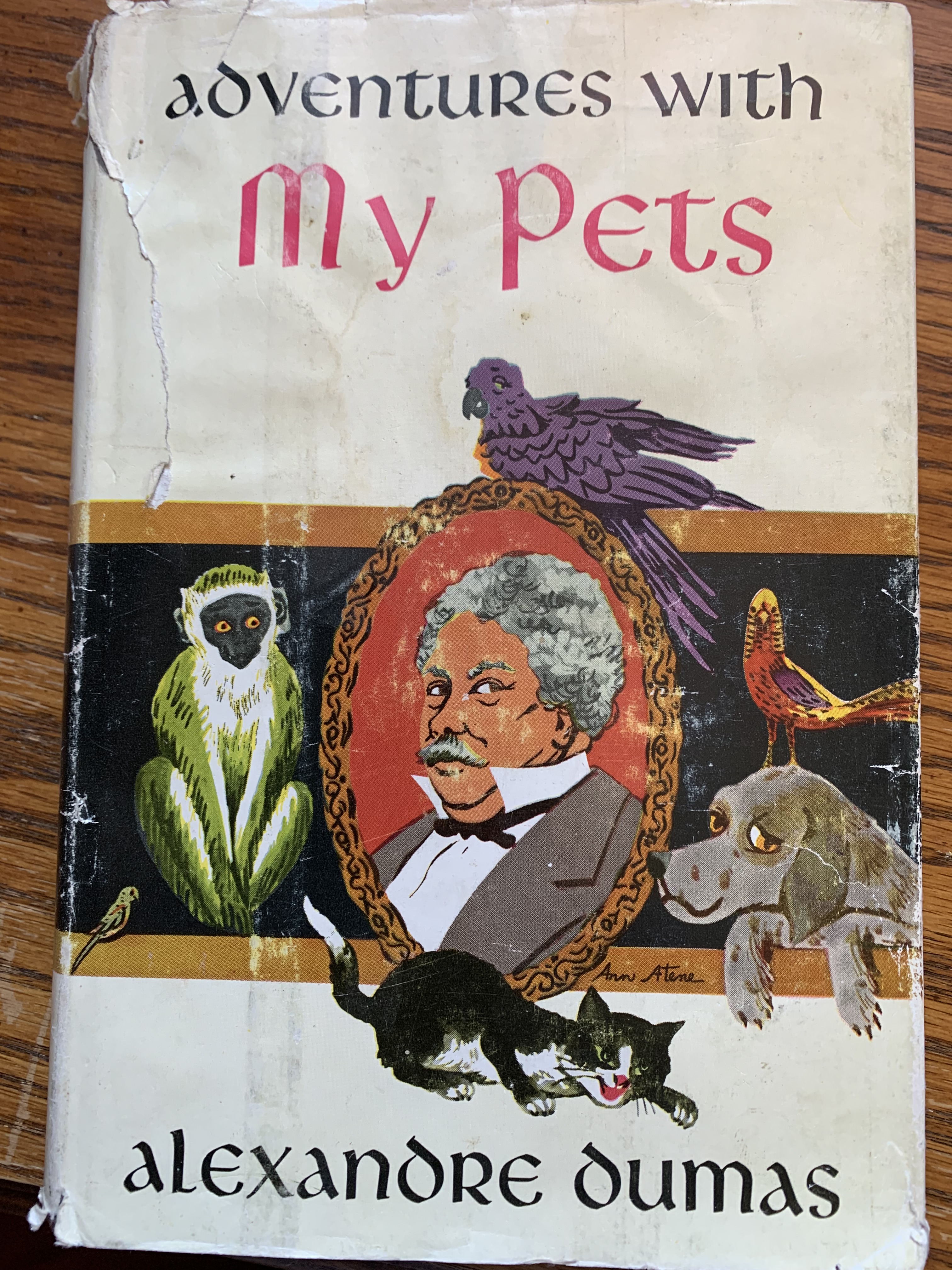
And a few months ago, at the local Human Society thrift store here in Tucson, I found — this.

Doesn’t the picture of Dumas look a little like this cat? Or maybe this picture is the one that looks like the cat…

This is a memoir written by the author of The Three Musketeers and The Count of Monte Cristo. Now, Dumas was a badass, particularly as a writer. I’ve read Monte Cristo, and it’s bloody brilliant; and pets are absolutely my thing — so I had to get this. Plus it was only $5.

Unfortunately, as Dumas lived in the 19th century, the times they have been a-changin’: and Dumas did not think of pets the same way that I do — and neither, honestly, did he think of adventures in the same way I do. I was hoping for, I dunno, hiking in beautiful mountains with dogs, who run off the trail and then make friends with an elk and bring it back to get a scratch behind the ear and take a treat from Dumas’s hand; that would be an adventure! With a pet!

Instead I got a whoooooooole lot of hunting. Dumas surely did like to shoot him some animals. Particularly rabbits and birds. The title, you see, comes from the fact that one of the main characters in the memoir is Dumas’s hunting dog, his English pointer Pritchard. And if you count all the times Dumas blasted a bunch of small helpless creatures with a shotgun while Pritchard pointed at them, then you betcha, there were plenty of adventures with his pets. But as you can probably tell, it was not my cup of tea.

It was interesting. Dumas was still a hell of a writer, and he does manage to make a lot of the little anecdotes come to life. Some of them were even fun: the man had a lot of pets, some of which he treated well; while many of Pritchard’s stories are about hunting, there is also one about how Pritchard often brought home many other dogs from the neighborhood to share in his lunch, because Dumas spoiled his animals and therefore Pritchard’s friends wanted the same good food he provided his dog. There are many conversations between people, often but not always about the animals, which were interesting and amusing. There’s a great secondary character, Michel, who was Dumas’s groundskeeper/animal expert, and he is interesting and amusing; Dumas presents a bunch of ridiculous folklore legends as coming from this guy, and clearly we’re supposed to laugh at them (there’s a chapter where Michel asserts that frogs act as midwives to other pregnant frogs, and so either frogs must have taught this to OBGYNs, or OBGYNs must have taught this to frogs — and as a fan of frogs, I’m good either way), but Dumas never makes Michel seem like a fool or a doofus, which I enjoyed. I appreciate that Dumas was, as he was described in one chapter, one of the most arrogant and self-centered of men (Which, not to be stereotypical, but I feel like saying that about a Frenchman is saying something) — but also one of the most generous and compassionate. He is completely ridiculous about handing out money left and right, usually, in this book, to acquire more animals, and I like that. I love the chapter where Dumas is described: because he reprinted a letter from a friend of his who defended him in Parisian social circles, with a letter to the local newspaper, which is fantastic; the letter basically says, Yes, he is arrogant, but also generous — and the real difference is, he’s arrogant because he actually is the greatest author in France, and that makes him a better person than all the rest of us.

I loved that.

But I did not enjoy all the killing of animals. I liked the cat Mysouff, but not when Mysouff killed all the pet birds. I liked the dog Mouton, but not when Dumas kicked Mouton in the rear, as hard as he could, for digging up his garden, and Mouton bit the crap out of Dumas’s hand — and the point of the story was that Dumas therefore had trouble writing for a while, because it was his right hand. I liked Pritchard, but not when Pritchard went hunting, or just killing and eating animals for fun — and especially not when Pritchard gets hurt and Dumas plays it basically for laughs: the dog gets shot by a hunter friend of Dumas’s, and the joke is that the pellets hit Pritchard in the testicles — but not to worry, one of the testicles is still functional! So all is well! And I was just like, “MOTHERFUCKER, SOMEONE SHOT YOUR FUCKING DOG, GO KILL HIS ASS!”

Plus: the dog dies in the end. And not of old age, surrounded by the family that loves him.

So nope: this was definitely not the book I was hoping for, and I would generally not recommend it. If you are a huge fan of Dumas, then you might enjoy it; it gives more insight into him and his lifestyle than it does into his pets or his attitudes towards his pets — but if you, like me, are a pet person, give this one a pass.

More Like POO-Preme Court, Amirite?

Ha! POO-Preme.

Neener-neener-neener GIFs - Get the best GIF on GIPHY

I will definitely change that title.

But there’s nothing I can do to change the Supreme Court.

Let me start with the reasons why the Supreme Court should be changed.

First and foremost, it has been captured by one political party, in defiance of all of the ideas they claim to hold dear: in defiance of democracy, in defiance of the ideals in the Constitution and the will of the Founders, in defiance of our nation’s proud traditions.

Should I use the word “captured?” Yes: if it wouldn’t be better to use the word “corrupted.”

Captured because Mitch “Fucking Turtle-Necked Chinless Redneck Powerhungry Asshole” McConnell (Am I the only one who uses that nickname for him? I shouldn’t be.) delayed a Supreme Court nomination for a damn year, after Antonin Scalia died in 2015, with some absolute bullshit about how it wasn’t appropriate to name a new Justice during an election year — and then he turned right around and named a new Justice during an election year, only a month before the Presidential election, when Ruth Bader Ginsburg died in 2020. What McConnell did wasn’t illegal, which is why those two Justices he stole for the GOP — or to be fair, one or the other of them was stolen: if we want to accept that Justices shouldn’t be named in an election year, then Neil Gorsuch’s nomination was legit and Amy Coney-Barrett’s was not; if we think the Justices should be named whenever the seat is empty, then Barrett is legit and Gorsuch is not — are both still Justices on the Court, making bullshit decisions according to their political ideology; but it’s clear that what McConnell and the GOP did was in defiance of all honor and decency, and intended only to swing the nation’s highest court over to their side so they could achieve their ideological goals. He did the same thing with the lower courts, holding up nominations through Obama’s second term in hopes of getting a Republican President to go with his Senate majority: which of course he did, and that’s why hundreds of federal judges were named by Trump instead of Obama. Which is bullshit — but it’s bullshit as usual. The Supreme Court nominations were not. That was blowing through precedent and decency for political gain. That, along with a hundred other examples of same, are why I will never accept criticism from the Republicans about Democrats playing politics. You don’t get to criticize when you do worse shit with more terrible consequences.

But hey, let’s pretend that all is fair in politics. (It’s not, as all is not fair in love nor war, whatever the old cliches say.) Because I certainly won’t pretend that the GOP’s justification for all of their shenanigans — that they are protecting the country from Marxism — has any merit at all, whatsoever. But sure, let’s pretend that as long as it’s legal to pull BS, you can go ahead and pull it. So then the 6-3 Conservative majority is permissible, even if it’s shitty.

So now let’s talk about corruption.

Let’s talk about Clarence Thomas accepting hundreds of thousands of dollars in gifts from a Republican mega-donor with interest in cases before the Court, from which Thomas never recused himself. Nor did he report the gifts on his disclosure forms. Also never disclosed that Crow paid his great-nephew’s tuition in expensive private schools. Or that Crow bought Thomas’s mother’s house. (My favorite counter-example, by the way, is that Justice Elena Kagan turned down a gift basket of bagels and lox from old high school friends because she wasn’t certain how it would look in terms of the ethics of accepting gifts.)

Let’s talk about Samuel Alito doing the same thing — accepting lavish vacation “gifts” from a conservative billionaire with cases before the Court.

Let’s talk about Neil Gorsuch selling a house to a law firm that has had several cases decided by the Supreme Court, from which Gorsuch never recused himself.

Let’s talk about Chief Justice John Roberts’s wife, who recruits lawyers for high-end firms that are frequently before the Supreme Court, making $10 million in commissions, which Justice Roberts described as “salary” on his disclosure forms. Also never recused himself.

Makes Kavanaugh and Coney-Barrett seem almost righteous.

I mean, unless you believe Christine Blasey Ford. Which of course I do. So that makes four conservative justices guilty of some questionable connections to wealthy Republicans with business before the court — and one credibly accused of sexual assault.

Wait, no, sorry — two. Because I fucking well believe Anita Hill, too.

And while we’re at it, let’s give that crapstack Thomas the trifecta, and include his wife, Ginni Thomas, who has frequently been closely connected to cases before the Court, from which her arrogant asshole of a husband has never recused himself. Not to mention her involvement in the Insurrection of January 6, 2021.

That’s the majority on the Court. To be fair, all of the Justices, including the liberal ones, accept travel as gifts from donors; mostly it is for appearances and speeches and so on, but sometimes it is for vacations. It’s just that they declare those vacations.

So yes: I consider the Court to be captured. To be corrupted. And that’s without even talking about the questionable decisions they have made over the last decade — going back to the Citizens United and Shelby County decisions, whose implications are still affecting us and our election processes, most intensely.

So let’s talk about those decisions.

First of all, as background, we should discuss the doctrine of originalism, which is a crock of fewmets to begin with. Created most actively by Robert Bork (80s kids will remember) as a reaction to the Warren court, which ended segregation, to the chagrin and outrage of every White supremacist then and since, originalism is the doctrine that the Constitution should be interpreted according to the original intent of the Framers who wrote it, and not adapted to meet the changing needs of the society they tried to shape into a democracy — pardon me, a Constitutionally limited Republic; Lord knows I don’t want to be accused of using the wrong term to describe this country, and therefore not knowing what the hell I’m talking about.

(Also, “AR” in “AR-15” doesn’t stand for “Assault Rifle.” It stands for “Armalite Rifle.” Don’t let anybody mock you for that one, which is quite literally the stupidest argument in the history of the gun control debate.)

There are several problems with originalism. For one, it’s impossible to know for sure what the Framers intended. We have their language in the actual Constitution, and we have in some cases writings they left behind explaining their intent. But — and please, take it from me, since this is literally all I do — all writing requires interpretation. And no author’s intent is purely apparent from their writing. Please see my last post for more on this.

Now, it’s fine to interpret the wording of the Constitution; that’s what the Supreme Court is for. The problem with originalism is they claim there is only one legitimate way to interpret that wording, and it’s their way. Why does one interpretive model always win when another must always be wrong? Go ahead, you try and justify it; I can’t. The objection against the more liberal decisions of the Supreme Court is that they interpreted the Constitution instead of following what it says; but since everybody interprets the Constitution, as everybody interprets all language and communication, it’s simply absurd to claim that THE OTHER GUYS are interpreting, and you’re going straight to the true essence. It’s bullshit.

The second problem with originalism is that, even when you get it right, the Framers were a bunch of racist sexist elitist shitheads. Sure, they had some incredible progressive ideas, especially for their time; and they had incredible intellects and great powers of reasoning, remarkable political acumen and voluminous knowledge of history and philosophy and so on, and, yes, wonderful rhetorical skill: but they still thought that only White men of means should be in control of this “free” nation they were creating. So it seems to me like their intent is not always the best guiding light for this modern nation descended from theirs. It is also ridiculous, by the way, to claim that this nation’s success is itself proof that the Framers had everything exactly right: that would require that everything in this nation’s history happened exactly as the Framers intended, and surely that whole Civil-War-Emancipation thing, not to mention women’s suffrage, was definitely not their intent.

Third problem with originalism: just like the Framers’ intent, the application of originalist doctrine is — malleable. It’s reasonable to interpret the Framers’ intent with firearms; while the form and function of firearms has changed in several ways, the essential concept of guns then and now is the same: it is a force multiplier that gives one person the ability to kill another from a distance with minimal risk to the shooter. So if we think that all of the Framers’ thoughts on guns were the best ever (and they probably weren’t — but actually, I think the problem is that we misinterpret the Second Amendment, not that the Second Amendment is a terrible piece of law), we can maybe apply those thoughts to modern gun control laws. Probably not a good idea still, but not absurd. But to say that “free speech” and “free press” and “free assembly” actually define the internet is to misunderstand the internet entirely. There is not any way you could print a thing, in any sense of “print,” that could reach 5 billion people around the world in mere seconds; but the internet can do that, in theory. There is no speech that could ever reach 5 billion people, period; but one YouTube video can. There is no sense of assembly that includes the ability to link FIVE BILLION PEOPLE in real time, but in different locations — but the internet can do that. The internet is a new thing. It is not a thing the Framers could have predicted, and therefore it is not a thing for which we can find the Framers’ intent. We have to make that shit up. Which means that, according to originalist doctrine, there should be no regulation of the internet at the federal level at all, because the Tenth Amendment reserves that power to the states. The same as the bullshit justification for the Dobbs decision overturning Roe v. Wade. Yet, strangely, the originalists do not claim that all internet regulation in any form should be done at the state level. Why? Because originalism is not a solid doctrine, it is all and only interpretation — opinion. It just has a particularly convincing, albeit specious, justification for why this opinion is better than other opinions.

The fourth problem with originalism (What, did you think three was enough? You thought I was done? AU CONTRAIRE, MON FRERE.) is, following the same logic, we should examine the intent of the original framers of the doctrine of originalism, Robert Bork being the main one. Robert Bork was an asshole. He was also one of the most influential people behind movement conservatism and trickle-down economics, which means we can also blame this crapstack for income inequality and our current plutocracy. It makes perfect sense that Bork would create originalism, and look to the 18th century Framers for guidance: he, like them, was a sexist, racist, elitist shithead. Which means that his doctrine should also not be a guiding light for a modern enlightened society.

The fifth and final problem with originalism? There are five originalist justices on the Supreme Court. Want to guess which five? Well, the easier way is to guess the one who isn’t: it’s Roberts, who strongly believes in stare decisis and respect for precedent. Roberts was the one who agreed with the Dobbs decision in favor of the state of Mississippi’s specific statute limiting abortion access; Roberts did not agree that Roe should be overturned. Because Roberts, while a conservative, is not an originalist. Alito, Barrett, Gorsuch, Kavanaugh, and Thomas are, and those five votes overturned 50 years of precedent, and removed a Constitutionally protected right from American citizens.

And then, when they struck down affirmative action, and the right for LGBTQ people to receive equal treatment in the free marketplace, they did it again — overturning 50 years of precedent in the affirmative action case, and removing Constitutional protections of the rights of Americans in the 303 Creative case, the decision that gave a Colorado web designer the right to refuse her services to (hypothetical) gay clients, as it would somehow violate her First Amendment rights. This time with Roberts joining in. Because he’s still a prick.

Okay: I was going to go through the decisions that I think the Court has decided wrongly, but I think this thing has gotten too long already; turns out I have a lot of beefs with the current Supreme Court. This is a good list from Truthdig of the bad decisions of the Roberts court; it doesn’t include the most recent ones.

YARN | I got a lot of problems with you people... | Seinfeld (1993) -  S09E10 The Strike | Video clips by quotes | 0f8e26b9 | 紗

Okay. So we all agree the current Supreme Court sucks. (MY title, by the way, was inspired by a Tweet I saw that called it the SUCK-preme Court. And mine’s better than that. But I will change it before I post this, I promise.) What do we do about it?

No, we can’t expand the court. Sure, it’s tempting, and there are both precedents and logical reasons for doing it — the best I’ve heard is that there are 13 Appeals Courts (12 districts and the Federal Appellate Court) and so there should be one Supreme Court justice per Appellate court, which would allow Biden and the current Democratic Senate to name four new justices and win a 7-6 majority going forward — but that only starts a game of back and forth: if the conservatives get a majority after liberals expand the court and add four seats, then the Republicans would add at least another two seats and take the majority back. And so on.

By the same token, we can’t impeach all the Justices. They haven’t committed high crimes and misdemeanors. (Thomas probably has.) They did say under oath that they would hold to established law in regards to abortion rights, but it’s not perjury if you changed your mind after you answered the question; and who could prove that the Justices were lying when they said something that wasn’t true? The free gifts from Republican donors, and the money taken in by Roberts’s wife, did not provably change a decision made by the Court; the law firm that bought Gorsuch’s house, for instance, received his vote eight times, but he voted against them four times — and honestly, it’s a pretty good bet that Gorsuch would agree with a conservative law firm two times out of three without anyone buying a log cabin. As we all learned with that other corrupt piece of shit Trump, it’s about the quid pro quo.

Though I learned it from Hannibal Lector.

Quid Pro Quo Qpq GIF - Quid Pro Quo Qpq Hannibal Lecter - Discover & Share  GIFs

No, the truth is, there isn’t anything we can do about this current court, except suffer.

But there is something we can do about the situation in this country, which the Supreme Court is making worse.

We can pass laws.

We can elect Democrats who can win a majority in both houses of Congress, and win the White House. It wouldn’t even be that hard, honestly, because so much of the country is blue; I know we’re fighting GOP gerrymandering and election tampering, but surprisingly, those were two of the decisions the Court made that went the right way, so neener neener.

neener Neener* GIF | Gfycat

But really: the Court can only toss out legal protections if they are not enshrined in law. They can toss Biden’s student debt relief plan (EVEN THOUGH THE PLAINTIFF HAD NO STANDING, GODDAMMIT), but they can’t tell Congress not to cancel student debt.

And the better we do at electing Democrats, the better off we will be in terms of election maps and rules going forward: and that will snowball in the future — until we can properly nominate new Justices to replace these assholes.

This court’s biggest mistake is in overturning precedent in order to appease their personal biases. We should not make the same mistake, and so compound the problem, by expanding the court or by impeaching Justices for being assholes. Not to be morbid or anything, but Clarence Thomas is 75 and Samuel Alito is 73; I think we can expect to name two new Justices in the next ten years — and so if the Democrats can maintain control of the White House and the Senate, or at least one or the other, then those can be liberal nominees, and that will swing the Court back to a better balance.

And then the liberal justices can just overturn all of the fucked up decisions that this court is making. Which is what happens when you throw out precedent: the next guy also gets to throw out your precedent, and reverse all of your decisions.

You know who pointed that out to me? My dad.

And that’s how we come full circle and start this blog off the right way.

Much better than that awful title.

I promise I’ll change that.

Okay, no I won’t.

I Thought It Was Funny GIFs | Tenor

Happy 4th of July, everyone.

What’s In a Name?

I want to write about the AP exam I scored. But those scores haven’t been released yet, and neither have the examples and so on, which show how the scores were earned; and I don’t want to get in trouble for posting confidential material.

So, without going into too much detail about the exam or the prompt or how a student earned a specific score, I’m going to talk about one general aspect of the exam which I noticed this year more than most: terminology.

In keeping with the theme I seem to have established of talking about my dad, and also of using quotations to center and introduce my thoughts, here is one of my dad’s all-time favorite quotes:

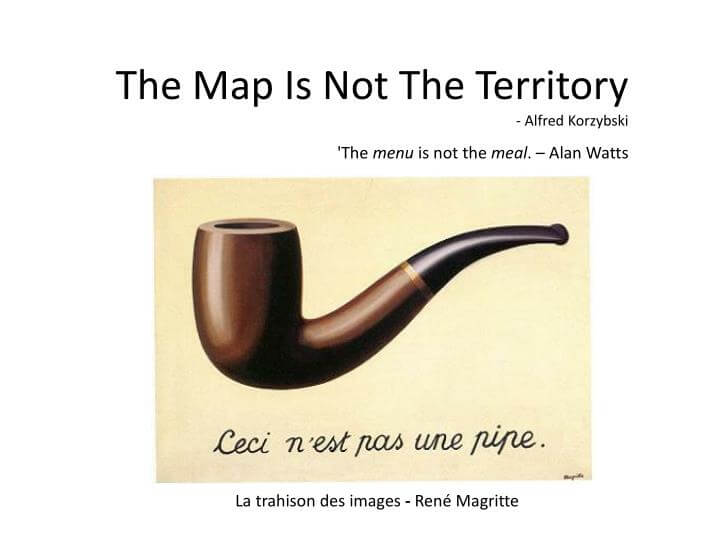
“The map is not the territory, the word is not the thing itself.”

This is from the science fiction novel, The World of Null-A, by A.E. van Vogt. It hasn’t been turned into a meme on the internet — so I’m going to put the cover of the novel here, because it’s awesome.

A.E. van Vogt – The World of Null-A (1948) Review | A Sky of Books and  Movies
Wouldn’t you love to live in Purple World? Arches and spires everywhere? STAIRCASES TO NOWHERE?!?

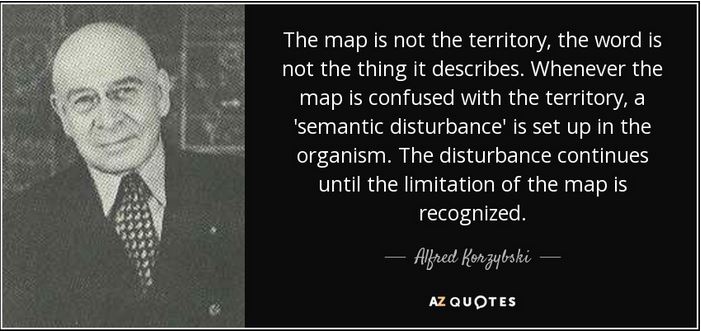
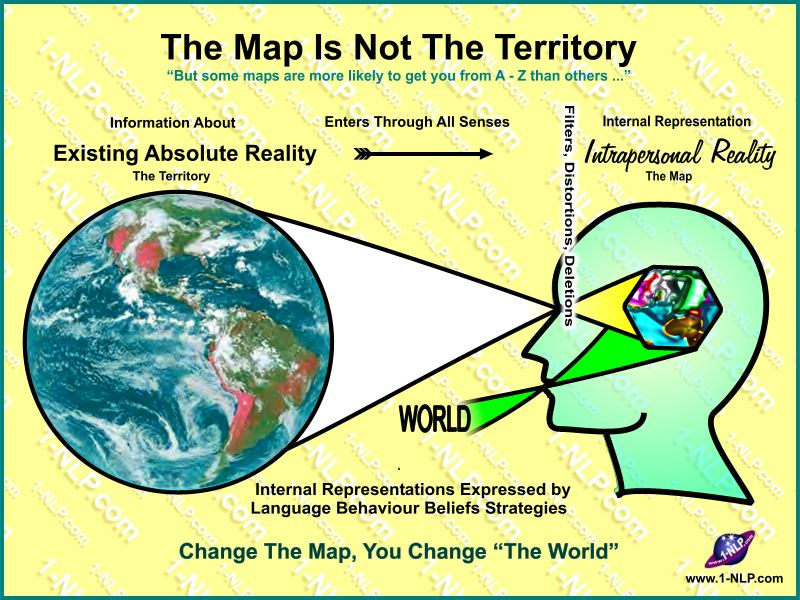
The quote is slightly adapted from a statement originally from Alfred Korzybski, a Polish-American philosopher and engineer, and while van Vogt’s words have not been memed, Korzybski’s have been.

Map And Territory - We Confuse The Map With The Territory

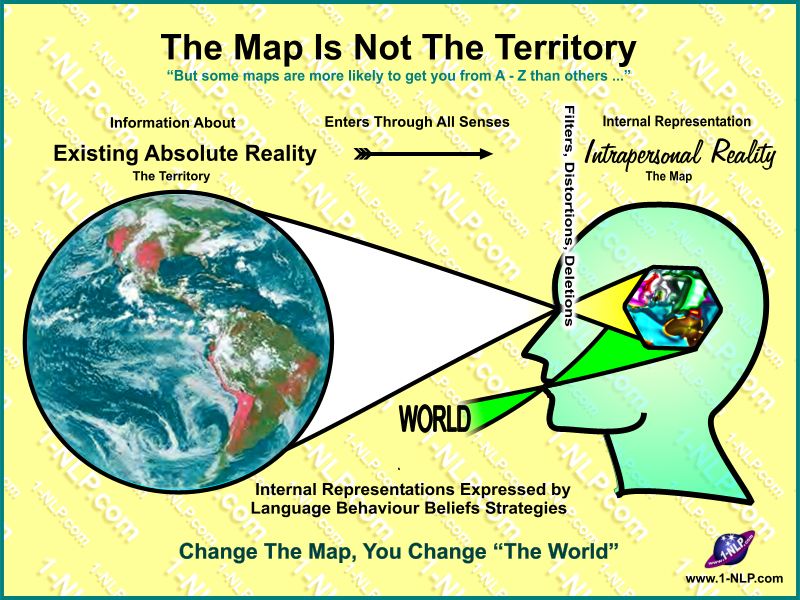
That’s the full quote, and you can see how quickly it makes one’s eyes cross. Here it is made even more confusing by the visuals:

The Map is Not The Territory – Explained in Simple Terms – Welcome to Club  Street Post
This was made by someone who does not understand how to explain things.

But that’s okay, here’s the simpler version, complete with standardized background image:

The more observant among you will notice the resemblance to a meme I used in yesterday’s post here.

But really, I prefer this last version, because I also like Watts’s iteration of this — and I love Rene Magritte.

The map is not the territory - Tom McCallum

So the point of this, then, is to recognize the limitations of representation and image — and of language itself. The map is probably the best example, because a map always sacrifices detail for coverage, showing a greater area while not showing everything about that area. If a map showed every detail of the area it depicted, it would be a photograph, not a map — and its value would be limited.

(Though it might be funny sometimes.)

On some level, this shows the difference between “book knowledge” and “world knowledge” — which my students still, still, call “street smarts,” a perfect example of a name that has lasted despite its limitations, which makes it a perfect example of the second half of this statement. If you know the name of a thing, that is analogous to “book knowledge;” and if you understand the thing (which is where I think the quote is going here, to a point about understanding, because certainly with a concrete object there is no doubt that the word could be the thing itself: I’m not sitting in the word “chair” right now.), that is equivalent to the experiential and deeper understanding implied by “street smarts.” Knowing the name for something does not mean you understand that thing, because the word is not the thing itself; again like the map, words reduce specific details in order to gain another value — generally universality, and economy, meaning I can communicate a fair amount of information, to a lot of people, without too many words. If I say I own a black SUV, then you don’t have much detail about my car — but (if you speak English) you have a general understanding of the category of vehicle to which my car belongs, and a general idea of its size and shape and appearance and so on, because we understand what aspects are included in the category “SUV,” and we know the color “black.” Also, as my wife has pointed out many times, with steadily growing annoyance as each year passes, all SUVs look the same — and a large proportion of them are black. But that means, while you can get a general idea of many, many cars with just two words, you can’t really identify those specific cars very well. And you definitely don’t know the things that make my car special, that make my car into my car. Not terribly important to understand the special things about my car, of course; but if you want to understand a person, you need to know much more than their name.

This comes into focus with the AP exam because I teach my students that they don’t really need to know the name of what they are talking about: but they need to understand the thing. This is, clearly, not how all AP teachers instruct their students, because I had MANY essays that used vocabulary the student did not really understand: and it showed. They named things they didn’t really have, because they didn’t understand the thing named. So that I don’t do that, to explain the details lacking in the term “AP exam,” so that you have more understanding of this thing instead of just knowing the name, the essay I scored last month was for the AP Language and Composition exam, which focuses on non-fiction writing, and examines primarily rhetoric. “Rhetoric” is another good example of a word which people know and use without really understanding it, because the connotations of the word have changed; now it mostly comes in a phrase like “empty rhetoric,” and is used to describe someone — usually a politician — who is speaking insincerely, just paying lip service to some idea or audience, without saying anything of substance; or in more extreme cases, using words to lie and manipulate their audience for a nefarious purpose. My preferred definition of rhetoric, the one I teach my students, is: “Using language to achieve a purpose.” What I am doing now in this blog is rhetorical: I am choosing words and using examples that I think will achieve my purpose — in this case to explain my idea, and to a lesser extent, to convince my audience that I am correct in my argument: that knowing the name of a thing is less important than understanding the actual thing.

So in the AP exam on Language and Composition, which focuses on rhetoric — or understanding and explaining how a speaker or writer uses language to achieve their purpose, as when a politician tries to convince an audience to vote for him or her — there are 50 or so multiple choice questions, and three essay questions. This year I scored the second essay question, which is the Rhetorical Analysis question; for this year’s exam (This is not privileged information, by the way; the questions were released right after the exam in May. It’s the answers that are still secret.) they used a commencement speech given at the University of Virginia at Charlottesville by former U.S. poet laureate Rita Dove. The goal of the essay was to “Write an essay that analyzes the rhetorical choices Dove makes to deliver her message about what she wishes for her audience of graduating students.”

Interestingly enough, the AP exam writers have given hints to the students in this instruction, which I’ve taken from the exam. They generally give important context in their instructions, quite intentionally; it’s easier to analyze rhetoric if you understand the context in which the speech or writing was delivered, so knowing that this speech was given at a commencement, at a university, in 2016, gives you a better idea of what is going to be said in the speech — you get the general shape of what is included in the thing named “commencement address.” One of the key aspects of this speech by Dove is both the expectation of what is included in a commencement address, and how she subverts that expectation: and that centers around the term “wish.” That’s the hint in the instruction there, along with the buzzwords “message” and “audience,” which are commonly part of a study of rhetoric and of rhetorical analysis.

Okay, that wasn’t interesting. I’ve lost you here, I realize. Let me use fewer words and just give you the general gist of my point: when students were analyzing Dove’s rhetoric, they did much better if they explained what she was doing and why, but didn’t know the proper name for her strategy; some of them knew the name of the strategy — or of a strategy — but couldn’t really explain it. They had the name, but not the thing itself.

Partly that’s because the study of rhetoric is very old, and thus has an enormous amount of terminology attached to it: much of it based on Latin and Greek roots, which makes the words sound really smart to modern speakers and readers of American English. It’s cool to use the words “antithesis” and “juxtaposition” and “zeugma,” so students remember the words and use them for that reason. I think it is also partly because a number of AP classes focus on remembering the word for something, rather than knowing the thing itself, because lists of words are easier to teach and easier to memorize and easier to test. Partly it’s because students under pressure try to impress teachers with the things they can do, to dazzle us and make us not notice the things they can’t do — like actually explain the thing they named.

Again, I don’t want to get into too many specifics on this particular essay because it hasn’t been released yet and I don’t want to get in trouble, so let me just give general examples.

There’s a rhetorical device called “polysyndeton.” (Cool name, isn’t it? Little annoying that the two y‘s are pronounced differently…) It means the use of more conjunctions than would be strictly necessary for grammar. If I listed all of my favorite activities and I said, “I love reading and writing and music and games and spending time with my pets and eating delicious food and taking walks with my wife,” that would be an example of polysyndeton. And if you were writing an essay about my rhetoric (Please don’t), you could certainly say that I used polysyndeton, and quote that sentence as an example. And if you used that sentence, it would be a correct example, and the person scoring your essay would recognize that you know what polysyndeton is, and you correctly defined and identified it, which is surely worth some points. Right?

But what does polysyndeton do? What did I do when I wrote the sentence that way, instead of, for instance, “I love reading, writing, music, games, spending time with my pets, eating delicious food, and taking walks with my wife.”? The ability to understand that, and to explain that — and, most importantly for the AP exam and for rhetorical analysis, the ability to explain how the effect I achieved through the use of polysyndeton helps to deliver my message, to achieve my purpose — that’s what matters. Not knowing the name.

(It’s a bad example here, by the way, because I made up the sentence just to show what the word meant, so it isn’t really part of my larger purpose; the purpose of using polysyndeton there was just to show what the hell polysyndeton is. And sure, I guess it was effective for that.)

The worst offenders here, on this year’s exam as in most, are the terms logos, pathos, and ethos, which are words used to describe certain kinds of argument, and also certain aspects of rhetoric. The words are Greek, and were chosen and defined by Aristotle; most rhetoric teachers at least mention them, usually, I imagine, as a way to show that there are many different ways to win an argument and to persuade an audience. That’s why I mention them in my class. But while a lot of students know the words, they don’t understand the thing itself, and so they find items in a passage they’re analyzing that looks like it belongs in one of those categories. Like statistics, which they identify as logos arguments, meaning arguments that appeal to reason and logic, which is indeed one way that statistics can be used. Dove uses a statistic in her speech, and a raft of student writers identified that as an instance of logos. The problem is that it isn’t logos, partly because it’s not a real statistic — she uses the phrase “150% effort,” and at one point lowers that to “75% effort” and “50% effort;” but at no time is she trying to present a reasoned and logical argument through the use of those numbers, which of course don’t come from any study or anything like that — and even more, because she’s not really trying to persuade her audience.

She was telling her audience an anecdote. And that’s where I ran into a stumbling block, over and over again in reading and scoring these essays: just because students know the name for something doesn’t mean they understand the thing: and just because students remember the name for something doesn’t mean they remember how to spell it.

Let me note, here and now, that these students are brilliant and courageous for even trying to do this damn test, for even trying to write three college-level essays in two hours AFTER answering 45 difficult multiple-choice questions in one hour. Also, because this was written under pressure in a short time frame, and with almost certainly only one draft, mistakes are inevitable and should be entirely ignored when they don’t get in the way of understanding. I knew what every one of these students were trying to say, so I ignored their spelling, in terms of scoring the essay. I also ignored their generally atrocious handwriting, not least because mine is as bad as any of theirs and usually worse.

I just thought this was a fine example of knowing a term but not really knowing it. Ya know?

(Also I apologize for the image quality. Just trying to make a point. And the picture is not the point.)

The first one gets it right. Another one gets it right — but spells “English” as “Enligh.” Also please note the spelling of “repetition” which students repeatedly struggled with.

Fun, huh? I scored 695 essays this year. Last year it was over a thousand. And that exam passage also used anecdotes.

I’m really not trying to mock the students; just using this fact to show that knowing a term doesn’t mean you understand the term, because the word is not the thing itself. By the same token, knowing the spelling doesn’t mean you know the term, or that you understand the thing itself; which is why we ignore misspellings in scoring these essays. I think understanding the thing is much more important than knowing the word — and I’m a word guy. I love words. (Flibbertigibbet! Stooge! Cyclops! Wheeeee!) But I’m a word guy because I think this world is magnificent and incredible, and I want to understand as much of it as possible; words help me to do that, and to share my understanding of the world we live in. That complicated image I used above to show how some people can’t explain things well? Here, I’ll bring it down here so you don’t have to be confused which one I’m talking about.

This one.

This makes a few important points, even if it makes them badly. I do like how it goes from an image of the Earth, to a jumbled collage of colors inside the head, to the one word “world.” I think that, once you can follow it, makes this point well, how much translation and simplification happens between observed reality and the words we use to represent them. Though it should also lead to another head, of a listener, and show how that one word activates their own jumbled collage of colors in their head represented by the word “world.” (Far be it from me to suggest making this more complicated, though.) Because communication happens between two minds, and both minds contribute to the communication: which is why language works despite this simplifying process.

I do also like the statement at the bottom of the image: “Change the map, you change the world.” (Even though I hate how they capitalized and punctuated it.) Because that’s the last point here: while words are not the things they represent, they are incredibly important to our understanding of the world and our reality. Because we think and communicate in words. Not exclusively: my wife, for one, is deeply eloquent in communicating with images; my dogs can communicate with a look; musicians communicate with sounds that are not words. And so on. But language is our best and most effective form of interpersonal communication: and also one of the main ways we catalogue and recall our knowledge inside our heads. So getting the names of things right is incredibly important to our ability to use the information we know, and to communicate it to others. And what is the most important factor in getting the names of things right? Understanding the things we are talking about.

Because a rose by any other name would smell as sweet — but if you want people to know you are talking about one of these, you better call it a rose.

How to Say Rose in Different Languages | 1800Flowers Petal Talk

And for my sake, please spell it right.

In Memoriam

Tis Better to have Loved and Lost #Inspiration #Tennyson – Poems for  Warriors

I am now always suspicious of quotations that I find on the internet. Too many of them get misquoted and misattributed; particularly when they are turned into lovely images with flowers and weathered wood in the background, as this one is.

Like this, for instance.

Be not afraid of going slowly, be afraid only of standing still. – FS News  Online

There are many iterations of this one, which does in fact seem to be a Chinese proverb. Though the other images don’t have a baby sea turtle in them, so, y’know — lame. But definitely a Chinese proverb, at least according to the majority of the Google results.

Or wait: maybe it’s from a fantasy series by an author named Jeff Wheeler. Who created a culture named Dawanjir. (To be fair, the series is strongly influenced by Chinese culture, according to Goodreads. But still. This meme just says it is a Dawanjir proverb, and then slaps the author’s name under it.)

Jeff Wheeler Quote: “Be not afraid of growing slowly, be afraid only of standing  still. – Dawanjir
Also, where’s the turtle?

Or maybe it was this Joshua Muax guy?

I'm not afraid of growing slowly,as long as i'm not standing: OwnQuotes.com
I love that this website is called “Ownquotes.”

No, wait, I’m wrong — it was Benjamin Franklin who said it.

Benjamin Franklin quote: By improving yourself, the world is made better.  Be not...

(Benjamin Franklin is probably the one person most frequently given internet credit for stuff he never said.)

PosterEnvy - Ben Franklin Healthy Quote - NEW Humorous Nutrition Poster  (he039)
This one’s just mean.

But it turns out that, in fact, my first meme has it right:

Alfred Lord Tennyson - 'Tis better to have loved and lost...

That is the actual quote, and it was originally written by Alfred, Lord Tennyson, in a poem (a VERY LONG poem) he wrote after a good friend, Arthur Henry Hallum, died young. The poem is called “In Memoriam A.H.H.” And I would quote it here, but — seriously, it’s over 180 pages long. It’s here, if you’d like to read it.

All of this is a very roundabout way to come to my question: is this true? Is it better to have loved and lost, than never to have loved at all?

I started thinking about this last week, when I went to visit my father and help out with the memorial for his wife. My dad’s wife Linda (who was, of course, my stepmother, but I never ever called her that or thought of her that way) passed away in February, from complications from paraplegia, which she had lived with for about two and a half years. She and my father had been together at that point for thirty years, give or take; they had been married for almost twenty-five years.

No photo description available.

Linda’s passing was hard. The two and a half years before that had been extremely hard, on both Linda and my father. The four months after her death were very difficult for Dad, as well. And so at the end of all of that, I certainly found myself wondering: was it worth it?

I won’t presume to even try to answer this for my father; I only bring up his love and loss to explain why my thoughts turned down such a cynical and morbid path. When I was thinking about this, I was thinking about myself and my wife: we also have been together for almost thirty years, and married for nearly twenty. I hope and expect to be with her until one of us passes: and that thought was the one that started me on this track.

Let’s be clear: the answer is yes. Without a doubt, it is better to have loved and lost than never to have loved at all. I would never give up my wife, or my life with my wife, no matter how difficult the end of our lives together may be. And I have some idea, now, just how difficult it may be, for one or both of us — but that doesn’t matter, because suffering would never wash out all the incredible happiness and the years – decades — of simple contentment which my marriage has brought me. I do not undervalue contentment, as I hope you don’t, either — as many people do when they think about love, and how love changes from fiery passion to simple human affection and connection. The novel The Awakening, by Kate Chopin, with which I have tormented several years’ worth of AP Literature classes (The book is good, but it’s written in Victorian English, which is not my students’ cup of tea; and the main character is intentionally obnoxious in some ways, which makes it hard to sympathize with her. Actually, all the characters are obnoxious, which generally makes students want to give up on the book.), features a protagonist who believes that life should be mad passion, extreme highs and lows, especially in love; this leads her to unfortunate decisions and a bad ending. My romance has stayed more passionate than many, I think (Mainly because my wife is SUPER hot); but even if it fades to simple companionship, I think that would be a wonderful thing to have in my twilight years.

More to the point, there are people who avoid romance and particularly commitment because they believe that the fire fades, that the passion diminishes; and that is somehow sad — and therefore they avoid love because they don’t want to suffer that diminishment. For them, tis better to have never loved at all, than to have loved and then lost that love, at least the passionate part of that love. And those people are clearly wrong.

But here’s the thing: I don’t know if they are. They don’t know if they’re right. Tennyson didn’t know if he was right: because there’s no way to compare the two states of being. If you have loved and lost, then you can’t have never loved; if you’ve never loved, then you can’t have loved and lost.

I’m not trying to logic my way into a clever Gotcha! to disprove Lord Tennyson; even I’m not that annoying, I hope. It’s not that we can’t live two lives in order to compare them: it’s that we can’t possibly know what our lives would be like if things went differently. I think about this a fair amount, not least because I’m a fantasy writer who reads and teaches science fiction as well, and so I have spent more than my fair share of hours thinking about time travel and alternate history. I’ve read (and taught) about the butterfly effect, and about the multiverse; I wrote two books about a time-traveling Irish pirate (They’re right here, and I swear to you that Book III will be out by spring of next year), for Pete’s sake. And in my own life, I have thought extensively about the slow accrual of causal events, themselves too insignificant to recognize, which add up to something significant, in terms of my life with my love: because if I had not been a screwup in high school, and therefore lacked the GPA to get into a four-year school; if my father had not lived and worked in California and had a friend who taught physics at UCSC, who mentioned to my father that UCSC had a creative writing program; if I had not gone to the community college after high school in order to transfer to UCSC to study writing; if my counselor there had gotten my transfer credits right and I had finished at community college in two years instead of three; and if I had not been wearing a button that said “A dragon on the roof keeps burglars away” and thus gotten into a conversation with a fellow gamer nerd who became my friend and eventually helped me get a job distributing student IDs at the school — I would never have met my wife. All those ridiculous coincidences had to happen in just that way for me to find the love of my life. And also, let me say, there are just as many on her side: just as many ways that her path could have taken her far away from me. Which would have changed both of our lives.

For the better? For the worse?

Who knows? Who can possibly say?

One way it could have gone differently would have been if I had been able to succeed as a student in high school. I got my first Ds and Fs in my freshman and sophomore years, mainly because I did not have study habits. But I developed those study habits, quickly, when I went to community college; so certainly I could have had them in high school. If I had stayed in my honors tracks and earned good grades, I might have followed most of my friends, who went to Ivy League or similar top-tier schools. I might have ended up a lawyer, as many of my friends in high school did. I love argument and I write and read well, so it would make sense. My oldest friend did that, and he started his own law firm; could I have joined him in that? Could it be McGuire, Humphrey and Associates, LLC? (No question Josh would get first billing, by the way.)

Would I be happier that way? Ignoring for the moment the obvious other possibility that goes along with that alternate track, which is that I would have met and fallen in love and presumably married someone else; and though she would not be as perfect and wonderful as my wife is — because there is no one as perfect and wonderful as my wife — I had fallen in love before I met my wife, and so I could probably fall in love with someone else. But forget that: the question is, would I be happy if I never fell in love, or at least never married?

My brother Marvin is three years older than me, so he’ll be 52 this month. And though I don’t know all the details of his romantic life (and don’t want to pry), I know that he has never lived with a woman and never married a woman. (Also I know that he is not gay, which wouldn’t matter to me in the slightest either way, but one of my favorite stories is from when Marvin had dinner with our dad and Linda, and after a prolonged silence at one point, Dad and Linda burst out with, “You know, it’s okay if you’re gay.” To which Marvin responded, in some way, “Thank you? But I’m not?” Which is a scene that still cracks me up. But Dad and Linda thought they should say that because Marvin had not brought home any women to meet them, and so they made a reasonable assumption.) Marvin is exceptionally accomplished: his degree is in music composition, and after he graduated he became a digital editor in a recording studio, teaching himself how to handle the equipment and the tasks involved; and then after that, he became a self-taught software engineer and web designer, which he now does professionally — all the while keeping up his music; he sings and plays several instruments, in addition to writing and arranging in several different genres. (Also, he can ride a unicycle off-road.) And the question has to be asked: would he have been able to do all that if he had gotten into a long-term romantic relationship? Would he have wanted to do the same things? Or would he have made entirely different choices?

To the point: my brother is essentially a happy man. I am also essentially a happy man. Though our father has not been all that happy for the last few years, for a very long time before that, he was an extremely happy man — and, now that he has moved through the most immediate grief, and reached the closure of a memorial service, I think he can be happy again. Our mother, by the way, has been single since she and Dad divorced in the early 90s; and she is also a happy woman, most of the time. She had one proposal, some years ago, from a man she had been dating; she turned him down. And went happily on her way.

So is it better to have loved and lost than never to have loved at all? Frankly, I don’t think it’s possible to decide.

What is definitely true is this: once one has found love, real love, love that brings joy and contentment, love that lasts as long as life does and then even beyond that: there is nothing that would persuade one to give that love up. Not even the knowledge that some people might be happier living without that kind of commitment, that kind of potential turmoil, and without the devastating grief that waits at the end for all of us who love another person. I love my wife, and I always will; and that is who I am. Would I be happier if I had never met her? No: because that would not be me. That would be some other dude. Maybe a happy dude, but not me. My life became mine when that gorgeous woman came up to me in the cafeteria at Cabrillo Community College and said, “Hey — do you like gum?”

In truth, I love it. And her. Forever.

No photo description available.

Welcome Back

And if that made you think of the Sweathogs and Mr. Kotter, then we are friends.

Welcome Back Kotter Dance GIF - Welcome Back Kotter Dance ...

Okay: lemme ‘splain.

No. Is too much. Lemme sum up.

Let Me Explain Sum Up GIF - Let Me Explain Sum Up Too Much GIFs

School ended on May 25th. That was at the end of a week including Graduation, which I hosted as Master of Ceremonies (A student of mine expressed distaste for the term “emceed,” and when I told her what it stood for, she said the full term was MUCH cooler than the phonetic abbreviation, so I’m going with that from now on.) and the usual grade-fest, necessitated by the fact that I accept all late work up to the last minute. Then I took a week or so to relax — though I did make a bed, as I described in my last post nearly a month ago.

And then the rocks arrived.

These first three pictures are my front yard. Notice it is nothing but dirt and a few plants. (This is after I weeded it, by the way. Bottom right corner of the first pic shows the weeds I had not yet gotten to, in front of the sage bush.)

And this is eleven tons of rock being dumped in my driveway.

The ton or so of dust is complimentary. And inevitable, in Tucson, which is mostly dust.

So then I started working on getting the rocks spread out across the yard. That means digging up the dirt to turn it and remove all the weeds I could get; then putting down weedblocking cloth; then hauling wheelbarrows full of rocks over to the cloth and dumping them. Since the temperature here has been well over 100 degrees for several weeks, it was hot, dirty, difficult work.

But my wife still made it look good.

I joked that this was her Jackie O. pose; the scarf is actually weedblocker cloth. The gorgeousness is all her.
I’m not as pretty.

In addition to the rocks, on June 10th I started my usual summer job: scoring essays for the Advanced Placement program’s Language and Composition exam. So that meant about eight hours a day staring at a computer screen trying to understand student handwriting — and spelling. I’d get up as early as I could (which is no hardship as I have always been an early riser) and lie in my hammock and grade for a few hours; then I’d go out in the yard with my wife and spread some rocks.

The rocks are not done, by the way, but it’s getting close; and it looks great.

Progress. Improvement.

Until June 18th, when I flew to San Diego to attend a three-day AVID conference.

This one had a roundabout genesis: back in March or so, a good friend of mine asked if I would go to the conference, because she was going and she wanted someone along whom she got along with. At first I turned her down, because I do not generally like pedagogy and conferences; my style and philosophy of teaching are not what other teachers’ are, and so most of the time, pedagogical instruction is lost on me — and it makes me feel bad, because I have just enough self-doubt and imposter anxiety, even after 23 years of teaching, to suspect that I’ve been doing it wrong all along. And the people who present at these conferences always seem so sure that their system is right.

AVID has a little more credibility with me, because when I started teaching in California in 2000, the school where I taught had an AVID program, and the teacher whose room I shared, who took on something of a mentor’s role for me, was the AVID teacher. So I had first-hand experience of how well the program can work, and I was more interested in being involved in bringing AVID to my school than I would be in most teacher conferences. I’ll write more extensively about AVID at some point, but the basic idea — it stands for Advancement Via Individual Determination, which I both love and hate, as I love and hate all good acronyms — is that it helps students who would struggle going to college and being successful there for reasons other than intellect, and tries to make those students more successful through teaching organization and study habits, and how to work with people and advocate for yourself, and so on. It’s a good system.

But I still would never choose to go to a three-day teaching conference if I could avoid it. So I said no when my friend asked me to go.

But in February, my father’s wife, Linda, passed away. It was, of course, devastating to my dad; and I promised him I would come to the memorial, and help him out in any way I could. And somewhere around April, my dad told me that Linda’s memorial would be Saturday, June 24th: the weekend after the AVID conference. My dad lives in Paso Robles, in wine country closer to the central coast of California than to San Diego; but my brother lives in San Diego, and would be driving up for the memorial anyway, of course. So I checked with my brother, and then my principal, to make sure I could extend my return flight from the conference and get a ride — and in the end, I went to the AVID conference, and then drove with my brother to Paso Robles and attended my father’s wife’s memorial.

Where I served as the master of ceremonies.

It was a beautiful ceremony.

May be an image of 7 people and wine
This is my dad at the podium sharing his memories of his wife. My brother is the one leaning against the casks — the memorial was held at a vineyard, whose owners are close friends.

***

I’m telling you all of this because I hope it explains why I have not posted on this blog for the last three weeks. I usually write and post on Sunday and/or Monday of each week. Well, last Sunday and Monday I was in Paso Robles, both helping my dad deal with his grief, and also going through my own (far, far smaller) suffering: because my dad is an extrovert, and he and his wife are extremely popular and well-loved among their family and friends and their community, so many people wanted to express their grief about Linda’s loss, and also to help my dad know that he is not alone: so we had four gatherings of people in the five days I was there visiting. Which was a lot for me. The Sunday and Monday before that, I was flying to San Diego and then attending the first day of a three-day conference for a program that I would actually be interested in learning about and bringing to my school, so I was trying hard to keep up with the information; and that was draining. Aaaand the Sunday and Monday before that, I was scoring essays and spreading rocks.

So here’s my plan. I’m counting this one, which I know is a bit of a nothingburger in terms of its value as a blog post (When I told my wife I was going to write “just sort of an update” for this post, she said “That doesn’t sound very exciting. Don’t you want your blogs to be about exciting things?”), and then I will be writing and posting for the next three days, to make up for the three weeks I missed, ending with a post for next week — which I’ll post on the Fourth of July. In honor of which, I plan to yell a whole lot about how the Supreme Court is fucking up this country. I have another idea for one of the other blogs; not sure about the last one — but I’ll think of something.

I don’t have anywhere else I have to go. Or any essays to grade. The rocks are almost done, and though I also need to work on my pirate book, otherwise I am just staying home with my wife and my pets.

I hope you’re all having a happy summer, too.