This Morning

This morning I am thinking about space.

I worry constantly about giving people space. I hate feeling like an imposition, and for some reason, I feel like anything I ask other people to do for me is always, always an imposition. Even the smallest things: if I email a friend and I’m eager for them to write me back, I don’t want to ask them to do it, and I don’t want to hurry them or remind them that they haven’t written me back yet, because — that would be an imposition. I ask my wife, every night, what she wants for dinner, what she wants to watch if we’re going to watch TV; I never start with my opinions or my preferences, because I don’t want to influence her decision by pushing for what I want. And somehow I see simply stating, “I feel like tacos tonight” would be — pushing. Imposing. Rude.

I honestly do not know if this is because I am introverted, or overly polite, or timid, or too nice; or if this is something that everyone worries about, or at least most people, or just some. I think, in fact, that I am annoying with this: I think sometimes my wife would like me to just say, “Hey, we’re having tacos for dinner tonight, and then we’re going to watch  The Umbrella Academy,” so that she doesn’t have to decide for both of us. Especially because I will usually go and get the groceries and make the tacos, if I am the one wanting that dinner. It should seem like less of an imposition if I am doing everything myself, and not asking other people to do things for me. I worry that my writing is an imposition, that I am too wordy or boring, and so asking people to read my work is rude and demanding. Somehow I never think that people enjoy reading my work  and would do so voluntarily. Somehow I never think that I’m the one doing the heavy lifting here; that writing is hard, but reading what I write is probably pretty easy.

On some level this attitude is good; it keeps me humble and grateful. I never take anything for granted. (I’m sure I do, and I don’t know what it is, because  I don’t think about it, because I take it for granted. This is the problem with being aware of what you are unaware of: you can’t be unless someone else points it out to you. So hey, if you know me, and you can tell me something I take for granted and am not grateful for, tell me, okay? If it’s not too much trouble. Thanks.) I think it is quite valuable in my teaching, because I do as much as I can to give control to my students. Because I don’t want to impose: I don’t want to assume that what I think is important is actually important for them, and what I think is fun is actually fun for them, and what I think is right is actually right for them. I am happy to offer my opinions — and if my wife asks what I want for dinner, I will tell her; sometimes, at least — but only as considerations, and only insofar as I can explain and argue for them. I think that sends a useful message and sets a positive example for my students, and I’m happy with that. I also think that everyone is constantly trying to control teenagers, and they need at least some adults in their lives who don’t do that to them, and I am glad when I can be one of those adults. I am also aware that I am a white man, and therefore my word gets taken over essentially anyone else’s, and so I try very hard not to be the one dominating the conversation or making all of the choices in a public/professional setting. I do not want my voice to drown out other people’s.

But I avoid imposing on others so much that I think I disappear sometimes. Which is too bad, mostly for me, but also because I’m a pretty good guy, with pretty reasonable opinions and mostly good taste; I can contribute a lot to most conversations and decisions. And I should do it more. I still like being consulted, so once I get to know people I hope they learn to ask me what I think, and then I will gladly say something; but I should also volunteer what I think, or what I want: as long as I don’t do it in an insistent, domineering, rude manner, it shouldn’t really be an imposition. Right? Just my opinion. Just an expression of my desires.

Hey: you all should buy my book, if you haven’t. And if you have, you should read it. And if you’ve read it, you should rate or review it on the site where you bought it, or on Goodreads. And you should like this post, and subscribe to this blog. And you should comment, if you have comments. You should tell me what you think. I am curious. I would like to know.

If it’s not asking too much.


Here: links to make it easier.

My book on Amazon

My book on Lulu.com, where if you don’t mind signing up for a new account with them, I get about twenty times more money because I don’t have to give most of the cover price to Amazon.

My book in ebook format on Smashwords, which links to a dozen other sites where you can buy it in whatever ebook format you prefer. Note that the ebook is broken into four smaller parts, and is appreciably cheaper than the paperback.

My book listing on Goodreads, though there are also listings for the individual ebooks if you want to rate and review those.

This Morning

This morning I am thinking about the work of art.

I have often questioned whether or not I’m an artist, a writer. And whether or not I should be an artist. I think that I don’t take it seriously enough, because art doesn’t always come first for me; I do all sorts of things other than art. The most obvious is work: as a teacher, I put in fifty or so hours a week on my job, and since I’m an English teacher, a lot of that time is spent reading and writing and talking about reading and writing. I took the job because I thought it would be both fun and beneficial for me to be surrounded by language and literature,  and to some extent it has been both; but I don’t understand why I didn’t think about how much effort it would take to do the job well. I question all the time whether I should have stayed a janitor, some kind of nice, essentially mindless work that would allow me to go home at the end of the day and write, for hours on end. I ask myself: are you really an artist if you spend all of this time and energy on your job? Shouldn’t all of that effort go into writing? Shouldn’t you quit your job and find a mindless one? Or at the least do your job poorly, with the minimum expenditure of effort?

Maybe so.

I also took this job because of summers off, and the several week(s)-long vacations; I figured I could use that time to write more seriously. And I have; summer has always been my primary writing time, along with spring break and winter break, and fall break, now that I have that. But even in those times, I only spend a couple of hours a day, at most, on actual writing. I’ve read about authors who work for eight hours a day, or who lock themselves away for a month, two months, six months at a time, and do nothing but write, all day every day. And here I am with two or three months off, and I write for — an hour a day? Clearly I can’t be much of a writer if that’s all I can stand to do.

But that’s not fair. Because the truth is that writing is fucking hard. It takes an enormous effort to focus on every single word, every single punctuation mark, every sentence, every paragraph, and make exactly the right choices in exactly the right places; and to do that at the same time that I am trying to keep a larger story in mind? Especially when the story is a novel, and so I have both the complete scene I am writing and the overall story to keep in mind while I am selecting each and every word? Jesus Christ, it’s amazing I can do this at all, if you don’t mind my bragging a little. Of course I don’t make all of the right choices, I probably make wrong choices most of the time; but I’m good enough at this that even my wrong choices are generally not terrible, not unforgivable. And just as a doctor’s first rule is “Do no harm,” meaning make sure you don’t do the wrong thing even before you try to do the right thing, I think my first rule as a writer is, “Don’t write shit. Or at least if you write shit, don’t let anybody else see it.”

But even that is hard, because shit is enormously easy to write. Just ask James Patterson. BOOM! No, I’m kidding, he’s not a bad writer. He’s a whore who made a name for himself and then let his publisher pimp that name out in “collaborations” that Patterson likely has almost no hand in, but his name is prominent on the front cover in order to boost sales — but he’s not a bad writer. I don’t want to actually name any bad writers; I’m not going to throw any writers under the bus quite that hard, because all of us struggle with this. All of us have to put in this colossal effort, and then take this terrible soul-searing step of letting other people read what we write.

It’s brutal. It is laborious and effortful and wearing and taxing and just hard.

And I keep doing it. And I keep doing it well enough that I am pleased with what I produce. And I do it sincerely enough that I feel better emotionally after I’ve done it, after I’ve written honestly and as well as I can; even though I’m generally mentally exhausted after I do it. I will also say that I don’t write much more than an hour most days, but I can always put in that hour: these morning blogs have been quite good for that, it turns out; I’ve also worked on my book every day for the last few days, and I’ll do it today, too. I am also capable of some serious marathon sessions of writing: I wrote the final chapter of my most recent book over one weekend, two days of solid writing for more than eight hours each day; I produced something like fifty pages.

Huh. Maybe that’s why I haven’t written that much in the months since.

But even when I hit these dry patches, I still come back to it. Even though it’s hard — and it is hard, though I sometimes fool even myself into thinking that it’s easy because sometimes the words just come and are perfect; but that is the end result of a whoooooooooole lot of hours spent slogging, and writing and rewriting and discarding the whole thing and then starting over again. Still I put in the time. I put in the work. Because I love it, and I believe in it, and I like myself better when I do it than when I don’t.

I guess I am an artist, after all.

This Morning

This morning I am thinking about my wife.

It’s not surprising, I think about my wife all the time: she is always worth thinking about. Everything with her is worth the doing: she is worth seeing all the time, in her beauty and grace and her sweetness; she is worth talking to all the time, in her intelligence and her humor and her generosity; she is worth holding all the time, and supporting all the time, and relying on all the time. She is worth all my time. She is worth all.

Today is our 15th wedding anniversary, though we had been together for almost ten years before we got married. I am excited to give her her present, and eager to get about our day’s activities — I highly recommend to teachers to have celebratory occasions during regular vacations — and so I’m not going to spend any more time writing this.

I wish you all love and joy and perfection. I go to enjoy mine.

No photo description available.

This Morning

This morning I am thinking about work.

It’s an interesting word, one that we use in many different ways: it is simple effort (“That looks like a lot of work!”), it is our profession (“I have to go to work. Please kill me.”), it means to stretch (“You have to work the joint”) or to exercise (“I have to go work out. Please kill me.”). It means to move or to move into place (“Her mouth worked furiously as she worked the Q-tip into her ear”), it means to control or manipulate or stress the emotions (“He worked himself into a tizzy, and then he went out on stage and worked the crowd like a pro.”). It means to maximize reward or response through confidence and panache (“Work it, girl!”) and it is the final product and achievement (“This is a work of art.”).

It is, for an artist, the goal. The purpose. We do this for the sake of the work. And not just the final product, because you can’t know going into it that what you will end up with will be a masterwork, will be your magnum opus (Magnum means great. Want to guess what opus means? Other than the most adorable cartoon penguin in history, that is?); we do what we do for the sake of doing it, for what doing it makes us feel, and what it makes us not feel; for who we are when we are doing the work and who we become after we do it and after we decide to keep doing it.

Sorry if that was too abstract. Let me be more clear. (Let me also give a modicum of credit to Steven Pressfield, because while he’s a toxic-masculine doofus who wrote a bad motivational book, he does talk about the value of artists simply doing the work, putting in the time and the effort, and so he has inspired me despite his doofery.) I write because writing brings me joy, and it gives me solace. When I am upset about something, particularly when the thing upsetting me is confusing or complex, my first urge is always to get out a journal of some form and write about it. When I have an idea, I always want to write it down; and then once I start writing about it, I want to keep writing about it until I have explored all of the possibilities. I am always happiest communicating through writing (Though I’m still, always, a little nervous when someone is reading what I have written.). This relationship with the page, the pen, the written word, along with my lifelong passion for reading, has led me to become a writer. That is how I define myself, how I view myself. It’s where the monogram that makes up my banner on this site came from (Also note: my brilliant wife, who is an artist and illustrator because everything I say about writing, she would say the same about drawing, made that banner for me.) My most important work, the thing that I was born to do, is write. Thus, when I write, both while I am in the act of writing and when I have done enough writing to have produced something worth reading, I feel most myself. I like myself best at those times. I like my life best at those times. That’s why I write: not for reward, not for applause or respect; but because of who I am when I write.

One of my favorite poems, We Are Many by Pablo Neruda, includes these lines:

While I am writing, I am far away;
and when I come back, I have already left.

I’ve taught this poem several times, and students always struggle to understand it (Not just because of these lines: the whole thing is about multiple selves, particularly perceived self vs. actual self, and it’s fantastically bizarre to read — “and so I never know just WHO I AM,/ nor how many I am, nor WHO WE WILL BE BEING.”). but I understand this part perfectly, and I think other artists would, as well, if they change the verb “am writing” to something appropriate to them, am dancing, am painting, am carving, am composing, am playing. Am working. While I am writing, I do not feel connected to the world; I am in my mind, sifting through words and phrases, images and metaphors, like the child I once was at the beach, when I would grab up handfuls of sand and pour them onto the ground, onto my legs, from one hand onto another, just to see how the sand piled up and how it fell, how it felt running through my fingers and sliding across my skin. I would thrust my hand, palm down, into the dry whispers of sand, and then I would lift my hand straight up to watch myself emerge from the Earth, and to see the way the sand would remain in skeletal ridges on the backs of my fingers; then I would drop my wrist and watch the sand blow away in a swirl of motes.

Just now, I forgot that I am sitting on my couch next to my dog, with a blanket around my shoulders and my laptop perched atop my crossed legs. I was remembering being on the beach and playing, and I was trying to dig for the right words to capture that moment. I was far away.  And now that I’ve come back, I’ve already left — which line I think has two meanings, both that the self that Neruda most clearly takes as his own, his writing self, the part of his mind that rises to find the words and put them in place, is only present while he is actually writing; and also that once he has written down what he was thinking, and he returns to awareness of the world and sees the words as a completed thought on the page, his writing mind is already off on another voyage through the clouds, soaring far above or below where he sits, suddenly aware that his ankles ache. It makes me want to just keep writing, to recapture that feeling of weightlessness, of timelessness, of pure and simple being; the fact that I can do it, and the fact that when I do it, I have this evidence, this product, this work that is my words, pleases me enormously. So much so that the potential rewards of that work, while I want them for the sake of my non-writing self, don’t matter so much as this: I did the work, and the work now exists because of me. It is both humbling in that I don’t matter nearly so much as the words do, and also flattering in that I am capable of making those words do what they do.

I am proud of my work.  I hope my work is proud of me.


I do have to note that this was not where I intended this entry to go; I was going to talk about the effort required to make art, and how it has to be done regularly, constantly, no matter how onerous it feels — and it does feel onerous sometimes; but I think I’ll save that for tomorrow. I am happy with this work.

This Morning

This morning I am thinking about art.

These thoughts were inspired by a book I just finished reading, Steven Pressfield’s The War of Art; I’ll be reviewing it later, (Sneak peek: IT SUCKS.) though after  yesterday’s post I’ve decided to keep the book reviews and This Morning separate. This Morning is what I think a blog should be, and what I haven’t been doing well despite my years of keeping a site for my writing: it should be a Web-log, a recounting of events, thoughts, feelings, etc. Part of me says “Then why the hell would anyone want to read it?” But that takes me to what art is.

Art is one of the two pursuits, ambitions, goals, that make humanity what we are, that set us apart. We share 99% of our DNA with chimpanzees, and everything we have — tools, technology, society, language, family, war — is echoed in the animal world. The only two things that make us unique (And they may not actually make us unique, as there may be other creatures on Earth with the same pursuits) are art, and truth. We  pursue truth for the sake of truth, and art for the sake of art, and I think there are no other creatures that can definitively be said to do the same. The argument could be made for birdsong and whale song, and for the way some animals play, and the way some animals dance; but I think all of those can be identified as survival traits in one way or another.

I think art  and truth can be seen as survival traits for humanity, as well, but the connection is more tenuous, more distant. Art and truth can be paths to personal success, financial or social, in society, and thus are they survival strategies; they can create pleasure in the individual, which makes us more likely to do other things that help us survive that we tend to do when we’re happy, and also helps us deal with the stress that kills us; they can be used to achieve pragmatic and temporal goals and to transmit and influence culture, which are all part of the survival strategies of the social animals that we are.

But the thing is, there are a lot of us who pursue art and truth despite those pursuits taking away from everything that would be seen as beneficial to Darwinian survival strategies. My art cuts me off from other people. It often makes me sad. It takes time away from the things that earn me money, that earn me social success. Art kills quite a few of us: Vincent van Gogh, Virginia Wolfe, Ernest Hemingway, David Foster Wallace, among others, by suicide; James Joyce and Jack London and Dylan Thomas, among others, by alcoholism. (I’m oversimplifying: they all suffered from various conditions that surely contributed to their deaths, particularly, in the case of the suicides, severe depression; but if you don’t think that the life of an artist was a factor as well, then you don’t do enough art. You should try to do more. I promise it won’t make you suicidal. Well, I don’t think it will.) Truth does a lot of the same things to scientists and mathematicians and philosophers, and where it has been used to have a direct impact on society, then sometimes lots of people die, particularly the one who speaks truth: this category, I would argue, includes Dr. Martin Luther King and Mohandas Gandhi and Martin Luther and Karl Marx. Also J. Robert Oppenheimer and the rest of the Manhattan Project, and Werner von Braun.

So art and truth are not, or not only, survival strategies; in some cases they are hazards — and yet we continue to pursue them. Because there is value in them, for society and for the individual, beyond survival, beyond life and death. That’s what art is: value beyond life and death. It’s something worthwhile even if we can’t say precisely why it is; we know it is. There are as many reasons why as there are people, but I think that for all of us, there is a reason why art is worthwhile beyond life and death. That’s not to say that we should die for art, nor that we should want to; it means the value of art is nothing to do with living or dying.

(I will say I think there is a biological evolutionary explanation for the pursuits of art and truth: I think our giant complicated brains evolved in order to keep us alive despite our essentially incompetent bodies, but then our brains got a jump on survival pressures when we created society, and gave ourselves an enormous lead in the race for survival — so strong a lead, in fact, that we’re probably going to kill ourselves off with the very things that help us survive, like the food we eat and the technology we create and the standard of living we uphold and the population  we sustain. But another aspect of this oversuccess is that we don’t actually need all of our brains in order to live; so we turn that excess energy into a pursuit that consumes brain power, and offers us some kind of valuable reward, but that doesn’t contribute to survival. Art. And truth.)

The difference between these two is the distinction between heart and mind, emotion and thought. Truth is thought, and art is emotion. That’s too glib and simplistic, of course; they almost always blend and combine and lead from one to the other and back. But one of my favorite quotes, from Vladimir Nabokov, is, “To call a story a true story is an insult to both art and truth.” The goal of fiction, which is Nabokov’s subject there, is not to depict the world, but to interpret the world; the same should be true for pictorial art, and for music, and for anything else that isn’t trying to capture and explain the world; that is the realm of truth-seekers, not artists.

When I think of the pursuit of truth, by the way, I think of my father. My father is a retired particle physicist, and for years, since before he retired, he’s been working on a physics problem in his free time. I can’t explain it; it has something to do with reconciling Newtonian physics with quantum mechanics. He had an inspiration years ago, and he’s been searching for the math to make it work ever since. He does this without expectation of reward; the best he can hope for is publishing an article in a physics journal, which would lead to no tangible reward. He has hit many stumbling blocks: he has had to look for math texts that can give him a formula or a method that he thinks he needs, and those are often dead ends. He has come close, only to find a flaw in his own math, which means he needs to start over again. He’s still working on it. He does it late at night when he can’t sleep, because simply working on it gives him peace. That’s the pursuit of truth, because all of those things would apply to someone, say, writing a novel, except my father is looking for an answer. That’s his goal even more than publication: he thinks this idea will work, and he wants to assure himself that it will. He is his own audience.

That, with the goal of capturing or creating a feeling, is art.

(To be continued. Because the pursuit of art never ends.)

This Morning (Book Review: Everything Box)

This morning I don’t know if this is a good idea? I wrote a book review, which I want to post; I don’t want to interrupt this stream of This Morning blogs, so I thought I would use the book review for This Morning. Opinions? Is this a copout? Just the wrong sort of thing for me to do, because This Morning is about my thoughts and feelings? I dunno.

I can make book reviews a part of this streak, or I can make separate posts.

Leave a comment and let me know what you think, if you have thoughts.


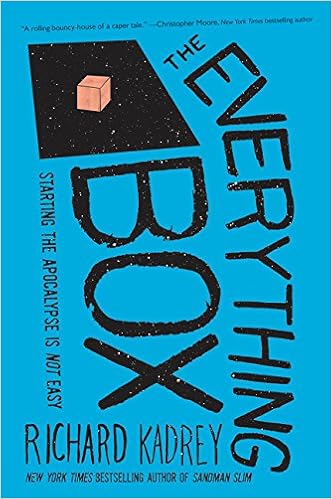
The Everything Box

by Richard Kadrey

I’ve read three Sandman Slim novels (And if you haven’t, you should – dark horror/fantasy with a punk edge and a great sense of humor), so I had some idea of what to expect with this book; but I didn’t expect this book.

It’s a caper story, a one-off novel with no connection to other Kadrey books (And I just found out this second that there are sequels) about a professional thief who gets hired to steal the wrong thing, and even though he manages to do it, he gets sold out on the job by a fellow thief, who, predictably, has no honor. Coop (Charlie Cooper, though no one calls him that) gets sent to a special prison for the next few years, before he is sprung, by the same guy who put him away, and for the opposite reason: this time the guy, Morty, needs Coop’s help.

He needs Coop’s help specifically for the same reason that Coop was in a special jail: because Coop is not a normal thief. He is a magical thief, who steals mystical and mysterious items for mystical and mysterious people who can pay him in cold, hard cash.

That’s the setup (And forgive me for spoiling the first two chapters), and it’s a good one. The opening scene when Coop is on the job is a lot of fun, and the subsequent caper action is just as good, all the way through. The book does start a little slow, as Kadrey has a pretty broad cast of characters; there’s a madcap element to this, as it ends up with one of those Mad Mad Mad Mad World scenarios, with everyone running around looking for the same thing – the Everything Box of the title – and so getting all of those characters with their disparate personalities and motivations into the reader’s mind is a challenge. Kadrey does it as well as any, I think, but simply because it’s a single book, he has to fall back on some fairly generic tropes and character types. He does at least one wonderful thing, though, which is to completely flip some of those tropes: there are two different demon-worshipping doomsday cults involved, one led by a High Dark Magister (Or is it Dark High Magister?) with a bad back whose throne is a Barcalounger, and the other led by a very traditional suburban family who hold bake sales to raise funds for their dark rituals. (The bake sale scene is one of the funniest things in the book, and one of the funniest scenes I’ve read in a long while.) But there are some confusing moments: there was one character who I actually thought was a different character until they met each other, and I got lost in the earlier chapters and had to slog a bit. But it picks up, and the last 100 pages whiz by; the ending is great.

Apart from the caper action – which takes more than enough twists to keep you guessing; I honestly kept thinking, “That’s it? That can’t be it. Oh wait – that’s not it!” – the book does one other thing remarkably well, which is make you like the characters. Almost all of them are generally likable and amusing, including the ones opposed to our hero Coop, who is an excellent sort of everyman guy who just happens to be a thief. But both because they are a bit one-dimensional, and also because they are pretty goofy, you don’t mind too much when bad things happen to them – and like all of Kadrey’s books in my experience, a lot of bad things happen to a lot of people.

And I liked it.

This Morning

This morning I am thinking about rules. And breaking them.

I don’t have any particular plans to break rules today, apart from  the ones I always break (I am insufficiently formal with my students! I don’t take their cellphones away! I DON’T ENFORCE THE DRESS CODE!!!); since I have become a teacher, I am generally on the side of rules enforcement (Not the dress code. Dress codes are a poor system. I’ll write about that some other morning.), because I recognize that most rules are intended to uphold the One Rule: Primum non nocere. First, do no harm. In my classroom that is the first rule and the only rule that gets regularly and consistently enforced. But other corollary rules are reasonable when they help maintain that one rule: the tardy policy is acceptable because students who come in late miss class, which is harmful to their education; they disrupt the classroom, which is harmful to everyone else’s. It is a minor harm in both cases, and so the punishment for tardiness should be a stern look, maybe a talking to (Especially in the case of schoolchildren, who are rarely tardy on their own behalf; I was late to homeroom for essentially my entire freshman year because my older brother drove me to school, and he didn’t have to be in homeroom, ergo late.), but there is harm, and the rule makes sense.

The more interesting situation is when someone — like me — decides that some rules should be enforced and not others. Because then it becomes a matter of reason and authority; argument, in other words. I have decided that the no-cellphones policy at the school where I teach will not be enforced in my classroom with the sole exception of tests. I confiscate their phones during tests; otherwise I let the students use them during class. Conversely, I insist that essays and projects be on school appropriate subjects. I can justify the enforcement of one rule and not the other, but am I the one who gets to decide that? My supervisors would say No. My students, who like my laxity, say Yes. I do what I want, ‘cause a pirate is free, and I am a pirate.

But then there are the rules, and particularly the uneven enforcement of rules, that I believe are problematic. My administration insists that the students do not talk during fire drills, that the entire school remain in absolute silence. They instruct the teachers, during every drill, to send the students who talk to the administration to be disciplined. They do not have a reasonable argument for this. The district insists, as a precaution against school shootings, that all classroom doors be closed and locked during the entire school day, with the sole exception (Other than when people are coming in and out of the doors, of course — though I have been frequently tempted to slam the door closed and yell, “IT’S A SAFETY PRECAUTION!” when people are trying to come into my classroom. Particularly when it’s administrators.) being when there is a teacher alone in the room with a single student; then the potential lawsuits override the risk of being shot, and so the classroom door must remain blocked open. They do not have a reasonable argument for this. My administration is constantly walking by my classroom and closing my door, which I habitually leave open because I have an open-door bathroom policy, and also because it helps keep the room a comfortable temperature.

Those rules, despite being irrational, are enforced consistently and vigorously. But other rules, such as suspension and expulsion for serious offenses — rules which do have a rational basis — are consistently bent or broken, generally for the same fear of lawsuits that governs our door closings. There are students at the school who should probably not be at the school, because their actions pose a genuine threat to themselves and the other students. But those students are generally allowed to remain, and even allowed to make up work missed during suspensions. I am not one to insist on expulsion; other solutions to the issue could certainly be tried — but those things don’t happen, either.

Let’s imagine, as an example, that a student was running around whipping people with goat skin in order to increase their fertility. (What? That’s where Valentine’s Day comes from.) A student who did that should be suspended, and certainly, if the student was naked as the Romans were when they did that, that student should be expelled and probably arrested. I could understand if, instead, the student was required to attend counseling, GoatWhippers Anonymous and the like; but my school, and the school where I taught before this, frequently did nothing post-suspension. The goat-whipper comes right back, sits in class, makes up work and gets their credits. And frequently, re-offends. With the same result.

I broke the rules almost ten years ago. I wrote angry blogs about my students, while I was in class, using a school computer; I also named former students and insulted them. I’m honestly not sure that my particular actions caused direct harm (largely because none of the students I talked about knew about or read the blog), but certainly the rules that I violated are intended to prevent harm: teachers should not insult their students, we should not post on social media or the internet during class; we should not name our students and violate their privacy. I should not have broken those rules. I was punished for them, and I still pay for it; and that’s as it should be. Especially because I still write this blog, I have to remain aware of where the line is, and not cross it. I suppose you could argue that I do cross it, that I shouldn’t write, that I shouldn’t write about my school or the administration or similar topics; but rules that prevent harm should not cause harm. And censorship is harm. My punishment taught me to be more responsible, and therefore I, who am closest to the potential damage, have become a means of preventing further harm. This is exactly what rules and punishments are supposed to accomplish: reform and prevention. For the offender far more than others who observe, but the idea of a deterrent is not absurd.

There are other instances where, rather than a poor policy or an unfairly enforced rule, specific individuals are allowed to skirt the rules — or simply to break them with impunity. Where, say, family members are allowed to have freedoms and privileges that they should not have, in violation of rules. This is, quite simply, corruption; not only does it allow harm to happen to all involved, but it creates harm directly. It allows others to be corrupt themselves, and therefore the harm spreads. And it begins at the top.

Looking at you, Mr. Trump. And your children.

When  the people who are given the authority to make the rules and enforce the rules do a poor job of choosing which rules are vigorously enforced — generally, rules that allow them to maintain and increase power and control over subordinates, but which do not tangibly prevent harm — and which are laxly enforced or not enforced at all, then the system is broken; then, unfortunately, it falls to those not in the position of authority to make decisions regarding which rules to enforce and which not. That’s where I come into this. If my students were not consistently and adamantly protected, by their parents and de facto by the school in that they do not enforce a schoolwide ban, in their right to have a cellphone with maximal functionality, I would enforce a ban in my classroom. If my administration acted in all ways with the safety and benefit of the students foremost in mind, then I would enforce their reasonable rules vigorously. As none of those things are true, I am forced to pick and choose.

I hope I choose well. I will take responsibility for the choices I make.

I learned that from my punishments.

This Morning

(Twenty mornings! Score!)

This morning I am thinking about yesterday afternoon.

Yesterday afternoon, following a full day of teaching, and right on the heels of a vapid and hollow staff meeting (“Let’s sing ‘Happy Birthday’ all at once to everyone who’s had a birthday in the last two and a half months! Then, as a special gift, the birthday people can cut this crappy cake we got for them! Also, teachers with high test scores win all the prizes! Yay math and English!” Except with less energy and verve.), we had an interesting and useful training. It was called Stop the Bleed, and it was about how to deal with critical bleeding, how to apply first aid, tourniquets and wound packing and pressure and the like. I was glad to get the training, because I learned things I hadn’t known before, things that could be useful in a crisis, and I learned them from actual medical professionals and first responders.

But there were a few things that bothered me. Apart from the graphic wound photos and the fake detached limbs with enormous puncture wounds for us to practice stuffing gauze into. Geesh.

The first was the audience participation; we were asked to identify some signs of critical blood loss, and also some consequences of it if left untreated; there’s nothing quite like hearing a bunch of teachers, who are all lovely people, and who also want to be the one to give the teacher the right answer, shouting out, “Spurting blood!” “Missing part of a limb!” “DEATH!” The flip side of this was the trainer’s comment that our practice hemostatic gauze lacked the chemical additive that is in actual hemostatic gauze, which helps cause blood clotting, because our gauze was “educational.” I love the idea that the crappy knock-off version, the one that doesn’t do the critical thing that the actual product does, is the educational version. It’s like school Chromebooks.

Then there were the trainers’ unintentionally strange comments. (At least I hope they were unintentional…) “We are fortunate to have the experience of the military, so we’ve seen tourniquets applied for up to two hours without loss of limb.” “They have tourniquets for the torso now so you can apply them to the lower abdomen, but unfortunately they’re only for the military at the moment.” (I think they had a different understanding of “fortunate” than I do. Is the military really fortunate to have the opportunity to field-test tourniquets for hours at a time without losing limbs? To have access to abdominal tourniquets? I mean, I’m all in favor of saving lives — but “fortunate?”) The better one was the trainer’s attempt at humor: when explaining that wounds to the “torso junctions,” where the limbs meet the trunk, at the shoulders, neck, and groin, the trainer said, “Now, you can’t apply a tourniquet at these places  — although I’m sure many of you would like to…” which is either, if she was talking about the groin, the weirdest and most inappropriate dick joke I’ve ever heard, or else she was joking about us strangling our students to death, ha, ha, ha. It’s especially disturbing that the murder joke is by far the more likely.

That’s especially disturbing because the impetus for this training? Sandy Hook. The program was put in place after the 2012 mass shooting in Newtown, Connecticut, because at that horrible scene, the paramedics could not reach the victims in time to stop their critical bleeding because the police had to secure the scene before the medical personnel could be allowed in to help. So that means two things: one, this training is being given to me because, if the worst happens, I’ll already be in the unsecured scene, and so will have nothing to lose  by applying first aid to people who are bleeding to death, because I will already be in mortal danger myself. And two, that means we were sitting in the library of my school, at the end of a day working with students, talking about when a psychopath brought an assault weapon to an elementary school and murdered more than twenty people, most of them under the age of seven: and at least some of those people died by bleeding to death because the paramedics couldn’t be permitted in to reach them.

And this, this, is how my nation and my school respond to those facts, those unspeakable horrors. Not with gun control, not, in the case of my school, with hiring a full-time security guard and nurse: no, no. With training for the teachers in how to apply a combat-tested tourniquet, and how to pack gauze into a wound — gauze that, I learned, comes with an x-ray opaque strip so that once multiple yards of it are shoved into the wound, the gauze can still be found and removed in the hospital. Where the firefighter teaching us pointed out that we had to be careful putting our fingers into the wound because there might be sharp shards of bone inside, or even a bullet — which, he said, would still be sizzling hot.

All I can say is, God bless America.

This Morning

This morning I had a blog idea that didn’t work. It was taking too long, and I wasn’t even sure of the point I was trying to make. So I’m scrapping it, and thinking about how you have to be willing to spend time and effort on failure. Not every idea is the best one, is the right one, but if you wait around for the perfect idea to come to you, you’ll be waiting forever, because perfection needs to be built, not discovered. And when you try something that doesn’t lead to perfection, especially if you see the path ahead before it’s finished, then you have to get off that path and try something else.

I’m also thinking about how yesterday I was listening to this song, and making matching friendship bracelets, and I wonder if this year’s Daylight Savings Time adjustment actually set the clock back to 1990.