
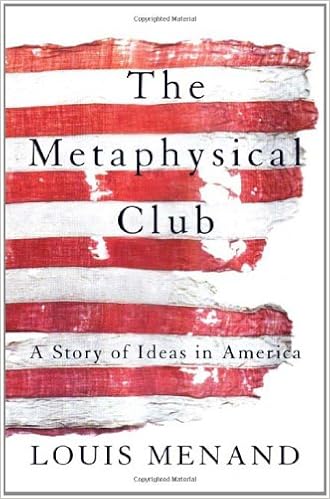
The Metaphysical Club
by Louis Menand
I’m not smart enough for this book.
But I want to be, and I think that means I have to keep trying to read books like this, and think about what they say while I’m reading them.
So this book traces the influence of four American intellectuals on the general mindset of the United States. The four are Oliver Wendell Holmes, Jr., the Supreme Court Justice; William James, philosopher and psychologist (And older brother of the writer Henry James); Charles S. Peirce, whom nobody has heard of but was an influential thinker and writer; and John Dewey, the philosopher who had more influence on American education than anyone else. The wonderful thing about the book is that the sheer volume of information is staggering, and yet it is told in a generally simple and straightforward narrative style, well-written, and with a deft human touch; Menand delves into the men’s youth, their childhoods and upbringings, their parents, particularly their fathers, and the influence those men had on these four men, and builds a fuller picture than I have seen in most histories – and he does it for all four of them, while also pursuing a history of a set of ideas. So for instance, we read about Charles S. Peirce, whose father, Benjamin Peirce, was a mathematician, author, and Harvard professor; we see how the elder Peirce’s ideas reflected and interwove with the dominant ideas of the time – since the book focuses on men who came of age in America in the second half of the 19th century, the most important event was the Civil War and the most important idea Darwin’s theory of evolution through natural selection – and how his father’s ideas influenced Charles’s thinking, and how Charles’s thinking was affected by Darwin and by the Civil War; and then lastly, how Charles’s thought influenced and was influenced by the thought of the other three men. Along with the philosophy of Emerson and Kant and Hegel and umpteen other pieces that go into an exploration of a whole set of ideas.
It’s a complicated web. That’s why I’m not smart enough: because I knew none of this, knew nothing about these men – had never heard of two of them, and could never remember whether Holmes Jr. or Sr. was the jurist – I could not keep all of the facts and names and such straight. By the end of the book I was having to look back to the beginning of the book to remember who people were; this was made easier by the extensive index in the back, but still, that’s not my favorite way to read. And while I enjoyed the book, it was hard enough to get through that I don’t want to read it again, which is obviously the best way to handle this much information.
But: while the book is a history of four important men (The details of whose lives, while interesting, are not things I really need to retain), it is more an exploration of a set of ideas. And those, I found fascinating, and do want to spend more time thinking about. The basic ideas that stuck with me, after this first reading and without doing more research and thought (I just finished the book fifteen minutes ago), are: truth is socially constructed. We don’t know if what we know corresponds in any way to an external reality, but we can know if it corresponds with what other people know – which, unless we are born with certain ideas already implanted in our brains and our DNA, is the only way we can learn anything. Identity also may be socially constructed, meaning that we only learn who we are in relation to who other people are, and thus who we are not. Conflict is always and only the result of a misunderstanding, which, depending on how optimistic one is, may naturally get worked out on the way to a common understanding. There are no rules that can be formulated that can trump the specific context of an individual case (though I’m probably misstating or overstating that one), meaning that the historicity and specific application of an idea are necessary parts of understanding it.
That’s where this book really shines. Because Menand gives context. To everything. Everything he talks about is grounded in the specific events of the day and of these men’s lives. He has a wonderful habit, too, of giving brief synopses of the end of the story; Charles Peirce divorced his first wife as part of a large scandal in the late 1800’s that cost him his academic career, and before this book is over, we know not only what happened to Charles afterwards, but also what happened to both his first wife and the woman he left her for. It’s great. Even somewhat minor characters, people that move quickly in and out of the lives of the four main subjects, get parenthetical descriptions, like, “Joe Smith (who would go on to international fame as the Ambassador-at-large for chickens), had an encounter that struck our hero in an interesting way.” That was my favorite part of the book as history.
My favorite part of the book as philosophy and thought-provocation? I’ll let you know when I’m done thinking about it.
 Just Dusty